
Music is the universal language
“Glory to God in the highest heaven, and on earth peace to those on whom his favor rests.” - Luke 2:14
Classical
Joe Bonamassa Releases Live Album “The Spirit Of Rory Live From Cork” And Concert Film
Press Release
Source: Prospect PR
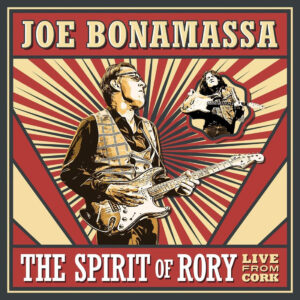 Joe Bonamassa has officially released The Spirit Of Rory Live From Cork, a powerful live album and concert film celebrating the music and enduring legacy of Irish guitar legend Rory Gallagher. Available now via J&R Adventures, the project captures Bonamassa’s sold-out tribute performances in Cork, Ireland, where Gallagher’s influence remains woven into the fabric of the city itself. Alongside the album release, Bonamassa has also unveiled the epic live performance video for the project’s emotional centerpiece, “A Million Miles Away (Live).”
Recorded with the blessing of Gallagher’s family and performed before passionate hometown audiences, The Spirit Of Rory Live From Corkdocuments what many in attendance described as a once-in-a-lifetime musical event. A lifelong admirer of Gallagher, Bonamassa approached the material with deep reverence, bringing together a band capable of honoring the fire, spontaneity, and emotional honesty that defined Gallagher’s work while allowing the performances to breathe with their own energy.
Rory Gallagher remains one of Ireland’s most beloved musical figures, revered worldwide for a style that fused traditional electric blues with hard rock intensity, Celtic influences, and fearless improvisation. His distinctive guitar tone, expressive slide work, and deeply emotional performances inspired generations of players, including Bonamassa himself. Together, the album and film capture both the scale of Gallagher’s influence and the deep personal connection his music continues to inspire among musicians and fans around the world.
Click here to view the embedded video.
At the heart of the release is “A Million Miles Away,” one of Gallagher’s most beloved and emotionally resonant compositions. Originally released on 1973’s Tattoo and a legendary extended rendition on his Irish Tour ‘74, the song captures themes of loneliness, longing, and emotional distance, pairing poetic imagery with one of Gallagher’s most vulnerable vocal performances. Joe’s DVD bonus features include a special interview with Rory’s brother, Donal, who recounts the story behind the song’s creation and visits the dramatic Irish cliffs whose rugged beauty helped inspire its emotional power.
Bonamassa’s interpretation embraces that emotional core. Filmed in front of a packed Cork audience, the performance unfolds with patience and restraint before building into a soaring guitar statement that reflects both Gallagher’s influence and Bonamassa’s own musical voice. The result serves as a fitting centerpiece for a project built on admiration, respect, and a shared love of the blues.
What began as a single tribute concert ultimately grew into a three-night sold-out run in Gallagher’s hometown, with fans traveling from around the world to celebrate the music. The atmosphere throughout the performances was electric, creating what Bonamassa describes as one of the most meaningful experiences of his career.
Early praise has already begun to reflect the significance of the project. Guitarist Magazine praised the release, writing, “Joe does his hero proud…a very fitting affectionate tribute to one of the most notable blues guitarists of our age.” Blues Matters hailed The Spirit Of Rory “one of the finest live albums ever produced,” while Powerplay awarded the project a perfect 10/10, writing that “Bonamassa has captured Gallagher’s genre-defining influence and honored it with flawless perfection.”
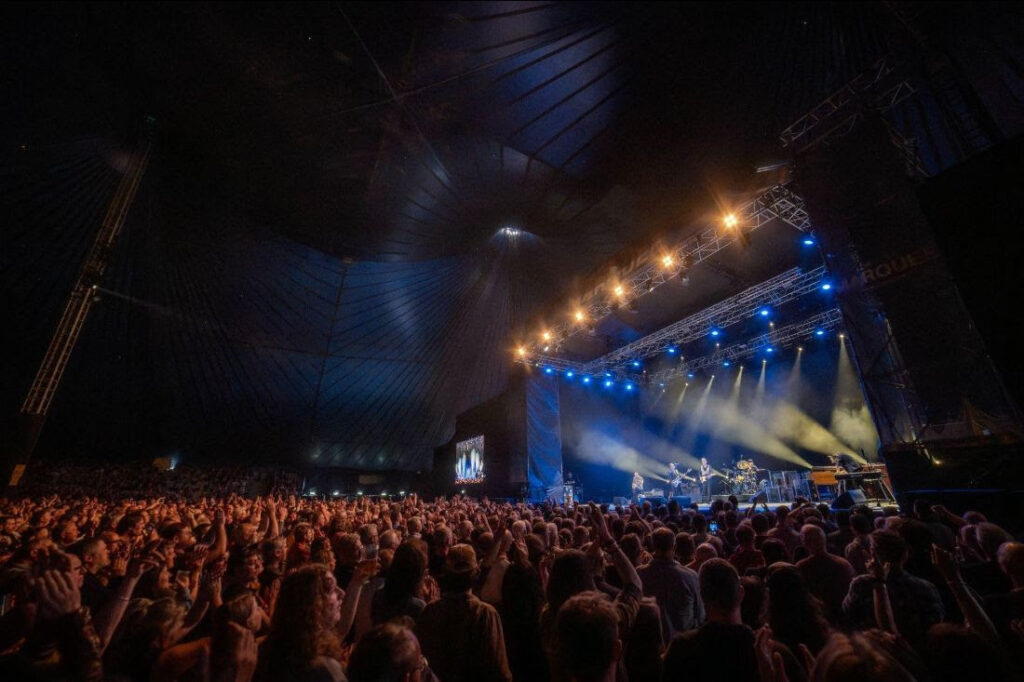
Joe Performing at Live At The Marquee – Photo Credit: Marcus Bird
Across fourteen carefully selected songs, The Spirit Of Rory Live From Corkexplores the full breadth of Gallagher’s catalog, from explosive live staples like “Walk On Hot Coals,” “Bullfrog Blues,” and “Bad Penny” to deeply personal performances including “Tattoo’d Lady” and “I Fall Apart.” The broader setlist was also inspired in part by the spirit of Gallagher’s legendary Irish Tour ‘74 era, which first introduced many listeners, including Bonamassa, to Gallagher’s singular live power.
The project also includes several moments of special historical significance, including Bonamassa’s performance of “As The Crow Flies” on Gallagher’s own 1930 National Triolian resonator guitar, generously loaned by the Cork Public Museum. Additional DVD and Blu-ray bonus features include The Inspiration of Rory, featuring conversations with Brian May and Slash, along with Rory’sAcoustic Guitar and Ballycotton – A Million Miles Away.
In celebration of the album’s release, European fans can now enter a special raffle benefiting the Keeping The Blues Alive Foundation, with the chance to win a one-of-a-kind signed Rory tribute guitar.
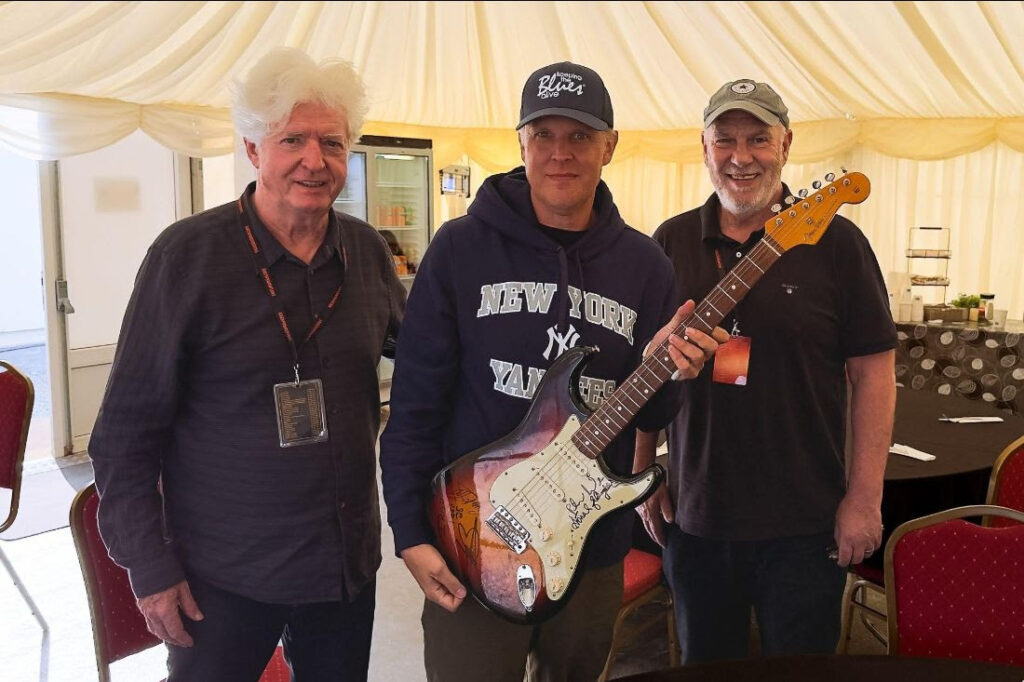
Joe Bonamassa with Rory’s brother Donal Gallagher and Irish Promoter Peter Aiken
The raffle runs from June 19th through July 20th, with donations supporting KTBA’s ongoing mission of funding music education and assisting musicians in need. The centerpiece of the raffle is a Classic Series ‘60s Fender Stratocaster personally purchased by Bonamassa at Cork’s legendary Crowley’s Music Centre and was subsequently signed backstage by Bonamassa, members of the band, Rory Gallagher’s family and others involved in the historic event. The prize package also includes a Joe signed copy of the Red Marble Double Vinyl, a CD/DVD or CD/Blu-ray package, and a $100 merchandise credit to the Joe Bonamassa online store.
Ultimately, The Spirit Of Rory Live From Cork stands as both a celebration and a thank-you letter – from one guitarist to another, from one generation of blues musicians to the next, and from a devoted fan to an artist whose influence continues to resonate decades after his passing.
As Bonamassa wrote in the project’s liner notes: “What you hear on these recordings is our best effort to pay tribute to Rory Gallagher, a man I never met, but admire so deeply. His music is part of me and I’m grateful that we were able to contribute in some small way to his ongoing legacy.”
CD Track Listing
1. Cradle Rock (Live)
2. Walk On Hot Coals (Live)
3. Tattoo’d Lady (Live)
4. I Wonder Who (Live)
5. Calling Card (Live)
6. Who’s That Coming? (Live)
7. Messin’ With The Kid (Live)
8. Bullfrog Blues (Live)
9. Treat Her Right (Live)
10. Bad Penny (Live)
11. I Fall Apart (Live)
12. A Million Miles Away (Live)
13. As The Crow Flies (Live)
14. Back On My Stompin’ Ground (Live)
DVD / Blu-Ray
1. The Spirit Of Rory (Opening Scene)
2. Cradle Rock
3. Walk On Hot Coals
4. Tattoo’d Lady
5. I Wonder Who
6. Calling Card
7. Who’s That Coming?
8. Messin’ With The Kid
9. Band Introductions
10. Bullfrog Blues
11. Treat Her Right
12. Bad Penny
13. I Fall Apart
14. A Million Miles Away
15. As The Crow Flies
16. Back On My Stompin’ Ground
17. Ballycotton (End Credits)
DVD / Blu-Ray Bonus Features:
- Ballycotton – A Million Miles Away
- Rory’s Acoustic Guitar
- The Inspiration of Rory (A Conversation with Brian May & Slash)
Vinyl (180 gram Red Marble Double LP)
Side A
1. Cradle Rock (Live)
2. Walk On Hot Coals (Live)
3. Tattoo’d Lady (Live)
4. I Wonder Who (Live)
Side B
5. Calling Card (Live)
6. Who’s That Coming? (Live)
7. Messin’ With The Kid (Live)
8. Bullfrog Blues (Live)
Side C
9. Treat Her Right (Live)
10. Bad Penny (Live)
11. I Fall Apart (Live)
Side D
12. A Million Miles Away (Live)
13. As The Crow Flies (Live)
14. Back On My Stompin’ Ground (Live)
U.S. SUMMER TOUR 2026
June 26 – Bethel, NY – Bethel Woods Center for the Arts w/ JJ Grey & Mofro & D.K. Harrell
June 27 – Atlantic City, NJ – Ocean Casino Resort
June 28 – Newark, NJ – New Jersey Performing Arts Center
July 4 – Sioux City, IA – Saturday in the Park
July 29 – Vienna, VA – Wolf Trap w/ Gov’t Mule
July 31 – Bangor, ME – Maine Savings Amphitheater w/ Gov’t Mule
August 1 – Gilford, NH – BankNH Pavilion w/ Gov’t Mule
August 3 – Hyannis, MA – Cape Cod Melody Tent
August 5 – Bridgeport, CT – Hartford HealthCare Amphitheater w/ JJ Grey & Mofro
August 7 – Selbyville, DE – Freeman Arts Pavilion
August 8 – Baltimore, MD – Pier Six Pavilion w/ Gov’t Mule
August 9 – Youngstown, OH – The Youngstown Foundation Amphitheatre w/ Gov’t Mule
August 11 – Huber Heights, OH – Rose Music Center at The Heights
August 12 – Highland Park, IL – Ravinia Festival
August 14 – Interlochen, MI – Kresge Auditorium w/ Gov’t Mule
August 15 – Welch, MN – Treasure Island Resort & Casino w/ Gov’t Mule
August 16 – Lincoln, NE – Pinewood Bowl Theater w/ Gov’t Mule
August 19 – Cheyenne, WY – Cheyenne Civic Center
August 20 – Salt Lake City, UT – Eccles Theater
August 22 – Albuquerque, NM – Sandia Resort & Casino
August 23 – Morrison, CO – Red Rocks Amphitheatre
September 26-27 – Austin, TX – Eric Clapton’s Crossroads Guitar Festival @ Moody Center
EU FALL TOUR 2026
October 21 – Helsinki, FL – Veikkaus Arena
October 23 – Stockholm, SE – Stockholm Avicii Arena
October 24 – Oslo, NO – Oslo Spektrum
October 25 – Gothenburg, SE – Göteborg Partille Arena
October 27 – Copenhagen, DK – K.B. Hallen København
October 29 – Rostock, DE – Stadthalle Rostock
October 30 – Berlin, DE – Uber Arena
October 31 – Dortmund, DE – Westfalenhalle
November 4 – Milan, IT – Unipol Forum
November 6 – Toulouse,FR – Zenith Toulouse Metropole
November 7 – Barcelona, ES – Barcelona Sant Jordi Club
November 8 – Madrid, ES – Madrid Palacio Vistalegre
November 11 – Wroclaw, Poland – Ethno Festival
ABOUT JOE BONAMASSA
Blues-rock superstar Joe Bonamassa is one of the most celebrated performing musicians of his generation. A five-time GRAMMY-nominated artist and 15-time Blues Music Award nominee – with four wins – he recently notched his 30th No. 1 album on the Billboard Blues Chart with B.B. King’s Blues Summit 100, extending his record for the most No. 1 albums in the chart’s history. With more than 50 releases spanning studio and live recordings, he has built a far-reaching, multi-genre catalog.
Beyond performing, Bonamassa plays a central role in today’s blues landscape as a producer and curator. Working closely with Josh Smith, he has produced albums for artists including Joanne Shaw Taylor, Marc Broussard, Larry McCray, and Jimmy Hall through his Journeyman and KTBA labels. He also curates and headlines sold-out destination events like Keeping the Blues Alive at Sea and Sound Wave Beach Weekend, while his Keeping the Blues Alive Foundation has funded hundreds of music education projects across the country.
A dedicated student of the instrument, Bonamassa is also known as one of the world’s leading guitar collectors and historians, with a deep connection to the lineage of blues and rock. For more information, visit http://www.jbonamassa.com.
PART 3 – Rod MacDonald Talks About Songwriting, Performing, and Memorable Performance Moments
By: Rick Landers
Guitar International and the masterful singer-songwriter, producer, author and music historian-presenter, Rod MacDonald, continue our conversation about Rod’s music career, including challenges, songwriting, memorable performances, and the quiet times of creating and situational flexibility to change to meet audience dynamics.
If you missed the beginning of our conversation, please go to PART 1 HERE! and PART 2 HERE!
“A keen sense of humor, an ingratiating way with romantic songs, and just enough recklessness to keep an audience wondering.”
Buffalo Daily News
“Rod MacDonald is a brilliant folk singer and composer. His melodic songs possess words that go straight into your heart and soul.” Atlantic City
(NJ) Press
“One of the most highly regarded singer-songwriters working in North America today”
Fast Folk Musical Magazine
CHECK OUT ROD’S 2026 CALENDAR!
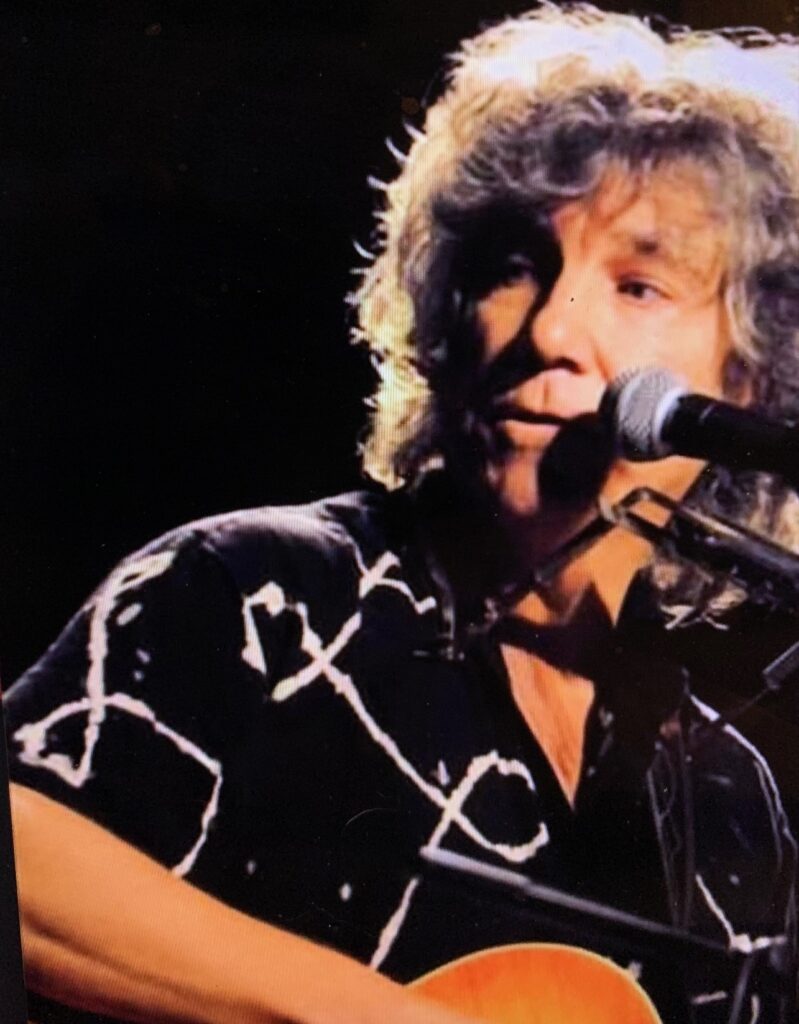
Rod MacDonald
Rick: It seems to me that based on what you’ve done, the amount of things that you’ve done, it takes a certain amount of discipline and some resilience not only to start a project, which is always kind of fun, but getting to be the finish line seems to be probably the last 5% of a project is the hardest part of the project. So, it sounds like you’re a finisher, you like to get things done and you do that last 5% and get it right.
Rod MacDonald: I do like to get things done. I’ll even do things that I know I’m not going use just to finish them and then put ’em aside and say, “Well, okay, but at least this is done if I ever want to come back to it.”
That’s definitely part of my personality, no doubt about it. I like to finish things and I like to finish them to the degree that I think that they’re where they belong, that they’re as good as they can be. I don’t like to leave things unfinished very much, unless I feel like every once in a while you come to a place where you think, “Well, I don’t think this is going to get any better no matter what I do, but I still don’t think it’s good enough to release.”
Andt then you have to let go of it. The song will occasionally end up that way. And then sometimes I’ll put it on my website as an archival recording later on and say, “Because it’s the only recording of this song. And every once in a while somebody will write me a letter or an email or say, “Hey, have you ever recorded such and such a song? I heard you do it at a gig and I loved it and I’d love to get a copy of it.” And then that’s what I’ll send them, that kind of thing.
But, yes, I am definitely a finisher.
Dan and I work very well together. I’d have to give Mark a lot of credit as leading me through a lot of the processes of recording and finishing work, but I’m finicky about the details. I’ll send a mix back and have him correct it just because I hear something going in the background at some point in the mix, I’ll make run, another one without that in it, that kind of thing. I’m very finicky about details, but I do finished work.
Rick: When you’re writing your songs, other than with Mark writing your own books, when you write your workshop stuff and your seminar stuff, that’s kind of a loner type of a world. And then you go out and you perform, which is more of an extrovert situation. So, how would you define yourself?
Rod MacDonald: I’m a little bit of both. I don’t think I’m naturally an ebullient person. I’ve come across artists who say,”The stage is my home.” I definitely don’t feel that way. I have to get up on stage and work my way through it.
I even had a woman once offered to pay for me to take lessons and how to smile more on stage. And I asked a friend of mine who’s in theater who teaches acting to teach me how to smile more on stage. And he’s a guy that’s come to a lot of my shows and he thought about it for a second and he said, “No, I won’t do it.”
“I said, really? Why not?” And he said, “Because, one of the things I like about watching you perform is watching you wrestle with it. And I don’t want to teach you how to be slick. I don’t want to see you be slick.”
And so I guess that’s a good analysis of the fact that I do have to wrestle with it a little bit. Years ago, back in the 1990s, I was traveling in the Midwest and I was holed up for a couple of days between shows and this woman who was affiliated with the club that I was there to play, very nice lady, asked me if I would like her to read my horoscope chart.
I said, “Well, I dunno, that’s kind of a personal thing.” And she said, “I’m really quite good at it and I rely on real material, real fixed material. I don’t just make it up. So, we had an afternoon hanging around, we were drinking coffee, and I said, “Okay, go for it.”
And one of the things that she said to me, I’m not sure if I have this exactly right, was that because I’m a Leo as a sun sign, but my moon sign or my birth sign rising sign, one of those is in Saturn. She said that I’m an unusual combination of a person who has both the ability to jump to the forefront of a situation and really be a leader of it, or alternately sit at the back of the room and very quietly observe everybody else. She said, there are very few people who have this dual ability, but you do. I absolutely understood what she meant right off the top. I had no problem. I didn’t at all go “Really? I never thought of that.”
I had never thought of it consciously, but I instinctively knew that it was true. I do have those two abilities. I often get put in leadership situations. In fact, almost every situation I’ve ever been involved in, people have put me in a leadership position without my even asking them to.
And then I sort of direct traffic. I think that one of the reasons that I’m good at it is that I don’t do it from a very egotistical point of view. I don’t sit there and go like, “Oh, I’m so important or anything like that. I kind of do it from a very pragmatic point of view, where I try to get the best out of everybody involved and let everybody do what they want to do and somehow make it make sense.
I’ve been the band leader of almost every band I’ve ever been in, even though I’m almost never the best musician in the band. In fact, I don’t even want to be the best musician in the band. I like to surround myself with better musicians than myself and then kind of direct traffic and get everybody to maximize what they do, without them having to think about telling everybody else what to do. So that is one reason why I think I’ve worked well with other musicians, probably a personality thing.
And then at the same time, I do have the ability to sit at the back of the room and listen and just kind of take it all in. And maybe this has allowed me to be a bit of a producer of my own recordings, but also of other people. I’ve produced a few recordings for people. I’ve directed a little bit of traffic. Sometimes people have invited me to their sessions and they’ll ask me what I think and I’ll diplomatically tell them and they’ll sometimes even do what I suggest. So I think that’s true. That’s something I can do both ways. So, I do find that the introspective part of it can be very rewarding.
When I feel really tuned into the writing, which isn’t always but does happen, and that’s when I write, is when I feel connected to it. And it’s an irregular thing. It’s something I can cultivate, but it’s also something that just kind of springs on me sometimes when I feel connected to the writing. It feels great when you have something that comes through and you are able to get it down in such a way that you feel makes sense. I really love that feeling. And it’s a solitary thing, absolutely.
It’s just you and the bull and you end up working your way through it. And sometimes it can be draining. I’ve burst into tears, fortunately, nobody else is around to see me feel like I’m embarrassing myself when that happens. But I’ve had that feeling in the writing process, and then you have to kind of try to take that out to the public.
The funny thing is that I didn’t understand that dynamic when I was young. I think I actually learned it from the process, specifically. This isn’t the only time it’s happened. When I was younger, I used to write songs that I think I thought people would like; happy, upbeat, kind of funny type stuff. And people liked them, okay, but they weren’t the songs that they were blown away by. They weren’t the memorable songs for people.
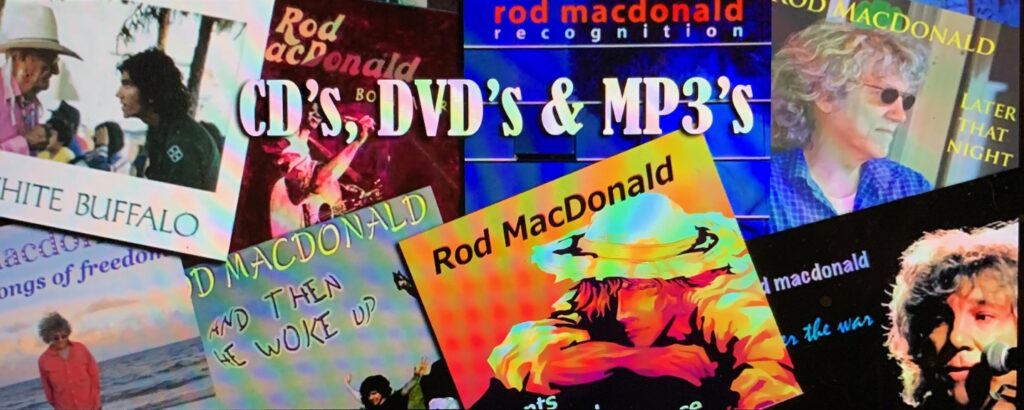
When I wrote “Cross Country Waltz”, which is one of my earliest songs on the White Buffalo album, and when I wrote American Jerusalem in 1978 or so, I played it for a songwriting workshop that I was going to with my peers in the Village. And everybody listened to it, and nobody said a word after I played it. Nobody said a word to me except my roommate, Tom Inandi, who was a former English teacher in high school who had become a singer-songwriter in the Village. And he was my roommate. And he was a great influence to be around because he didn’t really write words himself, but he really understood lyric writing on a listener level. And he looked at me after that song and he said, “I’m going to learn that.

And then Shawn Colvin said, “Can you teach me that song?” She learned it away right after I wrote it. Didn’t record it until 2015 or something, but she learned it right away and sang it all these years. And then I was playing a gig at Folk City one night and I was opening for somebody and I was playing some, what I thought the audience favorites were supposed to be.
Lucy Lansky, who’s a pretty good singer and writer herself, was the bartender. And she yelled from behind the bar, “Aren’t you going to play American Jerusalem?” And then everybody in the crowd who’d never heard the song kind of went, “What’s that?” And so I played it, and of course, it’s six minutes long and it’s very quiet, it’s very personal, and they really loved it. And everybody started asking me to play this song.
And somewhere in that process I realized that it’s okay to really externalize your inner self in song, that that’s to a great extent, what people actually most want from you.
So, if you can get to that place where you’re really kind of expressing your most inner feelings about things, and that’s what people are mostly going to remember, most of those songs come about spontaneously. They might get triggered by hearing a phrase or thinking, “I’d like to address this kind of situation,” or whatever it is. But most of those songs as songwriters often say, they kind of write themselves. It’s like they’re passing by and they choose you to download. And that’s often the most memorable songs in your repertoire. I think for most songwriters,
Rick: Well, maybe they resonate because they align more closely with your core values.
Rod MacDonald: Well, and maybe they also resonate because that’s probably true, even if you’re expressing them poetically. And I think also it’s probably true that when people see you sing those songs, they think that’s the real you. Oh, this is the real guy here.
Rick: True.
Rod MacDonald: This isn’t the guy who’s put on some happy mask. For my sake, this is the real guy. And people are drawn to that. I mean, we all loved The Beatles, and John Lennon said he never wrote a song that meant a thing to him until “In My Life”, which is what, their fourth or fifth album. So there is a place in music, especially popular music for well constructed songs, you might say. But I think that at the end of the day, what people really want is the real deal, and that’s you, something that you have to work at, but it’s kind of a gift when it comes to you.
Rick: Yeah. So do you have a favorite setting where you maybe prefer to perform? Concerts, small venues, festivals, and do you have any favorite or humorous performance moments?
Rod MacDonald: Oh, geeze. Well, everybody who’s done as many gigs as I have has humorous performance moments. But I don’t know. I like a lot of it. When I moved to Florida was playing in bars. I’d never done much of that when I was living in the village. I never really liked it because I didn’t like subjecting my own songs to the noise.
But I found that playing in the Irish Trio in West Palm Beach on weekends, for years, that I became a much better musician. And I got a lot of satisfaction out of that. And in fact, a friend of mine who’s maybe my oldest real good musician friend came down and visited me during that time. He’s in the traditional music world, he’s a mandolinist. And he sat in with us and he said, “You’re really getting better. This is a good thing for you to be doing. You’re going to become a much better guitar player from doing this on a regular basis.”
So I like that. I like anything that I feel is a fun experience and I of course love any fun experience when the audience really responds and gets it, that’s great. And they get it a lot of the time in almost any real listening situation. I think audiences like my songwriting and singing, and I play a fair amount of gigs where they’re unfamiliar with me because frankly, I’ve not been marketed by anybody.
So, I can show up in a city somewhere in another part of the country that I’ve never been before. And the audience that’s there is largely going to be, you might say, speculative. They’re going to be there because the promoter of the gig told them, “Hey, this guy’s really good. You should check him out.” Or there’s an article in the newspaper, or they heard one song on the local folk radio station and they’re deciding, “Okay, I like that song. I’ll go see this guy. I like this series. I am a regular member of this series, so I guess I’ll go see this guy.”
Click here to view the embedded video.
I play a fair amount of shows like that, and they’re usually very good. I think that I do well with those audiences. I like those kind of shows. I like the challenge. And then there are some places that I play. I play The People’s Voice Cafe in New York City every February. And the Turning Point in Piermont, I do that almost every year. And in fact, I’ve done the People’s Voice Cafe now for 15 years in a row. Really the same weekend every year. And a lot of those people that come are my long, loyal, longtime fans, and they could tell you or probably request songs that I do that I haven’t played in years.
And I’ll try to accommodate one or two of those requests. I like to challenge myself almost every show. I do one song that I haven’t played in a while, that I haven’t played for an audience so that each audience gets something special and unique out of me.
I love festivals. I just played Falcon Ridge this past summer, and that was really great. That was fun. I was on the main stage twice. One of the times was solo, and one of the times was with Joe Jenks and Pete and Maura Kennedy, and those were really fun. I do some Dylan Fests where everybody plays Bob Dylan songs. I’ve done a lot of those with Pete and Maura. Those are really fun. I suppose my least favorite gig is places where people really aren’t there for the music. They’re just okay. I mean, you do your best with those, but they’re not as much fun as playing for a crowd that’s really there to hear your music.
Rick: Like listening rooms are pretty good.
Rod MacDonald: But okay, let me off the top of my head, let me see if I can free associate some memorable, bizarre situations.
I played in Zagreb, Croatia, twice, once in about 1997 and once in 2024 for the same promoter both times. And the first time we went there, the first gig was in a gymnasium that would’ve easily held 5,000 people. And we were on the stage at one end of it and about a hundred feet away, collected in the middle of the basketball floor were about a hundred chairs where people were sitting when we started to play.
I could not make a thing out on stage. I mean, we had monitors, but the volume that it took to project out to the audience and the emptiness of the room created so much echo that it was like that psych experiment where they put your headphones on you and then delay your voice while you talk until you can’t talk anymore , because you just can’t separate the reflection from the real thing. And it was so weird. And we played one song and we finished the song and it was just total soup on stage. We played one song and the entire audience stood up and started cheering and clapping, and we kind of looked at each other and went, “I guess it sounds okay to them.”
So we just slugged our way through it, and they absolutely loved it. They thought it was a brilliant concert. So there’s an example of where you really have to know what you’re doing on stage. You have to be able to execute your music even when the situation that you’re listening to is just awful.
Then the very next night, we played a huge dance club for about a thousand people, and there were actually a thousand people in the club. And the speakers, they had these subwoofers under the stage because they were blasting disco music in between. And every note that Mark hit on the bass made my teeth rattle. I mean, it was unbelievably loud on stage, and I couldn’t function, and we didn’t get to do a soundcheck. They put us up in front of a thousand people with no soundcheck. So I plugged in my guitar and he plugged in his bass, and the next thing I know, it’s like, “Oh God, this is painful.” And the sound man doesn’t speak any English. So I’m pointing at the bass and to the floor. And he thinks I’m meaning, turn it up, turn up what’s underneath me. And I’m going like, “No, please turn it down, turn it down.”
And finally somebody went over to the guy and I guess understood English and said to him, “He means turn the bass down.”
And we finally got it down to where it was possible to stand on stage and play. And so we started off with a song of mine called “The Aliens Came in Business Suits”, which is from White Buffalo back in 1986 or so. And it’s the very first song that I wrote that was a spoken word piece, but it’s a real guitar extravaganza. There’s a lot of instrumental work in it.
Click here to view the embedded video.
And they were yelling and dancing and jumping around like crazy, all right in front of the stage, like a big rock arena type show. And we’re cranked up and we’re just acoustic guitar and bass. And we got through it and they went nuts. And so I turned to Mark and I said, “We’re just going to play all of my loudest and fastest songs here. That’s what we’re going to do.” And so that’s what we did, and we ended up having a pretty fun time with the crowd loving it and stuff. But I mean, you have to be able to react to the moment sometimes, particularly because we’re not one of those acts that arrives in a bus with our own sound crew. We’re getting up and playing.
You have to be able to tell the sound guys what you need, and you have to know what that is in each situation. And then on the same tour in rural Italy, at one of those places that’s like on a farm somewhere where they make all their own salami and wine and bread and cheese, and they’re hoping that people from the town will drive out.
And so we are in this restaurant with about 20 people in the audience and the sound system and a kind of a vacuum cleaner. It’s like this hose that you put in front of you and you sing into, and it sounds like you have to force your vocal into this tunnel. And then it comes out the other end of this device that’s sitting next to you on the stage going so loud that it’s drowning out everything you’re doing.
And I looked at the guy that was, and he was very proud of his P.A. I said, “We can’t use that.” And he goes, “What do you mean? And I got him to shut the thing off, and we just sang and played. Fortunately, I can play and sing loud enough into a small room, they can hear it. So we just did the concert with no sound at all. So again, it’s a situation where you have to be prepared. I remember talking about this recently, I was playing Easter Sunday at Folk City with a five piece band.
My piano player, a guy named Bernie Shanahan, who was a very good rock and roll piano player and a good guy…was kind of religious, Catholic. And we were playing on Easter Sunday, and he wanted to watch Jesus of Nazareth, which was being broadcast as a special on some TV network. So we watched Jesus of Nazareth before going over to do the gig, and then we got there and he said, “We shouldn’t do this show.” I said, “Why is that?” And he said, “It’s sacrilegious to be playing our music on a night after watching something like that.” I said, “There’s nothing sacrilegious about our show.”
Well, we did have one song called “All of the Same Old Saviors” that was kind of a not very religious type song. And so we got up on stage and I was playing electric guitar and Folk City in those days had a pretty primitive P.A., probably had the same P.A. he’d had for 25 years. And we started into the first song and the sound man flipped the ground switch like 30 seconds into the first song and sent a bolt of lightning through the microphone into my nose!
Knocked me flat backwards into the drum set, knocked over the drums, and of course the music came to a grinding stop and the audience was horrified. Well, we had done a soundcheck, and then he flipped the ground switch during the first actual song. So we got back up and Bernie looks at me and he goes, “I told you, I told you.”
And then the sound man waves at me. And he goes, “It’s okay. I got it fixed. But I did the rest of that night, really keeping my distance from the microphone, which of course is pretty tough to do because you’re singing in front of a band and it’s loud on stage. I mean, there are those things, and then there are other things. Sometimes stuff happens that’s just, I don’t know, kind of crazy. And sometimes it’s a happy accident when something happens.
Click here to view the embedded video.
I was playing one time at the Florida Folk Festival. There’s this pavilion down by the Suwanee River that’s kind of a legendary venue run by a longtime guy who’s no longer with us. And they didn’t use a P.A. It was like a gazebo on the river, and there’d be 50 people there and you’d just sing to ’em.
And there was a Chinese couple and they had their little daughter with them. And she was very young, very, very pretty little girl, two, three years old, whatever it was. And I started singing a song called “I’m Your Dad,” that I wrote for my daughter when she was first born. And this little girl wearing this really pretty little blue dress, started dancing around in front of me, holding her arms up to the sky. She was creating wings for herself and just dancing around in a circle. And she danced around in front of me for the whole song. And the audience was just spellbound, me included. I mean, could barely, it was so beautiful. I almost forgot where I was several times in the song. And it was just a really beautiful moment. And then when it was over, she went back and sat with her parents for the rest of the set, and I just went on.
Afterwards everybody came up to me and said, “Oh God, that was so incredible!” And it really was, was just a beautiful thing. But then on the other hand, here’s another one. When my rock and roll band was playing in Hartford back in the late Seventies, we used to play a song called, “I Don’t Believe You Don’t Want To Dance”. I never released it commercially, but it’s actually on this USB drive that I just released this past year. It’s an older song and it’s a very uptempo song, a real dance number. And there was a dance floor at the club that we were playing, and people got up and danced a lot if we played anything that was fun to dance to.
And so we started playing that song, and I think it was the end of the night. It was the very last song of the night. And we started playing that song. There was this guy who was kind of short and there was this very tall six foot blonde woman, very slender, very pretty, and for some reason they ended up on the dance floor together. I don’t know if they were a couple. And he started dancing really vigorously trying to get her attention.
And she just looked at him like, who are you? And he didn’t quit. He did this for the entire song. He danced, rings around her, he just chugged around her in this circle. And then everybody else on the dance floor backed off and started clapping and watching him. And this guy put on this amazing show dancing in a circle around this girl who clearly didn’t want anything to do with him, but didn’t know what to do. And she was kind of looking out across the crowd for one of her friends to come bail her out. And wherever her friends were, they were probably clapping along for this too and maybe didn’t realize, but we could see from the stage that she was really not very comfortable with this.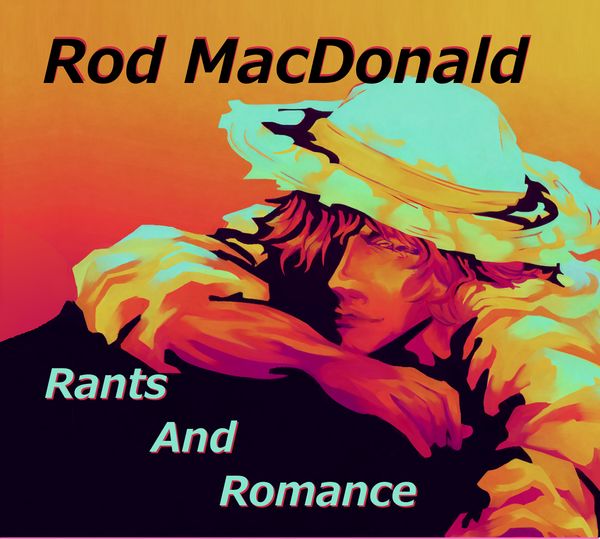 We kept playing this song, and one of the members of my band was a woman, Peggy Atwood, and she kind of looked at me, raised her eyebrows, “Are you going to wrap this song up to this Poor girl Can get away?” But the song had a real fixed arrangement, and there was a lengthy guitar solo that was part of the arrangement, and we weren’t going to tell the guitar player that he couldn’t play his solo. So we played the entire song, and this went on for five full minutes of this guy dancing in rings around this girl. And finally we ended this song and the lights came on, I think while we were still playing the song, which the restaurant had a very strict policy when the lights came on, stop playing, get it over with. So we were done and the girl walked away and just turned her back on the guy, and everybody walked away and everybody kind of applauded for the guy what he’d just done. He’d really done this amazing dance.
Was like a meeting dance. I couldn’t describe it any other way, but it obviously didn’t work. And then in that same club on another night, we were playing, I think in about 19, the spring of 1980, and it was right after the Iranian hostages had been released,
And somebody walked up to me while we were on stage and said, “Do you know that there’s one of the Iranian hostages is in the audience? And I said, “No kidding. Ask him if he’d like to come up and say a few words. And we played another song and the guy came back up to me and he said, “Yeah” that he would be glad to do that. So I said, “Okay”.
Well, we got a couple more songs to do this set and then I’ll invite him up. So we did. And then I said, and the audience, it was a big dance club, and so there were people drinking and partying, and it wasn’t like a quiet crowd, but it was a responsive crowd. They would clap and cheer at the end of songs, a noisy crowd. I walked up to the mic and I said, we have one of the hostages recently back from Iran here tonight, and it was the most amazing transformation. Everybody jumped to their feet and started cheering and clapping. Up until that moment, I wouldn’t have believed that everybody was paying that much attention to anything I said.
But they jumped to their feet and started cheering and clapping immediately, like everybody in the place all the way to the far end of the room had heard what I said. I thought, “Holy smoke!” And then they clapped and the guy walked up through the crowd and he got up on the crowd to the microphone and we stepped back, and I guess I stayed on stage. I didn’t want to abandon him up there. Well, I figured what I would do would be when he was done that there’d be a big round of applause, and we’d say, “We’re going to take a break. We’ll be right back.” We stayed on stage and he said to the crowd, “Thank you for that welcome.” And then he paused for a moment and he said, “I have to tell you that for quite some time, we thought that people had completely forgotten about us. And the mood in the room suddenly turned unbelievably ugly. I looked out at the crowd and I thought they were going to walk up on stage and beat us all to a pulp. Really, you could see the anger rising in people. And I thought, “Oh my God.”
I remember the lead guitar player Bill turning to me with his eyes wide, we got to get out of here. And then the guy said, “But you’ve just shown me that that wasn’t true. Thank you so very much.”
And he walked off the stage and then there was this kind of half-hearted applause, but everybody chilled. And I said, “Okay, thanks everybody. We’ll be right back.” And we got the hell out of there as fast as we could. And you learn a basic lesson from that, that if you do that, you better be prepared for whatever reaction you might get.
I mean, those are some of the magic moments I’ve been thinking lately about a song of mine called,”The Minstrel Boy” that I want to record that I’ve wrote 30 or 40 years ago and recorded a couple of times, but never released.
And it has a line in there. “You sat out on the highway looking for a living, trying to remember the people are listening with an ear or two though they may sleep through your finest lines. You walk along the shore, you sleep out in the dirt, you used to know the score, but now you’re really searching to one night they’re quiet and you feel it all light up before your eyes. It makes the man a minstrel boy.”
And I was trying to remember the first time that really happened. I think that it was probably me at Folk City in the 1970s that I had really been yearning to really get over to an audience that I was really motivated to play and sing my songs, but that I really kind of needed to have that happen. I know that it happened at Folk City one time I was playing.
Click here to view the embedded video.
I played two of my quietest and longest songs, “American Jerusalem” and “Sandcastles” at the end of my set back to back and got this really amazing encore from the audience, and it was like a really beautiful moment. And then I went back up on stage and played another song and everybody really loved it. And I just thought, “Wow, it was really magical. But I was the opening act and the headlining act, instead of taking a break, rushed up on stage and said to the crowd, “Thank you for staying through all of that.” What? A couple people booed her.
Rick: Wow.
Rod MacDonald: A couple people booed her for her lack of grace. It was kind of weird.
Rick: Yeah, it was weird. Jealous. Sounds like it’s jealousy,
Rod MacDonald: Insecurity, insecurity.
Rick: Your competition.
Rod MacDonald: You can’t think of opening acts that way. I’ve opened for a lot of people and the best of them always walk up and say something nice about you, even if you didn’t have that great a set. They’re just smart enough to say that and move on. I remember opening for Tom Rush and having a really great set once and getting an encore, and he walked up on stage and he goes, “How about that Rod McDonald?” That’s all he did. Everybody gets to clap a little more. And he goes “Okay! And then he goes into his thing and I thought, “Class act.” Exactly the way you want it handled. Really nice man and a gracious person. It’s part of his DNA and that’s a good thing.
I mean that’s something actually that I strive to emulate when you witness something like that, you think I want to be like that. I have guys open for me all the time too, guys and women in groups and whoever, and you always want to say something nice about ’em.
Rick: Yeah, it’s honorable to do that as well, I think.
Rod MacDonald: It’s honorable, but it’s also that everybody who gets up on stage is putting themselves on the line. It takes a certain amount of courage, even if you’re naive, even if you’re blind, even if you’re a maniac, it still takes a certain amount of courage to get up there and do that.
But anyway, when I sang those two really quiet songs and realized the most personal stuff sometimes is the most magical thing, and the people just lit up before my eyes. It’s what happens. And that’s kind of what you want to have. And as you get better and better, that happens more and more as you get more, I mean, I started out without a lot of experience doing this. Some people start playing when they’re 12 years old, but I did not, I never really faced an audience with a guitar in my hands till I was in my twenties. So, I had to really kind of figure it out.
BONUS VIDEO!
Click here to view the embedded video.
Roger McGuinn Interview: The Byrds, Martin Guitars and Home Recording
Here’s a classic Guitar International interview from Feb 16, 2006.
Roger McGuinn Interview
by Rick Landers
 During the mid-60s, the US music scene was overwhelmed with rock groups from England, to the point where the phrase “British invasion” entered the American lexicon. In response, one homegrown U.S. group emerged to fill the airwaves with a new and unique sound that became known as folk rock.
The Byrds.
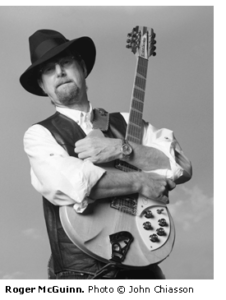
The Bryds were fronted by Roger McGuinn on vocals and his chimey 12-string Rickenbacker. The group laid down the gauntlet with a string of singles with McGuinn’s signature “jingle jangle” guitar work shining through with strong melodic undercurrents.
Although, Roger was certainly the hub of the group, David Crosby, Gene Clark, Chris Hillman and Michael Clark were equals when their mix of personalities, musical influences and individual talents sparked, igniting hits like “Mr. Tambourine Man,” “Turn, Turn, Turn,” “So You Wanna Be a Rock ‘n Roll Star,” and “Eight Miles High.” All of the songs are enduring classics that conjure up the phantasmagorical subculture of the Haight-Ashbury and Carnaby Street scenes, where the air was filled with flower power, peace, love, music, incense and other sweet smells of the moment.
Late in their career, the Byrds settled into their Sweethearts of the Rodeo album that would inspire the Eagles, the Flying Burrito Brothers and others into yet another style called Country Rock. The group disbanded in 1973 and Roger moved on to a solo career.
By 1978, Roger, Gene Clark and Chris Hillman got back together and signed a six album deal with Capitol Records and released their first LP McGuinn, Clark & Hillman (Capitol Records — 1979). Unfortunately, the group didn’t capture the magic or success of their previous collaboration and eventually moved on. There were more fitful starts and stops and by the 1980s, Roger’s solo career again made sense.
Born James Joseph McGuinn III in Chicago on July 13, 1942, by the time Roger reached his teens, he was inspired by such songs as “Abilene,” “Well, Well, Well,” and “You Can Tell The World” and their co-writer, folk legend Bob Gibson.
Before forming the Byrds, McGuinn toured with the Limeliters, the Chad Mitchell Trio and backed up the inimitable Bobby Darin as a guitarist and banjo player.
A folk singer at heart, McGuinn has maintained the storytelling tradition of that genre in his songs for his entire career. This coupled with his sense of musical composition and other talents have blessed him with not only a long career, but one where the name Roger McGuinn is well respected and recognized around the world.
In 1991, McGuinn, along with the Byrds, was inducted into the Rock n’ Roll Hall of Fame. That same year he released his superb Back From Rio CD that included a cast of luminaries like Elvis Costello, Tom Petty and the Heartbreakers, David Crosby, Chris Hillman, John Jorgensen and Michael Penn.
Always a traditionalist, McGuinn again journeyed back to his roots in 2002 when he released Treasures From the Folk Den with a series of duets that include Pete Seeger, Odetta, Josh White Jr., Joan Baez, and Judy Collins. This highly acclaimed CD was nominated in 2002 for a Grammy in the Best Traditional Folk Album category.
As an early adopter of new technologies, Roger has gained expertise in the area of home recording and in 2004 issued the DVD Roger McGuinn’s Guide to Home Recording on a Computer. The DVD is an instructional course that takes viewers through editing, fading, and mixing a recording as he lays down songs track by track. At one point, he makes a mistake, then takes the time to show his “students” how to fix it.
McGuinn has two other DVDs available, one that gives instruction on twelve-string guitar (The 12-String Guitar of Roger McGuinn) and another on how to play folk guitar (Roger McGuinn’s Basic Folk Guitar).
This year McGuinn released The Folk Den Project 1995 — 2005, a four CD edition that compiles 100 of his favorite folk tunes. The Folk Den effort started out as a way for Roger to help preserve the folk music tradition of handing down music to the next generation and this new set pulls together the best of the best doing just that.
Modern Guitars (Guitar International) met with Roger before he went on stage at the Melodee Music auditorium in Sterling, Virginia, where he sang and talked to the audience about his career, his interests in music, and some of the guitar techniques he’s employed to get that signature McGuinn sound.
******
 Many people claim that you first discovered the 12-string guitar after seeing George Harrison play his Rickenbacker?
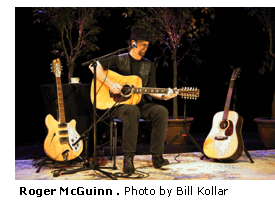
Roger McGuinn: The first 12-string guitar I bought was probably around 1957. I was influenced by Leadbelly, Pete Seeger, Bob Gibson and a lot of the folk singers. In the late 50s, I was in Chicago and went to the Old Town School of Folk Music. That’s where I learned about Leadbelly. Leadbelly’s guitar is in the Rock n’ Roll Hall of Fame.
I went to the south side of Chicago and got what I thought was a Stella, but it had a spruce top. It was a nice sounding guitar. I got a 12-string very early on and it wasn’t my main instrument, but something that was certainly part of my repertoire.
On your Limited Edition CD, you pay tribute to George. Was he a friend?
RM: Yes, we were friends. He was very reserved. A really sweet guy, he loved his music, loved his family. Not much to say. We went to his house in Hyde Park and he was kind enough to show us around. He let me play his Rickenbacker that he played on A Hard Day’s Night. Showed us around his studio and we all went out to dinner. Early on the Byrds went to see A Hard Day’s Night, a kind of reconnaissance trip. And we took notes on what the Beatles were playing and bought instruments like they had. We got a Gretsch Country Gentleman and the Rick.
You recorded “Turn, Turn, Turn” before forming the Byrds?
RM: I was sort of a sideman. I was a studio musician in New York. I did quite a few sessions with Elecktra Records. And around 1963, Judy Collins was doing a session at the time. So, Jac Holzman (Founder, Elektra Records) had me recording on a Judy Collins album and I started playing on that track. I ended up coming up with a lot of ideas and by the end of it she gave me a nice, very generous, credit as Musical Director.
What songwriters have influenced you or you’ve enjoyed over the years?
RM: Songwriters, hmm. Let’s see, I loved Lennon and McCartney, Pete Seeger, love his work. Bob Dylan, loved his songwriting. You mentioned Fred Neil earlier, I like his work too. People like Leonard Cohen and Joni Mitchell.
How did the instantly recognizable Byrds sound come about?
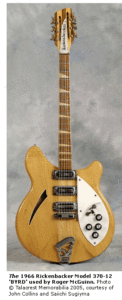 RM: The sound actually was formed in New York before I flew out to California. Well, not the 12-string Rickenbacker part, but the part about mixing folk and rock.
I was working as a songwriter in Bobby Darin’s publishing company in the Brill Building. My job was to listen to the radio and write songs like ones that came over on the radio.
The Beatles came out about that time and I got really jazzed by the Beatles. I loved what they were doing and they were doing a lot of passing chords. Like instead of just going like G, C, D, they’d go G, Bm, Em, C, Am, to D. So, the minor and passing chords I liked and, I thought these are really folk music chord changes. I kind of got it from what they were doing, I guess because they’d been a skiffle band.
I imagined that they were more folk oriented than they really were. I thought they were probably more a folk band that could play bluegrass banjo and mandolin, but they chose to do pop music because it was more commercial.
Turned out not to be the case. But in my imagination this whole thing developed and I started mixing up old folk songs with the Beatles beat and taking them down to Greenwich Village and playing them for the people there. To the point where a guy put out a sign outside that said, “Beatle Imitations.” I was kind of put off by that.
What pulled you to California?
RM: An opportunity came up right after that to fly out to California to play in Doug Weston’s Troubadour. I opened for Roger Miller and Hoyt Axton and took that repertoire out there, the folk music with the Beatles’ beat and the folk purists had kind of a mixed reaction. But that’s not all that were there.
One guy in the audience got it.
Gene Clark came up after the show and said, “I like what you’re doing, let’s write some songs together.” We had the same vision. So that was the nucleus of the Byrds. But the idea of mixing the folk and the rock act came ready-made from New York.
I always got a kick out of it when they called it the California Sound because it really came out of Liverpool and Greenwich Village. [Smiles]
Did Bob Dylan ever say anything about your renditions of his music?
RM: Yeah, in fact he was at our rehearsal hall when we were working up the song “Mr. Tambourine Man.” Not only that song, but we did quite a few of his other songs.
And I remember playing, I think it was “All I Really Want to Do” and he asked, “What was that?” I told him it was one of his songs. And he said, “Ah ha!” He didn’t recognize it. Bobby Neuwirth was there and said, “You can dance to it, that’s pretty cool!”
And they were very supportive of what we were doing with Bob’s music. So, we recorded “Mr. Tamborine Man,” and Albert Grossman tried to stop it. Bob was behind it, but his manager wasn’t. But, it had already gained enough momentum that Columbia couldn’t stop it.
What guitars are on your favorites list?
RM: Well, I guess that early 12 string. The first Martin I bought. I bought it around 1957 with money I earned as a janitor assistant. I bought brand new. I still have that. A five string banjo, a Vega long neck. I traded that for my first Rickenbacker and the first Rick was one of my favorite guitars.
Then, I guess, the Country Gentleman. I liked that a lot. And some of my other Martins. I have a D-12-35. I bought it new in 1967 or 68. I have from around the same time period a Martin D-12-45 which is really pretty. They didn’t make that many of them. I don’t really collect guitars. I like my Rick Signature 12-string model. I like that a lot. I like the Martin Signature 12-sting that Martin made in 1999.
What about the newest Roger McGuinn 7-string by Martin Guitar?
RM: Of course, the HD-7 I’m happy how that came out.
I went to Dick Boak (Director of Artist Relations & Publicity, Martin Guitar Company) and told him we we’re planning a European tour and Air France had broken my D-12-42RM. Dick was able to repair it, but it still had scars and cracks. I didn’t want that to happen again.
I wanted a guitar and thought it would be great if I could get one that had that jingle jangle thing on the G string and be able to bend like a six-string. So, I told Dick about my vision for a composite and he worked out a little design at the tail piece.
We talked about where to put the four strings as opposed to the, you know, three below and four on top. And I wanted D-45 inlays on it and we kept the herringbone. It’s basically a D-28. It’s Indian Rosewood. Brazilian would have kicked the price up. But this one has quite a punch to it! And this is number 7, HD-7. Dick’s idea. So those are the guitars in my life!
Please, tell us about your teaching DVDs.
RM: Okay, Happy Trail approached me I guess about 5 years ago to do one. The first one was a 12-string Rickenbacker oriented DVD where I actually show you how to adjust the tension rods in the neck by taking the plate off and how to change strings. Also, how to change the battery because it has a built in compressor circuit.
The sound we got with the Byrds uses two compressors run into each other. I had the compressor built in to the guitar and it sounds very much like it.
So, I do that and I play a couple of songs and demonstrate how it works. That’s basically the first one.
The second one is a more simplified folky one. I play a couple basic folks songs and break them down. I did that on a six string. I can’t recall all the songs on it. There’s some finger picking on it. Somebody actually complained on Amazon.com saying “This is NOT basic guitar! He’s finger picking and flat picking, so many beats per minute!” [Laughs] It does have that, but it also has some slowed down parts, so you can learn them.
And the third one, probably my favorite, is the DVD on how to record on a computer.
I heard you’re quite the gear head?
RM: I am! That’s my favorite subject because it really levels the playing field for artists these days. You don’t have to sell out to the record company. You don’t have to get a five hundred thousand dollars, or whatever, and pay them back for the rest of your life to record a record.
Now, you can just get a laptop, get some software, put a microphone on it and make a record. You have to know how to do it. It does help if you’ve had 35 or 40 years of experience in the studio. But, it still levels the playing field so artists can record their own stuff.
Your CDs are recorded at home?
RM: Yeah, that’s how we did my latest Limited Edition CD. One track was recorded in a studio in Nashville and the other twelve were recorded on a laptop, a Dell laptop. And that’s why I did it. Specifically for that purpose. To prove a point. To show that you could record an entire CD on a laptop.
When writing songs do you first start with a chord progression?
RM: Yes, basically, like you said, I’ll work out a chord pattern and work out the lyrics over that. Once in a while and really the exception, will be when I have an idea, then I’ll write a poem first and then write a tune to the poem.
Have some new chord patterns sitting around waiting for poems?
FM: Yeah, I do have a couple sitting around. Once I’ve written a song, I sometimes refine them. There’s one on the recording DVD, a poem from Ireland, “May the Road Rise to Meet You.” I think I had just put some on some new strings and I went in the powder room in my house and wondered if anyone had ever made up a tune to go with it. I had to revise the words a bit to make them rhyme.
So, I came up with a tune for that and kind of reworked the words so it would rhyme. And then I showed it to my wife, Carmella, when she came home and the two of us wrote down some verses. She’s been helping me since 1978. It was the exception to the rule though to come up with the chords and make up the melody.
Do you think the folk tradition of passing down songs from person to person has died?
RM: No, I don’t think so. I think with the advent of the Internet it’s still a one-on-one experience. When you’re sitting in front of a computer like my folk tune project, you can listen to it in MP3 and see the lyrics and the chords and story about the song. You can listen to it and learn it right off the DVD. It’s still a one-on-one experience for the person who’s watching it. Because you can reach so many more people now, it’s the oral tradition amplified.
Do you prefer smaller venues?
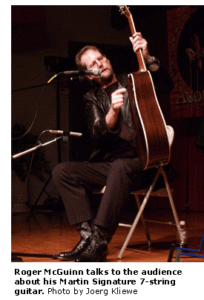 RM: I love the intimate surrounding. Where it gets to be less enjoyable is when the audience claps and there’s a time delay. So, it has to be a certain number of feet that the sound can travel and still be in the same number of milliseconds, so it will still be acceptable in that meter.
Otherwise, it gets too far away and when they clap there’s a time delay. If it’s like a thousand feet away, then it’s off. It’s off the beat. I like it to stay within the same sonic frame.
What else beside music occupies your time?
RM: Well I love music and it’s what I do for a living. We love traveling. I get to do concerts and travel with my wife, like Charles Kuralt. I have his book and it’s fun reading about his life. And I’m into electronics and computers.
While on stage, how do you weave the old tunes with your newer music?
RM: I do the songs that people want to hear usually at the end of the set. I start out with maybe one, maybe two songs from solos CDs, folks tunes. And then come up with the end of the set with from solo CD and then “Mr. Tambourine Man”, “Turn, Turn, Turn” and “Eight miles High.”
Let’s roll through some quick questions of your favorite things.
Book? The Bible.
Beverage? Water
Song? “Turn, Turn, Turn”
Album? If we’re talking about mine, then it’s the Limited Edition. Others? I like Pet Sounds and Meet the Beatles. My overall favorite is probably a Beatles album. Not Sergeant Peppers, maybe Revolver.
Car? I love my Ford van. I love it! Everything you need, a little house!
Guitars? I like my Martin acoustics and Rickenbacker electrics. Various models.
Quote? “To everything, turn, turn, turn. There is a season, turn, turn, turn. And a time for every purpose under heaven.”
Guitarist? Andre Segovia. Clapton.
Do you have a special concert moment that you cherish?
RM: When I was at a festival and I started singing “The Ballad of Easy Rider” and Odetta joined me on stage. It choked me up. She liked the song and she’d recorded it. It was a real honor.
Do you have any sage advice for musicians who have just had their first hit?
RM: Well, if they already have a hit song, it’s too late to get your deal together. Try to get all of your publishing in your name from now on, so it’s yours. And watch out for your manager. You can’t trust your manager or business manager to keep on eye on your best interests. You want to trust them, but it’s a luxury you can’t afford.
Tell us about your latest Limited Edition CD.
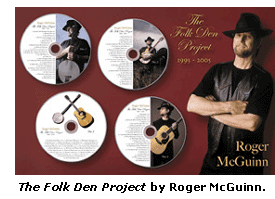 RM: The latest the one was a response to fans, people on the Internet, e-mails asking me to record another Rickenbacker electric album. My previous two had been acoustic, Treasures from the Photan and Life on Mars. So, I dusted off the old Rickenbacker and did the jingle jangle album. We started it off with the George Harrison tribute “If I Needed Someone,” which was a song we recorded in Nashville.
This is a funny story. When we got to Nashville, I expected to use a 24-track and a board. When we got there we found hundreds of thousands of dollars worth of equipment sitting in a corner and they’re recording with a mouse! And this little computer! I said, “Wait a minute! I can do this at home!”
We recorded the rest at home on a laptop and really just to prove a point. We recorded it in the family room. I did hired musicians and they’d come in and we paid them. It was a real recording session. But it just happened that instead of using the computer in the studio, we recorded it in our house. And studio time was free. It was a much more relaxed atmosphere.
Just how do you get that jingle jangle sound?
RM: The sound is a combination of several things. It’s compressed. I have to credit Ray Gerhard. He’s an engineer at Columbia Records. He came up with the idea because without compression the Rick kind of falls off. It doesn’t sustain a long time. And he compressed that into another, a serial compression.
The other thing is the arpeggio style I play comes more from a 5-string banjo. And then a lot of the folky stuff, like the Travis picking behind the lead break. Underneath it I’m playing (Plays), rolling. So, I’m overdubbing the lead break and doing the rolling underneath it.
I guess that’s the sound. Banjo picking, compression and some other little folk techniques I picked up along the way.
Do you foresee a Byrds reunion concert?
RM: I don’t think so. I’d like to leave it as a good memory. It’s hard to reheat a souffle as Paul (McCartney) said one time. We really couldn’t live up to it. It would be a sentimental thing, people would go, “Nice to see them together!”, but would it be better? I don’t know.
A Message from the Legendary Songwriter Jack Tempchin! “Stay Tuned!”
Press Release
Source: J. Tempchin
“Hi Folks,
I’m putting together a short film and album called, On The Spot May 2026. No release date has been set yet for the album, so stay tuned!
I went to the beach that day and with a few folks that dropped by I made up songs on the spot. It’s filmed in fantastic iPhone color and called, This Guitar Is My Best Friend.
Lead guitar by Jesse London and acoustic bass by a a guy named Mateo. He was walking by and went to his car and go his bass. I never saw him before, or since. Mixed by the great Craig Parker Adams.
Thanks! Jack”
Click here to view the embedded video.
******
 About Jack Tempchin: Signed to Arista Records by Clive Davis, the now legendary songwriter, Jack Tempchin, composed the song, “Slow Dancing (Swayin’ To The Music) that was recorded by Johnny Rivers in 1977. The song. reached the No. 10 spot of the Hot 100 and No. 8 on the Adult Contemporary chart. Tempchin’s songwriting attracted the attention of such major artists as: Buck Owens, George Jones and others who recorded his compositions. Jack would form a collaborative relationship with the Eagles that boosted his songwriting reputation by his songs such as, “Peaceful Easy Feeling,” and “Already Gone,” both featured on The Eagles 1917-1975 greatest hits album that was highlighted by RIAA
as the Best-Selling Album of the 20th Century. He’d partner with the Eagles’ Glenn Frey co-writing major hits, including, “The One You Love,” and “Smuggler’s Blues”. The songwriter’s songs would find themselves in film and television to be featured I such iconic films as “The Big Lebowski,” and “Thelma & Louise”. Jack would also co-write the theme song for the tv series, “7th Heaven”.
Inducted into the Songwriters Hall of Fame in 2019, Tempchin’s songwriting lyrics have been displayed at both The Grammy Museum and the Rock and Roll Hall of Fame. And in 2024 his full-length film, Midnight: Jack The Movie, attracted critical acclaim, with Jason Mraz noting it as “an amazing movie, a master class in songwriting and in life”.
Guitar Center inducts Billy Idol and Steve Stevens into the Hollywood Rockwalk (Bonus Video!)
Press Release
Source: Clyne Media
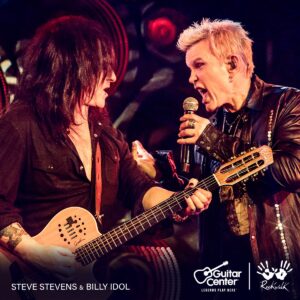
Steve Stevens and Billy Idol, the next inductees into Guitar Center’s Hollywood Rockwalk
Guitar Center today named rock legends Billy Idol and Steve Stevens as the next inductees into the Hollywood Rockwalk, the landmark Sunset Boulevard tribute honoring artists and industry pioneers who left a lasting mark on music history.
Owned and operated by Guitar Center since 1985, Rockwalk has become one of the music industry’s most recognizable public tributes to legendary artists and cultural innovators.
“Billy Idol and Steve Stevens didn’t just write hits – they built a partnership where a punk frontman and a virtuoso guitarist made each other sharper.
The ‘Rebel Yell’ intro alone has inspired generations of guitar players. Walk into any Guitar Center on a Saturday, and you’ll still hear someone chasing that tone. That’s the definition of Rockwalk-worthy,” said Gabe Dalporto, CEO of Guitar Center.
From “Rebel Yell” and “White Wedding” to “Eyes Without a Face” and “Flesh for Fantasy,” Billy Idol and Steve Stevens created some of the most recognizable rock songs of the 1980s. Idol’s unmistakable voice, rebellious image and hook-driven songwriting combined with Stevens’ virtuosic guitar playing and cinematic, genre-blending sound redefined what rock music could look and sound like on a global stage. The duo continues to tour together worldwide, and their catalog remains a reference point for generations of players.
“Steve and I have spent so much of our lives around music shops, trying new things while working hard to perfect our sound, with Guitar Center right at the center of it all,” said Billy Idol. “Being inducted into the Rockwalk together feels like a real full circle moment after all these years of making music side-by-side.”
“It’s absolutely awesome that Billy Idol and I will be inducted into the Guitar Center Rockwalk,” said Steve Stevens. “We join some of the greatest musicians ever in this honor. I hope some young guitarist looks down at our impressions and marches inside to buy his first guitar, just as I did. This building is filled with dreams and possibilities. All you need is desire and passion.”
Rockwalk has celebrated some of the most recognized names in rock, blues, soul and popular music through signature and handprint ceremonies outside Guitar Center Hollywood. More than 150 artists and innovators have been inducted, including Eric Clapton, John Lennon, Stevie Wonder, Aerosmith, Janis Joplin, Jimi Hendrix, Alanis Morissette, Black Sabbath, The Ramones, Elvis Presley and Johnny Cash.
Located at the entrance of Guitar Center’s flagship Hollywood store on Sunset Boulevard, Rockwalk is a permanent public destination where fans and musicians connect with music history year-round. The induction ceremony will be held on-site.
About Billy Idol:
For almost 50 years, Billy Idol has been one of the definitive faces and voices of rock ’n’ roll. Between 1977 and 1981, Idol released three albums with Generation X as their camera-ready frontman. In 1982, with guitarist Steve Stevens at his side, he embarked on a transatlantic/trans-genre solo career that integrated the bold and simple lines of punk and rock ’n’ roll decadence on songs like “Dancing With Myself,” “White Wedding,” “Rebel Yell,” “Eyes Without A Face,” “Cradle of Love” and more. Touring consistently around the world and showing no signs of slowing down, Idol released Dream Into It on Dark Horse Records in 2025, earning praise from fans and critics alike. Most recently Idol released Billy Idol Should Be Dead, the critically acclaimed definitive documentary about his life and career, and is a member of the Rock & Roll Hall of Fame’s incoming Class of 2026.
About Steve Stevens:
For more than four decades, Steve Stevens has been one of rock music’s most innovative and recognizable guitarists, known for his groundbreaking playing style and longtime creative partnership with Billy Idol. Since first teaming up in the early 1980s, Stevens has co-written and performed on some of rock’s most iconic songs, including “Rebel Yell,” “Eyes Without A Face,” “Flesh for Fantasy” and “White Wedding.” Beyond his work with Idol, Stevens earned a Grammy® Award for his performance on the “Top Gun Anthem” and contributed his signature sound to Michael Jackson’s “Dirty Diana” and records by artists including Robert Palmer, Joni Mitchell and Vince Neil. A sought-after collaborator, songwriter and performer, Stevens has also released acclaimed solo projects and performed on numerous major film soundtracks throughout his career. In 2025, Stevens and Idol collaborated on Dream Into It, their first full-length album of new material in nearly a decade, continuing a legendary creative partnership that remains as influential and relevant today as ever.
About Guitar Center:
Guitar Center is the leading retailer of musical instruments, lessons, repairs and rentals in the U.S. With more than 300 stores nationwide and one of the top direct sales websites in the industry, Guitar Center has helped people make music for more than 60 years. Guitar Center provides a range of musician-based services, including Guitar Center Lessons for players of all ages and skill levels, GC Repairs, an on-site maintenance and repair service, and GC Rentals, offering easy access to instruments and gear. Guitar Center’s family of brands includes Music & Arts, which operates more than 250 stores specializing in band and orchestral instruments for sale and rental, serving teachers, band directors, college professors, parents and students, and Musician’s Friend, a leading direct marketer of musical instruments in the United States. Guitar Center Business Solutions is the company’s commercial division, delivering professional audio, video, lighting and integrated technology solutions for businesses, institutions and creators nationwide through a portfolio of brands including AVDG (Audio Visual Design Group), GC Pro and Custom House at Guitar Center. The Guitar Center Music Foundation is a national nonprofit that expands access to music through instrument donations and support for communities in need.
BONUS VIDEO!
Click here to view the embedded video.
Billy Morrison Takes A Deep Dive Into His Psyche With His Single “Hollow”
Press Release
Source: SRO PR
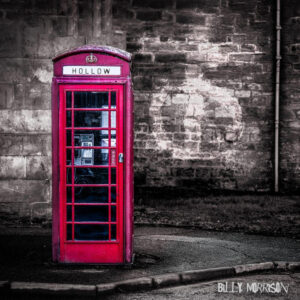 Billy Morrison takes a deep dive into his psyche with Hollow, the title track of the British guitarist, singer, and songwriter’s album of the same name out August 7 via TLG | ZOID distributed by Virgin Music Group.
The sonically explosive and lyrically gripping single is released today (June 12) along with an artful and eye-popping lyric video that traces Morrison’s previously unhinged life. View the Mike Savage-directed video HERE and listen to the autobiographical song, highlighted by Morrison’s deeply felt vocals and sweeping lead guitar runs, HERE.
“The title track to my new album was inspired by the life that I led when I was homeless and addicted to heroin,” says Morrison. “Begging for money on the streets and being the guy that people crossed the street from, I would watch people’s faces as they walked towards me, gradually realizing they had to walk past me and being disgusted at how dirty I was, or that I was begging for change. That leaves an indelible mark on your soul and the song is about slowly crawling out of that hollow life.” Read the full Q&A about the track and video below.
Morrison is now lighting up the rock charts with Hollow’s first single “Becoming” [feat. Sully Erna of Godsmack & GRAMMY® Award winner Nuno Bettencourt of Extreme]. It has surged at rock radio, hitting #20 this week on Billboard’s “Mainstream Rock” chart. Revolver dove into the track headfirst with an extensive feature interview, going on to note that “Morrison and Fuel member Brett Scallions co-wrote the song before sending it over to Erna, who delivers an impassioned and raspy set of lines. Bettencourt rises to the occasion and rips pure hellfire on his guest solo.” Listen to the song HERE and watch the video HERE.
Throughout an illustrious career, Billy Morrison has played live in front of millions of fans, collaborated with every A-list rockstar under the sun (even notching a #1 single with the late Ozzy Osbourne), sold his paintings in galleries on multiple continents, and logged hundreds of hours on-air as a radio host for SiriusXM. And yet—some folks wonder, “Who the F%@K is Billy Morrison?” Which is the title of a new short film that answers the question. Directed and edited by Mike Savage, it tells his story through punchy editing, candid footage, and new interviews with Duff McKagan of Guns N’ Roses, Al Jourgensen of Ministry, B-Real of Cypress Hill, Nuno Bettencourt of Extreme, mixer/engineer/producer Barry Pointer, and Morrison himself. Watch the six-minute documentary HERE.
Two years ago, Billy Morrison released The Morrison Project via TLG | ZOID distributed by Virgin Music Group. It marked his third solo album (and first since 2015) and produced the #1 Active Rock Song (Mediabase) in America: “Crack Cocaine” featuring Ozzy Osbourne and Steve Stevens and co-written by all three artists. A deluxe edition of the album followed in 2025 and bonus track, “Gods Of Rock and Roll (Orchestral)”—another seismic collaboration with Osbourne and Stevens—landed in the Active Rock Top Ten (Mediabase).
Hollow will follow the success of The Morrison Project format with 12 songs, half sung by Morrison and half sung by a handful of Morrison’s friends. Guests include Dexter Holland, Marilyn Manson, Chuck D, B Real, Duff McKagan, Steve Stevens, DMC, and the above-mentioned Sully Erna and Nuno Bettencourt, among others. “Forgive Me,” “The Tailor,” “No Suspects,” “Another Day,” “Leave No Trace,” and “Becoming” are among the song titles.
Hollow Single/Video—Q & A with Billy Morrison:
•“Hollow” is an intense and poignant song about personal desperation, with a reference to a “narcotic embrace.” Can you tell us what inspired the song?
Morrison: The title track to my new album, Hollow, was inspired by the life that I led when I was homeless and addicted to heroin. Begging for money on the streets, and being the guy that people crossed the street from ……. I would watch peoples faces as they walked towards me, gradually realizing they had to walk past me and being disgusted at how dirty I was, or that I was begging for change. That leaves an indelible mark on your soul and the song is about slowly crawling out of that hollow life.
•Looking at your career overall, you’ve been known primarily as a rhythm guitar player. “Hollow,” with its soaring, stadium-sized guitar lines, especially shows how much you’ve developed as a strong and confident lead guitarist. Can you tell us about your development?
Morrison: I think it was only a matter of time before I somewhat “graduated” as a guitar player into the category known as “lead guitarist.” Basically playing so much guitar for so many years, it was a natural learning curve for me. I would never stand next to any of the greats, but I can clearly play what’s needed in my own music, and that would be primarily due to the encouragement and belief of Steve Stevens, who has always allowed me to stretch in the Billy Idol band. I also gravitate to the kind of lead and solos that are musical, not necessarily a thousand notes a second. So that helps!
•This is so much more than a lyric video—artful and eye-popping—following right in line with your previous standout videos. It mixes black and white urban footage from the UK with colorful, surrealist imagery. It’s a fantastic visual vehicle for the song. Can you tell us how it all came together and who directed it?
Morrison: I definitely wanted to utilize the technology we now have available to us, even though this is “just” a lyric video! So I had a conversation with Mike Savage (who made the “Who the F%@K is Billy Morrison?” mini doc) and it turned out he was dabbling with all kinds of crazy tech and agreed to try a few things for this lyric video. I had no idea how it would turn out, but the brief was: “London, homeless, begging for change, being judged and criticized, Alice In Wonderland choruses.” And look what he came up with from just that brief description! I’m very happy.
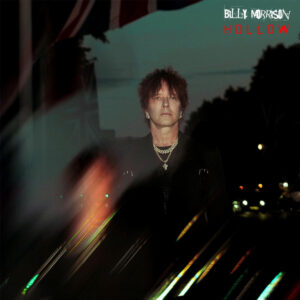
Hollow – Photo credit: Jane Stuart @JaneStuartPhotos
ABOUT BILLY MORRISON:
Billy Morrison is a British guitarist, singer, and songwriter, widely known as Billy Idol’s rhythm guitar player for the past 17 years alongside lead guitarist Steve Stevens. He is also a solo recording artist in his right having released three albums including the successful and acclaimed The Morrison Project in 2024 via TLG | ZOID distributed by Virgin Music Group. His fourth solo album, Hollow, will arrive in August 2026, also on TLG | ZOID distributed by Virgin Music Group. Morrison is also a former member of The Cult and Circus Diablo and currently also performs with the superstar cover band known as The Royal Machines. In addition, Morrison is a contemporary fine artist whose Warhol-inspired work has been shown at top galleries. He also has a regular show, “Influenced,” on SiriusXM’s Ozzy’s Boneyard (ch. 38), where he delves deep into the dynamic relationship between art and music.
“Electric Gypsy” – LA Guns Live From the Guild Theatre Album (July 30)
Press Release
Source: ABC PR
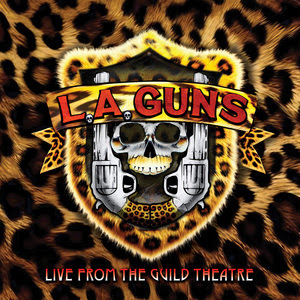 July 3 sees the release of one of the most anticipated live albums of the metal year, a full all-format release for Live From The Guild Theatre, recorded almost exactly one year earlier at the onstage launch of L.A. Guns’ most acclaimed album in years, the mighty Leopard Skin.
Rockpit.net described Leopard Skin as “a hook-filled, melody-drenched delight—perfectly mixed and balanced from start to finish. If you’re a diehard rocker who still worships the ’80s glory days, this one’s for you. But don’t get it twisted: this isn’t some nostalgic retread. L.A. Guns aren’t stuck in the past—they’ve evolved naturally, delivering a record that feels fresh while staying true to their roots.”
MetalPlanetMusic.com said the Guns are “still churning out bangers,” and Maximumvolumemusic.com applauded them for still having “a way of sounding filthy.” In fact, that review continued, “The best thing about L.A. Guns is how unapologetic they are, and ‘Hit and Run’ nails it. ‘We’re just having fun,’ sneers [vocalist Phil Lewis], as only he can.”
It nails it here, too, sliding in between “Hellraisers Ball” and “Like A Drug,” but Live From The Guild Theatre is explosive from start to finish, the Gunners firing off killer versions of fan favorites tracing as far back as the band’s debut album – “Sex Action,” for example, probably hasn’t featured in the repertoire since the eighties, but it’s alive and kickin’ here.
Sophomore set Cocked and Loaded, meanwhile, spits out some of the most powerful shotgun blasts in the band’s entire arsenal – “I Wanna Be Your Man,” “The Ballad of Jayne,” “Rip and Tear,” and the set-ender, “Never Enough.” And Leopard Skin gets both a triumphant airing and a delirious response.
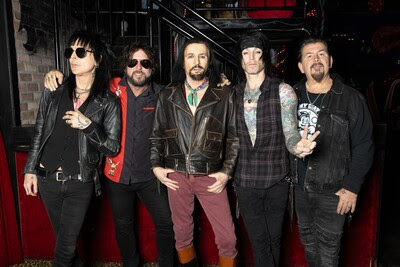
In fact, longtime vocalist Phil Lewis and the man who put the Guns in L.A. Guns, Tracii Guns, have never sounded better – quite an achievement for a band that’s been tearing up the stages of the world since 1983! Ace Von Johnson (guitar), Johnny Martin (bass) and Shawn Duncan (drums) complete the line-up.
The first single from the album, “Electric Gypsy” which is now available to stream and download HERE, is another from the self-titled debut, and it sounds as fresh now as it did way back then…drop it into your streaming playlist and it won’t simply wake up the neighbors, it’ll have them hammering on your door, demanding to know what you’re listening to.
Watch the video for “Electric Gypsy” HERE
Yes, you’ll tell them it’s L.A. Guns – who else could it be? But you can also tell them that it’s not only coming out on CD and vinyl, but there’s a DVD and a cassette.
CD/DVD/VINYL/CASSETTE: https://cleorecs.com/search?q=l.a.+guns+live+from+the+guild+theatre
DIGITAL: https://orcd.co/laguns_livefromtheguildtheatre
Here’s the track listing for LIVE FROM THE GUILD THEATRE:
1. Intro – Taste It
2. Cannonball
3. Electric Gypsy
4. Sex Action
5. Hellraisers Ball
6. Hit and Run
7. Like a Drug
8. Speed
9. One More Reason
10. Theremin Jam
11. Over the Edge
12. Guitar Solo
13. I Wanna Be Your Man
14. Lucky Motherfucker
15. Never Enough
16. The Ballad of Jayne
17. Rip and Tear
Europe Release The Cult of Ignorance From Upcoming Come This Madness Album
Press Release
Source: ABC PR
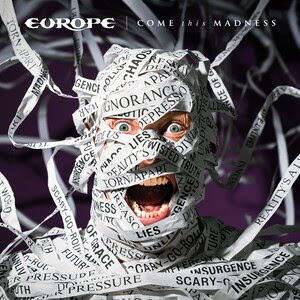 Europe release the hook-laden new single, “The Cult of Ignorance,” the second track unveiled from their highly anticipated forthcoming studio album, Come This Madness, set for release on September 25 via Silver Lining Music. Pre-orders are available now.
Driven by an instantly memorable hook and an anthemic chorus, “The Cult of Ignorance” combines undeniable catchiness with a message that resonates in today’s fast-moving world, delivering moments of reflection without losing its positive, feel-good energy.
As well as featuring Europe, the accompanying star-studded video showcases cameos from high-profile friends of the band, including renowned actress Malin Åkerman, former World No. 1 and multiple Grand Slam champion tennis player Stefan Edberg, astronaut Christer Fuglesang, Howling Pelle (The Hives), Mikael Åkerfeldt and Fredrik Åkesson (Opeth) and E-Type, alongside many other notable personalities from the world of music, film, fashion, sports and science.
“I love this track! It’s a straightforward rock anthem with lyrics reflecting the times we live in, written slightly tongue in cheek” says Europe’s founding member and frontman Joey Tempest. “Mic (keyboards) came to me with this song idea while on tour in South America – I thought it was crazy good! We finished it together and it’s become a real banger! The title was inspired by a phrase coined by author and biochemist Isaac Asimov. It reflects some of the negative tendencies emerging in our world today, though it is written in a slightly light-hearted tone.”
Watch/Listen to “The Cult of Ignorance” here – Video by Patric Ullaeus.
Europe’s new studio album, Come This Madness, signals a powerful new chapter for one of rock’s most enduring acts. Across songs like “One on One,” “The Cult of Ignorance,” and the title track “Come This Madness,” the band channel tension, truth, and raw energy into a record that feels both deeply personal and globally resonant.
Watch and listen to Europe’s recently released and celebrated single, “One on One,” here. The song is accompanied by a cinematic video featuring acclaimed actor Peter Stormare (Fargo, The Big Lebowski, Minority Report, 8MM, Armageddon) and directed by Patric Ullaeus.
Come This Madness was recorded at RMV Studio, the Stockholm-based recording facility founded by Benny Andersson and Ludvig Andersson. The album features special guests Tobias Forge (Ghost) and Mikael Åkerfeldt (Opeth) on backing vocals and was produced by acclaimed producer Tom Dalgety (Ghost, Rammstein, Pixies, The Cult, Opeth), who became a true creative force throughout the process, deeply embedded in the band’s writing and recording, shaping the album’s sound from the ground up. To bring the project to its final stage and complete their vision, the band turned to one of rock’s most respected recording legends Mike Fraser (AC/DC, Van Halen, Metallica, The Cult, Loverboy) to mix the record.
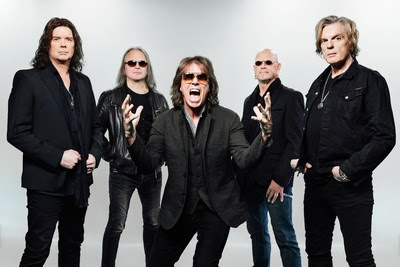
With Come This Madness, Europe deliver a landmark record that finds them fully realized and present, confronting the realities of the modern world with conviction and creativity. Building on the momentum surrounding the album’s release, the band will also embark on an extensive run of live dates, including numerous festival appearances and a major tour to celebrate the 40th anniversary of The Final Countdown. Kicking off in Glasgow on September 30, “The Final Countdown 40th Anniversary Tour” promises to unite the legacy that defined them with the renewed energy, driving them forward today. For a full list of dates and ticket information, please visit: www.europetheband.com
2026 Dates:
6 Jun – North Festival, Maia (PT)
21 Jun – Graspop Metal Meeting, Dessel (BE)
25 Jun – Rock Pod Kameňom Festival, Bela Nad Cirochou (SK)
28 Jun – Retro Trop C, Tilloloy (FR)
5 Jul – Summer Festival Piazza Castello, Marostica (IT)
7 Jul – Cavea-Auditorium Parco della Musica, Roma (IT)
8 Jul – Arena Campo Marte, Brescia (IT)
9 Jul – Villa Bertelli, Forte Dei Marmi (IT)
25 Jul – Son Do Mar Festival, Meaño, Pontevedra (ES)
30 Jul – Wacken Open Air, Wacken (DE)
29 Aug – Stonedead Festival, Newark (GB)
30 Sep – SEC Armadillo, Glasgow (GB)*
2 Oct – Civic Hall, Wolverhampton (GB)*
3 Oct – Eventim Apollo Hammersmith, London (GB)*
5 Oct – Musis Arnhem, Arnhem (NL)*
6 Oct – Olympia, Paris (FR)*
8 Oct – Poble Espanyol, Barcelona (ES)*
9 Oct – Bilbao Arena Mirabilla, Bilbao (ES)*
10 Oct – La Cubierta, Madrid (ES)*
12 Oct – Salle Métropole, Lausanne (CH)*
13 Oct – Volkshaus, Zürich (CH)*
14 Oct – Alcatraz, Milan (IT)*
16 Oct – Liederhalle, Stuttgart (DE)*
17 Oct – Gasometer, Wien (AT)*
19 Oct – Admiralspalast Theater, Berlin (DE)*
20 Oct – COS Torwar, Warszawa (PL)*
22 Oct – Falkoner, Frederiksberg (DK)*
23 Oct – Film Studios, Gothenburg (SE)*
24 Oct – B-K, Stockholm (SE)*
26 Oct – Sentrum Scene, Oslo (NO)*
15 Nov – Malta Metal Weekend, St. Julians (MT)*
21 Nov – Ostravar Aréna, Ostrava (CZ)*
25 Nov – Aalto Hall @ House of Culture, Helsinki (FI)*
27 Nov – John Smith Rock Frozen Paviljonki, Jyväskylä (FI)*
28 Nov – Unholy Winter Festival Joensuu Areena, Joensuu (FI)*
*The Final Countdown 40th Anniversary Tour
Come This Madness album artwork by Storm Studios (Pink Floyd, Led Zeppelin, and Muse).
Come This Madness track listing:
- One on One
- The Cult of Ignorance
- Come This Madness
- This Time of Year
- In a Different World
- Scandinavian Eyes
- Takin’ It Back
- In the Absence of Grace
- The Angels Must Have Flown
- The Devil’s Back
- Nothing Can Follow This
Come This Madness will be available on vinyl, CD and digital formats. Pre-orders can be placed HERE
EUROPE are:
Joey Tempest – Lead Vocals
John Norum – Guitars
John Levén – Bass
Mic Michaeli – Keyboards
Ian Haugland – Drums
www.facebook.com/europetheband
www.instagram.com/officialeuropetheband
www.youtube.com/europethebandtv
www.tiktok.com/@europethebandofficial
Your first pro IEMs: Clear Tune Monitors CTM CE220
By Carlos Martin Schwab
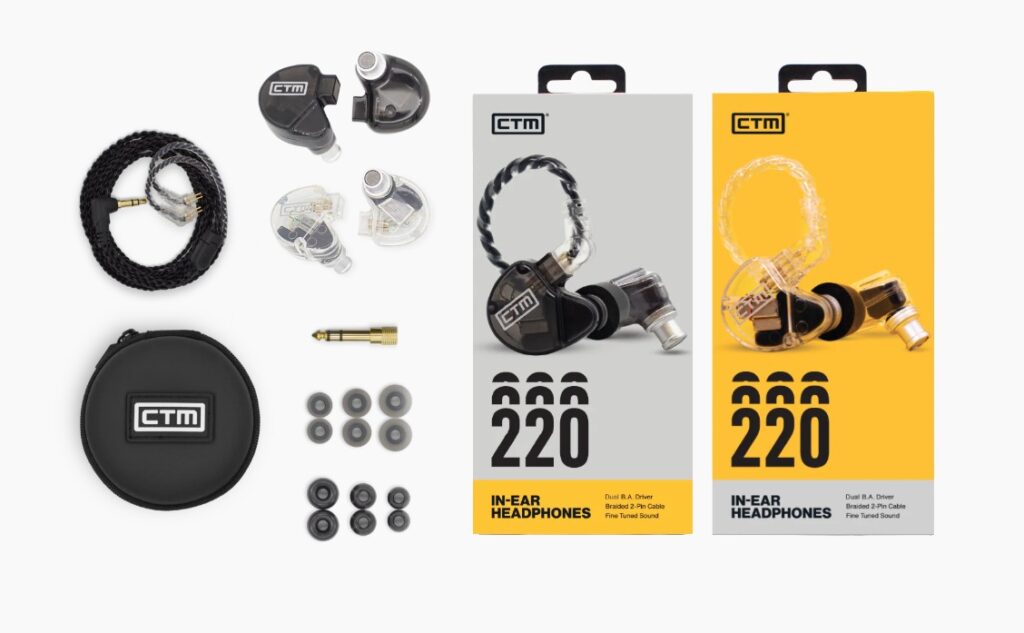 The Clear Tune Monitors CTM CE220 is a highly capable, entry-level professional in-ear monitor (IEM) that bridges the gap between everyday consumers and touring musicians.
Engineered with a dual balanced armature driver configuration, these monitors split the workload efficiently: one dedicated low-frequency driver generates a robust, punchy bass response that gives a solid foundation to the sound stage, while the second driver delivers warm, natural midranges alongside sparkling, airy highs. Vocals and strings are reproduced cleanly without harshness or fatiguing sibilance.
Comfort is a primary design pillar for the CE220. CTM utilized a unique scientific approach to craft a universal fit shell shaped by averaging data from their extensive library of custom-molded customers. The result is a highly ergonomic design that locks securely in the ear canal, ensuring a flawless acoustic seal even during active live performances. This structure achieves a remarkable -26 dB of passive noise isolation, easily blocking stage noise or ambient distractions.
Built to last, the monitors feature a detachable 4-core braided copper cable using standard 0.78mm 2-pin connectors, offering excellent signal conductivity and easy replacement. Technically, they are highly efficient and easy to drive from any portable source, presenting a 20-ohm impedance, 124 dB SPL sensitivity, and a smooth frequency response ranging from 20 Hz up to 16 kHz. Sold with a protective zipper case, various ear tips, and a quarter-inch adapter, the CE220 stands out as an affordable, durable, and acoustically balanced tool for any stage performer or demanding audiophile.
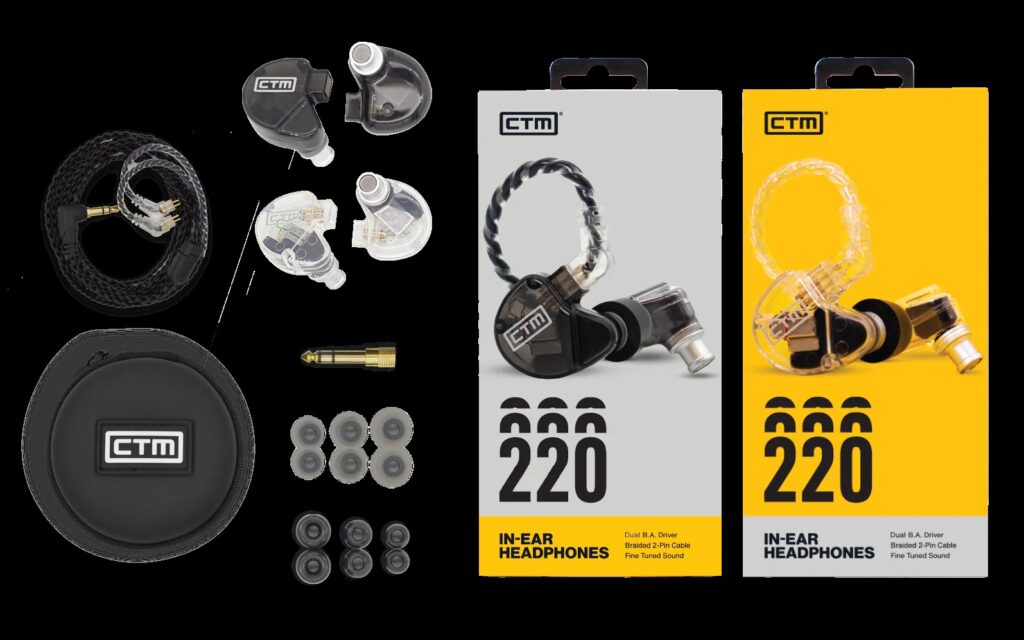
Pros
Outstanding Comfort and Ergonomics: The shell shape—designed by averaging thousands of CTM’s custom ear molds—fits the ear incredibly well. They are extremely stable, don’t fall out during active stage movement, and cause zero fatigue after hours of continuous use.
Excellent Passive Noise Isolation: Offering a -26 dB noise reduction, this feature is highly praised by live musicians and commuters alike, as it efficiently blocks ambient noise without relying on electronic cancellation.
Warm and Musical Sound Profile: The tuning is coherent, leaning towards a smooth, analog signature. The mid-range sounds organic, and the highs are polite and airy, completely avoiding harsh peaks or piercing sibilance.
Punchy Bass for Balanced Armatures (BA): Unlike other BA-only monitors that can sound thin or dry, the dedicated low-frequency driver delivers a bass response with solid body, warmth, and impact.
Easy to Drive: With a 20-ohm impedance and high sensitivity, they perform beautifully straight out of wireless bodypacks, modest audio interfaces, or smartphones.
Complete Accessory Package: Includes a sturdy zipper case, a 1/4-inch adapter, and a generous variety of both silicone and foam ear tips.
Cons
Loss of Micro-details: By prioritizing a smooth, fatigue-free sound, some of the finest, hyper-analytical details in the high frequencies are sacrificed. They are not the most resolving IEMs on the market.
Slight Congestion (Muddiness): In very fast or complex musical tracks, the sound can feel a bit congested or “cloudy” in the transition between the bass and the lower mid-range.
Basic Plastic Build: While the polycarbonate shell (available in clear or smoke finishes) is robust enough for stage abuse, it looks and feels a bit plain or overly “plastic” compared to resin or metal competitors in the same price bracket.
Average Soundstage and Imaging: The 3D space and instrument separation are perfectly adequate for reference monitoring, but they do not particularly stand out when compared to similarly priced hybrid models from Chi-Fi brands.
Carlos Martin Schwab would like to thank Cesar Milano (Clear Tune Monitors) for his help in writing this article.
Two strobe tuners: Peterson StroboStomp HD and Fender Strobo-Sonic Pro
By Carlos Martin Schwab
If we divide a semitone into 100 cents, the average human ear can hardly perceive variations of less than 5 cents in a musical context. A standard pedal tuner (such as the BOSS TU-3) has an accuracy of ±1 cent. A strobe tuner has an accuracy of 0.1 cents. Let’s take a closer look at this.
 The fundamental difference between a strobe tuner and a conventional tuner lies in the nature of their measurements. While a standard tuner (needle or LED) averages the note’s frequency and displays a visual approximation with an accuracy of 1 or 2 cents, the strobe tuner operates in real time without processing latency.
Instead of interpreting the signal, a strobe model allows the input signal to interact directly with a light or wheel pattern, revealing minute harmonic discrepancies with an accuracy of up to 0.1 cents.
For a musician, this means that the conventional tuner is useful for quick adjustments during live performances, but it may overlook slight detunings that affect intonation. In contrast, the strobe tuner is indispensable for octaving instruments and professional recordings, as its display only stops when the frequency is mathematically exact, offering a level of sound fidelity that a standard digital sensor simply cannot achieve.
These tuners are extremely precise—so much so that they are used more for adjusting the technical intonation of the guitar than for a quick tune-up between songs.
This strobe tuner is widely regarded as the gold standard in the world of tuning, offering unmatched accuracy of 0.1 cents. This pedal is not just an accessory, but a professional-grade tool that ensures every note is mathematically perfect, thanks to its true strobe technology in a compact and extremely durable pedal format.
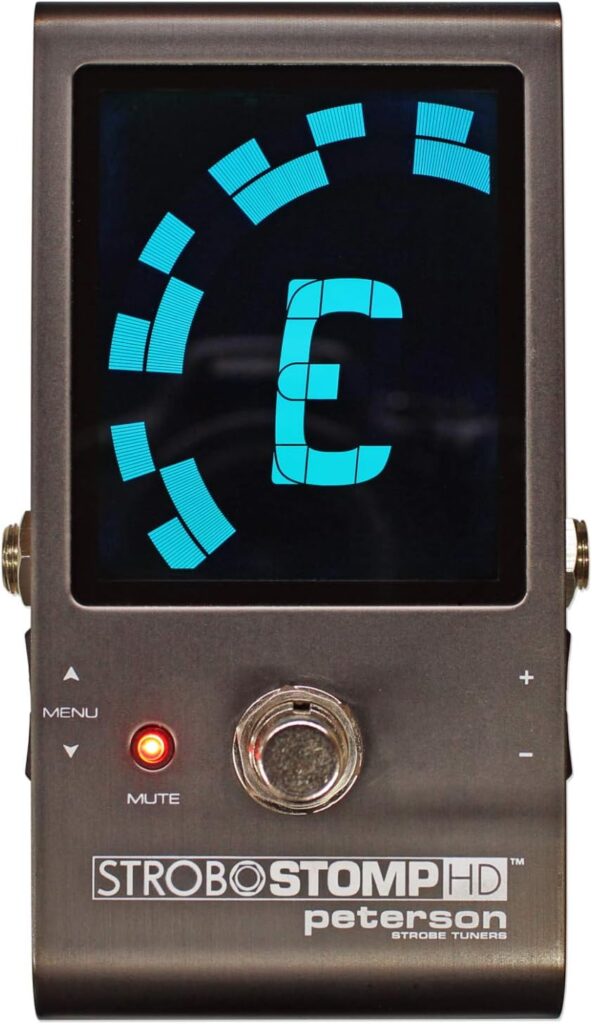
Key Features
Configurable High-Definition Color LCD Screen: Features a large screen with customizable LED backlighting, making it easy to view in any lighting environment. The user-selectable colors can be used to personalize the tuner or to improve display visibility in varying ambient lighting conditions, depending on the usage environment. The vibrant screen colors can also be assigned to stock or user presets to significantly reduce menu navigation time and increase on-stage tuning confidence during a gig.
“Sweetened” Tunings: Includes 135 exclusive presets that optimize tuning intervals for specific instruments (guitars, basses, banjos, and even wind instruments). Its low-frequency note detection algorithm (such as for 5-string basses) is the most stable in the industry.
Signal Management: The integrity of your signal is vital, especially if you have many pedals. This tuner offers 3 pop-free operating modes: True Bypass, Buffered output (to maintain tone integrity over long cables), and a Monitor mode (tuning always visible) by setting the mode switch located in the battery compartment.
Power: 9V battery or DC jack. It can power other 9V pedals on your board via the power-through jack.
Professional users unanimously praise its ease of use, noting that the stroboscopic wheel is much more intuitive for fine-tuning than traditional needle meters. They also highlight its versatility, as it allows for firmware updates and the loading of sweetened tunings via USB. Although it requires a brief learning curve, it is the ultimate pedal for those seeking maximum harmonic fidelity both in the studio and on international tours.
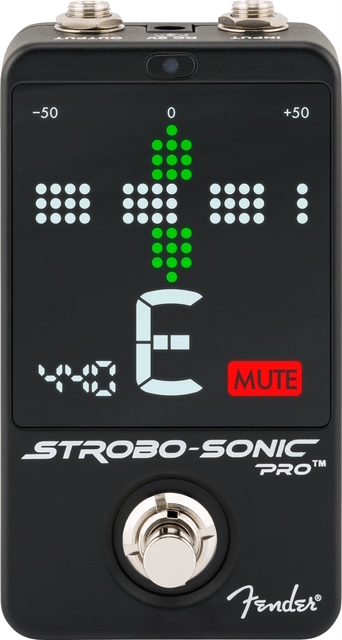 This is a high-end strobe tuner that redefines precision on stage. Sharing many features with its predecessor, this device stands out for its impressive accuracy of 0.1 cents, positioning itself as one of the most reliable tools on the market for ensuring perfect intonation, even in demanding studio setups.
Key Features
Its rugged aluminum design houses a 2.3-inch LED display with automatic brightness adjustment, ensuring full visibility in both dark stages and broad daylight. It offers two display modes: strobe (for maximum precision) and needle (for quick visual reference). A significant technical advantage is its bypass versatility, allowing you to choose between True Bypass, Buffered Bypass, or an always-on monitoring mode. Additionally, it features space-saving top-mounted connectors and power via 9V or USB-C.
Professional users praise its response speed, which eliminates the annoying lag found in other digital tuners. It does not have sweetened tunings, but it does allow you to calibrate the reference pitch between 430 Hz and 450 Hz. Reviewers agree that it is a direct competitor to the industry standard (Peterson), surpassing it for many in terms of ergonomics and ease of use. Its high-definition color LCD screen, which is its most useful feature, is extremely smooth and offers different display modes (including one that mimics an oscilloscope). It is, arguably, the most beautiful tuner display on the market.
More info: www.petersontuners.com and www.fender.com
Carlos Martin Schwab would like to thank Bob Potsic (Peterson) and Gabriel Madera (Fender) for their help in writing this article.
Kelakos Bassist Linc Bloomfield Linc Bloomfield Releases First Solo Album – LB Junior – Echos of Dreamworld
Press Release
Source: Deko Entertainment
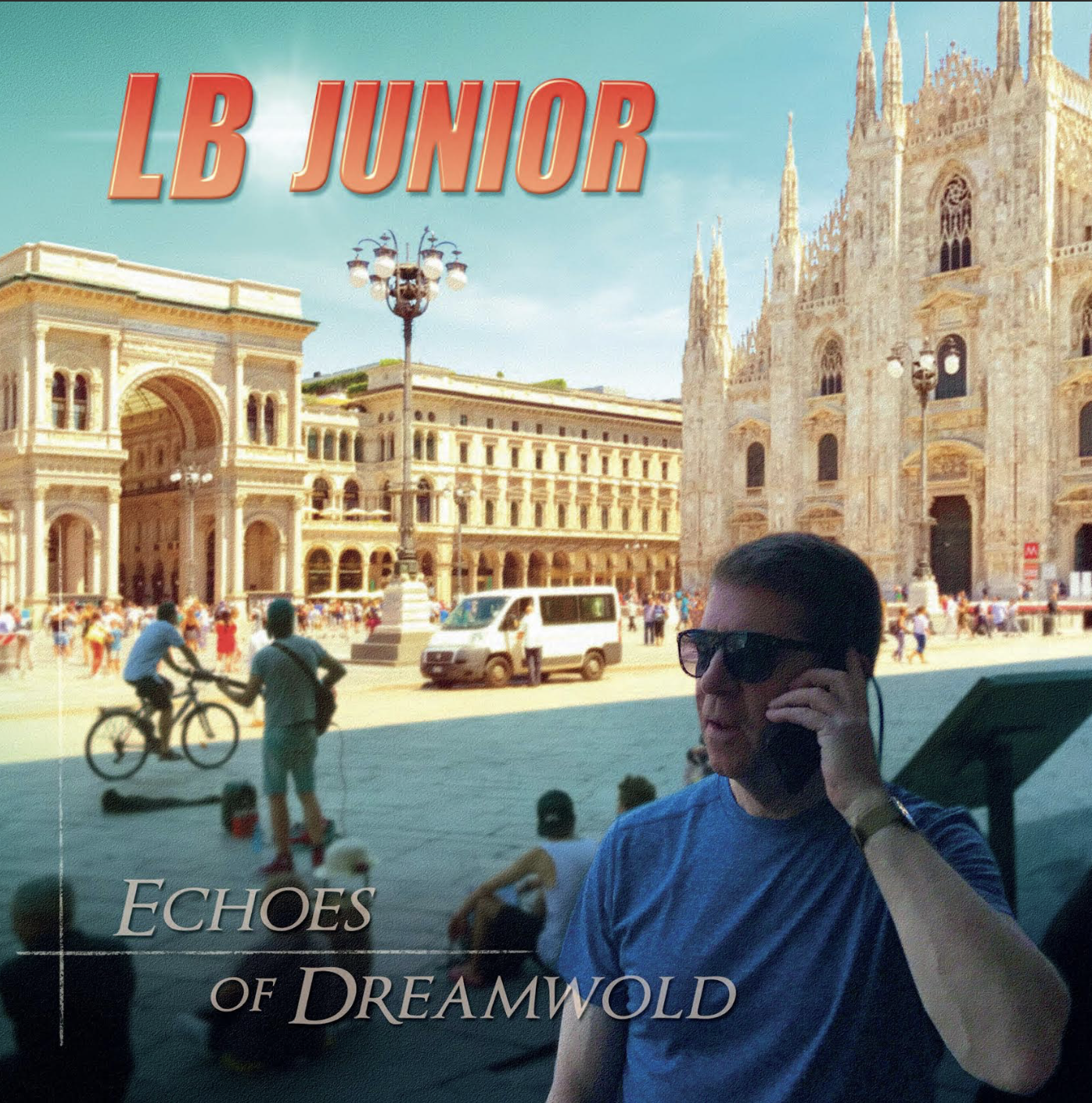 This 8-song collection by Linc Bloomfield (also known as Ambassador Lincoln Bloomfield Jr.), longtime bass player for Kelakos, showcases his songwriting, singing and overall musicianship, along with his studio engineering skills. After remixing and re-releasing the 1978 Kelakos album in 2015 as Kelakos Uncorked, Linc produced Kelakos’ second album, the 2023 Deko double LP release Hurtling Towards Extinction in which the collection of accompanying videos have racked up over one million views.
Echoes of Dreamwold is a true solo project. With the skillful studio work of two great drummers, Carl Canedy and Andy Hamburger, a sweet country pedal steel track by Billy Cooper on ‘No Second Chances’, and a classic lead guitar track by George Haberstroh on ‘(Got to) Save the World’, Linc sang all the vocals, played all the guitar, bass, keyboard and percussion tracks, and mixed every song, before they were mastered by Blaine Misner.
Listen to Echoes of Dreamwold here: https://push.fm/fl/nhz0a3fg
This album is meant to be played over and over, in the tradition of the sixties’ and seventies’ legends who inspired and influenced LB Junior’s own songwriting. No two songs are in the same genre. As he explains the origins of each of the songs
“Walk Away My Girl” is a soft-rock tale of heartbreak, originally written on his dad’s 1917 Steinway baby grand piano, on which he recorded this smooth, melodic track.
“Alive” explores the insecurity that holds many people back. Against a lively track derived from the reggae sounds heard on local radio on the island of Kauai, the lyrics are about coming to terms with self-doubts.
“Shot Down”, the first song Linc wrote after leaving Kelakos, in 1978, is a lively pop song featuring bright acoustic guitar harmonics and chords, and a story about how not to try and meet women.
“Greedy Child”, also written years ago, captures the sadness as the giants from the golden age of rock and pop music pass from the scene and along with it, a generation for whom their music was the soundtrack of their lives.
“(Got to) Save the World” reflects Linc’s life’s work promoting international security. This fast-paced rocker featuring George Haberstroh’s lead guitar and Andy Hamburger’s relentless backbeat, is a wake-up call to do something about armed conflict, mass shootings, and environmental destruction, and realize what is at stake.
“The (2nd) Fiddler’s Song” is a personal message set to a soft acoustic track, in which LB JUNIOR explains why contributing to something worthy and necessary is more satisfying than chasing personal glory.
“No Second Chances” is a country song, pure and simple, featuring Billy Cooper’s pedal steel licks and the distinctive rich tone of Linc’s 1955 Gretsch Country Club guitar.
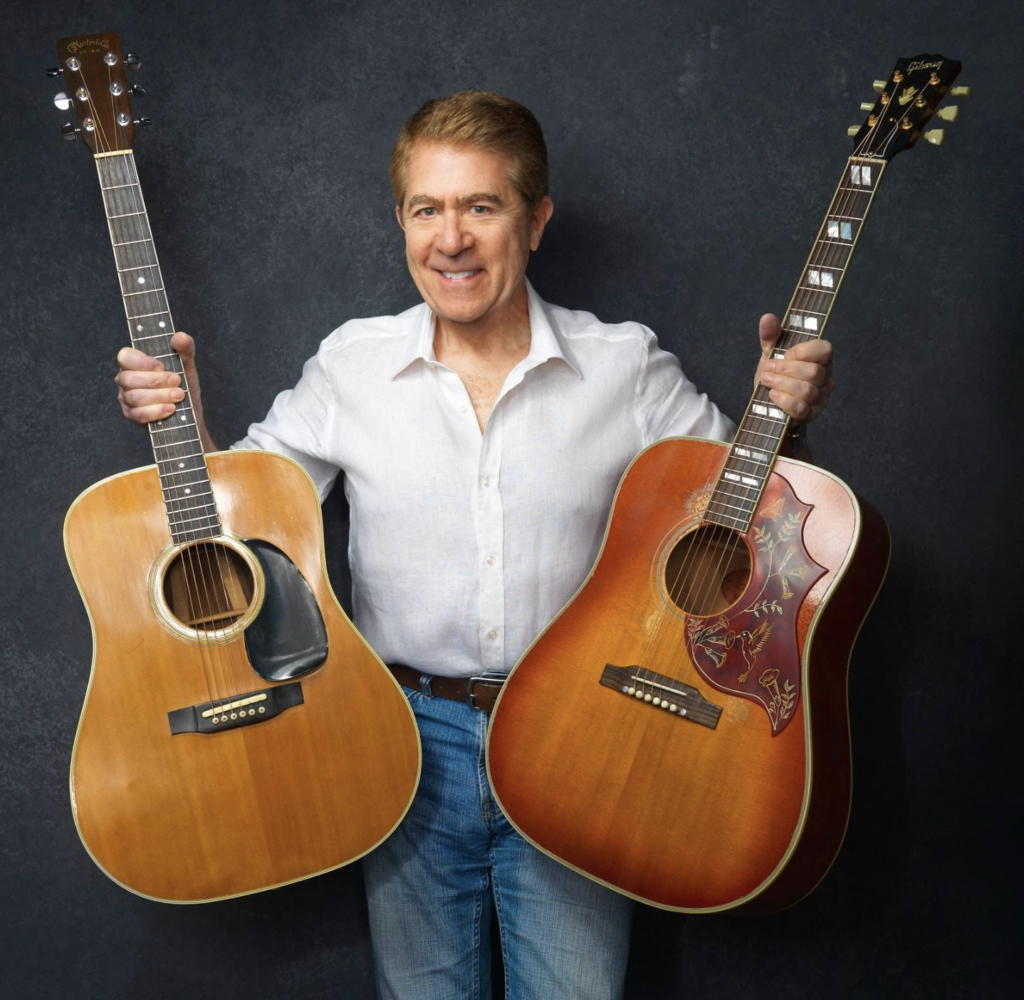
Linc Bloomfield
“Sand in My Hourglass” completes the 8-song set with a blues song, inspired by the recent pandemic, and showing LB JUNIOR’s chops on his 60s Les Paul guitar – inspired long ago, in 1968, when teenage Linc saw a memorable performance by bluesman Mike Bloomfield accompanied by Al Kooper and his whipping Hammond organ sound. This one is a real ‘echo’ of late sixties’ Dreamwold, as Linc’s earlier band Emergency Exit used to perform Kooper’s classic tune with Blood, Sweat, and Tears, ‘I Love You More than You’ll Ever Know’
Dreamwold was a grand estate built in 1901–1902 by financier Thomas W. Lawson in Scituate, Massachusetts. By the late 1960s, the ballroom had become a popular venue for live music. One of the regular performers was Emergency Exit, from nearby Cohasset, that included Linc, George Haberstroh, and Mark Sisson, who would later join Carl Canedy to form Kelakos. The band had a homemade light show, black lights, and a vintage Kustom P.A. system wrapped in sparkling Naugahyde. The Dreamwold estate was eventually redeveloped into condominium residences.
Order the vinyl of Echoes of Dreamwold while supplies last: https://www.dekoentertainment.com/inthesquare/lb-junior
TRACKLIST:
Alive
Shot Down
Greedy Child
(Got to) Save the World
The (2nd) Fiddler’s Song
No Second Chances
Sand in My Hourglass
For more information, visit
www.dekoentertainment.com
Deko Entertainment–Art Has Value
Judy Collins Suite Judy Blue Eyes Farewell Tour Adds Dates – Special Guests for 2026-2027
Press Release
Source: Think Press

Judy Collins – Photo credit: Shervin Lainez
Legendary singer-songwriter, Judy Collins – who celebrates her 87th birthday today – will embark on her highly anticipated “Sweet Judy Blue Eyes” farewell tour beginning July 4, 2026. Spanning iconic venues and cities across North America and beyond through winter 2027, this milestone tour has added dates and special guests.
Additionally, The Americana Music Association announced a special “Judy Collins and Friends” celebration at the 2026 AmericanaFest in Nashville in September. This final farewell tour will be captured on film for a forthcoming documentary on Judy’s life, music and legacy.
The tour kicks-off on July 4, 2026 with Judy headlining the live, star-studded PBS nationally televised Independence Day event “America Made In Virginia: 250 Years Together” celebration hosted by Virginia’s American Revolution 250 Commission (VA250) in Colonial Williamsburg, the capital city of revolutionary Virginia.
Throughout the tour, select dates will feature special guests including the newly confirmed August 30th performance at Tanglewood, featuring Mary Chapin Carpenter, Rosanne Cash, and Amanda Shires. Other guests confirmed along the tour are Richard Thompson, The High Kings, Bruce Cockburn, Elles Bailey, Livingston Taylor and Norwegian duo Oakland Rain, who are also filming the tour for a forthcoming Judy Collins documentary. Visit https://www.judycollins.com/ for specific guest appearance

Judy Collins – Photo credit: Patrick Donovan
Following the main tour, Judy will present the “Sweet Judy Blue Eyes – Celebration Encore,” a special series of encore performances for devoted fans and new audiences alike – an opportunity to celebrate six decades of musical brilliance with one of folk’s most treasured artists.
A 7-time Grammy nominee, Collins is an award-winning folk singer-songwriter who has released 55 recordings during her prolific career. She has released six albums since 2015 alone, and her Grammy nominated 2023 album Spellbound is her first of all original, self-penned songs. Collins is also a published author, filmmaker, keynote speaker for mental health and podcast host. In 2025, Judy Collins released Sometimes It’s Heaven: Poems of Love, Loss and Redemption – personal poems about love, loss and redemption.
Film About The First Black Hippie With Iggy Pop And Patti Smith Hits The Festival Circuit
Press Release
Source: Adrenaline PR
 The Song of Hiawatha: The Life and High Times Of The First Black Hippie is a feature-length documentary chronicling queer political activist and musician of African-American and Native-American ancestry, Hiawatha Bailey, recognized as the first black hippie.
The film traces Hiawatha’s path as part of the African-American “great migration” from the Deep South to Detroit in the 1950s, “turning on” to LSD and joining a commune in 1965, becoming the only Black member of a revolutionary cadre known as the White Panthers in 1968, serving a four-year prison term, starting a musical outfit in prison, and forming the Cult Heroes, a punk rock band, in 1978.
The cast includes a select array of rockers and activists (two were on the FBI 10 Most Wanted List): Hiawatha Bailey, Iggy Pop, Patti Smith, Wayne Kramer, John Sinclair, Cheetah Chrome, Niagara Detroit, Ron Ashton, Pun Plamondon, Professor Judson Jeffries, Leni Sinclair, Genie Plamondon, David Fenton, Lawrence Livermore, John Brannon, Maxie Chanel, Jennifer Holiday Chanel, and Deniz Tek. Documents include a letter from FBI Director J. Edgar Hoover, a landmark Supreme Court decision, a contract signed by John Lennon, and many never-before-seen photos dating back beyond the 1960s. The soundtrack features music by The MC5, The Rationals, Cult Heroes, John Brannon’s pre-Negative Approach band Static, and African-American punk rockers Pure Hell, with additional scoring by Elan Portnoy (Fuzztones).
The Song of Hiawatha floats along in a psychedelic haze as it touches on sensitive issues of race, rock, radicalism, sexual identity, prison life, and antiquated drug laws, so smoke ‘em if you got ‘em. Can you dig it?
“This film has the potential to tell a different story about the American rock counterculture than the one we are used to hearing.” – James Sclavunos, Nick Cave and the Bad Seeds
“This film will illuminate fundamental questions about past events by offering a particularly fresh look at the New Left and its complex relationships to culture and society. So doing, it will beckon audiences to join in understanding the complex configuration of elements that compose the American experience.” — Professor Ira Katznelson, History and Political Science, Columbia University
“The film chronicles the activities of the Black Panthers, the White Panthers, FBI surveillance, and how it all came together to shape the character of one counterculture punk rocker.” — Ann Arbor Observer

Producer Biography – Steven Blush
STEVEN BLUSH got his start in the 1980s promoting hardcore punk rock shows in Washington, DC. He published the award-winning Seconds Magazine and served as music editor for the late, great PaperMagazine, where he became the first writer to cover both rock and hip-hop.
His journalism has appeared in over 25 publications, including: Spin, Details, Interview, The Village Voice, and The Times of London. Blush has written ten books about rock and pop culture, culture — American Hardcore (2001), American Hair Metal (2005), .45 Dangerous Minds (2006), American Hardcore: Second Edition (2010), Lost Rockers (2016), New York Rock (2017), American Hair Metal: Can’t Get Enough (2023), and the trilogy of When Rock Met Disco (2023), When Rock Met Reggae (2024) and When Rock Met Hip-Hop (2026) — as well as Bustin’ Balls (2010), about Billie Jean King’s rebel tennis league, currently in television development. He wrote and produced the critically acclaimed, theatrically released, Sundance-premiered documentary film American Hardcore (Sony Pictures Classics, 2006).
JEFFREY WENGROFSKY has made ten short films about figures in the cultural underground of his native Lower East Side of New York, from the Warhol superstar Taylor Mead and anarcho-theater director Judith Malina, to hippie noise lords The Godz. Wengrofsky is also the author of The Wolfboy of Rego Park (Far West Press). The Song of Hiawatha is his first feature film.

Jeffrey Wengrofsky
Prosody for Guitarists, Part 2: Phrase Contour and Emotional Weight
By: Steve Canfield

Photo credit: Tatyana Makariva
PART 1 covered syllable stress. PART 2 zooms out. The shape of a melodic line does as much emotional work as the words do.
In PART 1 we looked at syllable stress: how individual words carry natural emphasis patterns and how the melody either supports or fights those patterns. PART 2 zooms out one level. Beyond the word there’s the phrase, and beyond the phrase’s stresses there’s its shape.
The three phrase shapes!
Every melodic phrase has a contour. Most phrases fall into three basic shapes.
Rising. The phrase ends higher than it began. “I’ll see you to-MOR-row” on a rising line carries forward motion, a question, hope.
Falling. The phrase ends lower than it began. “We used to dance all NIGHT” on a falling line carries settling, arrival, resignation.
Arched. The phrase rises, peaks in the middle, and falls back home. “So I called her on the phone” with the peak on “called” and a descent through “on the phone.” Most natural speech sits here. The arch is the default shape for a statement of fact.
The interesting work happens when the contour of the line matches, or deliberately fights, the emotional content of the words.
Descending lines sell loss!
This might be the single most useful observation in the whole prosody toolkit. If your lyric is about loss, disappointment, resignation, or quiet grief, a descending melodic line will do half the emotional work for you. The words don’t have to strain. The contour does the selling.
Think of Leonard Cohen’s “Hallelujah.” The word itself is set to a four-note descending line in the chorus. The descent is mournful before the listener has even processed what the word means. Now imagine the same word set to an ascending melody. It becomes celebratory. Same word, opposite effect, entirely because of phrase contour.
When you’re writing a line about loss and it’s not landing, check the contour first. If your melody is arching or rising, the music is fighting the words. Try rewriting the phrase so it ends on the lowest note of the line. You’ll often find the lyric suddenly works without a single word changing.
E minor descending phrase (standard tuning):
e|–7—5—————|
B|———-8—7—5—|
G|———————-|
D|———————-|
A|———————-|
E|———————-|
Lyric: “She was gone by dawn”
Notes: B A G F# E
The final long vowel (“dawn”) lands on the lowest note. The descent does the emotional work before the listener has processed the line.
Ascending lines sell hope!
The inverse is true. If your lyric is about longing, possibility, pursuit, or unresolved yearning, an ascending line carries that forward motion. Ballads often save the ascent for the chorus payoff. The verses may arch or settle, and then the chorus lifts, suggesting the feeling of the song is still reaching for something.
A lyric that wants to feel aspirational but lives on a descending melody will always feel slightly resigned, no matter what the words say on the page. Flip the contour and the same words start to sell the hope they were trying to describe.
C major ascending phrase (standard tuning):
e|——-0—1—3—|
B|–1–3————-|
G|——————-|
D|——————-|
A|——————-|
E|——————-|
Lyric: “And one day we’ll fly”
Notes: C D E F G
The final long vowel (“fly”) lands on the highest note. The rise carries the forward motion the lyric is reaching for.
The arched phrase is a workhorse!
Most verse lines are arched, because most natural speech is arched. They rise into a peak and then resolve back home. Use arched phrases as your default. Save the explicit rising and falling contours for moments where the emotion of the lyric justifies the special treatment.
A common amateur mistake is making every phrase the same shape. Verses all arched, or every line rising into the chorus. Vary it. The contrast between a rising line and a falling line is one of the strongest expressive tools you have, and it costs you nothing but attention.
Vowels want length!
Prosody isn’t only about emphasis. It’s also about the vowels themselves. Long vowels (the “I” in “mine,” the “o” in “alone”) want longer notes. Short vowels (the “i” in “sit,” the “u” in “cup”) want shorter notes. Match the duration of the note to the natural duration of the vowel and the line sings smoothly. Pit a long vowel against a sixteenth note and the singer has to rush the syllable to fit, which sounds stilted regardless of the pitch choices.
This is one reason country and folk lyrics often end phrases on words like “moon,” “rain,” “alone,” “gone.” Those are long-vowel words that sustain naturally on whole notes. The instinct of a good lyricist is to pick words whose vowels want to ring out where the melody asks them to ring out.
A ten-minute rewriting exercise!
Pull up any song of yours that isn’t quite landing. For every line, mark the contour: rising, falling, or arched. Now ask yourself a single question: does the contour match the emotional content of the line?
– If the line is about loss and arches upward, you’ve found a rewrite target.
– If the line is about hope and falls downward, you’ve found a rewrite target.
– If every line in the verse has the same shape, the verse will feel monotone and you can break it up by changing the shape of one middle line.
You don’t have to change the words. You often just need to change the shape of the melody.
Putting it together!
Prosody is a discipline of listening. Strong syllables want the strong beats. Long vowels want long notes. The shape of the line wants to match the shape of the feeling. None of this is complicated, but all of it requires slowing down a little on the lyric side and letting the words guide the melody as much as the other way around.
The songwriters whose lyrics feel inevitable are almost always the ones who’ve internalized these habits until they don’t have to think about them. The rest of us can get there the slow way, one line at a time, one rewrite at a time.
Write with your hands on the guitar, by all means. But say the line before you sing it, and check the shape of the phrase against the shape of the feeling. Your songs will thank you for it.
Prosody for Guitarists, Part 1: Syllable Stress and Why Your Best Lyrics Sometimes Sing Flat
By: Steve Canfield
PART I – Prosody For Guitarists
PART 2 – Soon!

Rick Landers – Photo credit: Steve Pendlebury Media
Every guitarist has written a line that looks great on the page and fights the melody when you try to sing it. Here’s what’s happening, and how to fix it in 30 seconds per line.
Every guitarist has written a line that looks great on paper and then fights the melody when you try to sing it. The words are right. The chord progression is right. But something is still off. In almost every case I’ve seen, the culprit is prosody.
Prosody is the rhythm, stress, and intonation of spoken language. It’s the reason “REC-ord” (the noun) sounds different from “re-CORD” (the verb). It’s the reason a lyric can scan perfectly on the page and still land wrong when you sing it. When a melody fights the natural stress of the words, the listener feels it even if they couldn’t name what’s wrong.
This is a two-part piece. Part 1 covers syllable stress, the first and most underused tool in matching lyrics to melody. PART 2, covers phrase contour and how the shape of a melodic line carries emotional weight.
The Strong Syllable Rule
Every English word of more than one syllable has a pattern of strong and weak syllables. “Guitar” is weak-STRONG. “Music” is STRONG-weak. “Am-BI-gu-ous” is weak-STRONG-weak-weak. Native speakers never have to think about this; we just know it.
When you sing a word, your melody assigns emphasis to syllables through pitch and duration. Higher notes and longer notes feel more accented than lower, shorter ones. If your melody emphasizes the wrong syllable, the line sounds awkward even when the listener can’t articulate why.
A classic example: a songwriter writes the word “forever” onto a melody that lands the high note on “FOR-ev-er.” But “forever” is “for-EV-er.” The melody is fighting the word. The listener’s ear expects the emphasis on “EV,” gets it on “FOR,” and the line feels stilted.
This is a fixable problem, once you know to listen for it!
The “Say it, don’t sing it” Test
Before committing a line, say it out loud in the rhythm of your intended melody. Not sung. Spoken, with the same emphasis pattern your melody is about to use. If the spoken version feels natural, the sung version will too. If the spoken version sounds stilted or robotic, the melody and the words are fighting each other.
This works in reverse too. If a line is bothering you in a song you’ve already written, speak the words in the rhythm of the melody. The awkwardness will either disappear (meaning the problem is elsewhere) or it becomes obvious.
Three Ways To Fix A Line That Fights Itself
In order of how much they cost you as the writer:
1. Change the word. If “forever” is fighting your melody, what about “always”? “AL-ways” starts with the strong syllable. If the emphasis in your melody lands on beat 1, “always” sings naturally where “forever” won’t. This is usually the cheapest fix.
2. Change the rhythm. Shift the whole phrase by a beat or an eighth note so the strong syllable falls on the stronger beat of the bar. Often a small timing adjustment is all it takes.3. Change the melody. Move the accent note to the strong syllable of the word. This is the heaviest fix and often the one we reach for first when we should try 1 and 2 first. Changing the melody costs more of the song than we think.
Many writers default to option 3 when the fix they actually needed was option 1. The right word for a given melody is sometimes just one thesaurus entry away from the word you first chose.
Why Guitarists In Particular Miss This!
We write with our hands on the instrument. The chord change often dictates where a phrase starts, and the rhythm of the music gets fixed before the rhythm of the words is even considered. A great line that wants the downbeat gets shoved into the off-beat because that’s where the chord lands. A two-syllable word with stress on the second syllable gets sung as if the stress were on the first, because the first syllable happens to fall where the right hand hits.
The fix is to slow down a little on the lyric side. Say the line out loud before you commit it. Hear the natural stress pattern before the melody locks it in. This takes some extra time but pays for itself tenfold by the end of the song.
A One-Minute Exercise
Take any line from a song you’re currently writing. Speak it aloud in the rhythm of the melody you have in mind and listen for the strong syllables. Now look at the bar. Which beat does the strong syllable land on? If it’s on the downbeat of the bar or a strong secondary accent, you’re in good shape. If it’s on a weak beat and an unrelated word is hogging the downbeat, you’ve found your rewrite target.
Do this for every line of the verse, then every line of the chorus. By the end you’ll either confirm the song is already working, or you’ll have a short list of rewrites that will noticeably tighten the whole thing.
In PART 2, we’ll zoom out from the word to the phrase and look at melodic contour: how rising, falling, and arched lines carry different emotional weight, and why descending phrases sell loss while ascending phrases sell hope.
Reba McEntire Celebrates 50 Years With Multiple Music Releases
Press Release
Source: The Green Room PR
Reba McEntire will begin releasing music capsules each month, thematically curated songs from throughout her career paired with brand new recordings that spotlight the road ahead for the iconic entertainer. The first release, ONE NIGHT IN TULSA, centers songs around her home state and will be released this Friday, April 17 via MCA and is available for pre-save HERE.
 On April 9, McEntire previewed the project during a special performance at her restaurant Reba’s Place, where she debuted a new song and title track of the first capsule “One Night In Tulsa.” Written by Neal Coty, Kylie Frey and Thom McHugh, the song marks a return to the ’90s country ballads that cemented McEntire’s place as one of the genre’s most definitive voices of heartbreak.
ONE NIGHT IN TULSA
- “One Night In Tulsa”
- “Tulsa Time”
- “Oklahoma Swing”
- “Does The Wind Still Blow In Oklahoma”
- “No U In Oklahoma”
Each digital music capsule pairs a newly recorded song with carefully selected tracks that trace the evolution of one of country music’s most enduring and influential voices. In tandem with each music capsule, tailored playlists will launch to further illuminate the defining eras of McEntire’s career. Beginning May 1 with “The Making of Reba,” the first playlist captures a young McEntire finding her voice through classic country heartbreak, laying the foundation for everything to come. The playlists serve as a companion piece, offering fans a deeper, more expansive look at the moments, milestones, and music that shaped her legacy.
About Reba McEntire:
Multi-media entertainment mogul Reba McEntire has become a household name through a successful career that includes music, television, film, theater, retail and hospitality. The Country Music Hall of Fame and Hollywood Bowl member has more than 50 award wins under her belt, earning honors from the ACM Awards, American Music Awards, People’s Choice Awards, CMA Awards, GRAMMY® Awards and GMA Dove Awards. Reba was also a 2018 Kennedy Center Honors recipient, in addition to multiple philanthropic and leadership honors. Reba has celebrated unprecedented success, including 35 career No.1 singles and more than 58 million albums sold worldwide. Reba earned her 60th Top 10 on the Billboard Country Airplay chart, extending her record for the most Top 10 hits among female artists. Reba’s Top 10 success spans five straight decades, landing her in the singular group with only George Jones, Willie Nelson, and Dolly Parton who have the same achievement. Most recently, her latest single, “Trailblazer,” featuring Lainey Wilson and Miranda Lambert, garnered an impressive 2.6 million on-demand streams in its first week, marking a new personal best for Reba in the streaming era. The Oklahoma native and Golden Globe® nominated actress has multiple movie credits to her name, a critically-acclaimed lead role on Broadway in Irving Berlin’s Annie Get Your Gun, and starred in the 6-season television sitcom Reba. Reba has also proven to be a savvy entrepreneur, with longstanding brand partnerships including her Dillard’s clothing line and western footwear collection REBA by Justin . She has even added restaurateur to the list with Reba’s Place, a restaurant, bar, retail and entertainment venue in Atoka, Oklahoma. Her book Not That Fancy landed on the New York Times bestseller list. For more information, visit www.Reba.com.
The most popular guitar fair in Europe: Guitar Summit in Mannheim, Germany
By Carlos Martin Schwab
 Following the death of Musikmesse (which was more significant than NAMM for many years), several guitar trade shows emerged in Europe. Guitar Summit is the most important one. Let’s take a closer look at it.
Organized by the German magazine Gitarre & Bass since 2017, this fair was designed as a 360° event that combines a trade show with a music festival, workshops, and masterclasses.
Over time, the fair has continued to grow: in its 2025 edition, it welcomed over 11,300 visitors, featured more than 470 international brands spread across the venue’s different levels, and hosted over 100 workshops, masterclasses, and live concerts during the three-day event (September 26–28).
The fair is usually divided into themed areas that help organize the large number of booths. The booths are spread across four floors, including specific areas for electric guitars, acoustic guitars, basses, and the popular “Pedal Show.” In 2025, innovations in digital modeling and the presence of independent luthiers in the Boutique section stood out in particular.
Silent Fair
This trade show describes itself as a “Silent Show.” This concept is one of its cornerstones and sets it apart from traditional music trade shows (such as the former Frankfurt Musikmesse or NAMM), where the constant noise can often be overwhelming. Here’s how it works in practice:
Equipment testing with headphones: The golden rule for exhibitors is that open-volume amplifiers are not allowed at the trade show booths. If you want to test a guitar, bass, or pedal, you do so almost exclusively through high-quality headphones. This allows you to hear the instrument’s true nuances without being distracted by noise from the neighboring booth and lets visitors hold conversations at a normal volume without having to shout.
Silent stages: Even the workshops and demonstrations held in the middle of the exhibition halls use this system. The audience receives wireless headphones as they approach the stage, and the musician plays and speaks through a monitoring system, so that only those wearing headphones can hear the performance. This allows multiple stages to operate simultaneously on the same floor without acoustic interference.

Soundproof rooms: For those who need to feel the sound pressure of a real amplifier, the event offers specific solutions: Ampfinity, a special area where you can test selected amplifiers and speakers using a professional switching system, often in isolated booths, and soundproof cabins installed at some large booths where you can close the door and play at full volume for a few minutes without disturbing others.
Nighttime concerts (the exception): The Silent concept applies primarily to the exhibition area during the day. At night, the event moves to the Mozartsaal, where rock, blues, and metal concerts are held using traditional sound systems at festival volume.
The “Silent” concept aims to protect attendees’ hearing health (preventing tinnitus after 3 days at the show) and ensure that the focus remains on sound quality and technical discussions between manufacturers and musicians.
Musicians I saw there: Andy Timmons, Tosin Abasi, Misha Mansoor, Plini, Alex Skolnik, Mike Dawes, Billy Sheehan, Michael Weikath & Sascha Gerstner (Helloween), Sacha Dunable (Intronaut), Mattias Eklund (Freak Kitchen), John Browne (Monuments). It’s also common to run into Europe’s most popular guitar YouTubers.
Some of the items on display that caught my eye:
Fretlook: Fret markers, neck side markers (glow in the dark) and body decals – fretlook.com
Franck Bichon: Removable shoulder pad for guitar strap – https://bgfrance.com/en/bg-rocks-straps-and-guitar-accessories/461-comfortableremovable-shoulder-pad-for-guitar-straps.html
Dan’s Guitar Store: Precision playing picks – https://www.dansguitarstore.com/precision-guitar-picks-explained
Plick The Pick: Ergonomic picks – plickthepick.it
Tonewood Amp: A device that uses an acoustic guitar’s own body and soundhole to create a range of enhancement effects – tonewoodamp.com
Valeton: GP-5 pedal multi effects processor – valeton.net/product/gp-5
Maytrem: Fully customizable guitar vibrato system that can bend chords in harmony – maytrem.com
More info at guitarsummit.de/?lang=en
Song Cage Launches: A NO-AI Songwriting Canvas For The Pre-DAW Phase of Writing
Press Release
Source: Song Cage PR
Song Cage – A new browser-based tool gives songwriters one place to capture lyrics, chords, melody, and song structure, with context-aware chord reasoning, a modulation panel that maps the way back home, and built-in tools for breaking writer’s block.
 Song Cage, a new browser-based songwriting app, launched this week with a distinctive design philosophy: no generative AI anywhere in the product. Every chord suggestion is deterministic music theory, labeled by its functional role and explained in plain language given the surrounding chords and the melody underneath.
Song Cage is designed for the pre-DAW phase of writing, the space where a songwriter sits with an instrument and a notebook, developing an idea before any recording begins. The app combines four layers (lyrics, chords, melody, and song structure) on a single canvas with two interchangeable views. Sheet view feels like a notepad, letting words flow naturally. Timeline view snaps every word onto a beat grid with syllable-level precision, so prosody can be shaped directly on the grid.
Key features include:
Context-aware chord suggestions. Every suggestion is labeled by its functional role (diatonic, borrowed from a parallel mode, secondary dominant, tritone substitution) and hovering reveals the reasoning for why it works given the surrounding chords and the melody beneath. Named progression patterns such as the Pop progression, 50s progression, and Andalusian cadence are flagged automatically.
Modulation with return routes. The modulation panel includes a Key Map showing harmonic distance to every key, pivot chords for smooth transitions, and full cadential routes (V-I, ii-V-I, tritone substitutions, extended paths). Unique to Song Cage, the panel also surfaces return routes, so the songwriter can take a harmonic journey into a distant key and find the way back home without getting stranded.
Lyric writing tools for writer’s block. A Words panel that follows the cursor offers rhymes grouped by syllable count, slant rhymes, synonyms, a Word Collider that pairs words from two semantic pools via a random bridge word, and semantic drift chains for wandering through an idea space.
Multi-user collaboration. Songs can be shared with up to five editors via email invitation or share link, with background sync across devices.
Guitar-first design. Real chord shapes on a mini fretboard, capo awareness, voicing carousel, and strum preview on every chord block. Piano voicings include voice-leading optimization.
“I built Song Cage for the thing I actually do with an instrument in my lap, before I hit record,” said Steve Canfield, founder and developer of Song Cage. “Nothing in this tool generates music for you. Every suggestion is real theory, and everything is aware of everything else. Change a melody note and the chord rankings reshuffle. Place a chord and the suggestions for the next slot recalculate. The craft stays in the user’s hands; the tool just makes the reference books live in the same canvas as the writing. The UI is designed for quickly getting ideas out without friction.”
A native iOS and Android capture companion, for recording voice memos and sending lyric and chord fragments to an inbox in the desktop app, is in development and expected for release later in 2026.
Song Cage is available at songcage.com. Free and paid tiers are offered, priced in line with comparable songwriting tools.
ABOUT SONG CAGE
Song Cage is a browser-based songwriting canvas for the pre-DAW phase of music writing. Designed and developed by Steve Canfield, it combines lyrics, chords, melody, and song structure on one grid, with built-in writer’s-block tools, context-aware chord reasoning, and multi-user collaboration. Song Cage is the no-AI alternative in a category dominated by generative tools.
Gruene Guitars Donation to Guitars 4 Veterans of a Gruene Saratoga Dreadnaught
Press Release
Source: Guitar International PR
Yesterday’s guitar donation to Guitars 4 Veterans (G4V) was very special. The guitar an all-solid body Gruene Saratoga with Honduran mahogany b/s, Alpine spruce top (aged 15 years), maple binding, natural abalone inlay with a headstock torch donated by Gruene guitars owners – John and Peggy Byers of San Antonio, Texas.

(L-R) Rick Landers presents a Gruene Saratoga dreadnaught to Robert Grealy| G4V Chapter Coordinator | Washington D.C. Region.
John retired from the U.S. Coast Guard and donating this to G4V’S was chosen to support and honor our military veterans. John had provided a few of his fine guitars to a local veterans’ group before he passed away from cancer.
At the most recent graduation of veterans who successfully completed G4V’s free guitar lessons program, Rick Landers, publisher/editor, Guitar International magazine, served as an intermediary to present the guitar to Robert Grealy, Washington, D.C. Region Coordinator, of the outstanding veterans support organization.
The high end guitar will be sold by the support organization with proceeds to go to buying entry level guitars for the novice guitar playing vets, many disabled and working hard to meet their challenges, and learning to play has been a huge, sometimes life saving success!
CHECK OUT GUITARS 4 VETERANS HERE!

Thomas Rhett Earns 25th No. One Milestone In Under 15 Years
Press Release
Source: The Green Room PR
 Diamond-certified superstar Thomas Rhett celebrates his 25th career No. One as “Ain’t A Bad Life” ft. Jordan Davis tops the Mediabase/Country Aircheck chart this week. Written by Thomas Rhett, Ashley Gorley, Blake Pendergrass, John Byron and Mark Trussell, the track “takes on a bright, acoustic sound, injecting a fresh breath of optimism” (Holler), delivering “charm and catchy melodies” (Country Central).
This achievement stands out not only for its sheer volume, but for the remarkable speed and consistency with which he’s dominated the charts in the 14 years since releasing his very first single.I’m really grateful to the fans, country radio, and everyone who’s been on this ride with me—this one means a lot.”
Joining “Beautiful As You” and “After All The Bars Are Closed,” the acclaimed single marks the third No. One from Thomas Rhett’s newest album, ABOUT A WOMAN (Deluxe). The “energized and upbeat” (Forbes) 25-track project born of charismatic craftsmanship, feel-good energy and his beloved awestruck romantic authenticity combine in a creative high-water mark. It also features collaborations with Lanie Gardner, Blake Shelton, Teddy Swims and Tucker Wetmore—showcasing why he continues to be one of Nashville’s most versatile hitmakers.
Thomas Rhett recently announced his return to the road this summer, bringing his “bombastic, good-time energy” (Esquire) to venues across the country on the SOUNDTRACK TO LIFE TOUR. The 20+ city run will feature two special stadium dates this July with longtime friend Niall Horan at GEODIS Park and Hersheypark Stadium. In addition to his headlining tour, Thomas Rhett is appearing with Morgan Wallen on his Still The Problem Tour and will make his highly anticipated return to the U.K. this summer for a three-night run at Wembley Stadium with Luke Combs.
Pairing a laid-back perspective with a vocal drenched in casual country soul, Thomas Rhett has spent just over a decade building one of country music’s most consistent hitmaking careers with more than 16 billion streams and armfuls of awards, including eight ACM Awards—among them “Entertainer of the Year”—two CMA Awards, five GRAMMY® nominations and trophies from the CMT Music Awards, Billboard Music Awards and iHeartRadio Music Awards; he has also received five CMA Triple Play Awards for penning three No. One songs within a 12-month period.
He’s just teamed up with GRAMMY®-nominated global artist and producer Marshmello on their new single “Where We Go” and recently released a fresh take on “Georgia On My Mind” as part of ESPN’s official campaign for the 2026 Masters Tournament. For a full list of upcoming dates and new music updates, visit ThomasRhett.com and follow along on Instagram // Facebook // TikTok // Twitter / X // YouTube.
Pages
