
Music is the universal language
“Glory to God in the highest heaven, and on earth peace to those on whom his favor rests.” - Luke 2:14
Guitar.com

Guitarist apologises after guitar-throwing stunt sends audience member to hospital

Japanese punk outfit Otoboke Beaver have apologised after guitarist Yoyoyoshie threw a guitar into the crowd at a show earlier this year, accidentally striking and injuring an audience member.
The incident happened during the band’s April show at Umeda Club Quattro in Osaka, Japan. The audience member was taken to the hospital by ambulance, where they were treated for a forehead laceration requiring seven stitches, as well as a cervical sprain.
Otoboke Beaver addressed the incident publicly on 11 August, writing on Instagram that they “wish the injured person a full recovery” and acknowledging: “we caused this accident.”
Beyond the physical injuries, the band said the incident had also caused the fan “significant emotional distress”.
The group – comprising singer Accorinrin, guitarist Yoyoyoshie, bassist Hirochan and drummer Leo – also admit that their response in the aftermath was not as swift as it should have been.
“Coordination between us and the staff member entrusted to act as the point of contact that day, as well as our follow-up response, was not prompt, resulting in a delay to both our direct apology and public statement.”
They added that the apology was being made “in good faith” before concluding: “We are truly sorry.”
The Osaka show was a significant one for Otoboke Beaver beyond the incident, as it marked a farewell to former drummer Kahokiss, who stepped away from the band to go on maternity leave. She was subsequently replaced by Leo.
The post Guitarist apologises after guitar-throwing stunt sends audience member to hospital appeared first on Guitar.com | All Things Guitar.
Soundgarden’s Kim Thayil says it’s “emotionally draining” working on new material using vocals Chris Cornell recorded before he died

Soundgarden’s Kim Thayil says working on new material featuring Chris Cornell’s vocals has been a draining experience, but feels it would be a “disservice” to the fans and the band for them not to release them.
Cornell died by suicide in May 2017. Thayil revealed last year that the bwere planning to release the final album they worked on with Cornell before his passing, and that it had always been a goal for them to complete the record as a gift to the fans, and to Cornell too.
Now, speaking to Guitar World, Thayil shares that the process has been challenging emotionally, but exciting at the same time. Though he confirms they do not have a release date in mind yet, he does say it will “definitely sound like Soundgarden”.
“It’s emotionally draining and there are things about it that are sad and melancholic. But at the same time, it’s exciting to finish the work that we started with Chris. It’s a tribute to Soundgarden and a tribute to Chris. To not do this would be a great disservice to everyone, including the fans who knew we were in a writing cycle while we were touring,” he states.
“I made an aphorism earlier about having too many cooks in the kitchen. Well, now we have one less. But we have these recordings Chris is on, and we all have a strong understanding of Chris’ identity within the band, so we are going to honour that completely, even though Chris isn’t there to throw in his two cents. So, yes, it will definitely sound like Soundgarden and I’m going to sound like me.”
Last month, Taylor Momsen of The Pretty Reckless shared her thoughts on Cornell’s work, and how it had impacted her life. The Pretty Reckless supported Soundgarden on their final tour with Cornell.
“I’ve listened to his solo work and to Soundgarden so many times, but every time I listen to them, it evokes something different in me,” she told NME.
“There is the sheer amount of depth and sensitivity and aggression… [but] also, it’s so smart. It’s musically exquisite and complex — like this never-ending onion where you discover something new about it and about yourself every time you listen to it. I think that is so powerful and so fucking rare. It’s coming from a place that’s so deep and so powerful that it touches your soul.”
The post Soundgarden’s Kim Thayil says it’s “emotionally draining” working on new material using vocals Chris Cornell recorded before he died appeared first on Guitar.com | All Things Guitar.
“I think you should stay there”: The great reason why Joe Bonamassa changed his mind about Jared James Nichols borrowing his guitar gear
![Jared James Nichols [main image] and Joe Bonamassa [inset]. Both are photographed on stage playing guitars.](https://guitar.com/wp-content/uploads/2026/08/jared-james-joe-bonamassa@2000x1500-2.jpg)
Jared James Nichols has been offering fans a peek behind the curtain on his new album, Louder Than Fate, and how a visit from Joe Bonamassa reframed both of their views on the amount of gear that should be used on a track.
Bonamassa has quite the reputation as a gear connoisseur, as his mighty Nerdville museum proves, but when he bought an entire rig over for Nichols to use on a track for his new album, the pair eventually settled on a less is more mind set, with a minimal set up.
- READ MORE: “Those amps are part of the DNA of rock music”: Jared James Nichols on becoming a Marshall endorsee
In an interview with Guitar World, Nichols says his use of gear forms not much of a long list “beyond the cable”. Though small and concise, he definitely utilised some pretty cool gems within his rig.
“I had the plexi and this special amp from Blackstar that’s a one-of-one, point-to-point handwired Series One. They’d made it for Jeff Beck but never got it to him. It’s more aggressive than the plexi, like an old JCM800. I used my Tube Screamer and for Runnin’ Hot I borrowed this [Electro-Harmonix Small Stone] big box phaser from the early ’80s,” he shares.
“The main guitars were Dorothy [his 1952 Les Paul Goldtop] and this Korina Futura for all the big-ass humbucker parts. I didn’t have to search when it came to tone. It’s funny; I remember doing this track with Joe Bonamassa, and he brought his whole rig over, saying to use whatever I needed. I brought my Marshall head, Dorothy and my Klon and started testing out tones with my stuff before asking him what I should try. His answer was, ‘I think you should stay there.’ That was it. I try not to overcomplicate things.”
Further speaking on his bond with Bonamassa and the Blues Titan’s connection to rare gear, Nichols looks back on the time he went to Bonamassa’s house to film a video on Gary Moore’s 1989 Soldano SLO-100 amp head (which you can watch below).
“Joe must have balls of steel because the amp hadn’t been serviced or even turned on. It literally just showed up in a shipping crate. It was like finding a classic muscle car, sticking some gas in and firing it up. Joe was cranking it right away with a 1959 Les Paul. In the video you can see the power sizzle down, shut off, then come back. It did that a few times. It’s like we were feeling Gary Moore’s spirit in the room,” he remembers.
Jared James Nichols’ Louder Than Fate is out now. Head over to his official website to find out where you can stream the album or buy a copy.
The post “I think you should stay there”: The great reason why Joe Bonamassa changed his mind about Jared James Nichols borrowing his guitar gear appeared first on Guitar.com | All Things Guitar.
Gretsch G2622TG Streamliner Ltd Ed Center Block Double-Cut with Bigsby review: “there are a million and one songs trapped inside this guitar, impatiently waiting to be unleashed”

$739/£549, gretschguitars.com
Gretsch guitars have always stood in a fascinating corner of the guitar world. Even music aficionados without a guitar-playing background know what a Stratocaster is, what it does, how it looks, and the fact Hendrix played one upside down. Similarly, fans with a penchant for the heavier side of the rock spectrum know the Les Paul ‘Burst in the gifted hands of Slash and Jimmy Page.
Gretsch guitars, however, have always seemed to exist in their own lane. From George Harrison’s early Merseybeat-jangle, to Tom Petty & The Heartbreakers’ signature songcraft, and Neil Young’s raw, jagged riffs, Gretsch guitars have become the choice for players who prioritise character over familiarity.
Into this comes the new Limited Edition G2622TG Streamliner – a guitar that seemingly offers a very affordable route to that rich heritage, with visuals that lean towards the most famous Gretsch big-bodied guitars, but will the reality match up to the first impression?
 Image: Adam Gasson
What is it?
The Streamliner designation of the ever-catchily named G2622TG means that it sits at the bottom of Gretsch’s three-tier production range after the Electromatic and premium Professional, but in truth you’d never notice from a distance. This is a beautiful instrument with the fancy elegance that has set the brand apart from the more utilitarian charms of its competitors.
In practice, that means a beautifully measured double-cutaway design finished in Vintage White (though the Midnight Sapphire option is also lovely), and paired with all the shiny gold hardware you could ask for. Some would say that a Gretsch is never fully dressed without a Bigsby, and here we get a lovely licensed B70 wobbler to pull the whole thing together.
The iconic “G” arrow logo on the control knobs never fails to make me smile, and the master volume knob includes a push/pull coil split option for extra Beatle-y twang when needed.
 Image: Adam Gasson
Usability and build quality
When the G2622TG landed in my hands, before I even played a note, I had an immediate sense that Gretsch might have hit a home run. It looks, feels, and sounds far more premium than its asking price would suggest.
The laminated body feels solid, and is wonderfully resonant, providing that airy sound that semi-hollow body players expect. The soft ‘C’ shaped neck nests comfortably in the hand, and the 22 nicely finished medium-jumbo frets give a sense of familiarity to the fingers for long-time Gretsch-heads. Combined with a low, comfortable action out of the box, they never get in the way and are an ideal bed for a wide-style of approaches.
Then, there’s the golden elephant in the room: the Bigsby B70. Many guitar purists still shoot a side-eye towards the B70, and other die-cast, affordable Bigsby ‘licensed’ models. After all, the B70s are manufactured overseas and cost a fraction of their US-made B7 counterpart. However, as we sit here in 2026, I think the B70 and B7 are almost identical in use.
Yes, the B7 is a touch heavier, and feels a tad more solid, but I barely notice a difference when comparing the two. The fact that a vibrato of this quality is bolted on to the G2622TG at this price point is still staggering to me. That expressive wobble is synonymous with thousands of classic recordings and should not be seen as merely an afterthought. It provides exactly what you’d hope – some slight shimmer and movement, without turning tuning into your new full-time job.
The controls are laid out in the typical Gretsch fashion, which is to say slightly different to the classic Gibson four-knob method. What you get instead is a volume knob per pickup, a master tone knob, and the previously mentioned, and extremely welcome push/pull coil splitting master volume knob.
In practice this means that the two pickup volumes are only really needed for blending, or if you want to use the volume to roll some of the gain off a sound on one pickup. The master volume is likely all you’ll need for actually controlling volume.
 Image: Adam Gasson
Sounds
This guitar’s tonal palette is fairly wide, whilst never sacrificing its character. That semi-hollow resonance instantly makes itself heard when plugging in – chords ring with authority, and lead lines are clear and articulate, with some satisfying snap about them in coil-split mode. To put it bluntly, this guitar sounds incredible. It just oozes Gretsch DNA and character.
The Broad’Tron BT-3S humbucking pickups are versatile, to a point, offering suitably punchy mids and predictably sparkling highs. Provided that you’re not going to push this thing into high gain territory, it can cover a lot of the rock-adjacent bases with aplomb.
The bridge pickup is clear, bright and spanky, with the sort of cutting midrange that makes it a usable clean twanger while also having plenty of ability to cut through when you start piling on the gain. Again, don’t expect to have your mind blown by the clarity and punch with excessive gain here, but everything up to this point sounds fantastic.
The neck pickup is a much thicker, more rounded affair that really shows its mettle when you add some distortion to proceedings – it’s chewy and meaty, and really suits bluesy lead lines.
The middle pickup offers a nice blend of both worlds that seems to be begging you to lean into the Hermanos Gutierrez vibes, add a bit of reverb and slapback, and start putting the Bigsby through its paces. It’s got a nice compressed quality when you add a bit of fuzz into the mix too.
Speaking of the Bigsby, provided that you don’t throw yourself too recklessly into extreme wangling, it stays in pitch nicely enough, though the nature of the beast means that its best suited to polite wobbles if you want to keep things in tune.
The coil-split does what you’d expect it to, bringing even more spank and twang on the bridge pickup, though you do lose a lot of the low-end – you have to be careful how and when you deploy it because there’s a real risk of things getting a little shrill here.
The middle and neck positions are more forgiving, and the blended sound in particular really opens up the sound, adding in some single-coil airyness to proceedings that can work really well as a contrast. Nobody is going to be mistaking this for a Strat any time soon, but it’s a nice extra option to have.
 Image: Adam Gasson
Should I buy one?
The Gretsch G2622TG Streamliner won’t be for players angling for tonal neutrality, or an ultra-modern feel and aesthetic. Instead, those wanting to immerse themselves into the world of Gretsch, with an instrument that is bold in character and elegant in design, this is the guitar for you.
Above all else, this just feels like it has the raw materials to take you on a journey as a musician and a songwriter. It’s a cliche to say that this guitar feels like it has songs in it, but that was my experience every time I picked it up to play.
The quality of its tones, the playability, and the versatility here means that you can easily find yourself coming across fresh inspiration, and there’s something so refreshing about that – especially for a guitar that is so competitively priced.
The $799 outlay not only gets you a guitar that looks, sounds and feels high-quality, but also grants you a lifetime membership into the Gretsch players club. The G2622TG doesn’t just make you want to play it over and over – it reminds you exactly why you fell in love with guitar in the first place.
 Image: Adam Gasson
Alternatives
The natural semi-hollow competitor for the G2622TG is, of course, the ES-335, and Epiphone’s version ($599/£599) is a very good guitar for the money. Another affordable take on the semi-hollow with bags of vintage pedigree is Guild’s Starfire I DC ($599/£659), while D’Angelico Premier DC ($799/£699) is another semi with a name from the annals of guitar history.
The post Gretsch G2622TG Streamliner Ltd Ed Center Block Double-Cut with Bigsby review: “there are a million and one songs trapped inside this guitar, impatiently waiting to be unleashed” appeared first on Guitar.com | All Things Guitar.
“I was just up my own arse” Johnny Marr recalls the moment he realised he was being “ridiculous” not playing The Smiths songs live

Johnny Marr has opened up about life after The Smiths, including the years he spent treating the band’s songs as too “precious” to revisit onstage.
Following the band’s acrimonious split in 1987, Marr says the idea of performing The Smiths’ material felt “wrong and raw” – until one very casual suggestion from a fellow musician changed his mind.
- READ MORE: “We lost your guitar… deal with it”: Johnny Marr blasts FedEx for losing Ella Feingold’s guitar
Speaking to MOJO, Marr recalls the moment during a 2001 soundcheck for Crowded House frontman Neil Finn’s charity project 7 Worlds Collide, when Finn suggested that Marr play The Smiths’ There Is A Light That Never Goes Out.
“[For years], the idea of performing Smiths songs felt wrong and raw and just very, very precious. Too precious,” he says. “He just assumed that it would be absolutely fine me doing a Smiths song that day. He went, ‘Hey, Johnny, how about doing There Is A Light?’”
Finn’s matter-of-fact attitude made Marr realise just how much he had been overthinking it.
“And in that moment I saw how ridiculous it was to be so precious,” the guitarist explains. “He didn’t say it, but it was like I was just up my own arse.”
The realisation came after Marr had already spent years carving out a career beyond The Smiths. After the breakup, he worked with artists including The The and Electronic before joining Modest Mouse in 2006, an experience that reignited his enthusiasm for live shows.
“My role was to be the guitarist in Modest Mouse. It really got me back into playing live,” says Marr. “And it showed me a new way of writing as a lyricist. Modest Mouse and The The were very alike. A lot of testosterone.”
Elsewhere in the chat, Marr also reveals a particularly memorable conversation with former Beatle Paul McCartney after The Smiths’ breakup.
“[McCartney’s wife] Linda was so generous as a person, she was asking me all about my life. And he was sat there so I just told him about the break-up of the band. I looked to him and waited and he just said, ‘That’s bands for you.’”
“It’s such a brilliant answer coming from him,” says Marr. “Over the years, I’ve been asked to give advice. There is just a time to say, ‘That’s bands for you.’”
The post “I was just up my own arse” Johnny Marr recalls the moment he realised he was being “ridiculous” not playing The Smiths songs live appeared first on Guitar.com | All Things Guitar.
Joe Bonamassa’s second collaboration with Martin is a stunningly accurate recreation of his prized pre-war 1937 00-18

Joe Bonamassa’s got one of the most impressive vintage guitar collections in the biz, so big that it has to be housed at two museum-style locations in Nashville and Los Angeles. And among his collection sits a 1937 Martin 00-18 shade-top…
Now, an instrument of this calibre tends to be out of reach for most guitarists, but thanks to two new Martin Joe Bonamassa signature models directly inspired by that guitar, the idea is a little more in reach than before.
Meet the 00-18 Joe Bonamassa and 00-10E Retro Joe Bonamassa, two new acoustic guitars that aim to give players the look and feel of the blues maestro’s treasured pre-war 00-18.
Martin’s second collaboration with Joe Bonamassa – the first being an epic $20k recreation of the guitarist’s 1941 000-45 – the two guitars include a handcrafted model built at Martin’s headquarters in Nazareth, Pennsylvania, and a more accessible version made at Martin’s Navojoa, Mexico factory.
Both guitars sport a custom 1937-style sunburst and carefully recreated top wear to give it the feel of an instrument that’s seen decades of use.
In terms of build, the pricier 00-18 Joe Bonamassa pairs a solid spruce top with mahogany back and sides for a “warm, clear and responsive voice”, with a compact 00 body suited to blues, folk and fingerstyle playing. The guitar also features Martin’s Golden Era scalloped X-bracing, a faux tortoise binding, and a Golden Era modified Low Oval neck profile with a standard taper for a vintage feel.
Meanwhile, the more affordable 00-10E Retro Joe Bonamassa features a solid spruce top, sapele back and sides, scalloped spruce X-bracing, Performing Artist neck and a high-performance taper and Martin E1 electronics with volume, tone and phase controls and a built-in tuner. Martin says Joe Bonamassa road-tested the E1 electronics onstage before approving the final production model.
Both guitars come with a case, the 00-18 Joe Bonamassa a hardshell case and the 00-10E Retro Joe Bonamassa a softshell.
 Credit: Martin
“If you told me when I was a kid that I’d be sitting here in Nazareth, Pennsylvania, with not one, but two signature guitars, I’d be like, ‘You’re out of your mind,’” says Bonamassa.
He also says the sound of the Nazareth-built model stands up to that of his 1937 pre-war original. “When we put the mic in front of it, my producer said, ‘I like that one better,’” he recalls.
Both guitars are available now from Martin.
The post Joe Bonamassa’s second collaboration with Martin is a stunningly accurate recreation of his prized pre-war 1937 00-18 appeared first on Guitar.com | All Things Guitar.
What are pots anyway? A working guide to the knobs on your guitar, and what they actually do

We talk a lot about guitar construction and the components that can have an impact on your tone, but one item is far too often left out of the equation, and they appear on nearly every electric guitar model made today. The pots – these are the things underneath your guitar’s control knobs that control what happens when you turn said knob.
A guitar pot (short for potentiometer) is a variable resistor with three lugs. Inside the case sits a horseshoe of carbon-resistive material and a wiper that sweeps across it when you turn the shaft. It’s really quite simple. The full resistance of the track lives between the two outer lugs, and the wiper picks off a point somewhere along it. The design has barely changed since the 1930s, and the part still costs a few dollars. It also has more say over how your guitar sounds than most of the hardware players actually obsess over.
The Value
Let’s start with the number stamped on the case, usually 250k or 500k. That figure is the pot’s total resistance. Higher numbers mean a brighter guitar, which is backwards from how most people guess. In electronics terms, a volume pot sits across the pickup as a load to ground, and that load bleeds off a little high end constantly, even with the knob wide open. A 500k pot bleeds less than a 250k, so more treble survives the trip to the amp. The load also flattens the pickup’s resonant peak, which is the bump in the frequency response that gives a pickup its character. Lower values flatten it harder.
That relationship explains the standard pairings. Humbuckers run slightly dark on their own, so they get 500k pots to hold onto their highs. Single coils are already bright, sometimes harsh, so 250k takes the edge off. Drop 250k pots into a Les Paul and it plays like there’s a blanket over the cab. Put 500k pots in a Strat and the top end gets glassy, sometimes brittle.
These pairings are just conventions. Gibson has shipped plenty of guitars with 300k volume pots, which splits the difference and shaves a little sparkle off a humbucker. Fender put 1 Meg pots in the Jazzmaster and Jaguar, and that enormous value is a big part of why the offsets sound so open and spiky on top. If your humbucker guitar sounds dull, checking the pot values and replacing them with something brighter is a lot cheaper than shopping for new pickups.
The Taper
Taper is a separate spec, and it governs the shape of the sweep. A linear pot changes evenly, so at halfway around the shaft you’re at roughly half the resistance. An audio pot, also called log, saves most of its change for the last part of the rotation. The curve exists because human hearing is logarithmic. An audio taper feels even to your ear on a volume control even though the resistance underneath isn’t. Wire a linear pot into the volume position instead and the sweep feels bunched, with nearly all the audible change crammed into a narrow slice of the travel. Tone is less settled, and plenty of players run linear there on purpose because they want a slower roll-off.
Get ready for some unavoidable electronics jargon. On modern CTS pots, current Alpha imports, and current Japanese pots, A means audio and B means linear. However, the old European DIN convention ran the opposite way and used A for linear, and the vintage Japanese JIS scheme did the same, so an old European pot, a vintage ALPS or Panasonic, or an unmarked one from a parts drawer can be exactly reversed from what you assume. When you can’t trust the stamp, measure it with a multimeter. Set the shaft dead center and read resistance from the wiper to each outer lug in turn. Roughly equal readings mean linear. A lopsided split, something like 10 to 20 percent of the total on one side, means audio.
Every pot carries a manufacturing tolerance, and even good ones drift off their rating. CTS’s factory standard is plus or minus twenty percent, so a stock “500k” can legitimately measure anywhere from 400k to 600k. The tighter ten percent pots sold by suppliers like StewMac are special-order runs, and some boutique parts houses go further, speccing nine percent tolerance with the nominal value bumped upward so the pot never lands under its rating. This is part of why two guitars off the same rack can sound slightly different. Builders chasing a specific voice will sit with a multimeter and hand-pick pots to hit a target number.
What The Tone Pot Is Actually Doing
A tone control uses the same kind of potentiometer as the volume knob, but wired with a capacitor to ground to create a variable low-pass filter. Turn it down and the pot lets more signal drain through the cap, which only passes high frequencies. The cap value sets how dark the fully rolled-off sound gets. Modern convention puts .022 microfarad caps with humbuckers and .047 with single coils, though vintage Fenders used values as big as .1, which is why an old Strat’s tone knob goes so muddy so fast. With the knob on ten, the cap barely matters.
Fender’s no-load tone pots go a step further. They have a detent at ten where the resistive track is physically broken, lifting the entire tone circuit out of the signal path. The guitar gets a touch brighter and more open at full, and behaves like a normal tone control everywhere else.
Shaft Size Does Matter…
US-made CTS pots use a 3/8 inch bushing. Metric pots use 8mm, so a metric replacement drops loose into a CTS-sized hole and a CTS pot won’t fit a metric hole without reaming. Split knurled shafts differ too: US pots carry 24 splines, metric pots carry 18, and push-on knobs made for one won’t seat on the other. Carved tops like a Les Paul need long-shaft pots to clear the carved maple top. Check all of this before ordering. The right electrical spec is useless if the part won’t mount. So shaft size does matter, no matter what anyone says!
The post What are pots anyway? A working guide to the knobs on your guitar, and what they actually do appeared first on Guitar.com | All Things Guitar.
“Eddie said, ‘I can’t play on that!’” Albert Lee reveals the genre that Eddie Van Halen was reluctant to play

Eddie Van Halen could tap, shred and generally make a guitar do things that seemed physically impossible. But according to country guitar legend Albert Lee, there was one style that had the rock virtuoso briefly questioning whether he could pull it off.
That moment came when Van Halen joined Lee’s Biff Baby’s All-Stars for a handful of gigs. The unlikely supergroup brought together some serious guitar talent, and during one of their shows, Van Halen found himself tackling Lee’s country classic Country Boy – complete with its chicken-pickin’ passages.
- READ MORE: Two of Eddie Van Halen’s Kramer guitars are up for auction – accompanied by his used cigarette butts
Speaking in a new interview with Guitar World, Lee recalls, “On a couple of gigs, we had Eddie Van Halen playing with us. He said, ‘I can’t play on that!’ I said, ‘Yes, you can – you can do all that tapping!’ And of course he was great.”
Van Halen apparently didn’t see country picking as part of his usual vocabulary, though Lee was quick to convince him otherwise.
“He didn’t think it was his style. I said, ‘Of course it is!’”
That said, Biff Baby’s All-Stars was never really a band in the traditional sense. Put together by Ernie Ball’s son Sterling Ball, the group featured a rotating cast of the era’s top guitarists including Lee, Steve Morse, Steve Lukather and, on occasion, Van Halen for impromptu performances and the occasional “odd gig”.
That included a memorable appearance at NAMM with Van Halen and Morse, a performance Lee says fans still bring up decades later.
“We did one at the NAMM show, which people still talk about,” says the guitarist. “They used to say, ‘That show you did with Steve Morse and Eddie Van Halen was great. Any chance of any more?’ I’d say, ‘I don’t think so!’”
Watch the full interview below.
The post “Eddie said, ‘I can’t play on that!’” Albert Lee reveals the genre that Eddie Van Halen was reluctant to play appeared first on Guitar.com | All Things Guitar.
“I didn’t even get the question out”: How Peter Frampton convinced Tom Morello to play on his new album

Earlier this year, Peter Frampton released Carry The Light, his first album of all-new rock material in 16 years. Written and produced alongside his son Julian Frampton, the album features guest appearances from Sheryl Crow, Bill Evans, H.E.R., Graham Nash, and Tom Morello.
In a new interview with Guitar World, Frampton reveals how a shared manager and a mutual admiration for each other’s work led to Morello joining the record – and, as it turns out, the Rage Against The Machine guitarist didn’t need much convincing.
“I’ve known Tom for a while now – I keep bumping into him,” Frampton says. “We’re managed by the same person, and I’ve been a huge fan of Rage Against the Machine and Audioslave, and – rest in peace – Chris Cornell. I’m a big fan of his.”
That connection eventually gave Frampton the opening to ask Morello about joining him in the studio.
“So a couple of years ago, I said to Tom, ‘If I’d a song, would you…,’ and he said ‘Yes!’ I didn’t even get the question out! It was wonderful, and he said some lovely things about Frampton Comes Alive! and how it affected him.”
Morello’s contribution ended up on Lions At The Gate, a protest song about the concentration of wealth and power among billionaires. Frampton says the title was inspired by the huge lion statues he saw outside mansions when he first visited Beverly Hills in the late ’60s.
“To me, that always made me feel like they were showing off their power,” he explains. “Basically it’s a protest song, saying that we’ve got to stick together. There’s safety in numbers, and we’re a band of brothers, and we’ve got to fight this.”
For Frampton, Carry The Light also arrives at an important point in his relationship with the guitar. The guitarist revealed in 2019 that he had been diagnosed with inclusion body myositis (IBM), a progressive neuromuscular condition that has affected his ability to play.
Rather than stepping away from the instrument, however, Frampton says he has embraced the “challenge” of continuing to perform as the condition progresses.
“I can’t complain about my life at all,” he told People recently. “Yes, it’s not the most pleasant thing to have. It changes your life. It’s not going to end it, but yeah, it’s a little difficult. But really I’ve gotten used to it, and I like the challenge of being able to do what I do as it progresses.”
The post “I didn’t even get the question out”: How Peter Frampton convinced Tom Morello to play on his new album appeared first on Guitar.com | All Things Guitar.
Johnny Marr reveals what Paul McCartney said when he told him about The Smiths’ ugly breakup: “It’s such a brilliant answer coming from him”
![Johnny Marr [main image] and Paul McCartney [inset]. Both are photographed on stage with guitars in-hand.](https://guitar.com/wp-content/uploads/2026/08/johnny-marr-paul-mccartney@2000x1500.jpg)
The breakup of The Smiths at the height of their fame is the stuff of music legend. Famously, Johnny Marr was only 24 when band split, but over three decades later, he still remembers the simple nugget of wisdom Paul McCartney shared with him in the aftermath.
In the wake of the acrimonious dissolution of the band in 1987, Marr recalls meeting with McCartney, and spending “one long, incredible day” with him and his wife Linda. Of course, there could be no better person to go to for wisdom on all the complexities of being in a band – and navigating what happens when they split up – than a Beatle.
Speaking to MOJO, Marr recalls, “Linda was so generous as a person, she was asking me all about my life. And he was sat there so I just told him about the break-up of the band. I looked to him and waited and he just said, ‘That’s bands for you.’ It’s such a brilliant answer coming from him. Over the years, I’ve been asked to give advice. There is just a time to say, ‘That’s bands for you.’”
Marr also goes on to share how post-Smiths, he found purpose in being a “ringer”, as he didn’t feel ready to form another band right away. In fact, he says it gave him a sense of “sanctuary”.
“I just have to give credit to the people I was working with – [The The’s] Matt Johnson is one of my closest friends to this day. Bernard Sumner and Chrissie Hynde – that collection of people. Because I get very tight with people, you know.
“If you’re looking at it like a CV it seems to be flitting around a lot, but I know when I’ve got a good job – playing with Bryan Ferry and turning up on his records. There’s a time to not look too deeply at stuff,” he says.
Earlier this year, Marr also spoke of what it was like to play alongside McCartney. He told The Overlap podcast, “Paul McCartney on the other hand – and speaking as a musician – I had a mind-blowing experience playing with Paul McCartney when I was younger. He’s like having your 12th man. In a band he really is like having two guys. Because he’s so melodic, he’s so attitude-y, and just [has] amazing musicality.”
Johnny Marr’s new album, The Age of Everything, lands on 2 October. You can pre-order it now.
The post Johnny Marr reveals what Paul McCartney said when he told him about The Smiths’ ugly breakup: “It’s such a brilliant answer coming from him” appeared first on Guitar.com | All Things Guitar.
Angine de Poitrine’s Khn on why guitarists shouldn’t be afraid of music theory: “Value terminology. Worship terminology. Or be a monkey”

Everything about Angine de Poitrine seems to flip the script on what a band ‘should’ look or sound like, but it turns out guitarist Khn de Poitrine thinks that you need to have a bedrock of knowledge of the rules of music before you can really get weird.
Known for his microtonal magic on guitar, Khn feels that some musicians have the wrong idea about implementing scales and theoretical knowledge into their playing. While some may argue it stifles your creativity, he likens such technicality to using a map and a compass, while still having a wandering spirit.
Speaking to Guitar World he says, “I think in terms of scales all the time. Or rather, intervals in a context. But it’s just a harmless piece of information that sits there in the consciousness. A lot of people get this idea of someone playing robotically with a straight face, thinking, ‘Now I should play this note, for this reason.’
“Even among musicians, there is this myth of how knowledge might somehow end up hurting your creativity. If I say, ‘I think in terms of scales all the time,’ it does not mean, ‘the things that should be done according to a given set of rules will dictate all of my choices.’ It’s not like I will only act creatively in a sterile and conscious effort to create only using these tools.”
He goes on to add, “When I wander in that space, I have a compass and a map in my pocket. Some areas remain blurry to me since my knowledge is limited, but I can recognise and name some of the sounds and phenomenons that I love. I can use them by choice if I’m looking for a specific taste, but I can also let things happen and analyse as I go or even after.
“Terminology matters to me,” he states. “When someone uses the inappropriate term in a conversation, I become insanely irritated. I make a conscious effort not to bother people too much with that stuff, though. But when you play chords, intervals, melodies in a harmonic and rhythmic context, every aspect of what is happening has a name.
“Why on earth would someone make a point out of not knowing the names of things? Terminology is our only hope at humanity. Without it, chaos awaits. Value terminology. Worship terminology. Or be a monkey.”
Want to catch Angine de Poitrine live? Head over to the band’s official website to view their full list of scheduled tour dates.
The post Angine de Poitrine’s Khn on why guitarists shouldn’t be afraid of music theory: “Value terminology. Worship terminology. Or be a monkey” appeared first on Guitar.com | All Things Guitar.
Roland CUBE Street MINI review: a busker’s bestie at an equally friendly price point

$199/£169, roland.com
It’s no exaggeration to say without the Roland Micro CUBE I wouldn’t be the guitarist I am today. My teenage years were defined by coming home from school, plugging in my Ibanez SA Series, and cranking that 2-watt beauty until it was time to go to bed.
All over the world there are countless guitarists with a similar story about the CUBE series, which has been a staple of the Roland product lineup for decades. According to Roland, over three million of these combo amps have been sold worldwide since the first CUBE’s launch in 1978.
- READ MORE: Orange Outlowd ES3 review: is Ed Sheeran’s signature amp the best compact acoustic combo out there?
And there’s a good reason for this – they might never be the coolest amps on the market, but as a young Sam found out, they do what they do very well indeed, and their ease of use and reliability means that they remain the default choice for many buskers and solo players.
The CUBE has enjoyed various major and not-so-major updates over its long life, with a variety of variants now in the line, but this latest one is tiny, mighty and a little bit different. Let’s get up close with the confusingly capitalised CUBE Street MINI.
 Image: Press
Roland CUBE Street MINI – what is it?
The CUBE Street MINI is designed, says Roland, to be the most sophisticated busker-friendly CUBE amp yet, and it does that by packing in such mod cons as a USB-C-rechargeable battery offering up to seven hours of continuous unplugged use, Bluetooth connectivity for backing track playback, a suite of onboard effects and more, all wrapped up in a package weighing no more than 2.2kg and being small enough to fit in a backpack.
The CUBE Street MINI boasts a dual-channel design, with the first channel supporting guitar, microphone or a stereo instrument, and the second – the mic channel – featuring an XLR/TRS combo input for a dynamic microphone. As such, it’s aimed squarely at solo buskers and content creators looking to talk or sing while playing guitar or another solo instrument.
An all-in-one PA solution for buskers and guitarists on the move, the CUBE Street MINI is designed to keep things as streamlined as possible, with a suite of onboard effects – including reverb, delay, chorus and echo – as well as an onboard tuner with panel indicators, and Bluetooth audio for streaming songs or backing tracks from a smartphone.
Of course, if you’re busking there’s a good chance you’ll be placing the CUBE Street MINI right on the floor, so it’s handy that there’s an integrated tilt stand for increased projection – and even an integrated mic stand mount. If you don’t want to shove it in a rucksack, it also has an optional soft case that will keep it scratch-free on public transport or in the back of your car.
 Image: Press
Roland CUBE Street MINI – build quality and usability
Like all Roland Cube amplifiers I’ve tried over the years, the CUBE Street MINI feels rock-solid, despite its uber-light weight. With any amp or pedal, or any other music gear, for that matter – there’s a certain resistance to the travel that you’re looking for in the knobs that reassures you about the quality; too loose and the device feels a little cheap, too stiff, likewise. Roland seems to get this right every time, and it’s no exception with the CUBE Street MINI. In fact, the robustness of the design in general makes you confident it could withstand the elements – perfect for a high street performance on a rainy autumn day..
The control panel is beautifully intuitive. After all, this is an amp aimed at buskers looking to plug and play, so there’s no need for it to be endlessly complex. Per-channel volume and tone controls, plus easy-to-understand effects knobs: everything you need and nothing you don’t.
With the exception of the charging port and headphone in, all the inputs are located on the side of the unit – a convenient design choice to get cables out of the way of the top control panel, and perfect for on-the-fly tone adjustments while performing. You get a single combi jack for vocal mics, and a pair of stereo line-level inputs for guitar and keys.
Where the CUBE Street MINI really sets itself apart as a busker’s amp, though, is the addition of a tilt-back stand. With an amp of this size, it’s crucial for the sweet spot of the amplified sound to hit the ears of passers-by rather than their feet, and the tilt-back stand makes this possible while keeping the profile small.
It’s a reassuringly sturdy little stand, too – though not one that is immune from being knocked over, at least compared to the angled bomb-proof stability of the regular CUBE Street. If you want to keep it out of harm’s way, it also has a socket on the bottom for mounting on a mic stand.
 Image: Press
Roland CUBE Street MINI – sounds
Part of the reason why the CUBE series has remained so popular is its unflappable ability to deliver rock-solid digital tones at an affordable price point, and the CUBE Street Mini is no different. Projection is brilliant thanks to 10W of power and a 2.1 speaker system (one 5” woofer and two tweeters), so it makes enough noise to have a chance to be heard in busy environments like town centres, for example.
The first channel allows you to select between clean and overdriven lead guitar, Flat and Bright options for acoustic guitar, a flat, full-range instrument setting for keyboards and other instruments, and a mic channel optimised for vocal clarity.
The lead guitar setting feels pretty powerful, but while you can crank up the overdrive via the tone knob, I can’t help feeling that it doesn’t have quite the same oomph as some of Roland’s previous CUBE models. Of course, you could run an external overdrive pedal, but as an amp marketed as something of an all-in-one performing solution, it feels like a little bit is missing here. Meanwhile, the clean channel sounds beautiful – particularly when paired with the onboard effects like chorus, reverb and delay.
On the acoustic front, it’s nice to have two unique settings to play with. I find myself going back time and again to the Bright setting, as it offers superb clarity while maintaining the sonic character of my acoustic guitar.
 Image: Press
Roland CUBE Street MINI – should I buy one?
If the regular CUBE Street is a reliable if somewhat unspectacular van, the MINI is effectively its sleek, EV equivalent. It might not be quite as outwardly robust as its sibling, but it packs in enough useful technology to make it a valid option.
With up to seven hours of battery life, Bluetooth backing track playback, a reliable onboard tuner and a healthy palette of sounds catering to electric and acoustic guitarists alike, Roland has pretty much hit on all bases a street performer would look for. My only recommendation would be to ensure you have an overdrive pedal if you’re primarily into higher-gain playing.
And at just $199/£169, you can’t really go wrong with the CUBE Street MINI if you’re in the market for a portable performance amp that can handle both vocals and guitar on a budget.
 Image: Press
Roland CUBE Street MINI – alternatives
At $199/£149, the new 3W Orange Outlowd ES3 – developed with busking veteran-turned-worldwide superstar Ed Sheeran – is an obvious alternative here. However, it’s geared squarely towards acoustic guitarists with the absence of a high-gain channel and simple volume, tone and spring reverb controls, so if electric guitar is your weapon of choice, you’ll be better off sticking with the CUBE Street Mini. Either that or go for the Positive Grid Spark Mini ($199/£171), a solid all-rounder offering both electric and acoustic sounds.
If you’ve got more budget to play with, the Katana Air ($499/£329) – from Roland’s subsidiary BOSS – could be a contender. It might be a bit overkill for street performance, but it’s completely wireless with a transmitter that plugs into your guitar, so no annoying cables while performing. That, and the impressive Katana amp models it offers, makes it worthy of consideration.
The post Roland CUBE Street MINI review: a busker’s bestie at an equally friendly price point appeared first on Guitar.com | All Things Guitar.
“We do not support AI-generated music, and our process will reflect that going forward”: D’Addario admits it used AI-generated music in promotional campaign

Last month, a promotional clip for D’Addario’s new NYXL HD electric guitar strings got a lot more attention than the brand had anticipated. The reason? Keen-eared listeners suspected that AI-generated music was included in the promo – an allegation that D’Addario adamantly denied.
However, the company has now edited its previous denial and admitted that it did use AI. Specifically, D’Addario has confirmed that it used Suno Studio to “regenerate the original track” that had been recorded for the promotional video.
“We got this wrong,” the new statement says. “We’ve completed a full review and confirmed that Suno Studio was used to regenerate the original track. We shared inaccurate information, and we’re truly sorry.”
“Music is made by people-their ears, hands, taste, and emotions,” it continues. “D’Addario exists to give artists the tools to shape their own sound, not to blur the line between human creativity and AI-generated content.”
While nobody is thrown under the bus, the statement implies that, somewhere along the line, someone used AI without D’Addario’s approval. “We do not support AI-generated music, and our process will reflect that going forward,” the company writes. “We’ll require our employees and creative partners to disclose any use of generative AI, and we’ll more closely review everything we put into the world.”
The unfortunate reveal comes after pushback from countless commenters and YouTubers, all suspicious of D’Addario using AI-generated music. At first, the company defended itself in a statement to Guitar World by saying that the demo music was just “over-produced” and that including the demo in a “fully produced mix” was a decision that had “backfired”.
D’Addario also shared behind-the-scenes clips of recording sessions for the track, as well as explaining in a since-deleted post: “[This track] was not created by AI. All guitars were tracked in real-life, drums and synths were MIDI programmed, plus a whole lot of plug-ins and production.”
The company even insisted that it was “a music company, built by musicians for musicians,” and therefore “naturally, [shared] the growing alarm that generative AI can remove the musician from the creative process.”
“Remember, we are a company whose products can only be used by people. If AI replaces musicians making music, then we’re out of business. Of course, that’s nothing compared to the chilling thought of musical expression being co-opted by machines. As a company made of hundreds of people, we desperately want to preserve human expression through music.”
Given the truth, these words seem very ironic… especially considering the company used Suno. When it comes to preserving human creativity, Suno in particular has faced a lot of backlash for allegedly using copyrighted music for its AI training. Just last month, German courts officially ruled that Suno had violated copyright laws.
Moving forward, D’Addario is keen to prove that it does genuinely believe in human-made music. “We know we can’t fix this with another statement,” the company concludes in its latest statement. “D’Addario exists because musicians trust our products with their sound, and we’re committed to earning that same trust in how we show up for this community.”
The post “We do not support AI-generated music, and our process will reflect that going forward”: D’Addario admits it used AI-generated music in promotional campaign appeared first on Guitar.com | All Things Guitar.
Foo Fighters fan? Right now you can get Dave Grohl’s signature Epiphone DG-335 at $500 off
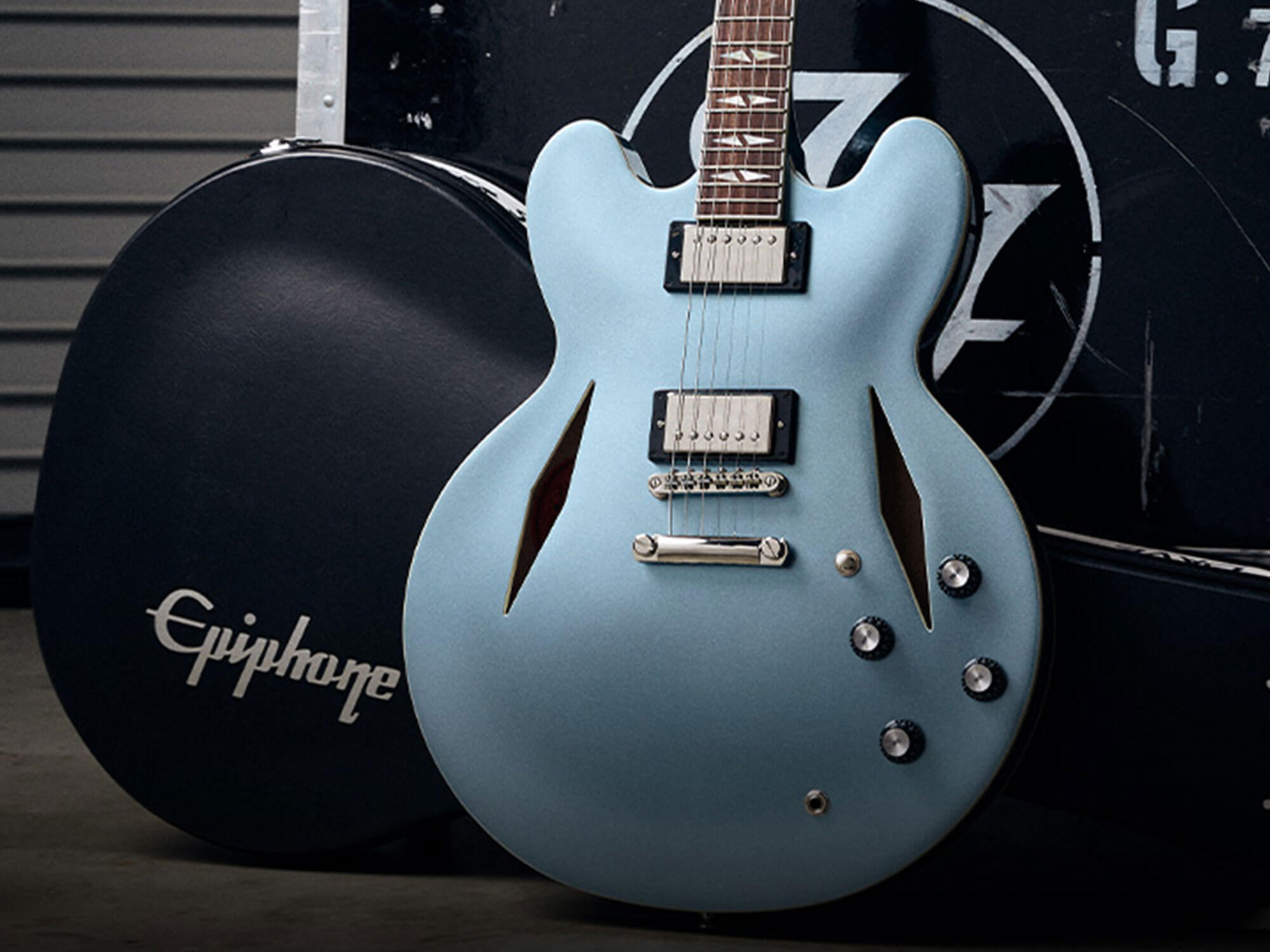
It’s not often a deal comes along where you can save half a grand on a guitar, but at Sweetwater and zZounds right now you can grab the Epiphone Dave Grohl DG-335 signature model with $500 off.
Now reduced to to $799, this Epiphone version of Grohl’s Gibson signature model launched in March 2024 after continued requests from Foo Fighters fans for more than a decade. An initial teaser post from Epiphone on social media showed a graphic resembling the diamond-shaped soundholes in Grohl’s Gibson signature model.
This Epiphone version is still premium-grade despite being a more affordable option. It comes in Pelham Blue (of course), and offers a resonant laminated maple body, Trini Lopez–inspired bound diamond-shaped soundholes, and a one-piece mahogany neck with a laurel fingerboard that hosts split-diamond mother-of-pearl inlays.
Up top there’s a Firebird-style headstock equipped with Grover Mini Rotomatic tuners, complementing the LockTone ABR bridge, and tone is powered by a pair of Gibson USA Burstbucker pickups. Sweetwater says these pickups offer “a rich, expressive, and remarkably dynamic humbucking roar”.
At the time of its launch, Epiphone said: “Dave Grohl is an alternative rock legend who needs no introduction. A longtime Gibson user, his previous Gibson signature guitars have remained extraordinarily popular and command premium prices on the used market – when you can find one.”
Grohl recently spoke of the Foo Fighters’ creative dynamic, stating they still make music like a band in a garage. Speaking to Radio X’s John Kennedy about their latest album Your Favorite Toy, the frontman explained that despite decades of success, the group’s creative process hasn’t strayed far from their roots.
“The way we function as a band… I know that all of this is much different than it was when we were young and playing in bands in a garage, but we still function like a band that plays in a fucking garage,” he said. “It’s the same thing! It’s like, ‘Hey, I’ve got a riff,’ and we show it to everybody.
“Maybe people would imagine that we’re a lot more professional than we actually are, but really the way that we function… it’s really similar to [Dave’s previous punk band] Scream.”
The post Foo Fighters fan? Right now you can get Dave Grohl’s signature Epiphone DG-335 at $500 off appeared first on Guitar.com | All Things Guitar.
What self-taught emo-folk guitarist Truman Sinclair learned from years as studio engineer to Grammy-winning producer

“I find it really hard to write on anything other than a guitar,” begins Truman Sinclair. “I am so inspired by it,” the self-taught emo-folk songwriter continues. “I think about it all the time.”
In fact, ever since he was a child growing up in Chicago, playing guitar was what he enjoyed most. “I’ve always been a fidgety kid and my fidget obsession was the guitar,” he reflects. “I would fiddle with it all the time learning tricks.”
Watching his brother play and having lessons from a friend helped him fall in love with the instrument from the age of eight. “He was really young when he was hammering around the G chord on a nylon string guitar,” Truman recalls. Picking the same one up soon after, his brother taught him the riff to Roy Orbison’s Oh, Pretty Woman.
“I was sold,” enthuses Truman, who grew up on his dad’s love of Bruce Springsteen, Nirvana and AC/DC’s “crazy and epic” Hells Bells before discovering metal bands like Slipknot, Metallica, Beartooth and Attack Attack! during middle school.
Truman’s taste changed, quite dramatically, when he moved to Laurel Canyon at 14-years-old and started going to high school in Los Angeles. “It was a total culture shock because I was used to playing Mario in basements in the Midwest,” he laughs, adding that being in a “massive city where everybody felt so much older than me” made making friends tricky.
He wasn’t too bothered, however, as much of his time after school was spent playing guitar (instead of doing homework) and walking around listening to music that had been made in the area, particularly folk songwriters James Taylor, Neil Young and Joni Mitchell. “Anytime you’re where something historical has happened, it can be really inspiring and I’ve always found that to be very powerful,” Truman says.
 Image: Press
New Noise
Being in a new place altered his approach to the guitar too. “It made me want to play some simple chords, because until then I was really focused on being the gnarliest shredder in town,” he recalls, adding that he tried to write “honest” songs when he turned 16. His limited life experience at that time made this difficult, so Truman started to make instrumental math-rock on his computer.
As his teenage years progressed, he played with the alternative act Fat, Evil Children, and later founded the beloved emo outfit Frat Mouse. Truman even produced four of the latter band’s albums from his bedroom. “It was as simple as it gets,” he reflects, adding that he already knew how to record sample drums. Using a laptop, a Focusrite Scarlett 2i2, mic, stand and Vox AC15 amp (which he still uses daily) he “tried to make the songs awesome”.
Learning how to record guitar educated Truman from a technical standpoint, he considers. “I would try the verse riff 100 times, and that would make me a lot better, because then I could play and listen to it and decide if it was good enough.” His attitude towards the instrument also evolved: “it’s deeper than just the guitar, it’s the spirit you put into it, what you’re trying to do, why you’re trying to do it, and how it makes you feel”.
With his passion abundantly clear, Truman decided to study music production at the University of Southern California. To increase his experience, he set out to work at a studio. Thankfully, Truman met Grammy-winning producer Dave Sardy who, having worked with Oasis and Johnny Cash, gave him a great opportunity. “He said ‘you can be the runner, but it’s on you’,” Truman recalls, describing Sardy as a “really tough, old school” boss. “He’d say ‘if I tell you to do something, don’t ask me, just go figure out how to do it and come back with it done’.”
 Image: Frank Lookinland
The Real Deal
As Sardy’s assistant audio engineer and producer, the first band Truman worked with was Modest Mouse. “I was really scared because I love them but they were very kind to me.” Social Distortion visited the studio soon after: “Mike Ness brought upwards of 45 ‘70s gold top Les Pauls in a vault”, Truman beams, adding that it was “so crazy” to unload them.
Having previously spent his spare time scrolling Reverb.com, Truman was living his “guitar dream”. Instead of looking online at all the different ones that exist, he was playing “priceless” guitars on a daily basis. “It’s like a museum,” he says. “He’s got everything, and he’s one of those dudes who genuinely has a real appreciation for gear, vintage and new.”
Witnessing Sardy at work was hugely inspiring, especially because “everything he makes is handmade; that dude can make a G chord sound better than anybody else on the planet”. This, perhaps unsurprisingly, is exactly what Truman now aspires to: “I’ve always been into making a bass drum guitar mix sound insane, and he’s the master.”
Despite their contrasting profiles, Truman found the similarities between his and Sardy’s processes particularly interesting, especially because of their different set ups. “I realised that what we do is largely the same, but being in a studio requires so much work to keep that sacred bubble working,” he ponders, drawing a comparison of when he’s in his own room working on songs. “No-one wants to bother me, I sit and record on my Nash-S57, sing into my microphone and use a little drum machine,” Truman shares of his creative process.
“I just do my thing, but when you’re a massive artist and you go into a studio, everybody wants to bother you. There are a million things you could do, and you’re all stressed out,” he suggests. Truman is keen to make clear that this wasn’t a problem for artists and bands who passed through Sardy’s studio while he was there: “he’s been able to create a space where they feel like they’re in a room and can just play.”
 Image: Ryan Gomez
Shifting Perspectives
Immersing himself in such an environment altered Truman’s perspective on the guitar even more: “I used to think that gear didn’t matter and that it was more about how you play.” While Truman still thinks this is true, he learned that every guitar sounds different, especially in terms of tone and tuning. “I found that, largely, what people want is what I had in my room — freedom. It all comes back to the simple stuff and the music, how something sounds; half the time, these big artists aren’t using the most expensive thing, they’re using the thing that is in tune, solid and sounds great.”
Subconsciously undergoing “exposure therapy”, as Truman describes it, impacted his own approach to songwriting. “It made me relax and use the gear that’s around because, at the end of the day, they’re all like tools.” Watching some of his favourite songs being made in Sardy’s studio on “the simplest thing” inspired him to pick up his acoustic guitar and “know that I wasn’t really missing anything and that I could do it all here in this very confined world,” he suggests.
“Because the music that I love is pretty simple but sounds awesome, the majority of my songs are no more than four chords,” Truman says, adding that his main focus is the melody and rhythm. To this end, he feels that his music “comes from a very free and fun place”. Maintaining this ethos requires him “having control over it”, so much so that he wrote, produced and recorded all the songs on his 2025 EP American Recordings. “I think I’m a bit of a control freak, which I’ve never admitted,” he laughs, “but it’s a valiant reason of mine. I think there’s something about doing it yourself that keeps it real and natural.”
In a similar vein, Truman is particularly passionate about being able to make the music that he wants to make. “I’m always worried about having it not be mine, so it’s for me,” he attests. “I am very aware that no one wants me to make anything that I think they want to hear,” he considers. “I can’t guess what somebody likes. I just have to make what I think is fucking sick and if I’m making something in my room that I think is cool then that’s good enough for me.”
Despite now being a solo artist, Truman plays with a band. “I don’t think I would feel like myself if I wasn’t doing that,” he says, having recently supported Courtney Barnett on a two-month tour. “Playing music loud in a group is one of the many fruits of life, so I’ll always do that,” he continues.
While it’s a different experience, Truman loves performing solo, on his acoustic guitar, too. “It feels like you can really drive everything. You’re making split-second decisions,” he adds. “Any choice you think of, you can just do it and then see what happens. There’s a freedom that’s super fun and addicting, but at the same time playing with the band is so powerful,” he considers. “There’s something really special about figuring out an arrangement with your band that you all know and love and are tweaking slightly every night. That’s its own thing, so I feel really happy to be doing both.”
Truman’s new single 4th of July is out now
The post What self-taught emo-folk guitarist Truman Sinclair learned from years as studio engineer to Grammy-winning producer appeared first on Guitar.com | All Things Guitar.
“We were just us and and we really stuck out”: Lost Slash interview shows how Guns N’ Roses were always outsiders in the LA scene
![[L-R] Izzy Stradlin and Slash of Guns N' Roses](https://guitar.com/wp-content/uploads/2026/08/Slash-Izzy-Stradlin-hero@2000x1500.jpg)
In a newly unearthed interview given in 1987, Slash comments on how Guns N’ Roses were outsiders to the LA scene during the early days.
Slash and Izzy Stradlin were being interviewed about the band’s at-the-time upcoming tour with Mötley Crüe. The interviewer asked the pair: “Do you feel that you actually fit in to the Los Angeles scene and are you happy out there?”
Slash replies: “Not anymore. We didn’t fit in when the band first started. We didn’t fit in ever. It was always like, there was LA and then there were the five of us crawling around in the dark. In Los Angeles, Los Angeles is like one of those places that like any other big city but even more so. It’s real trendy and it goes through fads and it goes through other stuff.”
The legendary guitarist also adds that they managed to stand out because they did not give into expectations of fad and trend. “And so it was always real hard to say ‘We’re an LA band’ because LA bands always meant this one little band for one particular time that everyone was into because it was a particular fad,” he says.
“We were never like that. We were just us and we really stuck out compared to everything else. I’m really surprised we went to become as big as we did but it’s just because we were really real and people pick up on that no matter how goofy they are.”
He adds that the Axl Rose-fronted group had set a precedent for other bands to “give it a shot and to really go for it. Because maybe at a particular time it wasn’t happening.”
Stradlin adds that music had gotten “into more of a groove” and at one time it was “just a lot of noise going on. It’s 12 million people and 6 million are musicians, it’s every type of music you can imagine.”
The post “We were just us and and we really stuck out”: Lost Slash interview shows how Guns N’ Roses were always outsiders in the LA scene appeared first on Guitar.com | All Things Guitar.
“It scared the s**t out of you”: Pepper Keenan explains what happened when he played through AC/DC’s “insane” guitar rig
![[L-R] Pepper Keenan and Malcolm Young](https://guitar.com/wp-content/uploads/2026/08/Pepper-Malcolm-hero@2000x1500.jpg)
Pepper Keenan had the chance to play out of one of the most legendary guitar rigs in the game thanks to a former guitar tech.
The Corrosion of Conformity member says he played through AC/DC legend Malcolm Young’s guitar rig, courtesy of his former guitar tech.
Keenan tells Chris Garza on the Garza Podcast: “My old guitar tech, Takumi, he worked for White Zombie and then he jumped to COC [Corrosion of Conformity] when COC had the Metallica tour and for all those years needed a real guitar tech.
“Takumi was great, we were on tour with Metallica doing the big, giant shows. Me and Takumi were so tight we roomed together on tour… We were just super buddies and stuff.
“One day he came to me on the Metallica/COC tour and said, ‘Pepper, I’ve been offered another gig.’ I was like, we’re on tour with Metallica. Who could it possibly be? He said ‘Prince.’”
While Keenan understood the offer and Takumi later worked with Prince “for years”, his former touring bunk buddy did later get him the chance to use the Malcolm Young’s AC/DC rig.
Keenan explains: “He did that and then he ended up working for AC/DC. He called me up and I went to a show. Down actually played with AC/DC in Transylvania, but yes, I got to play Malcolm’s rig.
“It’s Marshall’s improper bias that is microphonic, like hot, insane, and they’re all on. It scared the shit out of me. It’s just volume. No overdrive. Just volume. He has no pedals.
“He’s got this big rack for guitars and there’s two of them in there. There’s a glitter one, and then there’s The Beast.”
The post “It scared the s**t out of you”: Pepper Keenan explains what happened when he played through AC/DC’s “insane” guitar rig appeared first on Guitar.com | All Things Guitar.
We said this guitar might be the best PRS SE model yet – now it’s discounted at Sweetwater

If you’ve ever pondered trying out PRS’ take on a T-style guitar, then look no further than Sweetwater – right now, you can save $70 the PRS SE NF 53.
Now priced at $979, this quirky model is quite the investment. It has a unique White Doghair finish (visible wood grain), and comes fitted with PRS’ Narrowfield DD pickups, capturing the peak characteristics of a humbucker, a P-90, a traditional single-coil, and a mini humbucker, merging them into a distinctive voice of its own.
The launch of this SE version followed on from the release of the standard NF 53 and its Kennedy signature sibling back in 2023. PRS later revealed that the guitars were the brand’s top two best-selling USA guitars in that same year. We reviewed this SE version of the guitar last year, and noted that despite it being seen as a “T-type” guitar, it is entirely its own thing.
Guitar.com writer Eric Dahl said, “These Deep Dish pickups have a sound that’s very much their own, but that’s no bad thing at all – if pushed I’d say they sit somewhere between P-90s and mini-humbuckers. In practice, it gives you a very full tonality played cleanly, but adding some gain is where this guitar really comes into its own.”
Aside from its unusual looks and peculiar pickups, other key features of the guitar include a swamp ash body, a maple neck and fingerboard, and an NF 53-profile neck for speed and control. Its sculpted contouring allows for access to all 22 frets across its 10” radius fingerboard.
In other PRS news, the company appointed a CEO for the first time in its history just last month: Jack Higginbotham, formerly the guitar giant’s Chief Operating Officer. Higginbotham will oversee day-to-day business operations while its founder and Managing General Partner, Paul Reed Smith, continues to lead guitar development.
To check out this deal and more, head over to Sweetwater.
The post We said this guitar might be the best PRS SE model yet – now it’s discounted at Sweetwater appeared first on Guitar.com | All Things Guitar.
Joe Bonamassa calls out the guitar community’s “armchair quarterbacks”

Joe Bonamassa has criticised “armchair quarterbacks” for damaging guitar culture.
The blues hero believes those most critical of guitar players ought to pick up an instrument and play rather than put down those who are hard at work.
In a recent interview with Guitar Interactive Magazine [via Guitar World], he explains: “In the US, we have this term called ‘armchair quarterback’, right? I could sit in my chair and say to Tom Brady, ‘I could have thrown that ball better than you.’ No, you can’t.”
Bonamassa, a blues veteran who has opened on numerous occasions for BB King, says there needs to be more empathy – not judgement – when it comes to live performers. He points to a viral incident from the ACM Country Awards in 2016, in which Nick Jonas messed up a guitar solo, only for it to be immortalised on camera. The incident was so traumatic for Jonas that it sent him to therapy.
“That one that caused this guy to go into therapy,” says 49-year-old guitarist Joe Bonamassa. “We’ve all done that. Everybody’s done that.
“You know, like, ‘I didn’t even know what I was thinking!’ But the vitriol. What do you want him to do? Burn his guitar in effigy? Like, jump off a cliff? The guy had to go to therapy! What’s wrong with people?”
“Kenny Wayne Shepherd and I have been on stage a lot together, the last five, six years. It’s not a competition. We don’t look at it like that,” he continues. “Warren Haynes and I, we’re on stage a lot. We’re having fun.
“But what do they expect? A trophy at the end? A cash prize? A judge that goes, ‘I declare the winner!’ like a fucking boxing match.”
Bonamassa is set to tour across North America and Europe this year, with dates scheduled for Radio City Music Hall in New York City on October 1, and at the Uber Arena in Berlin, Germany, on October 30. He will return to Germany next year for the Tollwood Summer Festival in July.
See his official website for a full list of upcoming dates.
The post Joe Bonamassa calls out the guitar community’s “armchair quarterbacks” appeared first on Guitar.com | All Things Guitar.
Buzzing Bugs Bolster review – is this the ultimate dual fuzz pedal?

£179, buzzingbugsfx.com
If you name a fuzz pedal after an evil scary giant, it’d better be pretty frickin’ fearsome. To that end, the Buzzing Bugs Bolster has been designed with a scorching high-gain circuit on one side… and an even more scorching one on the other.
- READ MORE: Teaching Machines FuzzBillion review: is this the most ambitious and unique dirt pedal ever made?
The giant in question is a figure of Cornish legend – and that’s no coincidence, because the UK’s southernmost county is where this smart-looking pedal is made. But while the original Bolster apparently terrorised villages, ate children and was very inconsiderate to his wife, this one only wants to spook your eardrums.
 Image: Richard Purvis
What is it?
I spent a good half-hour noodling away with the Bolster before I realised something quite important: the ‘more’ side isn’t just an extra dose of gain to add to the main business on the right, but a whole separate fuzz circuit in itself. So this is a classic double stomper, offering instant access to two individual sounds plus an apocalyptic ‘both’ option.
The right-hand fuzz is a silicon transistor type, with controls for gain, tone, output level, volts (for bias-tampering effects) and shift (for thinning out the bass at the input stage). The left channel skips all of that and keeps things simple with a single level knob for its extra-feisty op-amp fuzz. This could get brutal.
 Image: Richard Purvis
Sounds
“Could get brutal”? It starts brutal! The right-hand channel is up first, and it’s a blast. Keep the volts knob set at noon for normal biasing, and what comes out is the very nicest kind of thick, smooth, aggressive fuzz, with a good balance between body and clarity.
If you want to change that balance, you have two options. Turning down the shift knob brings a leaner, more focused sound – a great match for humbuckers that are at risk of succumbing to flub – while the standard tone control turns out to be… well, not exactly standard. Crank it up and, rather than opening up the very highest frequencies, it gives a boost in the bitey upper-mids zone. Neither of these knobs will dramatically transform the tone of the Bolster, but between the two of them you’ve got an awful lot of tweaking power.
The one-knob fuzz isn’t entirely different in character but feels more open, with a distinctly mids-scooped voicing. On its own it sounds properly gigantic… and when you use both sides together, it somehow gets even bigger in a way that can make it difficult to persuade yourself to stop playing.
What’s really cool about ‘both on’ mode, though, is what it does to the volts knob. Without the left circuit engaged, pushing this in either direction brings familiar results: things become increasingly jerky and spluttery as the signal-killing gate effect gets more and more strict. But with both LEDs ablaze you get a softer, more forgiving kind of gating on the clockwise half of the dial – and, at maximum, a pinched buzzing effect that’s somewhere between a Zvex Fuzz Factory in velcro mode and an analogue synth. It’s fiendishly cool, and Bolster the Cornish giant would surely approve.
 Image: Richard Purvis
Should I buy one?
There’s no such thing as a single fuzz pedal that can do it all, but if I had to pick one for an open-ended residency on a desert island then the Buzzing Bugs Bolster might well be it.
As a single pedal, the right half is superb – a classic high-gain dirt machine with elements of Big Muff, Tone Bender and Fuzz Face. When you then add in the smart tone controls and the biasing tricks, and pair all of that with a second circuit that’s even more potent, it becomes something really quite special.
 Image: Richard Purvis
Alternatives
Not many people would be daft enough to put two separate high-gain fuzzes in one box, but there are plenty of one-channel options with a second footswitch that unlocks an extra level of rage. These include the Great Eastern FX Co. Focus Fuzz Deluxe (£299/$349), the Silktone Fuzz+ ($269/£279) and the ThorpyFX Field Marshal (£219/$269).
The post Buzzing Bugs Bolster review – is this the ultimate dual fuzz pedal? appeared first on Guitar.com | All Things Guitar.