
Music is the universal language
“Glory to God in the highest heaven, and on earth peace to those on whom his favor rests.” - Luke 2:14
General Interest
Podcast 567: Noah C. Lekas
This week, we’re talking to Noah C. Lekas, one of the Fretboard Journal’s longstanding contributors.
Over the years, Noah has profiled a variety of subjects for our magazine, from blues legend Hubert Sumlin to luthier Matt Eich of Mule Resophonics. Today, we’re sharing this Colorado-based writer/musician’s own journey: His near-fatal illness, the psychedelic therapy that helped save him, and the album that he just released to document the ordeal, ‘Flowers of Perennial Dissent.’ The spoken word and guitar project features guests such as Luther Dickinson (North Mississippi Allstars) and folk artist Charlie Parr.
All told, it’s a deep chat about the human condition, finding your why, gratitude, and so much more. We hope you like it.
Follow Noah here. Get the record here: https://www.blindowlrecords.com/products/noah-c-lekas-flowers-of-perennial-dissent
Subscribe to the Fretboard Journal’s quarterly print magazine. Issue 61 is about to be mailed to all subscribers: https://shop.fretboardjournal.com/products/fretboard-journal-annual-subscription
We are brought to you by Peghead Nation: https://www.pegheadnation.com
(Get your first month free or $20 off any annual subscription with the promo code FRETBOARD at checkout).
We are also brought to you by Mike & Mike’s Guitar Bar: https://mmguitarbar.com, located in Seattle, Washington.



The post Podcast 567: Noah C. Lekas first appeared on Fretboard Journal.
NUX C-58RC, C-7, and B-8S Wireless Demo | PG Plays
Wireless has reached the point where most players can’t hear the difference, so the more interesting question is what else the box can do while it’s working. PG contributor Tom Butwin details three new solutions from NUX: the C-58RC instrument system, the C-7 stereo in-ear monitor rig, and the B-8S, a beltpack-and-pedal setup that doubles as a DI, tuner, boost, and effects loop. Each offers automatic and manual pairing and ships in a charging case or charges magnetically through its receiver.
The C-58RC covers guitar and bass with active and passive modes, a cable-tone setting, one-touch reconnect, and a built-in tuner with mute and a flippable screen. Its case delivers roughly three full recharges. The C-7 turns wired earphones into a stereo monitoring rig with five EQ presets, one-touch frequency hopping, support for multiple receivers off a single transmitter, and 18 hours of total runtime.
The B-8S uses 1 MHz narrowband transmission for more usable channels in a crowded room, and its pedal receiver charges the beltpack while handling balanced DI, send and return, buffer, boost, and a 2.4" color screen that rotates for different board layouts. A ground lift and a 1/4" input on the side mean it still works wired if the connection ever drops.
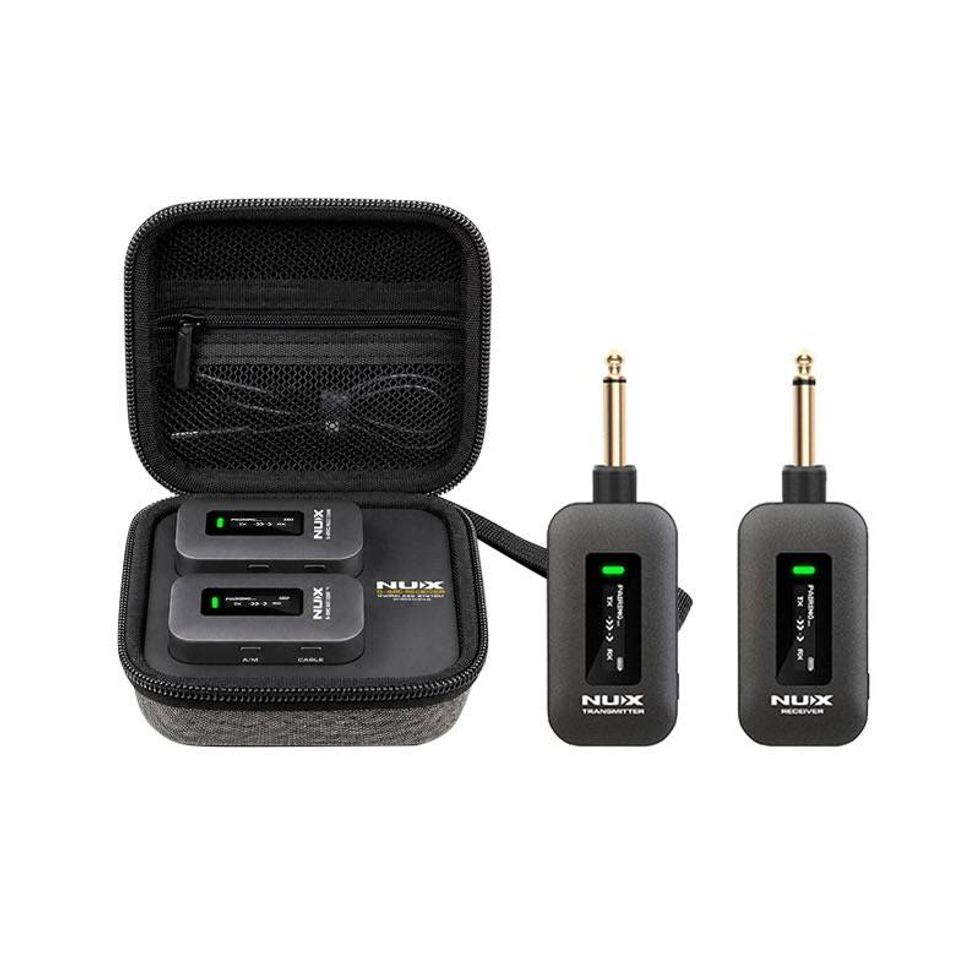
NUX C-58RC Wireless System
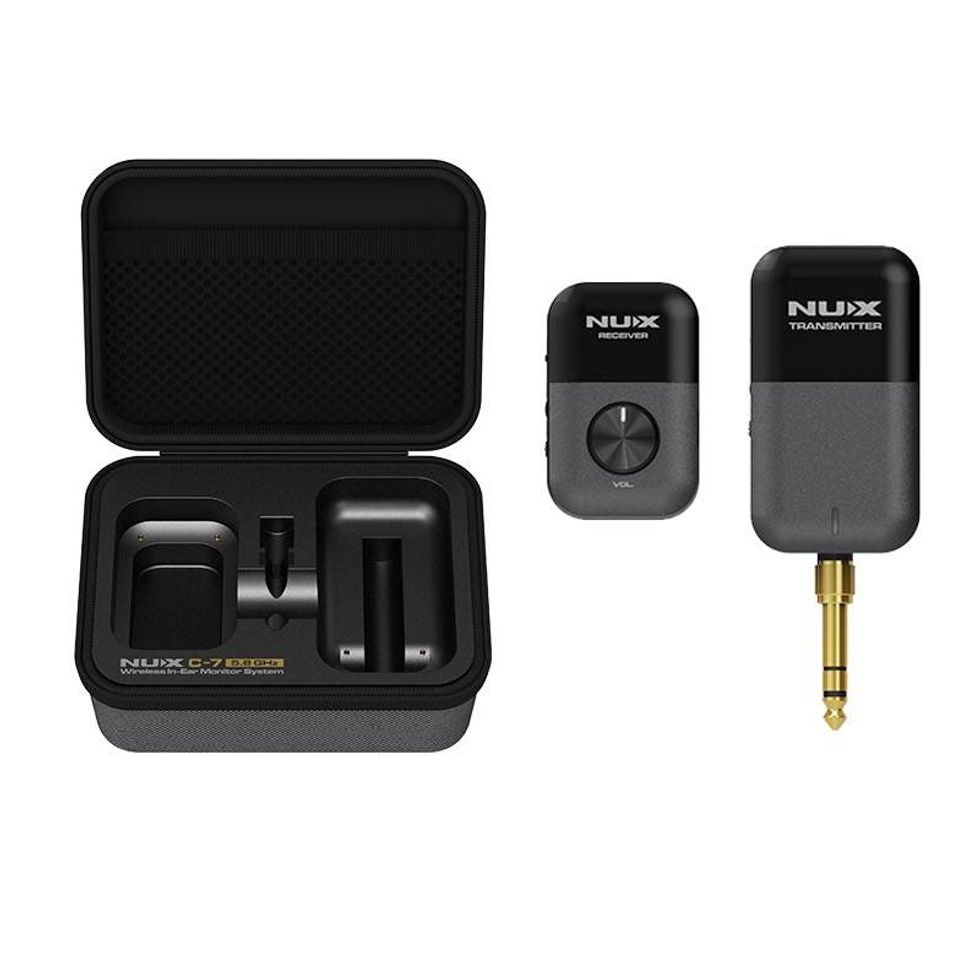
NUX C-7 Wireless In-Ear Monitor System
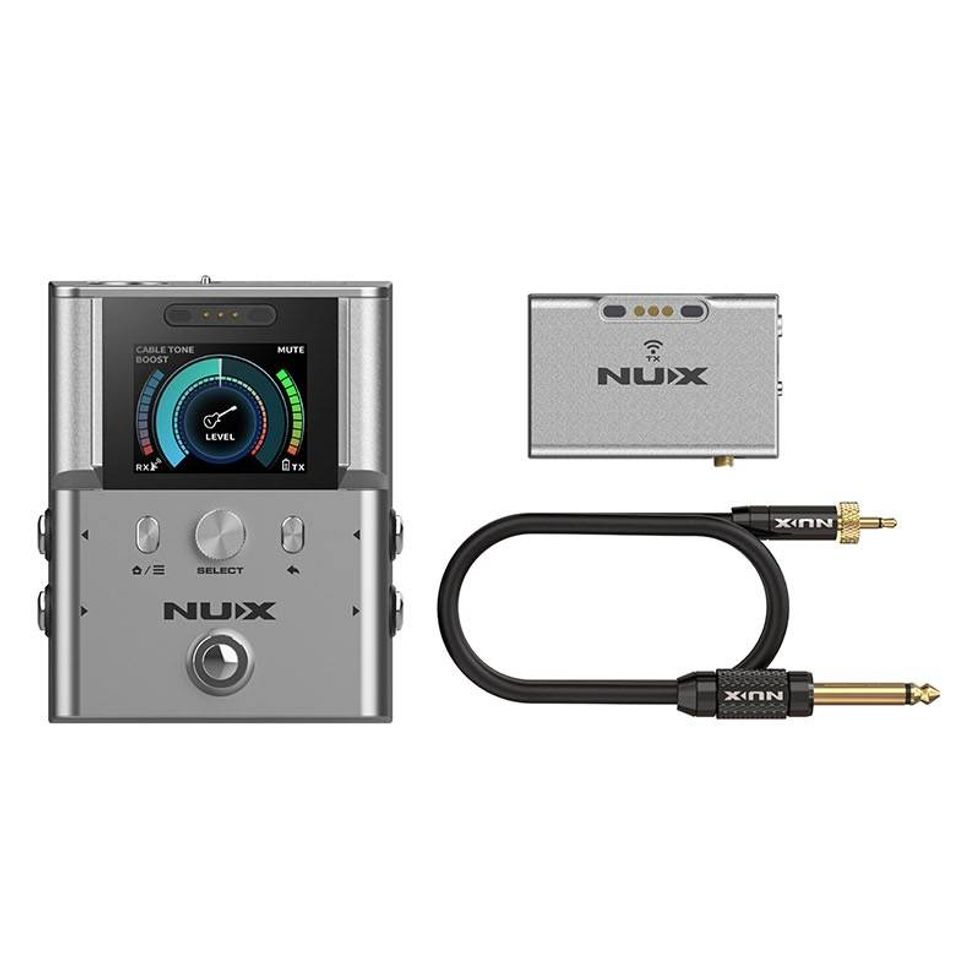
NUX B-8S Wireless Guitar System
Making a cheap guitar into a dream guitar

Ad feature with StewMac
It’s something you’ve probably considered at some point – is it actually worth getting a cheap guitar and upgrading it? Affordable guitars can be pretty inviting, as is the idea of kitting one out with your own choice of electronics and hardware. But, when the hardware and pickups cost a good deal more than the actual guitar they’re going into, is it worth it, or are you doing the guitar equivalent of fitting a rocket engine onto a Toyota Prius?
There is not a straight yes or no answer to that question, really – it depends on your goals, your tastes, and your patience for your own inevitable screwups. But these days, with the quality of affordable instruments only getting better, and places like StewMac providing more access to tools, parts and guides than ever before, there’s perhaps never been a better time to give it a go.
Check out the video above, where I go through the hows and the whys of upgrading an affordable instrument, from replacing the hardware, increasing the reliability of the electronics and changing the sound with a new set of pickups.
All of this was made a lot easier with the tools and guides available at StewMac – find out more at stewmac.com.
The post Making a cheap guitar into a dream guitar appeared first on Guitar.com | All Things Guitar.
Going Deeper: How String Makers Are Evolving for the Extended-Range Era
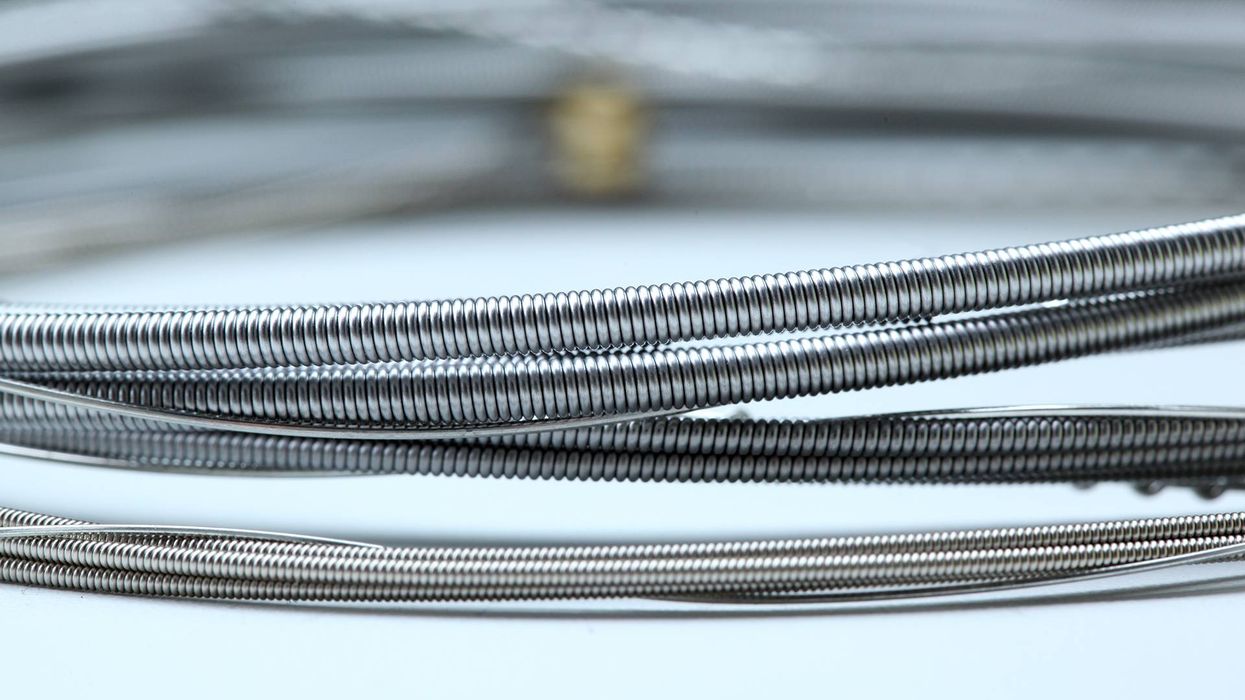
We’re living in a golden age of innovation for extended-range guitar. These days, there are more ways than ever to fine-tune and experiment—whether you’re playing a 7- or 8-string, cranking down to extreme drop tunings, utilizing specialized pickups or multi-scale designs, or chasing the sonic subtleties of particular string brands. We spoke to five top manufacturers for insights into the creation and refinement of their flagship products.
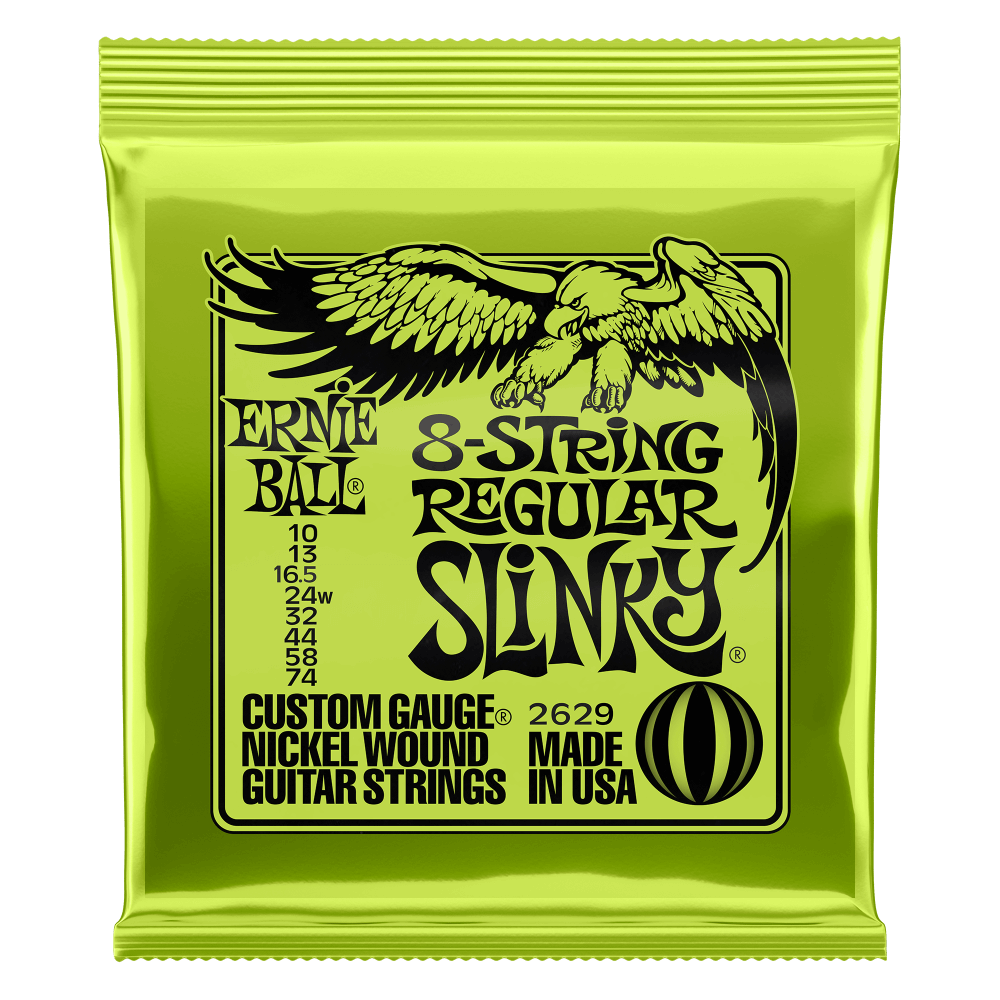
8-String Regular Slinky (P02629)
Ernie Ball’s extended-range history dates back to 1992, when they introduced their first set for 5-string bass. From there, the pace was fairly steady: a 6-string bass set a few years later, the 7-string Slinky guitar sets by 2000, and baritone gauges shortly after. “One clear signpost came in the early 2010s when we saw other manufacturers move quickly from 8-string to 9-string instruments,” says Chris Harrington, director of Operations & Innovation. “[This showed us that] extended range wasn't a passing trend but an accelerating one. We introduced our first 8-string set in 2012, followed by our first 9-string set just two years later.”
Another major turning point came in 2021: The company created a signature Music Man Majesty 8-string model for Dream Theater wizard John Petrucci, paired with a set of Regular Slinky strings (P02629) for optimized performance.
"Because tension alone doesn’t tell the whole story, development involved trial and error, which John validated when confirming the final gauges,” Harrington says. “We also use proprietary methods and tools to evaluate factors beyond tension, ensuring the set feels and sounds consistent across all strings. Lastly, we have the advantage of listening to our large family of artists to understand what matters most to players. Many of our set expansions over the years, including our extended range options, have been directly informed by these relationships and the solutions we’ve generated together.”
Ernie Ball’s philosophy in the extended-range space is to “build with users rather than guess what they want”—a support process that partly involves working through string needs beyond their current sets. “These conversations are often where our insight into future offerings comes from, as we see a need firsthand and develop a solution for it, which at times leads to an eventual product offering,” Harrington says. “Over the past 34 years, we have continued to expand our extended-range offerings, and I don't see that stopping anytime soon.”
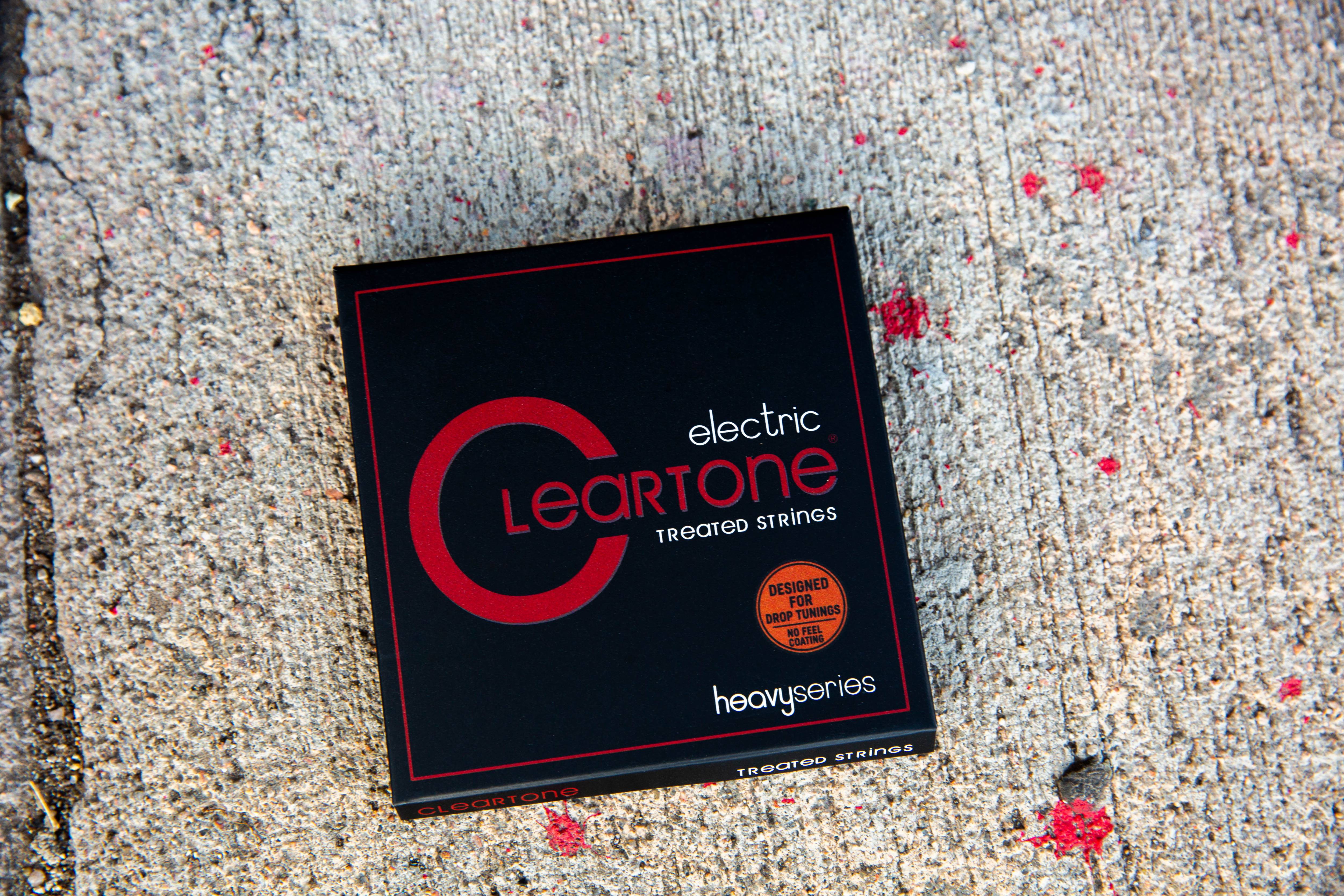
Heavy Series
Cleartone emerged in the early 2000s, just as nu-metal, metalcore, and post-hardcore guitarists were helping reimagine the dynamics of “heavy guitar.” The company recognized these shifts—the lower tunings, the increased string attack, the proliferation of extended-range instruments—and aimed to become part of that creative conversation. “From the beginning, we developed a proprietary manufacturing process called Super High Tension Winding,” company president Mike Loscalzo says. “We also custom-built our winding machines to apply precise, controlled tension as each string is made—an approach that was far from the industry norm at the time. Every wound guitar string contains hundreds of individual wraps, and we believe every one of them matters.” They went one step further with their Heavy Series, which uses a thicker core-to-wrap ratio to increase tension and structural strength, control excess string movement, and improve tuning stability, intonation, and note definition in those monstrous lower tunings.
“We’re constantly blown away by each new generation of guitarists pushing the instrument’s limits—tuning lower, developing more aggressive techniques, and creating sounds that didn’t exist when we began,” says Cleartone vice president Scott Sciacca. “As guitar manufacturers continue to develop more extended-range and longer-scale instruments, we’ve expanded and refined our offerings with more gauge options. We’ve also made baritone-compatible string length standard across all our electric sets, so players don’t need to purchase a custom or specially designed set to accommodate a longer-scale instrument. But at our core, we remain true to the same purpose Cleartone was founded on: making strings that resist breakage, stay in tune, last longer, and keep pace with the evolving demands of today’s players—and the next generation.”
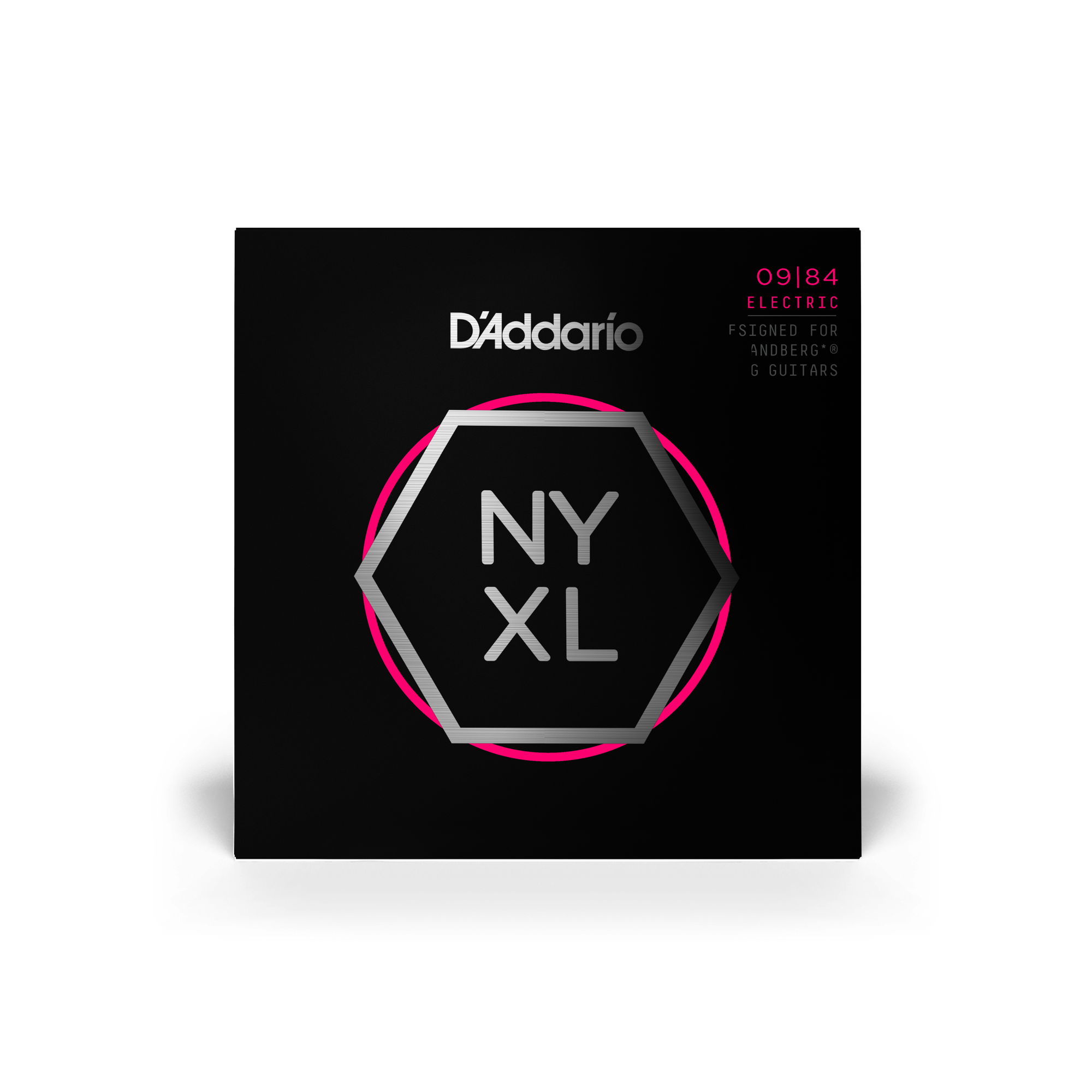
NYHD and XT Series
D’Addario have been around since 1973, through decades of string evolution. As extended-range guitars have become more prominent, they’ve responded by adding heavier-gauge strings to their XL series, introducing their NYXL line, and, in 2025, launching a program that allows players to customize sets for 7-, 8-, and 9-string guitars.
“We were very involved with the rising popularity of genres like djent and prog-metal that were pushing ERG instruments to their limit,” says Gabriel Sebastian, the company’s fretted product manager. “Feedback from the pioneers in that space helped define our first-generation ERG strings, which were sized to accommodate longer scale lengths and lower tunings. From there we continued to work with and learn from major guitar brands that were expanding their portfolios to cover extended range, along with smaller boutique guitar brands finding popularity with these segments.”
Two noteworthy string lines are the NYXL09564SB and NYXL0984SB,part of a joint effort withSwedish guitar/bass manufacturer Strandberg. “[Founder] Ola Strandberg reached out a few years after NYXL was launched,” Sebastian says. “He liked them and wanted to collaborate to offer them on his headless, muti-scale, extended-range guitars. This was a great opportunity to learn from an innovative industry leader.”
Artists have also been crucial to D’Addario’s philosophy and design. “Aaron Marshall from [prog-metal band] Intervals has had an immense effect,” Sebastian notes. “He reached out to us and asked, ‘Can you make a 7-string set that plays like it was meant for guitar, rather than a 6-string set with an extra heavy string?’ He and his contemporaries in the ERG space helped us understand what players were reaching for musically, what they wanted to get out of their instruments, and the string-related problems that needed to be solved.”
Then there’s Pat Metheny: “Yes, the jazz virtuoso,” Sebastian says. “Soon after we made modifications to our NYXL ERG strings, Pat came to us with an even more extreme request: ‘Make me a string for my 25.5" scale 6-string that allows me to tune the low E to E1 (a full octave lower) and has great harmonics, without the string being monstrously huge.’ That felt like an impossible ask. However, we were able to lean on our experience designing strings for cello and extended range electric violins to create a string Pat was happy with.
“These cross-instrument learnings are what make D’Addario a leading innovator,” Sebastian continues. “We can leverage orchestral string technology in fretted string designs, and vice versa. Which leads us to HD strings. We realized that we could take this even further by combining the Metheny experience with Aaron’s insight. That is how these series of High-Density strings came to be. So djent-y 9-string players can thank jazz for these strings.”
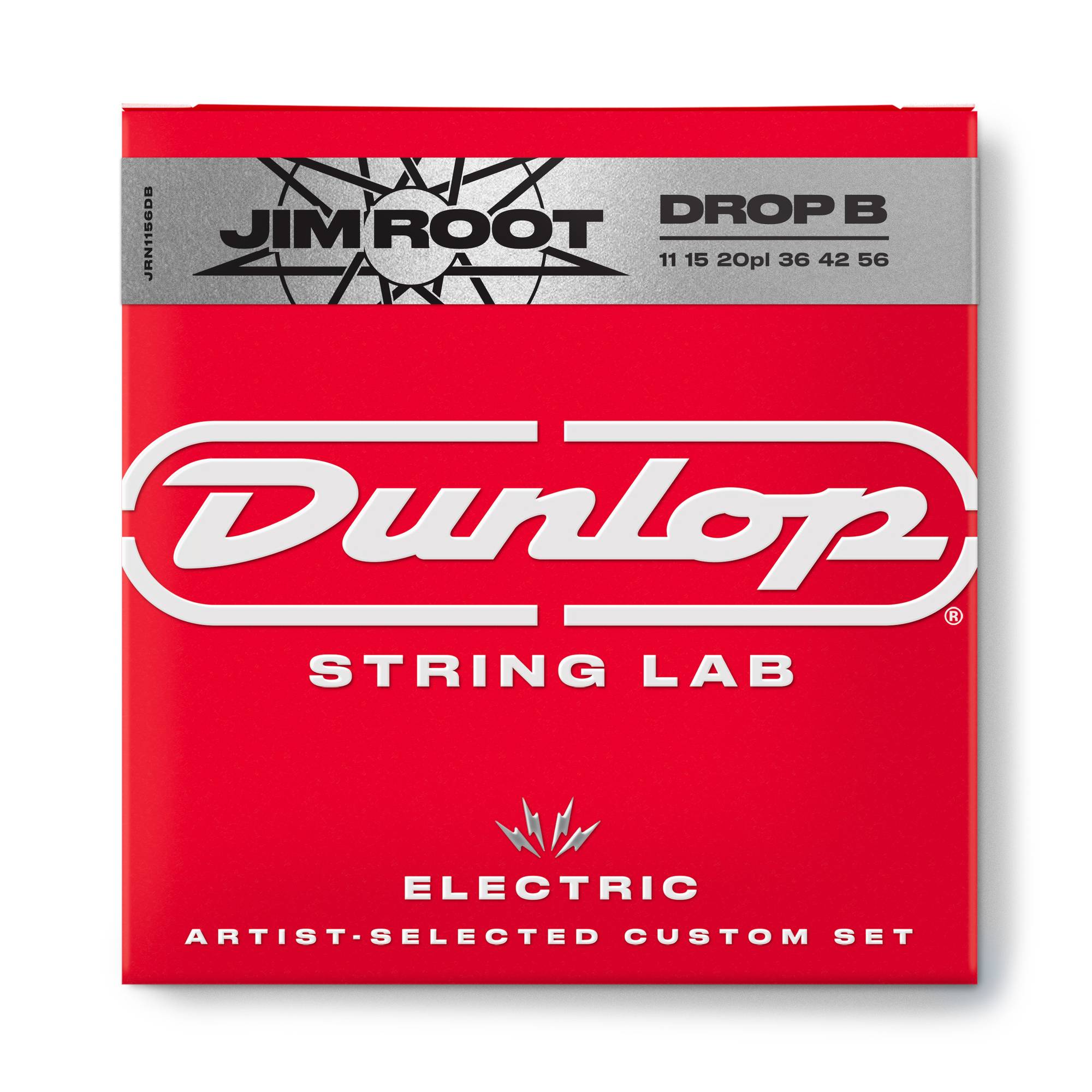
BIG1268 (Drop Bb), DEN1156DC (Drop C), DEN1156DB (Drop B), JRN1156DB (Drop B)
Dunlop is so attuned to the needs of guitarists that employ drop tunings that they’ve collaborated with artists to develop gauge combinations with those specific tunings in mind. They even identify them on the packaging. “We already have signature down-tuned sets from artists like [In Flames’] Björn Gelotte and [Slipknot’s] Jim Root,” says Frank Aresti, the company’s product manager of accessories. “But we’ve also expanded the lineup where we saw gaps, giving players more purpose-built options rather than expecting them to piece together their own sets.”
Their ultimate aim, regardless of gauge, is “true balance,” both under the fingers and in the ears. “I also want to distinguish that concept from the ‘balanced tension’ approach that some of our competitors promote,” Aresti adds. “While balanced tension focuses primarily on the measured pull of each string, our goal is a more holistic playing experience that considers both feel and tonal balance.”
To maintain that direct connection, Dunlop pays close attention to the daily challenges of working guitarists and the customer feedback passed along from dealers. “Those two groups are closely connected, because players often walk into a store looking to recreate the sound or setup of their favorite guitarist,” Aresti says. “Sometimes they’re asking, ‘How can I get the same tone as my favorite player?’ Other times it’s as simple as, ‘What strings should I use for Drop C?’ We've tried to remove the guesswork by offering purpose-built sets and clearly labeling many of them with the tuning they’re designed for, making it much easier for players to choose the right strings with confidence.”
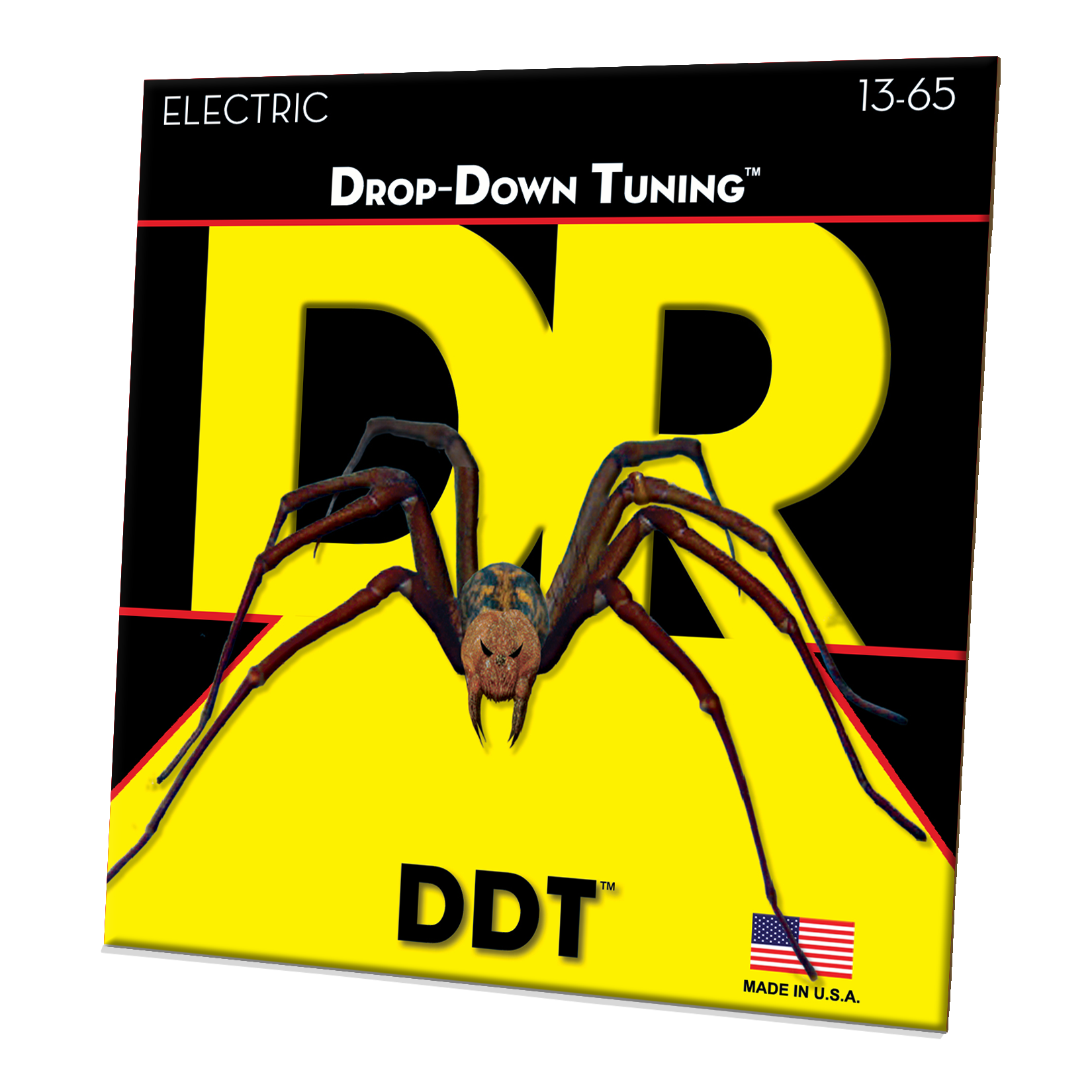
Dragon Skin+, Veritas, and DDT
Founded in 1989, DR have developed into one of the game’s most reputable brands, with their strings used by celebrated guitarists like Derek Trucks, Jared James Nichols, and, before their deaths, Dimebag Darrell and Johnny Winter. But they’ve also become staples among purveyors of heavier music, including Fredrik Thordendal and Mårten Hagström of extreme metal band Meshuggah and John Browne of prog-djent act Monuments. The company’s Vice President, Dave Avenius, highlights three string lines—Dragon Skin+, Veritas, and DDT—built using Accurate Core Technology. ACT primes the core wire to create more dynamic vibrations, improve tuning stability and intonation, reduce breakage, and add extra protection against tone-stifling dirt and sweat. (The company says DDT were the first strings on the market made specifically to support players who use drop tunings.)
“We believe that [they’re] especially great for players who use drop tunings, play extended scale instruments, or use 7- or 8-string guitars,” Avenius says. “Making a string bigger helps, but ACT upgrades the architecture of the strings, so they reproduce the lowest notes of your instrument with great tone and note-to-note definition, so you bring out the most from your guitar. Dragon Skin+ also features our K3 coating. This is a patented process by which we coat the outer wrap wire before we wind it around the core. This approach allows each part of the string to function properly, and the string can ring out pure and true. Everyone at DR is excited by all the players pushing the musical boundaries with drop tunings, extended scales, and 7- or 8-string guitars. We hope these artists will try our strings and hear and feel the benefits for themselves. As we like to say: DR—the Difference is Real."
John Mayer celebrates launch of his own record label with new single, Tom and Jerry

Big things are happening in John Mayer World; after recently announcing a massive residency at the Las Vegas Sphere for 2027, the guitar legend has just released a brand-new single, Tom and Jerry.
The track marks Mayer’s first solo release since 2021, when he released his eighth studio album, Sob Rock.
Produced and written by Mayer alongside Grammy-winning producer Blake Slatkin, recorded at Chaplin Studios in Los Angeles and mixed by veteran engineer Serban Ghenea, Tom and Jerry made its debut on Mayer’s SiriusXM channel Life With John Mayer on Thursday (22 October) before arriving in full today.
You can listen to the new single below:
As Mayer explains, the track’s name, “Tom and Jerry”, comes from the name he gave the voice memo he made when he first had the song idea.
“From that moment on, the adventure began in bringing that feeling to life,” the guitarist writes in an Instagram post. “I’ve said it before, but it bears repeating every time – I get to work with a group of incredibly talented and deeply dedicated artists who will stop at nothing until the sound comes into focus and becomes a picture.”
The single’s release also coincides with the launch of Mayer’s own record label, Sob Rock Records, in partnership with Mercury Records.
“Working with [Mercury Chairman and CEO] Tyler Arnold and the talented team at Mercury Records has already proven to be a great partnership,” Mayer said in a statement [via Rolling Stone].
“The path from creative vision to execution has never been easier or more rewarding. I feel very inspired, and I’m excited for what’s to come.”
“John Mayer is one of the greatest artists of all time, and I couldn’t be prouder to welcome him to Mercury Records,” adds Tyler Arnold.
“We’re excited to be part of his next chapter and to partner with his label, Sob Rock Records, to help bring his creative vision to life.”
That’s not all that’s been happening in a whirlwind few months for John Mayer, though. Last month, the guitarist announced a partnership with PRS and Land Rover Defender to bring a palette of the Defender’s iconic colourways to his signature guitar, the Silver Sky.
The post John Mayer celebrates launch of his own record label with new single, Tom and Jerry appeared first on Guitar.com | All Things Guitar.
Crazy Tube Circuits Triptychon review – this might be the most ambitious dirt pedal ever made

€299/£269/$359, crazytubecircuits.com
A triptych is a painting with three panels, so you might assume the Crazy Tube Circuits Triptychon is some kind of three-in-one pedal. And it is, in a sense – but it’s also a seven-in-one, or possibly a nine-in-one… or even, at times, a nine-in-two.
Yes, those freaky Greek boutique geeks have done their best to confuse us all with this one. But if they really have squeezed all the fuzz, overdrive and boost tones you need into a single standard-sized pedal, who cares?
What is it?
In line with its name (pronounced ‘trip tick on’), the Triptychon’s graphic design suggests some sort of three-panel church altarpiece, but this isn’t the world’s first Gregorian chant simulator – it’s a tribute to the much less godly rocking sounds of the late 1960s. That much is obvious from the four fuzz circuits that form the heart of the pedal: a Fuzz Face and three Tone Benders (Vox, Mk1.5 and MkII), selected via a rotary switch in the centre.
That would have made a pretty interesting pedal by itself, along the lines of CTC’s excellent Cyclone four-mode phaser, but there’s a whole lot more vintage rock noisiness going on here. Firstly, on the left you’ll find controls for an overdrive circuit, designed to recreate the sound and feel of plugging your fuzz box into a cooking amp; and then, on the right, you have a choice between two more old-school noise generators: an octave fuzz and a treble booster, each with two different modes to flip between using the ‘mod’ button.
So that’s four straight fuzzes, one overdrive, two octave fuzzes and two boosters – all in a pedal with just two footswitches? If you think that sounds like a stretch, you’re right – so you might want to consider thinking outside the box (literally) and digging out an extra 50-ish euros/pounds/dollars for the optional XT footswitch.
 Image: Adam Gasson
Build quality and usability
The Triptychon is a weighty little unit, which is no surprise considering how much it’s got going on inside, but the first issue it has to tackle is one of ergonomics: you’re looking at seven knobs, two toggle switches and three push-buttons, and that’s always going to make things cramped. CTC has done well to keep everything reasonably clean and accessible… but there are compromises.
Navigating is actually a lot simpler with the XT footswitch plugged in: now you’ve got a pedal made up of three sections with a switch for each, so you can tap-dance your way in and out of overdrive, fuzz and octave/boost at will. And the layout is intuitive enough that, when you do want to make changes to settings, you won’t struggle.
As well as that four-way mode switch, the fuzz circuit has controls for gain and volume, plus a button to engage a buffer. The overdrive has drive, tone and volume; and the right-hand panel has a gain knob and another buffer switch, plus a toggle for octave or boost mode and the aforementioned mod button.
 XT Switch. Image: Adam Gasson
Nothing too scary there… but without the XT switch, things suddenly start to look more fiddly. The problem is, with three sections but only two footswitches, you have to use a three-way toggle to set what those switches engage: left for fuzz and drive, and right for octave/boost; left for fuzz, and right for drive and octave/boost; or left for fuzz, right for octave/boost, and no drive at all.
If you got lost halfway through reading that sentence, don’t worry, I got lost halfway through writing it. In summary, using the Triptychon without the external switch is a pain in the hole. Mind you, it could be worse: the one other pedal CTC makes in this format, the Sidekick Jr, has a modulation section that can’t be bypassed on the unit itself.
 Image: Adam Gasson
Sounds
We’re told the fuzz uses silicon transistors for a “true germanium tone and feel”, which is stretching the definition of the word ‘true’ somewhat, but it certainly sounds big, warm and fluffy in vintage style. All four options are nicely balanced, with plenty of shunt and no spikiness – which is just as well, as there’s no tone control.
The Fuzz Face and the Bender Mk1.5 sound quite similar, as they should (the circuits are very closely related), while the Vox TB has more midrange bite and the MkII piles on the gain. All sound decent with the guitar’s volume backed off, and the switchable buffer should not be overlooked: it adds a significant amount of pep and clarity, the only pity being that there’s no LED to let you know if it’s on.
I don’t have a lot to say about the overdrive, which is low-key brilliant: just about totally transparent, natural in feel, and perfect for giving those fuzzes an already crunchy base to build on. The octave fuzz is good too, really bringing the gnarl and offering a tidy ‘Hendrix in a box’ option when you run it into the Fuzz Face.
But for me the best non-fuzz bit of this pedal is the booster, which can be set for either a Rangemaster-style lift to the high mids or something reaching a little lower down the frequency spectrum. Both sound ace – and again, the only thing missing is an LED to tell you which mode you’re in.
On the subject of LEDs, I could use this thing every day for a month and not get used to the way the three status lights aren’t aligned with the footswitches – well, how could they be when one of those switches isn’t even on the pedal? – but maybe the answer to that is just to use it for two months. I certainly wouldn’t get sick of how it sounds.
 Image: Adam Gasson
Should I buy one?
The Triptychon doesn’t quite live up to its fantastical space-saving promise, simply because it’s so compromised without the XT footswitch – which is small, yes, but could well take up almost as much room as another pedal depending on how your board is laid out. And that extra 50 notes is not something to take lightly, bearing in mind the serious price of the pedal itself.
Even so, this is an amazing feat of stompbox design, with nine different effects that all sound top-notch and work wonderfully well teamed up in twos and threes. If you can make the practicalities work, the tones on offer here are more than up to the job.
Alternatives
The Triptychon’s closest rival might be the Great Eastern FX Co. Focus Fuzz Deluxe (£299/$349), a consummate master of fuzz, drive and boost complete with footswitchable squawkage. The Walrus Audio Eons ($249.99/£235) has five different fuzz modes with variable voltage, while the Fender The Pelt V2 ($229.99/£159) offers a slightly more affordable mainstream option.
The post Crazy Tube Circuits Triptychon review – this might be the most ambitious dirt pedal ever made appeared first on Guitar.com | All Things Guitar.
IK Multimedia Releases TONEX Free Unlimited
DiMarzio Introduces Chopper T Neck and Cruiser T Neck Pickups
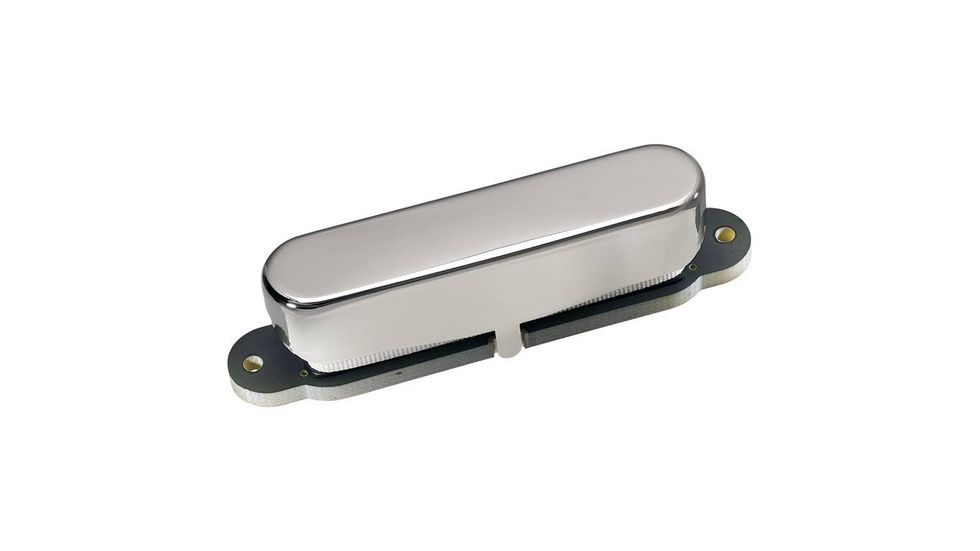
DiMarzio has launched a pair of Tele-style neck pickups: the Chopper T Neck and Cruiser T Neck.
They retain a familiar metal cover that has adorned Telecaster neck pickups for 75 years, but that's where the similarities end.
The new DiMarzio pickups combine neodymium magnets and twin-blade hum-canceling coils. They’re designed to optimize the magnetic field and deliver better string-to-string balance, even when notes are bent. The result? Higher output, faster transients, and a lower noise floor than traditional T-style neck pickups.
The Chopper T Neck has clear highs, and the midrange and lows are punchy without muddiness. It’s an overall balanced tone, and the pickup has an output resistance of 6.52k.
The Cruiser T Neck's harmonic overtones are right where you'd expect them to be from a "true" single coil. The midrange is open and its top end chime offers clarity without harshness. The Cruise T Neck delivers a brighter tone and its output resistance is 3.58k.
Both pickups feature 4-conductor wiring and DiMarzio’s PCB quick-connect baseplates for easy installation with no modifications required.
Both pickups are available in four color options – chrome, unplated nickel, gold and black. For black and chrome finishes you can also choose between a metal cover with the DiMarzio logo or a classic, logo-free look.
Street price for chrome and unplated nickel is $119; street price for black and gold is $126. For more information visit DiMarzio.com.
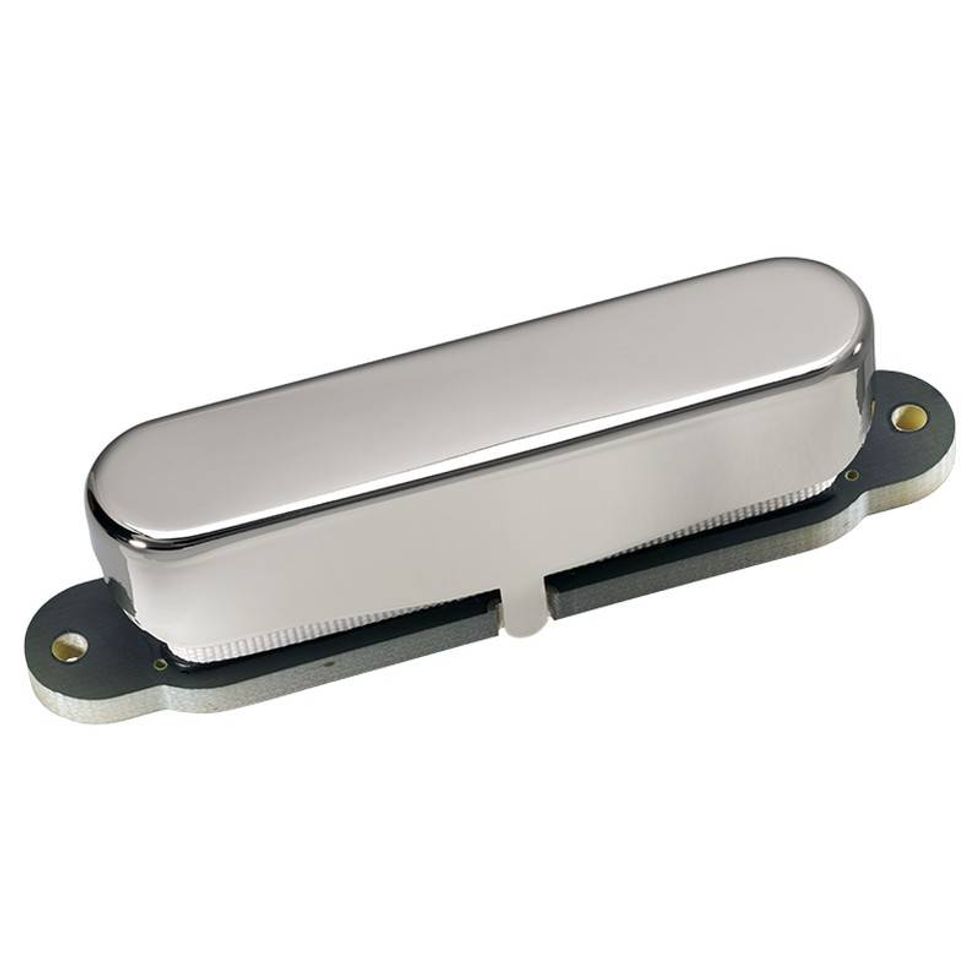
Chopper T Neck and Cruiser T Neck
DiMarzio has launched a pair of Tele-style neck pickups: the Chopper T Neck and Cruiser T Neck.
Wintergrass Sessions: The Jordan Tice Trio
The Jordan Tice Trio – Jordan Tice, Patrick McGonigle, and Alan Mackie – perform three songs at Wintergrass 2026: “Don’t Know Why I’m Going Into Town,” “Matter of Time,” and “Find A Way from Here.”
We also asked the trio about the instruments used on this session.
Register now for Wintergrass 2027. The lineup in 2027 will include Sierra Hull, Jerry Douglas Band, East Nash Grass and other bluegrass favorites.
Video by Brad Wagner, audio by Juan M Soria.
We’ll be sharing more highlights from Wintergrass 2026 on a weekly basis here and on our YouTube channel.
The post Wintergrass Sessions: The Jordan Tice Trio first appeared on Fretboard Journal.
Revisiting ‘World’s Fair’ with Julian Lage
“One can hear so many of the sounds and feel so many of the feelings that, moving forward so steadily and so eloquently (and successfully), I identify as Julian. His ability to uplift as well as astonish are fully in evidence on World’s Fair; unvarnished and direct, stunningly beautiful while eschewing sheen or artifice of any sort.” –Nels Cline
Reflecting on World’s Fair, his remarkable solo acoustic record from 2015, Julian Lage remarks, “I’ve had the great luxury and privilege to see it change over the last decade, and see certain things revealed.” It’s an album that has acquired beloved status for those of us who worship at the altar of acoustic guitar. Matt Munisteri, who co-produced World’s Fair, was presciently on-mark when he wrote in the original sleeve notes that “this music will cast a long shadow across an ever-widening terrain.”
World’s Fair was an important staging post in Lage’s career. Known for his collaborations with Chris Eldridge, Nels Cline, and Fred Hirsch, it was his first studio foray into solo acoustic. As Julian intimates in his foreword to the World’s Fair Songbook (link), the experience fundamentally changed his relationship with the acoustic guitar. “[It] taught me how rare and beautiful it is to hear a single guitar in all its spaciousness, delicacy, and elegance–and how I could begin to navigate space and time in ways that wouldn’t be as obvious in a group setting.”
The plan was to meet up in Melbourne during the Australian leg of the World’s Fair 10th anniversary tour for a retrospectively-slanted conversation centered on the record. In the end, Julian’s promo commitments and a crazy-tight travel schedule torpedoed an in-person interview and we reconvened on Zoom a few weeks later.
At home in New York, his circadian rhythm restored to Eastern Standard Time, straight off the bat Julian is his customary super-engaged, friendly, relaxed self. A few seconds into our call, he breaks off apologetically to attend to their new puppy who on hearing Julian’s voice has woken up and soft-paw scrabbled to his feet. With pup safely secured in his pen, we settle down to talk. Over the next half-hour we alight on vulnerabilities, narrative arcs, Segovia, noise floor, and how one instrument can carry a complete musical statement… and a new favorite acoustic guitar with vintage vibes.
FJ: In Melbourne, you prefaced the performance by describing it as a Book of Music. The expression would seem to encapsulate World’s Fair perfectly–a musical narrative of pages, sentences and phrases told through rhythm, silence and touch.
JL: Well, I grew up hearing that term. [John] Zorn uses that term because it quite literally amounts to a book of pages if you take all the charts and everything. I have a tendency for a sense of cohesion when it comes to songs for a recording. World’s Fair is very specific, you know? It’s about the specific agenda in a specific world of drama, if you will. In playing it over the years, I realized like, oh yeah, this was music that was meant to be together. So, it’s definitely with a sense of intention that I’d announce and think of it that way.
FJ: The running order on the record unfolds perfectly, nothing is out of place.
JL: You know, we’re all students of music, and there are as many ways to put a record of music together as there are people. Yet there seems to be these through-lines that I keep coming back to about arc and withholding certain things, especially with solo guitar. Maybe being conscientious not to do everything you’re capable of right away, you know? Or letting things have their moment or at least serve a function dramatically. Compared to having one song and the next song is basically the same song and so on. But that can be cool too. It doesn’t really matter. World’s Fair has become its own entity, which is nice, at least from a narrative point of view.
FJ: The foreword to the World’s Fair Songbook hints at some vulnerabilities in approaching solo guitar?
JL: Yeah, that’s true. At the time, it was so novel. It’s still novel to me. I think having not really done concerts and making a record presented some cool challenges. It was absolutely terrifying, you know. But I liked that part about it. I really did. I don’t know if I view it as terrifying in the same way now, but it’s rather illuminating. Wherever you are in your guitar playing. And that trip to Australia was no different. I thought, oh, this is where this music is now, cool, and then it’s somewhere else a week later. So, there’s something that might be a little more… I don’t want to say exposed because we’re always pretty equally exposed whether we’re alone or with a band… but it’s a nice snapshot of a lot of elements coming through one guitar. Where someone is personally, musically, “guitaristically,” physically, emotionally on display.
FJ: I understand Segovia and Barros were big influences?
JL: Yeah, well, those influences they’re huge in my life, not only for solo guitar, but for performance and composition. But absolutely, through the lens of solo guitar, the question remains the same: What’s so compelling about a single instrument and a single voice? In making World’s Fair, I had it backwards. I really did believe I had maybe a poor mentality, thinking that I needed to do more to make up for this lack of people around me playing. And when I did that, it garnered a very particular sound and results. I was able to reflect and go, no, this is one of the few times where you can actually be quite vulnerable and leave space. But not to conflate that individual nature with weakness or any sense of lacking.
In a way it’s a mindset shift, isn’t it? Under the scrutiny of a microphone, your things that might otherwise feel rather transient become a big deal. In relation to Segovia, those early recordings of his had a lot of noise in the recording, unrelated to his playing. In the electricity and the noise floor, so to speak. So, we have some of that on the record deliberately to contextualize the guitar. Rather than saying, “Well, get a perfect guitar sound, pure and beautiful, and that’s all that matters.” That maybe left us feeling a little bit cold. Things like reverbs, the sounds I involuntary make while I’m playing, the noise floor of the microphone… they all add up to something.
FJ: Can you talk about the role of Matt Munisteri and Armand Hirsch in achieving the intimate sonic footprint on World’s Fair?
JL: Absolutely. Armand Hirsch is one of the most brilliant musicians and, at that point, we were around each other all the time. It was a real privilege because that record could unfold over time, and he had that superpower of translating the evolution of the process into a sonic medium. He was no stranger to what the songs were, how far they had come, what we thought was possible… it was deeply integral. And Matt Munisteri too. He was looking at it from a more globalized conceptual point of view… knowing my playing, what would stand out, what would be cool to feature, what hasn’t been documented? So, you’re absolutely right. The conversation was consistent.
FJ: What are two lessons you took away from the making of World’s Fair in the context of what you’ve gone on to do over the last decade?
JL: It’s a great question. Well, I’d say one of the lessons would be that having heard myself recording and playing that music, it’s such a humbling reminder that the sound of a guitar is enough. You know that’s quite miraculous, a machine that makes sound and resonates. And like everything in life, you keep getting reminded it’s not about us. It’s not about I had a great idea and I did this. It’s not that. Making World’s Fair taught me that there’s a high degree of humility needed. You serve the music, serve the instrument, serve the resonance of the room you’re in to the best of your ability.
The second part of that lesson is that over the years, having played it live, that music was very much at its beginning stage by the time we recorded it. It’s only gone on to grow and I’ve learned a lot from it. It’s almost cliché, but that common notion that a recording is really a snapshot, and then it’s different the next time. I still love the original, but I like that it wasn’t limited to that recording. It was that music got me into playing, taking that role seriously and I’m grateful for that. I don’t know if I’d have taken it seriously unless I started with a higher stakes project like that.
FJ: The compositions on World’s Fair are infused with such humanity. In “40’s”, there’s an ascending chordal move–Gmaj13, Em11, Am11. Beautifully expressive, uplifting, transcendent, curious, slightly melancholic… I tried it out yesterday and it left me in a great headspace!
JL: That’s great you did that. That’s what it’s there for, you know. Suddenly you go, ‘oh, that’s a thing!’ and then you do what you want with it.
FJ: Reminds me of free-jazz drummer Cecil Taylor’s comment about great artists… rather than getting involved with discipline, they get to understand love and allow the love to take shape!
JL: Jeez, man, it’s amazing. It’s so fun. The fact it’s solo guitar really doesn’t matter. Of course, it’s part of the message and it’s the medium, but it’s not the point. When I listen to the masters, whether it be Julian Bream, Segovia, or Leo Kottke, I’m struck with that too. I grew up thinking it was one thing about the guitar, but then I have even more respect and humility when I listen to those players because I go, wow, they are really transcending the guitar. The thing that’s moving it is their sense of storytelling, and that’s a fabulous thing to shoot for.
FJ: You’re known for your kinesthetic approach to playing… shifting hands and feet, small vocalizations, facial expressions, and whole-body movement. It’s compelling to watch.
JL: You go in thinking this is one person playing music, but one person is full of so much stuff, you know. There’s really no such thing as seeing just one element at play, and I felt that on that tour. Melbourne happened to be in a beautiful hall, and that was a character. Look at this big room, sounds great, and then there’s this one person playing guitar. We went on to other shows that were far more challenging because they weren’t proper concert venues. You don’t have the scale and it’s a different kind of intensity. It’s one of the beautiful things playing solo. I’ve had the joy of seeing the juxtaposition, and typically a concert hall is a really nice place for it.
FJ: I’m intrigued by your choice of song titles on the record. It reads like a travel log–“Peru,” “Japan,” “Missouri,” “Ryland”…! Were those songs written in the lead-up to the record or had they been in your back pocket?
JL: No. Those were very much written for that record and it’s true, there’s something about those titles that are interpretive. It’s what you feel about it and you bring those feelings to the table. But there’s a neutrality about some of those names, for whatever reason, they seemed appropriate. “Japan” seemed appropriate, but it didn’t have to be called “Japan.” Then you have “Missouri.” They’re setting a certain geographical stance. Again, that may be neither here nor there, but it’s interesting. I remember talking to my father about this years ago. Names take on meaning when they fuse with compositions and sometimes they have to strike a balance of being compelling and neutral at the same time. My favorite titles are the musicians who understand that poetry. Those are the ones that stand out to me. You go, wow, they really got me into a place. But it’s very personal. I have to play, name things, give them titles that you can get away with that match your disposition. I appreciate you picking up on that because it does matter to me.
FJ: A personal favorite is “747.” At first you think, “Oh, that’s the airliner!” But turns out you named the song after a Swingline stapler. Super-playful.
JL: Well, numbers are words, you know.
FJ: Can we talk about your signature Collings OM1-JL, which is based on the 1939 000-18 you play on World’s Fair? Nully from Collings recalls working on the neck spec back in the day when Bill was still around. They’d line up the neck options, each with a different half-inch strip infill (maple, carbon fiber, spring steel, and ebony) for you to try out? You’d play the guitar, make notes and their set-up guy would swap out the neck for the next one?
JL: That project was complicated! The whole time I was keenly aware that they didn’t have to do this. I was essentially coming to Bill excited to be working with Bill, and Nully, Mark, Bruce, Clint, and Aaron. I came with a deep reverence for what they already did. By the same token, I was challenging them. What if we don’t have a guitar that’s high gloss? What if you have thinner top woods? What if the necks aren’t reinforced in this certain way?
I proceeded with caution because I knew everything I asked for was contradicting what they had built their company on. Fortunately, Bill was eager to see something from a different perspective, and the premise of that conversation was that the Waterloos were sounding so great. Whatever you’re doing here is working.
There’s a parallel in the world of Martin-style guitars, even though they’re not built the same way. They certainly benefit from some of the same features in terms of finish, weight, density of wood, the thickness and thinness of wood. They went through a lot of guitars and quite frankly, we got to a point where it didn’t seem like it was going to happen. Then somebody came in and basically said, ‘This is the combination of body neck you’re looking at,” and it was really wonderful. Guitar builders aren’t just guitar builders. They’re interacting with where they get their wood, who’s cutting their wood, what materials they have at their disposal. You have to fit into their ecosystem. They were at a point where they had the bandwidth to consider something different.
FJ: After all the experimentation, it turned out the neck you all liked best was the one Collings still use today: No internals other than the rod. Nully says it’s exactly this sort of mess-around project where you learn so much by confirming what you know and stuff you don’t.
How’s the 000-18 faring these days?
JL: I still have it. It’s been in disrepair for many years. The top was sinking at a certain point, so I put it away with the tension off and I’ve left it with a friend to fix. But I did have it up and running briefly, maybe a year and a half ago, and I tried and liked it. It made sense as a recording guitar but live it didn’t quite make sense.
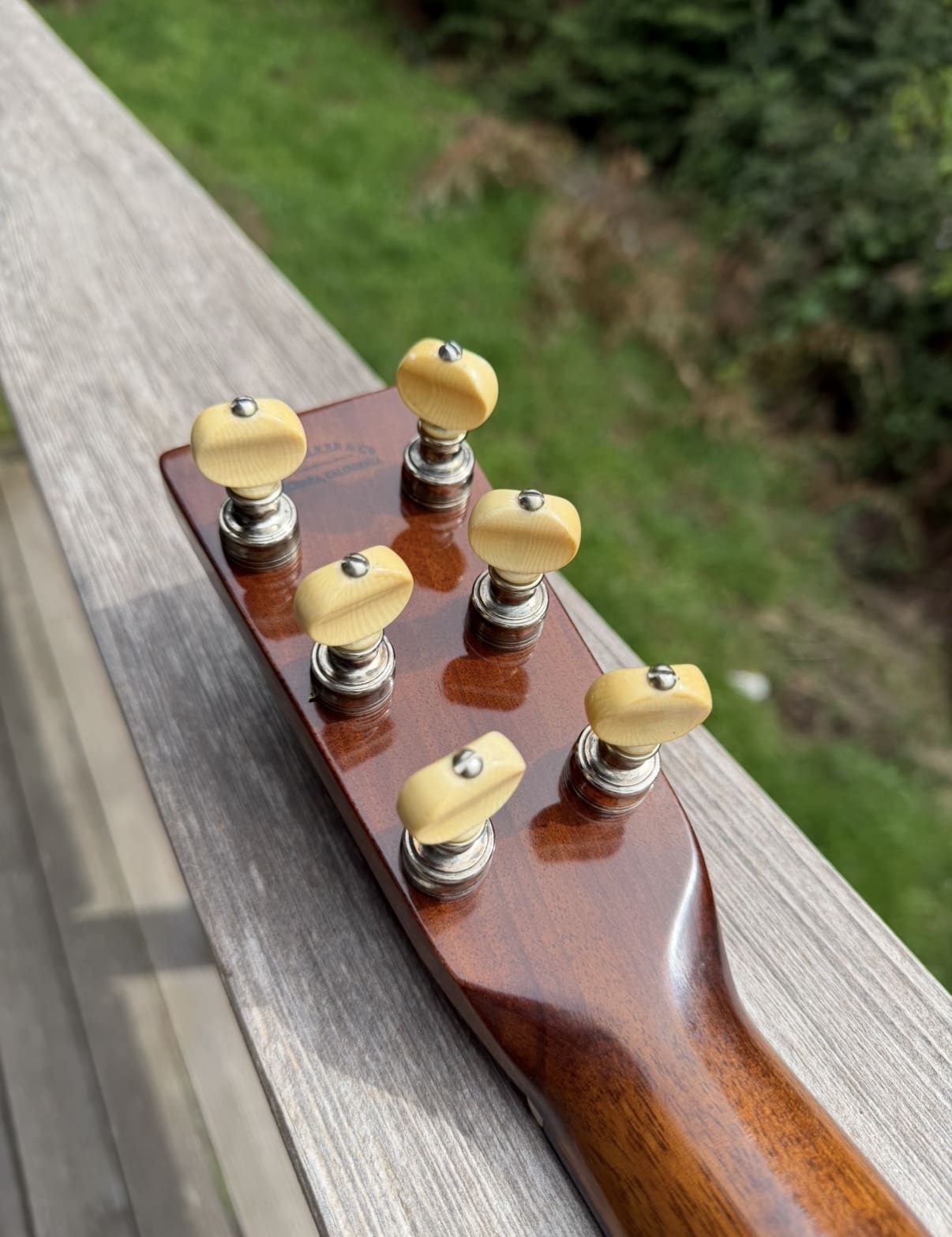
These days I’ve been playing a Michael Walker guitar that I really love. Bar-fretted, OM-18 style…it’s fabulous. What I’ve always been moving towards is something that replicates the sound of an early ‘30s OM-18. Growing up, our local guitar shop was Eric Schoenberg’s. Mr. O.M. himself. I forgot about that sound then; over the years, I thought, that’s the timbre I’ve been looking for. The 000 has some of that, but it’s shorter scale. The Collings has some, too, because of its longer scale, but it doesn’t have other things. The Walker has all those features. Michael is a fabulous builder. I wanted to bring it to Australia, but it’s got banjo tuners, and they didn’t fit in my Hoffee case.
Screenshot
Coda
I sought out Bill Frisell to garner his thoughts on Julian’s creative trajectory. His reply was informed by an Instagram post he’d seen earlier that day of Julian playing at the Crossroads Festival alongside Jorge Roeder and Nasheet Waits. “He’s evolving so fast, and it keeps getting deeper and clearer. His curiosity for everything around him. He’s not stopping!”
When I relay this to Julian, his reaction is typically warm and generous: “That’s sweet of Bill. I’m grateful to be doing this.”
Evolution–Curiosity–Humility. Hallmarks of Lage’s philosophy and sensibilities that hark back to the making of World’s Fair.
The post Revisiting ‘World’s Fair’ with Julian Lage first appeared on Fretboard Journal.
The Digital Amp That Won Over Bonamassa
Fender has unveiled the Tone Master ’59 Twin-Amp JB Edition, the first signature amplifier in Fender’s Tone Master series, created in close collaboration with blues-rock guitarist and longtime Fender artist Joe Bonamassa. Inspired by Bonamassa’s prized late-’50s high-powered tweed Twin amps — a mainstay of his touring and studio rig — the new model brings the sound and response of his vintage originals together with the versatility and functionality of Fender’s modern Tone Master platform.
“I wanted to hate it,” said Joe Bonamassa. “We’re all in agreement that this amp was tighter, punchier, and better. I never thought I’d see in my lifetime the fact that I’d be sitting next to a digital amp. Sound makes you play. Sound inspires you to play. You just need to know how to unlock the sound you hear in your head and get it out.”
Powered by Fender’s Tone Master modeling technology, this signature amplifier combines the character of Bonamassa’s beloved vintage tube amps with the convenience and versatility of modern engineering. The 2x12” ‘59 Twin delivers crystalline cleans that transform into aggressive, distinctive overdrive when pushed into its sweet spot. A six-way power attenuator makes those tones accessible at bedroom-friendly volumes, while the amp can reach up to 85W for the stage. Celestion JB Neodymium Speakers deliver an expansive frequency range, and onboard controls including a vintage/tight switch, line output with level control, ground lift and three-way cabinet simulator let players further shape their tone.
Key Features Include:
• Joe Bonamassa Signature Tone: Based on the legendary Fender 5F8-A "high-powered" tweed Twin circuit and voiced after Joe Bonamassa's own prized late-'50s amps, delivering bold cleans and rich, dynamic overdrive.
• Dual Celestion JB Neodymium Speakers: Custom-designed lightweight 12" speakers capture the punch, warmth and articulation of Joe's touring rig while reducing overall weight.
• Stage-to-Home Power Control: A rear-panel output selector provides full power plus five attenuated settings, making the iconic high-power tweed Twin tone accessible at any volume.
• Premium Modern Performance: Features top-panel convolution spring reverb, an effects loop for time-based effects and a rear-panel "Vintage-Tight" switch for enhanced low-end response.
•Studio-Ready Connectivity: Balanced XLR line out with three onboard cabinet impulse responses, plus fully customizable speaker IRs via the Tone Master IR Manager app for seamless recording and live performance.
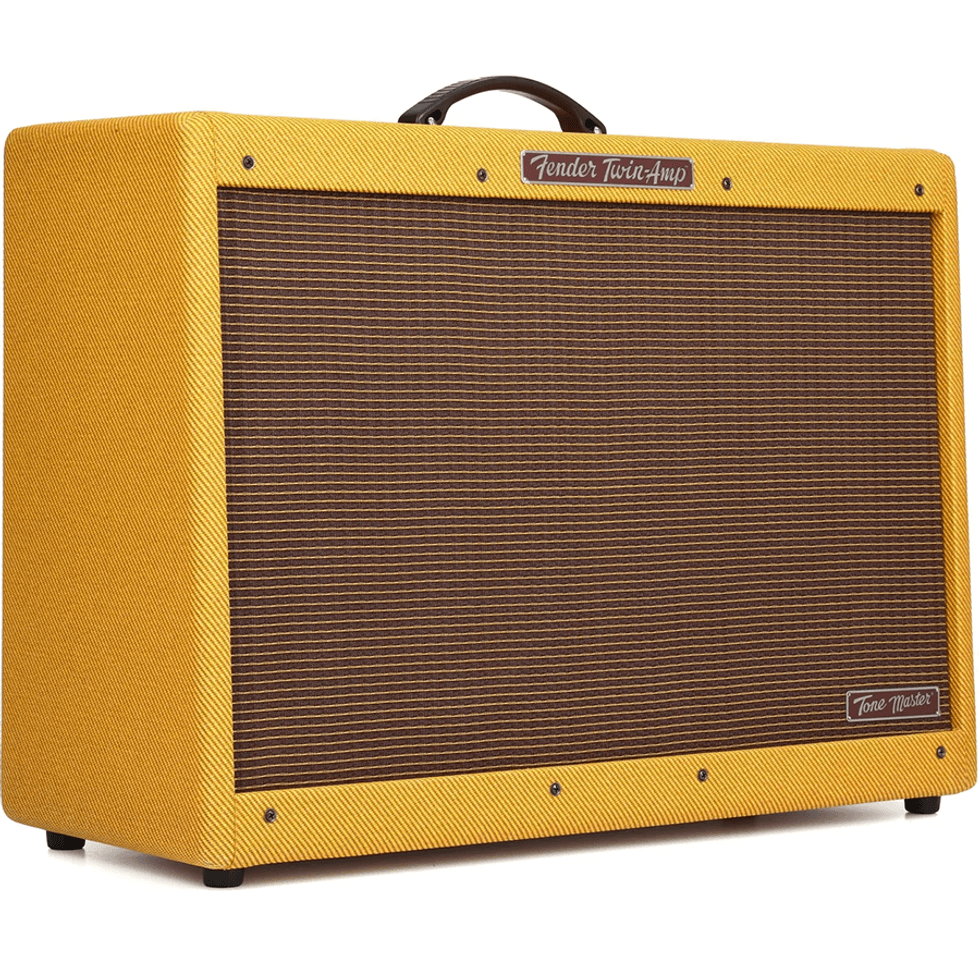
Joe Bonamassa Tone Master '59 Twin 85-watt 2 x 12-inch Combo Amplifier
Extensively road- and studio-tested by the man himself, the Fender Joe Bonamassa Tone Master ‘59 Twin Amp authentically replicates the legendary “high-powered” Tweed Twin circuit in a lightweight, digitally driven form. Every sonic nuance of the original has been precisely emulated, granting you the raging overdrive, the brilliant cleans, and touch-sensitive dynamism of a historic 5F8-A twin at roughly half the weight. And while a ’50s-era Twin rises to window-shaking volumes before achieving overdrive, onboard power scaling allows for glassy edge-of-breakup tones and pushed power amp sag at far more manageable levels. You can even record or play through a PA via the XLR line-out and onboard IRs. Topside, the Joe Bonamassa Tone Master ‘59 Twin-Amp preserves the 3-band EQ, Presence control, and channel-jumpering capabilities of an old-school Tweed Twin, only with the benefit of a vintage-style convolution spring reverb. Additional modern enhancements include an effects loop to accommodate your time-based/modulation stompboxes, a versatile Vintage/Tight switch to firm up your low-end response, and two ultra-lightweight Celestion JB neodymium speakers fine-tuned to Joe’s taste. Whether you’re a die-hard JB fan or a tube purist looking to dive into the world of digital modeling, the Fender Tone Master ‘59 Twin-Amp modernizes one of the most sought-after amps in history without giving an inch when it comes to pure vintage tone.
Last Call: The Coolest Guy in the Room
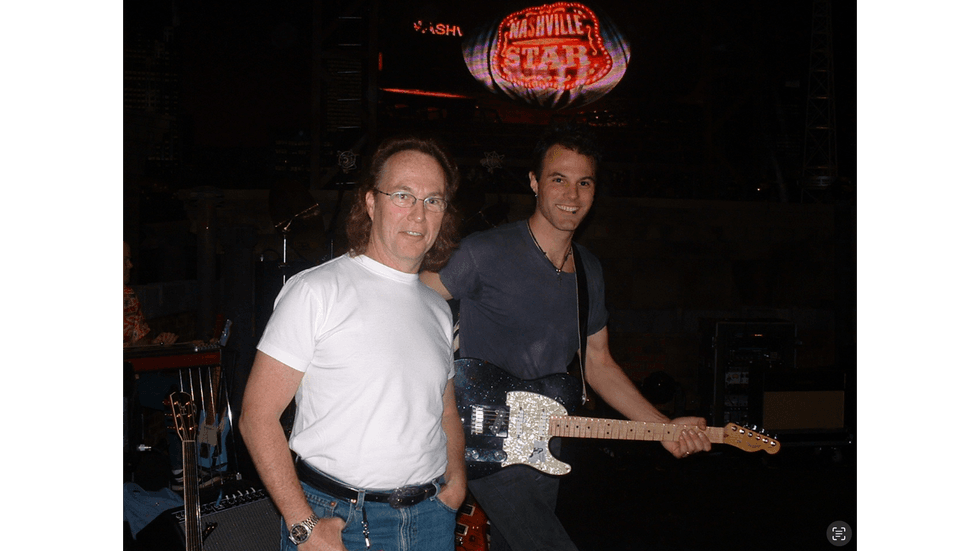
One of the best things about being a musician is the people you get to play and work with. Our group is made up of the most interesting outliers in the world. Of all those I’ve been lucky enough to know, undoubtedly the coolest guy in every room was my employer, mentor, and friend Jon Small.
Jon spent his entire life at the center of the zeitgeist. When Jon was a teen working one Sunday in the drum department at Manny’s Music on West 48th Street in Manhattan, his boss told him to assemble an oyster black pearl Ludwig Downbeat drum kit and walk it over, piece by piece, to the Ed Sullivan Theater. That night, Ringo used that kit to change the world.
When Jon’s band the Hassles parted ways with their keyboardist, the drummer went looking for a replacement and recruited a fellow Long Islander, Billy Joel, to see if he was interested in the gig. Billy turned it down until Jon, using his persuasion superpowers—as well as his Manny’s employee discount—promised Billy a Hammond B3 organ with a Leslie cabinet, and closed the deal.
As the Hassles began to disintegrate, Jon and Billy formed a new band, Attila, in 1969, perhaps the only organ/drum metal duo in history. They quickly landed a deal on Epic. Joel's 2005 box set, My Lives, featured one offering from that band: "Amplifier Fire, Part 1 (Godzilla)," a nasty metal jam co-written by Jon and Billy.
The recent documentary Billy Joel: And So It Goes perfectly illustrates what an amazing person Jon was. In the early days, Joel was adrift and battling depression. Jon invited him to live at his place with his wife and son, and while living there, Joel began a relationship with (and later married) Jon’s wife, Elizabeth Weber Small. Jon said it was like losing his “two best friends,” leading to a period of estrangement. Despite the betrayal, Jon forgave Billy, and the two went on to share a successful working partnership and lifelong friendship.
During the split, Jon worked as a session and live drummer for a ton of acts around New York. He was the go-to rock drummer whose energy lifted the spirits of everyone on the stage and in the crowd.
After a motorcycle accident ended his drumming career, Jon moved behind the camera. He founded Picture Vision Pictures and went on to direct or produce hundreds of music videos and concert films.
Working during the MTV boom of the early 1980s, he’s credited with shaping the format through innovative concepts, including the 1986 video for Run-D.M.C. and Aerosmith’s “Walk This Way,” where he came up with the wall-breaking visual that came to symbolize the rap-rock crossover.
“Jon spent his entire life at the center of the zeitgeist.”
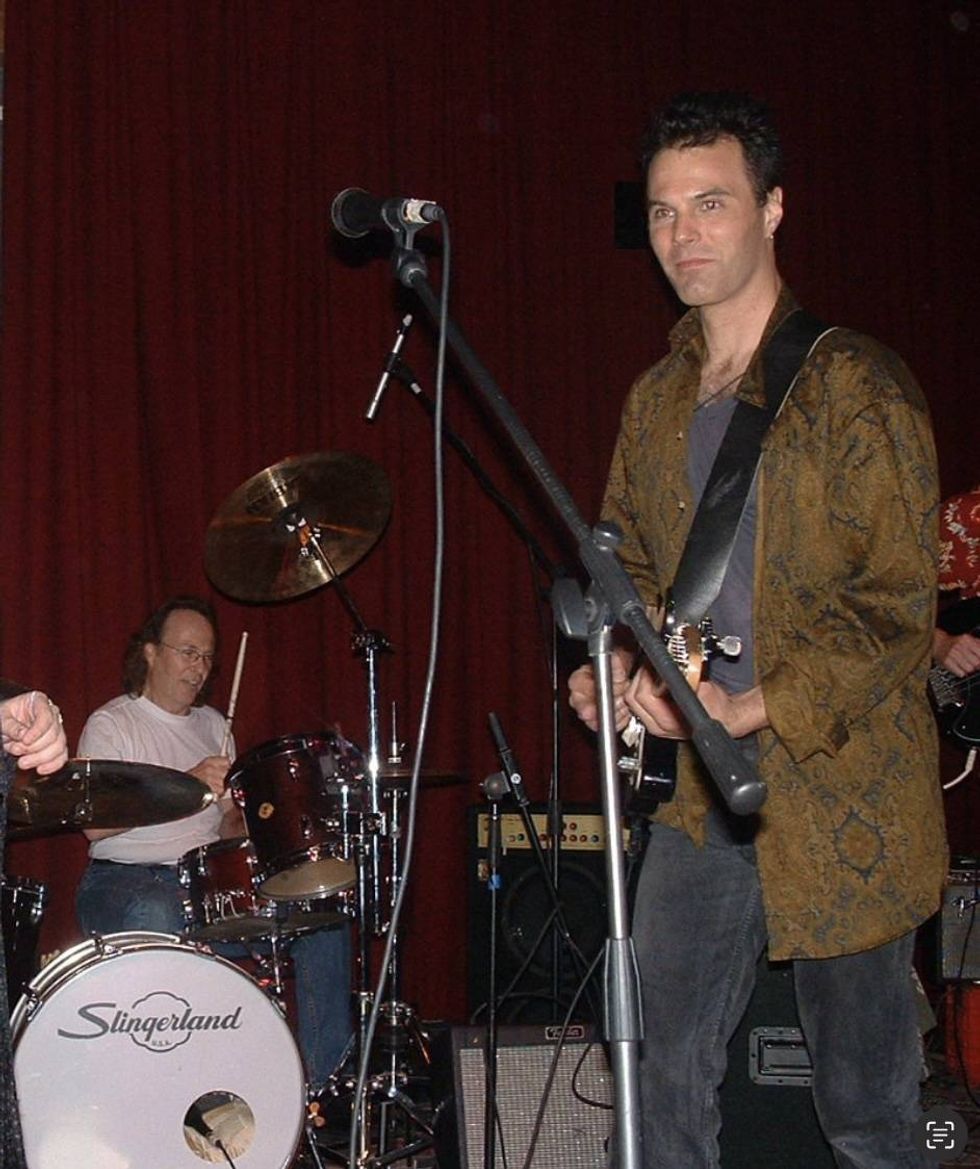
His other work includes a long run of Billy Joel videos, among them “Uptown Girl,” “Tell Her About It,” “Baby Grand,” and “The Night Is Still Young.” He also worked as a director, producer, or executive producer on Joel concert films including Live at Yankee Stadium (1990) and Live at Shea Stadium (2011). He had a similarly long relationship with Garth Brooks, directing the videos for “The Red Strokes” and “Standing Outside the Fire.” With Brooks he also made Live from Central Park (1997), Yankee Stadium Live (2016), and Live at Notre Dame (2018). Other videos he worked on include Reba McEntire’s “Whoever’s in New England” and “Does He Love You,” Whitney Houston’s “Greatest Love of All,” and his final major directing credit, co-helming Luke Combs and Eric Church’s “Does to Me” with Trey Fanjoy. He also made concert films for the Highwaymen, Lynyrd Skynyrd, and James Taylor.
In 2003, Jon took a chance on me and hired me to lead the band on Nashville Star, a country talent show that debuted on USA (and later moved to NBC) the year after American Idol launched. That job changed my life. Over six seasons, the show produced Miranda Lambert, Kacey Musgraves, and Chris Young, and all three are still major country stars today.
Jon taught me lessons that have guided me ever since. The first is to be kind to everybody. The second is to hire good people and then trust them. Give them direction and step back, and if something goes off the rails, give them some perspective instead of micromanaging. He also told me not to worry about work: Do good work and work will find you. The gig isn’t your security; you are your own security. He believed in keeping the work fun, especially when it got stressful and difficult. And he taught me that forgiveness is a gift you give yourself. Those lessons carried me through 20 years of leading bands on television.
Although Jon left this realm on September 4 of this year, his influence is evident throughout our industry. I’m certain that, in the next life, he will remain the coolest guy in the room.
Reader Guitar of the Month: A Deep Blues-Rock Tone Machine
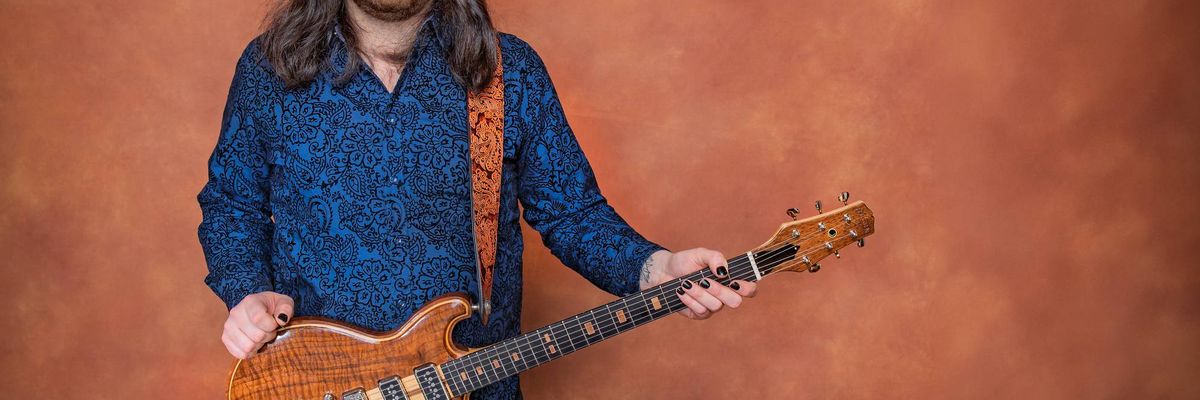
Reader: Matt Swanton
Hometown: Shirley, MA
Guitar: Wanita
For a while now, I’ve been chasing the perfect guitar to use in my writing as a blues artist. I’ve grown fond of guitars with neck-through construction, though I’ve struggled to find the right one since many neck-through guitars on the market are 24-fret shred machines better suited for metal or heavier genres. Because I work primarily in the blues and classic rock, neck-pickup tone is really important to me, and moving the neck pickup closer to the bridge to make room for two extra frets can change the sound significantly. But aside from the Gibson Firebird, options for 22-fret neck-through guitars are pretty slim.
A little less than a decade ago, I met a luthier by the name of Michael McCarten while playing a gig in Gardner, MA. After striking up a conversation, I started going to see him for the occasional repair job. Every time I went to his shop, I’d see some really cool double-cutaway guitars he built called the DC-13. Each one of them is completely unique, with different custom details related to a theme or the guitarist it was meant for. After a few years of wondering what I’d come up with if I had the money to afford one, I decided it was time. Michael graciously agreed to make my guitar with a 25.5" scale instead of his usual 24 3/4", as well as indulge my request for neck-through construction rather than a standard set neck.
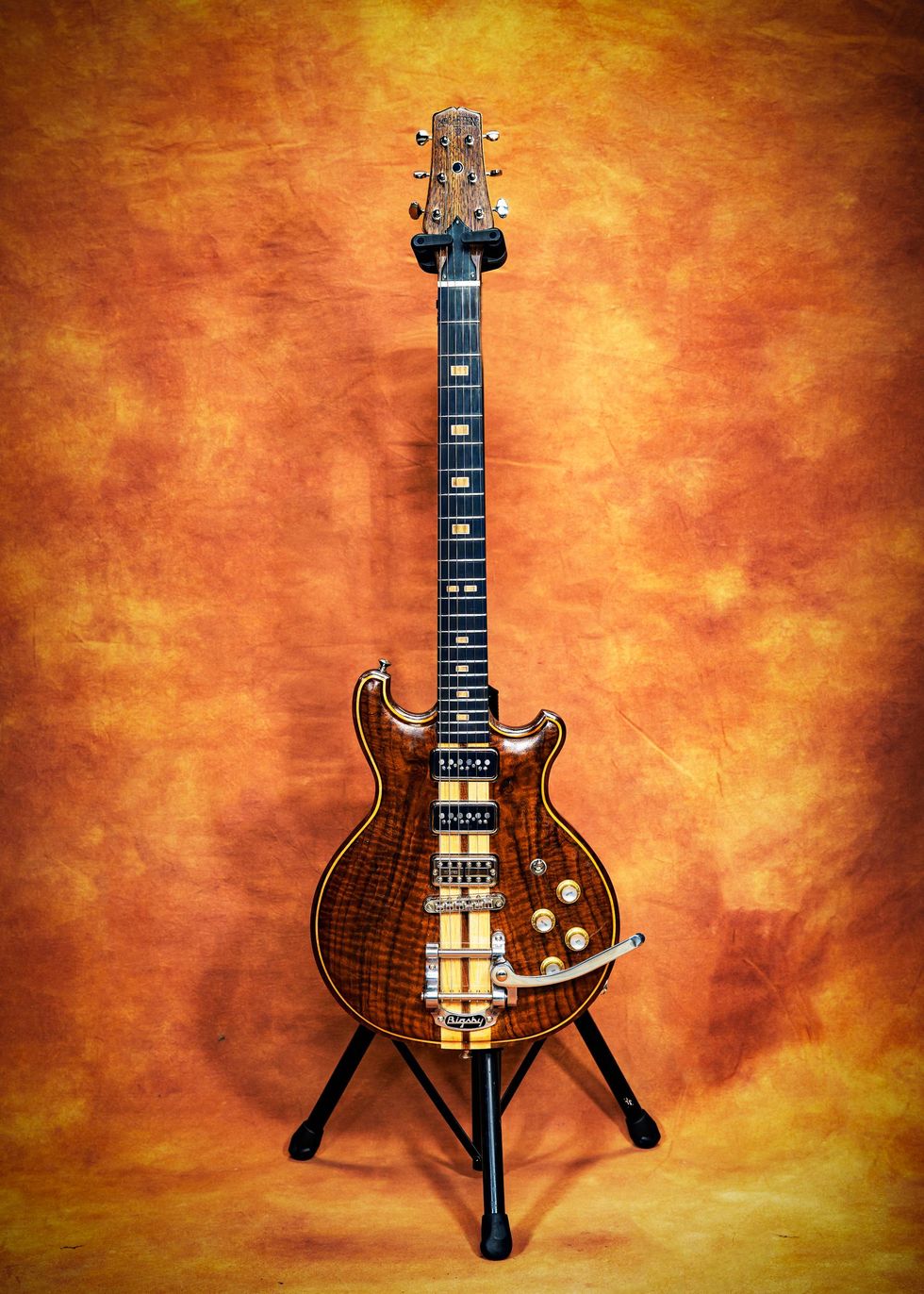
I’ve decided to name this guitar “Wanita,” for no other reason than it just sounded right. The body consists of a figured claro walnut top, a chambered walnut back, and a layer of maple in between to give it a stylish contrast line—especially when it’s exposed at the German carve along the edge. The neck is quarter-sawn maple with layers of walnut, and the fretboard is ebony. The fretboard inlays are blocks of flamed maple inserted into a rectangular section of copper that used to be waveguide piping. The whole guitar has been finished with tung oil for a smooth finish that doesn't stick like gloss.
For pickups, I went with a Gretsch-inspired HSS type of approach, with a TV Jones Power’Tron in the bridge and T-Armonds in the neck and middle position. It’s wired like Peter Frampton’s Les Paul, where the selector switch sees just the bridge and neck pickup, which are connected to a single set of volume and tone pots, while the middle pickup is hitched to the second set of volume and tone controls. This enables unique pickup combinations—I can use the bridge and neck pickups alone or together, and blend in the middle pickup at various volume and tone settings. It adds up to a lot of voices. A Schaller roller bridge, a U.S.-made Bigsby B5, and Grover imperial tuners help make it feel tight, smooth, and together, too. But the whole guitar plays like a dream.
Reverb’s End of Summer Sales Event might be the perfect time to give your rig a makeover

As the leaves shift from shades of green to warm, orange-y browns, it’s a nice reminder of how much can change with every season. And that goes for your guitar rig, too – because why should the trees be the only ones enjoying a fresh, seasonal makeover? Luckily, Reverb’s End of Summer Sales Event has got you covered.
While the sun may be going away, Reverb’s solid slew of discounts across top brands is here to stay. Fender in particular has a wide selection of discounted goodies across the site, including a slew of Custom Shop axes. For example, some unique relic’d pieces are available at a fraction of their usual price; a Fender Custom Shop ’57 Reissue Stratocaster Heavy Relic guitar in Fiesta Red is currently sitting at 35% off, dropping down to £2,685.10 from its usual price of £4,130.93.
If you’re particularly fond of Fender’s throwback designs paired with a worn-in, reliced feel, you may also be interested in a Fender Custom Shop ‘65 Stratocaster Super Heavy Relic. This brand new Strat is 15% off, dropping from £4,708.53 down to £4,002.26. In terms of colour, it’s a Faded Ages Sherwood Metallic Green, worn to expose some Three-Colour Sunburst – and it looks absolutely battered (in the best way, of course).
If you’re not into the new-yet-worn-in look, there are also some other Fender axes that look truly fresh-out-the-box. In particular, there’s an Olympic White Limited Edition American Vintage II 1973 Strat that’s sitting at 15% off, now costing just £1,615.19. Elsewhere, there’s also an American Professional Classic Telecaster, available in Butterscotch Blonde for just £1,063.89, which is a 20% drop from its usual price.
There are also some fabulous price drops on PRS axes – and, again, some are truly unique. One of the most unique guitars on sale is one from PRS’ Sprayers Choice line, which allowed painters to let their creativity run wild and use custom colours and non-standard finishes. A Limited Edition 40th Anniversary McCarty SC56 is currently available for £3,260.72 rather than £4,347.62, knocking over £1,000 off its usual price. So you’ll be able to enjoy the guitar’s weight-relief design, pair of PRS McCarty III pickups, and warm tone along with a striking colourway.
PRS’ John Mayer signature is also included in Reverb’s sale – specifically his left-handed Lefty edition of his SE Silver Sky. Brand new Lefty models are sitting at 25% off, dropping to just £580.44, and there are two colour options available: a bright Dandy Lion yellow, and the earthy Lauren Green.
Some new axes from this year are also part of the sale. A brand new 2026 Gibson Les Paul Standard ‘50s in particular has had a price drop; we were impressed when the guitar was first released back in 2019, so we’re sure this ‘26 edition will be a great addition to your collection. A Heritage Cherry Sunburst edition is sitting at £1,855.67, a 15% discount from its usual price of £2,183.14.
Of course, there are also a few nifty pedals involved in the sale. There are a few Electro-Harmonix products that have dropped by 20%, too. Highlights include the Electro-Harmonix 15 Watt Howitzer Guitar Amp / Preamp Pedal, which we awarded an 8/10 in 2022 and is currently £81.60. Elsewhere, the brand’s Pitch Fork polyphonic pitch shifter (which we also awarded an 8/10) has dropped to £174.40, down from its usual £218.
For more End of Summer deals, head to Reverb.
The post Reverb’s End of Summer Sales Event might be the perfect time to give your rig a makeover appeared first on Guitar.com | All Things Guitar.
Here are all the modellers with NAM A2 support

You might have heard quite a bit of buzz about the new Neural Amp Modeler (NAM) architecture – NAM A2. It’s been touted as a revolutionarily upgrade to amp capture technology, with marked improvements in efficiency and sound, letting you squeeze tones on par with fully-fledged Neural DSP out of far more affordable hardware, with a much more open approach to compatibility. While those all sound like big claims, earlier this year I took a look at the HeadRush Flex Prime’s NAM A2 update. And it very much lived up to the hype! So, to help you get in on the A2 game, let’s explore a little more about how it works, and explore what hardware modellers currently support the standard.
What is NAM?
Created by Steve Atkinson, Neural Amp Modeler (NAM) is an open-source deep-learning framework that profiles amplifiers and pedals with remarkable accuracy. It is, in essence, doing a similar thing to Neural DSP’s native models – teaching a machine-learning algorithm to behave like a tube amplifier, capturing all of the responsive, dynamic idiosyncrasies of the real deal. While NAM quickly became an industry standard in the software VST space, its original A1 architecture could be a little heavy on its processing power requirements. This made it difficult to run natively on embedded hardware like multi-effects pedals without using external conversion tools.
What’s different with NAM A2?
To solve this hardware limitation, Atkinson and TONE3000 officially unveiled the NAM A2 architecture in June 2026. The new A2 dramatically lowers CPU cost while improving sonic accuracy. The new format comes in two primary tiers: A2-Full, which will give you the best depth and realism, and A2-Lite, a highly optimized version designed specifically to run natively on units with more limited CPU power.
Currently available NAM A2 modellers and multi-effects
HeadRush Prime, Core, and Flex Prime
- Price: ~$499 USD (Flex Prime) to ~$1,200 USD (Prime)
- NAM Support: A2-Full & A1
Thanks to the Firmware 5.1 update released in August 2026, the modern HeadRush ecosystem now runs NAM A2 captures natively. Users can easily drag and drop .nam files via USB or browse the TONE3000 library directly on the hardware’s touchscreen via Wi-Fi. The flagship Prime, the mid-tier Core, and the compact Flex Prime all support this feature, making HeadRush one of the most accessible ecosystems for high-accuracy A2 models.
Darkglass Anagram
- Price: $1,199.99 USD
- NAM Support: A2-Full & A2-Lite
The Darkglass Anagram is a powerhouse bass workstation powered by a hexacore DSP architecture. Following a recent firmware update (KosmOS 1.17), the Anagram became the first bass multi-FX to natively support the TONE3000 A2 API. Its massive processing power allows users to run up to 5 A2-Full models or 9 A2-Lite models simultaneously, making an excellent tool for complex, parallel bass signal chains.
Blackstar Beam Mini
- Price: ~$200 USD
- NAM Support: A2-Lite
The Blackstar Beam Mini is a smart desktop combo amplifier and one of the first consumer amps to feature native NAM A2 integration out of the box. By utilizing the highly efficient A2-Lite architecture, it allows players to load NAM captures directly onto the amp without needing to run conversion software, making it a seamless desktop practice and recording tool.
Dimehead NAM Player
- Price: ~$500 USD
- NAM Support: A2-Full
A boutique pedal solution aimed at gigging professionals, the Dimehead NAM Player provides enough dedicated processing power to run two NAM models simultaneously. It natively supports the high-accuracy A2-Full architecture while maintaining backward compatibility with older A1 captures. The pedal also includes a convolution reverb, a high-resolution IR loader, and comprehensive MIDI control.
Hotone Ampero Series
- Price: ~$400 – $550 USD (Ampero II Stomp & Ampero II Stage)
- NAM Support: A2-Lite
Hotone’s Ampero II ecosystem has long been a favorite for players seeking a compact, touchscreen-driven floorboard. Following their late-2026 firmware overhaul, the Ampero II Stomp and Ampero II Stage now natively support the highly optimized A2-Lite format. This integration allows users to run pristine NAM amp profiles alongside Hotone’s expansive library of native delay, reverb, and modulation effects, making it a formidable fly-rig solution.
Mooer GE Series
- Price: ~$130 – $160 USD (GE100 Pro / GE100 Pro Li) to ~$300 – $650 USD (GE300 / GE1000)
- NAM Support: A2-Lite
Mooer has successfully updated its flagship multi-effects ecosystem to handle A2-Lite captures natively, creating one of the most comprehensive neural-capture lineups on the market. For touring and studio professionals, the flagship GE1000 and the older GE300 processors provide an intuitive touchscreen UI, extensive I/O routing options, and enough DSP overhead to run complex NAM models alongside the unit’s built-in synth engines and polyphonic pitch shifting.
More recently, Mooer expanded their neural capabilities to the ultra-budget market with the highly compact GE100 Pro and GE100 Pro Li. These highly affordable units not only load NAM A2 captures seamlessly, but also introduce Mooer’s “AI StemLab” for track separation and AI-generated presets. The GE100 Pro Li stands out particularly for mobile players, featuring a built-in rechargeable lithium battery that delivers up to nine hours of playing time, making it an ultimate portable gigging and practice rig that doesn’t compromise on studio-grade A2 amp tones.
Nux MG and Trident Series
- Price: ~$150 – $350 USD (MG-30, MG-50Li & Trident)
- NAM Support: A2-Lite
Nux provides some of the most highly affordable entry points for guitarists wanting authentic NAM captures in a traditional floorboard format. By adopting the A2-Lite standard, budget-friendly units like the MG-50Li and the gig-ready Nux Trident can now load third-party A2 captures natively. This brings top-tier, neural-captured amp tones to the ultra-budget market, proving that players no longer need thousand-dollar rigs to access studio-grade amp modeling.
Announced Plans for NAM A2 Support
Because A2 is a completely new architecture, hardware manufacturers must explicitly rewrite their firmware integrations to support it. Several brands are actively working on bringing A2 to their platforms:
- Valeton: Valeton is expected to follow suit soon, bringing native A2 compatibility to their highly popular GP series of multi-effects processors.
- Lava Music: Lava Music has announced plans to integrate A2 models directly into their smart guitars’ onboard digital operating systems.
- Boutique & Indie Builders: Brands like Sonulab (StompStation) and Chaos Audio are actively updating their hardware to support the TONE3000 API and native A2 captures.
The post Here are all the modellers with NAM A2 support appeared first on Guitar.com | All Things Guitar.
Fender just launched a new Mark Hoppus signature bass, but you’ll have to be quick – it’s only available for 182 hours

Fender has announced a new limited-edition signature bass for Blink-182 bassist and co-lead vocalist Mark Hoppus, celebrating his 25-year relationship with the brand.
And when we say limited-edition, we mean really limited-edition… So limited, in fact, that the Mark Hoppus Stone Fruit Jaguar Bass is only available to order for 182 hours, after which time it’ll cease to be available. So you’ll have to be quick if you’re interested…
The bass is inspired by Hoppus’s original “Stoned Fruit” Guava Green Jaguar bass, which he first played onstage during Blink’s 2023 world tour. The bassist personally commissioned Ohio-based artist Phil Guy – known professionally as “Burrito Breath” – to create the psychedelic-style fruit illustrations that were then placed individually across the instrument.
 Credit: Fender
The new Mark Hoppus Stone Fruit Jaguar Bass also comes with a selection of Burrito Breath-designed fruit decals, but they’re on the side, so players can decorate their instrument how they see fit and make it their own.
“To now have my own signature model done exactly the way that I like is super awesome,” says Hoppus on the new collaboration.
 Credit: Fender
“This is the culmination of my nearly quarter century relationship with Fender. Coming out of skateboarding and punk rock, stickers are such a huge part of everything that we do. You can take this bass, you can sticker it up, you can pretend you’re a little kid in the back of your parent’s car putting stickers on the window as they drive down the freeway. This bass plays incredibly well and you’ll look cool as shit.”
In terms of specs, the Stone Fruit Jaguar Bass sports reverse-mounted Seymour Duncan SPB-3 Quarter Pound split-coil P bass pickups, along with a Custom “C” maple neck, HiMass Vintage bridge and lightweight vintage-style tuners, with a nice visual touch coming with a custom neck plate featuring Hoppus’s “Hi, My Name is Mark” octopus logo.
 Credit: Fender
“Mark has always had a very clear point of view about what he wants from an instrument – both in how it performs and how it looks,” says Justin Norvell, Chief Product Officer at Fender.
“The Stoned Fruit Bass captures that perfectly. It’s unmistakably Mark: simple, powerful, personal and a little unexpected. We wanted to recreate the instrument he actually plays while giving fans the opportunity to put their own stamp on it.”
The Mark Hoppus Stoned Fruit Jaguar Bass is available now – for only 182 hours and counting… – priced at $1,499.99 / £1,499 / €1,749.
Learn more at Fender.
 Credit: Fender
The post Fender just launched a new Mark Hoppus signature bass, but you’ll have to be quick – it’s only available for 182 hours appeared first on Guitar.com | All Things Guitar.
Amels Audio Launches With Osetra All-Tube Instrument DI
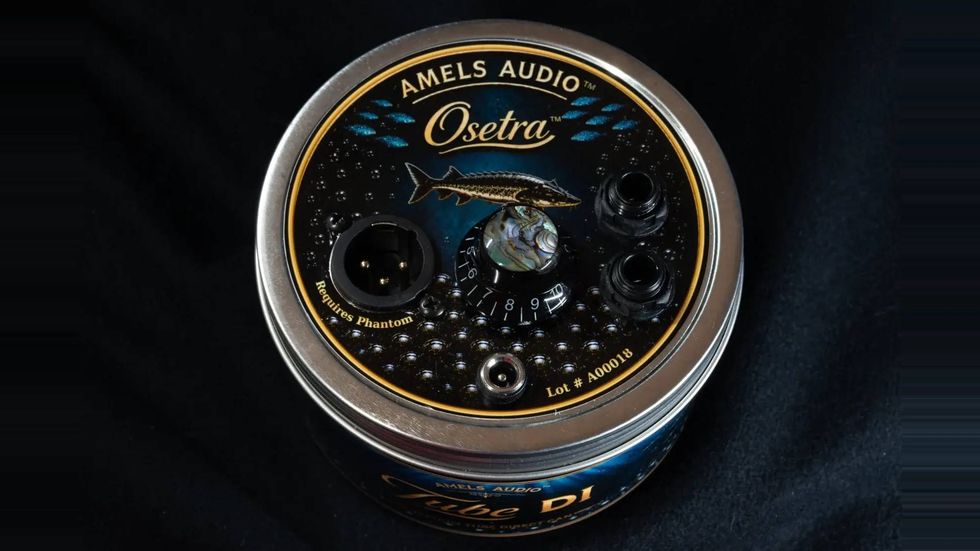
The newly launched Amels Audio has released Osetra, a direct-coupled all-tube instrument DI, as its debut product.
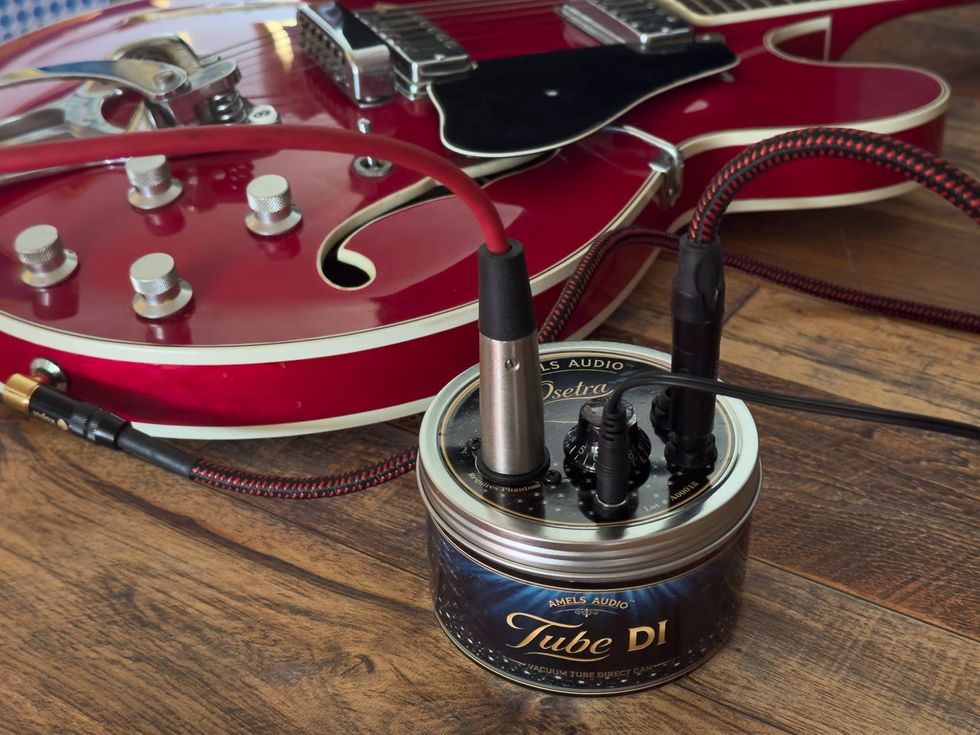
Audio designer Dave Amels’ new venture is an independent company making original hardware for musicians and recording studios. The Osetra DI is designed for use with electric guitar, bass, and pickup-equipped acoustic guitars, and comes first in an eye-grabbing, numbered 20-unit Founder's Tin Edition.
Osetra uses an original Class-A, transformerless circuit with no loop feedback. Its low-capacitance instrument input presents a 1 MΩ load, which helps preserve transients and contributes to a responsive playing feel. Measured response runs from 4 Hz into the megahertz range, with the observed upper limit set by the receiving microphone preamp. The tube B+ supply comes from 48 V phantom power, and the included universal-input 12 VDC adapter powers the filament.
Each Founder's Tin Edition unit is assembled at the bench and housed in a laser-cut caviar tin with sturgeon artwork. The Osetra product page (amelsaudio.com/osetra) hosts comparison videos and audio demos. These include level-matched bass and acoustic-guitar comparisons against familiar tube and FET DIs, plus standalone electric- and acoustic-guitar demos.
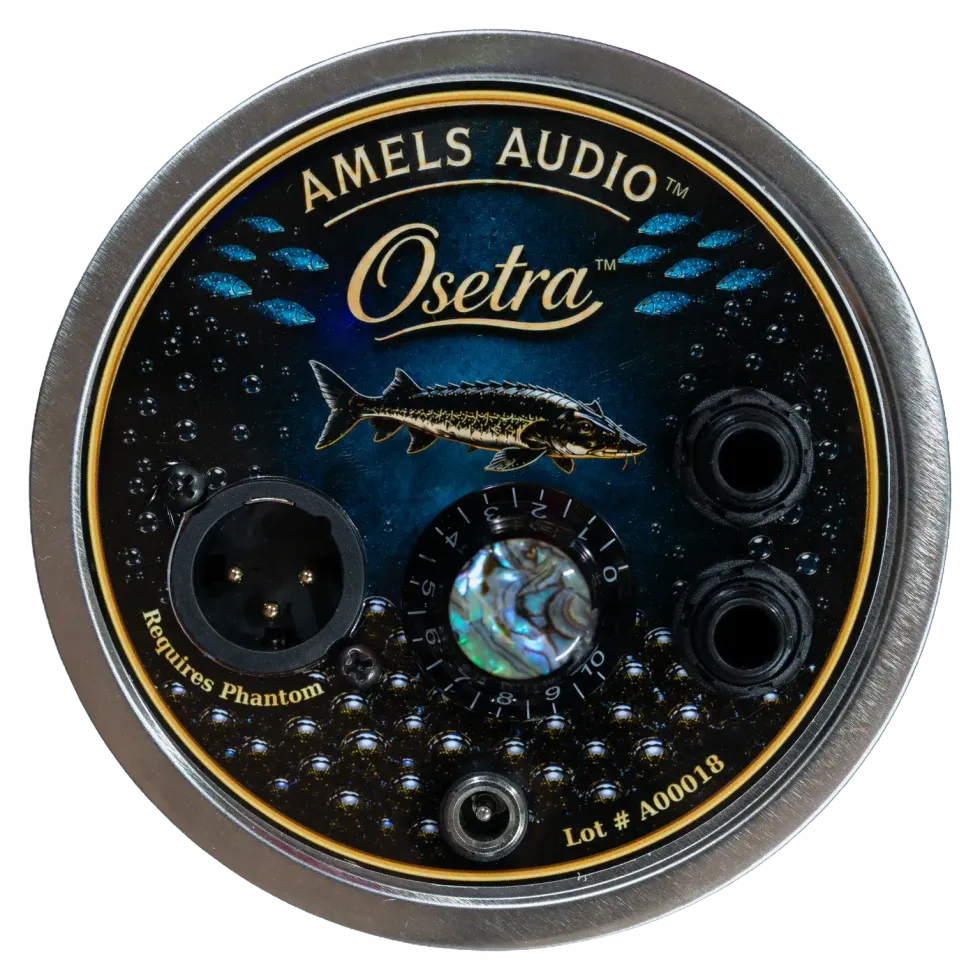
Amels Audio draws on founder Dave Amels' career in electronic musical instruments, mathematically modeled audio software, and analog recording equipment. Since the late 1980s, he has designed hardware and software for musicians and recording engineers, including at three companies he co-founded.
"Amels Audio gives me a place to invent and build the kinds of tools I want to use," said Amels. "They have to be technically serious, musically responsive, and useful in a working studio. Osetra is the first."
Osetra Founder's Tin Edition units 01–20 are available directly from Amels Audio for $425. Each comes with a universal-input 12 VDC filament adapter and a one-year parts-and-labor warranty. Initial sales are limited to the United States. For more information visit amelsaudio.com.
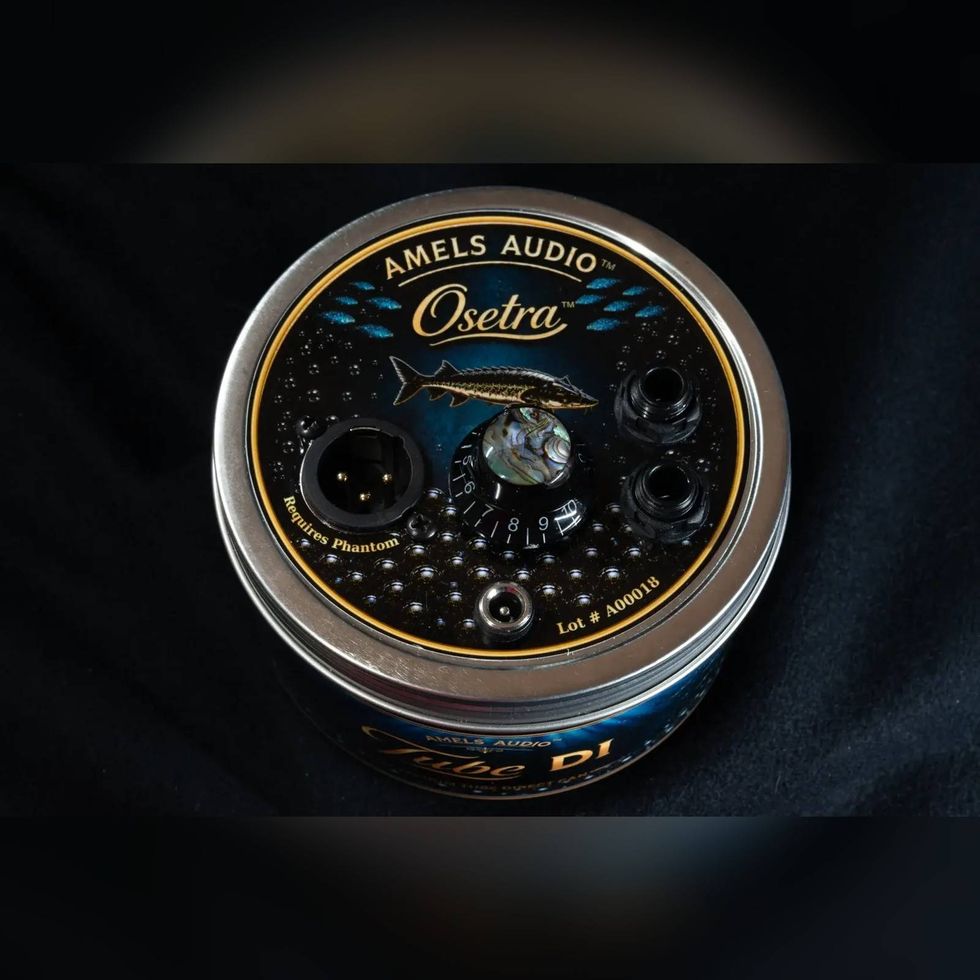
Osetra
The newly launched Amels Audio has released Osetra, a direct-coupled all-tube instrument DI, as its debut product.
The Johnny Marr x Maharishi Strat is a work of art. But don’t get too excited – you can’t buy one

Though mostly known for his pivotal guitar work in The Smiths and throughout his solo career, Johnny Marr has made no secret his opinion that the clothes you wear are pretty much as important as the instrument you play.
After recently parting with a number of his most iconic Smiths-era guitars – in an auction which netted £3.6 million – the guitarist went on record saying he’s, in fact, more sentimental about his clothes than he is his guitars. “I’d actually find it harder to get rid of some of my jackets,” he said.
So perhaps his latest collaboration with clothing brand Maharishi isn’t all that surprising…
The new partnership is headlined by a limited-edition Advisors Shirt – which takes its name and silhouette from the utility shirts worn by US military advisors during the Vietnam War – and features a hand-machine embroidered Dragon on the back, a detachable “Marrharishi” nametape, and unique collaboration patches on the sleeve.

Perhaps more interestingly for you guitar folk, the partnership has also yielded a new Johnny Marr x Maharishi Stratocaster, but don’t get your hopes up too high, as it’s not for sale. Only four have been made in total, with one going to Johnny – to help replenish his collection after the recent Marr’s Guitars auction at Christie’s gutted it – one going to Maharishi founder Hardy Blechman, and the other two on display at Maharishi’s flagship stores in London and New York.
 Credit: Maharishi
So you won’t be able to get your hands on it, but you can admire it from afar: it has a Custom HH 73 body and heirloomed hardware and the classic Maharishi Original Dragon artwork.
But that’s not all; Fender has also created a new Tone Master Deluxe Reverb amplifier, wrapped in Maharishi’s signature military-inspired Disruptive Pattern Material (DPM).
 Credit: Maharishi
“I’ve been going into Maharishi for many years, and I wanted to pay tribute to the ethos of the company and its designs,” Marr says. “So what better way to do that than by designing a guitar inspired by the same philosophy? I knew it had to be a customised Fender Stratocaster with the Maharishi aesthetic.”
“The design process for this project flowed easily as Johnny has a deep, long-standing understanding of Maharishi and its inspirations,” adds Maharishi Creative Director Hardy Blechman. “It was satisfying to witness him develop a guitar that reflected the Maha Tailor Shop ethos and spirit so well.”
“The collaboration reflects a shared design language across all three parties: Maharishi’s commitment to functional, story-driven military reproduction; Marr’s status as one of the most influential songwriters and guitarists of his generation and a longtime Fender artist and signature collaborator, and Fender’s own legacy of iconic instrument design,” says Fender.
The Marrharishi Advisors Shirt is available from the Maharishi website, and from its stores in London and New York, priced at £320.

The post The Johnny Marr x Maharishi Strat is a work of art. But don’t get too excited – you can’t buy one appeared first on Guitar.com | All Things Guitar.
“It costs too much to care:” Stand Atlantic’s Bonnie Fraser on her trusted gear and breathing life back into music

Bonnie Fraser was bored with the music she was hearing. “I just feel like so many things have the same samples and the same everything, like everything is perfect into the grid,” the Stand Atlantic vocalist and guitarist says.
“I just felt like I personally was missing that natural and more organic feel in at least genres like ours because it’s rock music at the end of the day, and it’s supposed to be about how the fuck you’re feeling.”
It’s an unexpected place to start a new record, but that’s how she began thinking about what would become Stand Atlantic’s fifth album, Godbreath, out on October 23. Following the pop-punk roots of 2018 debut album Skinny Dipping, Stand Atlantic’s next three albums – 2020’s Pink Elephant, 2022’s F.e.a.r. and 2024’s Was Here – were extremely experimental, drawing from pop, electronic and hip-hop influences. But the experimentation took a different form this time around: tracking live.
Instead of the typical method of recording one instrument and one portion of a song at a time, all four members of Stand Atlantic – including bassist Miki Rich, guitarist David Potter and drummer Jonno Panichi – recorded in the room together, playing each song the whole way through, with Fraser recording vocals separately. “At first, we were like, ‘This might sound horrible, guys!’” Fraser recalls. “’We might do the wrong thing here.’ But I feel like it was a great challenge, and it turned out to be a lot of fun.”
Tracking live does make it harder to get a take where everyone is playing everything perfectly. But that was kind of the point. And it fits with the mentality of a band who has always rolled with whatever life has thrown at them. “It costs too much to care,” Fraser says.
Professionals
Fraser tends to write on guitar – if she has one on hand when she’s working on an idea. “I’ll find a couple chords that I like, start humming some melodies, and then I’ll try and see what words are coming out,” she explains. “I think sometimes that helps me build what I’m trying to say without me even knowing.”
Fraser is known for her concise, vulnerable and visceral lyrics. “I feel like I’m always just trying to make it not cheesy,” she laughs. “Every single thing I’m doing, I’m like, ‘What’s not cheeseball, please?’ I feel like that’s my guide a lot of the time.”
When it was time to record the album, Fraser mostly turned to the guitar she plays onstage. “We wanted to be able to recreate the sound properly in a live setting,” she says. She and Potter play Fender American Professionals. “I have a Seymour Duncan in the bridge now, and no other pickups,” Fraser says. “And then, literally, just [an] on-off switch. It’s so sick. Super simple, Tom DeLonge-style vibes, and it’s my sewer green Strat.”
They also stuck with an equally tried-and-tested amp: Fraser’s father’s Marshall Mark II, which has made an appearance on every Stand Atlantic album to date. “I’m so lucky,” Fraser says. “My dad was a musician back in the day, and he has kept all his gear since then. I don’t really fuck with the guitars in there because I’m like, ‘I know I’ll break this. I don’t want to be responsible for doing anything wrong to this guitar,’ because he has so many little babies in there.”
When Fraser speaks, Stand Atlantic have just wrapped up a string of dates in Europe and are about to play a few shows in the UK. They’ll start an Australian headlining run when Godbreath comes out, before opening for Silverstein and Story of the Year on their North American tour in November and December. For a band from Sydney, Australia, it’s impressive – but it limits their touring rig.
“It needs to be flyable so we can’t unfortunately bring like ten million guitars for different things,” she explains. “We need to keep it as simple as possible, so me and [Potter] both have our own regular guitars that we all use, and then we have one spare guitar, which is also an American Professional Strat.”
For the set’s softer moments, the rig includes a Fender Acoustasonic. “That’s super light and super easy to travel with instead of a big bulky acoustic,” Fraser adds. “But one day I would love to be able to tour with a proper big acoustic guitar and seven other guitars that we can change out when we want.”
 Image: Press
Breath Of The Wild
Godbreath stands out from Stand Atlantic’s last two darker and more aggressive albums. The new record’s sun-soaked vibe was down to changes in Fraser’s headspace and personal life, namely being in a healthy relationship. But she had to overcome her initial hesitation about writing from a more positive place. “I wanted to accept the fact that it’s okay for an album to be like that, even though the world is fucked right now, and we all know it, and we all know who and why,” she says.
With Godbreath, Fraser wanted to capture, “the feeling you get when it’s a beautiful day and you’re driving down the highway with your best friend, your dog, your girlfriend, your boyfriend, your mum, your dad, whatever, and blasting your favourite songs.”
Godbreath, with its decidedly warmer feel, will be out in time for spring in Australia, which happens to be autumn for Northern-hemisphere listeners. “I was like, ‘Fuck, most of our fans are going to get this in spooky season,’” Fraser laughs. “It’s the most non-spooky fucking album ever! Should have called it Halloween Breath.”
Fraser had come up with the title Godbreath before she had written a single song – which has been the case for most Stand Atlantic albums. There was a title track at one point, but it didn’t make it onto Godbreath, although the name stuck.
“I thought, conceptually, it was interesting because you could take it two ways,” she reflects. “Is Godbreath when you’re full of ego and talking out your ass, and you think you’re fucking God’s gift to the world, or is it something that you also feel when you’re actually feeling really secure and self-assured, and you feel on top of the world in a more positive way?”
But she does have second thoughts about the title. “I did and still do wish that I called it Dogbreath, to be honest,” she admits. “It’s so funny. I should have done it. Should have fucking done it!”
Godbreath is out 23 October on Virgin Music
The post “It costs too much to care:” Stand Atlantic’s Bonnie Fraser on her trusted gear and breathing life back into music appeared first on Guitar.com | All Things Guitar.
Rig Rundown: Iron Maiden
Iron Maiden brought their Run for Your Lives World Tour to Sports Illustrated Stadium in Harrison, New Jersey, for two nights on September 5 and 6, and PG’s Perry Bean got backstage with techs Brent Diamond, Alan Sosa, and Colin Price to go through the rigs behind Steve Harris, Janick Gers, and Dave Murray. Have a look at some quick highlights below, and tune into the new Rig Rundown for all the details.
Brought to you by D’Addario.
The Only One
Harris has had this roughly 1971 Precision since the mid ’70s, right when Maiden was starting, and has played it at more or less every show the band has ever done. It’s had numerous paint jobs, the headstock logo is long gone, and the truss rod stopped being adjustable years ago—fortunately it’s sitting right where he wants it. Body and neck are otherwise stock apart from a Badass II bridge, his signature Seymour Duncans, and his signature Rotosound flatwounds (.050–.110), which he uses because he doesn’t like the noise rounds make when he slides. The tone knob is pulled out of the circuit entirely so it can’t get turned by accident.
Just in Case
A 1978 Precision is the designated backup, with a Harris signature model also out on the road, though both are there for emergencies rather part of the than rotation. Harris checks his tuning before the show, walks out, and the bass doesn’t come back to Diamond until the night’s over—even when there’s an acoustic in the set.
Built in ’81
A Shure Axient wireless runs four channels—three basses at the moment, plus the acoustic when it’s in the set—into a custom Cornish selector, which picks the active instrument, lets Diamond balance gain between them, and has meters for spotting where the signal is and isn’t. The Cornish is Harris’ second; the first was built in the ‘80s and this one dates to 2000.
Back to the Hiwatt
Harris settled on a Hiwatt NCA108 around 1981, but racking it didn’t take—it fell apart on the road—so he had Alectron build copies and ran those for 40-odd years. Then the originals turned up in a warehouse. Mark Dunn rebuilt them, rack-mountable this time, and Diamond says they edge out the Alectrons, though barely.
Heavyweights
Cambridge Audio SR707 amplifiers have been driving the rig since day one. Diamond says you don’t want to lift one, but they’re bulletproof. They push two stacks of Marshall 800-series 4x12s, beefed up beyond stock and loaded with EVM 12Ls—a guitar cab for bass, which Diamond admits is a little bizarre, and which Harris has run for as long as anyone there can remember.
Break Glass
A Tech 21 SH1 Steve Harris Signature SansAmp pedal handles the direct line to front of house. It exists because Michael Kenney, Harris’ tech at the time, worked with Tech 21 to get his rack tone into a stompbox for small British Lion club shows.
Tuner Loyalty
Harris tunes his own bass, and he does it on a Korg WT-12 that came out in 1980. It’s old enough to be unreliable—sometimes great, sometimes not—so there’s a second WT-12 onstage and another Korg beside it.
Gillan’s Gift
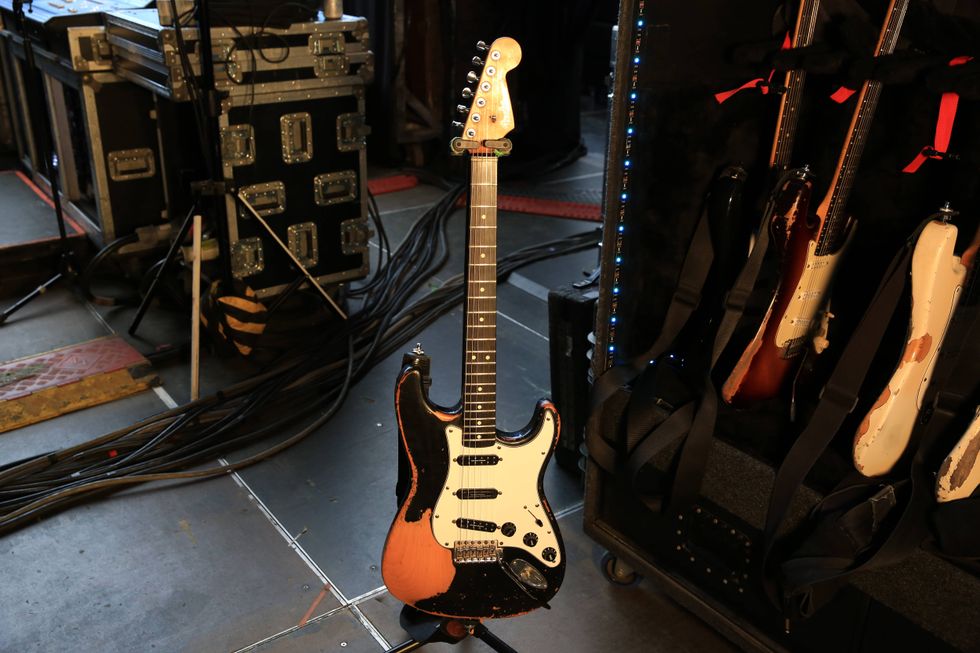
Gers’ number one is a Fender replica of a black Strat that Ian Gillan gave him. He played the original into the ‘90s, retired it, and had this one built; it was mint when it arrived and isn’t anymore. There’s a Duncan JB Jr. in the neck and bridge and a Hot Rails in the middle. Strings are .010–.046, and he likes swapping one for a lighter gauge— Sosa isn’t sure whether that’s about tension or superstition.
“Whitey”
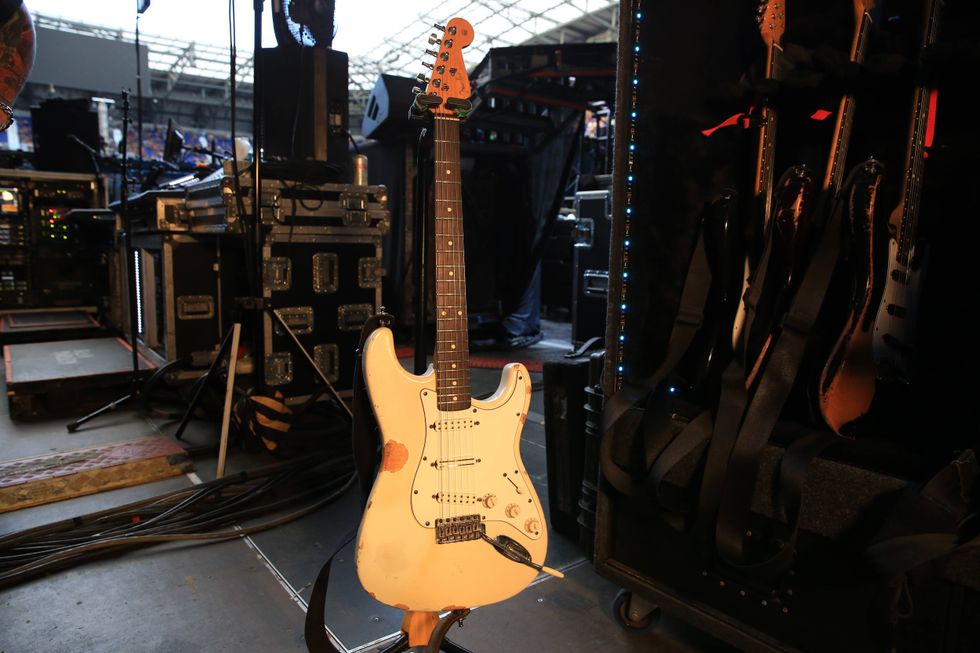
Gers’ other main Strat, also from the ‘90s, has the same JB Jr. and Hot Rails setup. The tape on the back is there because he wears a bullet belt— Sosa figures it buys the finish a little time, though it’s going regardless.
A Real Trooper
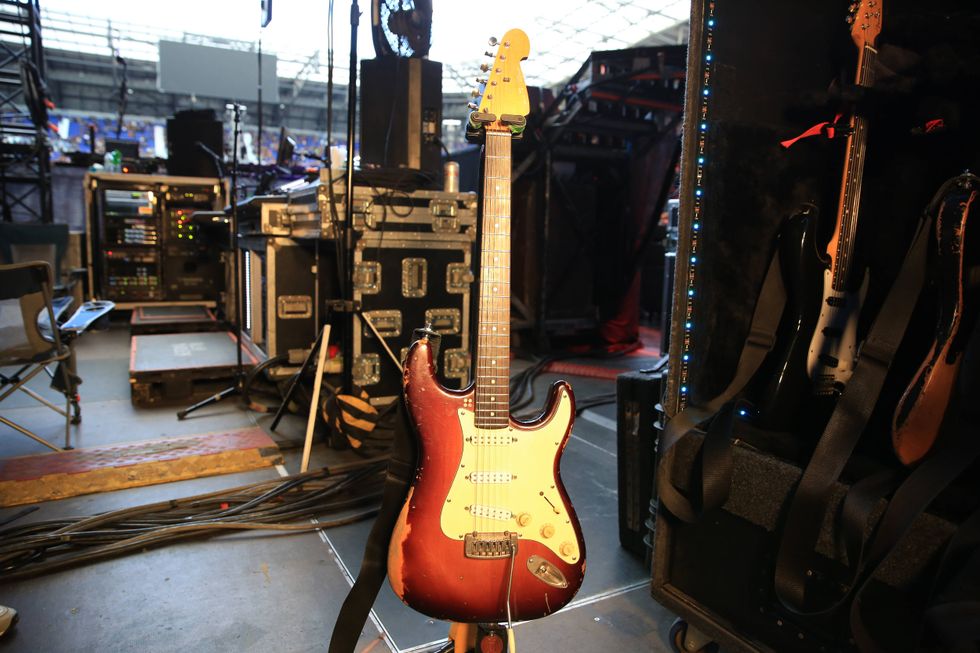
Sandberg has built Gers a few guitars over the years. This one has three JB Jr. pickups, and it comes out for “The Trooper.” The body’s close to a classic Strat, but the bridge, the headstock, and the sculpted heel are all Sandberg’s own.
First Strat
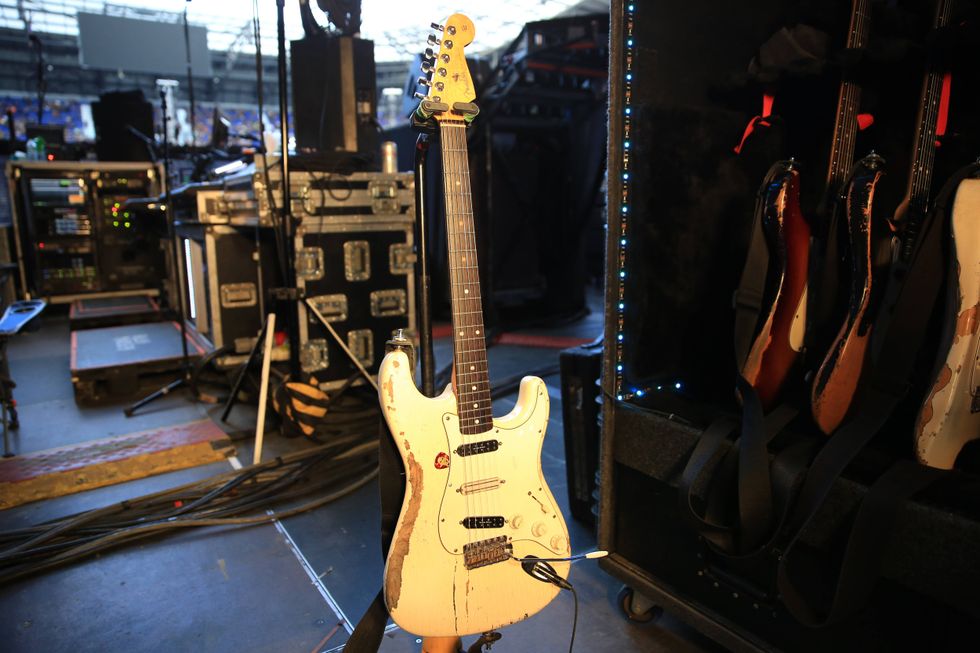
Gers has had this Strat since roughly his first band, and Sosa says he doesn’t give it a break—most of the checking is real cracks in the wood rather than cosmetic crazing. The neck is new because the old one was past working on, and the guitar’s been apart and back together more times than anyone can say.
Janick Gers’ Rack
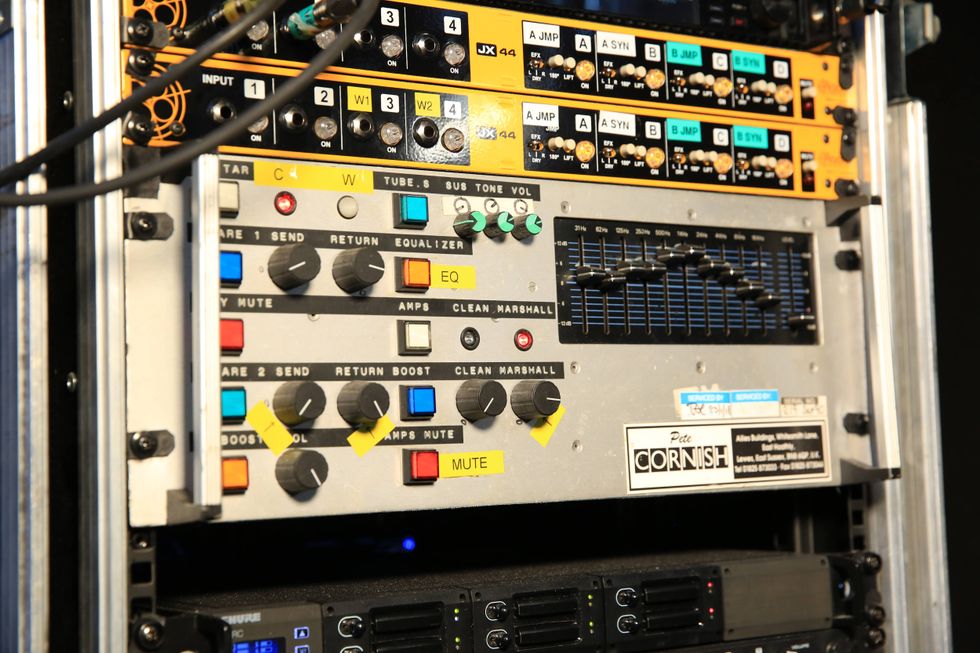
A Shure Axient True Wireless covers the three songs Gers wants to run around for; the rest of the night he’s on a cable. Both feed a Radial JX-44. A custom box that used to be the brain of the rig still earns its keep for its Tube Screamer, EQ, and a treble booster Sosa kicks in when Gers wants feedback at the end of a song.
Marshall Law
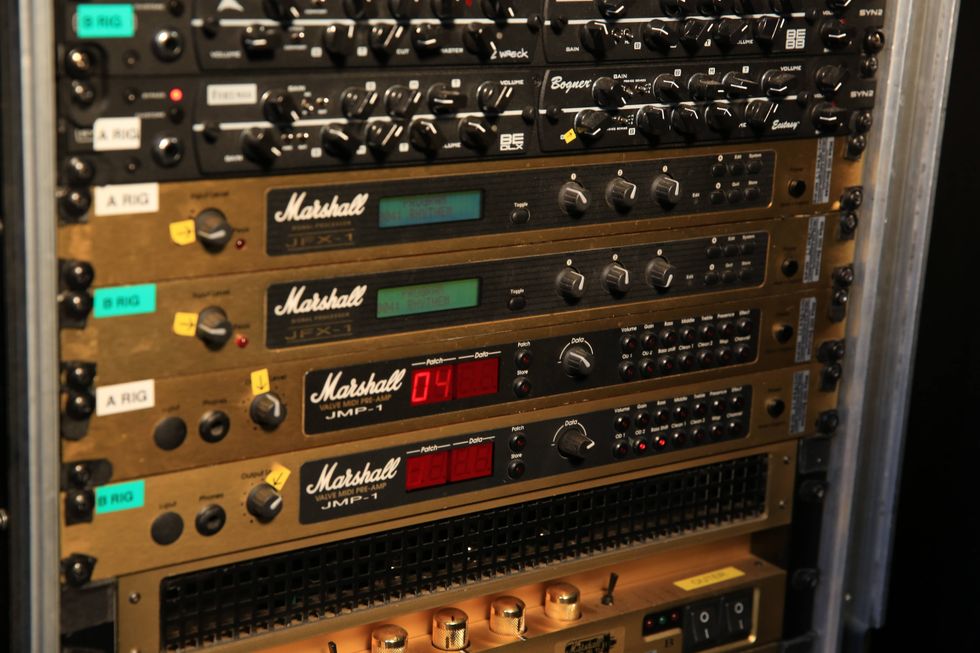
A Marshall JMP-1 is the main tone, a Marshall JFX-1 adds room reverb on rhythms plus delays, harmonies, and chorus, and a Marshall 9200 does the power. A Synergy setup with its own power amp covers the rest: a Bogner Ecstasy module for cleans, gain almost all the way down, and a Friedman for an alternate lead tone on “Hallowed Be Thy Name,” though both are placeholders until two more units arrive. Sosa does all the switching from a Voodoo Lab Ground Control Pro.
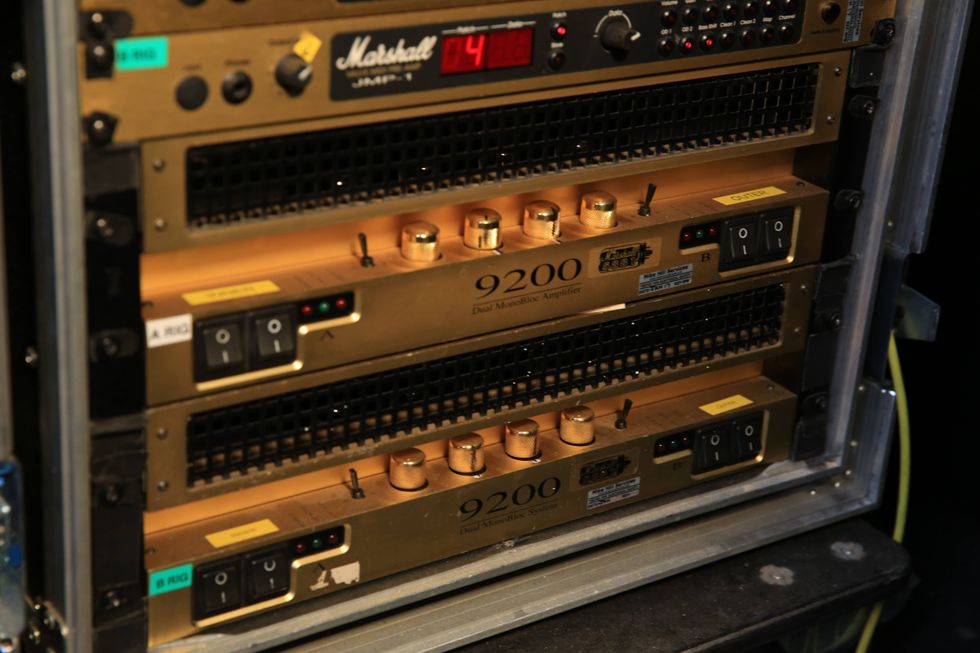
Number One, Literally
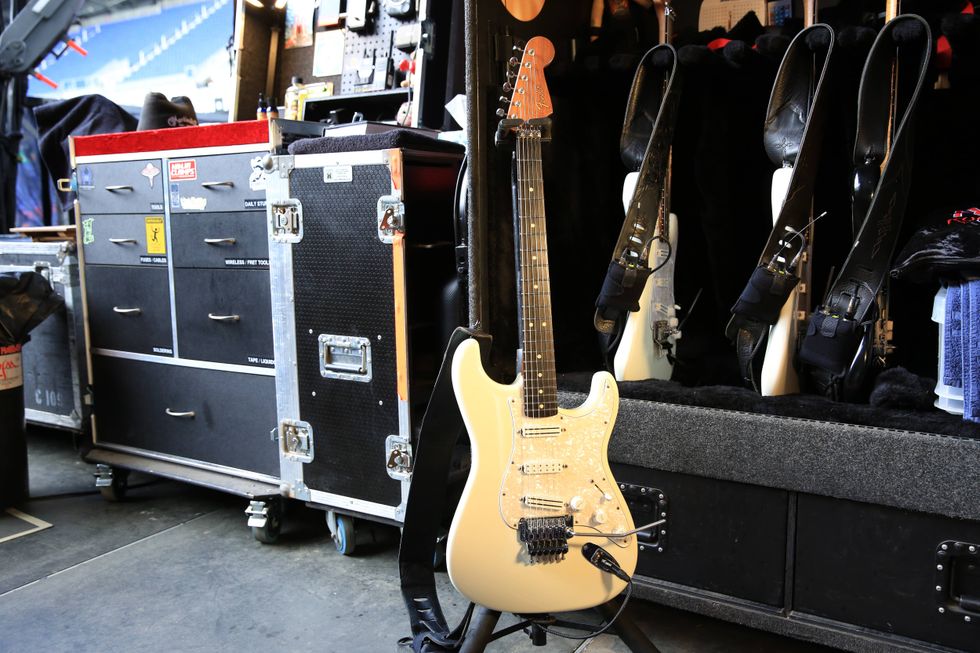
Murray’s main guitar is a Stratocaster from Fender masterbuilder Andy Hicks in Olympic white with a walnut neck that Price says doesn’t move. It’s DM0001, the first of a 70-piece run Hicks has just completed, and Price’s had FU-Tone and titanium parts fitted throughout. Three Hicks builds are out on this tour. The pickups are the Dave Murray Seymour Duncan set—Hot Rails at neck and bridge, and a JB Jr. in the middle for the cleans on “Seventh Son,” “Hallowed,” and the middle section of “Rime of the Ancient Mariner.” The big headstock and the Olympic white finish are both nods to Hendrix.
Kossoff Copy
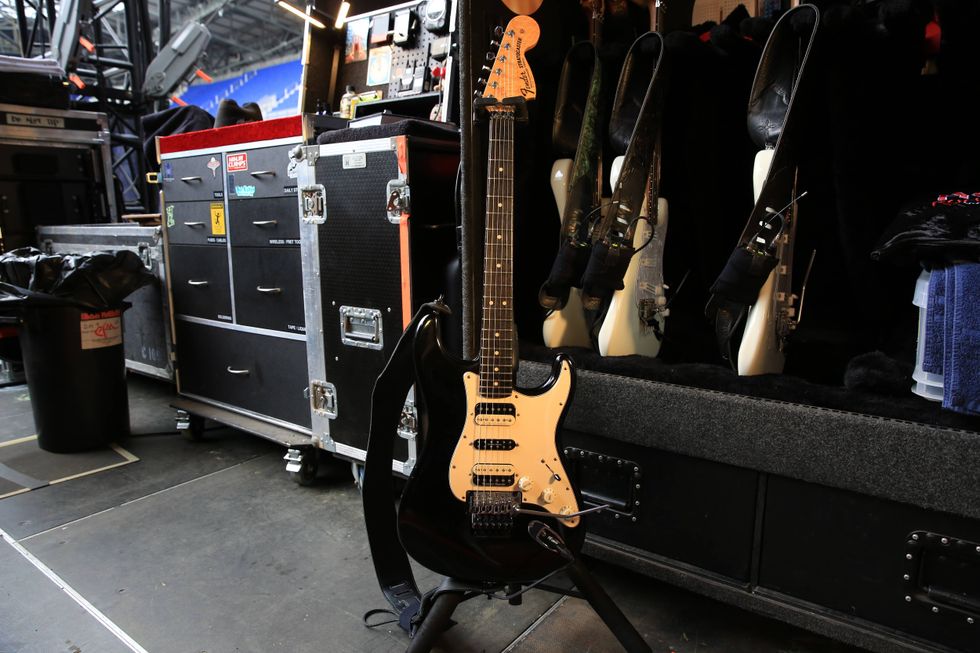
A guitar from Fender masterbuilder Jason Smith based on Paul Kossoff’s Strat, which Murray has had since about 2010 and kept at home for years before it came back out last year for the older material. It started with a JB and a ‘59; Price has since experimented his way to two JBs and a JB Jr. in the middle. The bird’s-eye top and the zebra coils are the reason everyone stops to look at it.
Dave Murray’s Rig
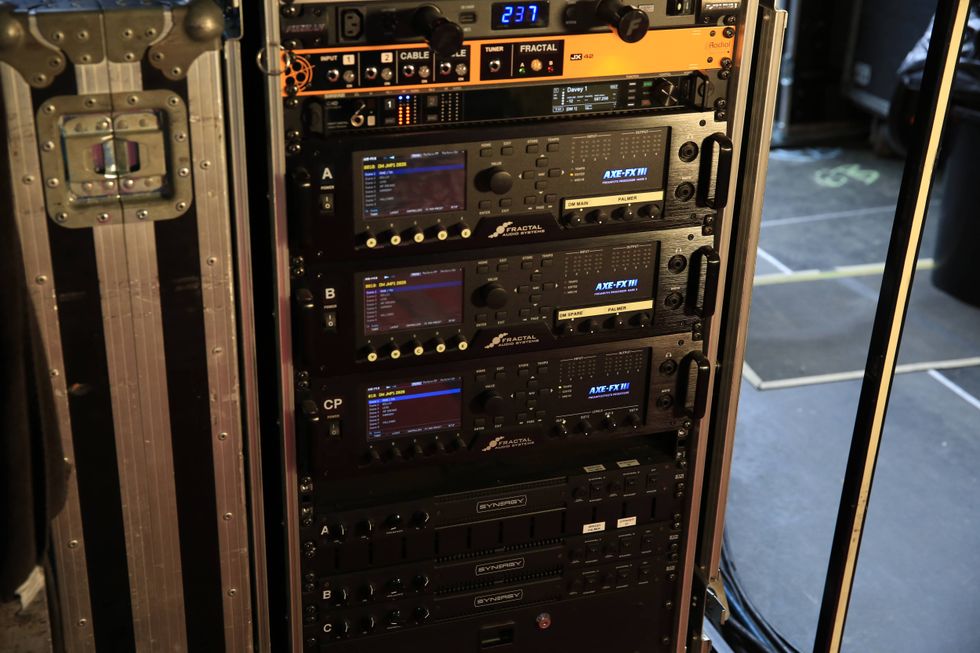
Murray runs a Fractal Axe-Fx, which Price came to after subbing on Devin Townsend gigs. It started as a JMP model—Murray’s sound—and has grown to four or five amps for different songs. A stereo out feeds Murray’s in-ears, which Price describes as “Steely Dan” clean; another goes to front of house and out to two Marshall cabs onstage, dialed cleaner to keep things from getting swampy. There are also cabs because Harris and Bruce Dickinson still work off stage sound.
Pages
