
Music is the universal language
“Glory to God in the highest heaven, and on earth peace to those on whom his favor rests.” - Luke 2:14
General Interest
New Fender Film Features J Mascis, Thurston Moore, and More Celebrating NYC Roots
Fender has released an original feature-length film capturing behind-the-scenes moments and performances with Dinosaur Jr. and friends across New York City, celebrating the community that has spawned some of indie rock’s defining artists.

The full-length film, The One. For New York., is now available on YouTube and features performances by Dinosaur Jr., Thurston Moore, Snail Mail, and more.
Punctuated by audacious music, gritty footage, and acidic humor, The One. For New York. attests to the city’s towering role in modern culture—as seen from a street-level vantage point.

Featured artists include:
- Dinosaur Jr.
- Marc Ribot’s Ceramic Dog
- Steve Gunn
- Thurston Moore Group (Thurston Moore, Steve Shelley, Deb Googe)
- They Are Gutting a Body of Water
- American Football
- Snail Mail
The artists themselves acknowledge the crucial role NYC has played in their creative growth.
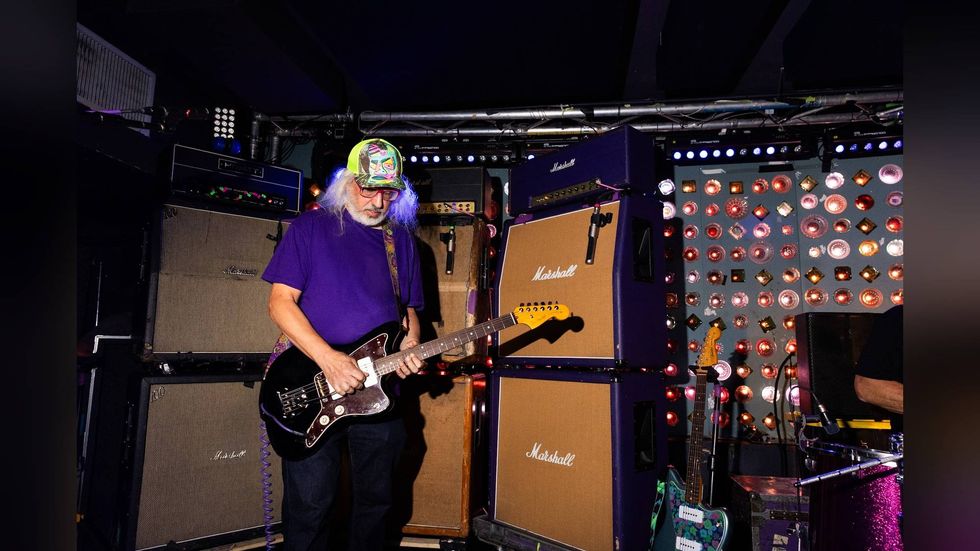
“New York was the first place we came where we had any fans or acceptance. We just kind of gravitated towards New York,” said J Mascis. “Starting a band I decided I wanted a Fender… I went to buy a Strat, but they had a Jaguar for $200 and Jazzmaster for $300. The neck felt better on the Jazzmaster; it was worn in like a baseball bat, so I just went for the Jazzmaster.”
“As far as Dinosaur Jr. getting welcomed in New York, I think a lot of it was predicated upon us welcoming them,” said Thurston Moore. “I mean, we really liked them. We brought them out on tour when we did a van tour across the USA with us. We were always championing them. They were always sort of like this little brother band to us.”
“I discovered Sonic Youth in high school, and it was sort of like my introduction to stuff that kind of fit outside of a mold that I understood at that point. And they just opened the door for me for my own guitar playing,” said Lindsey Jordan (Snail Mail). “I feel like there was life before Sonic Youth for me and then life after.”
“I think there's something like 70 languages currently spoken in New York. [A] byproduct of that is that there were a lot of different sounds,” said Marc Ribot. “I came down to New York, I realized this is where the work is. I didn't really know if I wanted to write songs or be a rock star. I didn't know what kind of guitarist even, but I knew I wanted to play guitar, and I knew this is where I could do it.”
“I fell in love with New York,” said Steve Gunn. “Even early on, I was always interested in expanding my palette of the guitar. From people like J and Thurston and other players who were using different tunings and capos and different frets, I feel like it really expanded your ear and limits of what a guitar can do.”
For more information visit Fender.com.
“What are you talking about, Baldini? Now you have more room”: Anthrax’s Scott Ian on how touring with Dimebag Darrell taught him “how to drink”
![[L-R] Scott Ian and Dimebag Darrell](https://guitar.com/wp-content/uploads/2026/10/Scott-Ian-Dimebag-Darrell-hero@2000x1500.jpg)
Anthrax guitarist Scott Ian says touring with Pantera in the late 1990s was where he truly learned to drink and that Dimebag Darrell was his teacher in the trade…
Ian, 62, recalls the tour in a new interview with Metal Hammer, describing the 1997-98 run as “fucking chaos”. His clearest memory is of being sick after a night of heavy drinking, opening the bathroom door to find Dimebag waiting with another shot. When Ian pointed out that he had just thrown up, the Pantera guitarist brushed it off with a nickname and a piece of logic: “What are you talking about Baldini? Now you just have more room.”
Ian also remembers the tour buses. He would sometimes hop on the one shared by Dimebag and his drummer brother Vinnie Paul, which seemed a great idea at 3am. By 7am, he said, the party was still going and the pair had spent hours watching the same live Kiss videos on loop.
Dimebag’s reputation as a drinker was well established. He had his own signature drink, the Black Tooth Grin, named after a Megadeth lyric. In 2022, Machine Head’s Robb Flynn recounted a night when a very drunk Dimebag smashed one of his guitars into the floor, then went onstage and played a flawless show.
Dimebag was shot dead on stage in 2004, aged 38, while performing with Damageplan, the band he formed with Vinnie Paul after Pantera split.
The friendship between the two bands produced music as well as stories. Dimebag contributed guest solos to six Anthrax songs across three albums: Fueled and King Size on 1995’s Stomp 442, Inside Out and Born Again Idiot on 1998’s Vol. 8: The Threat Is Real and Strap It On and Cadillac Rock Box on 2003’s We’ve Come For You All.
Anthrax released their new album, Cursum Perficio, through Nuclear Blast last month. Parts were recorded at Studio 606, the California studio owned by Foo Fighter’s Dave Grohl. The band have no tour dates announced, having recently played a run of shows supporting Iron Maiden.
The post “What are you talking about, Baldini? Now you have more room”: Anthrax’s Scott Ian on how touring with Dimebag Darrell taught him “how to drink” appeared first on Guitar.com | All Things Guitar.
Gibson launches limited-edition Tom Petty Flying V guitars to mark the Heartbreakers’ 50th anniversary

Gibson has released a limited run of 250 Flying V guitars honouring the 50th anniversary of Tom Petty and the Heartbreakers, alongside a lifestyle collection of apparel, accessories and collectibles developed with the Tom Petty Estate.
The guitars, dubbed the “Flying Five,” come in five gloss nitrocellulose finishes: Gainesville Gold, Graphite Metallic, Heartbreaker Red, Pearl White Metallic and Pelham Blue with only 50 made in each colour.
The design is inspired by the Heartbreakers logo from the band’s self-titled 1976 debut album. Adria Petty, the late musician’s daughter, said the logo has been a part of the brand’s identity since that first record and that the V was an essential part of the stage imagery for her father as the band rose to fame in the 1970s.
“The collection honours Tom and the Heartbreakers’ history while giving musicians and fans a new way to carry that spirit forward,” she said.
Specs
Each instrument has a mahogany body and neck, a SlimTaper neck profile and a rosewood fretboard with a 12-inch radius and 22 medium jumbo frets. Two 70s Tribute humbucker pickups are wired by hand with individual volume controls, a master tone control and a three-way selector. Hardwire is gold-plated and includes Grover Rotomatic tuners and a Nashville Tune-O-Matic bridge.
Commemorative touches include a Heartbreaker 50th truss rod cover and a reproduction of Petty’s signature on the back of the headstock. Every guitar ships in a Gibson hardshell case.
Apparel and collectibles
 Credit: Gibson
Made with Nashville-based apparel brand imogene + willie at the request of the Petty Estate, the line includes four American-made, screen-printed T-shirts, a patch-covered green military shirt jacket and a black “Backstage” work jacket. The most exclusive item is a black steerhide leather jacket, made with Schott N.Y.C., that reimagines the jacket Petty wore on the cover of the 1976 debut album. Only 75 will be made worldwide. Its striped satin lining nods to the black-and-white blazer Petty wore on the cover of the 1978 UK single Listen to Her Heart.
Other items include a Zippo lighter, a bandana, a snapback cap, a guitar strap, a pick tin, a sticker set and a Flying V mini guitar.
To develop the collection, Gibson sent a team to the Tom Petty Clubhouse in Van Nuys, California, to go through archived artifacts from the band’s history.
Learn more at Gibson.
 Credit: Gibson
The post Gibson launches limited-edition Tom Petty Flying V guitars to mark the Heartbreakers’ 50th anniversary appeared first on Guitar.com | All Things Guitar.
Triplet Patterns to Improve Your Time Feel and Inspire New Lines | Weekly Workout

Meet Yuben Grey: the folk artist using cosy guitars and spacey sounds to tackle anxiety

Ad feature with BandLab
Enjoy getting lost in the dreamy lullabies of Lord Huron? Get a thrill out of Gregory Alan Isakov’s guitar work? Then look no further than Yuben Grey, the chilled out folk artist from Rhode Island who makes music to soothe the mind.
Amid our ever quickening culture of information overload and shortening attention spans, his craft prioritises slowness and the value of space. We chat to Grey ahead of his next musical project to learn more about how he found his way to being the artist he is today, and how music has become an anchoring lifeline among some challenging personal experiences.
Hi Yuben! Tell us about your story with music. How did you find your way to guitar?
“Music is still my side gig. It was never really supposed to be the main thing, it was just a hobby. It started getting more serious about a year ago. My dad showed me [how to play when] I was seven or eight. I completely abandoned it for years and started making beats. I was making money being a producer but I [wanted] to be an artist, so I picked up my guitar again and was just messing around for a few years.
“I was married but I got a divorce, and that is actually how things started, really. It was the first time I was adjusting to having my son half the time so I didn’t really know what to do. I borrowed a guitar from my neighbour because she went out of town; it was broken so I stitched it up, and that’s when I recorded an album called The Moon Room. I guess it just hit the right people!”
 Image: Press
What artists or guitarists in particular are you inspired by?
“I absolutely love Gregory Alan Isakov and Lord Huron. [Their] songs are so inspiring. I would play Red Dead Redemption, [have a] chill ride around with the horse, and I would have their music on in the background. They definitely inspire the music that I make big time; it’s very spacey, atmospheric, ethereal. It’s very relaxing.”
Your track Roman’s Song is a great example of that. Take us inside the track – what’s it about?
“When I was going through [my divorce], I had to fly home to go see some family because I had some problems. I was getting ready to go to the airport, and I remember feeling like I wasn’t really escaping my own home. It just surrounded me, the thoughts and the feelings I had about everything around me. I wrote [the song] within an hour. I kept imagining a ballroom, a dance that never ends; no matter what, you can’t leave. Originally it was called Crooked Hands. My son picked up that I was playing it and absolutely loved it. He wanted to hear it again and again. Eventually I was like, you know what? If I release this, I’m going to call it //Roman’s Song//, which is his name. It seemed like it would calm him down whenever he was crying.”
It seems like music’s been quite a lifeline for you. What guitars do you like to use to tell your story? What gear do you gravitate towards the most?
“Right now I use an Epiphone Hummingbird. It’s my go-to because it just sounds beautiful. I feel like I’m still learning, but I love a warm, soft sound. I signed my guitar’s body so I can remind myself of what I am doing, and why I first started doing it.”
Looking back on your music journey so far, what makes you feel the most proud of yourself and your craft?
“For years, I pressured myself into making what was ‘current’ all the time. The best thing for me was becoming authentic, making exactly whatever I imagined. That was the most freeing thought: I can just make whatever comes to mind.”
Have your early experiences as a producer informed how you make art? What skills have you carried across to how you build a song?
“Absolutely. I think being a producer first helped me so much because I make everything myself. I’ll sit for a few hours and I can build a whole track, but also make sure it sounds professional too. It helps me to be self-sufficient.”
 Image: Press
You’re probably used to working collaboratively from your production work too. What artist do you dream of working with now?
“Oh my gosh, Gregory Alan Isakov. I think I’d cry… I would definitely cry.”
What has being a musician taught you about yourself as a person?
“When I create a song, I tend to build a world with it in my own head. I’ve realised how much I build stories, how much of a storyteller I am… I love storytelling, but I also love space [in a song]. When I was a kid, my dad used to play Beethoven and say, ‘Close your eyes and see what you can imagine. What can you understand from this? What can you picture?’ I love doing that with music now.”
Where do you recommend people start with your music? What song would you tell them to listen to first?
“It definitely has to be within The Moon Room, I would say The Night You Came Undone.”
What else do you have lined up right now? Are you playing any shows or working on some new music?
“I currently don’t play any shows, I’m trying to build more before I start doing that. As for new music, I have been writing another EP, it’s gonna be named Paper Bones. It’s very folk-y and has fall, autumn vibes. Fall is my favourite time of year, so I’m in the time of my life right now!”
What do you hope people take from your music as a listener?
“I feel like my music [provides] a chill vibe for when you’re alone and you’re reflecting, but relaxing. I struggle with really bad anxiety, so to be a safe space for somebody to reflect and think about their stuff without feeling anxious, I feel like that’s the biggest thing.”
Discover more from Yuben Grey on Spotify and BandLab.
 Image: Press
The post Meet Yuben Grey: the folk artist using cosy guitars and spacey sounds to tackle anxiety appeared first on Guitar.com | All Things Guitar.
The 10 best boost pedals for guitarists 2026, from budget to boutique

Ever felt like you need a boost? And not the slightly obscure Cadbury’s chocolate bar? Yes, these perhaps underrated pedals can really bring a pedalboard together, and despite their often simple operation, can offer surprisingly versatile shake-ups to your sound. Not all boosts are created equal, though, so let’s explore ten different excellent stompboxes that’ll give your tone a lift.
Why do I need a boost pedal?
So, before we dive in – what makes a boost a boost and not an overdrive? Essentially, a boost’s main purpose is to increase the level of your signal, without adding a significant amount of distortion. Overdrives will also include a stage (or stages!) that adds distortion in the process, which will limit the output level.
You’ll see a lot of boosts designated as “clean” boosts – these have the goal of linearly lifting the level of your signal across the board, with mostly a flat response across the bass, midrange and treble. If you have a the headroom for it, this can lead to a simple increase in volume (great for something like a solo boost). However if you use a clean boost in front of something that’s already limiting the signal, like an overdrive or a low-headroom amplifier, engaging it won’t lead to as much of a volume uplift – but it will increase the level of saturation. Using a clean boost right at the start of the chain isn’t always about getting more distortion, though – if you’re using two guitars over a set with vastly different output levels, a clean boost can help a quieter guitar play better with the rest of a rig.
Some boosts are more characterful than “clean” boosts, and will focus on certain frequencies. The Dallas Rangemaster is an early example of this approach, and it’s often cited as tonal inspiration for more modern pedals. It’s designated as a “treble booster”, but in reality a circuit like this often focuses on boosting the upper mids while cutting a little bit of bass. A boost like this can add clarity to a more distorted tone thanks to that bass cut, while also adding saturation to those pleasing midrange frequencies. (For tonal reference, Brian May and Tony Iommi’s early sounds both revolved around the use of one).
So, why not an overdrive? There are lots of reasons – overdrives themselves can work as great character boosts (TubeScreamers and Klons both do a commendable job here), but dedicated boost pedals are compelling in their simple operation (sometimes paired with a smaller footprint), and not every overdrive will put out the volume increase you need. So let’s dive into 10 fantastic pedals that’ll suit any budget or use-case!
At a glance:
- Best mini boost: TC Electronic Spark Mini
- Best budget boost: Electro-Harmonix LPB-1
- Best op-amp boost: MXR Micro-Amp
- Best Echoplex-style boost: Xotic EP Booster
- Best modern treble boost: CatalinBread Naga Viper MkII
- Best premium mini boost: Keeley Electronics Katana Mini
- Most aggressive boost: ZVEX Super Hard-On
- Best vintage-style treble boost: Vox VTB-1
- Best vintage-style preamp boost: Boss BP-1W
- Best multi-mode boost: Crazy Tube Circuits Super Conductor
- Why you can trust Guitar.com
Best mini boost: TC Electronic Spark Mini
If you need a flawless, transparent volume lift without coloring your tone, this $50 micro-pedal from TC Electronic is a steal. Built around a high-headroom op-amp architecture, it’s ideal for matching guitar outputs or kicking in a pure solo boost. Its momentary switching lets you accent certain phrases or short solos with ease, too.
Best budget boost: Electro-Harmonix LPB-1
This simple transistor-based boost is a reissue of EHX’s 1968 design – it’s great for fattening up single-coils and pushing vintage tube amps into thick saturation, with a little bit of a warmer, low-mid focused sound when compared with the more truly transparent Spark boost.
Best op-amp boost: MXR Micro-Amp
The MXR Micro Amp is one of those ‘industry standard’ pedals, with an op-amp-based design that incredibly reliable, flat-EQ volume. It works just as well as an always-on buffer and signal strengthener as it does as a massive solo boost. With just a single knob on the standard version (the Micro Amp+ offers bass and treble controls as well) and MXR’s solid-as-hell build quality, it’ll be a reliable and easy-to-use pedalboard companion for years to come.
Best Echoplex-style boost: Xotic EP Booster
Rather than offering a flat frequency response, this discrete JFET circuit from Xotic intentionally colors your signal with the magical, EQ-sweetening shimmer of a vintage Echoplex EP-3 tape echo. Lots of players favour it as an always-on sweetener, or a tool to add three-dimensional depth to sterile solid-state amps – but its preamp-esque character can do a great job of making a solo stand out too!
Best modern treble boost: CatalinBread Naga Viper MkII
Vintage Dallas Rangemasters are hard to come by, but CatalinBread’s modernised four-knob take on the format offers all of the upper-mid bite without having to shell out hundreds (or more!) for a finicky vintage original. It swaps the germanium for a silicon transistor tuned to emulate classic a Dallas Rangemaster’s character, and adds in an attenuator to bring out the pedal’s character without overloading it with hot modern pickups or gain pedals placed before it.
Best premium mini boost: Keeley Electronics Katana Mini
Achieving tube-like dynamics from a tiny enclosure is no small feat, but this $120 pedal from Keeley Electronics pulls it off using dual cascaded JFET transistors. It delivers an exceptionally transparent boost that preserves your core EQ while adding just a hint of harmonic richness, like a single. With internal micro-switches for added overdrive, it’s ideal for pristine soloing or pushing a clean amp into sweet saturation.
Most aggressive boost: ZVEX Super Hard-On
Don’t let the name fool you – this is more than just a juvenile allusion to increased power! With high impedance, high brightness and a staggering amount of volume, the ZVEX SHO is a discrete MOSFET circuit that can breathe brilliant life into dark or dull signals. Its explosive headroom and top-end sparkle make it an aggressive tool for pushing amps into natural overdrive or reviving complex pedalboards. The bias-based output may crackle when you adjust it, sure, but that musical quirk hasn’t stopped stadium-rocking guitarists like Matt Bellamy and J Mascis exploiting its massive, cutting clarity.
Best vintage-style treble boost: Vox VTB-1
Designed to capture the sound of Rangemaster-style treble boosters, this re-voices a silicon BC109 transistor to echo some of that germanium character. It is tailor-made for driving a Vox AC30 or AC15 into screaming, touch-sensitive British rock overdrive. While it is a modern release, it meticulously recreates the edge-of-breakup dynamics and volume-knob cleanup that saw the original used by legends like Rory Gallagher and Brian May.
Best vintage-style preamp boost: Boss BP-1W
Priced around $169, this Waza Craft pedal is a highly versatile preamp boost. It authentically recreates the legendary, tone-sweetening analogue preamp circuits found in the CE-1 Chorus Ensemble and RE-201 Space Echo. With a level and a gain control, you can adjust how much light saturation and tonal colouration you want to add, and there’s also a third mode that offers a more natural flavour if the vintage preamps are a little too characterful. Thanks to being built in the ever-reliable Boss format, too, the pedal offers reliable silent switching and pretty bulletproof build quality.
Best multi-mode boost: Crazy Tube Circuits Super Conductor
Why settle for one circuit topology when you can have four? At roughly $180, this premium pedal from Crazy Tube Circuits packs a silicon Rangemaster, a JFET Echoplex, an op-amp Micro Amp-style circuit, and a discrete MOSFET boost into a single box. Offering adaptable EQ profiles and varying input impedances, it is perfect for players switching between vastly different guitars and amps. That doesn’t come cheap, as it’s quite a boutique offering, but the flipside is a broad set of voices that could mean it’s the last boost pedal you buy!
Why You Can Trust Us
Every year, Guitar.com reviews a huge variety of new products – from the biggest launches to cool boutique effects – and our expert guitar reviewers have decades of collective experience, having played everything from Gibson ’59 Les Pauls to the cheapest Squiers.
That means that when you click on a Guitar.com buyer’s guide, you’re getting the benefit of all that experience to help you make the best buying decision for you. What’s more, every guide written on Guitar.com was put together by a guitar obsessive just like you. You can trust that every product recommended in those guides is something that we’d be happy to have in our own rigs.
The post The 10 best boost pedals for guitarists 2026, from budget to boutique appeared first on Guitar.com | All Things Guitar.
Butterfly Effects Dobbo review: “there’s a wonderfully creative reward waiting for you”

€350, butterflyeffects.world
Musicians are creatures of habit. Time and time again, we find ourselves circling back to the same guitars, amps and effects that have been around for well over half a century. All of that to say, we don’t exactly have the best relationship with change. I mean, who doesn’t need another Klone to add to the collection?
However, in recent years, there’s been a growing trend with granular delay and reverb pedals, with musicians increasingly embracing the unpredictability and spontaneous creativity these effects can inspire. So much so, in fact, that it feels like you can’t turn around without another brand tossing its own interpretation of granular effects into an increasingly crowded market.
Enter Belgian newcomer Butterfly Effects and its first foray into the pedal world, Dobbo. A granular delay that has, as the kids say, officially entered the chat.
But it’s also entering a space where established pedal makers are already offering their own takes on granular processing. Does Dobbo bring something genuinely new to the conversation, or is it simply another voice in an increasingly crowded room?
What is it?
At its core, Dobbo is a granular delay pedal designed to spark curiosity through its various randomized textures. Now, if you’re unfamiliar with the term “granular delay” and wondering what exactly that means, here’s the brief explainer.
Much like a traditional delay, a granular delay stores your audio in a temporary buffer. The difference is that it then chops that signal into tiny sections, often referred to as “grains,” which can vary in length and timing before being rearranged and manipulated in different ways. The result can range from chaotic, glitchy textures to beautiful, constantly evolving soundscapes. Dobbo does both.
TL;DR: Dobbo takes tiny bits of your sound, rearranges them, and lets things get weird, but in a creatively fun way.
 Image: Jason Mays
Build quality and usability
There’s a refreshing approach to colour in the design of the Dobbo – it’s bright primary-hued and in a strange way almost childlike. This clean and carefully thought-out approach feels very sensible considering just how integral color is to understanding how this pedal works (more on that later).
The minimalist graphic style is also welcome when you contrast the large number of controls on offer – seven knobs, five switches, and single soft switch. On paper, that sounds like a lot, but navigating it is an intuitive doddle thanks to the clever way that Dobbo has used colour instead of text to label the thing.
Each parameter has a corresponding color, making it surprisingly easy to understand what’s happening at a glance. For those of us who would rather dive headfirst into creating weird sounds than spend an evening curled up with an instruction manual, that’s a welcome surprise.
Elsewhere, Dobbo has the modern conveniences you’d expect from a pedal this ambitious. There’s USB-C for firmware updates, alongside high impedance stereo input and outputs, plus an expression/MIDI jack for all the cool nerds out there.
 Image: Jason Mays
Couple that with eight onboard presets and tap tempo, and there’s quite a bit packed into Dobbo’s colorful enclosure. And if you’re already mentally rearranging your pedalboard, don’t worry: it’s roughly the same size as a Little Big Muff Pi.
Rather than turn this into a lengthy explainer of every knob and switch, let’s focus on the three controls that, in my opinion, are the most important to understanding Dobbo: Pitch, Chance and Space.
Pitch controls the pitch of your grains across four octaves, from two octaves below your original signal to two octaves above it. Just bear in mind that how it behaves is also determined by the corresponding Pitch mode toggle.
Chance is where things get really interesting. It controls the amount of randomization applied to four of Dobbo’s main parameters, with each one color-coded to its corresponding control with five LEDs laid out like the side of a die. It’s a clever visual language that makes something potentially complicated much easier to understand.
Finally, Space controls the spatial characteristics of your grains. In layman’s terms, it essentially adds reverb to each individual grain, giving those tiny pieces of your signal a greater sense of depth and, well… space. It’s a relatively simple idea on paper, but it becomes pretty important once you start using Dobbo in real time.
 Image: Jason Mays
Sounds
Since I’m a self proclaimed experimental soundscape enthusiast who likes to get weird, I figured there were few tools better suited for the job than an offset guitar running into an amp capable of beautiful cleans and a little edge of breakup grit. Because realistically, what guitar is more strongly associated with experimental textures and soundscapes than the Jazzmaster?
Paired up with my beloved Marshall combo, I started messing around with a few of the presets included in the manual, beginning with Rich Chorus, arguably the safest place for newcomers to start. It takes advantage of the Pitch portion of Chance and essentially transforms Dobbo into a granular chorus. You still get the bleeps, bloops, and slightly unpredictable character you’d expect from a granular effect, but they’re joined by a warble that feels more like a traditional chorus and considerably less alien.
Strumming a few chords through it sounds a bit like Adam Granduciel’s chorus tones from The War on Drugs being filtered through the electronic weirdness of Radiohead’s Kid A. And yes, that combination is every bit as fun as it sounds.
Rate and Time also do a ton of heavy lifting here. Adjusting the two alongside Pitch, Space, and Chance quickly had me channeling my inner Pachuca Sunrise-era Minus the Bear, turning otherwise straightforward guitar leads into quick chops, stops, and almost synth like bursts of buttery stutter. Surprisingly, it all feels considerably more musically usable than I initially expected from something this unpredictable.
All of that sounds pretty cool, but I also don’t want to oversell Dobbo’s ease of use because, ironically, its accessibility is both one of its greatest strengths and one of its biggest shortcomings.
There’s a caveat however: it’s easy to use provided you already have some experience with granular effects. For players whose creative coloring tends to be a little more traditional, all of those grains, chops, pitch shifts, and randomization can become overwhelming pretty quickly, especially once Chance enters the equation.
The visual layout certainly makes the learning curve considerably less intimidating, but it doesn’t eliminate it altogether. This is still granular synthesis we’re talking about. If your idea of adventurous delay begins and ends with your grandpa’s DD-3, Dobbo is going to require a little more patience before the weirdness starts making sense.
Should I buy one?
With the granular effects category continuing to grow and more companies throwing their hats into the ring, you might be asking yourself: is Dobbo actually worth buying?
The answer is absolutely.
Dobbo is fun and creatively inspiring in a way that really has to be played to be fully appreciated. For anyone looking for a pedal capable of building glitchy ambient textures, unpredictable soundscapes, and wonderfully weird sounds, there’s a lot here that makes Dobbo worth exploring over some of the other options in an increasingly crowded category.
And the biggest selling point is undoubtedly Chance.
It’s the feature that gives Dobbo its personality and turns something as simple as a guitar part into something unexpected. Of course, that unpredictability also means Dobbo isn’t necessarily a pedal built around immediacy. If you want to plug in, turn a couple of knobs, and know exactly what’s going to happen, at a relatively affordable price point, this might not be the pedal for you.
But if you’re willing to embrace a little unpredictability and, quite literally, take a chance on Chance, there’s a wonderfully creative reward waiting for you on your next ambient endeavor.
Alternatives
With granular effects becoming all the rage nowadays, there are a few alternatives I’d recommend if you’re not quite ready to take a Chance on Dobbo.
First, for anyone just getting their feet wet in the world of granular effects, there’s the Walrus Audio Fable. At around three quarters of the price of Dobbo, it’s one of the most rewarding options out there for soundscape enthusiasts, offering plenty of experimental weirdness without feeling completely overwhelming.
For more of an all in one experience, there’s the brand new AC Noises Continua. It offers its own unique take on grains, bleeps, bloops, and unpredictable textures, while giving you plenty of room to venture into more traditional ambient territory as well.
Lastly, for anyone on a budget who isn’t quite ready to venture into the pricier side of granular effects, there’s the JHS 3 Series Glitch Delay. It’s considerably simpler than something like Dobbo, but that’s also part of its appeal. For ambient newbies looking to dip their toes into glitchy, chopped up textures without breaking the bank.
The post Butterfly Effects Dobbo review: “there’s a wonderfully creative reward waiting for you” appeared first on Guitar.com | All Things Guitar.
Crazy Tube Circuits Introduces Rapture
Meet PRS' Tekton: A Modern Metal Guitar
The Tekton family of four bolt-on guitars designed for the most technical of modern players. Named for the Ancient Greek term meaning artisan or craftsman, the Tekton (hardtail bridge), Tekton T (PRS two-point tremolo), Tekton “Floyd” (Floyd Rose tremolo system), and Tekton SVN (seven string) all feature a completely novel and lightweight body shape, thinner neck, flatter fretboard, stainless steel frets, longer scale lengths, and the genesis of PRS pickups purpose-built to get the most out of digital rigs. The new family brings with it a fresh color palette to complete the contemporary product launch.
“This is not just introducing a new model. We are planting a flag for a whole new family of guitars. Since day one, PRS has been built around a combination of player feedback and our experience as guitar makers. Listening to musicians while continually refining our craft has helped us create instruments that serve as tools for a wide range of players. Over the years, we have heard a growing call for more modern spec’d PRS guitars. The Tekton is our answer to that call,” said Jim Cullen, Director of Sales at PRS Guitars.
At the heart of the Tekton are PRS Stylus (Ancient Greek: an instrument used for writing) pickups, developed specifically for this family of guitars. Split or full humbucking, every position was designed to be equally useful on stage, in the studio, or at home. Built with Alnico 5 magnets and voiced for clarity, articulation, and character, Stylus pickups deliver aggressive tones without sacrificing note definition. While not “flat-response” pickups, they do have a flatter output than many other humbuckers to keep some character while catering more to digital gear. Whether paired with a traditional amplifier, a modern modeling system, or a complex recording setup, the Tekton delivers focused, musical tones that remain defined even under high gain.
The Tektons have the thinnest body and thinnest neck PRS has made in standard production. This new body style was created by finding a middle ground between the PRS flagship Custom 24 and the PRS offset Vela. The Tekton shape incorporates an exaggerated scoop for easy access to the upper frets, and a comfortable belly carve. The Tekton, Tekton T and Tekton SVN all featured highly figured mango tops and mahogany backs, while the Tekton “Floyd” is made with an all-alder body.
The fretboard features a 16” radius, stainless steel frets, and has a new, simple inlay design for PRS: offset dots. Additionally, Luminlay side dots help players keep their place on the board no matter the lighting environment. The fretboard is made from Indian ebony, a wood known to form mineral deposits as the tree grows. These deposits can sometimes appear as spots, streaks, or other variations in color. Lovingly referred to as “birthmarks” in the wood industry, these naturally occurring characteristics make every fretboard unique.
The neck is thin but with a near “D” shape so it doesn’t feel cramped. All four models are built with maple necks and ebony fretboards. The neck also features hormigo strength rods – similar to the carbon fiber rods PRS uses in acoustics and, most recently, in the Chleo signature model. These rods not only help with the stability of the neck, the added strength and rigidity are aimed at making a more resonant instrument.
The string spacing was also an important factor in the design process. The spacing on the Tekton models is the same as the Silver Sky and Fiore, which is a bit wider than PRS’s traditional spacing. This helps players with sweeping arpeggios and more precise pick attack.
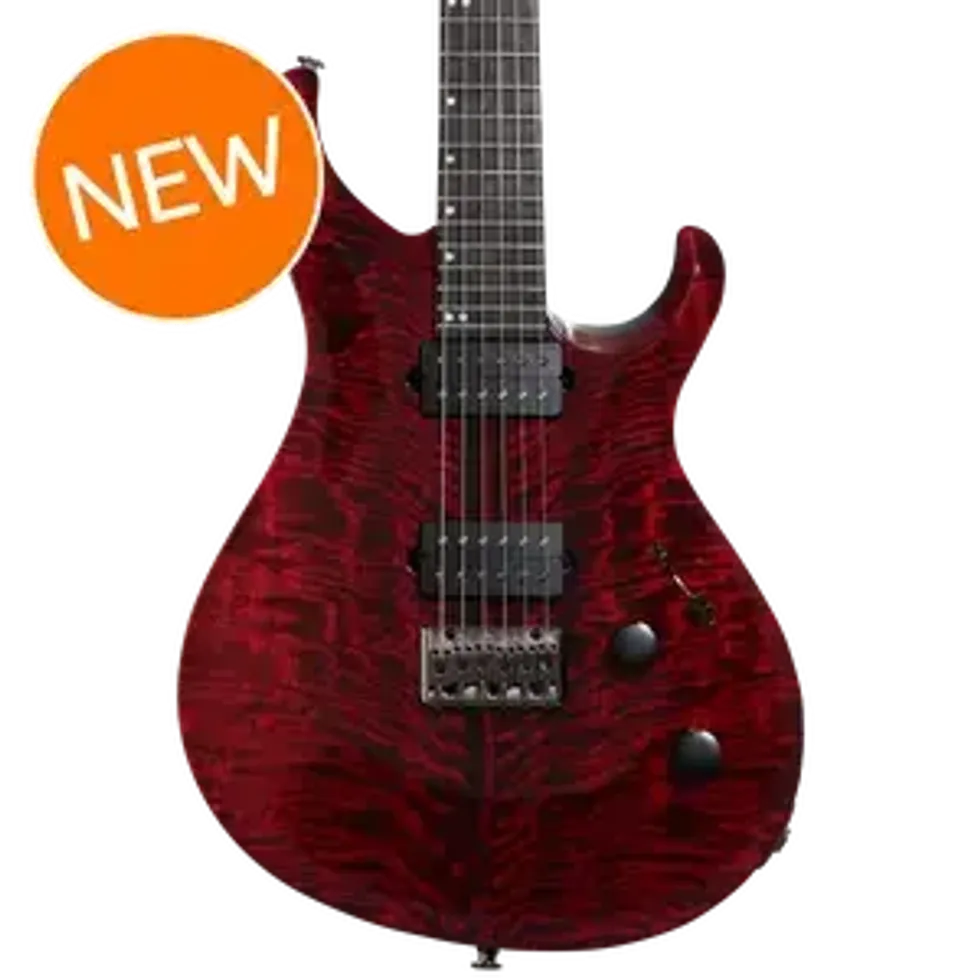
Tekton
Solidbody Electric Guitar with Mango Top, Mahogany Body, Maple Neck, Ebony Fingerboard, 2 Humbucking Pickups, and Tremolo
PRS Guitars Introduces the Tekton, a Four-Model Family of Modern Instruments
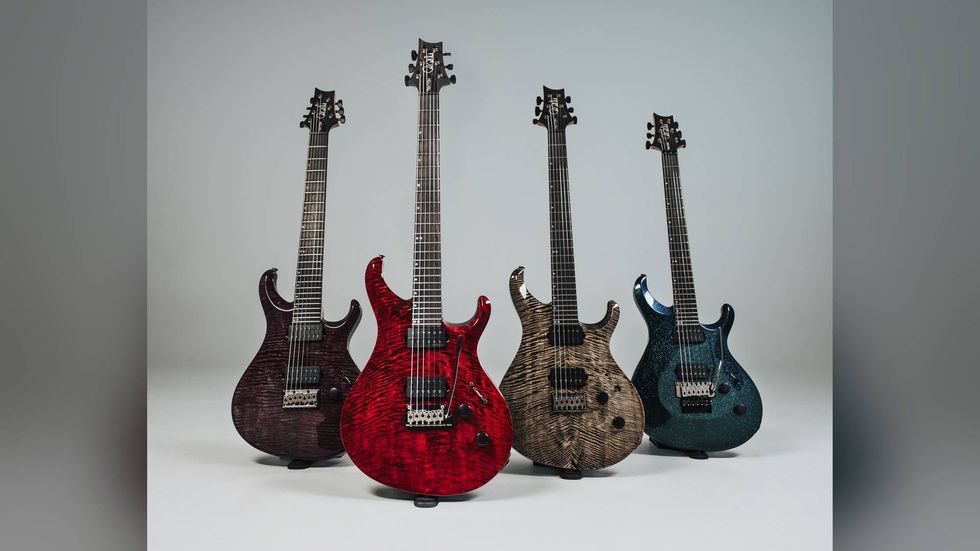
PRS Guitars has introduced the Tekton family of guitars, designed for the most technical of modern players. The four Tekton models each feature a new lightweight body shape, a thinner modern “D” neck, a 25.5" scale, a flatter 16" radius, stainless steel frets, wider string spacing, a bolt-on neck, and all-new Stylus pickups voiced to sound right through a tube amp or a digital rig.
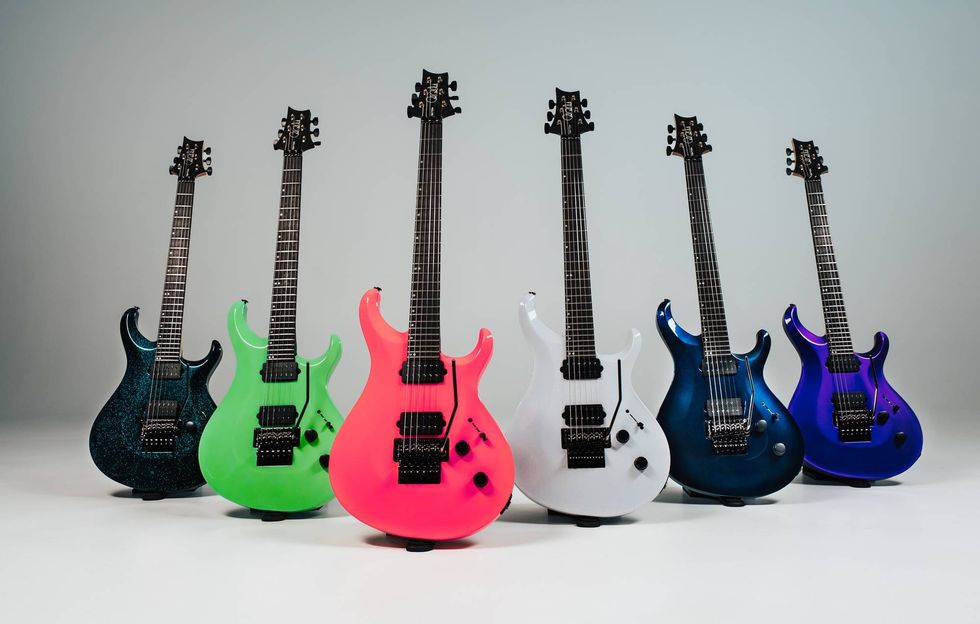
Named for the Ancient Greek term meaning artisan or craftsman, the four models include the Tekton (hardtail bridge), Tekton T (PRS two-point tremolo), Tekton “Floyd” (Floyd Rose tremolo system), and Tekton SVN (seven string). The new family brings with it a fresh color palette to complete the contemporary product launch.
At the heart of the Tekton are PRS Stylus (Ancient Greek: an instrument used for writing) pickups, developed specifically for this family of guitars. Split or full humbucking, every position was designed to be equally useful on stage, in the studio, or at home. Built with Alnico 5 magnets and voiced for clarity, articulation, and character, Stylus pickups deliver aggressive tones without sacrificing note definition. While not “flat-response” pickups, they do have a flatter output than many other humbuckers to keep some character while catering more to digital gear. Whether paired with a traditional amplifier, a modern modeling system, or a complex recording setup, the Tekton delivers focused, musical tones that remain defined even under high gain.
The Tektons have the thinnest body and thinnest neck PRS has made in standard production, with 25.5” scale length. The new body style was created by finding a middle ground between the PRS flagship Custom 24 and the PRS offset Vela. The Tekton shape incorporates an exaggerated scoop for easy access to the upper frets, and a comfortable belly carve. The Tekton, Tekton T and Tekton SVN all featured highly figured mango tops and mahogany backs, while the Tekton “Floyd” is made with an all-alder body.
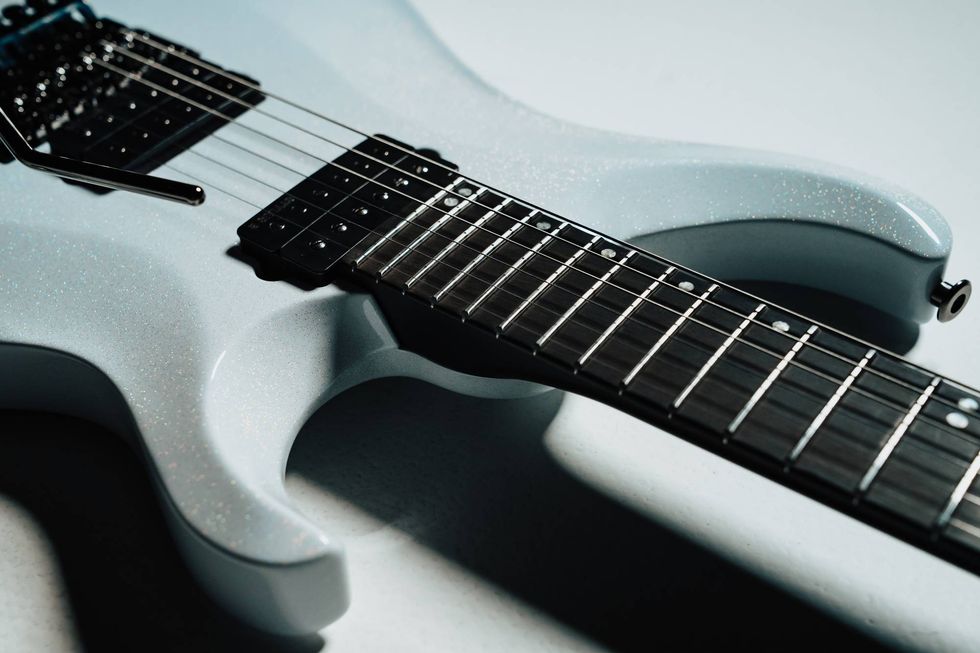
The fretboard features a 16” radius, stainless steel frets, and has a new, simple inlay design for PRS: offset dots. Additionally, Luminlay side dots help players keep their place on the board no matter the lighting environment. The fretboard is made from Indian ebony, a wood known to form mineral deposits as the tree grows. These deposits can sometimes appear as spots, streaks, or other variations in color. Lovingly referred to as “birthmarks” in the wood industry, these naturally occurring characteristics make every fretboard unique.
The neck is thin but with a near “D” shape so it doesn’t feel cramped. All four models are built with maple necks and ebony fretboards. The neck also features hormigo strength rods – similar to the carbon fiber rods PRS uses in acoustics and, most recently, in the Chleo signature model. These rods not only help with the stability of the neck, the added strength and rigidity are aimed at making a more resonant instrument.
The string spacing was also an important factor in the design process. The spacing on the Tekton models is the same as the Silver Sky and Fiore, which is a bit wider than PRS’s traditional spacing. This helps players with sweeping arpeggios and more precise pick attack.
“This is not just introducing a new model. We are planting a flag for a whole new family of guitars. Since day one, PRS has been built around a combination of player feedback and our experience as guitar makers. Listening to musicians while continually refining our craft has helped us create instruments that serve as tools for a wide range of players. Over the years, we have heard a growing call for more modern spec’d PRS guitars. The Tekton is our answer to that call,” said Jim Cullen, Director of Sales at PRS Guitars.
Street pricing for each model is as follows:
Tekton and Tekton T: $2899
Tekton Floyd and Tekton SVN: $2,999
'For more information visit prsguitars.com.
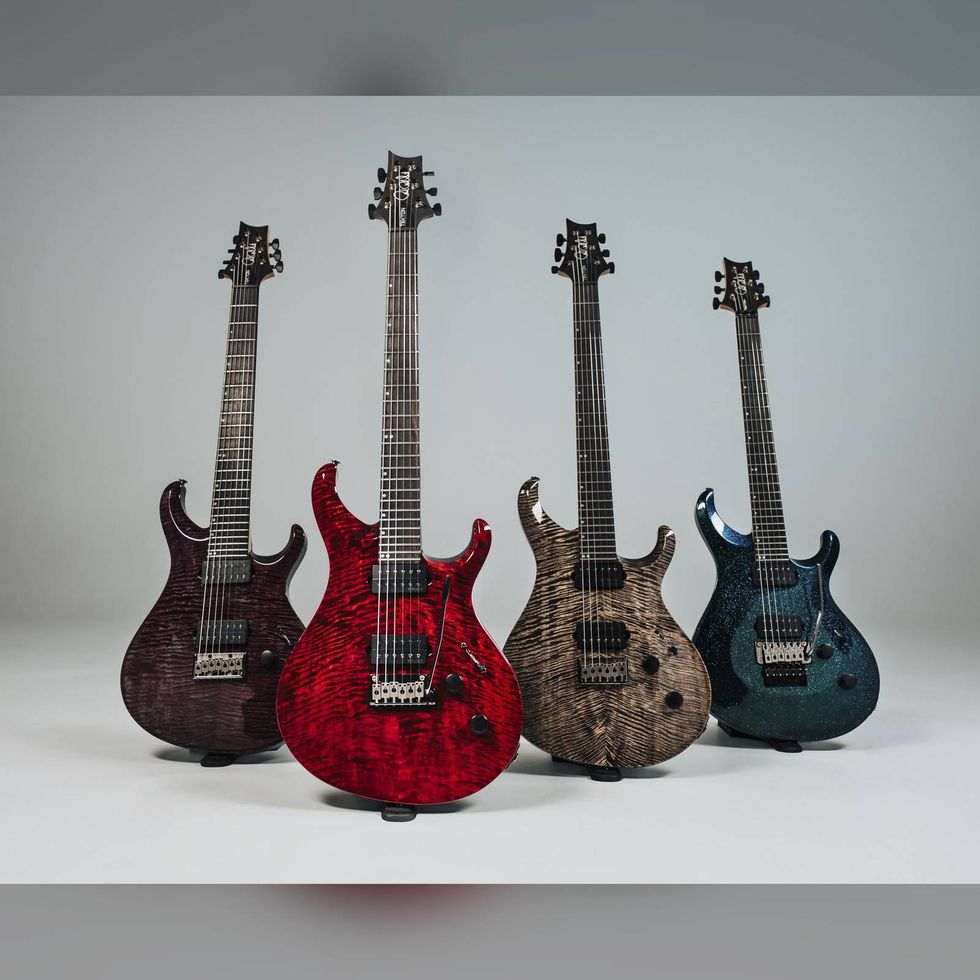
Tekton
PRS Guitars has introduced the Tekton family of guitars, designed for the most technical of modern players. The four Tekton models each feature a new lightweight body shape, a thinner modern “D” neck, a 25.5" scale, a flatter 16" radius, stainless steel frets, wider string spacing, a bolt-on neck, and all-new Stylus pickups voiced to sound right through a tube amp or a digital rig.
Sonic Research's Turbo Tuner Comes to MXR with Modern Upgrades
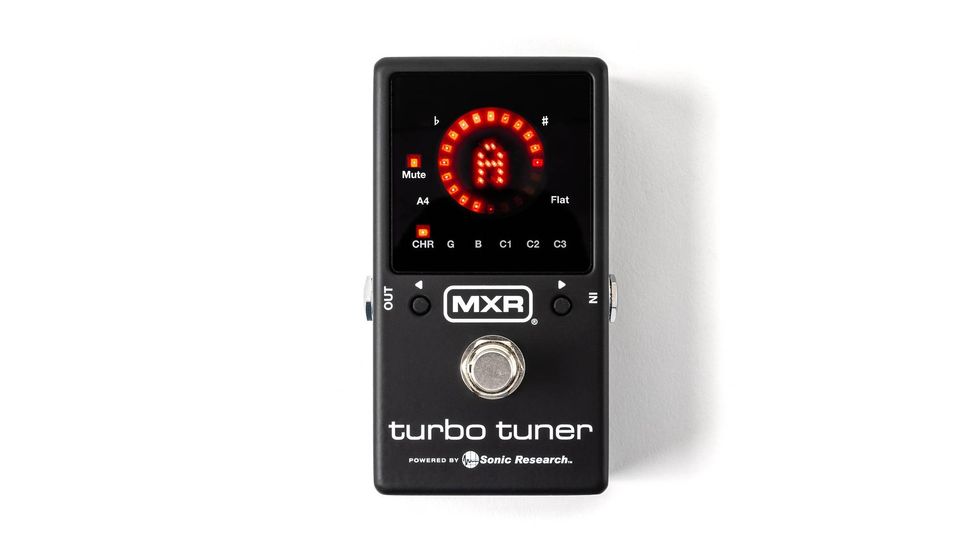
MXR has introduced the company’s first-ever tuner: the MXR Turbo Tuner is built around the core engine of the original Sonic Research Turbo Tuner, engineered to deliver the instantaneous, fraction-of-a-cent accuracy.
At its center is a big, bright true strobe display, driven by the analog signal straight from your instrument. There’s no lag and no bouncing needles. Sharp notes rotate right, flat notes rotate left, and the pattern slows to a creep as you close in on pitch.
MXR’s Turbo Tuner offers chromatic mode plus five customizable presets, each supporting up to 12 strings with ±50-cent offsets, covering everything from alternate tunings to microtonal experiments. Switchable true or buffered bypass lets you decide how it sits in your signal chain, and a USB port handles firmware updates and upcoming editor software. It’s all built with the road-ready durability that defines both Sonic Research and MXR.
MXR Turbo Tuner highlights:
- Built around the core engine of the gold-standard Sonic Research Turbo Tuner, engineered by Sonic Research
- Real-time strobe display tracks pitch with fraction-of-a-cent precision
- Five customizable presets support up to 12 strings and ±50-cent offsets
- Four brightness levels keep the display readable in any lighting
- Adds a high-fidelity buffer with three buffered bypass modes, switchable from true bypass
- Adds a MUTE indicator LED and automatic power-up mode
- Modernized LED display window
- 9V passthrough output powers an additional pedal
- USB port for firmware updates and upcoming editor software
The MXR Turbo Tuner carries a $149.99 street price. For more information visit jimdunlop.com.
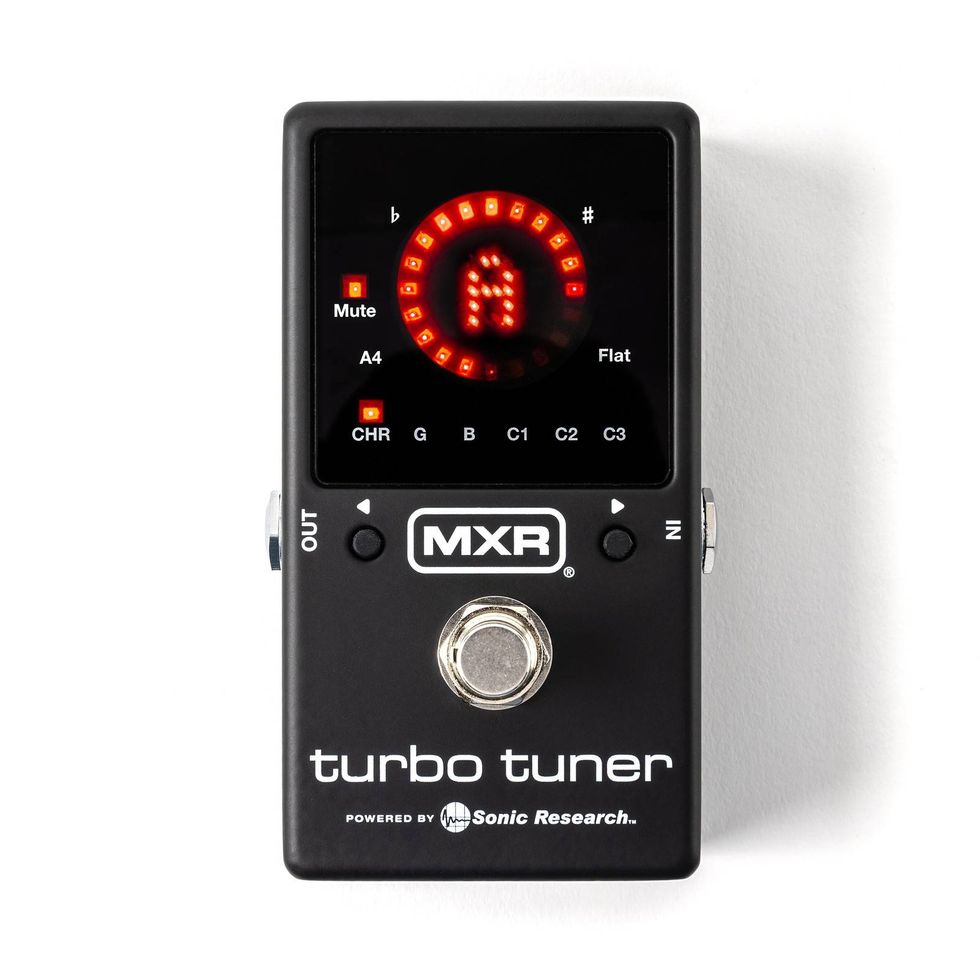
MXR Turbo Tuner
MXR has introduced the company’s first-ever tuner: the MXR Turbo Tuner is built around the core engine of the original Sonic Research Turbo Tuner, engineered to deliver the instantaneous, fraction-of-a-cent accuracy.
“A whole new family of guitars”: PRS’s new Tekton series is aimed squarely at shredders

PRS has announced an entirely new range of guitars, the Tekton series, and they’re aimed at the “most technical of modern players”.
Comprising four new models – the hardtail bridge-loaded Tekton, two-point trem-equipped Tekton T, Tekton Floyd and seven-string Tekton SVN – the series introduces a completely new body shape for PRS, plus a thinner neck and flatter fretboard for speed, plus longer scale lengths and PRS-designed pickups engineered to get the most out of digital rigs.
PRS’s new Stylus pickups have been designed specifically for the Tekton series, and feature Alnico 5 magnets voiced for “clarity, articulation and character. Usable in split or full humbucking modes, these pickups are said to possess a flatter output than other humbuckers, with the objective of retaining character while catering more to digital gear.
Also notable is the fact that Tekton series guitars have the thinnest body and thinnest neck of any guitar in the standard PRS product lineup. It’s said to find a “middle ground” between the flagship Custom 24 and offset Vela models. Upper fret access is facilitated by an exaggerated scoop, while a comfortable belly carve ensures comfort during long shredding sessions.
 Credit: PRS
In terms of build material, the Tekton Floyd has an alder body, while the other three have mahogany backs with highly figured mango tops.
The fretboard looks uber-sleek, with a 16” radius, stainless steel frets, plus a new simplistic inlay design with offset dots – another first for PRS. These guitars also feature Luminlay side dots for guidance in low light environments. Each fingerboard is made of Indian ebony, a material known to form mineral deposits as the tree grows. This leads to spots or streaks in the grain – known as “birthmarks” – which make every fretboard on each Tekton series guitar unique.
Every Tekton series guitar also sports a thin near “D shape maple neck, with a hormigo strength rod for support – similar to carbon fibre – and the same material found in PRS’s Chleo Herman Li signature model.
Any guitarist who has dabbled with higher speeds knows the importance of having the right string spacing. And PRS says this was a key part of the design process for the Tekton series. String spacing on the Tekton series is the same as the Silver Sky and the Fiore models, a little wider than PRS’s traditional spacing, catering to more advanced shred techniques like sweep picking, for example.
“This is not just introducing a new model. We are planting a flag for a whole new family of guitars. Since day one, PRS has been built around a combination of player feedback and our experience as guitar makers,” says Jim Cullen, Director of Sales at PRS Guitars.
“Listening to musicians while continually refining our craft has helped us create instruments that serve as tools for a wide range of players. Over the years, we have heard a growing call for more modern spec’d PRS guitars. The Tekton is our answer to that call.”
Learn more about the Tekton series at PRS.
The post “A whole new family of guitars”: PRS’s new Tekton series is aimed squarely at shredders appeared first on Guitar.com | All Things Guitar.
Emerald Guitars just discontinued its entire product range – but it makes way for an exciting new lineup of carbon fibre guitars

Irish carbon fibre guitar specialist Emerald Guitars has made the decision to abruptly discontinue its entire product range in order to make way for a new line of instruments.
While confirmed orders of previous-generation models will be fulfilled, all 16 are no longer available to purchase. They make way for four new next-gen X20 models, plus an all-new blueprint, the X20 Noir.
The four new next-gen X20 models – the X20, X20 Short-Scale, X20 12-String and X20 Nylon – are all highly customisable, with customers able to pick between different veneer types, colours and other specifications via an online 3D Guitar Builder. The core X20 range seeks to combine “acoustic performance with beauty and customisation”, Emerald says.
 Credit: Emerald Guitars
Meanwhile, the all-new X20 Noir has a more standard spec sheet. “A focused specification and streamlined production allow us to bring our carbon fibre craftsmanship to more players at a more accessible price,” the company says.
The substantial new overhaul to Emerald’s product lineup coincides with a newly completed manufacturing facility which was built to cope with growing demand, and will see “improvements to the manufacturing process”.
Core to each new X20 model is a newly redesigned soundhole that flows across the top and side of each instrument, alongside an updated neck profile, and truss rod adjustment accessible via this new soundhole, meaning a tidier looking headstock.
Emerald’s new Noir blueprint introduces a “distinct” new identity for the brand’s product lineup. Aiming for a recognisable visual character with a “straightforward buying experience”, this one isn’t customisable, but features a sculpted carbon fibre body, offset soundhole and updated neck profile, along with a distinctive Crystal Ice carbon finish and an onboard pickup, preamp and tuner.
 Credit: Emerald Guitars
The streamlined buying experience and lack of customisation options on the Noir does mean it clocks in cheaper, though, at just $1,495 / €1,595 / £1,295, compared with the £4k-plus base price of the core X20 range models.
These models mark the first stage of a new chapter for Emerald Guitars, with the company eyeing up more redesigned models for “progressive introduction” throughout 2027 and beyond.
 Credit: Emerald Guitars
Emerald Guitars appeared on the Guitar.com Cover earlier this year, when founder Alistair Hay told us about how his previous career in Formula 1 powerboat racing and a chance purchase of a guitar magazine while waiting for a delayed flight in 1999 led him to map his expertise onto the world of acoustic guitars.
“A racing boat has to actually work with the vibrations of the water: to flex and move. That really is the essence of a really good quality acoustic guitar too,” he said.
Learn more about Emerald Guitars’ refreshed product lineup.
The post Emerald Guitars just discontinued its entire product range – but it makes way for an exciting new lineup of carbon fibre guitars appeared first on Guitar.com | All Things Guitar.
How Taylor Swift’s debut album put the guitar at the heart of her artistry

The Taylor Swift of 2026 is a unique cultural force. A polarising pop billionaire whose chokehold on the modern music industry is pretty much unprecedented. In the last three years alone we’ve seen her Eras Tour redefine what an event tour could be. We’ve seen her Life Of A Showgirl album shatter records in sales, chart performance and streaming numbers. And her life has become such a matter of public interest she even managed to squeeze in the most talked about wedding of the century.
But 20 years ago this week, before she became this monocultural force – long before the term ‘Swiftie’ had entered the public lexicon – a young girl released an unassuming country-pop album that she’d written in her bedroom on an acoustic guitar.
Origin myths about Swift’s breaking into the music industry abound, but the one that we generally agree upon seems to be that she persuaded her whole family to uproot from a Christmas tree farm in Pennsylvania to move to Nashville to try to make it as a country singer. At age 14, she turned down a development deal with RCA in favour of signing with a brand new record label called Big Machine, and the rest is history.
In the twenty years since, Swift has reinvented herself and her sound many times over, and the guitar has remained a core part of her live artistry throughout many of these eras. Even so, it’s easy to forget how important her guitar was to her music and her identity in those early days.
Drop In The Ocean
Listening back to her debut in 2026, you’re struck by how central the guitar is to everything she does – to the point where it’s explicitly the fulcrum of the track, Teardrops On My Guitar.
The third track on her debut is an early mission statement, that uses metanarrative details to describe her own process of turning pain, in this case, romantic rejection, into art. If you’ve never listened to Taylor Swift before, brace yourself for this stunning and oft-overlooked early highlight of her career.
A melancholic country moment of teenage melodrama, Teardrops… captures everything about Swift’s creative process. In a recent interview with the New York Times, Swift acknowledged the fact that a large portion of her fanbase fixate on the “paternity test”, i.e. what the song is about and who inspired it.
But in the line “he’s the reason for the teardrops on my guitar”, she positions the man as the muse, while Swift’s pen and her own guitar create something beautiful and artistic out of hurt. At the centre of this image? Her trusty guitar was the only thing she could use to spin what she was feeling into a compelling story.
Now that she’s the most famous musician in the world, it’s easy to forget that Swift’s early success was hard-won, and based on real graft with her guitar. She’s spoken on several occasions about turning up to writing sessions with seasoned professional writers with a guitar in hand, songs half or fully written.
Practical too, was the guitar when showing off her music to impress industry folks. She handed out CDs, yes, but in the early days she’d literally play her music to anyone who would listen. The promotional cycle for her debut largely revolved around a mammoth in-person tour of radio stations where Swift would perform live on air, and she didn’t need a band or a backing track to do it.
This self-reliance helped build her brand as a young star with creative control, an important distinction which has carried through to the later years of her career.
But more so than just practicality, the image of the guitar represents something bigger and stronger in the wider Swift universe, especially in those early years. It is the instrument and her devotion to it, that allowed her agency, something which sets her apart from her peers.
Creative Control
We weren’t in the boardrooms; we will never truly know whether Swift was the first teenage girl popstar who was given full creative reign over her career, but it would be disingenuous to pretend that she was the first one sold to us as such.
Her most prescient predecessor, Avril Lavigne, was positioned as the anti-Britney and her attitude, her “I know who I am/anything but ordinary” stance, was a big part of that. Quite how much of that was just spine… well. The credits behind Lavigne’s smash debut Let Go have been contested in the years since, and Avril made no secret of the fact that it wasn’t exactly the album she wanted to make (sophomore goth-rock effort Under My Skin was much more in line with her actual tastes, and did not resonate as strongly)
Lavigne’s later career has been somewhat burdened by this, in a way that Swift’s early success and material hasn’t. There was something about the way Swift carried herself from the very beginning that made you think she knew exactly what she was doing, and what she wanted.
It’s the sort of confidence and artistic focus that made people want to take a gamble on her – an unwavering competency, dedication and self-belief which seemed to come from within, rather than a marketing campaign.
There was never any doubt that these were her songs, this was her career, and she was in charge of all of it. So much of this was communicated by her guitar, the symbol of authenticity, of ownership, of her songwriting prowess.
That realism – of being a confident, guitar-toting songwriter who wasn’t following the mainstream trends of that moment, resonated strongly with a generation of young people. It felt like we were watching our own stories play out in an authentic and relatable way.
Return On Investment
As someone who was a kid obsessed with pop music around this time, Swift’s agency felt revolutionary to me at that moment. You felt the authenticity of it, because it felt like she was in charge of her music, and in charge of how she wanted to be presented to the world – as a musician, not simply as a singer. That made it easy for teenagers to invest in her music not just in a passive, listening sense, but in more active ways as well.
The image of Swift on a bed with a guitar abounds, in the music video for Teardrops… and in countless early photoshoots and remains central to her iconography. That made it all the more natural for fans to make playing the guitar part of their own exploration of her work – there’s a reason why Swift is often cited as one of the most influential modern guitar players.
As Swift has ascended to the very top of the modern musical pantheon, her muse has regularly pushed the guitar out of the focal point. On Life Of A Showgirl the maximalist pop production of Max Martin and Shellback feels about as diametrically opposed to that enduring image of Swift as a young girl, shut up alone in her bedroom crafting songs straight from her journal entries as you can get.
Even when she leans back into moments that centre the guitar more overtly – such as the recent Toy Story 5-tie in I Knew It, I Knew You – it’s usually her more guitar literate producers like Jack Antonoff or Aaron Dessener actually picking up a six-string on record.
Yet the guitar remains an essential part of the Swift mythos to this day. The Eras Tour showed her relationship with the instrument remains strong – the carefully chosen guitars she used on stage are clear evidence of that. What’s more, Taylor’s signature Swift Baby Taylor model remains a constant part of the brand’s signature line-up, while her official store sells tie-in Epiphone acoustic guitars emblazoned with her album covers – reminding us all what an essential part of her artistry the acoustic remains.
The mixed reaction to Showgirl from fans and critics alike presents an interesting moment for Swift as she marks 20 years since she first charmed us as that girl in her bedroom with an acoustic guitar. Predicting her next move is never easy, but if her next Era finds her back with a guitar in hand again, it would be a canny move that would remind us of the innocence, but also the power and singularity which came with the early days of one of music’s most legendary and impactful careers.
The post How Taylor Swift’s debut album put the guitar at the heart of her artistry appeared first on Guitar.com | All Things Guitar.
Rick Nielsen Has 700 Guitars. He's Finally Selling Some.
The checkerboard-loving collector sheds over 300 memorabilia pieces from his Cheap Trick archive including 60+ instruments and 30+ amps. Plus, Rick Nielsen jokes about why he hasn't practiced since 1967, shares the one guitar sale he regrets, and details why he had to have a 5-neck behemoth. Sponsored by: https://stewmac.sjv.io/APO2ED
Chuck Berry destroyed multiple guitars because he loved driving Cadillac convertible cars: “He lets the top down and the mechanism crushes the case”

Chuck Berry was pretty damn protective of his instruments – in fact, he once punched Keith Richards in the face just because the Rolling Stones guitarist touched his guitar. However, despite his efforts fiercely defending his guitars, nothing could protect them from his love of Cadillacs.
You might be wondering how a convertible Cadillac could possibly pose a threat to Berry’s Gibson guitar babies. Well, the top of a convertible car doesn’t just disappear – it folds up into the boot. And, if you’re an absentminded guitarist, sometimes that boot contains your shiny new axe…
In a new interview with Guitarist, Berry’s son, Chuck Berry Jr, explains how his father crushed at least two guitars in the boot of his Cadillacs. One poor victim was one of Berry’s Gibson ES-330s. “My dad had several Cadillac convertibles, and, one time, he forgot his guitar was in the boot,” he remembers. “He lets the top down and the mechanism crushes the case…”
“He did the same thing to a 345,” Berry Jr adds with a laugh.
Of course, Berry tried not to make a habit of breaking guitars. It’s a very different attitude to, say, The Who’s Pete Townshend, who apparently used to break and fix his guitar four times a day, even telling Jimmy Fallon that his axes ended up being “more glue and string [than anything else]”. Even Jimi Hendrix became a routine guitar smasher eventually, chasing the thrill of a theatrical act of vandalism. But, in the world of Berry, he had plenty of respect for his axe.
Despite the unfortunate loss of his Gibsons, Berry’s love of Gibsons is undeniable. While the rock and roll pioneer started out with a Kay and Silverstone, with his son asserting that 1959’s Maybellene (a track that, ironically, mentions Cadillacs) was recorded on a Kay, his legacy will always be tied with the Gibson brand.
The post Chuck Berry destroyed multiple guitars because he loved driving Cadillac convertible cars: “He lets the top down and the mechanism crushes the case” appeared first on Guitar.com | All Things Guitar.
“My god, what am I going to do?”: Steve Vai and Joe Satriani are two of the greatest guitarists of all time, but these instruments made them panic

Even the most refined guitarists can struggle from time to time. Hell, Metallica’s James Hetfield thinks Master of Puppets is tricky, and Brian May describes the Bohemian Rhapsody riff as “unnatural”. But that’s what separates the rookies from the pros – a pro won’t back down from a challenge.
Steve Vai and Joe Satriani in particular have made a point of pushing themselves in their joint project, SATCHVAI. Alongside challenging riffs, they also strayed far out of their comfort zone; for the track Old Sins Have Long Shadows, Vai braved it out with a fretless guitar. “They’re not my expertise… I struggle with them!” Vai admits in a new interview with Guitarist.
Typically, Vai is known for his excellent fretboard tap dancing. Without the frets, though, he felt lost. In many ways, a fretless axe is the ultimate test for a guitarist, as scrapping the frets essentially throws all conventional chords out the window. It almost transforms an axe into an off-kilter violin. However, Vai knew that the track in questioned required a fretless guitar to capture a “ghostly” feel.
“[That was] one of the big challenges for me…” he says. “When I approached [that track] one side of me is thinking ‘My God what am I going to do?’ But to get that ghostly, weird, offbeat riff, it had to be [a fretless guitar], y’know? All the vibrato and little shakes – it doesn’t sound like a guitar. It sounds like a ghostly spirit.”
Other challenges took less intimidating forms – like opting for a nylon-stringed guitar instead of a bold electric. “The nylon string intro to The Sea Of Emotion Pt 2,” Satriani says. “When I first composed that, I had full distortion, stereo echo, chorus and I’m playing it on electric guitar… but the song made this journey from a grown man who still thinks like a 14 year old, sitting by his amplifier, having a rock ‘n’ roll moment, to seeing that I should play it on a nylon-string and leave space for what Steve did, which is that electric violin-type dreamscape.”
“It was a piece of cake on the electric, but not on the acoustic…” he laughs.
SATCHVAI’s debut, The Sea of Emotion, drops on 6 November.
The post “My god, what am I going to do?”: Steve Vai and Joe Satriani are two of the greatest guitarists of all time, but these instruments made them panic appeared first on Guitar.com | All Things Guitar.
Walrus Audio Lüm review – one small box, three colossal reverb effects

$279.99/£259, walrusaudio.com
The story behind the Walrus Audio Lüm tells us that guitarists are a bloody nightmare. Dammit, do we want a multi-mode soundscaping reverb pedal with presets in a compact enclosure or don’t we?
When Walrus Audio decided to discontinue the Slötva because of poor sales, the answer to that question appeared to be a clear no. But then, finding itself with a bunch of leftover PCB assemblies for Slötvas that nobody wanted, it did a bit of firmware tweakage and came up with last year’s limited-edition Lüm – mostly to avoid chucking all that unused hardware away. This time, though, it did sell… so much so that the Lüm is now back as a permanent fixture of the Walrus range.
In truth, the words ‘a bit of firmware tweakage’ are probably understating the efforts that were made to turn a relative flop into such an in-demand pedal. Anyway, the Slötva is now consigned to the past – is the Lüm the future of stompbox atmospherics?
What is it?
There’s more to the story of this pedal – because before the Slötva came the Slö (similar but without presets), after it came the Slöer (excellent but far from compact), and along the way we also got a trio of more adventurous ambience generators in the Lore, the Fable and the madcap Melee. All of these, to one degree or another, have fed into the character of the Lüm.
So we’re not dealing with a simple spring-style reverberator here. The emphasis is on otherworldliness, and there are three different modes to take you away from this ghastly planet to somewhere more sublime: a ‘grain cloud’, a ‘grain verb’ and a forward/reverse reverb. That word ‘grain’ means we can expect some randomised stuff, as the reverb is chopped up into bits and spat out again.
 Image: Adam Gasson
Build quality and usability
The full-production Lüm has had one major enhancement from the original limited edition: it’s pink instead of blue. This is good news because pink pedals sound better, it’s a FACT, and I will hiss menacingly at anyone who says otherwise. Mind you, it’s also available in plain black, which you might prefer if you’re all about the doom.
A low-pass filter control means you can opt for full-frequency shimmeriness or something more moody, and holding down the right footswitch makes the reverb glide up to a secondary setting at one of three speeds: almost instantly, over a second or over five seconds.
Explaining exactly what the ‘X’ and ‘stretch’ knobs do is a little more tricky, so it might be best to just stomp away and see where the celestial winds take us. Getting started is easy enough because of the three editable factory presets – just hit both footswitches to scroll through them, and use each one as a starting point for exploring the modes.
 Image: Adam Gasson
Sounds
There’s one factory preset for each mode, which makes sense – and the first one uses mode 1, which also makes sense. It’s a big and dreamy reverb, with a nice bit of grainy fluttering that adds interest but feels tastefully embedded in the ethereal wash. In this mode the X knob makes those grains bigger or smaller – from bouncy to jittery – and this is very useful for getting the texture just how you want it.
The second preset – using, you guessed it, mode 2 – is not massively different, but here the grains have been softened up much more by the reverb, a bit like the rice in a well-cooked risotto, resulting in a noticeably smoother effect. And mode 3 is smoother again, combining a ‘regular’ reverb with one that swooshes around in rhythmic waves.
There’s plenty of blissed-out fun to be had with all three modes, either clean or with masses of distortion; but if you are about to fuzz things up, you have a big decision to make about pedal order. Distortion before reverb is ‘correct’, but how about the other way round? An interesting reference point here is the aforementioned Melee, which includes both effects and lets you switch them around. Here’s what I wrote about its reversed combination back in 2023: “There’s so much harmonic overload, even when playing single notes, that you end up with an almost glitchy feel to the snowballing surface roar, snatches of melody struggling to rise above the swirling morass.”
How I didn’t win some sort of award for that sentence I’ll never know. But anyway, all of that is equally true of the Lüm if you run it through something very gainy indeed. Heavy shoegazers (by which I mean My Bloody Valentine fans) will be extremely happy here.
So that just leaves the stretch knob. Its role is to alter the sample rate of the pedal, and in normal use this has a fairly minimal effect. Where it really becomes a feature, though, is as the source of the secondary setting reached by holding down the ‘moment’ footswitch: this adds a ramping pitch-shift to the wet part of the signal, which can be subtle or extreme.
I had some good times with this set to a slow rise of just a semitone or two, using my whammy bar to push the dry signal in the opposite direction for quasi-atonal strangeness… and then I had some not-so-good times trying to find any other uses for the function that didn’t feel a wee bit gimmicky. It’s a pity you don’t get more options here – say, an eternal freeze setting, or changes to multiple knobs instead of just one at a time – but as an emergency messer-upper it’s certainly worth having on board.
 Image: Adam Gasson
Should I buy one?
The Lüm is a fine pedal, sure enough, but it has rivals that are arguably even finer – and I’ve listed three of them below. The only thing is, one of them doesn’t do presets and the others aren’t compact – so that’s the gap in the market where this little pink stomper fits very neatly.
I don’t think it’s a perfect ambient soundscaping device by any means – there are compromises in its design that some players will find limiting, not least the fact that you only get three modes to play with. But if you’re looking for a simple and practical shortcut to astral mind-expansion, you might not need anything more than this.
Alternatives
Anyone willing to sacrifice presets for the joy of only having a single footswitch to worry about has a top-class alternative in the EarthQuaker Devices Afterneath V3 ($249/£225). If, on the other hand, you have a bigger chunk of pedalboard space to fill up, you might as well go for something truly cosmic like the Old Blood Noise Endeavors Dark Star Stereo ($329/£339) or Source Audio Encounter ($399/£369). Those two are both stereo.
The post Walrus Audio Lüm review – one small box, three colossal reverb effects appeared first on Guitar.com | All Things Guitar.
Tonewood Teardown: Polishing the Frets
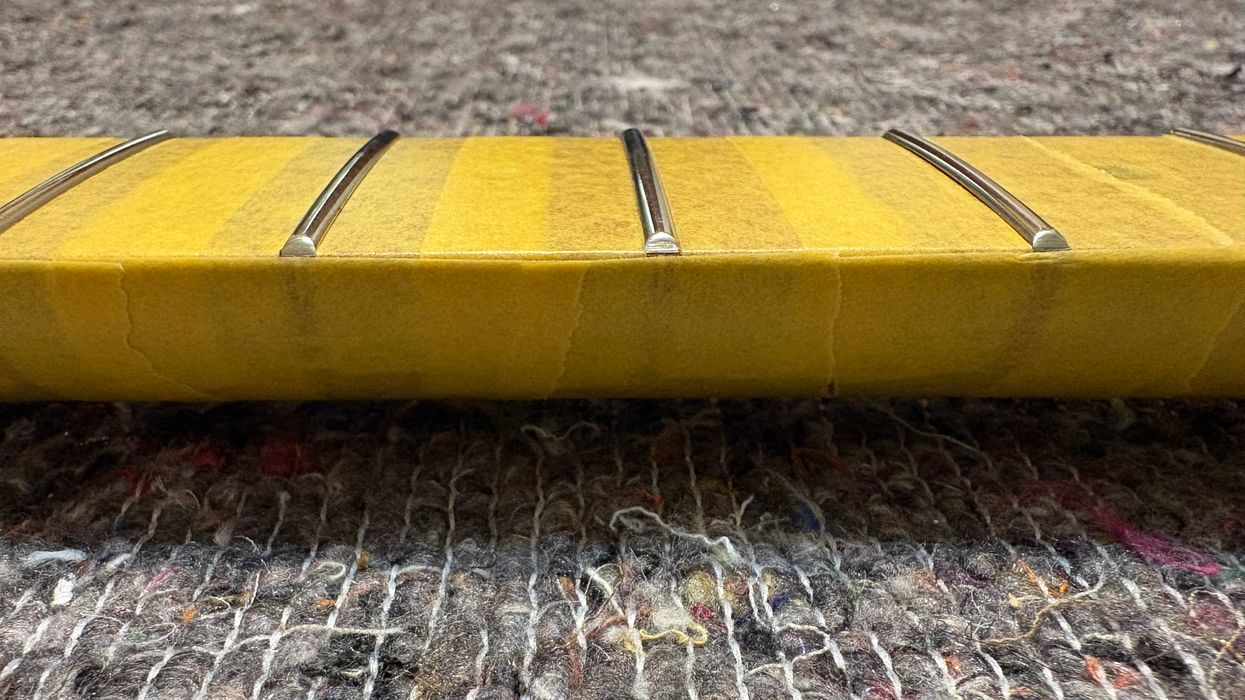
Hello, and welcome back to Mod Garage. We are almost done with our Harley Benton project—after working on the neck last month, there’s only one final step left before the neck is completely finished: polishing the frets. This is a very important step and one of the key factors in determining the playability of a guitar. If your frets are not polished well, there will be no “sexiness” when playing, and you will have to fight for every note. Bendings and vibratos will feel very stiff and uncomfortable and make strange noises on the frets. In essence, the instrument works against you instead of for you. In addition, dull or even dirty or rusty frets don’t look very good on a guitar.
The good news is that polishing the frets is something you can do yourself and the enhancement you will receive is simply stunning. And once done as thoroughly as possible, you’ll only need to refresh this process every time you change your strings. It’s a low-investment job with a high payoff, and you can do it to every one of your instruments, whether it’s a guitar, bass, mandolin, banjo, and so on. The procedure is always the same.
Many ways lead to Rome here, and there are a zillion different avenues and tools for success. I’ll demonstrate the intensive, serious polishing procedure I use in the shop, but naturally all other methods have their right to exist and will work, too. This is a time-intensive procedure, but it’s worth it; you can enhance your whole guitar armada one by one this way.
For my preferred way you don’t need very much, and you’ll likely already have some of the materials in your garage or workshop. So let’s go and make a perfect polishing job for your frets, resulting in a buttery-smooth, glassy feel and look.
Start with a basic cleaning of the fretboard and the frets, using Naphtha and a cotton rag. This is always the first step, no matter if you have a finished fretboard or one of bare wood like rosewood or ebony. To protect your skin you should wear gloves, this is lighter fluid and you don’t want to have direct contact with it. And it can’t hurt to also wear goggles to protect your eyes. An old cotton t-shirts works well as a rag; simply apply some Naphtha and clean the fretboard and the frets with it. After finishing, give it a minute so the Naphtha can completely disappear.
The next step is to precisely tape off the complete fretboard using low tack tape. This applies not only to finished fretboards like our Harley Benton one, but also to bare-wood fretboards like rosewood or ebony. The cleaning process with Naphtha will help a lot the tape will stick well on the wood. I prefer to completely tape the entire neck before I start polishing, which can be a kind of meditative work. Having a good coffee at hand and listening to some relaxing music can make this step go more quickly. As an alternative, it’s also possible to only tape off one fret, polish it, and then do the next, but I don’t recommend this method. We also want to polish the fret ends, which is a lot easier when taping off the entire neck. Using a fret guard is also not recommended for the same reason. Here’s a tip: Attach the tape as close as possible to the bottom of the frets and also mask the fretboard edge so you can polish the fret ends without any danger of disturbing the finish.
Next you have to decide what tools to use, and there are countless options. Avoid any steel wool for a serious fret polishing job—it’s not only a mess in general, but the pickups will attract the particles if you do not completely mask them. In general, the higher the grid you use, and the more grids you use in between to step up to the final grid, the higher the level of your polish and the smoother the feel. There are a lot of different polishing systems for frets from a lot of companies and they all work; my preferred way is to use Micro-Mesh soft touch pads in nine different grids, starting with 1,500 and stepping up to 12,000.
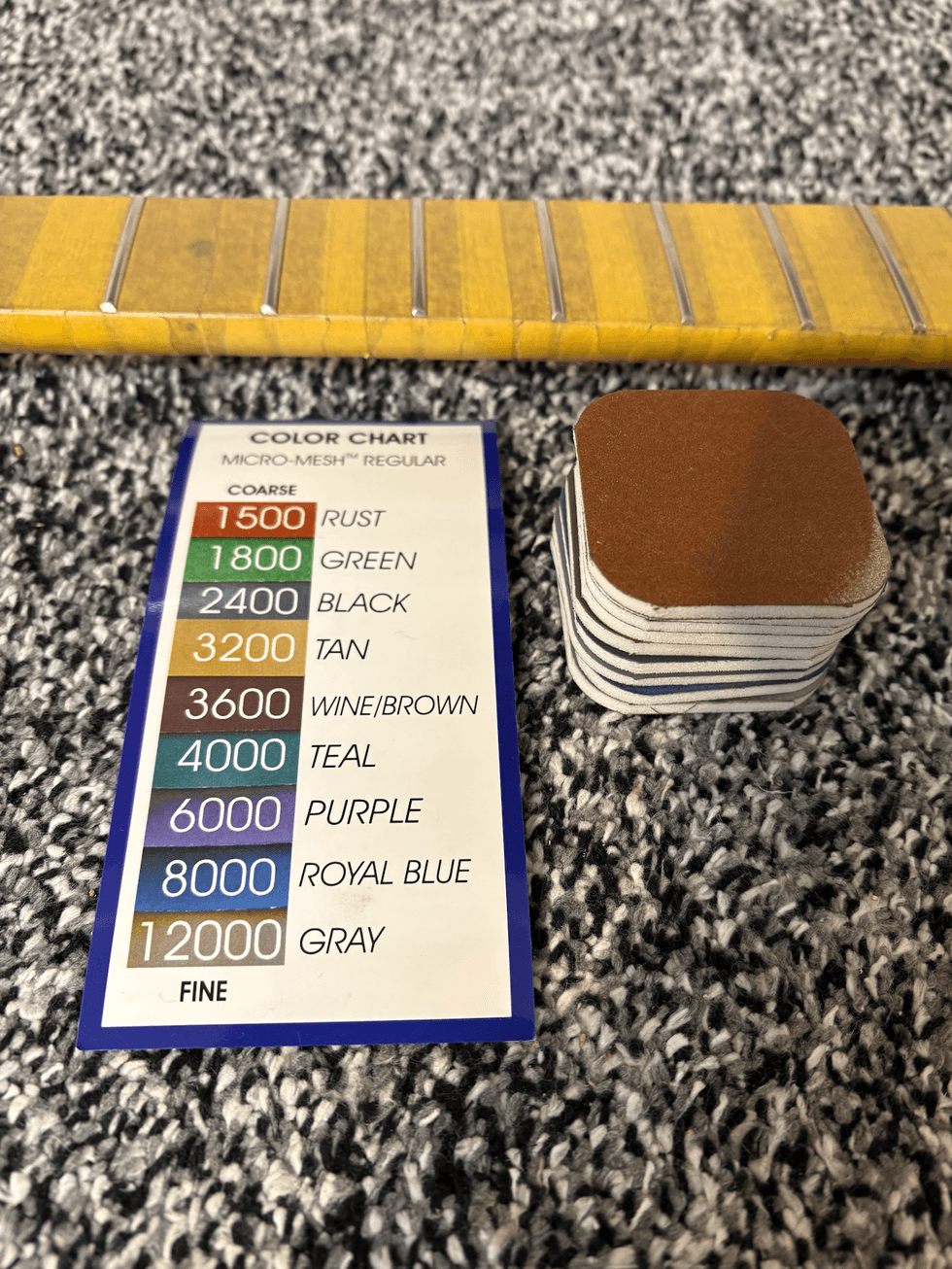
There are a lot of other options, including steel wool, abrasive touch-up sticks, abrasive sheets, Scotch-Brite, Kovax Tolecut, and others. If you already have a tool you use you can naturally stay with it, but for me, nothing beats the Micro-Mesh soft touch pads.
Now, take a small dish and fill it with soapy water as a lubricant for a scratch-free mirror shine. Simply use your finger to put some of the water on your polishing pad—don’t waterboard the pad, and avoid soaking it in water. Start with the 1,500 grid pad, wet it, and rub the fret from one fretboard edge to the other. Important: Do not polish from the nut to the bridge over the complete fretboard length, this is the correct direction for a serious polishing job. Take care to polish the complete fret down to the bottom, and take your time. You don’t need to be afraid about removing material, this is just a polishing job. After polishing the last fret angle, turn the pad approximately 30 degrees and polish the fret ends by rubbing the pad in that angle along both fretboard edges.
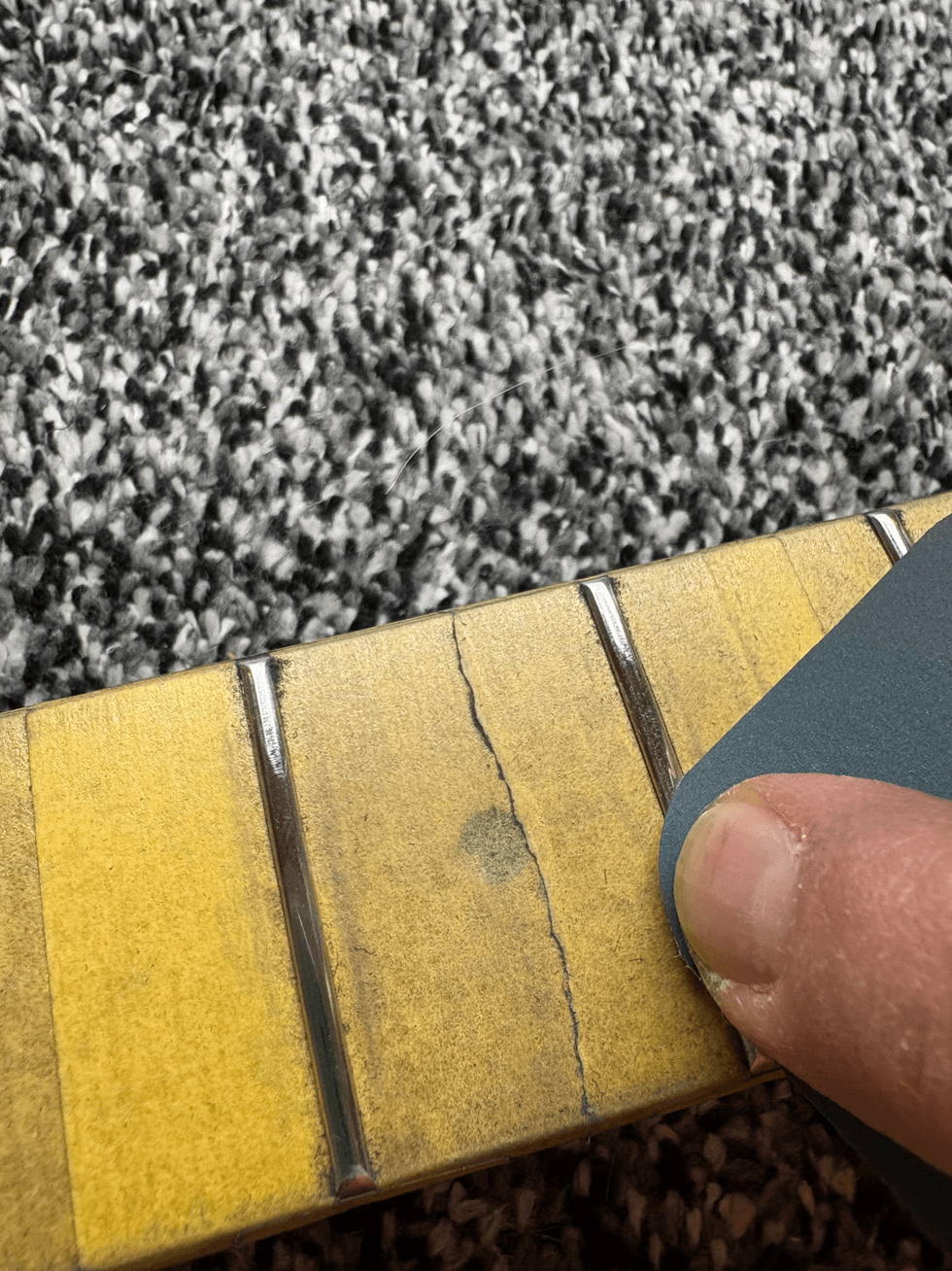
All done? Excellent. Take another nip of your coffee and step up to the next finest grid, repeating the entire process over and over again until you’ve stepped up to the highest grid.
I estimate that it should take roughly two hours on average to complete the whole process, including taping off the neck. Yes, it’s a long time for a polishing job. But believe me, it’s worth every minute.
You may ask—what about using machines like a Dremel or a stationary buffer to save some time? Yes, it’s possible to use such tools, but they’re a little risky to me. It’s easy to overheat and reshape the frets, and even easier to slip and hit the fretboard—something you definitely don’t want to do. I stopped using rotating tools for fret polishing several years ago and always take the long route. It’s better to be safe than sorry, especially on a customer’s guitar.
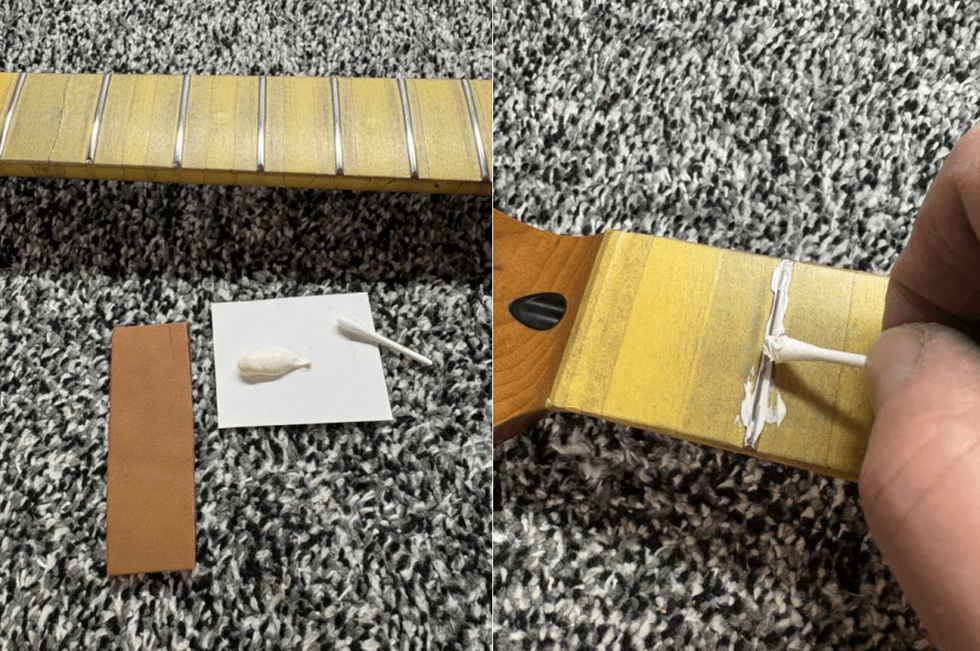
Now, the final step, which will make a big difference. For this we will need any metal polish of your choice, some Q-tips, and a piece of leather. Some advice: Wear gloves during the last step, and put some old newspapers underneath the neck.
First, put some metal polish on the Q-tip, and apply it all along the fret. With a piece of leather, polish one fret after another and, finally, the fret ends. Use the same procedure as earlier, but this time with a metal polish and a piece of leather. Using a piece of leather will not only polish but also burnish the frets to maximum shine, creating a glass-like feeling. There are special polishing leathers you can buy, but any old piece of smooth leather—like from an old leather belt—will do. Suede leather will not work properly, so stay away from that. Take your time and polish the complete fret; during the process you will feel a little bit of heat, which is a good sign that you are doing it right.
Finally, use a soft cotton cloth to wipe away any excess, and then take off the tape. When using low tack tape this should be easy; if there are any sticky areas use some Naphtha and a cotton rag to simply wipe it away. If you have an open-wood fretboard, apply fretboard oil of your choice afterwards and wipe away the excess.
And there you have it: Mirror-shine and glassy-feel frets for maximum playability. I’m pretty sure that when you experience the results on one of your guitars you will instantly undertake the same procedure on all your other instruments.
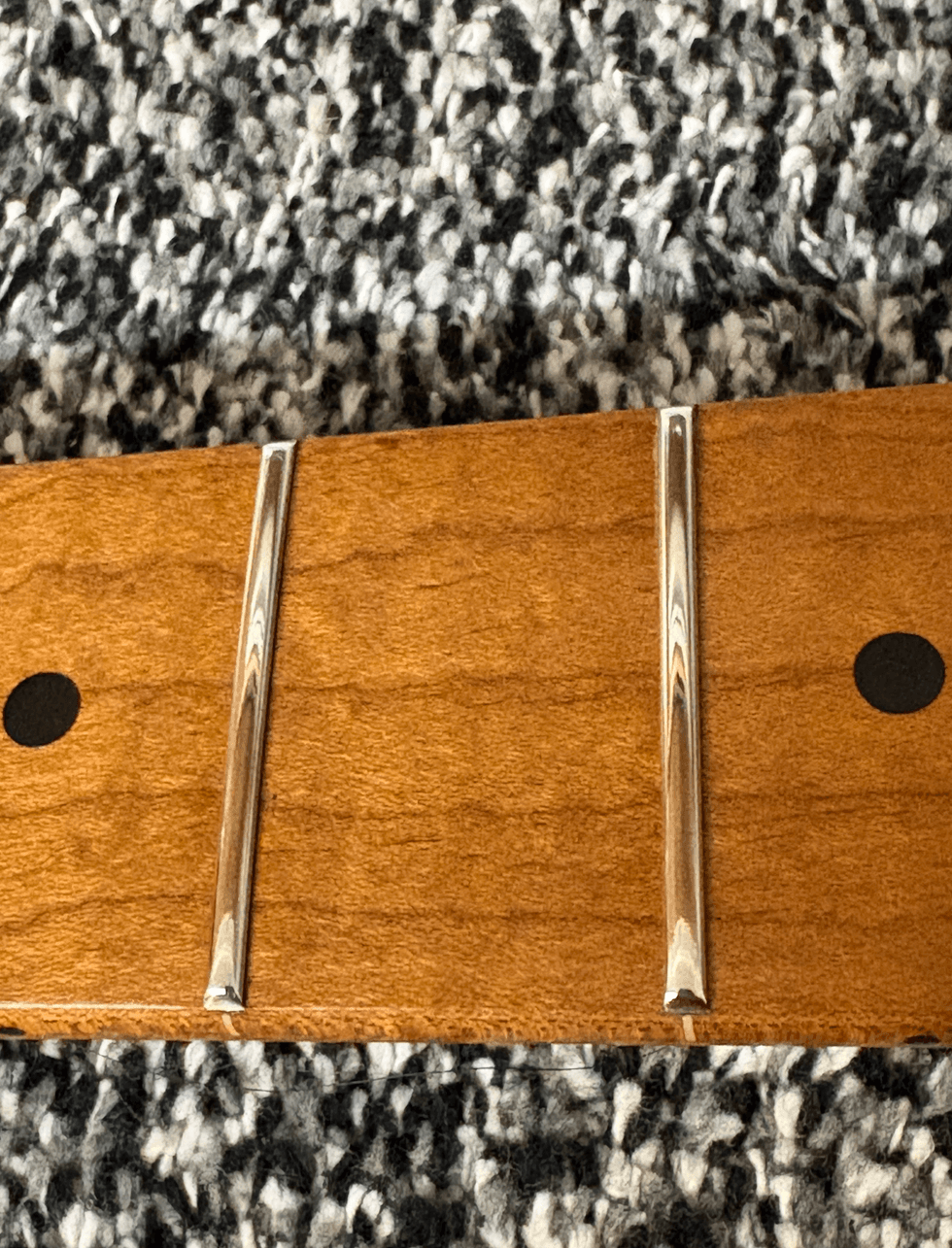
We didn’t spent any more money this month, so our budget of $100 for future investments is still available. Next month we’ll finish up our guitar project and compare the instrument to what we started with. So stay tuned.
Until then ... keep on modding!
Strymon TimeLine MX Review
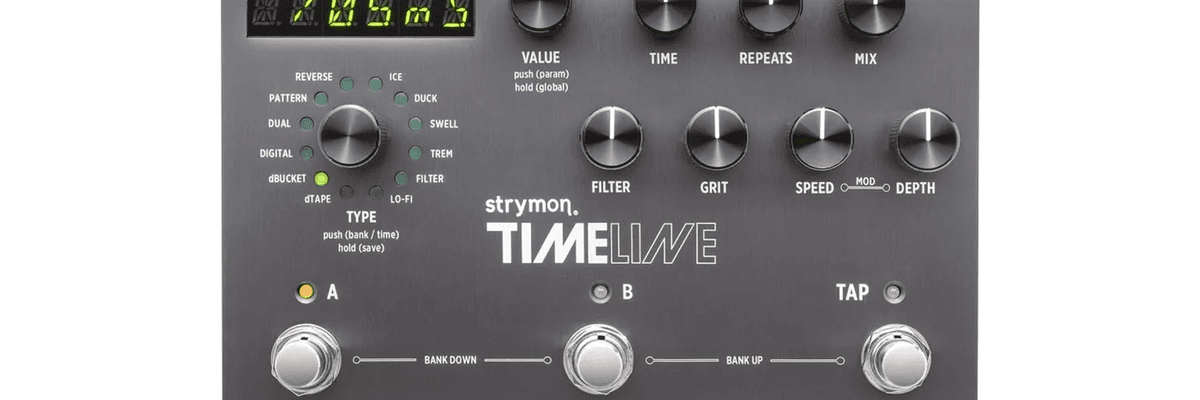
The original Strymon TimeLine always possessed the power and potential to transcend a mere guitar effect. Not long after its release, I got to know a sound guy who used one at every show. I’ve also seen them in synth-filled studios where a lone guitar sat tucked away, almost as an afterthought. To me that says a lot about what the TimeLine achieved in terms of user friendliness, power, and flexibility. Did its ability to work across disciplines make it less potent as a guitar effect? No way. The TimeLine was and is a blast to use for both straightforward guitar delay applications and late-night, down-the-rabbit-hole creative meanderings that birth whole musical pieces.
The new TimeLine MX is more of the same—a lot more. So much more, in fact, that I’ve heard grumblings about its $679 street price. If you’re a guitarist happy and fulfilled by making do with a Carbon Copy, and you’re skeptical about what the TimeLine MX can offer you, I get it. Even some delay power users may be hard-pressed to justify the expense. But after a few weeks of tinkering with the MX, it’s easy to imagine how guitarists who divide their time between home studio and performance—and for whom atmosphere and the ability to use echo as a compositional prompt is critical—will get back every penny of their $679 investment, and then some. This isn’t a perspective I arrived at because I imagined myself forever probing the MX’s deepest capabilities. It’s simply because the TimeLine MX proved fun, engaging, inspiring, and full of surprises, day after day.
Exponential Explosion
To try to describe every MX feature in the space of this review would be folly. (If you think I’m kidding, check out Strymon co-founder and designer Pete Celi’s deep dive video for the unit. It’s as long as a feature film.) But there are a few new core developments that are truly big news. The most important fundamental enhancement is the twin delay architecture, which enables you to use two delays in series, parallel, or in a stereo setup that sends different delays to different destinations.
Then there are the new algorithms, which include a wobbly vintage oil can-style delay, a slice-dice-and-reconstitute spectral delay, a Binson-inspired drum-style echo, and a rhythmically-driven multitap voice. There’s also a reverb mode you can add to the mix, if the new delays weren’t enough. These new algorithms join the lo-fi, digital, dBucket, and filter delay modes (to name just a few) that were stars on the original TimeLine. I’m sure there is a formula that can calculate the tone possibilities afforded by single, dual, stereo, series, and parallel iterations and combinations of the 12 algorithms. But frankly, the enormous sum of potential outcomes is something you feel more than you calculate. Scrolling through this many voices is often just flat-out thrilling, intoxicating stuff that makes afternoons and late nights disappear.
“Scrolling through this many voices is often just flat-out thrilling, intoxicating stuff that makes afternoons and late nights disappear.”
The “feel” factor is something that works in another design dimension, and that’s the unit’s layout, flow, and functionality. For a delay capable of a virtually incalculable number of sounds, the MX is still fairly compact—a design factor that was certainly part of its appeal to the synth artists and sound people I mentioned earlier, and, needless to say, a big deal for the pedalboard set. A more important facet of the MX’s ergonomics, however, is the sense of workflow. The new screen is super clear and organizes essential information well. The seven basic controls are arranged linearly in a single row, which makes them easy to scan and facilitates the development of muscle memory. The secondary functions are easily controllable via the assignable speed and depth knobs. The value and type knobs on either side of the screen—which work as both rotary and push-button controls—interface seamlessly with the readout. The bank-up, bank-down, tap-tempo and looper controls are also dead simple. Altogether, it’s a great study in flow and how to make a complex digital pedal accessible.
Surrounded By Sound, Drowned in Sensation
Highlighting just a few of the many remarkable sounds here could take up many pages. Here are some favorites anyway: The lo-fi is much more than a dollop of EQ blunting slathered over your original signal. There are options to change sample rate and bit depth that render the output a glitchy, grotesque mess, which, when mixed low and added in series or parallel to a lush and hazy drum delay, evoke fractured deep space communications embedded in the background of a gauzy, blissful dream. The spectral delay can be tuned to foreground sugary high-octave reflections in an array of crystalline, stained-glass echoes. But that formula can be flipped on its head, turning clear glass into mystery fragments of murky, patina’d sonic terra cotta. And while the drum echo doesn’t precisely replicate the sound signature of that lunatic device’s electromechanical quirks, the ability to edit the characteristics of each “record head’s” performance (via a very clever graphical representation on the view screen) means you can craft very hazy, syncopated repeats that are a perfect match for fuzzy and scuzzy overdrive.
The Verdict
Echo might be the only truly indispensable effect in my sound world, and I find the idea of spending lots of good money on great delay sounds totally relatable. So, when I consider the $679 Strymon asks for this high-quality, thoughtfully designed echo engine room, I wince ever so briefly before smiling at the possibilities. And these possibilities are copious, indeed—certainly for the side of my creative self that loves meandering through ambient music spaces, or spending hours soundtracking the abstract films cluttering my head and hard drives.
Musicians that work these fields with more focus and discipline than I possess have even more reason to be excited about what the TimeLine MX can deliver so intuitively. So will the many rock, pop, dance, and hip-hop musicians and producers that borrow from the ambient playbook. Less patient users, and I certainly count myself among this sect, can run into some hiccups: No delay this deep and capable can be navigated by intuition alone. But the essentials can be learned via the included five-page startup guide, and you have to be pretty lazy to get lost in the weeds here.
Back to that price: It’s probably one that needs to be considered on a sliding scale. For a lot of artists, the Timeline MX could be the backbone of a desktop studio or pedalboard. For players that view the TimeLine MX through that lens, the price is a fair one or better—especially when you consider its excellent workflow.
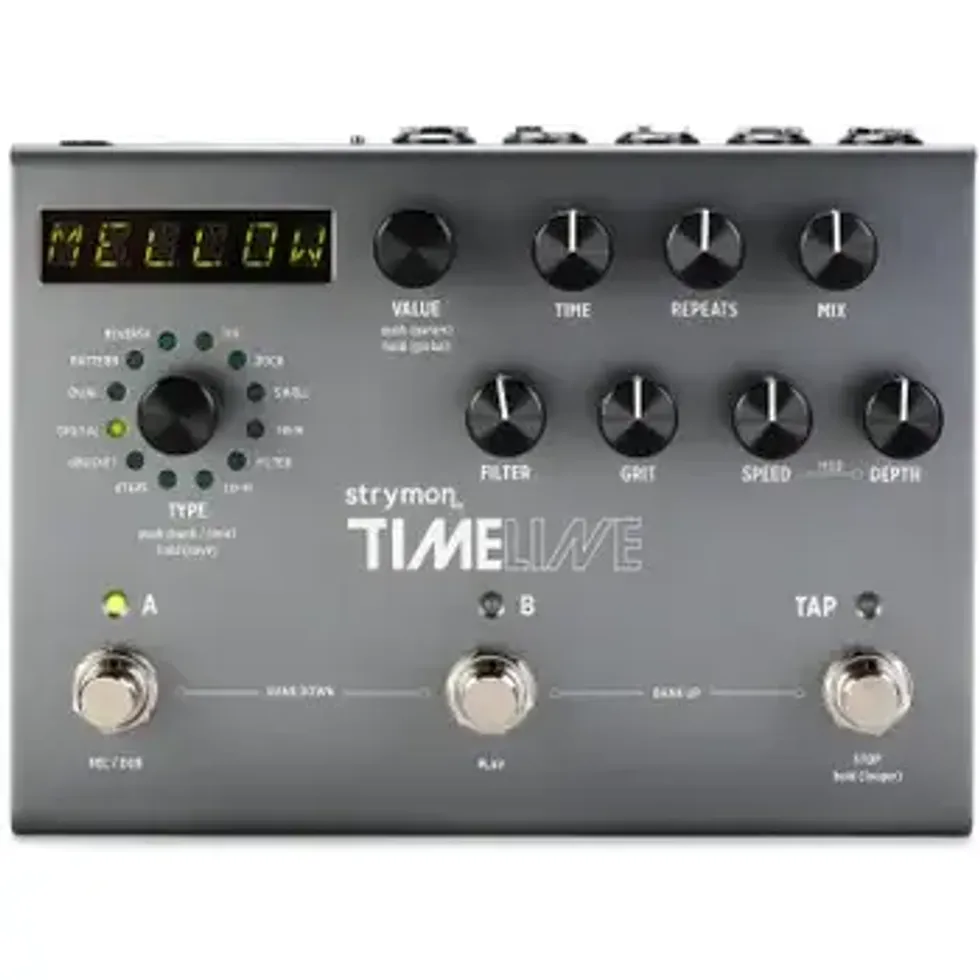
Pages
