
Music is the universal language
“Glory to God in the highest heaven, and on earth peace to those on whom his favor rests.” - Luke 2:14
General Interest
“John Lydon was alright – we got on quite well. It’s just that Sid Vicious was such a dick”: Roger Taylor recalls the first time Queen met the Sex Pistols

Queen drummer Roger Taylor has reflected on the infamous tense encounter that occurred with the Sex Pistols when the two bands were recording at the same studio in 1977.
At the time, Queen were working on what became News Of The World, while the Pistols were laying down their debut album, Nevermind The Bollocks…, when the two forces came into contact at Wessex Sound Studios.
Speaking to Classic Rock, Taylor says, “I really loved the Pistols album. It was [made with a] great producer, mate of mine, Chris Thomas. Because we were in the same studio for a while in 1976-77, somewhere around there. They were doing their first album, and it was dreadful at first until Chris came in and made a great record.”
Sid Vicious interrupted Queen’s session to taunt frontman Freddie Mercury over a comment he’d made in an NME interview about his love of ballet. Reports from other Queen insiders also recall the Pistols’ John Lydon crawling into their space on all fours.
“Sid put his head in the studio and said: ‘Hello, Freddie, are we bringing ballet to the masses?’ And Freddie said something like: ‘Oh, Mister Ferocious, we’re doing our best here…’” He goes on to add, “John [Lydon] was alright, actually. He was quite a character. We got on quite well. It’s just that Sid Vicious was such a dick.”
Earlier this year, Taylor and Queen guitarist Brian May spoke to Uncut about their own experience of recording a debut album, and the high-stakes that surrounded the experience: “We were ludicrously compliant on the first album because we were terrified that it was going to be our only chance to record,” said May.
“That’s the big difference between Queen and Queen II, the second album is the sound of us starting to get the sound we wanted,” added Taylor.
The post “John Lydon was alright – we got on quite well. It’s just that Sid Vicious was such a dick”: Roger Taylor recalls the first time Queen met the Sex Pistols appeared first on Guitar.com | All Things Guitar.
“He said some hurtful things, but I know he didn’t mean it”: Brann Dailor reflects on Mastodon’s public fallout with late guitarist Brent Hinds

Last year, the metal world was rocked when it was announced that Mastodon founding guitarist Brent Hinds had died in a motorcycle accident.
The guitarist had departed the longstanding Atlanta metal outfit earlier in 2025, and while the decision was described as mutual at the time, the split later became somewhat acrimonious. Three months after his exit, Brent Hinds described his former bandmates as a “shit band with horrible humans”.
But despite the harsh words uttered during the heat of the split, Hinds’ former bandmates – guitarist Bill Kelliher, bassist Troy Sanders and drummer Brann Dailor – hold nothing but respect and fond memories for the 24 years they shared together as one of the top bands in the metal scene.
- READ MORE: Want to test the prototype from Guitar Center’s new in-house guitar brand? Here’s how you can
In an interview in the latest print issue of Classic Rock, drummer Brann Dailor reflects on the years they spent together, and the circumstances surrounding Brent Hinds’ departure from the band.
“There’s 25 years of living with this guy,” he says. “When you have this otherworldly bond, this really deep emotional place together through music, it’s an elevated relationship. But when we did the Ashes of Leviathan tour, I could finally see that it had run its course with him. We needed some kind of change, because it was dragging everybody down.
“It became really hard to get Brent to commit to anything. He just wanted to go do his own thing, ride his motorcycle and be a free spirit.”
Dailor continues, reflecting on the thorny words said by Hinds about his former bandmates: “He was a man scorned. He said some hurtful things, but I know he didn’t mean it.
“I was always hopeful that he was going to call me at some point and be like: ‘Dude, I’m done being a ding-dong. Can I come back? I have a riff…’ We were 100% sure he would’ve done that.”
Just a year on, the death of Brent Hinds still affects the members of Mastodon profoundly.
“It isn’t easy to talk about Brent, he was our family, someone we all loved wholeheartedly. He was a wild man, our wild man and that came with some challenges,” the band wrote in July.
“Both things are true and we aren’t interested in chasing one truth over the other. Losing him has meant sitting with a type of grief we never expected. No more hugs, no more high fives, no more disagreements, no more making up. That part has been hard, it’s real.”
“I thought there’d be that turnaround where we’d meet, apologise, hug and say, ‘I love you.’ I didn’t know when, but I knew it would happen. And I was fucking wrong,” added Troy Sanders.
Since Hinds’ death last year, Mastodon have taken on two new members: Nick Jonhston on lead guitar, and keyboardist João Nogueira.
Last month saw the release of the band’s ninth studio album and first without Brent Hinds, Marrow Deep. The band have a string of US tour dates planned for the rest of the year to promote the album, alongside Deafheaven and Alcest.
For a full list of dates, head to MastodonRocks.com.
The post “He said some hurtful things, but I know he didn’t mean it”: Brann Dailor reflects on Mastodon’s public fallout with late guitarist Brent Hinds appeared first on Guitar.com | All Things Guitar.
The 10 best pedal compressors for guitarists in 2026
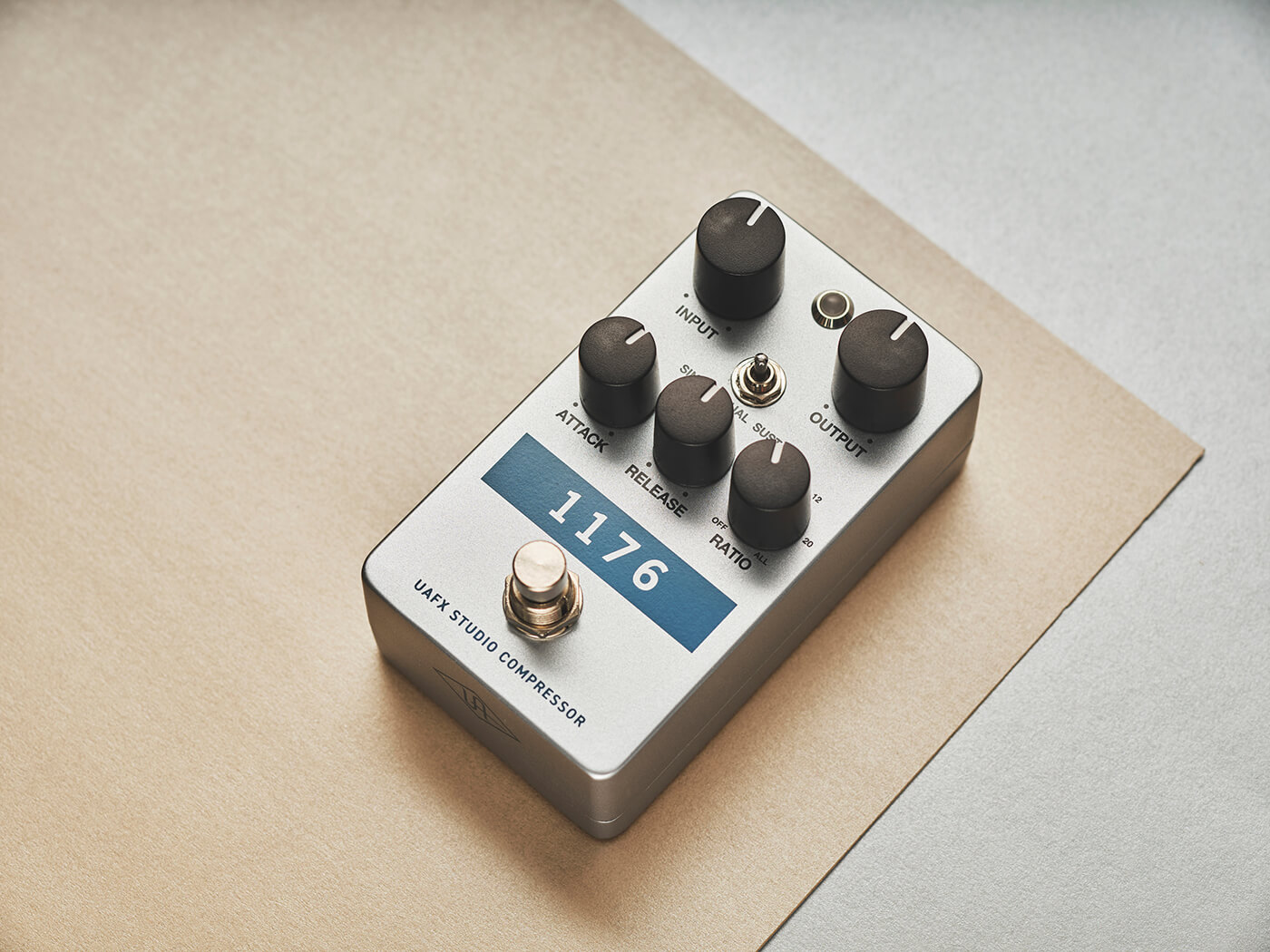
Compression! It’s one of the most misunderstood and underrated guitar effects. If you’re looking for your next dedicated compression pedal, you’re in the right place – let’s explore some great options for squishing your sound.
For electric guitar, some kind of compression somewhere along the chain is quite important – the raw, completely unaltered signal from a guitar’s pickup is quite uneven, with a big transient at the start, and a quick falloff as the note dies. Compression of all kinds, whether it’s from your amp’s front end, a dirt pedal or a dedicated compressor, evens out your volume and makes for a more pleasing playing (and listening!) experience.
Here we’re looking at dedicated compression pedals, which let you add sustain and even out dynamics without introducing extra distortion, unless you want to – overloading a compressor pedal can be its own kind of saturated fun. But the core use-case for compression is to gain some more control over your dynamics without having to sound like you’re suddenly in Slayer. Compression is at the backbone of many of the best guitar tones out there – from the punchy, ‘quacky’ country sound of a compressed Telecaster, to the sparklingly clean and articulate solos of David Gilmour, and a whole lot else besides.
A dedicated compressor pedal can be an excellent addition to your sound, particularly if you want to sculpt a quality clean tone. But there are a lot out there, ranging from the premium studio-grade compressor workstations for your board, to simple two-knob affairs that won’t break the bank. Let’s dive in.
At a glance:
- Keeley Electronics Compressor Plus
- Universal Audio UAFX 1176
- Empress Effects Guitar Compressor MKII
- Warm Audio Pedal76
- Origin Effects Cali76 FET
- JHS Pedals 3 Series Compressor
- Xotic SP Compressor Mini
- Boss CS-3
- MXR Dyna Comp
- TC Electronic Hypergravity
- Why you can trust Guitar.com
Keeley Electronics Compressor Plus
The undisputed standard for modern pedalboard compression. Evolving from Robert Keeley’s legendary two-knob design, the Plus features a blend control for parallel compression and a specialized attack/release switch optimized for either single-coils or humbuckers. It effortlessly retains your core tone while adding sweet, musical sustain and evening out your dynamics. It’s arguably the most versatile “always-on” compressor for everyday players.
Universal Audio UAFX 1176
Universal Audio managed to cram the exact algorithms of their legendary studio hardware into a compact stompbox. This pedal delivers authentic 1176 FET compression with switchable Single, Dual, and Sustain modes—giving you everything from subtle dynamic control to iconic Led Zeppelin-style squish. If you want uncompromising, studio-grade digital emulation of a legendary rackmount unit without dropping thousands of dollars, this is the benchmark.
Empress Effects Guitar Compressor MKII
This all-analog FET compressor brings recording console flexibility to your feet. It boasts independent Attack and Release knobs, a sidechain high-pass filter to keep bass frequencies from triggering the compression, and a handy “tilt” EQ knob. The standout feature is the vibrant LED metering strip, letting you see exactly how much gain reduction you’re applying.
Warm Audio Pedal76
Warm Audio built its reputation on cloning classic studio gear, and the Pedal76 brings an all-analog, true-to-spec 1176 circuit directly to your pedalboard. Featuring custom USA-made CineMag transformers, this pedal delivers rich, vintage FET character and lightning-fast attack times. It is undeniably large and requires serious board space, but it rewards you with authentic analogue warmth and punch that digital emulations struggle to fully replicate.
Origin Effects Cali76 FET
Widely considered the ultimate boutique compressor, the Cali76 is an ultra-premium, studio-grade FET compressor packed into a brushed-steel enclosure. It captures the distinct sound of an 1176 with zero digital processing. The inclusion of a dedicated Dry knob allows for seamless parallel compression, giving you massive sustain without killing your pick attack. It’s premium appointments don’t come cheap, though…
JHS Pedals 3 Series Compressor
Part of JHS’s budget-friendly 3 Series, this no-nonsense compressor offers just three knobs (Volume, Attack, Sustain) and a Bright switch to add top-end sparkle back into your signal. Despite the stark white enclosure and incredibly approachable price point, it’s built in the USA and delivers smooth, transparent dynamic control that rivals pedals double its price.
Xotic SP Compressor Mini
Don’t let the dinky footprint fool you – this tiny pedal houses a premium Ross-style circuit that punches way above its weight class. It features an external blend knob for quick parallel compression and a three-way toggle for High, Mid, or Low compression strength. Internal dip switches offer even deeper tweaking for attack and release.
Boss CS-3
A rugged, reliable workhorse that has graced thousands of professional pedalboards for decades. Unlike transparent modern compressors, the CS-3 is notoriously “squishy,” heavily coloring your tone and providing near-infinite sustain for searing solos or snappy country chicken-picking. It also comes with the added benefit of being housed in the Boss compact enclosure, and therefore will probably outlast several civilisations.
MXR Dyna Comp
The original red box that helped define the sound of modern country, funk, and 80s pop. With just two knobs, it’s easy dial in and hard to make sound band. The Dyna Comp is not transparent; it produces a very distinct, percussive “pop” on the attack and significantly alters your EQ, making it work great as a bit of a of a preamp boost as well as just a pure compressor.
TC Electronic Hypergravity
A highly advanced digital multiband compressor built on the MD3 algorithm from TC’s flagship studio System 6000. Because it compresses high, mid, and low frequencies independently, it yields incredibly transparent, even results without choking your tone. The real magic lies in the TonePrint app, which allows you to beam custom presets from pro artists directly to the pedal or deep-dive into the parameters yourself. It’s also eminently affordable, and sports a pretty compact enclosure given its extensive featureset.
Why You Can Trust Us
Every year, Guitar.com reviews a huge variety of new products – from the biggest launches to cool boutique effects – and our expert guitar reviewers have decades of collective experience, having played everything from Gibson ’59 Les Pauls to the cheapest Squiers.
That means that when you click on a Guitar.com buyer’s guide, you’re getting the benefit of all that experience to help you make the best buying decision for you. What’s more, every guide written on Guitar.com was put together by a guitar obsessive just like you. You can trust that every product recommended in those guides is something that we’d be happy to have in our own rigs.
The post The 10 best pedal compressors for guitarists in 2026 appeared first on Guitar.com | All Things Guitar.
“I chop the fingers off and throw the arms in the bin”: Tony Iommi reveals the bizarre thing he has to do to get his prosthetic fingertips

Despite Tony Iommi having lost the tops of two fingers in an industrial accident as a teenager, it didn’t stop him from becoming one of the most influential players of all time.
Iommi regularly gets sent prosthetic replacements from his local hospital, but according to the Black Sabbath guitarist, they don’t just send him a replacement for his missing fingertips, but rather ludicrously, a whole arm at a time.
Speaking to Classic Rock, he says with an amused smile, “The thing is, they send me a whole rubber arm. I’ve asked them: ‘Why not just send a hand?’ But apparently they can’t do that.
“They sometimes send me five arms at a time. So I chop the fingers off and throw the arms in the bin,” he admits. “The dustmen must be thinking: ‘What the bloody hell’s going on here? Has he bumped someone off?’”
Although incredibly bizarre, these ‘rubber arms’ of Iommi’s clearly do the job – he’s soon to release his first solo album in in 21 years, From The Dark, on 23 October this year.
Iommi announced the record back in July along with its first single, World Alone. On the record, he is supported by a band consisting of Norwegian vocalist Jørn Lande, Mercyful Fate bassist Becky Baldwin, and former Robbie Williams drummer Karl Brazil.
Listen to World Alone below:
Queen’s Brian May also features on the album for track Death Wake. Speaking to Loudwire last month, Iommi shared how May ended up on the record – and revealed that he’d actually asked his old friend to play on more than one track.
“I said to him, ‘Play on some other tracks,’ but he went, ‘Oh no, it’s your album,’” he said. “That’s the relationship we’ve had with each other for all these years. We’ve played a lot together. He is a great friend.”
You can pre-order From The Dark now via Tony Iommi’s official website.
The post “I chop the fingers off and throw the arms in the bin”: Tony Iommi reveals the bizarre thing he has to do to get his prosthetic fingertips appeared first on Guitar.com | All Things Guitar.
LsL Instruments Baribone review: custom baritone T-type finds the balance between vintage and modern

$3,999, lslinstruments.com
What a time to be reviewing an LsL guitar. Yes, for the last few weeks this Baribone has been awkwardly slotted into my guitar rack next to a few Fenders, no doubt feeling like it had wandered into a bar in the wrong part of town, the part where the honky-tonk piano crashes to a stop when the saloon doors swing open, and all the patrons tentatively reach for their lawyers’ email addresses.
Thankfully, for guitar reviewers who are running out of ways of describing the elephant in the room without wanting to waste a lot of word count reminding people about current events, the instrument we have here is mercifully separated from the current hurley-burley, though it is extremely on brand for 2026.
 Image: Adam Gasson
What is it?
So what’s different about today’s guitar? Well, it’s baritone for starters, with custom appointments that make it pretty far what even the Fender Custom Shop might make you unless you were prepared to remortgage the house and have a nice long chat with a Master Builder.
The custom nature of the Baribone line means LsL is pretty flexible about what your final instrument looks like, but the core model pairs a T-type body paired with a 27.5” scale length.
That baritone scale is a good middle-ground, particularly for faster playing – the tension is still quite hefty at B-B, but the fret span isn’t so wide that it feels like a different instrument.
From here, custom appointments open up a pretty wide world of single-cut downtuned fun – you can keep it traditional with a bridge plate and single-coils, go full modern with dual humbuckers and exotic woods, or combine your own personal mix of modern and vintage specs.
The latter has been done here: its future owner intends it to be used for progressive metal while still looking like something designed in the 1950s. And, indeed, used very hard every day since the 1950s – so it’s a vintage-styled heavy relic from a distance, but take a closer look, and something far more aggressive rears its head, with hefty humbuckers and jumbo frets.
 Image: Adam Gasson
Build quality
While it still polarises, artificial ageing has become a pretty commonplace thing in the guitar space. From Novos and Murphy Labs to Mexican Fenders… hell, even super affordable instruments can be found with aged finishes now (Harley Benton’s new range, for instance).
As anyone who has got up close with these cheaper guitars can attest, artificial wear and tear can look a little artless up close when done on a mass-production scale. Conversely, this guitar is a reminder of just how much of an art form ageing an instrument can be.
The finish wear, for instance, very much accentuates the three-dimensional nature of the lacquer, with satisfying, crackly checking and smears of damage that reveal sequential layers of colour, primer and wood.
The hardware ageing is subtle compared to the body’s, which is good to see from a comfort perspective (no one wants an actual rusty bridge), and a thin vintage-style finish will obviously take the brunt of genuine wear-and-tear. The look of the headstock really benefits from the ageing, too, with a really pleasing character added to the substantial bevels by the complex chipping.
Importantly, the effect is cohesive. An easy tell for rubbish relicing is a sort of mish-mash of damage, the obvious result of randomly throwing screwdrivers at the guitar for an afternoon, rather than a wear pattern with a more narrative aspect.
Everything flows together here, and feels verisimilitudinous (there’s one for your next Scrabble game) in where it lies – forearm wear smooths out the area where your forearm rests, the pick wear is where you’d pick, and also sort of clears the way for you with a little scoop in the bevel of the pickguard.
The only gripe I have with the ageing is the slightly inconsistent feel of the neck – some of the process has left that darker patch where my thumb rests below the seventh fret feeling just a tad rough. It’s subtle enough that it’ll likely smooth out after a couple of sweaty gigs, but maybe just one more pass of a micromesh pad might have given the same aesthetic effect without the slightly raw feeling on the pad of my thumb.
As for the rest of the actual build quality, it’s frankly faultless. The guitar presents as an extraordinarily complete instrument, with none of the little compromises of setup and alignment that factory guitars sometimes have to make. For this kind of cash, of course, you’d hope that it would be so – but it’s worth putting across just how neatly everything has been made and assembled here.
 Image: Adam Gasson
Playability
Picking up the guitar and giving it an unplugged strum, it’s striking how lively it feels. The factory setup and strings make for quite substantial tension in B standard – and that translates to extra twang and resonance from the lightweight, lightly-finished body. To channel Nigel Tufnel for a moment – even unplugged, it sustains for absolutely bloody ages when you ring out a big chord.
The neck profile is a custom C profile designed by LsL master builder Chris Fleming – and aside from the aforementioned rough patch it’s a very pleasing profile. Longer scale length aside, it still feels like a comfortable vintage Tele-style neck, particularly thanks to the 1.65” nut. Aforementioned rough spot aside, the texture of most of the neck is lovely and smooth – here the phrase “played-in” means that you’re never running up against any sticky gloss that’ll slow you down.
The jumbo frets here are mirror-smooth and, at first, distractingly massive – the vintage look makes me instinctively expect frets that aren’t railway-sleeper chunky, but, that cognitive dissonance quickly melts away upon actually playing the thing. The 12” radius helps things feel extremely glassy – not that I’m doing much bending on it, mind, thanks to that higher tension, but leads are a breeze and wide-open chords have a chewy, satisfying feel thanks to the extra space underneath the string.
At the right hand, the hipshot hardtail bridge is one of the best options for a no-nonsense string-through hardtail, with its little ramp for comfy palm-muting, and solidly made saddles that don’t drift downwards or rattle. Like a more traditional string-through Telecaster bridge, it makes for a pretty snappy feeling – but with a lot more comfort when it comes to heavier playing.
 Image: Adam Gasson
Sounds
Plugging in, the first thing I notice is that the Bare Knuckle Impulse that’s in the bridge position sounds absolutely killer. This is a signature design for Josh Smith from Northlane, and it’s voiced specifically for heavy baritone tones. It makes good on that promise, smartly cutting enough low-end to keep things clear and tight rather than flabby, but by no means does it let go of any impact. It’s a little like having an always-on tightening booster, something like an EQD Arrows, which, if you’ve ever used you’ll know just kind of makes most dirt pedals sound better.
The neck pickup is an in-house LsL humbucker. It’s fairly hot, but not to the point of overwhelming the signal, and in tunings like this, you don’t want to have something with too much power in the neck. Tonally it’s a little more of a classic humbucker, although most things are when compared to huge quad-bladed things like the Impulse. Regardless, it provides a nice contrast – a refined Japanese chef’s knife next to the sharp-but-brutal two-handed longsword of the bridge pickup – allowing for a more dynamic experience once you get that pickup switch in play.
Both are, of course, made nice and lively by the generally resonant character of the guitar – and while you can argue about psychosomatic transferral of tonewood characteristics through high-gain gear all you like, what you can’t argue with is the feel of the thing springing back in your hands and against your body as you strum it.
Overall, my time with this Baribone was pretty excellent, and I was (unsurprisingly) extremely sad to pack it up and send it on to its owner.
What I find exciting about baritones, too, comes across very strongly in the Baribone, resonantly and articulately projecting the huge presence of a downtuned instrument.
For heavy music, I can appreciate the ultra-thin shreddy necks and heel access down to the 22nd fret, but for my purposes the ergonomics of a Fender-style construction, replete with a vintage neck profile and nice big square heel, never provided a barrier.
 Image: Adam Gasson
Should I buy one?
Thinking about it, that term “Fender-style” is a lot more loaded with potential legal ramifications than it was a few months ago, isn’t it? And it’s fair to say that lots more people will recognise the name LsL Instruments than they might have either.
For transparency’s sake, I should note that this review was arranged before the brand became the focal point of a legal firestorm, but it’s tricky to untangle it from the wider notoriety here in September 2026.
That being said, it’s nice to be able to check out something like the Baribone in the shadow of what else is going on and appraise why people might want a guitar from LsL, beyond social media cheerleading.
Because obviously, there are bits of Fender in this guitar’s DNA, but it melds that with a bunch of stuff that you simply cannot get from a production Fender guitar right now. A USA-made hybrid vintage/modern T-type baritone may not be a mass-market instrument, but it’s still a very cool thing that would not exist without smaller builders like this.
With that out of the way: should you buy an LsL Baribone? Well, if you’re spending this much money on a guitar, I’d hope you’d be certain enough in your intentions that a single paragraph of a single review wouldn’t be the final thing to tip the balance – but, to be just a data point in your decision matrix anyhow: you should.
 Image: Adam Gasson
LSL Baribone alternatives
There are a good few other baritone instruments in this price range, but they tend to err on the side of more vintage-y or at least less heavy in their application. Novo makes a baritone version of the Serus J ($4,499), which is a similarly high-end custom with more of an offset vibe if that’s your thing. There’s also the Duesenberg Julietta Baritone ($2,999), a weirder unique thing with an undeniable eye-catching presence.
In the more explicitly metal world, ESP’s high-end offerings include some hefty seven-string baritones with somewhat T-style appointments, although more in the Jim Root tradition than the Roy Nichols one. Gibson has also just announced a ($2,499) bari version of its hard-rockin’ Victory model, too – it’s a cool thing for the 80s-inclined. And at around 1/10th of the price, there’s also something like the Squier Classic Vibe Baritone Telecaster ($549.99) and Gretsch Electromatic Jet Baritone ($549) if you’ve read this review and started to salivate at the idea of a single-cut baritone but are currently not in a position to drop $4,000 on an instrument.
The post LsL Instruments Baribone review: custom baritone T-type finds the balance between vintage and modern appeared first on Guitar.com | All Things Guitar.
Walrus Audio Intros Fundamental Lo-Fi Delay
Taylor Guitars Introduces Next Generation 12-Fret Grand Concert Models

Taylor Guitars has released five new Next Generation 12-fret Grand Concert models: the PS12ce 12-Fret, K22ce 12-Fret Special Edition, 712ce 12-Fret, 552ce (12-String) and 512ce 12-Fret. Spanning an array of tonewood pairings and appointment packages across Taylor's 500, 700, Koa and Presentation Series, the lineup pairs the playing comfort of the 12-fret design with a warm, articulate voice.
Combined with the Grand Concert's compact body and 24-⅞-inch scale length, the 12-fret configuration — in which the neck meets the body at the 12th fret — creates a hand-friendly playing experience, with a more compact relationship between the player’s hands, easier fretting, and a relaxed, responsive string feel. Because of the 12-fret connection, the bridge shifts closer to the center of the lower bout, changing how the soundboard responds to string energy and contributing to the 12-fret’s distinctive tonal character.
“The bridge placement lets the soundboard move more efficiently,” said Taylor Chief Guitar Designer, President and CEO Andy Powers. “That translates into a warmer tone, a stronger midrange, longer sustain and surprising projection, all wrapped in a compact, lap-friendly body that’s comfortable enough for hours of playing and versatile enough for virtually any style.”
Those benefits are especially pronounced in the 12-string/12-fret Next Generation 552ce, which is sure to impress players with its remarkably comfortable fretting. Likewise, Taylor’s double-mounted string anchoring system for 12-string guitars (in which each string pair is secured under a single bridge pin) ensures a consistent break angle for the strings across the saddle, yielding a more consistent voice across each course.
The Next Generation 12-fret Grand Concert models incorporate Taylor’s latest Next-Gen design innovations: the patented Action Control Neck™, scalloped V-Class® bracing and Claria™ System electronics. (The 12-string 552ce features standard V-Class bracing to accommodate the added string tension.)
The Action Control Neck enhances sustain, warmth and resonance while allowing players and technicians to adjust string height on the fly, making it easy to dial in the perfect feel and adapt to changes in climate, specific musical applications or unique playing styles. Scalloped V-Class bracing bolsters sonic depth with improved open-string richness and enhanced low-end presence while preserving the hallmark pitch accuracy, volume and sustain of the original V-Class platform. The Claria System pairs a reimagined under-saddle pickup with a proprietary preamp to produce natural, reliable amplified tone in live settings, with intuitive soundhole-mounted controls that include a new Mid-Contour knob for effortless tone shaping.
All five models feature a 24-⅞-inch scale length and a cutaway body.
NEXT GENERATION 512CE 12-FRET (MAHOGANY/WESTERN RED CEDAR)

A must-play model for fans of mahogany and cedar, the 512ce 12-Fret pairs Western red cedar with mahogany for a warm, intimate voice with rich midrange focus and exceptional touch sensitivity. Cedar responds effortlessly to a light touch with sweetness and nuance, while mahogany adds woody definition and earthy character — a natural fit for fingerstyle, blues, roots music and singer-songwriters.
- White binding (body), black binding (fretboard)
- Green abalone rosette
- Italian acrylic Meridian inlays
- Faux tortoise pickguard
- Taylor slot-head nickel tuning machines, ebony buttons
- Gloss body finish, satin neck finish
- Next Generation 512ce 12-Fret is priced at $2,999
NEXT GENERATION K22CE 12-FRET SPECIAL EDITION (HAWAIIAN KOA)

This all-koa Next-Gen 12-Fret Special Edition delivers a woody voice with loads of midrange swagger that opens up over time, rewarding players with added sweetness and resonance. Select-grade Hawaiian koa showcases striking grain and color variegation, complemented by iridescent shell appointments and a rich shaded edgeburst that wraps the entire guitar.
- Indian rosewood binding (body, soundhole), ebony binding (fretboard)
- Paua/Indian rosewood rosette
- Mother-of-pearl GA-LTD inlays
- Dark-stained sycamore pickguard
- Taylor slot-head nickel tuning machines, ebony buttons
- Shaded edgeburst gloss finish (entire guitar), satin neck
- Next Generation K22ce 12-Fret Special Edition is priced at $4,499
NEXT GENERATION 712CE 12-FRET (INDIAN ROSEWOOD/WESTERN RED CEDAR)

Pairing a Western red cedar top with Indian rosewood back and sides, the 712ce 12-Fret produces a richly textured voice with lush overtones, deep lows and piano-like trebles. From delicate fingerstyle to full, open-chord accompaniment, it offers a colorful tonal palette for players seeking depth, nuance and exceptional responsiveness in a compact form.
- White binding (body), black binding (fretboard)
- Green abalone rosette
- Green Abalone Reflections inlays
- Faux tortoise pickguard
- Taylor slot-head nickel tuning machines, ebony buttons
- Gloss body finish, satin neck finish
- Next Generation 712ce 12-Fret is priced at $3,399
NEXT GENERATION 552CE (12-STRING; MAHOGANY/WESTERN RED CEDAR)

The most approachable and versatile 12-string in the Taylor lineup, the 552ce pairs a cutaway Grand Concert body with an accessible 12-fret design for a uniquely intimate, easy-playing experience. A cedar top lends warmth and touch sensitivity, while mahogany back and sides enhance the octave shimmer with focus and midrange clarity. Standard V-Class bracing dials up projection and sustain for a supremely balanced 12-string voice suited to songwriting, recording and live performance — and an inviting entry point for 6-string players curious about the 12-string sound.
- White binding (body), black binding (fretboard)
- Green abalone rosette
- Italian acrylic Meridian inlays
- Faux tortoise pickguard
- Taylor nickel mini tuning machines, paddle peghead
- Gloss body finish, satin neck finish
- Next Generation 552ce 12-Fret (12-String) is priced at $2,999
NEXT GENERATION PS12CE 12-FRET (HONDURAN ROSEWOOD/SINKER REDWOOD)

The ultra-premium expression of the 12-fret experience, the PS12ce 12-Fret showcases Taylor’s finest craftsmanship, tonewoods and visual artistry. Sinker redwood and Honduran rosewood combine for inspiring warmth, bold projection and rich harmonic complexity, pairing soft-touch sensitivity with plenty of headroom. A comfort-enhancing radiused ebony armrest and an extensive suite of mother-of-pearl and paua appointments make it an instrument designed to be played — and treasured — for generations.
- Ebony binding (body, fretboard, soundhole)
- Paua rosette
- Taylor slot-head nickel tuning machines, ebony buttons
- California Vine paua and mother-of-pearl inlays
- Indian rosewood pickguard
- Shaded edgeburst back/sides, gloss body finish, satin neck finish
- Next Generation PS12ce 12-Fret (Presentation Series) is priced at $11,999
The Next Generation 12-fret Grand Concert models are available now through authorized Taylor dealers worldwide starting at $2,999. All models include Taylor’s Deluxe Hardshell Case. For more information on these new 12-fret guitars, visit taylorguitars.com. Follow Taylor Guitars on Instagram, Facebook, YouTube and TikTok.
Fretboard Summit 2026 Highlights
No one could quite explain it (and I still can’t), but our 2026 Fretboard Summit quickly became everyone’s favorite Summit to date.
Vibes were high, countless guitars were sold, but – most importantly – everyone just seemed to be smiling the whole time.
We had three days of talks, master classes, and panel discussions; around 100 exhibitors/luthiers; and a series of concerts with our most eclectic programming to date. Most importantly, we had fun.
Our next Summit takes place August 19-21, 2027 at Chicago’s Old Town School of Folk Music. Stay tuned for details.

Chris Martin IV (Martin Guitars) with an extra special talk featuring John Lennon’s old D-28.

Steve Dawson not only played in the Volcano Brothers with Richard Bennett at this year’s Summit (their first appearance outside of Nashville), but he also interviewed Richard about his extensive career as a guitarist. The interview will be shared soon on the Fretboard Journal Podcast.

Musician, historian and Fretboard Journal contributor Cameron Knowler opening for Jake Xerxes Fussell.

Offerings from Santa Cruz Guitar Co.

Fretboard Summit picks from Tone Slabs!

Maryland’s Cartouche Guitars.

Luthier Todd Lunneborg (TL Guitars) reprising his role as our Pinewood Derby emcee and officiant. This year we had around 20 luthiers build Pinewood Derby cars to compete.

New York’s Gillander Guitars knows how to make a flattop and a fast Pinewood Derby car.

Acclaimed bassist/cellist Gabe Noel shortly before his mind-blowing master class and Summit set, where he performed on a 1930s Rickenbacker tenor guitar.

Jacob Jolliff and Michael Daves.

Josh Scott of JHS did a session called Can You Hear It?, a blind taste testing featuring players trying to identify a coveted pedal versus its clones.

The Fretboard Journal’s Sofia Wolfson introduces Jessica Dobson of Deep Sea Diver.

The Fretboard Summit, where you may just catch Taylor Guitars’ co-founder Bob Taylor checking out the guitars of others. In this photo, he’s hanging out at the Breedlove booth.

Our first-ever Guitarmaking for Kids class at the Summit, where the next generation of luthiers learned about guitar construction, pounded some frets, and had some laughs.
Our next Summit takes place August 19-21, 2027 at Chicago’s Old Town School of Folk Music.
The post Fretboard Summit 2026 Highlights first appeared on Fretboard Journal.
Want to test the prototype from Guitar Center’s new in-house guitar brand? Here’s how you can

Back in April, Guitar Center got the guitar world talking when it announced plans to launch its own in-house guitar brand, outsourcing some ideas to its community while offering limited rights or remuneration for successful ideas.
The response wasn’t all positive at the time, but the retail giant has steamed ahead, and after months of R&D, is finally offering players the chance to test its first prototype…
- READ MORE: Seymour Duncan recreates the P-90s in Joe Bonamassa’s prized pawnshop 1961 Gibson SG Special
In May, CEO Gabe Dalporto elaborated on how the company became inspired to start its own guitar brand. As he explained, a lot of it came down to his perceived lack of variation or substantial innovation in the guitar industry. “The world doesn’t need another Tele or Strat clone – it just doesn’t,” he said.
Now, Guitar Center has issued an open invitation for guitarists to come and taste what it’s been cooking. Concrete information as to the build remains pretty limited – testers need to sign an NDA in order to do so – but you can bet your bottom dollar it won’t be another S-type or Les Paul copy…
As it stands, neither the new guitar design or in-house guitar brand as a whole has been publicly given a name.
“We’ve been building and creating a new guitar line from scratch, and that new guitar line has been based on interactions with you and your feedback,” Dalporto says in a new post on Instagram.
“You guys have been giving us tons of feedback on your aspirations and dreams and hopes of what you would like to see in a new guitar. We are now at the point where we’re getting prototypes into our office and we want real-world feedback – feedback from you.”
Fancy getting your hands on the prototype? If you’re in the LA area, you might be in luck. Testing for the new guitar will take place at Guitar Center’s Westlake Village, California offices in late September and early October. If you want to participate, you can email Guitar Center at info@GCPLB.com.
Rich Thrush, the man in charge of the new project at Guitar Center, has also taken to Reddit to confirm those wanting to test the prototype will need to sign an NDA.
“We’re now entering the next phase of the project, and we’ll have a new round of prototypes ready to test near the end of September and into October,” he writes. “The prototypes are still early and we have a long way to go but the vision is coming together. As always, we’ll be inviting players to come in, spend time with the guitars and give us honest, unfiltered feedback. We’d love to open that opportunity up to members of this community as well.
Because we’re still working on features and designs that aren’t public yet, there are a couple of requirements. You’ll need to visit our Westlake Village, CA office in early October, leave your phone outside the testing area, and sign a Non Disclosure Agreement before participating.”
“If you’re primarily an influencer or represent a brand, please let us know when you reach out. We’d still love to connect, but we’ll likely involve you at a later stage of the project.”
You can learn more at the official r/GuitarLab subreddit.
The post Want to test the prototype from Guitar Center’s new in-house guitar brand? Here’s how you can appeared first on Guitar.com | All Things Guitar.
“People don’t know that I wrote that part”: Dave Mustaine on creating one of Megadeth’s most well-known bass riffs

One of Megadeth’s most recognised instrumental parts was written by Dave Mustaine on bass, which went on to be used as intro music in a rather peculiar context.
The bass riff that can be heard on Peace Sells of Megadeth’s 1986 album Peace Sells… But Who’s Buying? was formerly used as intro music for MTV News in the 1990s. Played by David Ellefson, it was originally crafted as a guitar riff by Mustaine who then transferred to bass.
Speaking to The New York Post in promotion of his new book, In My Darkest Hour, Mustaine claims that the band never received any royalties for its use: “MTV cut it off right before I would get paid for it … at least that’s what I was told by our management and the auditors,” he says.
“So it was kind of bittersweet. Funny thing is, people don’t know that I wrote that part, because it’s played on a different instrument. I was in our rehearsal room in a place called Vernon, California.
“God’s been good to me,” he adds. “I don’t need to have every single crumb, that I’ve earned. I can afford to walk away from certain things. You know, when you get into legal battles, nobody ever wins.”
Elsewhere in the interview, Mustaine also speaks of his battle with throat cancer in 2019. Now in complete remission, he underwent more than 50 rounds of radiation and chemotherapy.
Speaking to Metal Hammer last month, Mustaine shared how a number of people reached out to him during his treatment, including fellow cancer survivor Bruce Dickinson.
“Bruce had some fantastic stuff to say as a cancer survivor,” Mustaine said. “There’s a big difference between someone saying, ‘You’re in my thoughts and prayers’, versus somebody who goes into detail about his treatment and tells you about the outcome.”
Megadeth are currently on their final tour ever. You can view their full list of remaining live shows via the Megadeth website.
The post “People don’t know that I wrote that part”: Dave Mustaine on creating one of Megadeth’s most well-known bass riffs appeared first on Guitar.com | All Things Guitar.
Grunge with a side of cheer: Watch Soundgarden perform with Taylor Momsen and Mike McCready at the NFL halftime show in Seattle

Soundgarden teamed up with The Pretty Reckless’ Taylor Momsen and Pearl Jam’s Mike McCready for the NFL halftime show at Seattle’s Lumen Field.
The game took place on 9 September, and saw the Seattle Seahawks go up against the New England Patriots, and win 13-10. The one-off supergroup performed Soundgarden tracks Outshined and Spoonman, and McCready also performed the US national anthem prior to the game.
The grungey performance was really something to behold, with cheerleaders dancing along to the slow tempo of the trudging tracks – a task that’s surely not easy, given the lack of usual pep for cheer dances. You can watch the show below:
The show isn’t the first time that Momsen has filled in on vocals for Soundgarden since the tragic passing of frontman Chris Cornell, who died by suicide in 2017.
Last July, Momsen spoke of how much she admired Cornell in an interview with NME surrounding the release of The Pretty Reckless’ album Dear God, in which she explores grief and depression.
“I can only speak for me, I can’t speak for the world, but for me all of Chris Cornell’s work speaks to me on a level that nothing else does,” she said. “When something touches you that way, it’s hard to put into words just exactly why.
“There is just this connection, and it’s like it is speaking to you on a level that is so deep that it feels like a part of you. I’ve listened to his solo work and to Soundgarden so many times, but every time I listen to them, it evokes something different in me.”
Soundgarden are continuing to work on an album that features vocals from Cornell that were recorded before his death. Guitarist Kim Thayil recently told Guitar World, “It’s emotionally draining and there are things about it that are sad and melancholic. But at the same time, it’s exciting to finish the work that we started with Chris.
“It’s a tribute to Soundgarden and a tribute to Chris. To not do this would be a great disservice to everyone, including the fans who knew we were in a writing cycle while we were touring,” he said.
The post Grunge with a side of cheer: Watch Soundgarden perform with Taylor Momsen and Mike McCready at the NFL halftime show in Seattle appeared first on Guitar.com | All Things Guitar.
SLIPKNOT Drop “ARSENAL” Single / Video
Today SLIPKNOT unleash “Arsenal”, the first new song from the band in over three years. The anthemic release arrives with a music video directed by M Shawn Crahan - (clown), and stars Jackson White.
The culture of Slipknot has spread much farther than anyone could have predicted when nine guys from Iowa put on masks and uniforms, and began challenging the globe to keep up. The band’s influence can now be seen and felt in the underground, in those artists headlining rock and pop festivals across the world, and virtually everywhere in between. Across genres and subgenres, artists the world over are following in the footsteps that lead out of the US Midwest, and onto stages around the world. And all without an ounce of compromise, to anyone.
“Arsenal” deploys nearly every weapon Slipknot owns: pummeling dynamics, razor sharp vocals and lyrics, knifing keyboards, and riffs that can only be measured in tons. “I fought a f*cking god and the god lost,” frontman Corey Taylor proclaims, ripping his way across the track with a self-aware braggadocio, melding metal, punk and hip hop verses while summoning his roar from the seventh circle of hell. He’s serious when he throws off the weight of trend-chasing and spits, “I know I’m a hack and a has-been, but motherf*cker I’m a .45 and not a Mach 10, ”but he’s also playing around; ditto when he screeches the song to a halt, shouting at his bandmates and bulldozing the wall of sound they’ve been building. There’s a focused, compressed brutality to this song that displays the firepower they’ve honed over their career.

Nearly three decades in, it's notable that Slipknot still summon the drive, creativity and band connection required to make music like this. Their rise to becoming one of the greatest and most influential rock bands of the 21st century is marked by hardship, having weathered enormous personal tragedies and facing them head on, alongside their fans. Through it all, they’ve kept a fighting spirit that’s allowed them to keep innovating, and keep testing the ragged edges of their sound to see how much farther they can push it.
On “Arsenal”, Slipknot sound sharper than ever, the direct result of their commitment to the music, first and foremost. The track is an undeniable statement of strength in the face of diversity, and a new marker for the world to deal with and wonder how Slipknot was always - and still remains - so vital and modern.

The guitarist with “a precise machine-gun right hand” that Marty Friedman loves to work with

Marty Friedman is a champion of uplifting other guitarists, and he’s recently highlighted another player he particularly admires.
Since relocating to Tokyo in Japan back in 2003, Friedman has integrated himself deeply into the country’s guitar scene, appearing on a number of Japanese music television shows like Rock Fujiyama, and networking with other musicians.
In a new interview with Guitar World, he highlights Asterism’s Hal-Ca as one of his favourite players to jam with. The band formed in 2014, and have gained international recognition for their own genre, which they call “mass metal”.
“There are a lot of super female rock guitarists in Japan, but if I were forced to choose a favorite, it would be Hal-Ca,” Friedman begins. “Her band is called Asterism, and we’ve done a lot of cool things together, notably performing the song Gyutto, which we wrote together on Sony’s The First Take video series.
“Hal-Ca is an extremely aggressive heavy metal player, with a precise machine-gun right hand for rhythm that I wish I had. Her soloing is wild, well thought out, and performed with ease and abandon.
“Hal-Ca will be doing some shows with me as my second guitarist on tour, and that requires some pretty high-level abilities,” he shares.
Hear Hal-Ca in action below:
Earlier this year, Friedman also shared his thoughts on the impact that social media has had on the guitar industry. In an interview with musician Tobias Le Compte, he argued that guitar’s popularity has always been cyclical – but today’s platforms are amplifying it in ways that weren’t possible before.
“It goes up and down in popularity as an instrument,” he said. “But the great thing about now is social media is just such a big support of guitar.
“Just right now, I did two things that are, without social media – no one would know what they are. But I did a great collaboration with Ichika Nito, and it’s all over social media now.”
Find out where you can catch Marty Friedman on tour by heading over to his official website.
The post The guitarist with “a precise machine-gun right hand” that Marty Friedman loves to work with appeared first on Guitar.com | All Things Guitar.
A previously unheard Van Halen track is about to be released – here’s how you can listen to it

A previously unreleased Van Halen demo recorded in 1974 is set for release alongside the limited-edition version of Alex Van Halen’s new book, Van Halen.
The new track, Glitter, marks the earliest Van Halen recording ever to be officially released, and features brothers Alex and Eddie Van Halen, alongside frontman David Lee Roth and original bassist Mark Stone.
Arriving alongside the signed limited-edition version of Alex Van Halen’s book, Glitter will be available via a 7” picture disc with artwork based on the band’s classic 1984 tour design. The record will also feature a spoken-word recording from Alex Van Halen, taken from exclusive interviews from the new book.
Published by Genesis, Van Halen is described as the “official chronicle of the band”, and is limited to just 1,500 signed and numbered copies worldwide.
The book draws upon AVH’s private archives, tracing his and Eddie’s journey from childhood to their arrival in California from Holland, charting “backyard parties in Pasadena” through to their formative years playing the legendary Sunset Strip, and their landmark 1978 debut album.
The book is made up of 312 pages in total, featuring photography of iconic moments, previously unseen images, correspondence, tour memorabilia, album artwork, press material, musical equipment and other archival material.
Of the total 1,500 copies, copies 351 to 1,500 are presented as Collector boxed sets, arriving in a quarter-bound black vegan leather with silver page edging and a silver-debossed Van Halen logo taken from the band’s 1978 world tour.
In other news, two Eddie Van Halen Kramer guitars recently went up for auction – accompanied by his used cigarette butts… They sold for $205,000 and $100,000, respectively.
The book is available now for pre-order via Genesis.
The post A previously unheard Van Halen track is about to be released – here’s how you can listen to it appeared first on Guitar.com | All Things Guitar.
“We’ll never stop doing what we do”: The Linda Lindas on the power of community, working with Hayley Williams, and becoming toneheads

The Linda Lindas’ new album begins with a twisted sort of disco. It’s not the usual sound most would ‘expect’ from the four-piece punk band, but their titular opening track proves exactly why this new era is so exciting.
“I had this crazy funk phase right before we started writing,” laughs Bela Salazar. “I was listening to The Brothers Johnson and [artists] like that. If you listen closely, there’s a lot of funky guitar parts. They’re not played in the context that they’re supposed to be played in, but I was deep diving and learning about the picking styles.”
Listen to the lyrics on Gotta Get Out, however, and it all starts to make sense. As demonstrated on their 2022 debut Growing up and 2024’s No Obligation, the Linda Lindas are good at this sort of oxymoronic thing: while their instrumental work is often colourful, their lyrics reveal inner stories of mental health struggles, burnout, pressure, and societal concerns, from climate change to warped politics.
 Image: Press
Different Strokes
There’s no doubt about it though, this album feels different, both from a listener’s perspective and for the band behind it. They’ve levelled up.
“We’re very proud of how much we’ve grown,” reflects Lucia de la Garza. “It’s really cool to get to do it with a band and have that shared experience. We’re really lucky to be making music still.”
Half a decade has passed since they went viral for their LA Public Library performance of their song Racist, Sexist Boy. Fast forward to the present, and it’s a busy August morning for the band – completed by Mila de la Garza and Eloise Wong – as they’re set for a day of both press and practice for their upcoming tour. They’re quite happy to have a chock-full calendar though; it was the comedown of their last tour that put the wheels in motion for album three, afterall.
“We toured No Obligation, and it was so, so fun. We were having the best time. Then we got home and were like, ‘Now what?’ And immediately decided that it was time,” recalls de la Garza.
“The process of No Obligation took a long time; from having written the songs to releasing them was a very long time, so the time from releasing them to touring them was even longer. We’d sat with them. They had been in our hearts and in our heads for a while. We had so many ideas for a third album.”
 Image: Press
Spinning Around
Not only is Gotta Get Out funky, but it’s metal AF, it’s classic emo, and it’s pop-rock, all in the same body of work. To forge the record as a fresh experiment, the band set out to break from familiar habits when writing, retreating to Palm Springs and Long Beach to work together in the same room for the first time.
A synergy was created between the two six-stringers, with Salazar starting most guitar parts, then de la Garza adding her own spin on them and pushing them even further. The whole band was in their element, inspired by trial and error, and a desire to learn new things.
“I was like, ‘Okay, I don’t really know how to do a lot of things. I’m going to learn how to use Logic. I’m going to demo out all my ideas,’” shares Salazar. “We had a couple of writing trips. I got really into pedals and became a little bit more of a tonehead.”
No gear snobbery round here, partner. The gang used a mix of classic pedals, multi-effects units and modellers, as well as a range of guitars, some of which echo back to the very first instruments they picked up.
The duo dipped into the world of EarthQuaker pedals – from the Westwood overdrive to the Sea Machine super chorus – the Line 6 HX Stomp, and Fender’s ToneMaster.
“I had a SG, I had a Strat, I had a Jazzmaster, I used a St. Vincent [Music Man],” lists de la Garza. “We’re getting ready for tour right now, and I’m going to be taking a Jazzmaster on the road, which I’m very excited about because I stopped [using one for a while].”
“In the studio, I used a [Gibson] ES-330, a [Fender] Jaguar, a Tele. I love Teles,” emphasises Salazar, who these days opts for lightweight models. “On tour, I think I’m going to go back to playing a Tele. My back is all messed up from guitar… I’m getting a Tele [that has] the inside carved out.”
 Image: Press
Blood Work
One of the most impressive exercises in the band pushing things further tonally is on track Blood On Our Hands. The band picked up their most metal axes and got to work on finding a classic metal sound. The result is mega, and works in tandem with ultra sharp lyrics: ‘All the people here, we’ll let them go hungry, How does building camps and dropping bombs help our country?’
“We picked the heaviest guitars we had, which for me was the SG,” shares de la Garza. “It took a long time to get there. We were playing for a while and tinkering, figuring it all out. My dad, who’s the producer on the album, really wanted to get it all right and [give] it the heaviest and coolest sound possible. We were using Marshalls a lot in the studio for the big, classic sound.”
Another significant track on the record is the band’s collaboration with Paramore’s Hayley Williams. It was a long time coming given the band’s longstanding bond with Williams, who showed her support from them right off the back of their 2021 viral performance.
“Most of the song was done by the time that she heard it. We layered a bunch of guitars on for the demo because we knew that was the sound that we wanted. She’s like the queen of emo, pretty much! So it was a little bit daunting showing it to her, but also pretty awesome,” says de la Garza.
“We ended up adding more to the bridge in terms of guitar after she heard it. She had ideas to bring it to that place where [it is now]. [Of course we were] going to trust her opinions on how to bring it home in terms of honouring the legacy of the genre.”
No Pressure
Much like Williams, who also started out in the industry as a young teenager, The Linda Lindas have found that breaking into music before adulthood can be a complicated journey of figuring yourself out in front of a public lens.
“Honestly, Hayley told us early on [about the] power of saying no,” explains Salazar. “That has helped us so much because it’s hard to say yes to every opportunity that comes in. We’ve learned to protect our peace.”
The Linda Lindas have their heads screwed on. Making art with good people and building a defiant community around them is not only an act of rebellion, but the hope they hold onto. Here’s to the next five years and beyond.
“One of the things that’s been really cool about being in this band is how many friends we’ve gotten to make along the way that do creative things too,” says de la Garza. “That’s something that AI can’t do, is build a community like that, build something bigger than yourself… We’ll never stop doing what we do, which is being creative and being true to us.”
The Linda Lindas are on tour from September. Head to their official website to find out more.
The post “We’ll never stop doing what we do”: The Linda Lindas on the power of community, working with Hayley Williams, and becoming toneheads appeared first on Guitar.com | All Things Guitar.
Shredding In Stereo
Positive Grid Announces Spark PEDAL
Podcast 561: Molly Tuttle
Molly Tuttle joins us this week to talk about guitars (of course), her touring rig, life on the road and so much more.
We chat about vintage Martins, the new Martin double-neck guitar she’s using (the Martin Grand J-28E DN), why she hasn’t gone electric yet, and so much more. It’s a fun chat with one of the bluegrass world’s most inspiring artists.
https://www.mollytuttlemusic.com
We are brought to you by Peghead Nation: https://www.pegheadnation.com
(Get your first month free or $20 off any annual subscription with the promo code FRETBOARD at checkout).
Mike & Mike’s Guitar Bar: https://mmguitarbar.com


The post Podcast 561: Molly Tuttle first appeared on Fretboard Journal.
Rig Rundown: Muse
PG’s John Bohlinger caught up with Muse at Lakewood Amphitheater outside Atlanta, where Matt Bellamy’s tech Chris Whitemyer and Chris Wolstenholme’s tech Jon Ashworth walked through a pair of rigs built on custom instruments, retired parts stockpiles, and a lot of MIDI. Have a look at some quick highlights below, and tune into the new Rig Rundown for all the details.
Brought to you by D’Addario.
Number One
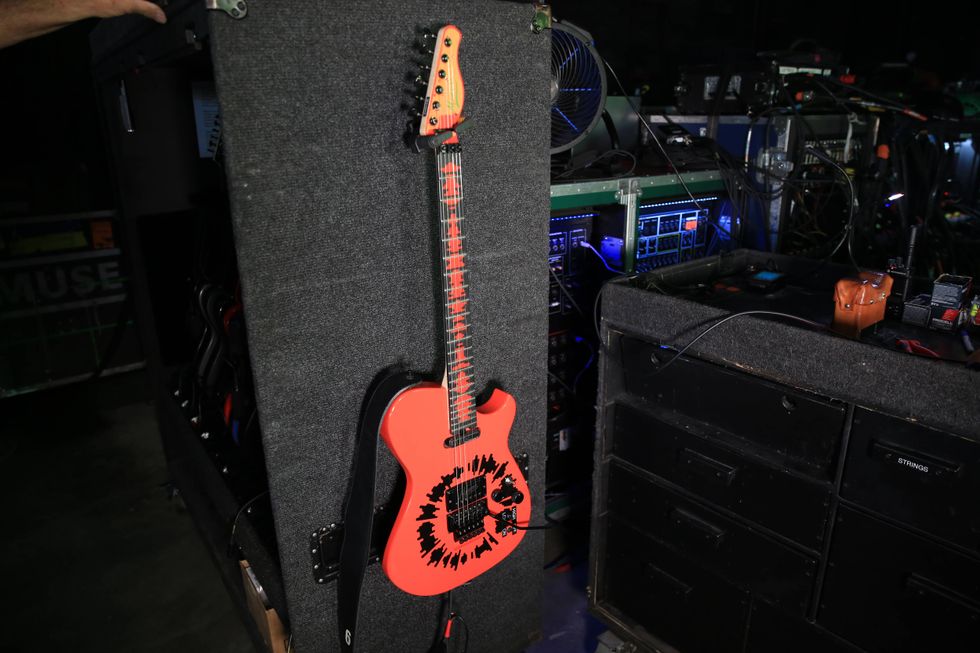
Bellamy’s main Manson MB gets played at least half the show—ash body, maple neck, rosewood board, with a Manson humbucker at roughly PAF output and a Sustainiac. Strings are Ernie Ball .009–.048 in standard tuning, and Whitemyer labels the controls so Bellamy doesn’t have to think about anything but singing. The bridge is a Floyd Rose Low Pro, long out of production: this one came off a 2008 guitar, and when Floyd Rose wound the model down the crew bought up the last of the parts.
Plug In Baby
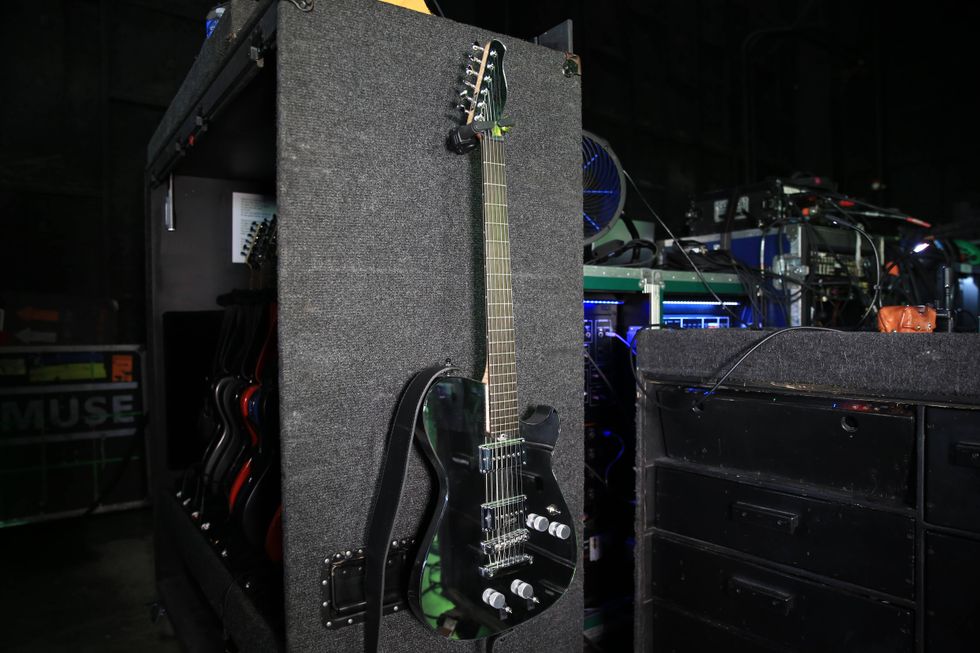
Bellamy’s custom Manson mirror guitar has an MXR Phase 90 and a ZVex Fuzz Factory built in, with no external controls—the Phase 90 lives at about 11 o’clock, set from the back. The Fuzz Factory’s gate and volume are onboard, so Bellamy can pitch it like a whammy. It runs single-coils, which suit the fuzz better, and two 9-volts, one per circuit.
The Kaoss Truth
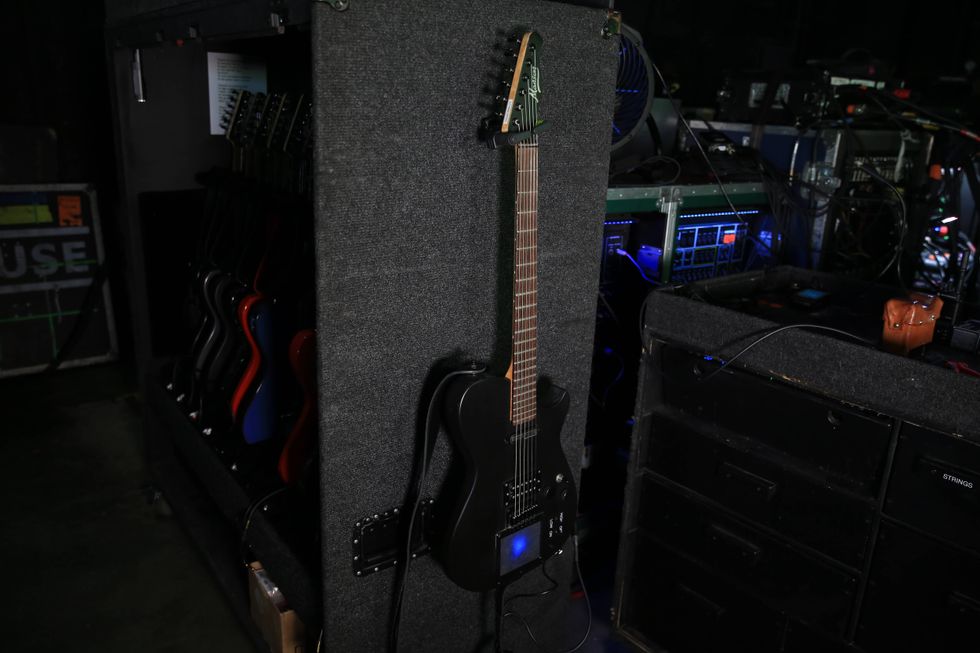
Everyone assumes there’s a Kaoss Pad in this Manson. There isn’t—it’s the controller only, sending MIDI to a Kaoss Pad in the rack for pitch-shifted synth textures blended with the guitar. Whitemyer buys every model that turns up on eBay. It also carries a Sustainiac, a humbucker, volume, tone, and a hardtail bridge.
Lower Than Vai
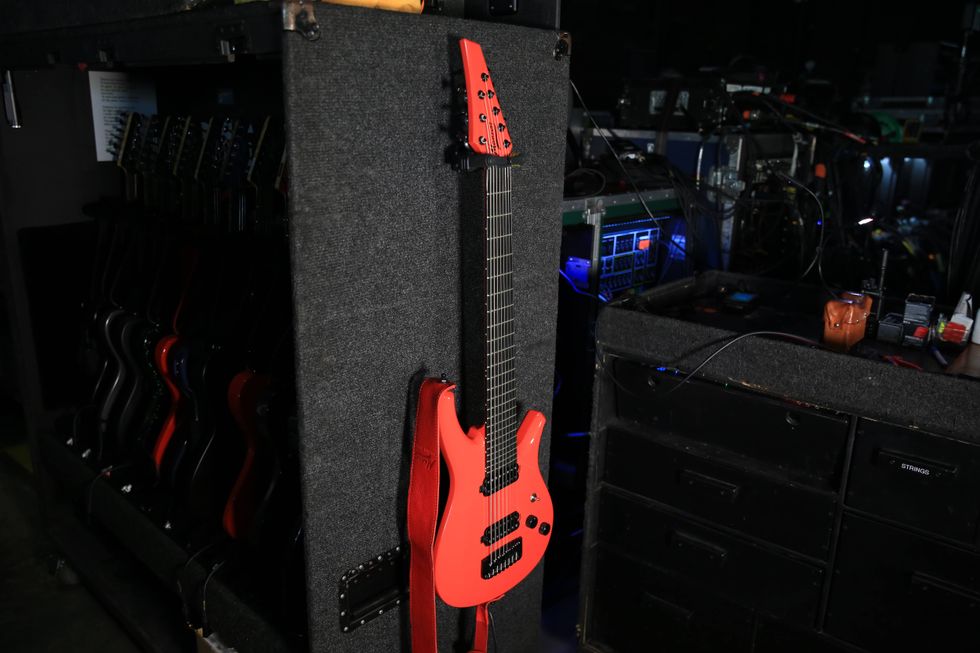
New for this tour: an 8-string Manson tuned E, B, then standard E–A–D–G–B–E. Basically, a guitar with two bass strings underneath it. No Sustainiac, no bender, nothing fancy; it comes out for two songs: “Unravelling,” and a new one.
Amps in a Box
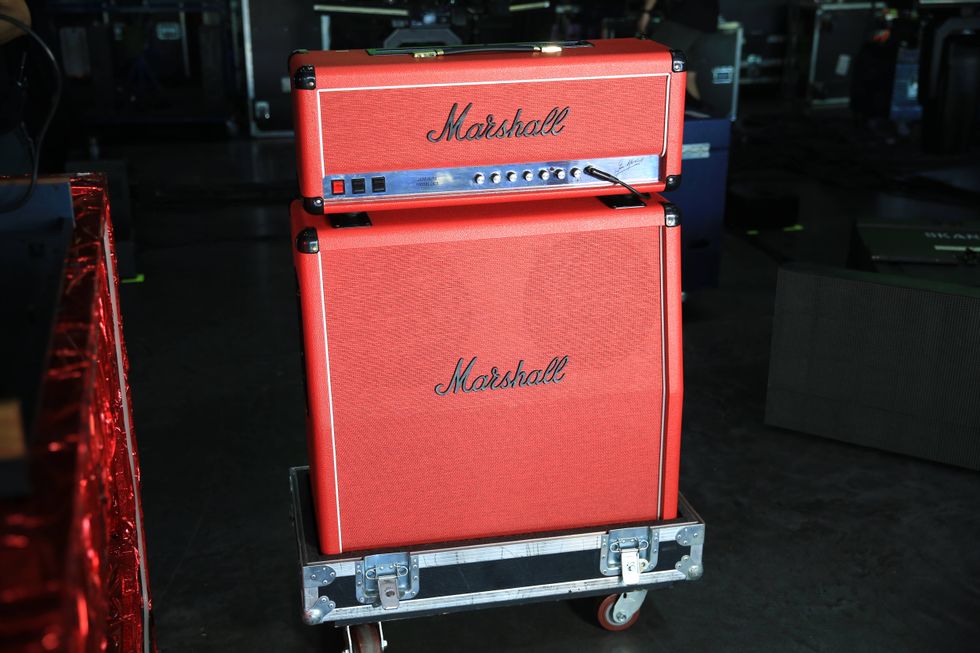
There’s a Marshall JCM 25/50 Model 2225 onstage, but it’s there so Bellamy has something constant behind him while he sings. Everything else runs Fractal Axe-Fx III, fed from Shure wireless through a custom selector and an “effect gizmo.” Bellamy wanted his own amps and nobody else’s, so Whitemyer spent 63 days capturing roughly 35 of them, including Vox, Diezel, Laney, Orange, vintage Fenders, and an old 1938 Gibson. They’re almost always run in combination.
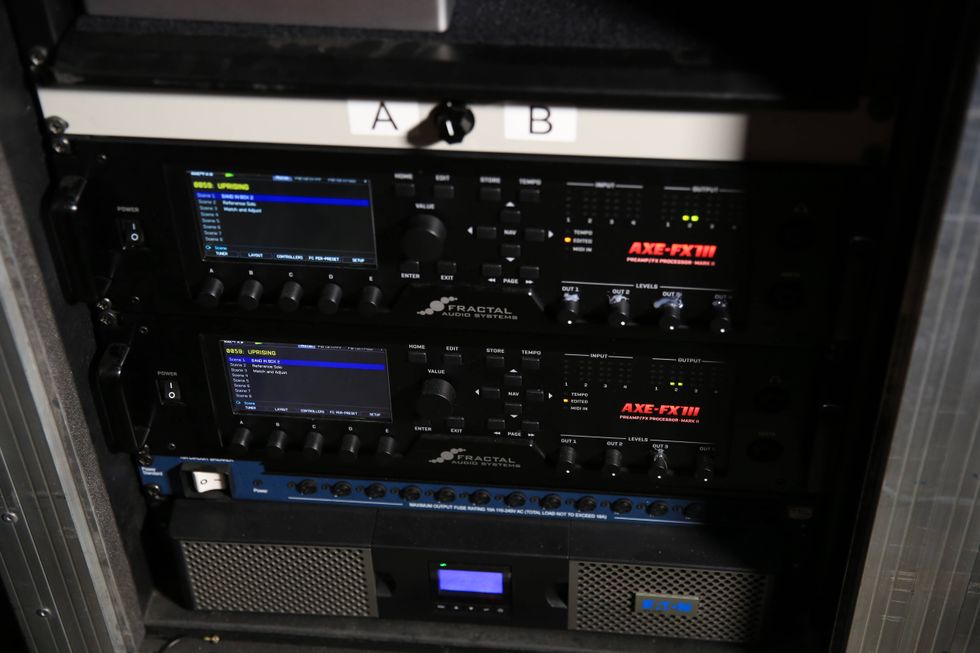
Outboard Holdouts
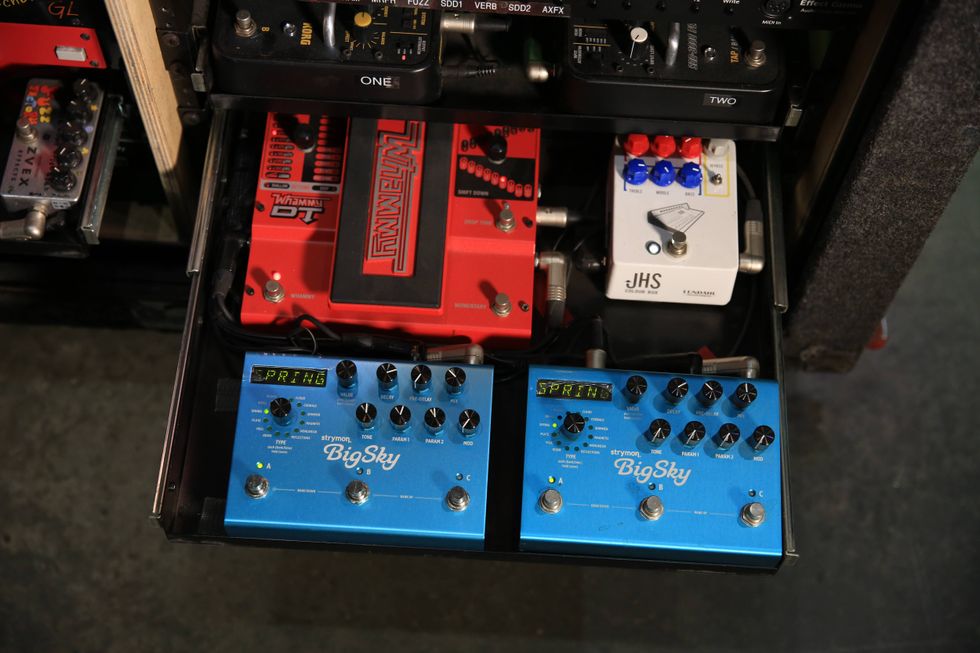
Only a few things live outside the Fractal: two Korg SSD-3000 delays in one drawer, another with two Strymon BigSkys, a DigiTech Whammy DT and a JHS Colour Box, and a third with a Boss OC-2, a DigiTech Whammy, a ZVex Fuzz Factory, a Keeley Fuzz Head, and a Korg Kaoss Pad. There’s also a Nord Modular G2 Engine, which handles the synth on “Map of the Problematique.” An RJM Mastermind GT sits above it all.
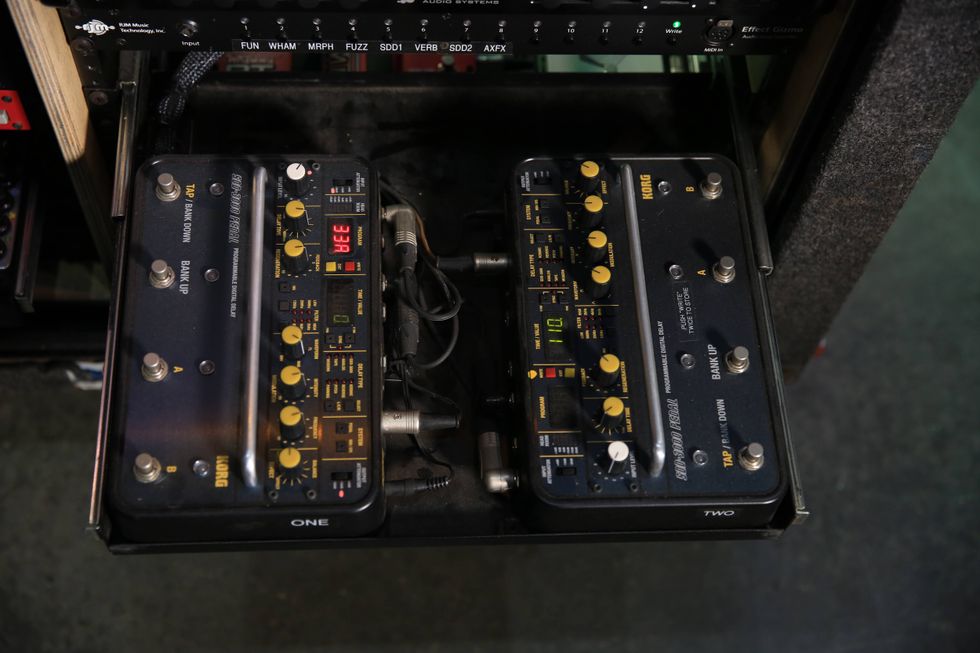
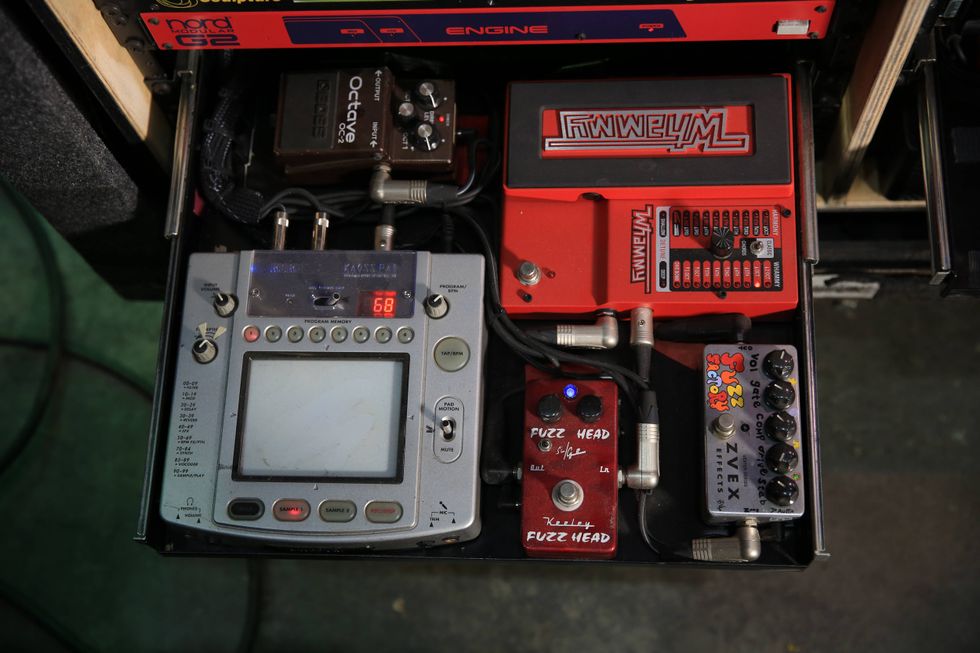
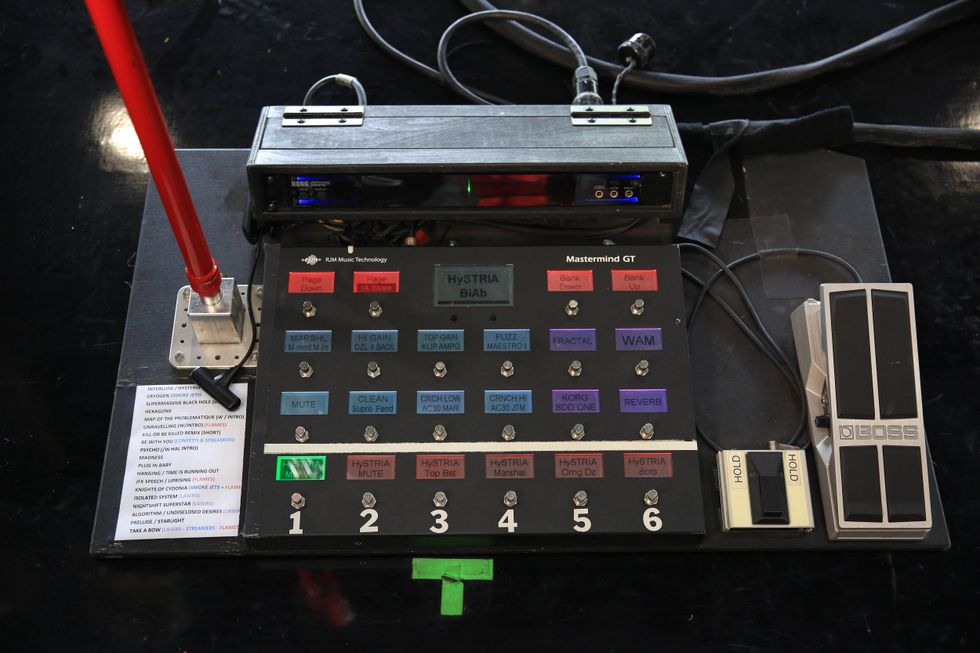
None More Red
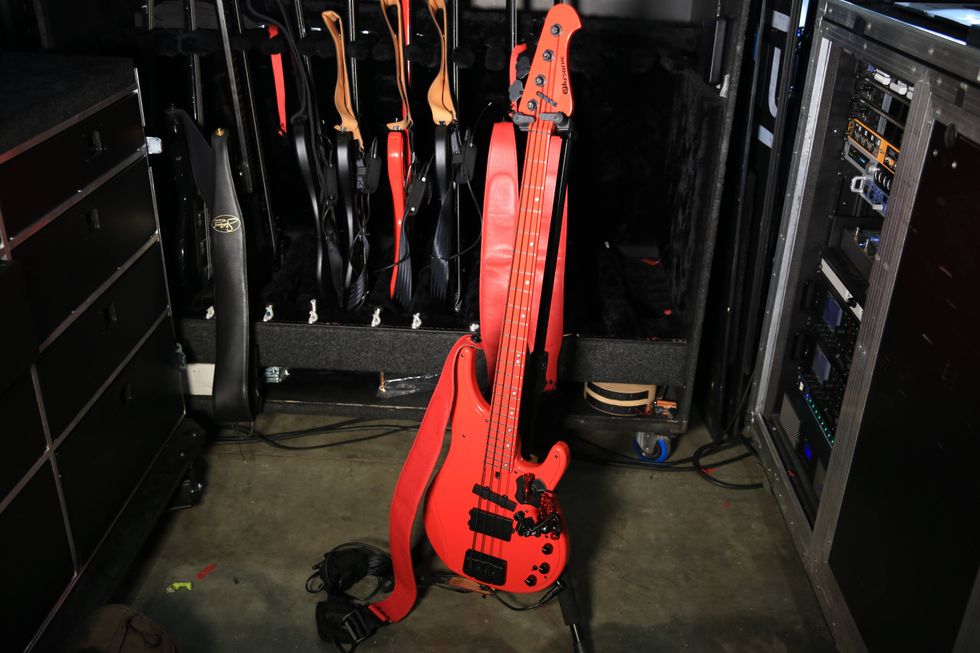
Wolstenholme’s new Alusonic basses replace the Statuses he’d played for over a decade. The signature CW model boasts a roasted maple neck, sassafras body, and carbon fiber top and fretboard, with Hipshot hardware and everything else made in-house in Italy. The pickups are Alusonic’s own—a Stingray-style humbucker and a single-coil across five switch positions, four of which get used in a show, all level-matched well enough to swap mid-song.
Madness, Mark III
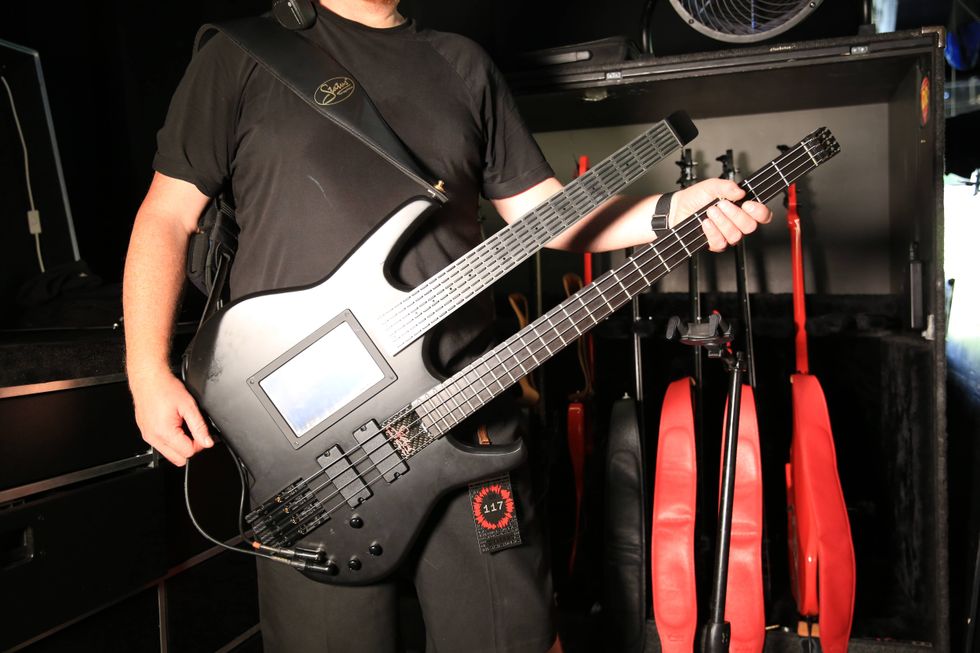
The “Madness” Status bass is on its third build. It started as a Misa Kitara grafted into a Status by Rob Green, moved to a Starr Labs iPad-based version, and now runs a Mosi Nova neck built into a Manson-engineered instrument with an XY pad, a MIDI merger, and a PC computer the size of a card deck inside it. Ashworth powers it up three songs early to let Windows boot.
Wolstenholme’s Rig
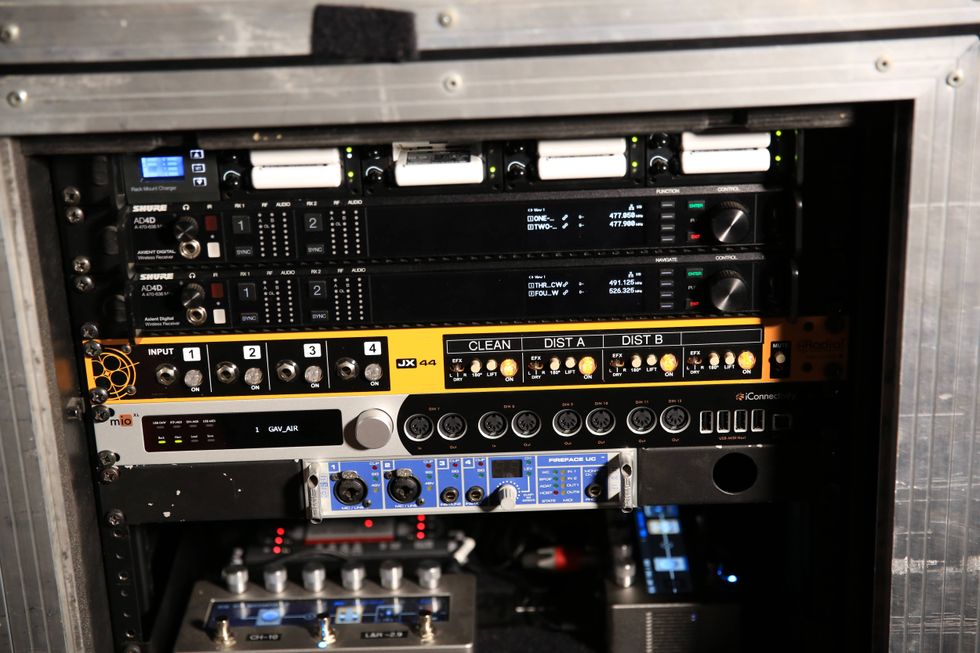
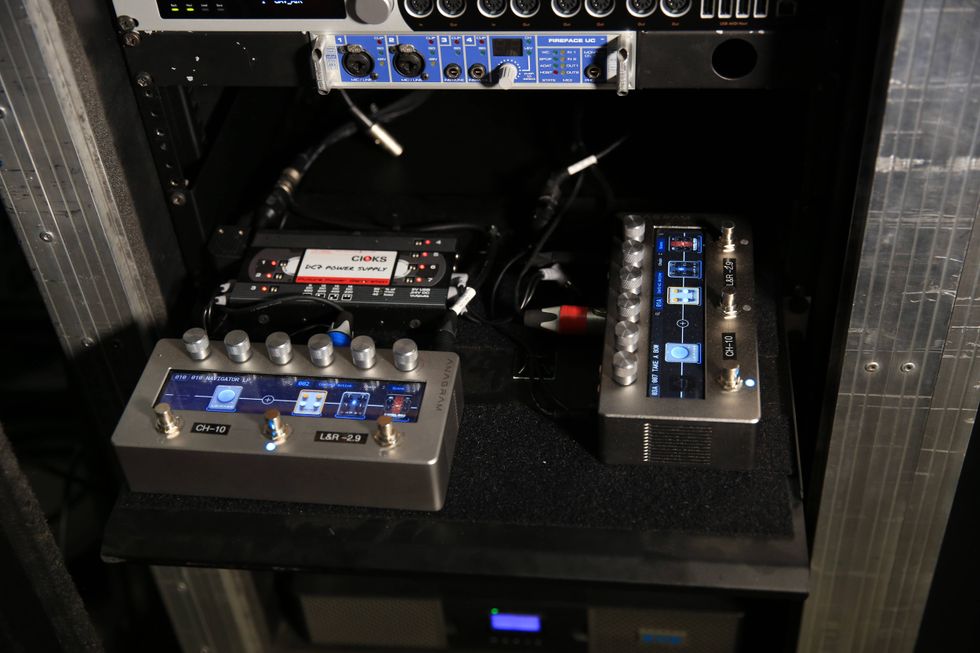
Wolstenholme’s bass goes out on Shure AD4D Axient Digital wireless system—four channels across two dual units—into a Radial JX44, which routes to a pair of Fractal Axe-Fx IIIs, one live and one as backup. The JX44 also feeds a stage tuner, so Ashworth can tune without unplugging anything. The whole rig comes down to four channels: a clean DI that goes straight to front of house untouched, a clean amp sound, and two different distortions. The Fractal only runs two amp models at once, so the distortions moved out to a pair of Darkglass Anagram pedals. Ashworth switches between sounds by turning outputs on and off rather than changing presets.
Two Keys, One Harp
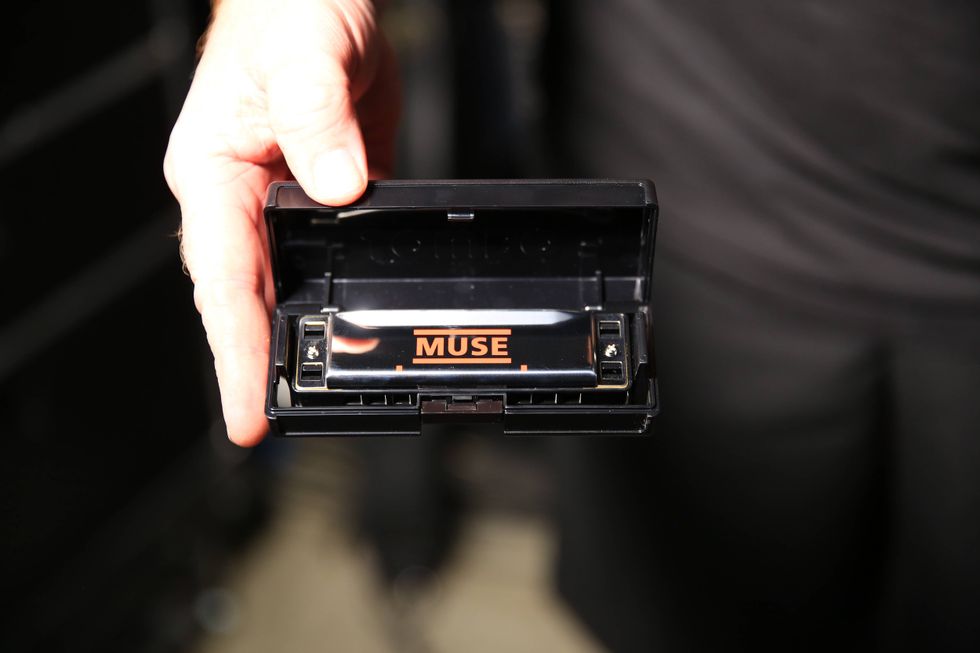
The “Knights of Cydonia” intro is played on custom Lee Oskar harmonicas built with two keys in one, so Wolstenholme doesn’t have to switch mid-part. They’re made in limited-edition colors each season, and he throws them into the crowd when he’s done.
Question of the Month: How Important Is an Effect Pedal’s Looks?
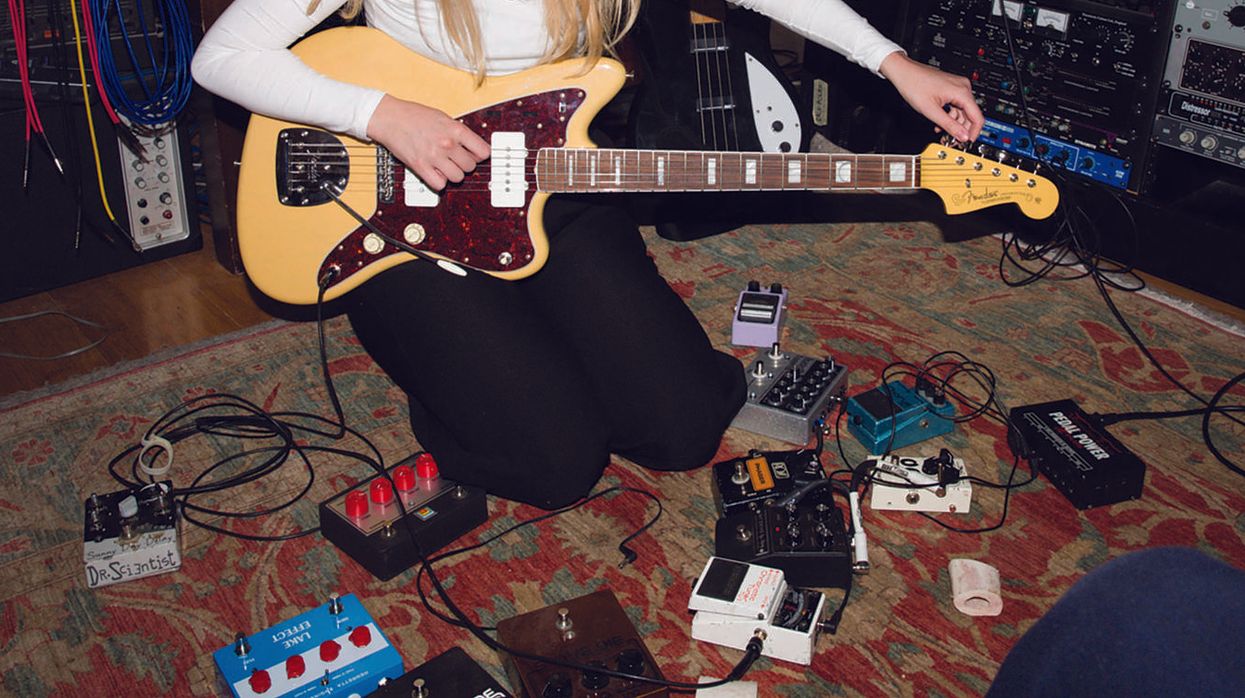
Question: How important is an effect pedal’s looks?
Linnea Siggelkow (Ellis, Ethel Cain)
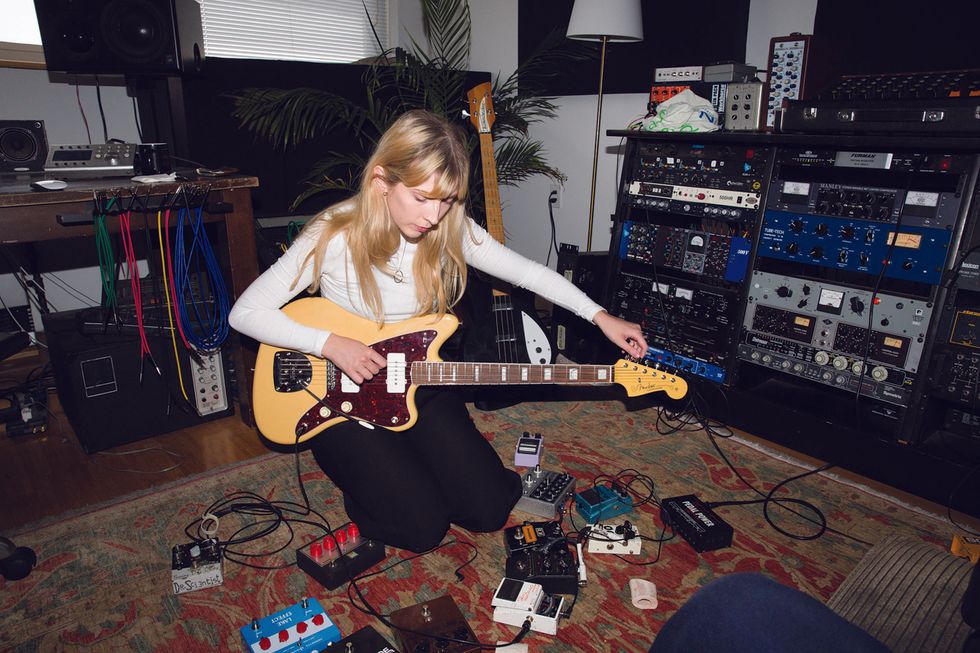
A: Ultimately, not important. I was just debating between two different overdrive pedals and ended up going with the less-cool-looking one, because it functioned the way I needed it to. But the truth is that if it had been really ugly, I probably wouldn't have bought it, so actually, ultimately kind of important.
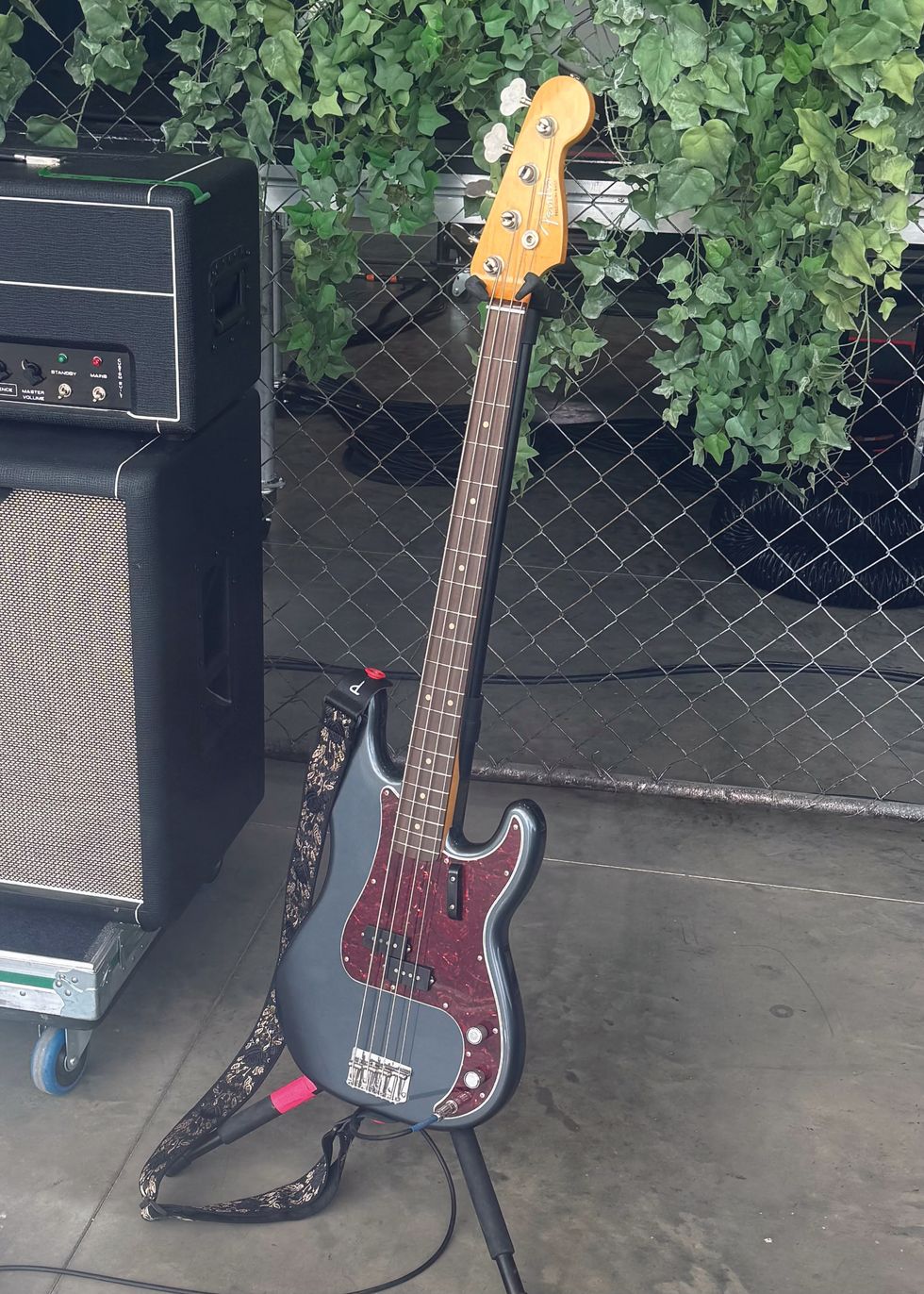
Obsession: Though I’ve been playing guitar for most of my life, more recently I’ve mainly been playing bass. I’m currently obsessed with this Fender Vintera II ’60s P Bass that I’ve been lucky to get to play on tour this year!
Luke Viertel, Director of Digital Publishing
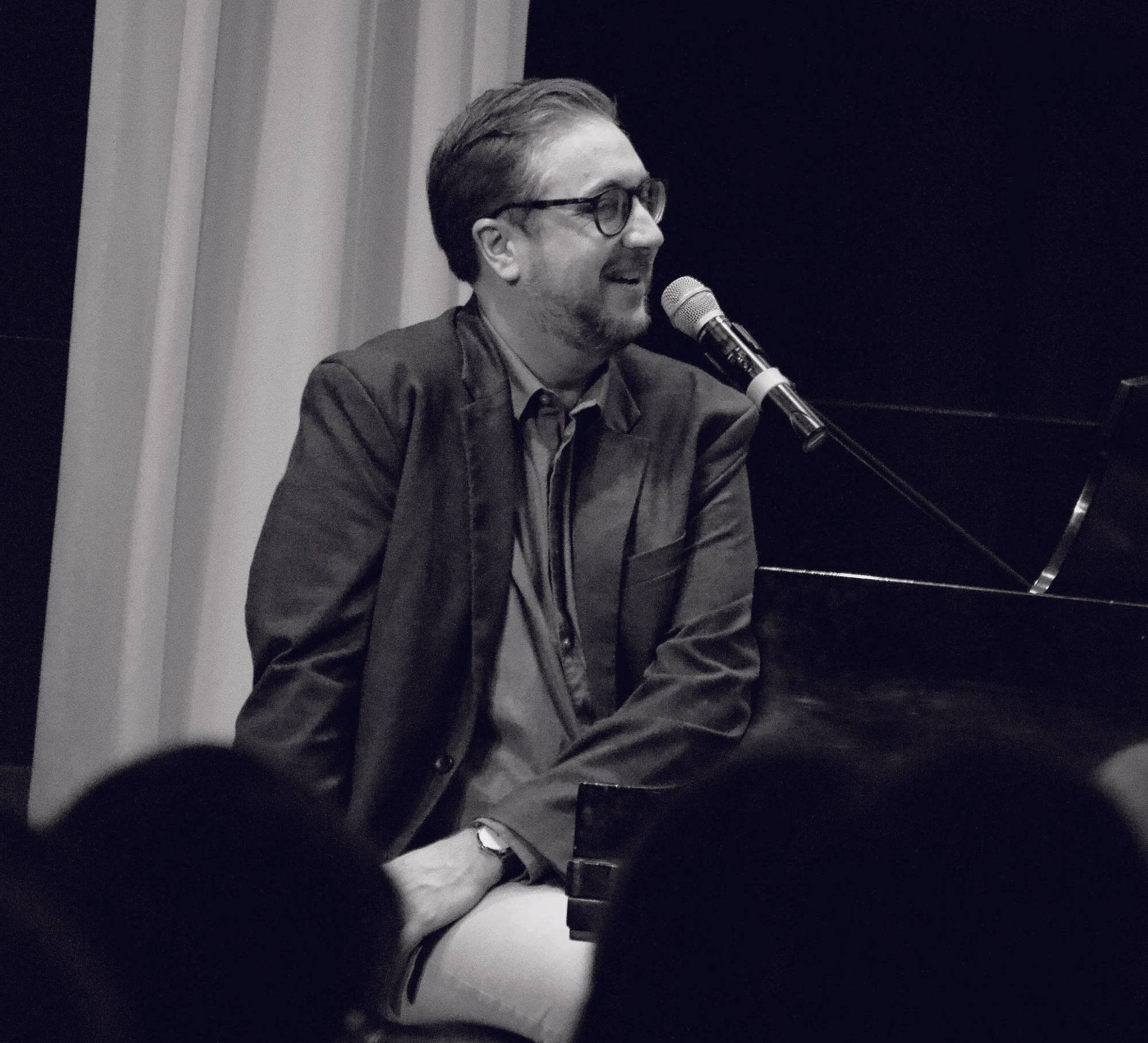
A: As the guitar-effect form factors and functions become more ubiquitous each year, I find that how an effect pedal looks and feels on your board is more important than ever. A proper and beautiful design indicates attention to detail and usually bodes well for the eventual quality of the product. Plus, music is art, and that should rightfully extend to the tools used to create it!
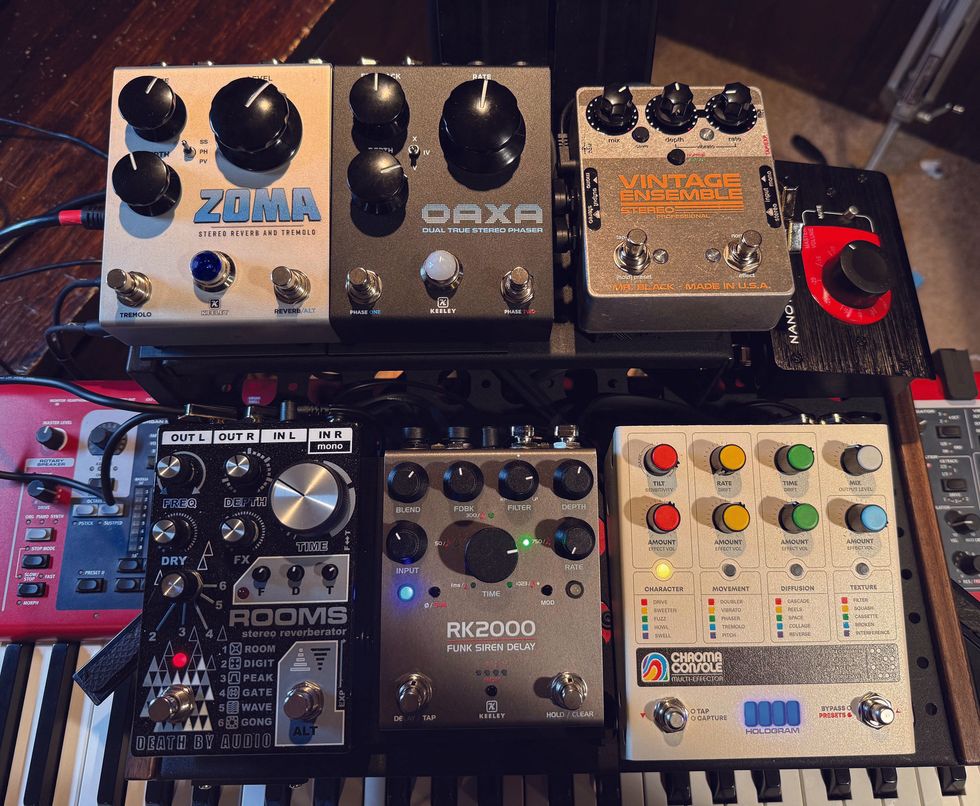
Obsession: After playing keyboards steadily in jam and improvisational bands for 15-plus years, a recent relocation has my gear in storage and cases while we get settled. So, I’m finally doing the Phish deep-dive I’ve been planning for ages. Call me weird, but at least go listen to ’97 at The Spectrum first.
Charles Saufley, Gear Editor
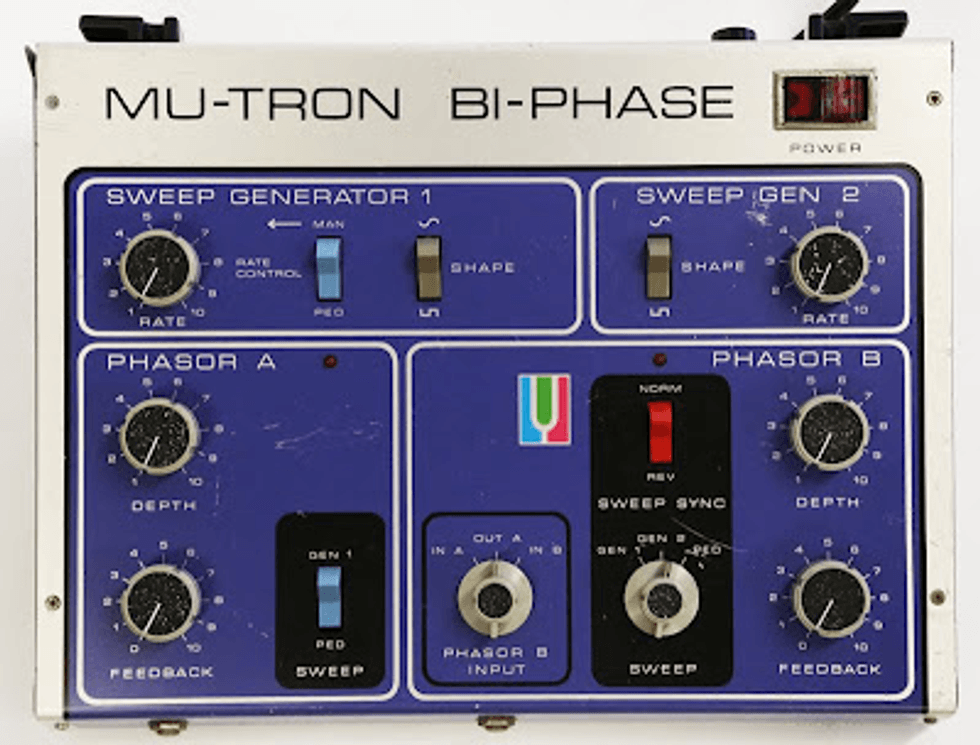
A: Style in design is vital. And to the extent that it can inspire joy, which can inspire creativity—yeah, a stylish pedal is very important. That doesn’t mean I don’t love functionality. Functionality brings happiness, too—especially when your stuff doesn’t break on tour. But when I’m in a studio and I get to plug in something that looks cool and sounds amazing, there’s an extra thrill. Over the years, Mu-Tron, Colorsound, EHX, and Death By Audio have all produced visionary devices that broke the rules in sonic terms, and are beautiful to behold.
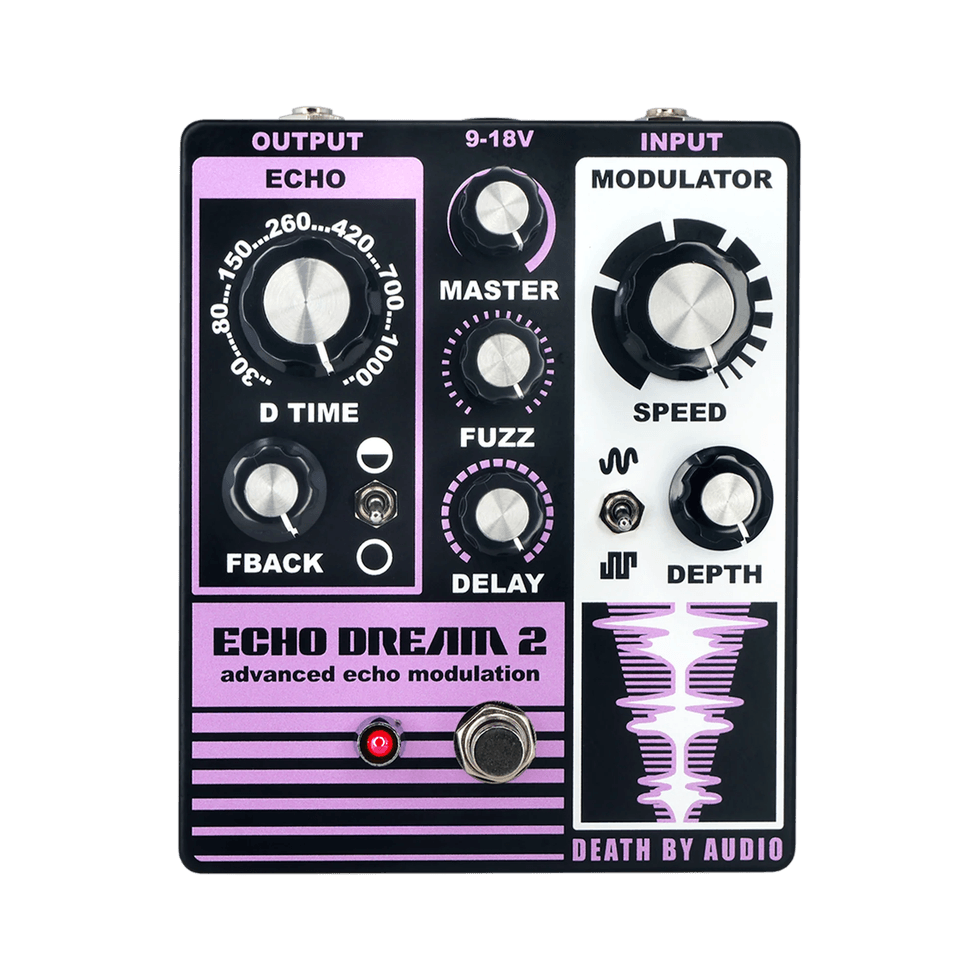
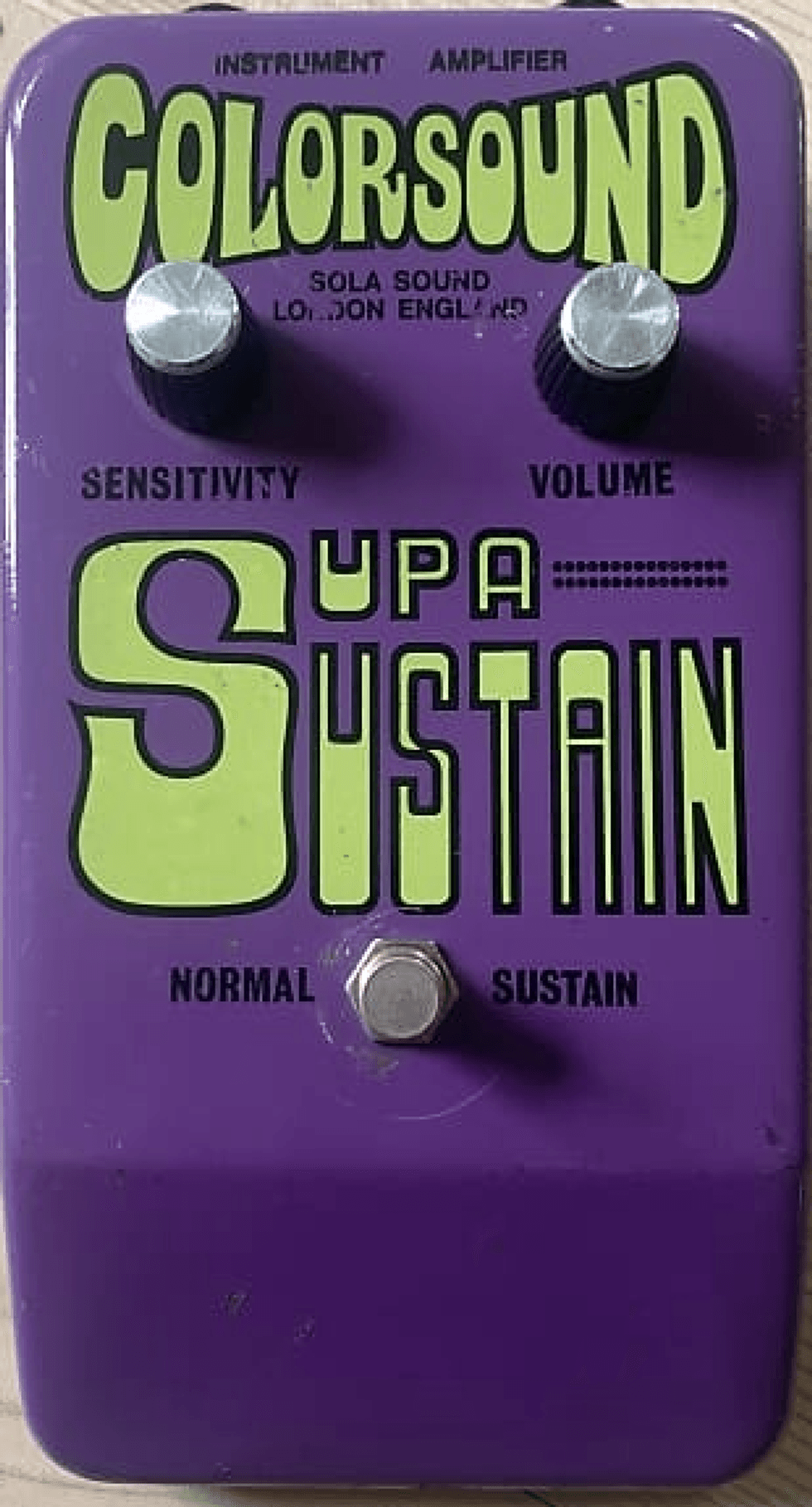
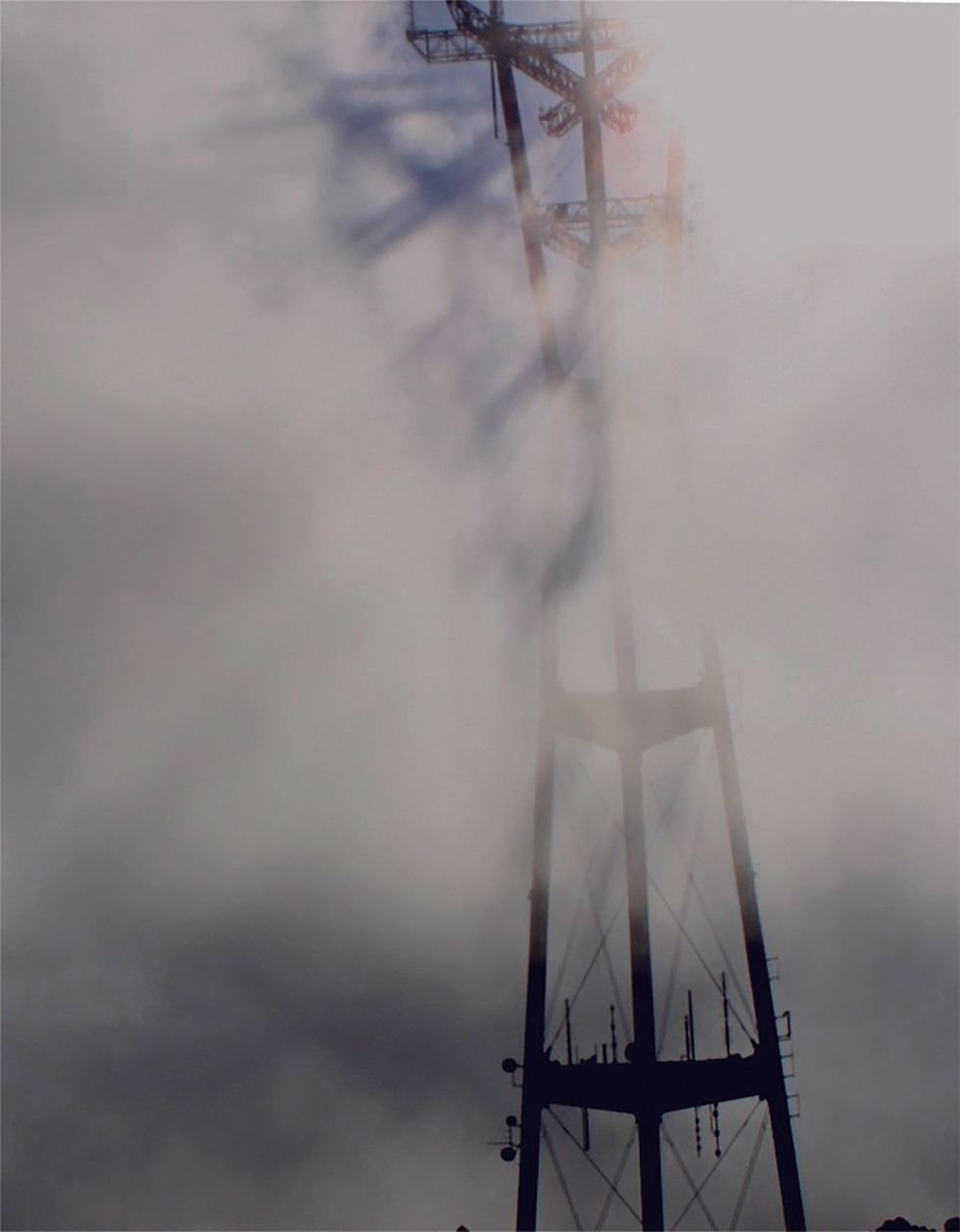
Obsession: Eeriness. It’s fog season where I live, and I’ve had a lot of run-ins with the uncanny of late. I keep waiting for special agents Mulder and Scully to appear out of the corner of my eye. It’s weird, but good for writing music!
Pages
