
Music is the universal language
“Glory to God in the highest heaven, and on earth peace to those on whom his favor rests.” - Luke 2:14
General Interest
Moth Electric P. Isabella Fuzz (Ram’s Head) review – is this the ultimate Muff-type fuzz pedal?

$189.99/£189, mothelectric.com / northernstomps.com
Have you ever met a sheep? They’re strange little fellas, but one thing they absolutely do not look like is the face on the front of a mid-70s Electro-Harmonix Big Muff Pi. Apparently that logo was never actually supposed to be a ram’s head, but the nickname stuck so here we are – and here is the latest American boutique fuzz box to take inspiration from its thick, creamy, endlessly sustaining tones.
Up-and-coming pedal brands don’t get much upper or cominger than Moth Electric, based in the Pacific Northwest. There are six pedals in its current range, and two of them carry the P. Isabella name – the other is based on the wonderfully evil green Big Muff made in Russia in the 90s. All are newly available in the UK via Northern Stompboxes.
 Image: Richard Purvis
What is it?
It’s all very well being able to design and build exquisite hand-soldered guitar pedals, but how do you expect to get by in life if you can’t manage basic arithmetic? Everyone knows a Muff-type fuzz has three knobs – this one’s got five! There’s even an added toggle switch for flipping between ‘classic’ and ‘modern’ modes, taking this pedal far beyond the realm of straight-up clones.
And what are those extra knobs? Joining the standard trio of volume, tone and fuzz are a mids control – a familiar mod for avoiding the Big Muff curse of vanishing in a band mix – and, less predictably, one for clean blend. All of this is presented in a large and quite beauteous enclosure with top-mounted jack sockets… and a picture of a moth that does actually look like a moth.
 Image: Richard Purvis
Sounds
For some of us – including David Gilmour, who famously used one for the solos on Comfortably Numb – the sound of the 1973 Big Muff v2 circuit is about as good as distorted guitar tones get. Certainly you’ll never separate me from my Stomp Under Foot Ram’s Head… but there’s no denying that Moth’s effort comes pretty close to matching it. The sound is huge, naturally, but what’s just as important is the impeccable balance of roaring rage and tonal discipline. There’s no flab in the bottom end and no scratchiness in the top – just pure all-round fuzzy goodness.
And of course, the P. Isabella also has those extra controls to take it to places no ordinary Muff can reach. The mids knob has a wide and well-judged sweep, from exaggerated scoopage to something much more forthright than the norm yet no less smooth; and while mixing in some clean signal with a sound this saturated is never going to be a good idea, the blend knob can be surprisingly useful when you have another dirt pedal on the go. Sometimes, it turns out, the only thing better than combining a Rat with a Muff is combining a Rat with two-thirds of a Muff.
The output level takes a big jump when you switch to modern mode, and most of that seems to be happening in the midrange: it’s a more solid kind of voice that reminds me a little of the EHX Big Muff 2, and it’s also less compressed than classic mode. Maybe that makes it a smidge less likeable, but it’s definitely a worthwhile addition to this unit’s armoury.
 Image: Richard Purvis
Should I buy one?
This really boils down to a simple choice between simplicity and flexibility. For Big Muff purists, the P. Isabella’s added controls will be nothing more than a distraction – and there are already plenty of options for getting those core tones from a compact enclosure with three knobs.
If, on the other hand, you wish you could enjoy the best of this celebrated circuit in a more tweakable package, a red and white Moth should probably be winging its way onto your pedalboard at the earliest opportunity.
 Image: Richard Purvis
Alternatives
If you’re happy to stick to the three-knob formula, your high-class contenders include the Stomp Under Foot Ram’s Head ($199.99/£189) and Wren And Cuff Caprid Small Foot ($199/£177). For a Muff that’s actually allowed to call itself a Muff, check out the Electro-Harmonix Ram’s Head Big Muff Pi ($114/£99), also available in J Mascis signature livery for a few dollars more.
The post Moth Electric P. Isabella Fuzz (Ram’s Head) review – is this the ultimate Muff-type fuzz pedal? appeared first on Guitar.com | All Things Guitar.
Hagstrom Megin Review
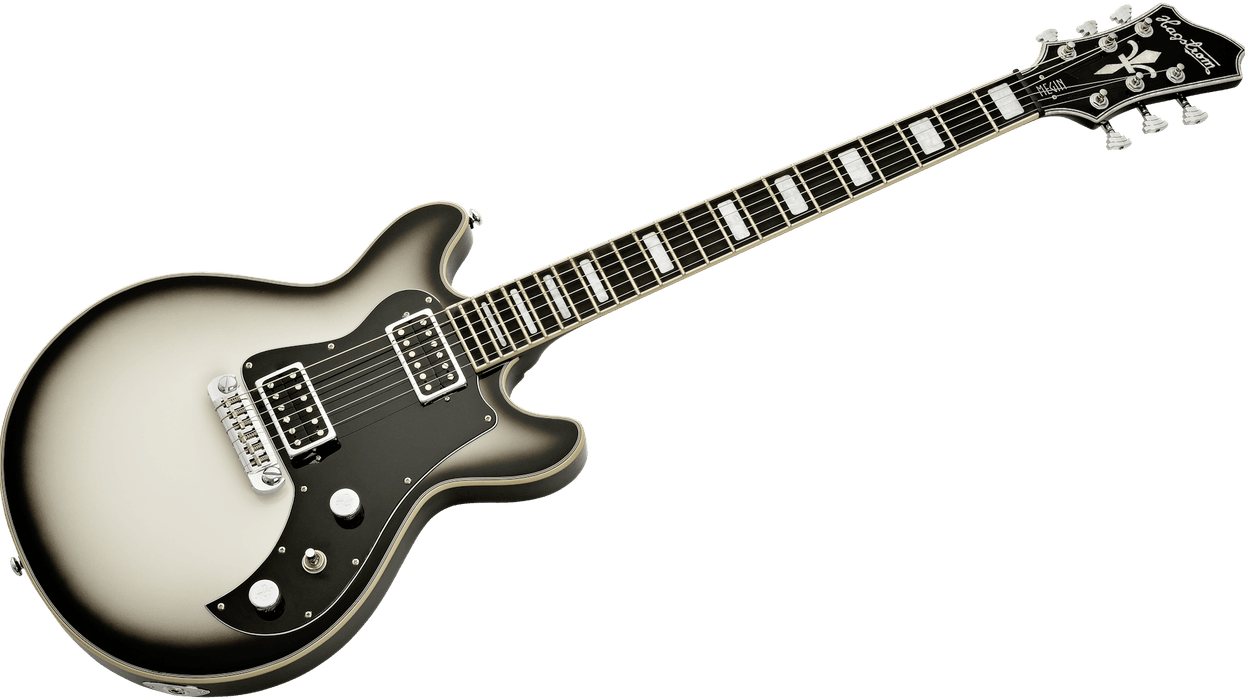
Though they never made major inroads into the North American guitar market, Swedish maker Hagstrom’s guitars have always had cool cred to spare. Hagstroms in the hands of ABBA’s Bjorn Ulvaeus and Rutger Gunnarsson might not surprise anyone. But they were also used by a range of icons spanning from Jimi Hendrix, David Bowie, Frank Zappa, and Elvis Presley, to Nels Cline, Mark Arm of Mudhoney, and Pat Smear of the Germs, Nirvana, and Foo Fighters. Hagstroms are often unique in sound and feel. The thin necks on many 1960s models, for example, make them favorites among players who like to riff at speed.
The new China-made Megin isn’t quite as quirky as, say, a 1960s Hagstrom III. It’s closer to a traditional rock machine and priced for what you could call the quality-entry-level range of the market, selling for a sum just south of a grand, including the tweed-style hardshell case.
Arctic Charm
At a glance, the Megin evokes thoughts of Gibson’s Les Paul DC, as well as Hagstrom’s own very Les Paul-like Swede, though there are plenty of departures from those formulas that give the Megin a unique identity and personality. What’s familiar here? Well, there’s a set neck, two humbuckers, and a mahogany body and neck. Unlike a Les Paul, though, there’s no maple cap. And the extra space and stretch you feel is the Megin’s 25.5" scale length, which translates to tighter bass tones on the wound strings and a little more shimmer on the higher strings.
The neck is carved to a slim-C profile that tapers only slightly as you climb it, and although the bound fingerboard looks like a slice of ebony, it’s actually a composite material Hagstrom calls “resonator wood.” Hagstrom’s unique H-Expander truss rod encloses the adjustable round rod within an H-shaped sleeve of lightweight alloy that increases stability—and, Hagstrom claims, the guitar’s resonance. The 22 medium-jumbo frets are smoothly dressed, and the guitar plays easily from nut to joint.
“The Megin cuts straight to the beefy humbucker rock tones that its looks suggest.”
The Megin has a lot going on in the style department, and deluxe details abound, including 5-ply body binding and rounded block inlays. The headstock is classically Hagstrom—ornate and bristling with Art Deco touches, including the Empire-style tuners. Our test guitar came in a grey burst finish that’s happily reminiscent of Gibson’s circa 1979 silverburst, which is one of four options including black gloss, crème, and sky blue. Taken as a whole, it’s fancy without being over the top.
Northern Lights
Hagstrom loads the Megin with a pair of the company’s own Custom 62 humbuckers, including a medium-output unit at the neck measuring 8.2k-ohms resistance and a high-output bridge pickup rated at 13.8k ohms. They’re routed through a simple 2-knob volume and tone setup, which includes a treble-bleed network on the volume control. A 3-way selector switch is positioned between the knobs.
Played through a 1964 Fender Bassman head and 2x12" cab, a recent Vox AC15, and a Fractal FM9 modeler, the Megin projects beefy humbucker rock tones, just as its looks—and those pickups’ resistance ratings—suggest. Guitars like this one have a way of sparking big leads and riffs, and the Megin excels in these rowdy musical settings. There’s lots of sizzle, tons of girth, and sustain enough for any situation I can imagine. Generally speaking, this might sound like a very same-old-humbucker-meets-mahogany-solidbody formula, but the Megin’s 25.5" scale adds articulation that cuts more effectively though distortion and lends the guitar a distinct personality.
Rock modes may be this guitar’s primary mission. Even so, I wonder about the need for such a high-output bridge humbucker. It ramps up dirt and saturation—often in a welcome way— but also makes it tougher to dial in pristine clean tones. A lot of the appeal in less potent humbuckers is that they make it easier to remove distortion and retain a big, clear signal. On the Megin, reducing the guitar’s volume control doesn’t always add up to crystal clear notes.
The Verdict
At $949, you start to expect a lot from a guitar in terms of quality. On that front, the Megin delivers. It’s extremely well put together and exhibits impressive care from just about every design and assembly perspective. That translates to easy playability and a lively resonance.
Guitarists familiar with Gibson-like 24.75" standard scale length might have to adjust to the slightly stiffer feel that comes with the longer scale, but the tone payoff from the extra chime and tight low end can be worth the sacrifice, depending on your style and preferences. The other factor to consider is the pickups. The high output may not be for players who work outside hot-rocking realms, and it can offset the charms of that extra chime and tight bass. But if that’s your lane, the Megin can be magical.
Happy Labor Day – we’ve done the work for you and found the 10 best guitar deals

Another year, another Labor Day. While the holiday honours the efforts of workers across US and Canada, it also holds a very special place in guitarists hearts… because it means oodles of deals on brand new gear. Hey, you know what they say – if you’re working hard, you deserve to play hard.
While the workers of the world kick back and take a load off, we’ve found some of the best deals on across Sweetwater, Guitar Center and zZounds. So, if you’re on the hunt for a new electric, acoustic-electrics, or maybe even a fresh amps, stay tuned…
Fender American Professional II Stratocaster (was $1,839.99, now $1,475.99)
If you’re after a tried-and-true American classic, look no further than the Fender American Professional II Stratocaster. We awarded this axe a 9/10 back in 2020, and it’s still a thing of beauty, with its trio of V-Mod II single-coil pickups, two-point tremolo bridge, contoured heel joint, and upgraded electronics from the American Professional’s first iteration. You can now get this guitar’s vintage sound and modern design for $200 off – and it’s available in a wide selection of colours, from striking Miami Blue to a warm Three Colour Sunburst.
More premium Roasted Pine and Sienna Sunburst models are also $200 off their usual price point of $1,939.99. That means they’re $1,739.99, so they sit a little higher than the rest of the colour options.
Fender American Professional II Telecaster (was $1,939.99, now $1,739.99)
That leads us onto the American Professional II Strat’s sibling – the American Professional Telecaster. Sweetwater have also cut $200 off of the Tele model, meaning you can enjoy this great axe for a fraction of the price. Available in a slew of colours, from Butterscotch Blonde to Roasted Pine, this guitar’s V-Mod Tele single-coil pickups and deep ‘C’ profile neck with a contoured heel joint are prime and ready for a guitarist to pick up and play.
Fender Player II Telecaster Electric Guitar (was $849.99, now $679.99)
Over at Guitar Center, Fender’s Player II Telecaster has taken a $170 price cut. This Guitar Center exclusive model pairs the six-string electric with a classy British Racing Green alder body, rosewood fingerboard, SS configuration and Alnico V Tele single-coil pickups. This is a great, affordable Fender axe, earning a 9/10 from us for being a total workhouse. If you’re after great Tele tones at an even greater price point, this could be the one for you.
Sterling By Music Man Kaizen 6-string Electric Guitar (was $949.99, now $759.99)
Yet another 9/10 guitar has been given a Labor Day discount. This one is Sterling By Music Man’s awesome, futuristic Stealth Black Kaizen 6-string electric. Crafted by prog metal mastermind Tosin Abasi of Animals As Leaders, this guitar is ergonomic and primed to tackle even the wildest of solos. With its contoured body allowing full access to all 24 frets, modern two-point tremolo and straight 25.5-inch-scale fingerboard, we stand by our assertion that this guitar is a “shredder’s dream”.
Strandberg Boden Standard N2.6 Electric Guitar (was $1,799.00, now $1,439.00)
Sweetwater has sliced $360 off of Strandberg’s Boden Standard N2.6 Electric Guitar. This headless six-string is definitely on the quirkier end of things, but this axe might be the one to convert you. We found it to be an addictively playable axe, and a grand improvement of the Boden Standard series. Comprised of premium tonewoods, EGS Arc hardware, an EndurNeck profile, dual Seymour Duncan humbuckers, a pair of Sentient and Pegasus pickups, this is a great option for prog heads out there. It’s available in cool Black Satin and Transformative Teal metallic finishes.
The axe also has a sale across all three of its stringed options – meaning you can get this as a six-string, seven-string ($1,519.00), or an eight-string ($1,599.00).
Yamaha FS-TA TransAcoustic Concert Acoustic-Electric Guitar (was $579.99, now $479.99)
If you’re after an acoustic-electric, Sweetwater has trimmed $200 off of the price of the Yamaha FS-TA TransAcoustic Concert Acoustic-Electric. Available in both Vintage Tint and Ruby Red, Yamaha’s FS-TA TransAcoustic comes loaded with reverb and chorus effects to add some flare and richness to your live performance in a jiffy. This version comes with a cutaway, but if you’re wanting it without the cutaway, no problem. It’ll just cost you a little extra – $100 more, to be exact.
Martin Special D-X2E Acoustic-Electric Guitar (was $759.99, now $649.99)
Guitar Center has some lovely deals on acoustic-electrics too; namely the Martin Special D-X2E Acoustic-Electric, which is currently $110 cheaper. With its Martin E-1 pickup, preamp system, and onboard tuner, it’s a great way to finesse your acoustic tone for a live performance. Its slim, oval-shaped mahogany neck and 12” radius fingerboard is also designed to be easy and comfortable, meaning you’ll be able to knock out high quality Martin tones on this solid spruce top all day long.
PRS S2 McCarty 594 Singlecut Electric Guitar (was $2,399.00, now $2,099.00)
zZounds has a great deal on the Paul Reed Smith S2 McCarty 594 Singlecut Electric, with its Lake Blue model dropping by $300. This American-made asymmetrical PRS axe is designed to deliver a vintage feel with oodles of modern features, from its coil-splittable 58/15 pickups, dual volume and push/pull tone controls. It’s bound 22-fret Pattern Vintage neck, zinc two-piece bridge and thicker back also allows for more sustain, allowing you to really feel out those vintage tones. It also comes with a gig bag, which is pretty handy!
Gibson Hummingbird Special Acoustic-Electric Guitar (was $1,869.00, now $1,859.00)
If you’re willing to invest in a Gibson that’s been pre-opened, zZounds has got a Hummingbird Special Acoustic-Electric available for $1,859.00 – a sharp drop from its cost brand new, which is $2,199.00. It’s a great price point, allowing you to enjoy the guitars solid mahogany body, round profile neck and rosewood fingerboard, L.R. Baggs electronics and lush tone for less. It also comes with a premium soft shell case, to keep it save on the go.
Peavey 6505 II Guitar Amplifier Head (was $1,999.99, now $1,699.99)
Boasting 120 Watts, Peavey’s 6505 II Guitar Amplifier Head is a reliable bit of kit. With its high-gain and two distinct, footswitchable tube channels, it’s a cracking Peavey amp to add to your rig – and zZounds has cut $300 off of its usual pricetag. It’s a great way to really control your sound, thanks to the channels having separate EQ, Resonance, and Presence controls. It also has the Crunch feature, allowing for a bit of extra gain in your Rhythm Channel, as well as a Clean Channel for when you want to sound – well – clean.
The post Happy Labor Day – we’ve done the work for you and found the 10 best guitar deals appeared first on Guitar.com | All Things Guitar.
ESP Unveils New Guitar Models and Overhaul of LTD Black Metal Series
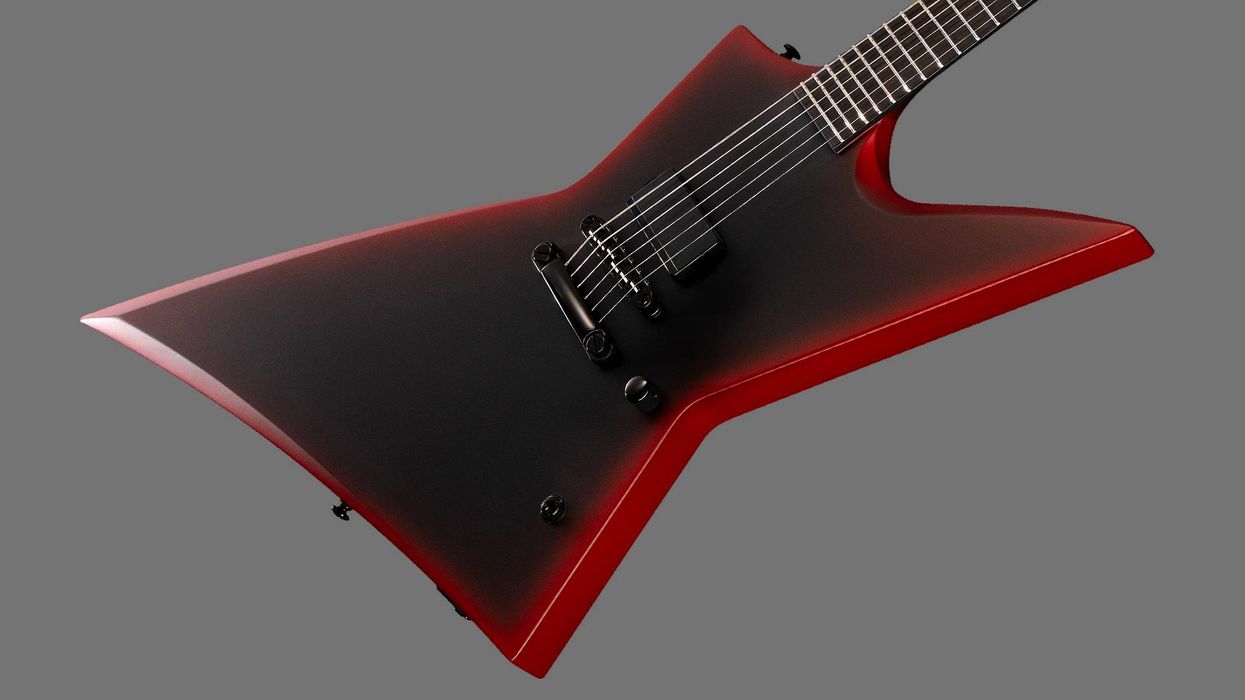
ESP Guitars has unleashed a surprise mid-year batch of new guitar models. These include six new guitars in the completely updated LTD Black Metal Series, as well as two new value-priced seven-string guitars and a new Signature Series model.
“The new Black Metal Series delivers everything that extreme metal guitarists have been asking of us over the years,” says Tony Rauser, Director of Marketing and Artist Relations for the ESP Guitar Company. “They offer more aggressive shapes, streamlined control layout, and a variety of tones from a single pickup design.”
The six completely updated LTD Black Metal Series guitars include the Arrow Black Metal, the EXL-7 Baritone Black Metal, the EXL Black Metal, the M-7 Baritone Black Metal, the M-6 EverTune 30 Black Metal, and the Phoenix-7 Baritone Black Metal. All of these newly-released guitars come in Black Red Burst Satin finish with black hardware, and feature matching red LTD metal headstock logos.
The LTD Arrow Black Metal offers neck-thru-body construction at 25.5” scale with a three-piece extra-thin u-shaped maple neck, mahogany body wings,Macassar ebony fingerboard, 24 extra-jumbo stainless steel frets, precise Grover tuners, a Floyd Rose 1000 double-locking tremolo bridge, and a Seymour Duncan MortalCoil 3-Voice active bridge pickup with a 3-way toggle to select voices.
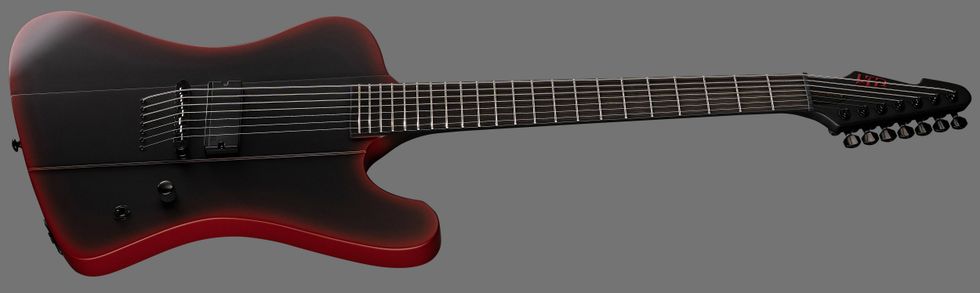
The LTD EXL Black Metal and EXL-7 Baritone Black Metal make use of ESP’s EX body shape with slightly larger dimensions. They offer set thru construction, mahogany body, thin u-shaped three-piece maple neck, Macassar ebony fingerboard, 24 extra-jumbo stainless steel frets, and a TonePros locking TOM-style bridge and tailpiece. The EXL Black Metal is offered in 24.75” scale and features a Seymour Duncan MortalCoil 3-Voice active bridge pickup with selectable voices. The EXL-7 Baritone Black Metal is a 7-string, 27” scale guitar that features a Seymour Duncan MortalCoil 7 String 3-Voice active bridge pickup with a 3-way toggle to select voices.
Two new M Series models are also part of the new Black Metal Series. Perhaps the most extreme guitar in the collection is the LTD M-6 EverTune 30 Black Metal, a six-string guitar with a 30” scale that’s tuned a full octave down from standard tuning. This guitar includes the innovative EverTune constant tension bridge system, and features bolt-on construction, a mahogany body with maple cap, an extra-thin u-shaped three-piece maple neck, Macassar ebony fingerboard, 24 extra-jumbo stainless steel frets, and a Seymour Duncan MortalCoil 3-Voice active bridge pickup with a 3-way toggle to select voices.
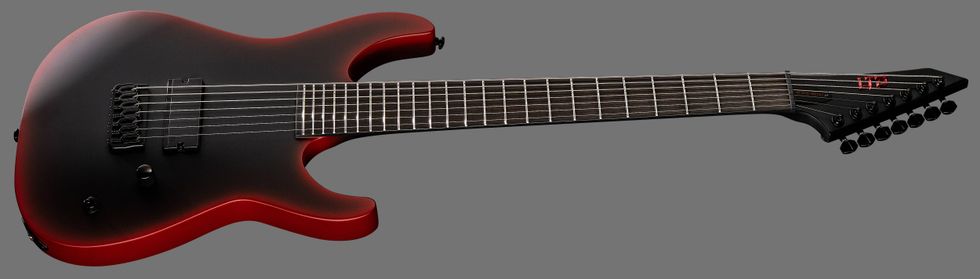
The LTD M-7 Baritone Black Metal is built with neck-thru-body construction at 27” baritone scale, with a comfortable alder body paired to a fast extra-thin u-shaped three-piece maple neck. Features include a Macassar ebony fingerboard, 24 extra-jumbo stainless steel frets, a Hipshot hardtail bridge with string-thru-body design, and a Seymour Duncan MortalCoil 7 String 3-Voice active bridge pickup with a 3-way toggle to select voices.
Another seven-string baritone in the updated series is the LTD Phoenix-7 Baritone Black Metal, with with neck-thru-body construction at 27” scale, a thin u-shaped three-piece mahogany neck, mahogany body wings with a maple cap, Macassar ebony fingerboard, 22 extra-jumbo stainless steel frets, a TonePros locking TOM-style bridge with string-thru-body design, and a Seymour Duncan MortalCoil 7 String 3-Voice active bridge pickup with a 3-way toggle to select voices.
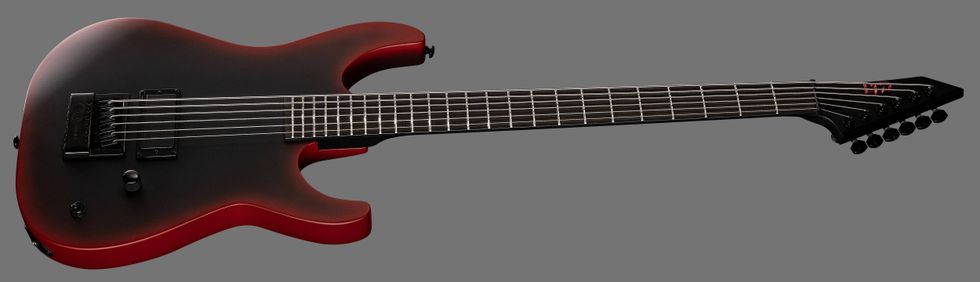
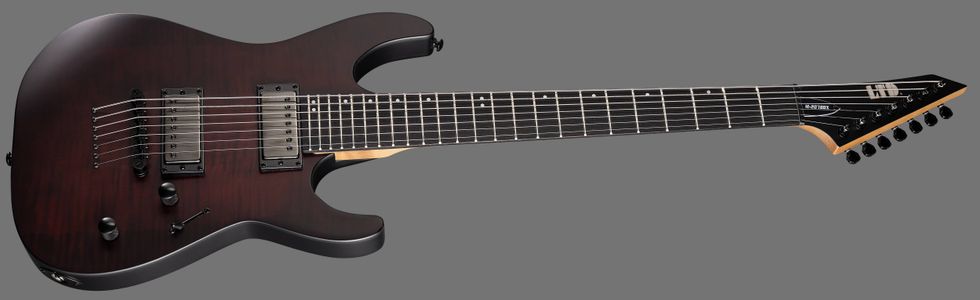
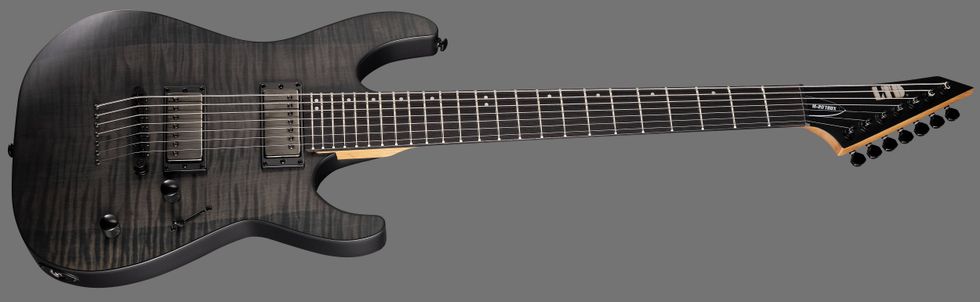
ESP has also announced two new guitars in its value-packed 200DX Range. The LTD M-207DX Baritone is being offered in Crimson Satin and See Thru Black Satin finishes. These seven-string baritone guitars have bolt-on construction at 27” scale, a poplar body with flamed maple top, an extra-thin u-shaped roasted maple neck with rosewood fingerboard, and 24 extra-jumbo frets. Components include LTD tuners, a TOM-style bridge with string-thru-body, and a set of ESP’s LH-150 humbucking pickups with matching black chrome covers, with single-coil tones offered by a push-pull switch on the tone knob.
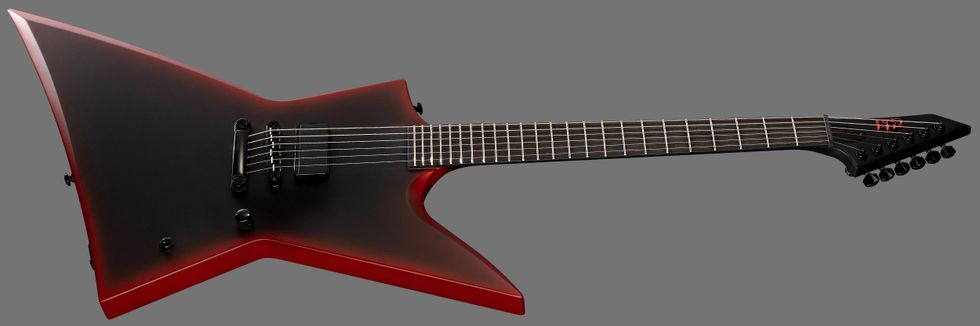
Finally, the company announced a new version of their Signature Series guitar for Ben Burnley, founder of the rock/alt-metal band Breaking Benjamin. The LTD BB-200 Baritone is a more affordable version of this popular signature guitar, and is offered in See-Thru Black Sunburst Satin finish. It includes set-neck construction at 27” scale, a mahogany body with quilted maple top, and a three-piece maple neck with rosewood fingerboard, red dot inlays, and 24 extra-jumbo frets. Components include black nickel hardware, LTD tuners, a TOM-style bridge and tailpiece, and a set of ESP’s LH-150 humbucking pickups with red covers that can be split for single-coil tones.
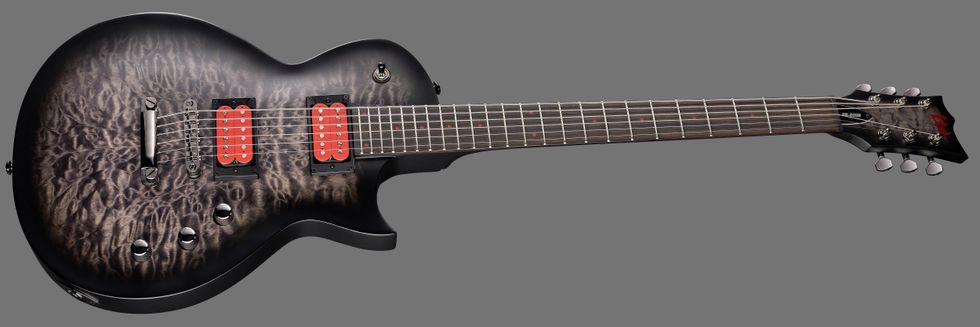
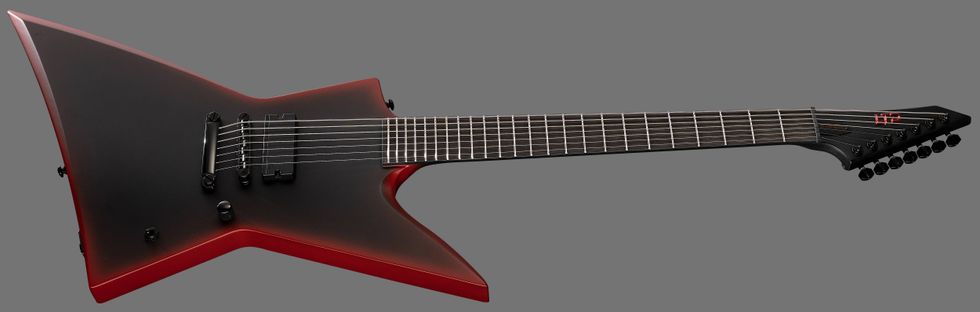
Street prices for each of the new models are:
LTD Arrow Black Metal - $1,299
LTD EXL-7B Black Metal - $1,299
LTD EXL Black Metal - $1,199
LTD M-7 Baritone Black Metal - $1,299
LTD M-6 EverTune 30 Black Metal - $1,399
LTD PHX-7 Baritone Black Metal - $1,299
LTD M-207B DX Crimson Satin - $499
LTD M-207B DX See-Thru Black Satin - $499
LTD BB-200 Baritone - $799
More information visit www.espguitars.com.
Keeley Tube Drive Review
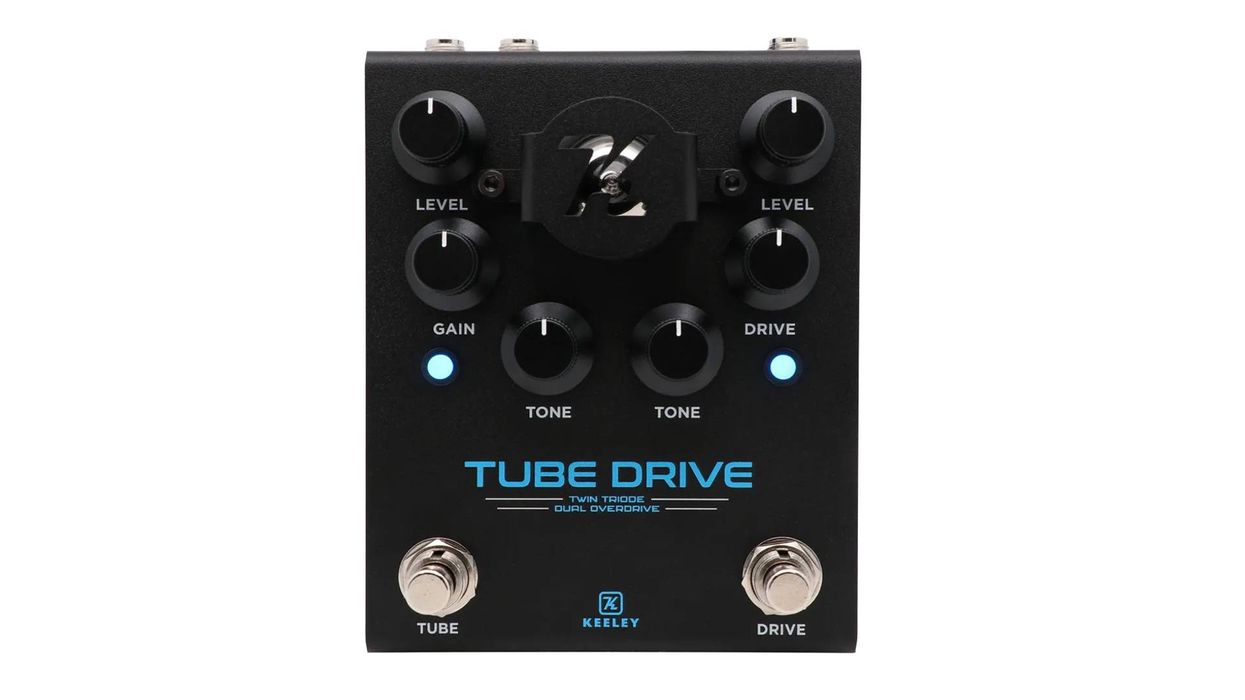
When I see an overdrive powered by a real tube, I’m predisposed to think about all those things that you associate with glowing tubes and overdrive—low-to-medium gain, warm, toasty, maybe even mellow tones. Keeley’s Tube Drive (which was originally issued in a limited edition of 100 fitted with 76-year-old Sylvania 12AT7s) dishes drive tones that are all those things, and sounds beautiful doing it. But the Tube Drive is made up of two sections. One is powered by a 12AX7 (alas, no ultra-rare antique tubes in this version.) The other is Keeley’s Phat Mod, a riff on the JFET Boss BD-2 Blues Driver, another circuit regarded as warm and responsive. Together, though, the two drive circuits expand each other’s range exponentially—right up to wicked saturated sounds that make a low-wattage combo more akin to a big British stack.
Glow Bug
So, two drives, six knobs. Seems simple, just like a dual drive should be, right? Well, not so fast. On the tube side, the controls include a 5E3 tweed Fender Deluxe-style tone stack after the tube. In a real tweed Deluxe the tone stack, and its effect on the amplifier's output, can be difficult to grasp in practice. A technical outline of its function, meanwhile, would take up a significant part of this review. In practical terms, though, the use of a 5E3 tone stack in the Tube Drive means that the tube side tone control shifts the pedal’s gain profile more profoundly than the tone control on your Tube Screamer might. The Tube Drive’s version of this setup does not make the pedal a tweed Deluxe. And thankfully, it’s much simpler to dial in. But it does lend the tube side a more complex range of voices, as well as a dynamic range that a lot of overdrives cannot touch.
The tube side’s drive tones are, predictably, a lovely combination of smooth and gritty. If you’re disinclined to use your guitar’s tone and volume controls, you can dial up low-to-mid-gain drive tones that sparkle with a Telecaster and a Deluxe Reverb—even at fairly advanced gain settings. But the real beauty of the tube side is how it sounds, feels, and functions when you set the level, gain, and tone controls in the latter third of their range, and use guitar volume and tone to shape the output. The clean tones you can access via this technique are beautiful stuff. They are alive, meaty, and sparklingly clear. But when you open up your guitar volume and tone, the output turns savage and nasty, dispensing distortion that’s thick, rich, and loud—and, more critically, tends to sound like an extension of your amplifier’s natural voice. At these settings, very small, incremental adjustments to guitar volume and tone can reshape this distortion in myriad ways between full-bore and clean.
Beyond Blues Driven
Adding additional gain from the drive side at aggressive tube side settings can be deadly—erasing any pretense of the Tube Drive being a polite OD, and transforming the pedal into a rabid distortion machine. By itself, it can be pretty mean. And compared to the tube side, the drive side feels hotter, grittier, and more abrasive in a way that, at times, makes its BD-2 Blues Driver origins seem many miles distant. But this contrast makes the Tube Drive exceptionally versatile.
The Verdict
On the surface, spending almost 400 bones on what’s ostensibly a two-channel overdrive does not sound like a very appealing proposition. But the Tube Drive’s genuine tubiness makes the pedal more than the sum of its parts. Its nastiest stuff can be intense. But set up right, these aggressive tones can be an amazing baseline to work backward from—happily ranging to sparkling clean, if you’re crafty about your guitar settings.

Tube Drive
Dual Overdrive Guitar Pedal, with Per-channel Level, Tone, and Gain Controls, FX Order Switching, 12AX7 Vacuum Tube, TRS Remote Jack, and True/Buffered Bypass - Black
“Slow down for Christ’s sake!”: Europe’s John Norum admits that he played too many notes too fast in the 80s

From The Final Countdown to Rock The Night, the ‘80s saw Europe carving out some mega riffs, courtesy of John Norum. At the time, the youthful Swede was full of piss and vinegar, keen to play as fast as he could – however, looking back, the guitarist winces at his shredding addiction.
In a new conversation with Guitar World, Norum admits that he should have toned it down a notch back in the ‘80s. “Mindless noodling and showing off is a bit pointless for me,” he says. “I don’t need to show off – I did plenty of that in the Eighties, especially live. I watch the footage now and think, ‘Take it easy and slow down, dude, for Christ’s sake!’”
While we don’t think he has anything to worry about, Norum seems mortified recalling his younger self shredding up a storm. But he also acknowledges that every guitarist needs to go through their shredding phase. “But that’s how it is when you’re young,” he says.
While shredding has a time and a place, plenty of guitarists have expressed similar sentiments to Norum. Back in 1991, Eddie Van Halen told Guitar Player journalist Jas Obrecht, that shredding was a young man’s game. As a more mature player, the Van Halen legend admitted that his years of shredding were well behind him. “A lot of people just do all kinds of crazy shit, and fine and dandy when you’re young,” he said.
“[Nowadays] playing as fast as you can doesn’t really hold much water for me…” he added. “To me, a solo is to highlight song. It’s not to show off.”
Speaking to Ultimate Guitar in 2023, Marty Friedman also noted that he wasn’t a fan of shredding. He described shredding as something that “looks cool on the fingers, but it doesn’t sound cool”.
As for Europe, the band are set to release their 12th studio album, Come This Madness, later this month. The record comes nearly nine years after their last record, 2017’s Walk The Earth, and Scandinavian Eyes comes as the latest taste of the record. It’s got a fabulous Deep Purple flavour to it.
Come This Madness is out 25 September 25. You can pre-order it now.
The post “Slow down for Christ’s sake!”: Europe’s John Norum admits that he played too many notes too fast in the 80s appeared first on Guitar.com | All Things Guitar.
Thin Lizzy’s Scott Gorham reveals the “most ridiculous question” he’s ever been asked about guitar

Most guitar fans have an opinion on who they think is the best player, alive or dead, but Thin Lizzy’s Scott Gorham thinks it’s an impossible question to answer.
He raises a good point: art is subjective, so how can any of us decide who is truly the best at anything? Gorham also believes that the only opinion that matters is your own when it comes to the music you enjoy listening to or creating.
Speaking to Jordi Pinyol on YouTube, Gorham shares, “Probably the most ridiculous question I’ve ever been asked is, ‘Who is the best guitar player in the world?’ It’s like… what? I don’t even understand that question, right? Who is the best band in the world? Wait a minute, there is no best.
“It’s the same in the art world. There is no best artist. It all depends on what you think, not what anybody else thinks. If people say, ‘I really love that [artist/song/album], I think it was really good,’ – great. But like I say, there’s no ‘best in the world’ anything!” He concludes.
In other Thin Lizzy news, the band’s former guitarist Eric Bell has reflected on the time he joined Metallica to perform Whiskey in the Jar.
The song began life as a traditional Irish folk tune, and it wasn’t until 1972 that Bell electrified it with Thin Lizzy. More than twenty years later, Metallica reimagined the track for their 1998 covers album Garage Inc.
Speaking with Guitar World last year, Bell revisited the unexpected moment he found himself performing the song alongside Metallica in Dublin.
“I didn’t know anything about Metallica. I’m not into that kind of music, really. But it was funny; they got in touch with me. Someone from their setup phoned me and said, ‘I work with Metallica. We’re doing a world tour. Would love to have you come along to play with us in Dublin and do Whiskey in the Jar.’”
He went on to add: “Once we got to Dublin, the thing that threw me was, I was trying out this Marshall amp, and Metallica walked in sort of like cartoons. They said, ‘Hey, man, when we do this, we tune our guitars a whole tone down.’ I thought, ‘A whole tone? The guitar is going to sound like a fucking banjo…’ But I don’t know; I didn’t really know them… I just felt a bit out of place.”
The post Thin Lizzy’s Scott Gorham reveals the “most ridiculous question” he’s ever been asked about guitar appeared first on Guitar.com | All Things Guitar.
Sweetwater’s Guitar Month is here – with new exclusives, and big discounts

Sweetwater’s Guitar Month is always a great time if you’re looking for a new electric, acoustic, amplifier or effects pedal, with exciting discounts and a whole new range of exclusive special editions. Let’s dive into some of the most eye-catching savings and exclusives Sweetwater is offering this Guitar Month!
Big Discounts
Designed after the drive sounds of Stevie Ray Vaughan’s cranked dumble, the Lenny boost/drive pedal gives you impeccable bluesy, crunchy drive sounds, and for Guitar Month you can save $120 on it – well over 50%!
This rather gorgeous D’Angelico has a big discount of $800 – almost half off. If you’re enamoured by D’Angelico’s curly, art-deco aesthetics but don’t want to lose the power and simplicity of a rock-ready single-cut, the Deluxe Atlantic is a great choice.
Who says tube amps need to break the bank – or your back? The Blackstar St James 50-watt tube head is a specially-designed amp with a unique power supply that drastically cuts down on the weight. For Guitar Month it’s not just lost the weight, as it’s been discounted by a tidy $450!
We cannot help you learn Bleed – but an eight-string Boden might get you closer tonally, with great ergonomics that make sustained prog-metal riffs easier on the mind and body. And for Guitar Month, it’s seen a great discount of $540 dollars.
Yamaha’s excellent effect-laden acoustic guitars are brilliant options for people who want all-in-one solutions for reverb and chorus in situations where pedalboards aren’t an option – while still being great acoustic guitars in themselves. This particular instrument has been discounted by a very pleasing $200!
New Exclusives
Sweetwater Exclusives are always pretty cool, and there are some particularly enticing ones at the moment. Last month I reviewed the Gretsch CVT Baritone and absolutely loved it, giving it a 10/10 – and exclusive to Sweetwater are two cool new finish options – Satin Black and Shell Pink.
The Shell Pink continues with a set of exclusive Player II Modified Strats and Telecasters – also available in eye-catching Fiesta Eed. The guitars themselves are true to their names, with classic Fender designed updated for the needs of modern players.
Need to stand out on stage, more so than an Acoustasonic makes you stand out by itself? This Sweetwater-exclusive Arctic Gold finish lends some extra panache to Fender’s unique hybrid design
Far from an early draft of a Prince song, Purple Doghair is actually a very cool finish option available for PRS’ well-regarded NF 53 guitar. Loaded with some unique pickups and with a distinct take on the T-type design, this extremely eye-catching variant is only available at Sweetwater.
This mini reissue of EQD’s excellent Bellows Fuzz Driver brings the same JFET-based saturation to a pedalboard-friendly mini pedal format, and Sweetwater carries this rather fetching black-on-teal variant (with fiery red knobs) to stoke some extra inspiration.
Explore Sweetwater’s Guitar Month here.
The post Sweetwater’s Guitar Month is here – with new exclusives, and big discounts appeared first on Guitar.com | All Things Guitar.
IK Multimedia’s new TONEX Board is its “most advanced” hardware platform yet: here is everything you need to know

IK Multimedia has launched the TONEX Board, its “most advanced” hardware platform and “the centrepiece” of its TONEX ecosystem.
Combining IK’s AI Machine Modeling technology with AmpliTube effects, dual signal paths, and touchscreen control, the TONEX Board puts a complete rig into a compact pedalboard in a first for the brand.
So far, IK’s TONEX range has landed glowing reviews from Guitar.com, with its TONEX Plug rated 8/10 and its small TONEX One pedal landing a 9/10 for its “excellent tones”.
With the all-new Board, users can run up to four Tone Models simultaneously (2,000 Premium Tone Models are included at launch) across two independent signal paths. Players can then combine these with 76 effects from AmpliTube and TONEX, plus all-new processors, using up to 12 effect slots.
The Board hosts a five-inch high-resolution colour touchscreen and six controls for building and editing your rigs, while a range of performance modes, independent stereo outputs, an assignable stereo effects loop, MIDI, and expression control provide the connectivity and control needed for recording, rehearsal, and stage use.
New content, effects, and capabilities are planned for release through future updates for the Board, but at release it includes the following software:
- TONEX Modeler to capture amps, pedals, cabinets, and full rigs
- TONEX software to import, download, and play Tone Models as a standalone or plugin version
- TONEX Board Editor to transfer existing Tone Models and presets
TONEX Board users will also have exclusive access to TONEX Player 2.0 Beta, which offers dual-rig editing with all 76 included effects, TONEX Board preset saving, and full bidirectional transfer of Tone Models and presets between Mac or PC and TONEX Board using the TONEX Board Editor.
Learn more and hear how it sounds in the videos below:
The TONEX Board is available now for $/€999.99 from the IK Multimedia website and IK dealers worldwide.
The post IK Multimedia’s new TONEX Board is its “most advanced” hardware platform yet: here is everything you need to know appeared first on Guitar.com | All Things Guitar.
Keith Richards explains the guitar magic of The Rolling Stones, and why the Tele became the number one choice for him: “You try and match your guitar to what the other guy’s playing”

Keith Richards has shared how he came to fall in love with the Fender Telecaster, and why it suited his work in The Rolling Stones.
The Telecaster celebrates its 75th anniversary this year. In honour of the milestone, Fender has launched a number of celebratory Anniversary Collection Teles that integrate archival finishes and modern touches, as well as the revival of more obscure takes on the Tele shape, including the nameless Nocaster. A collection of P-Bass 75th Anniversary models also landed in May.
Among a number of artist interviews for Fender’s “love letter to the Telecaster” on YouTube, Richards shares how his love for the Tele began: “So for a lot of the ’60s, my main work was with Gibsons. I wanted that bottom full end, and really I got into the Fender – especially the Telecaster – when I was hanging around with Ry Cooder for a while. We were playing around with tunings. He was showing me this five string open tuning on G.
“I just got interested in it and I found that the only guitar that could really sustain the chords and give you a beautiful, I don’t know… There’s no words for it. Every note is in place. And then I started to really discover what Leo [Fender] had invented. This is where I feel at home,” he says.
“And of course, the Stones is a two guitar band; you try and match your guitar to what the other guy’s playing, you know? In this case it was Brian Jones for most of the ’60s. He loved [to say], ‘You play that and in that case I’ll play this.’
“I mean it’s a piece of wood with some electronics on it, but these things can take on a soul of their own. You get affectionate about [these] things.”
Watch the full video below:
You can shop Fender’s 75th anniversary models for the Telecaster and P-Bass over at the Fender website.
The post Keith Richards explains the guitar magic of The Rolling Stones, and why the Tele became the number one choice for him: “You try and match your guitar to what the other guy’s playing” appeared first on Guitar.com | All Things Guitar.
Martin Road Series DC-13E Modern review: a stunning cutaway Dreadnought aimed at contemporary players

$1,499.99/£1,499, martinguitar.com
There’s a certain prestige that comes with Martin acoustic guitars, and for good reason. The near-200-year history of America’s oldest surviving guitar brand means that regardless of price point – and the brand caters from sub-$1k budgets all the way up to high-end Nazareth-PA-made instruments – there’s a faith and confidence that many of us guitarists have in Martin instruments before we pick them up.
- READ MORE: Martin 000-10E Retro review: “it authentically distils everything that’s great about 000 guitars”
There’s no escaping that a Nazareth-made Martin will cost you a pretty penny these days however, but there are also plenty of guitarists that want things that the affordable X series doesn’t offer – such as all-solid construction.
The Road Series has been bridging the gap between the base Mexico-made Martin line and the Standard Series for three decades now, and the newly refreshed range aims to make that more diverse and interesting than ever.
Perhaps inevitably, much of the attention the Road Series refresh has got has focused on the Retro guitars – with their classic looks and aging-toner’d tops – but Martin is a guitar company that isn’t just about the past.
The Modern side of the Road Series is where you’ll find specs and features that tailor to people whose acoustic needs evolved beyond the 1940s. It’s here you’ll find progressive body shapes such as the GPC and Inception for example, but also where you can indulge in that most controversial of Martin dreadnoughts – the cutaway. And that’s exactly what we’ve got here.
 Image: Adam Gasson
What is it?
While the Retro side of the series recreates the time-honoured Nazareth designs that have been fan favourites for decades – with traditional non-cutaway silhouettes, solid-wood builds and vintage-style hardware and appointments – the Modern side offers more contemporary ergonomics and wood pairings.
The DC-13E Modern features cutaway dreadnought body, with a solid Spruce top, though gloss-finished compared to the matte of the Retro, paired with a Koa Fine Veneer back and sides. You’ve also got a scalloped spruce X-bracing, high-performance taper neck which joins the body at the 14th fret, and an ebony fingerboard with 20 frets.
You’ll notice with a bit of digging that the newly revamped-for-2026 Road Series that each guitar in the lineup – on both the Retro and Modern sides – are labelled with either a 10, 12 or 13. This essentially relates to their degree of aesthetic luxury, if you will. Style 10 is the more basic end of the proposition, while Style 13 is the most visually decked out.
With that, with the DC-13E Modern, you get slightly more eye-catching – yet still understated – mother-of-pearl Diamonds and Squares inlays, white binding, and rather fancy looking skeletonized open-gear tuners.
All of this is paired with versatile Martin-designed E1 electronics, with controls and an onboard tuner placed conveniently and discreetly inside the soundhole. A well-spec’d Road Series Martin guitar for $1,500 is a strong proposition, but how does it measure up?
 Image: Adam Gasson
Build quality and usability
Pulling the guitar out of its semi-rigid gigbag, the first impression is probably not the best one. This is a Martin aimed at modern players after all, with a cutaway to enable easier upper fret access – so why is the action so high?
It’s pretty good at the lower strings for cowboy chords, but things get pretty tiring when you venture above the 10th fret for chords and single-note runs. A quick eyeballing down the neck reveals that the culprit is predictable but annoying – a bow in the neck.
Given that the Northern Hemisphere has been on fire for most of the last few months, I’m prepared to chalk this one down to temperature-induced warping – I’ve not come across any other Road Series guitars with similar issues – and a quick quarter turn on the truss rod makes things much more flat and even throughout.
It’s a timely reminder that acoustic guitars are temperamental beasts and if you’re buying a guitar sight unseen from the internet, you may have to do a bit of basic set-up work when it arrives.
Following the neck adjustment, the DC-13E offers an otherwise stellar playing experience that you’d expect of a Martin acoustic. It’s a big boy, of course, but the cutaway helps to make this a more manageable playing experience, especially when seated. This is further helped by the Performing Artist neck with a High Performance Taper – which offers a wider fretboard the further up the neck you go – is well suited to modern players partial to both complex chord voicings and lead lines in the higher registers.
In terms of build quality, it might be a Style 13 model and therefore one of the more aesthetically fancy guitars in the Road Series lineup, but the extra visual appointments are subtle. This is a Martin guitar, after all; it can speak for itself without being too visually ‘loud’. The Diamonds and Squares inlays make for a beautifully sophisticated look, completed by the headstock’s skeletonised open-gear tuners. As with other guitars in the Road Series range, these can be a bit sticky, but they do a good job of holding their tuning and allowing precise adjustment.
While this might be a Modern guitar, the DC-13E doesn’t want you to feel like you’re fully piloting a piece of technology, so it’s a nice and welcome touch that the controls and tuner for the E1 system are hidden inside the soundhole for easy access.
 Image: Adam Gasson
Sounds
The DC-13E boasts a wonderful tonal profile that you’d expect from a Martin Dreadnought, with terrific projection, sparkly highs and a strong midrange, although lacking ever so slightly on the low end front. The guitar otherwise passes the open G chord test with flying colours, and offers a superbly dynamic profile, with heavy chord strums as satisfying as subtler, more articulate fingerstyle playing.
Indeed, a good acoustic guitar feels like it’s alive alongside you, reacting in real time to the subtle dynamic changes in your playing. And on this front, the DC-13E quickly becomes an extension of yourself as you play it.
The Modern models in the newly updated Road Series are said to deliver stage-ready performance. And a large part of this is down to the onboard Martin-designed E1 electronics, which do brilliantly in retaining the timbre and character of the unplugged DC-13E, while allowing amplification in stage and other performance scenarios. I notice very little tweaking is required to nail down a stellar amplified tone – it’s pretty much plug and play, which is very welcome.
 Image: Adam Gasson
Should I buy one?
If you’re a player who loves that unmistakable Martin look and sound, but also dabbles in more contemporary-style playing further up the neck, the DC-13E Modern could be just the ticket. A Mexican-made Martin for $1,499 would be a solid addition to any serious acoustic guitarist’s collection – or even the perfect forever instrument – and save for a slightly high action out the box which I felt needed adjusting, the DC-13E Modern is a solid all-rounder with pretty much all pros and very few cons.
Martin Road Series DC-13E Modern – alternatives
If you want your Martin a bit more traditional then the Road Series has you covered with the D-12E Retro ($1,349), or if you want something that really does offer the most modern playability and feel imaginable, then the SC-13E Modern ($1,799) is your offset-bodied Martin of the future. Of course, when people talk about ‘modern’ acoustic guitars, they’re often alluding to Taylor, and the brand’s similarly Mexico-made 210ce Plus ($1,399) offers all-solid build and a cutaway.
The post Martin Road Series DC-13E Modern review: a stunning cutaway Dreadnought aimed at contemporary players appeared first on Guitar.com | All Things Guitar.
IK Multimedia Launches TONEX Board
2 Chances to Win a Fishman Wireless Rig (Loudbox Performer Amp + Airlock Wireless GT)

Queens Of The Stone Age’s Josh Homme on why his first guitar experience was playing polka: “In the desert there wasn’t a lot of guitar teachers”

Pop on a Queens Of The Stone Age track, and Josh Homme’s riffs are instantly recognisable. Years of experimentation went into his thick, distinctively dark and downtuned guitar tone – but Homme didn’t follow the conventional playbook of a hard rock guitarist. In fact, his first introduction to the guitar was through polka music.
Speaking on the Queer the Music podcast, Homme reflects on the limitations of growing up in California’s the Palm Desert. In particular, when he was keen to learn guitar, it was slim pickings in terms of who could teach him. “In the desert, there wasn’t a lot of guitar teachers, apparently,” he laughs. Instead of asking what style a teacher taught, if you found a teacher “it was like ‘You teach guitar? Good.’”
The one teacher available happened to be Tom Polanski, a polka guitar teacher. Polanski ended up teaching Homme guitar for two years. “So polka was my original style,” Homme explains. “And I’m actually really thankful for that, too. Because, if you listen to No One Knows, [it has] that sort of polka thing – [the beat] goes one – down, two – up… which is also what reggae does as well.”
In the past, Homme has explored how his unconventional guitar education helped carve out his unique tone. On Noisey’s Guitar Moves series in 2013, Homme explained that he has since developed his own ‘Josh Homme scale’, refined over years of melding polka, Jimi Hendrix techniques and altered blues scales.
While the desert didn’t have much going on, Homme also tells Queer the Music that “boredom” lead him to music. Being from a “very empty, very idyllic small town”, he had to entertain himself. “The gift of nothing is a very real thing,” he explains. “In the boredom… you’re allowed to practice playing guitar, piano, or drums.”
Homme also notes that his first musical obsession wasn’t even the guitar – it was the drums. “I used to play with chopsticks on wicker dirty clothes hampers… beats were always important to me,” he recalls. However, his dad was hesitant to splash out on a drum kit for a nine-year-old. Instead, he gave Homme a challenge: “if you play guitar for five years and you’re accomplished, then I’ll buy you a drumkit.”
Of course, Homme’s dad’s challenge ended up making Homme obsessed with the guitar. And that’s what he does best to this day with Queens Of The Stone Age. The band’s latest record, Perfecth, is due to drop October 30, and a pair of teasing singles, Insignificant Other and Easy Street, are already out.
Queens Of The Stone Age’s Perfecth drops on October 30. You can pre-order it now.
The post Queens Of The Stone Age’s Josh Homme on why his first guitar experience was playing polka: “In the desert there wasn’t a lot of guitar teachers” appeared first on Guitar.com | All Things Guitar.
IK Multimedia Launches TONEX Board
The complete TONEX rig on a single pedalboard, combining AI-captured tone, AmpliTube effects, advanced routing, and professional performance control.
IK Multimedia today launches TONEX Board, its most advanced TONEX hardware platform to date and the centerpiece of the expanding TONEX ecosystem. Combining IK's award- winning AI Machine Modeling™ technology with AmpliTube studio-grade effects, dual signal paths, advanced routing, extensive connectivity, and intuitive touchscreen control, TONEX Board puts one of the most advanced and best-sounding complete guitar and bass rigs into an extremely powerful, ultra-low-latency compact pedalboard.
At its heart, TONEX Board delivers the sound, feel, and response of real amps, cabinets, and pedals, with the flexibility to run up to four Tone Models simultaneously across two independent signal paths. Players can combine these with 76 effects from AmpliTube and TONEX, plus all- new processors, using up to 12 effect slots to create everything from streamlined traditional rigs to sophisticated dual-amp, parallel, stereo, and wet/dry setups.
A 5-inch high-resolution color touchscreen and six hands-on controls make building and editing complete rigs fast and intuitive, while flexible performance modes, independent stereo outputs, an assignable stereo effects loop, MIDI, and expression control provide the connectivity and control needed for recording, rehearsal, and the stage.
Key Features
- Incredible amp sound - The sound, feel, and response of real amps, cabinets, and distortion pedals, powered by AI Machine Modeling™
- Studio-grade effects - 76 total effects, including 51 derived directly from AmpliTube 5, 15 from TONEX, and 10 brand-new studio-grade guitar and bass effects, with more to come
- Complete rig building - Combine up to four Tone Models across flexible dual signal paths with 12 slots and flexible routing
- Effortless control - Intuitive touchscreen editing and flexible performance modes keep everything immediately accessible
- Connect to any rig - Professional routing and comprehensive I/O for amps, FRFR, front of house, studio setups, and more
- A universe of tone - 2,000 Premium Tone Models included, plus tens of thousands more to discover on ToneNET
- A complete, evolving ecosystem - Capture, create, edit, record, perform, share, and expand your sound across TONEX hardware and software.
One Board. A Complete Rig. TONEX Board takes the core technology behind TONEX further with a dual- signal-chain architecture capable of running up to four Tone Models simultaneously, combined with 76 studio-grade effects across nine categories. The effects collection includes 51 processors derived from AmpliTube, 15 from TONEX, 10 all-new effects, and more to come. Up to 12 Tone Model and effect slots can be freely positioned and routed across flexible signal paths to create dual-amp stereo rigs, wet/dry setups, two-instrument configurations, sophisticated parallel chains, and more.
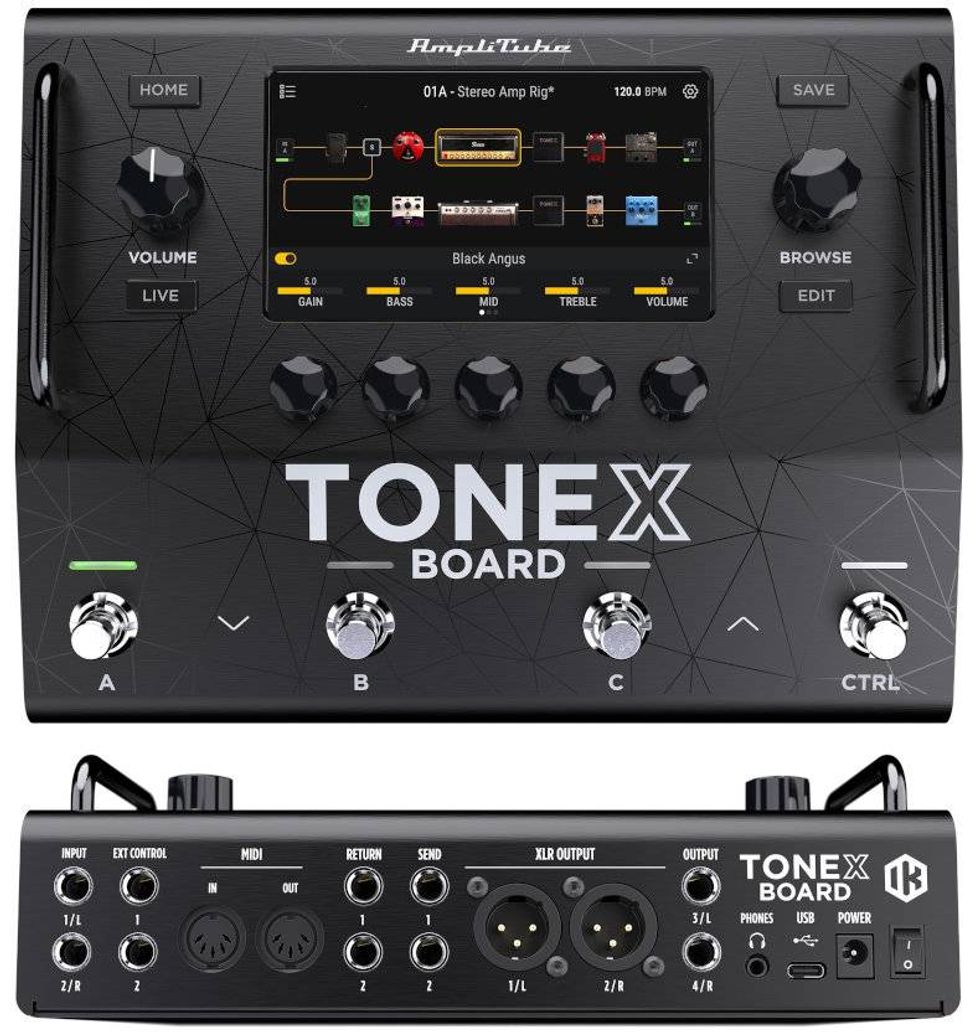
From authentic captured amps, cabinets, and pedals to drives, dynamics, modulation, delay, reverb, and creative processing, TONEX Board gives players the freedom to build the exact rig their music requires - all on a single pedalboard.
Control Without Complexity TONEX Board combines the depth and connectivity of a professional rig with fast, intuitive hands-on control. Its large 5-inch high-resolution color touchscreen provides immediate visual feedback, while six precision push-rotary controls make building and editing complete presets fast and direct.
Preset, Scene, and Stomp modes provide flexible control onstage, from recalling complete rigs and changing multiple settings at once to controlling individual effects directly from the footswitches.
TONEX Board also adapts to virtually any rig or performance environment. Players can split and merge signal paths, integrate external pedals with the movable stereo effects loop, or divide the loop into two independent mono paths. Two independent stereo output pairs (one with balanced XLR connectors), individual output EQ, MIDI, expression control, and four-cable method support provide the flexibility to connect to traditional amplifiers, FRFR systems, recording setups, or directly to front of house (4-in/2-out USB audio interface functionality with configurable routing and direct monitoring will be available October 1, 2026, via a free firmware update). Whether recording, rehearsing, or performing live, TONEX Board keeps the focus on playing rather than programming.
A Universe of Tone TONEX Board includes 2,000 Premium Tone Models, spanning sought-after vintage amplifiers and essential classics to modern high-gain rigs, pedals, and more. The collection combines the original TONEX MAX library, a selection from the latest TONEX ONE+ Signature Collection, and new TONEX content made exclusively for TONEX Board.
Nearly 200 of the included captures were contributed by a curated group of leading TONEX Tone Partners, including, in alphabetical order: Amalgam Audio, Big Hairy Guitars, Core Tone Captures, Drums And Tones, Gitarrenlehreronline, Jason Sadites, Juca Nery, Live Ready Sound, Mad Steex, Massimo Varini, Matt Fig, Passion For Tone, Signal Theory, The Studio Rats, The Tone Shepherd, Tone Factor, Tone Junkie TV, Tone Wars, and XOG.
And the included library is only the beginning. Through ToneNET, TONEX Board users can explore more than 60,000 additional Tone Models and presets from IK, Tone Partners, artists, brands, and a growing worldwide TONEX community.
A Full Software Ecosystem TONEX Board is the centerpiece of the complete, connected TONEX ecosystem. Capture gear with TONEX Modeler, discover sounds through ToneNET, shape and organize them with TONEX software, transfer Tone Models and presets with the dedicated TONEX Board Editor, and record with the TONEX plug-in.
Existing TONEX users can import their presets into TONEX Board and pick up where they left off, providing a seamless path from other TONEX hardware and software. And with new content, effects, and capabilities planned through future updates, TONEX Board is built to evolve along with the TONEX ecosystem.
TONEX Board at release includes the following software:
- TONEX Modeler to capture amps, pedals, cabinets, and full rigs
- TONEX software to import, download, and play Tone Models as a standalone or plug-in version
- TONEX Board Editor to transfer existing Tone Models and presets to TONEX Board
Additionally, TONEX Board users will have exclusive access to TONEX Player 2.0 Beta (version 2.0.3), which will offer complete dual-rig editing with all 76 included effects, TONEX Board preset saving, and full bidirectional transfer of Tone Models and presets between Mac or PC and TONEX Board using TONEX Board Editor.
Presets created with TONEX Board will be available to share with the community on ToneNET beginning October 1, when TONEX Player 2.1 is officially released. Full real-time editing in TONEX Board Editor will be implemented in Q4 2026.
Pricing & Availability The TONEX Board is now available for $/€999.99 (tax excluded) from the IK Multimedia online store and authorized IK dealers worldwide.
For more information, audio demos, videos, and availability, visit: www.ikmultimedia.com/tonexboard
LR Baggs Unveils Next Era as Baggs, Welcomes Second-Generation Leadership

As the company celebrates its 50th anniversary, LR Baggs has changed its name and unveiled new branding. The company is now simply Baggs, and has announced that Jenny Luckett, daughter of founder Lloyd Baggs, has joined the leadership team as Creative Director.
A Pepperdine University graduate with a BA in Art and Multimedia Design and a successful entrepreneur, Luckett recently sold her January Moon children’s brand to join Baggs full-time. She has led and directed a year-long development of Baggs' core visual identity and brand message.
"Removing the LR isn't about removing Lloyd from the story," says Luckett. "It's about expanding the story. It takes something that began with one person and makes room for all the people who have become part of it. To us, Baggs is the family, and that family is much bigger than Lloyd's actual family. It includes all the people who have helped build this company and all of the people who will be part of where it goes next."
Baggs began with one person: luthier Lloyd Baggs, one of the most influential innovators in acoustic amplification. Over the past five decades, most people have simply started calling the company "Baggs." Lloyd himself introduced the shorter name three years ago on the AEG-1 guitar, where "Baggs" appears on the headstock to represent the entire team behind it. The new name makes that philosophy official.
"I'm thrilled beyond words for Jenny to be joining the company and helping guide it into the future," says Lloyd Baggs. "Not only is she amazingly talented and driven to do the right things, but she's thoughtful, kind and joyful. She's a born leader and a joy for all of us to work with."
Lloyd's role isn't changing. He remains focused on product design and innovation, with a strong management team overseeing day-to-day operations.
The new identity follows a year-long, top-to-bottom examination of how Baggs presents itself and communicates its identity today. The result: a cleaner, more legible logo, vibrant and warm color palette, and all-new original photography that reflect the company's blend of craftsmanship and innovation. A distinctive orange icon incorporates Lloyd's personal "chop," the signature he used as a fine-art master printer before becoming a luthier, connecting his history to the company's future.
"We know our products are world-class, and we want the brand around them to perform at that same level," says Luckett.
For more information visit baggs.co.
Greta Van Fleet’s Jake Kiszka says people who dismiss them as being imitators are ignoring the “far more complex and nuanced” reality of their music

Ever since their debut single topped Billboard’s Rock Chart in 2017, Greta Van Fleet have been scrutinised by the press. While Highway Tune and every subsequent release has been a hit, listeners and critics have branded them as “derivative” rock ‘n’ roll, with many citing their similarities to Led Zeppelin. However, guitarist Jake Kiszka argues that Greta Van Fleet’s sound is more “nuanced” than the press might have you believe.
In a new conversation with Guitar World, Kiszka argues that there is a “lineation between innovation and imitation”, and Greta Van Fleet fall on the side of innovation. “People perceive our sound to be one way, but, in reality, it’s far more complex and nuanced than that,” he says.
He believes that a lot of the heat Greta Van Fleet have faced was exacerbated and fuelled by online forums and trolls. “There’s a lot of negative commentary that perhaps comes from the evolution of Greta Van Fleet, and how quickly it exploded and how polarising it has become… and there’s a lot of controversy on the internet, which has expedited and proliferated it,” he explains. “It was just a fire in the corner, and now it’s a conflagration.”
Kiszka also admits that people labelling his band as “saviours of rock ‘n’ roll” certainly didn’t help. “I think that’s a misconception as well… [it’s] an inaccurate representation of us…” he says. “We’re a bunch of young guys who grew up in mid-Michigan, in a little town somewhere. And in a garage, we fell in love with American blues and music of all cultures from all places.”
And anyway – is rock ‘n’ roll dead or in need of saving? “I don’t think so,” Kiszka says. “It just lays in wait, you know? And then it’s there for the next generation to pick up.”
Back in May, Greta Van Fleet sparked breakup rumours after releasing a cryptic social media video. However, they’ve recently confirmed that they’re still together, and their fourth album, Palace For The People, is dropping on 9 October. The release will be their first record since 2023’s Starcatcher.
The group have already shared a pair of new singles: Saw You Stand and Play Your Games. They also pulled off an intimate $20 show in New York City at the end of May.
Palace For The People from Greta Van Fleet is available to pre-order now.
The post Greta Van Fleet’s Jake Kiszka says people who dismiss them as being imitators are ignoring the “far more complex and nuanced” reality of their music appeared first on Guitar.com | All Things Guitar.
Phil X explains the things that “scream fake” when he hears someone using a digital guitar amp: “Violence is hard to replicate with the modeller”

The world of digital guitar amps and effects has got dramatically better in recent years, leading even sceptics like Joe Bonamassa to come around to them but not Phil X.
In a new interview, the Bon Jovi band member stated his belief that there are still ways that you can tell the difference between a real amp and a digital one – and even listed three ways that he thinks you can tell if a guitar player is running through a tube amp or a model.
He told Guitar World: “Playing with, you know, tube amps and stuff like it really dictates how you can approach getting all those dynamics where modellers, you know, you’re kind of stuck with that sound and it’s a little more nuanced where you where you have a lot more there. There’s three characteristics that scream fake to me.
“One is the squeal. It just sounds when guys squeal, it just it sounds like the old like kidney pod or something, right? And then, the chunkiness that you get from an amp like Unchained… that violence is hard to replicate with the modeller.
“It’s not an EQ thing. It’s violence. It should be a violence knock. And then chords. Sometimes you hear a chord and it’s just mush. You don’t hear the note separation. Those are the three things for me that scream fake.”
Phil X has been a member of Bon Jovi since 2013, playing lead guitar with the Livin’ On a Prayer hitmakers for 13 years. He uses Friedman amplification and became a Gibson artist in 2019.
He’s previously been outspoken about the quality of his playing. For years the guitarist would refuse to play Gibson products, and explained why in an interview two years ago.
“I got used to playing with the hardtail piece, and then I wanted an SG, but I have a thing for quality control,” Phil X tells Guitar Summit [via Ultimate Guitar]. “So for the longest time, Gibson wasn’t so good with the quality control. And that’s a long time ago.”
The guitarist elaborates, “And it’s not me — I could walk in and I could pick up a beautiful Les Paul that looks amazing, but it doesn’t sound very good and it doesn’t feel very good because it wasn’t set up right, because of the quality control, or the lack thereof.”
“And for me, it’s like, ‘I don’t care.’ I put it back. But you got a kid who saves all their money to go buy it, and Gibson Les Paul because Jimmy Page uses it, and they get a non-good version of it for, like, $4,000 that they saved. And that kind of bugged me.”
The post Phil X explains the things that “scream fake” when he hears someone using a digital guitar amp: “Violence is hard to replicate with the modeller” appeared first on Guitar.com | All Things Guitar.
Why your guitar’s fretboard radius matters more than you think

Every guitarist, in time, will develop guitar specs that they prefer, one of those specs, regarding playability, is the fretboard radius. Radius has more to do with how a guitar feels under your fretting hand than almost any other spec on the sheet, and it decides how low your action can go before your bends start dying.
So what is fretboard radius? Well, first of all, I’ll bet that some of you reading this didn’t even realise that the wood of your guitar’s fretboard probably isn’t perfectly flat, but actually has a very subtle curve running across its width.
And that’s what fretboard radius is talking about – it’s a measurement of the way in which the wood of your fretboard is curved. Still not following me? Picture a circle, and then slice a thin strip out of its edge and lay it across the neck.
That arc is your fretboard surface, and in order to measure this surface, we use the radius of the circle that you took that thin slice out of.
The bigger the radius number – and the bigger the circle you’re pulling from – the flatter your fretboard will be. So, for example, a vintage Fender guitar would have a radius of 7.25 inches, meaning that the slice comes from a relatively small circle.
Modern Fenders run to a flatter 9.5 inches, while Gibsons are generally flatter again at 12 inches. PRS sits in the middle at 10 inches. Ibanez’s Wizard necks are very flat in the 15.75-17-inch range, while a classical guitar has no radius at all and is completely flat (sometimes called “infinite radius”).
 Image: Adam Gasson
The Bending Debate
The biggest question you might be having is why are most guitar necks radiused at all? Radius was added to the guitar design long ago to adapt to the fact that your hand isn’t flat.
Wrap your fingers around a barre chord and they form a natural curve. A rounder board matches that curve, which is why cowboy chords and barre work feel so easy on old Fenders.
Flat boards make chording feel like pressing strings against a table. It’s fine for a classical player with proper left-hand position and the neck up at 45 degrees. Less fine for someone playing an open G with their thumb hooked over the top.
But there is a potential trade-off there, and that’s to do with bending strings further up the neck.
When you bend a string, you push it sideways across the board. On a curved board, sideways means uphill. Bend the high E at the 15th fret and the string travels toward the crown of the arc, where the frets sit higher relative to the string’s straight path from your fingertip to the saddle. If your action is low, the string loses clearance over the frets ahead of your finger and the note chokes out.
This is a famous issue that many players have found with Fender’s preferred vintage 7.25-inch radius. These guitars feel wonderful for chording, when you attempt a full-step bend above the 12th fret dies on the fret in front of it.
The fix is raising the action, which trades one problem for another. Flatter boards suffer less from this because the crown is lower. A 12-inch Gibson board will take noticeably lower action than a 7.25-inch Fender board before bends choke.
Now, there are plenty of eminent guitar experts who will tell you that a properly set up 7.25-inch radius guitar will take whatever you can throw at it. There are few men more obsessive about the minutiae of electric guitar design than Paul Reed Smith, and he dismissed the idea that you can’t bend on a vintage Fender as “new internet lore”.
He’s joined in his fight by John Mayer who dismissed the idea that his PRS Silver Sky was somehow problematic for having a vintage Fender radius, claiming that, “The difference between 7.25” and 9.5” is less significant than your strap being an inch higher or lower. I’ll fight anybody on that.”
As with most other things in guitar, the debate never stops!
 Image: Adam Gasson
What About The Compound Radius?
In 1978, a luthier named Denny Rauen was refretting a Stratocaster for a customer who wanted his Strat set up with the same low action as his Les Paul. Rauen got the action down, tried a bend, and hit the choke problem head on. His solution was a fretboard with more than one radius – one that’s round at the nut, where you generally chord, and flat at the heel, where you’re generally adding bends to a solo.
He called it the multi-radius fingerboard and published the idea in American Lutherie and String Instrument Craftsman in the mid/late 80s rather than patenting it. Warmoth picked it up, renamed it the compound radius, and the term stuck. Today Jackson and Charvel run 12 to 16-inch compounds as standard, Fender’s American Ultra line goes 10 to 14, and Warmoth still cuts its classic 10 to 16.
Now the part that gets muddled in forum threads. A properly made compound radius board is a section of a cone. Your strings aren’t parallel. They splay outward from a narrow nut to a wider bridge, and each one needs to travel in a straight line at a consistent height over the frets. A cone is the one surface that lets every string in that fan lie flat along it. Rauen understood this from the start, which is why he also called his invention a conical fingerboard.
The distinction worth knowing is between a true conical board and a blended one. CNC-cut boards from good makers are genuine cone sections, with the radius opening up continuously from the first fret to the last. Some cheaper boards and plenty of hand-modified ones are really two or three cylindrical sections sanded together at the transitions. This requires some careful fret leveling to get right. I’ve done it myself and admittedly, I’ve screwed it up a time or two before I got proper jigs.
 Image: Adam Gasson
So Which Is Best For You?
The obvious answer is that if you are playing chords, get a rounder radius, if you want to do bigger bends, get a flatter radius. For shred, flat or near-flat is what you’ll want. Wide legato stretches, tapping, and sweep picking all reward a board where every string sits at an identical, minimal height. That’s why Ibanez has kept the Wizard neck up around 17 inches for decades and why so many extended-range and metal builds push flatter still. The cost is that first-position chording feels slightly alien, which is a price most shredders happily pay – nobody pays to see Yngwie Malmsteen play cowboy chords, after all.
Two practical notes before you go shopping. First, your saddle radius should follow your board. Set a flat saddle arc over a 9.5-inch board and your middle strings sit too low. On a compound board, set the saddles slightly flatter than the last fret’s radius. Second, if you love your vintage-radius guitar but hate the choking, a good tech can level the frets with progressively more fall-away above the 12th fret, effectively cutting a compound into your existing fretwire. It’s a $100 fret dress instead of a new neck, and on a 7.25-inch board, it’s the single best playability upgrade money can buy.
Regarding radius, my advice, as always, is to play as many guitars as you can. Radius is one spec, but it is not a spec that exists in a vacuum – there’s also neck contour (the shape of the back of the neck), neck width, string spacing, etc – all of which can have a subtle effect on a guitar’s playability and feel. So play on, and when you find something you like, figure out what that is and stick with it.
The post Why your guitar’s fretboard radius matters more than you think appeared first on Guitar.com | All Things Guitar.
Cort Introduces the CR300MT Electric Guitar
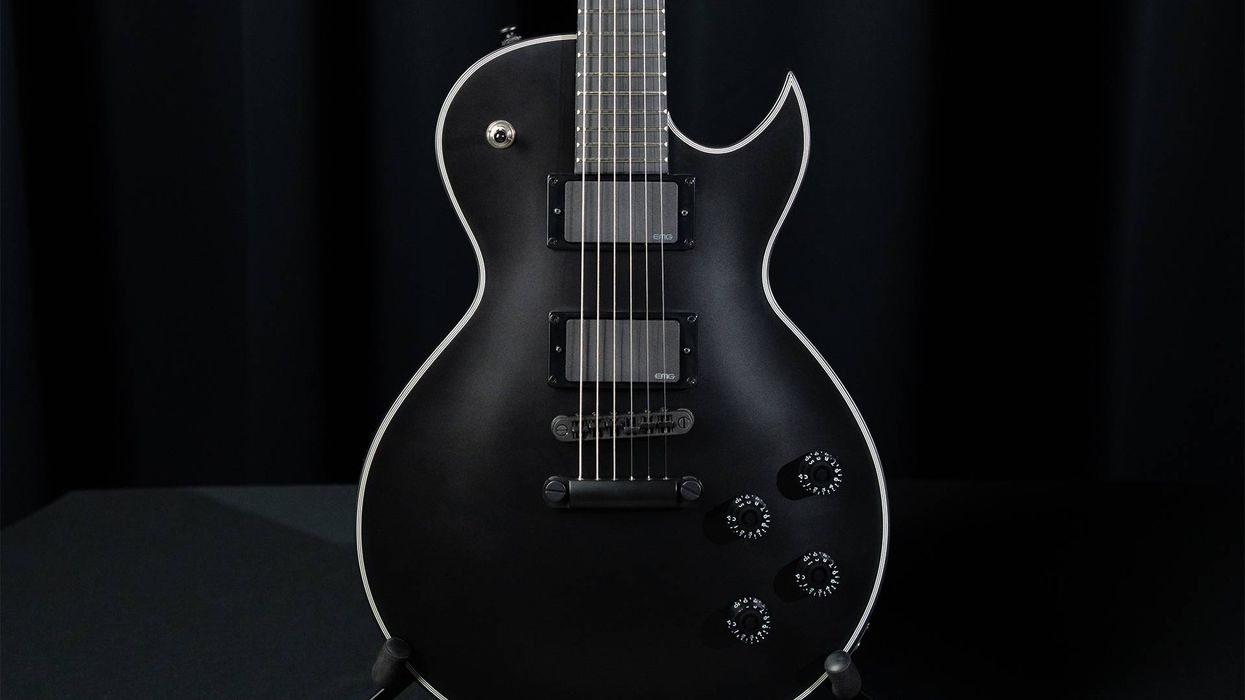
Cort announces the expansion of its single cut lineup with the introduction of the CR300MT electric guitar. Developed to fulfill the evolving preferences of contemporary guitarists, this guitar unites a highly requested combination of components and materials in a classic design.
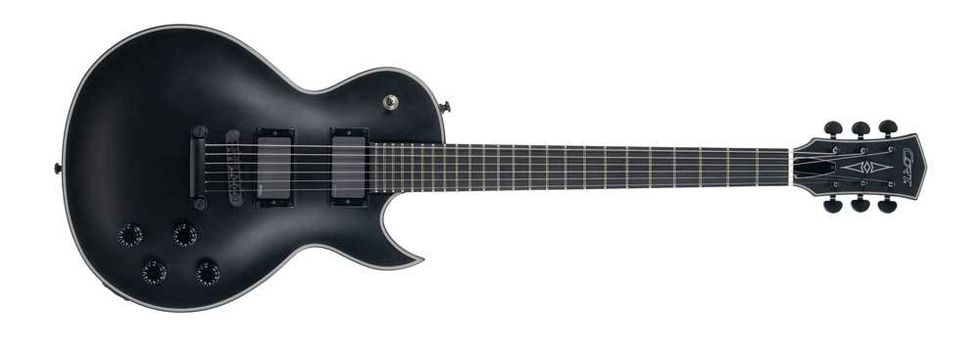
Built with a focus on traditional material choice, the CR300MT features a solid mahogany body configured to deliver sustained resonance and low-end warmth. The instrument is finished in a modern, streamlined Black Satin (BKS) finish, highlighting a clean aesthetic highlighting the physical architecture of the guitar body without distraction. The multi-ply white-and-black binding wraps the perimeter of the body and headstock, serving as a stark architectural outline against the deep satin color.
The guitar layout relies on a traditional set-neck construction, seamlessly pairing the mahogany body with a robust mahogany neck. This configuration refines mechanical stability and string-vibration transfer across the entire length of the instrument. Built to a classic 24.75-inch (628mm) scale length, the neck is capped with a durable Micarta fingerboard carved to a comfortable 12-inch (305mm) radius. The fretboard hosts a full 24-fret layout with nickel-silver frets. At the headstock is a premium Graph Tech® TUSQ nut, measuring a standard 1-11/16 inches (43mm) in width to ensure comfort and tuning stability.
The electronic architecture of the CR300MT is powered by a high-output EMG® 81 and 60 active humbucker pickup set to provide tonal versatility. This iconic pickup pairing is wired into an intuitive, control array consisting of two individual volume knobs, two individual tone knobs, and a standard 3-way toggle switch. This layout gives musicians precise control over their output shaping, allowing for immediate switching and independent adjustments between the neck and bridge pickup positions.
Rounding out the specifications, the CR300MT is equipped with Grover® Rotomatics™ tuning machines for reliable tuning stability and micro-adjustment precision. On the body, string tension and height are regulated by a classic Tune-O-Matic-style bridge paired with a secure stop tailpiece.
For more information, please visit the official Cort website at www.Cortguitars.com
Street Price: $899.99 USD
Pages
