
Music is the universal language
“Glory to God in the highest heaven, and on earth peace to those on whom his favor rests.” - Luke 2:14
General Interest
Podcast 560: Bryan Sutton
Bluegrass guitar hero Bryan Sutton joins us this week to talk about his brand-new album, From Roots to Branches, Vol. 1( Mountain Home Music Company).
The album features Sutton in duos with a bevy of friends, including Tommy Emmanuel, Billy Strings, Joe Bonamassa, Sierra Hull, the late Doc Watson, and others. As you’ll hear, the performances range from straight bluegrass to a rather rocking song with Billy Strings.
We also talk about his Blue Ridge Guitar Camp, session work, the joys of downsizing your guitar collection, and the secret studio weapon known as the Epiphone Seville (who knew?). We even brainstorm on a rather hilarious Fretboard Summit golf tournament.
https://www.bryansutton.com
https://www.blueridgeguitarcamp.com
We are brought to you by Peghead Nation: https://www.pegheadnation.com
(Get your first month free or $20 off any annual subscription with the promo code FRETBOARD at checkout).
Mike & Mike’s Guitar Bar: https://mmguitarbar.com
Above photo: Ali Hasbach


The post Podcast 560: Bryan Sutton first appeared on Fretboard Journal.
Luthier on Luthier: Jamie Gale
Jamie Gale is one of the most influential and forward-thinking voices in the guitar world. He is the founder of the Boutique Guitar Showcase, but his perspective goes far beyond guitars. His work has taken him into areas like artificial intelligence and robotics.
For episode 117, we talk about the changing cycles of the guitar industry, the rise of the Boutique Guitar Showcase, and some hard-earned lessons in business. Most importantly, Jamie shares his thoughts on what it takes for an independent guitar maker to build a distinctive identity.
Link: https://www.jamiegale.net
Luthier on Luthier is hosted by Michael Bashkin of Bashkin Guitars and brought to you by the Fretboard Journal. This episode is sponsored by the Looth Group, Dream Guitars, and StewMac.
Want to support Luthier on Luthier? Join our Patreon to get access to exclusive photos and content from Michael and his builds.

The post Luthier on Luthier: Jamie Gale first appeared on Fretboard Journal.
Paul Reed Smith to be Inducted into the Guitar Center Rockwalk

PRS Guitars and Guitar Center today announced that the national retailer is inducting Paul Reed Smith into the Hollywood Rockwalk, the handprint-and-signature tribute outside Guitar Center’s flagship Hollywood store on Sunset Boulevard. This pedestrian path and industry-recognized music landmark is dedicated to honoring the musicians and industry pioneers who have made significant and lasting contributions to the growth and evolution of music, through an exceptional level of talent, outstanding innovation and creative ingenuity.
John Mayer will give the induction speech to honor Smith. The handprint ceremony will take place September 26th at the Dell West Plaza Rockwalk Stage at the Moody Center during the Crossroads Guitar Festival in Austin, Texas. The completed handprint will later be installed at Rockwalk outside Guitar Center’s flagship Hollywood store.
“The first time I saw a Rockwalk induction, Ted McCarty was getting inducted and Eddie Van Halen was one of the people in attendance to witness it. I was very pleased for Ted. That I’ll be in the middle of another induction is an honor and leaves me without words. I look forward to seeing everyone,” said Paul Reed Smith, Managing General Partner of PRS Guitars.
“There are very few people in the history of the electric guitar who have pushed the design and perfection of the instrument forward more than Paul,” said Gabe Dalporto, CEO of Guitar Center. “He has inspired generations of musicians and instrument makers and is a living legend in our industry.”
Since its founding in 1985, Rockwalk has celebrated some of the most recognized names in rock, blues, soul and popular music through signature and handprint ceremonies outside the Guitar Center Hollywood. More than 150 artists and innovators have been inducted, including gear pioneers Jim Marshall, Robert Moog and Les Paul, as well as music icons including Eric Clapton, John Lennon, Stevie Wonder, Aerosmith, Janis Joplin, Jimi Hendrix, Alanis Morissette, Black Sabbath, The Ramones, Elvis Presley and Johnny Cash. Located at the entrance of Guitar Center’s flagship Hollywood store on Sunset Boulevard, Rockwalk is a permanent public destination where fans and musicians connect with music history year-round.
For all of the latest news, visit www.prsguitars.com and follow @prsguitars on Instagram, TikTok, Facebook, X, and YouTube.
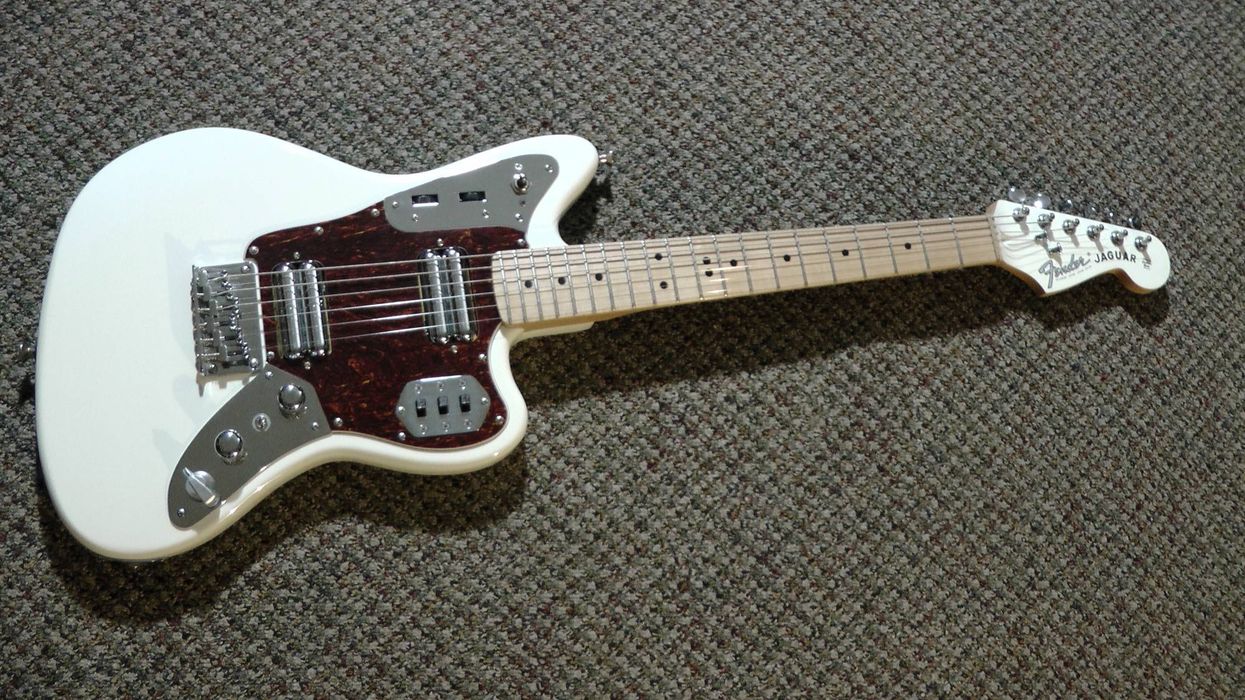
Reader Guitar of the Month: The Incredible Shrinking, Tenor-Tuned Jaguar
Reader: Verne Andru
Hometown: Vancouver, British Columbia
Guitar: Mini Jaguar tuned in 5ths
I fell down the alt-tuning rabbit-hole by moving from guitar to mandolin, before landing on extended-range tenor guitar. I wanted a nice electric for that purpose, so I approached the Fender Custom Shop through my dealer for a 5-string Jaguar tenor but was told they couldn't do it. I let the idea slide. But then Fender released their Squier Mini Jazzmaster with a 22.75" scale. I realized it would be the perfect platform for tenor tuning—in 5ths—but across six strings. Making it more Jaguar-like would be up to me and Vancouver luthier Paul Iverson.
I found a used Mini Jazzmaster at Guitar Center, but the action was terrible and the fret ends needed attention. I pulled the neck to level the frets and was puzzled by the fret wire. It didn’t feel like the soft nickel I’m used to finding on inexpensive guitars, and it wasn’t stainless, either—but it still fought me. After leveling, I recrowned the frets, dressed the sharp ends, and polished them with 800- and 1,500-grit sandpaper. I’ve never gotten a fret job right on the first pass, but I can usually get it where I want over time as I get used to the feel of the instrument
While the bridge is nothing fancy, it was high quality and the saddles allow a wide range of adjustments. The bigger surprise was the pickups, which sounded great. Even so, I thought GFS’ lipstick humbuckers would be a better fit, and I love the simplicity of lipstick designs in general. With the style of a 1964 Jaguar in mind, I used a tortoise pickguard, but also painted a matching headstock, over which I laid a Jaguar decal. Cutting the pickguard for the Jaguar control plates took some time, but with the cuts made and the Jaguar plates in hand, I got to work on the switching.
I learned electronics from Gar Gillies of Garnet amp fame, so I was comfortable trying a few things. Each pickup’s coils can now run in series, in parallel, or as a single-coil, and a push/push volume knob puts the two pickups in series or parallel with each other. There’s also a zero-load switch that bypasses the volume and tone controls, a blend knob for the two pickups, and a phase switch where a Jaguar’s “bass strangle” switch would go.
The project came out well, and the guitar has become a reliable daily player. I added Wilkinson tuners with a 19:1 ratio for finer tuning. Their long posts have two string holes, and I use the upper one on the Bb so the string doesn’t kink over the nut and throw off the intonation. The lipstick humbuckers sound great, and the guitar is light and easy to play. Tuned in fifths—Bb–F–C–G–D–A—it covers an enormous range. The low string sits a semitone below the low B on a 7-string, and the top string climbs into mandolin territory. Best of all, the switching options give me that many more ways to work with that range. It’s a small guitar, but it does a lot.
John Mayer honours Dolly Parton with instrumental I Will Always Love You cover

John Mayer has paid tribute to Dolly Parton with an emotional instrumental rendition of I Will Always Love You.
The guitarist performed the country classic during his SiriusXM concert at the Stephen Talkhouse in Amagansett, New York, on 26 August, a day after news broke of Parton’s death.
Mayer worked the song into the intro of Gravity, playing Parton’s familiar melody on his PRS Dead Spec Silver Sky and giving it a bluesy spin of his own before moving into his own song.
Before the show, Mayer also reflected on Parton’s death and the extraordinary reaction to her passing, particularly the way her music brought people together.
 Credit: Rick Diamond/ Getty Images
“I think Dolly would be really happy to see that on the day of her passing, the world came together in a way that it hadn’t in a very long time to celebrate someone,” he says.
“I don’t know that there are many people in this world [that are] left that can galvanise a very fractured world to come together and share love for one person. When everyone’s loving one person at the same time, it is everybody loving at the same time, which has this sort of side effect of feeling each other’s love when that happens.”
“This is what a life well-lived looks like, feels like, and sounds like,” Mayer continues, describing her career as a “brilliant, classy, talented, full artistic rendering”.
“This is how you give your life to the thing you love.”
Parton, who died aged 80, was one of the most celebrated songwriters and performers of her generation. I Will Always Love You was written and recorded by Parton in 1973, becoming one of her signature songs before taking on an entirely new life through Whitney Houston’s hugely successful 1992 cover for The Bodyguard.
Watch Mayer’s tribute below.
The post John Mayer honours Dolly Parton with instrumental I Will Always Love You cover appeared first on Guitar.com | All Things Guitar.
“It changed my career”: Joe Bonamassa pays tribute to Tim Curry and recalls their “perfect” connection
![[L-R] Joe Bonamassa and Tim Curry](https://guitar.com/wp-content/uploads/2026/08/Joe-Bonamassa-Tim-Curry-hero@2000x1500.jpg)
Blues legend Joe Bonamassa has paid tribute to actor Tim Curry, who died earlier this week at the age of 80.
Curry is well-remembered for his roles as Pennywise the Clown in the original IT movie, as well as in The Rocky Horror Picture Show, Clue, and Home Alone 2: Lost in New York. Bonamassa posted a tribute to Curry on Instagram yesterday (August 26).
He wrote: “Rest in Peace Tim Curry. Many do not know that Tim cut the original version of Sloe Gin on his debut album Read my Lips in 1978. The song was composed by Bob Ezrin and Michael Kamen.
“20 years ago Kevin Shirley rang me and said he found the perfect desperate blues song for me. He was right and our version changed my career trajectory forever. Tim’s version was bold, beautiful and featured the mastery of Dick Wagner on guitar.”
Alongside the written tribute is a video of Bonamassa performing Sloe Gin. The song remains one of Bonamassa’s biggest hits to date. He once told Total Guitar: “That song initially came to me via [producer] Kevin Shirley who was born in South Africa. It was a hit there but nowhere else.
“I have to give a special shout out to Steve Hunter and Dick Wagner who played on the original version. They were basically Bob Ezrin’s ringers… What you hear on the record and how we play it live are two different things. That song’s got a life of its own. I’m thrilled with that… sometimes we just have to play it!”
Curry’s 1978 release included not only the Ezrin and Kamen track but also featured covers of work by Paul McCartney and John Lennon, Roy Wood, and Joni Mitchell.
The post “It changed my career”: Joe Bonamassa pays tribute to Tim Curry and recalls their “perfect” connection appeared first on Guitar.com | All Things Guitar.
The baritone hype is real – and Gibson’s getting in on the action

Baritones seems to be all the rage in 2026, with a particularly eye-catching model recently coming from Jackson in partnership with Sleep Token.
It’s been a while since Gibson dipped its toes in the baritone pool – the last time extended-scale guitars among its product catalogue being the early 2010s, with the SG Baritone, Explorer Baritone and Les Paul Studio Baritone.
And while it’s not as radical a model as the new Jackson Monarkh for Sleep Token’s guitarist IV – which ships tuned an entire octave down – Gibson has revived its baritone offering once more, with the all-new Victory Baritone.
Shipping with a B-to-B tuning, made possible and more stable by a longer 28″ scale length (typically, Gibson guitars measure up 24.75″), the Victory Baritone features a double-cutaway mahogany body with “updated Victory contours for enhanced comfort, balance, and stage-ready performance”, as well as a glued-in mahogany neck, and compound-radius ebony fingerboard with 24 medium jumbo frets and acrylic dot inlays.
 Credit: Gibson
An extended-scale guitar sort of calls for high-gain, drop-tuned riffs, so the Victory Baritone is equipped with a pair of newly designed Gibson ELEV8 humbuckers, which are said to offer “powerful tone with unmistakable Gibson character”, with alnico 8 magnets and custom-gauge wiring. These electronics also include push-pull controls for coil-splitting as well as inner-outer coil selection.
 Credit: Gibson
The new Victory Baritone is just the latest addition to Gibson’s cult classic Victory line, which received a significant revamp back in 2024. We recently got our hands on the line’s Floyd Rose equipped model, and gave it a near-perfect 9/10 review.
Available in British Racing Green and Graphite Metallic, the Victory Baritone is priced at $2,499/£2,149.
Learn more at Gibson.
The post The baritone hype is real – and Gibson’s getting in on the action appeared first on Guitar.com | All Things Guitar.
Tom Morello’s “Arm the Homeless” guitar pickup combo is now available as an EMG signature set

Want to get a little closer to Tom Morello’s guitar tone without, you know, actually being Tom Morello? EMG has just made the pickup combination behind his legendary “Arm the Homeless” guitar available as a signature set.
The new Tom Morello TM Set pairs an EMG 85 in the bridge with an EMG H in the neck, recreating the exact setup that has been at the heart of Morello’s sound for decades.
And this isn’t just a pickup pairing the Rage Against the Machine guitarist happened to like. The EMG 85 and H have been the foundation of Morello’s “Arm the Homeless” guitar since the late ’80s, with the iconic axe appearing on every recording and live show he has played since then.
So, what are you actually getting? For starters, the set comes with the throwback EMG logos found on the pickups in Morello’s original guitar, along with a commemorative “ATH” Tom Morello guitar pick.
At the bridge is the EMG 85, an active humbucker designed to deliver plenty of output, punch and low-end heft while keeping its highs controlled and articulate. Morello says he chose it specifically for the “hard metal sound” he wanted from his riffs and solos.
The neck pickup is where things get a little more interesting. The EMG H is essentially an EMG S single-coil tucked into a humbucker housing. That means you can drop it into a guitar routed for humbuckers while still getting the kind of single-coil character associated with a Strat.
For Morello, that single-coil character is a big part of what makes a “heavy” guitar sound work. As he puts it: “Some of the greatest riffs of all time are done on a Telecaster with a single-coil pickup.”
“A lot of times, guitar players think they have to have the most manly, alpha, distorted sound in order to be heavy. That’s not the trick,” says Morello. “It’s the tone, and the chemistry of the people you play with. And so with this pickup, there was a springiness to the tone, a funkiness to the tone with the way that I played. It has made fields of people bounce up and down over the course of the last three decades.”
The EMG Tom Morello TM set is available now for $249. Like all EMG products, this set includes the solderless wiring system for simple installation.
Learn more at EMG.
The post Tom Morello’s “Arm the Homeless” guitar pickup combo is now available as an EMG signature set appeared first on Guitar.com | All Things Guitar.
Tony Iommi wanted Brian May to play on more of his new solo album: “But he went, ‘Oh no, it’s your album!’”

Black Sabbath guitarist Tony Iommi is gearing up to release his first solo album in more than two decades, From The Dark, with longtime friend and Queen guitarist Brian May among its guest contributors.
In a new interview with Loudwire, Iommi opens up about how May ended up on the record – and reveals that he’d actually asked his old friend to play on more than one track.
The collaboration came together pretty casually, with May dropping by Iommi’s house and the two guitar legends doing what they’ve apparently been doing for decades: picking up guitars and having “a little fiddle about”.
“He brings a guitar or I’ve got one here and he’ll use that,” says Iommi. “I said, ‘Oh, bring your guitar when you come,’ he brought his guitar and I said, ‘You’re going to be playing on this track here.’ He’s great.”
May ultimately contributes to Death Wake, the sixth track on From The Dark. Iommi, however, had hoped to get a little more out of his old friend.
“I said to him, ‘Play on some other tracks,’ but he went, ‘Oh no, it’s your album,’” Iommi recalls. “That’s the relationship we’ve had with each other for all these years. We’ve played a lot together. He is a great friend.”
Iommi says the pair have known each other for “56, 58 years” and describes May as his best friend, alongside another legendary guitarist – Eddie Van Halen.
“We’ve known each other for 56, 58 years. He’s my best friend. And of course, Eddie Van Halen was. We always stayed in touch a lot. They were the only two I really did stay in touch with.”
Beyond May’s contributions, the rest of From The Dark came together just as smoothly. Despite being his first solo album since 2005, Iommi says there was little pressure in the studio to force things.
“It’s been good fun, there’s no pressure,” he says. “If nothing happened, nothing happened, then we’d do it the next time. But it did, every time we come to record something, it’d work.”
From The Dark is due out on 23 October. Listen to the lead single World Alone below.
The post Tony Iommi wanted Brian May to play on more of his new solo album: “But he went, ‘Oh no, it’s your album!’” appeared first on Guitar.com | All Things Guitar.
“You hang with Ed, you’re not going to be talking about life in general. It’s about gear!” RATT’s Stephen Pearcy on the lessons he learned from his neighbour Eddie Van Halen

If you only lived half a mile up the hill from Eddie Van Halen in the ’80s, there was probably only one sensible thing to do: let him come over and talk guitars.
That was the case for RATT frontman Stephen Pearcy, whose house was close enough to Van Halen’s that the guitarist would regularly cruise over on his motorcycle when he knew Pearcy was home.
Speaking on the Mighty VH Podcast, Pearcy recalls how his “three-level, high-tech” house – jokingly dubbed the White House – became something of a hangout for the legendary rocker.
“I had a house we called the White House. It was a three-level, high-tech house. And I was never there. I was always on the road,” Pearcy says. “But when Ed would know I was home, he’d cruise over and, you know, go back up the hill on his motorcycle and get busted for being at my place.”
When Pearcy headed up the hill to return the favour, he’d often find himself in Van Halen’s studio, where the conversation inevitably turned to guitars.
“I’d go up there and check out the studio and hang a bit. I mean, we were trading guitars. It was all about Charvels and guitars,” he recalls.
Pearcy admits he wasn’t particularly interested in Van Halen’s obsession with the whammy bar at first. That changed when he started bringing some of his San Diego friends along, including RATT guitarist Robbin Crosby.
“I wasn’t really into his kind of trip, the whammy, this and that. But the minute I brought Robbin up there – I started bringing my San Diego guys up with me to check Van Halen out – Robbin and Ed became friends.”
That friendship came with a pretty useful perk: one-on-one guitar lessons from Eddie Van Halen.
“We’d literally go to his house, Ed’s house, and he’d have a little workshop in his bedroom or somewhere and he’d tell Robin how to keep in tune with the whammy. There were no lock bars back then,” Pearcy says.
Van Halen’s lessons didn’t just stop there. He also shared tips on keeping strings fresh and getting the most out of the guitars they were constantly tinkering with.
“A lot was going on. How to keep your strings fresh and new,” Pearcy says. “And I’m just taking notes, and these two guitar dummies are taking notes too.”
“You go, you hang with Ed, you’re not going to be talking about, you know, life in general. It’s about gear,” he continues. “Unless he wants to tell you something else.”
Watch the full interview below.
The post “You hang with Ed, you’re not going to be talking about life in general. It’s about gear!” RATT’s Stephen Pearcy on the lessons he learned from his neighbour Eddie Van Halen appeared first on Guitar.com | All Things Guitar.
T-Rex TwinBlaze review – one tube-driven pedal to cover all your rocking needs?

€299/$289/£249, t-rex-effects.com
The T-Rex TwinBlaze is the kind of stompbox that might just save the world. Okay, a piece of guitar gear isn’t going to do much about climate change or global conflict, but it takes an issue that’s just as polarising – single pedals versus multi-effects processors – and finds a way to combine the best aspects of both sides.
In spirit, this is a proper old-school dirt pedal for the purists, made in Europe and powered by a real preamp tube… but it also brings the simplicity and efficiency of having three effects in one: two switchable overdrive/distortion circuits plus a separate clean boost. Maybe that means everyone will love it, and the human race can live in harmony again?
 Image: Adam Gasson
What is it?
Proudly bearing the words ‘handcrafted in Denmark’, the TwinBlaze is part of an expanding range of homegrown pedals from a company that used to be pretty much all-in on Chinese production. I’m a big fan of the Danish-made reissue of the Mudhoney distortion, which has been around since 2018, so this neatly designed green metal box certainly has pedigree.
It’s billed as “a tribute to the 1980s golden era of rock” – and while you might struggle to match the word ‘golden’ to the bulk of the music of that decade, you can’t ignore the enduring appeal of the (mostly Marshall) amps that powered it. So what you’re getting here is two channels of old-school rock drive, plus a boost circuit to give it a kick up the jacksy on the way out.
Each channel has a control array that follows the Marshall JCM800 template – preamp gain and output level plus bass, middle, treble and presence – plus a toggle switch for ‘crunch’ or ‘lead’ mode. Both channels are voiced the same, so if you match up the settings there’ll be no difference when you flip between A and B.
As with the new T-Rex RoomMate D’Luxe reverb, a 12v power supply is included in order to supply enough juice to get the JJ ECC83S properly cooking – and again that valve has a slightly silly LED at its base, just in case you feel shortchanged by the low-key orange glow of the real thing.
 Image: Adam Gasson
Usability
Look at the control panel of the TwinBlaze when it’s in bypass and you’ll see two rows of six unmarked knobs – what is this, Russian roulette for tone-tweakers? Luckily, once a channel is engaged its corresponding row of markers lights up for easy visibility – in yellow for crunch mode, or orange for lead. It’s a smart system, just as long as you don’t need to make changes while the pedal is off.
The boost circuit gets its own orange light, and beyond that the functionality of this unit is as simple as it could possibly be. Just make sure you use the right output: there’s a second one with speaker cab emulation for plugging directly into an audio interface.
 Image: Adam Gasson
Sounds
The obvious place to start is with channel A in crunch mode and channel B set to lead. That gives you a total of five sounds accessible by footswitching alone: crunch, crunch plus boost, lead, lead plus boost, and boost on its own. Nice, although I can’t help wondering why the two channels haven’t been voiced differently – say, Marshall on one side and Fender on the other – for even more flexibility.
Anyway, that JCM-style voice is a pleasing one – and, running through a clean black-panel amp, uncannily accurate. Start chugging away on palm-muted power chords and within a few seconds you’ll feel your hair starting to perm: it is that 80s sound, kicking out plenty of raspy midrange but with enough saturation and compression to avoid any harshness.
In crunch mode you can go from light breakup to moderately hairy overdrive, while the switch to orange lighting brings a corresponding fieriness that sounds superb on attention-grabbing solo runs. The boost switch can prove really useful here, giving a tonally neutral lift of up to 20dB – and it works pretty well on its own if your amp is running anywhere close to the crunchy zone itself.
If anything, it seems T-Rex has copied the classic Marshall template too closely in terms of the EQ controls: they work OK, but somehow never quite as emphatically as you want them to. Don’t expect total tone-sculpting power, then – but if you just need to dial in the right amount of treble and bass for your rig, and maybe give the mids an extra shunt for the heavy stuff, they’ll do the job.
I did give the speaker-emulated output a spin, just to see if this pedal could also serve as a standalone recording preamp, and the results were… well, alright. My guess is there’s nothing more than a simple EQ treatment going on in there, which keeps things balanced but doesn’t stop it sounding DI-ish.
 Image: Adam Gasson
Should I buy one?
If you’re still trying to get your head around that “1980s golden era of rock” thing, let it go. Yes, the haircuts were unforgivable, but for guitar tones that rocked harder than the sounds of the 70s, without yet going to the ultra-high-gain extremes of the 90s, this was indeed a perfect moment – and T-Rex has captured it.
For most players, a simpler pedal that can create one or two sounds in that tonal area will probably be enough; but if your idea of classic rock is more Def Lepp than Led Zepp, and you want one unit to cover all levels of dirt, the TwinBlaze is a persuasive candidate.
 Image: Adam Gasson
Alternatives
A high-class option that flips the formula by having one drive and two boosts is the Dinosaural Cogmeister (£359.99/$399). If you’re just after a dual overdrive with a Marshall-ish flavour, try the Browne Amplification Protein ($299/£349) or Warm Audio Throne of Tone ($229/£219).
The post T-Rex TwinBlaze review – one tube-driven pedal to cover all your rocking needs? appeared first on Guitar.com | All Things Guitar.
Two Taylor Voices. One Ultimate Showdown.

Friedman Introduces JOSE 20 Head and Combo
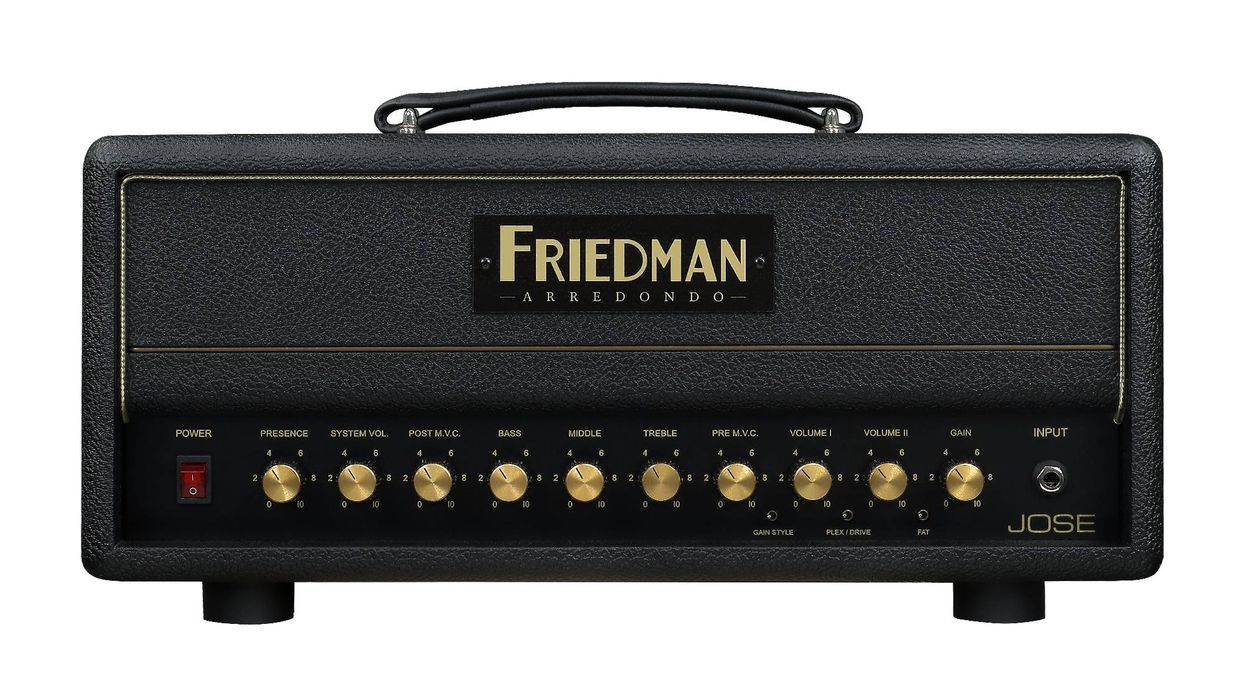
Following the success of the original Friedman JOSE 100, Dave Friedman has introduced the JOSE 20 Series. Available as both a compact head and a 1x12 combo, the JOSE 20 Series delivers the unmistakable voice, feel, and touch response of its 100-watt counterpart - now in a smaller watt format ideal for play at home, in the studio or on stage.
Developed by Dave Friedman in close collaboration with Jose Arredondo’s daughter, Marisol Arredondo, the JOSE 20 Series faithfully translates one of the most influential amplifier voices in rock history into a modern production amplifier. Rather than simply recreating Jose Arredondo’s amplifier modifications, Dave set out to capture the essence of Jose’s work - its feel, dynamics, harmonic complexity, and voice and faithfully translate it into the JOSE 20 Series.
Handcrafted in Los Angeles using premium components and custom-made transformers, every JOSE 20 is built to Dave Friedman’s uncompromising standards.
Jose Arredondo’s groundbreaking amplifier modifications helped define the sound of high-gain rock. His hot-rodded British amplifiers delivered greater sustain, richer harmonics, tighter low end, and a more responsive feel than players had ever experienced. They weren’t production amplifiers - they were individually modified instruments that became the secret weapon of countless professional guitarists and inspired generations of players, builders, and tone chasers.
The JOSE 20 Series distills that voice into a compact 20-watt platform. Internally bridged Volume I and Volume II recreate the classic channel-jumping technique players once achieved with patch cables, blending bright attack with warm body to create the rich harmonic foundation at the heart of the Jose sound.
The Plexi/Gain switch introduces a true additional gain stage, seamlessly moving from classic Plexi response into the aggressive saturation that defined Jose’s most celebrated modifications. The Fat switch adds body, low-end authority, and increased punch while preserving the articulation and clarity that make the amp exceptionally responsive.
The unique three-position Gain Style switch further expands the JOSE 20’s tonal palette by repositioning the master volume within the circuit while introducing diode clipping for additional bite and sustain. Rather than simply adding more gain, each position reshapes the amplifier’s response, delivering everything from articulate hot-rodded Plexi crunch to crushing rhythm tones and fluid, harmonically rich lead sounds.
A transparent series effects loop and System Master Volume allow players to experience authentic Jose dynamics at virtually any playing level.
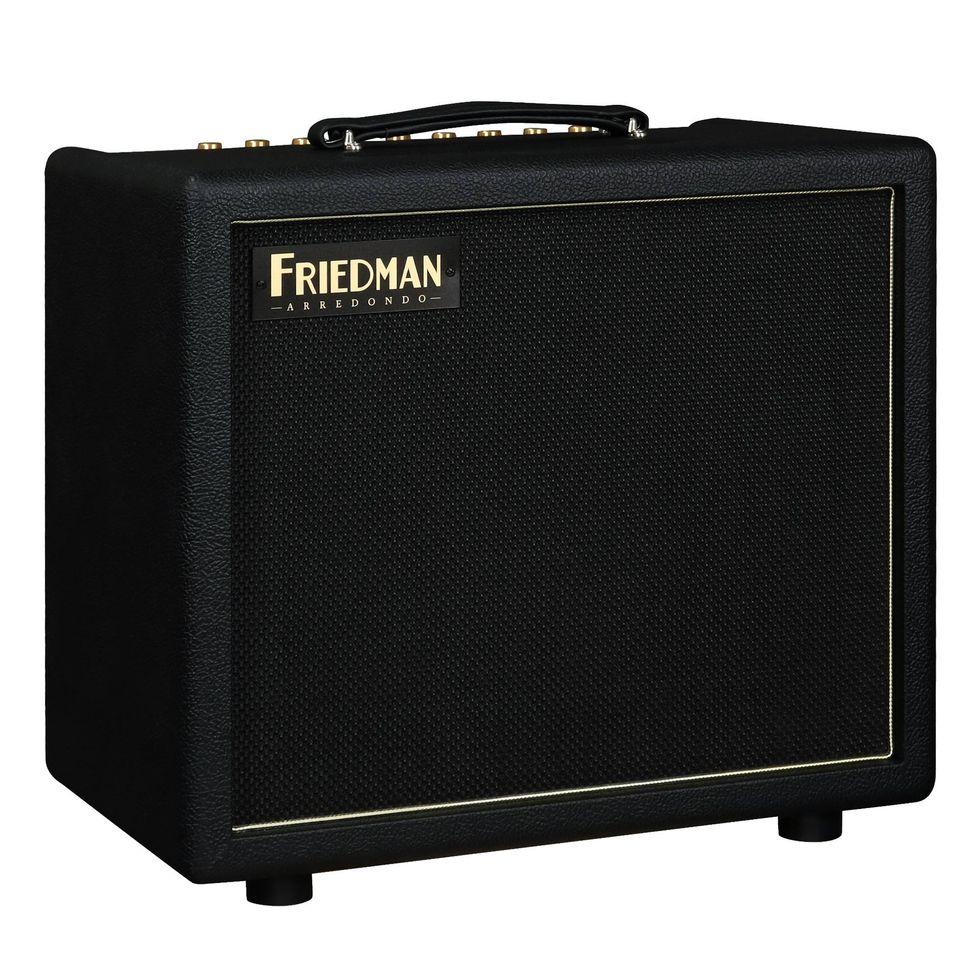
Available as either a 20-watt head or a 1x12 combo loaded with a Celestion G12M-65 Creamback, selected by Dave Friedman for its warm midrange, smooth top end, and dynamic response.
Key features include:
- Available as a 20-watt all-tube head or 1x12 combo
- 2 x EL84 Power Tubes4 x 12AX7 Preamp Tubes
- Combo loaded with a Celestion G12M-65 Creamback speaker
- Developed by Dave Friedman in collaboration with Marisol Arredondo
- Inspired by the legendary amplifier modifications of Jose Arredondo
- Internally bridged Volume I & II recreate classic channel jumping
- Plexi/Gain switch introduces a true additional gain stage
- Fat switch adds body, punch, and low-end authority
- Three-position Gain Style switch revoices the circuit for three distinct Jose-inspired gain structures
- System Master VolumeTransparent series effects loop
- Custom made transformers
- Handcrafted in Los Angeles, California, with Limited 5-Year Warranty
- Head Dimensions: 8.5" (D) x 18" (W) x 8.25" (H)
- Head Weight: 22.5 lbs.
- Combo Dimensions: 11.5" (D) x 18.75" (W) x 16.75" (H)
Friedman’s JOSE 20 amp head carries a $1799.99 street price and the 1x12 combo is street priced at $2099.99. For more information visit friedmanamplification.com.
JOSE 20 Head and Combo
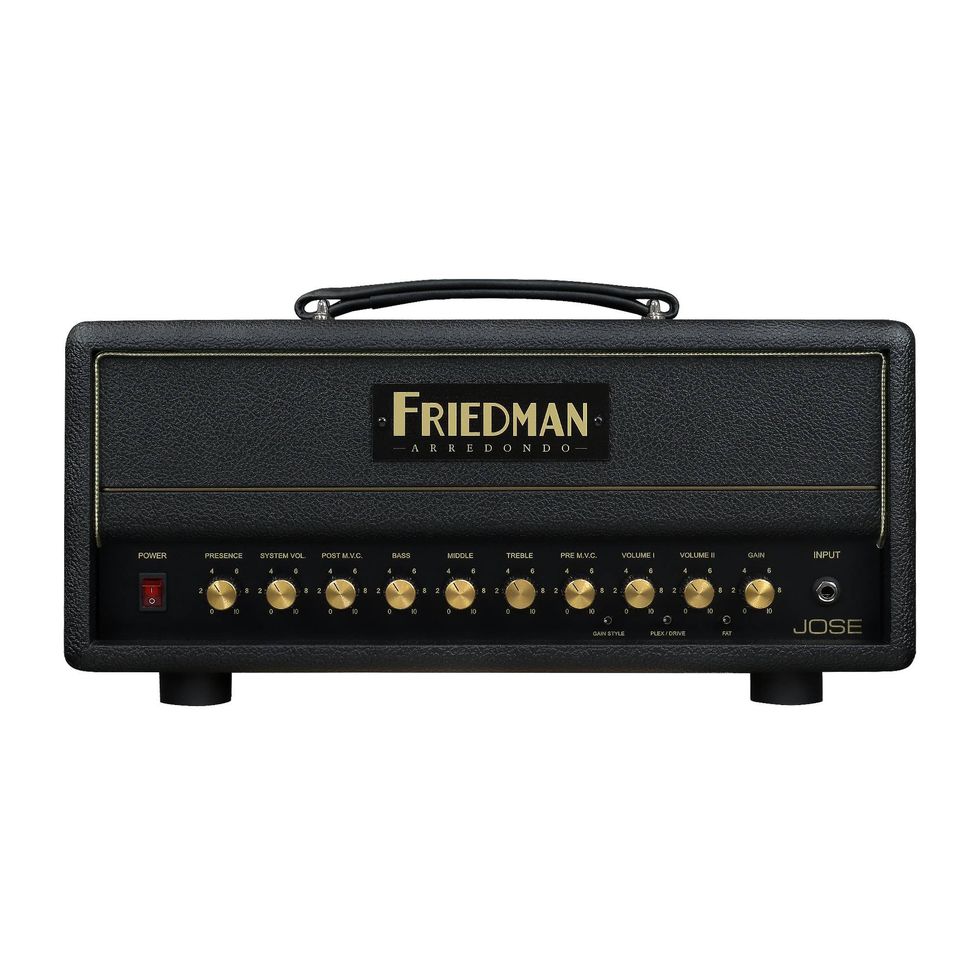
August 27, 2026 - Following the success of the original Friedman JOSE 100, Dave Friedman has introduced the JOSE 20 Series. Available as both a compact head and a 1x12 combo, the JOSE 20 Series delivers the unmistakable voice, feel, and touch response of its 100-watt counterpart - now in a smaller watt format ideal for play at home, in the studio or on stage.
Guitar Center unveils the 2026 Exclusive Crossroads Guitar Collection
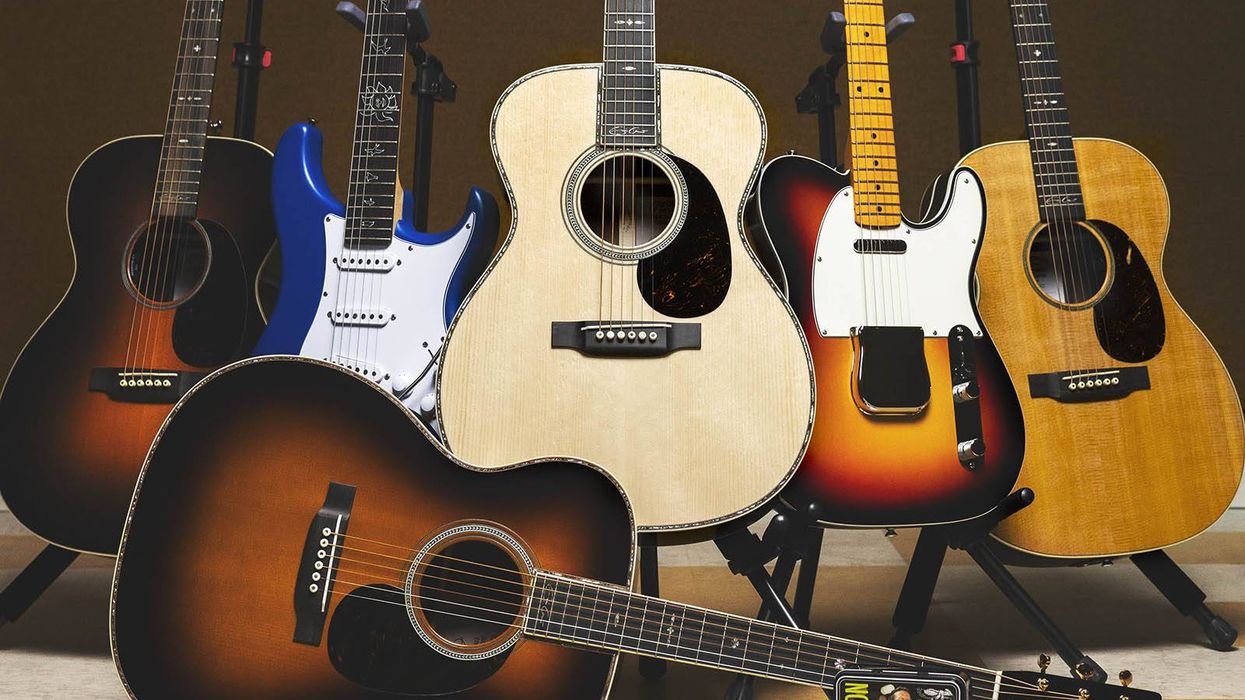
Guitar Center today unveiled the 2026 Exclusive Crossroads Guitar Collection (https://t.e2ma.net/click/l4543m/hda7hd/92s4tv), a lineup of signature guitars and accessories created in collaboration with Eric Clapton and industry-leading brands Martin, Fender and Ernie Ball. Launching ahead of the 2026 Crossroads Guitar Festival, the limited-edition collection builds on more than two decades of collaboration between Guitar Center, Clapton and the Crossroads organization. Proceeds from the collection support Crossroads Centre Antigua, the addiction treatment center Clapton founded in 1998.
Guitar Center’s relationship with Eric Clapton began in 2004, when the company purchased several of his most legendary guitars at the 2004 Crossroads Guitar Auction, including his iconic Blackie Fender Stratocaster, the Cream-era Gibson ES-335 and George Harrison’s Martin 00-21. Those historic instruments are now part of Guitar Center’s renowned Legends Collection, a one-of-a-kind archive of historically significant instruments on display at its flagship Hollywood store. Their acquisition laid the foundation for an enduring collaboration with Clapton and many of the world’s most respected guitar manufacturers, resulting in some of Guitar Center’s most coveted artist recreations and exclusive Crossroads Guitar Collections.
“For more than two decades, we’ve partnered with Eric Clapton and the Crossroads organization to create iconic instruments, with powerful stories behind them, and put them in musicians’ hands,” said Gabe Dalporto, CEO of Guitar Center. “The 2026 Crossroads Guitar Collection continues that tradition, with every one sold supporting a cause Eric has championed for decades.”
Guitar Center’s exclusive Eric Clapton collaborations have long been among the company’s most sought-after releases. The recreation of Eric Clapton’s legendary Blackie Stratocaster sold out in just four hours in 2006, becoming the company’s fastest-selling guitar launch at the time. More recently, Guitar Center’s exclusive Gibson Custom Eric Clapton 1958 Les Paul sold out in less than 12 hours following its 2025 debut. Since then, Guitar Center has continued its decades-long partnership with Eric Clapton through a series of exclusive Crossroads Guitar Collections, offering musicians first access to many of the collaboration’s most coveted releases.
Spanning handcrafted acoustic guitars, faithful recreations of Clapton’s most iconic electric instruments, and premium accessories, the 2026 Crossroads Guitar Collection offers something for every type of player – from exquisitely crafted collector pieces to signature models designed for everyday musicians. Developed in collaboration with Martin, Fender and Ernie Ball, each product celebrates a defining chapter of Clapton’s career while supporting the mission of Crossroads Centre Antigua.
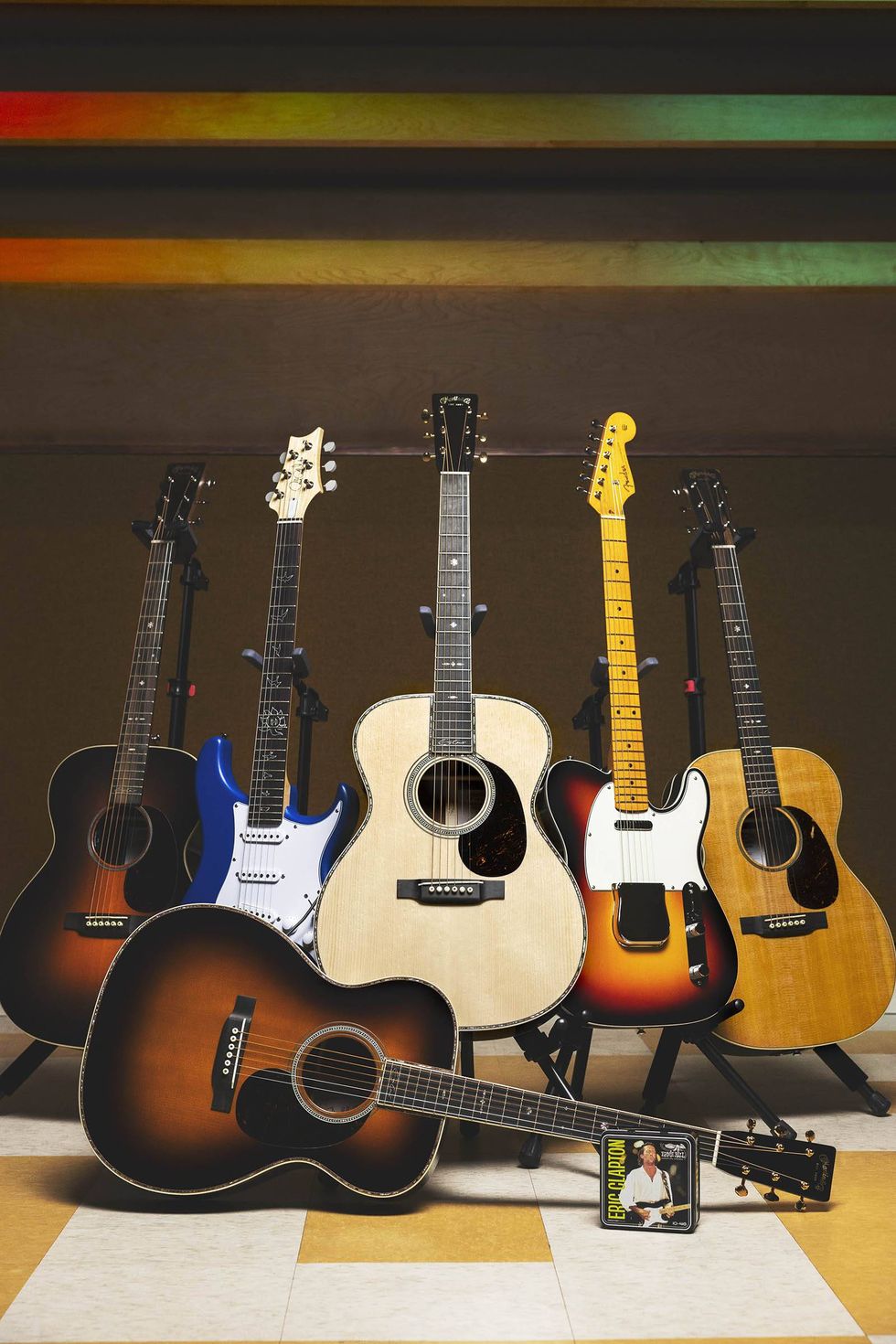
“Music has always been my most reliable source of inspiration, or salvation,” said Eric Clapton. “These guitars are sacred things to me.”
As the exclusive retail partner of the 2026 Crossroads Guitar Festival, Guitar Center returns to support the event and its mission to benefit Crossroads Centre Antigua. This year, Guitar Center will bring its presence to life through The Guitar Center Experience, an immersive destination at Austin’s Moody Center where fans can explore the new 2026 Crossroads Guitar Collection, connect with leading guitar brands including Fender, Gibson, Martin, PRS and Ernie Ball, and engage in hands-on interactive experiences throughout the weekend. Guitar Center will also offer on-site retail, giving attendees access to the exclusive 2026 Crossroads Guitar Collection and other festival merchandise.
In addition, PRS Guitars will support the 2026 Crossroads Guitar Collection in partnership with John Mayer, whose limited-edition PRS Silver Sky “Crossroads” model will be available exclusively through Guitar Center and make its first public appearance onstage with Mayer at the 2026 Crossroads Guitar Festival.
Complementing the new Crossroads Guitar Collection, The Guitar Center Experience will also feature a rare showcase of iconic guitars from Guitar Center’s renowned Legends Collection, including Eric Clapton’s legendary original Blackie Stratocaster and his Cream-era Gibson ES-335.
Fans will have a rare opportunity to view two of the most iconic guitars in rock history up close, while Guitar Center continues its legacy of honoring music’s most influential figures by inducting Paul Reed Smith, founder of PRS Guitars, into the famed Guitar Center Rockwalk during the festival.
Crossroads Guitar Collection Highlights
Martin Custom Shop 000-42 Eric Clapton Brazilian ($24,999.99)
The centerpiece of the 2026 Crossroads Guitar Collection, the Martin Custom Shop 000-42 Eric Clapton Brazilian represents the pinnacle of Eric Clapton’s more than 30-year relationship with Martin Guitar. Limited to just five instruments worldwide, the guitar is handcrafted with rare Brazilian rosewood back and sides, a solid Adirondack spruce top and Clapton’s preferred 000 body shape – the same style made famous during his legendary MTV Unplugged performance. Each guitar is personally hand-signed by Clapton and includes a Certificate of Authenticity, making it one of the most exclusive Eric Clapton signature guitars ever offered by Guitar Center.
Martin Custom Shop 000-42 Eric Clapton Ziricote (Natural & Sunburst) (starting at $9,699.99)
Joining the collection’s flagship Brazilian rosewood model, the Martin Custom Shop 000-42 Eric Clapton Ziricote pairs Clapton’s preferred 000 body shape with ziricote tonewood, prized for its rich sound and striking natural grain. Limited to just 50 guitars in each of two finishes, 1935 Sunburst and Clear Natural, the handcrafted Custom Shop model features a solid Adirondack spruce top, Golden Era 42-style appointments and an ebony fingerboard with an “Eric Clapton” signature inlay. Each guitar includes a printed Certificate of Authenticity and is available exclusively through Guitar Center.
Fender Blind Faith Telecaster ($4,999.99)
Inspired by the iconic guitar Eric Clapton assembled on his kitchen table in 1969 and debuted at Blind Faith’s legendary Hyde Park concert, the Fender Eric Clapton Blind Faith Telecaster faithfully recreates one of the most recognizable instruments of his career. Limited to just 130 guitars worldwide, the production model combines a Telecaster Custom body with a replica 1956 “Brownie” Stratocaster neck and period-correct details, while including both modern electronics and a vintage “Woof Tone” wiring kit for players seeking an authentic recreation. Available exclusively through Guitar Center, each guitar features a unique “EPC” serial number honoring Eric Patrick Clapton.
PRS John Mayer Silver Sky ($3,750.00)
Developed in partnership with John Mayer, the limited-edition PRS Silver Sky “Crossroads” features a unique Incline Blue finish, rosewood fretboard with a custom “Crossroads Sun” inlay at the 12th fret and a “Crossroads Guitar Festival 2026” neck plate. Limited to just 70 guitars, the model will make its first public appearance onstage with John Mayer at the 2026 Crossroads Guitar Festival.
Martin 000-13E Eric Clapton (Natural & Sunburst) (starting at $1,899.99)
Designed to bring an authentic Eric Clapton signature Martin to more players, the Martin 000-13E delivers Clapton’s signature acoustic style at the most accessible price point in the collaboration’s history. Inspired by the smaller-bodied 000 guitars Clapton has favored on stage and in the studio for decades, it features a spruce top with ziricote fine veneer back and sides, along with a built-in soundhole tuner and Martin E1 pickup—the first time those features have been offered together on an Eric Clapton signature Martin. Available in Antique Toner Natural and 1935 Sunburst finishes, the guitar is available exclusively through Guitar Center in the U.S. through Jan. 27, 2027.
Ernie Ball Eric Clapton Strings ($29.99)
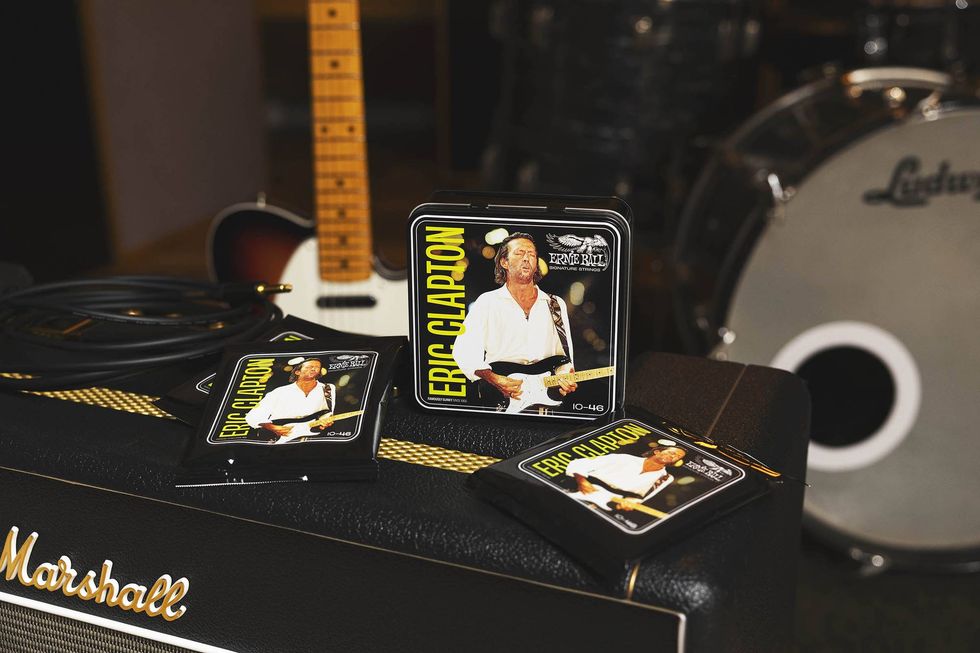
Celebrating nearly 50 years of Eric Clapton’s relationship with Ernie Ball, the Ernie Ball Eric Clapton Signature Strings mark the first-ever signature string set created in collaboration with the legendary guitarist. Packaged in a collectible commemorative tin containing three sets of Ernie Ball Slinky 10–46 strings—the gauge Clapton has relied on throughout much of his career—the limited-edition release gives players the opportunity to experience the feel and tone trusted by one of music’s most celebrated guitarists. Limited to 5,000 collectible tin sets and available exclusively through Guitar Center, the strings complete the 2026 Crossroads Guitar Collection.
The 2026 Crossroads Guitar Collection will be available beginning August 26 at Guitar Center stores nationwide and online at guitarcenter.com and will also be available for purchase at The Guitar Center Experience during the 2026 Crossroads Guitar Festival.
Vintage Vault: The Good, the Bad, and the Ugly of Vintage Guitars at the Movies
“It’s a Gibson SG, mint condish.”
Jack Black, as Dewey Finn, in the film School of Rock is the ultimate guitar salesman. Watch the scene where he puts the class band together, and you’ll pick up on his awesome energy. Dewey is so into what he’s teaching; he’s like some sort of a sanctified backwoods preacher on a sunny Sunday morning delivering the gospel. It’s his enthusiasm that sparks the kids into learning how to rock. What is Dewey’s Excalibur, his all-conquering and mighty weapon? It’s that Gibson SG guitar.
The way I see it, the guitar in cinema can be considered a ticket. In most cases, it’s a ticket to a better life for the person playing it. Be it creative expression, a way to escape poverty, or a way to escape the humdrum existence of the suburbs à la Marty McFly, the guitar, and music, can take you there.
Today, we’re going to look at the good, the bad, and the unexpected as far as vintage guitars are concerned in movies. Length constraints for this article dictate that I might miss your favorite guitar movie, and I apologize for that. I’ll talk about a couple of mine and maybe one you’re not familiar with.
First, the not-so-good. The Buddy Holly Story was released in 1978. It’s an excellent story about Buddy’s life, and Gary Busey is absolutely incredible portraying the young singer, songwriter, and guitar slinger from Lubbock, Texas. But man, for a guitar geek, it’s a little hard to watch. It’s like the people in the props department for that film didn’t do their homework at all.
In the beginning of this film, we see our hero playing at a roller rink in Lubbock, just before he finds fame as a recording artist. It’s a sock-hop and the kids are there to have some fun. It’s an infectious scene with great energy. What’s Buddy playing? A Fender Bronco.
Cue the record scratch: a Bronco? Wow, that’s an inspired choice! It’s also a guitar that didn’t make the Fender lineup for a full eight years after Buddy, Ritchie Valens, the Big Bopper, and their pilot died in a plane crash early in the morning of February 3, 1959 in Clear Lake, Iowa. It’s a cringe moment for guitar aficionados and historians alike.
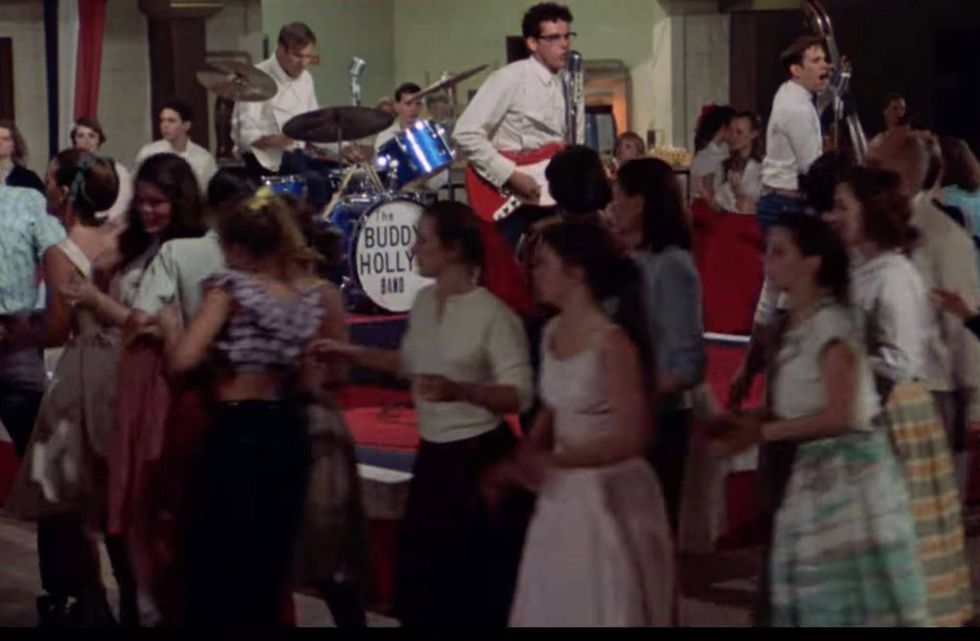
Not only is Holly playing a guitar that didn’t exist in the ’50s, he’s playing it through an amp made by a company that didn’t exist yet either. In the roller-rink scene, Buddy’s plugged into a Music Man amp. Music Man started production in 1974, a full 15 years after Buddy died. At the end of the movie, they show Holly playing his final show with a ’70s Strat with a large headstock. At least they got the Strat part right. It’s like they didn’t even try with the details!
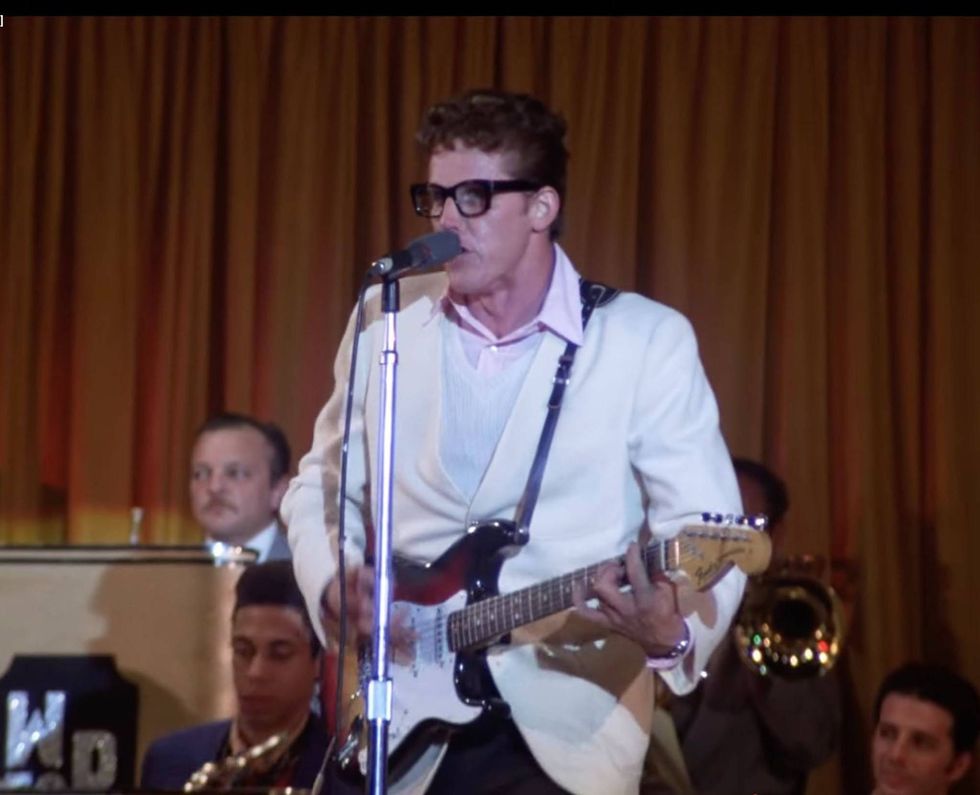
Don’t get me wrong—I love this film. The story is told in a compelling way, and it gets me every time. I just wish they would’ve paid even a small amount of attention to the musical instruments in the film.
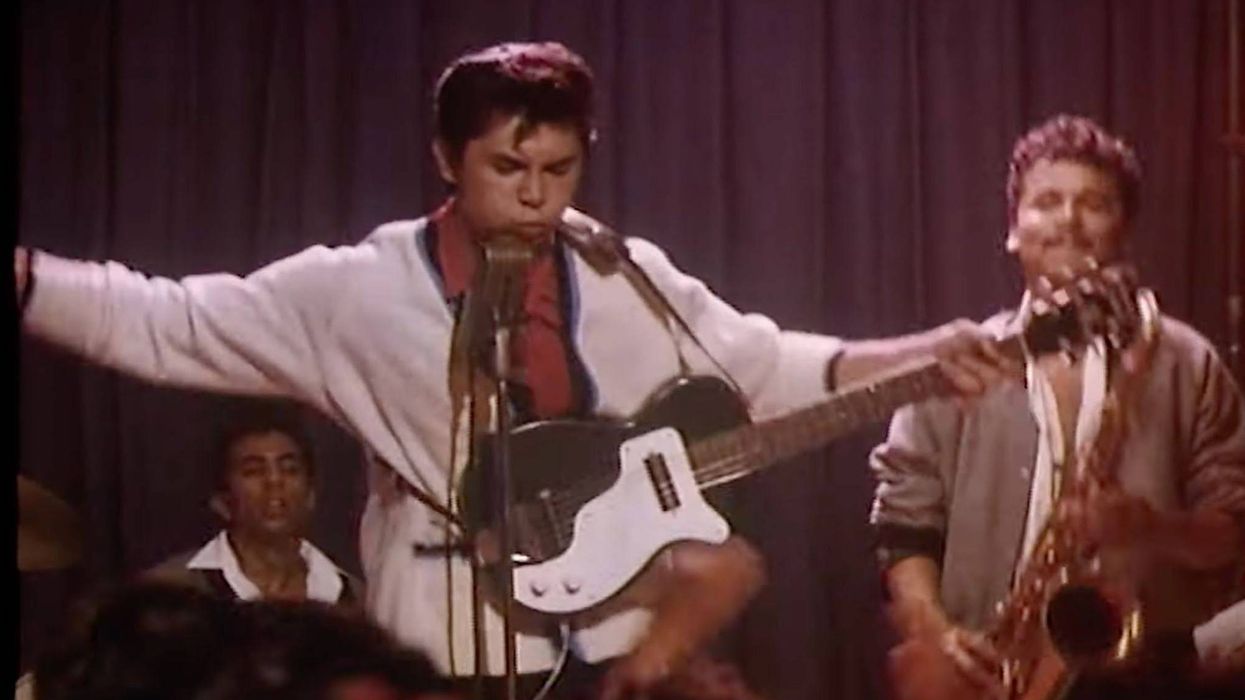
That was the bad; now for the good. La Bamba is my go-to Hollywood film for accuracy in the guitar department—ironically, a story concerning another man killed in the same plane crash, Ritchie Valens. Lou Diamond Phillips plays Ritchie, and does so with aplomb. Every character, every scene, in La Bamba is done with a level of care and attention to detail that seldom come together in a music biopic.
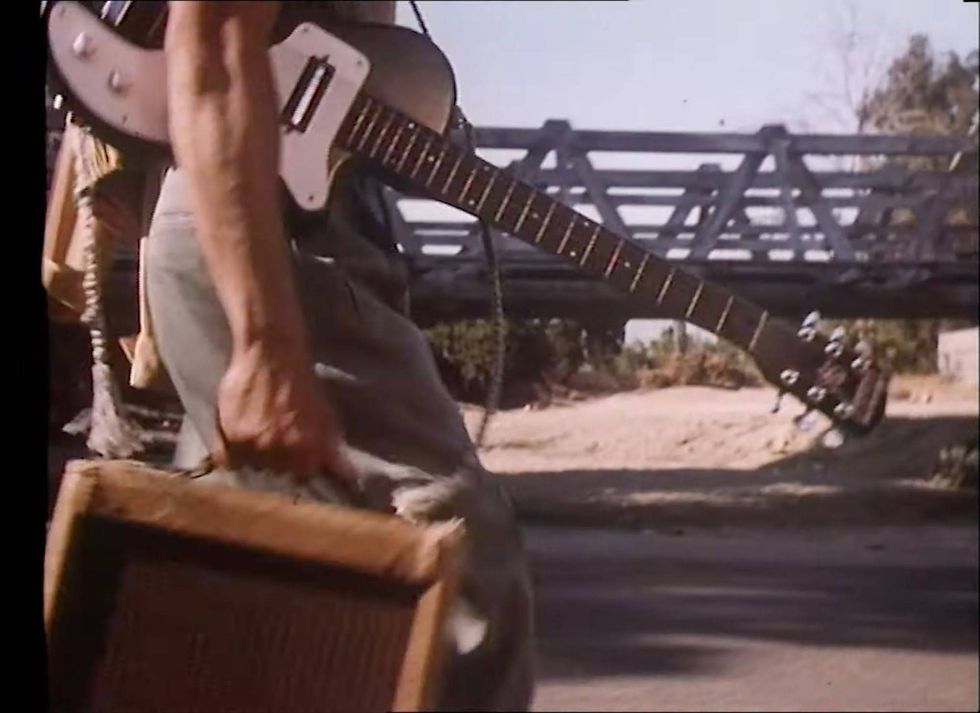
All the musical details in the movie are just about perfect. When pre-fame Ritchie shows up to audition for the Silhouettes, what does he have in tow? A seriously beat-up, single-pickup Harmony Stratotone, and a well-trashed Fender tweed Champ. This was probably the default setup for just about every fledgling rock ’n’ roll hero of the era. Nailed it! Later on in the film, after Ritchie has scored some chart success, we see him out driving around with his girlfriend, Donna. What’s in the back seat of Ritchie’s T’bird? It’s a tweed hardcase, with his Stratocaster inside. It’s a tiny detail, but those details make for a great film.
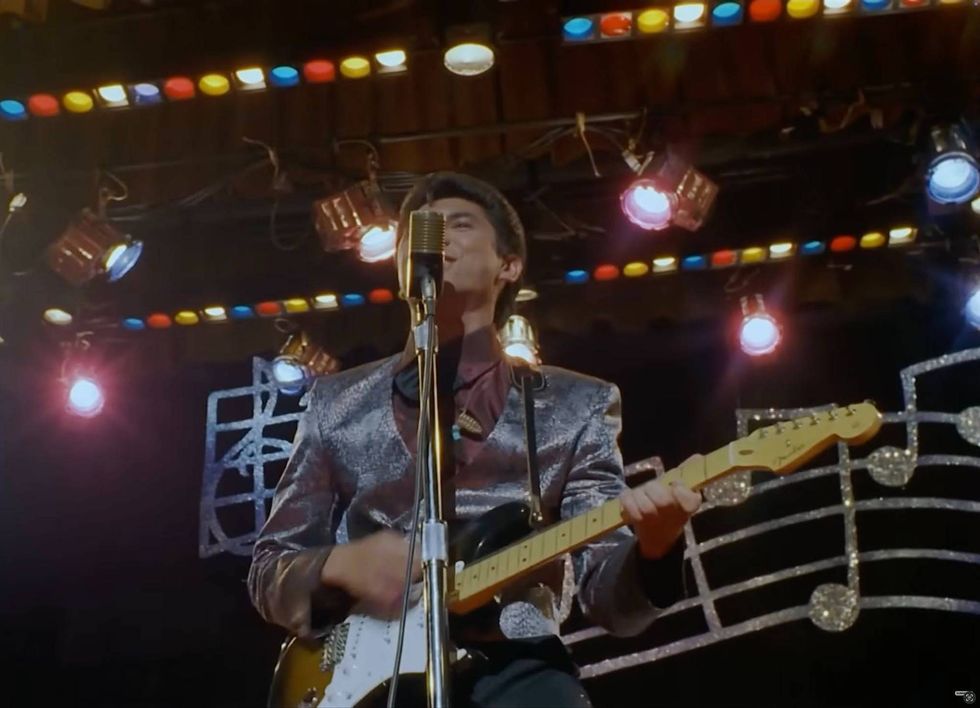
Later, when they show Ritchie playing on American Bandstand, he’s playing what looks like a lightly used ash-bodied Strat, which he probably picked up for $100 or less at a local pawn shop. Ash Strats were made from ’54 to ’56, so it would’ve been a little early for Ritchie to buy one new. At the end of the film, during his last show, he’s portrayed with yet another Strat. It’s a brand new, shiny, alder-bodied Strat. Ritchie likely received this one at the factory in Fullerton, right before he left for his first big tour in 1959. There’s some serious attention to detail in this film. If you haven’t watched it, do yourself a favor and look it up.
And now for the unexpected: Bell, Book and Candle. Made in 1958, it’s a wonderful rom-com about a witch who wants to experience love. (The film’s also the basis for the iconic TV series, Bewitched.) There’s some serious star power here, with Kim Novak as the witch, James Stewart as the love interest, and Jack Lemon as the troublesome little brother. Bell, Book and Candle has a couple of guitar sightings that will totally blow your mind. I don’t want to spoil them here—you just gotta watch it.
Until next time, happy viewing, and as they say in Tinseltown: Cut! That’s a wrap.
“By far the most meaningful record we’ve ever made”: Polyphia announce new album Be Not Afraid – listen to the first single now

Polyphia has announced their new album, Be Not Afraid, which will be released later this year. The band has not put out a studio album since 2022’s Remember That You Will Die and spent the last two years heading down “pretty dark rabbit holes” to come up with material for their fifth release.
The album announcement also saw the release of lead single, Power in the Blood. Polyphia worked on the album throughout 2024 and 2025 in Miami, Los Angeles, and Dallas.
Guitarist Tim Henson confirmed the composition of the album changed massively, initially singing lines out loud and then translating them to guitar. He said: “Instead of going wide on Be Not Afraid, we went as deep as we could. There are so many layers to pull back. Every time you listen to it, you’ll notice something new. Thematically, it’s by far the most meaningful record we’ve ever made.”
Guitarist Scott LePage added: “We physically can’t make the same album twice. We have a yearning to evolve. It was so much fun to write this one together too – the writing sessions for past Polyphia records typically looked like us gathering our ideas separately first and bringing them to each other second, so we took a different approach with Be Not Afraid by treating the sessions like an opportunity to create with everybody in the room first before getting into the separate writing.
“It was a much more communal approach that led to us having so much fun making it that the fun itself was the magic being captured.”
Henson added: “The album takes you through the extremes of two different worlds / moods: one being very uplifting and triumphant, the other being spine-chilling and terrifying. There are moments on the record that legitimately scare me when I listen to them.”
Tim Henson, who has been in the band since its founding in 2010, added that the band headed into darker territory and is their response to feeling “disgusted, demoralised, and completely powerless”.
He said: “During the making of this record, we went down some pretty dark rabbit holes. We kept coming across things that were so depraved they sounded insane when you said them out loud. Then some of the very things we had been talking about started appearing in documents released to the public. You can read that stuff and feel disgusted, demoralised, and completely powerless.
“Be Not Afraid is our response to that. Rather than allowing the ugliness of the world to paralyse us, we put everything we had into making something beautiful. We weren’t afraid of whether something was too different or whether people were going to understand it. We just followed what excited us and made what I believe is our best record to date.”
Dates for the band’s European tour, which starts on November 17 at the Halle 622 in Zurich, can be found below:
- Nov 18 – Zurich, CH – Halle 622
- Nov 19 – Lyon, FR – Le Radiant
- Nov 20 – Toulouse, FR – Interference
- Nov 22 – Barcelona, ES – Razzmatazz
- Nov 23 – Madrid, ES – Sala La Riviera
- Nov 25 – Milan, IT – Alcatraz
- Nov 27 – Munich, DE – Zenith
- Nov 28 – Prague, CZ – SaSaZu
- Nov 29 – Warsaw, PL – Progresja
- Nov 30 – Leipzig, DE – Haus Auensee
- Dec 2 – Hamburg, DE – Docks
- Dec 4 – Copenhagen, DK – Amager Bio
- Dec 5 – Berlin, DE – Tempodrom
- Dec 6 – Oberhausen, DE – Turbinenhalle
- Dec 7 – Brussels, BE – Ancienne Belgique
- Dec 8 – Amsterdam, NL – AFAS Live
- Dec 9 – Paris, FR – Zenith Paris
- Dec 11 – Birmingham, UK – O2 Academy Birmingham
- Dec 12 – Manchester, UK – Manchester Academy
- Dec 15 – Leeds, UK – O2 Academy Leeds
- Dec 16 – London, UK – O2 Academy Brixton
Learn more at Polyphia’s official website.
The post “By far the most meaningful record we’ve ever made”: Polyphia announce new album Be Not Afraid – listen to the first single now appeared first on Guitar.com | All Things Guitar.
DOD Pushes Analog Delay to the Edge with New DRAG Pedal
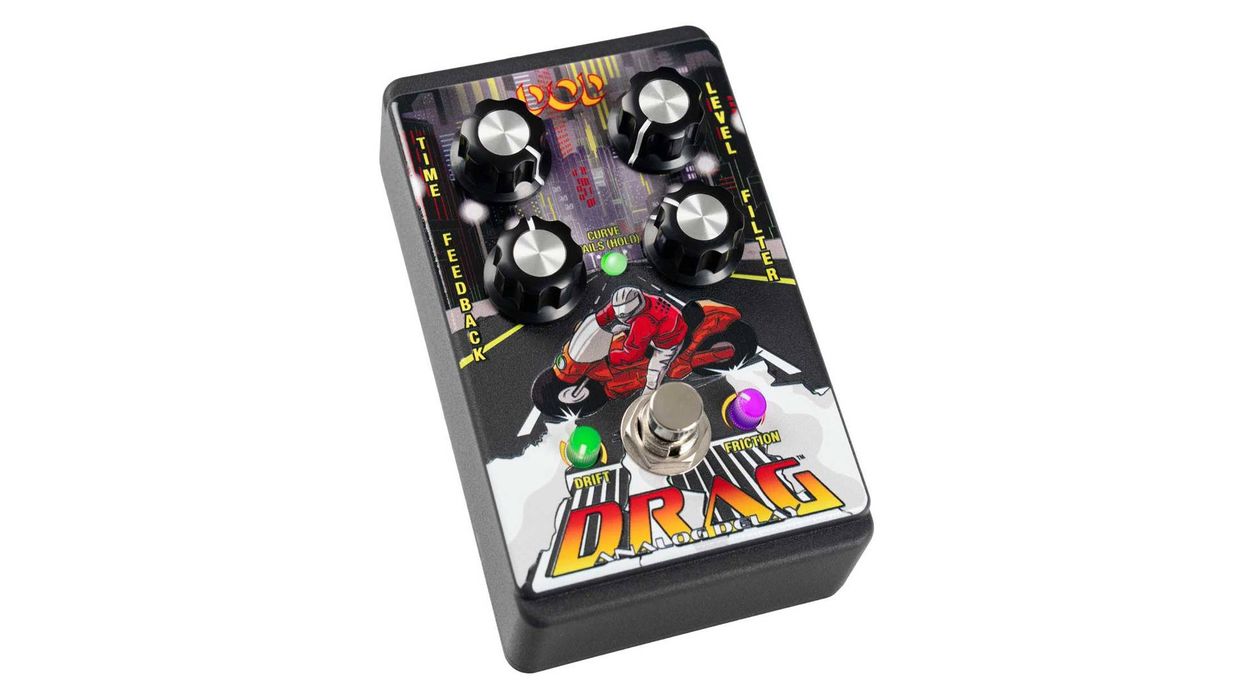
DOD announces the release of the DRAG™ Analog Delay, a new effects pedal that reimagines what analog delay can do through aggressive time-warping control, expanded modulation, and performance-driven features. Available now worldwide through local retailers and online, the DRAG combines classic analog BBD delay with new patent-pending functionality designed to push delay effects well beyond traditional boundaries.
Built around an all-analog bucket brigade design, the DRAG delivers up to 750 milliseconds of delay time, extendable to 1.5 seconds via its Rubbernecking™ function. From tight slapback echoes to drifting, modulated repeats and controllable runaway oscillation, the pedal is designed to move fluidly between familiar delay sounds and more unpredictable, expressive territory. Four standard delay controls: Time, Feedback, Level, and Filter, with two performance controls unique to the DRAG: Drift™, and Friction™, provide detailed command over delay response, tone shaping, and modulation behavior.
At the center of the DRAG experience are its time-warping features, including Rubberneck, SlideStop™, and Evade™ Friction categories. Engaged via the footswitch and Friction control, these functions allow players to manipulate delay time and pitch in real time. SlideStop™ can bring the delay signal to a complete stop before ramping it back up, while Evade introduces alternate motion behaviors such as HopStop™ and Slide-n-Go™. Rubbernecking adds octave-up and octave-down pitch shifting tied directly to delay time changes, opening further performance possibilities.
Modulation capabilities are equally deep, with four selectable waveforms: sine, reverse saw, square, and random. Plus, three intensity ranges: light, medium, and heavy. The Drift control adjusts modulation depth and speed, while the Curve™ control shapes how that modulation behaves, allowing users to dial in anything from subtle movement to more extreme, shifting textures.
The multi-function footswitch expands control beyond simple on/off operation, A short press engages or bypasses the pedal according to the selected bypass mode. Holding the footswitch activates the Friction feature, allowing expressive real-time control over SlideStop, RubberNeck, and Evade features. The two controls next to the footswitch are Drift and Friction change The DRIFT settings. The button in the middle of the pedal allows you to select between multiple bypass modes including True Bypass, and buffered options with delay tails. For extended control, a 3.5mm input supports connection to an optional FS3X footswitch, enabling tap tempo, oscillation hold, and modulation toggling.
Housed in an aluminum chassis with a top-jack design, the DRAG also introduces a patent-pending reversible StagePlate™. This two-sided plate allows players to switch between a Tire Tread Skid Pad for added stability and a hook surface for secure pedalboard mounting.
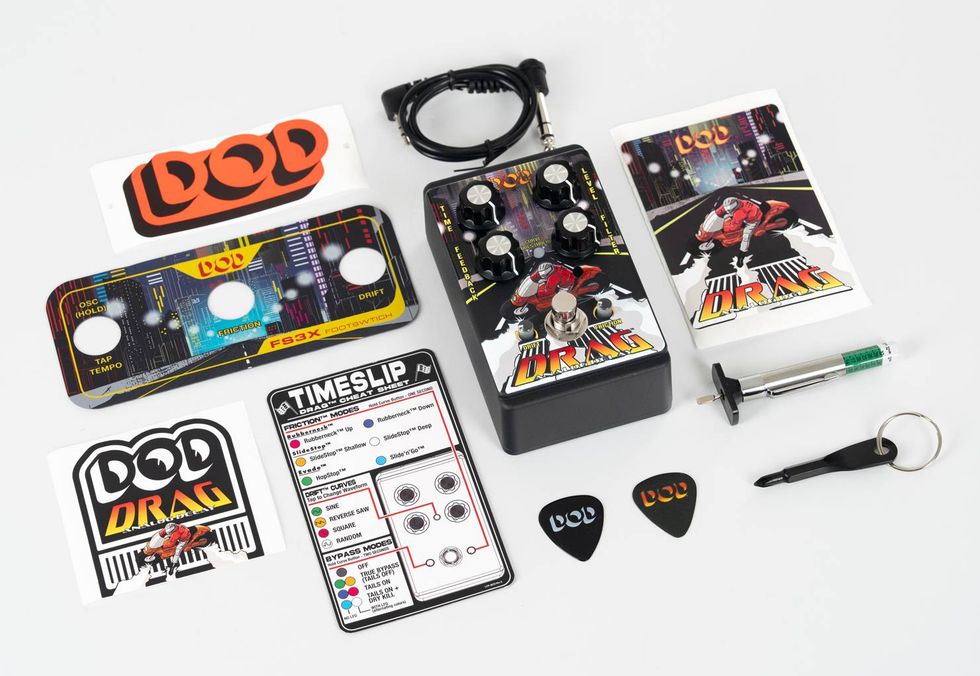
The DRAG runs on a standard 9V DC power supply, measures 4.8” x 2.8” x 1.5”, and weighs 0.67 lbs., making it a compact yet feature-rich addition to any setup.
For more information on the DRAG Analog Delay, visit www.digitech.com.
Street Price: $219.99 USD
Polyphia Announces New Record "Be Not Afraid"
Today, the genre-defying instrumental rock innovators Polyphia announce their fifth full-length studio album BE NOT AFRAID out October 23rd with Rise Records.
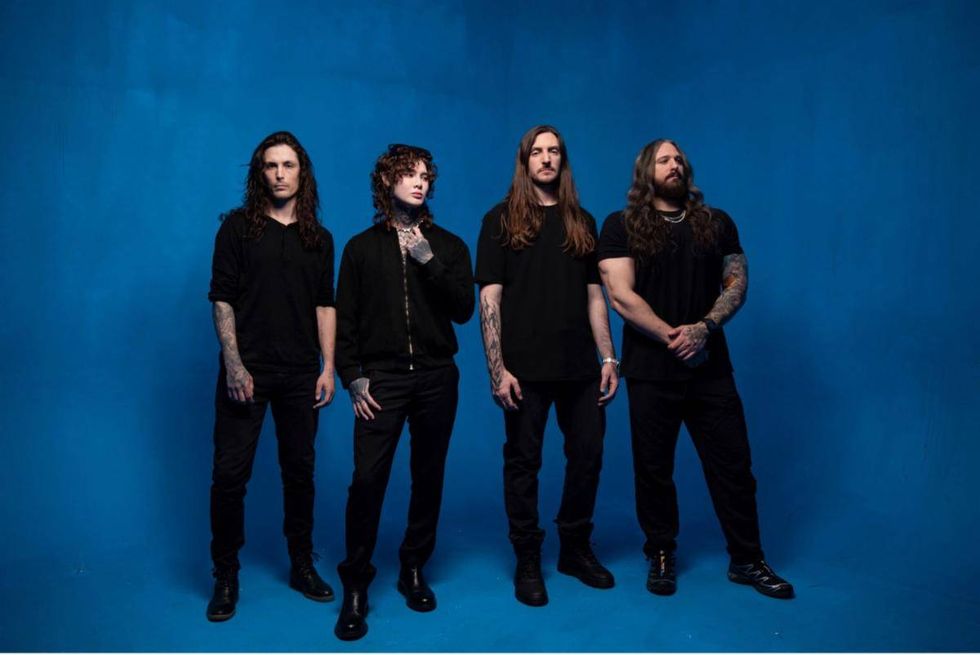
With the news, the band also released their new single off the record “POWER IN THE BLOOD” with an accompanying music video you can watch HERE . Filmed in Rio de Janeiro, Brazil, this video finds the band playing against the ornate, gold-leaf Baroque backdrops from the São Francisco da Penitência Church. The powerful visual lays the foundation for what’s to come off the new record, directed by Caleb Young.
Throughout 2024 and 2025, Polyphia worked together in various locations in Miami, Los Angeles and Dallas alongside co-producer RJ Pasin and guitar phenom Spiro Dussias. Guitarist Tim Henson took a different approach to composition, initially singing lines aloud and then translating them onto guitar, creating a process that encouraged the entire band to build on each other’s ideas in real time. More than anything, the sessions were defined by how much fun they were having creating music together. By the time the album was finished, they had reached a point where they could let go of any expectations about what would happen next and simply enjoy what they had created together.
“Instead of going wide on BE NOT AFRAID, we went as deep as we could,” Henson shares. “There are so many layers to pull back. Every time you listen to it, you’ll notice something new. Thematically, it’s by far the most meaningful record we’ve ever made.”
"We physically can't make the same album twice," adds guitarist Scott LePage. "We have a yearning to evolve. It was so much fun to write this one together too – the writing sessions for past Polyphia records typically looked like us gathering our ideas separately first and bringing them to each other second, so we took a different approach with BE NOT AFRAID by treating the sessions like an opportunity to create with everybody in the room first before getting into the separate writing. It was a much more communal approach that led to us having so much fun making it that the fun itself was the magic being captured."
The collective thread together a three-dimensional offering of otherworldly metal, future-facing prog, and pulsating house sealed tightly with carefully curated samples, inventive beat-craft, and the guitar eloquence that Tim and Scott remain renowned for. This time around, the instrumental push-and-pull invokes the polarity of the ultimate extremes: good and evil.
When speaking on the album Henson adds, “The album takes you through the extremes of two different worlds / moods: one being very uplifting and triumphant, the other being spine-chilling and terrifying. There are moments on the record that legitimately scare me when I listen to them.”
Earlier this year, Polyphia teased their new chapter with the release of their first single in over four years, “CAN YOU FEEL IT .” Pushing boundaries in ways the band never has before with a hybrid of metal and dance music, their music video showcased an electrifying performance by the band amidst a crowd of fans.
"During the making of this record, we went down some pretty dark rabbit holes. We kept coming across things that were so depraved they sounded insane when you said them out loud. Then some of the very things we had been talking about started appearing in documents released to the public. You can read that stuff and feel disgusted, demoralized, and completely powerless. BE NOT AFRAID is our response to that. Rather than allowing the ugliness of the world to paralyze us, we put everything we had into making something beautiful. We weren’t afraid of whether something was too different or whether people were going to understand it. We just followed what excited us and made what I believe is our best record to date,” Henson explains.
Polyphia refused to compromise on BE NOT AFRAID. Getting the album exactly where they wanted it meant giving it more time and ultimately pushing the North American leg of the 2026 World Tour to early 2027. RJ Pasin will still support every date worldwide. North American shows will feature Ladrones, with select dates including Intervals. Perturbator will join all UK and European dates, which remain unchanged for Nov/Dec 2026.
Tickets purchased for previous tour dates are valid for the newly announced show dates. A full list of show dates can be found below. For more information and to purchase tickets visit Polyphia.com .
North America Tour Dates 2027 w/ Ladrones & RJ Pasin:
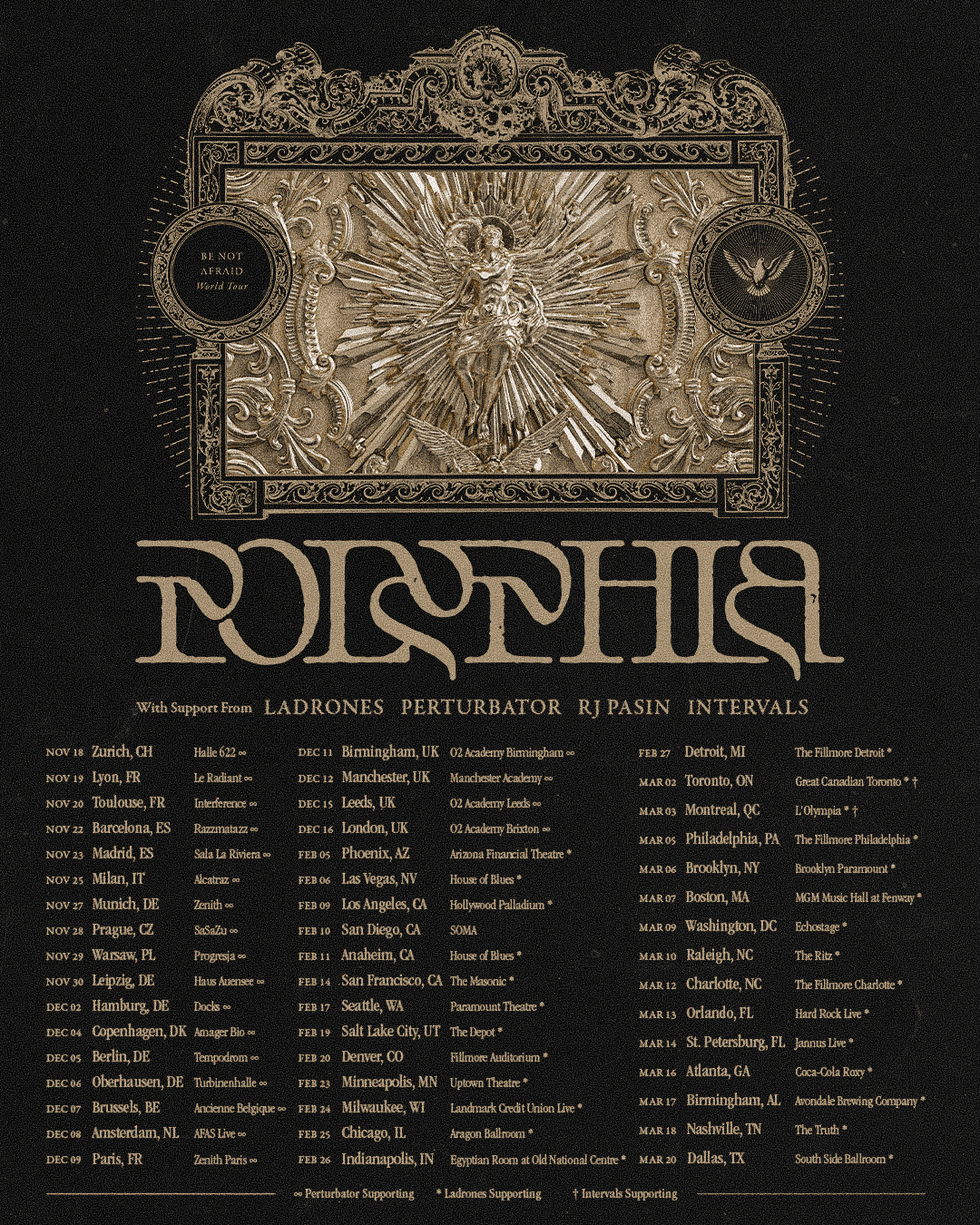
* w/ Intervals
# No Ladrones
February 5 - Phoenix, AZ - Arizona Financial Theatre
February 6 - Las Vegas, NV - House of Blues
February 9 - Los Angeles, CA - Hollywood Palladium
February 10 - San Diego, CA – SOMA #
February 11 - Anaheim, CA - House of Blues
February 14 - San Francisco, CA - The Masonic
February 17 - Seattle, WA - Paramount Theatre
February 19 - Salt Lake City, UT - The Depot
February 20 - Denver, CO - The Fillmore Auditorium
February 23 - Minneapolis, MN - Uptown Theater
February 24 - Milwaukee, WI - Landmark Credit Union Live
February 25 - Chicago, IL - Aragon Ballroom
February 26 - Indianapolis, IN - Egyptian Room at Old National Centre
February 27 - Detroit, MI - The Fillmore Detroit
March 2 - Toronto, ON - Great Canadian Toronto *
March 3 - Montreal, QC – L’Olympia *
March 5 - Philadelphia, PA - The Fillmore Philadelphia
March 6 - Brooklyn, NY - Brooklyn Paramount
March 7 - Boston, MA - MGM Music Hall at Fenway
March 9 - Washington, DC - Echostage
March 10- Raleigh, NC - The Ritz
March 12 - Charlotte, NC - The Fillmore Charlotte
March 13- Orlando, FL - Hard Rock Live
March 14 - St. Petersburg, FL - Jannus Live
March 16 - Atlanta, GA - Coca-Cola Roxy
March 17- Birmingham, AL - Avondale Brewing Company
March 18 - Nashville, TN - The Truth
March 20 - Dallas, TX - South Side Ballroom
Europe/UK Tour Dates w/ Perturbator & RJ Pasin:
Nov 18 – Zurich, CH – Halle 622
Nov 19 – Lyon, FR – Le Radiant
Nov 20 – Toulouse, FR – Interference
Nov 22 – Barcelona, ES – Razzmatazz
Nov 23 – Madrid, ES – Sala La Riviera
Nov 25 – Milan, IT – Alcatraz
Nov 27 – Munich, DE – Zenith
Nov 28 – Prague, CZ – SaSaZu
Nov 29 – Warsaw, PL – Progresja
Nov 30 – Leipzig, DE – Haus Auensee
Dec 2 – Hamburg, DE – Docks
Dec 4 – Copenhagen, DK – Amager Bio
Dec 5 – Berlin, DE – Tempodrom
Dec 6 – Oberhausen, DE – Turbinenhalle
Dec 7 – Brussels, BE – Ancienne Belgique
Dec 8 – Amsterdam, NL – AFAS Live
Dec 9 – Paris, FR – Zenith Paris
Dec 11 – Birmingham, UK – 02 Academy Birmingham
Dec 12 – Manchester, UK – Manchester Academy
Dec 15 – Leeds, UK – O2 Academy Leeds
Dec 16 – London, UK – O2 Academy Brixton
Polyphia have always said what they need to say with their instruments. Since their emergence in 2010, the Texas-bred outfit—Tim Henson [guitar], Scott LePage [guitar], Clay Gober [bass], and Clay Aeschliman [drums]—have organically progressed across a series of acclaimed albums, including Muse [2014], Renaissance [2016], New Levels New Devils [2018], and Remember That You Will Die [2022]. The latter bowed at #1 on the Billboard Top Hard Rock Albums Chart and cracked the Top 40 of the Billboard 200. Tallying hundreds of millions of streams, it established the band as rare outliers equally suited to collaborations with either pop singer Sophia Black, multiplatinum rapper SNOT, guitar hero Steve Vai, or iconic Deftones frontman Chino Moreno (on the same body of work). It’s no wonder Guitar World readers unanimously voted it “The Best Guitar Album of 2022.” Beyond headlining sold-out tours, the group incited the applause of Wired, Revolver, and Rolling Stone who described Tim as “reinventing the instrument for more than a decade.” However, the quartet make a particularly provocative and powerful sonic statement on their fifth full-length offering, BE NOT AFRAID [Rise Records]. The collective thread together a three-dimensional tableau of otherworldly metal, future-facing prog, and pulsating house sealed tightly with carefully curated samples, inventive beat-craft, and the guitar eloquence that Tim and Scott remain renowned for. This time around, the instrumental push-and-pull invokes the polarity of the ultimate extremes: good and evil.
Neural DSP makes “the biggest CorOS update in the company’s history”

Finland-based audio developer Neural DSP has expanded its flagship operating system, CorOS. Quad Cortex and Quad Cortex Mini users will now enjoy compatibility with five of Neural’s classic artist signature Archetype X plugins.
These include: Archetype: John Mayer X, Archetype: Petrucci X, Archetype: Misha Mansoor X, Archetype: Rabea X, and Archetype: Tim Henson X. In total, this includes over 70 amps, cabs and effects catering to everything from metal shredding to smooth, easy-listening strums. Moreover, with these additions, CorOS and Cortex Control can now work with every single X-updated plugin throughout Neural DSP’s arsenal.
Those who have Quad Cortex, Neural DSP’s flagship floorboard amp modeller, also now have access to the brand-new feature, Device Presets. As simple as it sounds, the Quad Cortex can save the precise settings on an individual device it is modelling. Amps, cabinets, drives, effects, and utility blocks can be instantly pulled up with all the knobs exactly where they were before. Plus, the new CorOS adds 2,000 device presets to try out.
“CorOS 4.1.0 represents a major milestone for the Quad Cortex ecosystem,” says Francisco Cresp, Neural DSP CPO and Co-Founder.
“With Plugin Compatibility now spanning every X-updated plugin in our lineup, alongside powerful new workflows like Device Presets, we’re giving musicians even more freedom to create, experiment, and move between software and hardware without compromise.”
As if that wasn’t enough, Quad Cortex and Quad Cortex mini users also get eight new virtual devices: Multivoicer harmonizer, Glitch granular delay, Ring Modulator, Arpeggio Delay, Crystal Delay, Vintage Digital Reverb, Douglas Shining Comp, and Plugin Parametric-4 EQ.
Last but certainly not least, the new Cortex Control has Multiple Device Management to adjust settings on multiple Quad Cortex and Quad Cortex mini units simultaneously. Now the monitor mixer can have a laptop side stage at gigs and change everyone’s settings with a click of a button when the next song arrives.
You can learn more at Neural DSP.
The post Neural DSP makes “the biggest CorOS update in the company’s history” appeared first on Guitar.com | All Things Guitar.
The Warning’s Dany Villarreal on her guitar collection: “I have them stored in a very special place in my basement… and in my heart”

The Warning were just kids when their cover of Metallica’s Enter Sandman went viral. In the decade-plus since, they’ve released four albums, been nominated for a Latin Grammy and toured with Evanescence, Foo Fighters, Halsey and Yungblud.
But before all that, they were just three sisters playing the Rock Band video game at home in Monterrey, Mexico. “I actually started with a plastic guitar,” Daniela “Dany” Villarreal, vocalist and guitarist for the band, says.
From there, she moved to the acoustic guitar, starting with a Taylor GS Mini. Her first electric guitar was a semi-hollow Ibanez, but Villarreal was still quite young, and the guitar was too unwieldy for her small size, so she ended up switching to a Stratocaster.
“My relationship with guitars throughout time was a process of me finding the right sound, the right guitar,” she explains. “Since I started at a very young age, I didn’t quite necessarily get into the specifics from the get-go. I was just focused on learning guitar, but not finding my guitar, what I wanted to sound like, what I was comfortable with.”
That changed when The Warning went into the studio to work on their 2022 album Error, with producer David Bendeth, and he recommended Villarreal try a PRS guitar. “We just clicked,” she says. “It was so comfortable. It just felt completely right. And the more I played it, the more I found quirks in the sound, what I wanted to be, what I wanted to evolve into, and it became my teammate for sure.”
 Dany Villarreal performing with a PRS guitar. Image: Press
Double Duty
The Warning are gearing up to release their fifth album, Everything’s Falling, on August 28, which sees them incorporating pop elements (Bloodsport), metal-style screams (Ego) and reggaeton beats (Bruises), into their signature hard rock sound, defined by blaring guitars. The band is rounded out by Villarreal’s younger sisters Paulina “Pau” Villarreal on drums and Alejandra “Ale” Villarreal on bass, and while all three sisters contribute vocals, Dany is the lead vocalist as well as the sole guitar player.
With dual duties comes additional challenges, one being differentiating the guitar melodies from Villarreal’s vocals, since they often occupy the same range. This has pushed her guitar playing into the lower end. “I’ve fallen in love with low-key trying to play the bass on a guitar,” she laughs.
There was another function Villarreal had to juggle on this record. “We’ve applied a new pedal to this album, sound-wise, that made the album what it is, I think,” she says. “It’s a very unique pedal. It’s called The Noise pedal [by Tallon Electric – Ed]. It’s a very indie pedal, but it just makes noise.” But it does mean that on top of singing and playing guitar, Villarreal also now has to operate a pedal with her foot, like on the groove-filled track Bruises.
It took several different guitars to achieve the dynamic, electrifying sounds of Everything’s Falling. Below Villarreal talks Guitar.com through the most treasured and meaningful guitars in her collection, , including her brand spanking new PRS signature model:
 Dany Villarreal with her signature PRS Astryx. Image: PRS
PRS Astryx
Announced just this week is Villarreal’s very first signature guitar, created in partnership with PRS. The Astryx is based on the iconic Custom 24 model, but with a variety of visual and spec flourishes. For example, the fretboard is ebony instead of the usual rosewood, while an inlaid sun adorns the twelfth fret. The sun theme continues with the guitar’s striking purple, red and orange top finish, which is intended to evoke a sunset. “I had never had the experience of trying to put myself, my personality into a guitar, and having that be me,” she says. “I’m completely in love, and it’s my favorite guitar.”
It took about a year of production, with Villarreal even going to the PRS factory in Maryland to watch how the guitar was made. “I feel like it’s a very big step as a guitar player, and it’s gonna be one of the highlights in my timeline as a guitar player,” she says. Just 200 of these unique instruments will be made for sale, with each one featuring an autographed backplate.
 Dany Villarreal with her signature PRS Astryx. Image: PRS
Gibson Les Paul
Early in her career, Villarreal got her hands on a Les Paul. “[It] is one of my very first guitars ever that I had a hard time letting go of,” she says. “Once I found a Les Paul, it was just like, ‘I love this guitar.’ It eventually became a problem for my back as a growing child because it was very heavy.”
The Les Paul didn’t make it into her touring set, but she held onto it. “I always invite my Les Paul over to the studio because I do feel a strong connection with it,” she adds. “It’s more of a nostalgia thing to have it with me there. We didn’t use it that much but there’s something about maybe playing a basic rhythm, strum-out chords with a Les Paul that just hits right.”
 Dany Villarreal performing with a Fender Stratocaster Baritone. Image: Press
Fender Stratocaster Baritone
This custom twin-humbuckered beast, and other Fender baris, have helped Villarreal reach those lower tones, which have shaped The Warning’s sound. “I have been loving the baritone feel and mid-range that it gives me between the bass and a guitar,” she explains. “It just makes the songs feel so powerful. So I’m really having so much fun exploring that baritone world.”
When it was time to work on Everything’s Falling, the baritone guitars played a key role. “I think I was even surprised how much we used baritone guitar in this album because I started using baritone guitars more as a layer than as a main guitar, and that was not the case for this album,” she says. “We went fully with the main guitars being the baritone guitars.”
They weren’t the only Fenders she used in the studio. “With little arrangements and things where I wanted to be a little bit more delicate, I went with a Telecaster, which is not something I usually use on tour – it’s mainly studio vibes,” she laughs. “And we would figure out at that point what the song was asking for guitar-wise.”
But for writing, she prefers the Fender Acoustasonic. “I usually go full acoustic, which is weird because [we play] rock and roll, but it’s my comfort guitar, and I keep that in my room…. But whenever I have an itch, I just [go for the] Acoustasonic, and it’s my favorite guitar to… explore with,” she says.
Manson Oryx VI
The Warning are big fans of Muse and in 2023, they got the opportunity to support them on tour. While playing a show in Mexico, Muse frontman Matt Bellamy asked Villarreal her favourite colour. “I didn’t know what he was talking about,” she recalls, but she answered with mustard yellow. The Warning ended up joining Muse for a few dates on the United Kingdom leg later that year. On the last show they played together, Bellamy surprised Villarreal by knocking on her dressing room door with a guitar in hand.
“I actually had a time where I played Manson guitars a lot because of him, and I couldn’t believe I was being gifted one by him,” she says. “I played it that very same day. I was just like, ‘I’m gonna test this out on stage, see how it goes,’ and I love it so much.”
But Villarreal’s reluctant to bring it on the road. “We had a jump scare,” she explains. “I took it out on tour, and it did not arrive [at] the final destination. It got lost in some of the airports, and I was like, ‘You know what? This is the only guitar I have gifted [to] me from Matt Bellamy. I’m gonna stop touring with it. I’m gonna keep it safe.’” She keeps it in her home studio. “I take very good care of it now because it really is very very special to me,” she says.
 Dany Villarreal with a Gibson Explorer. Image: Press
Gibson Explorer
In The Warning’s music video for the brash, swaggering single Ego, Villarreal’s holding a white Gibson Explorer with a similar story behind it. The Warning were playing in Texas in 2022 – on a bill that included Halestorm, The Pretty Reckless and Lilith Czar – when Halestorm frontwoman Lzzy Hale walked onstage with a white Gibson Explorer. “And she kneels down [as] if she is asking for my hand in marriage,” Villarreal remembers.
Villarreal assumed Hale was letting her borrow one of her guitars for that set, but when she went to return the guitar after playing, Hale told her to keep it. Hale had herself previously been gifted a guitar by Shinedown’s Jason Todd. “She felt super inspired, and she wanted to keep that tradition going,” Villarreal adds. “And seeing me so young and being a woman on stage, rocking out, and specifically in rock and roll, she felt it was the right moment to give one to me.”
Villarreal’s looking forward to following Hale’s example. “I love each and every one of [my gifted guitars], and I hope I can be that person too,” she says. “I would love to be a gifter of guitars that I like to guitar players that inspire me and want to inspire.”
But, like the Manson, Villarreal doesn’t road-test her gifted guitars. “I have them stored in a very special place in my basement and in my heart,” she says.
PRS Orianthi
Villarreal once mentioned in an interview that she admired Orianthi’s signature PRS guitar. It just so happened that Villarreal and Orianthi, both PRS artists, ended up sharing the stage as part of PRS’s 40th anniversary event last year. “After the performance was done, she just handed it to me,” Villarreal remembers. “I was like, ‘No way, this is insane!’ And it’s even [the] cherry on top that it was the guitar that she played that night with me on stage.”
While she’s been hesitant to take her gifted guitars for a spin live, she did make an exception. “It had to have a moment on stage, so I did play with it for one of the biggest shows in our career, which was Auditorio Nacional in Mexico City,” she explains. The three sold-out shows last year were recorded and the concert film was even screened in movie theatres. “It’s forever now there as the day I played with the Orianthi guitar,” she says.
The post The Warning’s Dany Villarreal on her guitar collection: “I have them stored in a very special place in my basement… and in my heart” appeared first on Guitar.com | All Things Guitar.
Pages
