
Music is the universal language
“Glory to God in the highest heaven, and on earth peace to those on whom his favor rests.” - Luke 2:14
General Interest
Gibson Victory Floyd Rose review: “this is a fantastic addition to the Gibson line”

$2,799/£2,399, gibson.com
The 1980s were an interesting time for the guitar industry. The decade saw a new generation of players who demanded instruments that were quite a departure from the electric guitars that had been front and centre for most of the previous thirty-plus years. That in turn enabled small makers like Kramer, Charvel and Jackson to become the big-time brands they are today.
- READ MORE: Gretsch Electromatic CVT Baritone review – long-scale downtuned heaviness from Gretsch hits the mark
It was a trickier period for the established big guns, however. While Gibson had some guitars that were ready-made for this new, more aggressively styled era – notably the Explorer and Flying V most notably – both the brand and Fender understandably wanted to make some guitars that were designed for this new era.
Unfortunately, none of these new models really caught fire at the time, and you imagine that there was a collective sigh of relief in both Nashville and Corona when the 90s rolled around and MTV was replete with Golden Era guitars once again.
But time has a funny way of changing perceptions. And just like it took wider guitar culture a few decades to really appreciate the V and the Explorer, so it has been with some of the more unloved guitars from the 80s.
 Image: Press
While nobody seems to be falling over themselves to demand a Corvus reissue (yet!), the Victory has long had a bit of a cult following. And looking at it with 21st-century eyes, you can see why – like so many underappreciated guitar designs, it was ahead of its time, offering a double-cut solid-body take on the Gibson recipe that has since become a huge part of the modern heavy guitar firmament.
All this meant it was a big deal when the brand relaunched the Victory into the core line back in 2024. Clearly this time around the concept has found a more receptive audience too, as it has been followed up two years later by this brand new version that puts it even more squarely in the wheelhouse of today’s technical guitar players.
What Is It?
Like its hardtail sibling, the Victory Floyd Rose is a solid-body, double-cut electric guitar with a pair of humbucking pickups, and – you guessed it – a Floyd Rose vibrato. Gibson says that the original Victory has been a big hit with its audience, but one of the most common bits of feedback was, “Can you add a Floyd Rose?” Request granted.
Other than that, it’s pretty much identical to the figured top version of the hardtail Victory. That means you get a solid mahogany body with a beautifully figured maple top, finished in either Deep Ocean Burst, Ebony Burst or the eye-catching Iguana Burst.
The neck is also mahogany, with a classic 80s hockey stick headstock. Despite its super-S-type-adjacent origins, there are no bolts here – this is a through-neck, glued-in neck construction, and interestingly the Victory comes with a longer-than-usual 25.5-inch scale length – most Gibson electrics ship with a 24.75-inch scale.
The neck itself has a shred-ready 10-14-inch compound radius, with Gibson’s SlimTaper profile, and you’ll find 24 medium jumbo frets on its mahogany fingerboard. Above the locking Floyd Rose nut are a set of Grover Mini Rotomatic tuners, not that you’ll be needing to mess around with them too much.
In terms of the noise-making stuff, the Victory ships with a pair of zebra-bobbin’d 80s Tribute humbuckers, and these both have coil-splits – pull up on the volume pot to engage the split on your selected pickup, and pull up on the tone to select whether you want the inner or outer coil.
 Image: Press
Build quality and playability
Gibson has upped its game considerably in the years since the brand was reborn out of bankruptcy in 2018, and so it’s perhaps no surprise that upon pulling the Victory Floyd Rose out of its (very cool blacked-out) hard case I was very impressed with it from a build and finishing perspective.
Iguana Burst isn’t going to be to everyone’s tastes, but it’s also the sort of colour that doesn’t give any hiding place to overspray or sloppy finishing. And yet every inch of the body, neck and headstock is finished expertly, and there’s a really inviting three-dimensional quality to that figured top that really pulls you in.
Picking the guitar up, I’m immediately impressed by the offset double-cut body – it really hugs the player from an ergonomic perspective, and invites you to explore the full length of its neck. At just under 7lbs, it’s lightweight and balanced, too.
That extra scale length does make this a different kind of ride to a Les Paul – it has a little more resistance when you’re bending, for one – but this is still a very slick player that’s set up low and fast, and encourages you to blaze up and down that neck.
Speaking of the neck, I found the combination SlimTaper profile and compound radius to be slim, but not too slim. A baseball bat this obviously ain’t, but it’s not so skinny that it feels insubstantial either – a nice middle ground.
The Floyd does what a Floyd does – giving you smooth and expressive control of your vibrato while keeping perfect pitch. The less said about restringing it, the better, of course, but that is the rub when it comes to a locking trem.
One slight bone of contention might be the frets. The playability is top notch, and I found the fretwork excellent throughout – there are no dull frets or rough patches to be seen. That said, many more technically minded modern players won’t get out of bed for anything less than stainless steel these days, and jumbo ones at that. It’s not a deal-breaker for me, but others may see it as an opportunity Gibson should be taking, following the move towards stainless steel frets in its Epiphone Futura line.
 Image: Press
Sounds
Gibson knows a thing or two about making great dual-humbucker guitars, and even in an unconventional format here, there’s some real Gibson magic to be found in these Alnico V-magneted 80s Tributes.
As befits their name, these are not ultra-high output modern humbuckers that are full-send all the time. There’s a nuance here – obviously these are great-sounding pickups that come ready to play with heavier rock and metal genres, but they’re not so lacking in subtlety that they don’t have character when you roll the volume off.
Ultimately though, these are pickups that are born to be distorted, and so that’s my first port of call. They sound absolutely fantastic as you dial the drive up, delivering warm harmonics and sustain with a depth that I haven’t heard from a new guitar in a while.
It’s hard to imagine too many people picking this guitar up and going for a crystal clean tone, and so it’s not a surprise that its un-gainy tones are perfectly fine, if unlikely to become the bedrock of anyone’s John Mayer tribute.
Equally, while the coil-split modes aren’t going to convince anyone that you’re playing a bona fide SSS or HSS guitar, they will do a solid job – especially in a live situation. Having the flexibility to select the inner-coils sounds is great, as they’ll do a passable out-of-phase sound, further enhancing your sonic options. This is a guitar that can cover a lot of bases without needing too much tweaking.
 Image: Press
Should I Buy One?
If you’re a hard rock or metal guitarist who wants to stand out from the crowd, it’s very easy to see why the Victory is proving such a popular option. The heavier end of the spectrum doesn’t lack for weird guitar shapes, but there’s something timeless and refined about the Victory that makes it feel much more palatable. Perhaps the Gibson inlay on the headstock speaks volumes here.
Because you know what you’re getting with a Gibson guitar, and it must be said that even by modern standards, this feels like a very well-built and well-thought-out instrument. It has a level of fit and finish that I would have expected from the Custom Shop a few years back, but at a price that makes it very competitive in the world of US-made hard-rocking guitars.
Okay, it might look a little weird if you trot out with it for an Eagles cover at your next gig, but there’s a lot to be said for a guitar that understands what it is and doesn’t try to be all things to all people. You probably already know if the Victory is for you just by looking at it, and this Floyd Rose version simply puts the icing on the cake of a shredder’s delight.
 Image: Press
Alternatives
It speaks to the impressive value proposition the Victory offers that to get a similar US-made guitar from a rival brand will cost you a lot more. Closest of all is perhaps the Jackson USA Signature Chris Broderick Soloist 6 ($5,549/£4,779) – which sports a mahogany body with a maple cap, twin DiMarzio humbuckers and a Floyd. When it comes to twin-humbucker mahogany-bodied electric guitars with flame-topped finishes, it would be remiss not to bring PRS into the conversation, though the Core line Custom 24 Floyd model is not cheap at $4,940/£3,999. More in the ballpark of the Victory is Mark Lettieri’s Fiore HH ($2,649/£2,499), though it’s just got a non-locking vibrato. ESP’s E-II Horizon FR ($2,789) is another guitar that dukes it out with the Victory in terms of build, spec and vibe. It’s made in Japan, not the USA, but that’s more a question of geography than guitar-making ability at this level.
The post Gibson Victory Floyd Rose review: “this is a fantastic addition to the Gibson line” appeared first on Guitar.com | All Things Guitar.
Musicians and Their Thompson Guitars

Axes Follow Me

I took these downstairs and showed them to my wife, she proceeded to laugh and said, "I guess axes just follow you around! They always find you!"


Now, get out into your shop and make something!
Taylor Guitars Introduces Next Generation 512ce and 712ce
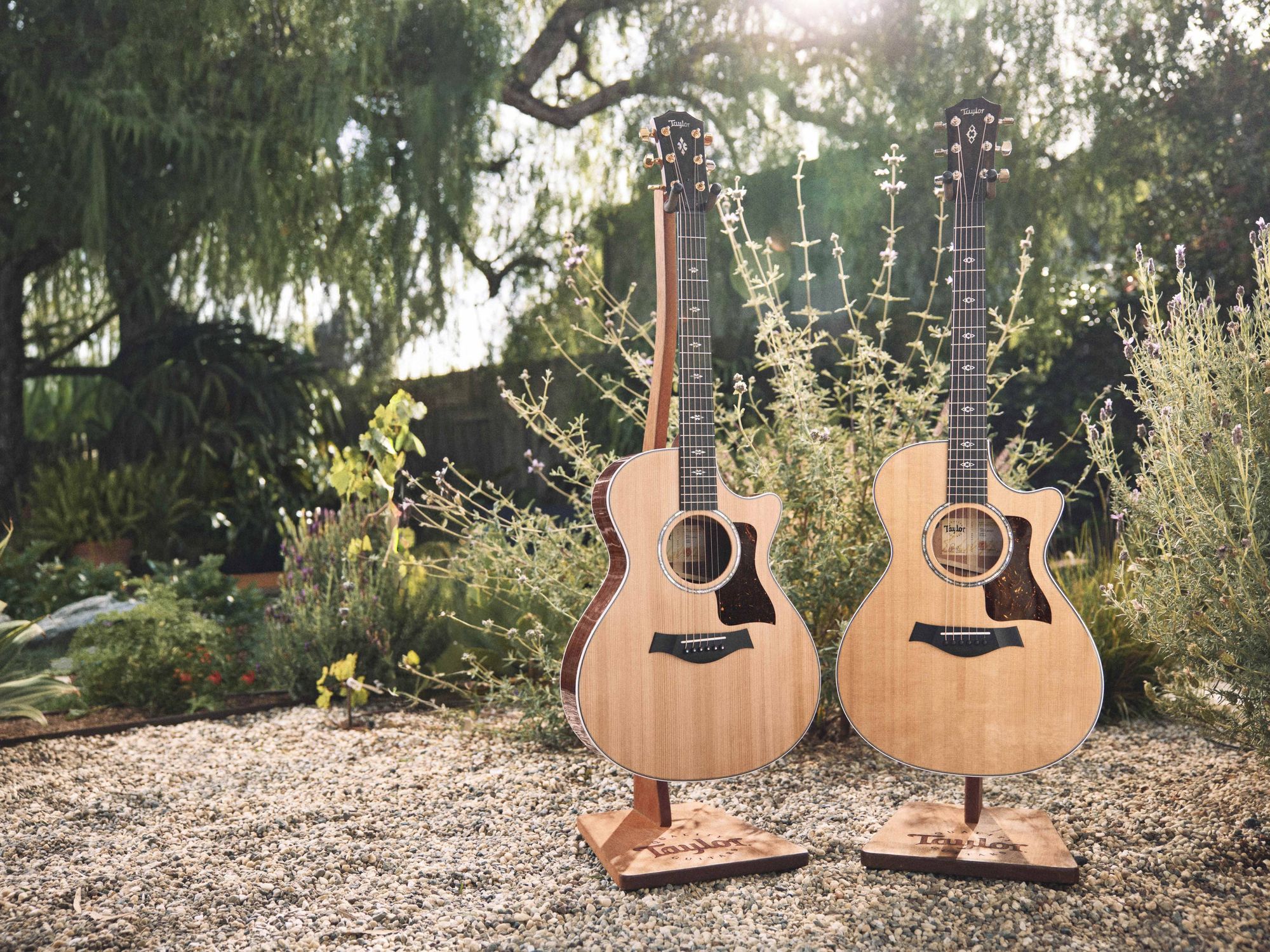
Taylor Guitars continues to evolve the acoustic guitar experience with the introduction of the Next Generation 512ce and 712ce, two new Grand Concert models that bring a powerful combination of tonal character, player-focused innovation and effortless playability to one of Taylor’s most comfortable body shapes.
At the heart of both guitars is Taylor’s Next Generation platform, which brings together three key innovations: scalloped V-Class bracing, the Action Control Neck and the Claria Acoustic Pickup System. Together, these features represent the latest evolution of Taylor’s approach to acoustic guitar design, enhancing warmth, resonance, sustain, adjustability and plugged-in performance while preserving the clarity and balance players have come to expect from a Taylor.
Both models feature the compact Grand Concert body shape, Taylor’s smallest full-scale body design. Its comfortable contours and responsive nature make it particularly well suited to players who value intimacy and control, while its balanced voice makes it remarkably versatile across playing styles.
The Next Generation 512ce pairs solid mahogany back and sides with a Western Red cedar top, creating a warm, woody voice with exceptional touch sensitivity and a clear fundamental focus. The cedar top responds readily to a light touch, while the scalloped V-Class bracing adds volume, open-string resonance and sustain, giving the compact body surprising depth and presence.
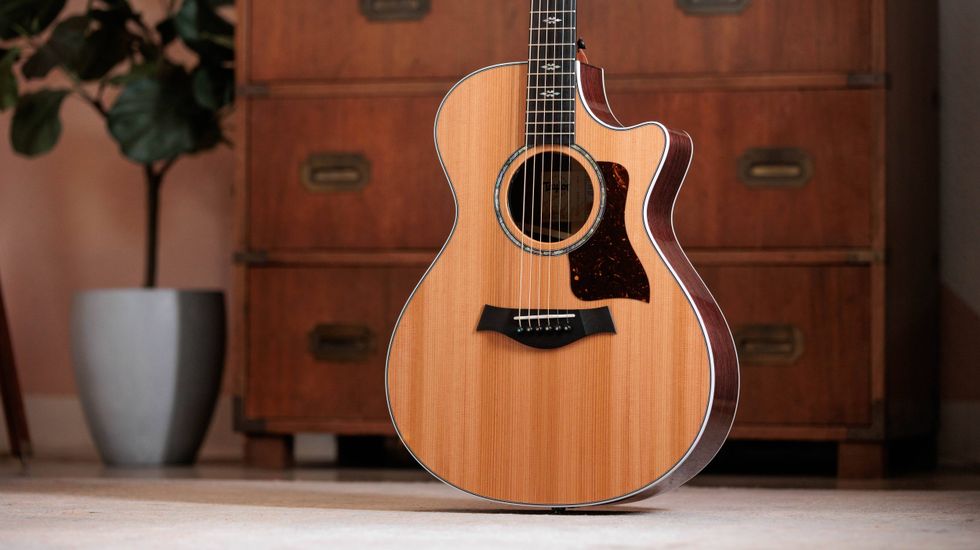
The Next Generation 712ce takes a different tonal path, pairing solid Indian rosewood back and sides with Western Red cedar. The combination produces a warm, sweet character with lush harmonic texture, rich overtone bloom and enhanced low-end presence. The result is a distinctive voice that remains clear and balanced while offering a more expansive tonal palette.
Underneath both models is the new Action Control Neck, which combines Taylor’s familiar slender neck profile with a long-tenon neck joint for enhanced tonal transfer, warmth and sustain. Its innovative adjustment system allows string height to be changed quickly and precisely without the need for traditional neck shims, giving players and technicians an easier way to dial in the feel of the instrument.
Both guitars also feature Claria electronics, Taylor’s new acoustic pickup system designed to deliver clean, natural and usable amplified tone. Developed with input from players and live sound professionals, Claria combines a new under-saddle piezo pickup with a proprietary preamp and onboard controls for shaping the amplified sound.
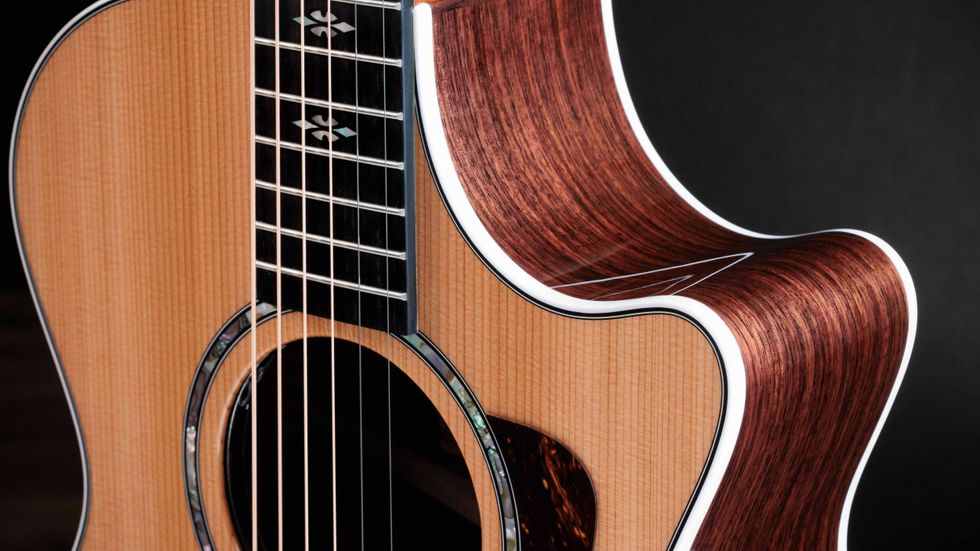
Visually, the 512ce and 712ce share an elegant full-body gloss finish, white binding, black/white/black top trim, green abalone rosettes and faux-tortoiseshell pickguards. The 512ce features Meridian Italian acrylic inlays, while the 712ce receives Reflections mother-of-pearl inlays, gold tuning machines and abalone-dotted ebony bridge pins.
With the Next Generation 512ce and 712ce, Taylor brings its latest acoustic innovations to two compact, highly responsive instruments, offering players a choice between the woody warmth of mahogany and the lush harmonic character of Indian rosewood. Both demonstrate how much musical expression can come from a comfortable Grand Concert body when traditional tonewoods meet Taylor’s newest generation of acoustic guitar design.
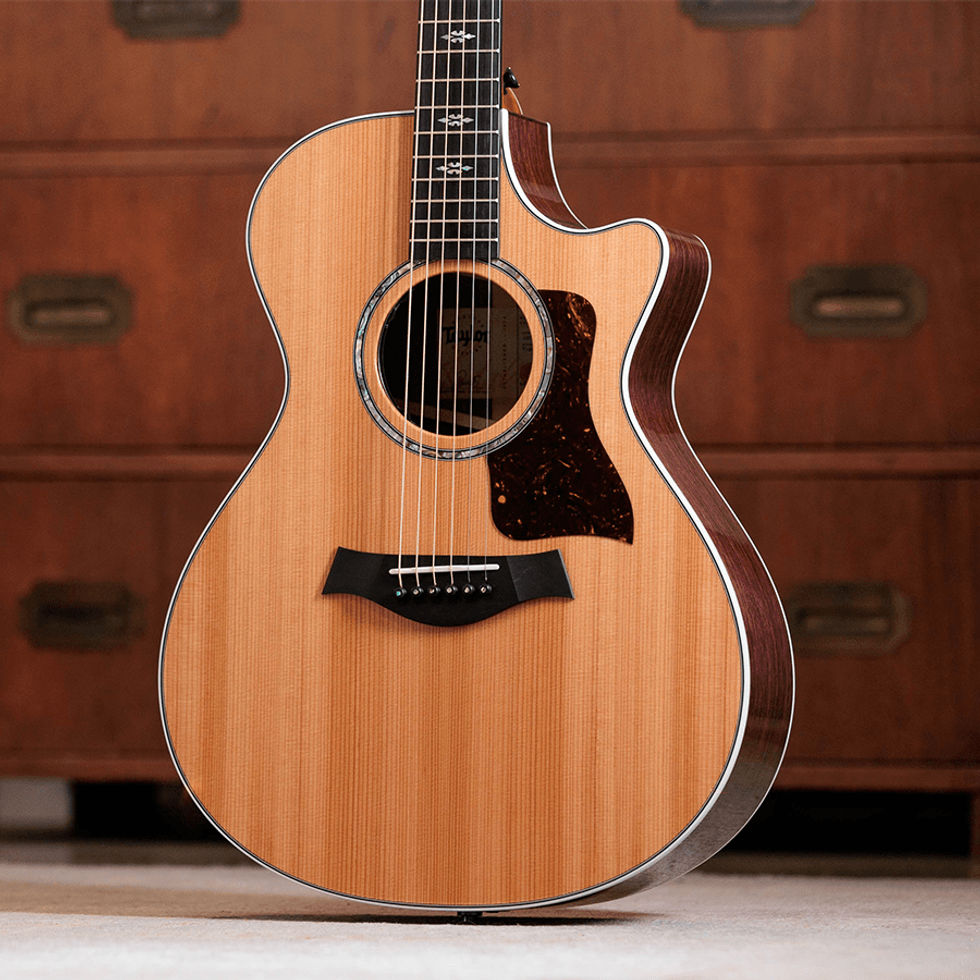
712ce
With its distinctive voice, comfortable contours and sleek appointments, the Next Generation 712ce promises an inspiring musical experience across playing styles. This compact Grand Concert acoustic-electric features back and sides of solid Indian rosewood paired with a Western Red cedar top, a unique combination that generates a warm, sweet character overflowing with harmonic texture and overtone bloom. Inside, our scalloped V-Class bracing dials up more low-end presence along with enhanced volume and sustain, adding up to a potent response that remains balanced and clear across the frequency spectrum. A slender Action Control Neck offers relaxed fretting while letting the player dial in the perfect feel in minutes, while our Claria electronics ensure clean, usable amplified tone whenever you need to plug in. This model sports a natural full-body gloss finish, white binding with black/white/black top edge trim, a green abalone rosette, Reflections peghead and fretboard inlays in mother of pearl, gold tuning machines, abalone-dotted ebony bridge pins, and a faux-tortoiseshell pickguard.
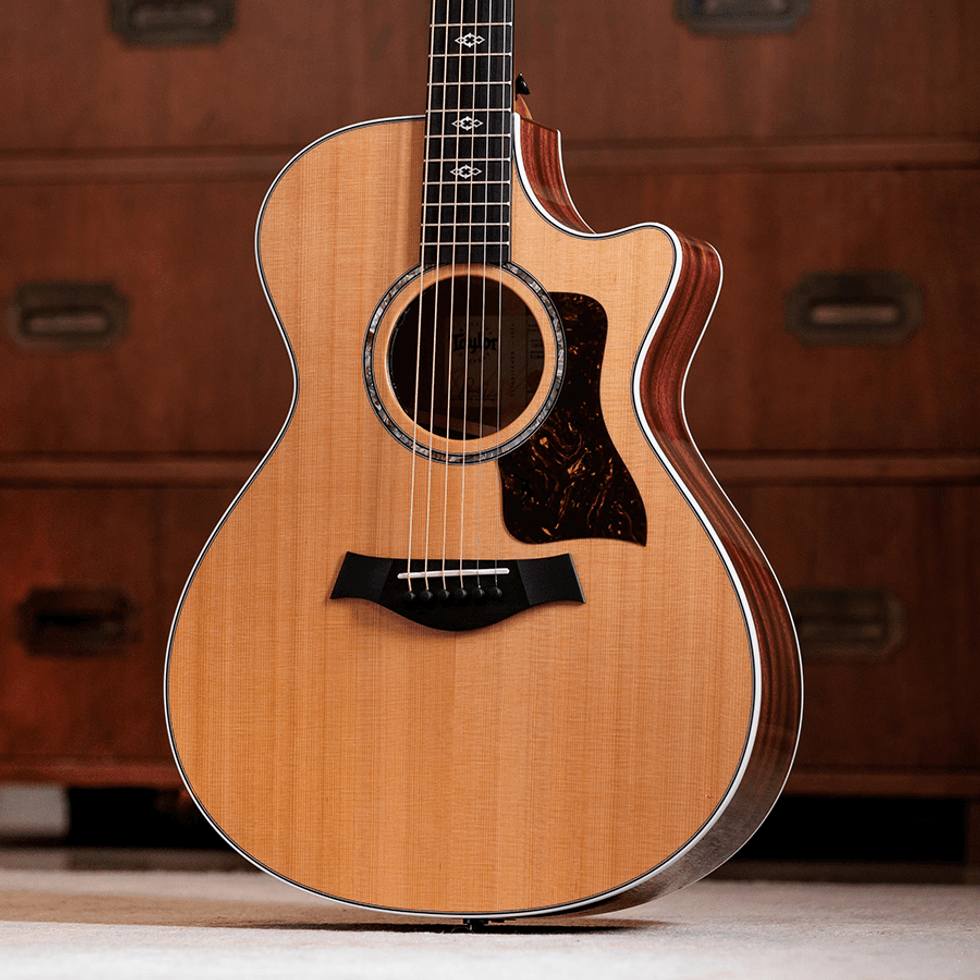
512ce
Sure to entice players who love the compact, accommodating feel of the Grand Concert body shape, the Next Generation 512ce serves up a beautifully warm, woody voice to complement its articulation and fundamental focus. Back and sides of solid mahogany pair with a top of Western Red cedar to produce a sweet character with remarkable touch sensitivity and balance across the frequency spectrum, while the scalloped V-Class bracing inside adds more volume, open-string resonance and sustain. Other Next-Gen features include the Action Control Neck for smooth fretting and fast string height adjustments as well as our new Claria electronics, which delivers clean, usable plugged-in tone for live performance and recording applications. Visual details include pristine white binding with black/white/black top purfling, a single-ring green abalone rosette, a faux-tortoiseshell pickguard, Meridian fretboard and peghead inlays in Italian acrylic, and a full-body natural gloss finish.
Dimebag’s Secret Weapon Is Finally a Pedal
The rabble-rousing, rack-mount flanger that drove Dimebag's riffs to swirling heights lives on in a more compact pedal format.
The MXR Flanger/Doubler recreates the original MXR rack unit in pedal form, capturing those classic all-analog flanger and doubler effects featured on hallmark recordings from the ’70s and ’80s. It’s designed for experimenters, offering the tools to blend and bend your signal into your own rich, multi-layered textures. Built around authentic bucket-brigade devices and the original control set, this pedal delivers the full range of sounds that made the rack unit a studio staple.
Whether you're chasing the sweeping jet-engine swoosh of the flanger or the thick, doubled-up layering of the doubler, the MXR Flanger/Doubler is equipped with the controls, the CV connectivity, and the visual feedback to take you wherever you want to go.
MXR Flanger/Doubler highlights:
- The renowned rack unit has returned in pedal form
- Authentic all-analog bucket-brigade devices
- Full, original control set shapes tone, range of motion, and sweep rate
- Doubler button switches between classic flanger swoosh and thick doubler chorusing
- Mix knob blends wet and dry signals to taste, from fully dry to fully wet
- Invert switch reverses wet signal polarity for airy, hollow vocality or bold low-mid punch
- Two LEDs track instantaneous delay time for quick adjustments when it’s too loud to rely on just your ear
- CV In and Out jacks connect with synths, sequencers, and CV-capable expression pedals
- Line Level switch ensures optimal performance when working with hot signals
The MXR Flanger/Doubler is available now at $333.00 street/$475.71 MSRP from select retailers.
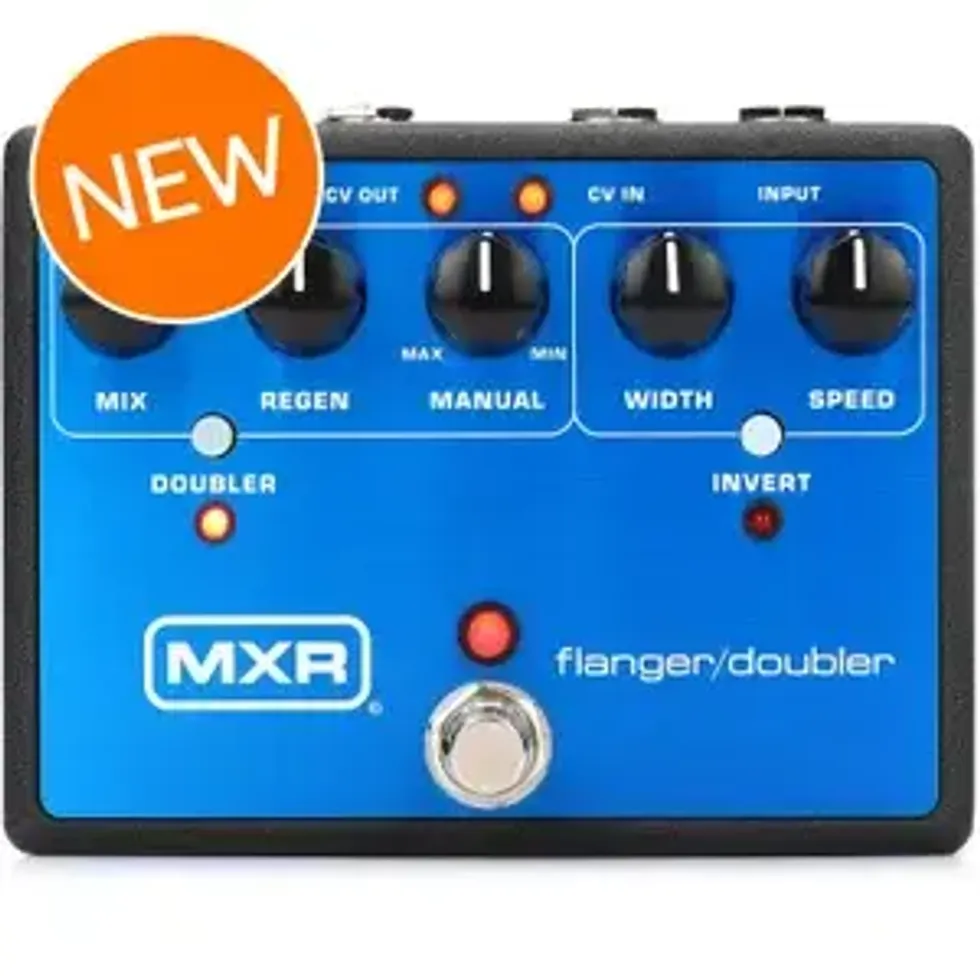
Flanger/Doubler Pedal
Flanger Guitar Pedal with 2 Modes, Regen, Manual, Width, Speed, Phase Invert, and CV Control
Wizard of Odd: The Quirks of Vintage Guitars and New Puppies

If you’ve been reading along for all the long years I’ve been writing this column, then you probably know a little something about my kids, co-workers, and friends. That’s the trick for me with writing: Something is going on in my life or rattling around in my head, and I start thinking about connections, mostly with guitars and history.
Now, about a month ago, we adopted two puppies! They were running the streets of Philly (Philly jawns!), so we took them in to spoil and love ’em. When I first started writing for this wonderful publication years ago, we had just adopted two puppy brothers, but one of them passed, so we’d been thinking about getting some more dogs. Now we have three and I’m running on next to no sleep. When your kids say that they’ll help with training, DO NOT believe them!
Anyway, what I was meditating on recently is how dogs have such deep personalities and quirks. Just like kids, man, these two new pups are so unique. The female is super tiny, super feisty and super noisy! The male is fearless and knock-kneed, and together, the two of them are just so adorable and hyper and loving that our family is living the good life. We’ll learn to live around their quirks, and eventually everyone will settle into new roles.
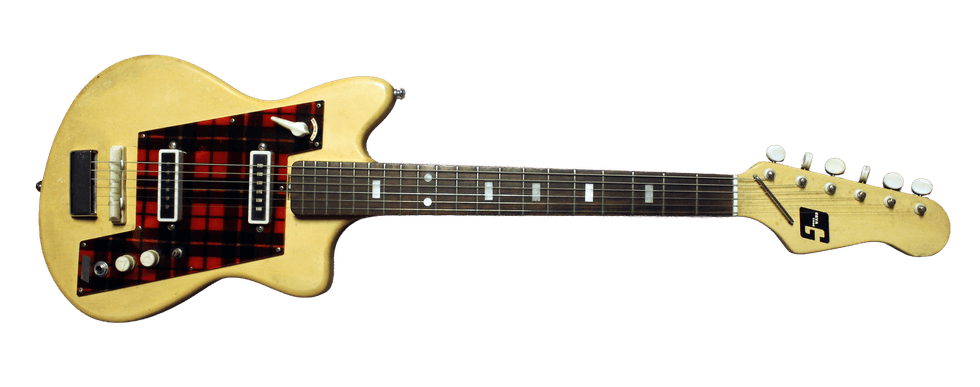
Of course, we all have our quirks, and as I’ve aged, I’ve come to terms with my own oddities. It’s so nice when people love you no matter what—and I’m a bonafide weirdo! But let me introduce some North American eyes to the weirdness of the Guyatone LG75. Only really appearing for about a year circa 1965, the LG75 was one of the quirkiest guitars I’ve ever owned (which is saying something).
First off, yes that is a plaid-patterned pick guard. Why? No idea. I mean, the Bay City Rollers did have a brush with stardom and tartan patterns, but that was in the ’70s. I don’t ever remember this pattern appearing on any other guitar I’ve seen, and curiously, these were sold primarily in the Japanese market. The Guyatone company was really picking up steam at that time and was cranking out all sorts of questionable guitar ideas; this was just one of them.
Second, the compensated but non-adjustable bridge can really give you trouble if the intonation is off. Good grief—I’ve spent so much time trying to get this guitar set up properly! At this time in Guyatone history, the Japanese Kasuga factory was making the wood parts of the guitar, and Guyatone was attaching their made-in-house electronics, but quality control was fairly hit-and-miss back then, and sometimes there were lemons. This guitar needed fret work, a neck angle repair, and plenty of precious time to deal with the aforementioned intonation issues.
Now, aside from all the challenges, who wouldn’t want to play this guitar?! With all that plaid, you could go hunting or settle into a ski lodge. It sounds pretty cool, and Guyatone always seemed to have solid electronics. (The Velvet Underground famously used a Guyatone electric guitar on their early recordings.) Yes, you have to fight with a lot of these old guitars. Yes, they can be weird and unpredictable. But isn’t that all part of the process? Even the color—yellowed off white—just looks like something Hank Marvin would be playing!
So, would you invest any time or money into a guitar like this? Would you accept its quirks and give it some TLC? These old import guitars are reaching around 60 years old now; are you prepared to give an old guitar a new lease on life? If so, you are my kind of people! Liking dogs helps, too.
Billy Strings explains why he’s still getting guitar lessons, despite being a Grammy-winning artist: “I hear myself play so much – I get sick of it”

Bluegrass artist Billy Strings still takes guitar lessons to expand his technical horizons and venture out of his genre.
Strings obviously doesn’t need lessons, and his three Grammy Awards can prove it, but he believes working with a tutor helps him to stay curious and inspired, as he starts to “get sick” of hearing himself play.
In The Interview podcast with The New York Times, he not only explains further why he takes lessons, but also demonstrates what he’s been learning within them to better his playing.
“Oh, I don’t know. I feel like I just play so many gigs and stuff, I hear myself play so much. I get sick of it, you know? Bluegrass is a lot of using this much of the fretboard,” he says, beginning to play, “I’ll occasionally slide up here, but there’s no money past the fifth fret.
“I’ve just started to try to learn some different styles of music that I never really got into, studying with my guy Rob that I’ve been taking lessons with for the last couple years… Just trying to expand my horizons, I guess.”
Hear what he’s been learning and watch him play below:
Last year, Guitar.com reviewed Billy Strings’s Martin D-X2E Signature model, and awarded it 9/10 for its playability and balanced tonality.
The model was part of a drop of two signatures with Martin, the first of which was launched at NAMM in January 2025 and was a $4,000 D-28 model, released as a love letter to his beloved 1940 D-28. The D-X2E is a more affordable option from Martin’s Remastered X-series.
Billy Strings has a new album, So Much For Goodbyes, landing on 28 August. You can pre-order it now.
The post Billy Strings explains why he’s still getting guitar lessons, despite being a Grammy-winning artist: “I hear myself play so much – I get sick of it” appeared first on Guitar.com | All Things Guitar.
Cort Guitars Unveils Exotic Series with Distinctive Tonewoods and Solid Tops
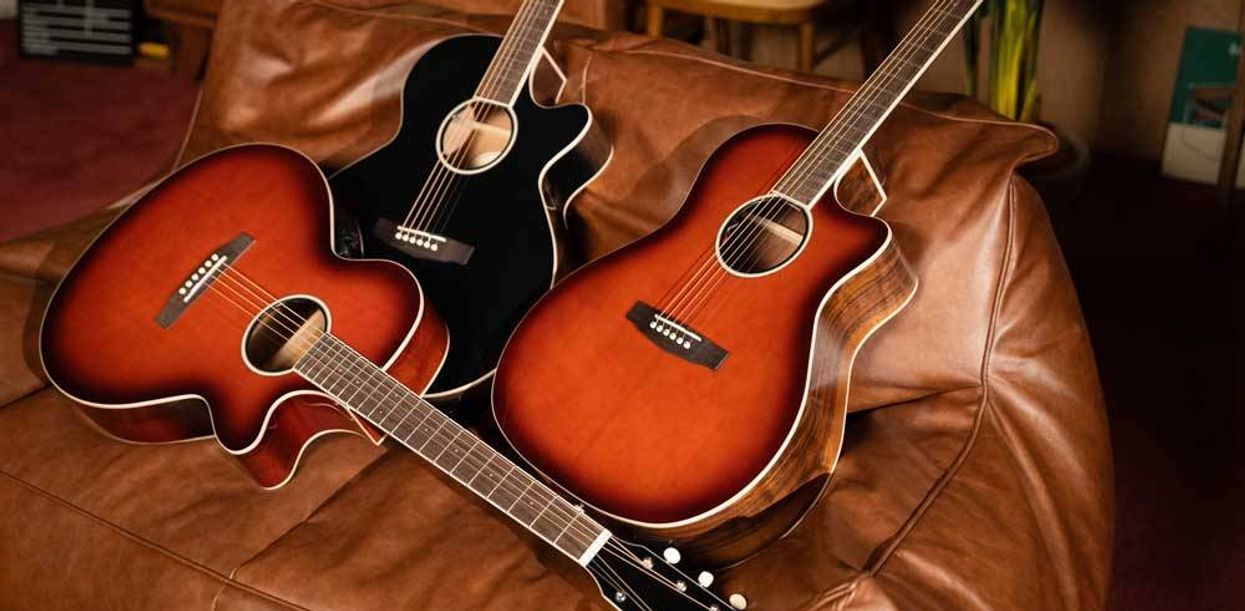
Cort Guitars announces the launch of its new Exotic Series acoustic guitars. Designed to provide unique visual identities at an accessible price point, the series targets entry-to-intermediate players, individual identity seekers, and collectors looking for one-of-a-kind natural wood grains. The lineup introduces three specific models engineered to blend organic visual character with dependable solid-top performance: the Exotic-GA Walnut, the Exotic-SFX Myrtle, and the Exotic-SFX Ash.
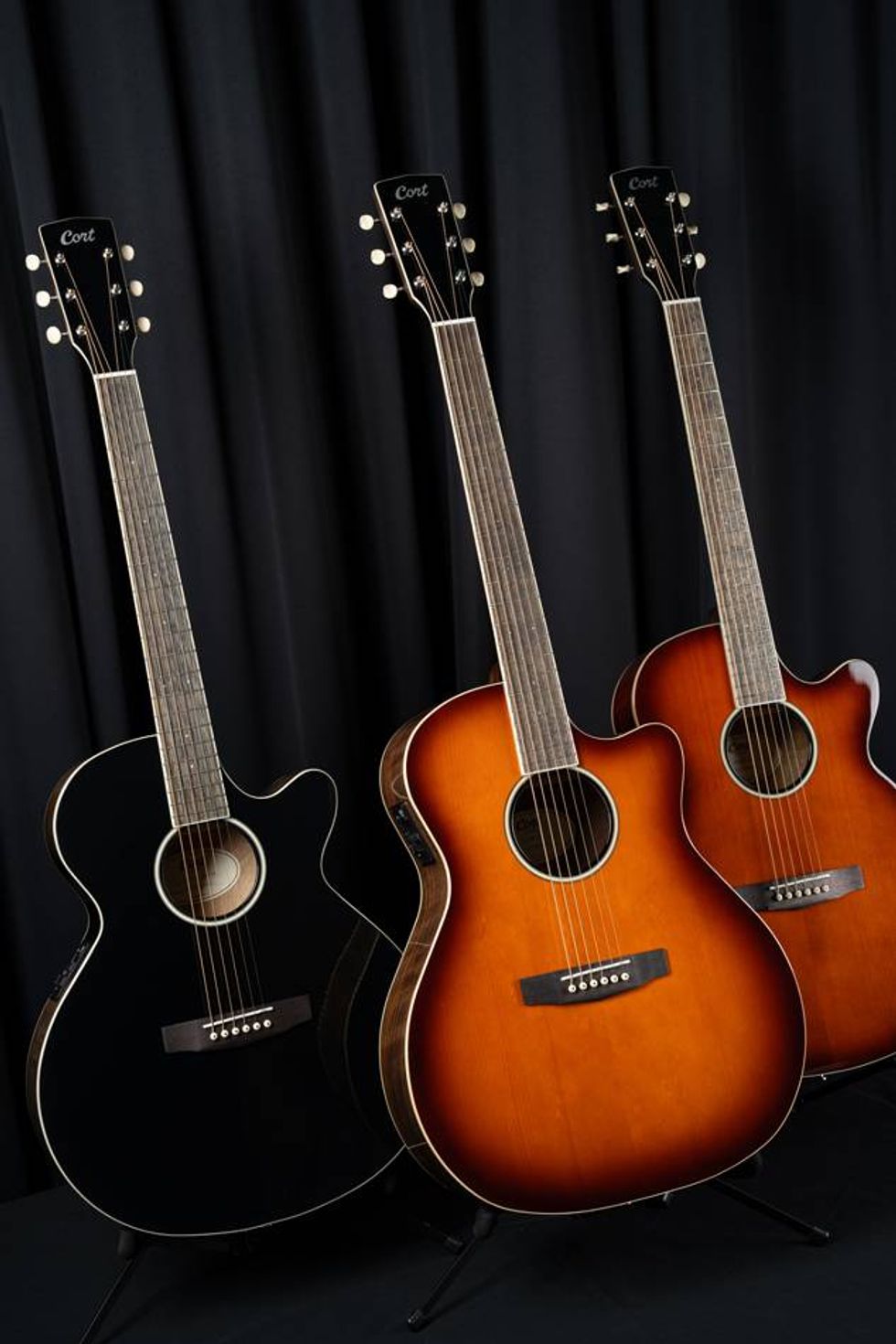
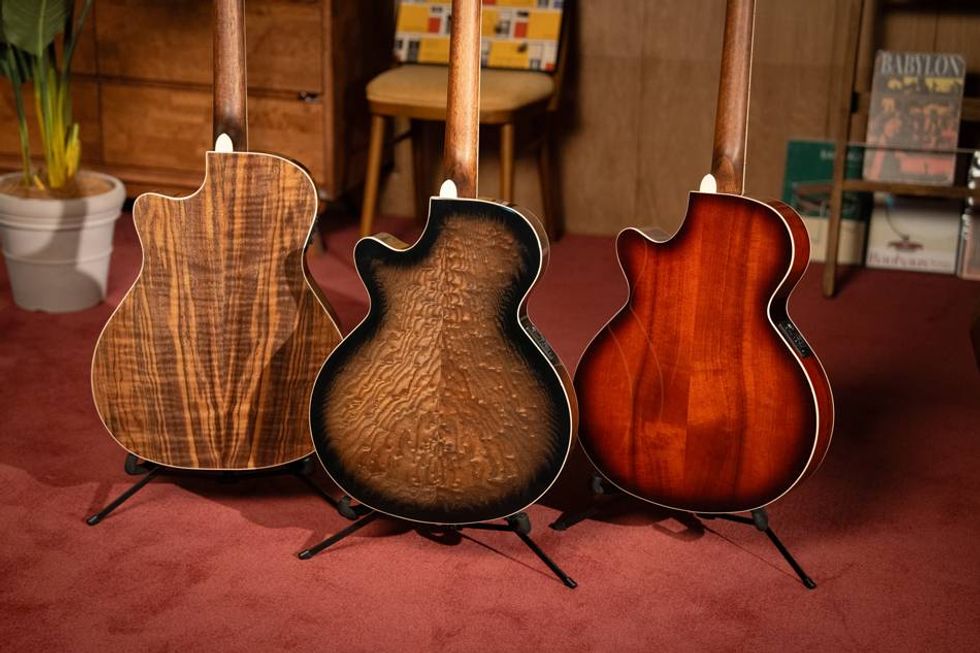
The construction architecture of the Exotic Series centers on marrying distinct back and side tonewoods with resonant solid soundboards to achieve specific acoustic balances. The Exotic-GA Walnut incorporates a Grand Auditorium body shape utilizing Claro walnut back and sides paired with a solid spruce top and finished in an organic sunburst, delivering a warm low-mid presence, smooth controlled sustain, and a balanced response tailored for both expressive fingerstyle and confident strumming. The Exotic-SFX Myrtle features a modern SFX body shape with a venetian cutaway, combining myrtlewood back and sides with a solid spruce top in a sunburst finish to yield a balanced, articulate response with clean note separation across a wide dynamic range. Conversely, the Exotic-SFX Ash model uses the same venetian-cutaway SFX body shape but pairs highly figured ash burl back and sides with a solid spruce top in a striking black finish, providing sharp note definition coupled with a warm, bass-forward tonal profile. All three variants feature refined aesthetic appointments, including aged white body binding and an aged white and black ABS rosette.
Every instrument in the collection is built with a standard 25.5-inch (648mm) scale length and structured around a robust dovetail neck joint at the 14th fret. The necks are crafted from mahogany into a comfortable C-shape profile, improving hand placement and comfort for transitioning guitarists. The fingerboard is made of laurel and features a flat 15.75-inch (400mm) radius with 20 frets, helping effortless string bending and clean single-note navigation across the guitar. Tuning stability is anchored by a matching laurel bridge alongside a high-density PPS nut and saddle combination, with the nut width specifically configured to suit the characteristics of each body style: a wider 1 3/4-inch nut width on the Grand Auditorium framework and a narrower 1 11/16-inch nut width on both SFX body shapes.
For immediate performance applications, Cort has outfitted the entire Exotic Series with integrated, stage-ready electronics. Each guitar is factory-equipped with a proprietary CE304T acoustic preamp and under-saddle pickup system. This active electronic package offers immediate plug-and-play functionality, providing users with onboard controls to shape their acoustic profile directly from the upper bout of the instrument. The system features a built-in digital LED tuner for fast, visible pitch adjustment on stage or in the studio, along with independent adjustments for volume and basic tone shaping to preserve the natural dynamic response of the solid spruce top when routing through an acoustic amplifier or front-of-house PA system.
Rounding out the structural hardware and remaining specifications, the instruments use advanced X-bracing patterns beneath the soundboards to maximize top vibration while supporting long-term structural integrity against high string tension. The pegheads are equipped with reliable die-cast tuning machines finished with tactile aged white knobs, mirroring the traditional aesthetic of the aged white body binding. To ensure immediate playability out of the box, the entire series ships from the factory strung with long-lasting, premium coated strings that resist corrosion and preserve high-frequency brightness. The underlying construction properties are uniform across the lineup, ensuring that whether a player opts for the bold, naturally varied grain of the Ash Burl or the refined elegance of the Walnut, the structural fundamentals stay durable and professionally balanced.
For more information about specifications, availability, and local dealer networks, please visit the official Cort Guitars website at www.CortGuitars.com
Street Price: $329.99 USD
D’Addario Launches XPND Voltage Booster
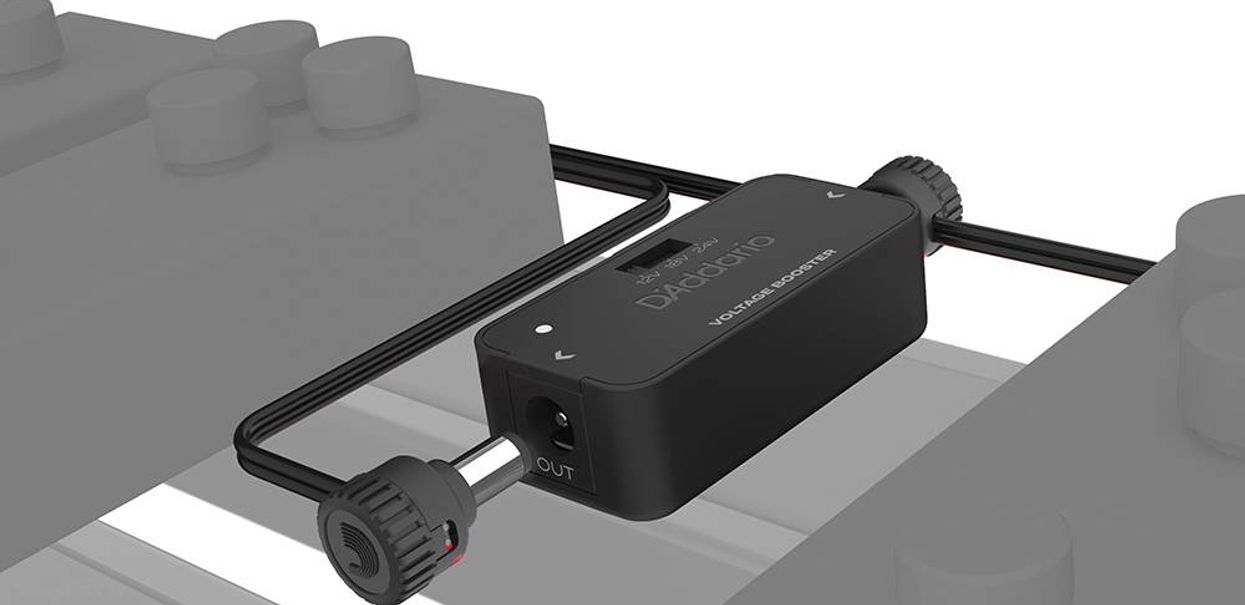
D’Addario announces the launch of the XPND Voltage Booster: a compact new power solution designed to help players easily integrate higher-voltage pedals into their setups without forcing them to purchase bulky power supplies or complicating routing.
Designed for modern pedalboards, the XPND Voltage Booster converts a single 9V source into selectable 12V, 18V, or 24V outputs, giving players instant access to the voltages required by many overdrives, delays, reverbs, compressors, and other high-performance pedals.
More Voltage, Made Simple
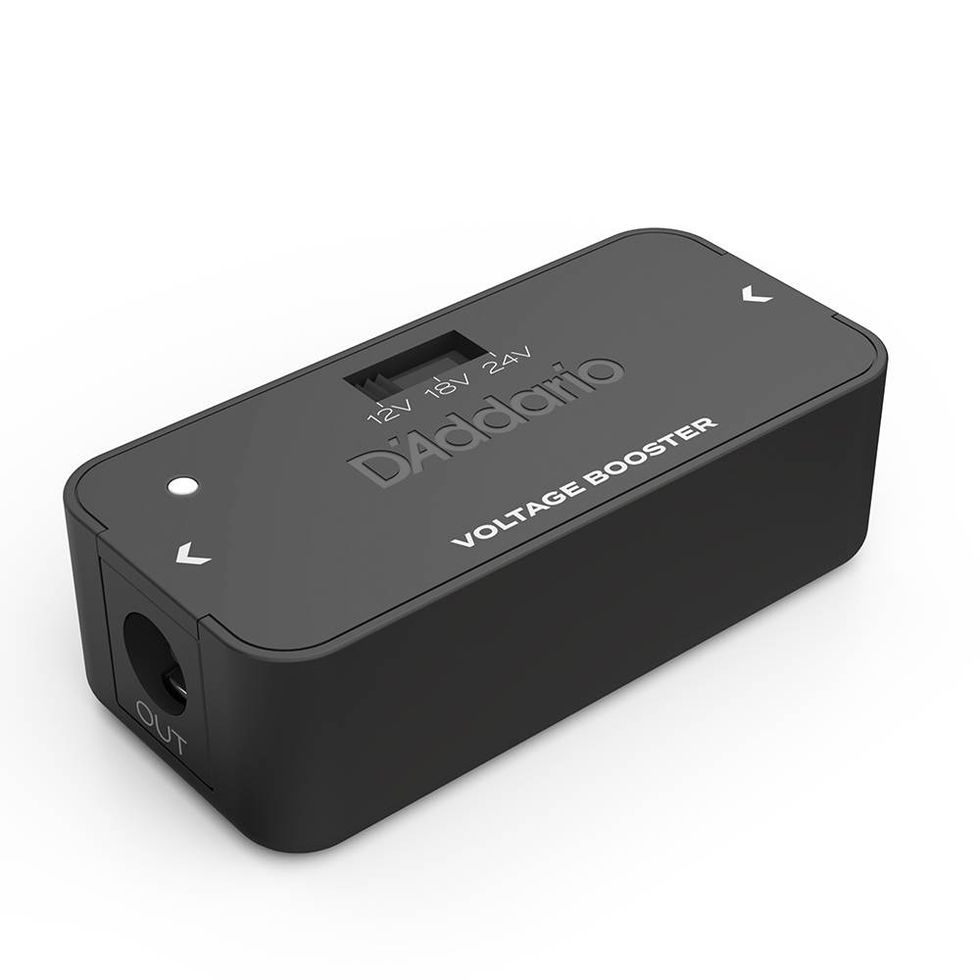
Higher-voltage pedals can unlock increased headroom, improved dynamics, and expanded tonal possibilities. But powering them usually requires additional equipment, expensive power supplies, and a lot of unnecessary complexity.
The XPND Voltage Booster simplifies that process with a compact, pedalboard-friendly design that integrates seamlessly with XPND Power and other 9V tip-negative power supplies.
Designed for players building increasingly sophisticated pedalboards, the XPND Voltage Booster offers a simple, more streamlined solution for powering up higher-voltage pedals. And all while keeping setups clean, efficient, and portable.
Key Features
- Easily converts a single 9V source into 12V, 18V, or 24V output
- Compatible with the XPND Pedal Power Battery Kit and other 9V tip-negative supplies
- Compact, space-saving design for easy pedalboard integration
- Eliminates the need for additional bulky power bricks, keeping rigs clean, lightweight, and portable
- Provides flexible power for a wide range of pedal requirements
Availability & Price
The D’Addario XPND Voltage Booster is available now through authorized D’Addario dealers and at daddario.com. Street price: $35.99.
For more information, visit: https://ddar.io/xpndvoltagebooster
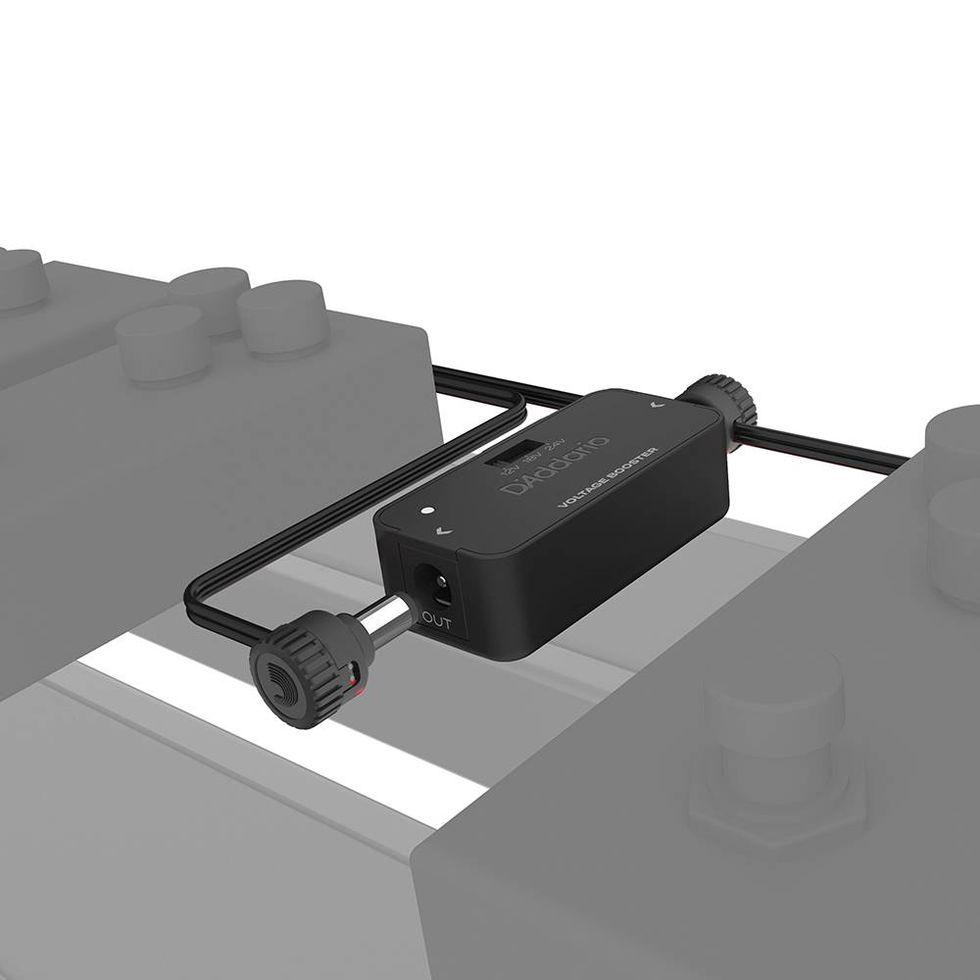
XPND Voltage Booster
Instantly unlock 12V, 18V, and 24V power from a single 9V source
Alex Lifeson reveals the Rush song he “really struggled with” learning to play again for the band’s reunion: “My hands are not operating like they once did”

Amid their Fifty Something reunion tour, Alex Lifeson and Geddy Lee of Rush have revealed the hardest song that they had to relearn ahead of the shows.
After kicking off in early June, the tour is still running this August and will continue through to April next year. It sees Anika Nilles take to the drum kit following the death of Neil Peart in 2020, who is continually honoured each night on the tour.
Speaking to Rolling Stone about their return to the stage together, Lee and Lifeson explain why they decided to bring A Farewell To Kings back into their setlist for the first time since 1979.
“We wanted to be better than we’ve ever been,” begins Lifeson. “Not just be as good as we were, and challenge ourselves with songs that we haven’t played in a long time. All of them were challenging after 11 years anyways, but to bring back A Farewell To Kings, that took a lot of work. Probably the hardest song of all.”
Lee adds, “That was the hardest one because it’s a really mental song. It’s just weird, structurally. Each part is difficult to play in and of itself. And then when you add… like even the beginning, it sounds like a walk in the park, but it’s not.
“You go into the intro, and the intro keeps changing. In the intro and the outro, beats are added, beats are dropped, and you have to remember the order that those happen in. Then you get into the opening riff. That’s a tricky riff for a guitar player to play.”
Lifeson continues, “Yeah, I really struggled with it. I’ve played classical for a long time, but I really struggled with it. My hands are not operating like they once did. I work really hard to get them to that level and it’s been pretty successful so far, I think. But to play that, like Ged said, to play that in a very smooth, delicate way, and that’s the way it is on record, while you still have another guitar draped on your sore neck, it takes a lot of gymnastics to get it all done.”
Watch the full interview below:
To view the full list of Fifty Something tour dates, head over to the official Rush website.
The post Alex Lifeson reveals the Rush song he “really struggled with” learning to play again for the band’s reunion: “My hands are not operating like they once did” appeared first on Guitar.com | All Things Guitar.
“I’m horizontal and I’m like, ‘Can we get a diaper?’”: The time Tobias Forge tried to go ahead with a Ghost show despite food poisoning

A cancelled show is frustrating for all involved, so much so that Ghost’s Tobias Forge considered wearing a diaper during a severe case of food poisoning just so he could push through a gig – now that’s dedication.
Not your regular show, the set was one of three shows in Mexico City due to be filmed for the band’s 2 Big To Rig concert film, which lands in cinemas this August. The opening show was inevitably cancelled at the last minute when Forge couldn’t pull through, despite his best efforts.
- READ MORE: Kirk Hammett, Tobias Forge and Billy Corgan to appear on new album celebrating 50 years of Accept
In an interview with Metal Hammer, Forge is asked what went down: “We flew into Mexico City five days before, just to get acclimatised to the elevation and jet lag,” he remembers. “Everything was dandy, and then came the show day. I woke up and felt weird. It takes about an hour to go from the hotel to the venue, and throughout that whole trip, I just slept. I thought I was just tired!
“When I came to the venue, I couldn’t stomach anything, everything was just flowing through me, and for every hour that went by I was getting more and more drained. And then, all of a sudden, I started puking violently. Everything, just, ‘Out, out, out!’ Everyone’s getting super-nervous: not only is the show dependent on this, but we also have a film depending on this! Fuck!”
With no other obvious cause for Forge’s sudden onset illness, it was then presumed he had a bad case of food poisoning. He recalls feeling an “incredible sense of defeat” with all that was weighing on the show ahead.
“The film is one thing, but I really don’t like cancelling shows in the first place, and I absolutely hate to cancel when the crowd is already there. I’m horizontal, and I’m like, ‘Can we get a diaper? I’m gonna give it my best!’ But I cannot stand – literally. Even if you get me up onstage, I will not be able to sing.
“Then you just have to do the rational thing: ‘Fuck this, we need to pull the plug.’ The rest of the evening, I was just lying on a stretcher with intravenous liquid going in. And then you have to handle the defeat and hope for people to understand,” he says.
Thankfully, Forge had a good team around him who knew that rest and recovery mattered most. The remaining two shows went ahead as planned as he began to get better.
You can watch the trailer for the film below:
To find out where you can catch 2 Big To Rig, head over to the Ghost website.
The post “I’m horizontal and I’m like, ‘Can we get a diaper?’”: The time Tobias Forge tried to go ahead with a Ghost show despite food poisoning appeared first on Guitar.com | All Things Guitar.
Green Day bassist Mike Dirnt is selling Dookie-, Nimrod- and American Idiot-era gear and clothing on Reverb

Green Day bass player Mike Dirnt has become the latest artist to sell a trove of his used gear on Reverb.
Launching 9 September, the Official Mike Dirnt of Green Day Shop includes bass guitars, amps, clothing and other items of memorabilia used by the bassist both on tour and in the studio throughout his multi-decade career.
A selection of bass guitars headlines the collection, including two American Idiot-era Fender Mike Dirnt Signature Precision Basses – used extensively on tour and personally customised by Dirnt – another Fender bass that was one of the main instruments used on Green Day’s landmark 1997 album Nimrod, and one of Dirnt’s original Gibson Grabber basses, smashed beyond playability by drummer Tré Cool and Dirnt.
Also up for grabs is one of the first Ampeg SVT-810 cabinets Dirnt bought with his first Green Day paycheck, and used throughout the band’s Dookie tour, one of two Yamaha G100-II amp heads used on some of Green Day’s earliest records and tours, and a selection of tour-used Mesa/Boogie amps and speaker cabs.
“I’ve found some amazing guitars and basses over the years. When you’re on tour for a long time, you’re always looking for cool gear. You’re always thinking about what could be on the next record or what do I need to play tonight or what can I find that sparks inspiration,” says Dirnt.
 Credit: Reverb
“Every guitar, every bass, every amp has something different. You pick up a guitar and strum it and you think, there’s songs in this thing and I’m going to extract those songs. Then once you feel like you’ve gotten the songs or the recording out of it, it’s time to let it go and give it to the next person.”
The Official Mike Dirnt of Green Day Shop also includes a haul of clothing worn by Dirnt on tour and in Green Day music videos, including the leather bomber jacket he wore in the video for Wake Me Up When September Ends, and jackets from the 21st Century Breakdown, American Idiot and ¡UNO! Tours.
“This is all stuff people have seen me wearing in the past,” Dirnt says. “If somebody wants to buy a pair of the pants and cut it, make bracelets with it, cut a patch off and put it on your jacket… that’s the coolest thing ever. It’s just fabric. Play with it. Have fun with it like I did. From me to you.” Proceeds from the sale of Mike Dirnt’s used clothing will go to charity.
This isn’t the first time Green Day gear has appeared on Reverb. Back in 2023, frontman Billie Joe Armstrong listed nearly 100 items of used gear.
The Official Mike Dirnt of Green Day Shop goes live on 9 September. You can preview the items up for grabs by heading to Reverb.
The post Green Day bassist Mike Dirnt is selling Dookie-, Nimrod- and American Idiot-era gear and clothing on Reverb appeared first on Guitar.com | All Things Guitar.
What’s the point in a fanned fret guitar anyway?

If you hand most guitar players a fanned fret instrument for the first time, their first reaction is probably to recoil in horror – after all, the way the frets gradually tilt forward on the fretboard as you move up the neck looks like something designed to confuse and confound your tried and tested muscle memory. And yet, more and more guitarists – especially those at the technical end of the spectrum – are using fanned frets. So what gives? Well, the answer is actually quite simple.
- READ MORE: What are pots anyway? A working guide to the knobs on your guitar, and what they actually do
In traditional guitar construction, the frets on the neck run perpendicular to the strings, parallel to each other from nut to heel. A fanned fret guitar is built differently. The frets sit at an angle, splayed out like the ribs of a folding fan, usually with the nut and bridge slanted to match. The proper name for the design is multiscale, and that name explains what is actually going on: each string gets its own scale length.
On a conventional guitar, every string shares one scale length (with slight variation at the bridge, of course). A Les Paul is 24.75 inches from nut to bridge on every string. A Strat is 25.5 inches on every string. On a multiscale instrument, the bass side is longer than the treble side. A common spec on a modern multiscale 6-string is 25.5 inches on the high E stretching to 26.5 or 27 inches on the low E. Strandberg’s standard Boden 6 runs a subtle 25 to 25.5 inches. Dingwall’s 5-string basses go much further, spanning 34 inches on the G string out to a 37-inch low B. Because each string has its own scale length, the frets need to be laid out according to that scale length, so they have to fan.
 Image: Rachel Billings for Guitar.com
Why Scale Length Matters In The First Place
String tension is a function of three things: pitch, string mass, and vibrating length. Tune a string to the same note on a longer scale and the tension goes up. That’s the entire reason fanned frets exist.
Every guitarist who has tuned a 25.5-inch guitar down to drop A has met the problem. The low string turns into a floppy noodle. You can fight it with heavier gauges, but heavy strings on a short scale bring their own trouble: stiff, thumpy attack, sharp fretted notes because the string deflects so much when you press it, and inharmonicity in the overtones that makes low chords sound blurry. Piano builders solved this centuries ago by giving bass strings dramatically more length than treble strings. A concert grand is, in effect, a multiscale instrument.
The obvious fix on guitar is a longer scale, which is why baritones exist. But if you stretch the whole instrument to 27 or 28 inches, you’re trading away the treble side. Bends get stiffer, the plain strings lose some warmth, and the fret spacing in the lower positions gets wide enough to annoy anyone with average hands. One scale length is always a compromise between what the low strings want and what the high strings want.
Fanned frets seek to end that compromise. The wound strings get the length and tension they need for a clear, focused low end. The plain strings stay at a familiar length where bends and vibrato feel normal. That’s the purpose of the design.
 Image: Rachel Billings for Guitar.com
Where The Idea Came From
Fanned frets are, contrary to popular belief, a very old concept. The orpharion, a wire-strung cousin of the cittern built in England in the late 1500s and credited to luthier John Rose, used slanted frets and an angled bridge to give its bass courses extra length. A patent for a fanned fingerboard was filed by E. A. Edgren as far back as 1900.
The modern version belongs to Ralph Novak. Working as a repairman and builder in the 1980s, Novak wanted the sweet, warm treble response of a short scale combined with the piano-like bass of a long scale on one instrument. He filed in 1988 and was awarded U.S. Patent 4,852,450 in 1989, the same year he founded Novax Guitars. Novak trademarked the term Fanned-Fret, which is why big manufacturers say multiscale instead. Charlie Hunter’s 8-string Novax hybrids were the design’s most visible early ambassadors. When the patent expired in 2008, the concept went from boutique curiosity to production reality. Ormsby, Dingwall, Strandberg, Ibanez, ESP, Jackson, Schecter, and Cort all build multiscale instruments now, and the design rode the extended-range metal boom of the 2010s into the mainstream.
 Image: Adam Gasson
What It Feels Like
Somewhere in the middle of a multiscale neck sits the neutral fret, the one that remains perpendicular to the strings. Builders typically place it between the 7th and 9th frets, and its location determines how the fan is distributed. Frets below it lean toward the nut on the bass side; frets above it lean toward the bridge.
There is an added ergonomic benefit to fanned frets too. In the first position, the slanted nut end roughly matches the natural angle of a fretting hand reaching for an open chord. High up the neck the angle reverses, which suits the way the wrist rotates as it travels toward the body. Most people adapt to it with relative ease. The genuine trouble spots are big barre chords near the extremes of the fan.
There are real costs to building this way, which is why I’ve done so few of them myself. Fretwork, nut cutting, and pickup makers have to offer slanted or individual-pole designs to track the string angle properly. None of this is exotic anymore, but unless you’re building your own custom pickups, it can limit your options. For many, the benefits outweigh the costs, and that’s why we see so many fan-fretted guitars out there today.
 Image: Adam Gasson
Who Actually Needs Fanned Frets
In modern settings, guitarists who play a 7-string, 8-string, or heavily downtuned 6-string are the core audience. This is because the low B, F#, or drop G is where a stretched bass scale earns its keep. Bassists chasing a tight, articulate low B are arguably served best of all, which is why Dingwall owns that conversation. If you play a standard-tuned 6-string, fanned frets solve a problem you do not have. Tension balance and intonation improve slightly, but the payoff is modest. The lower you tune and the more strings you add, the more sense the fan makes.
You’ll also occasionally see very high level acoustic guitar players – the sort who are not playing cowboy chords – using fanned fret instruments because there really is no hiding place for intonation when you’re playing virtuosic acoustic guitar!
The post What’s the point in a fanned fret guitar anyway? appeared first on Guitar.com | All Things Guitar.
Epiphone And Lzzy Hale Unveil The Explorer Custom In Black Diamond Holographic Sparkle
Epiphone , the innovative, high-quality instrument brand built for every stage, proudly announces the launch of the Lzzy Hale Explorer™ Custom in a striking Black Diamond Holographic Sparkle finish. A bold new artist model created in collaboration with GRAMMY® Award-winning Halestorm frontwoman, rhythm guitarist, primary songwriter, and Gibson’s first female Brand Ambassador, Lzzy Hale. The new model continues Hale’s celebrated run of Epiphone signature guitars, a series that has produced sold-out and highly collectible instruments embraced by fans, players and collectors. The Epiphone Lzzy Hale Explorer Custom, Black Diamond Holographic Sparkle is available worldwide now at authorized Epiphone dealers, the Gibson Garage in Nashville and London , and on www.epiphone.com.

A commanding new addition to Lzzy Hale’s celebrated series of Epiphone signature guitars, the Lzzy Hale Explorer Custom is designed to match the force of her performances: powerful, unapologetic, visually striking, and built to deliver night after night. Purpose-built for heavy music and unmistakable style, this new Explorer Custom raises the volume with a dazzling Black Diamond Holographic Sparkle finish, premium appointments, and a high-output voice made for heavy riffs, soaring leads, and arena-sized presence. More than a signature guitar, it is a true statement piece: a hard-hitting, high-impact instrument built for players who want standout style, powerful tone, and performance-ready dependability.
“Lzzy has always brought a rare combination of power, precision, and unmistakable style to the stage,” says Aljon Go, Product Manager, Epiphone. “The Lzzy Hale Explorer Custom captures that same energy in an instrument that looks unforgettable, plays fast, and delivers the clarity and punch players need to own the moment.”

Built around a classic mahogany Explorer body, the Lzzy Hale Explorer Custom features elegant 7-ply top binding and a single-ply mirror pickguard for maximum visual impact under stage lighting. The gloss Black Diamond Holographic Sparkle finish gives the guitar a bold, dimensional look that reflects Lzzy’s fearless stage presence and makes the model stand out immediately in any collection.
Coinciding with the new guitar’s launch, Lzzy Hale is offering fans on Halestorm’s Fall 2026 North American tour the rare opportunity to own an Explorer Custom played live on stage and personally autographed by Lzzy. The VIP upgrade also includes an exclusive pre-show meet and greet, individual photo opportunity, VIP merchandise, and additional on-site perks. For all package details, availability, and more information, visit Superfan.live/artist/halestorm.
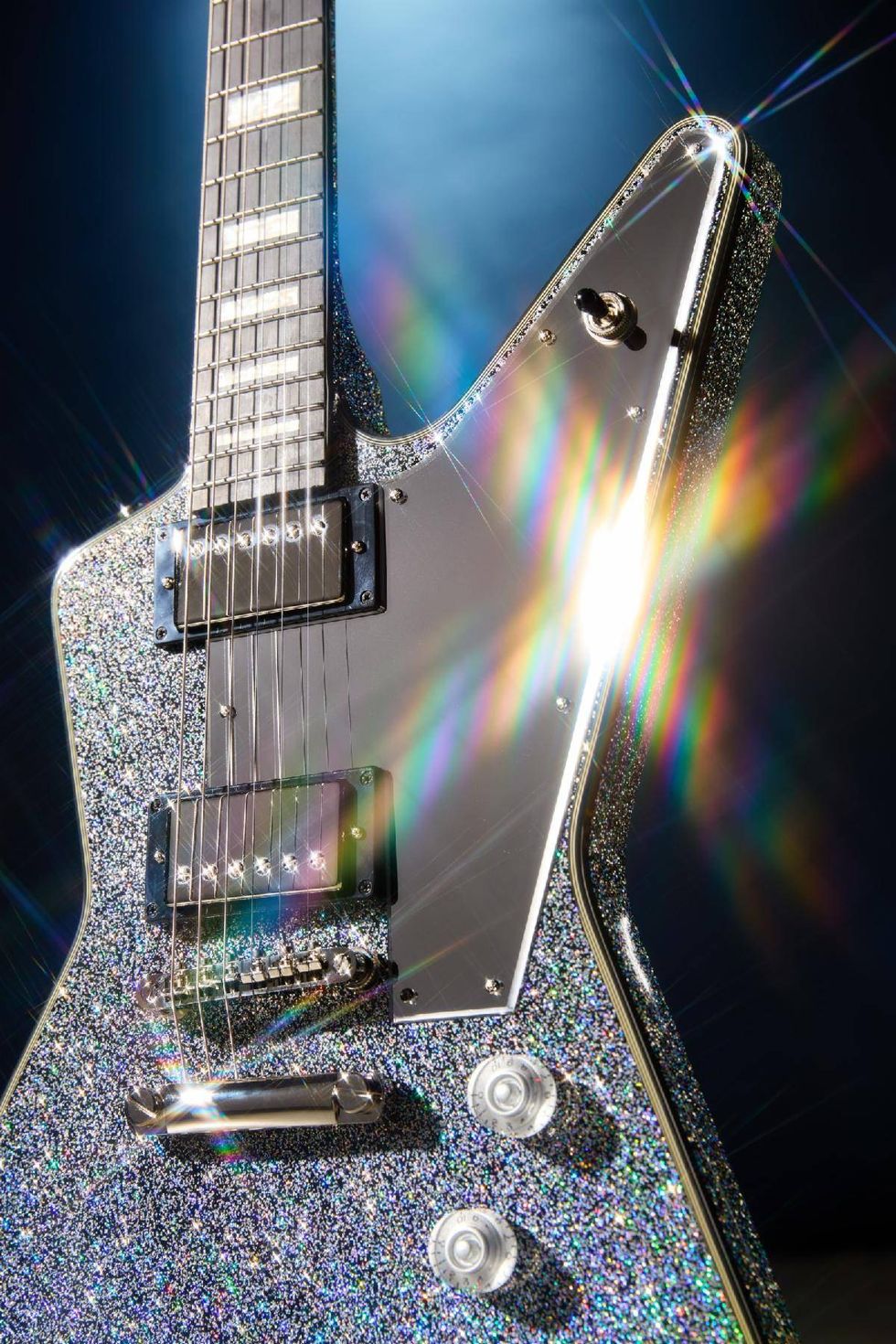
The mahogany neck is shaped to Epiphone’s comfortable and fast SlimTaper™ 60s C profile, paired with an ebony fretboard, 22 medium jumbo frets, and pearloid block inlays. The signature Explorer “hockey stick” headstock features a raised Epiphone 3D nickel logo, a Graph Tech® nut, and Grover® Mini Rotomatic® tuners for dependable tuning stability. Custom artist details include a black two-ply truss rod cover engraved with Lzzy Hale’s signature and a sleek black stinger on the rear of the headstock.
For players seeking crushing tone with definition and control, the Lzzy Hale Explorer Custom is powered by a matched set of Epiphone ProBucker™ Ignite pickups, engineered for power, clarity, and dynamic response. Each pickup is wired to its own volume control, with a shared master tone control topped by a silver Speed knob for precise shaping. A three-way pickup selector provides easy access to either pickup or both together, making the guitar equally suited for massive rhythm tones, articulate leads, and everything in between.
At the opposite end, the guitar is equipped with a LockTone™ Tune-O-Matic™ bridge and LockTone Stop Bar tailpiece, delivering accurate intonation, long-lasting sustain, and road-ready reliability. A hardshell case is included to protect the instrument at home, in the studio, and on tour.
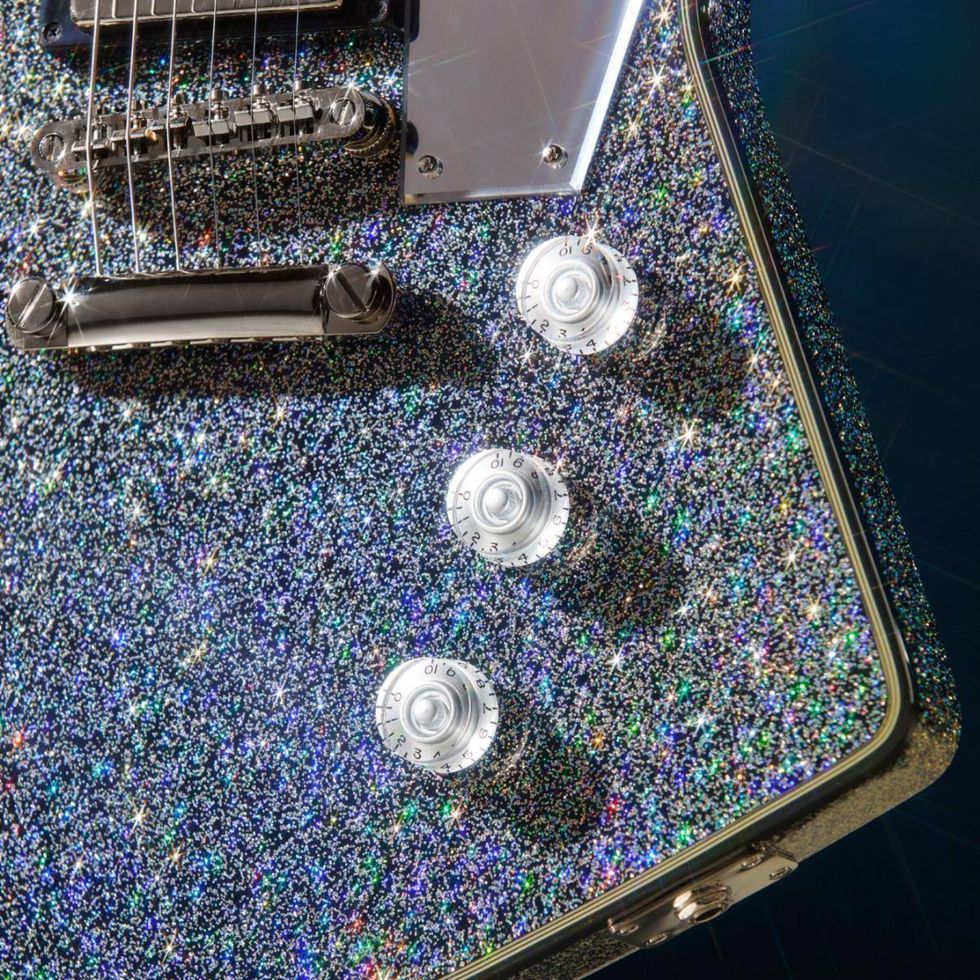
Lzzy Hale is the GRAMMY® Award-winning lead vocalist, rhythm guitarist, primary songwriter, and co-founder of Halestorm, one of modern hard rock’s most powerful and enduring bands. Known for her electrifying performances, commanding guitar work, and unmistakable voice, Hale has helped lead Halestorm to seven #1 hits at rock radio, more than three billion streams worldwide, over three million albums sold in the U.S., two GRAMMY® Award nominations, and a 2012 GRAMMY® Award win for “Love Bites (So Do I)” in the Best Hard Rock/Metal Performance category. In July 2026, Hale was honored by the Rock & Roll Hall of Fame as part of its “Women in Metal: You Will Know My Name” exhibit, where she spoke and performed with Halestorm guitarist Joe Hottinger in celebration of the women who have shaped heavy music. Her latest chapter with Halestorm includes the band’s album Everest and the fierce anthem “Rain Your Blood On Me,” which Hale has called “our ode to women” and “our war cry.” As Gibson’s first female Brand Ambassador and a longtime Epiphone signature artist, Hale has helped create a celebrated run of bold, sold-out, and highly collectible signature instruments. With the new Epiphone Lzzy Hale Explorer Custom in Black Diamond Holographic Sparkle, Hale continues to inspire players everywhere to stand out, turn up, and make their presence impossible to ignore.
Catch Lzzy on tour with Halestorm across North America this fall. For more info and tickets, visit halestormrocks.com.
Halestorm North American Fall Tour
Sep 2 Denver, CO Ball Arena
Sep 4 Chicago, IL Huntington Bank Pavilion at Northerly Island
Sep 5 Noblesville, IN Ruoff Music Center
Sep 7 Toronto, ON RBC Amphitheatre
Sep 9 Holmdel, NJ PNC Bank Arts Center
Sep 10 Mansfield, MA Xfinity Center
Sep 12 Bristow, VA Jiffy Lube Live
Sep 13 Raleigh, NC Coastal Credit Union Music Park at Walnut Creek
Sep 15 Charlotte, NC Truliant Amphitheater
Sep 16 Alpharetta, GA Ameris Bank Amphitheatre
Sep 18 Clarkston, MI Pine Knob Music Theatre
Sep 19 Louisville, KY Louder Than Life*
Sep 21 Maryland Heights, MO Hollywood Casino Amphitheatre - St. Louis
Sep 23 Dallas, TX Dos Equis Pavilion
Sep 25 The Woodlands, TX The Cynthia Woods Mitchell Pavilion
Sep 26 Del Valle, TX Germania Insurance Amphitheater
Sep 29 Albuquerque, NM First Financial Credit Union Amphitheater
Oct 1 Phoenix, AZ Talking Stick Resort Amphitheatre
Oct 2 Rancho Mirage, CA Agua Caliente Resort Casino*
All dates except * are with BABYMETAL
Rig Rundown: Pavement
Pavement’s 2026 reunion run brought them to Nashville’s Ryman Auditorium for a two-night stand, and PG’s Chris Kies caught up with Stephen Malkmus, Mark Ibold, and Scott “Spiral Stairs” Kannberg before the second show to look over the road rigs. Have a look at some quick highlights below, and tune into the new Rig Rundown for all the details.
Brought to you by D’Addario.
Knobody’s Business
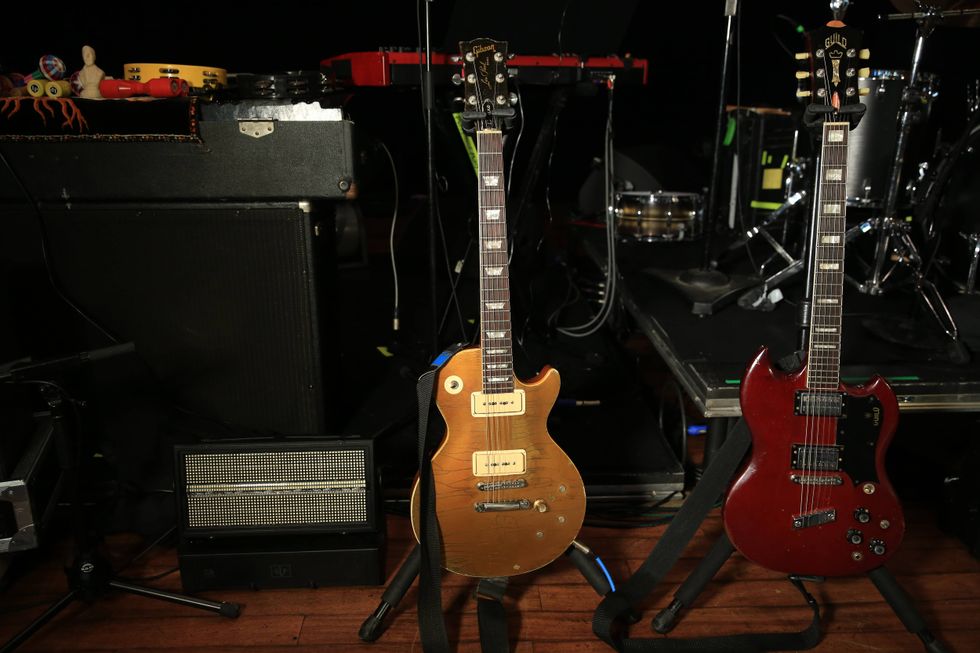
A friend pointed Malkmus toward this Les Paul Gold Top in the mid ‘90s, and the volume and tone knobs have been pulled out of it ever since—he’d rather think about singing. The finish checking came from a night in a van in Wyoming at 10 below, which he doesn’t recommend.
High-Voltage Riffing
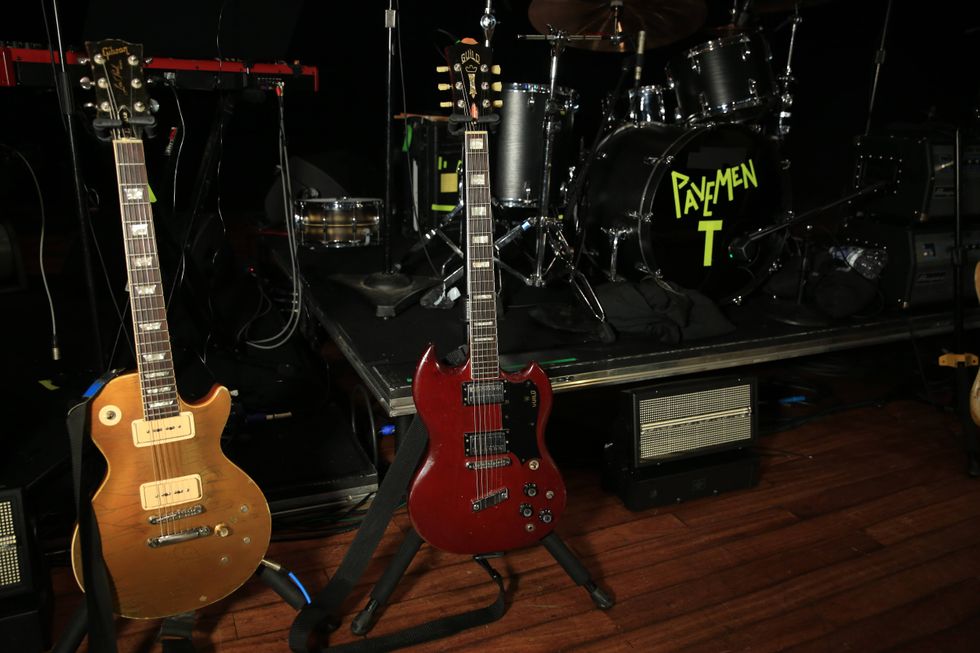
Malkmus also carries this Guild S-100, which he notes looks a lot like an Angus Young SG. He bought it beat up for a grand, which he considers the right way to buy a guitar since he’ll wreck anything nice.
Carry-On Crunch
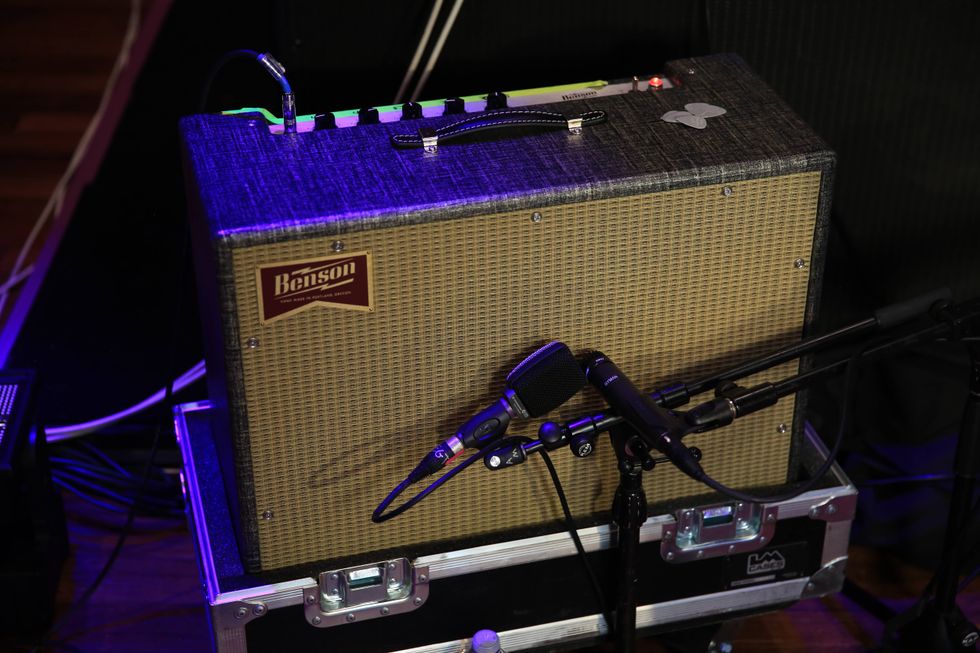
Malkmus’ sound is powered by a Benson amp, built in Portland, where he used to live. He likes the switchable wattage, the onboard reverb, and that it fits in an overhead bin.
Stephen Malkmus’ Pedalboard
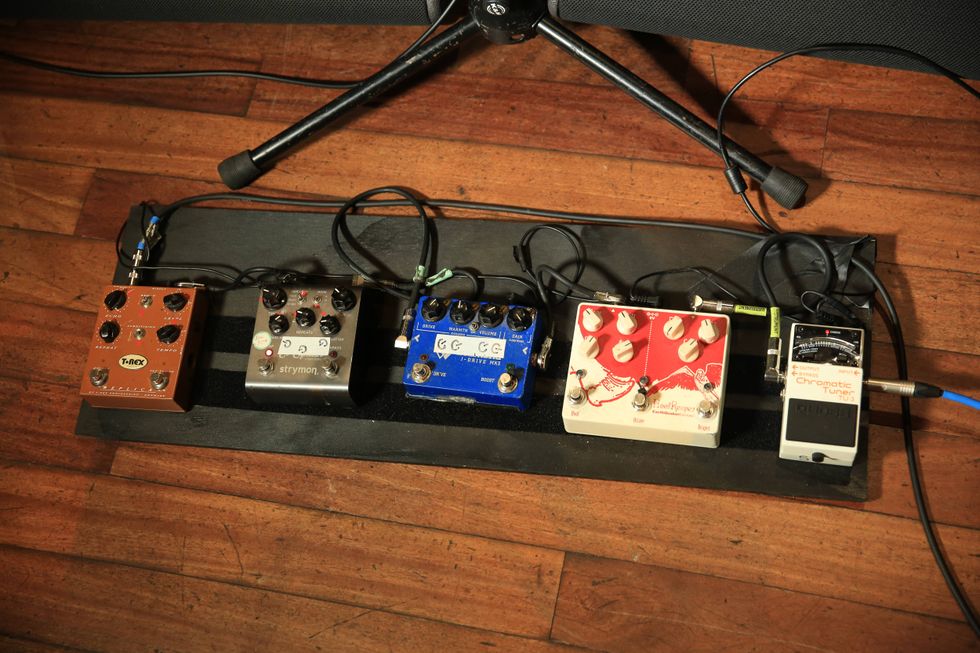
Malkmus keeps it to a Boss TU-2, an EarthQuaker Devices Hoof Reaper, a Diamond J-Drive MK3, a Strymon El Capistan, and a T-Rex Replica. He’s fitted plastic guards over the Hoof Reaper’s footswitches so he can’t kick one on by accident mid-song.
Classified Information
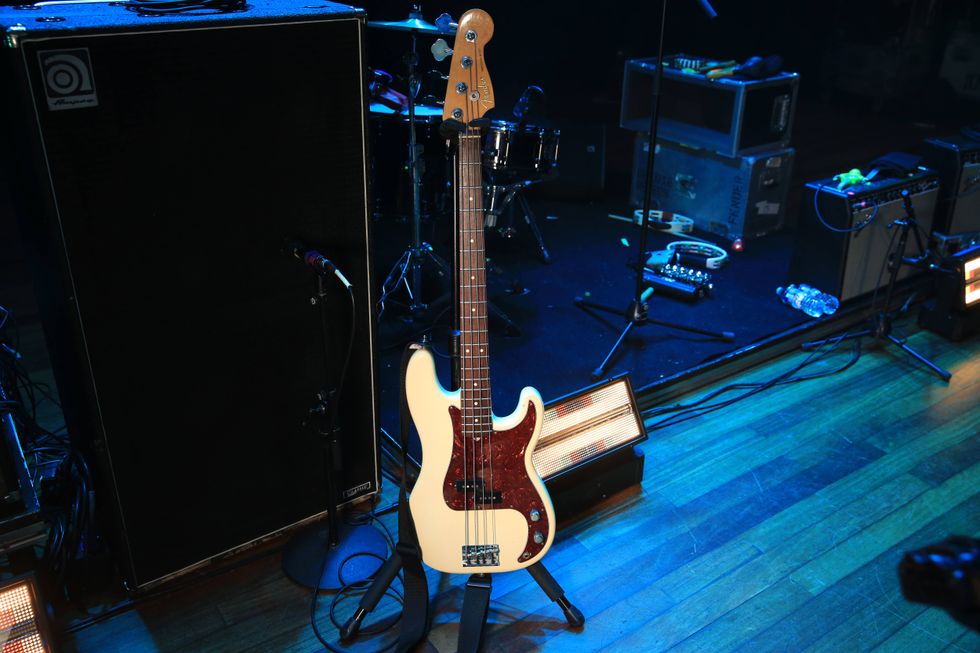
Ibold found this Precision in a free classifieds paper in the ‘90s and bought it in the seller’s kitchen out on Long Island. It’s the only bass he’s ever really played, it’s very light, and the finish cracked in that same Wyoming freeze. He uses Ernie Ball mediums (.050–.105). A backup P sits nearby, kept in a raised tuning for a couple of numbers.
Mark Ibold’s Pedalboard
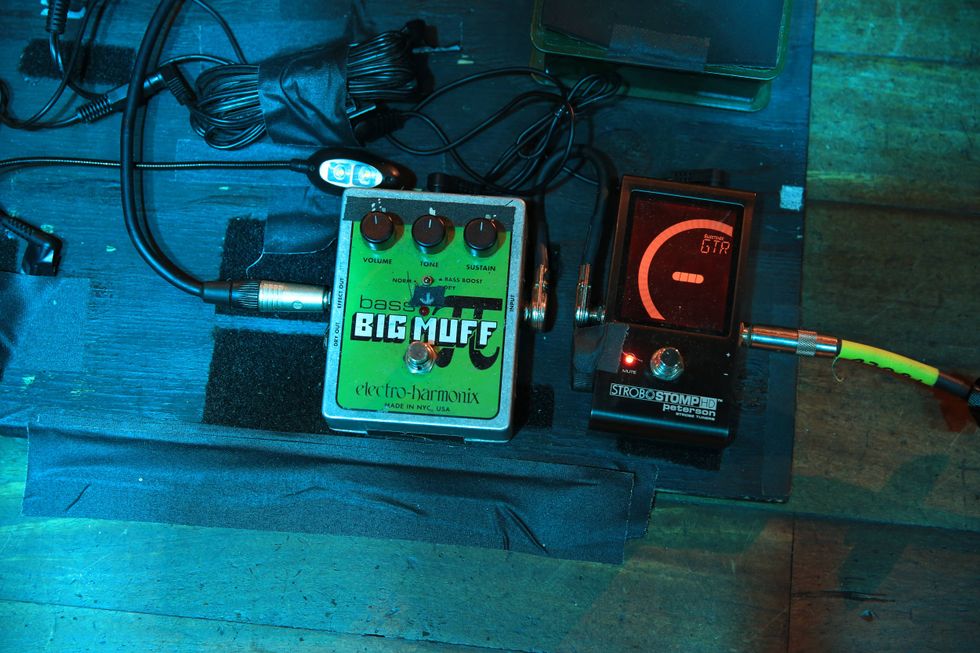
A Peterson StroboStomp HD and an Electro-Harmonix Bass Big Muff Pi, and that’s it. The part Ibold is proudest of is the little gooseneck lamp the band’s tech, Chopper, mounted on the board.
Deluxe Accommodations
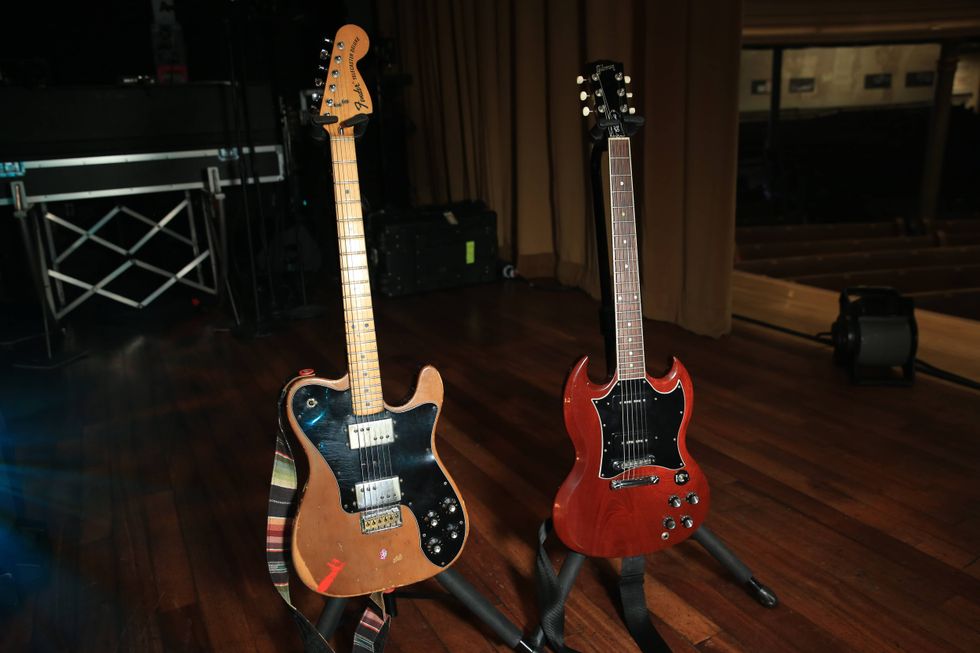
Kannberg found this 1974 Fender Telecaster Deluxe in Berkeley in 1995, and it’s been his companion since—the first “good guitar” he owned. He wanted one because Sonic Youth’s Lee Ranaldo had one. Strings are .010s.
Double Deluxe
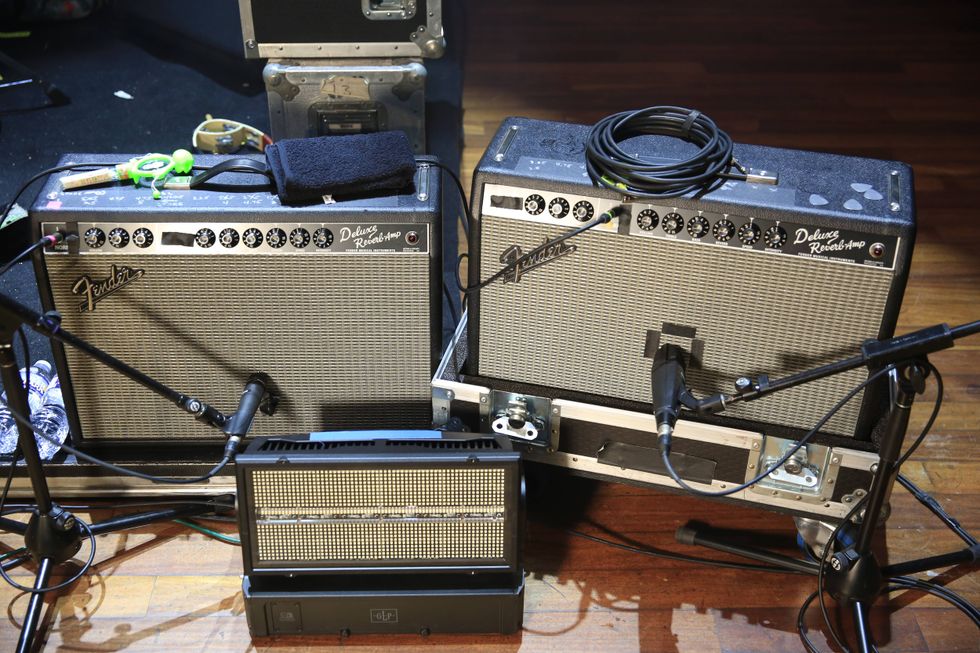
Kannberg carries two Fender Deluxe Reverbs, run dual mono, on a suggestion from his L.A. studio collaborator, Dan Long. One of them came free from Fender.
Scott Kannberg’s Pedalboard
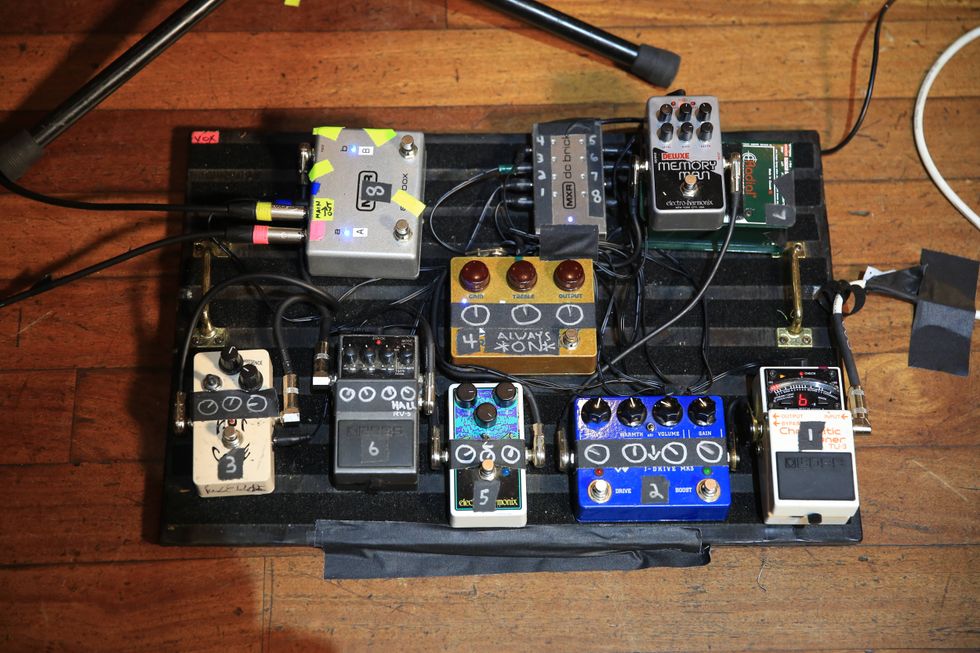
The Crowther Audio Hot Cake is what Kannberg calls the band’s secret weapon. Alongside it: a Boss TU-2, a Diamond J-Drive MK3, an EHX Octavix, a Boss RV-5, a “Klone” pedal that stays on to brighten the amps, and an EHX Deluxe Memory Man that Chopper handed him to make a mess with. An MXR A/B box switches amps, an MXR DC Brick supplies power, and a Radial box handles utility duties.
Charvel expands its Pro-Mod Plus Dinky DK24 line with four new shred-ready models

We’ve got some good news for all the shredders out there – Charvel is expanding its Pro-Mod Plus Dinky DK24 line. Both the HH and HSS ranges have new siblings, with three new HH options and one new HSS available in a slew of striking colour variants.
In terms of the Pro-Mod Plus Dinky DK24 line, the standard formula is a streamlined designed that is great for the technical, speedy riffers of the world. The guitars all wear the same double cutaway shape, designed to be lightweight and ‘dinky’ small, 24 stainless steel jumbo frets, a shredder-considerate cut heel for unrestricted upper fret access, and a five-way blade switch to flick between pickup configurations.
The new instalments offer up a few variations on the Pro-Mod Plus Dinky DK24 blueprint. In terms of the HH range, two of the new models come in the form of the £1199 HH FR EB, available in crimson eclipse and satin black, and the slightly more expensive HH FR QM EB, which comes in cloaked emerald green and costs £1299. Both models boast basswood bodies with quilt maple top, Seymour Duncan Nazgul bridge and Sentient neck pickups, as well as a Floyd Rose 1500 Series recessed double-locking tremolo bridge.
 Credit: Charvel
 Credit: Charvel
The last HH guitar in question is the HH HT EB, available in both crème white and black ash. This HH model differs slightly, instead comprised of an ash body. and Charvel’s HT6 string-through-body hardtail bridge alongside its Seymour Duncan Nazgul bridge and Sentient neck pickups. The guitar is the most affordable new addition to Pro-Mod Plus Dinky DK24 line, sitting at just £1149.
 Credit: Charvel
As for the HSS range, the HSS 2PT QM’s colourways are a tad more bold. The model comes in both a green-to-yellow ombré, called zombie face, as well as wearing a tiger print look, named amber tiger eye. The HSS 2PT QM is comprised of a basswood body with quilt maple top, and it’ll set you back by £1249.
 Credit: Charvel
The model also has a Seymour Duncan Full Shred TB-10 humbucking bridge and Seymour Duncan Custom Flat Strat SSL-6 middle and neck single-coil pickups. As for tremolo, we’ve got a two-point tremolo Wilkinson WVS130-2p bridge with locking saddles.
For more information on the new models, head to Charvel.
The post Charvel expands its Pro-Mod Plus Dinky DK24 line with four new shred-ready models appeared first on Guitar.com | All Things Guitar.
Casio Dimension Shifter Review
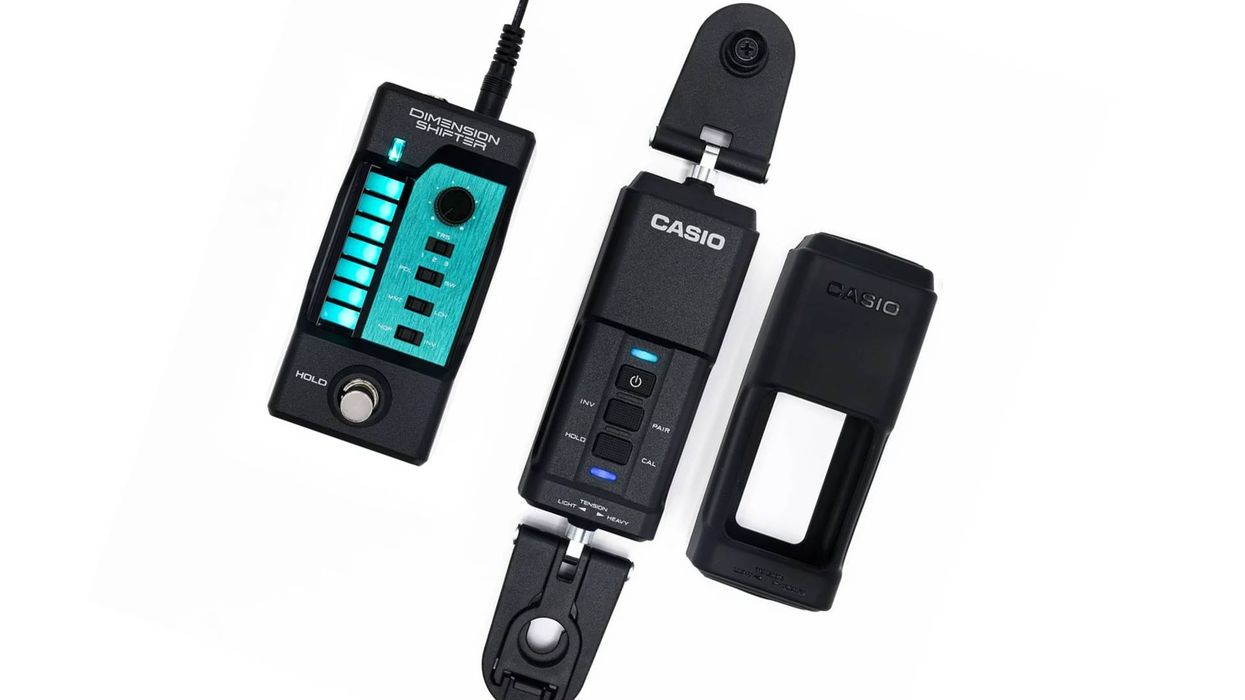
Casio’s Dimension Shifter is a beautiful and thoughtful idea. It reveals an understanding about how electric guitar players tend to move as they play, and the lyrical, maybe even balletic and poetic, manner in which motion can transform the music they make. The fundamental notions behind the Dimension Shifter are not new—essentially, it combines the basic mechanical concepts behind the expression foot pedal and the B-Bender into a wireless digital expression tool. But where an expression pedal weds the player to a single location, and the B-Bender (and its cousin, the Palm Pedal) can only alter the pitch of one or two strings, the Dimension Shifter enables a player to change effect parameters using the pull-and-release, strap-tension-based mechanical action of a B-Bender—all as they meander about a performance space. Depending on your average state of animation on a stage, this might not seem like a big deal. But for any player that tends to get lost in their musical reveries or likes to interact more intimately with bandmates while they sweep a filter, tweak their delay feedback, or increase the modulation rate of flange, it’s a very liberating technology.
Motion Stirs the Potion
I experienced a few hiccups setting up the Dimension Shifter. The problems were resolved quickly, but the user manual wasn’t a big help in solving the issues I did encounter. In general, though, the Dimension Shifter is pretty easy to set up and operate. The pairing between the strap transmitter and the receiver is automatic. You can easily adjust the strap-pull tension. And once you’ve got your connections in place and understand the basic functions of each button clearly (the labels on the receiver and transmitter themselves are a bit cryptic) using the unit becomes fairly natural.
To Casio’s credit, they kept the controls to a minimum. In terms of what you’d potentially use in performance, there are just a few essentials. There’s an inverse switch that reverses polarity, and therefore the direction of expression sweep—so if a modulation speed is at its slowest before you pull on the strap and at its fastest at the end of the range, you change that order by hitting a button on the transmitter. You can also freeze a setting in the sweep using the hold switch, quite like you would use a fixed wah. Which, with delays, reverbs, and modulation effects, enables very fluid movement—ramping, if you will—between radical effects settings. Both of these functions can be activated via switches on the transmitter or receiver. You can also use the knob on the receiver to establish a minimum and maximum range for an effect sweep, just as you would set the heel position on an expression pedal.
Even if you use the Dimension Shifter with just a single effect, it can have a profound impact on the way you play. Again, the function of the Dimension Shifter is fundamentally the same as an expression pedal, but it definitely feels different—and this leads to different results. The way I might use a delay feedback swell with bends or vibrato arm manipulation often felt more cohesively connected to the instrument, and you can experience a sort of unified, glued-together sense of playing when you pair the Dimension Shifter with certain techniques and effects.
I suspect, though, that multi-effects users—or those who use a single effect with multiple presets—will have the most fun with the Dimension Shifter. When you can quickly switch between presets to establish radically different baselines for the Dimension Shifter to work from, the possibilities multiply—and so, quite literally, do the dimensions
The Verdict
Though the Dimension Shifter is ultimately fun, inspiring, and, for certain kinds of kinetic performers, a tool that frees them from foot pedal constraints, there is room for refinement. The transmitter is still a bit clunky. And you have to wonder if a smaller, slimmer, rechargeable apparatus that loses the two AAA batteries is possible without sacrificing the unit’s mechanical functionality. It probably goes without saying, too, that a lot of aesthetic purists will not love the idea of the Dimension Shifter dangling from their strap (perhaps there is a way to cover the unit in vintage Ace strap material?) There’s also the issue of the 20-hour battery lifespan. And the fact that, for those of us who don’t use multi-effect units or digital effects with multiple preset options, the Dimension Shifter is an expensive way to manipulate the expression functionality on a single effect.
But it was very easy to feel and imagine how the Dimension Shifter could be transformative for many players onstage. I could manipulate echo feedback all day long with the unit and be happy. And the action of tugging on the guitar to shift my flanger’s modulation speed felt much more natural and tied to the instrument than a foot treadle does.
I hope that the Dimension Shifter succeeds, and gains enough traction with players that it can continue to evolve. It may not be a totally seamless solution now, but it’s easy to imagine how ongoing development, streamlining, weight shedding, and miniaturization could make the Dimension Shifter into a really magical, even essential, part of many players methodology. It’s off to a super-intriguing start.
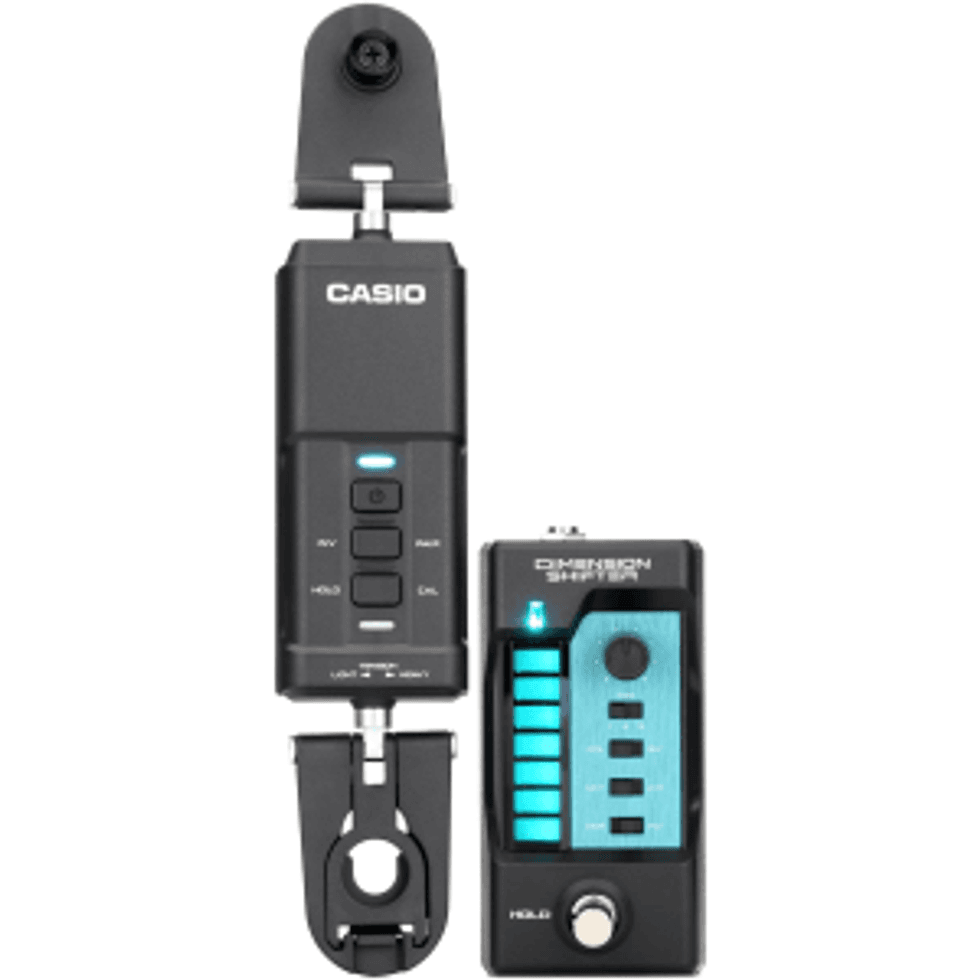
Dimension Shifter Wireless Expression Controller
Wireless Expression Controller with Adjustable Tension, Bluetooth, and Calibration Controls
Tosin Abasi and Willow Smith have been hanging out with Angine de Poitrine

Few have had the honour of wielding Khn de Poitrine’s ridiculous double-neck microtonal guitar-bass hybrid. However, on occasion the Angine de Poitrine axeman does allow his admirers a chance to bask the glory of his iconic creation – and the latest lucky pair was none other than Willow Smith and Animals As Leaders’ Tosin Abasi.
In a new Instagram post, Smith reveals that she not only attended Angine de Poitrine’s California show on 18 August, but she also got to hand backstage with the duo themselves. There, the young avant-garde rocker was allowed to toy with Khn’s signature axe – and she is pretty excited about it, judging by the “HOLY SHIT!!!!!” caption.
Alongside Smith’s picture with Khn’s double-neck, it seems Abasi was equally as keen to pose with the iconic guitar. Unlike Smith, who appears with an – ahem – ‘cigarette’ hanging out of her mouth, the prog metal guitarist looks like he’s deep in conversation as he plucks away. We can only assume he’s picking the brains of the elusive Poitrine duo for some tips and tricks.
On her story, Smith also posted a photo of a special cake congratulating Angine de Poitrine, presumably for smashing their current ongoing tour. The custom cake has the pair’s bizarre, polka-dot-infested faces on for good measure.
While it’s unclear how far back Smith’s friendship with the Quebec pair spans back, it’s possible that the musicians connected back in June. As Smith has been emerging from her pop-punk era and moving towards a more experimental jazz sound, she found herself performing at this year’s Montreal Jazz Fest – and Angine de Poitrine also performed.
 Credit: Willow Smith
In terms of Angine de Poitrine, the duo have been rapidly luring in a cult following. Back in April, guitarist Khn told Cult MTL that the project was “a culmination of a lot of years of inside jokes” at the beginning: “The whole idea of the band was to assume a bit of a satirical approach to rock music in general. We wanted an exaggeration, so the double-neck guitar was the perfect choice to kind of make fun of guitar heroes.”
However, the project has since become far more serious than a one-off gag. Hell, even Rush’s Geddy Lee has gone on record praising the eccentric duo. “I think they’re fantastic,” he told Radio Futuro two weeks ago.
“I love the fact that they’ve gone viral, because they’re so unusual, peculiar, idiosyncratic… It’s a sound that no one’s heard before. They’ve taken Primus and a bit of Rush and all the complexities and sort of boiled it down to a two-piece band using an incredible array of technology.”
The post Tosin Abasi and Willow Smith have been hanging out with Angine de Poitrine appeared first on Guitar.com | All Things Guitar.
Welsh Primitive: How Gwenifer Raymond Creates Cinematic Landscapes with Solo Guitar

“I once had three Porsches – I sold them all so I could snort up half of Peru”: Inside the drug-fuelled world of Aerosmith in the ’70s

Back in the late ‘70s and early ‘80s, drugs were part and parcel of the rock and roll lifestyle. Many of the biggest bands at the time indulged in hard substances, and in many cases they defined their sound during this era.
For example, when the Eagles and Black Sabbath recorded their respective albums Hotel California and Technical Ecstasy in adjacent studios at Miami’s Criteria Studios in the ‘70s, Tony Iommi and co found the console used by the Eagles clogged with cocaine.
Indeed, the Eagles were known for their rock and roll excess, and were routinely barred from hotels for their antics.
Aerosmith were another band known for their affinity for hard drugs, and in a newly resurfaced interview in the new issue of Classic Rock, Steven Tyler lifts the lid on some of the band’s drug-fuelled antics.
“We never knew enough to stop touring,” Tyler said. “We just stayed on the road, and our vacation was in a little gram bottle… We spent the whole of the ‘70s on a treadmill. It was never like there was a tour. We’d stay on the road for a year and a half. The only time we’d come off was to record an album.”
Back in those days, drugs were very much part of a rockstar’s image. “I once had three Porsches, and I sold them all so I could snort up half of Peru,” Tyler is quoted as saying. “I would have traded my nuts for a good ounce of heroin in those days!”
He continued: “Drugs are fun. Once you’ve tried them you love them so much it turns bad on you.”
Last year, Beatles man Paul McCartney reflected on the legendary drugs bust that landed him in a Japanese prison. “This stuff was too good to flush down the toilet!” he said.
“It was the maddest thing [I’d done] in my life – to go into Japan, which has a seven-year hard-labour penalty for pot, and be so free and easy,” he recalled in horror.
The post “I once had three Porsches – I sold them all so I could snort up half of Peru”: Inside the drug-fuelled world of Aerosmith in the ’70s appeared first on Guitar.com | All Things Guitar.
Pages
