
Music is the universal language
“Glory to God in the highest heaven, and on earth peace to those on whom his favor rests.” - Luke 2:14
General Interest
Presidents’ Day bargain: Save a MASSIVE $500 on this Sterling by Music Man Sabre at Sweetwater

If you’re looking to grab a bargain before Presidents’ Day comes to an end, then head over to Sweetwater where you can grab the popular Sabre model from Sterling by Music Man for less than $1,000.
The Sabre model has a long history – it was first launched in 1978 by Music Man, with production ceasing in 1980. It was then revived in 2020, and rated 9/10 by Guitar.com no less. The Sterling version then landed in 2022, offering a slightly more affordable take on the premium Music Man model.
[deals ids=”QG7vFi4QPnbrPpqfXJyX5″]
Saving you $500 and now priced at $999.99, this dent and scratch model from Sweetwater may only have minor cosmetic flaws but all of its key features work just perfectly. It offers a super lightweight nyatoh body topped with a piece of highly figured flame maple veneer, and comes in a Deep Blue Burst finish.
It also offers a roasted maple neck and a rosewood fingerboard with a 12-inch radius, modern “C” shape, and stainless-steel frets. Completing this rock-ready model is a Modern Tremolo and Sterling locking tuners, while tone is driven by a pair of Fishman Fluence Modern pickups that deliver two distinctive humbucker voices courtesy of a push-pull knob.
Check out the video below to hear the Sabre in-play:
If you’re looking for more Presidents’ Day deals, then check out our guide to all the best finds, as we trawled through the internet to find the best savings so you don’t have to. We found a bunch of huge deals on products from Fender, Gibson, Taylor, Positive Grid and many more treasured brands.
You can shop this deal and more over at Sweetwater.
The post Presidents’ Day bargain: Save a MASSIVE $500 on this Sterling by Music Man Sabre at Sweetwater appeared first on Guitar.com | All Things Guitar.
Yungblud says “it’s only the people who didn’t reach the mountaintop” who are “gatekeeping” rock music
![[L-R] Yungblud and Steven Tyler](https://guitar.com/wp-content/uploads/2026/02/Yungblud-Steven-Tyler@2000x1500.jpg)
It’s been a big year for Yungblud. Though a hugely successful artist in his own right for years, July saw him perform Changes at Black Sabbath’s massive final show at Villa Park, attracting tens of thousands of new eyes and even earning him his first Grammy for Best Rock Performance.
He’s since cemented himself as a prominent figure in the modern-day rock scene, performing with the likes of Nuno Bettencourt and Aerosmith (in a VMAs performance which attracted considerable criticism, including from The Darkness brothers Justin and Dan Hawkins).
But Yungblud’s sudden boost in exposure has also led some to accuse him of being an “industry plant”, a claim he vehemently denies. “If I’m an industry plant, I’ve planted the f**king plant myself,” he recently said.
Yungblud – real name Dominic Richard Harrison – says the backlash he’s faced as an artist diving deeper into the rock world is partly a result of “gatekeeping”, and has an opinion on who’s mostly to blame for the elitism.
“When people say to fit in rock, that is the most un-rock ‘n’ roll thing ever,” he told Rolling Stone Australia & New Zealand in a recent interview [via Ultimate Guitar].
“Rock music isn’t supposed to be a gatekept boys club, and it became that. That’s why it’s been suffocated, and boring, and so adherent to the past. We have to allow young people to pioneer something, or at least try and give this thing a heartbeat.”
The artist says many who might be inspired to try and start a band or make a career in rock music are dissuaded from doing so because of the alleged gatekeeping that goes on.
“It just sucks, because you just know that a 17-year-old in a room who was loving sounding like Queen, my biggest fear is that they get deterred from pursuing a career in it by some old bit of cunt on the internet,” he continues. “And I’m here to go, if you’re young, play rock, fuck it. Don’t listen to them. There’s a new generation of ideas.”
Yungblud says it’s not rock music’s most venerated names putting walls up around the genre, though.
“When you actually meet the legends like Steven [Tyler], Ozzy [Osbourne], Billy Corgan, they fucking want it. It’s only the people who didn’t necessarily reach the mountaintop [who are] gatekeeping the genre,” he goes on. “So, if you’re young, and if you want to start a band, do it with everything you’ve got.”
Despite his critics, Yungblud has many famous voices from the legacy rock world on his side, including Ted Nugent, who recently branded him the “real McCoy”.
In other news, it was recently revealed that Yungblud only got the gig to play Changes at Sabbath’s Back to the Beginning show 48 hours before the event.
“48 hours before, he wasn’t gonna be the singer of that song,” said event director and Rage Against the Machine guitarist Tom Morello.
“Things were changing… I landed at Heathrow Airport and I got a call, like, ‘That’s not happening.’ So I’m, like, ‘Okay, let’s figure it out.’ And it turned out to be one of the highlights.”
The post Yungblud says “it’s only the people who didn’t reach the mountaintop” who are “gatekeeping” rock music appeared first on Guitar.com | All Things Guitar.
“It just seemed Looney Tunes to me”: Paul Reed Smith dismisses the notion that you “can’t play solos” on a 7.25”-radius fretboard

The PRS Silver Sky – and the more affordable SE Silver Sky, in particular – are two of the most commercially successful electric guitar launches in recent memory, with the SE version topping Reverb’s best-selling electric guitars list two years in a row in 2022 and 2023.
But naturally, when a guitar becomes so ubiquitous, critics become louder. And much of that criticism has been levelled by those not a fan of the most expensive core Silver Sky’s smaller 7.25” fretboard radius.
It’s very much a debate on the minutiae of guitar building, but the argument basically goes that a larger fretboard radius and flatter fingerboard makes it easier to play solos as a less curved surface allows for a more consistent and low action across all six strings. It’s also argued that a smaller radius and more curved fretboard can sometimes lead to bent notes choking out while going over the hump of the ‘board.
But PRS main man Paul Reed Smith thinks these concerns are unfounded, as he explains in a recent interview on the Zak Kuhn Show.
“When I was a kid, nobody said you can’t play solos on a Tele or Strat. That’s new internet lore,” he says [via Ultimate Guitar].
“And so when we made the prototypes for John Mayer, we tried every single radius, every scale length, every position, every body shape. We tried everything. And he goes, ‘I want it to be the same as the guitars I’m used to. I don’t want to look down when I play.’ So we made it 7.25” and everybody, everybody pushed back. ‘Bad idea. Bad idea. Bad idea, you can’t play solos on a 7.25” radius.
Smith says despite the noisy opposition to the Silver Sky’s smaller fretboard radius, he thought it was “a bunch of hooey”.
While acknowledging that notes can sometimes choke out on bends on a fretboard with a smaller radius, Smith continues: “That I understood, but the idea that you couldn’t play solos on something that people have been playing solos on forever, just seemed Looney Tunes to me.
“What hurts me when people attack, it’s they’re so adamant that they know what they’re talking about. Sometimes they do, but sometimes they don’t…
“I’m sorry. One of the solos in [ZZ Top’s] La Grange is on a Strat, from what I can hear – sounded good to me. [Dire Straits’] Sultans of Swing, don’t even get me started. Machine Gun [Jimi Hendrix] is ridiculous.”
Last year, John Mayer himself downplayed the importance of fretboard radius on a guitar’s playability, even saying the height one sets their strap is more important.
“I just looked at the guitars I loved the most, and they were 7.25 inches” he said, speaking about the Silver Sky’s 7.25”-radius fingerboard. “That was my measuring stick. Now that I know the math behind it, I still don’t think about it. The difference between 7.25” and 9.5” is less significant than your strap being an inch higher or lower. I’ll fight anybody on that.”
The post “It just seemed Looney Tunes to me”: Paul Reed Smith dismisses the notion that you “can’t play solos” on a 7.25”-radius fretboard appeared first on Guitar.com | All Things Guitar.
How Taylor quietly revolutionised its most iconic design with the Next Generation Grand Auditorium

When you ask a guitarist to think about Taylor, the brand that’s been at the vanguard of acoustic guitars for the last 50 years, chances are they’re imagining the Grand Auditorium. Created by iconoclastic co-founder Bob Taylor in 1994 to be the ultimate all-purpose acoustic guitar, the Grand Auditorium sits between the big-bodied dreadnought and the more compact concert-sized instruments. Its versatility, a shining example of the brand’s determination to do acoustic guitars differently, has made it the most popular and beloved of Taylor’s many innovations since the brand’s humble beginnings in a hippy co-op in San Diego.
That’s probably why Andy Powers, Taylor’s CEO, President and Master Guitar Designer, chose the Grand Auditorium to put his most definitive and impactful stamp on the brand since his promotion to CEO in 2022. Enter the Taylor Next Generation Grand Auditorium – Powers’ reimagination of the brand’s most iconic instrument for its post-founder era.
 The Taylor Next Generation Grand Auditorium on the Guitar.com Cover. Image: Rachel Billings for Guitar.com
When you look at the instrument, though, you’d be forgiven for wondering what exactly is new about it.
“Well yeah, exactly!” Powers exclaims, sat cradling a new 814ce in his lap within the airy surrounds of a Californian hotel suite. “This is a guitar that we’ve built for a long time. It’s an iconic model for us. And we deliberately wanted to keep it appointed in the form that we know and love. But what’s so interesting about this instrument is that it represents our best and brightest guitar-making. A lot of very materially significant parts of the guitar design have been upgraded.”
 Image: Rachel Billings for Guitar.com
Stick Your Neck Out
Perhaps the most important and impactful change is one that you might never even need – but you’ll be thankful for if you do. The Action Control Neck is a Powers innovation that has been the best part of a decade of trial, error and experimentation, and after a limited debut on Taylor’s Gold Label collection last year, it’s now ready for the limelight.
Traditionally, acoustic guitar necks are glued into the bodies – a perfectly fine way to do it, but one that comes with its own issues. If you don’t like the height of the strings and general playability, your only real option is to take it to a luthier who will have to carefully remove the neck, add some shims to alter the neck’s angle so it’s more to your preference, and then reglue it back. What’s more, as a guitar gets older, the force of years of string tension often gradually pulls the neck forward, raising the action and making the guitar uncomfortable to play. The only solution? A neck reset.
“This instrument represents our best and brightest guitar-making”
“[With] a conventional neck reset, your guitar might be in a luthier shop for a month,” Powers explains. “That’s going to cost some money. It’s like open heart surgery for a guitar.”
Back in 1999 Taylor took its first steps to change this. The NT Neck, as it was known then, utilised cutting edge computer-controlled milling to create a bolt-on neck that had the same tonal transfer as glue, but also gave any tech or luthier the ability to easily remove the neck and reset it.
“We’ve been known for building great playing guitars that are easy to service, easy to adjust,” Powers explains. “But I wanted the adjustability to go even further. The way that we’ve built guitars with our Taylor neck system, that’s a huge improvement. But the Action Control Neck takes that level of adjustability farther than anything.
“You can do an action adjustment literally within seconds and not even have to re-tune the guitar. You simply adjust it to where you want to play, and you’re ready to go.”
 Image: Rachel Billings for Guitar.com
As he talks, Powers pulls out a flexible shaft screwdriver – the sort you can buy on Amazon for the price of a good cup of coffee – to demonstrate. He pops the screwdriver into the soundhole, gives a quick turn, and before our eyes, the action has been visibly lowered, but the guitar is still in perfect tune and intonation all the way up the neck. A job that would take a trained professional hours or even days to complete has been done in less time than it took to write this sentence. It feels a bit like a magic trick.
But why invest so much time in something that isn’t really a problem for Taylor once the guitar is out of the doors of their factory in El Cajon, California? Sustainability is one thing – which Taylor has taken seriously in its guitar-making for decades. If you’ve got a guitar that can be tweaked to a player’s individual taste – or their evolving playing style – in a heartbeat, you’re likely to hold onto that guitar for much longer.
“And you may never need to make those adjustments!” Powers adds. “You might pick the guitar up, it feels great, sounds great, and you’re happy forever. But I know for myself, over time my playing approach changes, or I start wanting to play in a different style. That means I want the guitar set up differently – fine. Just adjust it.”
 Image: Rachel Billings for Guitar.com
Grand Gestures
Wanting to meet real musicians where they are is also key to the other significant innovation at the heart of the Next Generation Grand Auditorium. The Taylor Expression system has been ever present in the brand’s guitars for the best part of two decades – the three rounded control knobs on the guitar’s top are about as distinctive a part of Taylor’s visual design language as the pickup itself was in shaping its live sound.
Now all of that is changing: the new Claria system offers not only a more subtle visual proposition, but a different approach to amplifying the sound, too.
“The development started by creating a pickup for big artists on big stages,” Powers explains. “It was the kind of situation where you don’t get to tune the environment to suit the pickup, so we needed to tune the pickup to suit the environment. And so we wanted to create something that was very player-centric, real intuitive and very easy to use.”
“I want the guitar to serve the player well in every way that we can”
While the Claria started with the needs of artists playing stadiums and other big rooms, Powers soon realised that the problems he was trying to solve could present themselves in any setting.
“If you’re playing a club date, when you walk on stage, you may not even get a soundcheck. Sometimes you barely get a line check and you’re off and running! And so you need something that you can dial in quickly that offers a greater selection of useful sounds.”
That user-friendly simplicity is at the heart of the new Claria system – if the Expression system was a scalpel made for carefully crafting perfect studio-quality tones, this is a lot more forgiving. “You’re not doing surgery on your amplified sound,” Powers reflects. “You’re just going, ‘That sounds good. Let’s play!’”
 Image: Rachel Billings for Guitar.com
Player Power
There was a time when Taylor guitars were designed for a certain type of player, and had a certain type of sound. Bob Taylor himself enjoys remarking that people often speak both positively and negatively about the sonic qualities of his guitars, using much the same language. It doesn’t bother him, so long as both sides agree that the instruments are well-made.
Powers is cut from a different cloth. His background as a boutique luthier who made guitars to suit each customer’s needs has helped make the ‘Taylor sound’ a much broader church than it was before he joined the company over a decade ago.
“I want the guitar to serve the player well in every way that we can,” he affirms. “The whole idea behind this was that we want to build a great, professional-quality guitar. If you were to pick a guitar because you like the sound of it, I want to make sure that all the other aspects of that instrument support you in your play. That’s what I’m looking for.”
 Image: Rachel Billings for Guitar.com
The proof of his success has been placing prototypes of these Next Generation guitars in the hands of artists – the grin on Powers’ face tells its own story. “You see players respond to these, and you can actually watch fresh inspiration happening,” he enthuses. “It does really feel like it’s a breath of fresh air. I can see the future. I can see where we’re going. I know that players love playing music. That’s what interests us in the first place. So let’s build the guitars to suit them and serve their needs.”
The Taylor Next Generation Grand Auditorium is available now
Words: Josh Gardner
Photography: Rachel Billings
The post How Taylor quietly revolutionised its most iconic design with the Next Generation Grand Auditorium appeared first on Guitar.com | All Things Guitar.
Behringer Copies Another Lovetone Pedal
Grand Ole Opry Partners With Martin Guitar To Create Limited-Edition Martin Hd-28

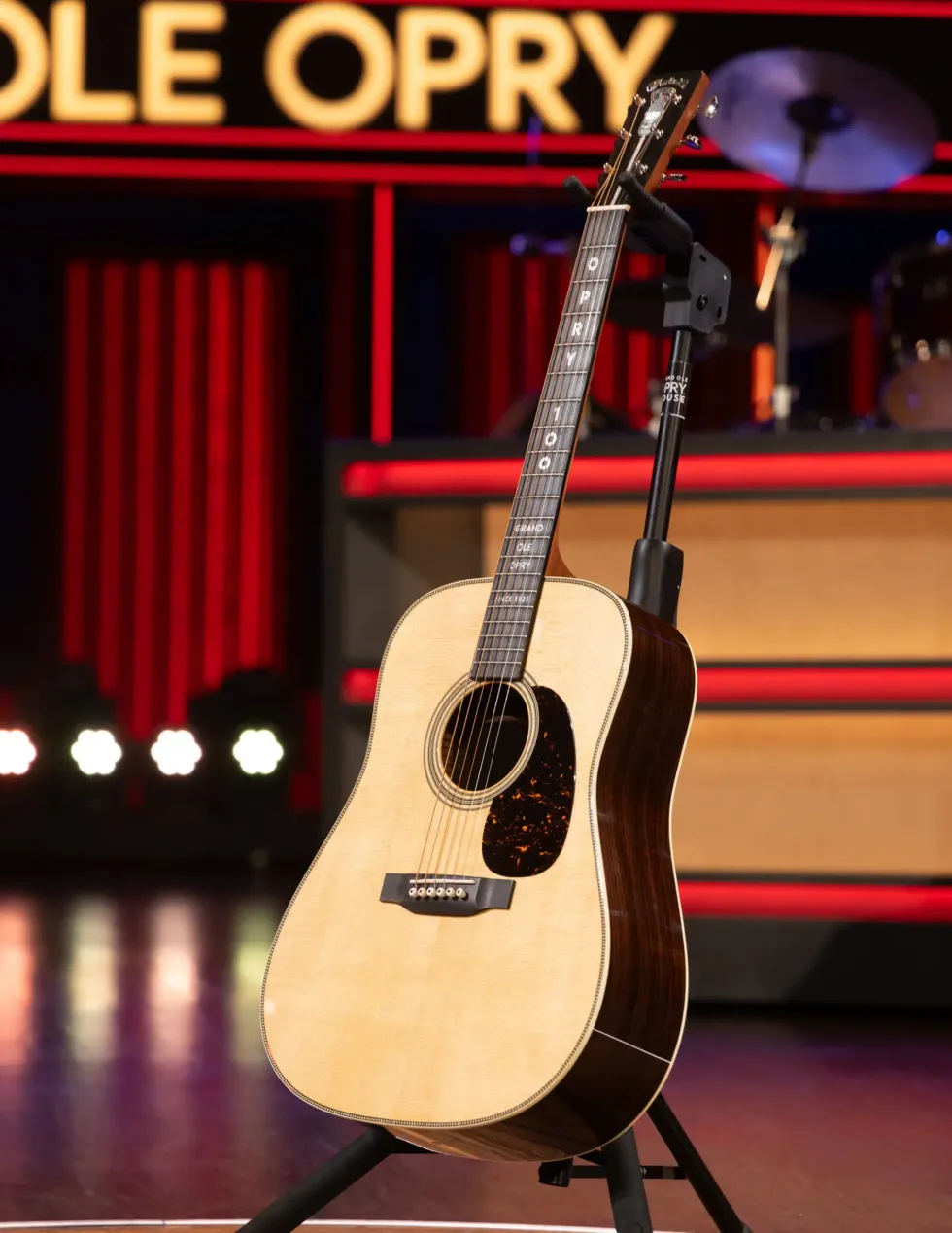
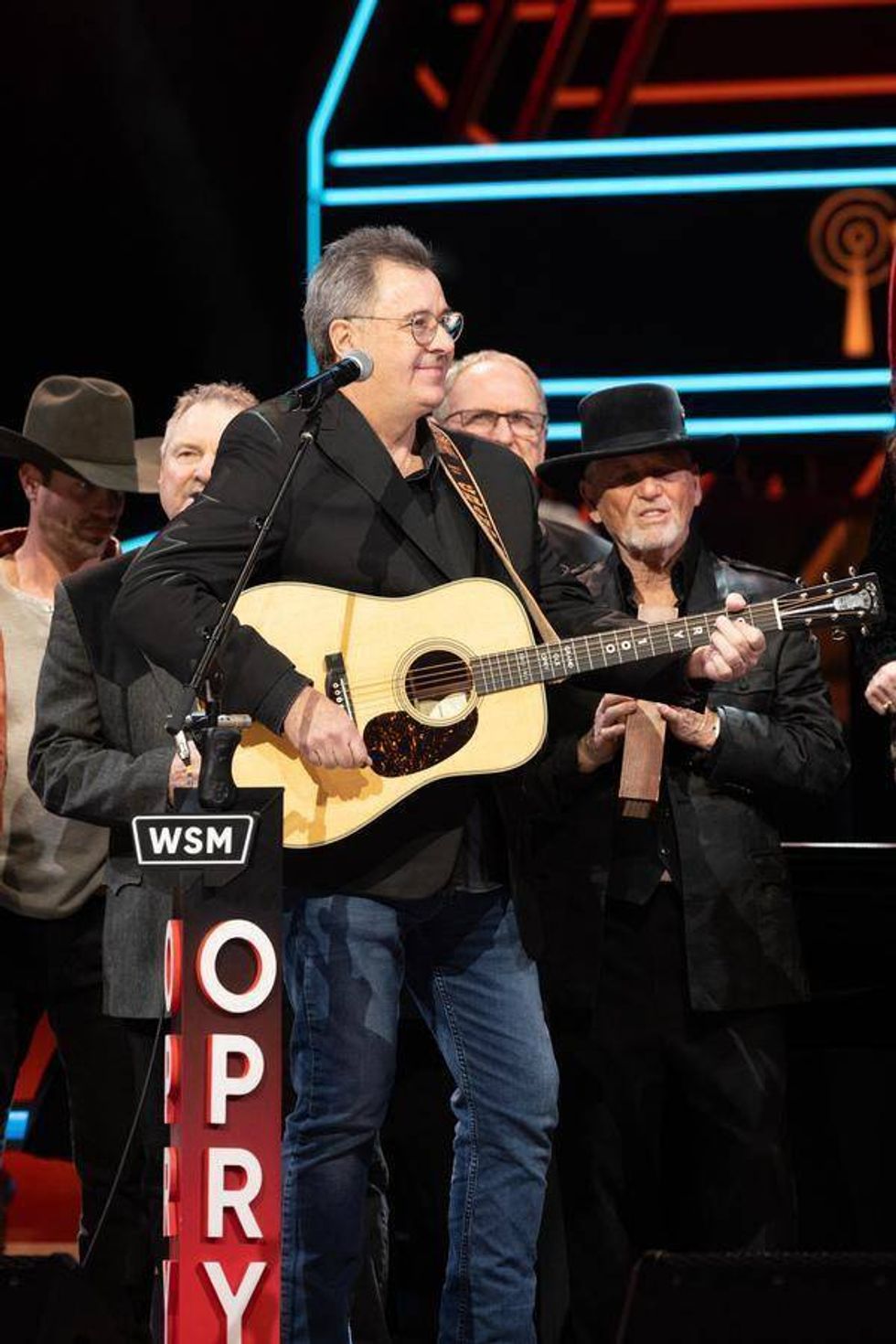
The Grand Ole Opry, George Gruhn of Gruhn Guitars,and Martin Guitar have partnered to create a limited-edition Martin HD-28 Grand Ole Opry 100th Anniversary guitar. Opry member Vince Gill was the first artist to ever play the one-of-a-kind instrument when the guitar was introduced to the public for the first time and played it on the 100th Anniversary Opry show on November 28, 2025.
To purchase the limited edition Martin HD-28 Grand Ole Opry 100th Anniversary guitar click HERE.
The Martin HD-28 Grand Ole Opry 100th Anniversary is a one-of-a-kind instrument handcrafted to honor a century of music, storytelling, and unforgettable moments on country’s most iconic stage. For generations, Martin guitars have been in the hands of countless artists who shaped the sound of country music from the Opry’s hallowed ground—heard by millions and woven into the very history this guitar celebrates. Built on the foundation of Martin’s legendary HD-28, it delivers the bold, balanced Dreadnought tone players have long trusted: powerful bass, clear trebles, and rich overtones shaped by forward-shifted scalloped X-bracing and time-honed craftsmanship.
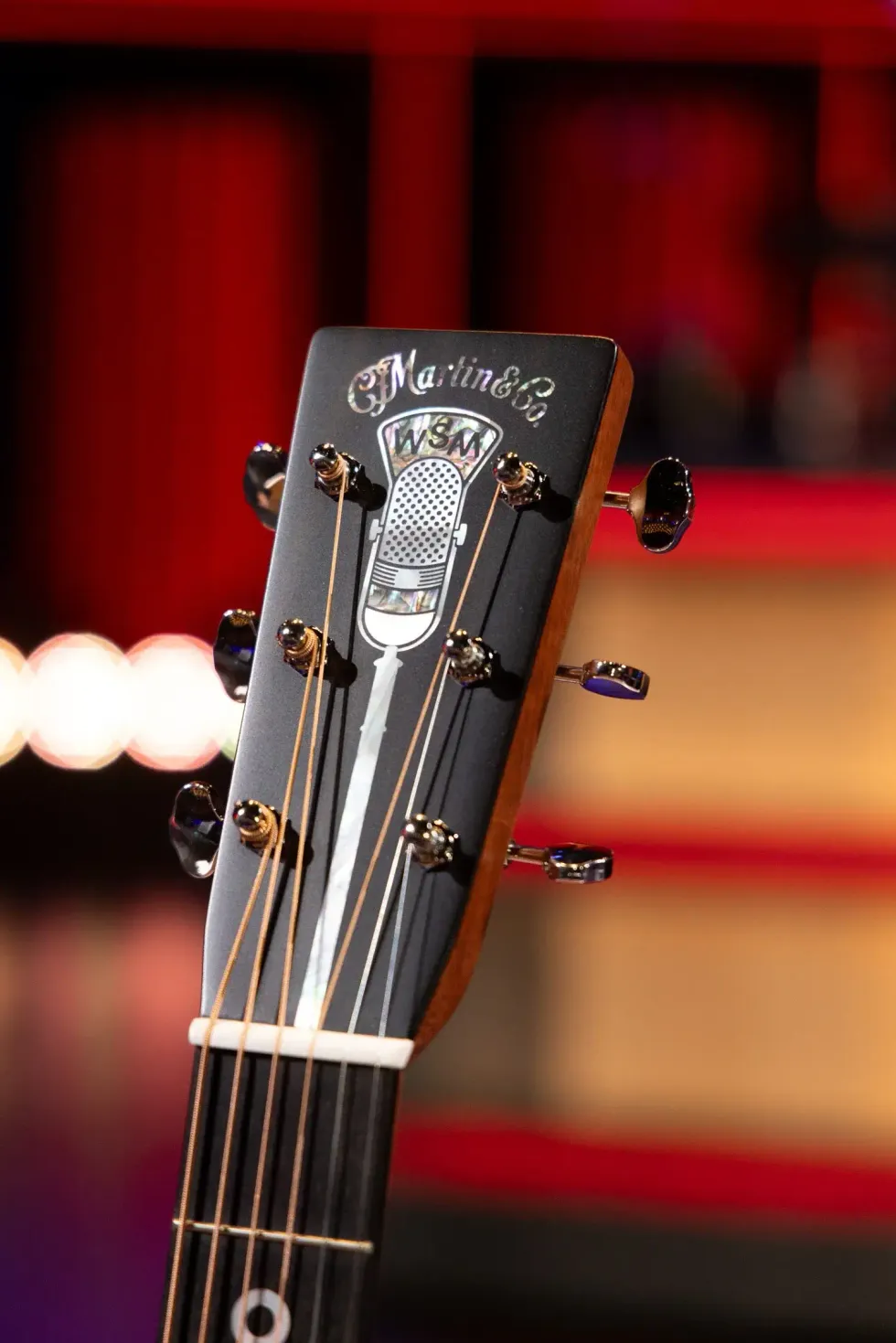
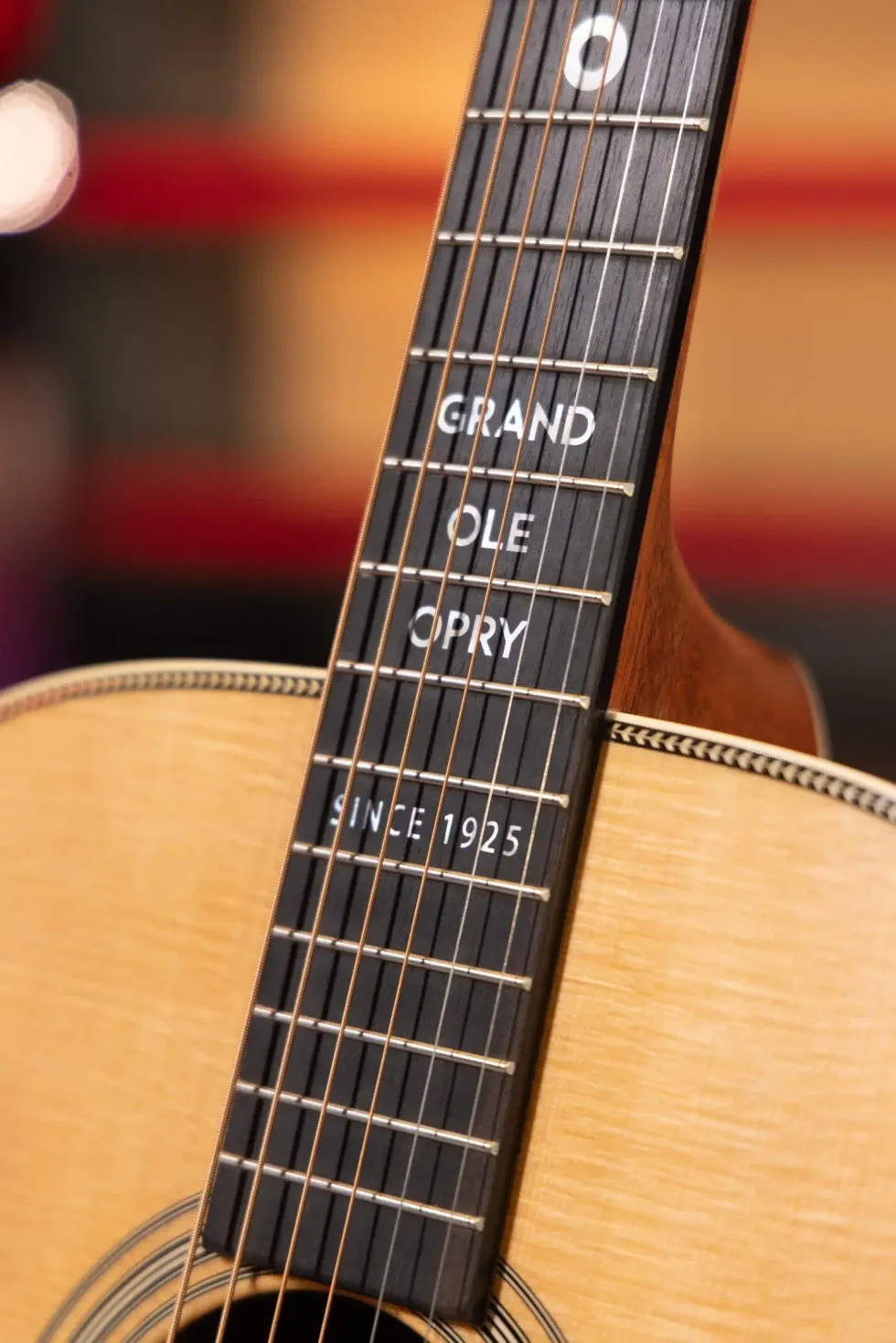
To mark the Opry’s 100th anniversary on November 28, 2025, Martin’s artisans added exclusive details found only on this guitar. The headplate features a custom inlay of the historic WSM microphone rendered in mother-of-pearl and abalone, a tribute to the broadcast that carried country music nationwide. A matching commemorative inlay theme continues along the ebony fingerboard, celebrating a century of Opry history and the artists and moments that defined the genre from this storied stage.
Handcrafted with a solid spruce top, solid East Indian rosewood back and sides, bold herringbone top trim, and elegant antique white binding, this special HD-28 also features a comfortable Golden Era Modified Low Oval neck that feels effortless in the hands. Together, these elements blend Martin tradition with Opry heritage in a single, remarkable instrument. It’s a playable piece of history made for those who keep the circle unbroken.
Podcast 537: The 2025 Fretboard Summit Guitar Repair Panel
In what has become an annual tradition, Evan Gluck (NY Guitar Repair) hosted a guitar repair roundtable at the 2025 Fretboard Summit. This year, he brought Ceil Thompson (StewMac); TJ Thompson (Pro Luthier Tools); Mamie Minch (Brooklyn Lutherie); and Mark Stutman (Folkway Music) onstage.
It’s an insightful (and often hilarious) talk about the realities of running a guitar repair business. Very quickly, these five guitar repair experts go deep on customers, the surprise revelations they’ve had in their careers; the tasks (and people) they avoid; and much more.
Give it a listen. It may just make you a better customer the next time your guitar needs to be repaired.
Our next Fretboard Summit takes place August 20-22, 2026, at the Old Town School of Folk Music in Chicago. Register today: https://fretboardsummit.org
Our 58th issue of the Fretboard Journal is now mailing. Subscribe here to get it.
We are brought to you by Peghead Nation: https://www.pegheadnation.com (Get your first month free or $20 off any annual subscription with the promo code FRETBOARD at checkout).
Stringjoy Strings: https://stringjoy.com
Mike & Mike’s Guitar Bar: https://mmguitarbar.com
Mike & Mike’s Substack: https://mmguitarbar.substack.com


The post Podcast 537: The 2025 Fretboard Summit Guitar Repair Panel first appeared on Fretboard Journal.
Keeley Nocturne Review

One of the great paradoxes of guitar sonics is that reverb, an effect invented to give electronic and recorded sound more natural ambience, can also make the instrument feel otherworldly. It’s reverb that transforms guitar and amp into waves crashing off the Malibu cliffs, and reverb that makes the Stones’ “Gimme Shelter” sound like the darkest of moonless city nights.
That midnight tone is among those that lives in Keeley Electronics’ Andy Timmons signature Nocturne, a versatile stereo pedal perfectly at home exploring reverb’s dual potential to recreate natural atmosphere or sounds that seem beyond physical dimensions.
Exploring the Atmosphere
Inspired by the Keeley Andy Timmons Halo delay/reverb, the Nocturne focuses on reverb exclusively, offering three flavors: nocturne, spring, and plate. While the latter two are the most conventional, they can be dialed in to break free from the constraints of their mechanical counterparts. All three modes give you control over tone, reverb level, decay, and modulation. But the pedal also has alternate functions that enable the tone and decay knobs to control a high-pass filter (which tailors the low end) and pre-delay (a powerful and often overlooked parameter that shifts the space between transient notes and the onset of the reverb).
Spring and plate do the most basic versions of their job well, but they happily go beyond the norm. In spring mode, the modulation control governs the mechanical “boing” overtones in the reflections, which range from realistic to totally over the top. Though I preferred the more subtle settings, which enabled me to capture the essence of gentle slap heard in my old Fenders and Ampegs, it was also easy to move between big and clangy or smaller and subtly ambient.
“It made me slow down, allow the notes to hang, and listen—and even led to new music for a documentary soundtrack I’d been struggling with.”
For most conventional guitar-tone tasks, the plate mode would be my go-to. It’s especially effective for high-gain sounds, where you can dial in the sense of a big amp in the studio. I used the Nocturne both in front of a solid-state amp and in the effects loop of a modified Bassman 10, which has Fender-style and pentode preamp channels and EL34 power tubes. The pentode channel can be set to preserve more low end than a typical guitar preamp, so the high-pass filter was especially useful there. More important, though, was the Nocturne’s high headroom, which meant it could live in the effects loop, on the receiving end of preamp and other drive sources, without complaint—even when powered by a basic 9-volt supply (18-volt is optional).
Dark Reflections
While both spring and plate are effective day-to-day tools, it’s the eponymous nocturne mode that opens up the pedal’s creative potential, delivering lush, modulated sounds with distinct echoes blended into long decays. I often got lost in the swirl of shimmering sustain while playing simple thirds and drones. It made me slow down, allow the notes to hang, and listen—and even led to new music for a documentary soundtrack I’d been struggling with. Things got more interesting when I grabbed an EBow, where the sustain and feedback-like harmonics let me create a sonic bed with far more texture than many synths, and far more expression than a sample.
As these experiences suggest, I often found myself playing to the effect in Nocturne, letting it serve as a guide, and treating it as an extension of my guitar and amp. Using the assignable expression input to change parameters while playing only enhances the sense of interactivity here. It’s that responsiveness to player input—and the fact that so many big sounds don’t completely obscure dynamics—that make the nocturne mode so effective as a creative tool.
The Verdict
While there are plenty of creative and powerful spatial effects on the market, the Nocturne is one of the few I know that works like it was designed for the guitarist without dumbing things down. It’s easy to get started and the basic sounds are satisfying, but it also invites you to go deeper. Preset capability (you can create up to 72 with MIDI) means that in a performance setting you can switch easily between completely space-altering effects and more earthly ambiance. The high fidelity and headroom make it a powerful studio tool.
Though it takes time to master some functions (it took a few tries to get the expression pedal assignments right) the layout remains super intuitive. That essential simplicity makes Nocturne equally suited to pedalboard minimalists and MIDI-based rigs. But whichever camp you’re in, you might want to leave a note for family and friends when you plug in, because you’re likely to get lost in space.
Review: Volterra Project Trio Explores Drama and Dialogue on ‘Parole in Musica’

I spent my afternoon sifting through Presidents’ Day guitar deals so you don’t have to

Sure, Presidents’ Day is no Black Friday – but it’s still a great opportunity to take advantage of some great deals on guitar gear. I understand, however, that it’s not exactly the most thrilling endeavour to have multiple tabs open sifting through the deals pages of all the big music retailers, which is why I’ve done exactly that so you don’t have to.
Presidents’ Day itself lands officially on the third Monday of February every year, which in 2026 is Monday the 16th. But some of the top music retailers are already offering pre-Presidents’ day discounts, and here are the best deals I’ve found…
Fender Player II Stratocaster HSS – save over $200
[deals ids=”6jg62r0gkgdR0fSHoX6pc3″]
When we got our hands on the Fender Player II Stratocaster HSS after its launch in 2024, we scored it a strong 9/10, even suggesting it could be the last guitar you’d ever need. Boasting a humbucker and two single coils for a wide palette of tones, this guitar takes the time-honoured Stratocaster blueprint and adds a number of appointments for the modern player, including rolled fingerboard edges, a rosewood fingerboard and an alluring Blue Burst finish. Get it now at Guitar Center with over $200 off until 18 February.
Fender FA-135CE All-Mahogany Concert Acoustic-Electric – save $100
[deals ids=”243YGD0ztNg9MG3UHLTtrg”]
In the market for your first acoustic guitar? Hell, the all-mahogany Fender FA-135CE would make a solid addition to any existing guitar collection, too. It boasts a mahogany build for a warm, resonant tone, Fishman electronics for amplification, a slim neck profile for supreme playability, plus a single cutaway for good upper fret access. Right now at Guitar Center, get it with $100 off, and pay just $219.99.
Gibson Les Paul Standard ’60s – save nearly $1,000!
[deals ids=”55vMsQmndacsw8VMMPkBNS”]
If you’ve got a little extra cash to spend and fancy getting yourself an authentic Gibson ‘60s Les Paul Standard, this awesome deal at Guitar Center means you could save a whopping $900 – and pay just $2,099. With an AAA figured maple top, pickups recreated from PAF-era examples, plus a gorgeous Honey Lemon Burst finish, what’s not to love…
Positive Grid Spark MINI – save $50
[deals ids=”2Hwp9eo2nSf6ylYPhezPN6″]
One of the most kitted out practice amps on the market, the Positive Grid Spark MINI doubles as a Bluetooth speaker – so you can play along to your favourite tracks – and also comes with a smart app packed with a host of forward-thinking features. Did we mention it’s tiny, so totally portable? But don’t worry, it still boasts a sound which belies its form factor. We gave it a 9/10 in our review and called it a “game-changer”, so trust us, we know what we’re talking about. Get it now direct from Positive Grid with $50 off.
Taylor Builder’s Edition 514ce – save $400
[deals ids=”5biWTKg5GUC1rt9TkPzFYA”]
Go on, you only live once, so push the boat out; treat yourself to your last-ever acoustic guitar with this insane deal on the Taylor Builder’s Edition 514ce at Sweetwater. This Presidents’ Day, you can save a massive $400, taking the normal price of $3,399 down to just $2,999. We get it: that’s not exactly an impulse purchase, but there’s a reason why Taylor acoustics have been widely regarded as some of the best money can buy for decades. This one won’t let you down…
Fender Custom Shop Madison ’54 Telecaster NOS Masterbuilt by Greg Fessler – save almost $3,000
[deals ids=”xFLpLvTwOVP8RCJGKtTef”]
Okay, this one’s a little gratuitous, but hey, maybe there’s a hardcore guitar collector out there who fancies saving nearly $3,000 on a Fender Custom Shop Masterbuilt Telecaster… You’ll still have to part with $8,745, but that’s a price slashed from $11,660 – so if you’re a serious collector with a bit of cash to spend, why not add this eye-catching Tele to the collection…
Of course, you might still want to browse the Presidents’ Day sales yourself…
- Guitar Center Presidents’ Day sale
- Positive Grid – 20% off select Spark gear
- Sweetwater Deal Zone
- Reverb Deals & Steals
- zZounds Big Deals
- Up to 84% off amp sims at Plugin Boutique
The post I spent my afternoon sifting through Presidents’ Day guitar deals so you don’t have to appeared first on Guitar.com | All Things Guitar.
How Khruangbin's Mark Speer is Changing Texas Guitar Music
Vibey melody maker Mark Speer details Khruangbin's implausible rise from lonely cover band to festival headliner, explains his approach to guitar that leans more keyboardist and harpist than shredder, and even shares a secret (that he still employs today) from the band's earliest gigs to trick the audience into acceptance and applause.
How to Play James Taylor’s Iconic “You’ve Got a Friend”

“One day it was nothing but laughs, then it was just over”: Josh Freese is still confused about his Foo Fighters dismissal – and says he needs to be “careful” what he says about it
![[L-R] Josh Freese and Dave Grohl](https://guitar.com/wp-content/uploads/2026/02/Dave-Grohl-Josh-Freese@2000x1500.jpg)
Josh Freese has reflected on his dismissal from the Foo Fighters last year, which came two years after he was announced as the band’s touring drummer in 2023 following the death of longtime drummer Taylor Hawkins in 2022.
In May last year, the 53-year-old drummer – who over the course of his illustrious career has performed with the likes of Guns N’ Roses, Nine Inch Nails and The Vandals – shared his “shock and disappointment” at receiving the news that he had been let go from the Foo Fighters after two years.
“In my 40 years of drumming professionally, I’ve never been let go from a band, so while I’m not angry – just a bit shocked and disappointed,” Freese said in an Instagram post at the time.
Now, in a new interview with Modern Drummer, Freese reveals he has a “couple of small theories” as to why he was let go from the band, but adds he “can’t really go into them right now”.
“The Foo Fighters are such a big, mainstream band that everything I say gets taken out of context, reposted and blown out of proportion,” he reasons [via Louder]. “People created headlines from one quick, simple comment I made on a podcast not long ago, it’s crazy.
“I’ve got to be careful about what I say about it. But I’ve got a lot to say about it and I’ve been just trying to figure out how and when to go about really articulating it.”
Freese adds that despite his shock at his dismissal from the band, he “did really enjoy the last two years [he] spent with those guys”, adding however: “They were good to me… until they weren’t.”
Much of Freese’s disappointment at being let go from the Foo Fighters appears to stem from his admiration for frontman Dave Grohl.
“I loved having Dave as a bandleader,” he continues. “I enjoyed being around those guys. They were generous and good to me… and that’s what makes the whole thing even more of a mystery. I think I’m a pretty good read on people, and I did not see that coming. One day it was nothing but laughs, we’re on stage and Dave’s looking at me every night like, ‘You’re killing it, dude!’ And then it was just – over.”
Foo Fighters have a string of tour dates planned for 2026 in North America. For tickets and dates, head to the band’s official website.
The post “One day it was nothing but laughs, then it was just over”: Josh Freese is still confused about his Foo Fighters dismissal – and says he needs to be “careful” what he says about it appeared first on Guitar.com | All Things Guitar.
David Ellefson thinks Megadeth should “give fans what they want” and include him in farewell tour: “Any reason that I’m not there now is unfounded, untruthful and unfair”

If this is truly the end of the road for Megadeth, David Ellefson believes he should be a part of it. Last August, the thrash metal titans announced plans to release one final studio album followed by a farewell tour, bringing more than four decades of metal history to a close.
But while leader Dave Mustaine has publicly stated that he doesn’t intend to invite former members back for the band’s final run, Ellefson clearly sees things differently. The ex-Megadeth bassist also describes his continued absence as “unfounded”, “untruthful” and “unfair”.
Speaking on Argentinian rock radio station UnDinamo, the musician reiterates that he remains “available” for Megadeth’s final tour – potentially alongside other past members such as guitarist Marty Friedman.
“I have always said that I am available for that. And I would do it because I think any reason that I’m not there now is unfounded,” says Ellefson [via Blabbermouth]. “It’s untruthful and it’s unfair because clearly there’s nothing wrong. So, I would hope and even pray to [God] that any misunderstanding, any bitterness would be removed, that that would somehow be dissipated.”
Reflecting on his career and the role of fans, Ellefson adds: “It’s funny – you make your first record, you have no fans. You just make your first album. Then you start to get fans who [say], ‘Hey, give us more.’ So you make album two, like we do. And then at that point, you – I feel – have an obligation to listen to your fans. You don’t have to do everything they say, like, ‘Make Rust In Peace Part II,’ ‘cause creatively the spirit leads you where it’s supposed to go. But I think, especially when you’re playing concerts – making albums is music business; playing concerts is show business. They’re two separate things that kind of come together.”
Without fans, he adds, there is no second album – and no farewell tour. “So, to me, you give them what they want.”
He also points to Friedman’s 2023 appearances with Megadeth as a sign that reunions are possible.
“So for me, yes. Marty – I can’t speak for anyone else, but Marty coming back to play a couple of shows showed his willingness, which I think was great,” says Ellefson. “I would wish that Dave [Mustaine]… Look, if it were just me and Dave sitting here, I’m sure everything would be fine, but there’s a lot of people with influences, and that can be sticky. So my hope is that the voice of the fans gets louder than any other voice that would tear it apart.”
The post David Ellefson thinks Megadeth should “give fans what they want” and include him in farewell tour: “Any reason that I’m not there now is unfounded, untruthful and unfair” appeared first on Guitar.com | All Things Guitar.
Watch the awesome moment Chino Moreno pulled a fan onstage to play guitar with Deftones at a recent Poland show

As a fan, nothing screams ‘once in a lifetime’ quite like getting pulled onstage to jam with your favourite band.
That’s exactly what went down at Deftones’ 5 February show at the Atlas Arena in Łódź, Poland, when one lucky fan got the ultimate VIP moment: joining the band for a set-closing performance of 7 Words from their 1995 debut album, Adrenaline.
According to The PRP, the guitarist, named Kacper, had been holding up a sign all night asking to play with the metal band. He eventually caught the attention of frontman Chino Moreno, who couldn’t resist having a little fun.
“The kid did the gesture for guitar solos, to which Chino joked, ‘saxophone?’,” a fan reports. “And then Chino said, ‘Guitar?’ He looked over at his bandmates and smiled and said ‘We’ll see.’”
As the band reached the end of their 20-song set, they made good on that tease. Kacper was brought up from the crowd, embraced Moreno, and was handed the singer’s Gibson SG by a guitar tech.
“Okay, so it starts in F sharp major,” Moreno joked, winding up the audience before launching into the pummelling opener from Adrenaline.
Judging by the footage, Kacper more than held his own, and the crowd absolutely loved it.
Check out the wholesome (and frankly, impressive) moment below.
Meanwhile, guitarist Stephen Carpenter – who in 2022 announced he would no longer tour outside North America with the band – remains absent from these overseas dates. As Moreno previously admitted, he’s still not sure why.
“If he does have an answer, I think it’d be great if one day he would share it,” said the singer.
The post Watch the awesome moment Chino Moreno pulled a fan onstage to play guitar with Deftones at a recent Poland show appeared first on Guitar.com | All Things Guitar.
Marty Friedman credits social media for keeping “excitement in the guitar”

Love it or hate it, social media algorithms now play a bigger role in music discovery than radio ever did. A single 30-second clip can launch a career, revive a forgotten track, or send a boutique guitar pedal into backorder chaos overnight. And according to Marty Friedman, that same machine is doing something else: keeping guitar culture alive and kicking.
Speaking in a recent interview with musician Tobias Le Compte, the former Megadeth shredder argues that guitar’s popularity has always been cyclical – but today’s platforms are amplifying it in ways that simply weren’t possible before.
“It goes up and down in popularity as an instrument,” Friedman explains. “But the great thing about now is social media is just such a big support of guitar.”
“Just right now, I did two things that are, without social media – no one would know what they are. But I did a great collaboration with Ichika Nito, and it’s all over social media now.”
That reach, he argues, has real-world consequences for the instrument’s future.
“And that gets people who sit around watching the internet all day to play guitar, you know what I mean. And if there wasn’t interest in guitar from those people, they’d be playing games or other things,” says Friedman.
“But it’s wonderful to see those people feel the fun of playing guitar and get the satisfaction. I’m sure it’s fun playing video games too, but it’s wonderful to play an instrument with your hands and not just a computer. And so thanks to social media, there’s a lot of excitement in the guitar.”
That optimism isn’t universally shared, though. Joe Bonamassa has previously cautioned that the pressure to constantly post on social media can shift the focus away from creativity and music-making itself.
“How long you can stay inspired doing one-minute videos is up to the individual,” Bonamassa said. “And I find that if I feel the need to stay relevant because I haven’t posted something in a minute and I just go, ‘I haven’t played guitar today but let me tune this Les Paul up and do a one-minute video.’”
“I’ve been guilty of this in the past where that one minute where it took me to film something in one take and just throw on Instagram was the only minute of music I had made that entire day. And that’s not for me,” said the guitarist. “That’s crossing a line where your inspiration is the dopamine you’re going to get from the comment sections of your social media. So for me personally, that’s not the lifestyle I want to live.”
The post Marty Friedman credits social media for keeping “excitement in the guitar” appeared first on Guitar.com | All Things Guitar.
Manson Supermassive Black Fuzz review: heavy, heady filter fuzz that’s not just for Muse worship

£259, mansonguitarworks.com
Matt Bellamy is a fuzz guy. You kind of have to be, to not only play guitars with in-built fuzzes, but for that in-built fuzz to be the Z.vex Fuzz Factory, a fuzz that’s as fantastic as it is finicky. There are few more prominent modern champions of weird, spitty, chaotic fuzz guitar tones than Muse, and for many Bellamy’s guitar sound is the touchstone for Fuzz Factory tones and fuzz as a whole.
And so we, finally, have a signature Matt Bellamy fuzz pedal. Which is, perhaps surprisingly, not a signature Fuzz Factory. It is instead made by Manson, a company that Bellamy is the majority shareholder of. It’s a collaboration with UK-based builder ThorpyFX, which has allowed Manson to both tap his wealth of experience in circuit design and keep things all UK-made.
 Image: Adam Gasson
Manson Supermassive Black Fuzz – what is it?
The Supermassive Black Fuzz (which I will now just call the SMBF so that the internet doesn’t run out of ink) is, tonally, inspired by the fuzz sounds heard specifically on the song Supermassive Black Hole. Brits will remember this track as being Muse’s highest-charting UK hit, and Americans will remember it from the baseball scene in the first Twilight film. It’s obviously a killer song – it remains their most enduring hit from that era when Muse were kicking out insane, fuzzy and theatrical hard rock that didn’t really sound like anything else on the radio. The pedal uses the thick, saturated guitar lines as a jumping off point to shape a fuzz with a lot of tricks up its sleeve for something ostensibly based off a single track.
Manson Guitar Works doesn’t lay out the exact structure of the fuzz circuit, but suffice it to say that it’s very much its own thing. Notably it’s not really a Fuzz Factory-inspired thing, at least not from a controls perspective, and its tone stack sets it very far apart from any specific vintage lineage. The core fuzz sound runs into an aggressive filter with variable Q, with the Peak footswitch engaging a boosted allpass/static phase filter.
The controls here are named in the grand tradition of ‘theme over function’ – you’ve got Magnitude, Warp, Dimension and Gravity, which are respectively volume, tone, filter Q and gain. It was pretty easy to remember Magnitude as volume, but I’ll be honest, I did have to frequently refer to the manual for the others. At least the EQ on/off switch is fairly unambiguously named, which is both good from a UX standpoint and a slight missed opportunity from a theming standpoint. Presumably “Hawking radiation on/off” didn’t quite fit on the toggle washer…
Strangely, the gain/volume and filter/Q controls are diagonally opposite from each other. This hardly makes the pedal unusable, obviously, but it’s perhaps not the most intuitive way of laying the knobs out, especially when they’ve already got non-standard names. It means that in your head you can’t easily divide the control surface into two vertical or horizontal halves, one for the core fuzz controls and one for the filter controls – it’s all just a soup of ‘controls.’
The engraved metal knobs also don’t really help on the UX front. They may be fairly indestructible, but they only have a tiny grey-on-silver line to tell you where they’re pointing. At a glance across a dark stage it’s basically impossible to see your settings. Again, not really a dealbreaker, but it’s another tick in the ‘form over function’ checklist. Cool is cool until it’s so cool it’s hard to use. But never mind that – how are the sounds?
 Image: Adam Gasson
Manson Supermassive Black Fuzz – build quality and usability
Perhaps fittingly for a pedal named after a black hole, the Supermassive Black Fuzz is dense. Drop this thing on the floor, it’s more likely to tunnel through to the centre of the Earth than break. The knobs are milled from aluminium, and engraved with custom designs, and are clearly extremely sturdy.
The double-sloped enclosure is also engraved aluminium, with a spacey black hole design that extends over the back edge. Aesthetically it’s undeniably striking, although I do wish that there was a little less logo on the thing – the design is sleek, dark and intriguing, but the massive typography tips the balance into perhaps overwhelming visual maximalism. Oh well – that’s probably on me for expecting any kind of restraint from a Muse-related product.
 Image: Adam Gasson
Manson Supermassive Black Fuzz – sounds
First things first – the SMBF can indeed make you sound like the hit 2006 song and 2008 vampire baseball jam Supermassive Black Hole. How close you can get relies on a few more aspects of the rest of your setup – you’ll definitely want to make sure your amp is relatively clean so that you’re focusing more on the crunch and splat, but that sound is absolutely in here. But here’s the interesting thing – the tone that apes that song absolutely one of the more restrained ones on offer. This thing can get bonkers.
First off let’s remove the filter and the “Peak” boost from the equation to get a taste for the raw fuzz. It ranges from spluttery and bright on the lower settings to full-on tonal destruction in the higher gain-ranges. I recently modified a Boss FZ-2 PCB to remove the octave aspect from the fuzz – the SMBF reminds me a little of that sound. It has the massive full-range approach of a more modern EQ and circuit design, combined with the chaotic, aggressive saturation of a more vintage unit. “Best of both worlds” is trite, but…
On its own this would be a mightily impressive two-knob fuzz. For such a wild sound it has a strangely high-fidelity quality to it – it’s like a fully-produced fuzz tone, complete with studio compression and mastering. However this is not the full story, obviously – it is time to reintroduce that filter, which we can do with a quick flick of the EQ on/off switch.
This is not just a RAT-style high-end roll off or even a scooped Big Muff tilt control. It’s far more resonant a filter, and its operation is highly dependent on how you have that Q control set. Set wide, the filter is good for pretty broad tonal adjustments, but set it narrow and the fun truly begins. It’s great for honking, screaming leads, as well as for thick sludge metal tones – and, for a more subtle textural layer, it can also turn your guitar totally anaemic for some spikey, clanging riffs that will work fantastically in a fuller mix.
The Peak footswitch isn’t a straight ahead boost mode, but instead a boosted static filter – it’s pretty subtle without the EQ engaged, but with it on, it becomes even more nasal and aggressive. It’s a great addition, really, as it gives you a pretty viable way of going from a rhythm to a lead tone – or just making the overall thing just that much more aggressive.
But for all of the talk of aggression, it is a fantastically versatile fuzz – I just kept on finding tones in it, even when I took off my reviewer hat and went full self-indulgent drone metal with the thing. Relatedly it’s also a fantastic fuzz for stacking – a RAT afterwards was incredibly gratifying in how it smoothed off some of the sharper edges for an even thicker block of fuzz.
Sonically, it’s pretty hard to fault the SMBF, however there is one particular area where the pedal’s monolithic approach to UX has led to a tonal limitation – namely, the lack of an expression input. In my playing I was messing around with the filter control, and the sharp Q and exaggerated response lent the actual sweeping motion a dynamic and ear-catching character, one of an extreme and modern fuzz wah. But unlike, say, the Death By Audio Evil Filter, you’ve got no way to manipulate the filter as you play, unless you count kneeling down and messing with the knob. That’s doable in some situations, but a more repeatable and hands-off solution would have really elevated the chaos-summoning possibilities of the unit.
 Image: Adam Gasson
Manson Supermassive Black Fuzz – should I buy one?
The SMBF is by no means a perfect pedal. Its bespoke-engraved knobs would be a shame to replace, but if I was to add this to any kind of live board I would tearfully replace them with ones I could actually see. Relatedly its slightly confounding control scheme is something that can be overcome with use, however for quick adjustments on the fly it is still a little annoying to have to rolodex four abstract black hole-related concepts and quickly match them to volume, gain, filter and Q.
Another elephant in the room: this is an expensive fuzz. Knowing the price and listening to the ultra-clean, ultra in-depth sounds, it is possible to square how much it costs with what it can do. But it’s still over £250 for a four-knob fuzz. The cash is undeniably felt in the build and sonic quality, and thanks to the EQ and Peak switches it’s not like it’s a single-mode effect – but it’ll be pricey enough to give a lot of players understandable pause.
With that said, the sonics are pretty much faultless. If there is ever a V2 of this pedal, and I hope there is because I want to see this circuit continue to exist and develop, I’d put expression control and a more sensible layout at the top of my wishlist. But until then this is still an extremely cool fuzz, one that will have you fast approach Supermassive Black Hole’s tones and shoot well past the event horizon, all the way into that little room with Matthew McConaughey in it shouting at bookcases.
 Image: Adam Gasson
Manson Supermassive Black Fuzz – alternatives
As mentioned it’s not like this is a clone of any one other fuzz circuit, but if you’re both a Muse fan and a fuzz fan I’d be remiss not to mention the ZVEX Fuzz Factory, of course, which is the actual fuzz you hear on that track, and the one Bellamy has used for years.
Another boutique option would be the Death By Audio Evil Filter, a chaotic fuzz driven through a very, well, evil filter. If you aren’t as bothered about the fuzz-wah nature of it or are put off by the DBA option’s price, then you could also take a look at the DOD Carcosa, a very chaotic-sounding box that straddles the line between a spluttery vintage voice and a modern level of amp-shattering output.
Finally, to go for something a literal 10th of the budget of the SMBF, you could gravitate towards something like the Behringer SF300, a clone of the long discontinued (change this please Boss) FZ-2 Hyperfuzz, which is a vintage fuzz combined with a more modern active EQ.
[Editor’s Note: Meng Ru Kuok, Founder & CEO of Caldecott Music Group is a part owner of Manson Guitar Works. Guitar.com is part of Caldecott Music Group]
The post Manson Supermassive Black Fuzz review: heavy, heady filter fuzz that’s not just for Muse worship appeared first on Guitar.com | All Things Guitar.
Ichika Nito claps back at “fake” playing accusations with a killer one-take performance

Nowadays, it can be hard to trust what you see online. In fact, people are quick to assume the worst, with viral shredder Ichika Nito recently facing accusations of miming in online videos. However, the Japanese guitarist has released a single-shot performance video to set the record straight.
Nito appeared on The First Take to show that he’s the real deal. The Japanese YouTube channel is known for placing a singers and bands in a studio and allowing them a single take to prove their worth – however, Nito’s episode comes as part of the new Highlight series.
The Highlight series in particular puts on a spotlight on individual talent. And the guitarist does just that, performing i miss you in one sitting with no edits – that means every second is there to scrutinise, from the tense walk to his seat right down to his closing strum.
“The concept is simple,” Nito writes in an Instagram post. “Step into the studio and capture a performance in a single take. No vocals, no backing track, just guitar, all in one shot.”
Nito’s single-take performance comes as a huge clap back at those doubting the authenticity of his skills. Back in January, YouTuber Jacobra Records released a video dubbing Nito the “ultimate FAKE guitarist”. The video fully dissects some of Nito’s online content, and ultimately accuses Nito of miming.
However, Nito’s First Take performance seems to prove he’s pretty capable. It even has a few imperfections, which to adds to the video’s authenticity.
It’s a sentiment Rabea Massaad shared in his own video critiquing guitar culture’s “endless pursuit for perfection”. In light of all the recent accusations of miming, he explains how we should shift focus from “unobtainable perfection” and remember that authentic players fumble sometimes too.
Pointing to Extreme’s Nuno Bettencourt as an example, Massaad explains that imperfections just show that a guitarist is human. “There are plenty of live videos out there of him making mistakes and playing bad notes and being a bit sloppy… but it’s cool because he’s performing and he’s loving it. Just embrace the imperfections. Some of the best solos and best performances out there have imperfections. It’s part of being human!”
Regardless of whether an online guitarist is faking or not, the truth always comes out in the end. Take Giacomo Turra, for example: when he was accused of plagiarism, even Rick Beato came forward saying that the guitar fraud “couldn’t play well enough to put the video out” when he was set to feature on his channel.
The post Ichika Nito claps back at “fake” playing accusations with a killer one-take performance appeared first on Guitar.com | All Things Guitar.
Gear Radar: 15 Pro-Grade Tools to Refine Your Rig

This month's roundup features 15 essential releases, including EarthQuaker Devices’ all-analog tube preamp, Red Panda’s new pitch delay, and a studio-grade line isolator from Lehle. Whether you need vintage grit or modern precision, we’ve got the highlights.
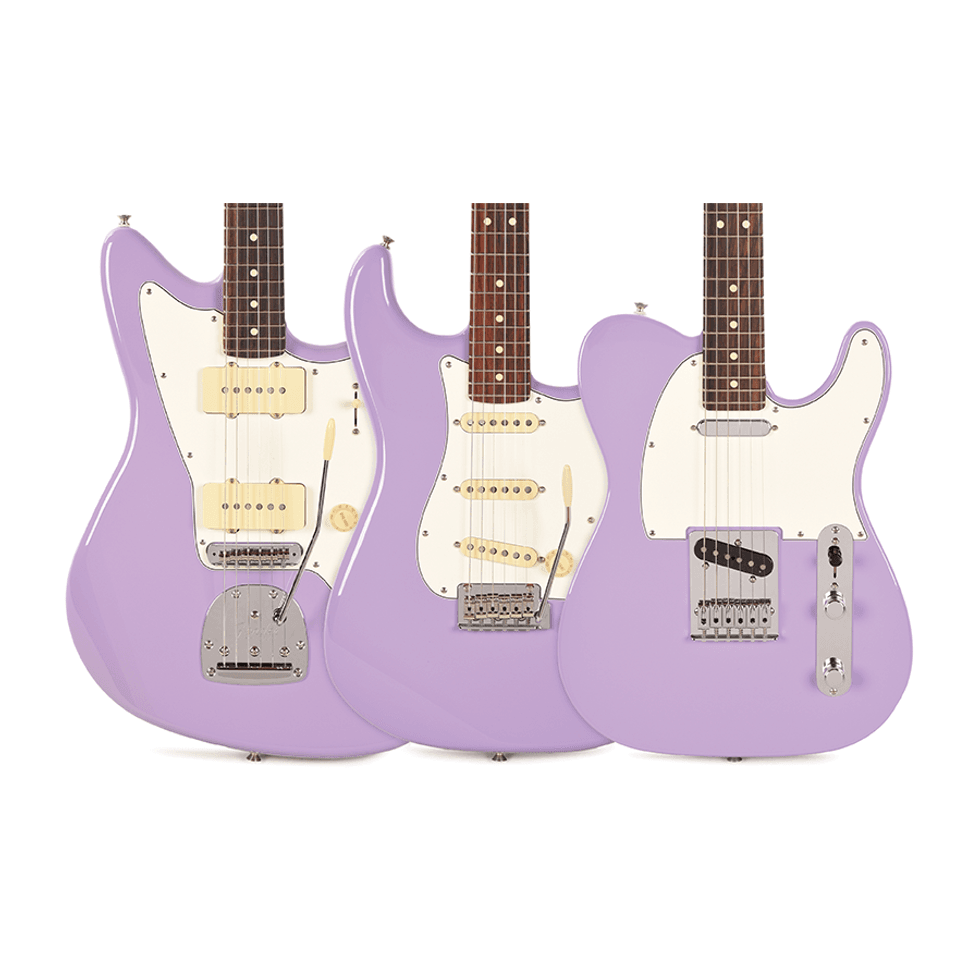
Fender Player II Lavender Haze Collection
Chicago Music Exchange and Andertons introduce their latest exclusive: Lavender Haze—a Player II collection that looks like a lost custom color from Fender’s golden era and sounds bigger, warmer, and more powerful than ever. Each instrument is loaded with exclusive “Full Dip” pickups, upgraded wiring mods, and thoughtful vintage-inspired details.
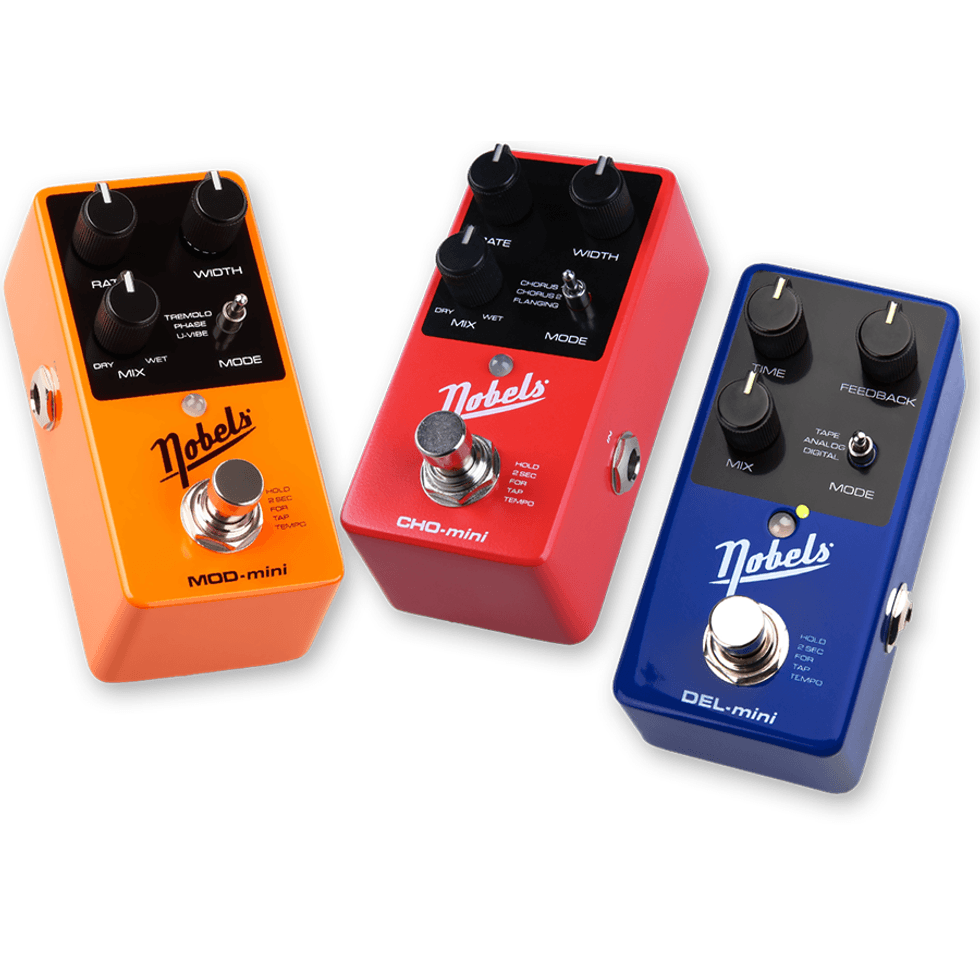
MOD-mini, CHO-mini, and DEL-mini
Nobels’ new mini pedals all feature tap tempo, mono or stereo (TRS), and true- or buffered-bypass switching. Each model offers 3 modes: MOD-mini has tremolo, phase, and u-vibe; CHO-mini has chorus 1, chorus 2, and flanger; DEL-mini tape, analog, and digital. Lots of features, great value!
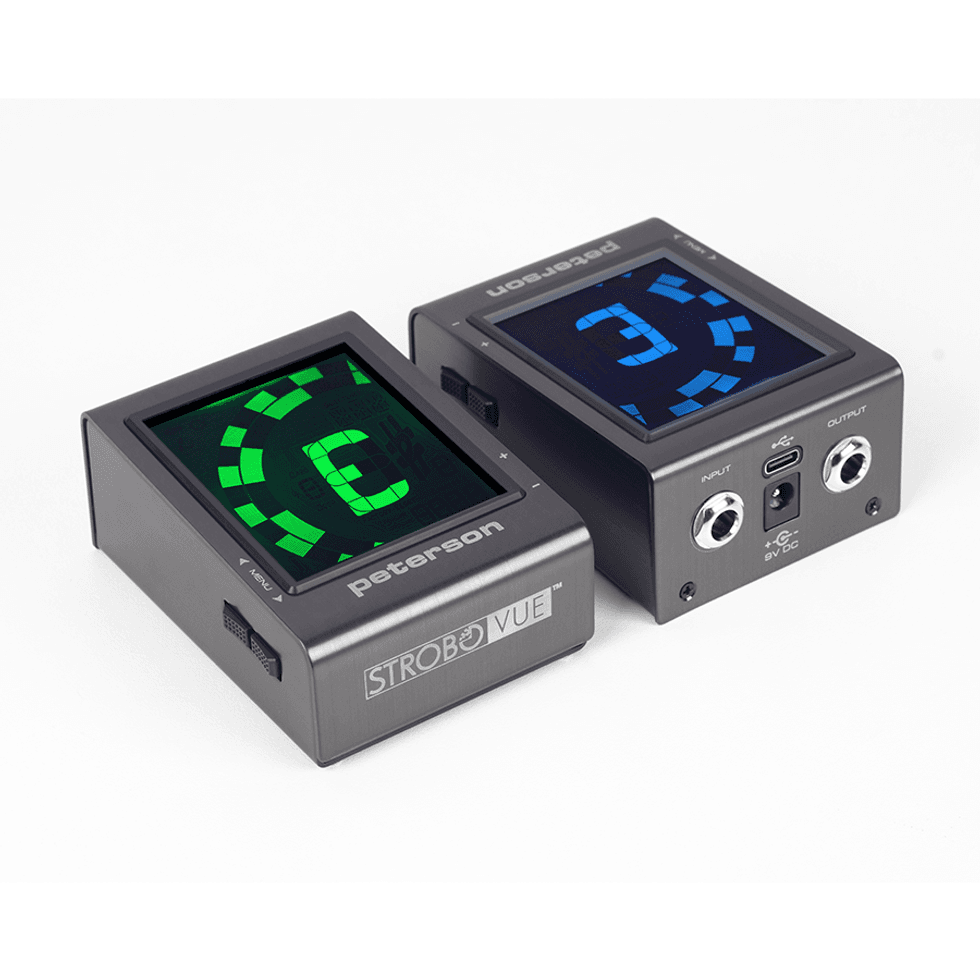
StroboVUE
Building on the legacy of the StroboStomp HD, the view-only StroboVUE delivers Peterson’s renowned strobe accuracy in an always-on pedalboard format. Its angled, high-visibility display and fully top-mounted jacks keep setups clean. Featuring pure buffered output, continuous tuning feedback, and no mute switch, StroboVUE is built for players who demand precision.
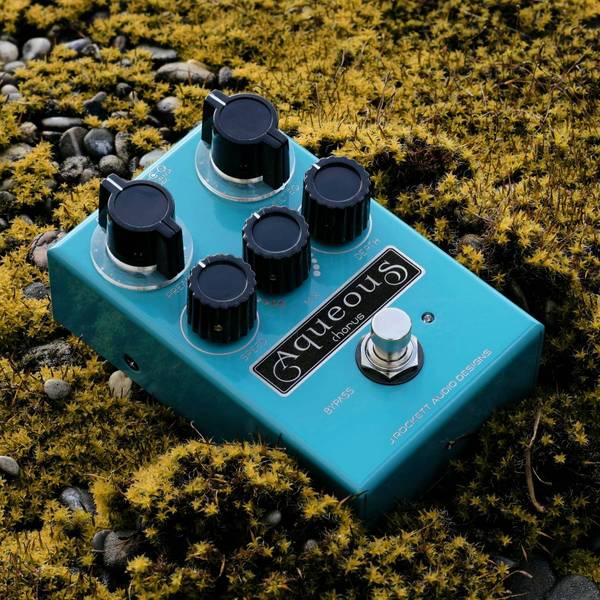
Aqueous Chorus
Dial in the past with the tilt EQ to create vintage bucket brigade tones, or dial it the opposite way to achieve classic ’80s sounds. The Aqueous features a preamp for gain makeup to limit the input and brings the circuit to life.
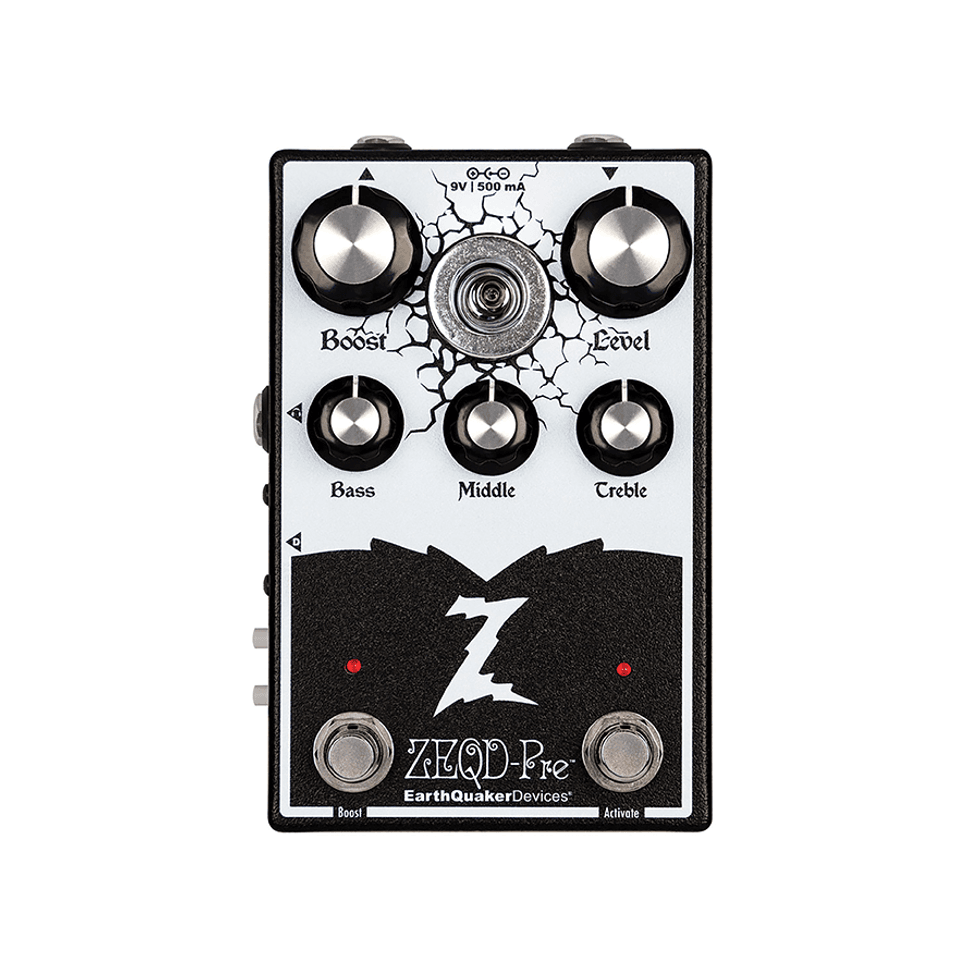
ZEQD-Pre
This all-analog tube preamp, designed with Dr. Z Amplification, features a real EF86 pentode tube to deliver authentic warmth and touch-sensitive response. This end-of-chain solution includes a three-band EQ, independent boost, analog cabinet simulation, and XLR/headphone outputs—perfect for direct recording or pedalboard-based rigs.
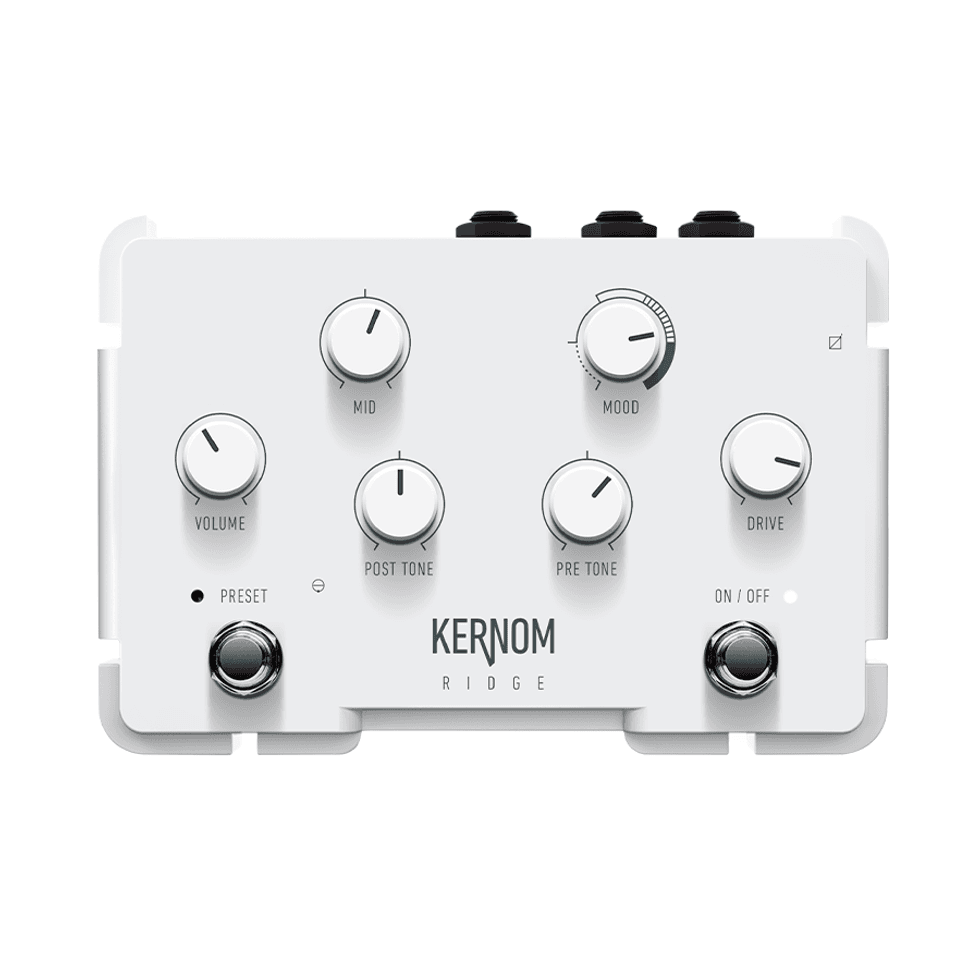
RIDGE
Do you want complete control of your overdrive? Kernom Ridge preserves your pure analog tone while unlocking the power of digital control. Its patented Analog Morphing Core sweeps smoothly from edge-of-breakup to saturated lead and every drive tone in between. Save presets, use MIDI or expression, and command your tone.
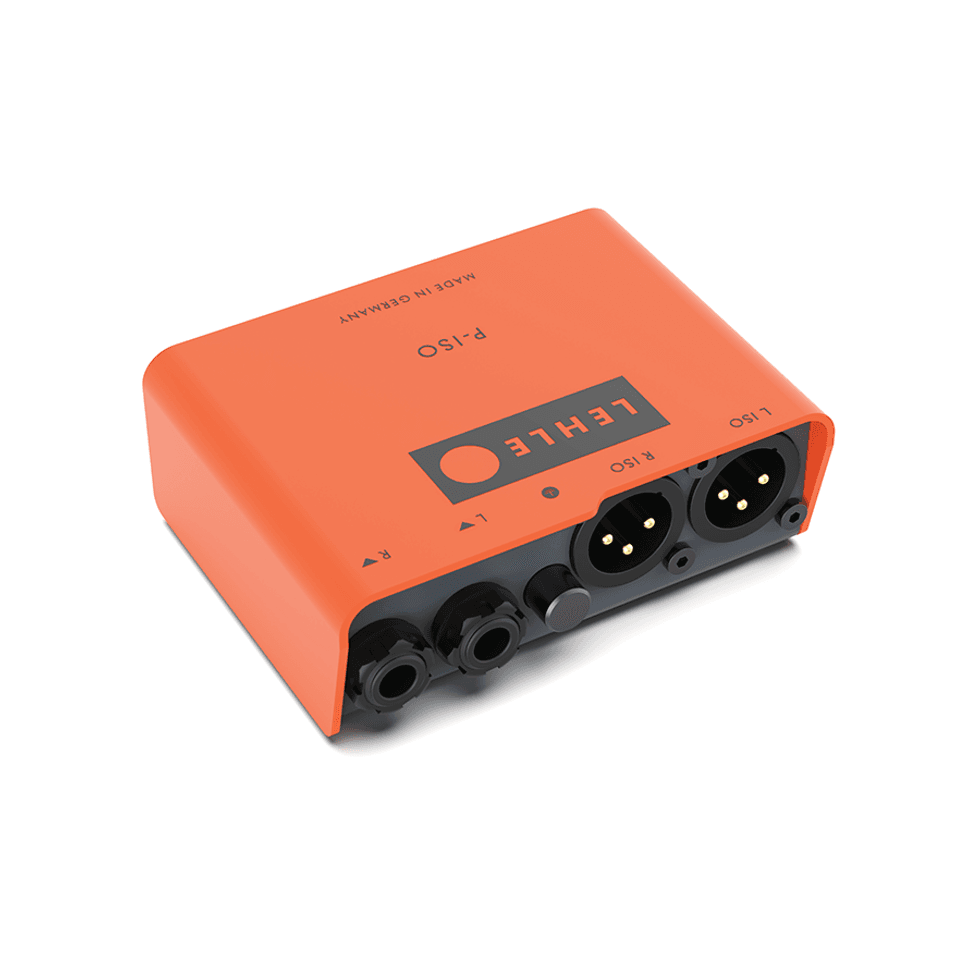
P-ISO TRS XLR Stereo
This stereo line isolator brings you closer to the main system. Passively, it converts your stereo audio signal not only to balanced XLR but lifts the ground so there’s no chance of noise or hum. Perfect for pedalboards or modeler, live or studio—all fitted into a handy size.
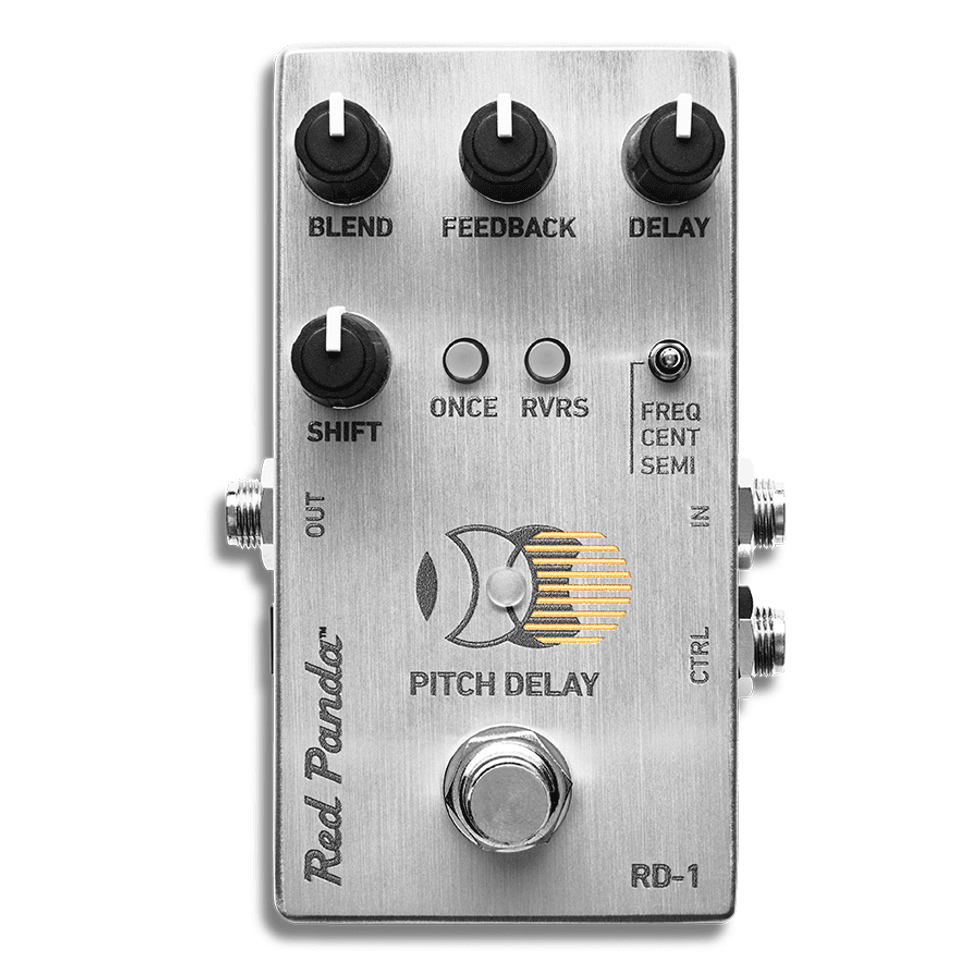
RD-1 Pitch Delay
This focused digital delay features integrated pitch and frequency shifting designed for immediate, hands-on control. Shift repeats once or endlessly in the feedback loop, from clean delays to subtly twisted textures and out-there sounds.
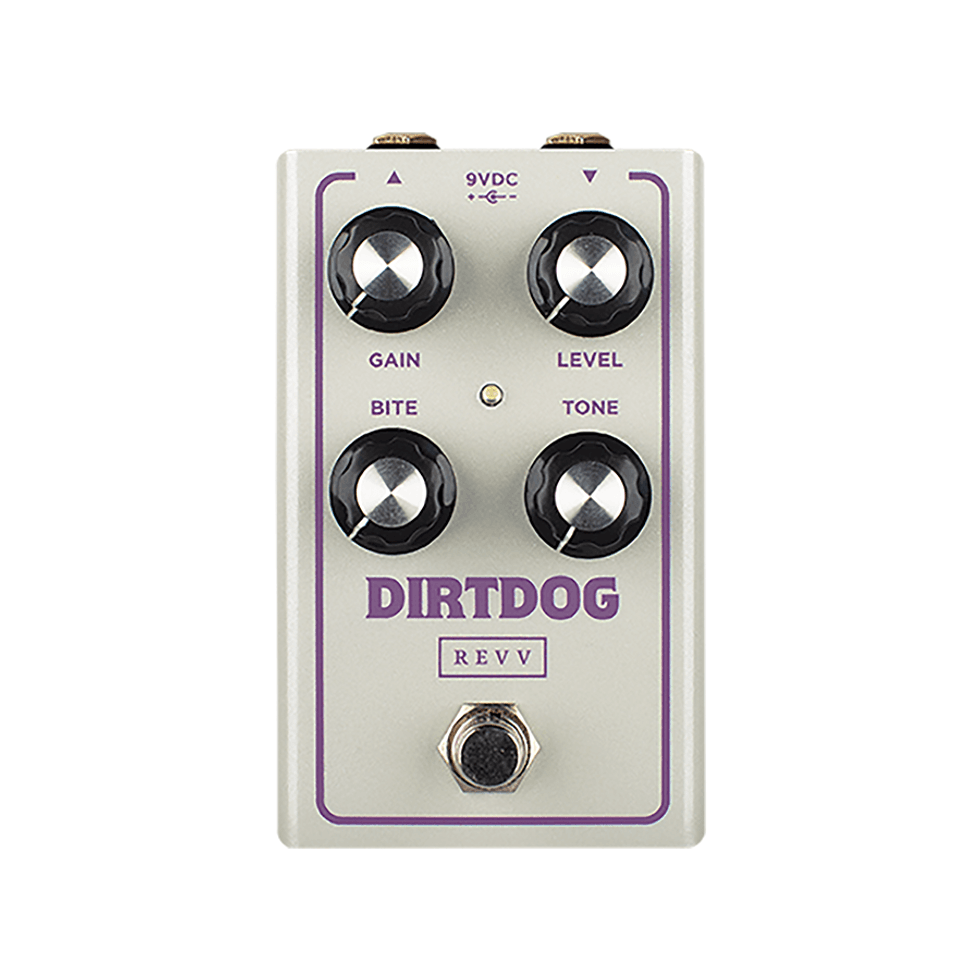
Dirt Dog Overdrive Pedal
The Dirt Dog Overdrive—developed with Joey Landreth—delivers expressive, amp-like breakup with outstanding touch sensitivity. Simple gain, level, bite, and tone controls make it easy to shape everything from warm grit to rich, sustaining drive.
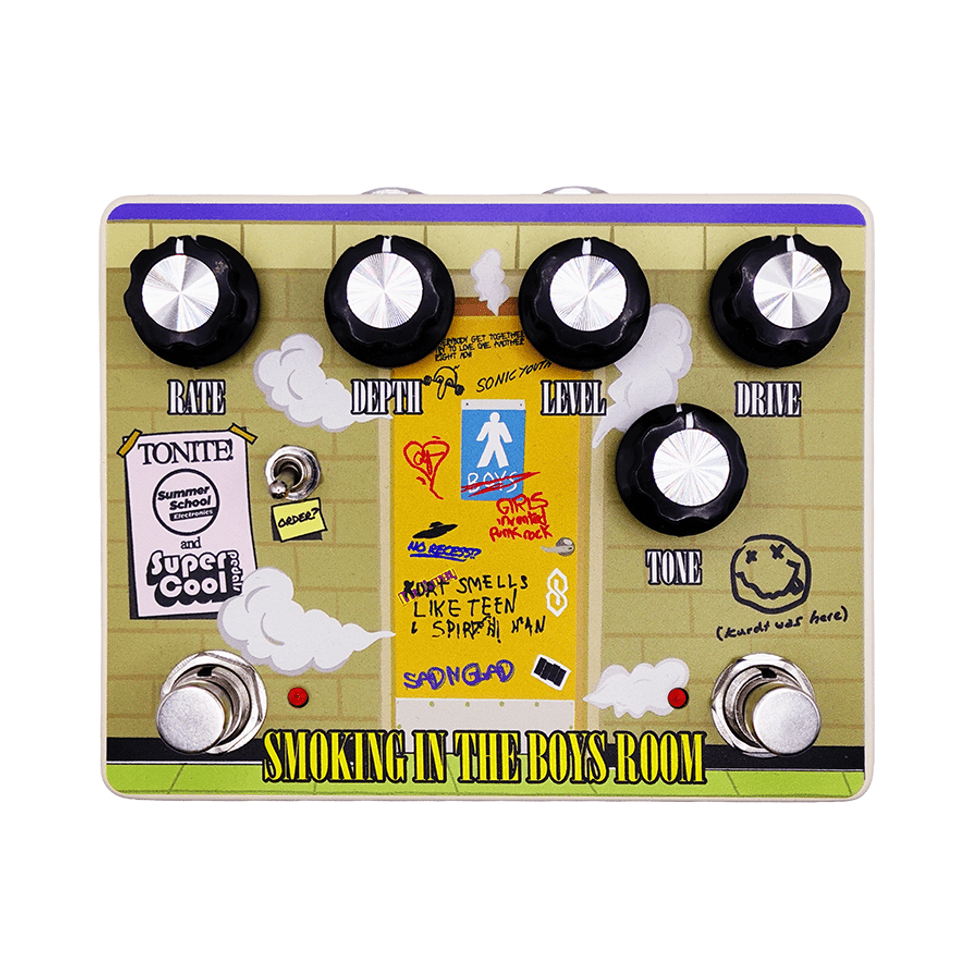
Smoking in the Boys Room
This bold cross-border collab takes Summer School Electronics’ DS-1-inspired buzzsaw distortion and smashes into Supercool Pedals’ watery Small Clone chorus to create unmistakable grunge tones. With a chain-order switch in tow and art soaked in ’90s lore, it’s a blistering love letter to an iconic sound.
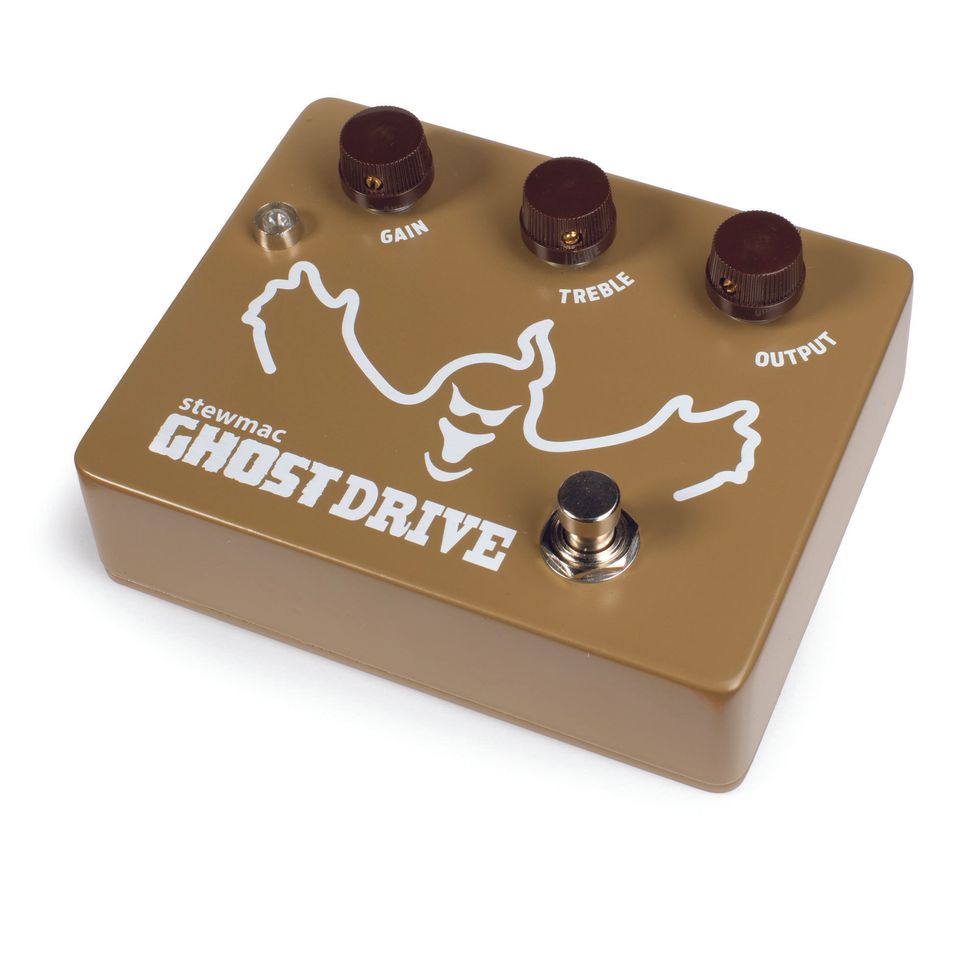
Ghost Drive Transparent Overdrive
This boutique, Klon-style overdrive pedal is now fully built and ready to play. Get rich, transparent drive, smooth sustain, and dynamic response without building the kit yourself. Perfect for adding warm grit or pushing your amp into singing lead tones.
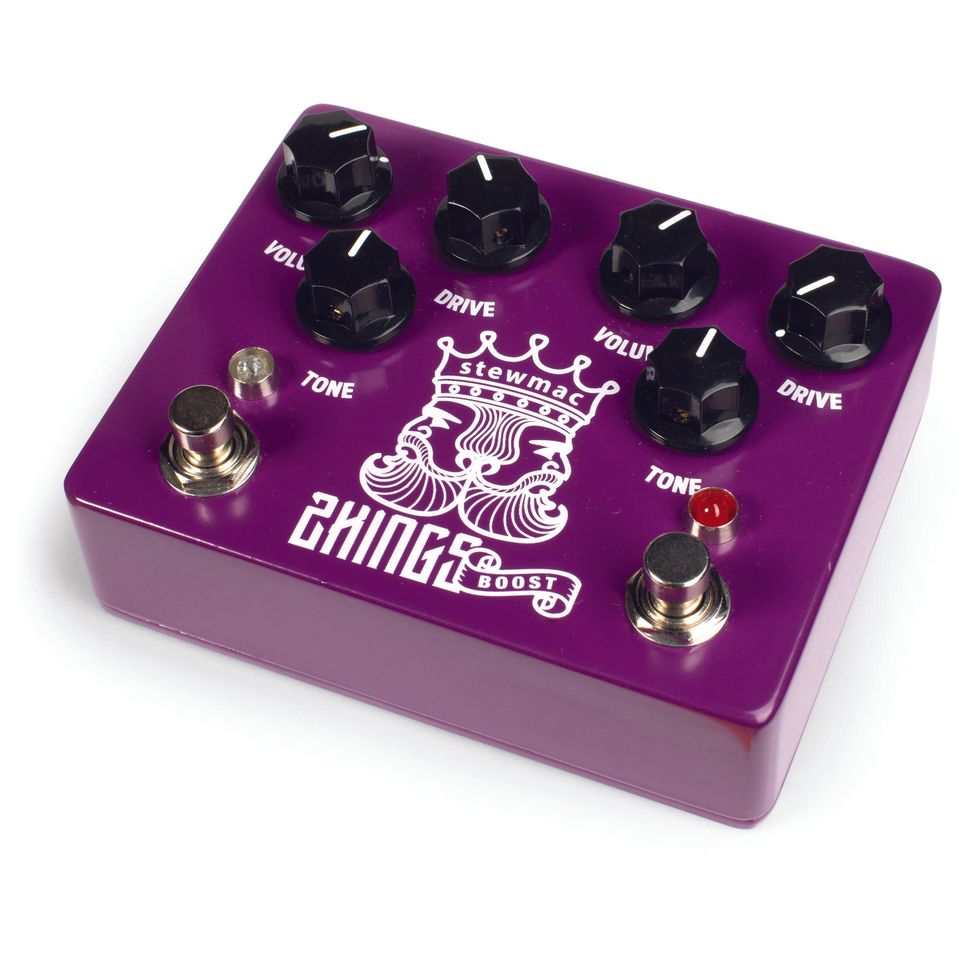
Two Kings Boost Dual Overdrive
The StewMac Two Kings, based on the Analog Man King of Tone, packs two legendary overdrive circuits into one fully built pedal, no soldering required. From transparent boost to rich mid-gain crunch, stack the drives for endless tonal options. Perfect for shaping your rhythm tone or adding singing sustain to solos.
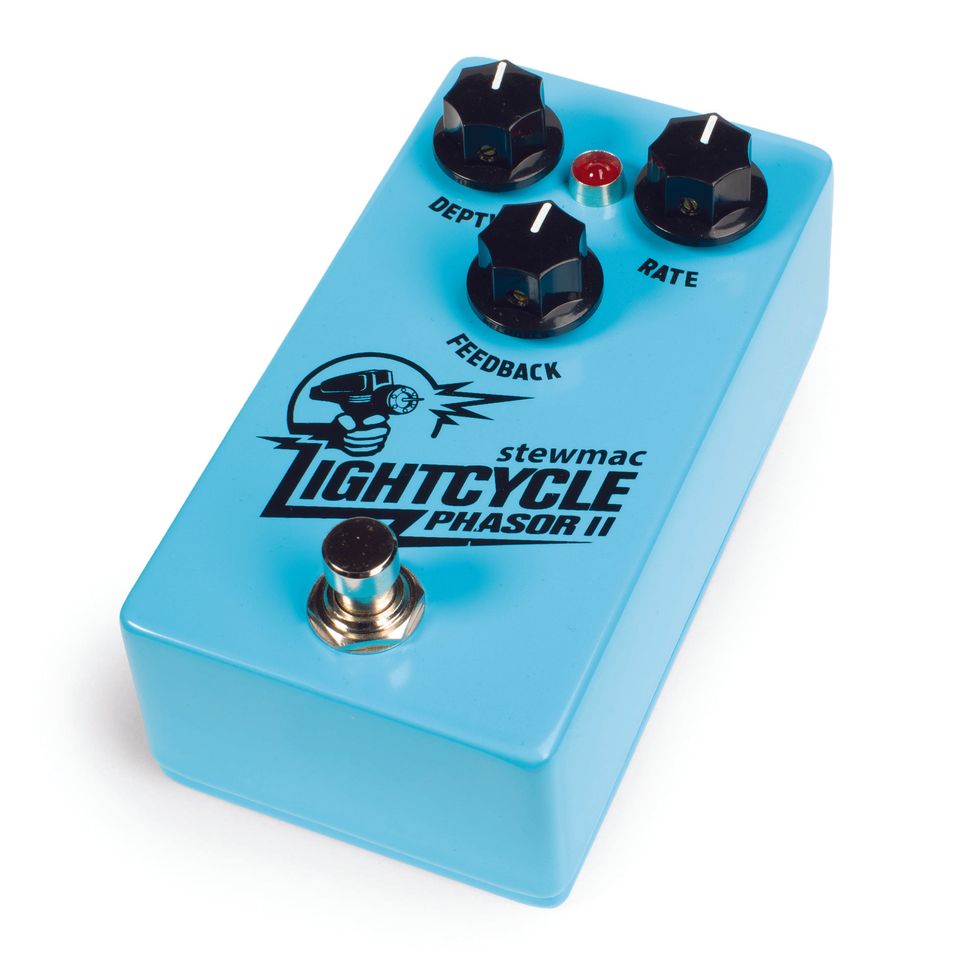
Lightcycle Phasor II
This fully assembled, board-ready analog phaser pedal was inspired by the legendary Mu-Tron Phasor II. Featuring lush, sweeping modulation, rich vintage tone, and three intuitive controls for rate, depth, and feedback, it effortlessly delivers anything from subtle movement to deep, psychedelic swirls—no assembly required.
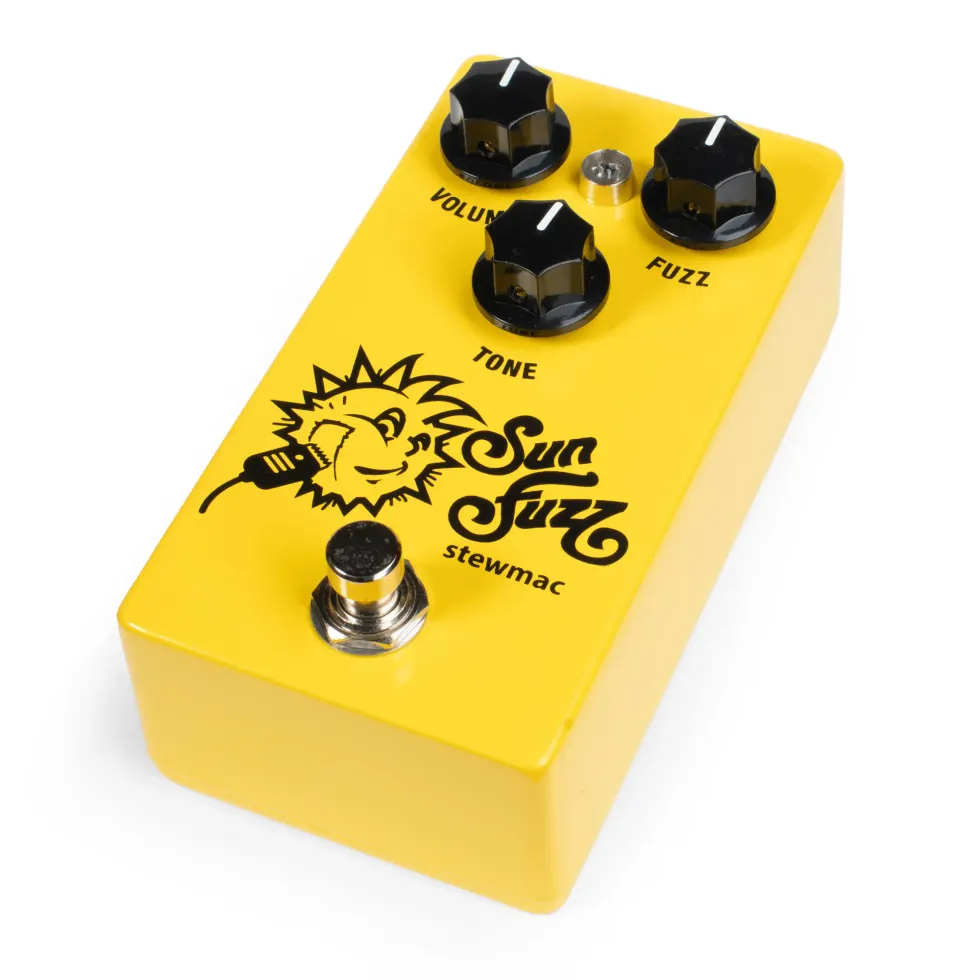
Sun Fuzz
A boutique-style pedal inspired by the Analog Man Sun Face, fully built and board-ready. The Sun Fuzz delivers rich, touch-sensitive fuzz tones with warmth, clarity, and adjustability. Featuring silicon-based circuitry with internal bias and clean blend controls for tonal finesse, it handles thick chords and saturated leads equally well.
Reader Pedalboards 2026

Pedalboards tell stories, and this year's submissions prove it! From the minimalist who ditched the road case and went back to a One Spot on the floor, to the collector building a “Starboard” entirely from famous guitarists’ gear, to the neurosurgery videographer crafting soundscapes for the nervous system—these rigs reflect real lives and real gigs. Bass players with bamboo builds, experimentalists with dual boards, and portable warriors powering entire rigs from USB banks all made the cut. Here are seven boards with stories to tell.
New Wave Happy Place
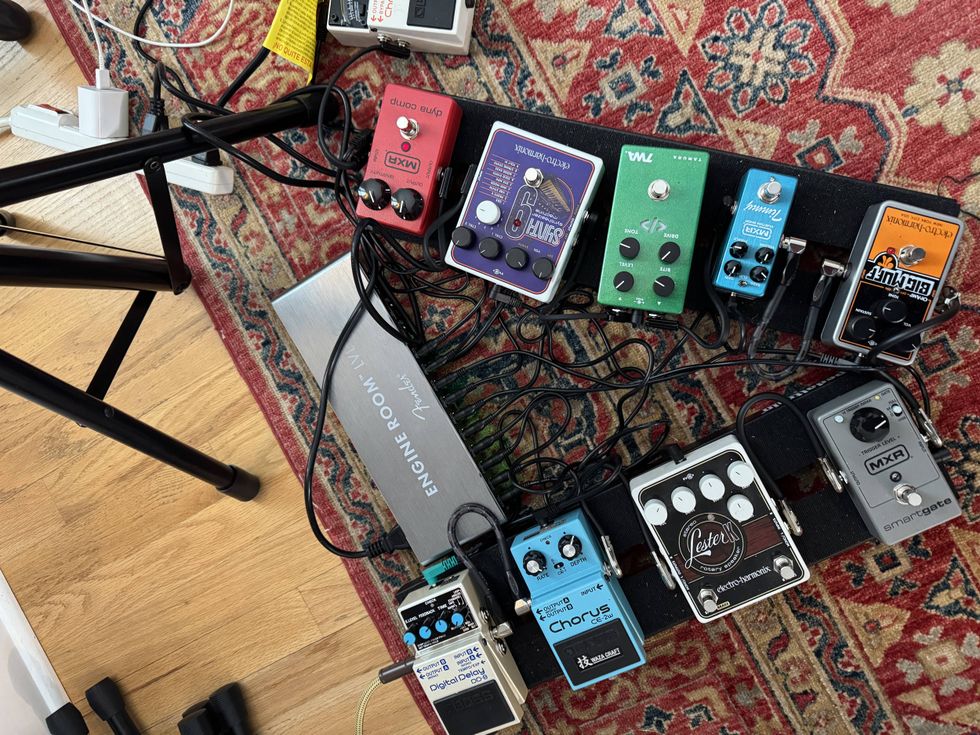 Reader: Stephen Jackson
I’m a pretty ordinary guitar player, but I’ve loaded up on ten pedals that make me sound halfway decent. For me, my happy-place sonics are from the diffuse new wave genre of the late 1970s to mid-1980s. I just can’t get enough.
I prefer keyboard-dominated new wave that’s generally kind to enthusiastic but ordinary guitarists. I like it nice and dark—the Cure, Siouxsie and the Banshees, or the Cocteau Twins—or more pop-ish with some grit, like the Psychedelic Furs. I also love what I call “skinny guitar rock new wave”—earlier Talking Heads or Elvis Costello.
My pedals are powered by a Fender Engine Room LVL12, which is great for cutting down amp hum. Yes, there are battery packs that power pedals and may even help reduce cord hum, but they make me nervous—I forget to charge my phone or my vacuum stick, let alone a battery pack.
The first port-of-call from guitar to amp on my rig is a Boss TU-3 Chromatic Tuner. Next is an always-on MXR Dyna Comp compressor. Following that is a new wave synth staple, an Electro-Harmonix Synth9. Then the overdrive pedals: a newly-released entry in the Tube Screamer lineage, the TWA SC-01 Source Code, which is commonly on and dialed up relatively mellow; a kicked-up MXR Timmy; and a seething and spitting Electro-Harmonix Op Amp Big Muff Pi. My skinny rock songs get the SC-01 treatment or a Timmy on occasion. Oddly enough, the Big Muff is at home when turned down to backing some electronica—Berlin, for instance—as well as noisy new wave.
Next up is an MXR Smart Gate. Before I added that—and the Fender Engine Room—my Fender Jazz Bass had an annoying hum. Not anymore.
Finally, there are three stomps that, along with the Synth9, get my sound to the electronica and pop new wave happy place: an Electro-Harmonix Lester K stereo rotary speaker pedal, a Boss CE-2W Waza Craft Chorus, and a Boss DD-8 Digital Delay. My advice: never fear a chorus pedal.
Portable Power
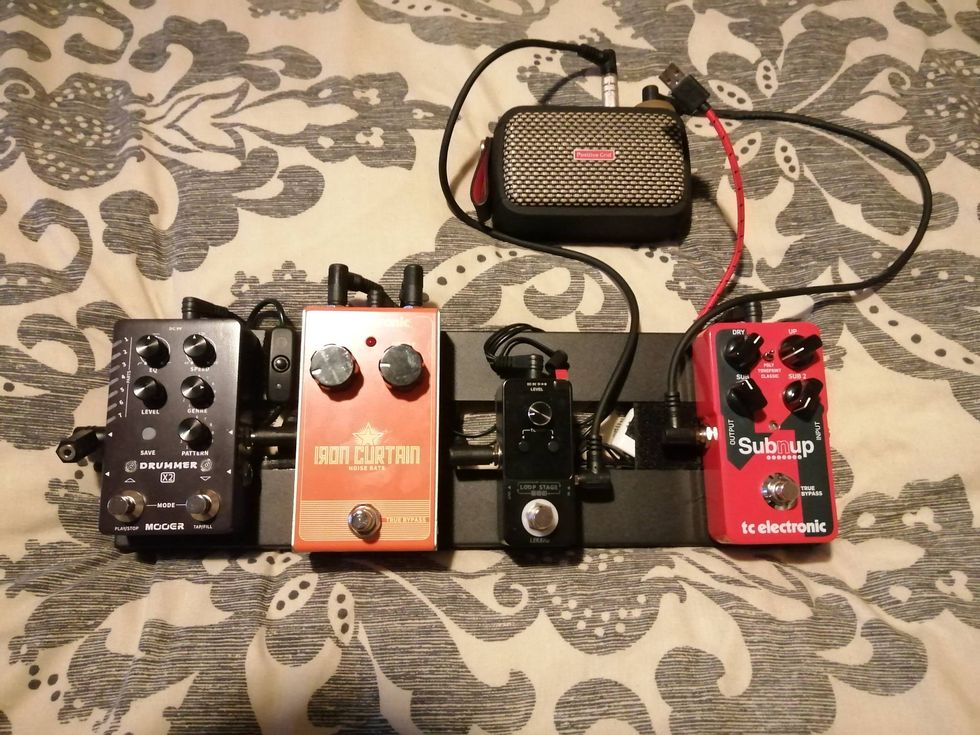 Reader: Adam Thomas
The board itself has a Li’l-moXie power supply hiding underneath. The red USB cable plugs into any USB power bank and powers the whole rig. The guitar output plugs straight into the [TC Electronic] Sub ’N’ Up [Octaver] pedal for the creation of bass lines and general low-frequency ambience. From there the signal travels to the Spark GO to be given a thorough going-over before it heads into the Lekato Looper. The second layer of the loop probably needs a true bypass from the Sub ’N’ Up and a different preset on the GO—no problem if you have the Spark Control X.
Next I send the signal into the [TC Electronic] Iron Curtain noise gate to get rid of any little imperfections created by the looper, and off we go to the Mooer Drummer X2 to provide some rhythmic accompaniment. I send the final output to a SubZero 15" portable PA (battery powered) via a stereo splitter line, giving me more options than you can shake a stick at for the entertainment of your fellow man, no matter where you may find them.
Experimental Lab
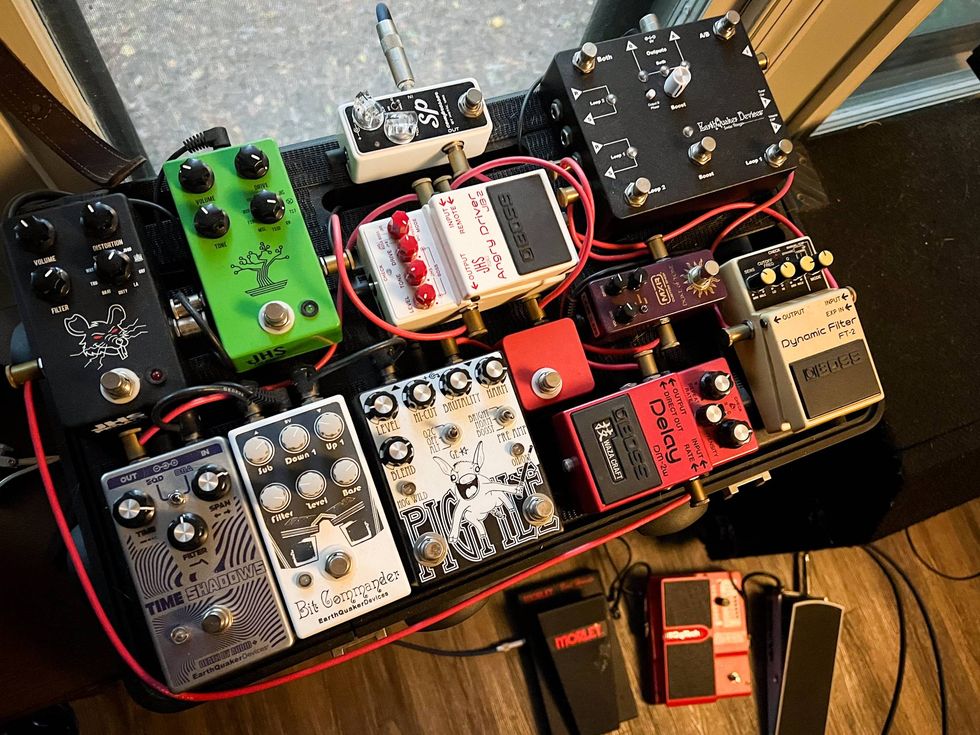
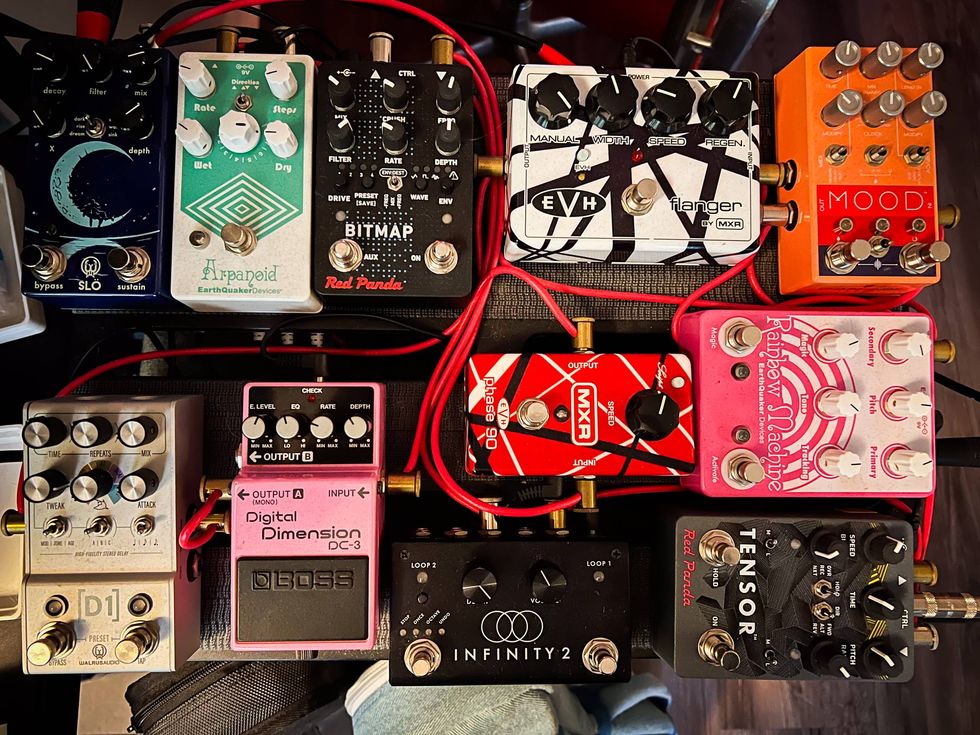 Reader: Kurt Nolen
I’m the Medical Photographer/Videographer for the University of North Carolina School of Medicine Department of Neurosurgery, and frequently need to produce educational/academic or communications-related videos. Sometimes this material can use more narrative styles of music, but frequently it needs textural soundscapes that reference the subject matter in the video and drive viewer interest without being distracting. Want to evoke the sound of your globus pallidus? What does your nervous system sound like? What would high-intensity, focused ultrasound treatment sound like if you could hear it? This rig does it. I’m also an experimental composer and noise artist in my free time and needed something that could serve that purpose—or for sitting in with my friend’s Oingo Boingo cover band.
Board #1 (front of amp): guitar into Ernie Ball VPJR, DigiTech Whammy 4, Morley Bad Horsie, Xotic SP Compressor, Boss FT-2 Dynamic Filter, EarthQuaker Devices Swiss Things—loop 1 out to MXR Duke of Tone, Electrofoods Ultd Pigpile fuzz, EarthQuaker Devices Bit Commander, EarthQuaker Devices Time Shadows V1, Boss JB-2 (with JHS Red Remote), JHS Bonsai, JHS PackRat, Boss DM-2W to loop 1 return.
Board #2 (amp FX loop or loop 2 on EQD Swiss Things if running direct): FX out to EarthQuaker Devices Rainbow Machine, MXR EVH117 Flanger, MXR EVH Phase 90, Boss DC-3, Walrus Mako D1 Delay V2, Red Panda Bitmap, EarthQuaker Devices Arpanoid, Chase Bliss Audio MOOD, Red Panda Tensor, Pigtronix Infinity 2, Walrus Audio Slö Multi Texture Reverb to FX return (or Swiss Things loop 2 return if direct).
Legendary Pedals
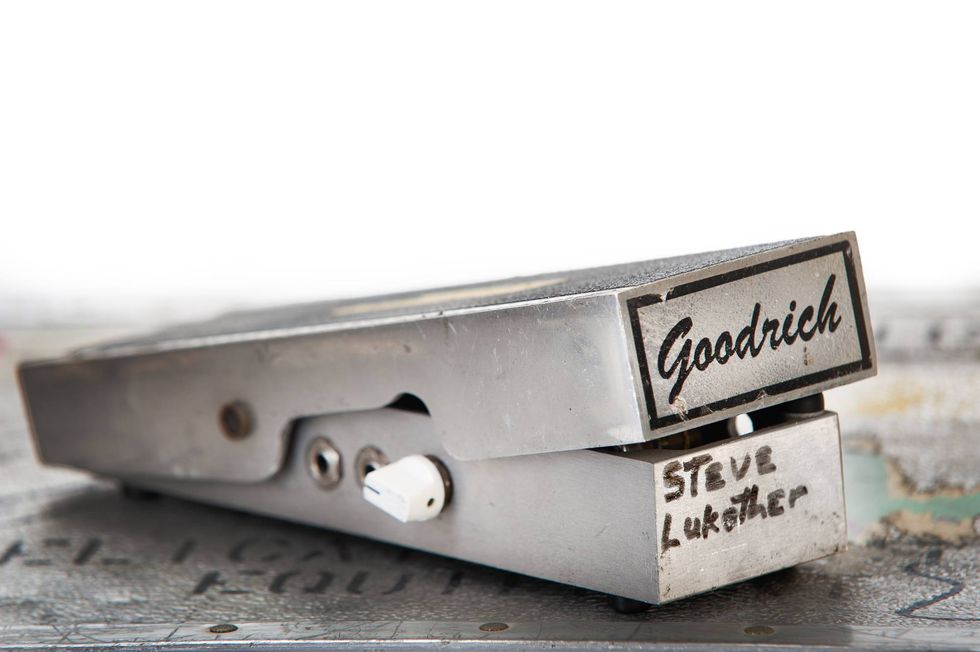 Reader: Paul Martin
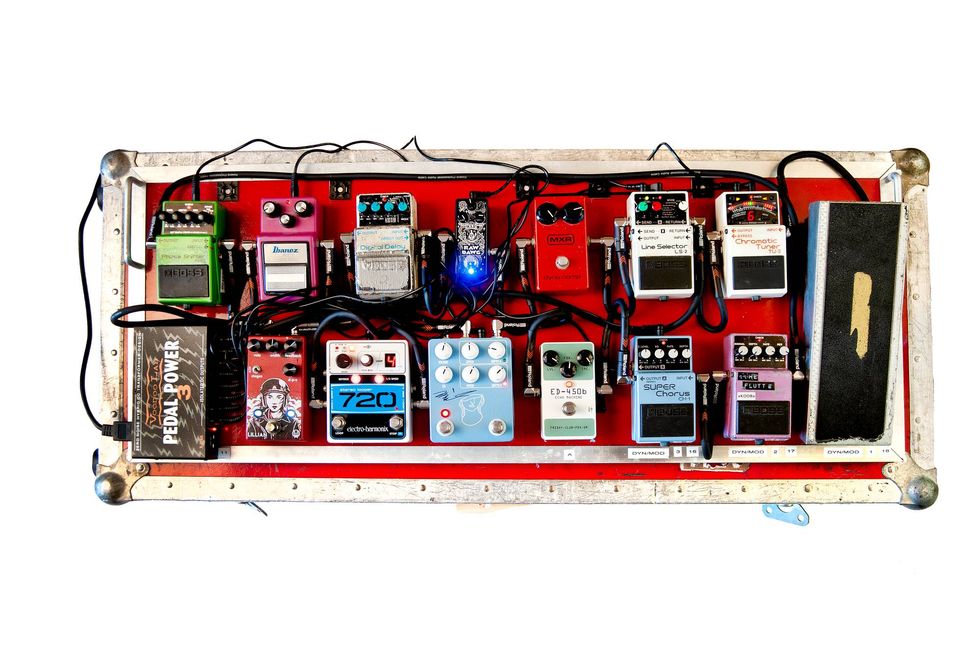
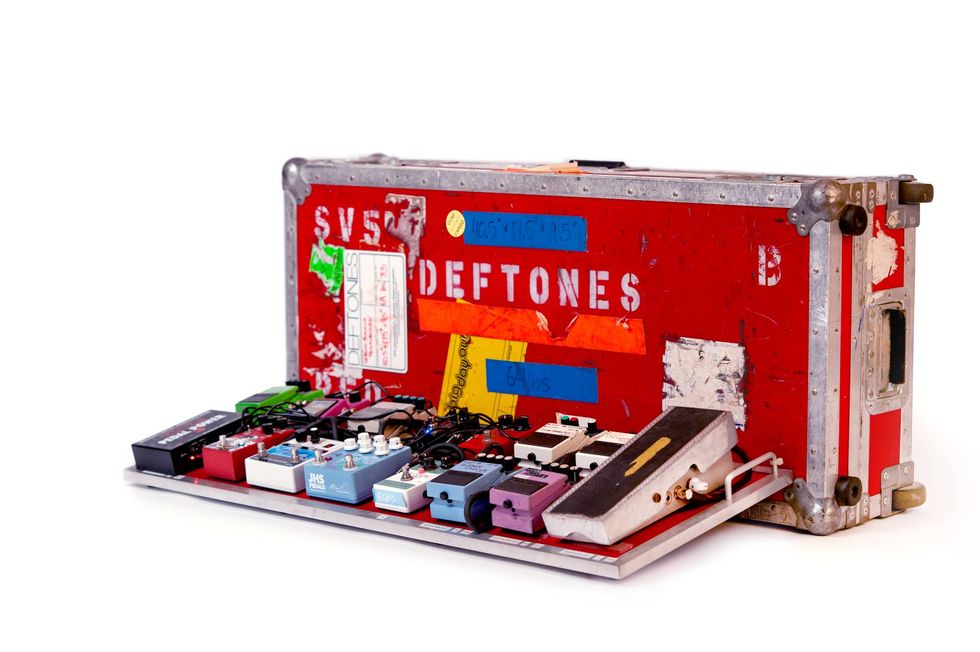
This is my “Starboard.” I call it that because it’s made up of pedals previously owned by famous guitarists. I mostly bought them from artist sales on Reverb, with a couple from Techno Empire and Pedal Pawn in the U.K. I was randomly collecting artist-owned pedals for a while, but when I bought [Deftones bassist] Sergio Vega’s pedalboard I decided to put a board together. The line selector switches between the top row for soloing and bottom row for clean. The board itself was owned by Sergio.
Top row: Boss PH-3 Phase Shifter, owned by Andy Taylor (Duran Duran and the Power Station); 1980s Ibanez AD9 Analog Delay, owned by Mitch Holder, a go-to session guitarist for Frank Sinatra, Barbara Streisand, and Lionel Richie; Boss DD-2, owned by Kiko Loureiro (Megadeth); signed MXR EG74 Eric Gales Raw Dawg Overdrive (limited to 250); vintage MXR MX-102 Dyna Comp, owned by producer and musician Dennis Herring; Boss LS-2 Line Selector, owned by Evanescence; Boss TU-3 Chromatic Tuner, owned and signed by Tommy Emmanuel.
Bottom row: Walrus Audio Lillian Analog Phaser; Electro-Harmonix 720 Stereo Looper, owned by Malcolm Cecil, who invented the TONTO analog synthesizer and was responsible for the sounds on Stevie Wonder’s first three albums; JHS Artificial Blonde Madison Cunningham Signature Vibrato, signed by Madison when she was in Dublin supporting John Mayer; Friday Club ED-450b Echo Machine, owned by Isaac Brock (Modest Mouse); Boss CH-1 SUPER Chorus, owned by Daryl Stuermer (Genesis and Phil Collins); Boss HF-2 Hi Band Flanger, owned by Tad Kubler (the Hold Steady); and Goodrich Model 122 Volume Pedal, owned by Steve Lukather (Toto). From soloing on Stevie Nicks’ “Stand Back” to virtually all of Michael Jackson’s Thriller, it doesn’t get much cooler than that.Bamboo Bass Rig
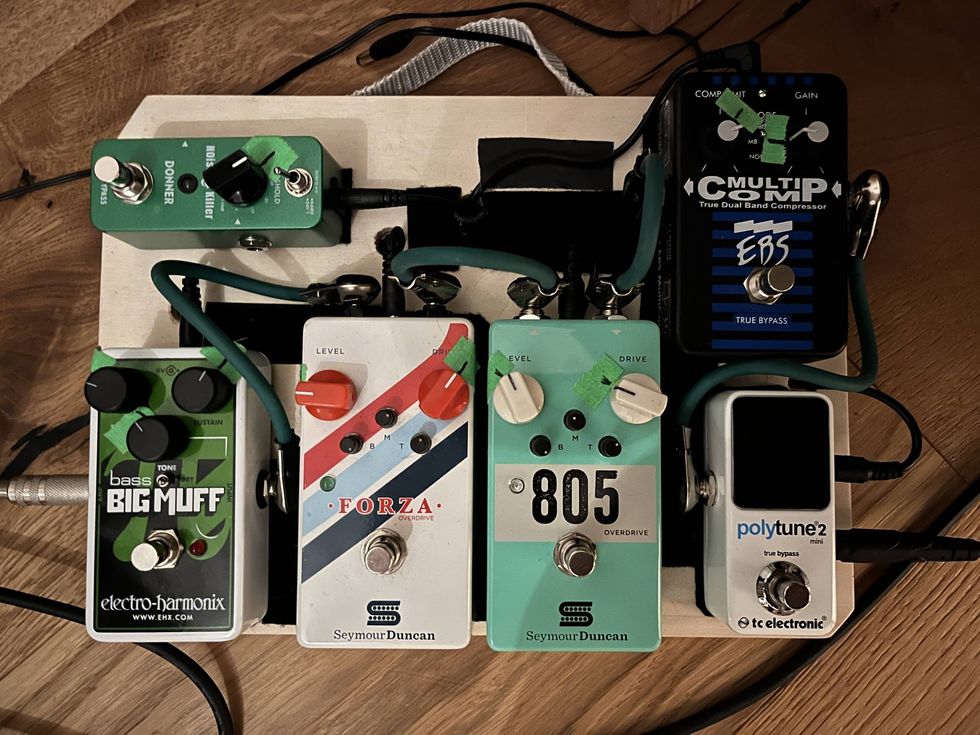 Reader: Dino von Wintersdorff
My bass pedalboard: Starting with a TC Electronic PolyTune 2 tuner, the signal goes into a Seymour Duncan 805 Overdrive, then a Seymour Duncan Forza Overdrive, an Electro-Harmonix Bass Big Muff, and finally a Donner Noise Killer. [An EBS MultiComp sits top right as well.] All on a board made out of bamboo and plywood, giving a fresh vibe on the stage!
First I got the Seymour Duncan Forza to have some nice controllable overdrive for the bass—the 3-band EQ helps get a nice tone. Then I found the clean signal was too boring and I added the SD 805 to have an always-on slight crunch and tone shape, and I love it! Sometimes the Muff and Forza are on at the same time, but the 805 isn't. So switching back to only 805 mode can be wild—there are times onstage that I would hit not only those three pedals, but also the tuner, instantly killing my signal!
No Board Required
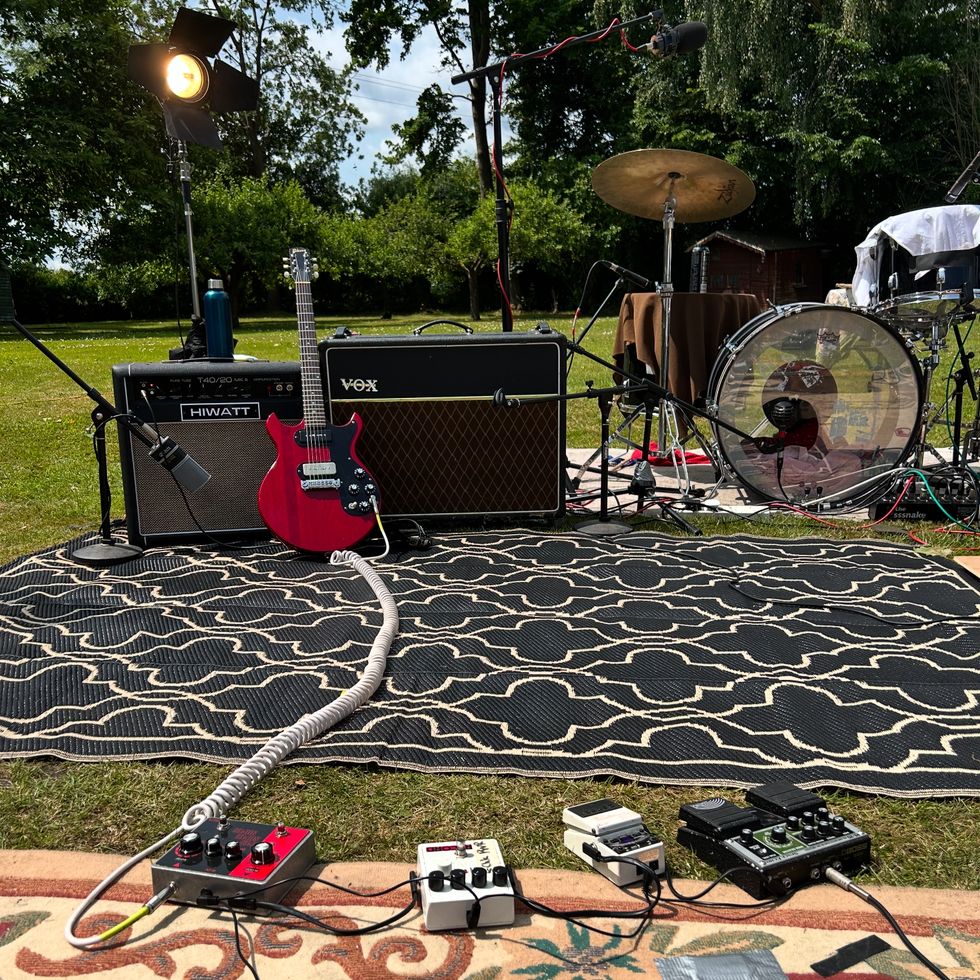 Reader: Sam Paige
So obviously, yeah, there’s no board. It’s on the floor. In the 20-plus years I’ve been playing—starting with a few daisy-chained pedals to a fully-loaded [Pedaltrain] Novo 24 and nearly doing my back in taking the case offstage—I’ve got back to the pick-and-mix life of a [Truetone] 1 Spot and whatever I fancy.
Recently a band I fronted for six years or so fell apart, and as one door closed another opened. Starting in a new project, this was the first few weeks of bringing some old pedals and the 1 Spot to a new adventure and finding a new footing again.
Chain: Defects Super Super Super, something of a clone of the rare Death By Audio Super Fuzz War. Fuzz on one side, then boost. Inside there are dip switches for each side to shape EQ, add gain, add mids—usual setup is “full Fuzz War” with added mids, and currently a full-range boost on the other side. Second, the Electro-Harmonix Mel9, a sort of impulse buy based on seeing one of my favorite guitarists, Mr. John Dwyer, use it. It’s janky, has trouble with certain power supplies, and seems to have no built-in compression. So your effect out is either too quiet, just right, or blows your head off. I love it. It hasn’t left a setup since I bought it. Next, the Boss TU-2—god knows how old it was when it got to me (I rarely buy new), but I’ve had it for at least a good 15 years. A bit hard to see in the direct sunlight, but at least it won’t break. And a Boss RE-20 [Space Echo]—the more I use it, the more I’ve grown to love it—the perfect amount of bounce for echo effects. It’s forever inspiring and reliable. I keep thinking of trading in for one of the newer models, either to downsize or expand, but I can’t relegate this pedal to the shelf, or the draft listings on Reverb or eBay.
Double Trouble
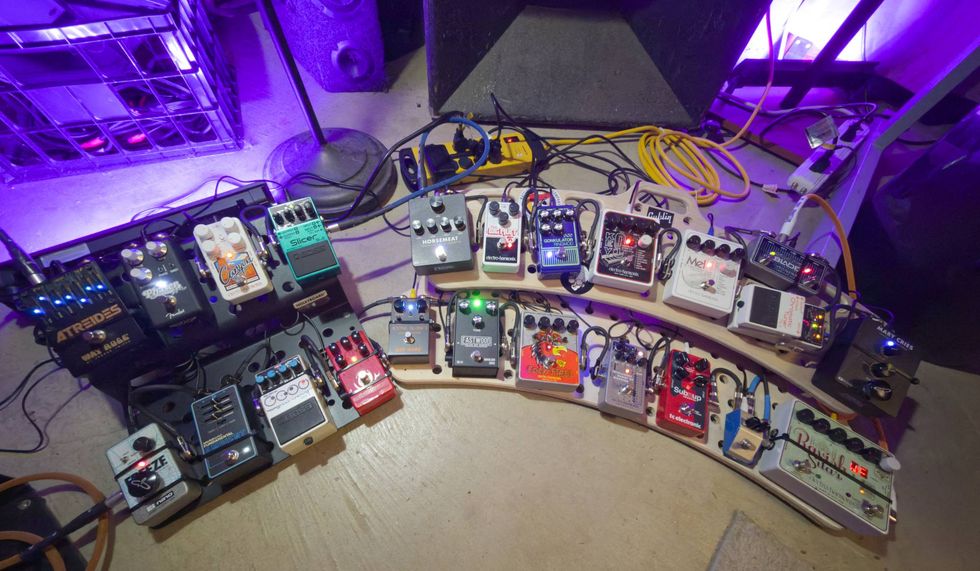 Reader: Randall Brown
I spent years as an “only use the amp’s drive channel” guy, then started looking at EHX pedals out of nostalgia for a long-lost Muff Fuzz. Over the last 15 years or so, I’ve collected this batch of circuit friends with the idea of building wide tonal flexibility. I’m influenced equally by classic riff lords like Black Sabbath, contemporary psychedelic outfits like Osees and King Gizzard, and the ultra-modern trips of St. Vincent.
One of my favorite recent discoveries is a parallel mix of the EHX Cock Fight and the Fender Waylon Jennings Phaser—a slow-modulated buzz that really straddles the synth/buzz-guitar fence. I still pay the most attention to the magic that Electro-Harmonix puts out. In my drive to build the mega-board I have now, I started with the Freeze first. I also keep an eye out for additions to what I call the “fake bored keyboardist” section. The Freeze, Canyon, Key9, and Mel9 are the cornerstones of that. There are some days when I think I should go back to a single overdrive or go straight into the amp. But all the sounds are just too much fun!
My guitar goes into a PRS Mary Cries compressor, then a Boss TU-2, then into an Electro-Harmonix Switchblade Plus. From the Switchblade, two signal chains go to two different amplifiers.
Roland JC-120 signal chain: Electro-Harmonix Ravish Sitar, Tonebutcher WeeWah auto wah, TC Electronic Sub ’N’ Up, Electro-Harmonix Intelligent Harmony Machine, Electro-Harmonix Cock Fight, Eastwood BB-01 Manalishi Drive, Way Huge Stone Burner, Catalinbread Bicycle Delay, Boss DD-2 Digital Delay, Walrus Audio Fundamental Series Ambient, Electro-Harmonix Freeze.
Fender Hot Rod Deluxe signal chain: Electro-Harmonix Mel9, Electro-Harmonix Key9, DOD Gonkulator, Electro-Harmonix Nano Big Muff Pi, PRS Horsemeat Transparent Overdrive, Boss SL-2 Slicer, Electro-Harmonix Canyon, Fender Waylon Jennings Phaser, Way Huge Atreides Analog Weirding Module.
Pages
