Music is the universal language
“Glory to God in the highest heaven, and on earth peace to those on whom his favor rests.” - Luke 2:14
Premier Guitar


Trey Anastasio on Dumbles, Broadway, and 40-Plus Years of Phish
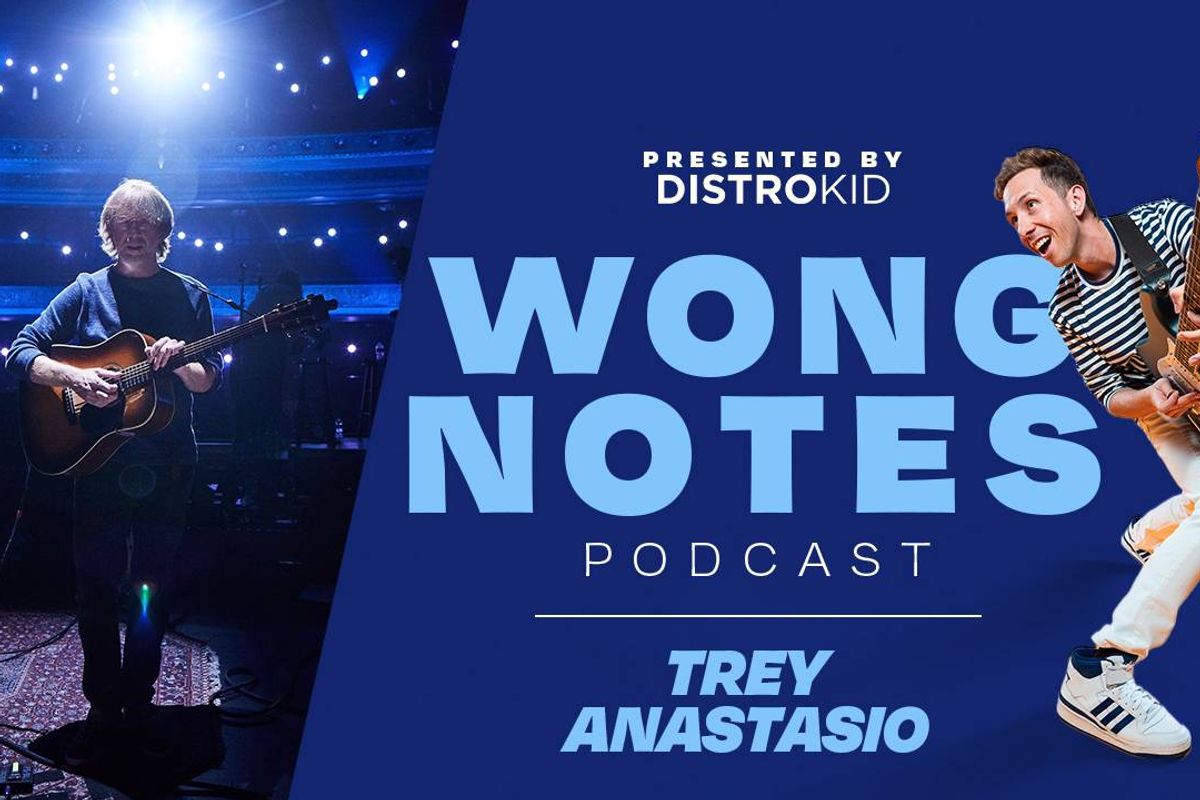
Imagine being in a band with your best friends for over 40 years, and each night you step on stage you get to play one more show. That’s exactly what guitarist Trey Anastasio and his bandmates in Phish think about right before every sold-out arena or amphitheater show. “We're all hyper aware now, every night,” mentions Anastasio. “I mean, we just love it so much. It's like, I can't wait for the tour to start.” Anastasio’s energy and passion is infectious, even when he isn’t talking about music. Bring up hockey, 6L6-based amps, or even his generationally deep Iowa roots and watch as his eyebrows raise.
We had to do something special for the 100th episode of Wong Notes. We caught up with Trey while he was preparing for a November tour with his solo band. In part one, Cory Wong brings Anastasio in with some hockey talk before diving straight into his current full-circle journey with his rig, and he reveals a bit of an epiphany that all true gearheads know, but sometimes are afraid to admit. —Jason Shadrick
John Mayer Convinced Trey to Try a Dumble
Cory Wong: Your rig looks quite a bit different now. Tell me about the transition to using Dumble amps. When and why? When and why?!?
Trey Anastasio: I've only played three shows through a Dumble, which was a borrowed Dumble. A guy lent me one. I was doing the Dead 60 thing out there in San Francisco, and John was like, “You gotta try a Dumble.” We were backstage just talking and he's like, “Have you tried a Dumble yet?” I'm like, “No, no, I haven't.”
Wong: He did the same with me. He makes a pretty convincing case. Did he give you the whole like cost-per-gig spiel? What was his method of marketing to you?
Anastasio: He was just talking them up, you know, and I said, well, I would get one except that you own a third of them. [Laughs.] When he [Alexander Dumble] started making those Dumbles, he was trying to beat Randall [Smith] over at Mesa/Boogie. So, they're kind of in the same family. When I tried the Dumble on the last tour, I borrowed it from a very kind person for the Alabama and Hampton shows. And maybe I might have had it at SPAC too. I'm trying to remember, but anyway, it really worked. All the people who are like the arms-crossed, tone haters out there were like, “Okay, this works, because it sounds Fender-ish, but just sort of better.” The reason I've never tried one before is because I always thought that the price was just so obscene that I kind of rebelled against the whole concept of the thing.
But I think what flipped me around on that is that the last couple years I played with this four-piece string section that was at the Beacon Jams and stuff, we called it the Rescue Squad. And these string players who don't make a ton of money were explaining to me how it works in orchestras. One of the women had a Stradivarius from 1700, which is worth millions of dollars, right? Well, she doesn't have millions of dollars. And she said the way this works is that the orchestra you play with, if you get a seat, you know, there's investors and stuff. People think of themselves as curators of these instruments for a while. And then they give them to the next person. So if you get a seat in the Boston Symphony, you're probably going to end up with a better instrument one way or another, based on all the practicing and hard work that you did. One of the caveats is that you get to play a really beautiful instrument for a while. Yes, it's worth an insane amount of money, but you're really just taking care of it. I think that's kind of what's happening now that there's such a finite number of these Dumble amplifiers. John was like, “You should call my buddy at this music store in Seattle, Trevor,” and I called him, he's really nice. And he said they have an amp that maybe I should look at. I went to look at it, and it turns out that Keith Urban owned it previously. Keith and I have met at a couple of events, and I texted him and asked what he thought of this amp. He told me a few things about it. He's really nice. And so they get passed around.
Trey’s Early Influences
Wong: Where did it feel like the main source of your voice came from? And when did you feel like you had it?
Anastasio: I felt that way pretty early. It's interesting. I saw a live show from 1990 recently, and I was kind of surprised—looking backwards—how much of the bulk of this material, it was all originals we were playing. It was like, “It’s Ice,” “Maze,” “You Enjoy Myself,” and all these things that became who we are were already in place by the time I was 25. There was an enormous amount of material and I was writing obsessively by fifth or sixth grade. Still to this day, my favorite part of the whole thing is writing. Even when we were playing at Nectar's, I think I already had an individuality, but I kind of grew up listening to a strange mix of music that influenced me pretty strongly.
I was obsessed with the same things that all the kids my age were. I had every Led Zeppelin record and all that stuff—of course, I had the whole catalog memorized by 14. I think I mentioned earlier that my mother had moved to New York in the late ’40s, and she was lucky enough to go to all the golden age of Broadway shows. She gave me all those records when I was very young. These very lyrical, deeply written, composed pieces of music.
There's a place in Bucks County, Pennsylvania, called the Bucks County Playhouse that Oscar Hammerstein opened. It was a place where all those Broadway shows would come on Tuesday nights, and the original cast of the Broadway shows would do the show at an affordable price. Every week we would go see Gypsy or West Side Story. I was always interested in soaring melodies and also harmonically complex music.
My grandfather was a classical music nut. He and his brother had lifetime season tickets to the orchestra. When I went to his house, he would play me Brahms and Ravel and Rachmaninoff. He liked serious, heavy, melodic classical music.
When I was 15, I saw the Discipline Tour when King Crimson came through Alexander Hall [in Princeton, New Jersey]. There was just a lot of cool stuff going on in that era. I saw Zappa numerous times. I was a huge fan of his guitar playing much more than anything else he did. I was an absolute geek for Zappa's guitar playing and I was blessed to see him lots of times. He just ripped shit on that thing. I mean, it was just so cool. And I loved his rhythmic variation. And I love Fripp. I was obsessed with all of the early- and mid-’70s Eno albums. That was how I got into Talking Heads—through Eno. I kind of worshiped at the altar of Eno because I liked "Another Green World” and “I’ll Come Running” and “St. Elmo’s Fire.” That was one of the first solos I learned.
Rig Rundown: The Band Royale
Thanks to some key years working at a celebrated music store, this band of brothers has the goods.
The Band Royale, the Chicago-based brotherly “yacht metal” outfit, know a thing or two about gear—guitarists Joel and Zach Bauman, plus bassist Marc Najjar, all worked at Chicago Music Exchange, one of the premier music shops in North America. PG’s Chris Kies traveled deep into the band’s bunker in Chicago for this Rig Rundown with Najjar and the Bauman brothers.
Brought to you by D’Addario.
Real One
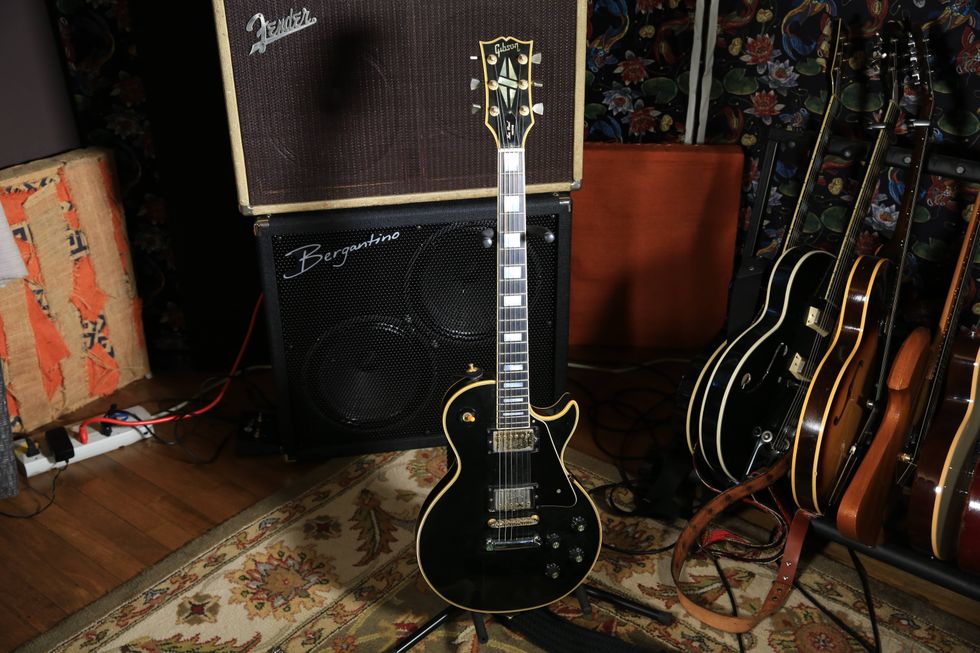
This 1972 Gibson Les Paul Custom was Joel’s first “real” guitar, which he bought from CME. It’s all original except for the tailpiece, and weighs in at a whopping 11 pounds. Joel keeps it in open D6 tuning.
Mock Mockingbird
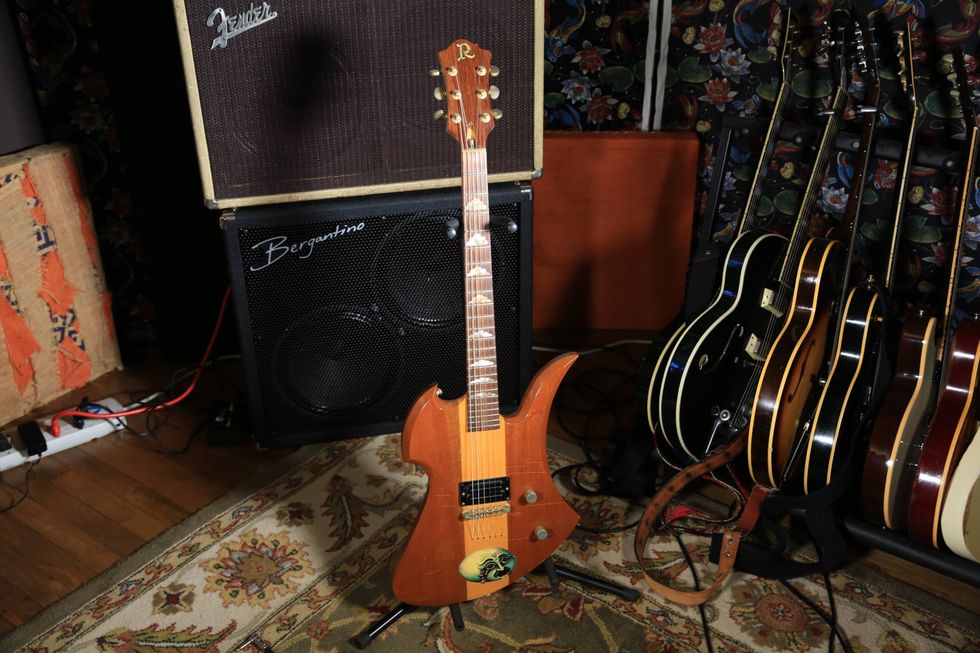
Someone brought this fake Mockingbird into CME one day, and Joel decided he had to have it. It boasts neckthrough construction with maple and mahogany, a Bill Lawrence dual blade pickup, brass nut, and heftier .012-gauge strings. The original builder must’ve liked the sticker he added to the body; it’s underneath the lacquer.
Warming Up
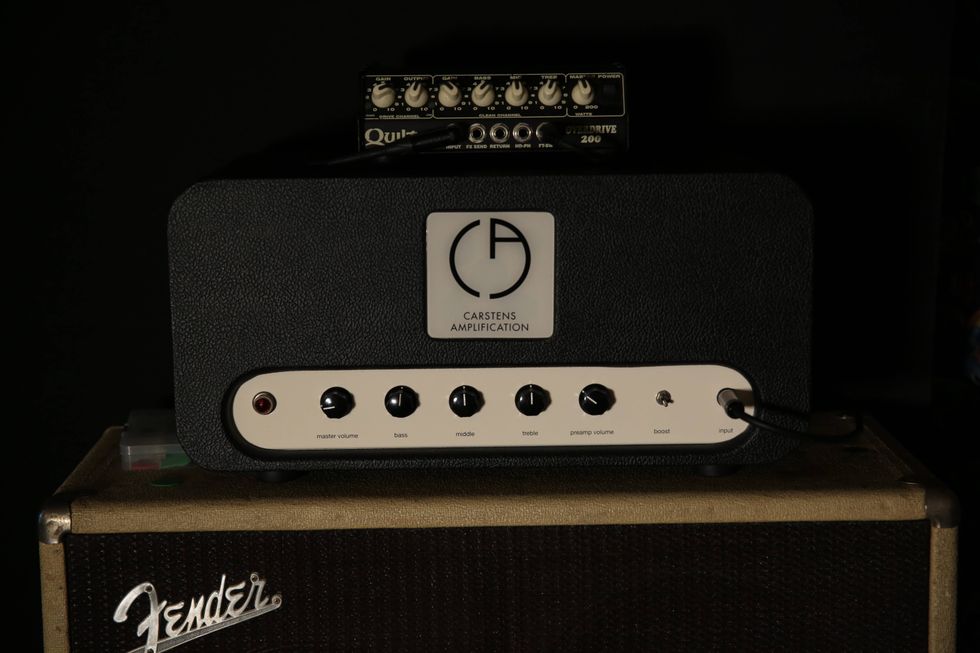
While Brian Carsten was still an amp tech at CME, Joel bought this Carstens Amplification Warm Machine off of him—the first he ever made. It’s designed around a master-volume, 50-watt Marshall head circuit, with a bit more warmth. Joel has had this one for over two decades now, and runs it through a Fender Bassman 2x12 cab with Celestion Creamback speakers.
He’s also been experimenting with a Quilter Overdrive 200 for a lighter solution, which he runs through a Bergantino 2x12 cabinet—Joel calls the cab and Quilter combo a “game-changer.”
Joel Bauman’s Pedalboard
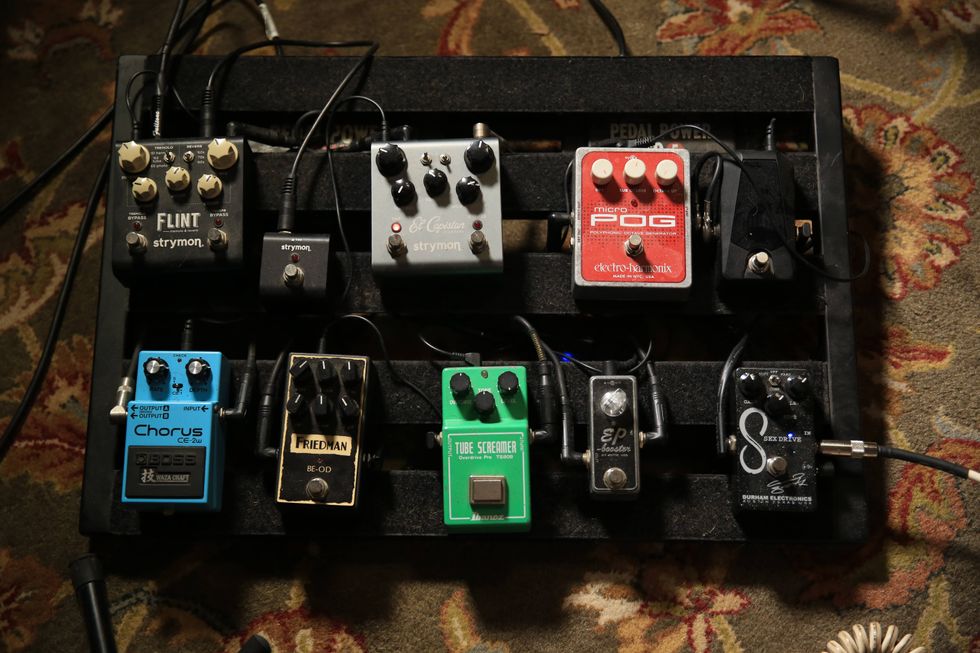
The jewel of Joel’s board is a 1981 Ibanez Tube Screamer, gifted to him by Josh Klinghoffer. There’s also a Durham Electronics Sex Drive, EHX Micro POG, Xotic EP Booster, Friedman BE-OD, Boss CE-2W, Strymon El Capistan, and Strymon Flint, plus a Korg Pitchblack Advance tuner.
Holesome
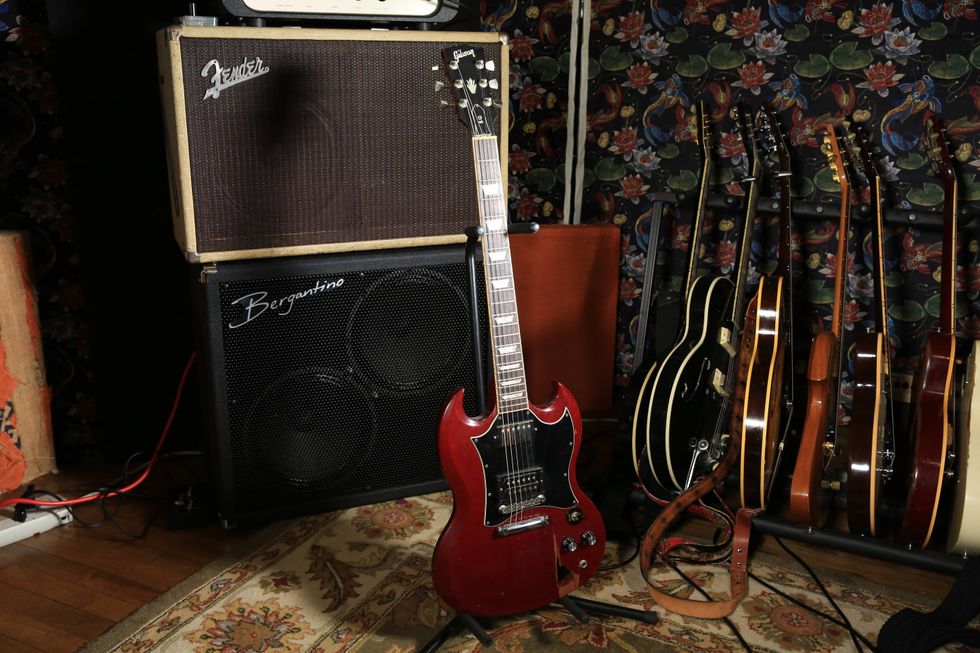
Zach Bauman isn’t bothered by the gaping hole in his 1990 Gibson SG; it gives the guitar a whole lot of character. This guitar has a Gibson T-Top Burstbucker in the bridge, and has been modded to have just two pots for master tone and volume. Zach strings it with .011–.052s.
Painted Paul
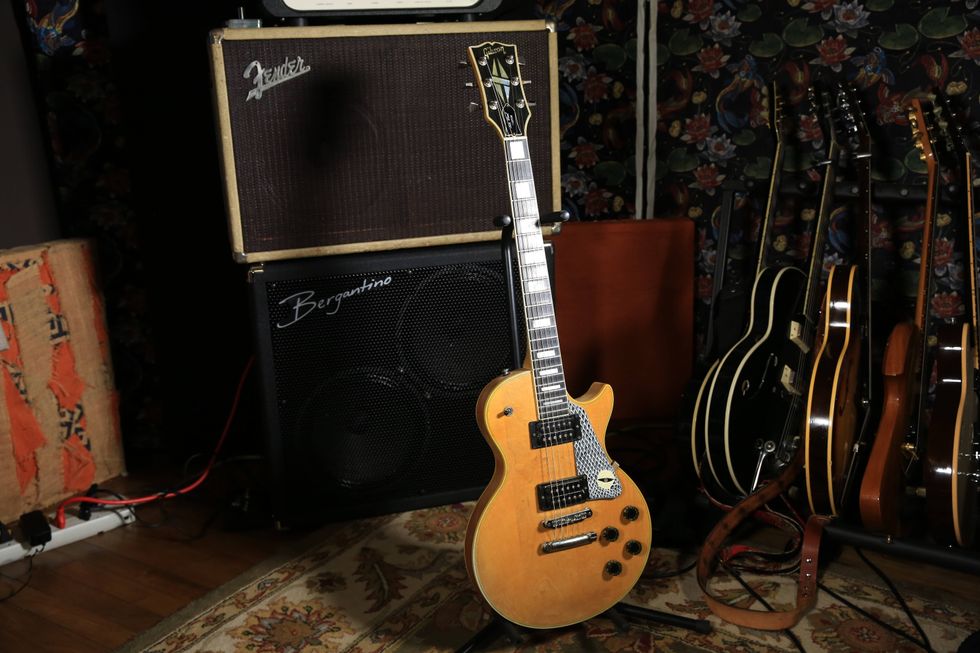
Zach snagged this 1979 Les Paul while working at CME, and scraped off a nasty previous paintjob with a card before getting to work making it his own. A friend painted the headstock, and another made him this custom pickguard. It’s also got T-Tops in the neck and bridge.
Mig Buff
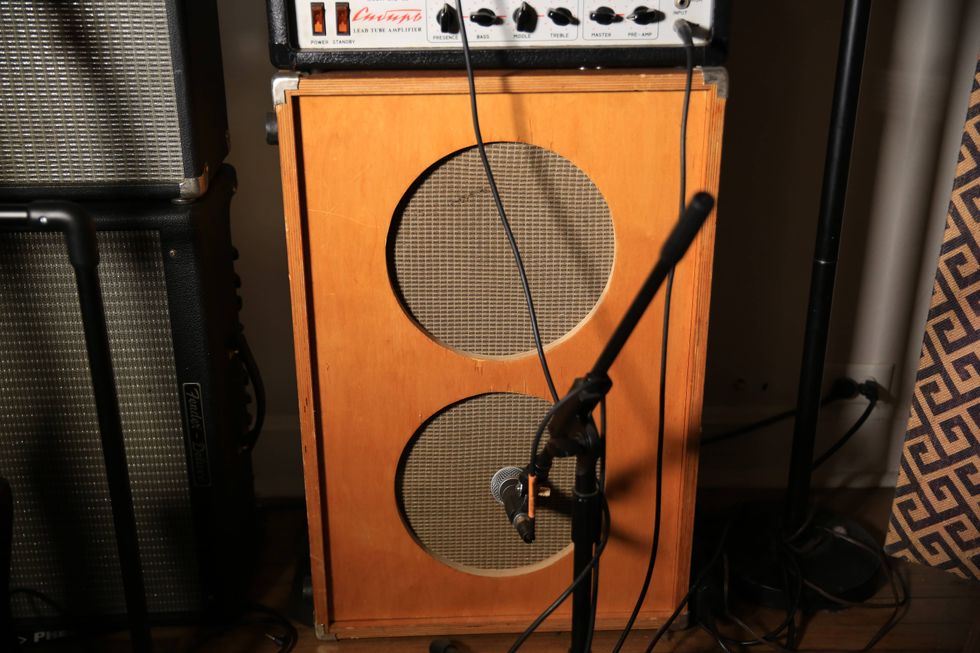
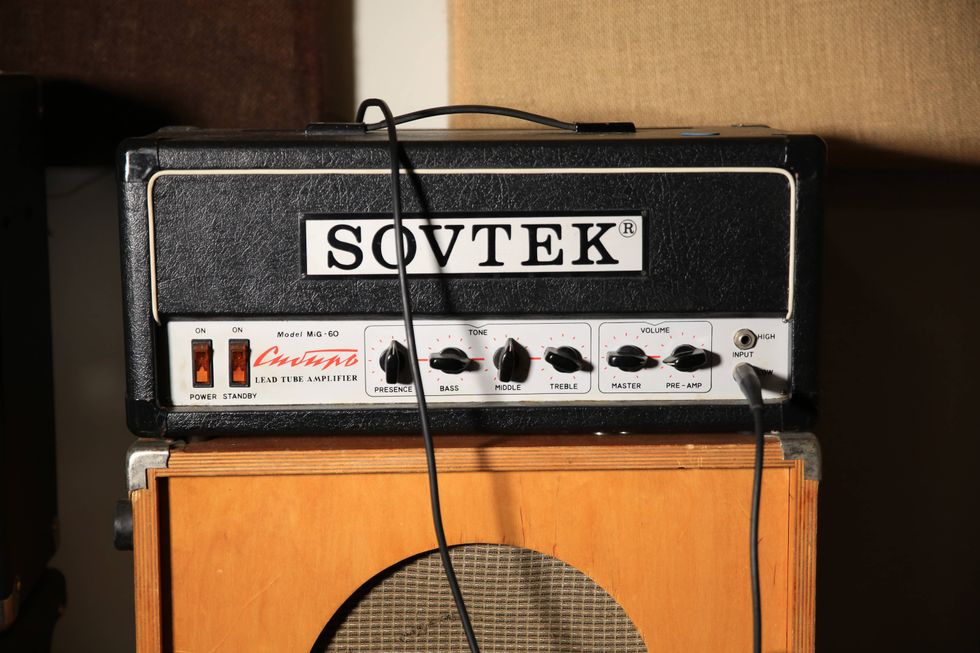 Zach loves his Sovtek Mig 60 head, which he plays through a cab he built himself at a pipe-organ shop in Denver. Every glue joint is lined with thin leather for maximum air tightness, and it’s stocked with Celestion G12M Greenback speakers.
Zach Bauman’s Pedalboard
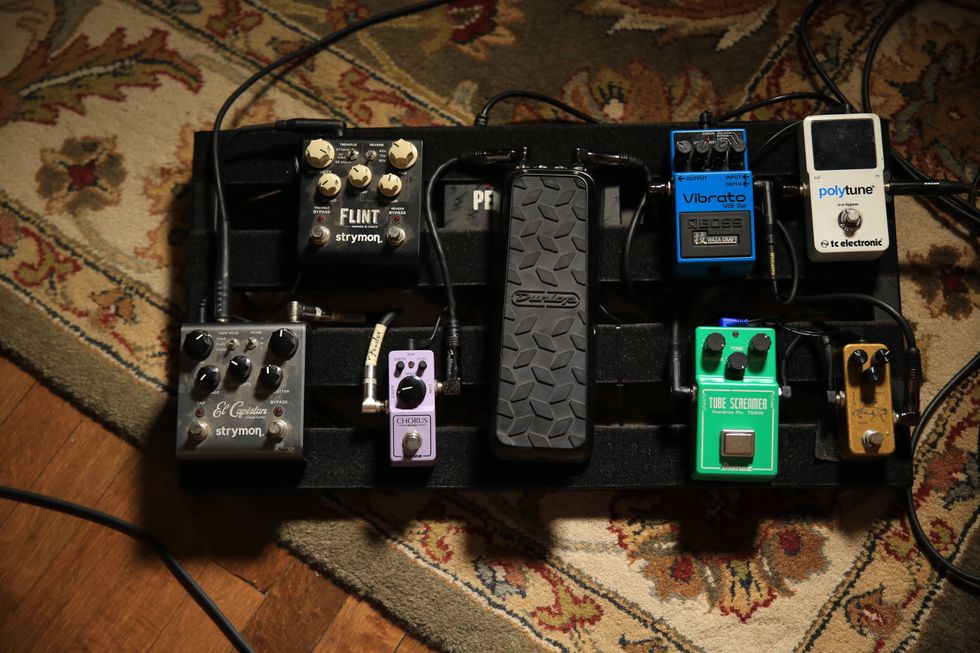
On Zach’s board, we find a Klon clone, Ibanez Tube Screamer, Boss VB-2W, Ibanez Mini Chorus, Strymon Flint, and Strymon El Capistan, along with a Dunlop Volume (X) pedal and a TC Electronic PolyTune.
Bergantino’s Best
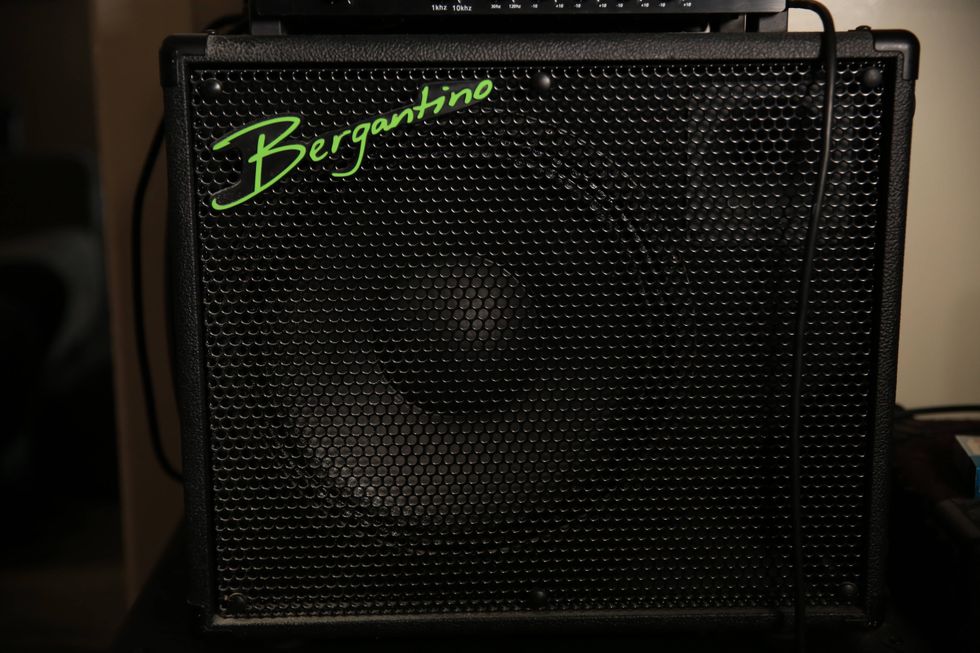
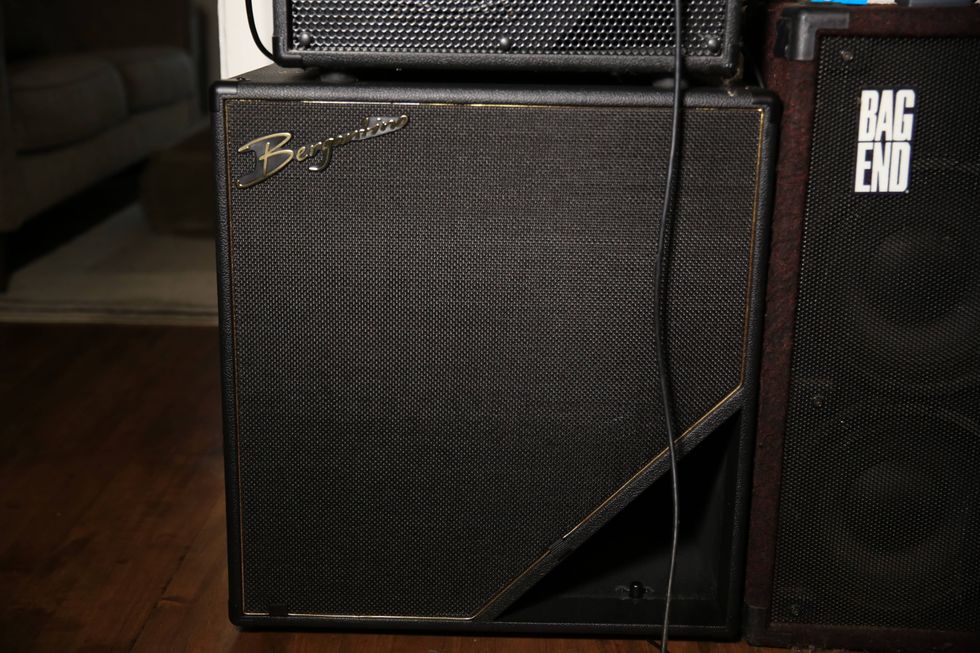
Najjar has deep love for Holly and Jim Bergantino and their Bergantino Audio Systems products. He plays with both a Forte and Forte HP Ultra—a 2000-watt prototype—through a Bergantino HDN112 cab and special 3x10 cab.
Bass for Babies
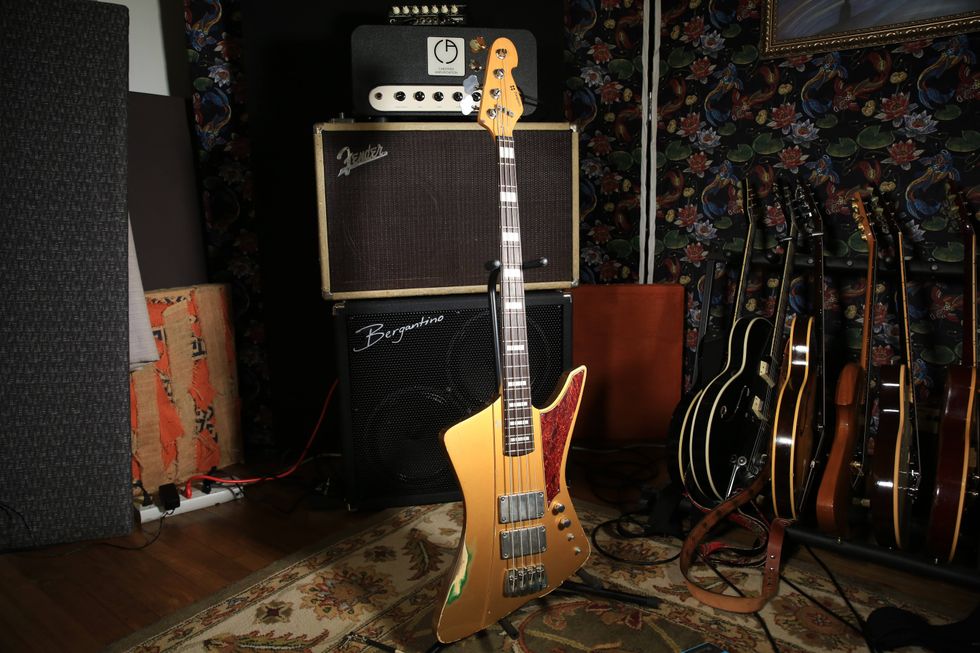
Najjar’s Sandberg Forty Eight finished in shoreline gold, nicknamed the “golden baby,” was the first of its kind.
Going to California
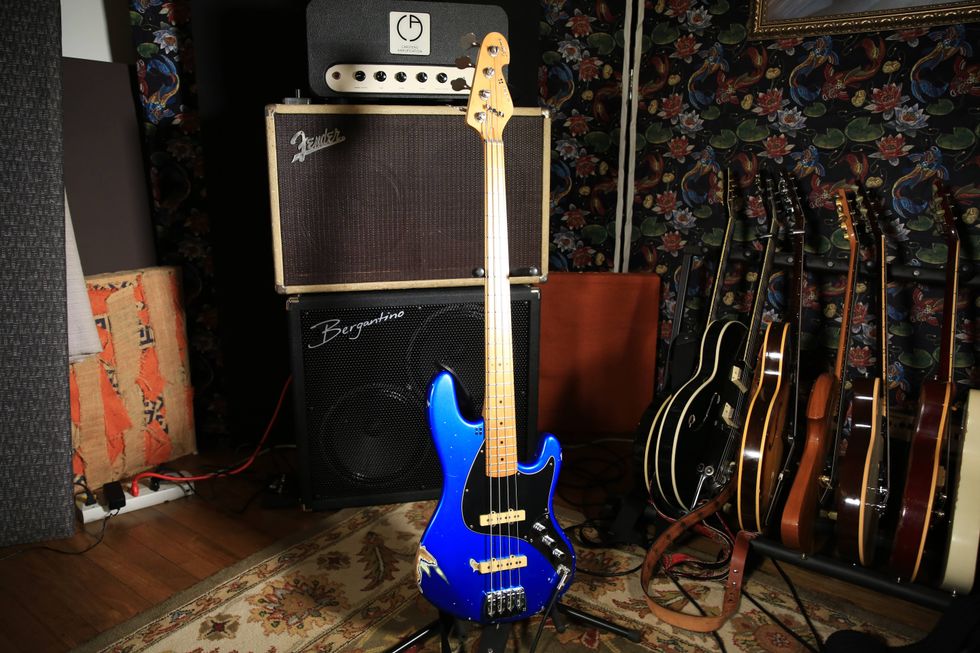
This Sandberg California TT4 has ’70s-style J-bass pickups and a 34” scale. Najjar gets a “Geddy Lee-style” vibe from it.
Marc Najjar’s Pedalboard
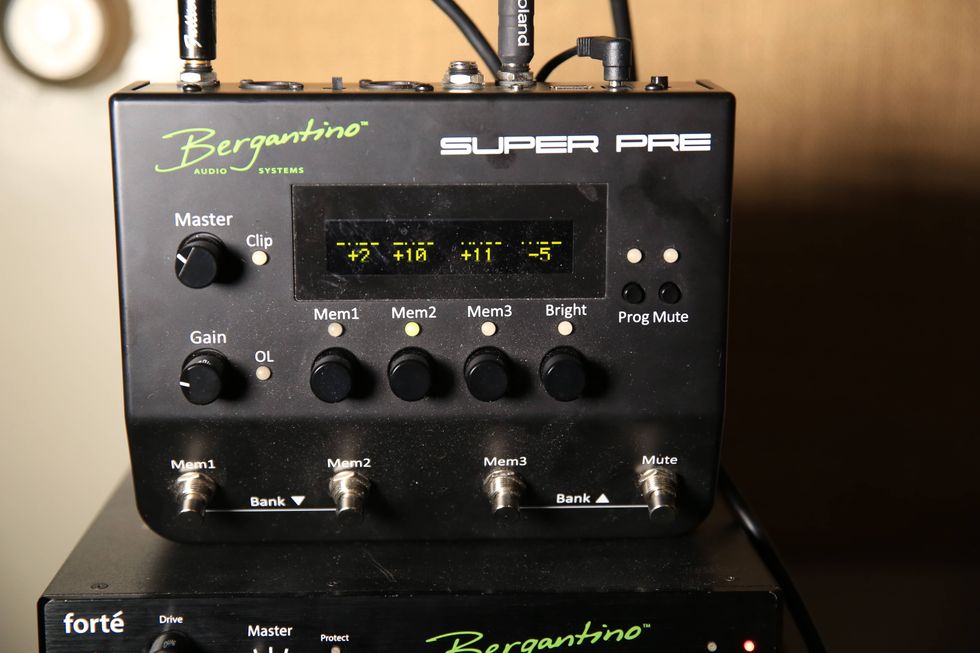
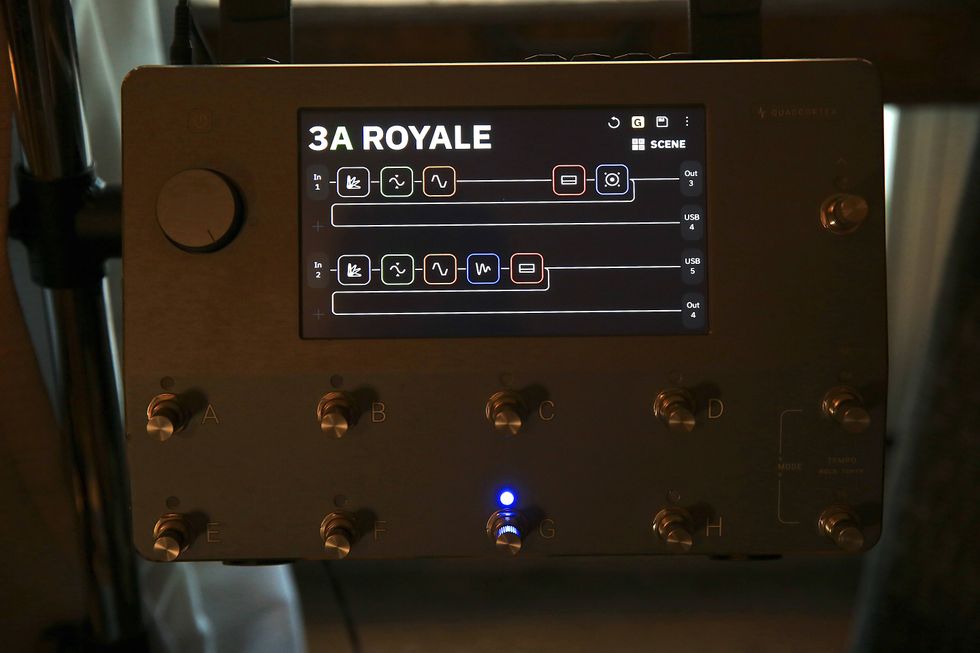
Najjar’s tone temple is topped off with a Bergantino Super Pre brass preamp into his Neural Quad Cortex.
Xotic EP Booster Mini Boost Pedal
Dunlop & Jerry Cantrell Launch Special Edition I Want Blood Cry Baby Wah
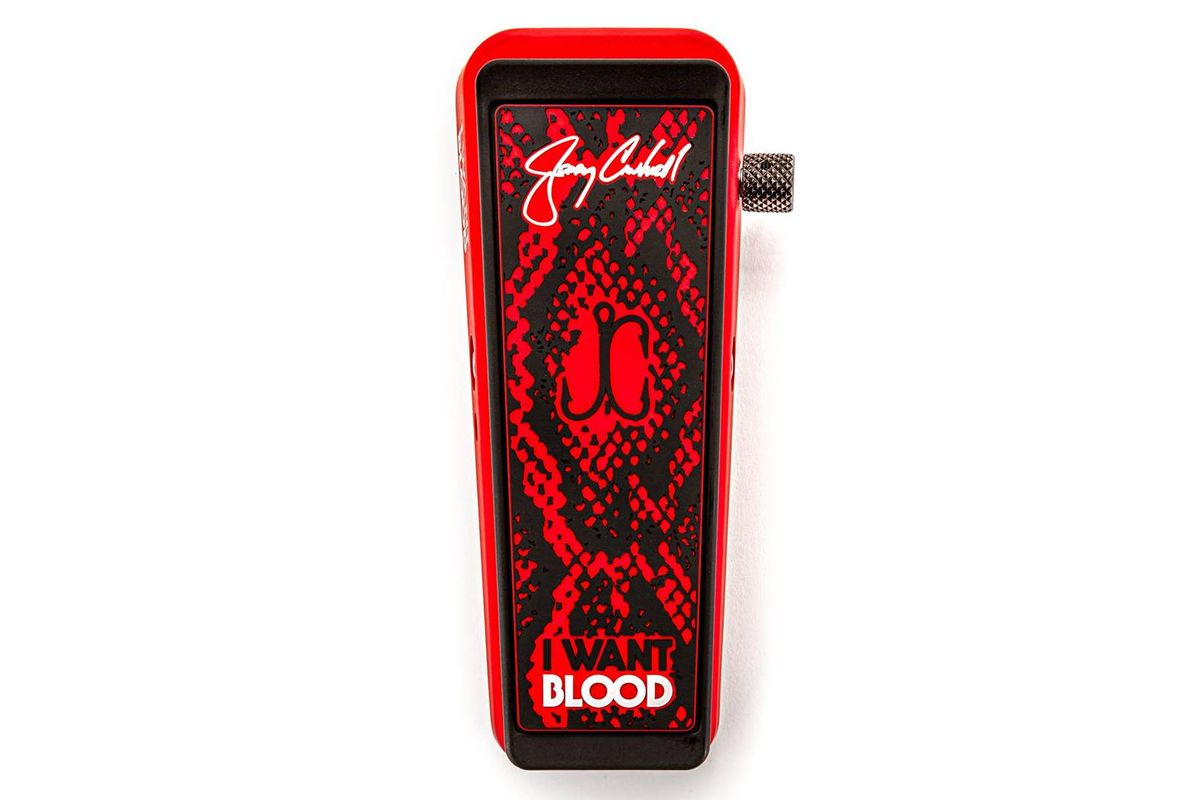
This special edition of the Jerry Cantrell Cry Baby Wah channels the raw intensity of the prolific artist’s latest solo record, I Want Blood. Finished in bold black and red, it features a killer custom-molded tread inspired by the album’s striking cover art, and its bottom plate features the no-holds-barred title track’s full lyrics.
Sonically, the Jerry Cantrell I Want Blood Cry Baby captures his fierce sound with a tight, punchy heel-down tone and a rugged side-control knob for fine-tuning the toe-down frequency. Go for blood, and get yours now.
Get the full story here:
https://www.jimdunlop.com/jerry-cantrell-i-want-blood-cry-baby-wah/
Jerry Cantrell I Want Blood Cry Baby Wah highlights:
- Special edition makeover inspired by Jerry Cantrell’s solo record, I Want Blood
- Bold black-and-red finish with custom-molded tread inspired by the album’s striking cover art
- Bottom plate features full "I Want Blood" track lyrics
- Custom-voiced for a tight, punchy heel-down tone
- Rugged side-control knob for fine-tuning the toe-down frequency
- Perfect for nailing Jerry’s famous wah tone
Availability
The Jerry Cantrell I Want Blood Cry Baby Wah is available now at $249.99 street/$357.13 MSRP from your favorite retailer.
Tracing the History of Guitar Tab, From Seeger to Steve Vai
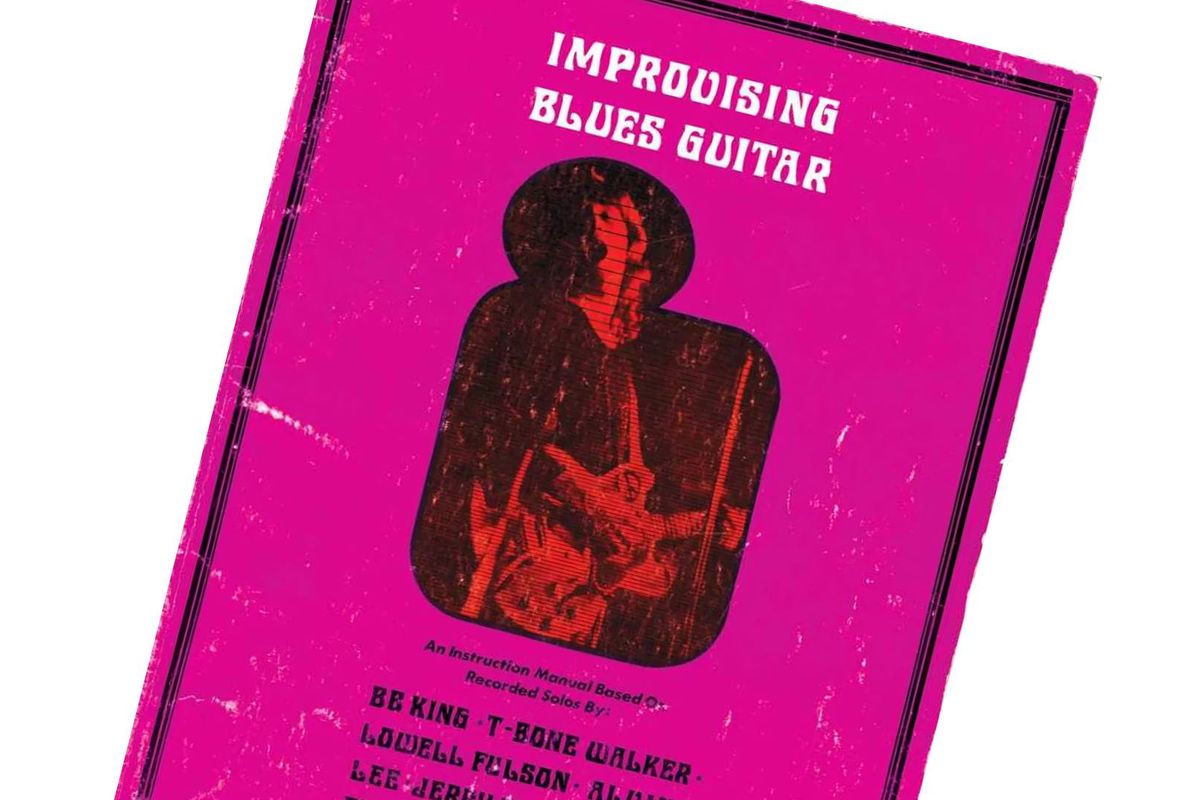
Back in October of 1971, I bought my first guitar. It was the day after I had attended a concert by Captain Beefheart and the Magic Band. Elliot Ingber (aka Winged Eel Fingerling) had improvised a life-changing (for me) guitar solo at that show, which sent me to a guitar store to purchase a black Fender Telecaster. While there, I saw a book on the counter next to the cash register: Improvising Blues Guitar, by the staff of Green Note Publications. It contained tab transcriptions of electric solos by many of my favorite guitarists at the time: B.B. King, Jerry Garcia, Jimi Hendrix, Albert King, etc. I took the book and guitar back to my college dorm room.
The first thing I did was put a slide on my left hand and play along, making uneducated and non-technical sounds, with several albums that were favorites of mine. Those albums were from artists including the Grateful Dead, Captain Beefheart, Derek Bailey, and Sonny Sharrock, as well as a 1964 album of valiha music from Madagascar. Over the decades that followed, I came to meet and play and record with all of the artists that I played
along with that day. When David Lindley and I traveled to Madagascar in 1991 to record our A World Out of Time albums, we recorded with Sylvestre Randafison, my favorite of the valiha players on that 1964 album. How could this possibly have happened? I believe that I have guitar tablature to thank!
Like many self-taught guitarists today, tab was my primary mode of instruction for learning how to get around the fretboard. Tab was the way that I mastered the guitar solos of my guitar heroes—and, more importantly, their musical concepts and ways of expressing their ideas and feelings. In 2025, I’ve thought back about this, wondering how long tab has been in existence, and how it became a dominant feature of guitar instruction.
After a bit of online research, I decided to speak with many of the musical educators and artists who, 50–60 years ago, were involved with the published beginnings of tab in the U.S. Long before that, though, tablature likely originated with the Chinese guqin more than 1,500 years ago. Written guqin music did not directly tell what notes were played. Instead, it was written in a
tablature detailing tuning, finger positions, and picking techniques, comprising a step-by-step method and description of how to play a piece—just like the Improvising Blues Guitar book I purchased with my first guitar. Although that book did have conventional Western music notation printed above the tab.
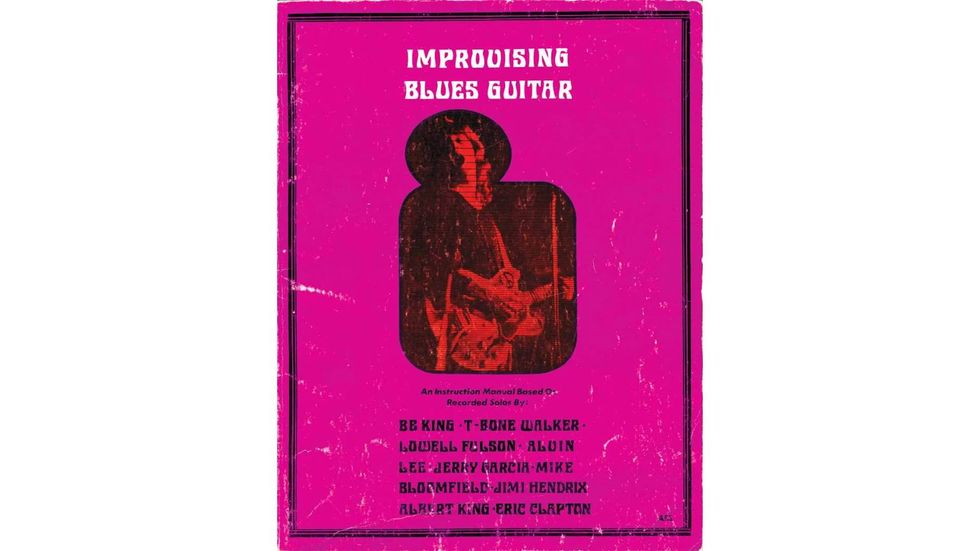
“Like many self-taught guitarists today, tab was my primary mode of instruction for learning my way around the fretboard.”
As far back as the 15th century, Europeans had created lute tablature that closely resembled modern guitar tab. Yet it wasn’t until the 20th century that the system made its way to the guitar. The first appearance of published tab in America was in Pete Seeger’s 1948 book, How to Play the 5-String Banjo, in which he seemed to reinvent tab methodology. Tab then jumped to guitar in Pete Seeger’s The Folksinger’s Guitar Guide, in 1955. These books inspired guitar teachers to begin creating their own tab. The earliest example I’ve found on the West Coast is Jerry Garcia, who in 1964 was teaching at Dana Morgan Music in Palo Alto and drawing on the Seeger banjo book for his tab approach. On the East Coast, around the same time, Stefan Grossman was creating his own tab transcriptions of country blues 78s and tunes that he personally learned from Reverend Gary Davis. Stefan’s early books from Oak Publications are likely the first post-Seeger published guitar tab.
The first electric guitar tab likely showed up in a few Green Note Publications books, like that 1970 one I bought with my first guitar. Rather than notating simple melodies, they decoded the
intricacies of famous blues and rock players’ techniques. Tab eventually began to illustrate ornamentation and string-bending. Soon, it was appearing in guitar magazines and hundreds of books. Instructional audio and video tapes quickly followed. And thus, tab became an expected necessity of guitar education in America.
Tab has had its celebrators and its enemies. I’ll note that Stefan Grossman originally did not want Oak Publications to print misleading western music notation with his tab, as he felt that the rhythmically divisional form of notation could not represent the actual rhythms of Afro-American country blues artists. To Grossman, you had to hear the music along with the tab to understand that. As for me, I finally felt that I was a real guitarist when Steve Vai transcribed my solo on the Golden Palaminos’ Omaha in DownBeat magazine. Thank you, tab!
Gibson To Unveil The Limited-Edition Kirk Hammett Raven

One of the most iconic rock guitarists of our generation, Kirk Hammett—legendary guitarist of the multi-platinum-selling, nine-time GRAMMY® Award-winning band Metallica—continues his long-standing partnership with Gibson. Today, the iconic instrument brand proudly unveils its latest collaboration: a bold new acoustic from Gibson Custom. Kirk Hammett teamed up with the master luthiers at Gibson Custom in Bozeman, Montana, to create the Gibson Custom Kirk Hammett Raven, a majestic counterpart to the legendary Gibson Hummingbird™. The Kirk Hammett Raven is limited to only 100 guitars worldwide—and available at authorized Gibson dealers, Gibson Garage locations, and on www.gibson.com.
While it shares the Hummingbird’s square-shoulder silhouette, Kirk Hammett’s Raven distinguishes itself with a dark, artistic twist on the Hummingbird aesthetic. Crafted with a Sitka spruce top and mahogany back and sides, and supported by traditional scalloped Advanced X-bracing, it delivers the timeless acoustic tone that has captivated musicians and audiences for generations. Its mahogany neck features a comfortable Round profile and is topped with a bound ebony fretboard, complete with 20 frets and mother-of-pearl star inlays. A 16" radius makes it ideal for fast, expressive playing. Grover® Rotomatic® tuners ensure reliable tuning, while TUSQ® components—including the nut, saddle, and bridge pins—enhance tonal consistency and tuning stability. The headstock showcases the Gibson logo alongside a striking mother-of-pearl raven skull inlay, reinforcing the instrument’s bold identity.
Explore the Kirk Hammett Raven on Gibson.com HERE.
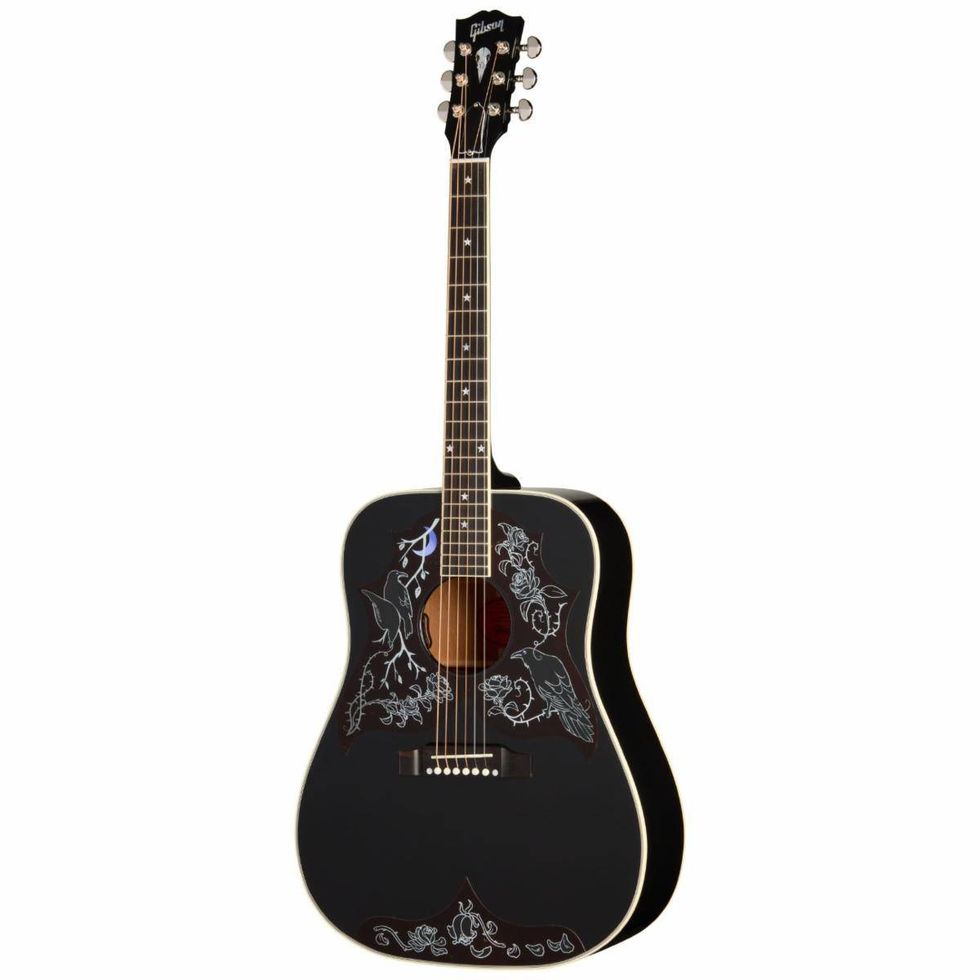
This limited-edition model also pays homage to Gibson’s tradition of wildlife-inspired designs, featuring intricately crafted double pickguards and a raven-themed tailpiece accent. It’s a visual and sonic statement piece. Equipped with an L.R. Baggs™ Element VTC +4 system, the Raven is ready for both stage and studio. The discreet soundhole-mounted volume and tone controls offer easy access without disrupting the guitar’s aesthetics, and the additional 4 dB of output provides extra headroom when needed. Each Raven ships in a black Gibson Custom hardshell guitar case adorned with a matching raven skull graphic and includes a certificate of authenticity and a custom raven-themed strap. Limited to only 100 guitars, each handcrafted in Bozeman, Montana, and personally signed by Kirk Hammett on the soundhole label, this Ebony-finished acoustic is destined to become a collector’s treasure. Availability is extremely limited—secure yours before they vanish into the night.
One of the most influential metal guitarists of all time, Kirk Hammett is the lead guitarist and contributing songwriter in the trailblazing band Metallica. Kirk grew up in California and formed the group Exodus during the birth of the Bay Area thrash metal movement. In 1983, he began his now 40-year career as the lead guitarist in Metallica, selling over 125 million albums and winning multiple GRAMMY® Awards. Kirk’s first Gibson was the legendary 1979 Flying V he used on Metallica’s groundbreaking early studio albums. These days, his number one guitar is “Greeny,” the 1959 Les Paul Standard formerly owned by Peter Green and Gary Moore. Both instruments have been painstakingly recreated by Gibson for a range of tribute models.
Positive Grid Expands the Spark NEO family with Spark NEO Core

New wired smart guitar headphones offer immersive audio and built-in amp for listening or guitar/bass practice and play
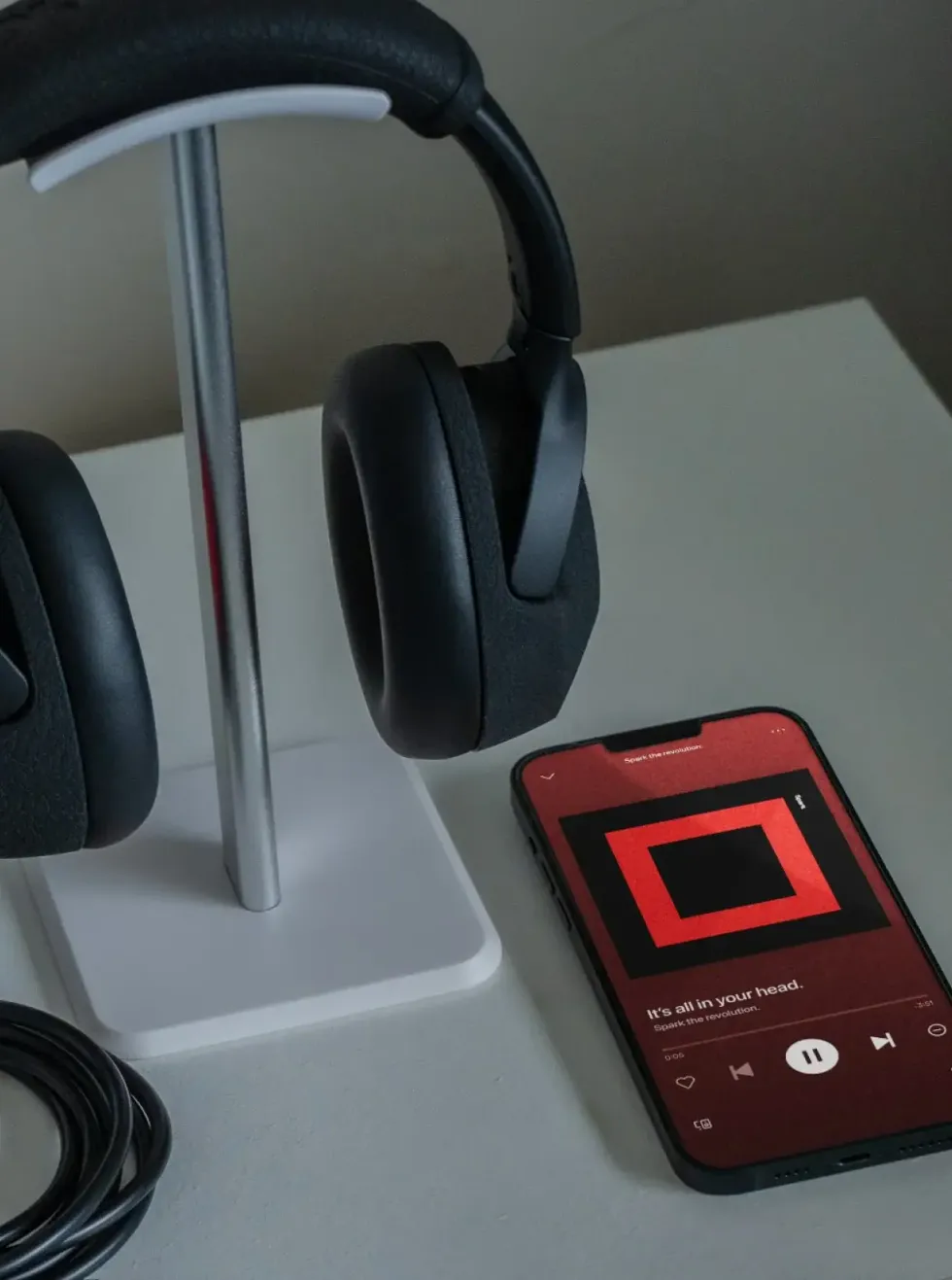
Positive Grid announces Spark NEO Core, the newest member of the Spark NEO family of smart guitar headphones. These wired headphones integrate a Spark guitar amp in a lightweight, ergonomic design that offers plug-in simplicity for electric, acoustic and bass players. Users can also enjoy onboard guitar tone presets, access to dozens of amps and effects, plus AI-powered tone generation.
Just like the original wireless Spark NEO, the new Spark NEO Core doubles as premium Bluetooth headphones that deliver rich, detailed sound for listening to music or streaming podcasts. Designed for total immersion without distraction, Spark NEO Core makes it possible to experience premium tone anywhere––from late-night guitar jamming to quiet home practice and audio streaming.Clear, Immersive Sound
Spark NEO Core shares the same premium audio engineering found in the original Spark NEO, delivering high quality sound with crisp highs, tight lows, and balanced mids.
The custom 40mm drivers are tuned for guitar and bass frequencies, so every note resonates with rich, detailed, sound—from clean melodic passages to high-gain riffs. An Advanced Bio Fiber (ABF) diaphragm enhances sound clarity and durability, ensuring consistent performance across every genre of music or instrument type.
Endless Tone Options
Spark NEO Core connects seamlessly with the Spark app, unlocking access to 33 amps, 43 effects, and thousands of community-shared presets through Positive Grid’s online ToneCloud. Additional creative tools such as backing tracks and Auto Chords enable users to learn, experiment, and expand their musical ideas effortlessly.
Guitarists can also use the app’s Spark AI feature to instantly create or discover tones by describing their desired sound. Whether chasing classic warmth, modern drive, or shimmering acoustic textures, Spark AI intelligently delivers amp and effect combinations tailored to the player’s style and needs.
Designed for Comfort and Ease
Built for extended wear, Spark NEO Core features soft, ergonomic ear cups and a lightweight construction that minimizes fatigue. The noise-isolating design enhances focus, allowing users to stay immersed in their sound without external interference.
Players can quickly connect using a standard ¼” guitar cable*, for immediate performance and authentic Spark tone. Onboard controls allow fast access to four customizable preset tones and quick volume adjustments.
Long-lasting BatteryPower
With up to 6–8 hours of battery life and USB-C charging, Spark NEO Core supports everything from brief warm-ups to long creative sessions or podcast streaming.
Spark NEO Core comes in a classic black finish and is available for USD $159 through Positive Grid’s online store. It’s also available through Amazon and authorized music dealers worldwide.
For more information about Spark NEO Core, visit positivegrid.com/pages/spark-neo-core.
To see the entire Spark NEO family, visit positivegrid.com/pages/spark-neo-series.
A 100-Plus-Year-Old Mystery Banjo Travels from Alaska to Nashville

What would one be most likely to discover in the basement of an old house in rural Alaska, deemed unfit for occupancy by local authorities? Smoked fish? A dog sled? A rare, possibly one-of-a-kind, turn-of-the-century banjo?
That’s exactly where this 1911 Vega Tubaphone tenor banjo was before it arrived at Fanny’s House of Music. It came by way of a local Alaskan musician who was helping move things out of the condemned house and found this instrument—over a century old, but looking as if it had left the factory earlier that week.
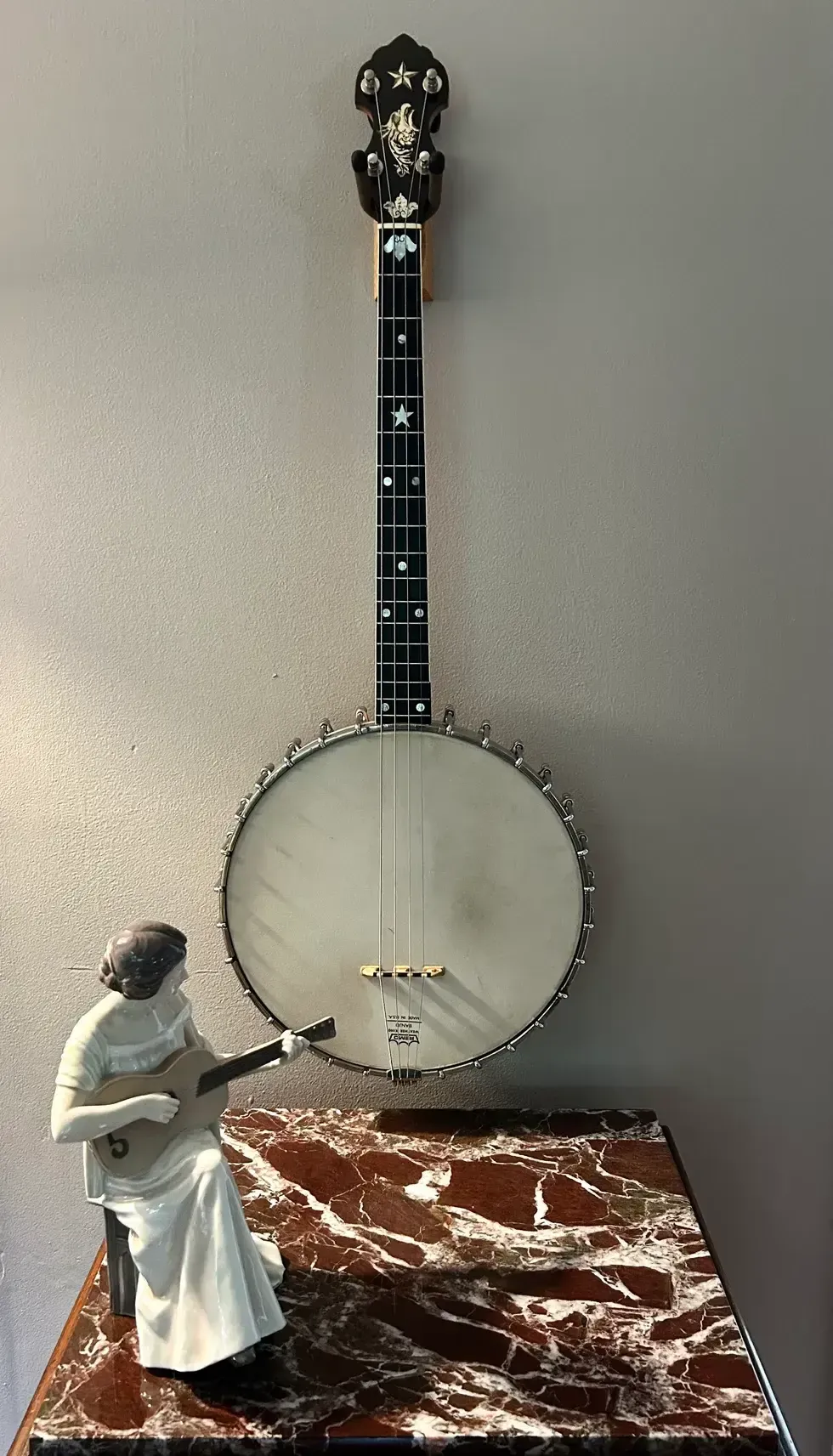
The rabbit holes of vintage banjo identification are myriad. It’s a Vega because of the stamp on the dowel rod, but why does it also say “Fairbanks Banjo made by Vega?” The serial number dates it to 1911, and of the banjo models Vega produced at that time—the Regent, the Imperial Electric, the Whyte Laydie, and the Tubaphone—this one is clearly a Tubaphone. Except Tubaphones never had an elaborate gryphon peghead inlay, so how can it be a Tubaphone? When did Vega switch from a grooved stretcher band to a notched one? And what the heck is a stretcher band, again?
That’s when it’s time to bring in the big guns.
Enter Karl Smakula, friend of Fanny’s and third-generation banjo expert. His grandfather Peter H. Smakula heard Pete Seeger in the 1950s and immediately bought himself a Kay banjo. He began repairing instruments and building banjos, eventually opening his own music store, where his son Bob also worked. Bob went on to open Smakula Fretted Instruments in 1989, where his son Karl also worked. Suffice it to say, if it’s a banjo, Karl and his family probably know about it.
“I would have never said the gryphon inlay was used on a Tubaphone until I saw this one,” says Karl. “My dad, who has seen everything, has never seen this.”
In the early 1900s, Vega was focused on guitars, mandolins, and brass instruments, but they were aware of the growing popularity of the banjo. The A.C. Fairbanks Banjo Company, a widely respected banjo maker, suffered a devastating fire in 1904 and made for a timely acquisition by Vega. (“After which Fairbanks made a hard pivot to bicycle parts,” reveals Karl.)
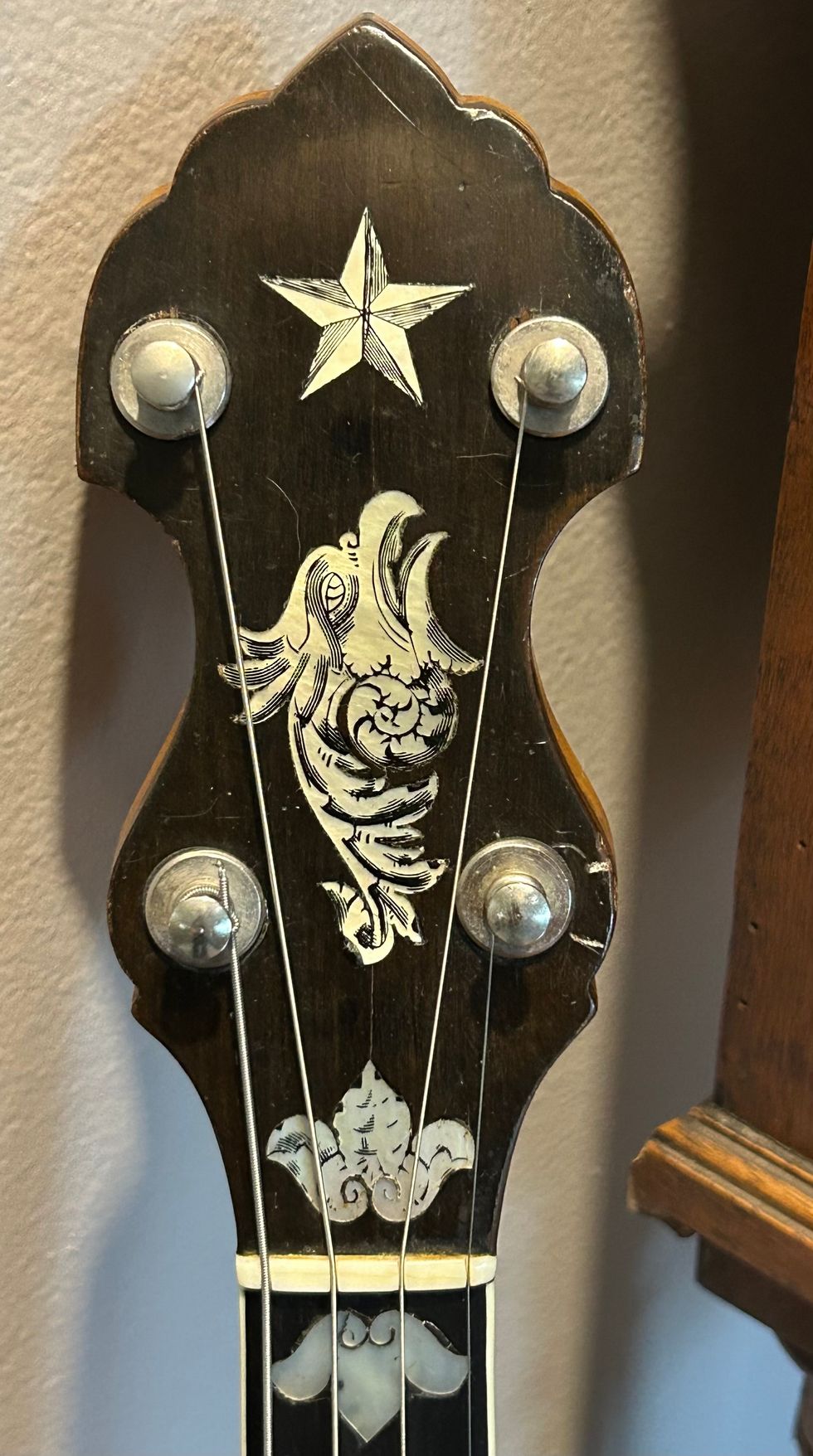
Vega kept making the Fairbanks Whyte Laydie model, retaining the intricate gryphon peghead inlay and scalloped tone ring. In 1909, they introduced a new model called the Tubaphone, with a leafy “flowerpot” inlay and a brand new tone ring design featuring a sequence of holes drilled into the side. Where the Whyte Laydie sounded sweet and refined, the Tubaphone was louder and more aggressive. It quickly made a splash among banjo players, as this customer letter from the 1912 Vega catalog shows: “I have tried them all but from now on it will be a TU-BA-PHONE and nothing else for me. Refer any inquiries you like to me ... and I will show them what a real banjo is.” Banjo players have always been an opinionated bunch!
Tubaphones are still highly valued among old-time musicians today, although it is important to note they were intended for what’s called “classic” banjo playing when first produced. Derived from classical guitar playing, it uses bare fingers and gut strings. While this style is little practiced these days, it doesn’t take a big intellectual leap to see how classic banjo combined with African banjo playing, jazz, and two-finger style to form the bluegrass “Scruggs” style we’re familiar with today.
“This old gal made it from rural Alaska to Nashville, nearly stumping two generations of banjo experts.”
“This banjo’s had a life, that’s for sure,” says Karl with a laugh. Karl noted the dowel stick at the end of the neck matches the rim, indicating the neck and gryphon inlay are, improbably, original to this Vega Tubaphone. “It shows they were figuring out what they were doing.”
This old gal made it from rural Alaska to Nashville, nearly stumping two generations of banjo experts. It’s in superb condition, and everyone who takes it for a spin at Fanny’s agrees with the 1912 Vega catalog, which proclaims, “There is Tone Value to the Vega with which every player should become acquainted. To know and realize that Vega Construction is the easiest way to advancement means that your future Musical Prosperity is assured.” It’s safe to predict the Tubaphone will be assuring musical prosperity for another 114 years at least.
SOURCES:
Banjo Studio, Vega 1912 banjo catalog, Fanny’s House of Music, Smakula Fretted Instruments, Banjo News, Vintage Instruments, Mugwumps, Vega Style M webpage, Bill Evans YouTube channel.
Stompboxtober 2025: SoloDallas

Today’s featured giveaway: the SoloDallas Orbiter Fuzz. Vintage‑inspired (by the 1966 Arbiter Fuzz Face) yet modernized with a unique bias circuit, “Sweet Spot” internal adjustment, and rugged road‑ready build.
Stompboxtober 2025 - Win Pedals All Month Long!
SoloDallas Orbiter Fuzz
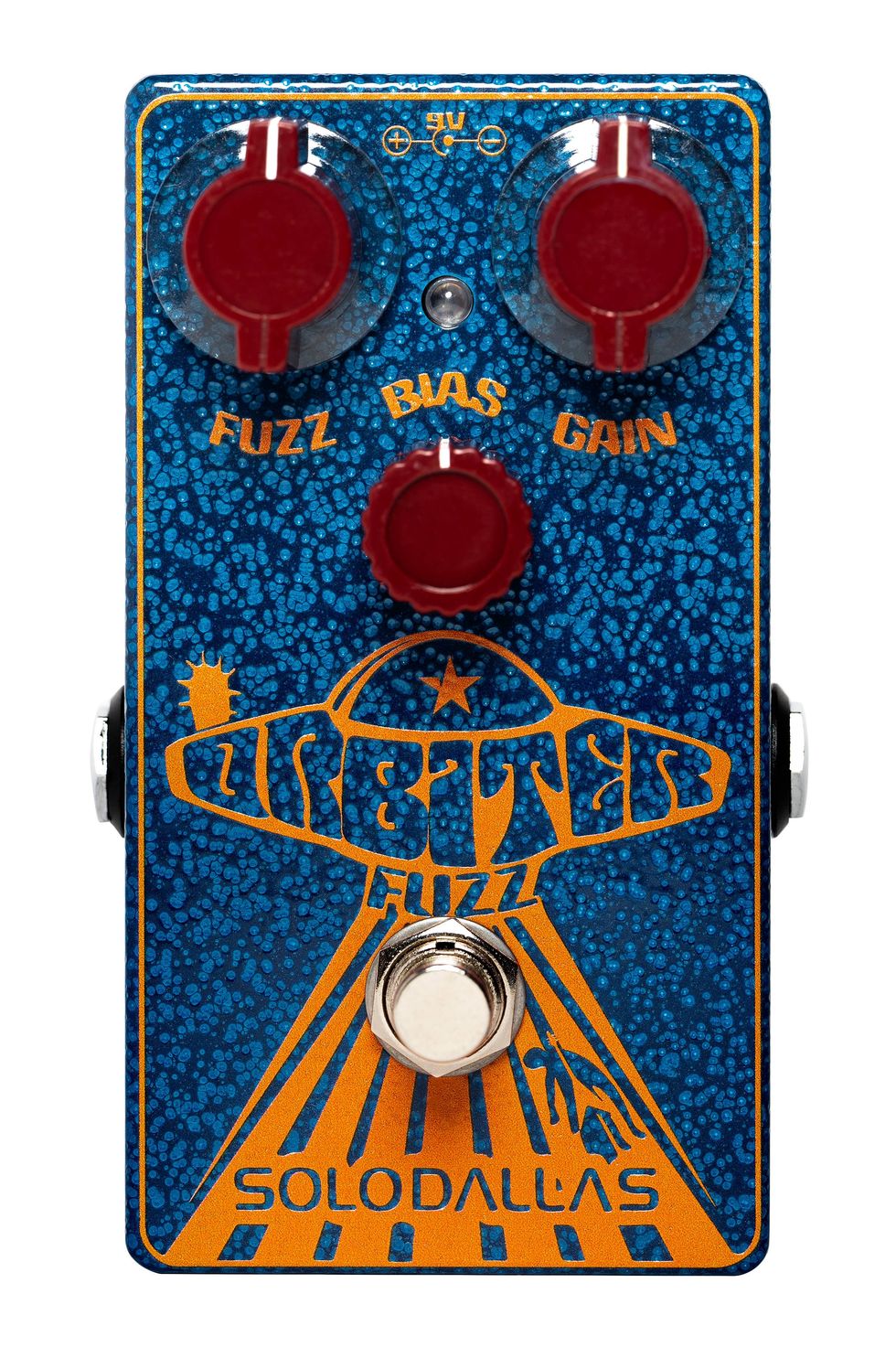
Discover the SoloDallas Orbiter Fuzz, a meticulously crafted effects pedal designed to combine genuine vintage tones with user-friendly versatility. Building upon the legacy of the 1966 Arbiter Fuzz, the Orbiter Fuzz adds fine-tuning circuitry to this already amazing vintage circuit.
- Vintage Tone: The Orbiter Fuzz promises immediate inspiration with a range of smooth musical fuzz tones that sing out with cutting sustain.
- Vintage Power: Our unique power circuit internally converts modern wall power to emulate the draw of a vintage carbon zinc battery.
- "Sweet Spot" Dial: We included an internal mini potentiometer to dial in the perfect impedance response for your favorite pickups.
Vox AC15 Hand-Wired Review
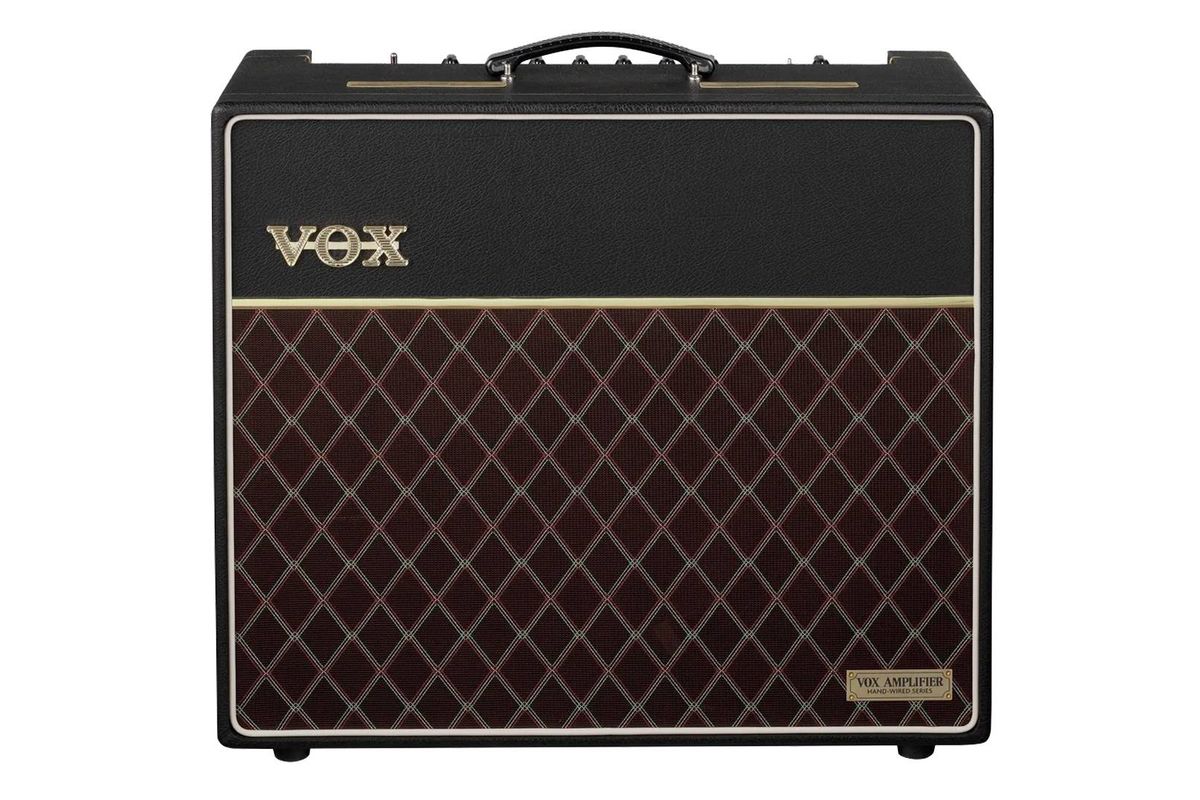
Since it was first introduced in 1958, Vox has released myriad iterations of the AC15 combo—built variously in England and Asia, and offered in both hand-wired and PCB formats. The new AC15 Hand-Wired suggests a strictly old-school ethos, but several of its features—most notably a move from EF86 to 12AX7 preamp tubes—are deviations from vintage form. That does result in a different feel in some situations; at times it sounds and feels more like a half-power, 1x12 AC30 than a vintage AC15. But this iteration is arguably more flexible than its predecessor, too.
Channel Crossing
Given the microphonic tendencies of EF86 tubes, the switch to 12AX7s is an intriguing and practical move. Elsewhere among the tube complement, there’s a 12AT7 for the preamp and phase-inverter, two EL84s in the output stage for 15 watts RMS, and a GZ34 tube rectifier. It’s all housed in a classic Vox combo cab measuring 22 1/4"x23 1/4"x1 1/2".
The AC15 Hand-Wired’s normal channel has just a single knob for volume. But its voicing can be tweaked via a bright switch and the tone cut knob in the master section, and there’s also a boost switch to increase gain. The top boost channel features volume and dedicated treble and bass controls, but no boost or bright switch. Both channels have high and low inputs, and the latter can be handy for taming hot humbucker-equipped guitars.
The fine-tuning capabilities of the amp extend to the footswitchable, tube-driven, spring reverb circuit, which has a tone control in addition to its level, enabling you to fine-tune the frequency emphasis of the reverb itself. Send and return jacks for the effects loop—along with a bypass switch and a –10/+4 dB level switch for compatibility with both rack and pedal effects—are smartly positioned along the lower edge of the upper-back panel, rather than on the underside of the chassis. Dual speaker-outs have an impedance switch for 8- and 16-ohm operation. (The combo’s Vox-labeled Celestion Alnico Blue requires the latter.)
Vox was careful to reproduce the windings of a vintage AC15 output transformer circa 1963, which results in a heftier chunk of metal than you might expect in an amp this size. Vox makes up some of that weight by using slightly thinner plywood for the cabinet walls, which are just less than 1/2" in thickness—matching vintage specifications and, in Vox’s estimation, enhancing resonance and dimensionality. As with many AC15s past, the transformer and alnico speaker help push this new edition to 50 lbs, making for a surprisingly heavy combo of this size and output power. It might have been nice for Vox to slim things down. On the other hand, the amp might lose what turns out to be a strong, audible vintage spirit without those heavier design elements.
Chiming In
Paired with a Gibson ES-335 and a Fender Telecaster, the AC15 Hand-Wired plated up many impressive slices of vintage Vox tone, with plenty more versatility on top. With all knobs at noon and the boost and bright switches on the normal channel engaged, the two channels sound remarkably similar. There might be just a touch more grind and sparkle on the top boost side, but it’s close! At these levels, both channels still summon plenty of break up with a Telecaster. Switching to the ES-335’s humbuckers predictably kicks the overdrive up a notch at the same settings.
The boost switch on the normal channel isn’t always a breeze to manage. It delivers a pretty big jump in gain and, with it, a slightly ragged edge at some settings. With both boost and bright switches down, though, the normal channel is rich, warm, and muscular, and makes an excellent, adaptable platform for gain pedals (in my case an Analogman Prince of Tone and a Wampler Tumnus Deluxe). Knock this normal channel volume up to around 2 o’clock and it segues into toothsome sounds that dip into clipping under heavier pick attack.
Arguably the most delectable tones are found in the top boost channel with all three knobs set to around 11 o’clock. Here, the AC15 Hand-Wired achieves its closest approximation of vintage Vox tone: chewy midrange, lots of chime and sparkle in the highs, and a dynamic edge-of-breakup touch sensitivity that you can control and vary via pick attack. Cranked up, the top boost channel roars with a throaty, shimmery vintage lead tone, although at the expense of the delectable dimension and clarity achieved at lower volumes.
The amp’s master volume, by the way, is very effective at tailoring the AC15 Hand-Wired for a range of room requirements, and is essential for smaller venues. This amp is loud when maxed—probably a lot louder than you’d expect from a 15-watt 1x12" combo—which is another classic characteristic of the AC15. It’s worth noting that things can get a little ratty with the master below 10 o’clock and either channel volume up high, but that’s par for the course with such circuits.
The Verdict
Vox’s new AC15 Hand-Wired combo does a good job of capturing much of the vintage-voiced spirit of the classic while offering many features that are must-haves for modern guitarists less burdened by complete vintage correctness. And if it’s not a point-perfect reproduction, it honors the sound and spirit of the original—and looks the part onstage, too.
Foo Fighters New Single "Asking for a Friend" Out Now
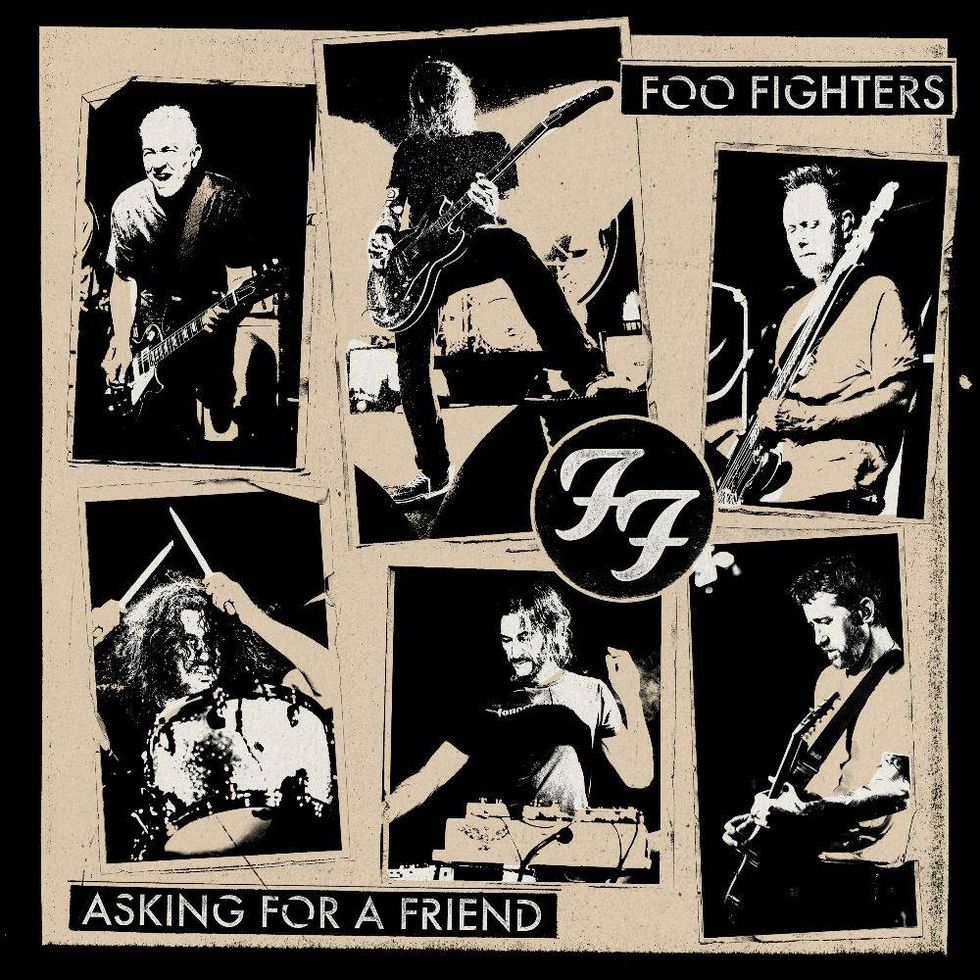
Time to start training for your local rock and roll marathon: Foo Fighters have confirmed their first stadium tour since the massive 2023-2024 Everything or Nothing at All run that sold out football and baseball fields the world over. Kicking off August 4 at Rogers Stadium in Toronto, the new tour will see Foo Fighters bringing the maximum volume euphoria of the band’s recent surprise US club gigs and overseas outdoor / arena spectaculars to a total of 12 North American cities, concluding (for now) September 26 at Las Vegas’ Allegiant Stadium.
Queens of the Stone Age will be direct support on all dates except September 12 in Fargo.
General on sale for all shows is Friday, October 31 at 10am local time. Don’t sleep on information re: tickets, pre-sales and more at foofighters.com
If that’s not enough good news for you, today sees the release of new Foo Fighters song “Asking for a Friend.” Featuring a decidedly darker melodic approach than the smash hit “Today’s Song,” “Asking for a Friend” ratchets up the energy and intensity of its predecessor in favor of hypnotic opening verses that build and explode into impassioned refrains of “What is real? I’m asking for a friend…” By the time the song's final breakneck rave-up screeches to a halt with a throat-shredding “Or is this the end?”, FF fans of all ages will find themselves joyfully bludgeoned into submission.
Dave Grohl wrote at length about inspiration for the new music and upcoming tour, in a post that read in part:
"Since our return to the stage in San Luis Obispo five weeks ago, we have been reminded of why we love and are forever devoted to doing this Foo Fighters thing. From reuniting as a band and staring at a list of 30 years worth of songs to brush off, to reimagining versions with the incredible blessing of the one and only Ilan Rubin behind the drums, to reconnecting with our amazing fans and blasting them with everything we’ve got (no matter the size of the venue) because we would not be here without them, we have the most solid core. And the sun is finally rising over the horizon.
What better way to share the view than with close friends?
In 1992 I first saw the legendary Kyuss perform at the Off Ramp in Seattle and met Mr. Josh Homme. The band were friends of a friend, and before long their album Blues for the Red Sun became the soundtrack to that summer. 33 years later and with many miles behind us, I have shared some of my life’s most rewarding musical moments with my dear friend, Josh. A lifelong bond that goes far beyond the sound we’ve made together. So it is with great happiness that we can share this next chapter together with his almighty Queens of the Stone Age.
Take cover.
But none of this would be complete without new music to share from Pat, Nate, Chris, Rami, Ilan and I. ‘Asking for a Friend’ is a song for those who have waited patiently in the cold, relying on hope and faith for their horizon to appear. Searching for ‘proof’ when hanging by a wish until the sun shines again.
One of many songs to come…”
To read the full statement, go to https://FooFighters.lnk.to/DG-TakeCover
Many more shows to come as well -- keep an eye out for impending announcements and sign up to the mailing list at: foofighters.com to stay inFFormed.
Foo Fighters are Dave Grohl, Nate Mendel, Pat Smear, Chris Shiflett, Rami Jaffee and Ilan Rubin.
FOO FIGHTERS
2026 Stadium Tour
August 4 — Toronto ON — Rogers Stadium
August 6 — Detroit MI — Ford Field
August 8 — Chicago IL — Soldier Field
August 10 — Cleveland OH — Huntington Bank Field
August 13 — Philadelphia PA — Lincoln Financial Field
August 15 — Nashville TN — Nissan Stadium
August 17 — Washington DC — Nationals Park
September 12 — Fargo ND — Fargodome
September 15 — Regina SK — Mosaic Stadium
September 17 — Edmonton AB — Commonwealth Stadium
September 20 — Vancouver BC — BC Place
September 26 — Las Vegas NV — Allegiant Stadium
Fans can sign up for Artist Presales now through Sunday, October 26 at 11:59pm PT.
If you are already on Foo Fighters Newsletter, sign up using the same email address at https://livemu.sc/foofighterslist for first access to tickets during the Newsletter Artist Presale. Tickets will be available beginning on Tuesday, October 28 at 10am local time
If you are not signed up to Foo Fighters Newsletter, sign up at https://livemu.sc/foofighters for access to the General Artist Presale. General Artist Presale begins on Wednesday, October 29 at 10am local time.
Introducing The JB Jr. for Tele
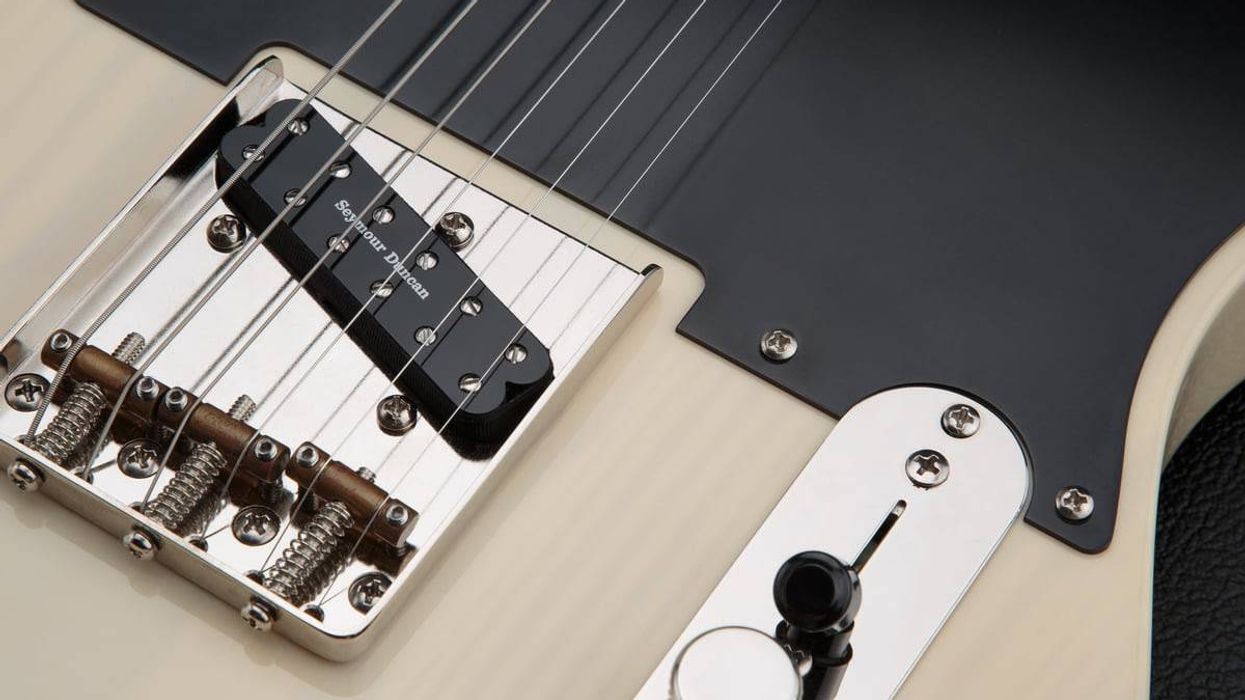
Seymour Duncan, a leading manufacturer of guitar and bass pickups, effects pedals, and pedal amps, is proud to announce The JB Jr. for Tele® is now available to order from seymourduncan.com and from authorized Seymour Duncan dealers.
The JB Jr. for Tele
The legendary JB tone, now reimagined for Telecasters. The JB Jr. for Tele brings high output, tonal versatility, and signature harmonic richness to your Tele bridge, all in a single-coil-sized humbucker design.
Seymour Duncan is proud to offer this special pickup set featuring:
- Design: Single-coil-sized side-by-side humbucker for Telecaster bridge position.
- Magnet Type: Ceramic.
- Output: High-output design for powerful and dynamic tones.
- Wiring: 4-conductor lead wire, enabling series, parallel, and split coil wiring options.
- Compatibility: Fits most standard Telecaster bridge single-coil routs.
- Construction: Hand-built in Santa Barbara, CA, and vacuum wax potted for squeal-free performance.
MAP pricing: $129.00
Looking for a way to inject your Telecaster® with the raw power and versatility of Seymour Duncan’s legendary JB humbucker? The JB Jr. for Tele® is here to deliver. Designed specifically for Telecaster bridge routs, this single-coil-sized humbucker captures the beloved punch, harmonic sparkle, and searing highs that made the original JB a classic.
For decades, the Seymour Duncan JB humbucker has been the go-to pickup for guitarists across countless genres. Its distinct sound has shaped iconic tracks and defined legendary performances. The JB Jr. for Tele continues this legacy, bringing that same tonal magic to the timeless simplicity of the Telecaster.
Whether you’re chasing the sounds of legendary players or crafting your unique voice, the JB Jr. for Tele captures the spirit and flexibility of the classic JB.
Turns Your Guitar Into a Cello (and More)!
It rhymes with cello for a reason—EHX’s new attack filter lends beautiful blooms to every note.
Electro-Harmonix is excited to introduce the Pico Swello Attack Envelope pedal. Inspired by the legendary POG2 ATTACK slider, the core effect of the Swello is a polyphonic attack filter which applies individual volume swells to each note you played, even within chords and through sustained arpeggios. This unique effect is paired with an adjustable Low Pass Filter for smooth swells and envelope filter-style effects.
Housed in EHX’s Pico-sized chassis, the Swello has a simple four knob/one button layout. VOL adjusts the overall output of the pedal while ATTACK sets the attack envelope time. Low ATTACK settings attenuate just the initial attack of your instrument, while higher settings offer epic, long note swells. The Low Pass Filter is controlled by the FILTER button as well as the FREQ and MOD knobs. FILTER engages the LPF and applies an adjustable high or low resonance setting. The FREQ knob sets the cutoff frequency of the LPF and the MOD knob controls the depth and direction of the filter modulation akin to an envelope filter. Turn MOD up from noon for an upward filter sweep or down from noon for a downward filter sweep.
The EHX Pico Swello comes equipped with a standard EHX 9 Volt power supply. It will be available Mid-September and features a U.S. Street Price of $149.50.
Adrian Belew’s Wildest Sounds | 100 Guitarists Podcast
Adrian Belew has spent his career on the cutting edge of guitar sounds, inventing the most forward-thinking tones to ever appear on record. His work as a solo artist and with King Crimson would be enough to land him on every guitarist’s radar. But that’s just one facet of his musical life, and he’s famously spent time with some of the biggest artists of all time: David Bowie, Frank Zappa, Talking Heads, Nine Inch Nails. He even appears in places you’d never expect experimental guitar, like Paul Simon’s “You Can Call Me Al.”
To talk about Adrian, we called up Blair White. As co-owner of Nashville’s Eastside Music Supply, White and Belew struck up a friendship and they ended up working together to decode some of the tones that Belew needed for the much-lauded Beat tour and beyond. Blair gives us some insight into Belew’s playing, his process, and helps us solve a mystery.
Thanks to our Sponsor! 
IRON MAIDEN 50th Anniversary ‘Run For Your Lives’ World Tour

IRON MAIDEN today announces the highly anticipated North American dates of their critically acclaimed RUN FOR YOUR LIVES WORLD TOUR. In celebration of their 50th Anniversary, the band will be performing at stadiums and major amphitheaters across the United States and Canada, allowing fans the chance to witness the brand new, state-of-the-art production, on the scale it is intended for – huge stages in outdoor venues, to accompany the once-in-a-lifetime setlist of songs from the band’s groundbreaking first nine albums. They will also headline America’s biggest rock festival, Louder Than Life at the Highland Festival Grounds in Kentucky on 17th September 2026.
Steve Harris says, “We are greatly looking forward to bringing this RUN FOR YOUR LIVES TOUR to North America and hope the fans enjoy seeing the show and hearing the set list as much as we do playing it. It’s an added bonus to have a few of our good friends on the tour with us. MEGADETH are playing all the shows and it’s an honour to have them join us on their last ever tour. We also have Anthrax with us on the bigger shows, we had a great time with them when they came out with us on Ed Force One around the world in 2016. We’re delighted to have both bands with us for this tour and know our fans will enjoy seeing them.”
Bruce Dickinson adds, “This whole tour has been such great fun. I really enjoy belting out all these great old songs, and the whole band are loving playing them too! We’ve got all the big ones from that early period including Hallowed, Run To The Hills, Trooper, Number Of The Beast, Killers, Powerslave, 2 Minutes… and some of them we haven’t played in the US for over 20 years!! Plus there’s some real epics including my particular favourite ‘Rime of the Ancient Mariner’ and Seventh Son... We are doing them all and more. I mean, who wouldn’t for a 50th birthday party!”
“For a tour celebrating the 50th Anniversary of Iron Maiden” notes Manager Rod Smallwood, “the scale and incredible visual aspects of this tour deserve larger venues than the arenas we have generally played in the past. We particularly chose this time of year to go bigger outdoors but to give us darkness when we go on stage so you will see the best of the production. Fans certainly won’t be disappointed in the show or the 50th anniversary set list that is for sure!
“We particularly look forward to playing the huge shows in Montréal and the Alamodome in San Antonio, two of the biggest shows we have ever played in North America plus, of course, Louder Than Life – America’s biggest Rock Festival! Along with the stadium shows in Los Angeles, New Jersey and Hershey we have also chosen to play a few of the biggest amphitheaters as they always have a fantastic atmosphere and great visual sight lines. We’re also going to be doing everything we can to bring the hugely popular Eddie’s Pop-up Dive Bar experience across the Atlantic for the very first time. Our European fans just loved these and we’re convinced that the mix of Maiden fans, Trooper Beer & exclusive Tour merch makes for a winning combination.
“Likewise we will continue to offer the well-loved Trooper VIP Experience at all venues.
“Finally it was really special on our European dates this year to see that the vast majority of our fans appreciated and respected our request to severely limit their use of phones at our concerts, ideally just keeping it in their pockets the whole time, especially in those standing areas in front of the stage. Our fans’ understanding and cooperation made a colossal difference to the atmosphere of every show and increased the enjoyment enormously for the band and fans alike.
So for all our North American shows we are once again requesting that fans keep their phones in their pockets and enjoy the show ‘in the moment’, rather than raise their phone in the air trying to film sections and thus inconveniencing those around them and annoying the band. So if a so-called fan near you thinks they are special and filming what they selfishly want please just ask them, very politely of course, to put their phone somewhere the sun doesn’t shine!”
These upcoming tour dates will mark 45 years since IRON MAIDEN first visited Canada and the USA on the 1981 Killer World Tour, and feature some of the biggest shows the band has ever played there. The return to BMO Stadium concert in Los Angeles on September 25th will be the 25th time the band has played in the City of Angels. A history-making tour for sure!
There will be an exclusive Iron Maiden Fan Club presale beginning on Tuesday October 28. Headline shows go on general sale on Friday October 31. Head to ironmaiden.com for all ticketing and tour information.
RUN FOR YOUR LIVES NORTH AMERICAN TOUR DATES

AUGUST 2026
29 Toronto, ON - Scotiabank Arena *
SEPTEMBER 2026
03 Montréal, QC - Parc Jean-Drapeau *^
05 Harrison, NJ - Sports Illustrated Stadium *^
09 Boston, MA - TD Garden *
11 Bristow, VA - Jiffy Lube Live *
12 Charlotte, NC - PNC Music Pavilion *
15 Hershey, PA - Hersheypark Stadium *
17 Louisville, KY - Louder Than Life Festival
19 Shakopee, MN - Mystic Lake Amphitheater *
22 Chicago, IL - Credit Union 1 Amphitheatre *
25 Los Angeles, CA - BMO Stadium *^
29 San Antonio, TX – Alamodome *^
* Megadeth
^ Anthrax
Wampler Pedals Announces the Release of the MINI EGO 76

Wampler Pedals proudly announces the release of the MINI EGO 76, a studio-grade compressor pedal that channels the unmistakable spirit and tone of the legendary 1176 Peak Limiter. Designed by renowned pedal designer Brian Wampler, the MINI EGO 76 brings decades of recording studio magic to your pedalboard—without sacrificing dynamics, space, or signal integrity.
While many compressor pedals are known for flattening tone, the MINI EGO 76 takes a different path: it enhances, enriches, and elevates. Inspired by the iconic 1176—arguably the most celebrated compressor in studio history—this compact powerhouse captures the musical soul of vintage FET compression while offering modern controls designed specifically for guitarists.
A Studio Icon, Reimagined for the Stage
First introduced in 1967, the 1176 Peak Limiter was the first solid-state compressor of its kind, famed for its aggressive character and FET-driven sonic signature. The MINI EGO 76 borrows that DNA and reshapes it for a live performance context, giving players access to that same harmonic richness and dynamic control, all in a pedalboard-friendly format.
“At its core, the MINI EGO 76 is about tone,” says Brian Wampler. “It’s not just about compression—it's about adding character, feel, and response that you typically only get from the best studio gear. We set out to recreate the experience of using an 1176, not just the circuitry.”
Classic Tone Meets Modern Control
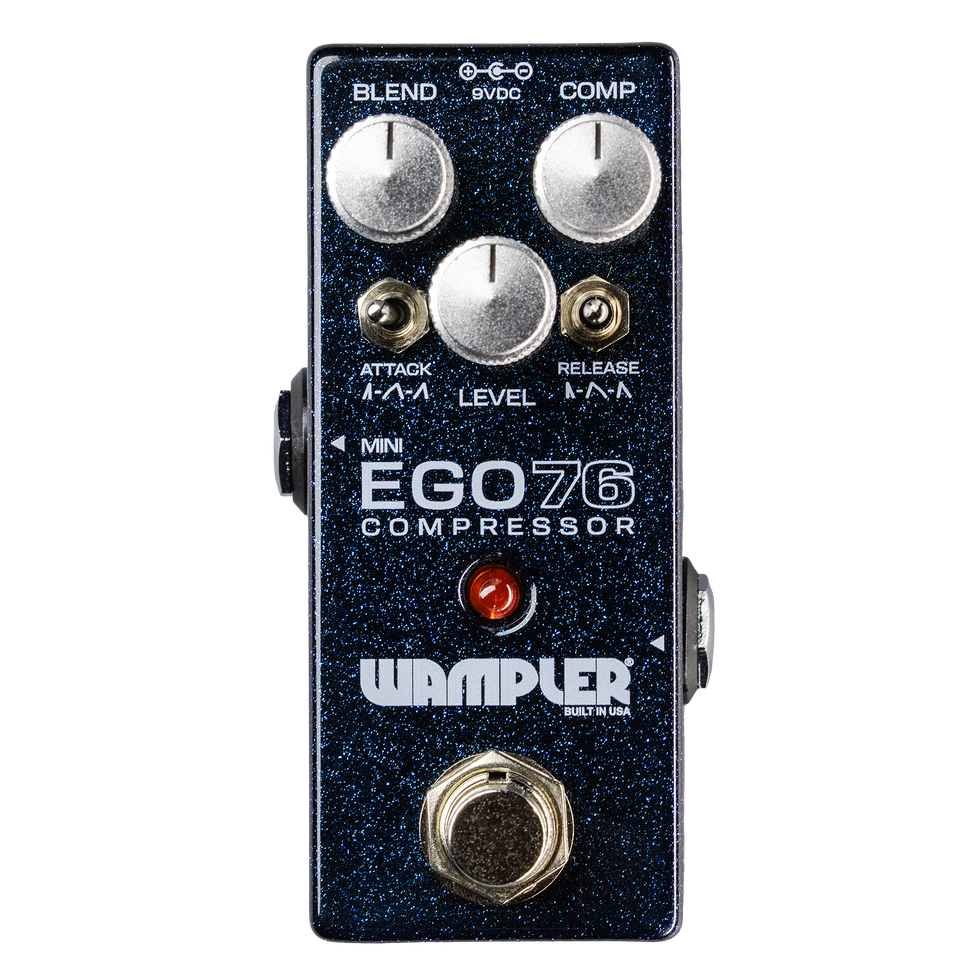
The MINI EGO 76 features three essential knobs—Level, Compress, and Parallel Clean Blend—allowing for precise tonal shaping. Two three-way switches provide selectable Attack and Release settings, based on classic studio configurations. The result is a pedal that gives players fast, intuitive control over how the compression reacts, from subtle sustain to punchy, expressive snap.
A standout feature is the Parallel Clean Blend, enabling players to mix in their uncompressed signal—an approach borrowed from high-end studio production techniques. This lets guitarists preserve articulation and dynamics, even while achieving that signature “glue” of compression.
Built for the Pedalboard, Inspired by the Control Room
Encased in a premium chameleon sapphire finish with aluminum knobs and rugged hardware, the MINI EGO 76 is compact enough to live comfortably on any pedalboard. Designed to be an “always-on” pedal, it delivers studio-level enhancement without adding bulk or complexity.
Key Features:
- High-grade components for superior tone and response
- Parallel Clean Blend for studio-style parallel compression
- Five controls: Level, Blend, Compress, plus Attack and Release switches
- Premium aluminum construction and finish
- Compact footprint: 1.6” x 3.9” x 2”
- 9V DC operation, 20mA draw
- Built in the U.S.A. with a limited 5-year warranty
More Than a Compressor—A Sonic Signature
Far from a simple emulation, the MINI EGO 76 is Brian Wampler’s tribute to the timeless sound of analog studio recordings. Whether it’s sweetening a clean rhythm track or adding punch to a lead line, the MINI EGO 76 becomes an extension of your tone—one you may never want to turn off.
The MINI EGO 76 is available now at wamplerpedals.com and authorized dealers worldwide.
Luther Dickinson’s Dead Blues: Where Tradition Meets Tomorrow

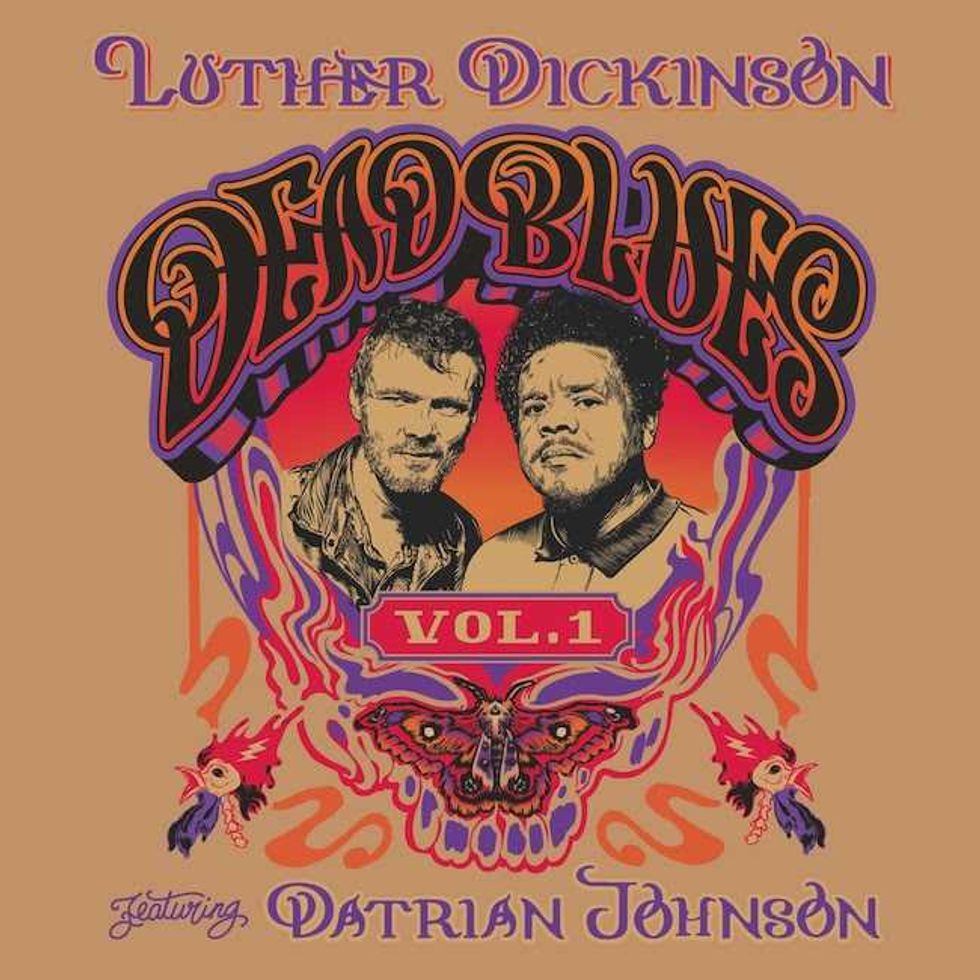
There’s something beautifully paradoxical about Luther Dickinson’s new album, Dead Blues Vol. 1. It’s a collection of blues standards that were performed by the Grateful Dead throughout their career, yet it sounds like neither traditional blues nor Dead-style interpretations. Instead, it exists in some liminal space between the Mississippi Delta and the cosmos—a place where Blind Lemon Jefferson meets synthesizers and omnichords, and Willie Dixon’s words floats over funk grooves and ambient soundscapes.
“I would never claim to be a bluesman,” Dickinson says during a phone interview from the road, somewhere between Asheville and Nashville. For someone whose band, North Mississippi Allstars, has earned multiple Grammy nominations exploring roots music, it’s a surprising admission. “I’m more of a psychedelic folk rocker, you know? That’s what I claim, if anything.”
This perspective—reverent toward tradition but unbound by its conventions—defines Dead Blues Vol. 1. The album reimagines nine blues songs from the Dead’s repertoire, featuring the remarkable vocals of Datrian Johnson alongside contributions from Phil Lesh’s son Grahame Lesh, the Hold Steady’s Steve Selvidge, Dickinson’s brother and Allstars band mate Cody, and pedal-steel wizard Ray Ray Holloman.
The genesis of the record stemmed from two separate ideas colliding in Dickinson’s mind. In 2013, Phil Lesh invited Dickinson and his brother Cody to join Phil & Friends, the legendary Grateful Dead bassist’s rotating collective of musicians. As Dickinson studied up on the Dead catalog for rehearsals and performances, he and Grahame Lesh began performing casual Dead Blues shows focusing specifically on the blues songs in that band’s repertoire. “Grahame and I started doing the Dead Blues to do looser, easier shows outside of the Dead musician pool,” Dickinson explains. “We’d bring in musicians like the Black Keys, Alabama Shakes, Charlie Musselwhite—artists outside of Phil’s scene—to play with us. That was really fun.”
Around the same time, New West Records approached him about doing a Grateful Dead tribute. “I was like, man, I don’t know,” he admits. “My only in was like, ‘Well, I could do a Dead Blues thing.’ But that was years ago, and I didn’t really consider it. It wasn’t at the top of my to-do list, you know?”
The project might have stayed dormant had the pandemic not shifted Dickinson’s creative direction. When touring stopped in 2020, he found himself working on an instrumental record—and not only that, but one “where I didn’t play guitar,” he explains. Instead, he wrote the material on bass and keyboards during the lockdown, creating spacious, experimental soundscapes with no connection to the blues standards—"Who Do You Love,” “I’m a King Bee,” “Little Red Rooster”—they would eventually be paired with.
Then came the revelation. “I woke up one morning and I was like, ‘Datrian could sing the Dead Blues lyrics on top of this instrumental record!’ And sure enough, it just happened so easily. It was so fun that, within three sessions, we had the record done. And after the fact, I went in and overdubbed guitar on it as the last flavor.”
Which Dickinson actually does frequently. “Usually if I’m overdubbing guitars, I’ll do it at the last minute,” he says. The guitar work he added referenced the original blues melodies even when Johnson’s vocals didn’t directly follow them. “Even if Datrian isn’t singing it, the guitar work I added is more referential, a nod to the original melodies. My stance is the melody and the poetry is to be protected. All the trappings of production, the beats, the fashion of an interpretation—that’s malleable. But the melody and the poetry is what’s interesting to protect.”
Datrian Johnson proved to be the crucial element that transformed the project. Keyboardist John Medeski had introduced Dickinson to the Asheville-based vocalist a couple of years ago during work with The Word, Dickinson’s band with Medeski and Robert Randolph. The chemistry was immediate. “He’s one of the most moving vocalists I’ve ever worked with onstage,” Dickinson says. “I’ve worked with Mavis Staples, John Hiatt, Patty Griffin, Robert Plant, Chris Robinson—some of the best vocalists in rock ’n’ roll. But Datrian has this thing. People are like, ‘What the…?’”
Indeed, his delivery on tracks like “Little Red Rooster” and “High Heeled Sneakers” demonstrates an interpretive depth that honors the source material while completely reimagining it. “He’s such a humble, unassuming guy,” Dickinson continues of Johnson. “And then he starts singing … I just remember people’s reactions. I’ve never seen anyone make an audience gasp before.”
The album’s unconventional approach—featuring melodica, Wurlitzer, DX7 synthesizer, omnichord, and what Steve Selvidge calls “space-funk guitar”—reflects Dickinson’s philosophy about roots music. These blues standards may be traditional, some stretching back nearly a century, but Dickinson gives them a somewhat futuristic-sounding treatment. Which, to his mind, puts him in the same forward-thinking tradition as the bluesmen themselves. “Musicians that try to be old-timey—I’m not into it,” he says. “If you think about it, Charley Patton was revolutionary. He was forward-thinking. Howlin’ Wolf was forward-thinking. Little Walter, Robert Johnson … none of these guys were trying to be old-fashioned. Every great musician—Charlie Christian, Jimi Hendrix—they were all forward-thinking.”
“Every great musician—Charlie Christian, Jimi Hendrix—they were all forward-thinking. No one was trying to be old fashioned.”
That same spirit could be found in the Grateful Dead, though Dickinson’s relationship with the band came relatively late. “I didn’t grow up with it. I stayed away from it,” he says. That changed in 2013, with Phil Lesh’s invite. “We jumped at the opportunity and studied up on the catalog,” Dickinson recalls. The education deepened over years of performances, particularly at Lesh’s venue Terrapin Crossroads. “Most of our work was on the West Coast, but then when Phil took me to New York and I saw the East Coast Deadheads, I was like, ‘Holy shit.’ They were singing along to every word. It’s not just the parking lot and the dancing and the jamming. It’s the songs.”
That realization also deepened Dickinson’s appreciation for Robert Hunter’s lyrics, which he calls, “pure, classic Americana, on a par with Dylan, I think,” he says. “That generation, Garcia as well, they weren’t hippies, they were beatniks. They were older than the hippies. They grew up reading Jack Kerouac and listening to the radio. They remember before rock ’n’ roll. That generation of writers that grew up like Dylan and Hunter and my dad—they grew up listening to the radio before TV, and they had a way with words that will never come again.”
Dickinson dedicated Dead Blues Vol. 1 to Lesh, who passed away in October 2024. “Phil changed my life,” Dickinson says. “He welcomed me into his crew, taught me his repertoire, shared his improvisational approaches, and introduced me to a whole new community of musicians. This record reflects Phil’s wild musical spirit and approach to reinterpretation.”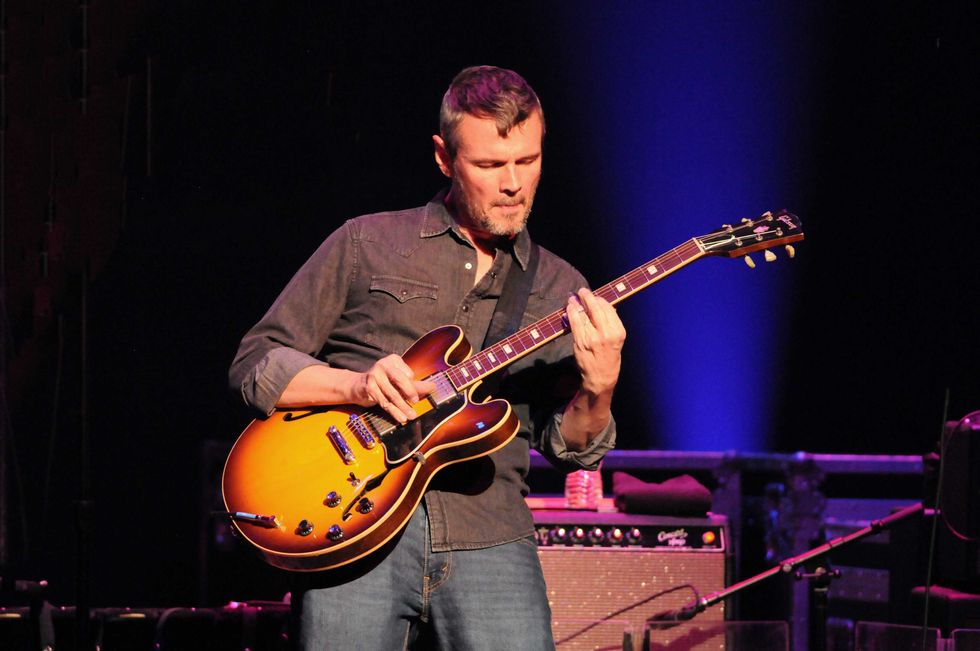
“When Phil [Lesh] took me to New York and I saw the East Coast Deadheads … they were singing along to every word. It’s not just the parking lot and the dancing and the jamming. It’s the songs.”
That wildness manifests in bold instrumental choices and fearless reimagining. The omnichord, played by Paul Taylor, adds an otherworldly shimmer. Ray Ray Holloman’s pedal-steel work provides both traditional country blues flavor and sci-fi textures. Steve Selvidge’s “space-funk guitar” creates grooves that feel simultaneously vintage and futuristic. Selvidge has been in Dickinson’s orbit since childhood—their fathers played in a band together. “Steve is so multifaceted,” Dickinson says. “He can play country blues like his dad, he can play rock ’n’ roll—he’s my favorite rock ’n’ roll player of my peers. With the Hold Steady he’s straight rocket. But space funk, that’s the style he’s playing on this record.”
For his part, Dickinson discovered that synthesizers could intertwine with slide guitar in ways that feel both ancient and futuristic, which can be heard throughout the album, particularly on tracks like “Little Red Rooster” and “High Heeled Sneakers.” “I realized a synth can be as expressive as a slide guitar,” he says. “And I’ve never experimented with slide guitar and synths together before, which was really fun. I was like, ‘These sound cool.’”
Perhaps the track that best exemplifies the album’s aesthetic is “Who Do You Love,”—a Bo Diddley classic transformed by layers of funk guitar and bass, DX7 synthesizer, cajon, and omnichord into something that sounds like it could soundtrack a midnight drive through Mississippi on Mars. Yet Dickinson’s guitar work, added last, references the original melody, grounding the experimentalism in tradition. “That one worked really nicely,” Dickinson says, especially when we realized we could put the hook over that melody. And then Datrian made it so smooth.”
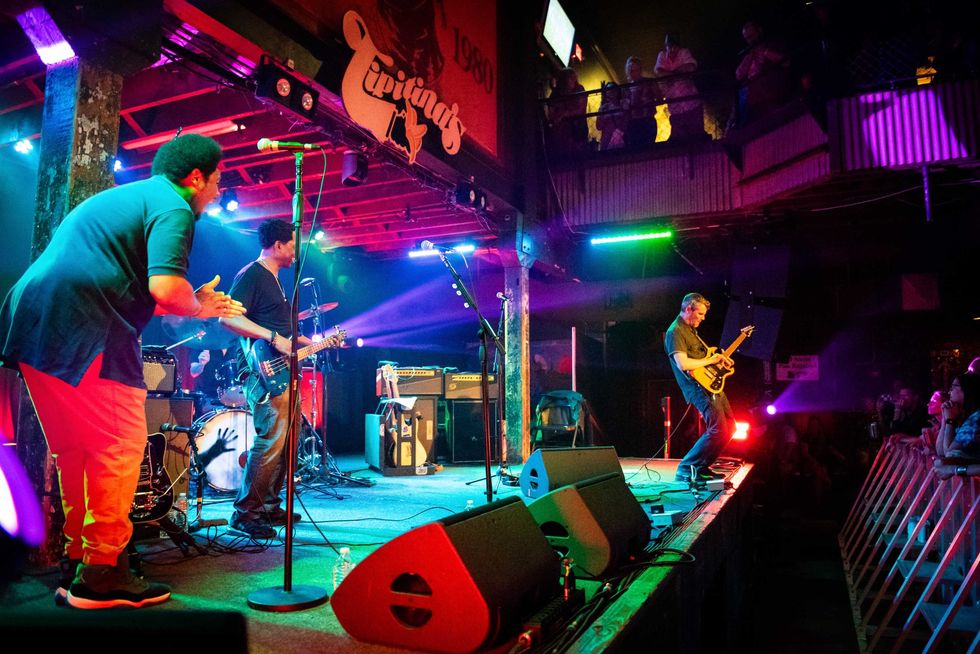
“I realized a synth can be as expressive as a slide guitar.”
For Dickinson, Dead Blues represents the next step in a significant shift in his approach to guitar. “During 2020, I sold most of my Gibsons,” he reveals. “I grew up playing Les Pauls and 335s, and I just got burned on that very sound I used to strive for—the neck pickup, midrange feedback, sustain, fat, oozy tone. It started hurting my ears. I think it was just too much of a good thing.”
Dickinson says there were “a lot of things” that led to him changing up his sound, but working with Phil Lesh was an important factor. “Playing with Phil, I was finally able to become comfortable playing clean as opposed to relying on distortion or fuzz. It really changed my life. My whole time I’ve been trying to make an electric guitar respond like an acoustic guitar. And what really turned me on was that Steve Selvidge gave me a guitar, a partscaster, with Lollar Regal pickups—Fender-style wide-range humbuckers. Man, those pickups are so cool because they’re a quiet humbucker, but they don’t sound like a PAF or whatever. They’re beefier than a Strat, kind of like a civilized gold-foil. Those pickups just changed my life. And then my friends and I started making guitars called Vibratone. Those two guitars are a lot of what you hear on the album.”
Even as Dickinson releases Dead Blues Vol. 1, he’s characteristically busy with multiple projects. North Mississippi Allstars are continuing to tour behind their recent album, Still Shaking, and also preparing for a new studio effort. Additionally, Dickinson reports he’s working on what he calls an “ambient blues” project—“like a folk film score. Instrumental modern acoustic country blues with organic drones.”
In this regard, Dead Blues Vol. 1 is of a piece with Dickinson’s restlessly exploratory approach—whether it’s ambient blues or Dead Blues, he’s always pushing boundaries while staying rooted in tradition. It’s about honoring and celebrating the past more than it is about attempting to preserve it. “American roots music as a whole is worthy of being protected,” Dickinson says. “When old-timers teach you the repertoire, you owe it to them to keep that repertoire alive. But if you can’t evolve and adapt, you won’t survive.”Luther Dickinson’s Gear
Guitars
Partscaster with Lollar Regal wide-range humbuckers
Vibratone prototype
1970s Yamaha acoustic
Gretsch parlor acoustic
Amps
Category 5 signature LD50
Category 5 signature LD30
Strings & Picks
DR Strings (.009–.042)
Fender thin picks
Stompboxtober 2025: Nobels (Bonus Day!)

Bonus Day Alert! Today’s #Stompboxtober giveaway throws two pedals into the mix: the Nobels CHO‑mini and the Nobels DEL‑mini. Whether you’re craving lush stereo chorus or vintage/modern delay textures, this combo has your modulation and echo needs covered.
Stompboxtober 2025 - Win Pedals All Month Long!
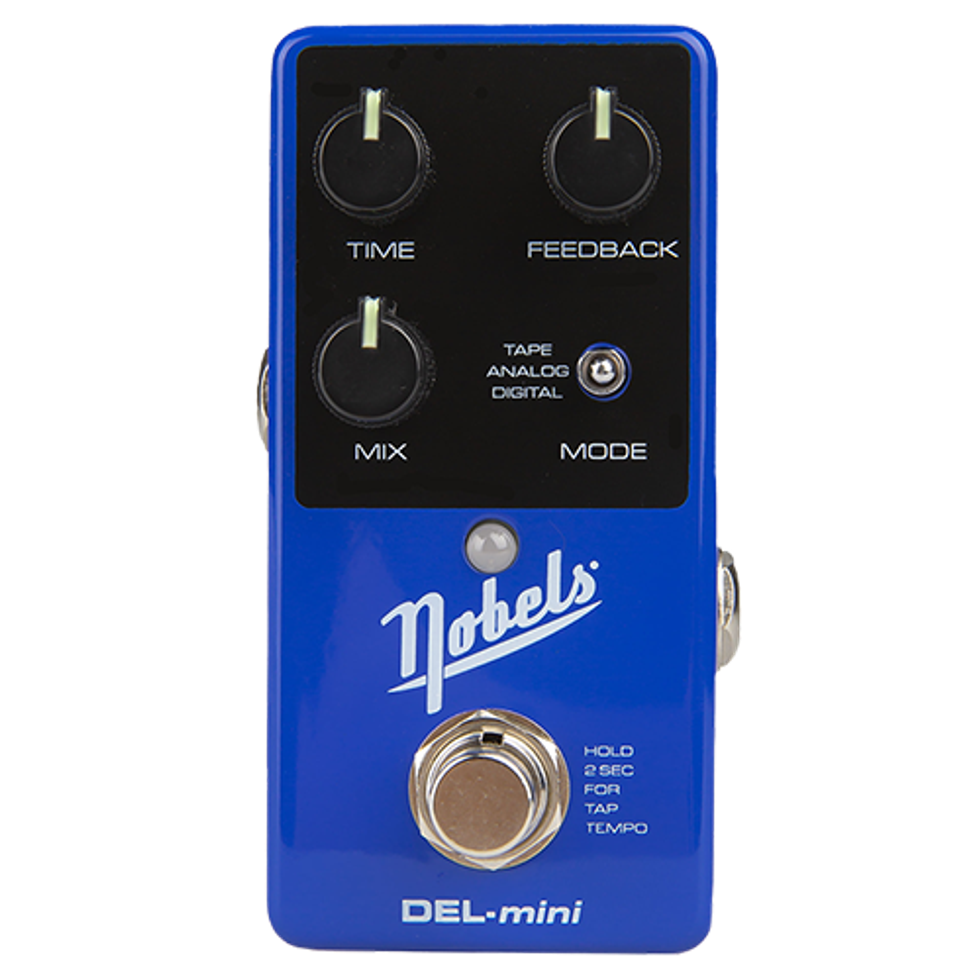
The new Nobels DEL-mini digital delay pedal combines an outstanding sound selection of legendary echoes, practical and simple switching and application options in a space-saving housing. Plus that little Nobels extra in the form of fold-out Mounty-P mounting plates or “Glow in the Dark” pointer knobs. Everything at an extremely attractive price! We hope you enjoy using this pedal!
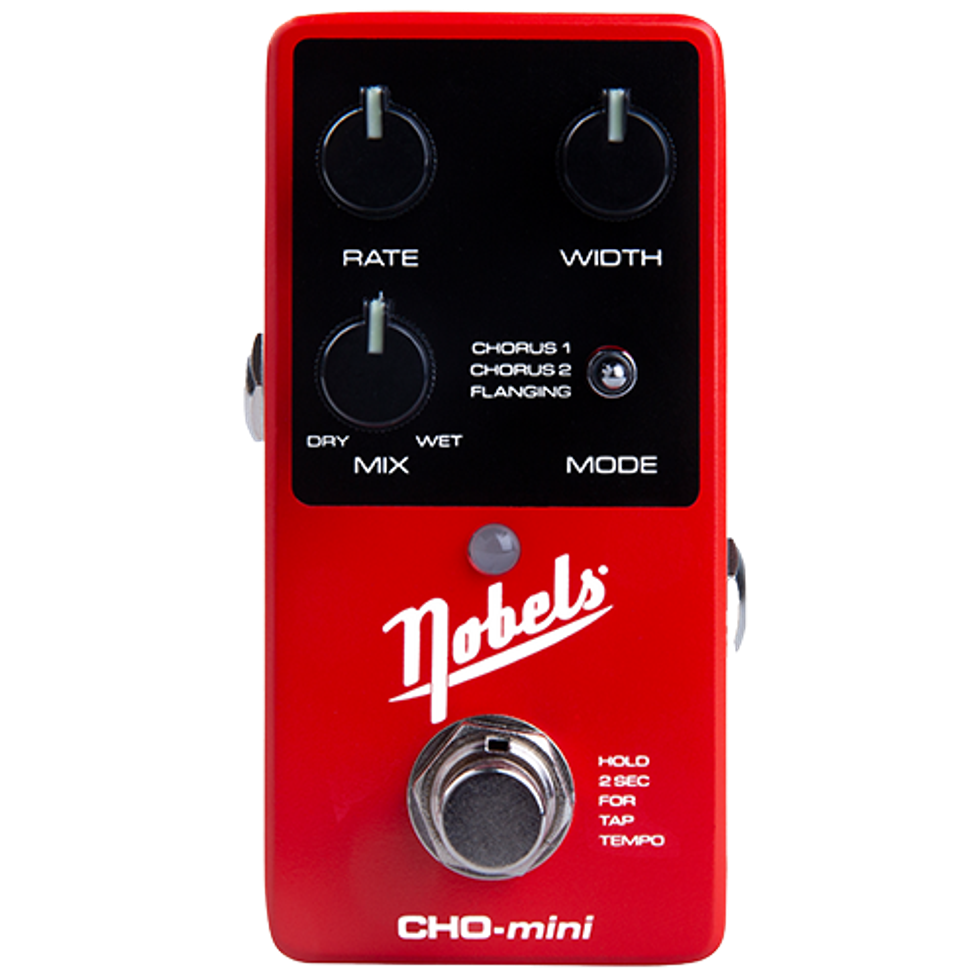
The pocket-sized and featured packed Nobels CHO-mini delivers an outstanding selection of chorus tones at a budget-friendly price. With a heritage of building chorus units, Nobels has engineered this new pedal to offer maximum versatility, in a super compact package. Providing a selection of 3 curated timeless chorus effects, the CHO-mini delivers a wealth of sonic possibilities in either mono or spacious stereo image. The realized tones are far beyond the pedal’s modest footprint and is an excellent addition to any pedal board.
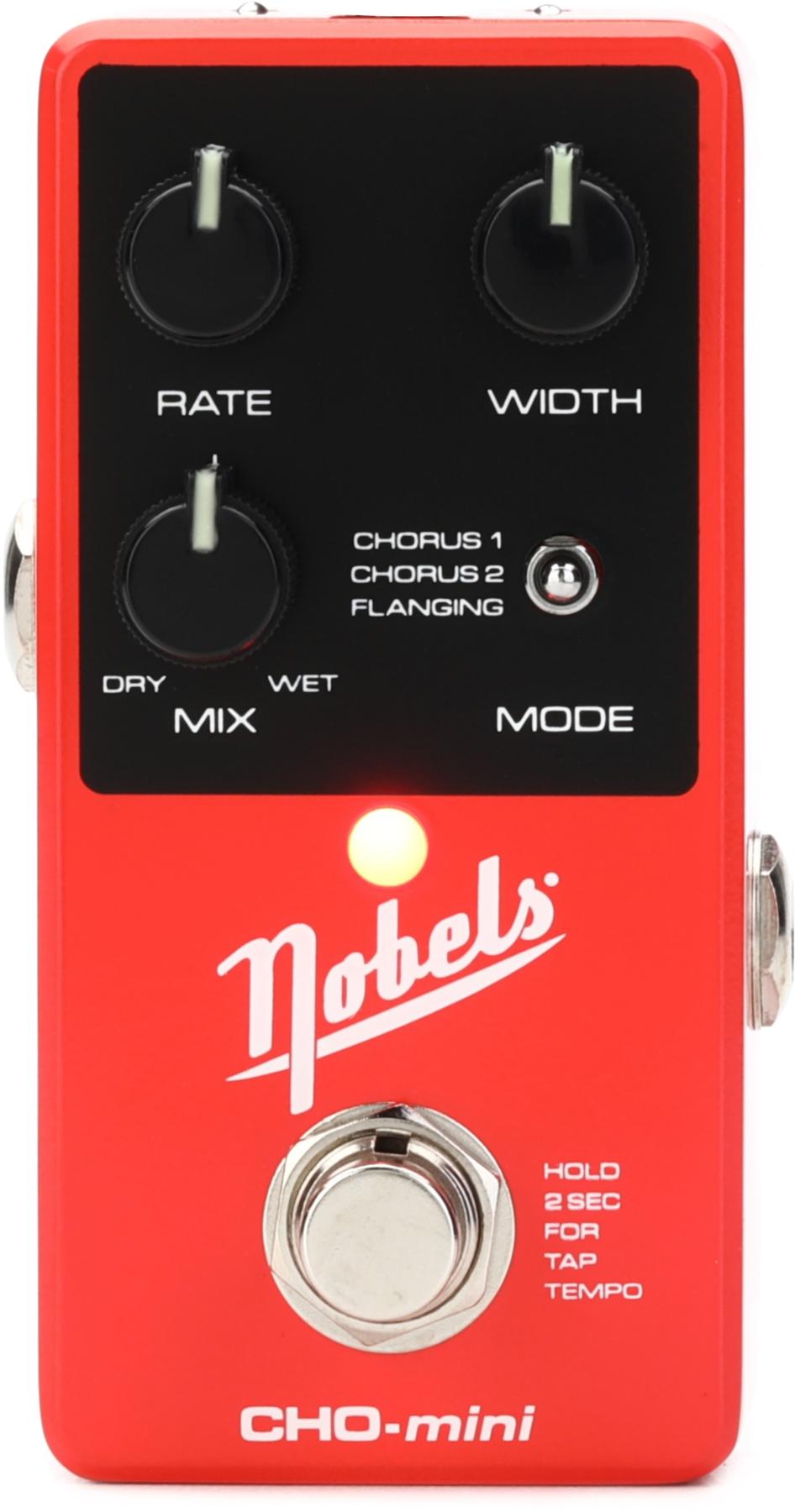
Nobels CHO-mini Stereo Chorus Pedal

Nobels DEL-mini Digital Delay Pedal
Stompboxtober 2025: Line 6
Ready to consolidate your rig? Enter today’s giveaway to WIN the Line 6 HX One — a single‑stomp powerhouse with 250+ HX‑family effects, stereo I/O, MIDI, a Flux controller, and full preset power in a compact package.
Stompboxtober 2025 - Win Pedals All Month Long!
Line 6 HX One
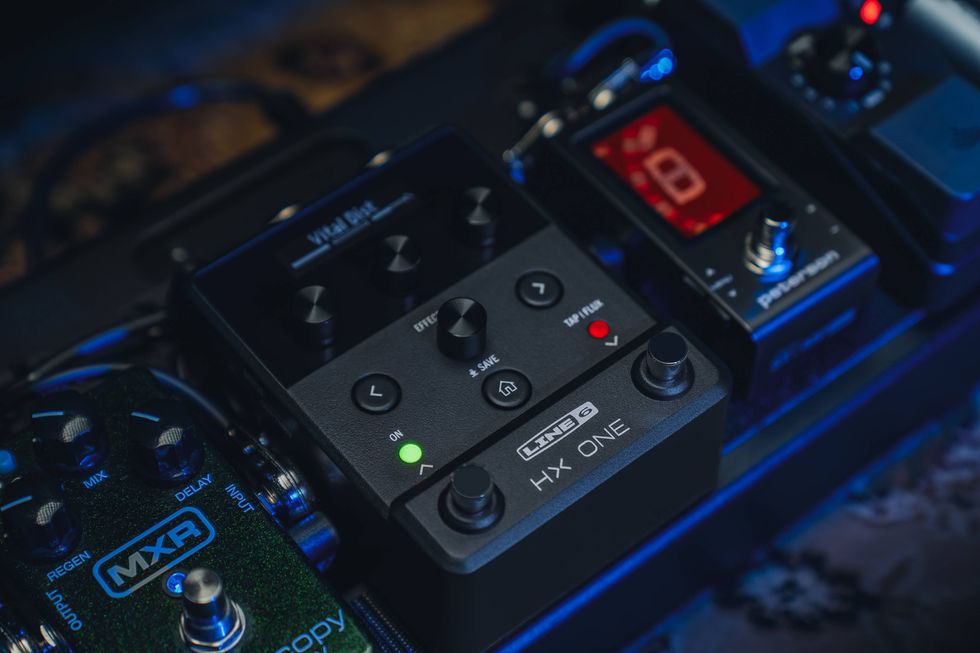
Seeking that one elusive sound for your pedalboard? You will almost certainly find it in HX® One, a powerful and compact stereo effect pedal that is a great option for when you want to add more effects to your board but only have room for one! It features intuitive controls, options for 250+ effects taken from HX family processors, a unique Flux Controller, a jack for connecting an optional expression pedal or two footswitches, adjustable input impedance, MIDI capabilities, and a choice of true or buffered DSP bypass.

Line 6 HX One Guitar Multi-effects Floor Processor
Reverb Therapy, Part 2

Hello, and welcome back to another Dojo. Previously I mentioned that there are hundreds of reverb plugins (convolution, algorithmic, plate, and spring) out there, but the vast majority of them are either direct emulations of 6 classic reverbs—or derive a huge amount of inspiration from them, to say the least. I highlighted the EMT 140, the Lexicon 224, and the EMT 250 last month, and I’ll finish up this month by paying homage to the remaining classic trio. I’ll also give you some strategic advice on how to take better advantage of these, and even the reverbs that you already have as well. Tighten your belts—the dojo is now open.
The Bigger Picture
The Lexicon 480L Digital Effects System, introduced in 1986, easily stands as one of the most important reverbs in the history of studio recording. Conceived as Lexicon’s next step beyond the 224 (see last month’s Dojo) it employed 18-bit A/D and D/A converters, giving it a wet path dynamic range approaching 98 dB and either 44.1 kHz or 48 kHz sample rates.
Internally, it was essentially two powerful stereo processors, labeled “Machine A” and “Machine B.” These could be run independently, producing two separate stereo effects, or cascaded so that one fed into the other.
The sound of the 480L is where its legend was truly forged. The reverb tails were smoother and more natural than anything that had come before, while still carrying Lexicon’s trademark musicality. One of the most beloved algorithms was “Random Hall,” which added subtle modulation to the reverb tail, preventing it from sounding static and giving it a sense of living, breathing space. The 480L dominated mainstream pop, rock, film scores, and TV from the mid-’80s through the 2000s. While earlier reverbs like the EMT 250 or Lexicon 224 had charm and warmth, the 480L delivered polish and versatility. It was the professional standard against which all others were judged.
A studio spring?
The AKG BX20 spring reverb is another gem from the analog days. Unlike the small, twangy springs found in guitar amps, the BX20 was designed for studio use, housed in a (roughly) 4' x 2' x 2' wooden cabinet. Its dual spring system produced a reverb that was deliciously dark, smooth, and surprisingly versatile. It became beloved for its organic, almost smoky quality—perfect on guitars, keys, and even vocals if you wanted a touch of atmosphere without the sheen of a plate or the brightness of a Lexicon.
The Underdog from Burnley
By 1981, EMT in Germany had already unveiled the EMT 250, and Lexicon in the U.S. was about to shake the industry with the 224. But back in the U.K., a pair of aerospace engineers in Burnley, Lancashire, created a 3U rackable reverb that came to define the sound of 1980s pop and rock—the AMS RMX16 (admittedly, my favorite). Compact, rugged, and intuitive, with a sound that was bold rather than naturalistic, the RMX16 was the first microprocessor-controlled, full-bandwidth digital reverb with nine core algorithms—halls, plates, rooms, ambiences—but it was the ‘NonLin2’ (nonlinear reverb) preset that turned the machine into legend. The gated snare in Phil Collins’ “In the Air Tonight”? The RMX16. Peter Gabriel’s “Sledgehammer”? The RMX16. Prince, Dire Straits, Hall & Oates, Bruce Springsteen—all embraced its punchy, present character.
The RMX16 influence has endured. AMS—now under AMS Neve—has since reissued it as a 500-series module and collaborated on official plugins with Universal Audio.
What’s in it for me?
Remember that a plate doesn’t sound like a spring, a spring doesn’t sound like a Lexicon, and an AMS doesn’t sound like an EMT 250. If you grab “any old reverb” from your DAW, you’re missing the point. These machines became prized not just for what they added, but for how they shaped the emotional character of music. Understanding the differences will leave you better equipped to make deliberate choices. Want your vocal to shimmer with vintage romance? Try a plate or spring reverb. Need drums to slam? That’s RMX16 territory. Looking for a reverb that’s lush yet unobtrusive? The Lexicon 480L is still king.
In the end, knowing your reverbs is like knowing your guitars. Each one has a story, a color, a legacy. These classics remind us that technology and artistry are forever intertwined. You’re not just “adding reverb”—you’re tapping into a lineage of sound that has shaped records for generations. And that, more than anything, is why these machines remain revered.
Fender Mark Speer Stratocaster Review
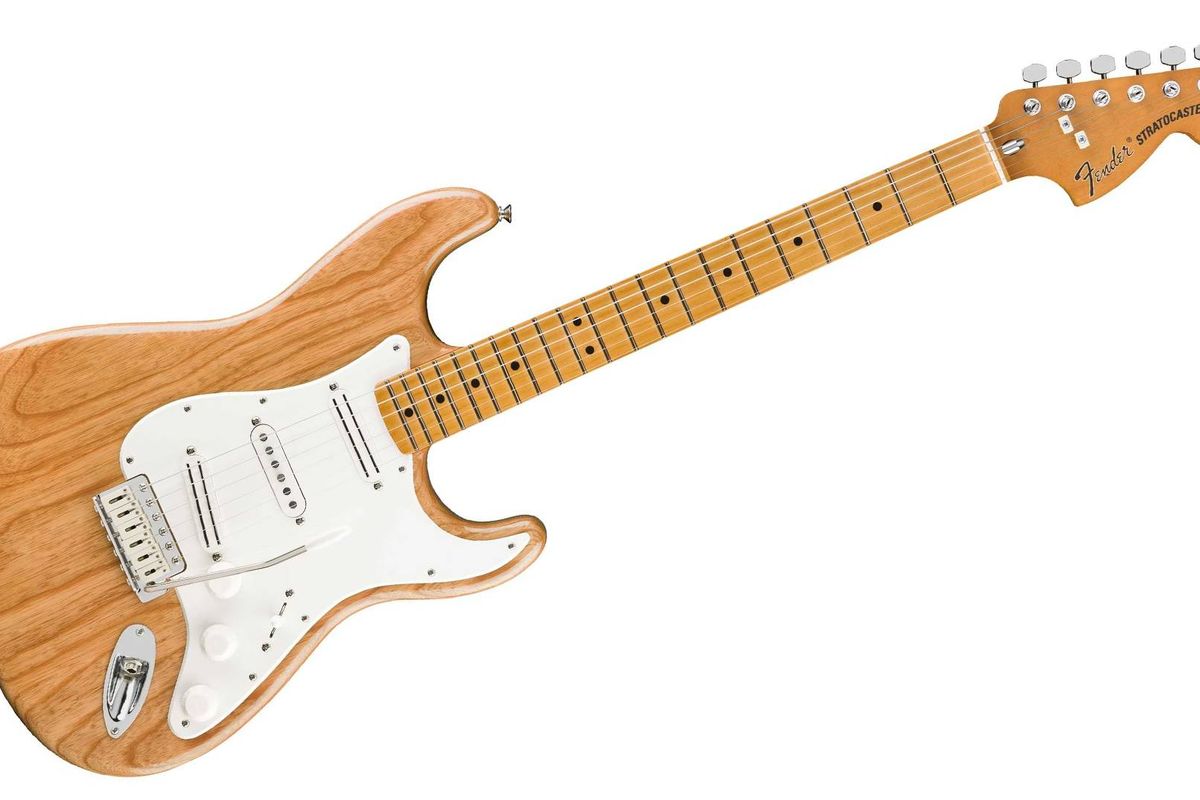
Khruangbin is a band that moves freely in negative space. They don’t deal in negative vibes, mind you, but the spaces in between objects—or in music, between notes and tones. In Khruangbin’s case, negative space isn’t quite as empty as it seems. In fact, a lot of it is colored with reverberated overtones, which is an aesthetic well suited to Mark Speer’s instrument of choice. Because if you want to color negative space without being a space hog, there are few better means than a Stratocaster.
Speer’s signature Stratocaster, is not, in the strictest sense, a classically Strat-like specimen. Its bridge and neck pickups, after all, are DiMarzio Pro Track humbuckers, with a design informed more by PAFs than Fender single coils. Nor is it modeled after a priceless rarity. Speer’s main guitar is a humble ’72 Stratocaster reissue from the early 2000’s. But the Speer signature Stratocaster is a thought-provoking twist on classic “Stratocaster-ness,” and one well-suited to the atmospherics that mark Khruangbin’s music, but also soul, reggae, jazz, and any other expression where clarity and substance are critical.
Mr. Natural Takes It In Stride
I have to admit—and no doubt some of you will disagree—for most of my life, as an early- to mid-1960s-oriented aesthete, an all-natural-finished Strat with an oversized headstock looked flat-out wrong. My opinion on the matter has softened a bit since. And I think the Speer Stratocaster is beautiful, elegant, and does much the flatter the Strat profile. The pronounced grain in the ash body is lovely, and it certainly doesn’t reflect the drop in ash quality that many feared when ash-boring beetles started to decimate swamp ash supplies. It also looks great against the milk-white single-ply white pickguard and all-white knobs (another nice study in negative space).
Elsewhere, many features are authentically 1972. The 1-piece, 3-bolt maple neck with a 7.25" fretboard radius boasts a micro-neck-adjust feature as well as the practical and cool-looking bullet truss rod. The tuners also feature early ’70s-styled machine covers. The neck itself feels great—slightly less chunky, perhaps, than early ’70s Strats I’ve played, and, oddly, not worlds apart from the neck on my Mexico-made ’72 Telecaster Deluxe, which has a much flatter 12" radius. Some of the similarities in feel may have to do with the jumbo frets, which here give the gloss urethane fretboard a slinky, easy touch. Less delicate players (like me) who tend to squeeze when chording should check out the Speer before purchasing to make sure they don’t pull everything sharp. The frets do make string bends feel breezy, though. Other details, apart from the jumbo frets, that deviate a bit from 1972 Fender spec include a bone nut and Graphtec saddles and string trees.
Warmth of the Sun
The DiMarzio Pro Tracks dwell in an interesting tone space. They’re built with ceramic magnets (vintage Strat and Gibson PAFS were made with alnico magnets) with a resistance of about 7.7 k ohms, which is in the range of a vintage PAF humbucker but hotter than most vintage Stratocaster pickups. In terms of tone signature, they sound and respond a little more like PAFs than Stratocaster pickups, too, which aligns with DiMarzio’s design objectives. But in the neck pickup in particular, the Strat-iness is very present. And when I switched back and forth between a Stratocaster and PAF-equipped SG as baselines for comparison, I marveled at how well the DiMarzios retained qualities of both. It’s hard to know how much Fender’s 25 1/2" scale factors into lending the extra bit of Fender color. But the sound is distinctly, authentically, Speer-like. (For the record, I replicated much of Speer’s circa 2018 signal chain for this test, including a Fender Deluxe Reverb, Dunlop Cry Baby, Boss PH-3 and DS-1, MXR DynaComp, and a Echoplex-style pedal).
The PAF qualities of the DiMarzios are most pronounced in the bridge pickup, which is much burlier and thicker than a Stratocaster single coil. The one single coil on the guitar meanwhile, the middle pickup, will sound and feel familiar to any old-school Stratocaster player. It’s also perfect for chasing Jerry Garcia tones if you’re selecting the Speer for its likeness to Jer’s “Alligator.” The real treat among the Speer’s many sounds, though, is the number 4 position, which combines the neck pickup and middle pickup out of phase. It’s snarky, super-focused, and just a little bit nasty, especially with overdrive and treble bump from either a wah, OD, or boost pedal.
The Verdict
For those players who fall in love with the comfort, feel, and looks of a Stratocaster, only to find it a bit thin-sounding for their purposes, the Mark Speer Stratocaster is an intriguing option. The humbuckers deftly thread the needle between Stratocaster and PAF tonalities, with a distinct lean toward the latter, and the out-of-phase number 4 position is a cool sound that lends the Speer Strat expansive smooth-to-nasty range. Like so many Mexico-made Fenders, the quality is superb. And while the $1,499 price tag represents a Signature Series bump compared to the similar $1,209 Vintera II ’70s Stratocaster, the Speer’s extra tone range and ash body do a lot to soften any sticker shock. If the options here fit your style, it could be well worth the extra dollars.