Music is the universal language
“Glory to God in the highest heaven, and on earth peace to those on whom his favor rests.” - Luke 2:14
Premier Guitar


How MTV Unplugged Saved the Acoustic Guitar

On November 14, 2025, I’ll be giving a presentation at the Royal College of Music in London. It’s in conjunction with a unique guitar they have on display: Kurt Cobain’s 1959 Martin D-18E, the one he played on MTV Unplugged. To honor the occasion, we’ve built a modern reproduction of that particular guitar for my friend Craig Thatcher to play at the event—because I don’t think they’ll let him play the original. (Yes, that one … the guitar that sold for $6 million at auction in 2020.)
MTV Unplugged: What a good idea that was! And talk about good timing. The 1980s were not a good time to be in the acoustic guitar business. My dad joined the family business in 1955, the year I was born. The mid-’50s were the era of the folk revival. Acoustic music was taking hold in coffeehouses and on college campuses. Thanks to bands like the Kingston Trio, folk music was becoming pop music.
By the early ’60s, demand for Martin guitars outstripped the capacity of our old factory on 10 West North Street in Nazareth, Pennsylvania. My dad convinced my grandfather that we needed a new factory to keep up with the boom. So in 1964 we opened the new plant at 510 Sycamore Street. What else happened in 1964? The British Invasion.
Yes, Bob Dylan went electric, but the acoustic guitar remained a mainstay on many folk-rock songs. Crosby, Stills, Nash & Young and others drove demand skyward. We couldn’t keep up. These were good times. Politics, the Vietnam War, and the fight for civil rights … it all gave the younger generation reasons to speak out and speak up, and the acoustic guitar became an integral part of that messaging.
By the late 1970s, music was changing. Disco was taking over. The Eagles were the last significant folk-rock supergroup. By the 1980s, it was tough going for acoustic guitars. Several of our smaller competitors closed their shops. Pointy electric guitars were flying off the shelves, thanks to hair metal. The Yamaha DX7 and other digital keyboards were everywhere.
“By the end of the 1990s, our production had increased fivefold compared to the start of the decade.”
Our business struggled. My dad retired and moved to Florida. I had just graduated from college and joined the family business full-time, at a difficult moment. My grandfather passed away in 1986, and at 31, I became CEO. I was scared. My dad had encumbered the company with a crushing level of debt. We were on the verge of bankruptcy. I wasn’t sure exactly what to do, but I was determined to not allow my multi-generational family business to disappear. We cut back expenses and focused on what we did best: flat-top acoustic guitars. One of my dad’s better decisions was to acquire a string company. String sales helped us survive those lean years.
One day, my friend and colleague Dick Boak walked into my office. “I got a call from MTV,” he said. “MTV? The rock video station?” I inquired. “Yes,” he replied. “Why did they call us?” I asked. “They have this idea,” Dick said. “They want to get rockers into the studio and have them play their famous songs on acoustic guitars.” Hmmm. Not a bad idea.
“Why did they call us?” “They weren’t sure if the rockers they were going to ask even had acoustic guitars,” he said. “And they’re going to film some shows in New York. Could they borrow some guitars from us if needed?” I looked at Dick and smiled. He took that as a “yes.”
MTV Unplugged launched in 1989. It started slowly. Initially, few people noticed. But it built momentum. In 1992, Eric Clapton recorded his Unplugged segment at Bray Studios in London, playing his 000-42 Martin. The subsequent album became a phenomenon, garnering multiple Grammys, selling millions of copies, and becoming the best-selling live album of all time.
In 1993, Nirvana performed one of Kurt Cobain’s last televised sets. After his death, MTV Unplugged in New York was released. It sold over 5 million copies and won a Grammy for Best Alternative Music Performance. As the momentum grew, our phones started to ring. And ring. Players were rediscovering how cool it is to hold a wooden box against their body and feel it vibrate as they played their favorite songs. The acoustic guitar was back. Thank you, MTV Unplugged. (Fun fact: Many of the guitars played on MTV Unplugged were actually plugged in!)
What started as a simple TV concept helped usher in a full-fledged acoustic revival. For Martin, it arrived just when we needed it most. By the end of the 1990s, our production had increased fivefold compared to the start of the decade. Sometimes, all it takes is a well-timed idea and a few beautifully-built guitars.
The Year in Gear 2025
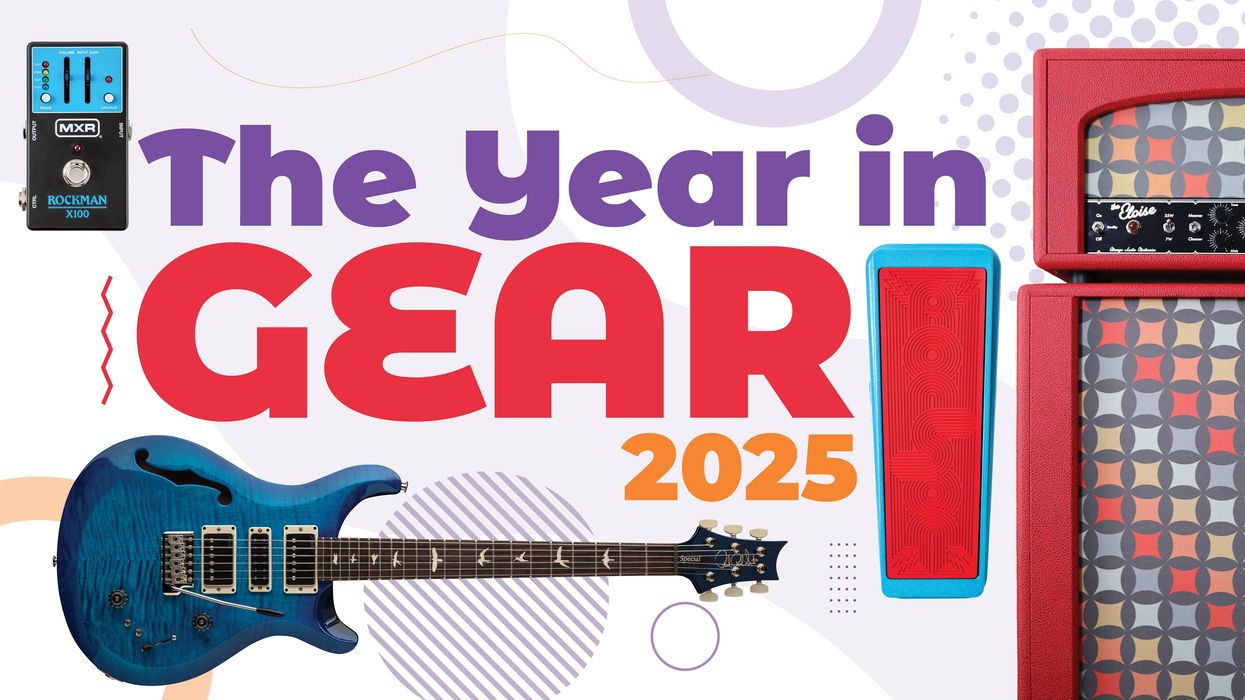
The gear that passed through our reviewer’s hands in 2025 was a thrillingly varied bunch. There were new takes on old friends, slimmed and shrunken evolutions of proven designs, and radical reinventions of the instrument we love and treasure so much. Join us as we review the guitars, pedals, amps, modelers and more that stood apart from the pack.
Keeley Zoma
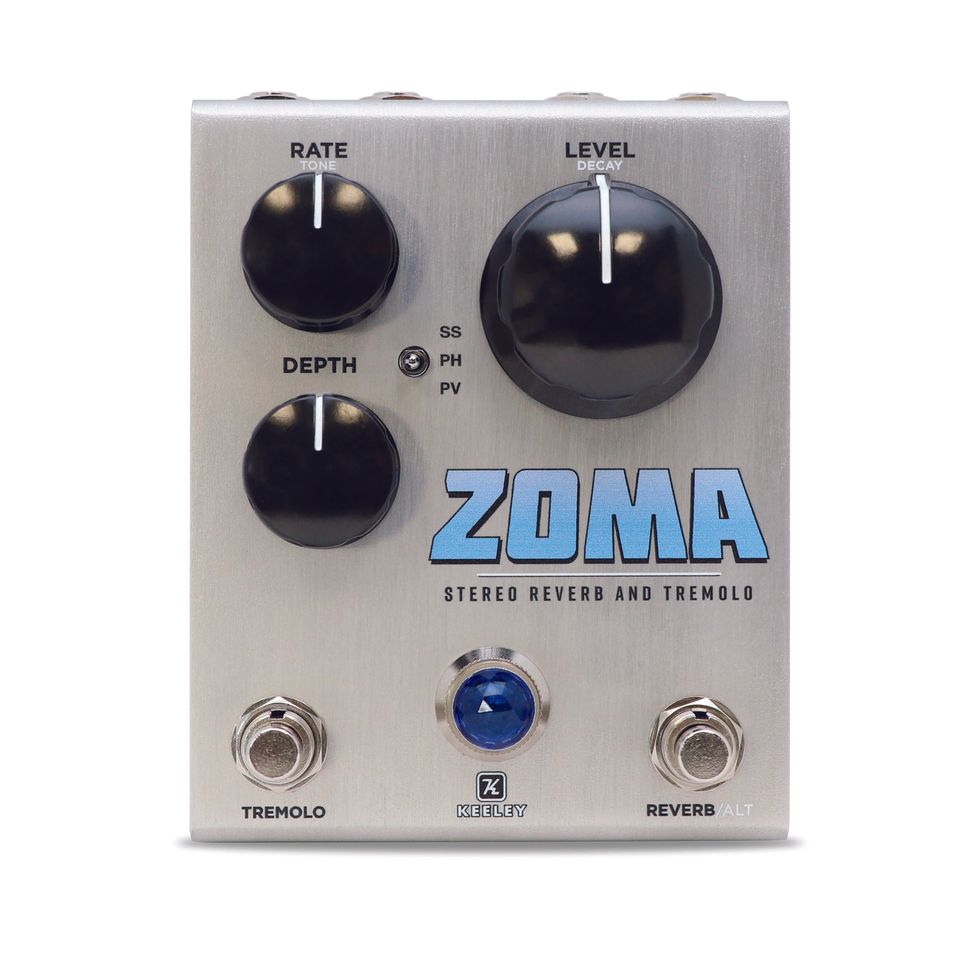
Keeley chased one of the most perfect effect combinations—the tremolo and reverb from a black panel Fender amplifier—in the form of the Zoma. But the tremolo-and-reverb combo goes beyond mere black-panel flavors. There’s a versatile plate reverb setting, harmonic tremolo, and vibrato, too, and it’s all very straightforward and easy to use. Stereo capabilities take the lushness to another level if you choose, making the Zoma a standout in a class of pedals chasing magic Fender amp effects formulas.
$229 street, robertkeeley.com
J. Rockett PXO
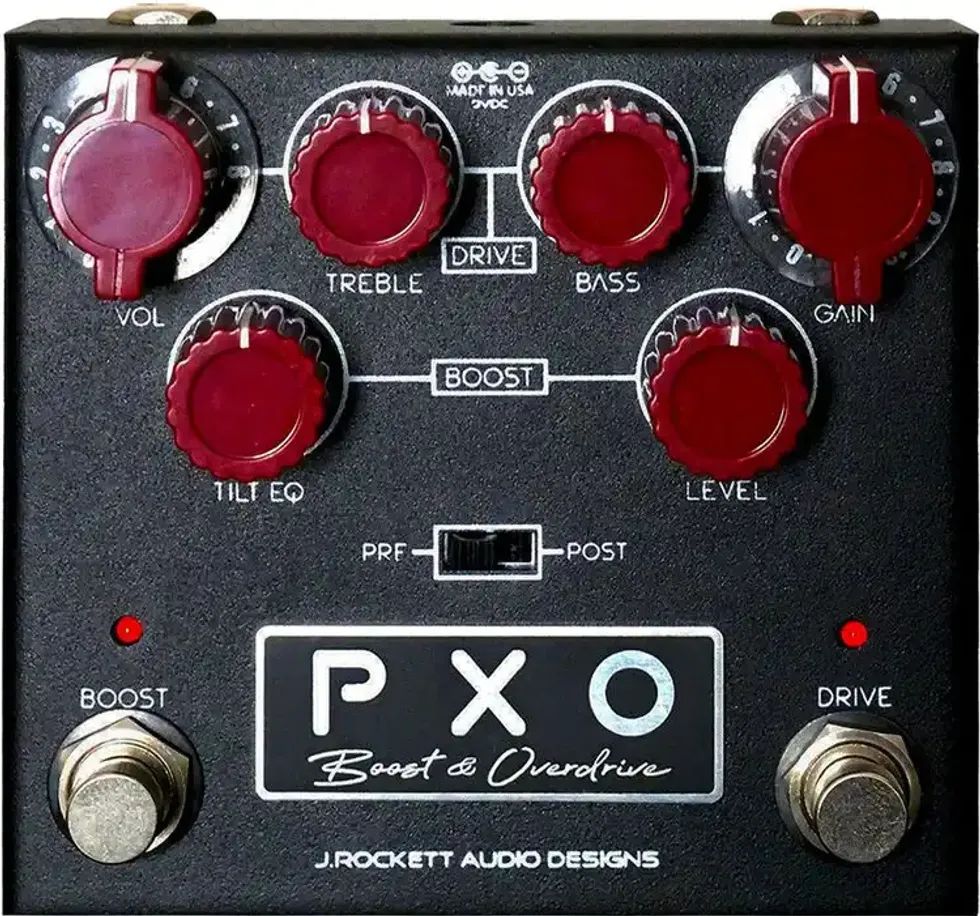
Phil X’s signature drive and boost is not, at its foundation, a unique idea. But by making the boost and overdrive order switchable and adding flexible EQ controls, the PXO becomes more than the sum of its parts. It can make single coils sound as fat as humbuckers or add treble that burns. It’s a fantastic studio and stage tool—both for discovery and backline problem solving.
$349 street, rockettpedals.com
Gibson Les Paul Studio
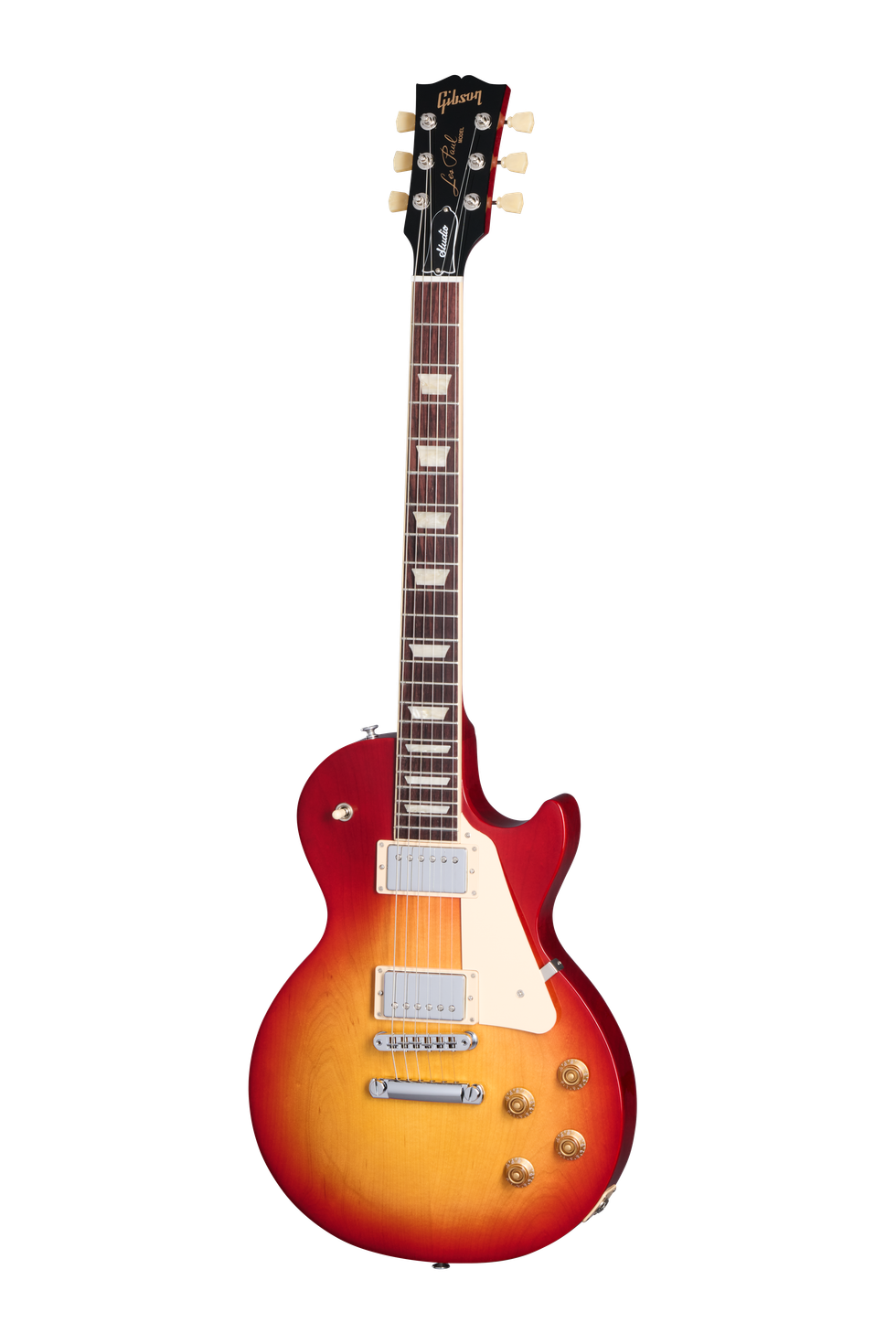
Over several decades, Gibson’s minimalist, more economical version of the Les Paul enabled a lot of players to own the fabled—but often expensive—solidbody. In this case, $1,599 might still feel a touch pricy, but reviewer Dave Hunter found the playability on our review model superb, and described the hotter-than-vintage-spec Burstbucker Pro pickups as extremely articulate.
$1,599 street, gibson.com
SoloDallas SVDS
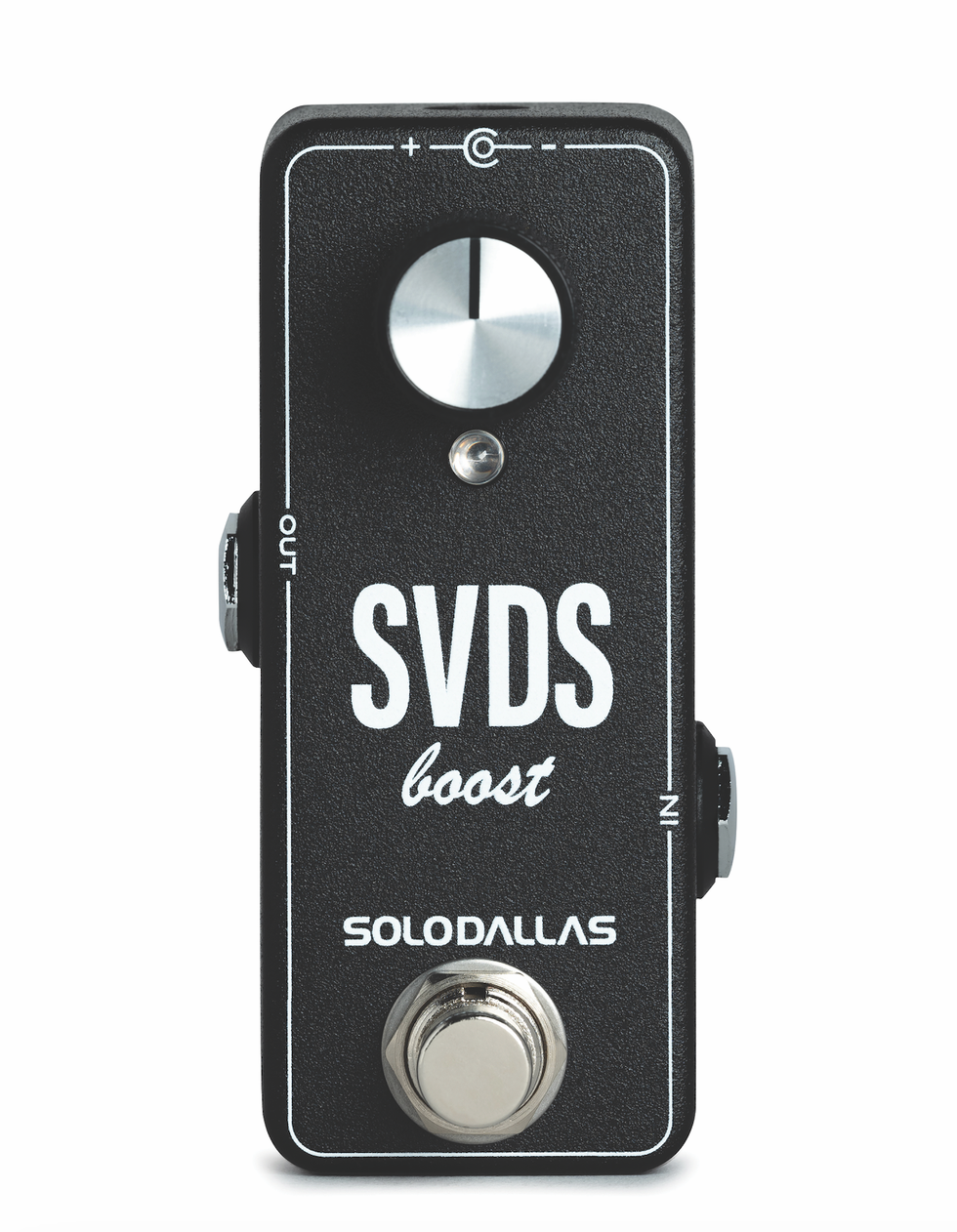
The Schaeffer-Vega Diversity System isn’t exactly a household name—even among gear nerds. But as an early wireless system, its mild coloration became essential for Angus Young and Eddie Van Halen. The SVDS Boost reduces its inspiration to its essence, beautifully fattening every facet of a guitar’s output without favoring any particular frequency.
$129 street, solodallas.com
Read the ReviewOrange Gain Baby
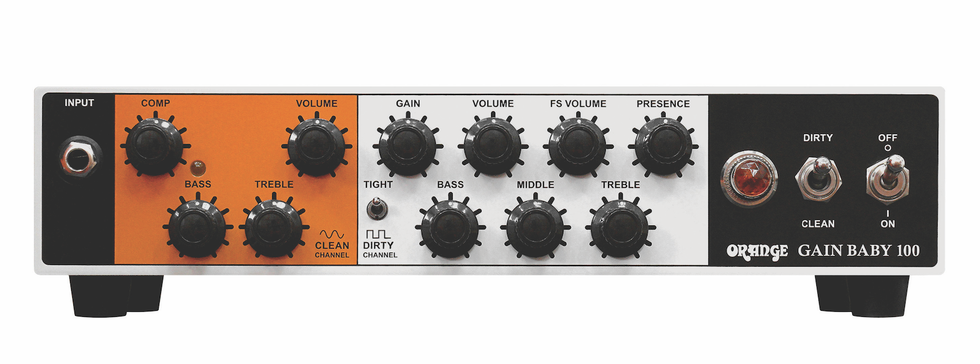
Many of Orange’s solid state amps in the Crush and Terror series have become staples of studios and the road. The Gain Baby, which is part of a trio of new “Baby” solid state offerings, is crushing in its own way. It also weighs just 6 1/2 lbs. Stuff it in the included shoulder bag and you have a highly portable monster that can deliver headroom and rage.
$599 street, orangeamps.com
TC Electronic Plethora X1
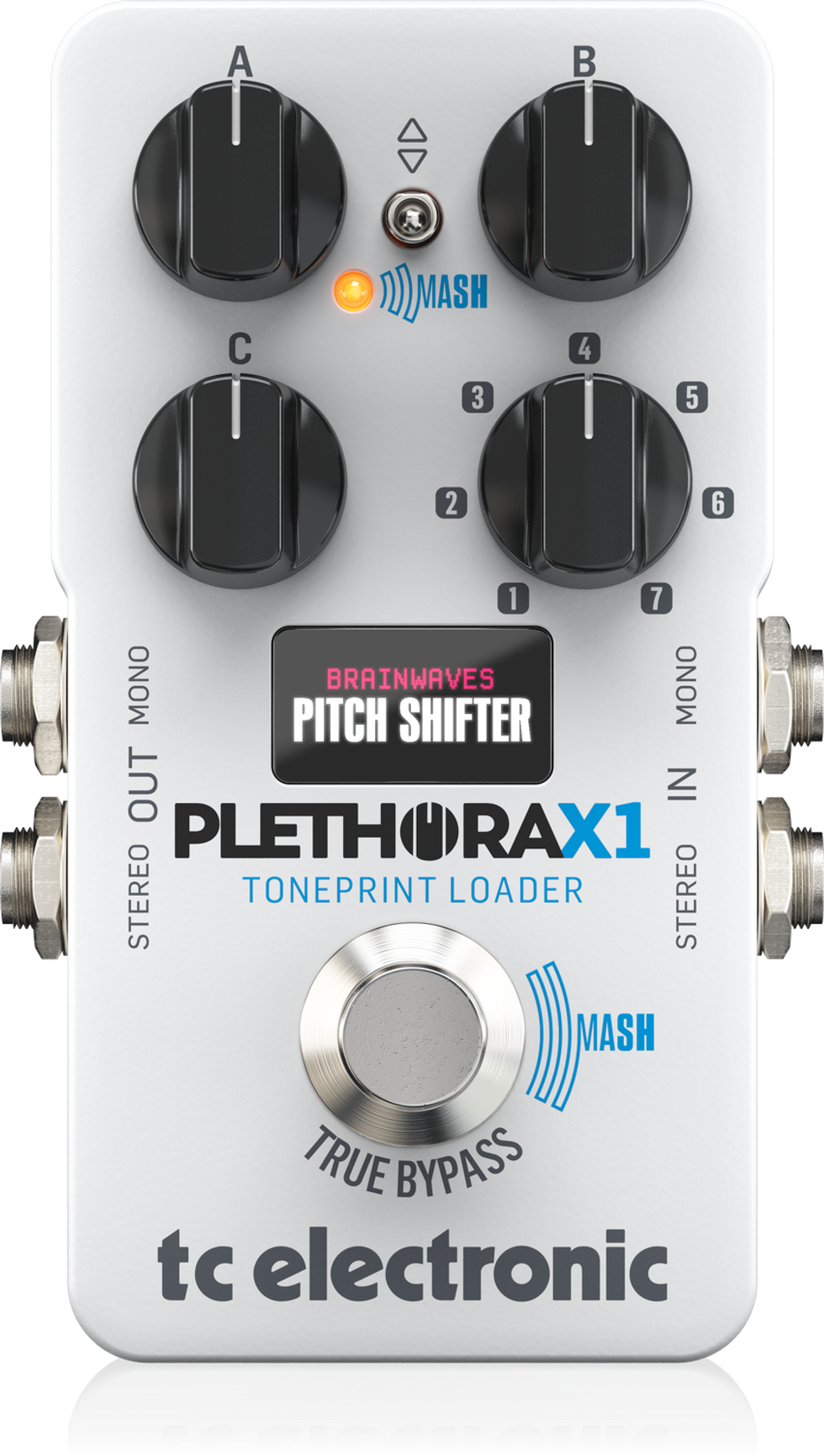
The Plethora X1 doesn’t do gain effects, but it covers just about everything else. It’s packed with models of TC’s signature delay, reverb, modulation, octave effects and more, plus access to the company’s star-studded Tone Print library. At just $159, it's a stellar value.
$159 street, tcelectronic.com
MXR Rockman
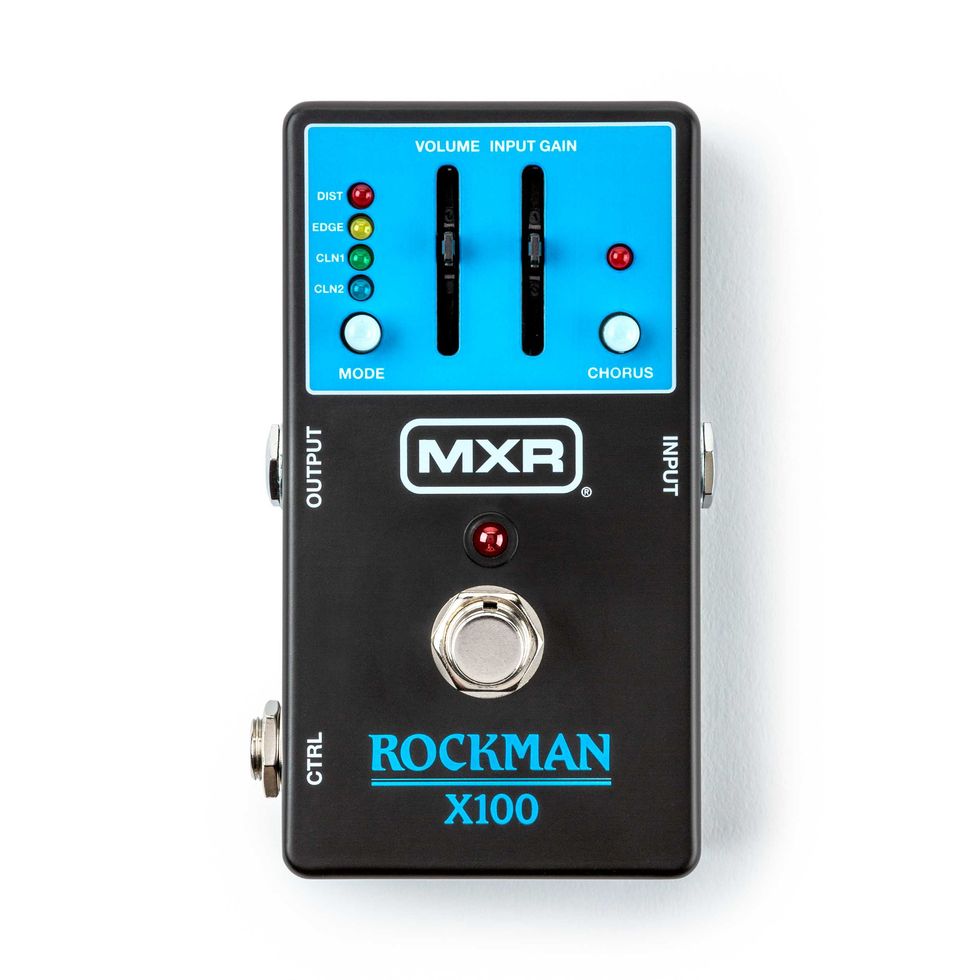
To resurrect one of the ’80s most essential tone machines in pedal form, the MXR team set their sights on the Rockman X100. They’ve recreated all four modes from the original: cln2 is the default setting, cln1 in the second position is EQ’d with a mid-boost, edge delivers moderate clipping, and dist is high-gain. Both distortion settings use the same hard-clipping LED diodes as the original. Preset compression and an analog chorus circuit add to the fun and nail the vibe.
$245 street, jimdunlop.com
Carr Skylark Special
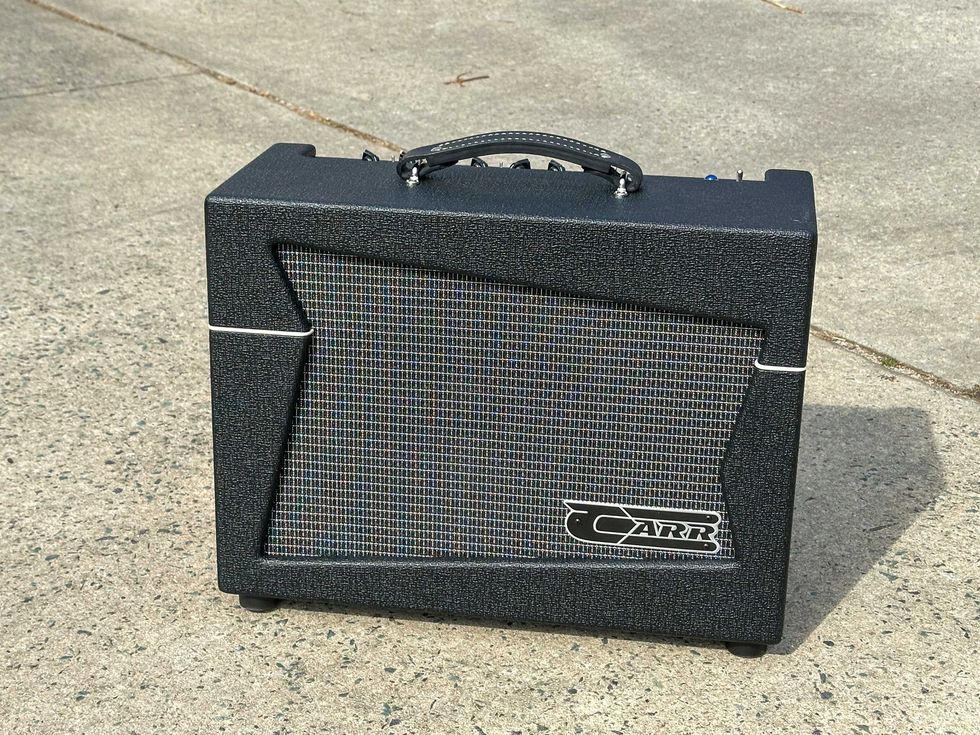
No stranger to our Year in Gear list, Carr Amplifiers delivered again. The brand made the already spectacular Skylark lighter, but also added an EZ81 tube rectifier and a Hiwatt-inspired tone section from their equally awesome Bel-Ray. With a 2x6V6 power section, it’s no surprise that the Skylark Special has more than a hint of Fender Harvard and Princeton in its makeup. But the extra bit of British flavor, as well as the bass response from the 12" Celestion, make it a thrillingly versatile twist on the Fender formula.
$3,200 street, carramps.com
Supercool Barstow Bat
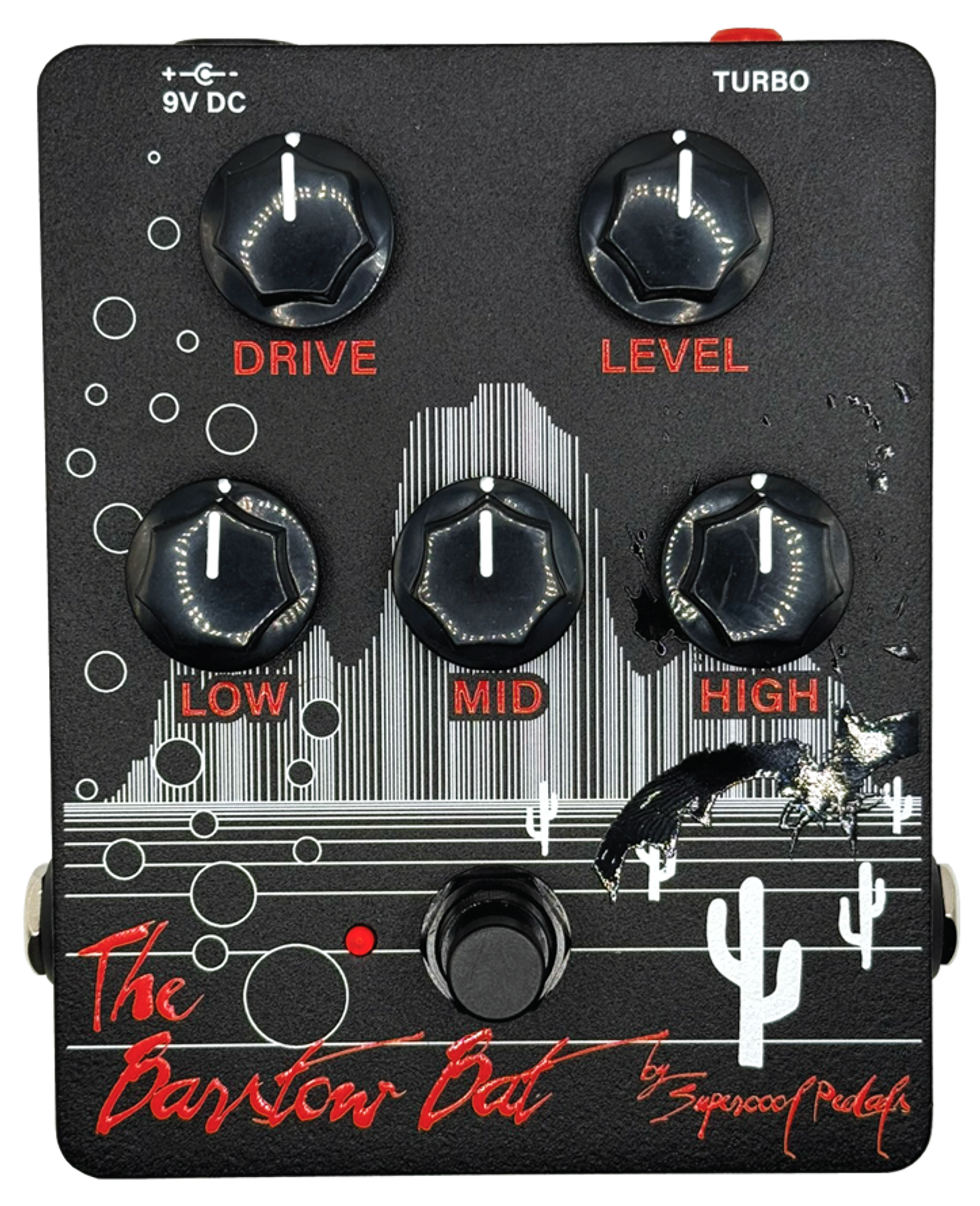
The magic of the Barstow Bat is its ability to expand the Pro Co RAT’s traditional vocabulary to include 1960s-style fuzz realms, exploding lo-fi student-amp tones and extreme sounds spanning fat and blurry and hot and trebly. A 3-band EQ replaces the traditional filter knob on a RAT, extending its sound palette significantly—and in ways an old RAT could only hint at.
$200 street, supercoolpedals.com
Ernie Ball Music Man StingRay II
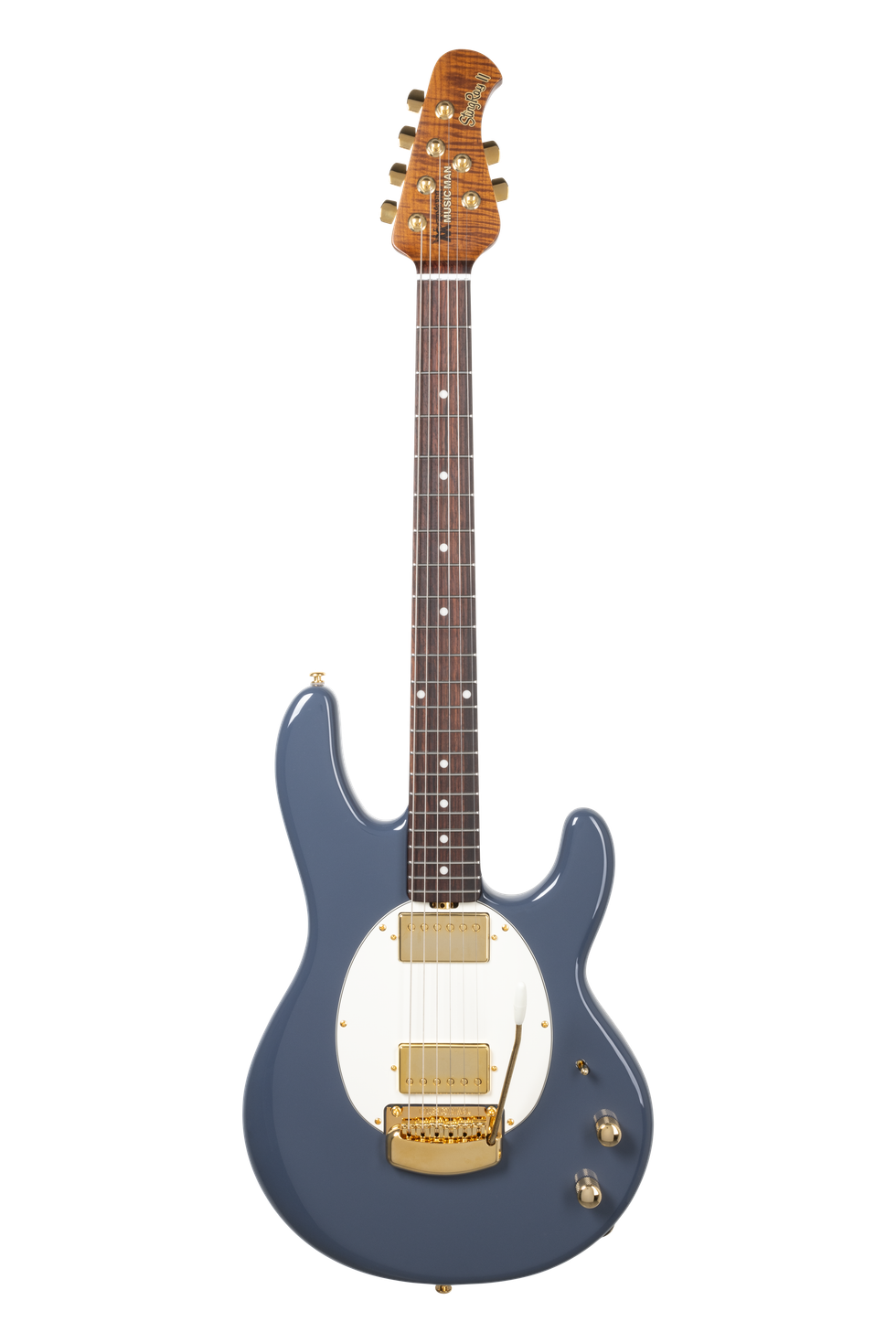
Some might find it hard to imagine Cory Wong without a Stratocaster. But in helping design the StingRay II, Wong not only deviated from the Strat template but delved into the realm of humbuckers. Our reviewer found the pickups warm and tight in the low end and more than articulate enough to accommodate Wong’s signature rhythm riffing. They’re also capable of smoky jazz tones and burly alt-rock rowdiness, making the StingRay II an axe for any mission.
$2,999 street, music-man.com
Ananashead Spirit Fuzz
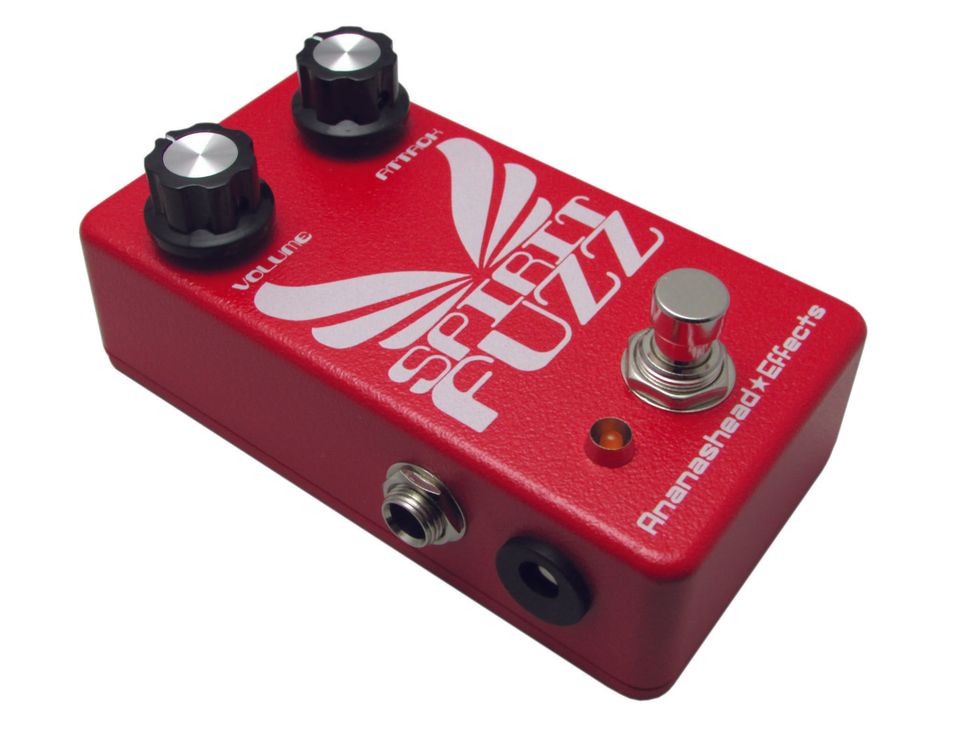
The Jordan Boss Tone is one of the nastiest 1960s fuzz artifacts—check Big Brother and the Holding Company's Cheap Thrills for reference—and Barcelona’s Ananashead captured every bit of that potency in the Spirit Fuzz. The Spirit Fuzz isn’t exclusively mean—it can be smooth and mysterious, too. And while it really loves humbuckers, it will happily take a buzzy trip with just about any guitar or pickup you put in front of it.
$117 street, ananashead.com
Great Eastern FX Co. Focus Fuzz Deluxe
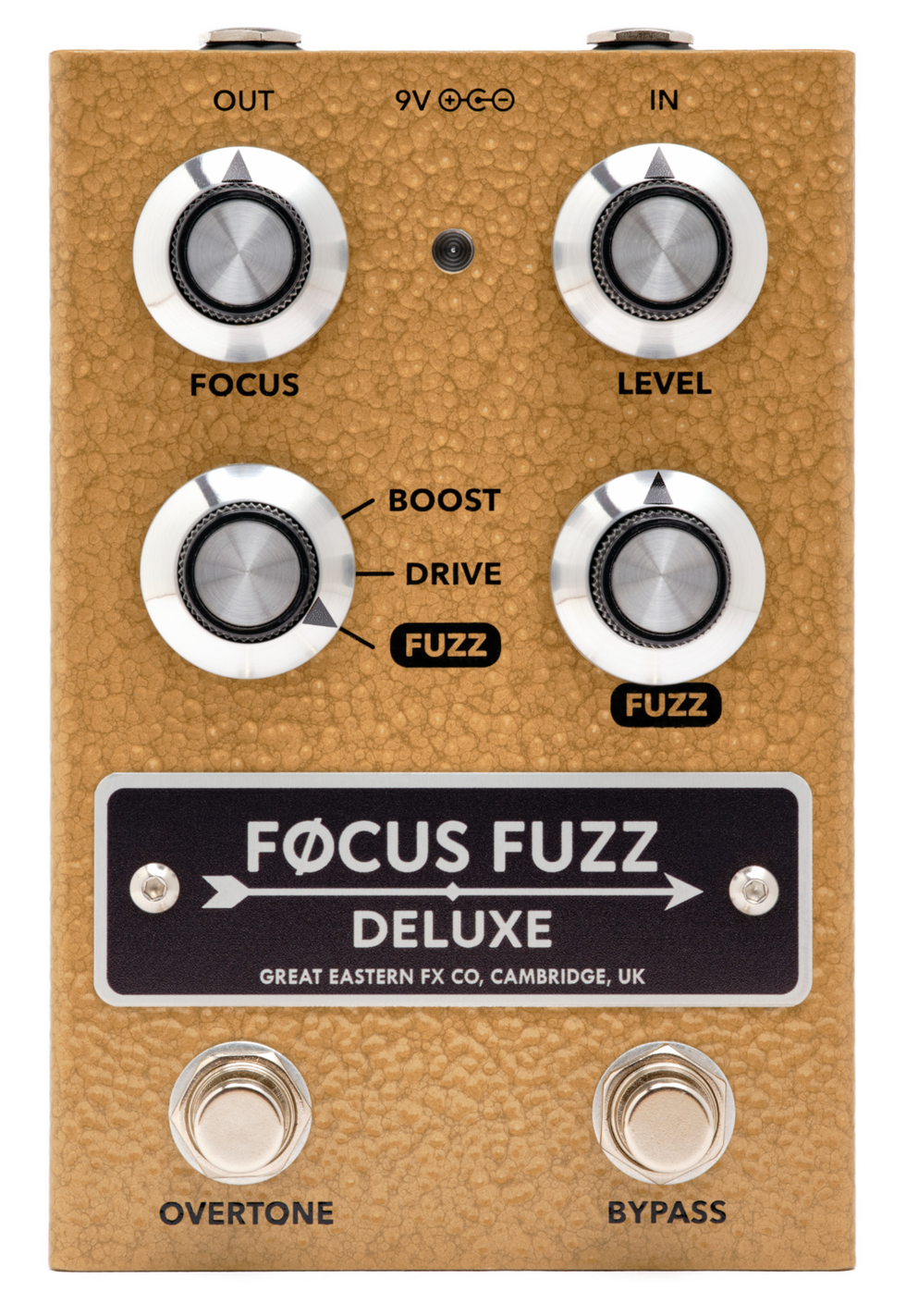
The Focus Fuzz Deluxe was destined to be a rare bird from the start. Great Eastern boss David Greeves had just 400 of the NOS transistors required to arrive at the Focus Fuzz Deluxe formula. But oh, what a formula it is. Unlike many fuzzes, it leaves lots of headroom for a dynamic touch, but still screams—all while offering superb boost and drive sections.
$349 street, greateasternfx.com
Boss Waza Tube Expander Core
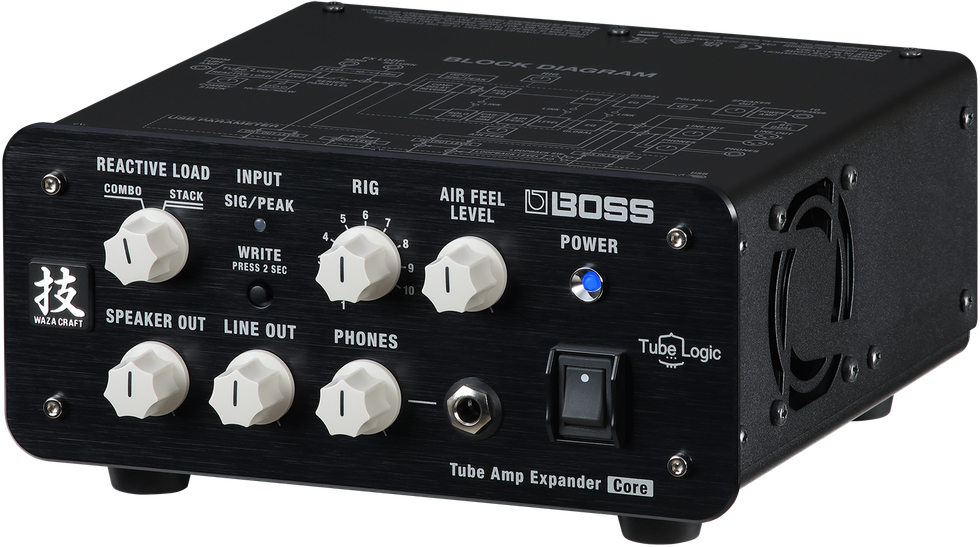
Boss’ first Tube Amp Expander reactive load box stood out among the competition for its integrated 100-watt power amp. Still, it was expensive, and though compact, wasn’t exactly backpack portable. The small, more wallet-friendly Core version addresses both issues, making one of the most powerful tools for recording big sounds at quiet volumes a more accessible proposition.
$769 street, boss.info
Divided By 13 CCC 9/15
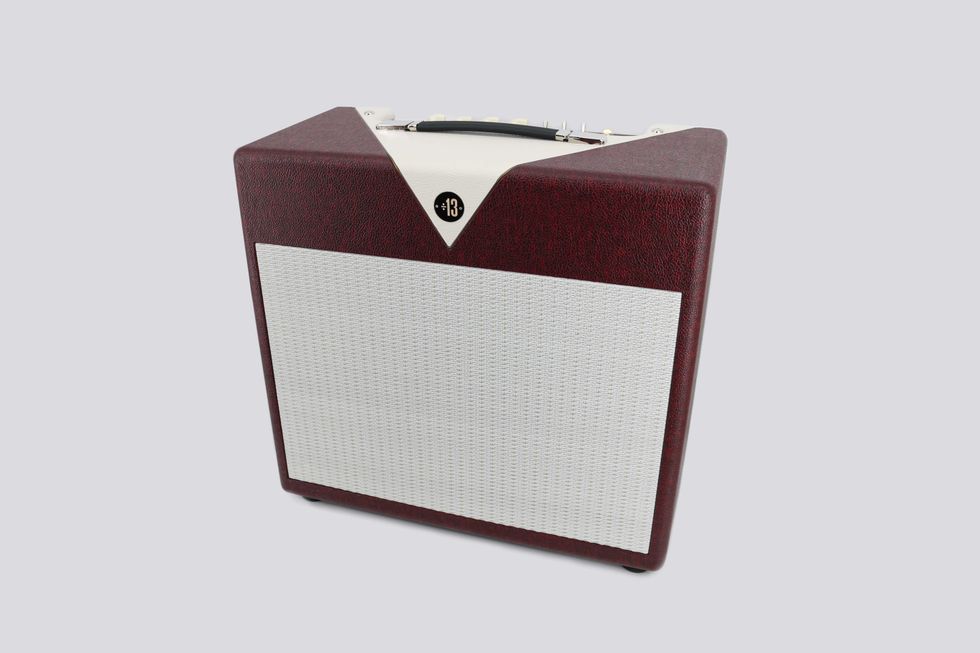
Clearly, Divided By 13 has thrived under the ownership and guidance of Two-Rock Amplifiers' Eli Lester and Mac Skinner. This brilliant design enables the lucky owner to select between 9-watt 6V6GT or 15-watt EL84 output stages. As you’d expect, it spans 1950s Fender tweed colors and 1960s Brit chime, all while staying dynamic and deftly ranging from clean to filthy.
$3,549 street, dividedby13.com
Moth Electric C. Regalis
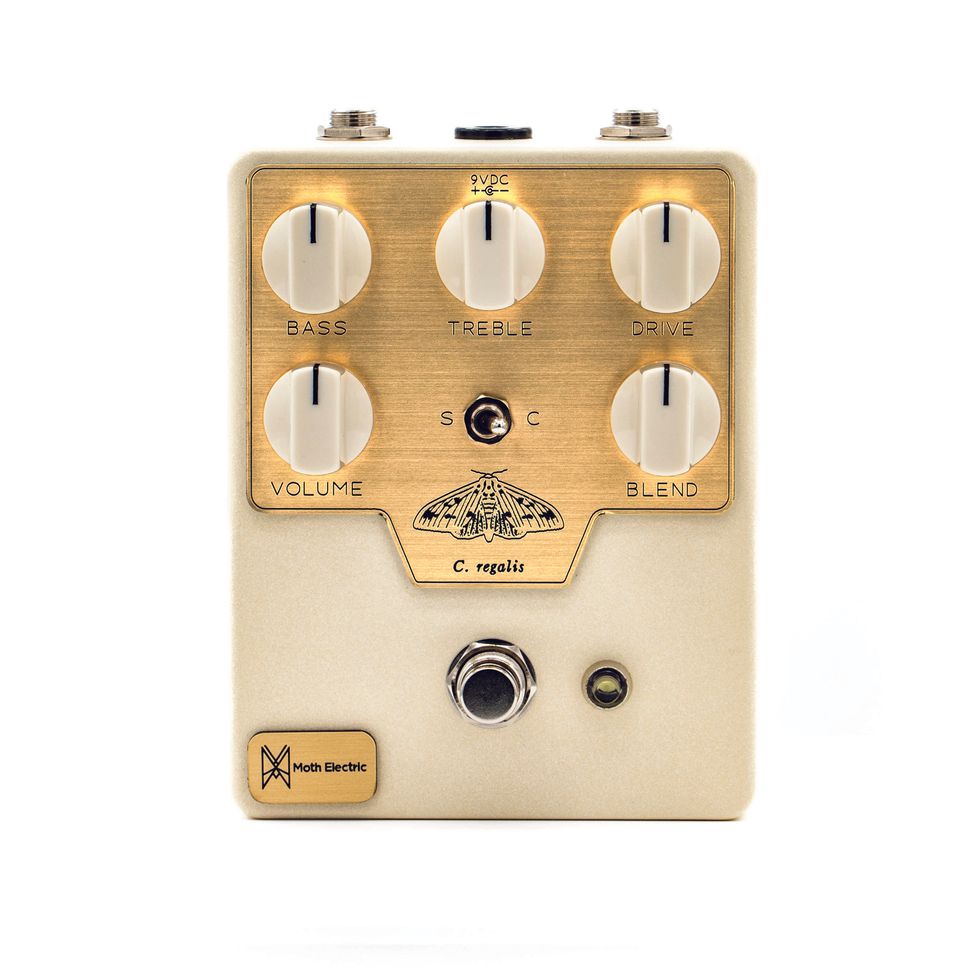
Any overdrive that offers blendable clean and dirty tones promises a certain measure of extra flexibility. But the C. Regalis’ powerful +/-15 dB bass-and-treble EQ, as well as its smooth/crunch switch that adds even-order harmonics, make it capable of very heavy and subtly boosted tones that can coax magic out of any guitar/amp combination.
$179 street, mothelectric.com
Taylor Gold Label 814e Koa Super Auditorium
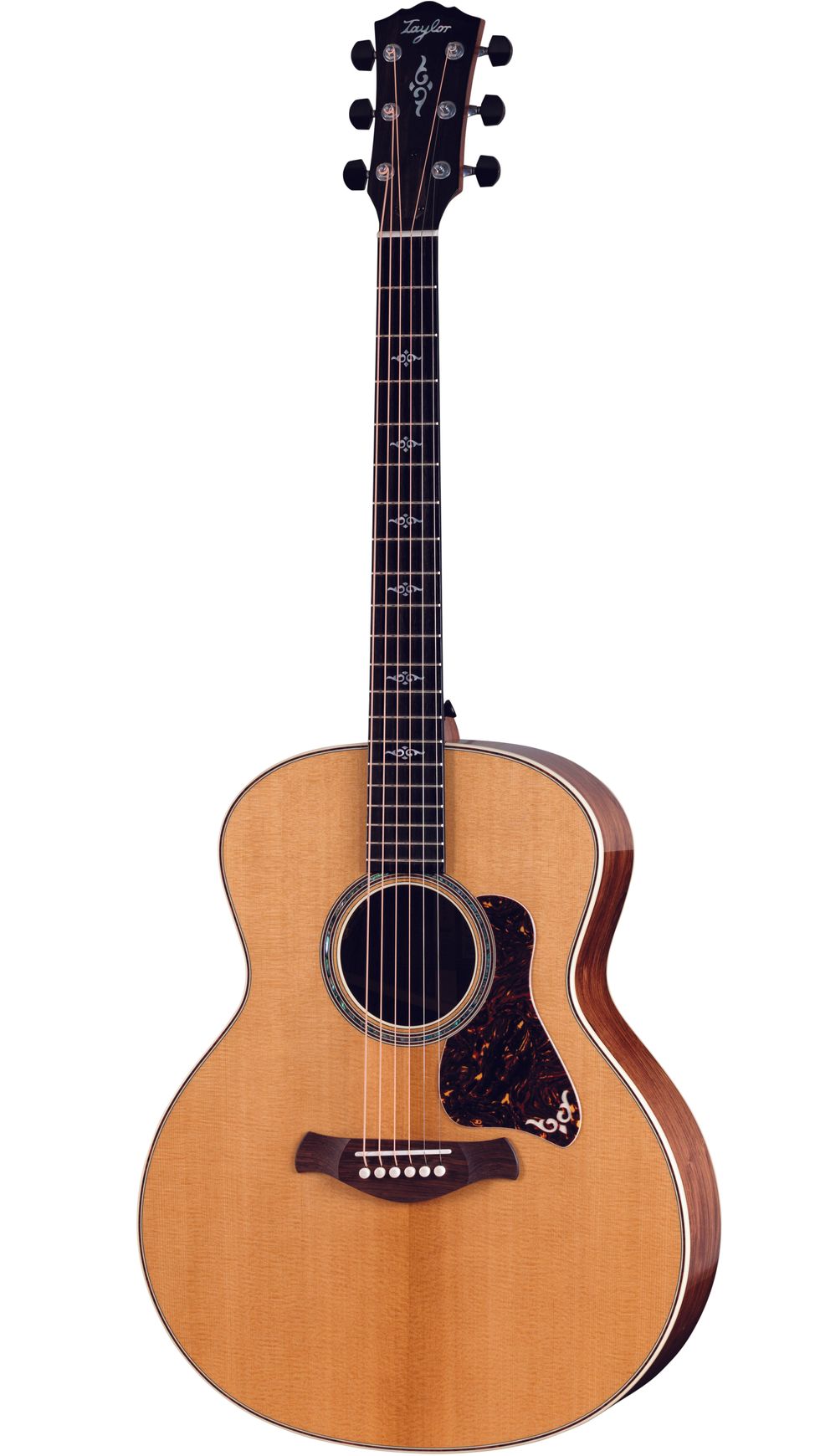
Seeing a Taylor on our Year in Gear list is practically inevitable. But even by Taylor standards the Gold Label 814e Koa Super Auditorium is Cadillac stuff—and a treat to play. For starters, the Super Auditorium body could be Taylor’s loveliest shape ever. But the just-right proportions, combined with Andy Powers' V-Class bracing, add up to a flattop that sounds seasoned, balanced, and beautiful.
$4,799 street, taylorguitars.com
Dunlop Mick Ronson Cry Baby
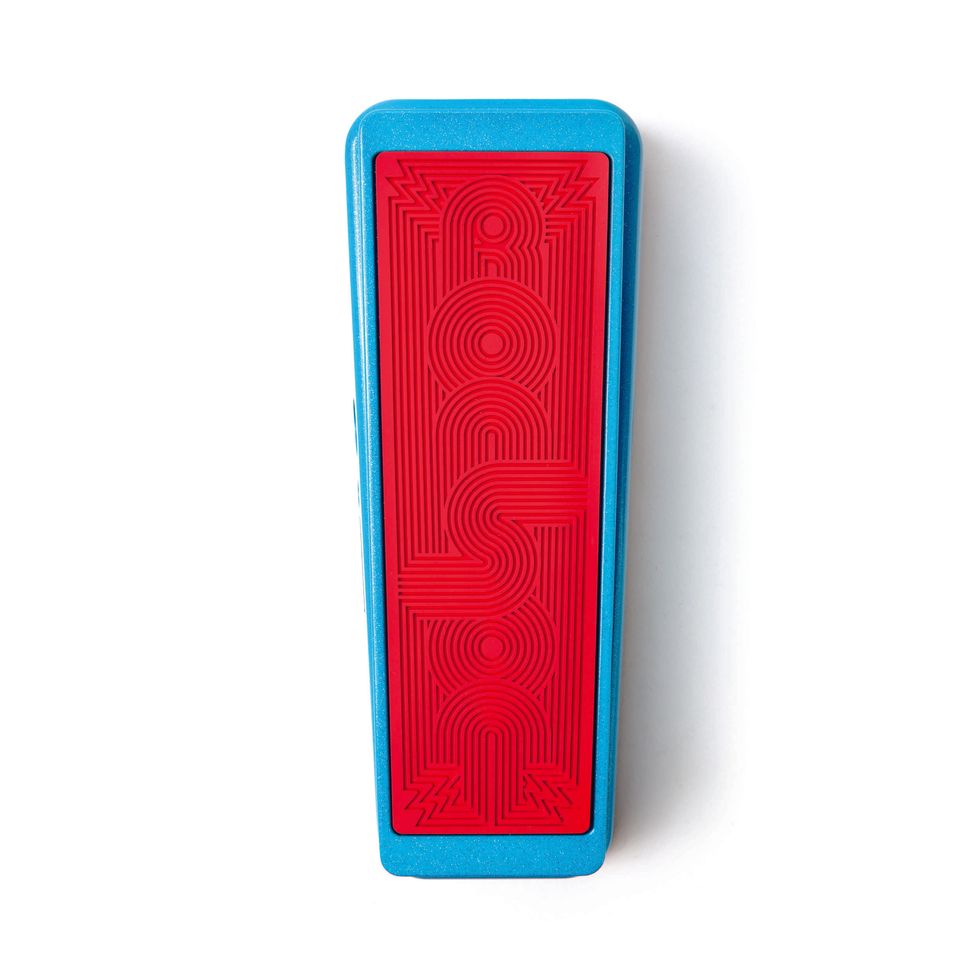
It’s super cool to see Bowie’s right hand man and ripper supreme, Mick Ronson, honored with this fantastic looking Cry Baby. But there is much practical appeal to this wah, too. It stays bold and heavy in the midrange and is a great match for a nasty fuzz, a wide-open Marshall, or any occasion where you want a solo or riff to stand out like a pair of cherry-red platform boots.
$265 street, jimdunlop.com
Marshall 1959 Super Lead Pedal
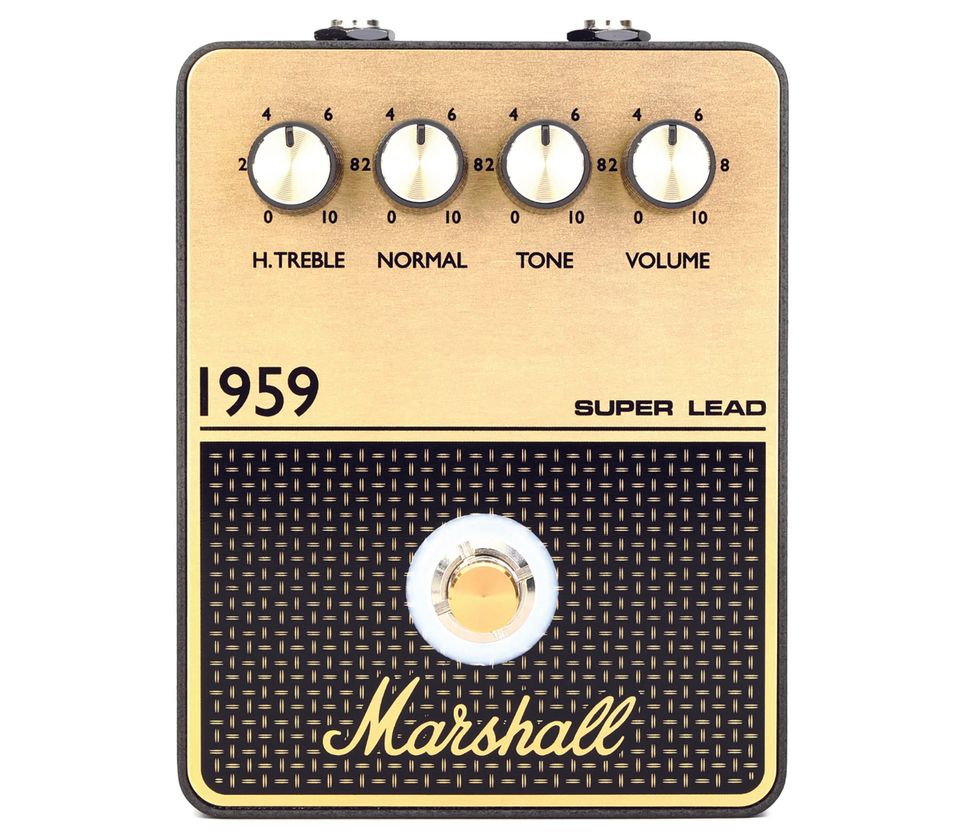
Most of the time you don’t really expect a Marshall-in-a-box to rival the sound of the real thing. But Ted Drozdowski, who had the good fortune to test this pedal alongside a real 1972 Marshall Super Lead, found it more than capable of holding its own against the original.
$159 street, marshall.com
Chase Bliss Brothers AM
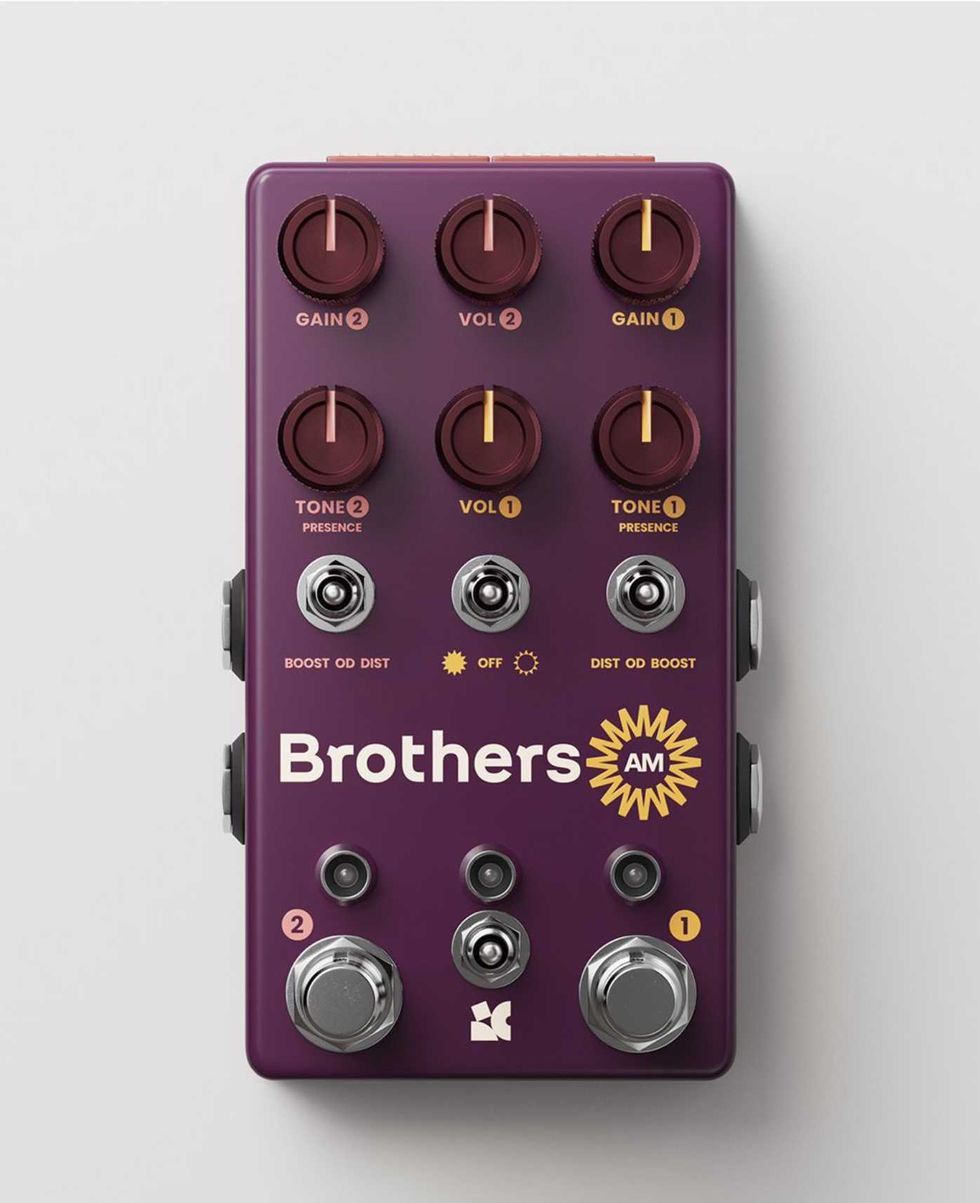
Chase Bliss’ Joel Korte and “Analog” Mike Piera—now there’s two sticklers for detail. It shows in the fruits of their collaboration, the Brothers AM, a take on Analog Man’s King of Tone that could help sate the hunger of players marooned on the King of Tone’s seemingly endless wait list. It’s a fantastic, agreeable drive that can add a lively edge to any guitar/amp pairing.
$399 street, chasebliss.com
PRS Archon Classic
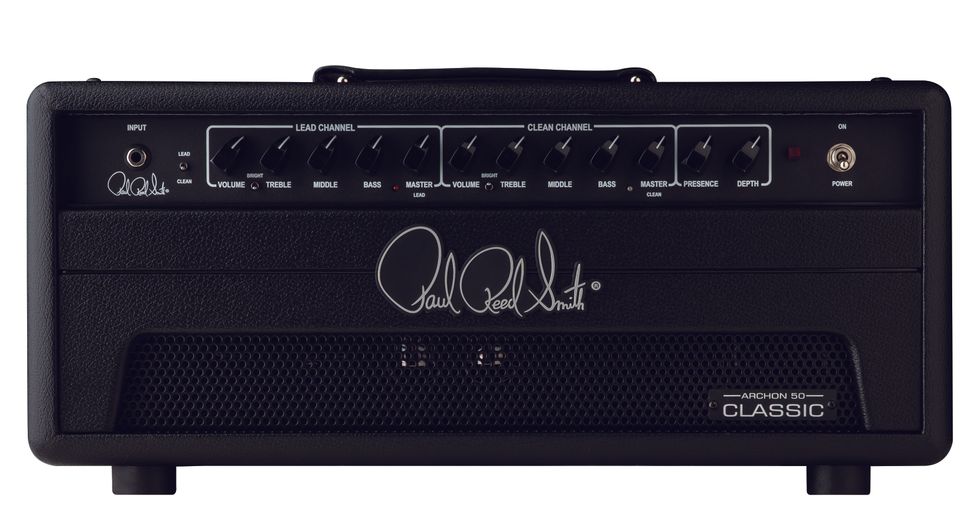
Most players probably associate the Archon name with ultra-high gain. But that’s not the direction PRS went in with this evolution of the original. The 50-watt, 2-channel Classic is, instead, a relatively streamlined affair that, as the name suggests, coaxes a lot of mid-rangey, Marshall-like tonalities from its 2x6CA7 power tubes and six ECC83S preamp tubes.
$1,149 street, prsguitars.com
Strange Audio The Eloise
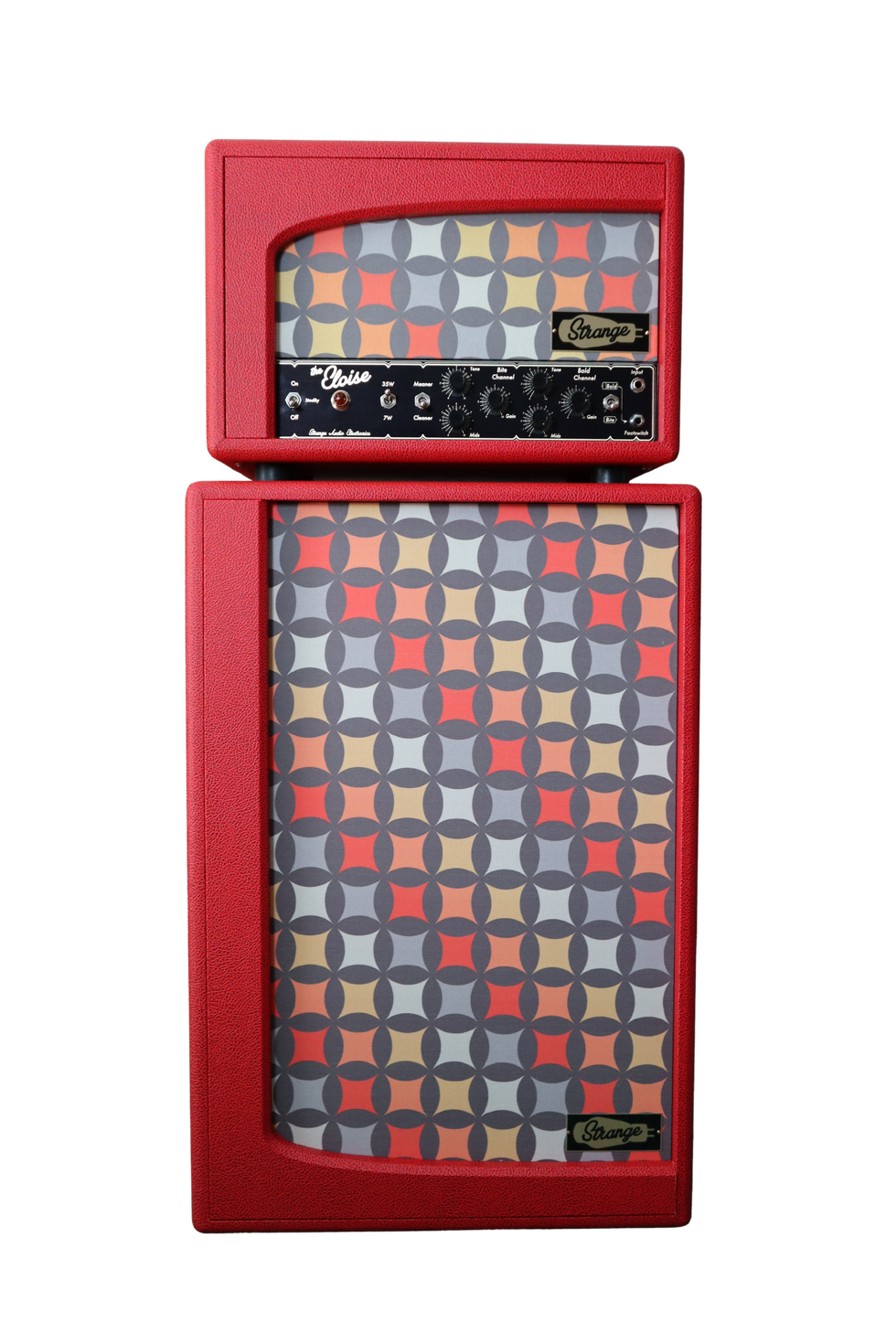
One of the more distinctive newcomers in the boutique amp world, Strange Audio has turned heads with its bold, midcentury-modern-inspired colorways and patterns—and circuits that sound as striking as they look. For its first head-and-cab design, the company has built a uniquely interactive control set with switchable preamp tubes, housed in a 35-watt, 2-channel, 6L6-powered package that appeals equally to natural-overdrive purists and pedal-platform players—and looks incredible onstage.
$3,199 (head)/$3,999 (with cab) street, strangeaudioelectronics.com
Verso Sine
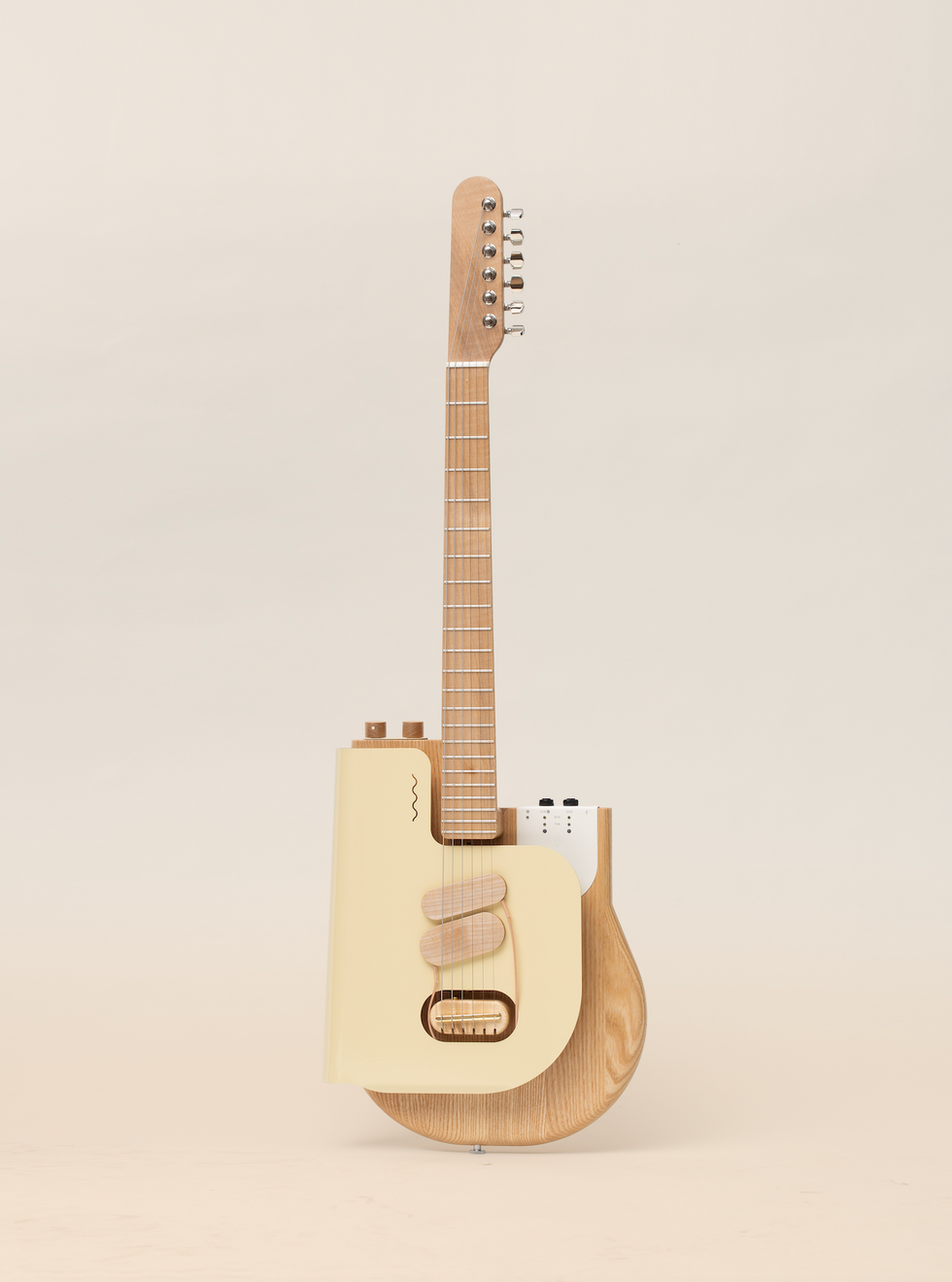
Leaping into the future, luthier Robin Stummvoll re-thought the nuances of electric guitar design and created an “expressive guitar” in the Sine. This truly experimental instrument pairs a powder-coated flexible steel “top” with Lehle expression controls to offer playability never before seen on a guitar, including volume-swell capabilities and two expression outs to run to your outboard devices. Plus, the Sine’s easily movable pickups and stereo outs multiply the sonic possibilities exponentially. It’s fun, forward-thinking, and intuitive.
$3,699 street, versoinstruments.com
Old Blood Noise Endeavors Dark Star Stereo
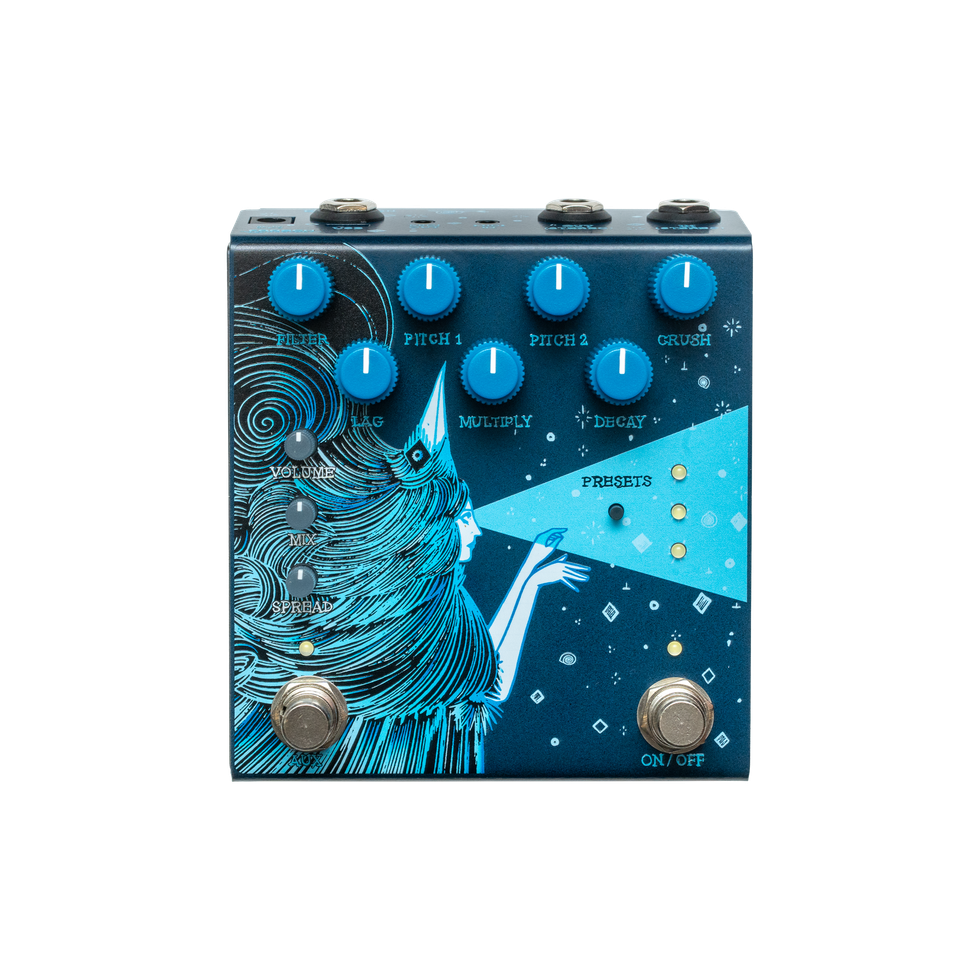
A digital reverb pedal that lives beyond simple effect categorization, the DSS is a feature-rich stomp built for creativity. With a control set that includes pitch shifting and bit crushing, the DSS provokes experimentation. There’s a great balance between the pedal’s deep, tweakable controls and easy usability. And it sounds just as great at always-on reverb settings as it does diving into the sonic cosmos.
$299 street, oldbloodnoise.com
Walrus Audio Voyager MkII
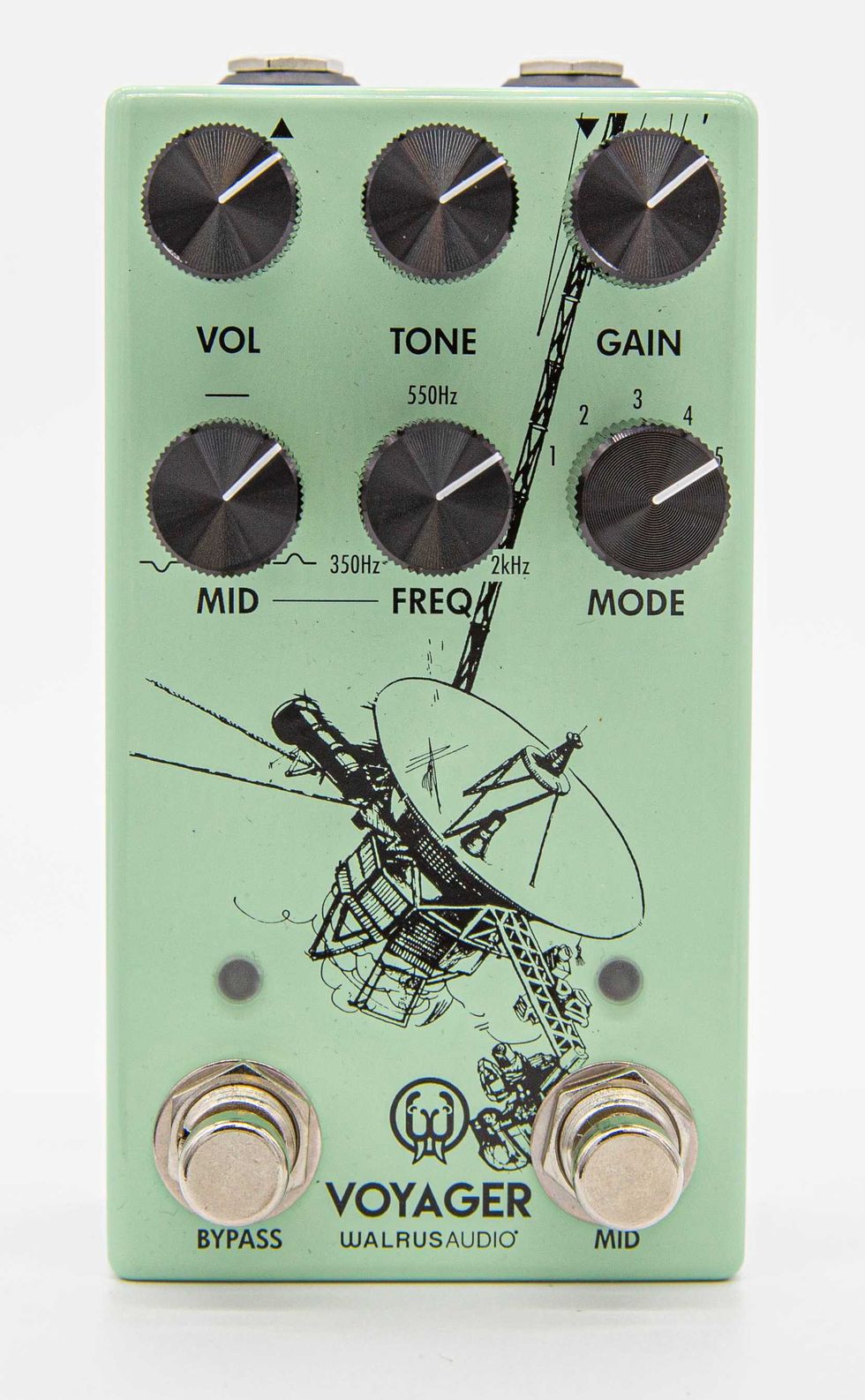
Built on a Klon-style foundation, the Voyager delivers a level of versatility that reaches well beyond the average klone. By combining the tight boost and overdrive users expect with a 2-knob sweepable-mid control set and switchable diodes—1N34A and silicon, both with and without bass boost—the Voyager opens up the sonic possibilities of the genre and demands attention.
$249 street, walrusaudio.com
SOMA Laboratory Harvezi Hazze
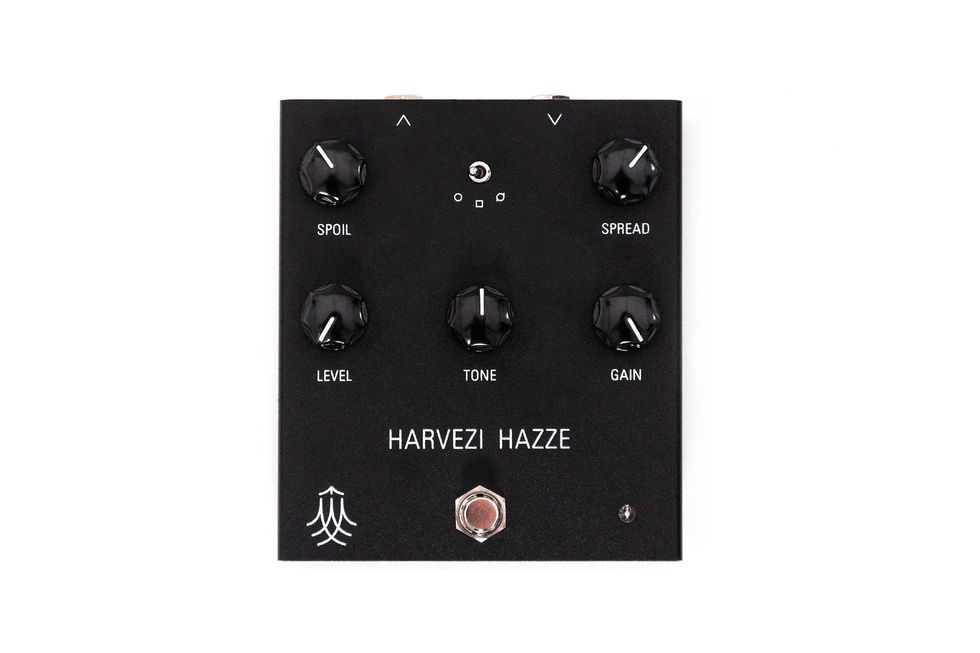
If you’re looking for the one distortion to rule them all, the Harvezi Hazze from SOMA Laboratory is a good place to start—and end—your journey. It can do your typical rodent-style dirt, but this transistor-based stomp’s unbelievably deep tweakability—centered around its wave-folding function—make it capable of just about any overdrive, distortion, or fuzz tone you'd dream up. It’s not cheap, but the Harvezi Hazze can outperform most signal-clipping boxes in its price bracket.
$349 street, somasynths.com
Fish Circuits Echo Limiteur
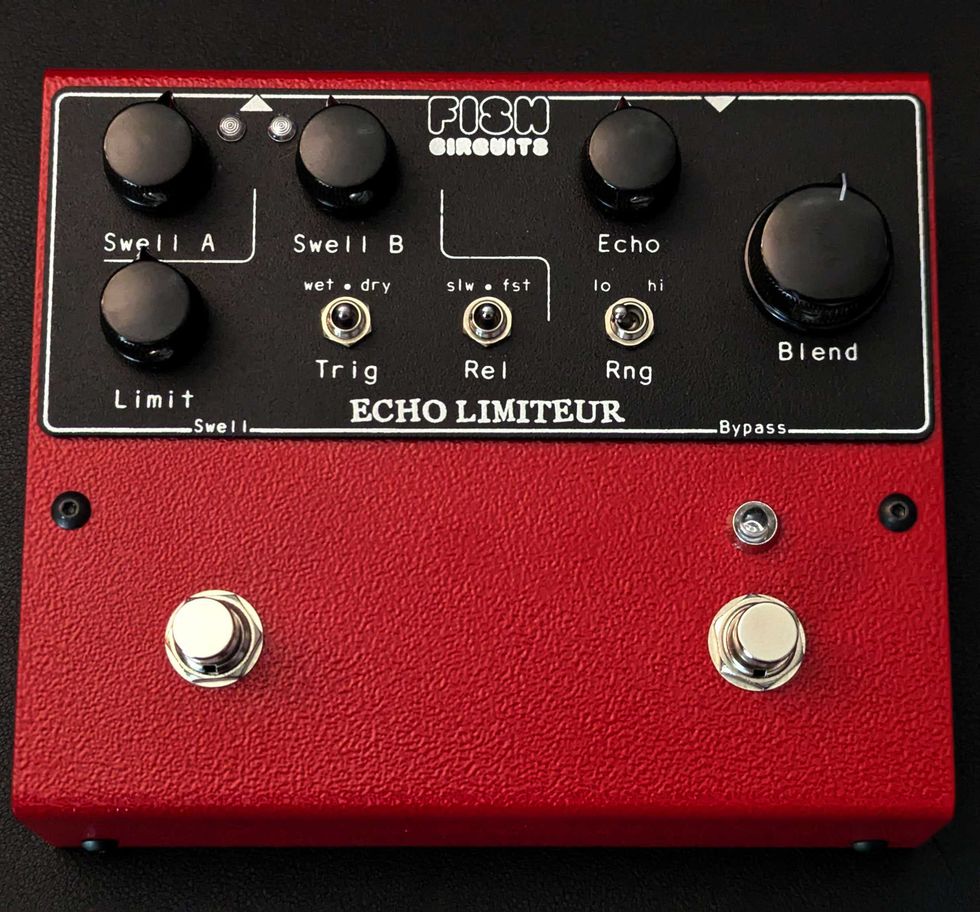
Fish Circuits designs pedals with equal attention to both sight and sound. The Echo Limiteur—a hefty, striking delay box—offers two modes that blend a warm analog echo with the extended range of a digital PT2399 chip. Its standout feature, dynamic delay mode, lets your playing intensity control the number of repeats, and when they start or stop. This stompbox has the rare, exhilarating ability to transform the way you play.
$349 street, fishcircuits.com
Mile End Effects Pique
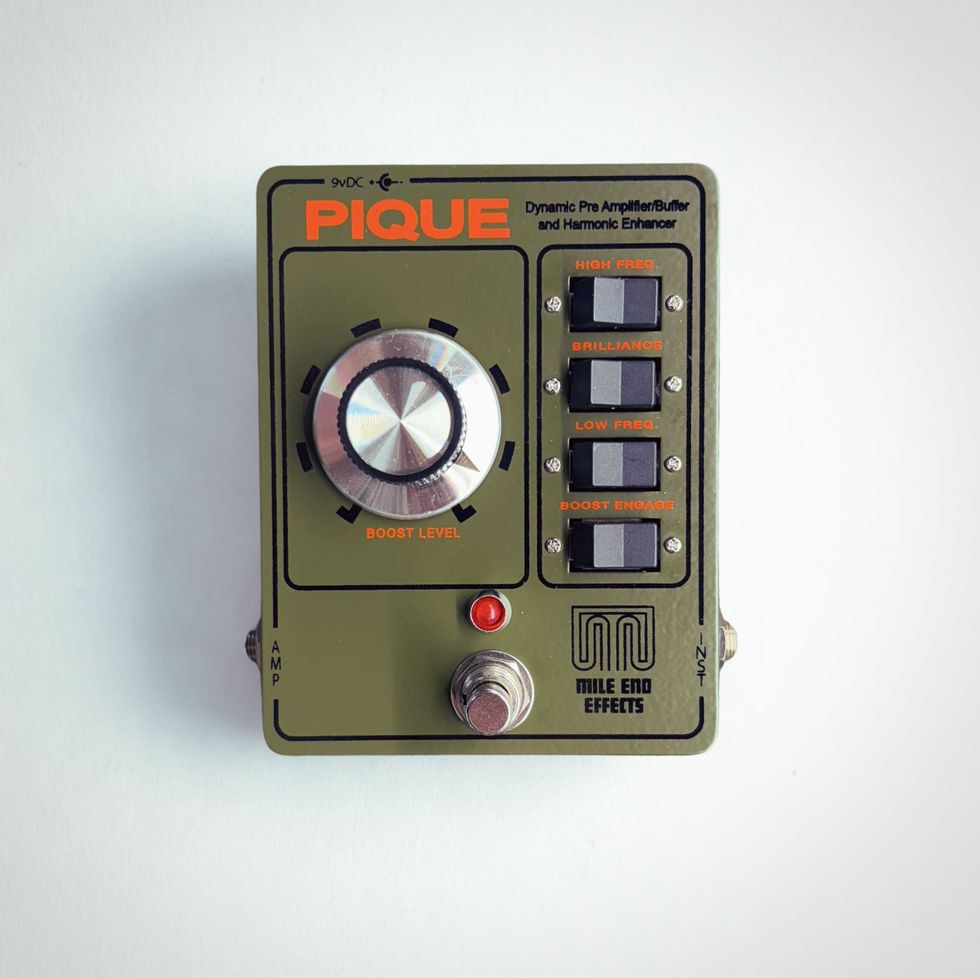
Montreal builder Justin Cober did something remarkable when he built the Pique: He made an EQ pedal that’s fun. The Pique is technically a 3-in-1 (a boost, buffer, and EQ—or, as Cober puts it, “frequency enhancer”) built around Mile End’s beloved Preamp 150 circuit, a take on the sounds in vintage Roland Space Echo units. By incorporating three straightforward EQ modes that enhance targeted frequencies, Cober ensures you spend more time chasing inspiration and less time tweaking settings.
$212 street, mileendeffects.org
Keeley Manis
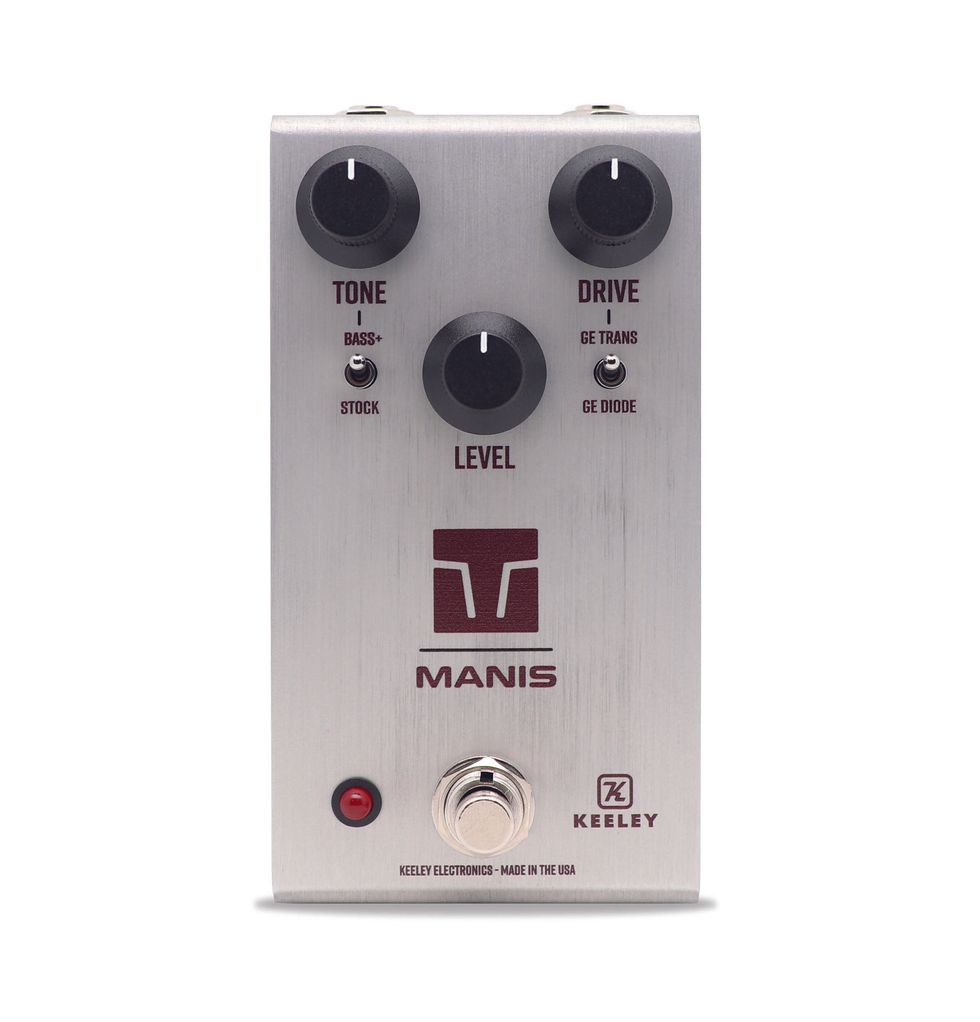
Did you really expect Robert Keeley to build a simple klone and leave it at that? Of course not! Keeley made sure his Manis possessed all the essential goodness of a Klon Centaur—it’s adaptable to changing rigs and backlines, and its overdrive and distortion profile ranges from barely boosted to raging. And while in many respects it's faithful to the Klon’s architecture, the addition of a germanium transistor clipping and bass boost options extends its utility and enhances its personality significantly.
$199 street, robertkeeley.com
Asheville Music Tools APH-12
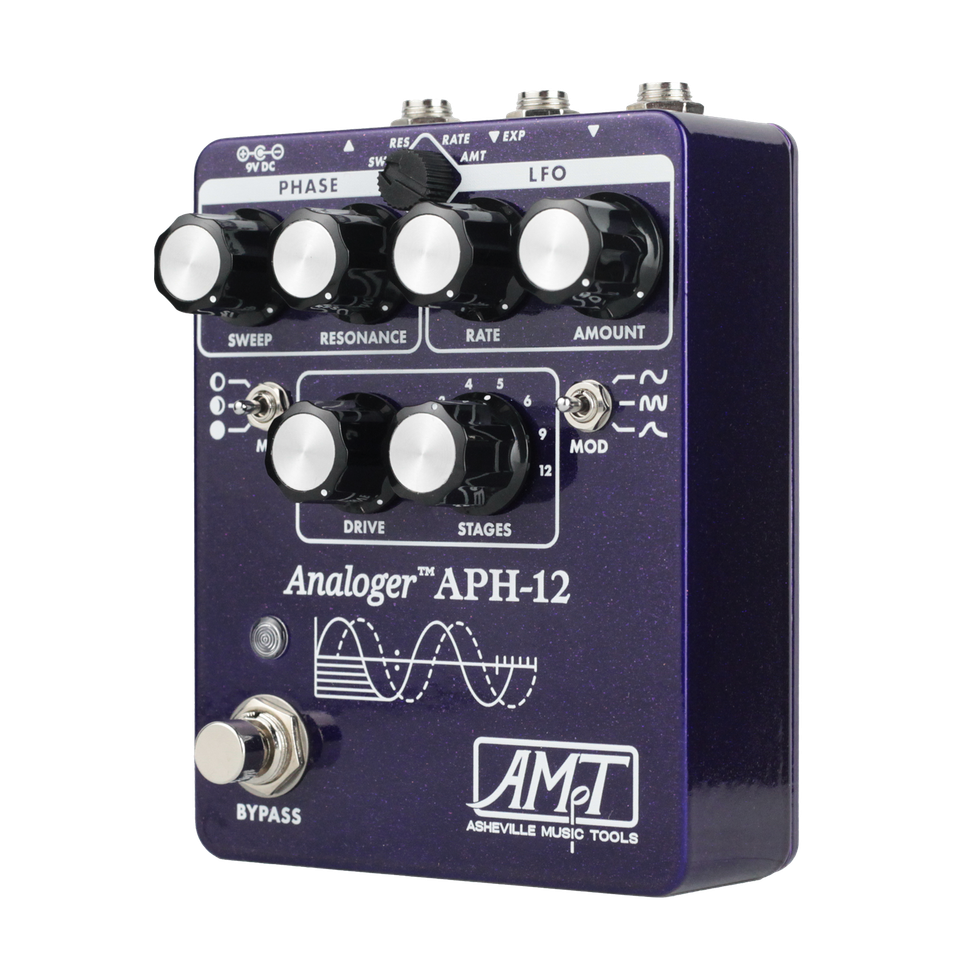
With 12 stages, the all-analog APH-12 phaser is capable of much more than simple phasing as most players understand it. It chirps, quacks, thrums, and throbs with intensity, richness, and personality. The likeness to the beloved Moog Moogerfooger MF-103 is not entirely coincidental. Designer Rick “Hawker” Shaich worked at Moog and helped refine the original MF-103 design. With that model long since discontinued, it’s wonderful to see an all-analog phase conceived in that same adventurous spirit.
$397 street, ashevillemusictools.com
Fender Laura Lee Jazz Bass
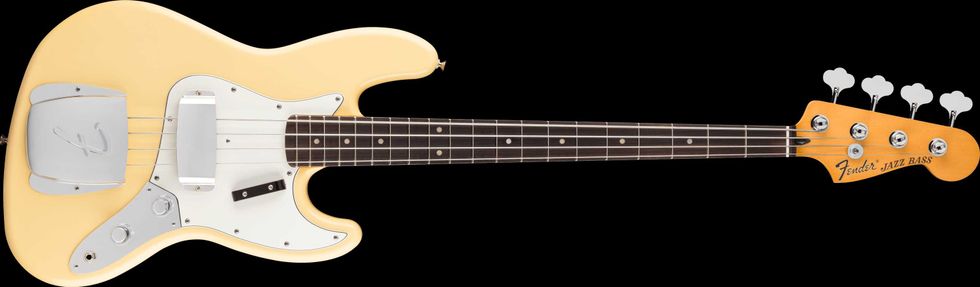
Khruangbin’s music is driven by groove. And bassist Laura Lee’s tasteful parts, which often evoke vintage soul and reggae lines, are ideal for the fat, punchy tonalities of a Fender Jazz Bass. This signature edition is actually a copy of a copy in one sense: Lee always used an inexpensive SX-branded J-bass-style instrument. But this flawless evolution of that bass, with DiMarzio Ultra Jazz noiseless pickups and jumbo frets—not to mention that ashtray pickup cover—is both a looker and a studio-grade performer.
$1,499 street, fender.com
MXR Bass Synth
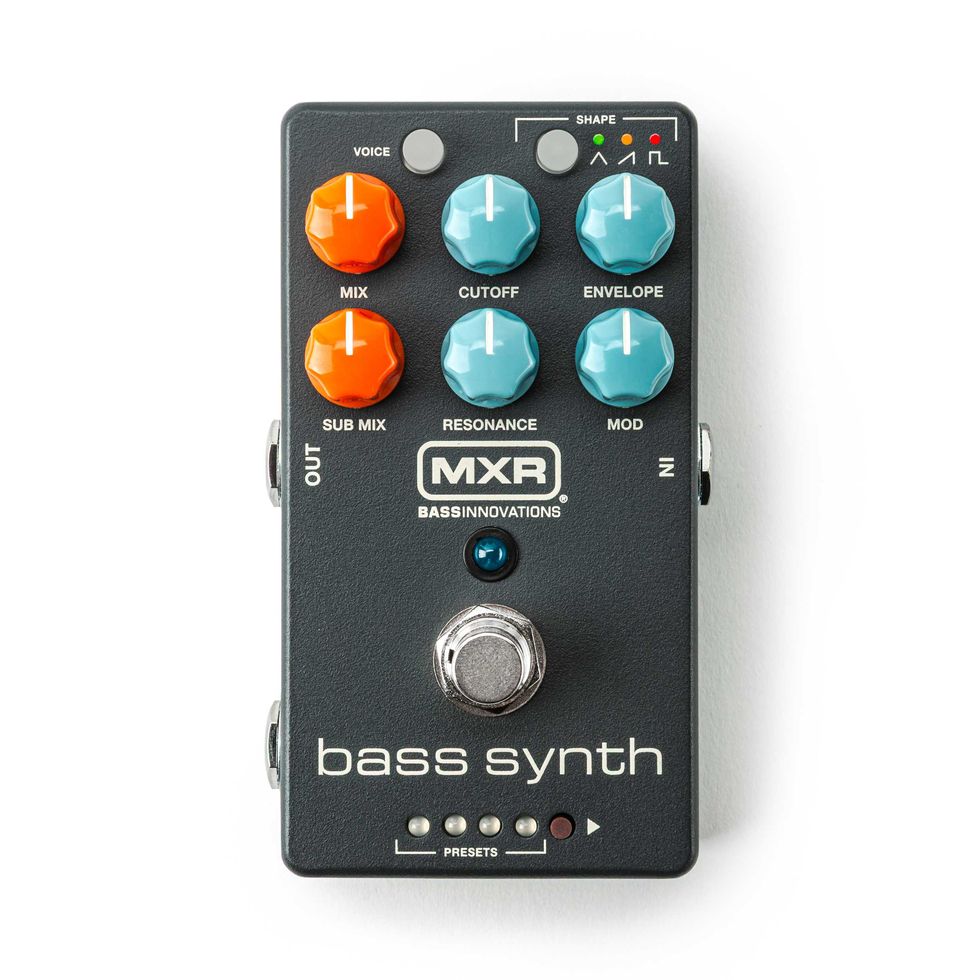
MXR’s Bass Synth is the kind of pedal that can blur the differences between a stringed instrument and a keyboard. And the “synth” in the name is not one that MXR tosses about lightly in this case. Several textures here use vintage keyboards like the Minimoog and Stevie Wonder’s TONTO synth as sonic departure points. The MXR not only captures these tones convincingly, but makes it easy for novices with less synthesis experience to incorporate them into their vocabulary.
$285 street, jimdunlop.com
PRS S2 Special Semi-Hollow
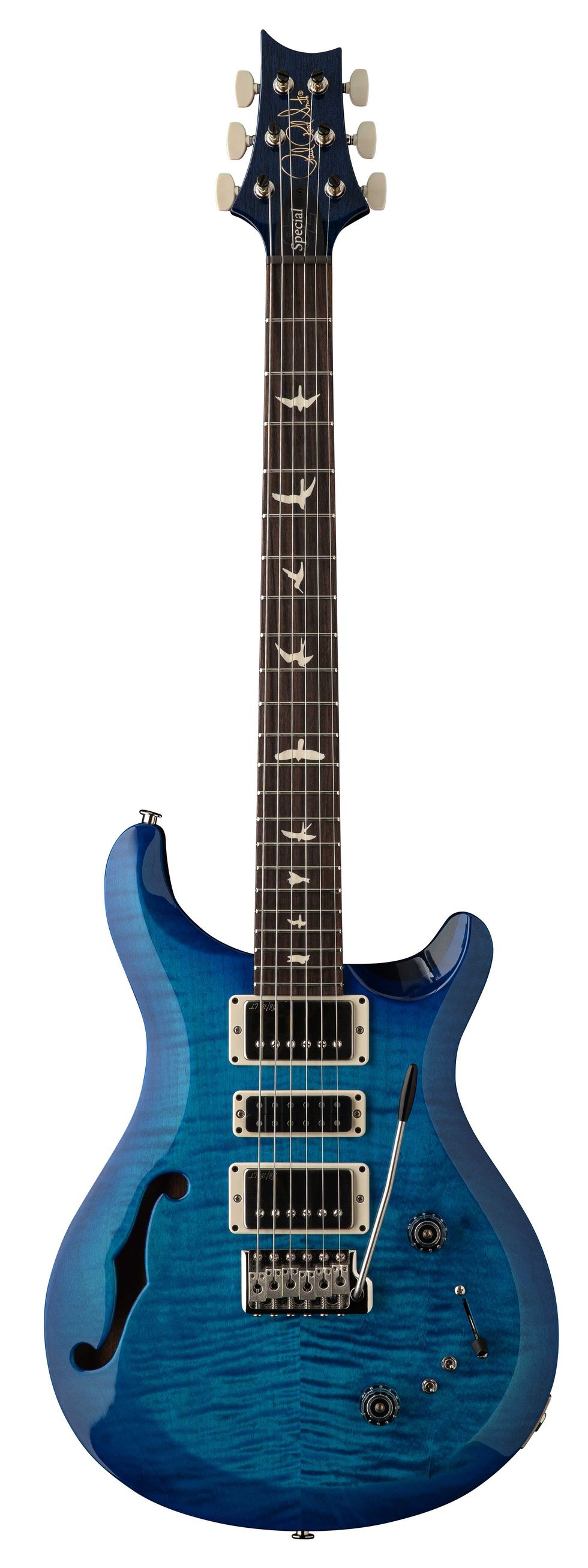
We’re used to PRS guitars being well-built, smooth-as-butter players. And yeah, they tend to sound pretty great, too. But the S2 Special Semi-Hollow, with its 58/15 humbuckers in the neck and bridge positions, a Narrowfield pickup in the center, and a bevy of switching and tapping options, is wildly versatile and possesses a distinctive, airy semi-hollow voice that represents a cool alternative to PRS signature sounds.
$2,599 street, prsguitars.com
Aclam Go Rocky Go
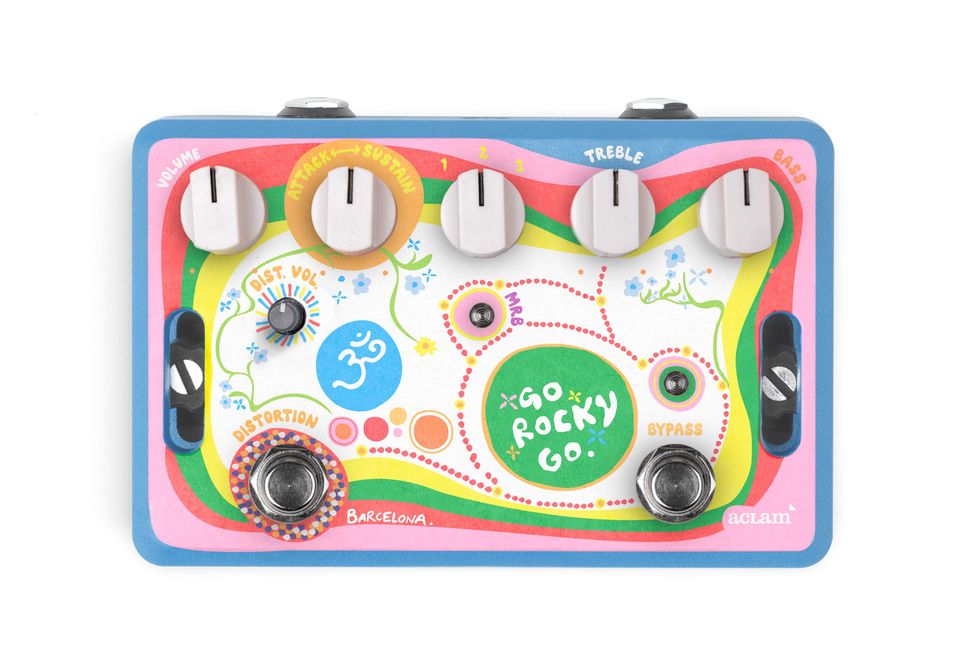
In terms of pure sonic presence, it’s hard to match the toothy, trebly tones that marked many Beatles recordings of the 1966-1968 period. Much of what made those sounds distinctive was the band’s occasional use of Vox amps with all-solid-state circuitry or solid-state preamps. The Go Rocky Go, the third of Aclam’s homages to these amplifiers, apes the sound of the Vox Conqueror, which spiced up many White Album tracks. But it’s also a drive, distortion, and fuzz that offers delicious alternatives to familiar, run-of-the-mill dirt sounds.
$348 street, aclamguitars.com
Marshall JVM, DSL, JCM 800 and JCM 900 Pedals
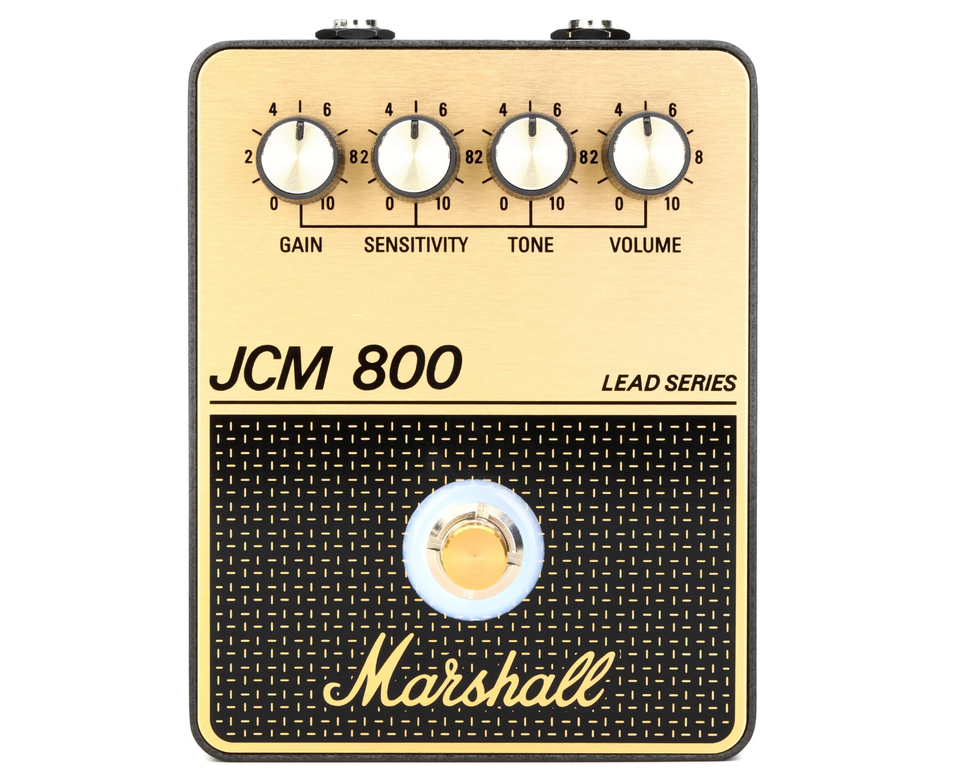
Four pedals, four award winners. Not a surprise, perhaps, given that it’s Marshall. On the other hand, generating the sheer mass and presence of a Marshall from a pedal isn’t easy, which makes this quartet of heavies—which span a rainbow of gain colors—very impressive indeed. Just as impressive is the $159 tag for each, a very nice price considering how close these stomps come to the real thing.
$159 street, marshall.com
Wampler Cryptid
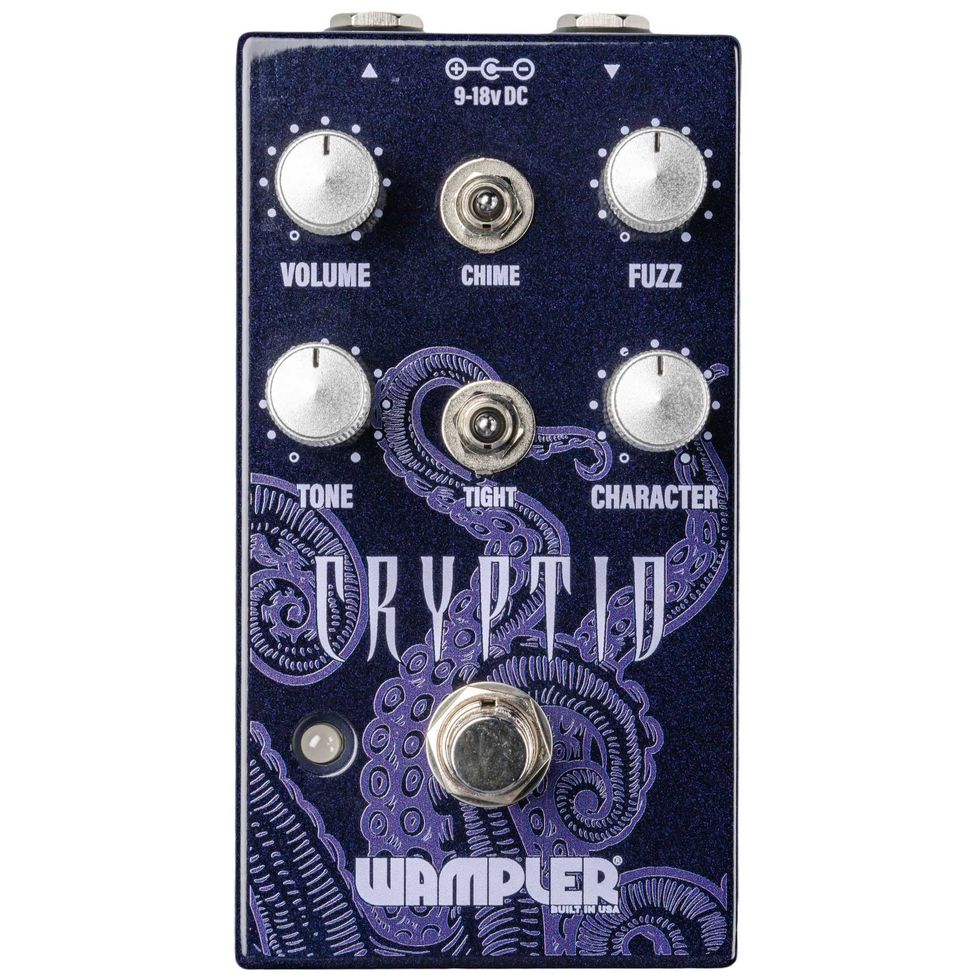
We’re always intrigued when a manufacturer releases a “fuzz for those that don’t like fuzz.” What could that possibly mean? In the case of the Cryptid, it definitely isn’t a fuzz that skimps on nastiness. While it doesn’t imitate any specific classic fuzz, it can erupt with explosive tone—and its bias control adds sputtery, delightfully deranged textures. Where it breaks from fuzz tradition is in its ability to deliver overdrive and bright, near-clean tones, creating a versatility that could make many pedals on your board feel obsolete.
$199 street, wamplerpedals.com
Vox V863-CA Wah
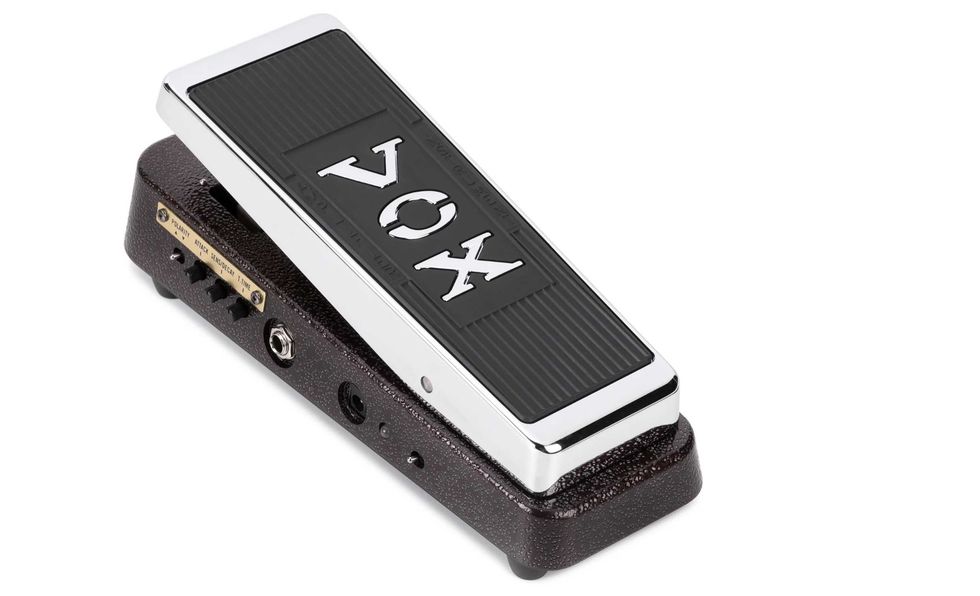
Vox has always been fearless about messing around with familiar formulas. Sometimes their success in these endeavors is in the eye of the beholder, as any collector of mid- to late-1960s Vox oddities will tell you. But the V863-CA, which can switch from wah to envelope generator or envelope follower merely by lifting your foot from the treadle, fits seamlessly into Vox’s history as a design renegade—while remaining highly functional and musically intuitive.
$279 street, voxamps.com
Boss RT-2 Rotary Ensemble
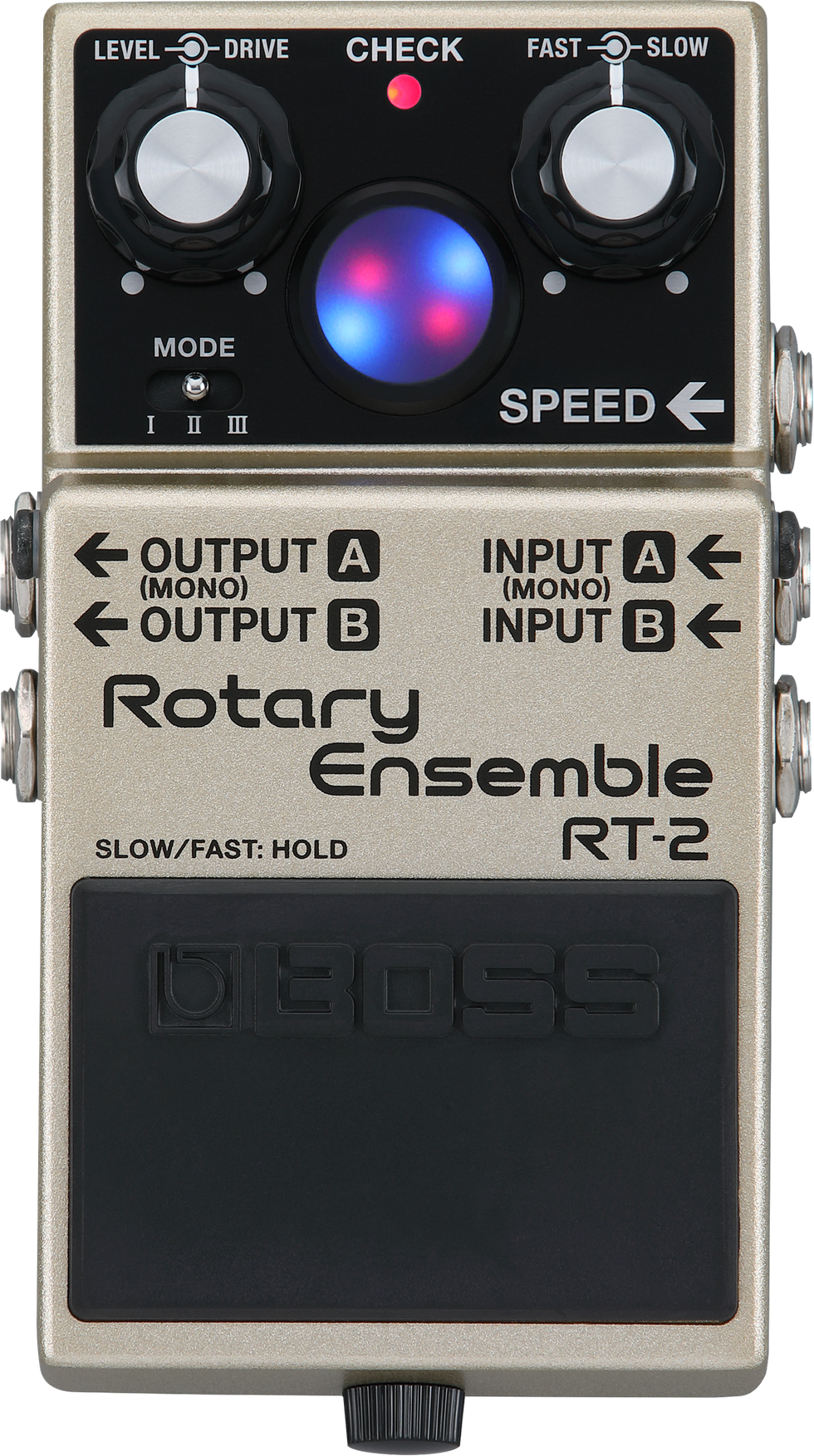
This simpler evolution of Boss’s discontinued RT-20 is definitely one of the better rotary speaker simulators you’ll find in a compact pedal. It’s rich and realistic, in no small part because its simple control layout still enables a user to shift emphasis between virtual treble and bass horns, add simulated tube amp drive, and switch between slow and fast ramp times. The resulting modulations are much less binary, more organic, and considerably more atmospheric than those from a simple vibrato pedal.
$239 street, boss.info
Strymon EC-1
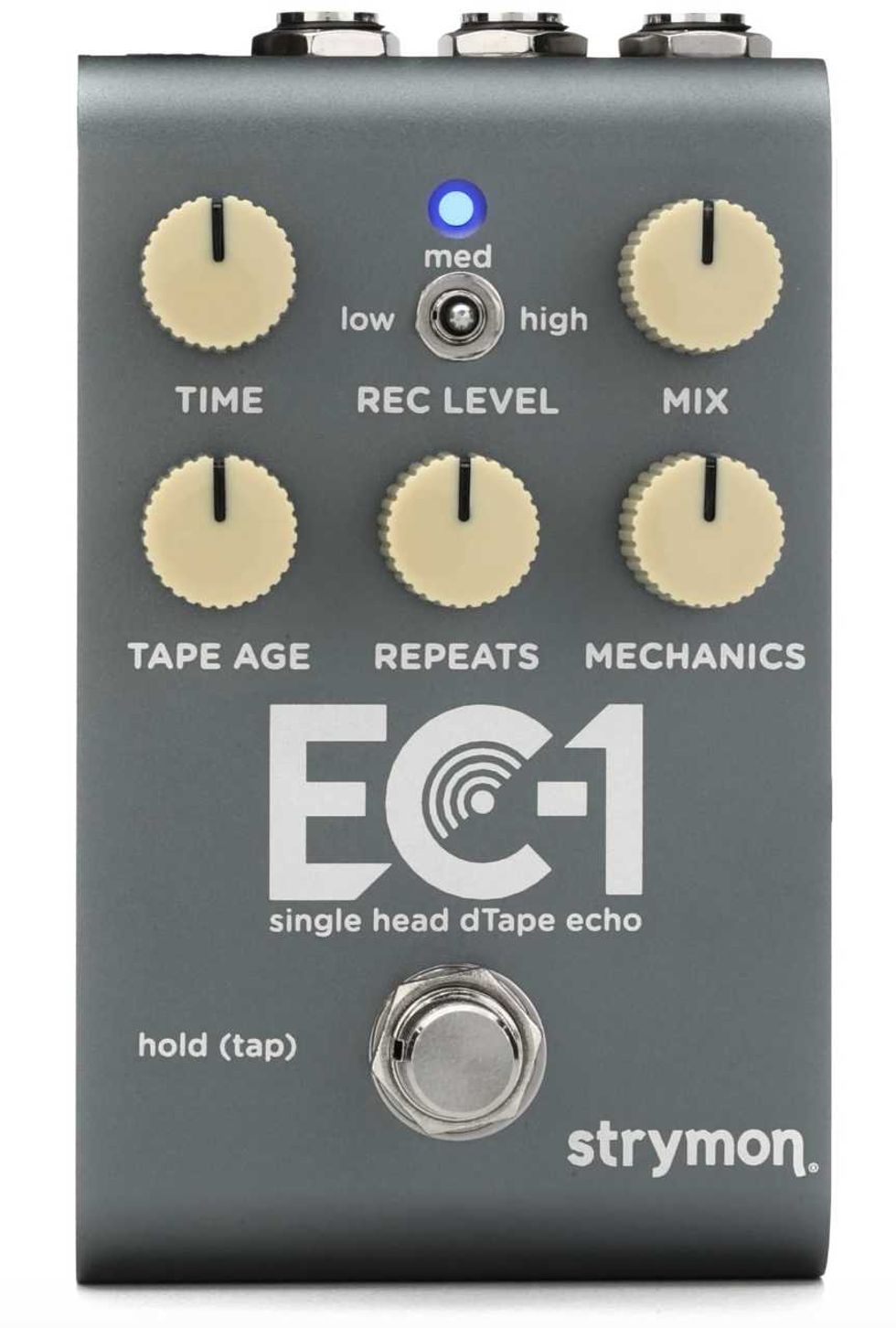
Typically, when a pedal maker tries to capture Echoplex tones, the solid-state EP-3 is the go-to reference. Strymon, however, took a different path: it based its design on the less common—and in some circles, more coveted—tube-driven EP-2, and used one modded by legendary amp technician Cesar Diaz. The result is an Echoplex simulation that feels both warmer and punchier than many others on the market, an appealing proposition in a crowded product segment.
$279 street, strymon.net
NUX Queen of Tone
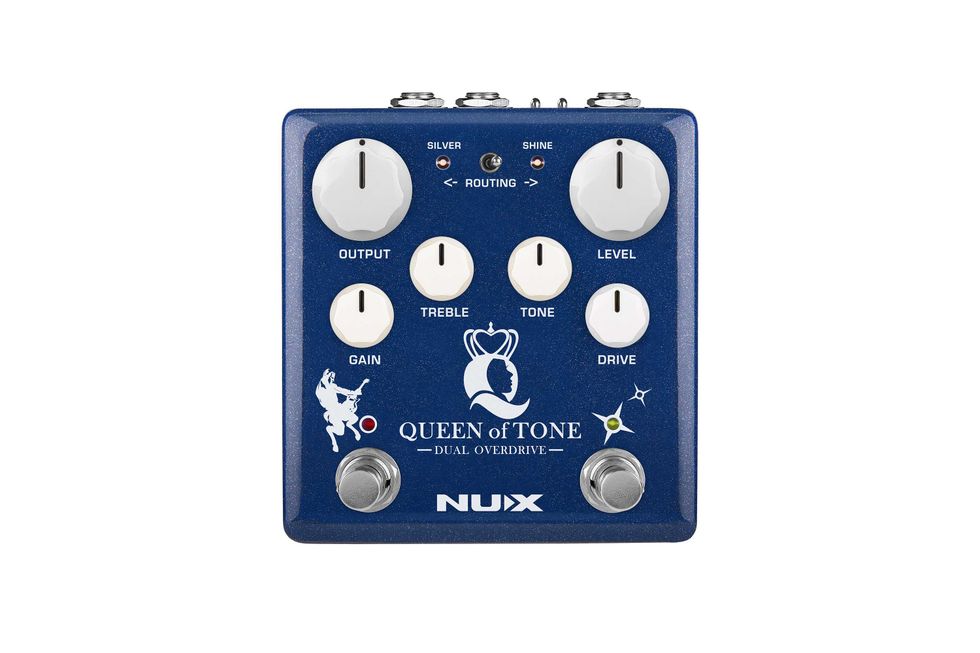
The name may suggest a note-for-note copy of Analog Man’s much-coveted King of Tone, which is a modified mashup of two Marshall BluesBreaker circuits. But NUX’s two-headed overdrive machine actually unites the company’s BluesBreaker-style Morning Star overdrive and their take on the Klon Centaur, the Horseman. You can, of course, switch the order of the effects, which can yield many interesting colors, but you can also opt for a raspier “silver” version of the Horseman or a FET circuit that will hammer the front end of an amp.
$149 street, nuxaudio.net
Berzerker Aquanaut
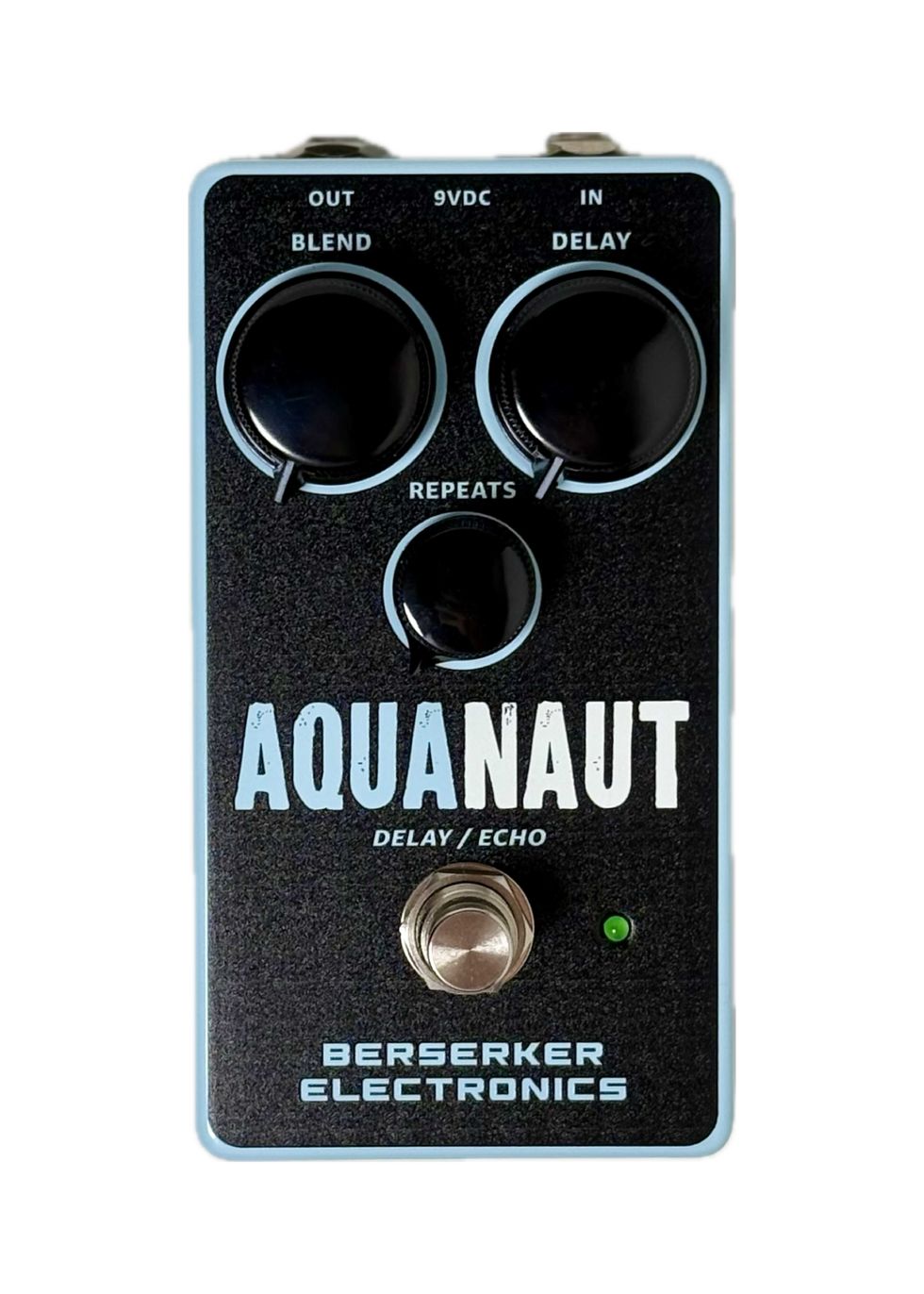
The affordable, U.S.-built Aquanaut takes an interesting approach to achieving its pleasing and unmistakably analog-like tone color. For generating repeats, the unit employs the PT2399 digital chip—an inexpensive device once used in karaoke machines that delivers analog haziness. However, the Aquanaut also uses analog filtering at the input and output, which adds to an overall sense of bucket brigade toastiness without the clock noise.
$129 street, berserkerpedals.com
PRS SE NF 53
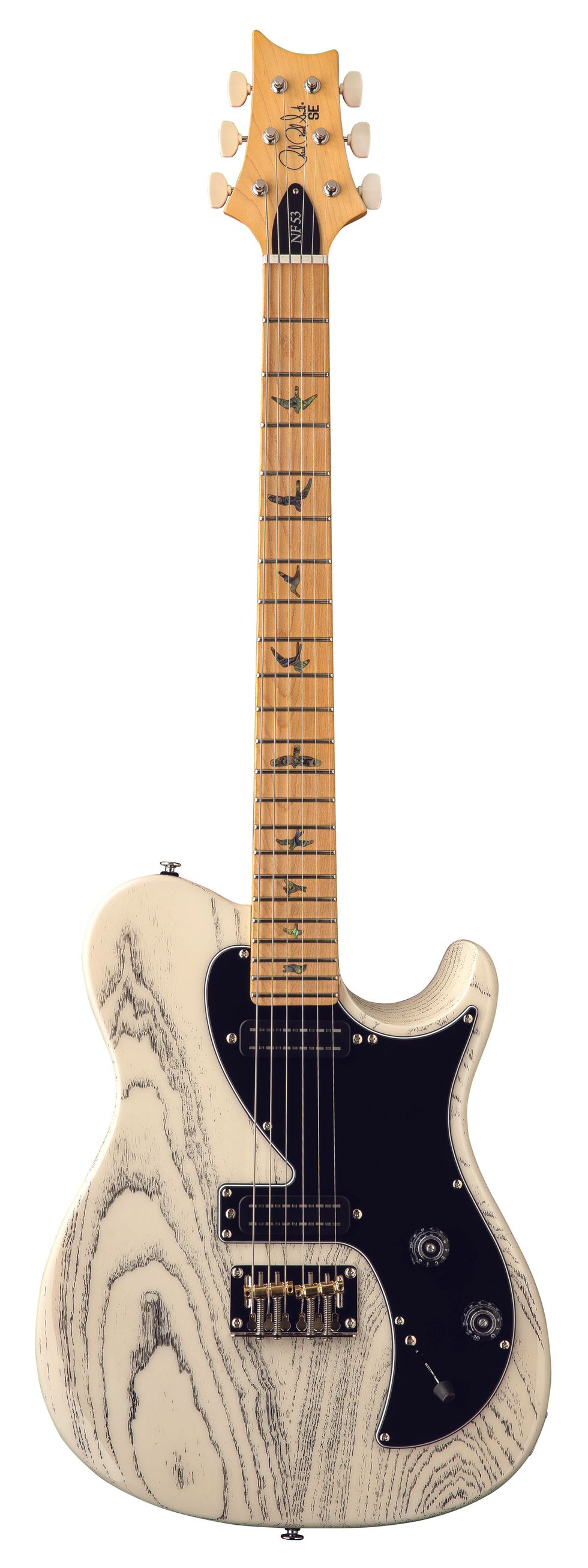
At first glance, the single-cutaway might mislead a novice into thinking the SE NF 53 is just another T-style guitar—but that label hardly does justice to its distinctive qualities. The Narrowfield DD humbuckers, for instance, can deliver tones that are punchier, grittier, or smoother than a Telecaster’s, depending on how you set the guitar’s volume. Meanwhile, its streamlined design will feel familiar—and inviting—to anyone drawn to T-style guitars for their elegant simplicity.
$2,899 street, prsguitars.com
Kingfish & Bohlinger Jam! Plus Talk New Album, Record Label & Gear!
At just 26, the guitar-playing phenom has already netted a Grammy, earned a signature Telecaster, started his own label, and we think this is just the beginning. John Bohlinger checks in with the lovable Mississippi kid who always has a guitar nearby and continues finding inspiration in his church roots and new gear.
Sponsored by StewMac: https://stewmac.sjv.io/APO2ED
NUX Steel Singer Review
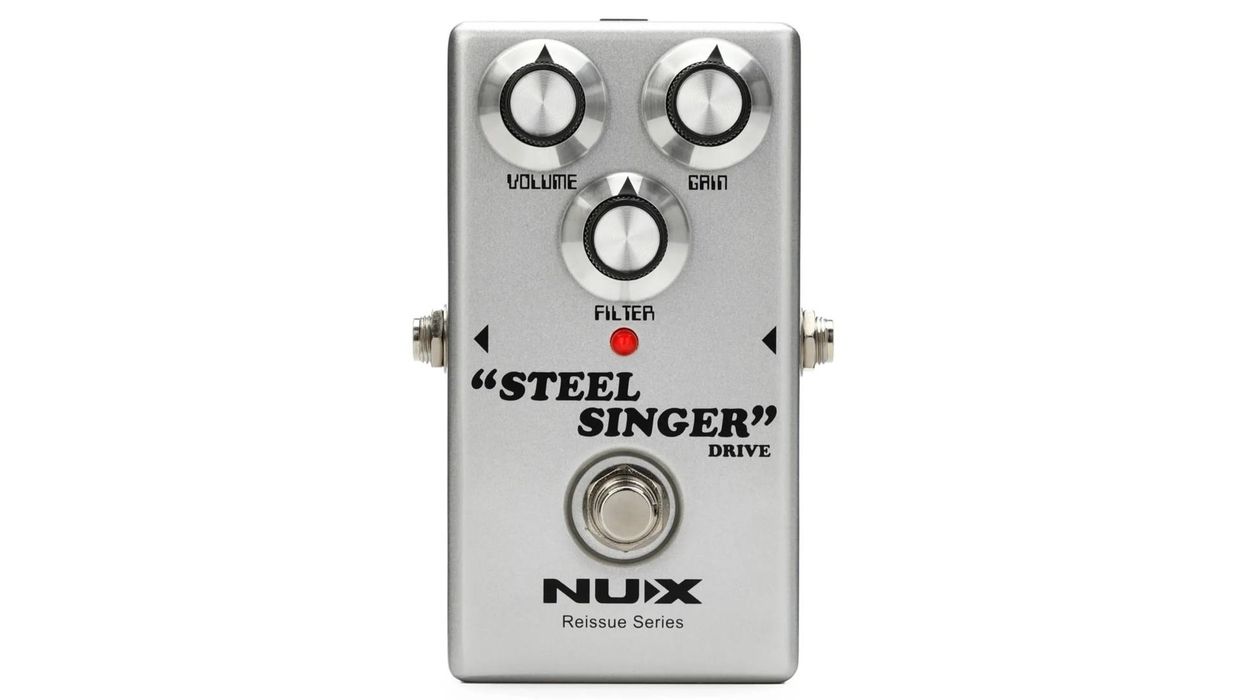
Like most of you, I would guess, I’ve never had the pleasure of playing a Dumble amp. I have a fair idea of what they are supposed to sound like thanks to Stevie Ray Vaughan and, presumably, David Lindley and Henry Kaiser (I’m never sure what amp I’m hearing on records from those two mad geniuses). But I definitely don’t know how a Dumble feels, or how it sounds up close in a room. So, I have to take NUX’s word for it that they deliver on the Steel Singer—an overdrive inspired by the Dumble Steel String Singer.
Fat and Snappy
While I can’t comment on the Steel Singer’s ability to perfectly ape a Dumble, there is a lot of reason to recommend the NUX Steel Singer as an overdrive. As a light drive or near-clean boost it can be a great thickening agent (at bassier filter settings), or a better-than-serviceable treble booster at toppier filter settings. At its trebliest extremes it can be a bit crispy, so you should take care. Additionally, the NUX tends to move beyond light drive pretty quickly—requiring only a slight bump in pedal to filthy up a Deluxe Reverb and Stratocaster.
To many ears, single coils and clean Fender-style amps might be the most natural and well-suited companions to the Steel Singer. In these setups, the pedal adds discernible edge in the midrange, while retaining the scooped essence of those formulas. Humbucker users can get in on the fun, too, and a PAF can coax many Plexi-like drive tones from a Deluxe Reverb. British-style amps, however, are less accommodating to the NUX’s charms. AC15-style and 18-watt Marshall-style settings on a Carr Bel-Ray, for instance, clashed with the NUX at times, a setup where klones and TRS-style pedals got along reasonably well.
The Verdict
To many ears, single coils and clean Fender-style amps might be the most natural and well-suited companions to the Steel Singer.
There are two keys to success using the NUX Steel Singer. One is to keep the gain and tone at relatively modest settings and out of the range where merely excited tones become fried. The second is to expect the best results with single coil pickups and clean Fender-style amps. This makes sense. Dumble’s Steel String Singer is, in many respects, an evolution of black-panel Fender designs. And if the goal is to create smooth overdrive and boost tones, a pedal that dovetails more precisely with that Fender-style profile is a smart move. That isn’t to say there aren’t joys to be found in a Steel Singer/humbucker combo, or even with an AC30. But such tones will be better suited for more adventurous players less aligned with classic amp-drive results.
Win a Year of Premium Santa Cruz Strings!

Your guitar’s voice deserves strings that sing. Premier Guitar and Santa Cruz Guitar Co. are giving you a chance to win a year of their world-class acoustic strings, crafted for exceptional tone, balance, and feel.
Santa Cruz Strings PG Perks giveaway
The Science of Perfect Tension
When it comes to guitar strings, it's all about tension. While gauge is simply the measurement of the string's diameter, the tension of a string determines its relative volume to the other strings (EQ). String tension is determined by its core to wrap ratio, which can vary greatly among manufacturers.
Santa Cruz Guitar Company has developed unique "Parabolic Tension" acoustic guitar strings that are engineered to create even tension across all strings for a more balanced tonal response. This innovative approach ensures that each string has the optimal tension for its pitch, resulting in superior projection, clarity, and tonal balance.
.rbm-pick-card { --rbm-border: ; --rbm-accent: ; border: 2px solid var(--rbm-border, #e53e3e); border-radius: 10px; padding: 16px; background: #fff; font-family: inherit; position: relative; } .rbm-pick-badge { position: absolute; top: -10px; left: 12px; background: var(--rbm-accent, #e53e3e); color: #fff; font-size: 12px; line-height: 1; padding: 6px 10px; border-radius: 6px; font-weight: 700; } .rbm-pick-wrap { display: grid; grid-template-columns: 110px 1fr; gap: 16px; align-items: start; } .rbm-pick-img { aspect-ratio: 1 / 1; /* forces square crop */ overflow: hidden; border-radius: 6px; background: #f3f4f6; /* subtle placeholder */ } .rbm-pick-img img { width: 100%; height: 100%; object-fit: cover; /* crops without distortion */ display: block; } .rbm-pick-title { margin: 0 0 4px; font-size: 20px; font-weight: 800; color: #111; } .rbm-pick-sub { margin: 0 0 12px; font-size: 14px; font-weight: 700; color: #334155; } .rbm-pick-btns { display: grid; gap: 10px; max-width: 560px; } .rbm-pick-btns a { display: block; text-align: center; background: #000; color: #fff !important; text-decoration: none; padding: 12px 14px; border-radius: 8px; font-weight: 800; letter-spacing: .3px; } .rbm-pick-btns a span.price { text-transform: none; } .rbm-pick-btns a span.label { text-transform: uppercase; } /* Responsive */ @media (max-width: 560px) { .rbm-pick-wrap { grid-template-columns: 80px 1fr; } .rbm-pick-title { font-size: 18px; } }
Santa Cruz Parabolic Tension Strings
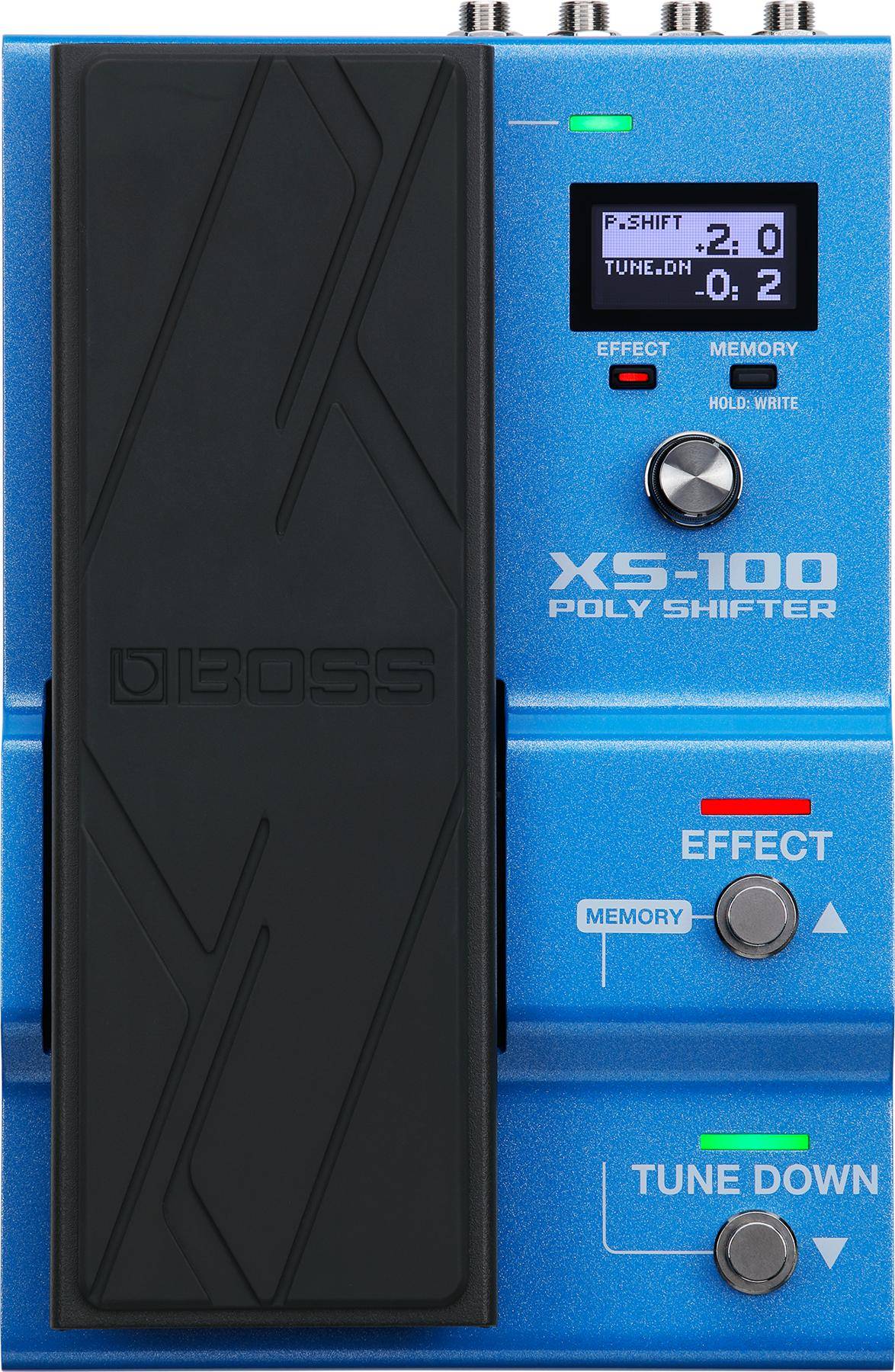
BOSS XS-100: Eight Octaves of Creative Mayhem
PG contributor Tom Butwin explores the new BOSS XS‑100 Poly Shifter—an 8-octave powerhouse that lets guitarists and bassists go from subtle drop-tuning to full-on pitch chaos with expression pedal and MIDI control. From transforming a standard guitar into a baritone to turning a 4-string bass into a five-string monster, this pedal offers both inspiring sounds and real gig-day utility.
Boss XS-100 Poly Shifter Pitch-shift Pedal
Boss XS-1 Poly Shifter Pitch-shift Pedal
IK Multimedia Announces TONEX Plug for Guitar and Bass
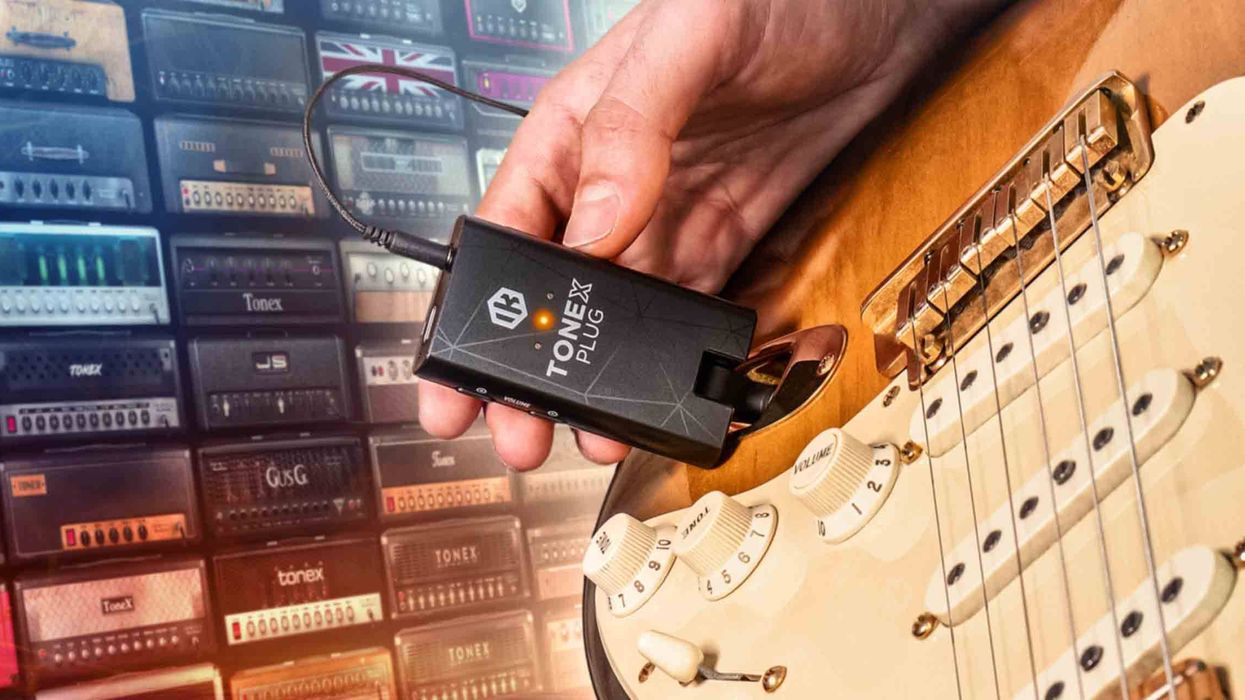
IK Multimedia is proud to announce TONEX Plug, the ultimate portable guitar and bass headphone amp, offering instant access to over 40,000 free amps and pedal rigs, plus Premium and Signature Collections. Powered by IK's award-winning AI Machine Modeling™, TONEX Plug delivers the same studio-quality tone as the TONEX Pedal and TONEX ONE in a sleek, pocket-sized design.
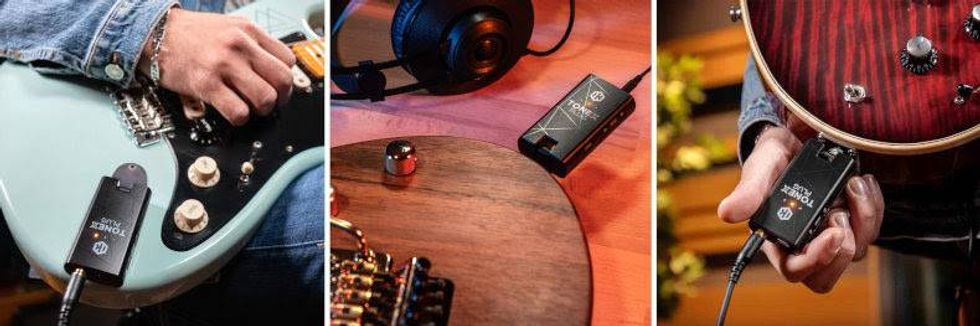
With built-in Bluetooth and the included TONEX Control app (iOS/Android), users can practice or play anywhere, stream audio, and browse and edit presets with the app, then load them wirelessly to TONEX Plug.TONEX Plug Overview
- Personal headphone amp with AI Machine Modeling™ for guitar and bass
- Over 40,000 FREE Tone Models on ToneNET, plus Premium and Signature Collections
- Fully compatible with the growing TONEX Ecosystem
- Stores 30 user presets across 10 color-coded banks
- Find, load, and edit presets wirelessly via TONEX Control App (iOS/Android)
- Stream stereo audio via Bluetooth from all popular apps
- Also functions as a high-quality USB-C audio interface
- Onboard EQ, gate, compressor, delay, modulation, and reverb
- Built-in chromatic tuner with LED indicator
- 1/4" swivel jack and 1/8" stereo headphone output
- Rechargeable battery with up to 6 hours of playtime
- Includes TONEX SE and AmpliTube 5 SE software for capturing, recording, and playing
Great Tone on the Go
From the first note, players will experience incredibly rich, dynamic, and touch-sensitive tones from an ultra-compact device. TONEX Plug, through its control app, also provides unlimited access to ToneNET, the world's most popular tone-sharing platform. Users can expand their personal library of sounds to suit any style or session at a moment's notice.
Whether it's a beloved vintage amp or models of their own rig, users can load any Tone Model wirelessly and transport themselves to the front of the stage as every nuance of the original rig comes to life. The TONEX Plug is ideal for silent rehearsal and travel.
Practice, Play, and More
With TONEX Plug, users can explore their tone library in complete silence using headphones, stream backing tracks via Bluetooth, jam with YouTube lessons or music-learning apps, all while playing their guitar or bass through high-quality amps and effects. Additionally, a built-in tuner and metronome eliminate the need for extra gear, allowing players to focus on improving their skills or warming up for gigs.
A Community of Great Tone
The TONEX Plug isn't limited to just factory sounds. Through the app, users can instantly connect to ToneNET and explore over 40,000 free Tone Models, as well as Premium and Signature collections. The active ToneNET and Tone Partner community uploads and shares some of the most sought-after amps ever made, all of which are easily searchable by song and artist keywords or by using dedicated filters such as instrument, type, Most Liked, Top 10, and more.
Total Tonal Control
The TONEX Control app for iOS and Android serves as the wireless command center for TONEX Plug, providing real-time control over all parameters. Easily browse and load Tone Models from ToneNET. Edit the amp, cab, EQ, IRs, and TONEX FX with precision, and save changes directly to the hardware.
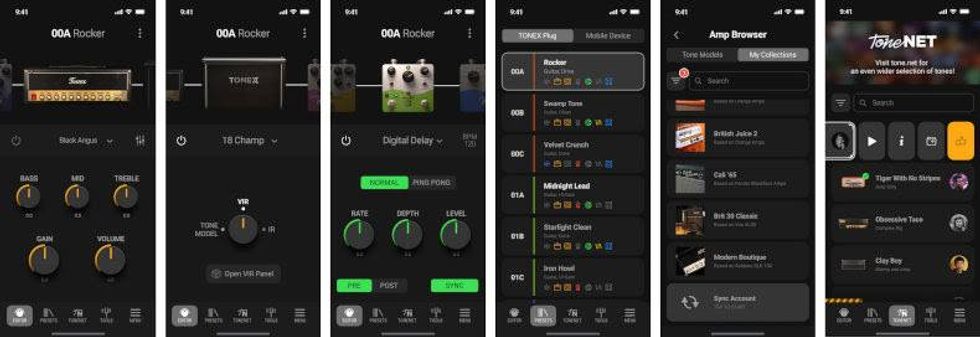
With drag-and-drop editing and integration with Premium and Signature Collections, TONEX Control transforms the TONEX Plug from a headphone amp into a fully customizable tone workstation that adapts to any workflow.
For Learning, Recording, and More
Whether it's learning new chords or recording professional-level tracks, TONEX Plug gives users more ways to connect. Stream audio wirelessly from devices via Bluetooth or connect directly to a computer to unlock even more possibilities.
With many guitar and bass learning apps offering real-time feedback, the connected TONEX Plug ensures precise note tracking, delivering a studio-quality tone. It's the perfect companion for practicing smarter and sounding better everywhere.
And when inspiration strikes, TONEX Plug also works as a high-quality audio interface. Easily record directly to a desktop setup via USB-C, without the need for extra equipment. The best tones are always just one connection away.
Signature Tone Anywhere
TONEX Plug users can easily capture their own rig and take it anywhere with IK's powerful AI Machine Modeling. The included TONEX Modeler profiles a rig's tone in just minutes using real guitar signals - not just test tones - and delivers unprecedented authenticity. Players can take Tone Models of their own rigs on the road, backstage, or wherever they go.
Pricing and Availability
TONEX Plug will ship in November and can be ordered now from the IK online store and from IK dealers worldwide at the following prices:
TONEX Plug - $/€149.99* - Includes TONEX Plug, USB-C cable, TONEX SE and AmpliTube 5 SE software.
- TONEX Plug + Pouch - $/€159.99 - Includes TONEX Plug, custom carrying pouch, USB-C cable, TONEX SE and AmpliTube 5 SE software.
- TONEX Plug Pouch - $/€19.99 - Custom carrying pouch for TONEX Plug.
- TONEX Control app (iOS/Android) - FREE - Provides wireless control over all TONEX Plug parameters and access to ToneNET.
For more information about TONEX Plug and to hear it in action, please visit:
www.ikmultimedia.com/tonexplug
Spice Up Your Cowboy Chords
Last updated on April 28, 2022
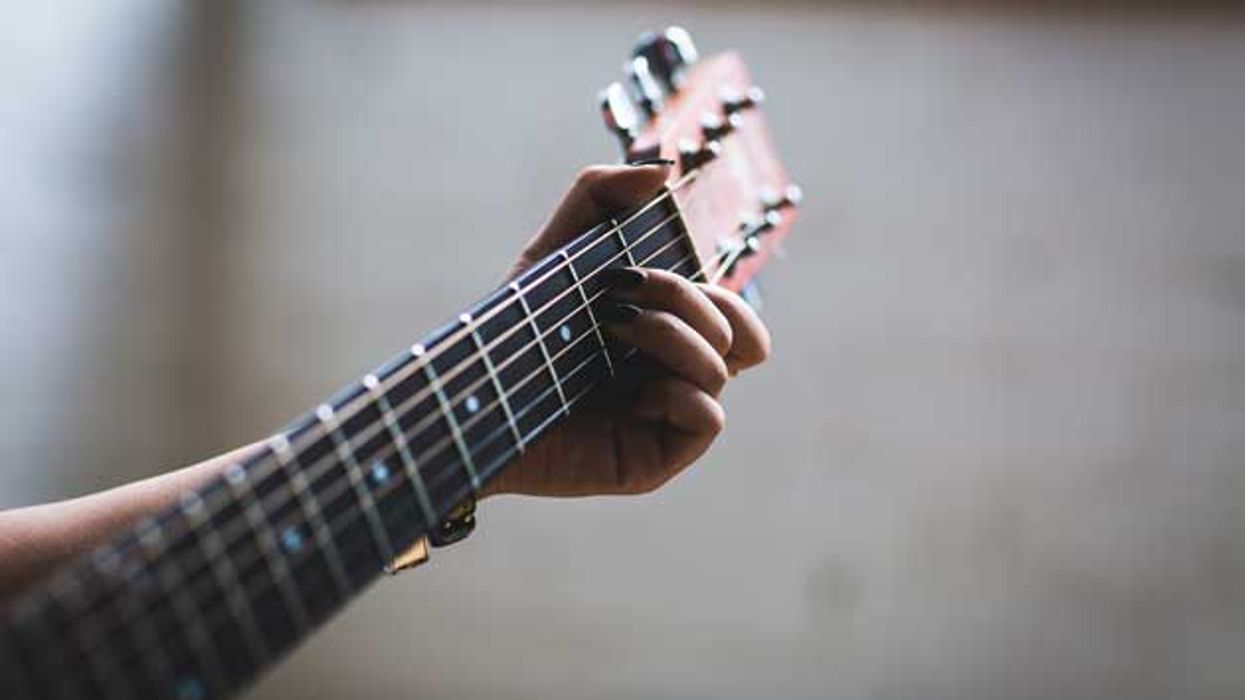
So-called "cowboy chords" have been fundamental to the guitar since its invention. In this lesson, we'll look at easy ways to spice up these everyday grips so they'll add interest to your playing, improve your rhythm, and liven up even the most predictable of progressions.
What is a Cowboy Chord?
Speculation abounds regarding the origin of the term "cowboy chord," but here's an explanation that makes sense to me: In many 1940s movies, such actor-musicians as Roy Rogers and Gene Autry portrayed cowboys who played guitar and sang. In these musical scenes, the actors strummed first-position, open-string chords and seldom strayed beyond the 3rd fret.
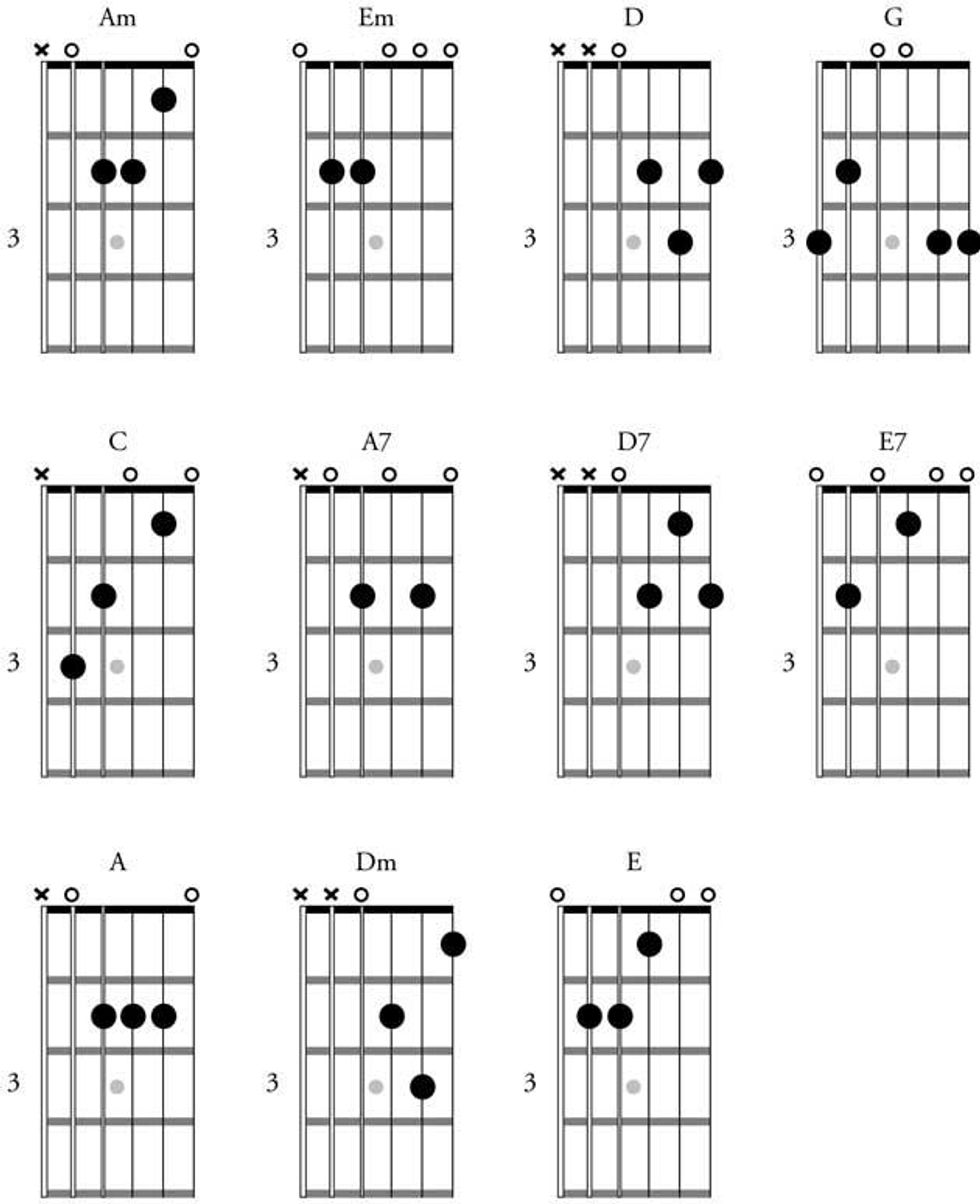
However they earned this nickname, cowboy chords remain essential to all guitarists—from beginners to pros. Unfortunately, many players rarely get past the most basic shapes shown in Ex. 1. That's a pity because by just moving a finger or two—or sometimes simply lifting a finger off the fretboard—you can add color, tension, movement, and zest to your playing. Let's make that happen now!
Cowboy Chords Ex. 1
Just Move a Finger
These days it seems like every other hit song features the prosaic I–VIm–IV–V progression. Now there's nothing wrong with the progression itself. In fact, the reason we hear it so frequently is because it sounds good, and it has been used masterfully by everyone from George Gershwin to the Rolling Stones and the Police. But the aforementioned songwriters knew that to make the everyday unique, you need to add some spice.
That's exactly what we've done in Ex. 2. This example demonstrates two basic concepts: The first is that you can add color to the most basic chords, in this case C–Am–F–G, by moving, removing, or adding a finger to each voicing. This second concept is particularly interesting because even though we keep moving the same notes on the 2nd string against the first three chords, the quality of these chords keeps changing. For example, when you let the 2nd string ring open on a C chord, it becomes a Cmaj7, but when you let the same string ring open on an Fmaj7 chord it becomes the much more sophisticated Fmaj7#4. Now that's spice.
Cowboy Chords Ex. 2
Ex. 3 uses the same progression (I–VIm–IV–V), this time in the key of G, but now all the movement happens on the 1st string. Once again, we find ourselves with some very elegant harmonies. The Gmaj7 in measure one is particularly noteworthy because it sounds quite mournful, as if longing for something. Lost love perhaps? Maybe that's why the Smiths, Jim Croce, and the Sundays have all used it to complement melancholy lyrics.
Cowboy Chords Ex. 3
Ex. 4 expands upon the "move a finger" idea by moving several fingers to create a melodic motif in the D and G chords. It also gives movement to the A7 chord by shifting shapes up and down the neck. We'll expand upon the latter idea in the next example.
Cowboy Chords Ex. 4
Spice Up Your Blues
Ex. 5 appears to be a common 12-bar blues, and form-wise this is true, but the uncommon movement we've applied to the E7 and A7 shapes adds considerable harmonic sophistication with very little effort.
Cowboy Chords Ex. 5
Going Outside the Key
Up to this point, all of the examples have been completely diatonic, meaning all the notes we've added to the basic triads have been in the same key as the chord progressions. But what happens if we add some notes that are not in the home key? Well, now things get really spicy, though no more difficult to perform. Ex. 6 is an ingenious example of how to add variation when you're stuck on one chord for more than a measure or two. Notice how tense the progression becomes when you play the Em#5 and yet completely relaxes when you conclude on the Em. This particular progression, both descending (as shown) and ascending (just play in reverse order) was used numerous times by the Beatles, most notably in "Eleanor Rigby," "Hey Bulldog," and "Savoy Truffle."
Cowboy Chords Ex. 6
Speaking of the Beatles, Ex. 7 is a progression they learned from "Don't Ever Change," written by Gerry Goffin and Carole King and recorded by the post-Buddy Holly Crickets. Once again, the tension created by the D augmented chord resolves very nicely into the D6 on the way up, and into the D triad on the way down. By the way, if you just play the D to Daug over and over again, you'll find yourself playing the verse to Eddie Money's "Baby Hold On."
Cowboy Chords Ex. 7
Add Some Bass
So far, all our examples have focused on movement and color in the higher registers, but you can also add spice to the bass notes. Ex. 8 is a folk and folk/rock staple, used by everyone from Simon and Garfunkel to Led Zeppelin and, despite the obvious chord names that are written here, it's relatively complex harmonically. You see, in this folk context, it is best to name the chords using the bass-note slash, i.e., Am/G–Am/F#–Am/F. But in different contexts, particularly in jazz, those last two chords could be named F#m7(b5) and Fmaj7, suggesting that adding a bass note can radically alter—and enhance—the harmonic quality of any given chord.
Cowboy Chords Ex. 8
Ex. 8 featured a descending bass line, but in Ex. 9 we'll turn that around and have the bass ascend while we're playing an Em chord. Notice how we've included a non-diatonic note, Bb, at the end of the progression. This adds tension that's released by the final Em.
Cowboy Chords Ex. 9
Be Judicious
These exercises have been specifically designed to get you into the habit of adding variation to your everyday cowboy chords. They're also, as good exercises should be, rather formulaic. While you play through them, remember that when making up your own progressions, you don't need to add movement to every chord. Maybe you insert movement in the verse but not in the chorus, or vice versa. There's no need to overdo it: A little spice can go a long way toward making your songs and arrangements a lot more inventive.
This article was last updated on May 17, 2021
Christone “Kingfish” Ingram Maps a Modern Blues Journey
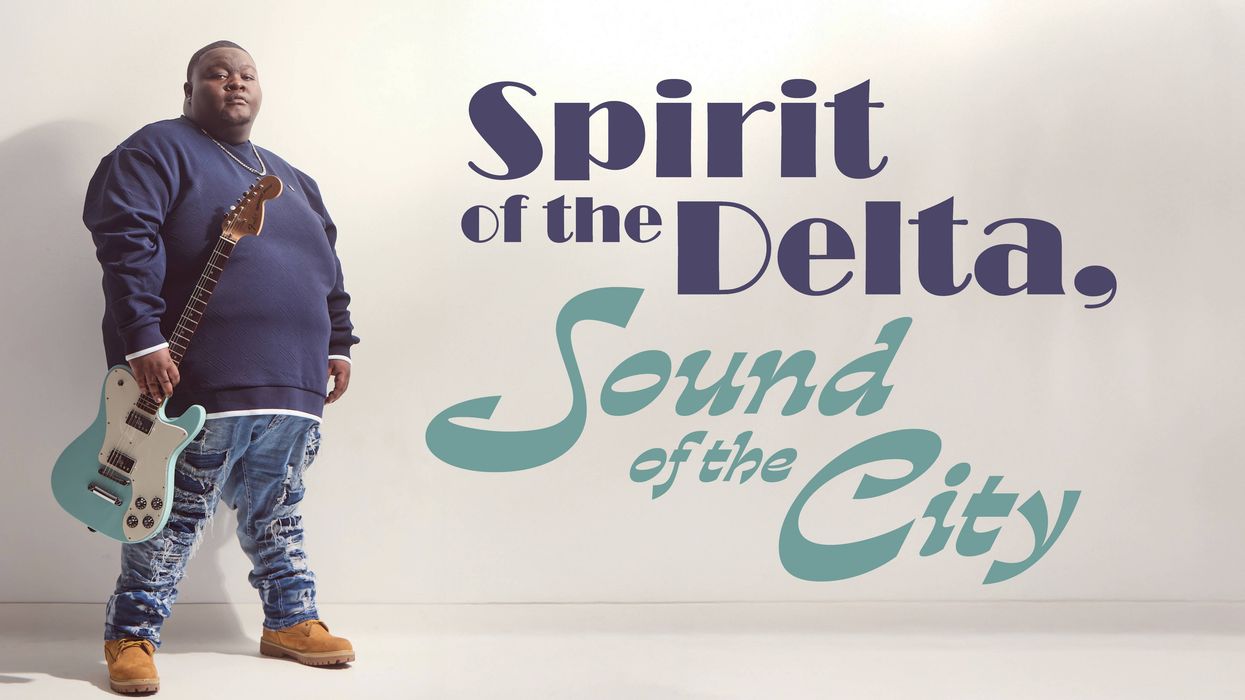
A 21st-century bluesman raised in the heart of the Mississippi Delta carries with him both instant credibility and the burden of an illustrious history. Growing up in an environment so saturated with the imposing spirits of America’s musical past, a person might, you’d think, find it hard to pick up a guitar and even consider making a career with it. But Christone “Kingfish” Ingram, born 26 years ago in Clarksdale, Mississippi—the legendary stomping ground of Robert Johnson, Son House, Muddy Waters, and John Lee Hooker, memorably depicted this year in Ryan Coogler’s hit movie Sinners—doesn’t seem to have paid much mind to any of that. For him, the blues has simply always been a part of his everyday life.
“Muddy Waters and B.B. King were the first two bluesmen that I learned about at an early age, before I even got to proper schooling,” Ingram said in a recent Zoom interview. “My dad showed me a PBS documentary on Muddy Waters and he showed me B.B. King doing a cameo on an episode of Sanford & Son. I remember those two things very well. And not only that, I lived right next to a blues band. Being around them definitely made me want to do what I’m doing now.
”Getting from there to here—“here” being the position of critically lauded, internationally touring Grammy Award-winning singer, songwriter, and guitarist—involved a mixture of raw talent, good genes (Kingfish comes from a musical family; the late great Black country star Charley Pride was his mother’s first cousin), and a supportive cultural infrastructure. Not long into his elementary school years, Ingram got involved in the music education program at the Delta Blues Museum in Clarksdale. Starting out on drums in his church group at age six, he switched to bass by 11 and guitar by 13.
“When I started learning about the blues, I wanted to get on guitar,” he recalls, “but I felt like my fingers were too big for the strings, so I moved to bass and that became my primary instrument. And when that phase went away, I switched to guitar. First I would do some of my bass fills and lines [on guitar], and next thing you know, my teachers at the museum taught me how to use the first two high strings, and once I started learning a couple of chords, I took it from there.”
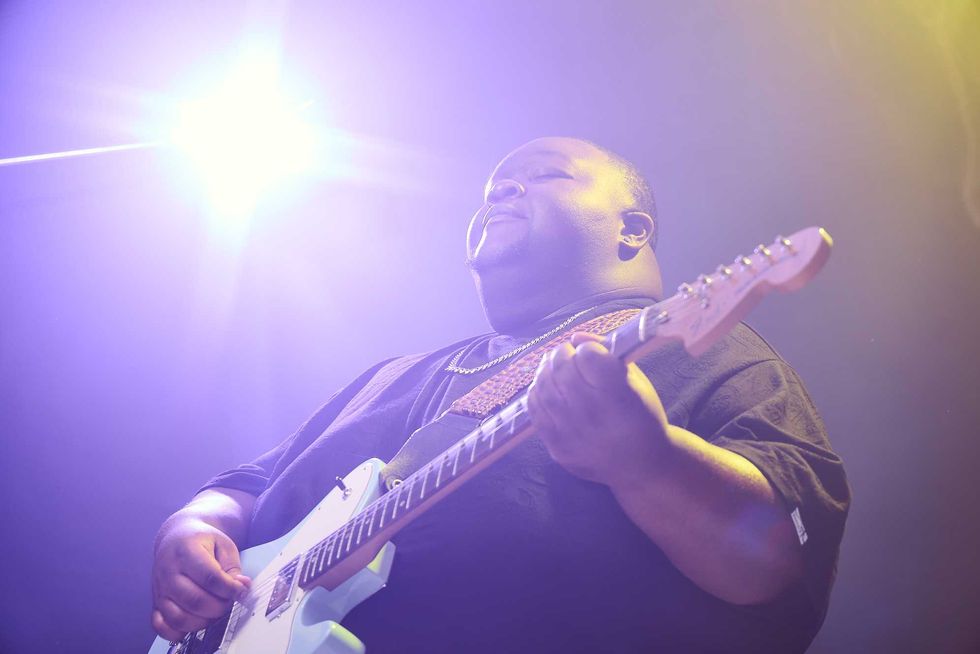
Christone "Kingfish" Ingram's Gear
Guitars
- Fender Kingfish Telecaster Deluxe signature
- Banker Custom V
- 2001 Gibson Memphis ES-335
- Gibson ES-339
- Fender Custom Shop Stratocaster
- Custom Michael Chertoff Les Paul-style electric
- Fender Acoustasonic
- Fender Redondo
Amps
- Two Fender ’65 Twin Reverb reissues
Effects
- Dunlop Cry Baby Mini Wah
- Marshall ShredMaster
- Boss DD-3 Digital Delay
- Boss TU-3W Chromatic Tuner
- Strymon power supply
Strings, Picks, & Accessories
- Ernie Ball Power Slinky strings (.011–.048)
- Dunlop Jazz III picks
- Shure BLX4
That he did. Within a couple of years, Ingram was gigging locally and, thanks in part to his Delta Blues Museum connections, gaining national notoriety. At 15, he performed with the museum’s band for Michelle Obama at the White House. The emotional authority of his guitar playing in particular astonished listeners. Veteran bluesman Eric Gales told Blues Rock Review that Kingfish was “killin’ from day one … It’s a beautiful thing to see such a vibrant, intense, very skilled artist.” (Gales and Ingram have since become close comrades, referring to each other as uncle and nephew.)
“Muddy Waters and B.B. King were the first two bluesmen that I learned about at an early age.”
Ingram’s superb 2019 debut album Kingfish, the recording of which was financed by no less an elder statesman than Buddy Guy, turned plenty of heads in the music world; its crunchy opening track, “Outside of This Town,” remains an excellent introduction to the Kingfish style. Its 2021 follow-up, 662, won the Grammy for Best Contemporary Blues Album, and 2023’s fiery Live in London consolidated his status as a major modern blues force. His latest collection, Hard Road, presents a markedly different picture, though. No longer a Clarksdale resident, Kingfish now makes his home in Los Angeles, where he moved three years ago. “Sometimes I miss the simplicity of Mississippi,” he acknowledges. “But out here in California I definitely have more resources, more opportunities, and more ways to work.”
That new reality is reflected in the songs on Hard Road, which were the product of collaboration with 11 songwriters and 12 musicians, recorded with three producers in 11 studios spread across two states—a level of ambition, and logistics, that dwarfs any of Ingram’s prior work. For five songs cut at various locations in Nashville, Tom Hambridge (Buddy Guy, George Thorogood, Susan Tedeschi), who’s been working with Ingram since the start of his recording career, took the reins. Patrick “Guitar Boy” Hayes (Usher, Trey Songz, Keyshia Cole) helmed sessions for four songs in L.A., Hollywood, and Irvine, California, while up-and-comer Nick Goldston oversaw two songs in Santa Monica and Memphis.
As you’d expect, it took a while to put all this together. Ingram at first estimates a gestation period of three to four years, then reconsiders. “Probably even longer than that, because some of the songs that we used were from the 662 sessions,” he says. “But it was really when I came out here to L.A. and was working with Guitar Boy in the studio week after week when I wasn’t on the road that this project was born. I was a little scared, making a project with all these different genres. I didn’t want it to sound like a random jukebox thing, you know? I just wanted to do more music that showcased a lot of other things about my talent: the vocal range, the writing, stuff like that.”“Sometimes I miss the simplicity of Mississippi. But out here in California I definitely have more resources, more opportunities, and more ways to work.”
Hard Road certainly achieves that goal. Riff-powered rock and luscious R&B coexist comfortably with more traditional-sounding electric and acoustic blues turns. “Nothin’ But Your Love,” for example, is an irresistible slow jam recalling Prince in his ’80s prime that keeps the focus squarely on Ingram’s rich baritone. “That was one of the songs we’d been sitting on since 2021,” Kingfish reveals. “A young man out of Nashville by the name of Dylan Altman came to us with it, then we added a verse and switched some things around. We recorded that in Memphis at Royal Studios, and for the solo I was using my Custom Shop Strat with just a little bit of gain on a [n Ibanez] Tube Screamer, going through a Sunn amp. I remember that session because I don’t play Strats that often, except in the studio—live it’s all [guitars with] humbuckers.”
As Ingram’s comment makes clear, Hard Road’s stylistic diversity doesn’t mean an absence of guitar solos. For further proof, check out his slippery-smooth funk excursions on “Bad Like Me” or his psychedelic scorcher on the downright Hendrix-ian “Crosses.” Moments like these also demonstrate Kingfish’s multidimensionality as a player. Sure, he can lean into a gut-punching bend with the best of them, but his ear for melody and sophisticated sense of harmony are what really set him apart.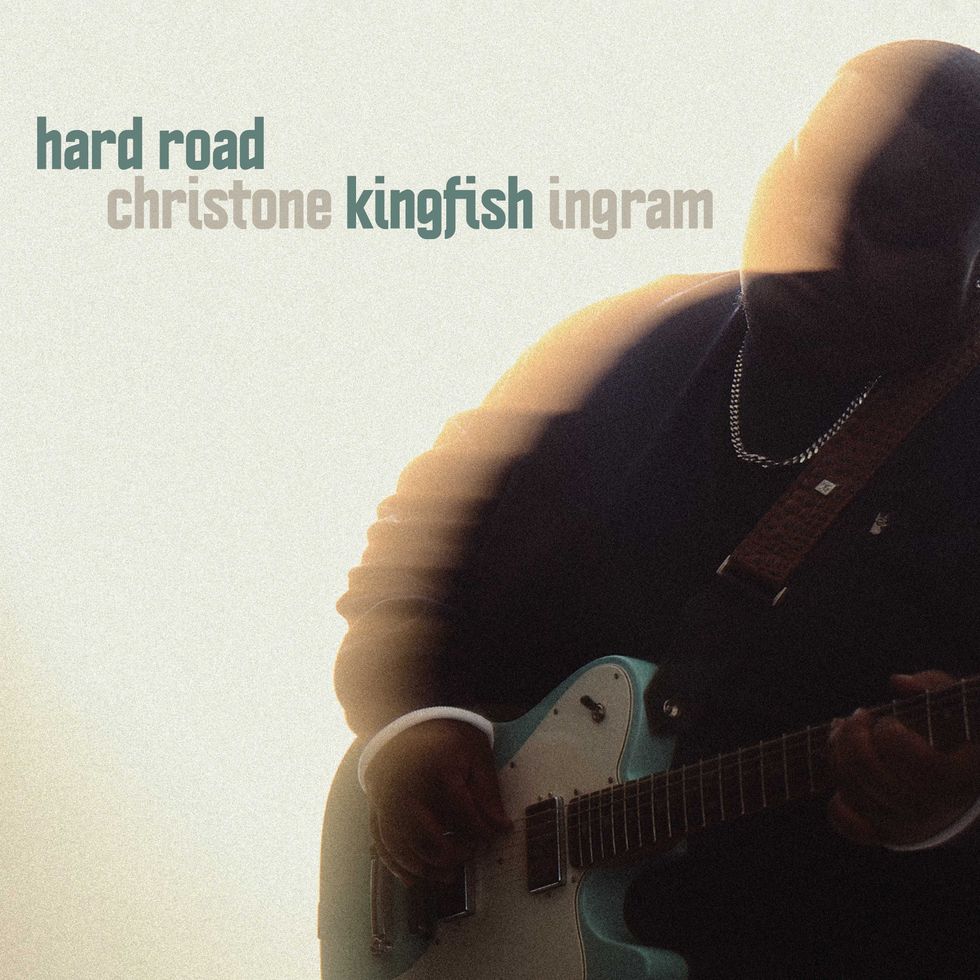
“The Covid era was a little good for me,” Ingram says, “because I was able to sit back and [wood]shed and learn more about music theory. I was always into it, but I just wasn’t figuring out a way to play it. I’m still learning, but now I definitely know the numbers, and I can explain a bit of what I play. Shout out to a couple of guitar players outside the blues, like Isaiah Sharkey and Jerry Mosey and Uncle Kevin Wilson in the gospel realm. These are players that I listen to who are fluent in that area, that I can borrow stuff from and pull into my blues. Josh Smith, too, who’s one of my favorite blues-fusion players.”
Of course, when showtime rolls around, the time for shedding is over and Ingram lets the spontaneous phrasing instincts that he’s cultivated for years take charge. Most of the time, he says, it’s not a process that involves the conscious mind. “For my live show, there are definitely spots in certain songs where I feel like a certain lick needs to go there, because it just sounds good on top of that progression at the time, so I do think in that way. But as far as soloing goes, it’s all improv.”
“I was a little scared, making a project with all these different genres. I didn’t want it to sound like a random jukebox thing.”
Another noteworthy fact about Hard Road is that it’s Ingram’s first release on Red Zero, the record company he recently co-founded with his manager, Ric Whitney (all previous Kingfish albums were issued by the respected blues label Alligator). According to Ingram, Red Zero is no mere vanity imprint. He and Whitney intend to build a significant stable of artists in the months and years ahead, inspired in part by SAR Records, the indie label founded by Sam Cooke in 1959 that was an early home to artists such as Bobby Womack, Johnnie Taylor, and Billy Preston.
“My manager and I formulated this idea,” Ingram explains, “because we saw a lot of talented artists out there who aren’t being shown in a proper light. We wanted to give them an opportunity. Sam Cooke gave some people a shot who hadn’t been lucky like he was. So that’s pretty much all I’m trying to do. And me owning my records, of course we thought about that as well. But for me, the bigger picture was just shining a light on a lot of young and old and middle-aged talent, in the blues and outside the blues.”
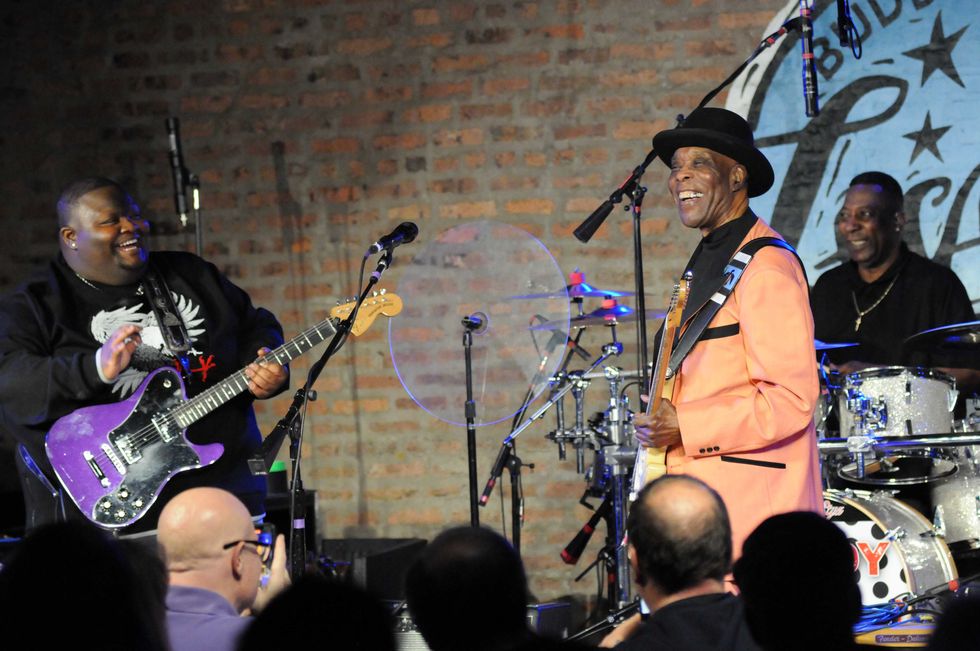
Early Red Zero signings include Texas guitarist Mathias Lattin, winner of the 2023 International Blues Challenge in Memphis, and St. Louis soul singer Dylan Triplett. “We have a lot of guitar slingers these days,” Ingram says, “but we don’t have much of a Bobby ‘Blue’ Bland type of thing going on, and that’s what Dylan has. We’re starting with the blues because that’s our forte and we want to take care of family first, but Ric and I are both lovers of music and we can definitely see ourselves venturing out into other genres.”
Before that happens, Ingram will be venturing out on the road once again, where he’s starting to like what he’s seeing. “Man, I think the blues is thriving,” he says. “And in a sense of young artists coming out of the woodwork, like the ones I just mentioned, Mathias and Dylan [both of whom are joining Kingfish on tour], and Stephen Hull and bands like Southern Avenue. It’s all out there—artists that are honoring the tradition but also creating a new sound and bringing that sound to a broader audience.”
Artists, in other words, like Christone “Kingfish” Ingram.
Christone “Kingfish” Ingram Maps a Modern Blues Journey
A 21st-century bluesman raised in the heart of the Mississippi Delta carries with him both instant credibility and the burden of an illustrious history. Growing up in an environment so saturated with the imposing spirits of America’s musical past, a person might, you’d think, find it hard to pick up a guitar and even consider making a career with it. But Christone “Kingfish” Ingram, born 26 years ago in Clarksdale, Mississippi—the legendary stomping ground of Robert Johnson, Son House, Muddy Waters, and John Lee Hooker, memorably depicted this year in Ryan Coogler’s hit movie Sinners—doesn’t seem to have paid much mind to any of that. For him, the blues has simply always been a part of his everyday life.
“Muddy Waters and B.B. King were the first two bluesmen that I learned about at an early age, before I even got to proper schooling,” Ingram said in a recent Zoom interview. “My dad showed me a PBS documentary on Muddy Waters and he showed me B.B. King doing a cameo on an episode of Sanford & Son. I remember those two things very well. And not only that, I lived right next to a blues band. Being around them definitely made me want to do what I’m doing now.
”Getting from there to here—“here” being the position of critically lauded, internationally touring Grammy Award-winning singer, songwriter, and guitarist—involved a mixture of raw talent, good genes (Kingfish comes from a musical family; the late great Black country star Charley Pride was his mother’s first cousin), and a supportive cultural infrastructure. Not long into his elementary school years, Ingram got involved in the music education program at the Delta Blues Museum in Clarksdale. Starting out on drums in his church group at age six, he switched to bass by 11 and guitar by 13.
“When I started learning about the blues, I wanted to get on guitar,” he recalls, “but I felt like my fingers were too big for the strings, so I moved to bass and that became my primary instrument. And when that phase went away, I switched to guitar. First I would do some of my bass fills and lines [on guitar], and next thing you know, my teachers at the museum taught me how to use the first two high strings, and once I started learning a couple of chords, I took it from there.”
Christone "Kingfish" Ingram's Gear
Guitars
- Fender Kingfish Telecaster Deluxe signature
- Banker Custom V
- 2001 Gibson Memphis ES-335
- Gibson ES-339
- Fender Custom Shop Stratocaster
- Custom Michael Chertoff Les Paul-style electric
- Fender Acoustasonic
- Fender Redondo
Amps
- Two Fender ’65 Twin Reverb reissues
Effects
- Dunlop Cry Baby Mini Wah
- Marshall ShredMaster
- Boss DD-3 Digital Delay
- Boss TU-3W Chromatic Tuner
- Strymon power supply
Strings, Picks, & Accessories
- Ernie Ball Power Slinky strings (.011–.048)
- Dunlop Jazz III picks
- Shure BLX4
That he did. Within a couple of years, Ingram was gigging locally and, thanks in part to his Delta Blues Museum connections, gaining national notoriety. At 15, he performed with the museum’s band for Michelle Obama at the White House. The emotional authority of his guitar playing in particular astonished listeners. Veteran bluesman Eric Gales told Blues Rock Review that Kingfish was “killin’ from day one … It’s a beautiful thing to see such a vibrant, intense, very skilled artist.” (Gales and Ingram have since become close comrades, referring to each other as uncle and nephew.)
“Muddy Waters and B.B. King were the first two bluesmen that I learned about at an early age.”
Ingram’s superb 2019 debut album Kingfish, the recording of which was financed by no less an elder statesman than Buddy Guy, turned plenty of heads in the music world; its crunchy opening track, “Outside of This Town,” remains an excellent introduction to the Kingfish style. Its 2021 follow-up, 662, won the Grammy for Best Contemporary Blues Album, and 2023’s fiery Live in London consolidated his status as a major modern blues force. His latest collection, Hard Road, presents a markedly different picture, though. No longer a Clarksdale resident, Kingfish now makes his home in Los Angeles, where he moved three years ago. “Sometimes I miss the simplicity of Mississippi,” he acknowledges. “But out here in California I definitely have more resources, more opportunities, and more ways to work.”
That new reality is reflected in the songs on Hard Road, which were the product of collaboration with 11 songwriters and 12 musicians, recorded with three producers in 11 studios spread across two states—a level of ambition, and logistics, that dwarfs any of Ingram’s prior work. For five songs cut at various locations in Nashville, Tom Hambridge (Buddy Guy, George Thorogood, Susan Tedeschi), who’s been working with Ingram since the start of his recording career, took the reins. Patrick “Guitar Boy” Hayes (Usher, Trey Songz, Keyshia Cole) helmed sessions for four songs in L.A., Hollywood, and Irvine, California, while up-and-comer Nick Goldston oversaw two songs in Santa Monica and Memphis.
As you’d expect, it took a while to put all this together. Ingram at first estimates a gestation period of three to four years, then reconsiders. “Probably even longer than that, because some of the songs that we used were from the 662 sessions,” he says. “But it was really when I came out here to L.A. and was working with Guitar Boy in the studio week after week when I wasn’t on the road that this project was born. I was a little scared, making a project with all these different genres. I didn’t want it to sound like a random jukebox thing, you know? I just wanted to do more music that showcased a lot of other things about my talent: the vocal range, the writing, stuff like that.”“Sometimes I miss the simplicity of Mississippi. But out here in California I definitely have more resources, more opportunities, and more ways to work.”
Hard Road certainly achieves that goal. Riff-powered rock and luscious R&B coexist comfortably with more traditional-sounding electric and acoustic blues turns. “Nothin’ But Your Love,” for example, is an irresistible slow jam recalling Prince in his ’80s prime that keeps the focus squarely on Ingram’s rich baritone. “That was one of the songs we’d been sitting on since 2021,” Kingfish reveals. “A young man out of Nashville by the name of Dylan Altman came to us with it, then we added a verse and switched some things around. We recorded that in Memphis at Royal Studios, and for the solo I was using my Custom Shop Strat with just a little bit of gain on a [n Ibanez] Tube Screamer, going through a Sunn amp. I remember that session because I don’t play Strats that often, except in the studio—live it’s all [guitars with] humbuckers.”
As Ingram’s comment makes clear, Hard Road’s stylistic diversity doesn’t mean an absence of guitar solos. For further proof, check out his slippery-smooth funk excursions on “Bad Like Me” or his psychedelic scorcher on the downright Hendrix-ian “Crosses.” Moments like these also demonstrate Kingfish’s multidimensionality as a player. Sure, he can lean into a gut-punching bend with the best of them, but his ear for melody and sophisticated sense of harmony are what really set him apart.“The Covid era was a little good for me,” Ingram says, “because I was able to sit back and [wood]shed and learn more about music theory. I was always into it, but I just wasn’t figuring out a way to play it. I’m still learning, but now I definitely know the numbers, and I can explain a bit of what I play. Shout out to a couple of guitar players outside the blues, like Isaiah Sharkey and Jerry Mosey and Uncle Kevin Wilson in the gospel realm. These are players that I listen to who are fluent in that area, that I can borrow stuff from and pull into my blues. Josh Smith, too, who’s one of my favorite blues-fusion players.”
Of course, when showtime rolls around, the time for shedding is over and Ingram lets the spontaneous phrasing instincts that he’s cultivated for years take charge. Most of the time, he says, it’s not a process that involves the conscious mind. “For my live show, there are definitely spots in certain songs where I feel like a certain lick needs to go there, because it just sounds good on top of that progression at the time, so I do think in that way. But as far as soloing goes, it’s all improv.”
“I was a little scared, making a project with all these different genres. I didn’t want it to sound like a random jukebox thing.”
Another noteworthy fact about Hard Road is that it’s Ingram’s first release on Red Zero, the record company he recently co-founded with his manager, Ric Whitney (all previous Kingfish albums were issued by the respected blues label Alligator). According to Ingram, Red Zero is no mere vanity imprint. He and Whitney intend to build a significant stable of artists in the months and years ahead, inspired in part by SAR Records, the indie label founded by Sam Cooke in 1959 that was an early home to artists such as Bobby Womack, Johnnie Taylor, and Billy Preston.
“My manager and I formulated this idea,” Ingram explains, “because we saw a lot of talented artists out there who aren’t being shown in a proper light. We wanted to give them an opportunity. Sam Cooke gave some people a shot who hadn’t been lucky like he was. So that’s pretty much all I’m trying to do. And me owning my records, of course we thought about that as well. But for me, the bigger picture was just shining a light on a lot of young and old and middle-aged talent, in the blues and outside the blues.”
Early Red Zero signings include Texas guitarist Mathias Lattin, winner of the 2023 International Blues Challenge in Memphis, and St. Louis soul singer Dylan Triplett. “We have a lot of guitar slingers these days,” Ingram says, “but we don’t have much of a Bobby ‘Blue’ Bland type of thing going on, and that’s what Dylan has. We’re starting with the blues because that’s our forte and we want to take care of family first, but Ric and I are both lovers of music and we can definitely see ourselves venturing out into other genres.”
Before that happens, Ingram will be venturing out on the road once again, where he’s starting to like what he’s seeing. “Man, I think the blues is thriving,” he says. “And in a sense of young artists coming out of the woodwork, like the ones I just mentioned, Mathias and Dylan [both of whom are joining Kingfish on tour], and Stephen Hull and bands like Southern Avenue. It’s all out there—artists that are honoring the tradition but also creating a new sound and bringing that sound to a broader audience.”
Artists, in other words, like Christone “Kingfish” Ingram.
PRS Guitars Announces 40th Anniversary Special Semi-Hollow Limited Edition
PRS Guitars today announced the 40th Anniversary Special Semi-Hollow Limited Edition. Limited to just 280 pieces worldwide, this special edition features PRS McCarty III treble and bass pickups with a proprietary PRS Narrowfield in the center position, along with an artist-grade figured maple top, black limba back and neck, and Honduran rosewood fretboard and headstock veneer. Each guitar features the pre-factory eagle on the headstock and includes a 40th Anniversary certificate hand signed by Paul Reed Smith.
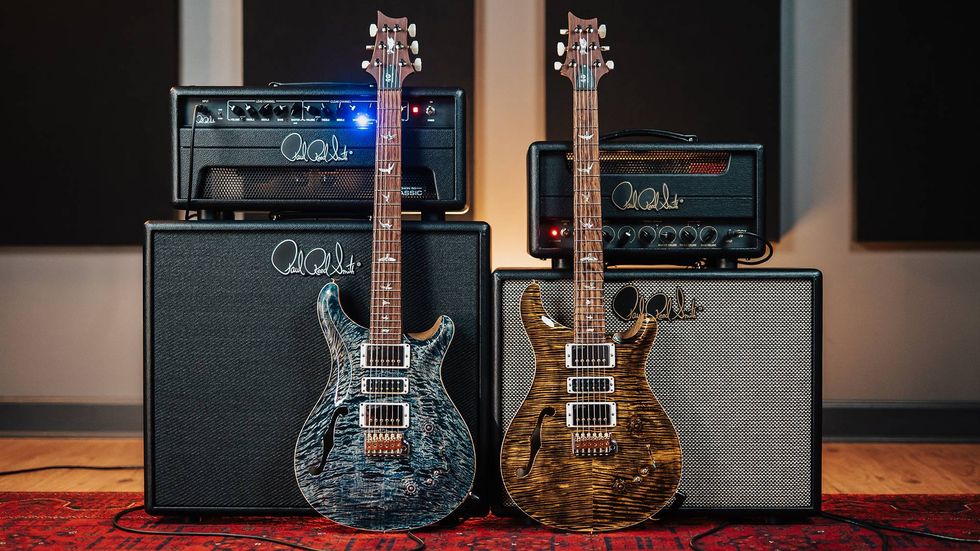
The PRS Special Semi-Hollow delivers twelve pickup combinations to players, thanks to the three-pickup configuration paired with a 5-way blade and two mini-toggles. Roll back the tone control for added growl, turn it up for some shimmer. The volume level between the humbucking and single-coil settings remains even, and the semi-hollow body provides airiness and depth to the guitar’s tone.
“This has been an incredible year of releasing special limited-edition guitars to celebrate our anniversary. The 40th Anniversary Special Semi-Hollow Limited Edition is the culmination of this year’s anniversary lineup. With a dozen pickup combinations, the ability to summon both humbucker and single-coil sounds, and beautiful woods, this instrument will inspire you to play. Have fun exploring this versatile tonal palette," said PRS Guitars Director of Marketing, Judy Schaefer.
PRS Guitars continues its schedule of launching new products each month in 2025. Stay tuned to see new gear and 40th Anniversary limited-edition guitars throughout the year. For all of the latest news, click www.prsguitars.com/40 and follow @prsguitars on Instagram, Tik Tok, Facebook, X, and YouTube.
Rig Rundown: AFI [2025]
The long-running punk quartet pick prototypes, P basses, and Pauls for their latest live shows.
On tour supporting their 12th full-length record, Silver Bleeds the Black Sun…, California rockers AFI rolled through Nashville’s Marathon Music Works in October. After first running down their rigs in 2017, PG’s Chris Kies linked up again with guitarist Jade Puget and bassist Hunter Burgan to see how their gear has evolved in the past eight years.
Brought to you by D’Addario.
Off the Wall
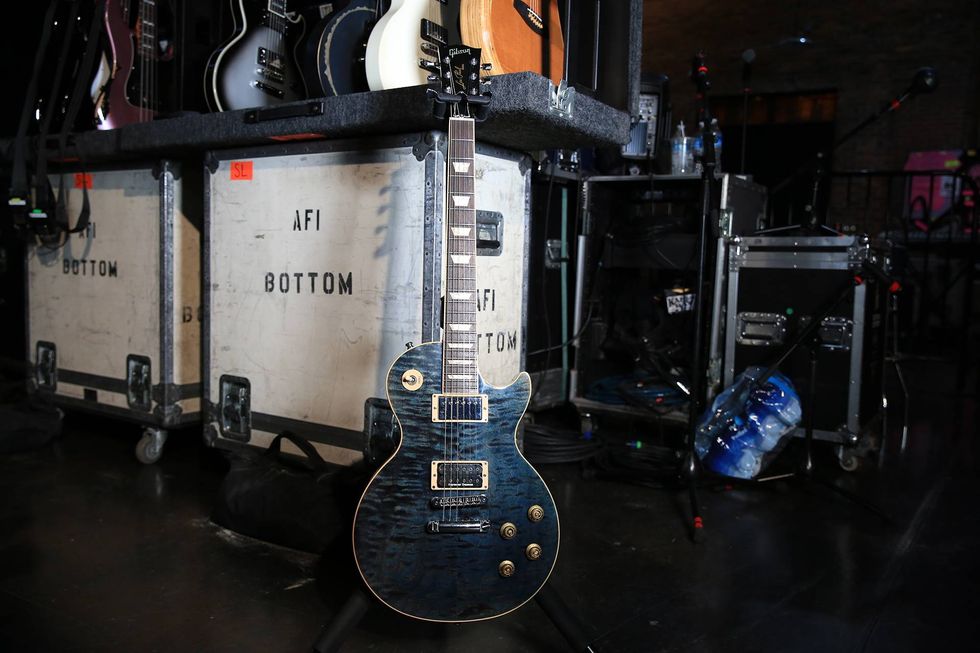
Puget found this Les Paul Standard hanging at Guitar Center 15 years ago, and it’s still his go-to live guitar. A surprisingly light specimen, it’s had a Seymour Duncan pickup swapped in, and it’s strung with Ernie Balls—usually .010s.
Throughout AFI’s set, Puget switches between tunings: D sharp, drop C sharp, D standard, and E standard.
Silver Surfer
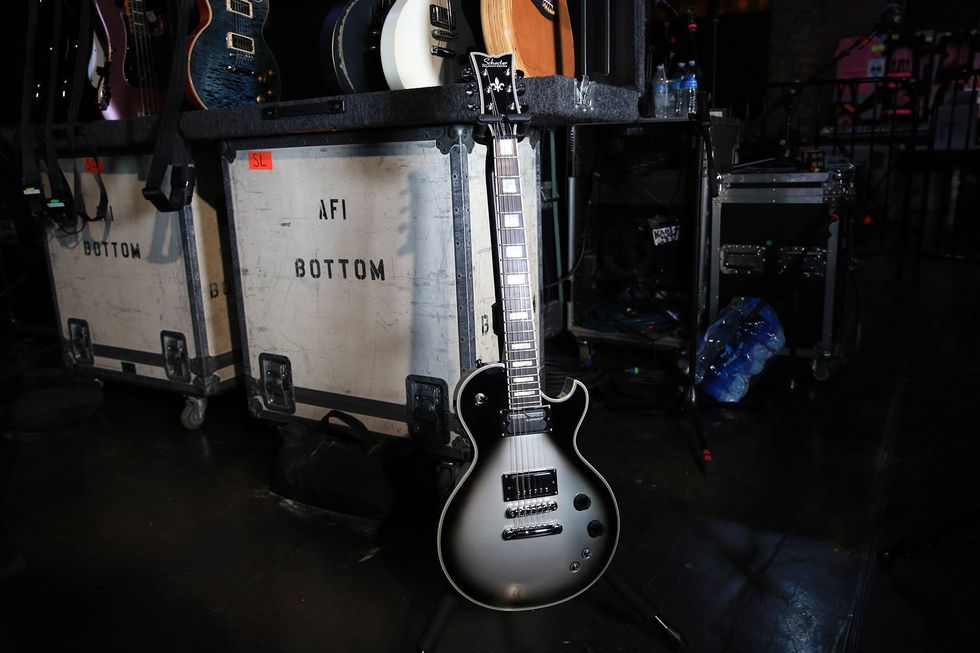
This new Schecter, a prototype made for Puget, is his first ever silverburst, which saw service in the music video for “Holy Visions.” It’s loaded with a Sustainiac system in the neck position.
Willing and Ableton
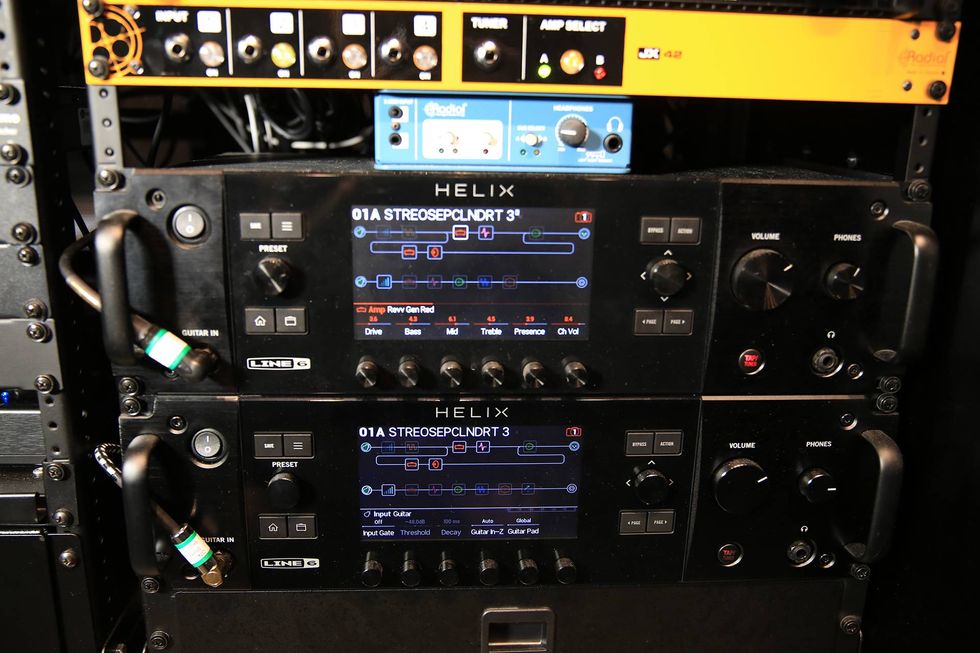
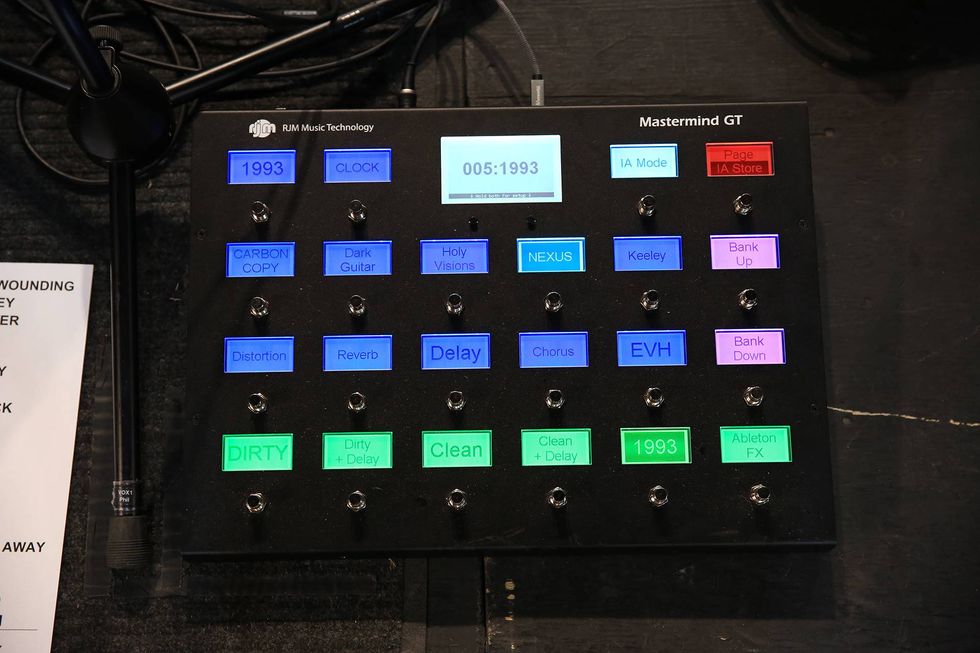
Puget has experimented a lot to get his rig to this point. His signal runs through a pair of rack-mounted Line 6 Helix units in a stereo configuration, and also through a computer running Ableton that triggers the exact sound designs he created while recording. The RJM Mastermind and Effect Gizmo are programmed to control all pedals, the Helix, and Ableton.
Jade Puget’s Pedalboard
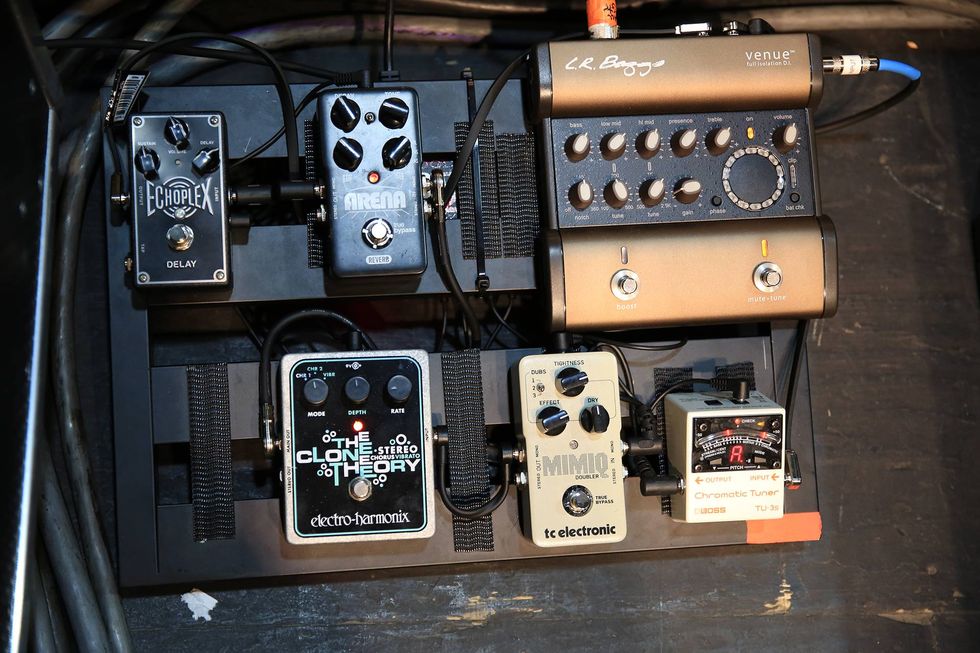
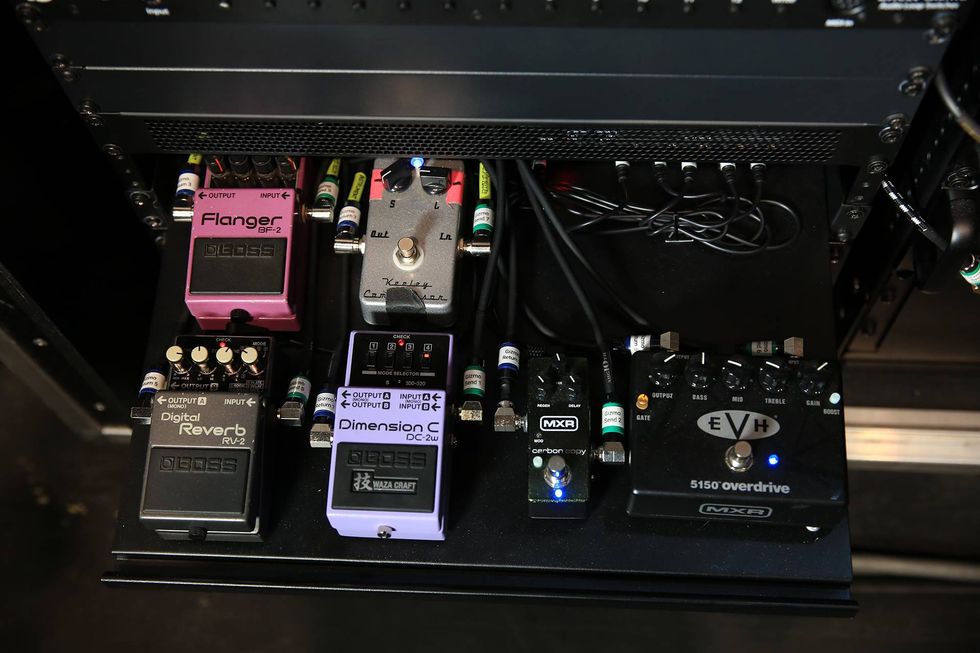
Most of Puget’s effects come from the Helix, but he also runs a few pedals in his rack, including an MXR EVH 5150 Overdrive and Carbon Copy, Boss DC-2W, RV-2, and BF-2, and a Keeley Compressor.
Another board carries a Boss TU-3, TC Electronic Mimiq, EHX The Clone Theory, TC Electronic Arena, MXR Echoplex, and L.R. Baggs Venue DI.
Blackout
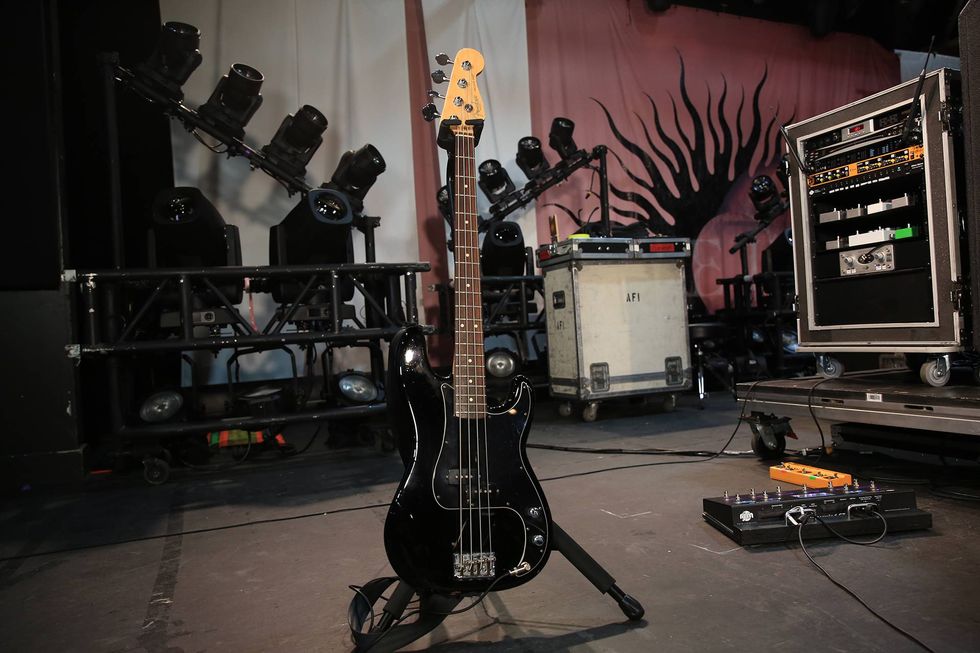
In live contexts, Burgan uses Fender P basses exclusively. This is his No. 1, which he’s had since 2012.
Pinky
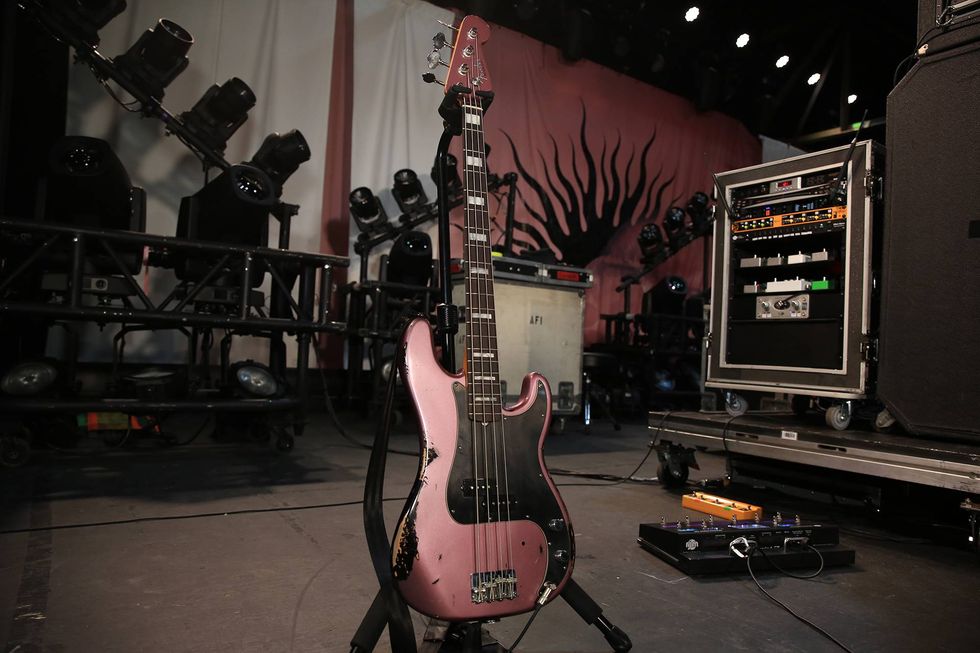
This dazzling Fender P was made custom for Burgan before this tour.
Triples is Best
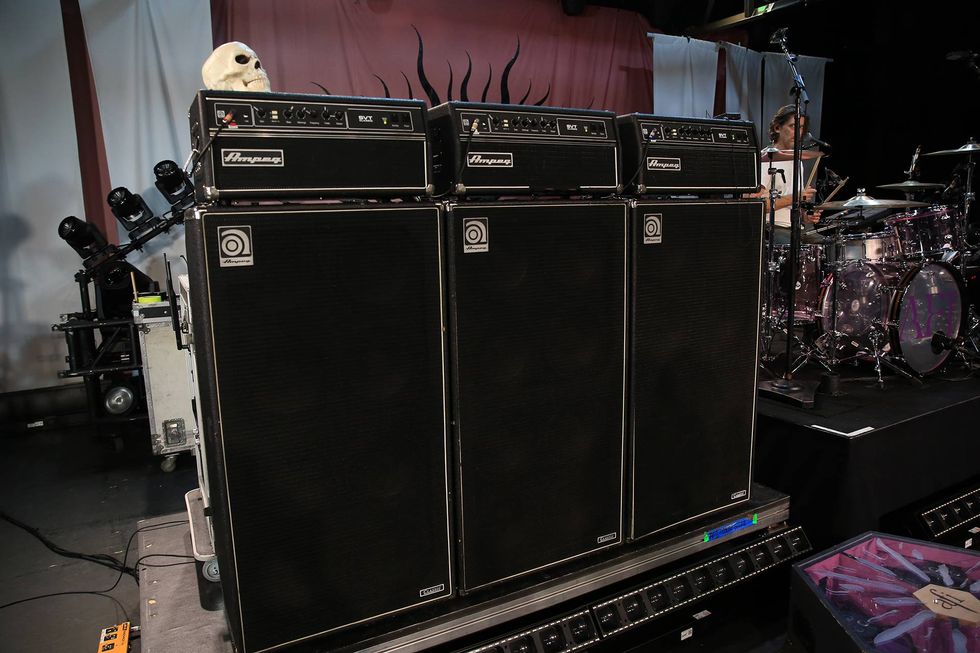
Burgan runs this trio of Ampeg SVT Classics.
Hunter Burgan’s Rack Setup
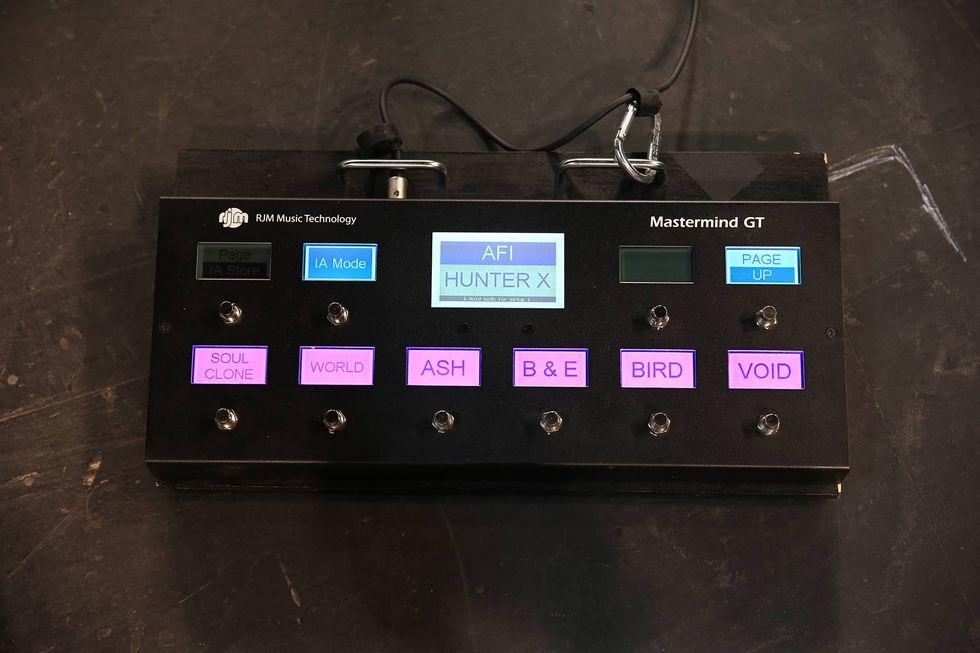
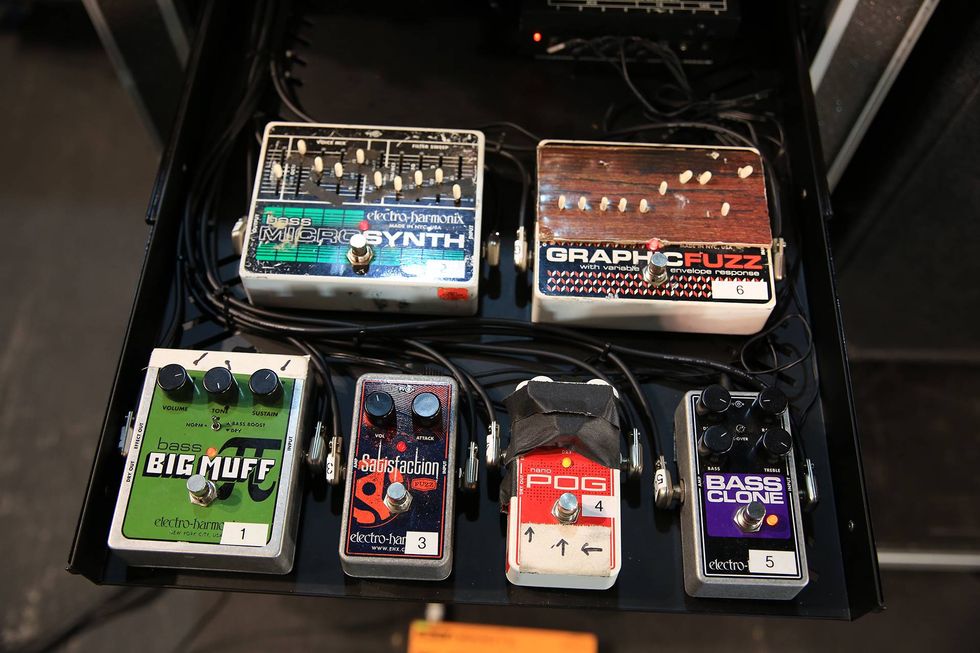
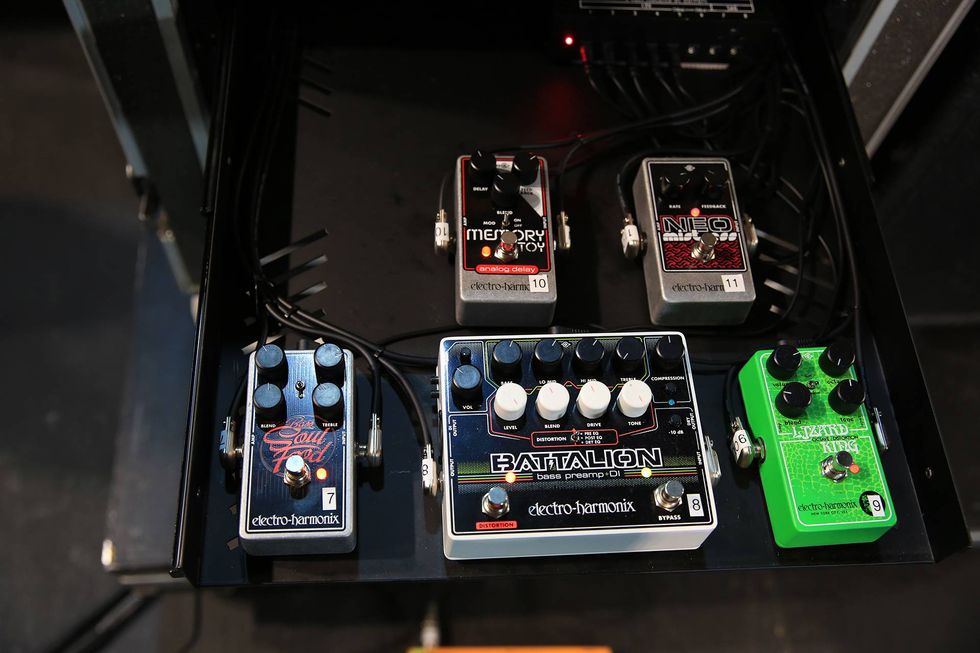
Burgan uses a RJM Mastermind GT to control his in-show switching. In his backstage rack, there’s an EHX Bass Big Muff, Micro Synth, Satisfaction, Nano POG, Bass Clone, and Graphic Fuzz, and on a second shelf, there’s the rest of the collection: a Bass Soul Food, Battalion, Lizard King, Neo Mistress, and Memory Toy.
Introducing The Duff McKagan Signature PJ Pickup Set
Harness the same tight low-end and attack Duff is known for with a pickup combination sure to inspire anyone looking for an aggressive bass tone without the hum.
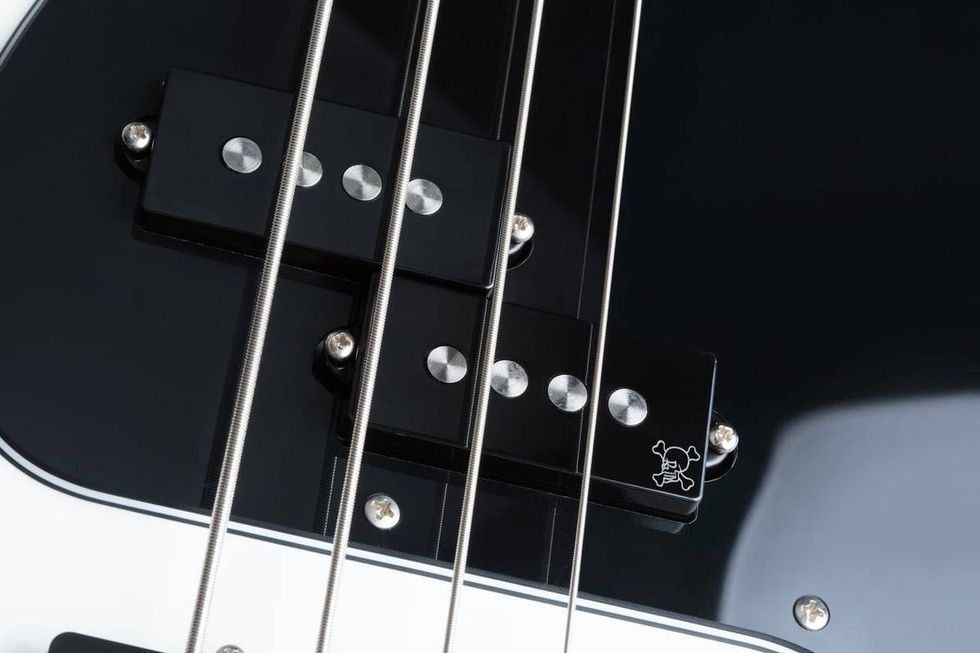
Seymour Duncan is proud to offer this special pickup set featuring:
- Combines a Hot Stack Jazz Bass Bridge with a Quarter Pound Precision Neck
- Hum Cancelling
- Fits most standard PJ routs.
- Hand-built in Santa Barbara, CA
Since the mid-1980s, Duff McKagan’s bass lines and songwriting have powered hits from Guns N’ Roses, Velvet Revolver, and his other highly influential projects. On classic performances like “Sweet Child O’ Mine”, “Slither”, and “Welcome To The Jungle” his weapon of choice was a Fender® PJ bass loaded with Seymour Duncan pickups. Now you can harness that same tight low-end and sharp attack Duff is known for with the Duff McKagan Signature PJ Pickup Set.
Great bass players know that a PJ pickup combination can give you the punchy, thunderous tones needed for rock, punk, funk and beyond. Chasing that flexibility, Duff used his first record advance to buy a Fender Jazz Bass® Special with a Precision® split-coil pickup in the neck position and a Jazz bass pickup in the bridge. The original single-coil bridge pickup was swapped out for a Seymour Duncan Hot Stack Jazz bass® pickup, nixing the hum in all positions while also adding some extra output.
Years later, Duff was gifted a bass with the Seymour Duncan Quarter Pound P-Bass® pickup in the neck. The large diameter alnico 5 magnets and high output coils gave Duff an exciting new dimension to his sound, and he began to pair it with the Hot Stack Jazz Bass bridge for a powerful pickup combination with plenty of grit, low end, and attack. This pairing became Duff’s signature sound, and he’s used these pickups on hit recordings and world tours ever since.
Seymour Duncan has partnered with Duff to offer these two pickups as the Duff McKagan Signature PJ Set, bearing his distinctive skull & crossbones logo. This combination is sure to inspire anyone looking for an aggressive bass tone without hum, perfect for stage and studio. Load these high output pickups into your PJ bass to achieve Duff’s trademark sound – noise free and with plenty of attitude.
Introducing The Duff McKagan Signature PJ Pickup Set
Harness the same tight low-end and attack Duff is known for with a pickup combination sure to inspire anyone looking for an aggressive bass tone without the hum.
Seymour Duncan is proud to offer this special pickup set featuring:
- Combines a Hot Stack Jazz Bass Bridge with a Quarter Pound Precision Neck
- Hum Cancelling
- Fits most standard PJ routs.
- Hand-built in Santa Barbara, CA
Since the mid-1980s, Duff McKagan’s bass lines and songwriting have powered hits from Guns N’ Roses, Velvet Revolver, and his other highly influential projects. On classic performances like “Sweet Child O’ Mine”, “Slither”, and “Welcome To The Jungle” his weapon of choice was a Fender® PJ bass loaded with Seymour Duncan pickups. Now you can harness that same tight low-end and sharp attack Duff is known for with the Duff McKagan Signature PJ Pickup Set.
Great bass players know that a PJ pickup combination can give you the punchy, thunderous tones needed for rock, punk, funk and beyond. Chasing that flexibility, Duff used his first record advance to buy a Fender Jazz Bass® Special with a Precision® split-coil pickup in the neck position and a Jazz bass pickup in the bridge. The original single-coil bridge pickup was swapped out for a Seymour Duncan Hot Stack Jazz bass® pickup, nixing the hum in all positions while also adding some extra output.
Years later, Duff was gifted a bass with the Seymour Duncan Quarter Pound P-Bass® pickup in the neck. The large diameter alnico 5 magnets and high output coils gave Duff an exciting new dimension to his sound, and he began to pair it with the Hot Stack Jazz Bass bridge for a powerful pickup combination with plenty of grit, low end, and attack. This pairing became Duff’s signature sound, and he’s used these pickups on hit recordings and world tours ever since.
Seymour Duncan has partnered with Duff to offer these two pickups as the Duff McKagan Signature PJ Set, bearing his distinctive skull & crossbones logo. This combination is sure to inspire anyone looking for an aggressive bass tone without hum, perfect for stage and studio. Load these high output pickups into your PJ bass to achieve Duff’s trademark sound – noise free and with plenty of attitude.
Win the Ultimate Nuno Bettencourt Prize Package!
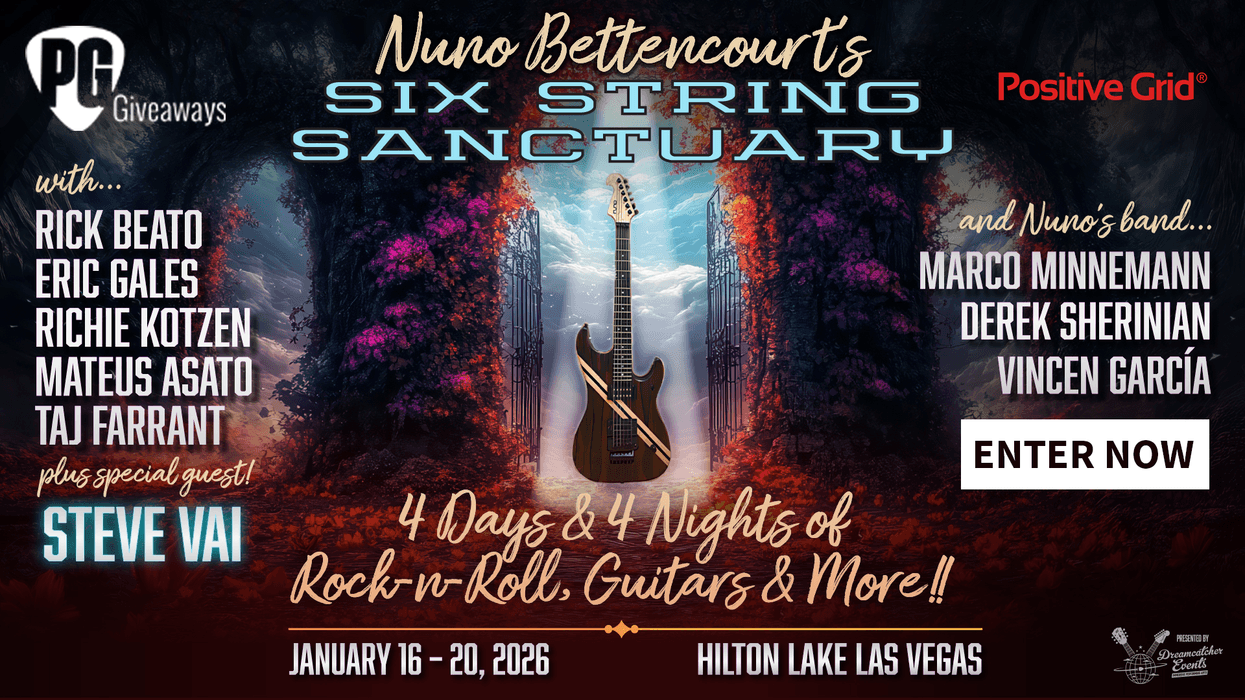
Are you ready to join an unforgettable guitar experience led by Nuno Bettencourt and an all-star faculty including Steve Vai, Rick Beato, Eric Gales, Mateus Asato, and Richie Kotzen? Dreamcatcher Events is proud to present the Six String Sanctuary taking place in Las Vegas from January 16-20, 2026.
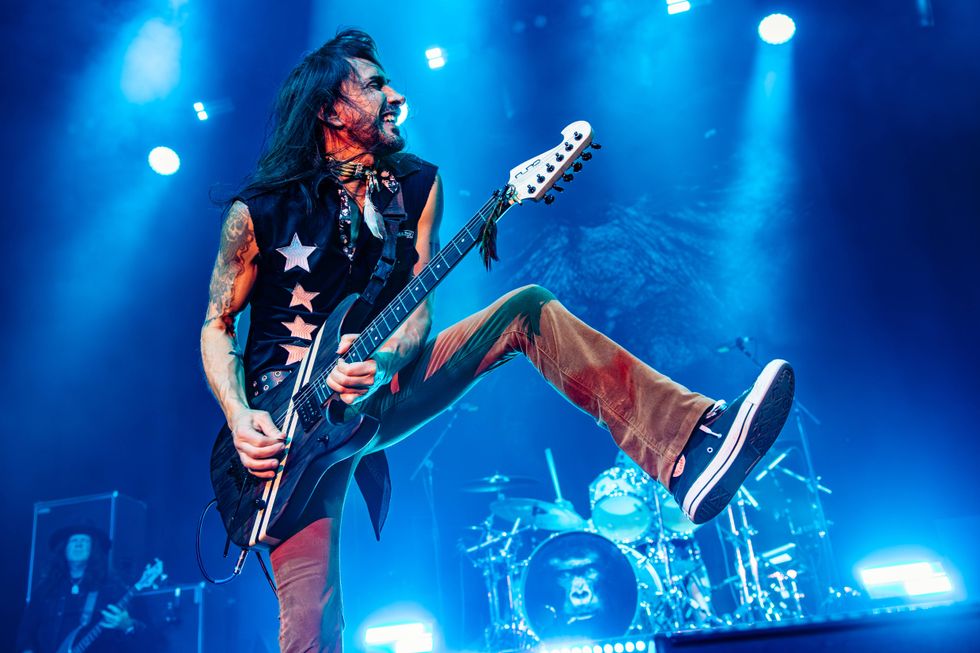
We’re giving away a full Nuno Bettencourt prize package including one of his brand-new signature guitars, a commuter ticket to the Six String Sanctuary, and a Positive Grid Spark 2.
The prize package will include::
- Full access to every masterclass, workshop, breakout session and concert.
- Late-night jam sessions, one-of-a-kind recording opportunities, and networking with fellow guitarists and music lovers.
- The chance to dive deep, learn from the best, play alongside peers and level up your guitar game.
- A brand-new Nuno signature guitar (specific model is to be determined).
- A Positive Grid Spark 2 Amp.
This isn't just another "watch a concert" ticket — this is an immersive, high-energy music camp where you'll participate, create, and connect. Whether you're a beginner or seasoned pro, the vibe is inclusive, electric, and designed to build community, not competition. Four days and nights surrounded by passionate players, expert instructors, unforgettable performances—with YOU in the middle of it all.
Plus, you'll get one of Nuno's signature guitars and a Positive Grid Spark 2 amp. Learn at the Sanctuary, then keep shredding with pro-level equipment that's yours to keep.
About Positive Grid Spark 2
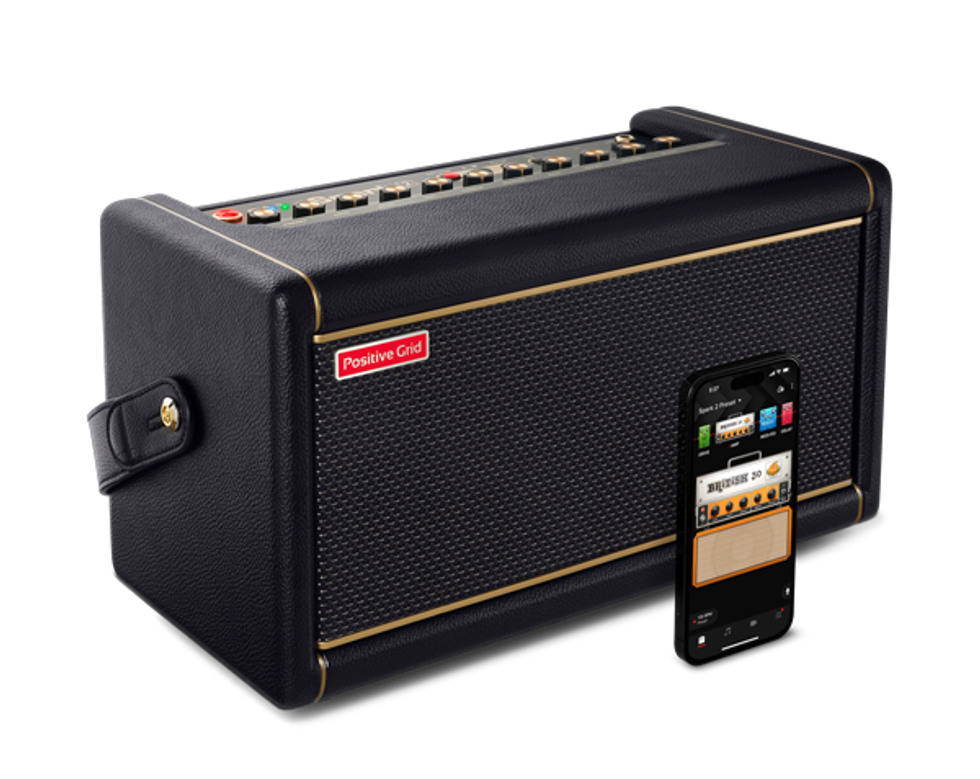
Take your guitar experience to the next level with the 50W Spark 2 smart guitar practice amp/Bluetooth speaker. Get ready for jaw-dropping sound, new HD amp models and smart features that make your guitar time addictive. Use the built-in looper to turn riffs into songs, or explore endless tone options with Spark AI. From daily practice to jam sessions or spontaneous songwriting, this compact powerhouse will be your new go-to creative companion. And, with optional rechargeable battery power (sold separately), your music can go anywhere you do.
Nuno Bettencourts Six String Sanctuary Giveaway from Dreamcatcher
Trace Acoustic Debuts New Clarity Pedal

Elliot® introduces the Trace Acoustic® Clarity™ effects pedal. Designed for use with most acoustic-electric instruments, the pedal is designed to enhance the acoustic sound qualities of an instrument when amplified. The pedal is now available worldwide via online and local retailers.
The Trace Acoustic Clarity is a frequency expansion device consisting of two proprietary variable filters, controlled by separate LOW and HIGH pots, to enhance the existing undertones in both low and high frequencies of an acoustic electric instrument. With input and output fixed at unity, combined with a bipolar 18V internal supply from a standard 9VDC supply or battery, the Clarity delivers dynamic acoustic tones throughout any instrument's acoustic range. The pedal is to be used in line, between an instrument and any PA system, instrument amplifier, or pedalboard setup.
For more information, please visit www.traceelliot.com
Street Price: $199.99 USD
Seymour Duncan Pickup Booster Review Mini
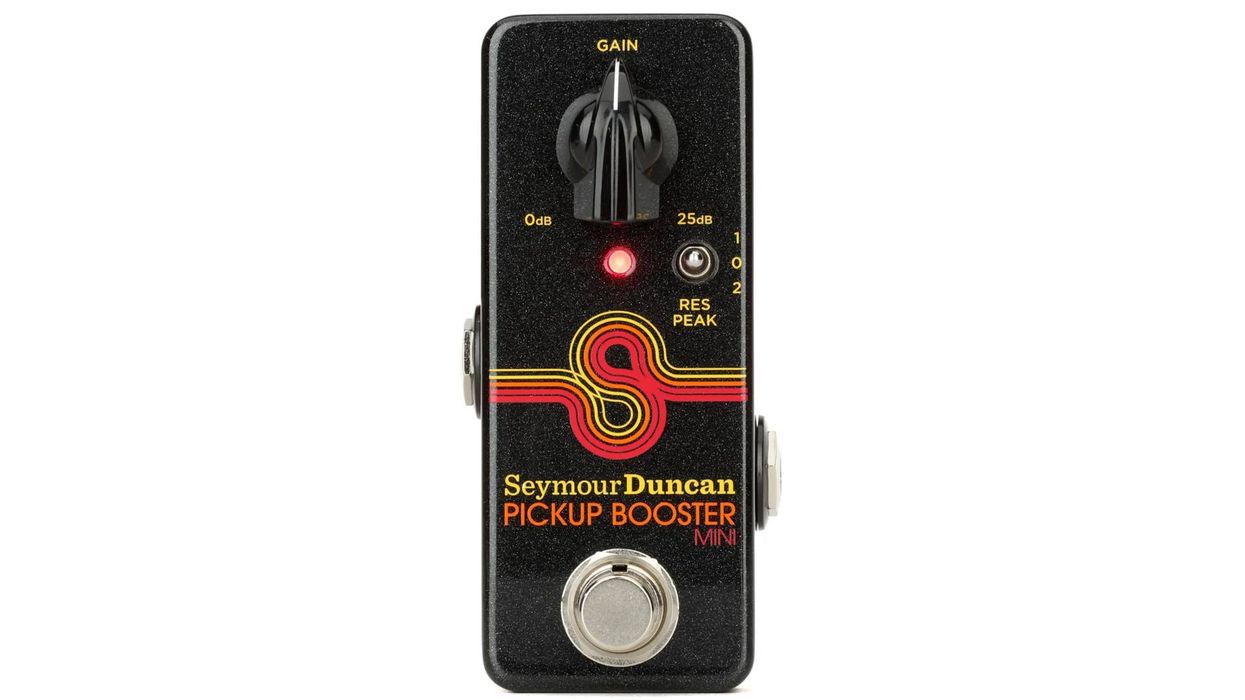
If there’s any company you’d expect to understand the delicate relationship between pickups and pedals, it’s Seymour Duncan. The company’s Pickup Booster Mini, an evolution of the Pickup Booster that’s been around for roughly two decades, certainly reflects a less-is-more philosophy about what you should stick between a good pickup and your amplifier. But while the Pickup Booster is simple, it’s far from inflexible, nor, in most cases, does it sound very “mini.”
Friend to the Single Coil
The Pickup Booster Mini’s versatility is most evident in its resonance control. These shifts are clear when you use the pedal with single coil pickups at the front of a pedal chain—in fact, the resonance switch works only when the Pickup Booster Mini is the first stomp in a line. The differences between settings are also apparent when used with a clean amp. So yes, Fender-oriented players, with their single coils and high-headroom amps, get a fatter share of the fun when using the Pickup Booster Mini, as well as a greater sense of the pedal’s transformative power.
For all its single-coil bias, the Pickup Booster Mini is still a good buddy to humbuckers.
I tested the Pickup Booster Mini’s interaction with different pickups using two contrasting rigs—first between a Fender Jaguar and black-panel Deluxe Reverb, then an SG and the Marshall 18-watt setting on a Carr Bel-Ray. To widen the stylistic disparity between these surfy- and AC/DC-sounding setups, I deliberately set up the Jaguar/Deluxe tandem for fairly anemic output, with the amp volume just past 2. Without the Pickup Booster Mini the combination was thin and lifeless. With an assist from the pedal, the previously absent low- and low-midrange became quite prominent—and not in a fashion that just added mud to the equation. Instead, it lent sustain and a warm, discernible glow to overtones while maintaining the Jaguar/Deluxe combination’s sunny essence. Could I have generated the same tone by turning the amp volume up, the guitar down, and adding some bass? Not easily with the Jaguar’s 1k pots. But even a Telecaster with a finely tapered volume control couldn’t always match the low-mid punch the Pickup Booster Mini added at lower amp volumes.
For all its single-coil bias, the Pickup Booster Mini is still a good buddy to humbuckers. In the more AC/DC-like SG/Carr set up, the Pickup Booster Mini worked best as a lead boost. And in terms of creating bolder tone contrasts, I had good luck with the pedal’s resonant peak 2 setting which, while ostensibly ideal for making single coils sound like high-gain humbuckers, can lend an almost cocked-wah like focus to leads.
You don’t have to use the Pickup Booster Mini at the front end of a pedal chain. Its buffer also means you can use it at the end of long cable runs to make up for the associated tone loss. You lose the flexibility of the resonance switch, but it still sounds fantastic and can work as an almost compression-like glue to meld overtones and artifacts from delay, reverb, and modulation units.
The Verdict
If, like me, you’re always looking for ways to shrink your pedalboard, the Pickup Booster Mini makes an appealing ingredient in a compact setup. Though it doesn’t excite the treble spectrum quite as much as some boosts and overdrives, it restores the fullness often lost when using single-coil pickups at low amp volumes, making it a simple, cost-effective cure for one of many performer’s most common challenges.
Goldbird Introduces New Line of Electric Guitar Strings
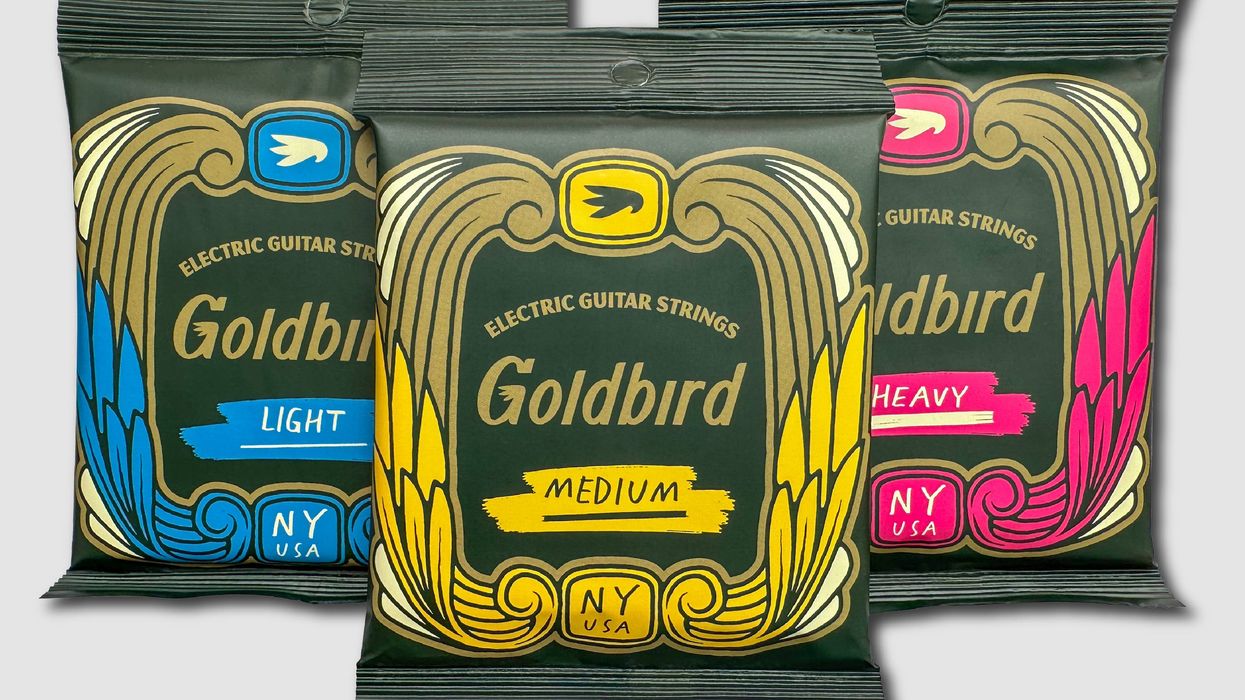
Goldbird, an independent NYC-based music gear brand, has announced the release of its signature line of electric guitar strings. Designed for modern musicians who value reliability, simplicity, and style, Goldbird’s products combine top-tier materials and performance with a community-driven approach.
The new Goldbird electric guitar strings are available in Light (9-42), Medium (10-46), and Heavy (11-50) gauges. Each 6-string set is crafted to deliver durability, balanced tone, and consistent feel across all six strings.
Key product features include:
- Made in the USA
- Nickel-plated steel construction — the ideal balance of brightness and warmth
- Three simple gauges — covers most common playing styles
- Thoughtful packaging — rust-inhibiting material extends shelf life
The debut string offerings are a product of the company’s indie energy. Goldbird is a New York–based music gear brand founded in 2025 with a mission to support emerging musicians and the next generation of creators. Goldbird’s products are designed to make gear simple, reliable, and inspiring — whether you’re practicing at home or playing on stage.
Goldbird strings are available at www.goldbirdmusic.com for $10 per set or $25 for three packs.
Cheap Trick’s Amazing Journey

“I wouldn’t say that All Washed Up was my first choice for the title of the new record,” says Cheap Trick guitarist Rick Nielsen from the living room of his Rockford, Illinois, home. “But hey, I’ve always said that if you have to tell people you’re cool, then you’re not!”
Nielsen and his longtime bandmates, vocalist and guitarist Robin Zander and bassist Tom Petersson, are not among those who need to toot their own horns. Six decades into a career that has seen the band inducted into the Rock and Roll Hall of Fame, invited to collaborate with John Lennon, name-checked by Jerry Garcia, and cited as a primary influence by bands as disparate as Mötley Crüe and Nirvana, Cheap Trick certainly have nothing left to prove. Yet the group, whose deft ability to combine muscular riffs, edgy subject matter and unforgettable power-pop hooks continues to tour relentlessly—they’ve long since passed the 5,000-show mark—and record with a regularity that might wind bands half, or even a third, their age.
All Washed Up, the band’s 21st studio album, captures a Cheap Trick that’s still in top form and able to effortlessly deliver snarling rockers like the swaggering “Riff That Won’t Quit” and thunderous “Bet It All” that harken back to such early classics as “Stiff Competition” and “Daddy Should Have Stayed in High School.” The group’s ability to shift gears and settle into Beatles-inspired midtempo numbers is also on clear display, and tracks like the swirling “The Twelve Gates” and ethereal “The Best Thing” are melodically and lyrically compelling enough to stand shoulder-to-shoulder with decades-old fan favorites like “Downed” and “Heaven Tonight.”
“Luckily, we never progressed,” says Nielsen of the band’s ability to remain on musical track. “We still like the Beatles. We still like the Stones and AC/DC. We still love the Who. And most importantly, we still love making records.”
RICK NIELSEN’S LIVE RIG
Guitars
- Various Hamer Standards
- Fender Custom Shop Tribute Series Jeff Beck Esquire
- 1984 Gibson Aldo Nova Les Paul with Explorer headstock
- Epiphone “Dwight”
- Gibson Explorer
- Gibson Flying V
- 2016 Gibson Custom Mike McCready Les Paul
- Various other Gibson Custom Shop Les Pauls
- GMP Mandocello
Amps
- Modified silver-panel Fender Deluxe Reverb
- Marshall JMP
- Orange Rockerverb
Effects
- Dunlop MXR Micro Amp
- Dunlop DCR2SR rack-mounted Cry Baby
- Shannon Phaser
Strings, Picks, & Accessories
- D’Addario EXL 110 strings (.010–.046)
- D’Andrea picks
- Shure AD4Q wireless
“It’s one the few things that we’re actually really good at,” Petersson adds from his home in Nashville. “We’re lucky enough to still have an outlet to release our music, so we send ideas back and forth and what we end up doing is what we as music fans would like to hear from a record. What we’re not as good at though,” he continues, “is picking out what other people want to hear!”
There to assist with this last task is long-time Cheap Trick producer and self-professed super fan Julian Raymond (the Struts, Brian Setzer). “Julian, even though at this point we basically treat him like a member of the band, has the perspective of what a fan would like us to do, and it really brings out the best in us,” says Petersson. Adds Nielsen, “He knows us better than we know ourselves. He’ll say, ‘I really liked what you did on “He's a Whore” from your first album. Can you get that sound and do something like that here?’”
“At this point in their careers, the guys in Cheap Trick don't care about anything but being happy and doing what they want to do,” says Raymond, also calling from Nashville, where the bulk of All Washed Up was tracked at Blackbird Studios. “Those first four Cheap Trick records from the late ’70s—the debut, In Color, Heaven Tonight, and then Dream Police, those are the best songs on earth,” he continues. “The only problem is that the band sounds all slendered down, because the producer of several of those albums was looking to get on the radio and get hits. It’s a much different vibe from what the band does live, which is so brash and heavy. So now we try to capture that feel and power whenever we make a record.”“I’ve always said that if you have to tell people you’re cool, then you’re not!”—Rick Nielsen
Nielsen is widely known as an avid guitar collector, with a stash in the hundreds that includes both incredibly rare and valuable vintage instruments like original late-’50s Gibson Explorers and Les Pauls and off-the-wall custom one-offs like his iconic checkerboard Hamer 5-neck. But he brings only a limited number of guitars with him to the studio. “This time, I had a couple of my Dwights [in the ’60s, Epiphone manufactured guitars under the Dwight brand name for Sonny Shields Music in East St. Louis], a couple of my Hamer Explorer-shaped Standards, a ’59 Les Paul, and a Telecaster. And I just grab the one I think is good for the song,” he says. The sessions also relied on only a trio of guitar amps: a Marshall half stack, a Vox AC30 and one of the Paul Rivera-modified silver-panel Fender Deluxe Reverbs that have been Nielsen’s go-tos since the ’70s.
TOM PETERSSON’S LIVE RIG
Basses
- Brooks EXP-12-TP 12-string
Amps
- Orange OR30 with Orange 4x12 cab
- Fender Super Bassman with Fender 4x12 cab
Effects
- Tech 21 SansAmp Bass Driver DI
Strings, Picks, & Accessories
- D’Addario EXL170-12 strings
- Junger Pyramid picks
- Shure AD4Q wireless
- Radial JD7 splitter
- D’Addario foam earplugs
For Raymond, limiting the number of choices available to Nielsen is crucial to ensuring that the guitarist remains engaged in the creative process. “When you start getting down that road of auditioning 10 different amplifiers and 15 different guitars with Rick, he just gets bored,” says Raymond. “He doesn't have the patience.”
Nielsen likes to work fast when he’s in the studio, often keeping the basic track that was played live with the band. “I know what I want to do and have it down, so I’ll often keep that track and then embellish on it afterwards,” he says. The guitarist also rarely doubles his rhythm tracks exactly, but instead has the guitars engage in a push-and-pull dialogue that introduces tension and a ragged intensity to songs like the album’s title track. “Rick doesn’t double his tracks exactly because he’s sloppy—and I mean that in the best possible way,” Raymond explains. “You can hear what the guitar on the left is doing, and you can hear what the guitar on the right’s doing. That’s what I love about the way he plays. It’s almost kind of a punk-rock style in more of a rock and roll manner, you know?”
“What we end up doing is what we as music fans would like to hear from a record.”—Tom Petersson
“Of course, we could take those tracks and make them match as perfect doubles in Pro Tools,” he continues. “But you don’t want that. That’s not Rick’s sound.”
Where the lead guitar work on All Washed Up is concerned, Nielsen takes one of two approaches: the first, melodic and impeccably structured, like the rotary-speaker enhanced break on the ballad “Best Thing,” and the other, manically chaotic and visceral, like the hair-raising screech fest on “Bet it All.”
“I’m no guitar virtuoso like Satch or Vai, so I don’t try to make something real fast and real cool,” he says. “But I do make it so my solo has something to do with the actual melody of the song. Then when I run out of smart ideas, there can be a lot of noise and unison bends and screeches and all that stuff!”
From a producer’s standpoint, Raymond says that, much like when he’s recording the guitarist’s rhythm tracks, cutting Nielsen’s frenetic leads is an exercise in catching lightning in a bottle. “Rick plays guitar like it’s his last day on earth,” he says. “He just bounces off the walls and plays, and it’s so much fun to watch because you don’t have to give him any direction. And he gets those solos quick. It’s just his spirit—the spirit of the way he thinks and plays. You don’t fix that. You don’t try to manipulate that. That’s the soul of Cheap Trick to me.”
“I’m no guitar virtuoso like Satch or Vai, so I don’t try to make something real fast and real cool.”—Rick Nielsen
If Nielsen’s methodology has a seat-of-the-pants spontaneity at its core, Petersson’s approach to recording the bass tracks on All Washed Up is decidedly more considered. “We pretty much used a different bass on every song,” he says. “There were two Gibson Thunderbirds, which have been my go-to recording basses since the beginning of the band, a ’66 non-reverse and a ’64 Thunderbird II. I was introduced to those by [PG columnist] Jol Dantzig, who would end up at Hamer guitars and now builds under his own name. He said, ‘Tom, you’ve got to try these Thunderbirds. They’re really cool.’ To me they're just a little clunkier and dirtier than a P-Bass, and to me, the P-Bass is the best all-around bass ever. I mean, it’s a subtle difference. So, in the end, when it’s on a recording, who can tell the difference? Probably no one!”
True to his word, Petersson also used four Fender Precision basses—a ’53, ’55, ’56, and a ’71—on All Washed Up. “And then a ’65 Jazz Bass with flatwound strings and one with roundwounds, a Rickenbacker 4003 with flatwounds, a 1960 Gibson EBO with a body like a double-cut Les Paul Junior, a Hofner 500/2 Club Bass, and my Gretsch White Falcon 12-string bass,” he adds. Petersson is widely credited with conceiving the 12-string bass, an instrument later adopted by players like Jeff Ament of Pearl Jam and Doug Pinnick of King’s X, but he generally reserves the thunderous buzz of this sometimes-unruly instrument for the stage. “I don’t usually use that much 12-string on the records—mainly just for overdubs,” he explains. “Because I feel it’s like a 12-string guitar; it’s cool, but do you really want to have that on everything? But this time, there’s way more of it on there. We just thought, ‘Why not? Let’s just do the song the way it will sound live.’”
Both onstage and in the studio, Petersson’s beefy, overdriven tone booms, growls, and sustains, perfectly complementing his Paul McCartney, John Entwistle, and Ron Wood (when he played with the Jeff Beck Group)-inspired lines and fills. “Tom is my favorite bass player on earth,” says Raymond. “His sound has enormous bottom end, but it’s totally distorted, like he's the rhythm guitar player in the band.”
To achieve his signature sound, Petersson employs a multi-amp setup that can be changed to adapt to the material at hand. “I use a combination of stuff, all through Orange or Hiwatt 4x12 cabinets,” he reveals. “There’s a 30-watt Orange for the distortion, a 300-watt Orange, a 20-watt Hiwatt Maxwatt that was really cool, a 400-watt Hiwatt bass head and then my old Hiwatt Lead 100 that I’ve had since 1972. That was actually the only amp that I had when we made the first album.”
And where many bass players customarily also record a clean DI signal to complement their amplified sound, Petersson strongly disapproves of the practice. “I have my sound, so once it’s there, why give people the opportunity to change it?” he says. “Inevitably, it will get blended in there somehow or they’ll just use the direct. I play all my parts with distortion, so can you imagine how lame and plinky it’s going to sound without that? I want it to sound like the Who!”
At the sound of those two last words, Nielsen’s eyes light up and his enthusiasm can’t be contained. “The Who were the ultimate live band,” he interjects. “They were the greatest: loud and nasty and melodic. They had everything, and it was like nobody could keep up with it.”
“Luckily, we never progressed. We still like the Beatles. We still like the Stones and AC/DC.”—Rick Nielsen
“I saw them open for Herman’s Hermits, and when they smashed their gear after only playing for, like, 20 or 25 minutes, I didn’t completely get it,” Petersson chimes in, also switching into fan mode. “But then right after that tour, they were in the States on their own, and I saw them again in Lake Geneva, Wisconsin. It was the real deal. Once they built it up to a frenzy at the end, it all made sense. It wasn’t just some fake show of smashing gear. It was like we were losing our minds because it was so great.”
“We’ll be playing a few songs with the Who on their farewell tour in Los Angeles soon, which is amazing,” says Nielsen. “But I remember the first time we played with them, in 1979, at Zeppelinfeld in Nuremberg, Germany—Pete Townshend walked up to me and said, ‘Rick, how’d you get that sound on your live record, At Budokan? And I was like, ‘Pete, you’re the guy that did Live at Leeds! The greatest live album of all time.’”
Nielsen pauses to give his trademark smirk. “What are you asking me for?”Special thanks to Cheap Trick techs Chet Haun and Mark Newman for their live rig assistance.
Cheap Trick’s Amazing Journey
“I wouldn’t say that All Washed Up was my first choice for the title of the new record,” says Cheap Trick guitarist Rick Nielsen from the living room of his Rockford, Illinois, home. “But hey, I’ve always said that if you have to tell people you’re cool, then you’re not!”
Nielsen and his longtime bandmates, vocalist and guitarist Robin Zander and bassist Tom Petersson, are not among those who need to toot their own horns. Six decades into a career that has seen the band inducted into the Rock and Roll Hall of Fame, invited to collaborate with John Lennon, name-checked by Jerry Garcia, and cited as a primary influence by bands as disparate as Mötley Crüe and Nirvana, Cheap Trick certainly have nothing left to prove. Yet the group, whose deft ability to combine muscular riffs, edgy subject matter and unforgettable power-pop hooks continues to tour relentlessly—they’ve long since passed the 5,000-show mark—and record with a regularity that might wind bands half, or even a third, their age.
All Washed Up, the band’s 21st studio album, captures a Cheap Trick that’s still in top form and able to effortlessly deliver snarling rockers like the swaggering “Riff That Won’t Quit” and thunderous “Bet It All” that harken back to such early classics as “Stiff Competition” and “Daddy Should Have Stayed in High School.” The group’s ability to shift gears and settle into Beatles-inspired midtempo numbers is also on clear display, and tracks like the swirling “The Twelve Gates” and ethereal “The Best Thing” are melodically and lyrically compelling enough to stand shoulder-to-shoulder with decades-old fan favorites like “Downed” and “Heaven Tonight.”
“Luckily, we never progressed,” says Nielsen of the band’s ability to remain on musical track. “We still like the Beatles. We still like the Stones and AC/DC. We still love the Who. And most importantly, we still love making records.”
RICK NIELSEN’S LIVE RIG
Guitars
- Various Hamer Standards
- Fender Custom Shop Tribute Series Jeff Beck Esquire
- 1984 Gibson Aldo Nova Les Paul with Explorer headstock
- Epiphone “Dwight”
- Gibson Explorer
- Gibson Flying V
- 2016 Gibson Custom Mike McCready Les Paul
- Various other Gibson Custom Shop Les Pauls
- GMP Mandocello
Amps
- Modified silver-panel Fender Deluxe Reverb
- Marshall JMP
- Orange Rockerverb
Effects
- Dunlop MXR Micro Amp
- Dunlop DCR2SR rack-mounted Cry Baby
- Shannon Phaser
Strings, Picks, & Accessories
- D’Addario EXL 110 strings (.010–.046)
- D’Andrea picks
- Shure AD4Q wireless
“It’s one the few things that we’re actually really good at,” Petersson adds from his home in Nashville. “We’re lucky enough to still have an outlet to release our music, so we send ideas back and forth and what we end up doing is what we as music fans would like to hear from a record. What we’re not as good at though,” he continues, “is picking out what other people want to hear!”
There to assist with this last task is long-time Cheap Trick producer and self-professed super fan Julian Raymond (the Struts, Brian Setzer). “Julian, even though at this point we basically treat him like a member of the band, has the perspective of what a fan would like us to do, and it really brings out the best in us,” says Petersson. Adds Nielsen, “He knows us better than we know ourselves. He’ll say, ‘I really liked what you did on “He's a Whore” from your first album. Can you get that sound and do something like that here?’”
“At this point in their careers, the guys in Cheap Trick don't care about anything but being happy and doing what they want to do,” says Raymond, also calling from Nashville, where the bulk of All Washed Up was tracked at Blackbird Studios. “Those first four Cheap Trick records from the late ’70s—the debut, In Color, Heaven Tonight, and then Dream Police, those are the best songs on earth,” he continues. “The only problem is that the band sounds all slendered down, because the producer of several of those albums was looking to get on the radio and get hits. It’s a much different vibe from what the band does live, which is so brash and heavy. So now we try to capture that feel and power whenever we make a record.”“I’ve always said that if you have to tell people you’re cool, then you’re not!”—Rick Nielsen
Nielsen is widely known as an avid guitar collector, with a stash in the hundreds that includes both incredibly rare and valuable vintage instruments like original late-’50s Gibson Explorers and Les Pauls and off-the-wall custom one-offs like his iconic checkerboard Hamer 5-neck. But he brings only a limited number of guitars with him to the studio. “This time, I had a couple of my Dwights [in the ’60s, Epiphone manufactured guitars under the Dwight brand name for Sonny Shields Music in East St. Louis], a couple of my Hamer Explorer-shaped Standards, a ’59 Les Paul, and a Telecaster. And I just grab the one I think is good for the song,” he says. The sessions also relied on only a trio of guitar amps: a Marshall half stack, a Vox AC30 and one of the Paul Rivera-modified silver-panel Fender Deluxe Reverbs that have been Nielsen’s go-tos since the ’70s.
TOM PETERSSON’S LIVE RIG
Basses
- Brooks EXP-12-TP 12-string
Amps
- Orange OR30 with Orange 4x12 cab
- Fender Super Bassman with Fender 4x12 cab
Effects
- Tech 21 SansAmp Bass Driver DI
Strings, Picks, & Accessories
- D’Addario EXL170-12 strings
- Junger Pyramid picks
- Shure AD4Q wireless
- Radial JD7 splitter
- D’Addario foam earplugs
For Raymond, limiting the number of choices available to Nielsen is crucial to ensuring that the guitarist remains engaged in the creative process. “When you start getting down that road of auditioning 10 different amplifiers and 15 different guitars with Rick, he just gets bored,” says Raymond. “He doesn't have the patience.”
Nielsen likes to work fast when he’s in the studio, often keeping the basic track that was played live with the band. “I know what I want to do and have it down, so I’ll often keep that track and then embellish on it afterwards,” he says. The guitarist also rarely doubles his rhythm tracks exactly, but instead has the guitars engage in a push-and-pull dialogue that introduces tension and a ragged intensity to songs like the album’s title track. “Rick doesn’t double his tracks exactly because he’s sloppy—and I mean that in the best possible way,” Raymond explains. “You can hear what the guitar on the left is doing, and you can hear what the guitar on the right’s doing. That’s what I love about the way he plays. It’s almost kind of a punk-rock style in more of a rock and roll manner, you know?”
“What we end up doing is what we as music fans would like to hear from a record.”—Tom Petersson
“Of course, we could take those tracks and make them match as perfect doubles in Pro Tools,” he continues. “But you don’t want that. That’s not Rick’s sound.”
Where the lead guitar work on All Washed Up is concerned, Nielsen takes one of two approaches: the first, melodic and impeccably structured, like the rotary-speaker enhanced break on the ballad “Best Thing,” and the other, manically chaotic and visceral, like the hair-raising screech fest on “Bet it All.”
“I’m no guitar virtuoso like Satch or Vai, so I don’t try to make something real fast and real cool,” he says. “But I do make it so my solo has something to do with the actual melody of the song. Then when I run out of smart ideas, there can be a lot of noise and unison bends and screeches and all that stuff!”
From a producer’s standpoint, Raymond says that, much like when he’s recording the guitarist’s rhythm tracks, cutting Nielsen’s frenetic leads is an exercise in catching lightning in a bottle. “Rick plays guitar like it’s his last day on earth,” he says. “He just bounces off the walls and plays, and it’s so much fun to watch because you don’t have to give him any direction. And he gets those solos quick. It’s just his spirit—the spirit of the way he thinks and plays. You don’t fix that. You don’t try to manipulate that. That’s the soul of Cheap Trick to me.”
“I’m no guitar virtuoso like Satch or Vai, so I don’t try to make something real fast and real cool.”—Rick Nielsen
If Nielsen’s methodology has a seat-of-the-pants spontaneity at its core, Petersson’s approach to recording the bass tracks on All Washed Up is decidedly more considered. “We pretty much used a different bass on every song,” he says. “There were two Gibson Thunderbirds, which have been my go-to recording basses since the beginning of the band, a ’66 non-reverse and a ’64 Thunderbird II. I was introduced to those by [PG columnist] Jol Dantzig, who would end up at Hamer guitars and now builds under his own name. He said, ‘Tom, you’ve got to try these Thunderbirds. They’re really cool.’ To me they're just a little clunkier and dirtier than a P-Bass, and to me, the P-Bass is the best all-around bass ever. I mean, it’s a subtle difference. So, in the end, when it’s on a recording, who can tell the difference? Probably no one!”
True to his word, Petersson also used four Fender Precision basses—a ’53, ’55, ’56, and a ’71—on All Washed Up. “And then a ’65 Jazz Bass with flatwound strings and one with roundwounds, a Rickenbacker 4003 with flatwounds, a 1960 Gibson EBO with a body like a double-cut Les Paul Junior, a Hofner 500/2 Club Bass, and my Gretsch White Falcon 12-string bass,” he adds. Petersson is widely credited with conceiving the 12-string bass, an instrument later adopted by players like Jeff Ament of Pearl Jam and Doug Pinnick of King’s X, but he generally reserves the thunderous buzz of this sometimes-unruly instrument for the stage. “I don’t usually use that much 12-string on the records—mainly just for overdubs,” he explains. “Because I feel it’s like a 12-string guitar; it’s cool, but do you really want to have that on everything? But this time, there’s way more of it on there. We just thought, ‘Why not? Let’s just do the song the way it will sound live.’”
Both onstage and in the studio, Petersson’s beefy, overdriven tone booms, growls, and sustains, perfectly complementing his Paul McCartney, John Entwistle, and Ron Wood (when he played with the Jeff Beck Group)-inspired lines and fills. “Tom is my favorite bass player on earth,” says Raymond. “His sound has enormous bottom end, but it’s totally distorted, like he's the rhythm guitar player in the band.”
To achieve his signature sound, Petersson employs a multi-amp setup that can be changed to adapt to the material at hand. “I use a combination of stuff, all through Orange or Hiwatt 4x12 cabinets,” he reveals. “There’s a 30-watt Orange for the distortion, a 300-watt Orange, a 20-watt Hiwatt Maxwatt that was really cool, a 400-watt Hiwatt bass head and then my old Hiwatt Lead 100 that I’ve had since 1972. That was actually the only amp that I had when we made the first album.”
And where many bass players customarily also record a clean DI signal to complement their amplified sound, Petersson strongly disapproves of the practice. “I have my sound, so once it’s there, why give people the opportunity to change it?” he says. “Inevitably, it will get blended in there somehow or they’ll just use the direct. I play all my parts with distortion, so can you imagine how lame and plinky it’s going to sound without that? I want it to sound like the Who!”
At the sound of those two last words, Nielsen’s eyes light up and his enthusiasm can’t be contained. “The Who were the ultimate live band,” he interjects. “They were the greatest: loud and nasty and melodic. They had everything, and it was like nobody could keep up with it.”
“Luckily, we never progressed. We still like the Beatles. We still like the Stones and AC/DC.”—Rick Nielsen
“I saw them open for Herman’s Hermits, and when they smashed their gear after only playing for, like, 20 or 25 minutes, I didn’t completely get it,” Petersson chimes in, also switching into fan mode. “But then right after that tour, they were in the States on their own, and I saw them again in Lake Geneva, Wisconsin. It was the real deal. Once they built it up to a frenzy at the end, it all made sense. It wasn’t just some fake show of smashing gear. It was like we were losing our minds because it was so great.”
“We’ll be playing a few songs with the Who on their farewell tour in Los Angeles soon, which is amazing,” says Nielsen. “But I remember the first time we played with them, in 1979, at Zeppelinfeld in Nuremberg, Germany—Pete Townshend walked up to me and said, ‘Rick, how’d you get that sound on your live record, At Budokan? And I was like, ‘Pete, you’re the guy that did Live at Leeds! The greatest live album of all time.’”
Nielsen pauses to give his trademark smirk. “What are you asking me for?”