
Music is the universal language
“Glory to God in the highest heaven, and on earth peace to those on whom his favor rests.” - Luke 2:14
Norse Guitar Feeds
“He played a gig with a nub”: Steve Morse remembers watching a one-armed bassist perform – and how it inspires him to keep playing despite arthritis struggles

Virtuoso and former Deep Purple guitarist Steve Morse has opened up about his struggles with arthritis in recent years, and how he remains determined to continue playing despite the pain.
In 2024, Morse explained how “10,000 notes a day” of practice for “decades” – combined with a genetic history of arthritis – means his fingers “don’t have the cartilage anymore”, leading to pain while playing guitar.
Now, in a new interview with American Musical Supply, the 71-year-old guitarist tells the story of how he once watched a bassist with one arm perform live, and how the memory keeps him inspired despite his own health issues.
“I thought at one point, ‘Dude, you’re done,’” Morse says [via Blabbermouth]. “And I thought, when I was a kid going to see bands in Atlanta, it was a three-hour drive, a band called Hydra came out. The bass player, his arm was cut off here. And he was playing the gig and he was getting into it, and it was great…
“Every time I’m feeling bad about, ‘This hurts…’ he played a gig with a nub. And you think about [jazz guitarist] Jeff Healey [being] blind and making his own technique.”
Morse continues: “Humans adapt. And I’ve learned a lot from watching things on the farm, watching the ants, for instance… I’m like Bill Murray with the groundhogs. The persistence of the animals counts. They keep on and on and they find a way. But they never stop. I guess that’s one of my big lessons, is don’t give up while you’ve still got a breath.”
Steve Morse adds that he’s tried “every treatment” he can find in a bid to help his arthritis condition.
“The reason why I wanna keep playing is because it really is a part of me – I mean, it’s a big part of me…” he explains.
“I’ve tried every treatment I can find. In fact, I’ve got another trip a thousand miles away to try something else. So, yeah, I changed my technique, changed my picking pattern, changed everything that I can to make it through whatever the challenge is.”
The post “He played a gig with a nub”: Steve Morse remembers watching a one-armed bassist perform – and how it inspires him to keep playing despite arthritis struggles appeared first on Guitar.com | All Things Guitar.
Fender Master Builder Andy Hicks’ Winding Road

Andy Hicks’ path to becoming a guitar craftsman—from overachieving student to Fender Custom Shop Master Builder—can be traced back to age 11 or 12, when a friend introduced him to Nirvana’s In Utero. Hicks had grown up savoring his dad’s eclectic record collection—everything from the Beatles to jazz standards to Black Sabbath. But as he soaked in the noisy strains of songs like “Serve the Servants” and “Scentless Apprentice,” it felt like “something was unlocking” in his brain.
“It was a band my parents didn’t know about,” Hicks recalls. “It was this secret. It’s kind of edgy, so do I tell them about this?’ I remember being nervous: ‘The band is Nirvana, and here’s the album cover [which shows a transparent anatomical mannequin].’ My dad was like, ‘Let’s go buy every record of theirs.’ A couple weeks later, I’ve got the entire discography and t-shirts and everything. I was just so fascinated by Kurt Cobain as an artist, and I was the perfect age for that music to resonate with me.”
But this resonance went even deeper than most kids bewitched by the brooding “Smells Like Teen Spirit” video. In that clip, Hicks happened to notice Cobain was playing a Fender Mustang—not that he knew anything about his future employer as a pre-teen. “That video made me want to play guitar,” he says. “I was like, ‘That looks so cool.’ I knew he played a Fender, but I didn’t know any Fender models or anything. For my birthday, my parents took me to Guitar Center and I got my first: a made-in-Mexico three-tone sunburst Strat. I just fell in love with the guitar.”
In the decades since, Hicks—a former member of the doom-metal band Stygian Crown—has forgotten more about the instrument than most people ever learn. But in a way, his wealth of knowledge hasn’t really altered his perspective all that much, either as a builder or a musician: Instead of chasing trendy guitar gimmicks or seeking out some unattainably perfect tone, he’s just aiming for empowerment.
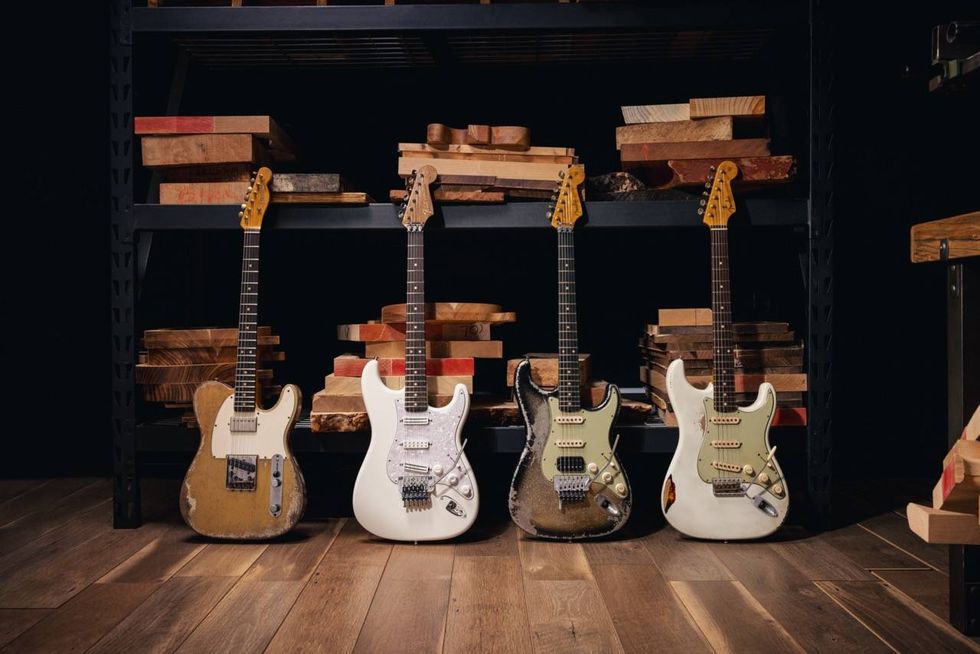
“My formative years were spent learning how to use my hands to make the sounds I wanted to make,” he says. “Years later, I look back at that as being such a blessing. As a builder, I’m not sucked into the misinformation pool about tone wood and all of these little minute changes to something that people think is gonna make this huge change in the instrument. It’s more, ‘Let me make the best-feeling instrument for you,’ because the tone is ultimately going to come from you. I can’t make you have the tone that you want. That’s freeing as a builder, and I think it’s freeing for the player, too.”
After getting his hands on that first Strat, he was obsessed. But not necessarily with gear. Back at home with his little 25-watt amp, he realized too late that he needed effects pedals to emulate his heroes: “I have this vision of going home and playing ‘Smells Like Teen Spirit,’” he says. “‘Why doesn’t my guitar sound like that guitar?’” But even after experimenting with “a million” options, he learned a crucial lesson: “After having a distortion pedal, it was like, ‘I still don’t sound like Black Sabbath.’” He eventually found his own path, falling in love with heavy metal and taking any chance he could to practice.
“I wanted the guitar to be as involved in my life as it could possibly be forever,” he says. “In high school, the only guitar class they taught was Introduction to Guitar. I was beyond ‘introduction,’ but I explained to the teacher: ‘I’m just looking for a place where I can come play. If I don’t learn anything new, I’m gonna teach myself stuff. Can I take this class?’ I took it for a semester. When it was over, I said, ‘Can I sign up again?’ He was like, ‘Uh, I guess.’ I took it for two straight years, for four semesters.” That same devotion followed him into college, where he played in bands but also envisioned a life as a teacher and water polo coach. The itch, it turns out, was too strong to not eventually scratch.
“The tone is ultimately going to come from you. I can’t make you have the tone that you want.”
“My roommates would always say, ‘Why aren’t you a music major?’” he recalls. “I knew some music majors, and it sometimes seemed too clinical, the way they would talk about music. I didn’t know if that part of the guitar would give me joy. For a long time, it was, ‘I’ll have some other career, and the guitar will always be there for me to come home and decompress with.’”
He got the push he needed from his future wife. “I came home from work,” he says, “and she told me, ‘I don’t think you love what you’re doing. I think you love guitar. There’s a school in Hollywood [called the Musicians Institute].’ At this point, I was tinkering with guitars all the time. I wanted to make my guitars feel better, and I didn’t have the money to have somebody constantly adjust these things for me, swapping out pickups or whatever. When we came home [from touring the school], I was like, ‘I have to do this.’ I signed up and started there the next semester [in 2009].”
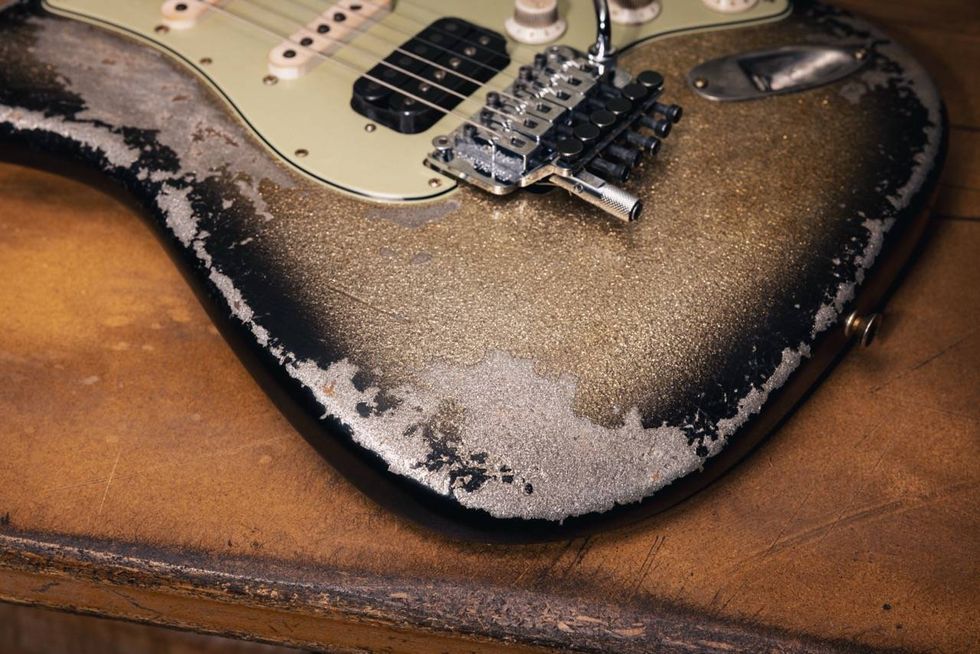
He learned a lot in the Guitar Craft Academy program, focusing six months on the electric guitar and impressing one of the instructors, longtime Fender employee Dave Maddux. “He was the first person to say to me, ‘Judging by the builds you’ve done in school, I think you could make a good go at this,’” Hicks says. “He put me in contact with some people, and when I graduated, I had a job lined up at Jackson Custom Shop, where I shaped necks and did fretwork. That’s been a main focus my whole career: making the neck feel as good as possible.”
He bounced around a bit at Jackson, including a stint on the Fender production line. But these early days were anything but boring: He was only on the job for a few weeks, working on necks for the EVH Wolfgang, when he first met Eddie Van Halen, who was on site with master builders Chip Ellis (Fender) and Mike Shannon (Jackson).
“I wanted the guitar to be as involved in my life as it could possibly be forever.”
“It’s Fender—we have tours all the time,” Hicks says. “This guy comes over, leaning on me, and he looks like some dad wearing a baseball hat. Then I’m like, ‘Oh, Eddie Van Halen is just standing here watching us work.’ The guy I was working with was in the middle of complaining: ‘Man, these stainless steel frets. With just these Wolfgangs, we’ve gotta do 12 stainless steel necks today.’ Eddie [playfully] said something along the lines of, ‘I’m sorry my guitar is such a pain in the butt.’ It was incredible.” (The story has a full-circle coda: Toward the end of Hicks’ run at Jackson, Van Halen held a friends-and-family show at the Forum, and the virtuoso gave +1s to everyone who worked on his guitars. “My dad was sitting next to Tom Morello, telling him that his son made Eddie Van Halen’s guitar,” he says with a laugh. “I had to say, ‘Dad, please stop talking to Tom Morello. And also, I didn’t make his guitar. Chip made his guitar. I make Wolfgang guitars.’ He was so excited to talk to somebody, and he just happened to be talking to Tom Morello.”)
After a couple years at Jackson, Hicks “got noticed a little bit” and made the jump over to the Gretsch Custom Shop, where he earned his stripes as a “guitar detective,” helping with a meticulous recreation of Malcolm Young’s “Salute” Jet. Gretsch initially thought they’d have access to the AC/DC icon’s original axe—but after both Young and his tech suffered health issues, they were left only with photos, dimensional specs, and a lot of question marks.
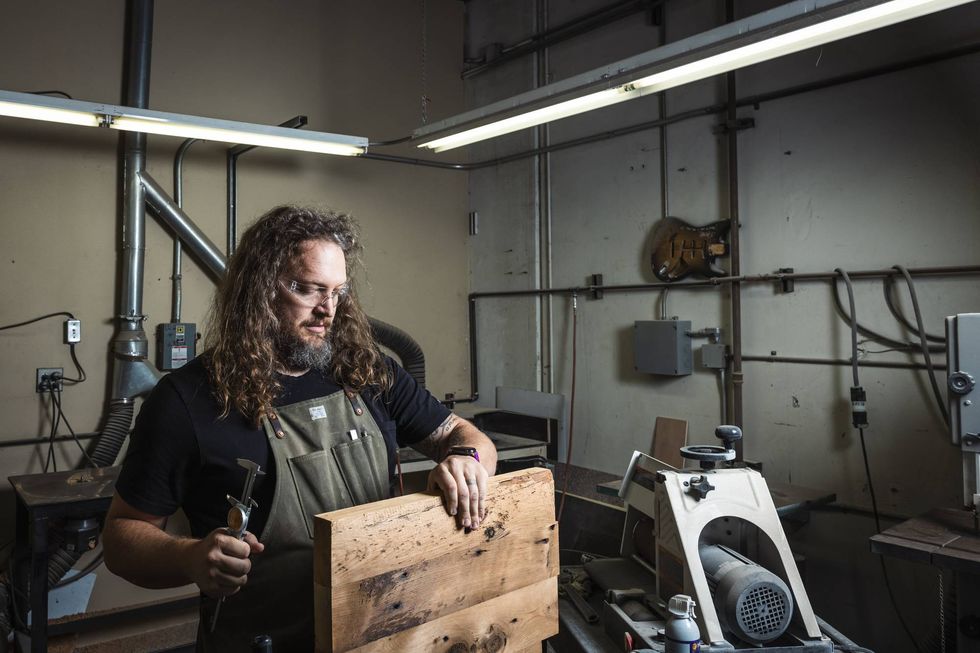
“There were a lot of things that had been done to it over the years,” Hicks recalls. “It had one pickup in it and three knobs. What do those do? No one could really tell us. During some of my digging, I contacted a guitar shop in Melbourne, Australia, that had it in there before a tour. They took photos of it just for fun, so they sent me a bunch of them. That’s how I learned about the weird tone caps that they had in it—they were like wah-pedal tone caps instead of normal tone caps. It was essentially two master volumes and a tone. That’s the fun stuff of doing an instrument like that.”
“I thought to myself, ‘I don’t know if I’m growing anymore.’ I didn’t like that feeling.”
Hicks grew super comfortable at Gretsch—almost too comfortable. “I thought to myself, ‘I don’t know if I’m growing anymore,’” he says. “I didn’t like that feeling. I didn’t want to wait around anymore to see if it’s going to be my turn.” When he got an offer to run production at the high-end manufacturer James Tyler Guitars, he leapt at the opportunity—finding a mentor in the titular builder, who “ran his shop like a pirate” and followed his gut above all else. “When everyone was doing the roasted necks, he was like, ‘I don’t really like how it sounds, so we’re not doing it,’” he says. “I remember some of his finance guys saying, ‘We can charge more.’ But he didn’t care.” After Tyler’s health took a turn, Hicks wound up running production and building simultaneously, often working two shifts a day to help steer the ship opposite general manager Rich Renken. This was another valuable learning moment, but he felt like there was unfinished business back at his old stomping grounds.
After a serendipitous phone call with Fender’s Ron Thorn, who told him a spot was opening up at the Custom Shop, that feeling only solidified. “As soon as Ron said this, it was like, ‘That’s the thing. I have to know if I can do it,’” Hicks recalls. “I think I left Tyler in good hands, so there were no bad feelings. It was an emotional day, coming in here, being welcomed back. It was an interesting first day, too, because you know everyone’s name. [laughs] It just felt right. It felt like coming home.”
He returned with a wealth of knowledge, but none of it prepared him for one particular build: making a new model for his favorite guitarist of all time, Iron Maiden’s Dave Murray. “It was completely insane,” he says. “They were about to start this multi-year tour and wanted another guitar. I was working really closely with his tech, fine-tuning his model a little bit.” He decked the bridge, adjusted the neck angle, oil-finished the neck—tailoring it as best he could to Murray’s preferences. Despite all that hard work, it was still tense waiting for feedback. “I shipped it off and got an email a couple days later from Dave,” he recalls. “It just said ‘Regarding the guitar’ [in the subject line], and it’s a Schrödinger’s cat situation: ‘I’m gonna open this email, and one of two things happens: He either likes the guitar, and that’s good, or he doesn’t like it, and now what do I do?’ He said how much he loved it. His guitar tech reached out and said it was going to be his number-one for the tour. And now we’ve announced that we’re launching the master-built version of that.”
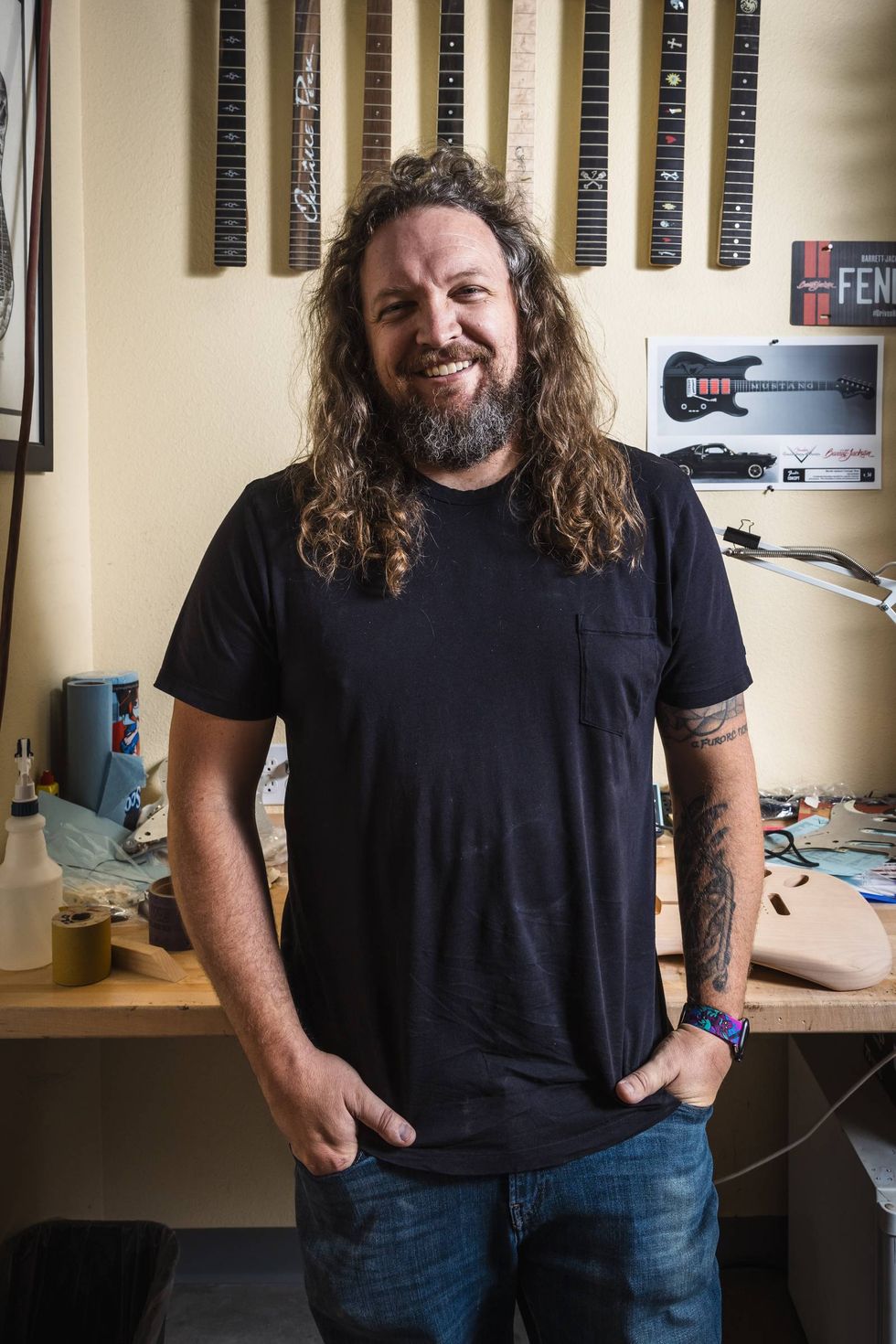
Hicks once envisioned the guitar dominating his life—and between his day job and his own creative pursuits, that’s pretty much come true. “The bigger balancing act,” he says, “is learning how to turn the guitar off for a little bit when I’m at home with my kids,” he says. Those worlds are colliding even more than usual now, though, as his nine-year-old son is taking guitar lessons. (The kid has access to a pretty sweet setup, too, including Hicks’ Fender Tone Master Pro workstation and Tone Master FR-12 amp. Plus, he’s playing what Hicks calls “the nicest 3/4-scale Squier in the entire world,” after his hours of re-fretting and tweaking.)
Back home at Fender, Hicks is master-building the life he always wanted: “Man,” he says, “it’s been a dream come true.”
Save $1,000s on these stunning PRS 40th anniversary Custom 24 guitars at Sweetwater!

Right now at Sweetwater you can save over $1,000 on a range of PRS 40th anniversary Custom 24 models until the end of March.
These 40th Anniversary Custom 24 guitars are reduced to $5,822.50 and are available in four different finishes: Sub Zero (blue) and Tiger Eye (brown), plus a Micro Wraparound Burst version of each. Granted, these guitars aren’t cheap, but they’re top-of-the-line instruments, and $1,000s in savings is nothing to be sniffed at…
[deals ids=”4c6x6wGCtJrwmF1u8rhfRj”]
The PRS 40th Anniversary Custom 24 offers a mahogany body and an Artist Grade figured maple top. It has a mahogany neck and a compact Pattern Thin profile, a 10-inch-radius ziricote fingerboard, and Old School Birds inlays.
Each is also fitted with two of PRS’s DMO humbuckers and has a five-way blade pickup switch. Topped off with PRS Phase III locking tuners, a Gen III tremolo bridge, and a pre-factory headstock eagle inlay, only 400 of these guitars were made available worldwide, and Sweetwater says it only received 26.
PRS celebrated its 40th anniversary last year. In honour of its special birthday celebrations, PRS held a get together with 1,400 artists and music industry personnel at California’s House of Blues, where they were treated to an evening of performances by PRS’s extensive roster of talent. Hosted in conjunction with NAMM 2025, the exclusive event saw the likes of John Mayer, Mark Lettieri, Orianthi and others performing.
Later, when speaking to Andertons, founder Paul Reed Smith spoke of the brand’s signature tone: “We’re starting up the beginning of PRS having its own sound,” he said. “So, there’s sounds of Les Pauls, there’s sounds of Strats and Sounds of Teles, and maybe there’s a side table of SGs and Gretches and this and the other, Danelectros… But we’re starting to get our own tone and it’s starting to be acknowledged.
“The party last night was about that. There weren’t Tele tones or…Well, there might have been some Strat tones, maybe. Really beautiful ones. John’s solo in Gravity last night was spectacular.”
Shop this deal and more at Sweetwater.
The post Save $1,000s on these stunning PRS 40th anniversary Custom 24 guitars at Sweetwater! appeared first on Guitar.com | All Things Guitar.
Fender’s new Strobo-Sonic Pro Tuner pedal uses strobe tuning for “ultra-precise” ±0.01 cent accuracy

Fender has expanded its lineup of utility pedals with the Strobo-Sonic – a new “ultra-precise” tuner pedal with ±0.01 cent accuracy.
Built for performing musicians and professionals, the Strobo-Sonic also features a large, high-visibility 2.3″ x 2.1″ LED display with auto brightness dimming for low-light environments, and operates in two modes, Strobe and Needle.
- READ MORE: Laney’s new Prism-Mini is a pocket-sized smart amp ready to take on Positive Grid’s Spark GO
Strobe tuning is a tuning method by which a strobe light illuminates a pattern – often on a rotating disk, or a digital equivalent, as is the case with the Fender Strobo-Sonic Pro Tuner – which spins or moves at a rate corresponding to a specific pitch. The pattern appears to freeze when the string is perfectly in tune. It’s regarded as the most accurate way to tune a guitar.
 Credit: Fender
The Strobo-Sonic also features a Needle mode, offering a more familiar tuning experience for many players.
It also sports convenient side switches offering deep control over reference pitch – this is adjustable between A = 430Hz and 450Hz – plus three bypass modes: true bypass, buffered bypass and buffered always-on.
The Strobo-Sonic also occupies a pedalboard-friendly form factor, measuring 115mm x 66mm x 44mm and weighing just half a pound.
“Made for the stage, the pedalboard-friendly tuner offers a high-visibility display, two easily trackable tuning display modes, and accessible side switches for deeper control – perfect for players of all skill levels,” says Fender.
The Strobo-Sonic Pro Tuner is available now, priced at $129.99 / £95. For more info, head to Fender.
 Credit: Fender
The post Fender’s new Strobo-Sonic Pro Tuner pedal uses strobe tuning for “ultra-precise” ±0.01 cent accuracy appeared first on Guitar.com | All Things Guitar.
Myles Kennedy was worried about “tainting the history” of Jeff Buckley’s famous Telecaster when he used it onstage in 2019: “I truly didn’t feel worthy of it”

Being a hugely successful guitarist – in Alter Bridge and alongside Slash, plus as an accomplished solo and session musician – Myles Kennedy has had access to some truly special instruments over the course of his career.
Kennedy recently explained how he got “emotional” when he had the chance to hold Eddie Van Halen’s Frankenstein guitar while tracking the latest Alter Bridge album at 5150 Studios. And now, he’s remembered a Paris performance back in 2019 in which he covered Jeff Buckley’s Hallelujah, while holding the late guitarist’s 1983 Telecaster.
- READ MORE: Rick Beato says excessive phone scrolling is the reason he can’t downpick like James Hetfield
The performance came during an Alter Bridge set at L’Olympia in Paris, France on 9 December 2019, and as Kennedy explains, his veneration of Jeff Buckley had him questioning whether he was even “worthy” to hold his guitar.
“Grace [Jeff Buckley’s only album, which came out in 1994] is an album that gave me the same feeling as hearing [Van Halen’s] Eruption, with my brain wondering, ‘Whoa, what’s happening here?!’” Kennedy explains.
“I also felt that way when I heard Julian Lage. Playing Jeff’s guitar was amazing, though I truly didn’t feel worthy of it. I was a little uncomfortable, to be honest.
“I gradually convinced myself that it was okay. It’s just a guitar that’s part of this incredible history. All I had to do was not taint that history!”
You can check out a pro-shot video of that now-famous performance below:
As for what technically makes Buckley’s ‘83 Telecaster so special, Kennedy goes on: “It’s just an early-to-mid ‘80s Tele, but there’s something weird about how the pickup was wired.
“Apparently, there’s something technically wrong with it, at least from what [Matt’s Guitar Shop owner] Matt Lucas explained to me. That’s what gives it that beautiful shimmery sound. It’s all down to this imperfection, which makes it even cooler. When you plug it in, you think, ‘Oh yeah, there’s that sound!’”
Despite Alter Bridge’s enduring success, Myles Kennedy and his bandmates remain astutely aware of the rich rock history of some of the studios they record in and instruments they get to play.
The band recorded their self-titled new album at LA’s 5150 – the studio once owned by Eddie Van Halen and now operated by his son Wolfgang.
“Wolf was incredibly kind enough to bring that offer up with our manager,” Kennedy recently explained.
“We were like, ‘Really?’ We knew the history of all the incredible music that had been made there. Just the fact that he trusted us enough to come in and not totally ruin the legacy really meant a lot. When we all showed up, we were very cognisant of that, and we wanted to honour the situation.
View a list of Alter Bridge’s upcoming tour dates at their official website. Listen to the new Alter Bridge album below:
The post Myles Kennedy was worried about “tainting the history” of Jeff Buckley’s famous Telecaster when he used it onstage in 2019: “I truly didn’t feel worthy of it” appeared first on Guitar.com | All Things Guitar.
Laney’s new Prism-Mini is a pocket-sized smart amp ready to take on Positive Grid’s Spark GO

Portable all-in-one digital practice amps are all the rage right now, and a new contender to Positive Grid’s Spark GO has arrived in the form of Laney’s Prism-Mini – a compact desktop smart amp packed with presets, onboard effects and Bluetooth connectivity.
At its core, the Prism-Mini aims to be a self-contained tone playground for guitarists who want big sounds without the bulk. Despite its small size, the amp comes loaded with 100 presets, split between 50 factory patches and 50 user slots, giving players plenty of room to explore and store their own signature tones.
Laney says its factory presets are far from generic placeholders. Instead, they’re carefully crafted tones inspired by the sounds of notable Laney players including Tony Iommi, Billy Corgan, Devin Townsend, Lari Basilio, Tom Quayle and Jack Gardiner – offering quick starting points for everything from doom-laden Sabbath grind to modern prog and fusion tones.
Players can choose from 17 amp models, covering everything from crystal-clean tones to full high-gain firepower, alongside 32 studio-style effects spanning drive, EQ, modulation, delay and reverb.
The unit allows up to six DSP effects to run simultaneously alongside the amp and cabinet models. Those effects can be freely arranged using Laney’s Tone Wizard companion app, which lets players drag and drop blocks anywhere in the signal chain. From the app, users can edit patches, manage presets and control the amp remotely, as well as import and export tones for easy storage and sharing.
Notably, those sounds are delivered through a surprisingly serious speaker setup for a practice amp this size. The Prism-Mini features dual 1.5” woofers and a true stereo 3W + 3W output, promising a wider and more detailed soundstage than the typical single-speaker mini amp. In other words, it’s built for more than just quiet bedroom noodling.
 Credit: Laney
A 1.77” full-colour LCD screen on the amp itself provides quick access to presets and parameters, while Bluetooth 5.3 allows players to stream backing tracks directly from a phone or tablet. The app also includes a built-in drum machine, while the amp itself packs a tuner and Bluetooth audio streaming, making it easy to jam along with backing tracks or your favourite records.
If it isn’t already obvious, portability is a key part of the design. A rechargeable battery provides up to 14 hours of playtime, so the amp can travel easily from desk practice to dressing-room warmups without needing a wall socket. USB-C charging keeps things simple, and despite the compact build, Laney says the amp still delivers “rich stereo depth” and a tone that feels “unmistakably Laney”.
Priced at $149, the Laney Prism-Mini is available now in Blue or Black colourway.
Learn more at Laney.
The post Laney’s new Prism-Mini is a pocket-sized smart amp ready to take on Positive Grid’s Spark GO appeared first on Guitar.com | All Things Guitar.
“I don’t like the way they look or sound. I have no fondness for them at all”: Jake E. Lee hates Telecasters… but there was one which changed his mind

Buyer’s remorse is a familiar tale for many guitarists, but Jake E Lee knows the opposite: the regret of passing on a guitar that just felt right. The former Ozzy Osbourne guitarist recently shared the story of a Telecaster he once let slip – and how he still thinks about it decades on.
In a new interview with Guitarist, Lee recounts his strongest case of buyer’s remorse: “About 20 years ago, I was in a local guitar shop, looking to see what they had, and there was nothing new but this ‘67 Telecaster. And I don’t like Telecasters. I don’t like the way they sound. I don’t like the way they look. I have no fondness for Telecasters at all. But I picked this one up anyway and it felt really good, so I plugged it in. It sounded really good and I had a connection with it.”
Despite the instant spark, Lee hesitated.
“But I put it back down and said, ‘I don’t really like Teles… I don’t even know why I picked it up,’” he says. “Two days later, I went back in there because I couldn’t quit thinking about it and it just felt right, but they’d sold it already. So that’s a different kind of buyer’s remorse, right? Maybe we’d call that no-buyer’s remorse [laughs]. I still think about that Tele every once in a while… there was just a connection there. I really wish I’d bought it.”
Lee’s regrets aren’t limited to Telecasters. Over the years, there’s been a long list of guitars he wishes he’d held on to.
“How long have you got?! I had a ’56 Les Paul Junior and a ’67 ES-335 that I wish I’d held on to. I wish I still had my original SG that I sold in the 90s, too. The list is too long and too sad,” he says.
Elsewhere, Lee also shares some sage advice for guitarists searching for that elusive “ultimate” instrument. His tip is simple, but it comes from decades of trial, error, and hard-earned lessons.
“Play it, don’t just hope for the best,” Lee says. “With older guitars, there are some that are really special and some that are just okay – you have to play those first. But I’ve bought new guitars online, like an Eastwood Messenger like [the Musicraft model] Mark Farner used to play with Grand Funk Railroad. If it’s a new guitar, the quality is gonna be pretty standard.”
Returning to the Telecaster story, the guitarist sums up why hands-on experience matters: “Going back to that Tele I mentioned before, I never would have thought about buying that guitar – and I should have bought that guitar – if I hadn’t tried it. That’s why you need to try a guitar. Sometimes you get a connection where you just feel it, like it’s the right one. And sometimes you’ll pick up a guitar that you’re sure will be the right one and it’s not there.”
The post “I don’t like the way they look or sound. I have no fondness for them at all”: Jake E. Lee hates Telecasters… but there was one which changed his mind appeared first on Guitar.com | All Things Guitar.
Galahcore FX Ploverdrive review: focused boutique overdrive can help a board take flight

After a short break in our series taking a look at some of the choice offerings from NotPedals.com, we’re returning to the shelves of that ever-so-cool small builder marketplace to take a look at the Galahcore FX Ploverdrive – an interesting overdrive pedal with some uniquely Australian aviary inspiration.
The Ploverdrive is inspired by the masked lapwing, AKA the spur-winged plover. It’s an Aussie bird that’s known for defensively swooping at anything or anyone that threatens its nest – even, in some cases, airplanes. This aggressive territorial control is aided by its spurs – sharp outcrops of bone on its wings’ carpal joints that can make a curious cat’s day a lot worse.
In all it’s a good basis for thematically mapping onto an overdrive pedal, as the heart of the unit is the Spur control – a highly interactive tone control that gives the Ploverdrive a lot of its character. I’ll get onto the specifics of its functioning in a moment. The Spur control is joined by the more standard and self-explanatory gain and volume controls, with no other switches, leading to a pretty straightforward three-knob drive format housed in a 1590bb-sized enclosure adorned with some gorgeous art by Conrad Keely of the band …And You Will Know Us By The Trail Of Dead.
Build quality, along with the quality of the art’s printing, is top-notch – component selection tends towards the sturdy and the high-end. Jacks connect with a satisfying and firm clunk, and the potentiometers offer the kind of resistance that indicates a quality part. Everything else is all pretty within the remit of a ‘standard’ pedal – mono, 9V pedal power, so it’s time to plug in and get going.
In use
When I first fire up the Ploverdrive, I happen to have the Spur control all the way ‘down’ and the gain all the way up. There are few better ways to wake up in the morning – the Spur control, a little like a RAT’s filter, is wired ‘backwards’, in that anticlockwise means a brighter, more focused and more resonant sound. Combined with the higher gain setting its a very punchy sound indeed, and per the manual is voiced more for brightening up a neck pickup.
On the bridge pickup that brightening effect is a little too effective, but on the neck humbucker of a Telecaster Deluxe the Ploverdrive does indeed add a lot of clarity – impressive given that this is a pickup that can quickly overwhelm a gainy amp.
Rolling the Spur all the way to the soft, fluffy, not-yet-flying-baby-bird side of the dial, and things get more interesting still. Here you’ll find the basis of a great sound for warm, wooly leads – the sound is very rounded, no matter the pickup, and does invite some more singing, Claptony style playing – here, higher gain settings accentuate its smooth, sustaining character, rather than the sonic stabs of the less friendly side of the Spur control.
And speaking of gain – there’s a lot of it! We’re still firmly in overdrive territory here, it’s no HM-2, but atop a relatively clean sound from a Marshall-style amplifier, the Ploverdrive can add a decent amount of thick saturation by itself. However, in backing off the gain control and setting the Spur to something less extreme, the sound remains very characterful and perhaps shines a more flattering spotlight on the operation of the Spur control. The amount of volume on tap can absolutely invite the front end of your amp to the party too – which is always a good combo with a mid-gain overdrive that manages to keep things dynamic. Set right the Ploverdrive will be extremely honest as to how hard you’ve hit your strings.
But enough restraint – doesn’t this bird attack airplanes? Setting the Ploverdrive back to its aggressive stance and feeding it into a more gainy amp, even more avenues for Ploverdriven goodness open up. The slightly resonant ring to the brighter side of the Spur control means that for “chugging” it may not be the most ideal pedal – through faster playing your ear does tend to latch onto the more static factor of that resonant beak. Er, peak.
However, if you put a more generic metal sound out of your head for a moment you get an excellent tone for clanking noise rock in the vein of The Jesus Lizard and Shellac. The sharpness of the more extreme settings becomes a feature not a bug if you play it right – and the fact that the pedal remains dynamic the whole way up the gain lets you still express yourself through it, but the fact that its EQ curve is very much not flat and transparent remains a boon for this kind of music.
Should I buy a Ploverdrive?
Overall the Ploverdrive is an affordable but creatively-designed pedal that is easy to learn, and hard to master, in a very good way. The spur and gain controls are quite interactive with each other, and so I was still finding new sounds within the thing days into my testing. And that’s not to mention that it very much won me over by coming with a nanoblocks model of a bird, which, you know, more pedals could stand to do. If you like an overdrive that’s ready to make its presence known with an aggressive caw and an ambitious swoop at a Cessna, you won’t be disappointed in the Ploverdrive.
Check the pedal out at notpedals.com.
The post Galahcore FX Ploverdrive review: focused boutique overdrive can help a board take flight appeared first on Guitar.com | All Things Guitar.
Acoustic Soundboard: Strengthen Your Guitar with Structured Sides
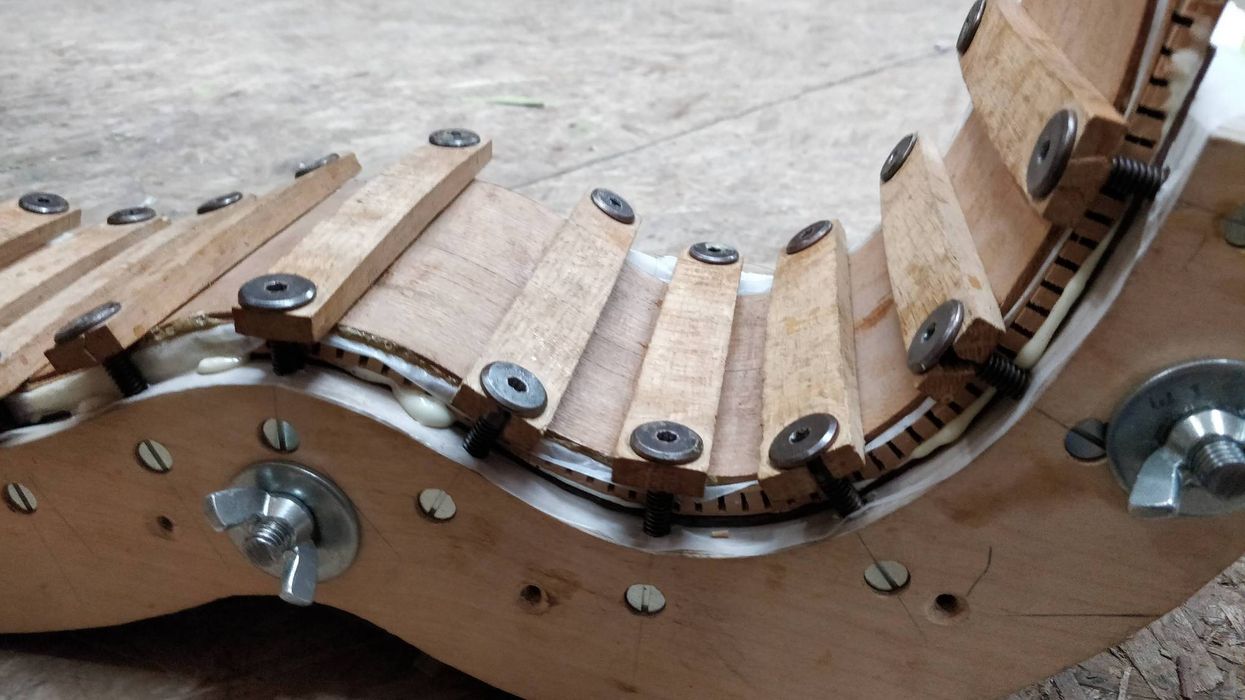
Most exciting new innovations in acoustic guitar have to do with the top, like new bracing systems, double tops, etc. This makes sense, because this is the main sound-producing component of the instrument. But a guitar is a whole system of parts that work together to produce sound, and the sides of the guitar play a significant role in this.
From an engineering perspective, there are two functions of guitar sides: first, to hold the structure of the guitar together and bear some of the tension of the strings; second, to transfer vibrations from the top to the back.
Traditional guitar sides are composed of a single layer of wood, which is bent into shape using heat. Then, kerfed liners are used to glue the sides to the top and back. This is the simplest way to construct sides, and it’s also the lightest method, since it involves the least wood. However, a single thin layer of wood is prone to cracking.
That’s not the only downside of traditional acoustic sides. They also absorb some of the energy of the vibrating top and back, which has a damping effect on the guitar, analogous to brake dampers in a car. Damping decreases the loudness and sustain of the guitar. To reduce the amount of damping, guitar sides should be as stiff as possible (without being too heavy) so that they transmit vibrations, rather than absorb them. This is the goal of structured sides.
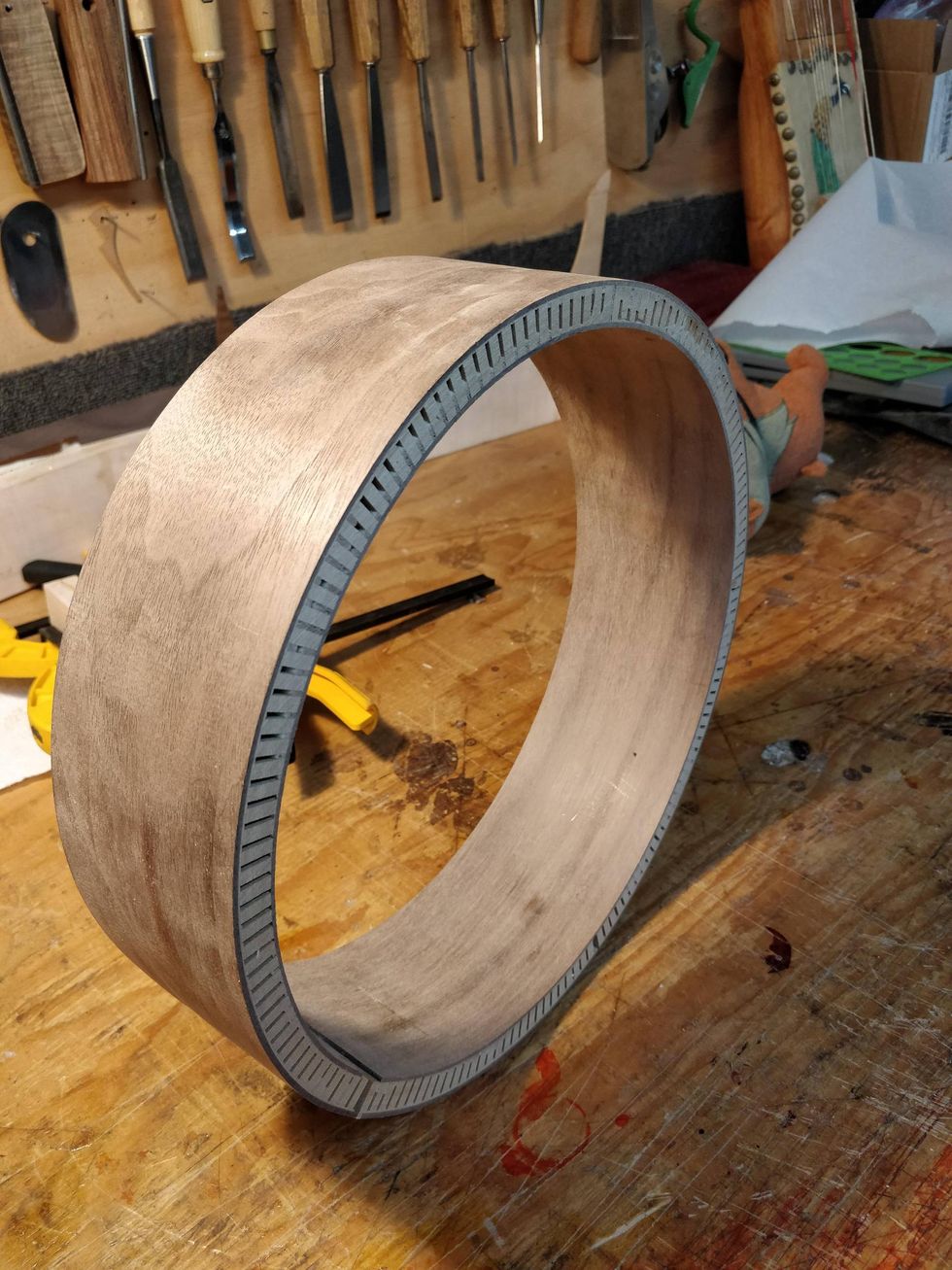
A logical way to increase the rigidity of the sides is to extend the top and bottom liners, making one big liner that spans the whole depth of the sides. This means the whole area of the side is reinforced, which in effect makes structured sides a type of laminated construct, with two plies. One ply is the outer “show” wood, and the other is the kerf bent piece that lines the inside. In general, lamination increases the rigidity of wood and helps counteract any internal stresses that may be present in one of the plies.
Several builders have contributed to the development of structured sides. Based on my research, the two-ply version was invented by Sheldon Schwartz. Another luthier, Allan Beardsell, then brought the idea to the workshop of Sergei de Jonge. While working at de Jonge’s shop, two founders of the Mile End Guitar Coop (Michael Kennedy and Jeremy Clark) learned about the technique. When they went on to found the coop, they took this technique with them and continued to experiment.
The next evolution was to add a third layer to the sides, thus making them even more stiff. This method was developed by Kennedy and Clark at the coop, and it’s currently the method that most of us in the coop use—the name “structured sides” comes from someone here. There are three plies: the outer show wood, the inner kerf bent layer, and a final thin layer on the inside of the guitar. The outermost and innermost layers are thin, solid pieces of hardwood. The inner kerf component is made of a lighter softwood, like cedar.
The physics of our three-ply sides are comparable to an I-beam. The stiffness of an I-beam comes from the two outer flanges. The middle section doesn’t add much rigidity; it simply holds the two flanges at a distance apart. The greater this distance, the more rigid your sides. Similarly, the inner kerf layer functions as a spacer for the outermost and innermost layers. This makes the sides much stiffer than if the two solid layers were glued directly together, meaning that structured sides have a higher stiffness-to-weight ratio than simply laminated sides. This also means that structured sides make the guitar more efficient by reducing the damping effect of the sides!
As a bonus, structured sides increase durability, doing a better job of supporting the body against the forces of string tension, so the back of the guitar can bear less of this stress. They also protect against side cracks and other damage; it takes a pretty big bump to the side of the guitar to get through all three plies.
Although structured sides were intended for acoustic guitars, I’ve been using the technique to build laminated banjo rims. This makes the banjo significantly lighter than a traditional solid rim. Recently, I built a tackhead banjo that weighed just 3.2 pounds when fully strung up!
All this said, I think there’s still plenty more room to experiment with sides. Maybe another filler material like Nomex could be used instead of the kerf layer. Maybe other instruments, like mandolins or upright basses, could benefit from structured sides? I look forward to seeing what the future holds for this technique!
Recording Dojo: When Is a Record Done?
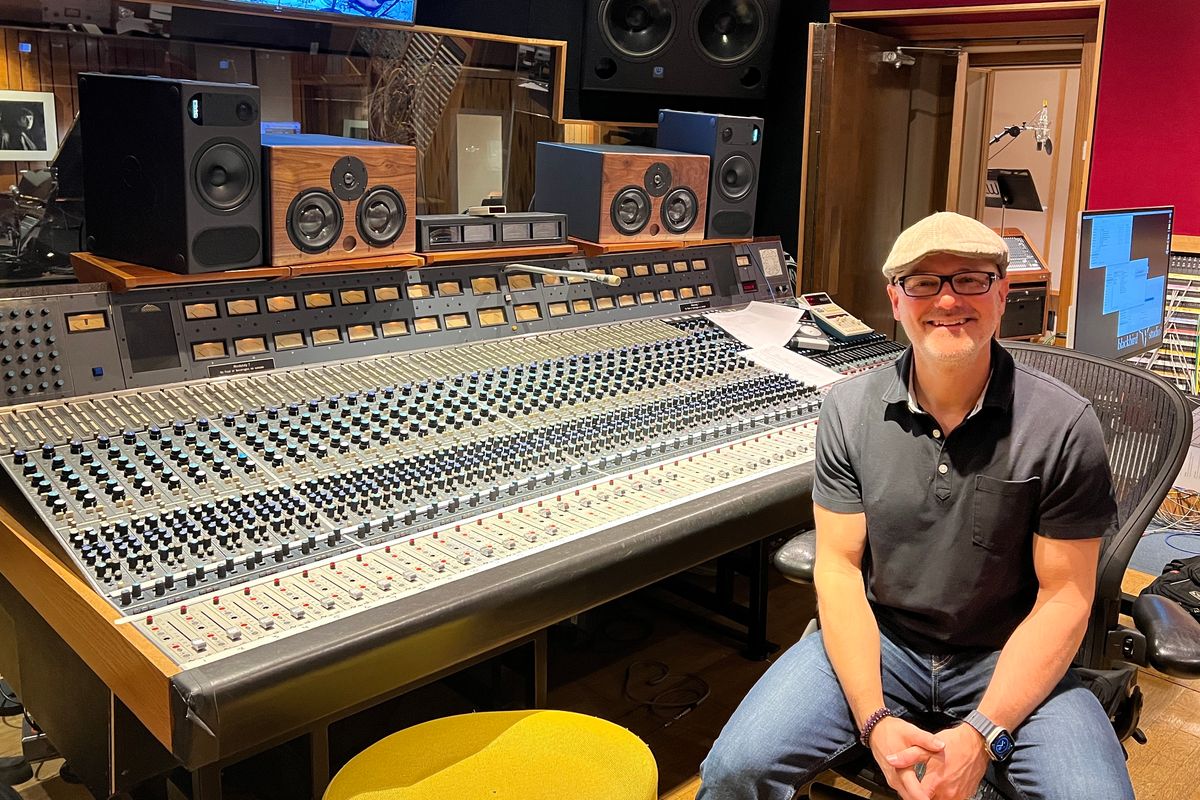
Q: How do you know when the record is finished?
A: When the budget runs out.
It’s an old studio joke, but it sticks around because it points at something deeper than money. Budgets don’t just limit time—they force commitment. And nowhere is that more obvious than during the recording process, when the record still feels malleable enough to become anything.
That sense of possibility is intoxicating. It’s also dangerous.
I’ve lived this from both sides of the glass—first as a signed artist, aware of how the clock quietly ate into my recording money, and later as a producer watching artists wrestle with the same invisible tension. At some point, the record has to stop being an idea and start being a document.
Early in a tracking session, performances tend to arrive with a kind of clarity that’s hard to manufacture later. Musicians are alert. Intentions are strong. The red light still carries weight. You hear phrasing that commits, dynamics that breathe, and little mistakes that feel wonderfully human. The song is being captured, not negotiated.
Then something subtle shifts. Takes get more refined—and usually safer. Players start listening backward instead of playing forward. Energy gives way to self-correction. Suddenly the band is performing for the playback instead of for the moment. Technically, things may improve, but past a certain point the music begins to suffer. This is the point where the studio can easily stop being a temple of documentation and become a laboratory of doubt.
Unlimited recording time accelerates this process exponentially—especially in home studios. Without constraints, every decision becomes provisional. Mic choices stay “temporary.” Arrangements remain “open.” Performances are endlessly replaced and playlisted rather than committed to. The record never quite becomes real because nothing is allowed to harden into fact.
Some of my favorite records came together quickly and felt almost divinely inevitable. Parts were chosen. Tones and effects were printed. Performances were treated as events, not auditions. Not because they were flawless, but because they told the truth of that moment. And that truth is fragile. Chase it too long and it disappears.
“Records are never finished. They’re just released. The art is knowing when to let them go.”
One of the most useful questions you can pivot to during recording isn’t, “Can we do better?” but rather, “Are we improving the song—or just exhausting it?” Knowing when to ask that question isn’t about a fixed number of takes. It’s a feel. And if the answer isn’t immediately obvious, you’re probably already past the peak.
This is where experience earns its keep—not in knowing how to fix things later, but in knowing when not to defer decisions. Every time you avoid committing during tracking, you push weight downstream. You don’t eliminate risk; you relocate it. And by the time you reach mixing, the cost of that indecision gets paid with interest.
This is why mixing so often becomes the next battlefield. When performances, arrangements, and tones remain unresolved, the mix is forced to carry emotional weight it was never meant to bear. Engineers start chasing balance problems that are really performance problems, and tonal issues that should have been settled at the microphone. Endless tweaks follow—not because the mix is unfinished, but because the record never fully decided what it wanted to be.
Budgets—financial, temporal, or self-imposed—are what can help prevent that drift. They create gravity. They force choices out of the abstract and into the real world. They turn possibility into artifact.
Records aren’t finished when every option has been explored. They’re finished when enough of the right decisions have been made that they far outweigh the remaining ones.
Records are never finished. They’re just released. The art is knowing when to let them go. Until next time, namaste
.
Totally Guitars Weekly Update March 6, 2026
March 6, 2026 I spent some time this week revisiting the early Loggins & Messina albums and realized I had not gotten to a couple lessons that I had planned on years ago. The remedy was to finish up Long Tail Cat and Whiskey, two of Kenny Loggins great tunes. They are live now and […]
The post Totally Guitars Weekly Update March 6, 2026 appeared first on On The Beat with Totally Guitars.
New Substack Post - Flattening Boards by Hand
Hi, Everyone!
Check out my latest Substack post!
Stay tuned to this blog! I plan on updating the layout a bit and talk about some new woodworking ideas!


Mod Garage Tonewood Teardown: Fixing Up Your Bridge and Saddles
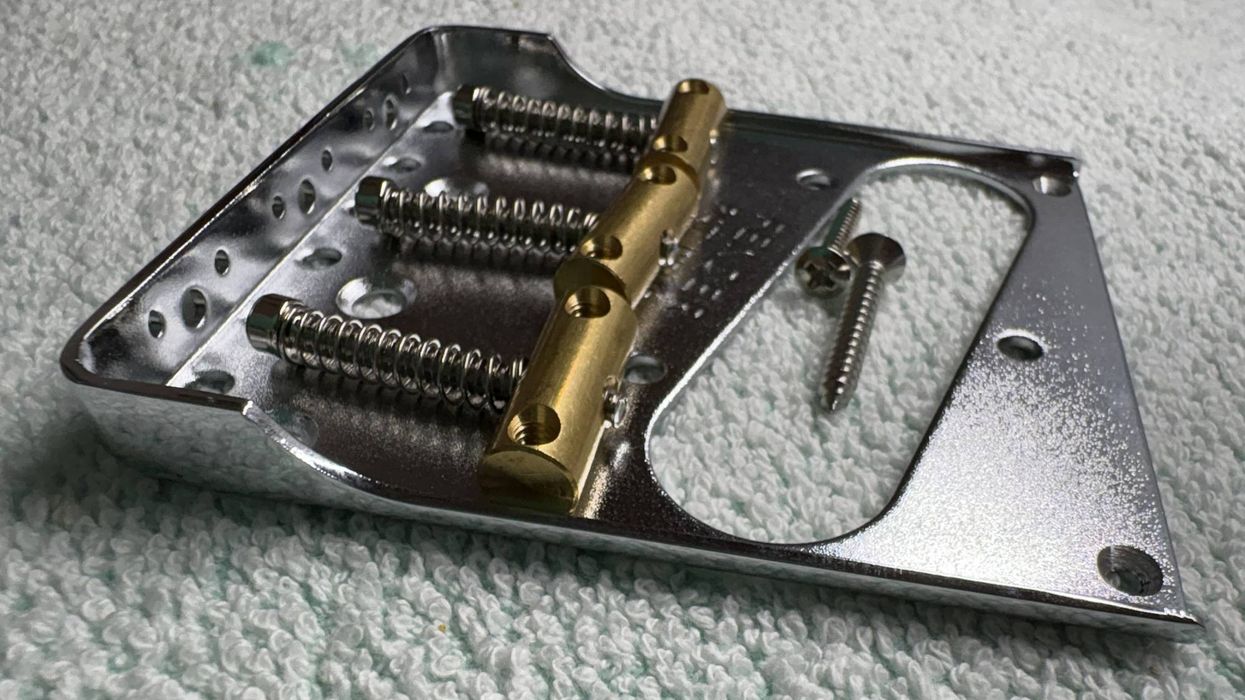
Hello, and welcome back to Mod Garage. Last month, we started to talk about the new bridge and saddles for our guitar, so let’s continue where we left off. In general, the two contact points where the strings meet the guitar are crucial and very important regarding playability, comfort, and tone. It’s always worth taking special care of the bridge and the nut on any electric guitar, and this month, we’re focusing on the bridge. Let’s break down the details of our replacement bridge and what we can expect from it.
The new bridge is much lighter than the stock model, which is great for getting a lighter-weight guitar. The overall weight of a guitar is a major factor for comfortability—a heavy guitar will add nothing to your life besides shoulder and back pain. Contrary to what you might read on the internet, science tells us it won’t increase sustain, nor add any “heavy” tone attributes to the amplified signal.
The thinner metal walls of the new bridge aren’t closed—a great attribute for reducing weight—and the double-cut “tapered walls” are a practical update, though some will disagree and prefer a bridge with vintage-style closed walls. There are countless bridge options for Telecasters, so find the best fit for your playing style. The edges of the short walls on my new bridge felt a little sharp, so I used some fine metal files and sanding paper to smooth them out. Your hand is resting on this surface, so you don’t want any jagged edges.
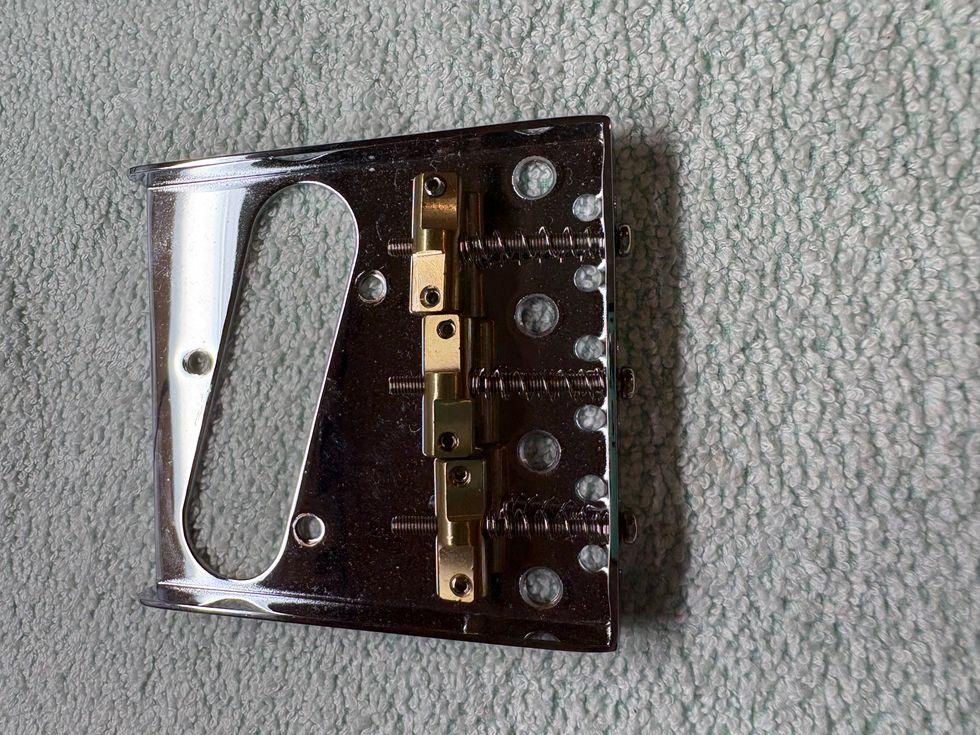
In addition to the classic string-through-body method, the new bridge also offers the late-’50s top-loading option, which means the strings are not running through the body but rather directly through the back of the bridge plate, giving you a gentler break angle. I recommend a bridge that provides you with both options. Top-loading your strings can give a feeling that some describe as “loose” and “rubbery,” but this route has its devotees, like the great Jim Campilongo, and it can make string bends a bit easier. Experiment to see if you like it or not. On my new bridge, all the holes for guiding the strings felt a bit gritty, so I spent some time taking care of any burrs.
The new bridge has two additional screw holes at the front, which is a very clever upgrade—two extra screws there will help join the front part of the bridge to the wood of the body. Speaking of screws, the stock bridge was attached with tiny, soft screws, which I replaced with standard-sized stainless-steel ones.
So why are these two additional screws a boon for our guitar? One of the most common culprits behind unwanted Telecaster feedback is the typical bridge plate itself. The Telecaster bridge system was designed in the 1940s by Leo Fender, and it was a crude design at best. Its function was to position the strings and offer a rough and easy adjustment of intonation and string height. Today, they don’t make them like they used to—the current-production Fender vintage bridge plates, as well as most budget aftermarket versions, are made from thin, hot-rolled steel in a deep-drawn process. This process produces parts very quickly and cheaply, but at a severe cost in quality. The steel used must be soft and thin to allow it to fold and bend in the corners, but sadly, this process creates internal stress in the material, which can bow the plate so that it can’t sit flat on the body. This often creates unwanted feedback on Telecasters.
The early bridge plates Fender made used a cold-rolled steel procedure to avoid this problem. Using two additional screws at the front of the bridge plate to firmly attach it to the body can minimize this issue. Our new bridge is straight as an arrow anyway, but it doesn’t hurt to secure it extra tight. To test your own bridge plate for any bowing, simply place it on a flat surface and check for wobbles. To level things out even more, I sanded the backside of the bridge, starting with 150-grit sandpaper and working my way up to 1,000.
Now, let’s have a look at the saddles. The classic T-style bridge sports three barrel saddles for intonation and height adjustment. As I said before: Crude at its best! Since this vintage bridge has two strings on each saddle, you’ll always be compromising on intonation. If you’re looking for perfect intonation, you should go with a new bridge with six individual saddles, like on a Stratocaster.
My new bridge came with three compensated saddles made from brass, which is the material used in the very early Fender days. These saddles are available in a large selection of materials, including steel, stainless steel, aluminium, diecast, and titanium, and also in compensated, uncompensated, smooth, threaded, and other configurations. (Differences between saddle materials are often audible when playing the guitar unamplified, but nearly none of these subtleties will present in the amplified tone.) For example, if you’re looking to shave off even more weight, I’d go with aluminum, but the brass saddles with my bridge are great quality, so I decided to keep them.
Our brass saddles are compensated for intonation in the most pragmatic way possible: slanted drill holes for the intonation screws. This not only looks quite vintage—it’s effective, too. The stock bridge uses a different compensation technique, which I described in my previous column. It works, too, but the look irritates me, and usually comes with some sharp edges. No matter what system you choose, take care to put the saddles in the right spot on the bridge plate. Typically, you can find an imprint on the underside of the saddles to indicate their position.
Our barrel saddles have a flat underside rather than being completely round, which makes it easier to do a low setup and—you guessed it— saves some precious weight! To make the surface of the saddles as glossy as possible, I polished them in several steps: first with a Dremel tool, before breaking the shine again with some super-fine Micro-Mesh to get to a used look without losing our smooth surface.
Finally, let’s talk about the height adjustment set screws, which are key for comfortability and tone. Depending on your preferred string action and the length of the set screws, chances are good that they’ll stick out a little bit from the top of the saddles. I find this super uncomfortable; bloody palms are not unusual with this quirk! Luckily, this problem is easy to solve.
These set screws are available in different lengths, and since they can make life so much easier for just a few cents, I recommend that you start building a solid collection of short and long versions. Rather than trying to level off the top of the set screws sticking out of the saddles, simply swap in a shorter screw and you’re done.
Take special care of the underside of the set screws, where they make contact with the bridge plate. It’s important to have the flattest, smoothest possible surface here—this is a spot where you can absolutely influence the amplified tone of your guitar. To hold these tiny set screws in place while filing and polishing their ends, I screw them into an old Telecaster saddle so they stick out, and lock the saddle in a vice afterwards. This way, you can work on the underside of the screws with files, sandpaper, or a Dremel. This takes some time, but is very important: I spent roughly 30 minutes with my six set screws, but I’m very happy with the result!
Next month, we’ll continue with our guitar’s pickup, electronics, and wiring. Our $259 budget for future investments remains untouched this month, but not for long! Stay tuned.
Until then ... keep on modding!
Rick Beato says excessive phone scrolling is the reason he can’t downpick like James Hetfield
![[L-R] Rick Beato and James Hetfield](https://guitar.com/wp-content/uploads/2026/03/Rick-Beato-James-Hetfield-hero@2000x1500.jpg)
Who’s got the most ferocious picking hand in metal? 99 times out of 100, that award would surely go to James Hetfield. The Metallica frontman is known for his relentless downpicking capabilities, which are still sharp as a tack in his 60s.
The stamina required to downpick eighth notes at 215bpm for extended stretches and across two-hour setlists is simply out of reach for many players. Your forearm also needs to be kept tremendously physically fit in order for the muscles to cope with the continuous strain.
In a new interview with podcaster Lex Fridman, music YouTuber Rick Beato explains his theory as to why his own downpicking isn’t what it used to be, and it has to do with his smartphone use, apparently…
“James and Kirk [Hammett, Metallica lead guitarist] – the downpicking… I used to be able to do that!” Beato says. “I just can’t do that anymore. It hurts my thumb.
“I think, honestly – I thought a lot about it – it’s like, ‘Why is it so painful, why is it so hard?’ It’s from swiping with your thumb on phones. And I think it affects that basal joint there.”
“I’m serious,” Beato confirms, adding: “I think that that’s actually right. Because I’m thinking, ‘Why does it hurt so much to do that, all the downstrokes and stuff? It’s gotta be something.’ It’s like, yeah, it’s from swiping with a phone.”
So what do you reckon? Do you also suffer thumb joint pain when trying to downpick thrash metal riffs, which may have been made worse by excessive TikTok doomscrolling? It’s an interesting theory, to say the least…
It’s worth noting, though, that even James Hetfield admits he finds Metallica’s relentless downpicking sections tricky at times.
“We all have our own certain songs that are a little difficult,” he said in January on Metallica’s own podcast, The Metallica Report. “Moth Into Flame, Master of Puppets, those are two that are, ‘Wow, those are a little difficult.’ I’m sure Lars [Ulrich, drummer] has his list; we all have our list. But we push through, and we help each other with it.”
The post Rick Beato says excessive phone scrolling is the reason he can’t downpick like James Hetfield appeared first on Guitar.com | All Things Guitar.
“Honestly, I wanted to grab my guitar and smash it through the wall!”: Zacky Vengeance on being put through his paces by Synyster Gates on Avenged Sevenfold’s latest album
![[L-R] Zacky Vengeance and Synyster Gates of Avenged Sevenfold](https://guitar.com/wp-content/uploads/2026/03/A7X-new-hero@2000x1500.jpg)
Avenged Sevenfold’s Synyster Gates has solidified himself as one of the most technically proficient and wildly creative guitarists in rock and metal music in the last 25 years. Known for his devilishly accurate sweep picking and fretboard-spanning rapid-fire solos, his face-melting guitar work is present across the Huntington Beach metallers’ discography.
And in a new podcast episode with YouTuber Nik Nocturnal, rhythm guitarist Zacky Vengeance reflects on trying to keep up with his co-guitarist while recording the band’s sprawling prog-influenced latest album, Life Is But A Dream…
“Dude, I’ve got to be in a band with fucking Synyster Gates!” he jokes. “That dude, he comes up with the craziest jazz chords – and he’s got long-ass fucking fingers… He can span seven, eight frets. And he can play faster than almost anyone. He just can.
“I always say there’s certain shit I cannot do. The same as you can’t run faster than [Jamaican sprinter] Usain Bolt at the Olympics. I can’t play shit as fast as he can play it, no matter how hard I try. I can set the metronome, I can try and try and try.
Zacky continues: “Even with Life Is But A Dream, I had to learn stuff that I’ve never even fathomed and chords I can’t even – but it’s fun! But at first, I mean, honestly, I wanted to grab my guitar and smash it through the wall. But once you’ve got it, you’re happy you did it.”
A highlight of Synyster Gates playing on Life Is But A Dream… comes with a ludicrous solo at the end of third track Nobody. Check it out below:
Elsewhere in the interview, Zacky Vengeance reflects on writing the riff for Waking the Fallen track Unholy Confessions, which remains one of the band’s biggest songs, and is often argued to be one of the quintessential metalcore riffs.
“It kind of blows my mind because having written that riff, I was a kid, you know? I was, like, 20 years old,” he says. “And you have no idea that it’s gonna have an impact when you’re writing it. It was a riff I was playing when I lived in my parents house, when we were touring in a van – running through it at soundcheck.
He explains that he wrote the riff as a byproduct of learning to play guitar. “I was a punk rock guitarist in high school – I grew up learning punk songs, like Bad Religion songs, Pennywise songs, and stuff like that.
“And then when me and Matt started Avenged, he started showing me stuff like At The Gates, Children of Bodom, In Flames, Pantera – shit that I wasn’t fully used to. And I was like this shit’s fucking awesome. I don’t know how to play it though. I can’t play this shit.
“So I was practicing and practicing. I’ve never taken any lessons but I was just trying to play what I heard and come up with riffs, and it was still a full learning phase. And honestly, with guitar, I don’t think there’s ever not a learning phase. I’m still learning.”
Zacky Vengeance is set to release his debut solo record, Dark Horse, on 3 April, 2026. Artistically, the project sees him use his real name, Zachary Baker.
The post “Honestly, I wanted to grab my guitar and smash it through the wall!”: Zacky Vengeance on being put through his paces by Synyster Gates on Avenged Sevenfold’s latest album appeared first on Guitar.com | All Things Guitar.
Mesa/Boogie has relaunched the Triple Rectifier – the amp that helped define metal music

Mesa/Boogie is reissuing its legendary Triple Rectifier amp head – which along with its lower-powered sibling, the Dual Rectifier – has been pivotal in shaping the sound and direction of the rock and metal genres since its launch in the early ‘90s.
Arriving on the heels of the reissue of the Dual Rectifier last year, the Triple Rectifier reissue – dubbed the 90s Triple Rectifier Solo Head – promises the same “layered harmonics, tight low end and percussive mid hit” that made the original such a classic, while sporting a blacked-out aesthetic: with a black chassis, black Speed knobs and black Diamond Plate.
“Since its original release in 1992, the Rectifier family has dominated – and in many ways reinvented – the sound of rock and heavy music, powering walls of crushing high gain for detuned crunch rhythms and bass lines that became the soundtrack of a generation,” Mesa/Boogie says.
Built in Petaluma, California, the 90s Triple Rectifier Solo Head is a metal-ready, 150-watt, Class A/B, all-tube monster packed with six Mesa 6L6 power tubes, and three 5U4GB rectifier tubes. It also features a maintenance-free fixed-bias design and bias switch which support alternate power tube types like EL34s.
 Credit: Mesa/Boogie
There’s also selectable Tube or Silicon Diode rectification, as well as a two-position BOLD/SPONGY power switch, allowing you to tweak the feel and response of the amplifier to your taste and preference.
In keeping with the original Triple Rectifier’s dual-channel design – later versions came with three channels, and the “Triple” refers instead to the inclusion of the three 5U4GB rectifier tubes – the new reissue features two independent channels, with Channel Style/Cloning voicing options plus Gain, Treble, Middle, Bass, Presence and Master dials for each channel. There’s also a tube-driven FX loop onboard, with a global output level control active when the loop is engaged. This loop is also engage-able via external switching.
Weighing just over 22kg, the 90s Triple Rectifier Solo Head’s chassis features marine-grade Baltic birch finished in Black Bronco vinyl with a black Diamond Plate grille. It also comes with a fitted slipcover to keep it safe in transit.
 Credit: Mesa/Boogie
“Following the excitement around last year’s Chrome edition of the ’90s Dual and Triple Rectifier Solo Heads, we wanted to honour one of the most iconic Custom Dress options in our history with a limited run of stealth-inspired ‘Blackout’ Triple Rectifiers,” says Doug West, Director of Tone Lab for Gibson Amplifiers and MESA/Boogie.
“These coveted heads feature the original black chassis, replacing the polished aluminium diamond plate and grille vent with black anodised versions, and swapping chrome speed knobs for sleek black ones.
“Back in the ‘90s, these upscale, blacked-out models dominated stages behind some of the biggest names in rock. Today, finding one on the pre-owned market usually means heavy wear from years of touring – so this is a rare chance to own one in pristine, brand-new condition.”
The 90s Triple Rectifier Solo Head is priced at £3,799. For more information, head to Mesa/Boogie.
The post Mesa/Boogie has relaunched the Triple Rectifier – the amp that helped define metal music appeared first on Guitar.com | All Things Guitar.
“It’s noisy, it’s crap, and we f**king love it”: Max Cavalera was so bad at guitar for Sepultura’s first gig, the guitarist from another band offered to tune his guitar for him

Imagine being so new to guitar that, at your first gig, the guitarist from another band has to step in and tune your instrument for you. That was the reality for Sepultura’s Max Cavalera, who remembers the moment with equal parts horror and humour.
In a new interview with Metal Hammer magazine, the rhythm guitarist reflects on the early days of his career and how the band got started.
“I wanted to be a drummer at first,” Cavalera explains. “[Iggor, his brother] was a born drummer, a natural talent, but he didn’t have a drum kit until [Sepultura’s third album, 1989’s] Beneath The Remains… He was way better than me, so I had to pick a new instrument and guitar seemed like the right choice.”
Even after picking up the guitar, the learning curve was steep. “I didn’t know how to play,” Cavalera admits. “I still remember when I learned the first riff of [Black Sabbath’s] Heaven And Hell, I ran out and did laps around the backyard. I was like, ‘I made it! I’m somebody!’ Ha ha ha! It was like a moment in a comedy movie.”
Which probably explains why the band’s first gig was… a bit of a mess.
“I remember playing with this band Overdose and they were really good, like a Brazilian version of Maiden,” says Cavalera. “The girls loved them. We were the opposite. The girls hated us, we didn’t know how to play. The guitar player from Overdose took my guitar and everything was out of tune. He said, ‘Let me tune the guitar for you, bro’, but it didn’t help my playing. It was just noise.”
Still, there were small victories amid the chaos.
“There were two guys wearing Motörhead shirts and they fucking loved the show!” Cavalera recalls. “‘You guys are the greatest thing ever! It’s noisy, it’s crap, and we fucking love it!’ Two guys out of a hundred. Ha ha ha!”
The post “It’s noisy, it’s crap, and we f**king love it”: Max Cavalera was so bad at guitar for Sepultura’s first gig, the guitarist from another band offered to tune his guitar for him appeared first on Guitar.com | All Things Guitar.
Two Notes Reload II review: is this the new king of amp-top attenuators?

$1,099/£999, two-notes.com
The original Two Notes Reload was something of a well-kept secret in guitar circles. In terms of profile, it was frequently outshone by the undoubtedly impressive Universal Audio OX Amp Top Box, but that was more to do with marketing than capabilities. It might not have had the stylish looks to become a constant feature in the background of every guitar influencer’s videos, but the Reload could go toe to toe with it in features and usability.
Perhaps the industrial appearance of the original Reload didn’t help its case against the undoubtedly nicely designed Ox Box, but for those in the know, it became a real weapon on stage and in the studio.
 Image: Adam Gasson
For starters, the original Reload came packaged with Two Notes’ cabinet emulator plugin, Wall Of Sound, which offered hundreds of different cabinet and mic options, many of them designed in conjunction with prestigious guitar amp and cabinet manufacturers.
It’s part of why many guitarists were disappointed when the original Reload was discontinued a few years back. But never fear, now the Reload is back in a completely redesigned package – is this the Ox-beater we’ve been waiting for?
Two Notes Reload II – what is it?
Two Notes claims the Reload II is a “ground-up rework” of the original, and this time the load response receives the stamp of approval from perhaps the most authoritative name in guitar speakers – Celestion.
“With a completely new load architecture developed for Reload II, it was essential that the response didn’t just perform well technically but behave in a way that felt authentic to both players and amplifier”, says Guillaume Pille, Two Notes founder and CEO. Collaborating closely with Celestion to ensure it met their expectations for real-world speaker behaviour, the design process culminated in an impedance curve inspired by Celestion’s iconic driver lineup, earning Reload II the industry-first Celestion-Approved Load Response badge.
 Image: Adam Gasson
Whereas most load boxes base their impedance curve of a single speaker or cabinet, the Reload II was instead developed by analysing and averaging impedance characteristics across a range of Celestion drivers. According to Guillaume, “this approach delivers a balanced, musically responsive load that works optimally across the broadest possible range of amplifiers, rather than being tailored to a single tonal reference”.
Two Notes Reload II – build quality and design
You’ll also have noticed that the Reload’s aesthetics have been given a serious upgrade here. Gone is the utilitarian metal casing and cheap-looking black knobs, replaced instead with an elegant brushed-steel front panel and neatly laid out control panel, beautifully flanked by faux-wood panelling. It still weighs a significant amount, but this is one of the few times that weight is an indication of quality, as serious components are required to absorb up to 200W of amp power.
Most guitarists will likely be looking at the Reload II for its attenuation and cab simulation, but it offers far more than that. It’s also a solid-state two-channel power amplifier capable of outputting 215 watts per channel from an amp or line level source, each with a stereo effects loop. The potential live and studio configurations possible would take up this entire review, but of particular interest is the ability to run a wet-dry-wet amp stereo setup using just one amplifier.
 Image: Adam Gasson
The line-in facility may be of particular interest to those playing through digital modellers. Should you wish to use them in a more traditional setup or even simply as an onstage monitor, then it can be run it direct into one of the two channels, which will power a cabinet or FRFR speaker.
Why would we need an effects loop in a loadbox? Well, the stereo effects loop will prove a godsend for those using single-channel or vintage amps without effects loops. Many vintage amps, including my ’85 Marshall JCM800, have no effects loop. This means everything, including modulation, reverb, or delay, must be routed through the front of the amp, which generally yields a tone completely enveloped by the effect. Using it via the Reload enables us to mix in these effects post-power and preamp section.
Two Notes Reload II – in use
With the luxury of several amps to choose from, I select the one with a tone that has been least accurately reproduced following attenuation over the years – my Mesa Mark IV head. I take a line from the speaker-out and plug into the Reload’s amp-in jack socket, setting the impedance to 8 ohms (4 and 16 ohms are also available), and then plug my 2×12 Mesa cab with Vintage 30s into one of the ‘cab-out’ sockets.
Like most Mesas, the Mark IV doesn’t rely on its 85-watt power section for overdrive, but even with a master volume it’s extremely difficult to generate usable tones at bedroom-friendly levels on its own – let’s see if the Reload II changes that.
Setting the master volume halfway and dialling in my usual gain-laden tone on the amp’s lead channel, I begin to crank up the oversized cab volume knob on the Reload II. One of the most coveted retained features of the original Reload that returns here is the ability to increase/decrease volume in a linear fashion with precise, smooth increments – all the way from barely audible to deafening.
 Image: Adam Gasson
At a very low volume, my sound is immediately recognisable, still in possession of the punch and grunt I was expecting, but without upsetting the neighbours. As per its predecessor, there are tone-shaping controls on the front of the unit, to dial back in any frequencies you may feel lost during the attenuation process. A common side effect of attenuation is a slight loss of high-end, and this can be compensated for on the Reload by turning up the presence control.
However, as I sweep through different volumes, I don’t feel the need to add additional presence or depth. Tube amps, irrespective of attenuation, always sound better with the volume up, so I choose to crank it up a little bit more, still within reasonable volumes. What I continue to experience is the information-laden guitar tone that I’ve come to expect from my beloved amp, and the loss of detail that feels inevitable with attenuation is barely perceptible, if it exists at all.
Connecting one of the two line-outs from the Reload into my audio interface, I load up the included Genome software. It seems quite a significant upgrade on the former Wall Of Sound cabinet emulation software in terms of appearance and features, and it’s straightforward enough to use without the manual. Input and output volumes feature at the top of the screen and directly underneath is a left-to-right signal chain of 10 blocks, which can be filled with a variety of applications such as amps, cabs, effects and so on.
The first step is to insert a DYN-IR cabinet. There are 16 dynamic cabinets free with the Genome, but fortunately, I’m also able to restore and use previous purchases I made via the Wall Of Sound app. So I load up a 2×12 Rectifier cabinet with Vintage 30 Celestion speakers. The cabinets are all dynamic, which means that you can move the position of the mic onto different areas of the speaker cone and at different distances. There is also a selection of mics to choose from, but my choice is a virtual Royer 121 ribbon mic pointed at the middle of the cone.
 Image: Adam Gasson
It’s a little sludgy sounding at first so, as I would in the physical world,I add a virtual Shure SM57 to balance out the low end and provide more high-mids. I’m quite blown away by the accuracy of the tone. In my opinion, many load boxes with cab emulation are a little fizzy in the top end and a great deal of tone shaping is required to achieve accurate emulation of the desired tone. Here though, my amp’s character is instantly recognisable.
To finesse further, I load a graphic EQ into my chain block and enact a low-cut on the lowest of frequencies, then finally I add a tiny bit of reverb to thicken up the sound a little. It sounds very impressive, and A/B’ing with both the actual mic signal using the same mic and cab, and our Fractal Audio Systems Axe FX III Mark IV profile (which is a superb recreation of the iconic amp) reveals very little difference at all.
Two Notes Reload II – should I buy one?
The original Reload, with its sensitive and accurate linear attenuation (not stepped-up volume like the Ox), was arguably one of the best attenuators on the market. The Reload II has really taken the attenuation accuracy much further and the Genome software (of which a lifetime license is provided) is much more user-friendly and feature-packed.
A grand is a lot of money to spend on any bit of hardware that doesn’t actually make any noise itself, but it’s worth remembering what you actually get here. Not only do you have a superb attenuator and uber-accurate cab simulation, but you also get a two-channel power amp, allowing a plethora of live and studio set-up options, including the ability to run a wet-dry-wet setup.
You also get Genome, with its plethora of effects and tone-shaping tools, which even in its infancy, delivers regular updates and a flow of third-party cabinets, which can’t be said of one of its main high-profile competitors.
Despite the hyperbole about amps facing their demise following the domination of digital modellers, reality tells us differently. These modellers wouldn’t exist without amps and the raison d’etre of two of the most popular – Kemper and Quad Cortex – is to profile your own amp. Guitarists will always love tube amps, but the difficulty of operating them within an acceptable volume whilst running the tubes hot is age-old, but this has now been comfortably addressed by the proliferation of load boxes. The Reload II has proven itself to be the best of them. Don’t let the price fool you – the package is worth every penny.
Two Notes Reload II – alternatives
The Fryette Power Station ($1,199 / £899) is the Reload II’s biggest competitor in my view. Having similar features, including a high-end amplifier attenuator, effects loop, a reactive load and the real kicker; it also possesses a 60-watt valve power stage built-in so it can be used to beef up the volume of any low-wattage amplifiers you may wish to use live. This is a highly regarded unit amongst guitars, preserving any amp’s tone in low volumes much better than the opposition. It doesn’t come with its own cabinet emulation software but does feature a line-out so that it can be used with third-party software.
The Universal Audio OX Reactive Amp Attenuator with Speaker Modelling ($1,499 / £1,259) is currently the industry standard loadbox and a mainstay in studios around the world. Featuring attenuation capabilities and a cab emulation software suite loaded with the most iconic of speakers, cabs, and microphones, its firmware and software updates are few and far between, but fans of the unit would argue that UA got it right first time, so updates are superfluous.
The Suhr Reactive Load Box ($599 / £419) is another hugely popular choice. With its impedance curve based on one of the most popular speakers, a Celestion Greenback in a 4×12 cab, its emulation is known to be warm and dynamic. It’s limited to an 8-ohm input but it’s unlikely to find many amps that don’t output this impedance.
The post Two Notes Reload II review: is this the new king of amp-top attenuators? appeared first on Guitar.com | All Things Guitar.
Steve Vai plays on cover of Van Halen’s Jump for 2026 World Cup anthem

Van Halen’s ’80s classic Jump has been given a fresh spin for the FIFA World Cup 2026, with guitar virtuoso Steve Vai lending his chops to the new cover.
The reimagined track arrives via Coca-Cola’s Real Thing Records label in partnership with Capitol Records, bringing together Latin pop heavyweight J Balvin, singer Amber Mark, Vai and Blink-182 drummer Travis Barker.
“Being a football fan means feeling everything at full volume – the joy, the heartbreak, and the hope that keeps you coming back,” says Joshua Burke, Head of Global Music & Culture Marketing at Coca-Cola. “Jump captures those shared highs and lows that unite fans everywhere. Coca-Cola and the FIFA World Cup have always brought people together, and we wanted this track to feel like that moment when millions of fans are singing the same feeling at once.”
While the original’s unmistakable synth stabs remain front and centre, the new version leans further into modern pop territory. Balvin delivers an extended rap verse, while Vai takes on guitar duties, recreating – and putting his own spin on – the iconic solo first made famous by the late Eddie Van Halen. The track was first teased earlier this year through Coca-Cola’s ‘Bubbling Up’ campaign as part of the build-up to the 2026 tournament.
Released on the band’s blockbuster 1984 album, Jump remains the most successful single in the Van Halen catalogue. At the time, its synth-driven hook marked a surprising pivot away from the band’s bluesy hard-rock formula. For some fans it was a shock; for everyone else, it was irresistible – and the gamble paid off, turning the track into one of the most recognisable arena anthems of the decade.
Its connection to sport runs deep too. Ahead of the 2012 Summer Olympics, Jump was voted most popular sporting anthem in a poll conducted of members PRS for Music.
“Van Halen’s Jump is one of those rare songs that transcends generations, so approaching it came with a lot of respect,” says Mark. “Being able to honor the original while bringing a modern perspective was incredibly special.”
Vai’s presence also adds a neat historical link to the Van Halen camp. In the mid-’80s, the guitarist joined David Lee Roth’s solo band following the singer’s split from Van Halen – a gig that saw him tackling Eddie’s famously acrobatic parts on songs like Panama and Hot for Teacher night after night.
The new single arrives alongside an animated music video directed and designed by McFlyy, featuring stylised versions of the performers and an animated cameo from football star Lamine Yamal as the road to the 2026 World Cup ramps up.
Listen to the track below.
The post Steve Vai plays on cover of Van Halen’s Jump for 2026 World Cup anthem appeared first on Guitar.com | All Things Guitar.
IK Multimedia Expands TONEX Ecosystem
Pages
