
Music is the universal language
“Glory to God in the highest heaven, and on earth peace to those on whom his favor rests.” - Luke 2:14
Norse Guitar Feeds
This Line 6 Helix Floor has been used onstage with Ed Sheeran – and it’s listed on Reverb for a totally reasonable price

Reverb is a great place to find unusual gear gems, and occasionally, you might just come across something that’s been used on stage with a huge celeb.
Right now, one seller has listed their used Line 6 Helix Floor, and says it’s been used on stage with Ed Sheeran, of all people. The seller, based in London, has owned the Helix Floor since 2019, and says it has been used on tour with not only Ed Sheeran, but also R&B singer Jorja Smith.
[deals ids=”5MgMSLFkp208pCHXxaW4By”]
They say it is in great condition minus one small screw missing from the IEC power socket, but the unit itself works perfectly fine. They’re also including an original Helix backpack case for transport. The seller doesn’t have much information on their profile, but has provided a YouTube link of them using it for a performance of Bad Habits with Sheeran in 2021 (though it is difficult to see the unit in shot).
They also say it was used for a recorded performance of Smith’s Falling or Flying on Later… With Jools Holland, and one of the provided pictures shows the unit displaying “She Feels” on its screen, the title of a Jorja Smith song. Most gear used alongside well-known artists is often sold at higher prices, but this Helix Floor is listed at £660. Most brand-new Helix Floors still sell for around £999.
The Helix Floor first launched back in 2015, and has undergone several updates over the years that have expanded its offerings of amps, cabs, mics, and effects. The Helix utilises Line 6’s HX modelling engine, and captures the sonic nuance and dynamic response of vintage and modern gear.
Line 6 has recently upped the ante for its offering of floorboard modellers with its new Helix Stadium line. At its huge announcement last year, the company teased the pair of new modellers, with the flagship Helix Stadium XL Floor earning an earlier release and shipping out at the end of 2025. Now, the standard Helix Stadium Floor has just begun shipping.
While the XL model offers the most “comprehensive and integrated guitar processor ever created by Line 6”, according to the brand, the smaller Helix Stadium Floor offers a cheaper, more streamlined alternative. It scraps the built-in expression pedal, and halves the amount of effects loops, external expression pedals, and drum trigger inputs it can support to just two each.
To check out the Line 6 Helix used on stage with Ed Sheeran and Jorja Smith, head to Reverb.
The post This Line 6 Helix Floor has been used onstage with Ed Sheeran – and it’s listed on Reverb for a totally reasonable price appeared first on Guitar.com | All Things Guitar.
Laney just launched its pocket-sized smart amp, the Prism-Mini – and you can already save $30 at Sweetwater

Laney launched a brand new compact smart amp last week, and you can already save your pennies on it over at Sweetwater.
The Prism-Mini is a new rival to Positive Grid’s Spark GO, offering a whole bunch of presets, Bluetooth connectivity, a full-colour LCD screen, and an accompanying Tone Wizard app for tweaking and fine-tuning your tone. This tiny blue amp is already on sale with $30 off.
[deals ids=”7pQbUtT5WHgBREU87WU9yZ”]
Small but mighty for a pint-sized desktop amplifier, it has a 14-hour rechargeable battery, a built-in tuner, and features 100 presets (50 factory, 50 user). You’ve also got 17 amps and 32 effects on board, and you can even use up to six effects simultaneously in stereo.
- READ MORE: Victory Amplification’s new PowerValve 200 brings “authentic valve response and tone to modern rigs”
Its 50 factory presets are not just your run-of-the-mill tones either, as they were inspired by Laney’s endorsed artists, including Tony Iommi, Billy Corgan, Devin Townsend, Lari Basillio, Tom Quayle, and Jack Gardiner.
These sounds are all delivered through a rather serious speaker setup for an amp this size – the Prism-Mini features dual 1.5” woofers and a true stereo 3W + 3W output, promising a “wider and more detailed soundstage” than the typical single-speaker mini amp.
The back panel also hosts a headphone jack for private listening, and the free Tone Wizard app enables players to not only control their effects and amps, but also stream music from a smartphone. Additionally, it even provides you with an app-based drum machine.
In other Laney news, the brand unveiled the Supergrace Loudpedal in January, a floor-based dual-amplifier platform that puts Billy Corgan’s live rig within reach. Developed in close collaboration with the Smashing Pumpkins frontman, Supergrace captures the core of his touring sound.
At its heart are two of Corgan’s essential amplifier voices: the high-gain Carstens Grace, and the famed Laney Supergroup, distilled into a single, compact 60-Watt floor unit.
The Laney Prism-Mini is reduced to $149.99 now at Sweetwater.
The post Laney just launched its pocket-sized smart amp, the Prism-Mini – and you can already save $30 at Sweetwater appeared first on Guitar.com | All Things Guitar.
“Sharon told him he was out of his f**king mind”: Jake E. Lee recalls when producer Ron Nevison tried to replace him on Ozzy Osbourne’s The Ultimate Sin

Recording an Ozzy Osbourne album should be a dream gig for any guitarist. For Jake E. Lee, however, making 1986’s The Ultimate Sin was a “terrible” experience – largely thanks to clashes with producer Ron Nevison.
In a new interview with Guitar World, the former Ozzy guitarist looks back on the making of the record, and how tensions with Nevison escalated to the point where the producer even suggested replacing him altogether.
Asked what it was like working with Nevison, Lee doesn’t mince words: “Terrible. [Laughs] It was butting heads from the beginning,” he says. “Ozzy gave us a list of producers, and it wasn’t my choice per se, but he asked me, and I thought Nevison was a guitar producer since he’d worked with UFO and Led Zeppelin, so he had my vote.”
The problems started almost immediately – beginning with something as simple as studio hours. Lee, who had recorded Bark at the Moon during late-night sessions, insisted that rock music was a “nighttime” affair.
“I’m a nighttime guy, right? To me, rock is nighttime music you play in clubs until closing time. It didn’t feel like a daytime thing to me,” says the guitarist. “I recorded at night, and that’s how we did Bark at the Moon. Max Norman, who produced that, was cool with that. Ron Nevison wasn’t. He told Sharon [Osbourne] that he wanted to start no later than noon.”
“Sharon told me that, and I said, ‘Noon? I’m not even thinking about waking up then. I won’t start any earlier than 6 p.m.’ So right off the bat, we had problems, and Nevison told Sharon, ‘I know a lot of guitar players… we don’t have to use him. We can use other people to come in and play the parts. I have all the demos.’”
The idea was shot down by Sharon immediately. As Lee recalls, “It was ridiculous. He obviously had no idea what Ozzy was. He’s not somebody who brings in fucking guitar players. But Sharon told me that, and I said, ‘Really? And what did you say?’ Sharon said, ‘I told him he was out of his fucking mind. You’re playing the guitar. How about we start at 3?’”
“That was a good compromise, so I said I’d come in at 3, but I never did,” Lee admits. “I’d get up, look at the clock and if I saw it was 3, I’d say, ‘Oh, shit, I better get ready…’ But I never showed up earlier than maybe 4. I just hated the idea of forcing myself to wake up and play during the day. It felt wrong to me to make an album that would last forever that way. It irked me.”
The friction didn’t stop there. Lee says he prefers recording in the live room with his amp cranked “because I like getting feedback”, but his first session brought about another dispute – this time about temperature.
“I went into the room, and it was fucking freezing,” he recalls. “I was like, ‘What the hell? Can you warm up the room?’ Nevison said, ‘No. I like my musicians to be awake. The cold keeps them awake and alert.’”
“I said, ‘Fuck you. You know what it also does? It makes my fingers fucking slow because they’re frozen. I can’t play like that.’ So we argued about the temperature in the room, which I won. I said, ‘I’m just not fucking playing when my fingers are fucking cold. Fuck you.’ [Laughs] He acquiesced.”
The post “Sharon told him he was out of his f**king mind”: Jake E. Lee recalls when producer Ron Nevison tried to replace him on Ozzy Osbourne’s The Ultimate Sin appeared first on Guitar.com | All Things Guitar.
Derek Trucks played Jerry Garcia’s “Tiger” guitar live just one day after it sold for $11.5 million – and broke a string

Jerry Garcia’s legendary “Tiger” guitar barely had time to settle into its new home before it was back in action. Just one day after selling for a staggering $11,560,000 at Christie’s, Derek Trucks put the instrument through its paces onstage with the Tedeschi Trucks Band at New York’s Beacon Theatre.
Trucks’ performance came during the band’s ongoing Beacon residency, immediately following the historic auction in New York City. Tiger was purchased as part of the Jim Irsay Collection, a multi-day sale featuring hundreds of the late Indianapolis Colts owner’s prized possessions, from rare instruments to pop culture memorabilia.
The guitar was purchased by Bobby Tseitlin of Family Guitars, who makes it clear that Tiger is part of a “living, breathing collection”, meant to be played rather than “locked away in a vault or hidden behind glass”.
Tseitlin is also owner of a number of other high-profile instruments, including items once belonging to the Grateful Dead’s Bob Weir and Jerry Garcia, as well as a Dave Davies-owned Flying V and a Telecaster belonging to blues guitarist Mike Bloomfield.
Derek Trucks must have been visualising his performance before the historic Christie’s sale, as it’s also been revealed he was sat next to Tseitlin when he placed his winning bid. Despite the instrument’s eight-figure value, Trucks wasn’t overly careful with his performance at the Beacon Theatre, and even ended up breaking a string mid-set…
“Every scratch, every worn fret, every vibration in the wood carries the fingerprints of the musicians who played them and the songs that defined generations,” Family Guitars notes on its website. “Our mission is simple: keep these guitars alive.”
On Friday night, Trucks put that philosophy into action, performing several songs on the instrument, including Blind Willie McTell’s Statesboro Blues, Frank Zappa’s Willie the Pimp, John Prine’s Angel From Montgomery, and Garcia’s own Sugaree.
Speaking to Rolling Stone, Trucks describes the guitar’s unique feel: “It’s a really heavy guitar, but it’s really articulate when you play it. So there’s no hiding anywhere. You’re going to hear all of it, every note. It almost speaks like a piano in some ways, where everything’s clean and even. It’s not for the faint of heart. You need to know what you’re doing to play that guitar. I wasn’t worried about hurting that thing. It’s a big old heavy beast, and he can handle it.”
The Christie’s auction also made headlines beyond Tiger, with David Gilmour’s black Fender Stratocaster fetching $14,550,000, claiming the title of the most expensive guitar ever sold, a record previously held by Kurt Cobain’s MTV Unplugged Martin D-18E.
The post Derek Trucks played Jerry Garcia’s “Tiger” guitar live just one day after it sold for $11.5 million – and broke a string appeared first on Guitar.com | All Things Guitar.
“Nothing pisses me off more than someone throwing a label on me: I’m 19!” Grace Bowers is determined to forge her own path

The music industry isn’t very good at understanding artists who don’t want to sit in a box, particularly strong young women. This is the story of Grace Bowers, and even we don’t have her figured out like we thought.
Today she is happily “doing nothing”, and her uber-chilled manner is exactly the same as it is when she’s playing before thousands or walking red carpets. ‘Would you say you’re an old soul?’ Guitar.com asks, expecting a resounding yes. While in some respects she agrees, Bowers feels she’s in the right place at the right time. None of this ‘born in the wrong generation’ schtick.
 Grace Bowers on the Guitar.com Cover. Image: Alanna Taylor for Guitar.com
The proof in the pudding? Her winning combination of utilising social media and playing as many live shows as possible to get where she wanted to be. Now 19 years old, she’s shared stages with artists like Slash and Dolly Parton, has played the US national anthem at an NFL game, and even performed at the 2024 Grammy awards with Coldplay’s Chris Martin.
But Bowers doesn’t want to be defined as a guitar prodigy, or as any one thing at all. We’re about to meet a completely different version of her, and in another five years we’ll likely meet another. She’s excited about this, and is working on new music that is a huge departure from her 2024 funk-laden debut, Wine On Venus.
 Image: Alanna Taylor for Guitar.com
“I’m leaning very heavily on rock and punk, while also combining some pop elements. It’s more me. The stuff I was doing before, I got really into funk and was in this jam band world. I realised very quickly, ‘Oh, I do not fuck with this,’” she laughs.
“I feel like there’s such a movement right now with hardcore and punk. Rock bands are coming back. You have Geese and Yungblud… it’s super inspiring to me. I’m like, ‘What can I add to this?’ What I have is not straight ahead rock, it’s very modern sounding.”
“Nothing came naturally at first. I f**king sucked when I first started. It was years and years of non-stop practice”
Diving in
This is a woman with a mission, and one that’s been in her back pocket from her early gigs in dingy dive bars. Originally from a small town in the East Bay of Northern California, Bowers and her family moved to Nashville in the middle of the pandemic, when guitar became her core focus.
Her relationship with the instrument began far before then, just not as smoothly as you may think: “Nothing came naturally at first. I fucking sucked when I first started,” she confesses. “I was trash. It was years and years of non-stop practice.”
Bowers began playing at age nine, and with no other musical members of her family, she had to figure things out on her own. She once had dreams of becoming a football player, but stumbling upon Guns N’ Roses’ Welcome To The Jungle music video made her instantly want to learn her way around a guitar.
 Image: Alanna Taylor for Guitar.com
“When I first started I had a teacher and he taught from a church. I would always come to him asking to play AC/DC’s Highway To Hell. He was like, ‘No, that’s not Christian. I can’t teach you that.’ I’m like, ‘Okay, whatever,’ and I go home and learn it by ear,” she remembers.
Moving to Nashville wasn’t an intentional way for Bowers to chase music. Her family wanted a change, and it’s almost as if by destiny the sweet sounds of Music City became inescapable and influential. “I was immediately surrounded by music 24/7, I didn’t have a choice!” she says gleefully. “It definitely inspired me. Being able to go to shows and be around other musicians was something I never would have gotten where I used to live, so that honestly changed my life.”
Meanwhile, Bowers’ social media presence was burgeoning, and opportunities to play in front of real people began to land in her lap. Summarising the vibe of these early dive bar shows, Bowers treads carefully. “It’s kind of dirty, honestly. But you know what? Some of the most fun I’ve ever had has been on a cramped stage with people I just met. You have a musical freedom knowing that half these people aren’t listening. On the other side, maybe the other 50 per cent are listening, and you never know who’s in the crowd.
“I get people in my DMs all the time like, ‘How do I start doing what you did?’ Dude, go to open mics! Go see local bands, get connected. At the same time, keep posting your stuff on social media,” she urges.
“I feel like there’s such a movement right now with hardcore and punk. Rock bands are coming back”
On another planet
Bowers recorded her Wine On Venus album when she was 16. Produced by John Osborne and made with the Hodge Podge band formed off the back of various jam sessions, its sound naturally became a funkadelic melting pot of soul and blues. Now, over a year on from its release, her connection to the album has certainly changed.
“I can’t go back and listen to it,” she admits. “I had never written a song before and my agent was like, ‘I’m having trouble booking you because you don’t have music out.’ I’m super glad that I did it. It was an incredible experience, and there are songs on it that will always be near and dear to my heart because of what they were written about.” Its title track was dedicated to her grandmother, who lived to be 100 years old.
 Image: Alanna Taylor for Guitar.com
“At the same time, it’s not the kind of music I want to make anymore. I didn’t even know what kind of music I wanted to make when I was 16. I also don’t tour with that band anymore, so it definitely stands as a phase of my life that is documented. But I don’t really associate myself with it anymore.”
In line with the punky spirit Bowers is channeling within her new music, she’s becoming more and more in tune with what she wants, and has less time to care about what others want from her.
“Nothing pisses me off more than someone throwing a label on me,” she says ardently. “I’m 19! The music I play now versus the music I played when I was 16 or 17 is vastly different. People get upset about that. I’m like, think about when you were 16… You were probably a different person. That’s what kind of sucks about being on social media all the time; I’ve grown up in front of so many people.”
 Image: Alanna Taylor for Guitar.com
There is one thing that has remained consistent across her career so far that will likely never waver: Bowers’ connection to the Gibson SG. Though she may occasionally dabble with a Stratocaster when in need of a different sound, it’s the SG she is most drawn to.
“First of all, they look cool,” she states. “I feel like I can get most of the things that I need out of the SG because it has a lot of versatility that people don’t realise. They probably see an SG and associate it with Angus Young or Tony Iommi. Really, it can be used for everything.”
Bowers’ pedalboard is “pretty bare”, but she never goes without a wah pedal (typically a Vox or Dunlop Cry Baby), keeps a highly-coveted Analog Man King Of Tone on constant, and occasionally uses a chorus pedal on a low setting. She’s not opposed to the idea of embracing an amp modeller to save on space, but right now, Bowers bleeds tube amp supremacy: “Fender Deluxe Reverb all the way. It has never done me wrong.”
“Some of the most fun I’ve ever had has been on a cramped stage with people I just met”
Reaching for the stars
Before we get out of Bowers’ signature curly blonde hair, we take some time to look back on the bedlam and beauty of all she has conquered. “If you told me five years ago, ‘You’re gonna play the Grammys one day,’ I’d be like, ‘Get out!’ I never would have thought that posting videos from my bedroom could lead to something like that. It’s trippy,” she says.
The trick to performing with world-famous artists and nailing it? “Don’t overthink it,” she replies. “For me, it goes better when I just let things happen. They’re asking you to play with them because they like what you do. So you shouldn’t all of a sudden start to change or overthink. They’re asking you for you, and not to sound like someone else.”
While at the Grammys, Bowers also got to meet Taylor Swift, who reassured her she knew exactly how she felt as someone who was also once the only teenager in the room. Elsewhere on her bucket list of dream collabs is Olivia Rodrigo, and she’s a big fan of trailblazing women in modern punk.
 Image: Alanna Taylor for Guitar.com
“It would be a dream to open for her,” Bowers says dreamily. “There’s a lot of really awesome bands out right now. I just met The Linda Lindas – I’m a huge fan of them, and Amyl And The Sniffers, Lambrini Girls.”
With such a large and colourful career, she thankfully has outlets that allow her to switch off and stay in tune with herself outside of music. She works with a modelling agency and loves to experiment with style, “whether it’s high fashion or a really cool pair of blue jeans”. She skateboards, enjoys long drives in Tennessee, and has “an obsession” with exploring abandoned buildings – don’t say we didn’t tell you she’s full of surprises.
Bowers can put one word on her experience in music so far: “wild”.
“The hardest part about it is being away so much and missing out on normal teenager stuff. I stopped going to school midway through my sophomore year. The pros of it are that I get to travel the world and I’ve experienced so many things that I never would have experienced had I stayed in school, and I’m so glad I didn’t.”
 Image: Alanna Taylor for Guitar.com
Bowers’ new goal? Blow all preconceived notions of her career out of the water. She doesn’t want to be ‘Gen-Z’s answer to’ your favourite formative blues-rocker, she doesn’t want to be ‘the next’ anyone. She’s the first Grace Bowers.
“I’ve never tried to copy anyone else. I don’t want to do something that someone’s already done before, and I feel like that sets me apart,” she declares. “People are either gonna appreciate the growth, or not be cool with that. I don’t care either way. That’s always been my thing. I’m gonna do what I want to do, and I’m not doing it to impress anyone else.”
Words: Rachel Roberts
Photography: Alanna Taylor
Photo Assistance: Mallory Lowery
Glam/Styling: Lisa Bowers
The post “Nothing pisses me off more than someone throwing a label on me: I’m 19!” Grace Bowers is determined to forge her own path appeared first on Guitar.com | All Things Guitar.
The Good Stuff: The Eventide TimeFactor and the Case for Big Pedals
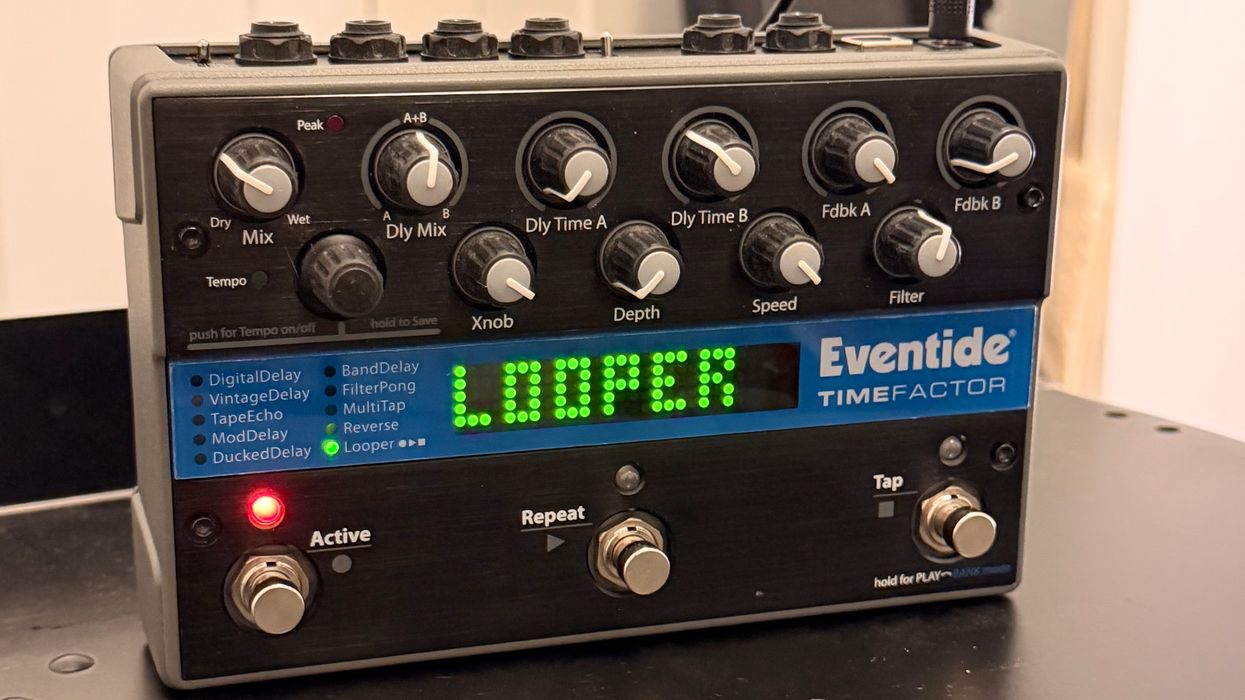
Sometimes in a musician’s life, gear design aligns with the needs of the artist. Picture this: It’s 2014. You’re surrounded by several pieces of inadequate and unobtainium looping gear in various states of disrepair, wondering if there will ever be a time when a single device is available to help you meet your ambient, pan-rhythmic, non-band-in-a-box playalong-looping desires. Then, you read about the brand new update to the looper algorithm of the Eventide TimeFactor. Once upon a time, this happened to me.
This was back when, seemingly, the powers that be saw fit to regress looping hardware devices back to the dark ages, as if the Lexicon PCM 42 and original Electro-Harmonix 16 Second Digital Delay had never existed. You’d be hard pressed to know that now, what with the plethora of forward-looking looping and sampling devices available today from the likes of Hologram Electronics, Red Panda, Chase Bliss, Expedition Electronics, Kinotone, and many, many more. But sandwiched right in the time zone between these two eras is where I found the Eventide TimeFactor’s looper algorithm.
The TimeFactor had been out for several years at this point (released, in fact, on my birthday a few years prior to this—how’s that for a sign?). It was marketed primarily as the latest super delay with a variety of dual parallel delay engines available with presets. An Eventide product, there’s no doubt about the sound and build quality of this device. But the looper seemed kind of basic and a bit of an afterthought initially, doing little more than recording and overdubbing. The major update delivered access to options like overdub order, reverse, retriggering, loop windowing, tap tempo (sort of…), and up to two octaves up or down of intervallic scanning and recording—from octaves and fifths to completely smooth linear movement, all mappable to expression pedal and AUX switches.
So, I’d like to make a case for this large-ish piece of hardware, by modern standards, with many knobs and switches, if I may. For the type of music I strive to make, swift access to parameters is essential—with little to no latency and minimal hindrance to making changes. No menu diving to reassign a knob mid-song or mid-improvisation when the fancy strikes.
It’s true that this exact same looper algorithm lives within the Eventide H9. But with only one giant knob and a couple buttons, how can I reasonably be expected to have access to the 13+ parameters available to me at the surface level of the TimeFactor hardware? It’s also true that the H9 has a digital facsimile of the TimeFactor’s hardware available in the tablet app that can control the H9 over Bluetooth, but, unfortunately, the latency introduced is still a … “factor.” (Sorry.) In fact, I think it speaks volumes that one of the best ways the Eventide engineers could come up with to control the parameters of the H9 was to simply replicate the TimeFactor control layout in the tablet app.
“For the type of music I strive to make, swift access to parameters is essential—with little to no latency and minimal hindrance to making changes.”
The TimeFactor also speaks to the priority of immediacy by allowing an expression pedal and (not or) an aux switch for further parameter control. Another great aspect of the design, and one I don’t hear much talk about, is that you can assign two instances of any knob on the unit to an auxiliary switch. If I want to jump between 0 percent and 70 percent decay in my looping overdubs at the click of a switch? No problem, we can make that happen!
Still need convincing? The pristine Eventide tone can be vintage-ified by setting a longer loop length and lowering the bit rate. The instrument/line-level switches on the back panel add further tonal shaping—some players love running that line-level boost into a guitar amp. All of this has kept me from feeling any need to "upgrade" for the past 12 years.
Please allow me to end my love letter to the TimeFactor’s looper with the following: When a legendary company known for great sound and creative devices drops a product like this—one that allows an artist to not only find a way to serve their musical ideas inspired by great guitarist looping effectors like Robert Fripp, Brian Eno, Daniel Lanois, David Torn, Henry Kaiser, Bill Frisell, and Nels Cline, but also builds enough in there to allow any artist to find their own way forward in their music into the future of their own voice—I truly believe they have done an unquestionable service for the good of all creative artists everywhere. And for that, I thank them, heartily!
Grammy Nominated Guitarist Rick Vito To Release Slidemaster Instrumental Album April 3 on Mojo Records
Press Release
Source: Mark Pucci PR
“The single most spectacular solo I’d ever heard (‘Like A Rock’)” – BOB SEGER
“A singer and guitarist of the first rank. A master of his instrument!” – JOHN MAYALL
“My favorite Blues guitarist and vocalist…the real deal.” – STEVE MILLER
“Rick Vito’s guitar playing is as cool and sharp as a Cadillac tail fin!” – BONNIE RAITT
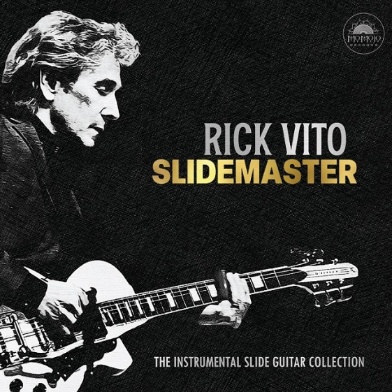 Grammy-nominated guitarist Rick Vito announces the April 3rd release of his new all-instrumental album, Slidemaster, on MoMojo Records, with physical distribution by MVD and digital thru The Orchard. Pre-orders for Slidemaster are available now!
This unique recording is a compilation of Rick’s all-instrumental cuts played exclusively on slide guitar, in the style of which he is universally renowned. It features both new material plus some of his best former releases which were remixed and mastered specifically for the album. Rick’s takes on Peter Green’s “Albatross,” and “The Supernatural,” Sam Cooke’s, “A Change Is Gonna Come,” and the originals, “Vegas Jump,” and “Soul Shadows,” are not to be missed!
“For many years now, friends have asked, ‘when will you release an instrumental album?’ Having recorded even more instrumental tracks this past year, I finally decided to do just that,” says Vito. “To my knowledge there have not been many slide guitar instrumental albums, and out of this came the idea for my new release, Slidemaster. These new works are paired with some of my very favorite cuts from previous albums resulting in a soulful collection of all-instrumental slide guitar tracks. This album comes from years of recording in a style that I hope you will love as much as I do.”
Rick’s last album, the highly acclaimed Cadillac Man in 2024, generated universal rave reviews and extensive radio airplay, reaching the number one slot on the Roots Radio Report. “Vito transports listeners with his wraithlike style. He never wastes a note in his expressive playing and always finds just the right phrase to fit the song he’s serving on his album,” said Henry Carrigan in Living Blues. In Rock and Blues Muse, Jim Hynes opined: “Vito’s playing is clean, tasty, and impactful… one of the best guitarists in the genre, and a premiere slide guitarist with few peers.” And Marco Piazzalongo, writing in Jazz N More summed up by stating: “Vito’s licks and solos go down like a tasty cocktail mixed by one of the greats in the field. They exude atmosphere, warmth, deep musicality and do not require any gimmicks. But it’s not just his amazing skills on the six strings, be it without or (especially!) with a bottleneck, that Vito brings to life with grandeur on Cadillac Man. His songwriting also has style and class throughout, is based on inspiration from across blues’n’roots history, and is cleverly composed.”
Guitarist, singer and producer Rick Vito is perhaps best known as a member of the legendary supergroup Fleetwood Mac (1987-1991). His guitar work and songs are featured on their albums, Greatest Hits, Behind The Mask, The Very Best Of Fleetwood Mac, The Chain, and the live concert DVD, Tango In The Night.
He later partnered with Mick Fleetwood to form the “Mick Fleetwood Blues Band featuring Rick Vito.” Shortly after the release of their CD, Blue Again, Rick was nominated for the 2010 Grammy Award in the Best Traditional Blues category as both artist and producer.
Of particular note, Rick’s now iconic slide guitar solos on Bob Seger’s “Like A Rock,” have been heard and heralded by untold millions, both on Seger’s hit albums and as the guitar voice on the Chevy truck TV commercial ads which ran over ten years.
Rick’s solo albums began with Atlantic Records in 1992 with his debut album, King of Hearts, after which he began performing worldwide with his own band. His unique guitar work has also appeared on hundreds of recordings by such legendary Rock & Roll and Blues Hall of Fame artists as Bonnie Raitt, John Mayall & the Bluesbreakers, John Fogerty, Christine McVie, Little Richard, Leon Russell, Boz Scaggs, Maria Muldaur, John Prine, Delbert McClinton, Rita Coolidge, Roy Orbison, Jackson Browne, Roger McGuinn, Todd Rundgren, Bob Seger, and scores of others.
Rick Vito is also the recipient of the Blues Music Award for the song of the year, “It’s Two A.M.” by Shemekia Copeland, and his compositions have appeared in numerous movies and TV shows, including multiple episodes of the highly acclaimed TV series, “Blue Bloods.”
A designer of Art Deco and Modernistic guitars, Rick’s stunning “Rick Vito Soul Agent” Signature model guitar is currently available from Reverend Guitars. This represents the fourth edition of Reverend Signature models bearing Rick’s name and design features.
In 2020, Rick appeared alongside Christine McVie (in her final performance), Billy Gibbons, Pete Townsend, David Gilmour, Bill Wyman, John Mayall and a host of other musical luminaries in the “Mick Fleetwood & Friends Celebrate the Music of Peter Green” concert filmed in London, now available on CD and DVD from BMG.
About Rick Vito
Rick Vito began his professional career in 1971 after moving to Los Angeles and joining Delaney & Bonnie & Friends, also working with Todd Rundgren and Derek & The Dominoes’ Bobby Whitlock. Vito was a featured guitarist on Bob Seger’s albums starting in 1986, including his legendary slide guitar solo on the Seger classic, (and Chevy truck TV commercial), “Like a Rock.” He was a regular member of Bonnie Raitt’s touring band in the 1980s and 1990s, also recording and/or touring with John Mayall, Jackson Browne, Little Richard, Roger McGuinn, Roy Orbison, Dobie Gray, John Fogerty, Stevie Nicks, Maria Muldaur, Albert Collins Dolly Parton and many others. Vito has had 12 solo album releases (counting his latest), having toured in Europe and the US with his own band. He also produced rockabilly singer Rosie Flores’ album, Speed of Sound, released in 2001.
SLIDEMASTER
PRODUCED BY RICK VITO (C) 2026
Catalog Number: MMJ404
1. VEGAS JUMP
2. STEAL AWAY
3. THE BIG BEAT
4. THE DANGER ZONE
5. RED HOT BABY
6. ALBATROSS
7. SOUL SHADOWS
8. SLIDE THE BLUES
9. A CHANGE IS GONNA COME
10. RIVER OF BLUES
11. THE SUPERNATURAL
12. THE LORD’S PRAYER
MUSICIANS:
Guitars, Acoustic & Electric Bass, Keys, Percussion: Rick Vito
Drums: Rick Reed (tracks 1, 5, 6, 8, 9), Lynn Williams (track 11), Charles Johnson (tracks 2, 3, 4, 7)
Electric Bass: Charlie Harrison (tracks 1, 6, 8, 9)
Organ: Mark Horwitz (track 9), Kevin McKendree (track 12)
SONGS: Rick Vito, Vitone Music, BMI, plus:
“Albatross” and “The Supernatural” by Peter Green, Primary Wave Music
“Steal Away” by Jimmy Hughes, Screen Gems-EMI Music
“The Lord’s Prayer” by Albert Hay Malotte, G. Schirmer Inc.
“A Change Is Gonna Come” by Sam Cooke, Abkco Music Inc.
EXECUTIVE PRODUCER: Mark Vito
ENGINEERS: Rick Vito, Brian Harrison, OB O’Brien, Michael Lawson
MASTERING: Phil Nicolo, Studio 4 Mastering
Podcast 540: Jonah Sissoyev & Eric Skye
Portland, Oregon-based musicians Eric Skye and Jonah Sissoyev join us this week to talk about Jonah’s beautiful new EP, ‘A Place Called Nowhere.’
The EP’s origin story begins with Jonah asking Eric, an acclaimed fingerstyle guitarist and Santa Cruz Guitar Co. signature model artist, for guitar lessons. Once he heard Jonah’s songs, Eric offered to produce and record this project.
During our chat, we hear all about their collaboration, Eric’s recording techniques (including some DIY home recording advice), the Stew-Mac kit guitar that Jonah built for himself, and so much more.
Listen to Jonah’s EP here:
https://jonahsissoyev.hearnow.com/a-place-called-nowhere
Follow Eric: https://www.instagram.com/eric.skye.guitar/
Our next Fretboard Summit takes place August 20-22, 2026, at the Old Town School of Folk Music in Chicago. Register today: https://fretboardsummit.org
We are brought to you by Peghead Nation: https://www.pegheadnation.com (Get your first month free or $20 off any annual subscription with the promo code FRETBOARD at checkout).
Stringjoy Strings: https://stringjoy.com
Mike & Mike’s Guitar Bar: https://mmguitarbar.com
Mike & Mike’s Substack: https://mmguitarbar.substack.com


The post Podcast 540: Jonah Sissoyev & Eric Skye first appeared on Fretboard Journal.
Victory Amplification’s new PowerValve 200 brings “authentic valve response and tone to modern rigs”

Victory Amplification has launched a new 200-watt valve power amp, which is made to bring valve feel, response, and tone to digital rigs.
The PowerValve 200 allows players to run their modeller, preamp or pedalboard through a real guitar cabinet with the dynamic response of Victory valve technology. The company claims that while modellers have made vast progress, digital rigs “still struggle” to recreate essential elements of a traditional amp.
- READ MORE: Victory sends blind guitarist custom braille amp in the most wholesome moment of 2026 so far
The PowerValve 200 is said to bridge the gap. Users can connect their modeller via 1/4” jack to the PowerValve’s balanced input, set their levels, engage the valve stage, and drive a real speaker cabinet with “authentic amp-like response”.
At its core is Victory’s Valve React Circuit (VRC) featuring an EF91 (CV4014) valve. For players who prefer a completely transparent signal path, the valve stage can be bypassed via a front panel switch. This front panel also includes a 3-band EQ (Resonance, Body, and Presence) allowing players to fine-tune their tone, and there is also a Cab Sim on/off switch.
Ryan Morgan, Head of Global Sales at Neural DSP (home of the acclaimed Quad Cortex) comments, “The PowerValve 200 genuinely exceeded our expectations. The response, feel and tone — especially when paired with the Quad Cortex — were outstanding. With the flip of a switch, the added tube stage delivers an immediate improvement to the signal. This is a seriously impressive piece of kit.”
Martin Kidd, Chief Designer at Victory, adds: “Players told us they still wanted to feel a guitar speaker cabinet moving air on stage — something that doesn’t quite happen with FRFR cabinets. The subtle harmonic content generated by a valve stage creates slight asymmetry in the waveform — and that’s where the feel comes from.”
The PowerValve 200 is available now for £499 / $599 / €579. Find out more via Victory Amps.
The post Victory Amplification’s new PowerValve 200 brings “authentic valve response and tone to modern rigs” appeared first on Guitar.com | All Things Guitar.
Dusty Hill’s sheepskin bass and an Eddie Van Halen stage-played Charvel: The guitars up for grabs in the second day of the Jim Irsay auction
![Dusty Hill [main], Jim Irsay [inset]](https://guitar.com/wp-content/uploads/2026/03/Jim-Irsay-2-hero@2000x1500.jpg)
The second round of the Jim Irsay Collection auction is now live, and there’s a whole bunch of incredible guitars up for sale once again.
The first round took place yesterday through Christie’s in New York, with some of the most famous guitars selling for ground-breaking amounts. In fact, the first round saw history made, as David Gilmour’s black Fender Stratocaster once again took the crown as the most expensive guitar ever sold, raking in an eye-watering $14,550,000. It broke the previous record held by Kurt Cobain’s MTV Unplugged Martin D-18E, which sold for just over $6M in 2020.
Widely described as the greatest guitar collection on Earth, the collection was curated by billionaire and Indianapolis Colts owner Jim Irsay, and following his death in May last year, his estate took the decision to sell it. The live auction will also continue tomorrow, 14 March.
In today’s round, 34 instruments are included, with some of the biggest highlights from the most influential musicians – including George Harrison, Eddie Van Halen, and many more – due to fetch in up to $300,000, though they could sell for much more.
One of the most significant items is Harrison’s Harptone 12-string acoustic, which is estimated between $200,000 – $300,000 and is accompanied by a copy of a letter from his father, Harold Harrison, on Harrisongs headed notepaper. Another standout is Dusty Hill’s incredibly kooky sheepskin-covered Dean bass guitar, which was used in the music video for ZZ Top’s Legs in 1984, and is also estimated to fetch up to $300,000.
The auction will also see an Eddie Van Halen signed and stage-played Charvel EVH Art Series model go under the hammer. It features the signature red, white and black striped pattern associated with the guitarist, and is accompanied by an EVH Art Series certificate of authenticity signed by Eddie and a colour photograph of him playing this same guitar live on stage at the Plaines d’Abraham in Quebec City, Canada, on 3 July 2008. It’s also signed on the body in silver marker pen.
Other key guitars include:
- Neal Schon’s Gibson Les Paul Pro Deluxe, used to record Journey’s 1981 hit, Don’t Stop Believin’
- Don McLean’s Martin 00-21 acoustic, used to record his 1972 hit, Vincent
- John McVie’s custom Alembic fretless bass, used to record Fleetwood Mac’s The Chain
- Bob Dylan’s Gibson Hummingbird acoustic, played at the inaugural concert for president-elect Bill Clinton in 1993
Other musicians whose guitars are featured include Lou Reed, Paul McCartney, The Rolling Stones, Nancy Wilson, Billie Joe Armstrong, The Who, and many more.
To view the full range of guitars going under the hammer, head over to Christie’s.
The post Dusty Hill’s sheepskin bass and an Eddie Van Halen stage-played Charvel: The guitars up for grabs in the second day of the Jim Irsay auction appeared first on Guitar.com | All Things Guitar.
Kidd Funkadelic Breaks Out on His Own
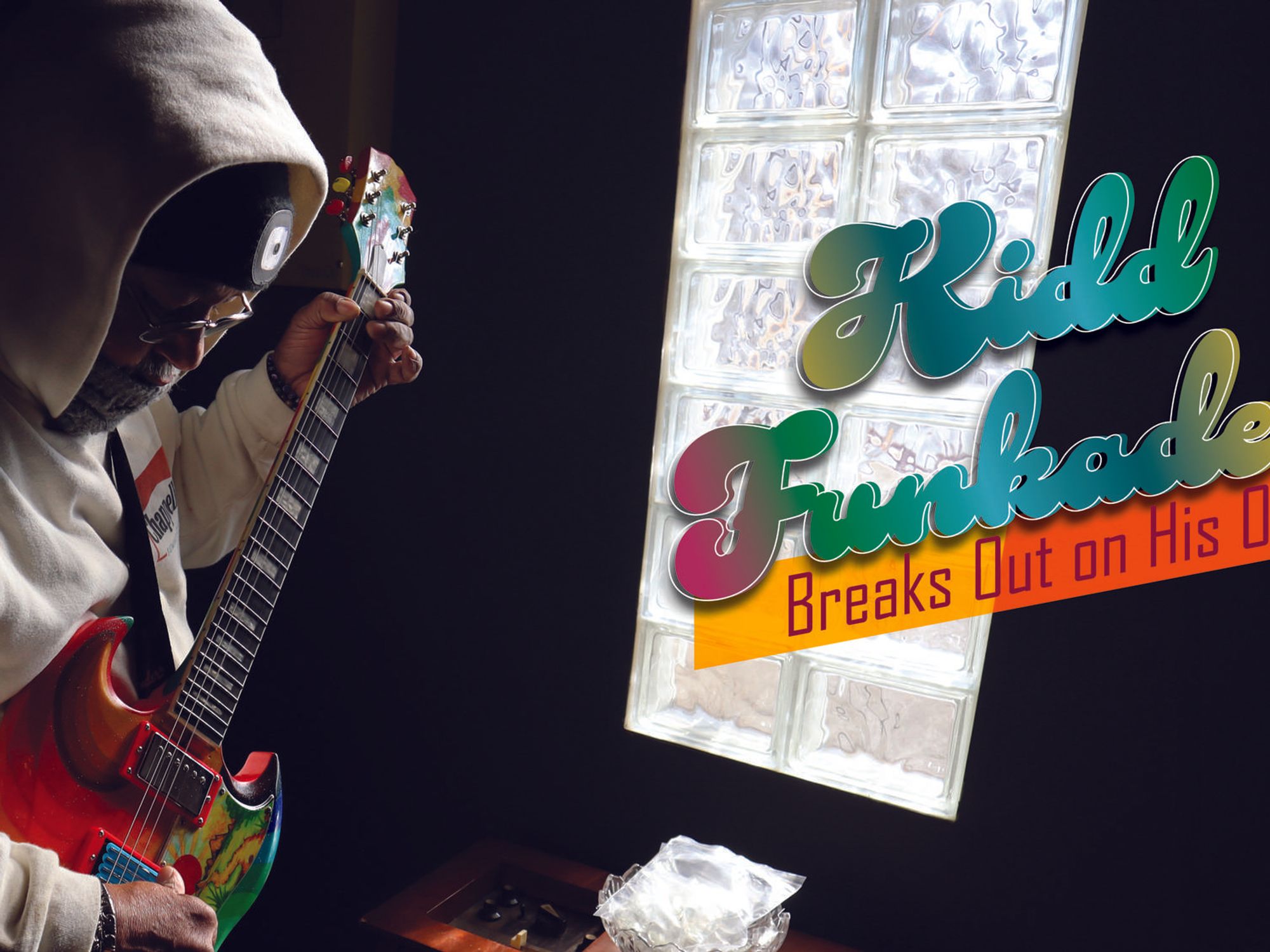
Michael Hampton’s whole career started with a single song.
As a teen growing up in Cleveland, Ohio, he taught himself to play along with records on just one string. The Temptations’ “Get Ready,” Led Zeppelin’s “Dazed and Confused”—those worked. Then he expanded, adding strings and songs like Kool & the Gang’s “Jungle Boogie” and Edgar Winter Group’s “Frankenstein” to his repertoire. Somewhere in there, he started jamming along with Funkadelic’s 1971 psychedelic guitar opus, “Maggot Brain.”
On the opening track to the band’s album of the same name, guitarist Eddie Hazel defined new boundaries of post-Hendrix fuzz-and-wah-soaked psychedelia. George Clinton’s Echoplex manipulations cranked the mind-melt factor further afield. It moved the young guitarist, and he kept coming back to that song.
By 1974, the band rolled through Cleveland and the 17-year-old had a chance to witness the live P-Funk extravaganza. Around that time, he had been playing music with his cousin, Lige Curry, and “a guy on the east side called Ed Sparks, he was an older guy playing bass,” according to Hampton. Together, they went to catch the show at Public Hall. Afterward, they all ended up with some of the band back at Sparks’ house.
“Ed’s like, ‘Go play “Maggot Brain,”’” Hampton recalls in his soft-spoken voice, “and I just played it til I couldn’t play it no more.”
About two weeks or so later, P-Funk drummer Tiki Fullwood called and invited the teenager to join the band. Driven to the airport by his cousin—who would also go on to join the band in 1978—he recalls, “I took my first plane ride to a sold-out show at the Capital Center in Landover, Maryland. I put my head down and played ‘Maggot Brain.’ Bernie [Worell, the band’s keyboardist] was accompanying me, which helped a lot. They wanted just Bernie and myself to do it. He was good at putting that backdrop behind me so I could solo freely.”
At first, Hampton’s only role in the Parliament-Funkadelic stage show was to play “Maggot Brain.” He eventually learned the whole set, somewhere along the way earning the nickname Kidd Funkadelic. (A recording of Hampton’s “Maggot Brain” from 1978 is included on the CD edition of Funkadelic’s One Nation Under a Groove, showing his soaring, liquid phrasing and searing tone.)
Ever since that first night, Hampton has been a fixture in the P-Funk universe, and the band and its music have been the centerpiece of his musical life. Though he’s done some collaborating beyond P-Funk, his own solo work has maintained an orbit, as can be heard on his 1995 release, P-Funk Guitar Riffs for DJ’s, or on the more solo-minded but still related Heavy Metal Funkason from 1998, which features Curry as co-producer and Clinton on guest vocals. More recently, with drummer Chuck Treece and guitarist PhilipTheArtist (Philip Smith), he’s released music as Punkadelic, which includes original material, but remains reverential in name.
Now, he seems ready to set himself apart. But that might not be a conscious effort. In fact, sitting and talking to Hampton on one of the couches at SoundPlex Studios in South Jersey, just outside of Philadelphia, I get the distinct sense that Hampton makes his way through life by going with the proverbial flow. He takes it as it comes, and for a guy who’s been playing a lot of the same music for decades, he seems surprisingly in the moment, not lingering on the past.
“Since Parliament-Funkadelic is one of the most sampled groups of all time, it’s probably safe to say you’re among the most sampled guitarists around,” I point out. “Do you ever reflect on that?”
“Nah,” he tosses off. “I don’t reflect on it. I’m honored.” He pauses, adding, “It’d be cool if I could get some more sessions or be a fly on the wall at some of these sessions that they do.”
What does get him excited is a lifetime of listening. Hampton cites his musical inspirations off the cuff: Pink Floyd, Herbie Hancock’s solo on “Chameleon,” Kiss—he stops to show me a recent gift from guitarist PhilipTheArtist, the owner of retro-minded Goldfinch Guitars, an LP-style guitar with an Ace Frehley tribute finish. “This was a gift after Ace passed,” he explains. “That’s what’s gonna get me inspired to do more—‘I wanna do something Kiss-like with that guitar’ or whatever.”
“Everything I hear, I want to play.”
He jumps to a host of more recent references—cosmic jazz saxophonist Kamasi Washington, bass futurist MonoNeon, blues phenom Christone “Kingfish” Ingram, and electric blues rocker Joe Bonamassa—then goes more big-picture. “The grooves to a lot of things—it could be commercials—whatever catches my ear, it could be electronica, it could be classical, everything I hear, I want to play.”
Hampton gets stoked thinking about all the music he loves. He mentions Les Paul, then catches himself—“Django … his ass! Man, come on!” It’s a wide musical world, full of inspiration.
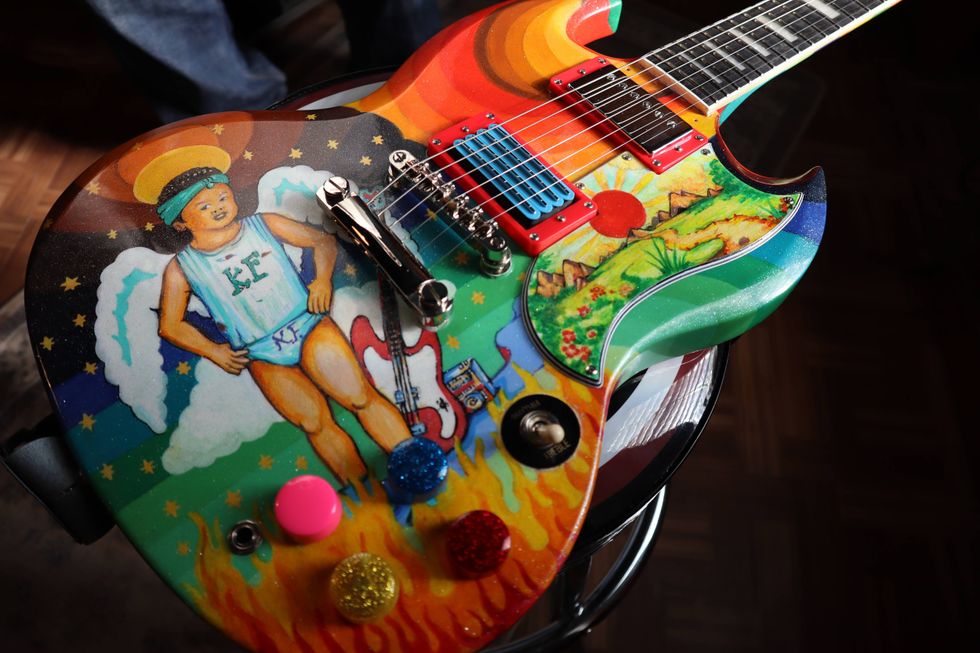
It’s not just music itself that gets him going, it’s the instruments as well. Hampton loves to collect guitars, and figures he currently owns around 50 or so. In addition to the Ace Frehley tribute, he’s also brought another recent gift, also from PhilipTheArtist, this one an SG-style guitar with a finish in the style of The Fool—the Gibson once owned by both Eric Clapton and Todd Rundgren. On this one, the iconic angel has been replaced by the Kidd Funkadelic logo from Funkadelic’s 1976 Tales of Kidd Funkadelic.
That guitar made it out with Hampton for some solo band dates to celebrate the release of Into the Public Domain, the first of two EPs plus an LP that he’s releasing. The name is literal: He’ll also be releasing the multitrack files, which can be used royalty free.
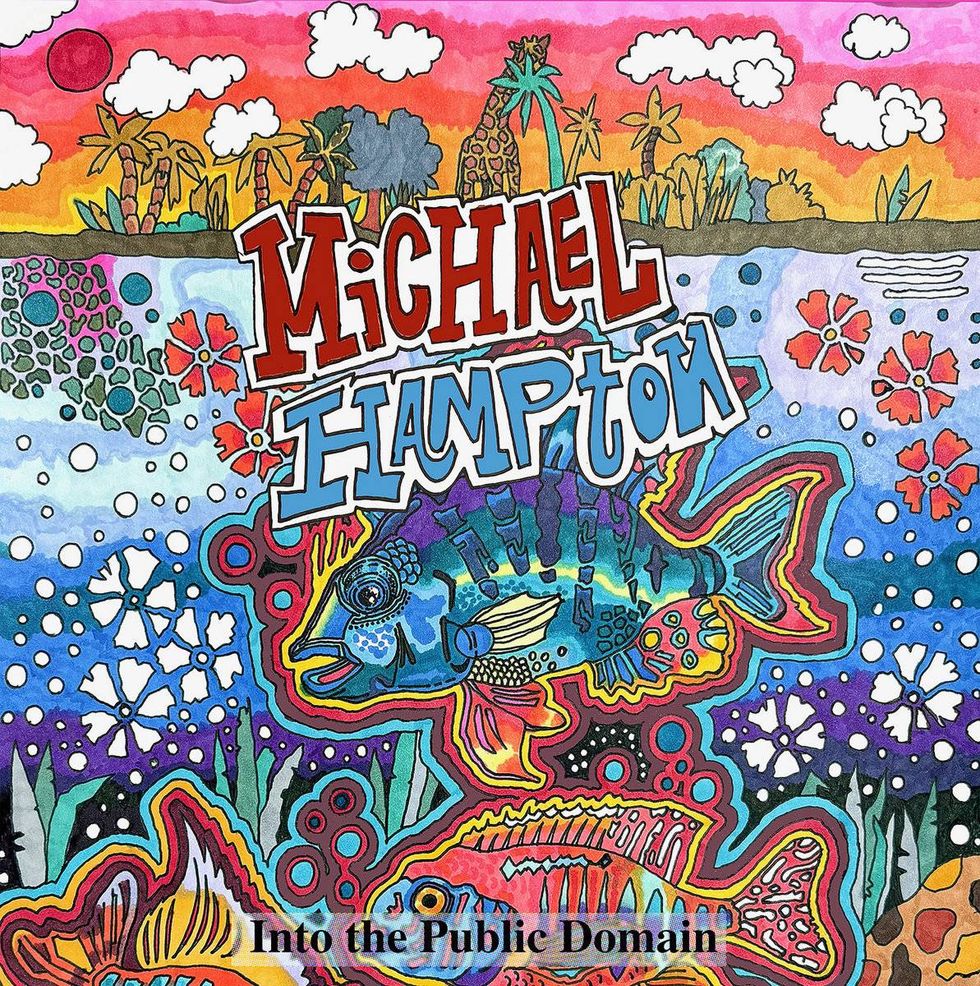
It’s a large project with a lot of moving parts and a long cast of collaborators, but it came together at the behest of PhilipTheArtist, who co-produced the record along with Hampton, Joe “the Butcher” Nicolo, and John Schreffler. Recorded at Fort Wolf Studios in Canyon Country, California, and Los Angeles’ Sunset Sound, much of the music was initiated by PhilipTheArtist and Schreffler in order to create something, according to the former, “like if National Geographic or Nova wanted something in the background—not just rock ’n’ roll.”
A song like the off-kilter funky rocker “Steve’s Kadillac” strikes an experimental funny bone that could certainly work in that direction, with warped riffs floating in and out across the groove-centric soundscape. But there is plenty of rockin’ to be found, as on the opening “Fight or Flight” and the title track, where Hampton’s distortion-drenched leads crack the stratosphere wide open and launch into space.
PhilipTheArtist explains that “Technicolor Mobile Home” has roots that reach beyond the studio. “When me and Michael play ‘Hit It and Quit It’ [from Funkadelic’s Maggot Brain] live,” he explains, “there’s a certain way he plays the chorus that is different than the record. That way he plays it evolved into ‘Technicolor Mobile Home,’ then I recorded what I remembered he came up with.”
Hampton remembers the sessions as a laid back affair, where the vibe, from his perspective, was “just do what ya feel.” He recalls, “Phil would call me up from California and say, ‘You got time, Mike?’” If he was available, he’d fly out from his Philly area home. “If I didn’t jump on and do it then, I wasn’t gonna do it,” he says.
“Today, there are some serious issues and it’s like, what am I gonna write to that? Am I gonna write about it? Or not gonna write about it? Or just play?”
Nicolo, a nine-time Grammy winner and co-founder of legendary hip-hop label Ruffhouse Records, assembled the jammy tracks into songs. “I had so many colors of the rainbow to paint with,” he says.
Hampton will follow Into the Public Domain with King Kong, a musical telling of the classic story, and The Kidd. With a preview of rough tracks from the latter, it seems as though the trilogy will showcase just how singular and varied Hampton’s guitar playing is. The early tracks indicate a world that’s all over the sonic map, his still-distinctive guitar fitting right into ’90s ZZ Top-style heavy blues, warped disco funk, soul jazz, and beyond.
Nicolo will release the albums through his SMN Records imprint—a part of his Sound Mind Network, a nonprofit whose “mission is to change the way the world looks at trauma suicide and drug abuse with the arts.” He says the records display Hampton’s “splintered genius” and calls him a “chameleon" who is “so unlike traditional guitar players.”
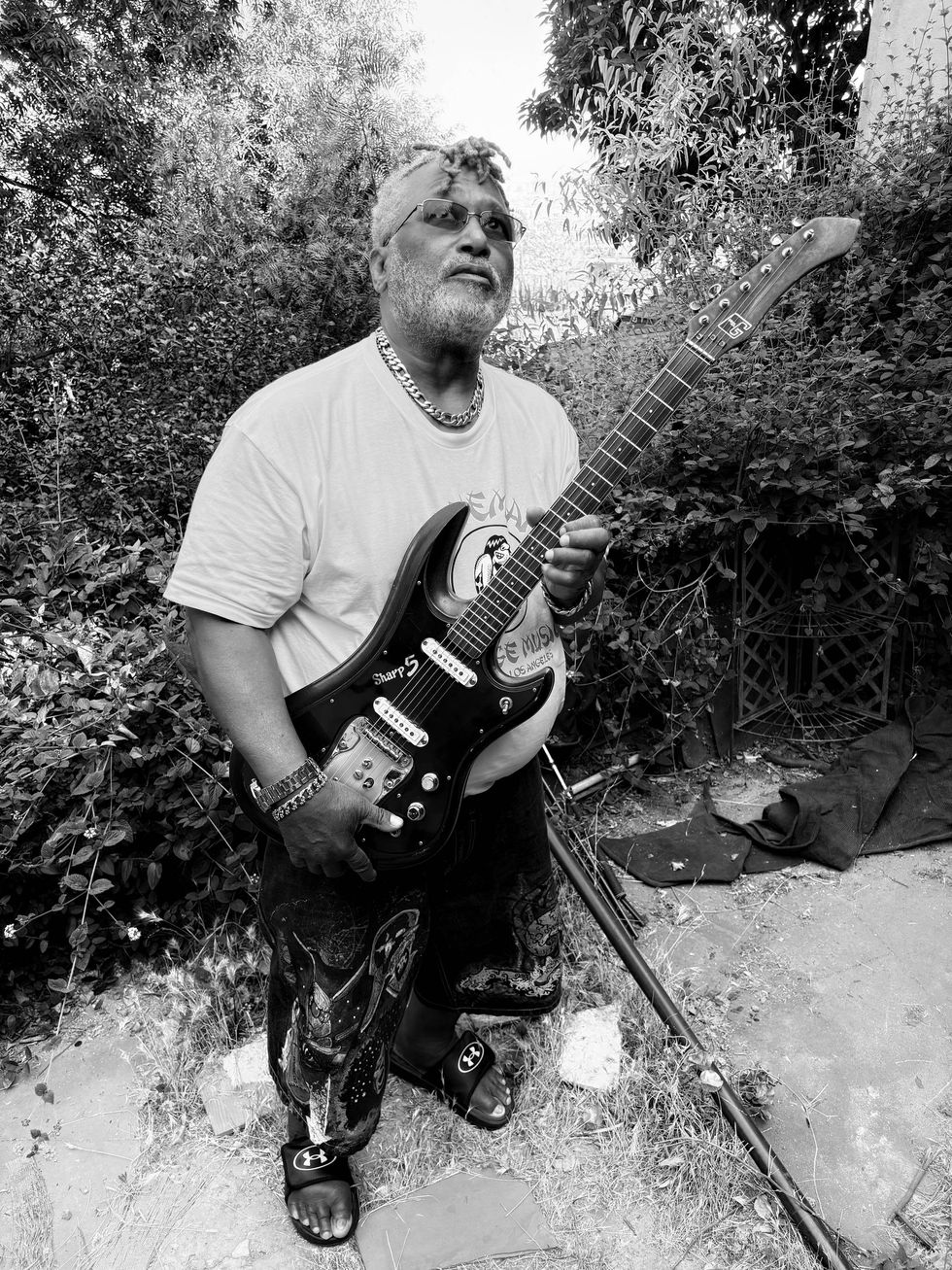
Hampton is all about the vibe, and that seems to be what makes him such an adaptable player. He gets the vibe, and dives in. It’s an approach that any improvisor knows requires staying in the moment and keeping overthinking at bay, and that’s where Hampton is most natural.
“I like to remain ‘not-knowing,’” he muses. “I like to practice a lot, but at the same time, I want it to be new.” (It’s also the answer he gives when I ask if he likes messing around with pedals, which he doesn’t really get into extensively: “Every time I hook something up, I want it to be brand new.”)
“Staying inspired,” he continues, “it’s just life itself. Today, there are some serious issues and it’s like, what am I gonna write to that? Am I gonna write about it? Or not gonna write about it? Or just play?”
This recent burst of activity is intentional, though; Hampton tells me he’s trying to be more available to new musical things. In this case, it’s been working out. Jams that started some years ago in Philadelphia turned into sessions—he mentions some early jams related to the project at Bam Margera’s house—that led to more sessions and eventually to the L.A. recordings. Throughout, he’s just been trying to be open to saying yes. Where that will lead next is anybody’s guess.
“I like to remain ‘not-knowing.’ I like to practice a lot, but at the same time, I want it to be new.”
If all that sounds like he’s always on to the next thing, that’s only partially true. P-Funk continues to take it to the stage, and when we talk, Hampton is getting ready to head out for a few dates. The group’s large ever-changing lineup has sounded powerful on recent tours. And at the recent Hampton-band live shows in California, the pickup band assembled by PhilipTheArtist opted to stick to versions of P-Funk classics, namely “Butt-to-Butt Resuscitation,” “Red Hot Mama,” “Hit It and Quit it,” and, of course, “Maggot Brain.”
While the classics remain in all parts of his life, Hampton says he hopes to get a live band playing the new material. He adds that when the time comes to play those songs, “I don’t want to know them too well.”
The driving force in Hampton’s camp, it seems—the one making sure this all goes down—is PhilipTheArtist, and he’s passionate about the music. He wants people to hear the breadth of what’s possible. The world knows his work with P-Funk, but he wants Hampton to be heard as an individual. “It’s time for Michael to get out there,” he says. “Every legendary guitar player has a set of solo records and has a sound people can put their finger on. Michael was under-celebrated in that way. It was time.”
What is it about Hampton that has driven this project? “Michael has the ability to give you goosebumps with his playing,” PhilipTheArtist says. “He’s one of those guys who can make you cry or make you smile with his playing.” Or to put it simply, “He just knows how to make you feel something.”
Letter from the Editor | Acoustic Guitar, Spring 2026 Issue 357

The Jim Irsay Collection saw five of the top 10 most expensive guitars ever sold at auction in a single day
![[L-R] Eric Clapton, David Gilmour and Jerry Garcia](https://guitar.com/wp-content/uploads/2026/03/Irsay-auction-hero@2000x1500.jpg)
The Jim Irsay Collection auction at Christie’s in New York is well under way, with yesterday’s lot featuring sales of some of the most iconic guitars in rock history. As you might expect, some fetched truly astonishing sums.
Widely described as the greatest guitar collection on Earth, the Jim Irsay Collection was the pride and joy of late billionaire and Indianapolis Colts owner Jim Irsay, and features hundreds of guitars and instruments once played or belonging to rock’s most revered elite.
- READ MORE: Why the sale of Jim Irsay’s Greatest Guitar Collection On Earth is a sad moment in guitar history
Following Irsay’s death in May last year, his estate took the decision to sell off his collection via a landmark auction at Christie’s in New York. That auction is taking place across March, with an online auction from 3-17 March, and live auctions featuring the bigger hitters on 12, 13 and 14 March.
Yesterday’s auction saw history made, as David Gilmour’s black Fender Stratocaster once again took the crown as the most expensive guitar ever sold, raking in an eye-watering $14,550,000. Yep, over 14 and a half million… It smashed the previous record by some margin, held by Kurt Cobain’s MTV Unplugged Martin D-18E, which sold for just over $6M in 2020. The value of Gilmour’s Strat has more than tripled since 2019, when Jim Irsay purchased it for $3,975,000.
 David Gilmour’s famous Black Strat needs no introduction. Purchased at auction for $3.9m in 2019, at the time the guitar was the most expensive ever sold
But that was far from the only multi-million dollar sale. In fact, the auction saw five of the top 10 most expensive guitars ever sold at auction – in a single day.
Eric Clapton’s iconic 1964 Gibson SG Standard “The Fool” also hit the auction block, and sold for just over $3 million, way above its $800,000 – $1.2 million estimate. That’s also a considerable markup, after Jim Irsay added the guitar to his collection in 2023 for $1.27 million. “The Fool” – named after the Dutch design collective that did its artwork, was used extensively by Clapton during his time in Cream.
 Credit: Michael Ochs Archives/Getty Images / Christie’s
The Grateful Dead guitarist Jerry Garcia’s custom-built “Tiger” electric guitar also demolished its estimate, fetching a final sale price of $11,560,000 – way above its $1m – 2m estimate.
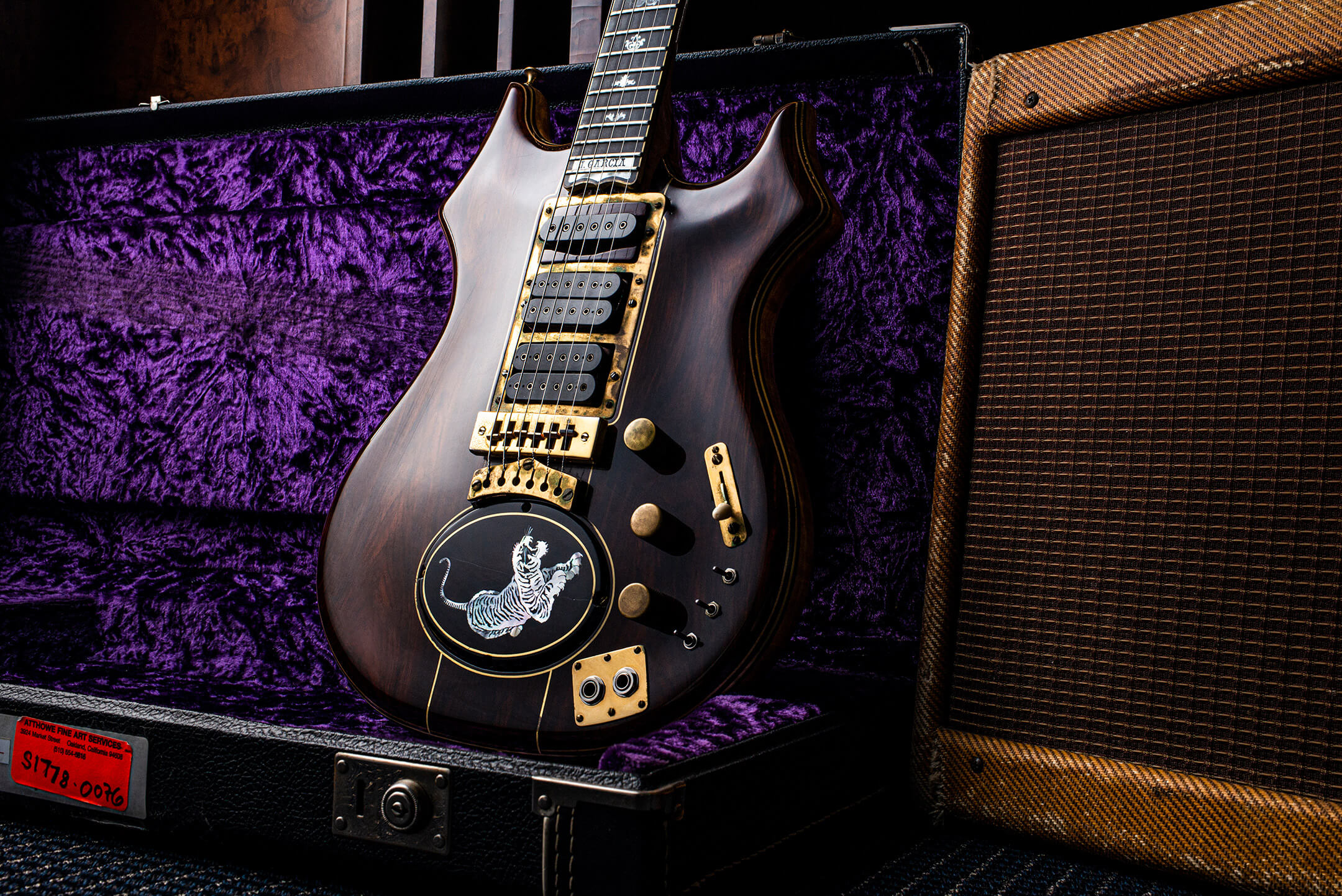 Irsay purchased Jerry Garcia’s Tiger for $957,500 in 2002. Built by luthier Doug Irwin, it was the Grateful Dead star’s main guitar from 1979 onwards and in 1995 was the last guitar he ever played in public
The Fender Mustang used by Nirvana frontman Kurt Cobain in the Smells Like Teen Spirit music video was only the third highest-selling guitar from the auction at $6.9 million, but still above the previous record holder for the most expensive guitar ever, Cobain’s MTV Unplugged Martin D-18E.
 Credit: Christie’s
Another guitar once belonging to Eric Clapton – his Martin 000-42 acoustic used for his 1992 MTV Unplugged performance – sold for $4.1 million, way over its $800,000 – $1.2 million estimate.
The updated list of the top 10 most expensive guitars ever sold can be seen below, with the new entries following the first day of the Jim Irsay Collection in bold:
- David Gilmour’s Black Fender Stratocaster – $14,550,000
- Jerry Garcia’s “Tiger” guitar – $11,560,000
- Kurt Cobain’s Smells Like Teen Spirit Fender Mustang – $6,907,000
- Kurt Cobain’s MTV Unplugged Martin D-18E – $6,010,000
- Eric Clapton’s MTV Unplugged Martin 000-42 – $4,101,000
- Eddie Van Halen’s Hot For Teacher Kramer – $3,932,000
- Eric Clapton’s “The Fool” 1964 Gibson SG Standard – $3,003,000
- John Lennon’s Framus Hootenanny 12-string – $2,857,000
- Eddie Van Halen’s 1982 Kramer – $2,734,000
- “Reach Out to Asia” Fender Stratocaster – $2,700,000
Other notable sales from the first day of the Jim Irsay Collection included David Gilmour’s Wish You Were Here Martin D-35 ($2,393,000), The Edge’s Gibson Explorer Reissue ($635,000), George Harrison’s 1964 Gibson SG Standard ($2,271,000), John Lennon’s Paperback Writer/Rain Gretsch 6120 Chet Atkins ($1,270,000), Lennon’s stage-played ‘Rose-Morris’ Rickenbacker ($1,270,000) and Janis Joplin’s Gibson J-45 ($381,000).
A number of non-guitar items also fetched large sums, including John Lennon’s Broadwood upright piano, which brought in $3,247,000 – well over its $400,000 – $600,000 estimate – Miles Davis’s Martin Committee trumpet ($1,651,000) and The Beatles’ logo drum head used on the Ed Sullivan Show in 1964 ($2,881,000).
All in all, day one of the Jim Irsay Collection auction brought in $84,091,350.
You can take a look at all the final sales figures from day one of the Jim Irsay Collection auction at Christie’s. The auction continues today – you can preview what’s hitting the auction block now.
The post The Jim Irsay Collection saw five of the top 10 most expensive guitars ever sold at auction in a single day appeared first on Guitar.com | All Things Guitar.
Rivolta Mondata CC review: sets a new standard for what a mass-produced offshore guitar can be

$1,399, rivoltaguitars.com
If you’re reading this, you probably already know about Dennis Fano: the man who created two of the most respected and revered boutique electric guitar brands of the last few decades – first with his own name and more recently under the Novo marque.
- READ MORE: Eastman Fullertone Offset ’62 review – “it has a unique sonic voice and retro feel all of its own”
There’s a compelling argument to make that in terms of electric guitars, nobody on earth knows how to make a better playing, better sounding instrument than him – as the monster waiting lists and remarkably consistent resale values of Novo and Fano guitars will attest. The problem is that even on the used market, you’re veering into ‘half-decent used car’ territory – and very few of us are whispering “Treat Yo Self…” at the prospect of dropping five grand on a guitar, no matter how good we’ve been.
Mercifully for those of us not burdened with an overabundance of paper, there’s Rivolta – the brand partnership between Fano and purveyors of affordable, quirky guitars Eastwood, which celebrates its 10-year anniversary this year.
In the beginning, Rivolta was a place where Fano could get weird and explore some of his most esoteric ideas – full-length block inlays! Weirdo top carves! Baritones! – but over the years the brand has evolved.
Rivolta is still a place where Fano can take big risks design-wise – last year’s gloriously unique Forma series being a perfect example – but here in 2026, some of the more polarising edges have gradually been shaved off to create something that’s a lot more universal.
This has never been more overt than in the brand new Mondata CC – and in terms of the overall package of aesthetics and functionality, it might be the most compelling Rivolta yet.
 Image: Adam Gasson
Rivolta Mondata CC – what is it?
The magic of Rivolta was always found as much in who designed them as who made them. Despite being made alongside Eastwood’s other guitars in Korea, Rivolta guitars added a level of refinement and quality borrowed from Fano’s US-made instruments.
The rub was that there were always some eccentric elements to the design and functionality that meant that these guitars didn’t become as popular as they deserved to be – the Mondata CC might well be the guitar to change that.
Because, for starters, just fucking look at it. Dennis Fano has built a career doing marvellous and unique things with offset shapes, but the Mondata in its CC form is something special. Stripped of the extraneous switches, elaborately over the top pickguards and polarising headstock combos that have been a fixture of the model (and the Rivolta line) since it debuted in baritone form half a decade ago, now replaced with an understated elegance across the board.
Most notably, instead of the usual three-a-side angular headstock, we get the beautifully proportioned stepped six-in-a-line number seen on the original Fano-branded instruments, and the first Rivolta Regata semi-hollow model.
I cannot overstate what an improvement this makes to the guitar’s overall look – combined with the majestic body shape, it feels complete and considered in a way that no other Rivolta guitar has before it.
Speaking of the Simarouba body, the Mondata’s raised central block has always nodded to the guitar’s Firebird inspiration. But here, with a simple understated pickguard, Gibson-style four-controls and a three-way switch wiring, tune-o-matic bridge and tailpiece, and of course those mini-humbuckers, that spirit is in full effect. The finest compliment I can give this guitar from a visual perspective is that it looks more like a lost classic from the Kalamazoo drawing board than what Gibson actually found in Ted McCarty’s filing cabinets.
 Image: Adam Gasson
Unlike a Firebird, however, the Mondata CC is a more traditionally set-necked instrument, with a scale length that’s bang on 25 inches – splitting the difference between Gibson and Fender is a theme we will come back to, I suspect.
That neck is of the one-piece roasted maple variety – a recipe Fano has used almost exclusively for Novo guitars over the last decade or so – though you wouldn’t be able to tell as it’s sprayed with a caramel satin finish that fits nicely with the rest of the guitar’s gloss tobacco burst.
You get an ebony fretboard that’s bound with white plastic, and a generous complement of 24 medium jumbo frets. The ‘board’s edges are factory rolled, while the 12-inch radius will make any Gibson fan feel right at home. The inlays are Rivolta’s own pearloid ‘MOTO’ style – that’s rounded off blocks to you and me. I’ll admit I don’t love these as much as I’d love dots or regular blocks, but they’re about as inoffensive as quirky inlays can be.
Equally inoffensive is the set of quality Wilkinson tuners keeping things in check on the peghead. Those vintage Fender-style buttons further add to the hybrid vibe of the whole thing.
The pair of mini-humbuckers are Rivolta’s own design, and the output measured 6.5k at the bridge and 7.5k in the neck. There’s no case as standard, but you can add a custom-fit premium gigbag for an extra $100 or a wooden hard case for $200.
 Image: Adam Gasson
Rivolta Mondata CC – build quality and playability
The first thing to note about the Mondata CC is that this is a pretty big guitar for a solidbody: as evidenced by the fact that it pretty much obscures every trace of my trusty Jazzmaster when I rest the Mondata on top of it for comparison’s sake. This is worth remembering because it’s also impressively lightweight for such a chonky boi – barely tipping 7lbs on my trusty luggage scale.
This is no doubt down to the use of Simarouba for the guitar’s body. This South American wood is quite an uncommon tonewood, but it’s notably less dense than most traditional timbers used in guitar building, giving it a lower overall weight. The more classic and familiar pickup, electronics and hardware arrangement no doubt contributes to this too – there are no extraneous pots, switches or a vibrato here to add mass. It’s a well-balanced guitar both on the strap and on the lap too, with no noticeable dip at either end. The rear body contour on the top also makes it a more ergonomic and enjoyable instrument when played seated.
When I reviewed the Forma series, I enthused at length about Rivolta’s wonderfully characterful necks – and the Mondata gives me another excuse to rabbit on about it. Novo guitars might have the most wonderfully playable necks in the business, and Fano has clearly brought that knowledge to bear here.
I’m so used to mass-produced guitars having necks that simply exist in the middle ground of generic inoffensive usability, it feels almost subversive to make a guitar at this price point with a neck that reminds you that actually, a guitar’s neck is designed to enable a meaningful and organic connection between player and instrument.
Quite how the Rivolta Chunky C+ neck carve does this is quite hard to quantify – it’s not slim, it’s not a baseball bat… it’s just… right? At every point up the neck it feels like the connection is meaty enough to feel secure, without ever feeling like you’re having to wrestle with it. It’s really quite some feat of craftsmanship to do this at scale.
The general playability is helped by that new super smooth satin-finished neck (a real improvement over the gloss on the Formas), some nicely rounded ‘board edges, immaculately installed and polished frets, and a body shape that allows excellent upper fret access, should you be that way inclined.
It’s a similar story all over really – the finish and build quality is first class, internal wiring is neat and tidy, and everything feels solid, dependable and ready to take on the road. There’s nothing here that would instantly hint that this was a guitar made in Korea and not the USA, bar that price tag – and that’s a very good thing indeed.
 Image: Adam Gasson
Rivolta Mondata CC – build quality and playability
It’s worth noting out of the gate that, despite appearances and the lack of adjustable poles, the pickups here are listed as mini-humbuckers and are not the same as Firebird pickups. You might wonder why I’m splitting hairs here, but traditional ’Bird pickups do have quite a different kind of construction to a mini-humbucker – with alnico bars set in the bobbins themselves, and steel reflector plates on the top and bottom.
This is what gives Firebird pickups their distinctive single-coil-esque quality – albeit without the hum, of course. Mini-humbuckers are constructed much more like traditional buckers, just smaller, and so have more in common with their big brothers – albeit with some sonic differences.
Plugging in the Mondata CC, you can readily tell this out of the gate – but that doesn’t detract from it being a rather glorious experience. Mini-buckers tend to offer the grunt and power of a full-sized bucker but with increased clarity and high-end response, and flicking the three-way toggle switch to the bridge position and running it through a dirty Marshall Plexi, you’ll find the sort of unrestrained fun that respectable people would no doubt disapprove of.
Interestingly, given the snarl and grunt at play here, I find the bridge pickup uncommonly usable when cleaning things up too – it’s strident, sure, but without the piercing nature that a lot of bridge buckers can offer.
Switching to the neck and there’s an enjoyable woodiness to proceedings, but without the darkness that you’d normally find from a neck humbucker. It’s more like swimming in maple syrup than molasses if that makes any sense? It’s thick, it’s warm, but you don’t feel like you’re losing too much of the inherent character of your sound.
The middle splits the difference between the two nicely, offering a punchy, insistent sound with a soupçon of fluteyness – it’s again very usable. While this isn’t a guitar that’s going to offer you glassy, Fender-style cleans, there’s a quality spectrum of Gibson-adjacent tones to be found in here.
 Image: Adam Gasson
Rivolta Mondata CC – should I buy one?
It’s increasingly rare in this job when a guitar comes across my desk that has me looking at my guitar rack and having some genuine hard internal conversations about which one of my treasured instruments is going to have to have a new home under the bed in the immediate future.
But the Mondata CC has been making me do those equations virtually since the moment I pulled it out of its box. I’ve played some really impressive mid-priced guitars over the last few years, and while there’s no doubt that the Mondata CC is not the most inexpensive Korean-made instrument you can buy, it might very well be the best.
The only hair I can really split is the fact that at the moment it’s only available in a single finish – imagine this guitar in Pelham Blue, Shoreline Gold or some of the other legendary DuPont metallic shades? The lack of an included gigbag or case also feels a little on the mean side. It’s certainly not the cheapest guitar you’ll find coming out of Korea either, but if you want a fantastic-sounding, elite-playing, rock-ready guitar that stands out from the crowd, you need to check this out.
 Image: Adam Gasson
Rivolta Mondata CC – alternatives
An even more affordable Asian-made guitar that’s seeking to offer a killer blend of unique looks and high-quality characterful build is Eastman Fullertone Offset ’62 ($999 / £899) – it’s a killer guitar for the price. If you want real Firebird mojo then Gibson’s new Firebird Platypus ($2,499 / £2,199) is a very cool, USA-made option. Another USA-made offset guitar that’s more in the ballpark of the Mondata is the PRS S2 Vela ($2,049 / £1,699) – it’s a stripped-down, no frills thing, but personally that’s part of the charm.
The post Rivolta Mondata CC review: sets a new standard for what a mass-produced offshore guitar can be appeared first on Guitar.com | All Things Guitar.
The 15 Most Expensive Guitars Sold At Auction
What price for a piece of bona fide rock ‘n’ roll history? Well, if that piece happens to be an iconic guitar used by an equally iconic guitar player, then the last few decades have demonstrated that price is ‘an awful lot indeed’ – especially if that guitar has been sold at auction.
- READ MORE: Why the sale of Jim Irsay’s Greatest Guitar Collection On Earth is a sad moment in guitar history
In the decades since Eric Clapton’s iconic Blackie Strat was purchased by Guitar Center for just shy of a million dollars, more and more legendary guitar players have put their collections under the hammer, and it’s led to increasingly outlandish sums being paid for some of the most iconic guitars in rock.
The 2024 auction of Mark Knopfler’s guitars at Christie’s saw some practically every lot smash its estimate, but despite that the most iconic item of the day – a 1983 Gibson Les Paul Standard that the Dire Straits legend used to write and record Money For Nothing and Brothers In Arms – smashing its $19,000 estimate and selling for a whopping $753,231 (£592,200), it wasn’t enough to make it onto our list (in fact it wasn’t even the biggest seller of the day, with a Burst Knopfler bought in 1999 selling for a massive $880,186).
Even Blackie itself – once the benchmark for outrageously expensive electric guitars, no longer occupies a place in the top 15 most expensive guitars sold at auction, falling out of the list in June 2024. It shows how wildly the market for rock star guitars has inflated in the last few years.
The seemingly endless appetite for rich folks to pay increasingly outlandish sums for iconic instruments has meant that several guitars have appeared on our list for a short time before dropping off. Bob Dylan’s ‘Newport Folk Festival’ Strat, the guitar used when the folk messiah turned “Judas” with an electric band on 25 July 1965 sold for $965,000 in 2013 and had a home on our list, but not anymore.
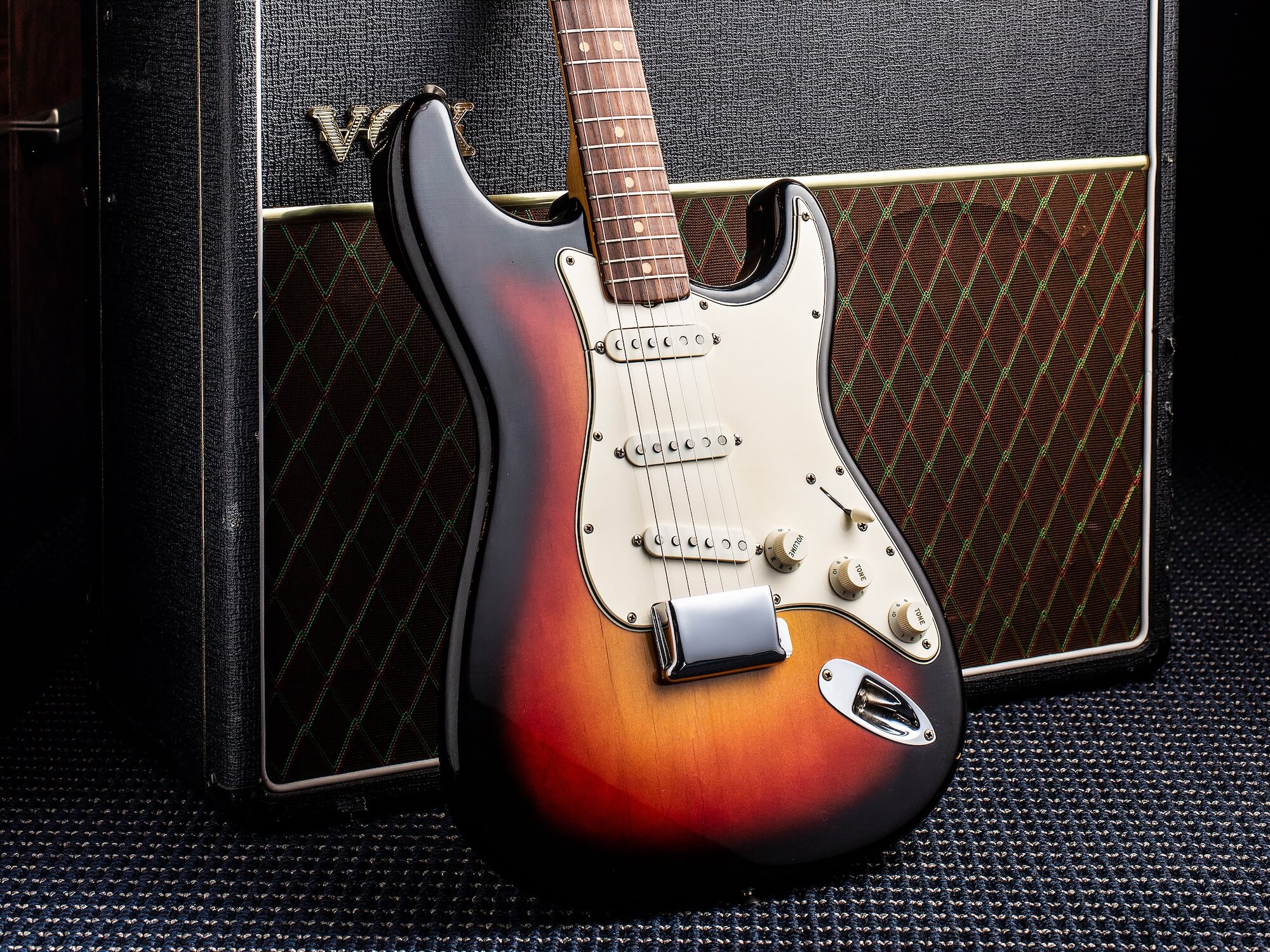 Bob Dylan’s ‘Newport’ Strat. (Image: Eleanor Jane)
Another guitar to fall off the list was Rory Gallagher’s iconic 1962 Stratocaster – which barely lasted three months on the list before being unseated in January 2025. Another brief entrant into the list was Jeff Beck’s ‘Anoushka’ Fender Custom Shop Strat – it barely lasted 10 months on our list but holds the distinction of being a rare non-vintage artist instrument that cracked the million dollar mark.
Also not making it into the list are some of the most iconic guitars of all time that never made it to auction. It’s almost impossible to confirm private sale figures, so the rumours that Kirk Hammett paid $2 million for Greeny – the 1959 Les Paul previously owned by Peter Green and Gary Moore – or that the late Microsoft founder Paul Allen paid $1.3m back in 1993 for Hendrix’s Woodstock Strat will have to remain just that: rumours.
The most seismic change in this list came in March 2026, however, when the collection of late Indianapolis Colts owner Jim Irsay came to auction at Christie’s in New York. We had christened Irsay’s collection ‘The Greatest Guitar Collection On Earth‘ when we got an up-close look at it in 2022 – and many of the guitars already featured on our list, having been bought by Irsay for huge sums at auction.
It was perhaps no surprise then that the sale completely redrew the landscape of rock star guitars at auction, with nearly half of our top 15 guitars being moved or replaced in one crazy afternoon. We’ve entered the age of the eight-figure rock star guitar – and these are the most expensive ones of the lot.
15 David Gilmour’s 1954 Fender Stratocaster $1,815,000
The Pink Floyd man’s second most iconic Strat is the one steeped in the most controversy – for years people assumed that the serial number #0001 meant it was the first Strat ever made. Instead, it turns out that #0100 was actually first, but this is still one of the first pre-production Strat prototypes ever made. The fact that this guitar is also laying down the rhythm parts on Another Brick In The Wall Pt 2 only further adds to this guitar’s legend.
It was sold in 2019 when Gilmour auctioned off a huge amount of his iconic gear for charity – it’s the first guitar from that sale we’ll see in this article, but it won’t be the last…
14 Jerry Garcia’s Wolf Guitar $1,900,000 (2017)
The Grateful Dead guitarist loved weird and heavily customised guitars, and this one made by luthier Doug Irwin, is perhaps the most eccentric guitar the late guitarist owned (though not the most expensive…), with a body made of ultra-strong purpleheart, capped back and front with bookmatched maple.
The guitar also features an innovative plate system for mounting the pickups, which allowed Garcia to swap them from their original SSS configuration to the HHS it currently sports. The Wolf was auctioned in 2017 with proceeds benefiting the Southern Poverty Law Center.
13 George Harrison’s ‘Revolver’ Gibson SG $2,271,000 (2026)
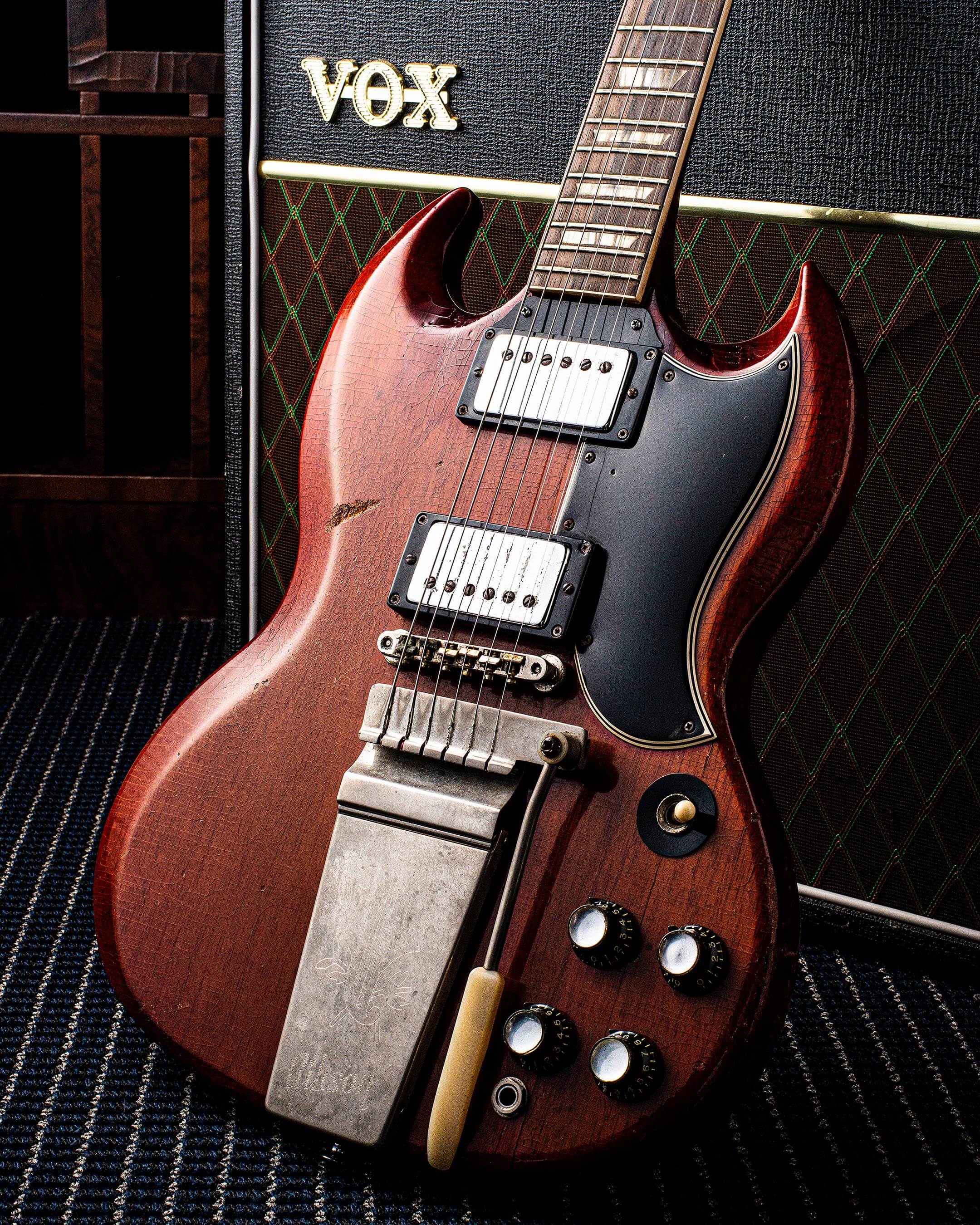 George Harrison acquired this 1964 SG Standard in 1966 and it quickly became a studio favourite, featuring on Revolver (Photo: Eleanor Jane)
The most expensive Beatles electric guitar ever sold at auction isn’t one of the iconic Gretsch and Rickenbacker guitars that John Lennon and George Harrison used to such seismic effect in their early career, instead its this humble-looking SG that became a real favourite of Harrison in the studio in the later part of their career, and was used particularly heavily on the peerless Revolver.
The guitar was part of Jim Irsay’s enviable collection of Beatles gear, which also included a pair of John Lennon-owned electrics – a Rickenbacker and a Gretsch. All three were sold at Christie’s in March 2026, and while the Lennon guitars went for exactly the same figure ($1,27m) this one pipped them to the post, and sneaked onto our list.
12 David Gilmour’s Martin D-35 $2,393,000 (2026)
The first guitar to have the distinction of dropping out of our list and then jumping back onto it later, this guitar was originally sold for $1,095,000 in 2019, when it was bought by Irsay, but then catapulted back onto the list in 2026 and more than doubling its previous price. And it’s honestly not hard to understand why this special guitar was so in demand. This 1969 D-35 is, of course, the sound of Wish You Were Here – we certainly wish we could afford it…
11 John Lennon’s 1962 Gibson J-160E $2,410,000 (2015)
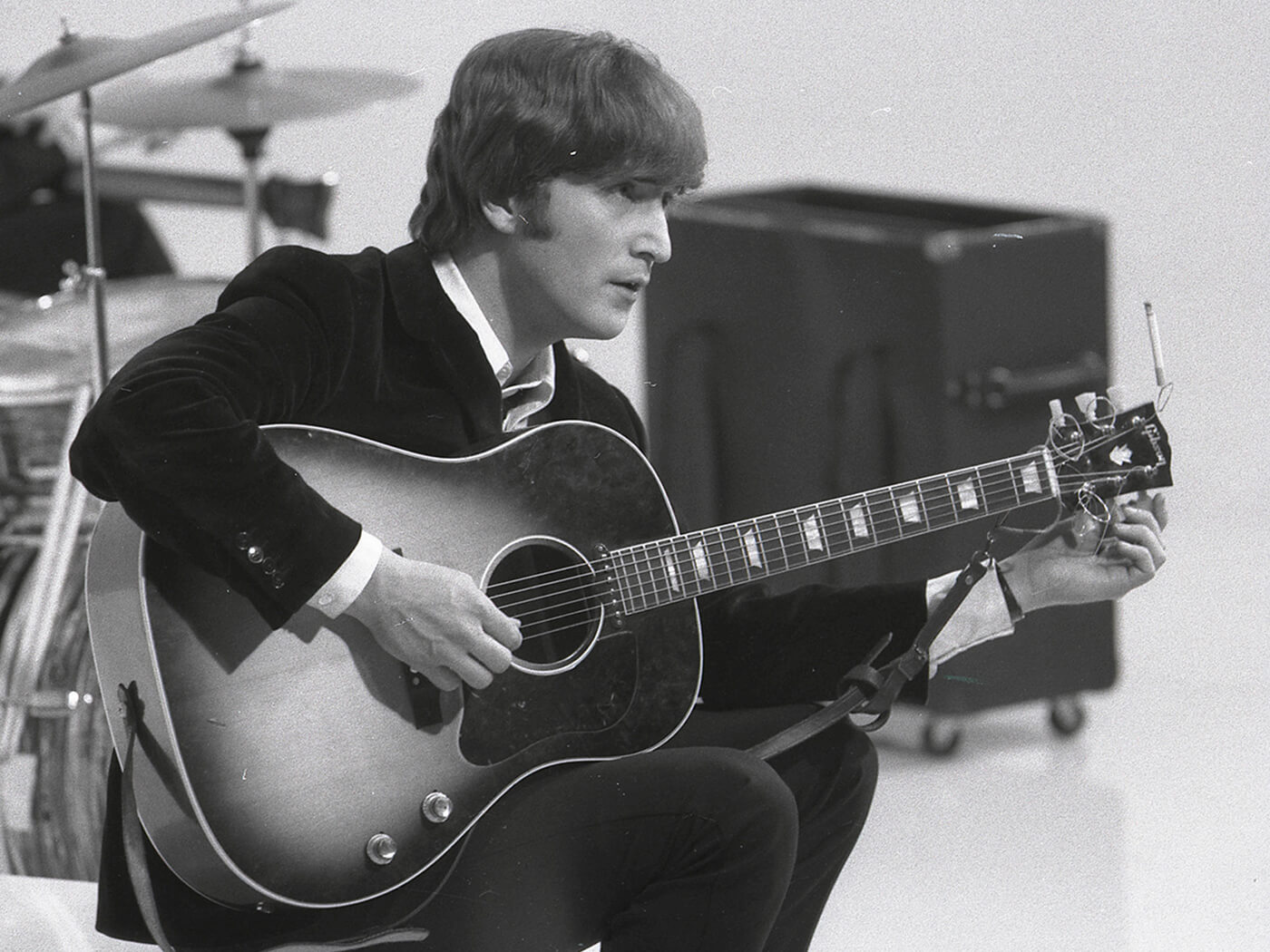 John Lennon tuning his Gibson J-160E during the filming of ‘A Hard Day’s Night’. Image: Max Scheler – K & K/Redferns via Getty Image
With its electric-like volume and tone knobs and the pole pieces of a P-90 pickup rather artlessly sticking through the top between the neck and soundhole, the J-160E wasn’t Gibson’s most elegant design, but it was the perfect instrument for young songwriters craving amplification in the early 60s, including a couple of cats called John Lennon and George Harrison. This particular J-160E can be heard on Love Me Do and continued to be a favoured acoustic for Lennon throughout his career.
10 ‘Reach Out to Asia’ Fender Stratocaster $2,700,000 (2004)
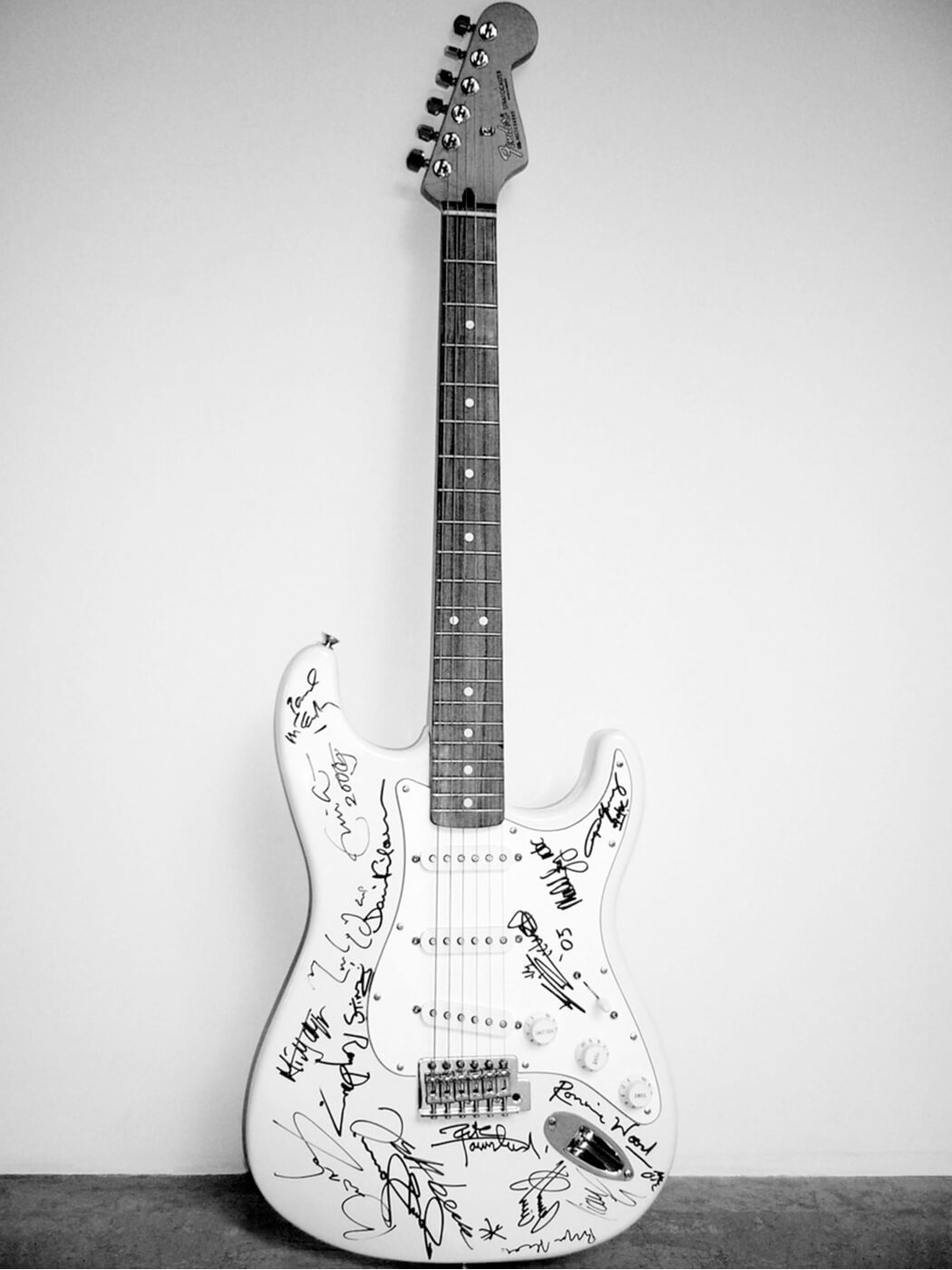 Reach Out To Asia Stratocaster. Image: Fender Wiki
Something of a curio on this list, this guitar isn’t an iconic artist instrument at all, but rather a stock Mexican-made white Fender Stratocaster that just happens to have been signed by (deep breath) Mick Jagger, Keith Richards, Eric Clapton, Brian May, Jimmy Page, David Gilmour, Jeff Beck, Pete Townshend, Mark Knopfler, Ray Davies, Liam Gallagher, Ronnie Wood, Tony Iommi, Angus and Malcolm Young, Paul McCartney, Sting, Ritchie Blackmore, Def Leppard and organiser Bryan Adams. The guitar was auctioned off to help the victims of the 2004 Indian Ocean Tsunami, and certainly did its job.
9 Eddie Van Halen’s 1982 Kramer $2,734,000 (2025)
 Image: Kramer
“It’s very simply the best guitar you can buy today”. If you’re a guitar player of a certain age, you probably remember flicking through a guitar magazine and being presented by a striking picture of Eddie Van Halen, guitar in hand, lit cigarette tucked under his E string alonside this quote. It’s one of the most memorable and iconic guitar ads ever, and one that certainly did the Kramer brand no harm in the early 80s when EVH was at his most godlike pomp – the brand briefly became America’s biggest guitar brand off the back of this in the middle of the decade.
The guitar used in that shoot was a custom Kramer modelled on Eddie’s iconic ‘Frankenstein’ guitar – but with a striped Kramer ‘hockey stick’ headstock – and was also used for various shows in 1982 and 1983. Then later on in the decade, he gifted the guitar to his tech Rudy Leiren, and it still bears the autograph “Rude – it’s been a great ten years – let’s do another ten. Eddie Van Halen”.
Leiren sold the guitar to Mötley Crüe’s Mick Mars, who would use the guitar extensively on the band’s Dr. Feelgood record. The guitar would later come to be auctioned at Sotheby’s with a massive $2 million estimate – a sign that expectations for iconic artist instruments are catching up with demand – but it still smashed through that. It’s not the most expensive Van Halen guitar on our list however…
8 John Lennon’s Framus Hootenanny 12-string $2,857,000 (2024)
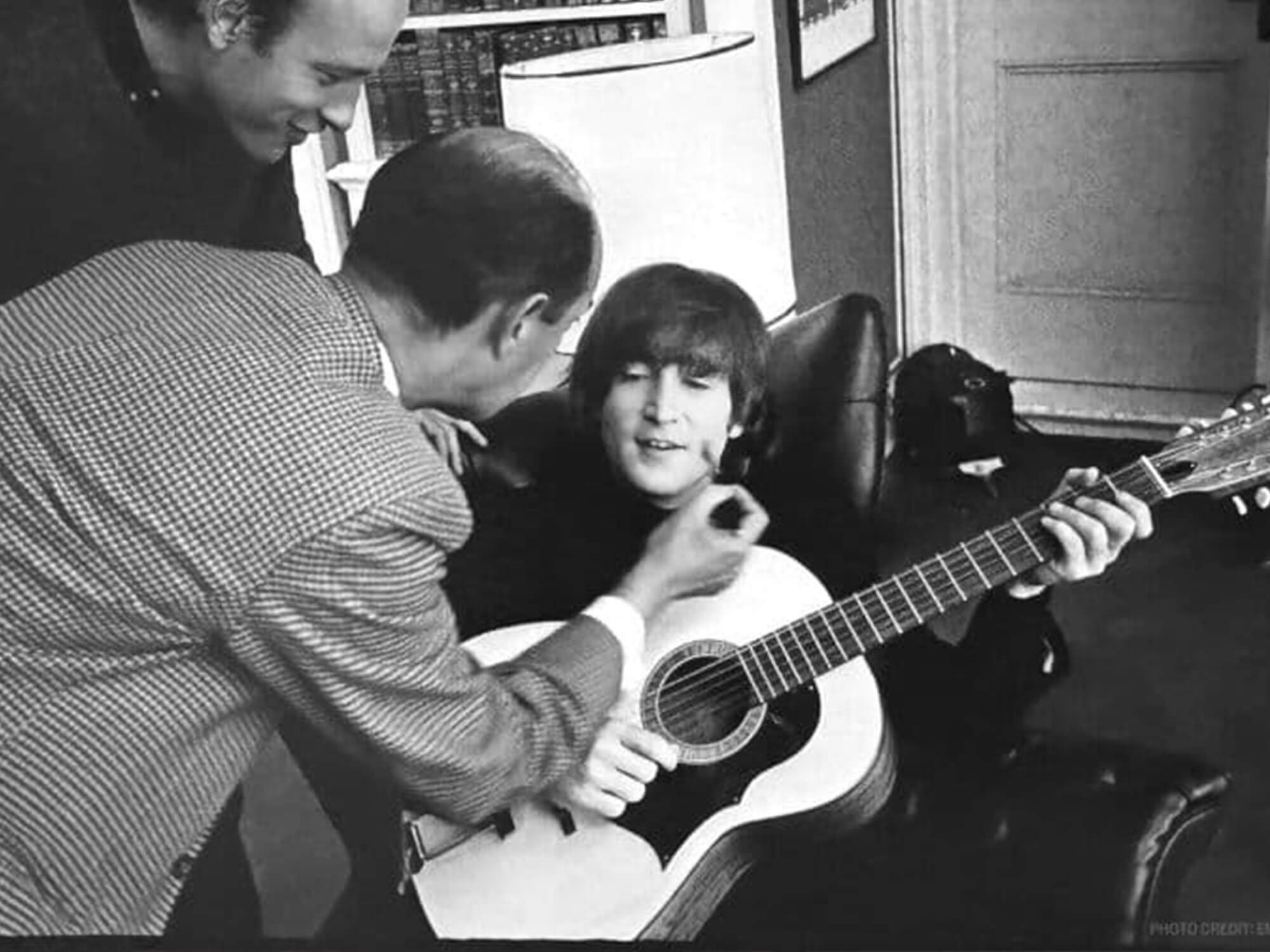 Credit: Julien’s Auctions
The guitar that was famously used on Help! and its accompanying album was thought lost to the sands of time for decades, until it was found in by the new owners of a house in the British countryside when they were clearing out the attic. The guitar was given to Scottish guitarist Gordon Waller, half of the pop duo Peter and Gordon, and then later handed over to one of his road managers, but the guitar hadn’t been seen in public for over 50 years.
The guitar, which is seen being used by Lennon in the Help! movie during the performance of You’ve Got to Hide Your Love Away, was also used by Lennon to record It’s Only Love, I’ve Just Seen a Face and Girl, and by George Harrison for the rhythm track of Norwegian Wood. Before the auction in May 2024, there was speculation the guitar might end up becoming the most expensive ever sold at auction, but in the end the Framus had to settle for being the most expensive Beatles instrument ever, eclipsing Lennon’s J-160E (above).
7 Eric Clapton’s ‘Fool’ 1964 Gibson SG $3,003,000 (2026)
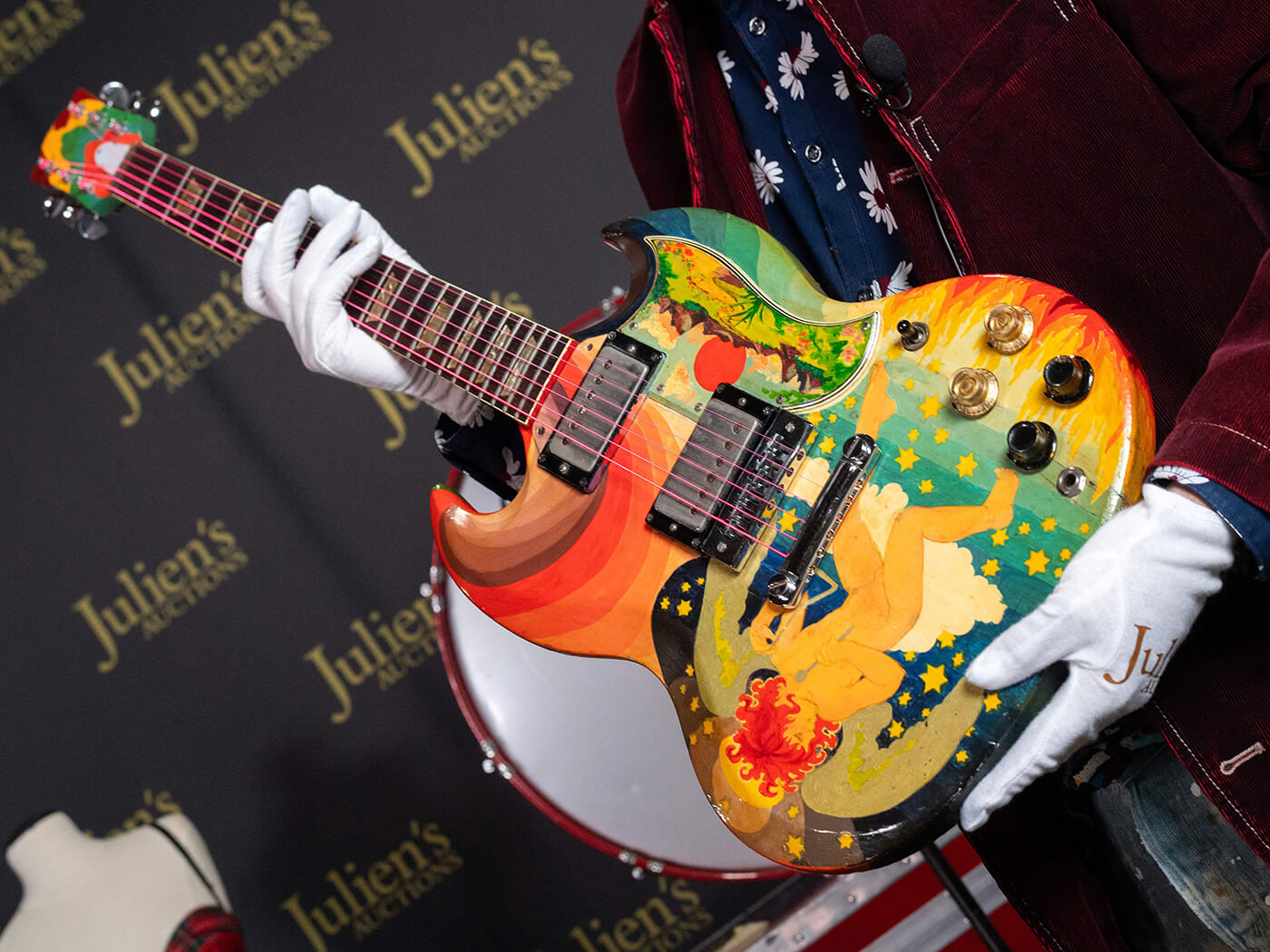 Eric Clapton’s Fool guitar at the media preview for Julien’s “Played, worn, torn rock ‘n’ roll iconic guitars and memorabilia” in 2023. Image: Valerie Macon/AFP via Getty Images
Perhaps Eric Clapton’s most distinctive instrument also has the distinction of being Slowhand’s most expensive electric sold at auction – twice! Hailing from Clapton’s Cream era, the Fool is celebrated as an enduring symbol of the psychedelic era in music, the 1964 Gibson SG earned its name from the Dutch art collective that gave it its striking finish. Sunshine of Your Love, White Room, I Feel Free… Clapton’s iconic Woman tone is all this guitar.
It was sold at auction in 2023 for $1,27m by Jim Irsay, but when it returned to the market in 2026 it smashed its estimates and eventually went for $3,003,000. It’s not the most expensive Eric Clapton guitar ever sold, however…
6 Eddie Van Halen’s Hot For Teacher Kramer $3,932,000 (2023)
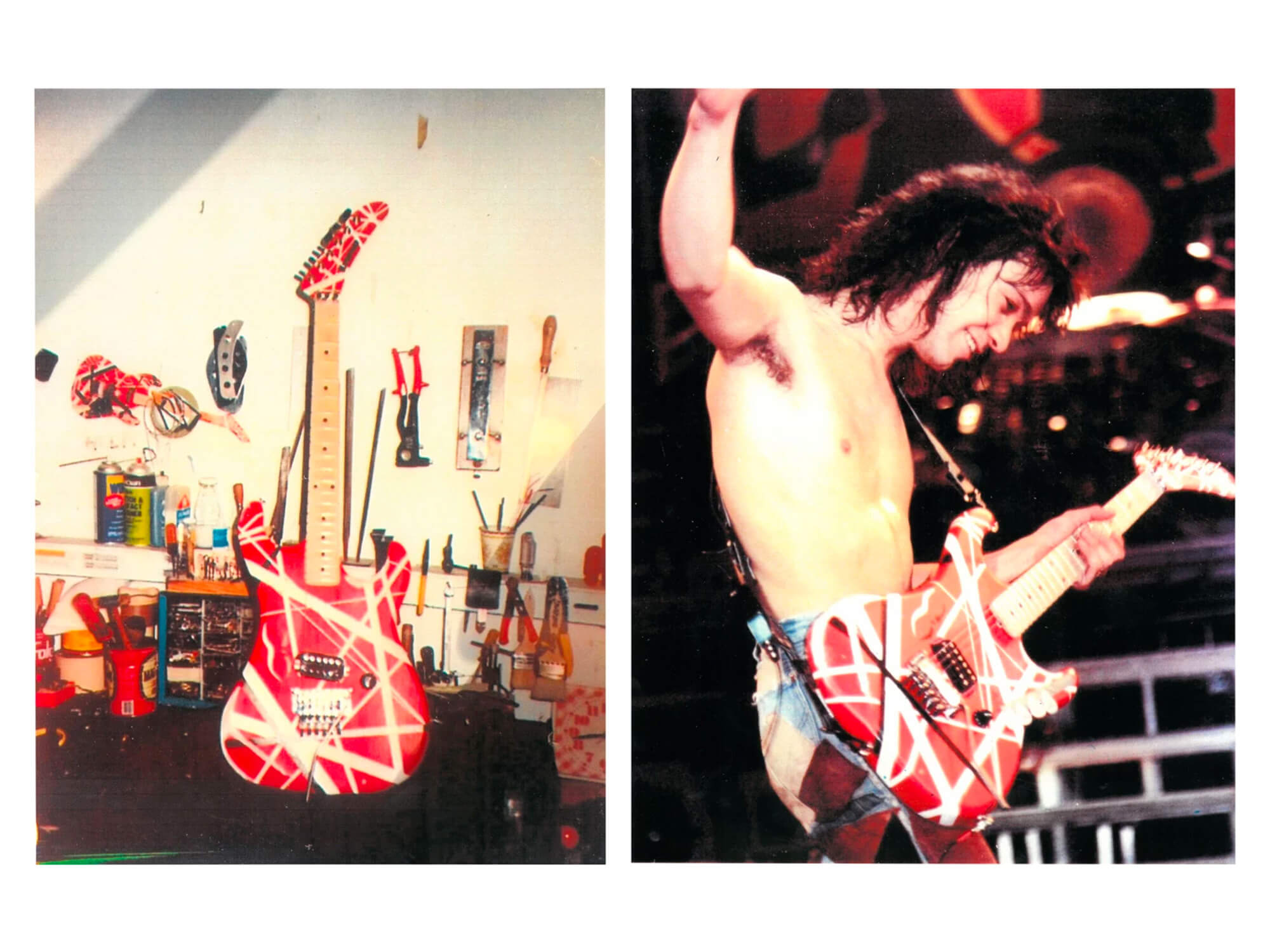 Credit: Sotheby’s
Eddie Van Halen’s guitar designs have become almost as iconic as the man himself, but with most of EVH’s most iconic gear still treasured by his family, it’s rare for a bona fide EVH guitar to make it onto the open market. With that in mind, it’s no surprise that interest in this guitar, used by Eddie in the Hot For Teacher video, was so high – and the price tag followed suit.
5 Eric Clapton’s ‘MTV Unplugged’ Martin 000-42 $4,101,000 (2026)
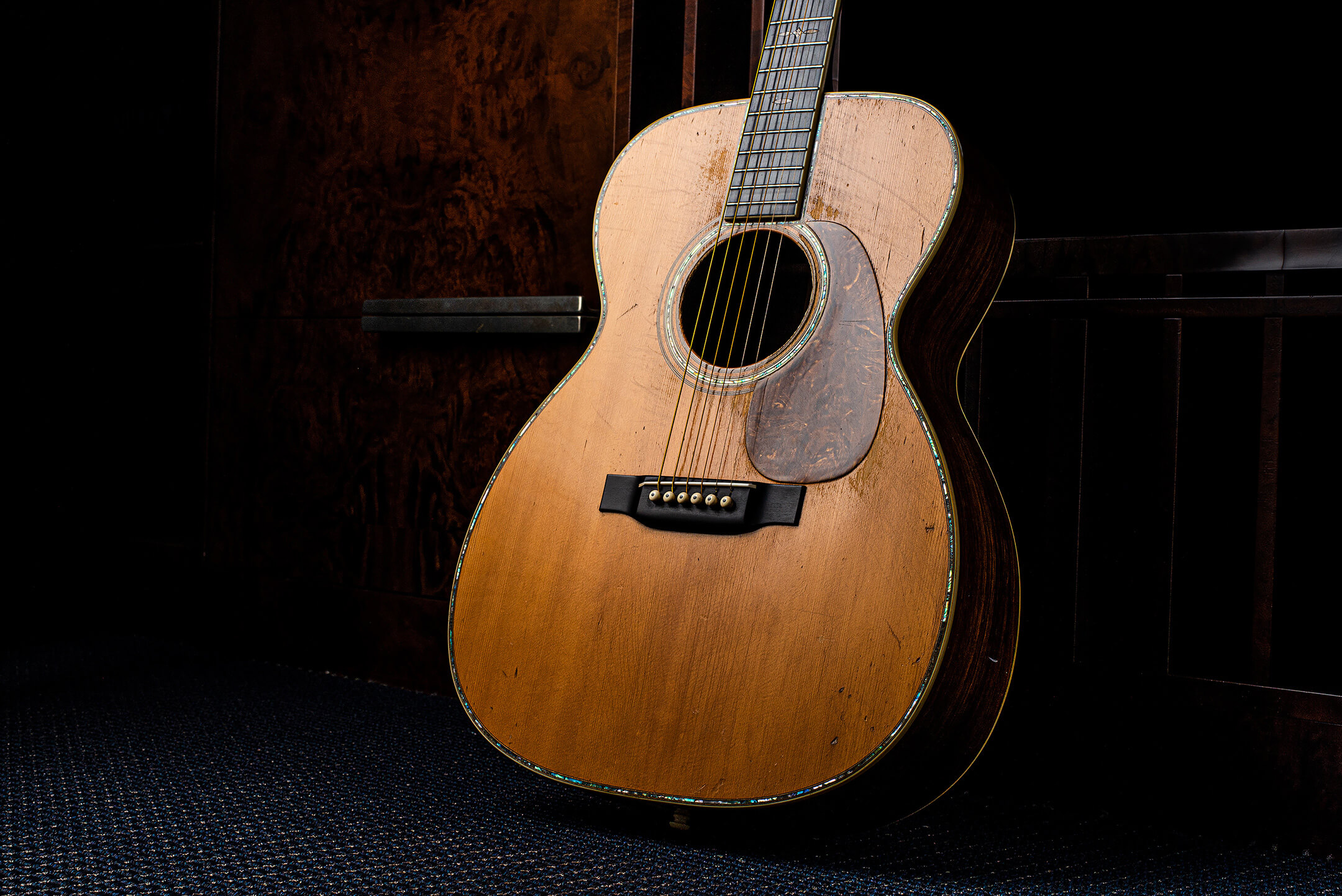 Eric Clapton played this 1939 Martin 000-42 during his MTV Unplugged performance in 1992 (Photo: Eleanor Jane)
The impact of MTV’s Unplugged series on the popular perception of the guitar is hard to understate, and as we’ll see more than once on this list, the impact of these concerts clearly resonates with collectors, too. Eric Clapton’s legendary Unplugged performance, and its accompanying platinum-selling album not only revitalised Clapton’s career, it had a huge impact on the popularity of the acoustic guitar in general.
The 000-42 that Clapton played for the performance is hugely important in a variety of ways – Martin credit it with revitalising interest in the 000-sized guitar overnight, while it also inspired the company’s most successful and long-running signature model. Irsay bought the guitar for under a million dollars back in the day, but it smashed expectations to become the second most expensive acoustic of all time in 2026.
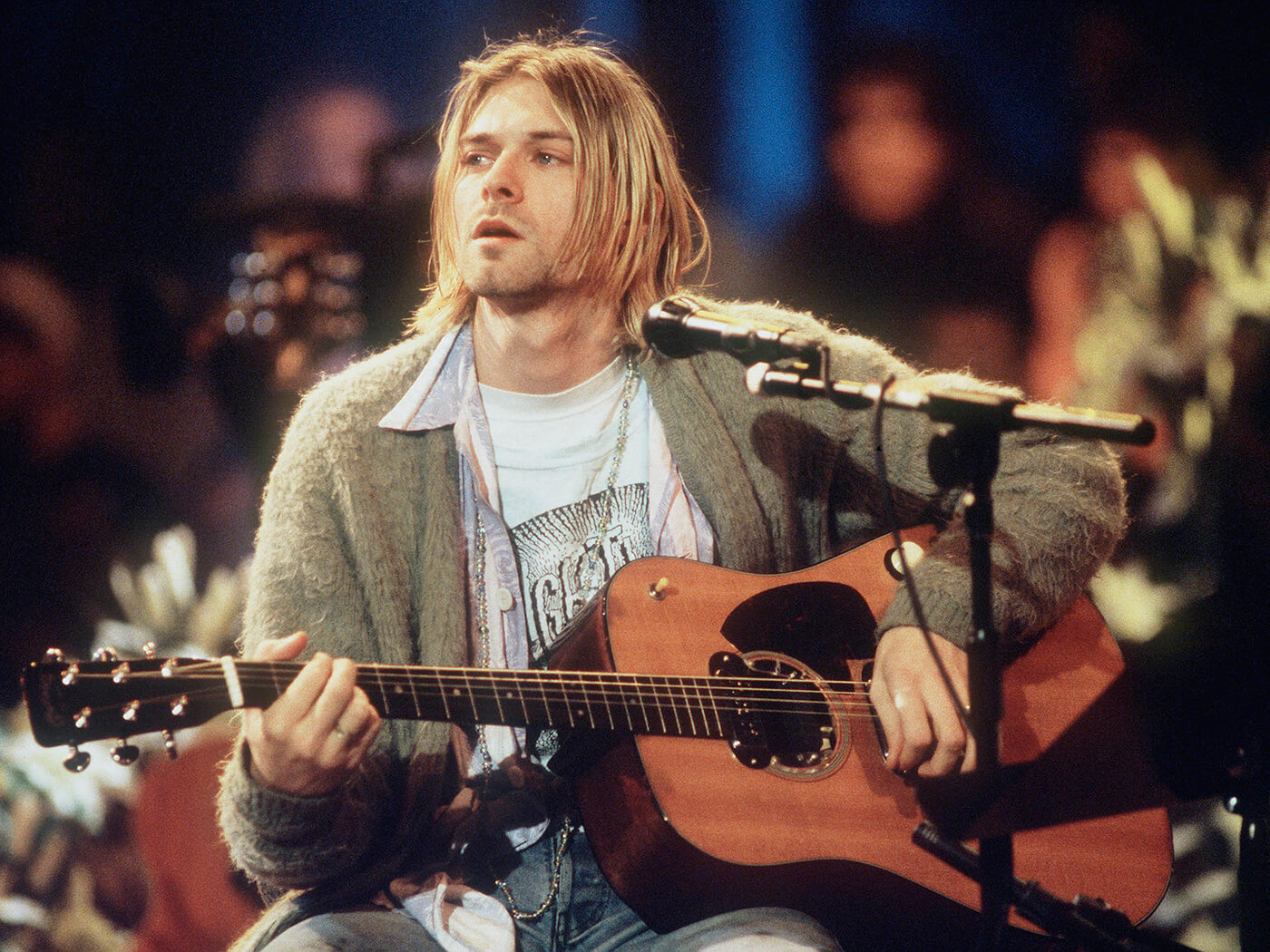 Kurt Cobain performing with his Martin D-18E during Nirvana’s MTV Unplugged. Image: Frank Micelotta Archive/Getty Images
4 Kurt Cobain’s Martin D-18E $6,010,000 (2020)
From one Unplugged moment to another! If there’s one Kurt Cobain guitar moment that’s become even more iconic than the Teen Spirit video, it’s Nirvana’s incredible, bittersweet performance on MTV Unplugged. Kurt bought the D-18E in 1992 at Voltage Guitars in Los Angeles, and it’s a rare bird for Martin guitars in that it came out of the factory with the DeArmond pickups, but Kurt disliked their sound and had it modded with a Bartolini 3AV soundhole pickup.
The guitar was left to Kurt’s daughter Francis Bean, and then ended up with her ex-husband Isaiah Silva as part of their divorce settlement. The guitar was purchased by RØDE Microphones founder, Peter Freedman in 2020 and topped our list for the best part of half a decade – until the 2026 Irsay auction redrew the map somewhat.
3 Kurt Cobain’s Smells Like Teen Spirit Fender Mustang $6,907,000 (2026)
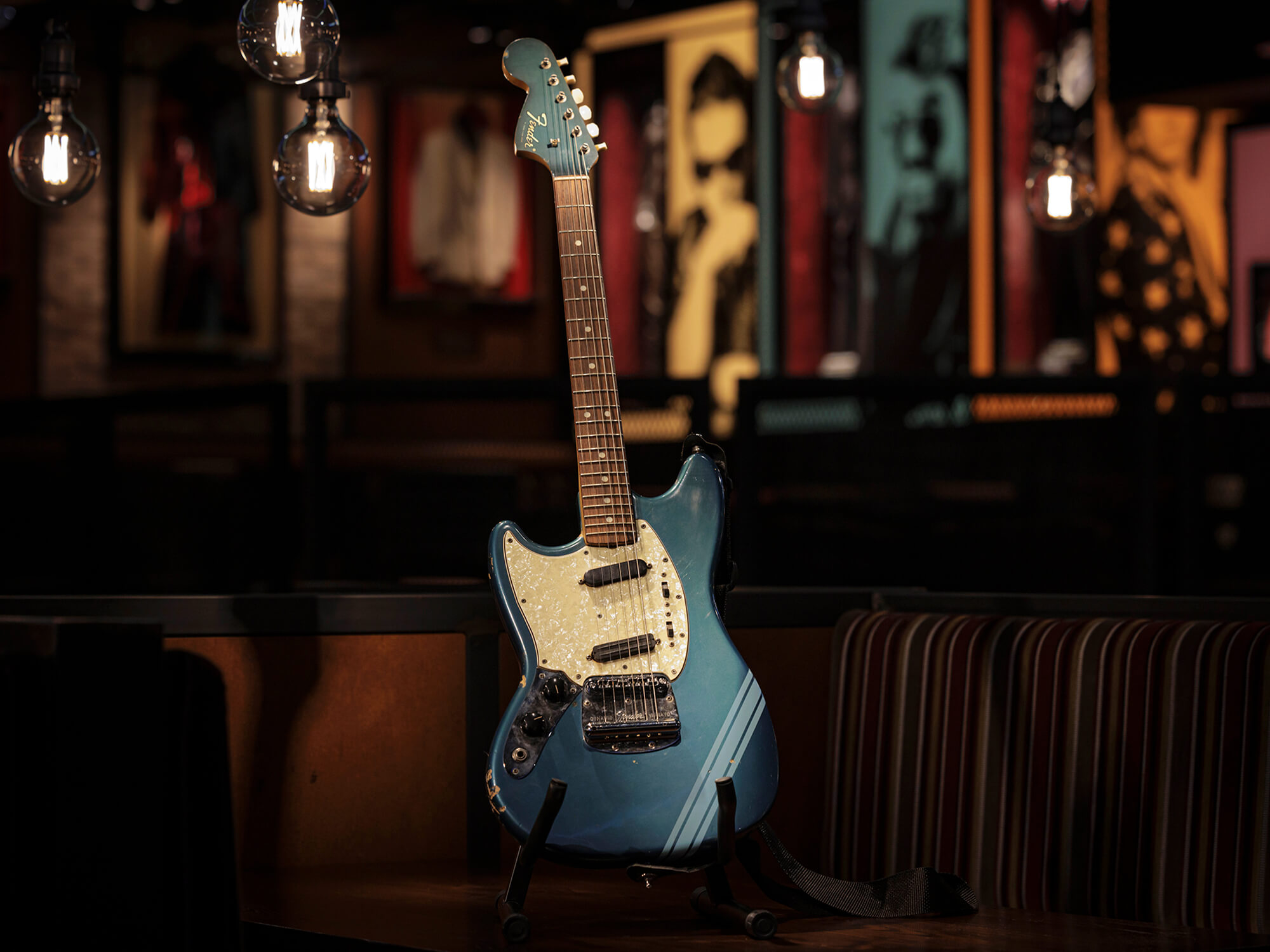 The Fender Mustang used by Kurt Cobain in the ‘Smells Like Teen Spirit’ music video on display at Hard Rock Cafe in Piccadilly Circus, 2022. Image: Rob Pinney/Getty Images
What does an iconic moment in guitar history cost? About seven million dollars? It’s not an exaggeration to say that the Smells Like Teen Spirit music video changed the world, and in it Kurt Cobain is playing a rather fetching but typically unconventional lefty Lake Placid Blue Mustang with a competition strip – 1.5 billion YouTube views and countless hours of MTV airtime later, its place in the pop culture firmament was assured.
Ironically, the guitar wasn’t really one of Kurt’s favourites, only really getting a run-out live on a few other occasions but its place in the Teen Spirit video assured its place in rock history, and in the Jim Irsay collection in 2022 when it was sold for $4,550,000. Interestingly, when the Irsay sale was announced, this guitar had the largest estimated sale price of $2.5-5m. While it comfortably smashed that, it ended up being outshone on the night by two less heralded instruments…
2 Jerry Garcia’s ‘Tiger’ $11,560,000 (2026)
Image: Eleanor Jane
Over the last few years, the magic of the Grateful Dead has been experienced by an entire new generation. Fuelled by the popularity of the John Mayer-aided Dead & Co tours, Deadheads are arguably more numerous and passionate than they have been at any point since Jerry Garcia’s passing in 1995. The sad passing of Bob Weir earlier this year, and the global outpouring of love that has followed reminding us all of the enduring power of the band and its music.
Tiger was built for Garcia by luthier Doug Irwin, and it became his main guitar from 1979 onwards. It was also the last guitar he ever played in public before his death in 1995. Irsay bought Tiger for $957,500 in 2002, and all of the above combined to make those in the know raise eyebrows at the relatively modest $1-2m estimate at the Irsay sale in 2026.
But even they were gobsmacked by how much it eventually went for – $11,560,000 made it the second most expensive guitar of all time, and the second ever guitar to reach eight figures at auction. The power of the Dead endures, clearly.
1 David Gilmour’s Black Fender Stratocaster $14,550,000 (2026)
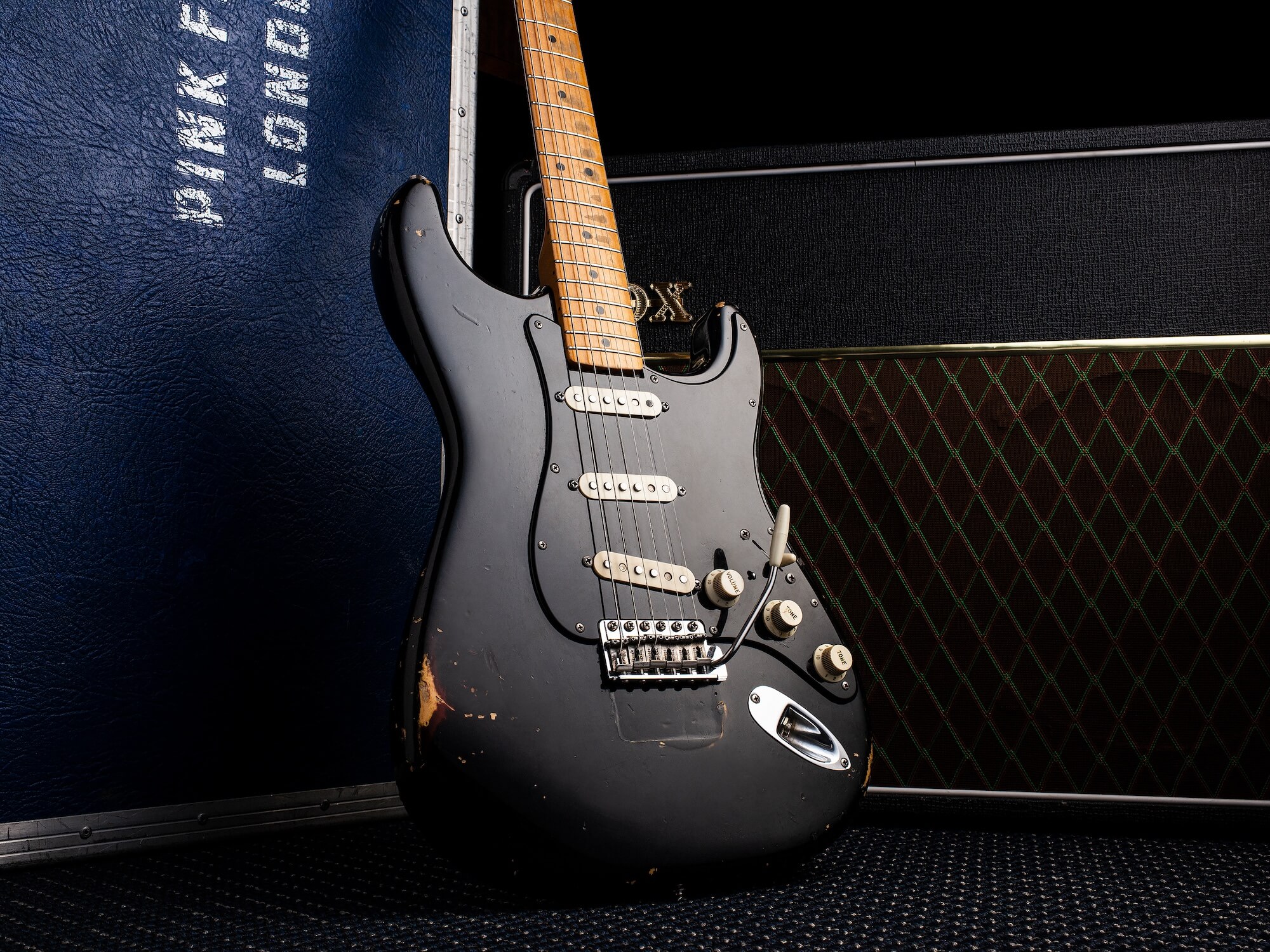 Image: Eleanor Jane
The Black Strat is David Gilmour’s most iconic guitar and is also one that’s been heavily modified over the years – bought from Manny’s Music in New York, this 1968 model was originally Sunburst but had been refinished in Black by the time Gilmour bought it in 1970. It originally had a maple neck with a late-60s big headstock, but throughout the 70s Gilmour frequently swapped between two 50s necks, one with rosewood and maple.
That wasn’t the end – over the decades since the pickups, tuners, pots, trem and scratchplate have all been swapped, and in fact it’s now estimated that the only original parts of the guitar remaining are the body, selector switch and (maybe) the bridge plate. Despite this, the Black Strat remains Gilmour’s most iconic instrument – the sound of Money, Comfortably Numb and scores more.
Despite its status as effectively the most important and iconic partscaster of all time, that didn’t stop it reaching a world record sum when it first sold in 2019 for $3.9m and became the crown jewel of the Jim Irsay Collection.
In the following years it would have its title usurped by a pair of Kurt Cobain guitars, but the 2026 Irsay auction didn’t just cement the guitar’s status as the most valuable guitar on earth – it completely redrew the map. The gasps as the guitar sailed past $10 million were audible in the Christie’s New York sale room, as the guitar finally sold for a scarcely believable $14,550,000. Where do we go from here? Well, if the last decade is anything to go by, the only way is up…
Editor’s note: this article was first published on 1 February 2024 and most recently updated on 13 March 2026. All figures below are converted into US Dollars and were correct at time of auction and not adjusted for inflation.
The post The 15 Most Expensive Guitars Sold At Auction appeared first on Guitar.com | All Things Guitar.
David Gilmour’s Black Strat is the world’s most expensive guitar again – selling for a staggering $14,550,000

David Gilmour’s most famous and iconic guitar once again owns the title of the most expensive guitar ever sold at auction, nearly than tripling the previous record by selling for $14,550,000 including fees.
Today’s Jim Irsay Collection auction at Christie’s in New York was always likely to reset the market for rock star guitars at auction – we dubbed it the world’s greatest guitar collection in 2022, after all.
But with an estimated price of $2-4,000,000, even wild estimates would never have imagined that the guitar – which was bought at auction by the late Indianapolis Colts owner for $3,975,000 in 2019 – would command such an unprecedented price.
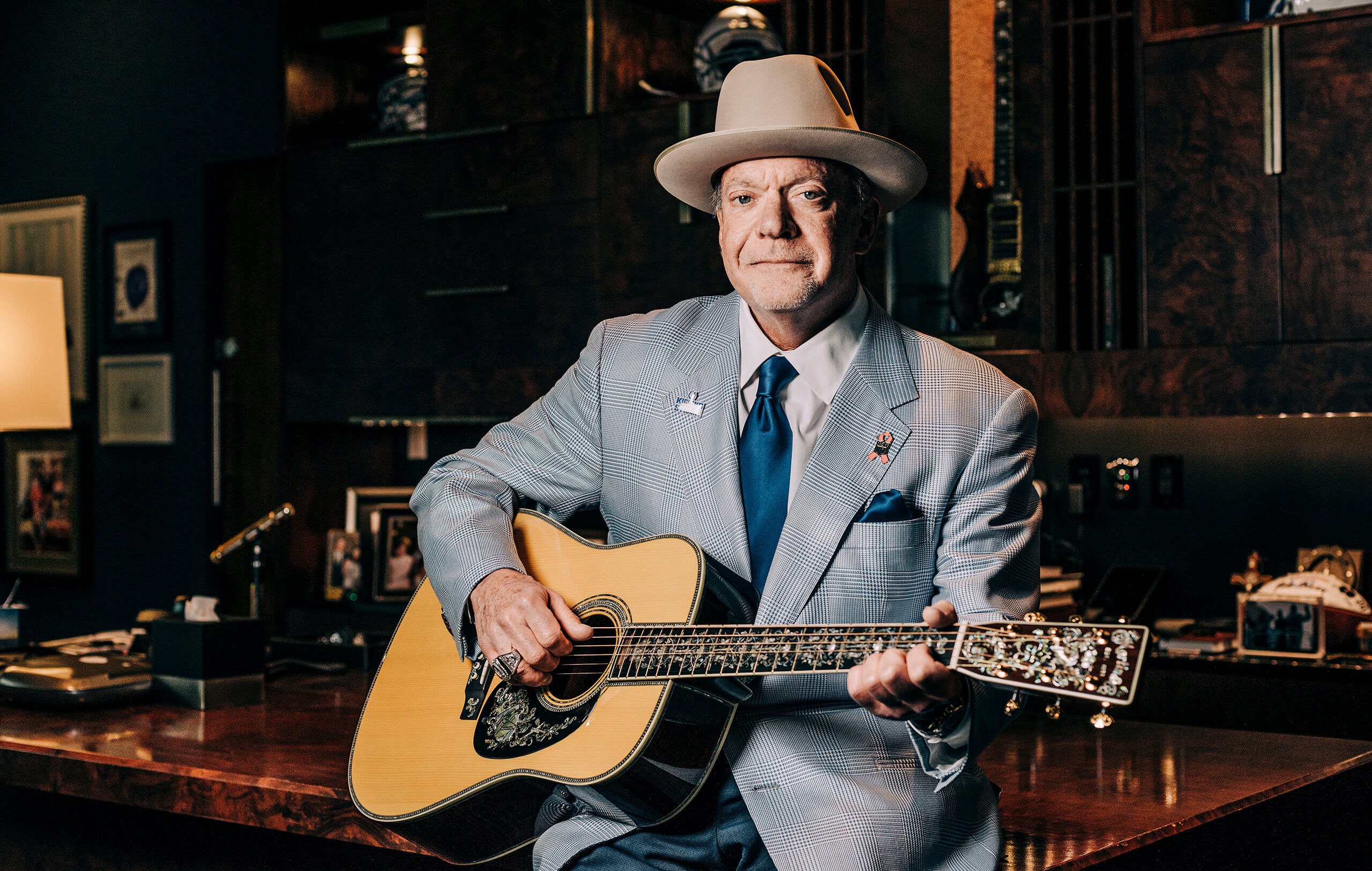 All images: Eleanor Jane
The sale makes the Black Strat not only the world’s most expensive guitar again, it more than doubles the previous record held by Kurt Cobain’s Martin D-18E which he used on Nirvana’s MTV Unplugged performance.
That guitar was sold for $6,010,000 in 2020, though interestingly another Kurt Cobain guitar that was also part of the sale and expected to fetch the highest price did relatively modestly by comparison.
Kurt’s Smells Like Teen Spirit video Mustang held the record for the most expensive electric guitar going into the sale, having sold for $4,550,000 in 2022. It sold in the end for ‘only’ $6,907,000.
That still wasn’t good enough for the silver medal on the night however, as another rock star guitar came out of nowhere to become the second most expensive guitar sold at auction.
Irsay purchased Jerry Garcia’s Tiger for $957,500 in 2002. Built by luthier Doug Irwin, it was the Grateful Dead star’s main guitar from 1979 onwards and in 1995 was the last guitar he ever played in public
Interest in the Grateful Dead has exploded over the last few years, and so perhaps it’s no surprise that Jerry Garcia’s legendary Tiger guitar would comfortably beat its $1-2m estimate.
For it to fetch an astounding $14,560,000 however? That certainly wasn’t on the script for the evening.
The sale also saw Eric Clapton’s “Fool” SG sell for a little over $3m, while a treasure trove of Beatles gear also fetched big sums – most notably George Harrison’s Paperback Writer SG which sold for $2,271,000.
The post David Gilmour’s Black Strat is the world’s most expensive guitar again – selling for a staggering $14,550,000 appeared first on Guitar.com | All Things Guitar.
Gibson expands its Songwriter line with new Recording Artist and Recording Artist EC models

Gibson’s long-standing Songwriter series has welcomed two new acoustics to its lineup. Designed to be the perfect tool for studio recording sessions, the Recording Artist and cut-away variant Recording Artist EC promise to be the perfect way to capture Gibson’s classic tone with a “modern, professional” polish.
Handcrafted in Bozeman, Montant from thermally aged Sitka spruce tops, rosewood backs and sides, and long-scale mahogany necks, the Recording Artist and Recording Artist EC have been designed with reliable studio-worthy clarity in mind.
With their 25.5” scale length and combination of tonewoods, both guitars harnessing the essence of the 1936 Advanced Jumbo – resulting in a rich, warm and balanced Gibson sound.
Both guitars also boast a bound headstock with a rosewood veneer, classily inlaid with the Gibson logo and crown. The guitars also have a bone nut, while gold Grover open-back tuners add a premium feel to the instrument. Then there’s an ebony bridge with a bone saddle, TUSQ bridge pins, and mother-of-pearl arrow inlays.
 Credit: Gibson
Elsewhere, both models also employ an L.R. Baggs HiFi electronics system, which features dual bridge plate sensors and an internal preamp to help provide you with a natural acoustic tone. Soundhole-mounted volume and tone controls are also in place to keep your controls discreet, but still easy to access.
Visually, the guitars also opt for timeless Rosewood Burst and Antique Natural finishes. The top also has a tortoise pickguard, while the sound-hole is framed by an abalone rosette.
 Credit: Gibson
Whether you’re opting for the Songwriter Recording Artist or the Songwriter Recording Artist EC, you’ll be getting the same quality build. The primary difference is the EC’s cutaway – so you can opt for either model that allows you to feel most comfortable playing without sacrificing that rich Gibson voice. They also both cost $4,999, so you wont have to splash out more on a certain model, either.
Both the Songwriter Recording Artist and Songwriter Recording Artist EC are available now for $4,999. For more information, head to Gibson.
The post Gibson expands its Songwriter line with new Recording Artist and Recording Artist EC models appeared first on Guitar.com | All Things Guitar.
The Other Side of GAS: Decoding Price Points
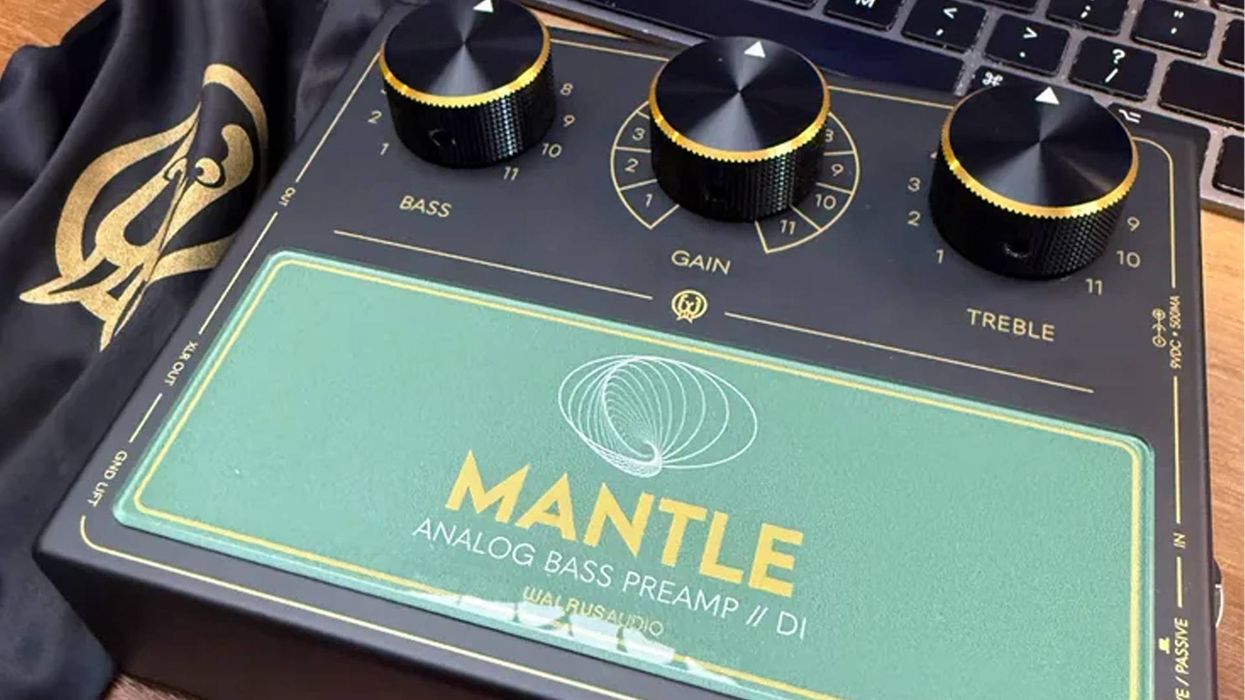
At the beginning of my career, I made a lot of mistakes. The beginning is the time for it. If you’re lucky, and you are surrounded by enough good people (as I thankfully was), you begin to learn what’s important and replace the mental noise with hard work.
Buried in the center of all the mental stuff is, for a lot of bass players, the inevitable pursuit of sound through gear. Sometimes it’s totally justified; other times it’s what has become known as GAS: Gear Acquisition Syndrome.
In those early years, I knew nothing about gear. I had very little of it. Maybe three or four basses and a total of two pedals and a tuner. (The EBS Octabass and a Boss Chorus, for anyone wondering.)
If you know anything about me now, almost 30 years later, you literally can’t move in my studio for pedals. Sometimes I grab a gig bag out of the closet to go to a gig and find a bass inside that I forgot I owned. This isn’t a flex; this is just to highlight how things have changed, how absurd they have become, and to perhaps lend some validity to what I want to talk about today, considering the amount of experience (good and bad) I’ve had with gear.
My good friend Ian Martin Allison, who you may know from Scott’s Bass Lessons or from countless recordings and tours, recently collaborated with Walrus Audio on a preamp/DI, the Mantle. I was fortunate enough to receive an advance unit to check out and give feedback on. I posted an episode of my podcast featuring it, and the outrage at the price point of the Mantle is on a level I haven’t experienced before on my channel.
It’s fascinating to see how far the algorithm has come in terms of brainwashing us into thinking we either need, or deserve, every new thing that is announced, regardless of whether it makes any sense for what we do, and more importantly, regardless of what our personal means are. People look at the price, know they can’t afford it, and immediately accuse the company of greed, all the while having never used it, never been involved in R&D, and with no experience of the artist/brand relationship.
I was very careful on my podcast to highlight the fact that there are a multitude of entry points into the world of preamps, and at $749, this latest one might not be the thing for you, no matter how much FOMO you think you might have or how much you love the way it sounds.
I really like how the Bugatti Chiron looks, and boy would it be a special moment to be able to drive one and experience engineering that is incomprehensible to most of humankind. But the $4-million-plus price tag lets me know it’s not for me, that I should appreciate it from afar, and reminds me my Mazda (at 0.63 percent of the cost) still has four wheels, AC, Bluetooth, and gets me where I need to go in quite some comfort.
“Not only do you probably not need the latest, most expensive thing on the market, you really don’t need to be mad about its price.”
I think the internet has changed the way we bass players chase things like sound, and a healthy dose of awareness could not only save you a ton of money but get you to the thing that is actually right for you. Is it a unit that is $749 (Mantle), $1,400 (Noble Preamp DI), or $449 (JHS Colour Box)? It could well be. If that is the case, and you are a professional who requires high-quality gear that you will actually use, then fantastic. Question asked, question answered.
If your budget doesn’t allow for that right away, definitely try to have the patience to save until it does so that you buy once and cry once. Patience now for a short period of financial pain and a lifetime of happiness with your sound.
Is your budget sub-$300? This is also great information, and you have so many options for bass preamps. I used the EP Booster from Xotic for years. I think I paid $100 for it used and still have it to this day. Want more EQ options and a DI? MXR Bass Preamp at $189. Want an industry-standard DI that will never die? Radial Engineering JDI for $260.
This isn’t a commercial piece for any of the aforementioned companies or products. It’s just a heads up that not only do you probably not need the latest, most expensive thing on the market, you really don’t need to be mad about its price. If we can start asking bigger questions about our own needs and means, we’ll be able to shut out the mental load marketing algorithms place on our decision-making process and live a far more streamlined existence with the absolute best gear for us.
“What is this entire piece-of-s**t setup?”: Josh Homme once showed his Peavey/Yamaha bass rig to John Paul Jones – this was his reaction
![[L-R] John Paul Jones and Josh Homme of Them Crooked Vultures](https://guitar.com/wp-content/uploads/2026/03/Josh-Homme-John-Paul-Jones@2000x1500.jpg)
When it comes to gear, Josh Homme is known to opt for the “underdog”. And in a new interview with Guitar World, the Queens of the Stone Age frontman recalls the time he showed one of his rigs – a Yamaha hollowbody bass into a Peavey Decade practice amp – to his Them Crooked Vultures bandmate, former Led Zeppelin bassist John Paul Jones, and his reaction that followed.
“I showed the Decade to John Paul Jones when we were in Them Crooked Vultures,” Homme says. “I have this Yamaha hollowbody bass with flatwounds on it, which I call Lame-aha. Instead of a pickup switch, it’s a volume knob, so you’re on the spectrum of which pickup you’re using. I said, ‘Try that with the Decade and a Coles ribbon mic.’”
- READ MORE: Josh Homme says “you have to be willing to lose your fans sometimes” when writing new music
Jones was bewildered. “He laughed – and I love that, because the looks are deceiving,” Homme explains. “You’re like, ‘What is this entire piece-of-shit setup?’ Then he played it. It was fun to see him go from giggling about how shitty something looks to complete joy. It’s fun to do that to people and it’s fun to do that to yourself, too.”
Homme embraces the ‘shitty’ look, because he knows how good he can make ‘shit’ sound. It’s a mindset that keeps his sound unique, as well as intriguing audiences and peers alike. “You’re looking for any way, visually and sonically, to do something that nobody else is doing,” he explains. “Getting shit from people is the best thing that could happen. It made me think, ‘Never again will anyone ever say I sound like someone else…’”
As Homme puts it, his goal was that “within three seconds, you know it’s [him]”. The approach has been a constant through the Queens of the Stone Age’s three-decade run, even spanning back to his downtuned guitar work in Kyuss.
Employing quirky gear helps the process, and Homme has worked his way through countless pieces of rogue gear. “Anything is an amplifier to me,” he says. “I love playing out of old stereo tuners, old tape machines; anything with a speaker and a jack. With a Les Paul and a Marshall I know what’s going to happen there. Music is about matching your own evolution.”
“It’s hard not to want to get behind the underdog, because music is about being an outcast,” he continues. “All I need is insurmountable odds and I’m in. Give me your worst guitar, a boutique amp made in someone’s mom’s garage, and a pedal that’s not supposed to be there, and we’ve got something. When you do that, you instantly feel like these things are yours.”
Now, Homme has worked on reviving the Peavey Decade. The Peavey Decade Too “revives that voice and makes it accessible again” while removing the need to “hunt for vintage originals”.
Back in 2022, Acorn Amps transformed Homme’s Peavey Decade into a nifty pedal. The Solid State pedal serves as a “full circuit recreation” of the compact 10-watt practice amp.
The post “What is this entire piece-of-s**t setup?”: Josh Homme once showed his Peavey/Yamaha bass rig to John Paul Jones – this was his reaction appeared first on Guitar.com | All Things Guitar.
“I can’t fake the funk”: Parliament-Funkadelic guitarist on why he’s often looked so miserable on stage

It’s hard to control your facial expression when you’re lost in the music. From blissfully closed eyes to rock-ready stank-faces, you can see when a musician is really in-tune with their instrument – and when they aren’t. Parliament-Funkadelic’s Michael Hampton in particular has been prone to look quite stone-faced if he isn’t ‘feeling the funk’ on-stage.
In a new interview with Mojo, he laughs about how his power-funk sound might have seemed at odds with his grumpy demeanour. “The way I may have come across on-stage, it might have been like I wasn’t having a good time,” he says. “[I might have looked] a little bit bored… because I can’t fake the funk, if I’m not feeling something.”
Just as other guitarists can’t contain their excitement, he couldn’t contain his disinterest when he wasn’t in the mood to perform, or when the performance wasn’t feeling particularly magic. “I went as far as I could go and, you know, you get tired,” he explains. “Still to this day I’m not the one dancing around. I like to joke a bit but I’m pretty serious about playing. I just go with the flow and kind of stay in my lane.”
“Nowadays on tour, I’m not as loud as I would like to be, there’s a lot of vocals,” he continues. “I really miss the part of it when we’d crank up the amp all the way and do Cosmic Slop. But it’s another day and time. I’ll play Maggot Brain until I’m told, ‘Okay, it’s time to end it.’”
When the late Eddie Hazel stepped down from his Parliament-Funkadelic duties in 1971, the group quickly sought out his successor. They’d find the perfect guitarist in 17-year-old Michael Hampton, enlisting him to join the collective after witnessing him perform the 10-minute Maggot Brain solo at a Parliament-Funkadelic aftershow party.
Despite worries that he may have appeared “bored” onstage, his work with the band was anything but boring. Plenty of his time performing in Parliament-Funkadelic was electric and “spontaneous”, just like that first solo that convinced the gang to take him on board. “Everything’s pretty much a spontaneous surprise and it’s all inter-changeable,” he explains. “The last time we played [in 2025], it was good, you know?”
Michael Hampton’s Into The Public Domain EP is out now.
The post “I can’t fake the funk”: Parliament-Funkadelic guitarist on why he’s often looked so miserable on stage appeared first on Guitar.com | All Things Guitar.
Pages
