
Music is the universal language
“Glory to God in the highest heaven, and on earth peace to those on whom his favor rests.” - Luke 2:14
Norse Guitar Feeds
“I can achieve every sound I need” how Yamaha’s Revstar won over the professionals to become a modern classic

Ad feature with Yamaha
Back in 2015, if you asked someone to think about Yamaha electric guitars, they’d almost certainly point to the budget brilliance of the Pacifica or the under-the-radar classic that is the SG 2000.
Nobody would have expected that a brand with such a defined identity could introduce not just a new guitar, but an entire concept that would redefine what people expected from a Yamaha guitar, and establish itself as a true modern classic in a world that’s often so resistant to new things. But the Revstar was no ordinary guitar line – it’s a guitar that has won over beginners and professionals alike, and won dedicated fans in the shape of two of the brightest lights in modern guitar: Chris Buck and Matteo Mancuso.
Revs Your Heart
 Image: Yamaha
To understand the DNA of the Revstar, you have to understand the history of Yamaha. While the world’s largest musical instrument maker and the world’s second largest maker of motorbikes have been independent companies since 1955, there is obviously a significant fraternity between the two still.
That’s why, when the design geniuses at Yamaha Guitars came together to create what would become the Revstar, they borrowed from their own history, of course, but they also looked to their friends over the Tenryū River at Yamaha Motor Co.
In particular, the designers looked to the timelessly cool stripped down Cafe Racer motorcycles that had ferried the hip young rockers of London around the city in the 1960s – the same decade that Yamaha first started making guitars.
The bikes even gave the Revstar its name – a nod both to the revving of a motorbike engine, but also the Yamaha Motor Group’s “Revs your heart” company slogan. The Revstar would certainly set guitarists’ hearts racing when it arrived in 2015.
More Than Skin Deep
 Image: Yamaha
But if the Revstar was just a pretty guitar, it would never have established itself in the unprecedented way it has over the last decade – becoming a fixture with professionals and hobbyists alike. These are people who appreciate not just the Revstar’s looks, but the usability and design that could only have come from Yamaha.
The genius of the original Revstar line was the way every design choice was made with the prospective player in mind – making sensible and smart decisions based on hundreds of interviews conducted with real guitarists from across the playing spectrum.
Whether it was scale length, tonewoods, fret size or pickup selection, the huge amount of research allowed Yamaha’s expert designers to craft instruments that put the player at the heart of things like never before.
For example, each of the original Revstar guitars featured custom pickups created for the line. In the hugely popular entry-level RS320 model, the pickups were high-output units with ceramic magnets. This was done because the designers sensibly reasoned that a beginner player would appreciate more volume when they were developing their technique, but would also allow even more advanced players who appreciated heavier styles to still have fun with them.
 Image: Yamaha
At the other end of the scale, the Bigsby-toting RS720B featured underwound humbuckers – with 2500 turns of heavy formvar wire on the neck pickup and 2900 on the bridge – in order to give a more classic, vintage tonality that would pair with the Bigsby’s smooth wobble.
It’s this kind of considered and evidence-driven approach to guitar design – mixed with an undeniably beautiful overall design of course – that captured the attention of guitar players. Where so many brands lean heavily on nostalgia and established designs to appeal to the masses, the Revstar courted the attention of those seeking something unquestionably new, distinct and timeless.
Rather than look back, the Revstar represented an inspiring new tool for the job, that captured the imagination of a generation of guitar players looking for something outside of the norm.
Refining The Concept
 Image: Yamaha
Given the huge amount of research, development and listening that Yamaha’s designers put into the first generation of Revstars guitars, it would have been unthinkable for them to not take advantage of the fact that it was now out in the real world being played by thousands of musicians who would provide even more feedback.
Thus in 2022 the second generation of Revstar guitars was launched, which featured a host of refinements, tweaks and improvements on the original. Perhaps the most significant of these was the fact that each Revstar guitar now utilised Yamaha’s proprietary Acoustic Design chambering to improve resonance and reduce weight.
Another key addition to the second generation of Revstar guitars was the Revstar Professional RSP02T – a Japan-made take on what had become the defining recipe of the Revstar platform, ready for pro musicians to take on the road.
And that was important, because the Revstar had quickly become a guitar that had been embraced by major recording artists for its unique looks and wonderful functionality: from Graham Coxon of Blur, to Lynval Golding of The Specials, Dave Keuning of The Killers, and Jeff Schroeder of Smashing Pumpkins.
Player’s Choice
 Image: Yamaha
The breadth of the Revstar’s appeal is shown in the variety of players who have adopted it over its first decade, but two modern guitar greats stand apart in making the guitar their primary means of guitar expression: Matteo Mancuso and Chris Buck.
“I chose to play a Revstar because I was searching for a solid body that was similar to the SG but with more versatility for both jazz and rock,” the Italian jazz phenomenon explains. Mancuso is one of the most jaw-dropping technical guitar players on the planet, but the Revstar’s intelligent and thoughtful design takes him where he needs to go.
Mancuso references the comfort of the body shape and its lightweight design, plus the versatility of the five-way selector switch on his personal model, which adds coil splitting options to the Lollar Imperial pickups onboard. Combined with the guitar’s lively chambered body, it accommodates everything he wants in one guitar: “I can achieve every sound I need!”
For Buck, the love for Revstar runs even deeper, and it’s an enduring relationship that has spawned not just the first Revstar signature model ever, but Yamaha’s first signature electric full stop for 15 years.
The first time Buck saw a Revstar was when he walked into a Cardiff guitar shop a decade ago, and instantly the design spoke to him. The Revstar has been by his side ever since as he’s become one of the most respected blues-rock guitarists on the planet.
 Image: Yamaha
He loved his Revstar so much, he later upgraded to a model made by the YASLA Custom Shop in the USA that became his primary stage instrument. This guitar has helped usher in another milestone for the Revstar when it became the basis for Buck’s signature model in early 2026.
“My Custom Shop Revstar has been the beating heart of every record I’ve made and every show I’ve played since I first laid hands on it in 2020,” Buck enthuses. “It hasn’t left my side and has quite literally travelled the globe with me, from Cairo to California.
“The phrase ‘labour of love’ gets thrown around a little too often these days, but collaborating so closely with Yamaha to recreate my Number One over the past few years has been exactly that. I’m beyond thrilled to finally see it come to life.”
That two masterful players with such different approaches to the instrument can be united by the Revstar is a testament to the design brilliance at the core of this modern classic. From expressive and feel-led playing to highly articulate modern technique, the Revstar can handle anything these titans of modern guitar can throw at it. It’s a platform for inspiration no matter who you are.
Find out more about the Revstar at yamahaguitargroup.com
The post “I can achieve every sound I need” how Yamaha’s Revstar won over the professionals to become a modern classic appeared first on Guitar.com | All Things Guitar.
“They can hear it in the song, see it in the art, and they’re, like, ‘Ah, that ain’t it’” Papa Roach’s Jacoby Shaddix says he loves rock’s pushback against AI

Artificial intelligence may be creeping into all aspects of music-making, but Jacoby Shaddix believes rock is pushing back – and he’s all for it.
Speaking on the LA Lloyd Rock 30 radio show, the Papa Roach frontman reflects on the genre’s resistance to AI, noting the way rock fans can “smell” when something’s off. He describes the current moment as “a strange time” for artists, particularly those just starting out, and sees the rise of AI as yet another turning point for the industry, much like the collapse of the CD era.
“I think now, at this point, we’re at another kind of strange time in music where this AI element is coming through, and it can be frightening, I think, for a lot of people, for a lot of young artists maybe,” Shaddix explains [via Blabbermouth].
“But then there’s this hopeful element in it that I feel. Will.i.am from the Black Eyed Peas was trying to explain it, and I think he kind of hit the nail on the head in a way of, like, when you go to the grocery store, you can get the organic or you can get the GMO. What do you want? So if you want music, do you want fake music or do you want the music that’s coming from a human being? And we have a choice.”
For Shaddix, the issue lies in what AI currently represents: imitation over intention.
“AI is really essentially studying us. It’s a study of us,” says the musician. “And how does it regurgitate us back at us in a generic way? And that’s where it’s at right now. And it will be interesting to see how this plays out.”
“But I love the pushback from rock culture against it. I think that a lot of people in rock culture can smell it. They can hear it in the song, they can see it in the art, and they’re, like, ‘Ah, that ain’t it.’”
“And I love collaborating with people,” Shaddix continues. “I love the humanness of it. I love the push and pull in the relationship of creating with another person and having to have a conversation in a room, creating a song. And sometimes my idea isn’t the best idea in the room, and it gets shot down. And then sometimes my idea is the idea that sticks, whereas this other one is, ‘I have a prompt. Let me press a button.’ It’s just lazy, man.”
“I think the people in the rock culture and in the rock space, we could smell it a mile away. There’s room for the human in that.”
That mindset is already shaping how Papa Roach approach recording. Shaddix says the rise of AI has prompted the band to strip things back in the studio and rethink overproduction.
“[It’s] prompted us, when we go into the studio, to kind of dial back some of the tech and the overproduction of things,” he says. “[Our latest single] Wake Up Calling being one of those. There’s no samples on the drums in that song. It’s just raw drums. It’s just a recording of a drummer playing drums. And I think that that element is coming back into the play.”
Papa Roach’s new album – the follow-up to 2022’s Ego Trip – will be out later this year. Listen to the single Wake Up Calling below.
The post “They can hear it in the song, see it in the art, and they’re, like, ‘Ah, that ain’t it’” Papa Roach’s Jacoby Shaddix says he loves rock’s pushback against AI appeared first on Guitar.com | All Things Guitar.
Is a new The Who album on the cards? Pete Townshend claims Roger Daltrey “wants to give it a try”

Don’t count The Who out just yet. A new album from the prog rock legends may not be as far-fetched as it once seemed – at least if Pete Townshend is to be believed.
While frontman Roger Daltrey has repeatedly downplayed the idea of another Who record in recent years – citing the cost and underwhelming commercial performance of 2019’s WHO as reasons to move on (“there’s no record market anymore,” he previously said) – Townshend has now suggested that door might not be fully closed.
The Who guitarist and primary songwriter recently shared a glimpse of his new London writing studio on Instagram – a space he says was “built by Rick Astley” and “mine now”.
“I’m loving it. Great sound. I’m very spoiled,” Townshend writes.
And when one commenter suggested there was “no way” “another Who album” would happen, Townshend fired back with a surprising reply: “You might be wrong. Roger wants to give it a try.”
The musician also fielded questions about his current setup, revealing a relatively no-frills approach to writing and recording.
“I use a MacBook. The sequencer is an MPC Live III. I use it on the road like a portastudio,” he writes in the comments, adding that his speakers of choice are Genelec.
Whether that setup ends up powering a full-blown Who record remains to be seen – but for now, it appears the idea is back on the table.
In the meantime, Townshend has previously revealed he’s sitting on hundreds of unfinished pieces – and isn’t opposed to using AI to help complete some of them.
“I’ve managed to wade through about half of [my unfinished music],” he said during an appearance on The Late Show with Stephen Colbert. “What’s interesting is… I don’t know what to do with it! I’m quite interested in AI [to see what it makes of it].”
“I’m quite interested in [using it to rework] some of my old songs that didn’t quite work,” he added. “[If I put stuff] onto Suno or some AI music machine, [I could see] what it can make of it. There might be some hits!”
The post Is a new The Who album on the cards? Pete Townshend claims Roger Daltrey “wants to give it a try” appeared first on Guitar.com | All Things Guitar.
The Real Riot Women: the Gen Xers discovering punk and embracing guitar

“People on Facebook I hadn’t spoken to in a decade were all sending messages, going, ‘Hi. How are you?’” begins Lucy Morgan of London-based, kitchen punk band, I, Doris. “Just wondering, have you seen this TV show?” The series in question is Riot Women, a critically acclaimed six-part drama from the BBC that the New Yorker described as “genius” and currently sits at 92% Fresh on Rotten Tomatoes.
Set in the quirky and inclusive Northern town of Hebden Bridge, pub landlord Jess Burchill assembles an unlikely crew of women to form a band for a local talent contest. But for a legion of Gen X women across the globe, the storyline felt far from fictional.
Director of the upcoming documentary Menopunks, Alicia J. Rose, performs in two bands born from Portland’s punk energy, the city also responsible for seminal riot grrrl acts like Heavens to Betsy, Team Dresch, and later, Sleater-Kinney.
For Rose, the show was a welcome tonic in its focus on women in their 50s and 60s reclaiming their voices. “[It] reminded me of The Full Monty but with women and rock and roll as the MacGuffin,” she says from her home in Oregon City. “I love every fucking character in the show. They’re not the real thing, but I’ll tell you, the real thing does fucking exist.”
Nana Punk
South Wales sextet the Nanaz, an outfit that formed in 2024 through a punk rock workshop, proves not only that these women exist, but their sounds are in demand, thanks to the BBC series. “We’re riding a very good wave, partly as a result of Riot Women,” admits bassist Anne-Marie Bollen. “People are looking at who’s actually doing this for real.” The group met through the Nana Punk project, an initiative hosted at Wales’ Millennium Centre to break barriers and build new communities.
For the Nanaz’s Deborah de Lloyd, the sessions were a crash course in stepping out on stage. “At the end of the workshops, they got us to play a gig, with no rehearsal time, in the middle of the Millennium Centre. I was working out the chords ten minutes beforehand!” Lead guitarist Angela Samuel, who played acoustic before turning to electric in the last few years, is still astounded by their progress. “When we started, I thought ‘There’s no way we’re going to get a band going,’ but we actually have!”
I, Doris’s Lucy Morgan’s entrance to music was more traditional. Rather than taking in the toilet circuit of dingy East London dive bars, she was classically trained. But the desire to perform with other creatives like her was strong.
“I liked the idea of having a band with Cassie [Fox, LOUD WOMEN founder and I, Doris bassist and frontperson]. We have a shared love of pop music, Dolly Parton, and gin-soaked evenings.” For Fox herself, it’s railing against societal expectations. “It’s what we do, rather than play bridge or golf,” she quips. “What are normal middle-aged women supposed to do with their time?”
Portland’s Alicia J. Rose feels similarly, learning drums when she turned 40 and forming Party Witch. She’s since added another artistic output to her arsenal that’s quickly picked up steam in the community, as she shares. “I’m in another band called The Fabulous Bloodstains with Gilly Ann Hanner [ex Calamity Jane and former tour support for Nirvana]. It’s the most real version of the Riot Women that I’ve ever experienced in my life. We formed to open for two sold-out shows of Sleater-Kinney playing as the Ramones last October.”
 Anne Marie Bollen of the Nanaz. Image: Press
Seeing Red
This new burst of creative flow didn’t come easily for Rose, though, whose forthcoming documentary, Menopunks, paints an intimate portrait of celebrated female musicians (think vocal tornado Neko Case and original riot grrrl Allison Wolfe of Bratmobile) navigating midlife. In the BBC’s Riot Women, vocalist Kitty Eckersley and keyboardist Beth Thornton pen the band’s talent show entry, Seeing Red, supercharged with the frustrations of accessing HRT (hormone replacement therapy).
The struggle isn’t a new subject for I, Doris, who wrote their own powerful post-punk number about gynecological healthcare three years prior. Alicia J. Rose is adamant that the shift from hot flashes and brain fog on stage is all thanks to the drug. “Now I have the energy to be in two bands. Now I’m making a movie, and I couldn’t be doing any of these things if I were as miserable as I was two years ago.”
While the TV series’ songwriting themes line up with lived experience, there’s a longstanding ethos from the riot grrrl era that doesn’t chime so well. In the ‘90s, Bikini Kill’s Kathleen Hanna began demanding “Girls to the front!” at her band’s shows to create safe spaces for women in a male-dominated scene. While the riot women of today are happy blasting out their politically charged tunes, they’re demanding visibility on their own terms, as I, Doris’ Lucy Morgan explains.
“In my last band, I hid behind a trombone. I, Doris is my first opportunity to be on a stage as a performer, not someone hiding in the background, [but] it took me a lot of years to get over some really crippling stage fright. It’s only as I got past 40 that I became comfortable with standing up on stage and people looking at me.”
 Lucy Morgan of I, Doris. Image: Press
Getting Things Wrong
This trepidation to take up space also feels familiar to the Nanaz’s second guitarist, Claire Symons. “They’re always trying to get me out from behind a pillar!” she admits before bandmate Marega Palser chips in. “When we started, it was like if you’re shy, just put a fucking bag on your head.” But as Symons reflects, that’s not so easy when you’re a woman of a certain age. “Someone said, ‘Wear a balaclava. Do a Kneecap!’ And I was like, ‘Jesus Christ, I’m always hot!’”
Pushing past the debilitating stage fright and questionable accessories, bands like the Nanaz and I, Doris are channeling a lot of the early DIY spirit that post-punk godmothers The Raincoats gifted us back in the 1970s, a learn-as-you-go mentality. “We’ve got no shame in making mistakes or getting things wrong,” says Marega Palser of the Nanaz. “The fact that you’re getting up on stage and doing it is enough of a signal to women of the same age. It’s important to see that there are other ways of being and behaving.”
The same could be said for the bands’ attitudes to guitar culture. I, Doris’ latest addition, Lenie Mets, who has consistently performed in London’s live music circuit, is unsettled by the weight often placed on an artist’s gear. “I honestly couldn’t give a blank shit about that. You see a guy with his 500 guitars and the pedal boards they come up with, and you just think, why?” Some of that resistance may stem from how the gear is marketed and displayed.
Research by Fender revealed that women were predominantly buying guitars online “because in the bricks-and-mortar stores there was nobody to relate to, and they weren’t getting treated well”. For the Nanaz’s Anne Marie Bollen, her bass came via an unlikely punk grapevine about a decade ago. “Richie from Dub War told me to drive over quickly — a guy had been kicked out, and I could have his bass for £100,” she laughs. “Years later, we’re playing shows with Bad Sam featuring Dean Beddis, and he goes, ‘I had one like that!’ I said, ‘I know — it’s yours!’”
With the Welsh creative community rallying around them, it’s no surprise that the Nanaz have been embraced on the live circuit. But there’s one particular supporter in the crowd who’s been rooting for lead guitarist Angela Samuel for years. “We’ve got Ang’s dad in the audience,” beams Bollen. “He’s 87 and an old rock and roll drummer. He’s always wanted Ang to be in a band.”
 Claire Symons of the Nanaz. Image: Press
Louder Than Ever
It’s champions like these that are helping to turn up the dial on women’s voices that have been systematically suppressed and repressed for generations. In the ‘90s, women-fronted bands grappled for the single slot on an all-male festival bill. Today, initiatives like Nana Punk and Leicester’s Riotous Collective mean more Gen X women are making noise than ever before.
“We deserve to be louder than fucking ever,” insists Alicia J. Rose back in Portland. “So why the fuck not pick up the loudest instrument possible and turn it up to fucking 11, as Tufnel said, and rage against every fucking machine that will be in listening distance?” The beauty of this collective coming-of-age? The message is spreading far and wide for others to reconnect with their creativity, regardless of status or tech setup.
Like The Raincoats’ Gina Birch seeing the “madness and chaos” of The Slits for the first time, sometimes we just need to see someone like us on stage. Today’s real-life riot women are making that visibility louder — and contagious.
“What I’ve found really amazing is talking to other female friends who have said, ‘I’ve started singing lessons!’ or ‘I’m going to play the guitar!’” says the Nanaz’s Claire Symons. “My sister-in-law even said, ‘Oh, I’m gonna get my mandolin out that I bought 15 years ago, and I’m now gonna have another go!’”
Follow the real riot women at @thenanazband, @idorisband and @menopunks
The post The Real Riot Women: the Gen Xers discovering punk and embracing guitar appeared first on Guitar.com | All Things Guitar.
Colin James Is Going Coast To Coast on April-May US Tour With Matt Anderson & Terra Lightfoot For A Roots-Rock Extravaganza
Press Release
Source: Mark Pucci Media

Colin James – photo credit: James O’Mara
Multi-award-winning blues/rock guitarist Colin James’ last US tour in 2024 was cut short due to an automobile accident. Now fully recovered he’s bringing his exciting blend of blues and rock music to fans in the States with the upcoming “Coast to Coast Tour” in April and May. Joining him on the tour are Matt Andersen and Terra Lightfoot to celebrate the rich legacy of electrifying Canadian blues and roots music.
The “Coast to Coast Tour” starring Colin James, Matt Andersen and Terra Lightfoot brings these friends and fellow musicians together for an 18-city US Spring 2026 cross-country tour celebrating blues and folk to rock and soul. Audiences can expect powerful individual sets and inspired collaborative performances from three of Canada’s most acclaimed and distinctive roots artists. The “Coast to Coast Tour” honors the enduring power of music to cross borders, generations and traditions – live on stage!
James’ career spans over 30 years, with a track record that includes 21 studio albums, 8 JUNO Awards, 31 Maple Blues Awards and multi-platinum record sales. He has worked with some of the world’s most revered artists, including Bonnie Raitt, Albert Collins, Pops Staples, Robert Cray, Albert King, Keith Richards, Lenny Kravitz, ZZ Top, Mavis Staples, Carlos Santana, and Buddy Guy, to name a few. His latest album, Chasing the Sun, featured guest appearances from Lucinda Williams and Charlie Musselwhite. Colin will be performing with his trio.
Matt Andersen
New Brunswick, Canada, native Matt Andersen is one of the most accomplished Canadian singer-songwriters and powerhouse vocalists active today. A multiple Maple Blues Award winner, multi- European Blues Award winner and JUNO nominee, Andersen was the first Canadian to take home top honors at the International Blues Challenge. Today he headlines major festivals, clubs, theaters throughout North America and the rest of the world. Matt will be performing solo.
Terra Lightfoot
This native of Ontario and two-time JUNO Award nominee has drawn musical comparisons from Dusty Springfield to Van Morrison. Her decade-plus musical evolution has seen her tour four continents alongside Willie Nelson, Bruce Cockburn and the all-female revue The Longest Road Show, among others. Terra will be performing solo.
Colin James with Matt Andersen and Terra Lightfoot Tour Dates
April 17 – The Admiral Theatre – Bremerton, WA
April 18 – Mount Baker Theatre – Bellingham, WA
April 19 – Edmonds Center for the Arts – Edmonds, WA
April 21 – Urban Lounge – Salt Lake City, UT
April 24 – Knuckleheads Saloon – Kansas City, MO
April 26 – The Parkway Theater – Minneapolis, MN
April 27 – City Winery – Chicago, IL
April 29 – City Winery – St. Louis, MO
April 30 – Lincoln Theatre – Columbus, OH
May 1 – The Kent Stage – Kent, OH
May 2 – The Cellar at the Original Pittsburgh Winery – Pittsburgh, PA
May 3 – Town Ballroom – Buffalo, NY
May 5 – Sellersville Theater – Sellersville, PA
May 6 – Rams Head on Stage – Annapolis, MD
May 7 – The Katharine Hepburn Cultural Arts Center – Old Saybrook, CT
May 8 – Lewis A. Swyer Theatre – Albany, NY
May 9 – Jimmy’s Jazz & Blues Club – Portsmouth, NH
May 10 – The Center for the Arts in Natick – Natick MA
“I saw UFO play with Van Halen in the ’70s – they got their asses kicked”: George Lynch recalls seeing Eddie Van Halen’s “mind-bending” playing up close

Dokken guitarist George Lynch has recalled watching Eddie Van Halen play up close in the ‘70s, and how his chops humbled even the formidable musicians of English hard rock outfit UFO, who Van Halen supported during a show at the Golden West Ballroom in California in 1976.
“I saw UFO play with Van Halen at the Golden West Ballroom in Norwalk, California, near where we lived. We played there a lot.” Lynch tells The Music Zoo owner Tommy Colletti in a new conversation [via Blabbermouth].
- READ MORE: EVH unveils two 5150 “blast from the past” models – with both throwback and modernised features
“It was somewhat dramatic, because I don’t know if UFO knew what they were in for. And I love UFO – we all love UFO – but they got their ass kicked. I mean, they came up, and I don’t think they were ready for that.”
Lynch goes on to recall the “paradigm shift” in hard rock brought about by Eddie Van Halen’s guitar playing and how he spearheaded two-handed tapping’s foray into the mainstream.
“To see it up close and personal as it was happening, in Mammoth [one of Eddie Van Halen’s pre-Van Halen bands, not to be confused with his son Wolfgang’s active band of the same name] and also early Van Halen, it was mind-bending to see that in person. It was just insane.
“I mean, I’d just go to my studio or go home and just get on my guitar for eight hours and go, ‘I gotta step up. This is insane.’”
Elsewhere, blues ace Joe Bonamassa recently pondered whether Eddie Van Halen would have been as cool if he were to have used an amp modeller like a Neural DSP Quad Cortex, as opposed to the vintage analogue gear that was available to him at the time of Van Halen’s heyday.
The guitarist and avid gear collector said: “Instead of a 68 plexi with a laydown transformer, a Univox [EC-80A Tape Echo], and MXR Phase 45, a [Marshall] basket weave cabinet, and a Boogie Bodies Strat, imagine if the same Eddie Van Halen showed up with a Neural [Quad Cortex] and a Suhr.”
He asked, “Is it as cool? I’m not knocking John Suhr, I’m not knocking Neural… Great invention, but I just pose the question. People hear with their eyes. It’s the whole thing.”
The post “I saw UFO play with Van Halen in the ’70s – they got their asses kicked”: George Lynch recalls seeing Eddie Van Halen’s “mind-bending” playing up close appeared first on Guitar.com | All Things Guitar.
Gojira guitarist’s new Jackson signature is the first-ever Rhoads model to feature an EverTune bridge

Jackson has blessed Gojira guitarist Christian Andreu with a brand-new signature model, and intriguingly, it’s the first-ever Rhoads model in the Jackson lineup to feature an EverTune bridge…
The guitar joins two existing Jackson signatures under the French guitarist’s portfolio, completing a trio of custom-spec’d Randy Rhoads tuned for his punishing riffs in Gojira.
In terms of specs, as stated, the headline feature of the Pro Plus Series Signature Christian Andreu Rhoads RR24 EVTN6 is its EverTune bridge – the first time one has featured on a Jackson Rhoads.
For those unaware, the EverTune is a patented bridge design which uses a system of springs and levers to keep a guitar perfectly in tune no matter the conditions or ferocity of playing that’s thrown at it.
As you’d expect, then, the EverTune is widely favoured by metal musicians, with Andreu’s Gojira co-guitarist Joe Duplantier using one during the band’s landmark 2024 Olympic opening ceremony, as well as other metal stalwarts including Trivium’s Matt Heafy and Tetrarch’s Diamond Rowe.
 Credit: Jackson
Elsewhere on the spec sheet, Christian Andreu’s new signature model features a single Fishman Fluence Modern humbucker in the bridge position – with a three-way mini toggle for access to three different Fishman voicings – 24 jumbo stainless steel frets on a “lightning-fast” 12”-16” compound-radius ebony fingerboard, and a three-piece neck-thru build with graphite reinforcement with alder wings for “earth-shaking tone with fortress-like stability”.
“It started as love at first sight when I was 15, seeing the legendary Kirk Hammett wield this iconic shape. It was the most metal thing I’d ever seen, and I was hooked,” Andreu says.
 Credit: Jackson
“20 years later, holding my first Jackson RR signature model turned that teenage dream into reality. And now, I’m even more excited to introduce my brand-new RR signature guitar. This instrument isn’t just something I play live; it’s an extension of who I am.
“It’s also an honour to represent the first-ever RR model equipped with an EverTune bridge! With an unbelievably smooth neck, perfect balance and effortless playability, this guitar feels like it was built for me. I couldn’t be prouder of how it turned out.”
Watch Christian Andreu put his new signature model through its paces in Jackson’s new demo video below:
“This Pro Plus Series signature is the culmination of everything we’ve learned about extreme performance,” adds Jon Romanowski, VP of Product, Jackson.
“It’s a precision-engineered instrument built to withstand the most punishing tour conditions while delivering the sonic brutality that defines Gojira’s legendary sound. We’re proud to collaborate with a groundbreaking artist who shares our commitment to creating instruments that unleash musicians’ full creative potential.”
The Pro Plus Series Signature Christian Andreu Rhoads RR24 EVTN6 is available now, priced at $2,429 / £1,849. Learn more at Jackson.
The post Gojira guitarist’s new Jackson signature is the first-ever Rhoads model to feature an EverTune bridge appeared first on Guitar.com | All Things Guitar.
EVH unveils two 5150 “blast from the past” models – with both throwback and modernised features

EVH has launched two new 5150 Series models, the DX and DX QM (quilted maple), which blend both throwback and modernised features together.
The DX offers a modified Strat-style basswood body with a deeper upper body curve. While the striped original had a single humbucking bridge pickup only, this new version comes with a HH pickup configuration and also has a lower bout kill switch.
- READ MORE: The best value electric guitars: 11 affordable options for beginners and players on a budget
These models also offer a graphite-reinforced bolt-on quartersawn baked maple neck with a modified “C” profile, 12”-16” compound radius baked maple fingerboard with 22 jumbo frets and black dot inlay, plus a hand-rubbed satin urethane back finish, heel-mount truss rod adjustment wheel, and a “hockey stick” headstock decorated with the EVH logo decal.
Its custom designed EVH Wolfgang Alnico 2 humbucking pickup configuration is controlled by a three-way toggle switch. The bridge pickup delivers punch and articulation with sweet sustain and thick chunky rhythms in a perfectly balanced EQ curve, according to the EVH brand, while the neck pickup serves up “no-nonsense, balls to the wall overdrive and endless sustain without skimping on articulate cleans when the volume is rolled down”.
The DX is completed by an EVH-branded top-mount Floyd Rose bridge and locking tailpiece with fine tuners for each string, plus a patented EVH D-Tuna for switching back and forth from drop-D to standard tuning.
The DX is available in Black or Candy Apple Red Metallic, while the DX QM comes in Pacific Drift (blue) or Limeade Zest (a green into yellow ombre).
The MSRP for the 5150 Series DX is £1099 / €1299 and the 5150 Series DX QM is £1249 / €1449. Find out more via EVH.
The post EVH unveils two 5150 “blast from the past” models – with both throwback and modernised features appeared first on Guitar.com | All Things Guitar.
Fender to celebrate 75 years of the Telecaster with one-night-only Nashville event featuring Brad Paisley, Brent Mason and Brothers Osborne

With the Telecaster’s 75th anniversary celebrations well underway, Fender has announced Tele Town, a “live music experience” with appearances from a smorgasbord of top Tele players at the Ryman Auditorium in Nashville – “where the Telecaster became a legend”.
Taking place Monday, 4 May, 2026, Tele Town will be a “one-night live music experience” celebrating all things Telecaster, with a curated lineup of performers including Brad Paisley, Brent Mason, Brothers Osborne, Guthrie Trapp, James Burton, Luke McQueary, Ricky Skaggs, Steve Wariner, Trey Hensley and Zach Top.
They’ll perform alongside a dedicated house band led by Nashville native and the event’s musical director Derek Wells.
Elsewhere, the event will be hosted by Nashville guitarist and music historian Zac Childs, who will take the audience through performances and segments which highlight the Telecaster’s “pioneering design and role in shaping Music City’s – and the world’s – musical identity.
“75 years after its debut, the Telecaster remains proof that simplicity endures, adaptable enough to move across genres, generations, and stages without losing its identity,” says FMIC President of Americas, Justin Norvell.
“This celebration is our way of honouring not just an instrument, but a cultural phenomenon that has shaped music for over seven decades.”
He continues: “Tele Town at the Ryman will be the culmination of this celebration – bringing that story to life on one of music’s most hallowed stages in the heart of Music City. From our limited edition collections to the content pieces and community celebrations, we’re ensuring the Telecaster’s legacy reaches both longtime fans and discovers new ones who will carry its voice into the future.”
 Credit: Fender
“Serving as musical director for Tele Town is a true honour, especially in my home city of Nashville, where I grew up and where the Telecaster’s legacy runs so deep,” adds Derek Wells.
“Putting this show together has been about more than just great players, it’s about capturing the spirit of an instrument that’s shaped so much of the music we all love. This lineup is full of people who’ve lived with this guitar onstage and in the studio, and I’m certain that when we all are together, you’ll see people playing with love and reverence for what this instrument has meant to us all.”
Tickets for Tele Town will go on sale Friday, 27 March, 2026 at 8AM PT. All net proceeds from ticket sales will be donated to local Nashville charities.
Prior to the event, the Fender Custom Shop will also celebrate the 75th anniversary of the Telecaster with an exclusive Roadshow event on 3 May from 18:00 – 21:00 at Carter Vintage in Nashville. The event will feature FCS Senior Masterbuilder Paul Waller, Master Pickup Winder Josefina Campos, and Fender’s Chief Engineer of Guitars Tim Shaw, who will offer an “intimate look” at the craftsmanship behind Masterbuilt guitars.
Visit AXS for ticket information for Fender Presents: Tele Town.
The post Fender to celebrate 75 years of the Telecaster with one-night-only Nashville event featuring Brad Paisley, Brent Mason and Brothers Osborne appeared first on Guitar.com | All Things Guitar.
Joe Bonamassa thinks Eddie Van Halen wouldn’t have been as “cool” if he’d used a Quad Cortex instead of vintage analogue gear: “People hear with their eyes”

Joe Bonamassa has been questioning if modern gear looks as cool as good old fashioned analogue rigs, and believes people “hear with their eyes” to a certain extent.
The blues guitarist and gear obsessive’s home gear museum, known as Nerdville, holds thousands of rare and vintage gear gems, with over 600 guitars. The collection has grown so much that he’s even slowing down to avoid reaching “a saturation point”.
With such an avid love of gear, Bonamassa may be somewhat biased, but he poses an interesting question, and he’s not alone in quizzing how smaller and modernised set ups can sometimes take away from the visual aspect of putting on a gig or affect the sound overall.
During his appearance on the No Cover Charge podcast, he uses Eddie Van Halen as an example: “Instead of a 68 plexi with a laydown transformer, a Univox [EC-80A Tape Echo], and MXR Phase 45, a [Marshall] basket weave cabinet, and a Boogie Bodies Strat, imagine if the same Eddie Van Halen showed up with a Neural [Quad Cortex] and a Suhr.”
He asks, “Is it as cool? I’m not knocking John Suhr, I’m not knocking Neural… Great invention, but I just pose the question. People hear with their eyes. It’s the whole thing.”
Interestingly, not all artists believe smaller rigs impact the visual aspect of live shows. Chad Zaemisch, guitar tech for James Hetfield of Metallica, actually feels that a large wall of amps is not missed at their shows. In an interview with Guitar World, Zaemisch explained how their one-off Freeze ‘Em All concert in Antarctica in 2013 caused their transition.
“We were kind of forced to come up with a solution for playing a show in Antarctica where we couldn’t have speakers. For environmental reasons, they didn’t want any noise pollution. Matt Picone from Fractal came and got all our sounds started. It was definitely a learning curve for us and the band, but once we got through that, everybody started to look at how convenient it was.”
He went on to add, “Everybody’s all about content these days, and not a lot of people want to watch a band stand in front of their amp line with nothing else going on. Now we can use large video screens. It opens up a lot more opportunities to do different things.”
The post Joe Bonamassa thinks Eddie Van Halen wouldn’t have been as “cool” if he’d used a Quad Cortex instead of vintage analogue gear: “People hear with their eyes” appeared first on Guitar.com | All Things Guitar.
Chromatic Connections: How to Make the Spaces Between Chord Tones a Source of Color and Momentum

“Maybe he’s a drummer”: Outrage sparked as viral video shows airport baggage handler throwing guitar cases to the tarmac

A video taken by a passenger onboard a plane at Los Angeles International Airport showing a baggage handler throwing guitar cases to the ground has gone viral.
The footage has been seen by millions, with 4.1 million views on TikTok alone. It’s also made the rounds on Instagram, where a number of musicians have commented in outrage. This isn’t the first time an incident like this has occurred, as a number of other artists have faced damage to their instruments over the years following flights, including Emily Wolfe, Madi Diaz, Pete Thorn, and more.
You can watch the footage below, but beware, it will make you wince. Touring guitarist Chris LaPlante comments, “first time I’ve wanted something to be AI”, while another user on TikTok comments, “was he kicked out of the band?” Others are questioning, does he hate music, or is he just a drummer? It seems we will never know.
@goyamariacookieI hope your guitars are ok #LAX #losangeles #airport #guitartok
Nick Ruiz, who captured the footage, has spoken to Need To Know, and says, “The whole situation felt wrong. My instinct was to start filming.”
At the time of writing, LAX has not commented publicly on the viral footage.
A number of musicians have argued that it is better to pay for a seat for your guitar – Joe Bonamassa has also spoken about doing so – but with many touring musicians on a tight budget, it’s not always possible.
Emily Wolfe called out Southwest Airlines after her signature Epiphone White Wolfe guitar had its headstock “completely broken off” following a flight in August last year.
In a post on Instagram, she explained how she followed every guideline for traveling with an instrument: it was in a hard-shell flight case, checked in properly, and was labelled with fragile stickers.
When she first filed a report at the airport, she was first told the airline was not responsible for anything inside the case and that instruments are considered “fragile items.” After posting about her experience online, the airline eventually reached out and agreed to cover the damages.
The post “Maybe he’s a drummer”: Outrage sparked as viral video shows airport baggage handler throwing guitar cases to the tarmac appeared first on Guitar.com | All Things Guitar.
Ace Frehley’s number-one Les Paul headlines upcoming auction at Julien’s – and could fetch half a million dollars
![[L-R] Kirk Hammett's “Ouija” ESP Custom, Ace Frehley's number one Gibson Les Paul, Stevie Ray Vaughan's MTV Unplugged Guild F-412](https://guitar.com/wp-content/uploads/2026/03/Music-Icons-auction-2026-hero@2000x1500.jpg)
Julien’s Auctions is set to sell a number of high-profile instruments from the rock and metal world in its upcoming Music Icons auction, including some owned by Ace Frehley, Kirk Hammett and Stevie Ray Vaughan.
Celebrating the “enduring power of heavy metal”, the Music Icons auction will also feature instruments played by the likes of Billy Duffy, Izzy Stradlin, Mick Mars and Black Sabbath’s Bill Ward. Over 800 items in total will be featured.
It also celebrates 50 years since Kiss first came to London for their Destroyer tour in 1976, with Ace Frehley’s most-played 1975 Gibson Les Paul front and centre, expected to fetch between $400,000 and $600,000.
Elsewhere the sale features: Stevie Ray Vaughan’s 1969 Guild F-412 from his 1990 MTV Unplugged performance, which is expected to fetch between $300,000 and $500,000; Kirk Hammett’s stage- and studio-played (and signed) “Ouija” ESP Custom, expected to sell for between $250,000 and $350,000; and Izzy Stradlin’s 1987 Gibson HR Fusion 1 (estimate $30,000 – $50,000.
But again, the late Ace Frehley is at the centre of the Music Icons auction, with a number of other pieces of memorabilia also up for grabs, including his 1977 tour jacket, a full-length kimono from the Rock & Roll Over tour era, and a stage-worn jumpsuit.
An exhibition of highlights from the auction has been unveiled at London’s Hard Rock Cafe Piccadilly Circus, where it will remain before travelling to Japan to the Hard Rock Cafe Tokyo on 27 April, the day the sale goes live. Additional items will be unveiled on 13 May at Hard Rock Cafe Times Square, available to the public until the live auction on 29-30 May.
“Interest in music memorabilia is reaching unprecedented levels, fueled by collectors who appreciate both the cultural significance of these instruments and the legacy of the artists behind them – often resulting in record-breaking sales,” says Martin Nolan, Co-Founder and Executive Director of Julien’s Auctions.
“Our annual Music Icons auction, featuring extraordinary guitars from Ace Frehley, Stevie Ray Vaughan, and Kirk Hammett, underscores Julien’s ongoing commitment to bringing museum-quality pieces to market while shaping the global conversation around music collecting.”
Learn more at Julien’s Auctions.
The post Ace Frehley’s number-one Les Paul headlines upcoming auction at Julien’s – and could fetch half a million dollars appeared first on Guitar.com | All Things Guitar.
Taylor Showdown

Levi Foster To Release “Appalachian Funk Tree” October 2026 Produced By Shooter Jennings
Press Release
Source: 37-Media
 When Nashville artist, Levi Foster, flew to Los Angeles carrying a 1966 Martin guitar and a stack of restless songs that didn’t quite fit Nashville’s modern mold, he wasn’t chasing polish, he was chasing freedom. The result is Foster’s second full-length album Appalachian Funk Tree, produced by outlaw-country torchbearer Shooter Jennings at the legendary Sunset Sound in Hollywood.
Born from a collision of Appalachian storytelling, psychedelic grit, and country swagger, the track signals a new chapter for an artist determined to push beyond genre lines without abandoning his roots.
“I listened to the music he already had out there and I liked him, and I liked his voice a lot,” says Jennings on his first impressions of Foster. “Then when I spoke to him on the phone I really liked where he was going with everything…then when I heard the songs he put together, I thought this was going to be really great…The minute we started on the songs I was really excited right out of the gate because it was already sounding like Tony Joe Wright swampy kinda Bobbie Gentry stuff, it was really exciting…I love the songs he wrote and the stories he wove really leant themselves for a really exciting and country soundtrack.”
Working with Jennings left a lasting impression on Foster and an experience for which he’ll always be thankful. “Shooter Jennings was generous enough to take a chance on me,” says Foster. “Those two weeks recording in the heart of Hollywood are memories I’ll carry for the rest of my life. I’m deeply grateful to everyone who helped bring these songs to life.”
PRE-SAVE HERE
Foster is set to release the first track off the album, “Fat Elvis,” on April 17 (pre-save here), a rowdy, cinematic introduction to Foster’s evolved sound. What began as a late-night joke among friends sparked by the line in the song “sweatin’ like fat Elvis on a postcard down in Memphis, Tennessee” quickly evolved into something larger.
Set against the chaos of Mardi Gras in New Orleans, “Fat Elvis” unfolds like a hazy fever dream of American excess and hard-earned lessons, blending humor with a darker reflection on fading icons, bad decisions, and the strange mythology we build around ourselves. The track features Foster on vocals and lead guitar, two-time Grammy-Award winner Ted Russell Kamp (Shooter Jennings, Tanya Tucker, Robert Randolph) on bass, Brian Whelan (Chris Shiflett, Dwight Yoakam, Jim Lauderdale) on lead guitar, Jamie Douglass (Shooter Jennings, Jaime Wyatt) on drums, Evan Hull (Lee Greenwood, Ty Herndon, Vince Gill) on electric guitar, and Greg Leisz (Joni Mitchell, Beck, Eric Clapton) on steel guitar.
At a moment when mainstream country continues to lean sleek and radio-ready, Foster’s music digs into something stranger and more unpredictable, blending mountain gospel spirit, Red Dirt attitude, and Americana storytelling that feels lived-in rather than manufactured. Jennings, known for championing artists who exist outside traditional boundaries, approached the project less as a producer chasing perfection and more as a collaborator helping Foster build a sonic world where humor, chaos, and hard-won truths could coexist.
A natural progression from his acclaimed 2025 release We Made Fire, with “Fat Elvis,” Foster steps further into a lane that feels defiantly his own, one where humor meets heartbreak and tradition collides with risk. As the Americana landscape continues to evolve, Appalachian Funk Tree positions Foster among a new wave of artists willing to challenge genre expectations while staying rooted in the storytelling spirit that defines country music at its core.
Catch Levi Foster on tour throughout the year. Current tour dates are listed below. More will be announced soon.
Tour Dates:
March 28 at The Mint Franklin, KY
April 17 at El Club w/ Colby Acuff, Detroit, MI
April 18 at The Intersection, Grand Rapids, MI w/ Colby Acuff
April 24 at Willies Saloon, Stillwater, OK w/ Colby Acuff
April 25 at Magnolia Motor Lounge, Fort Worth, TX w/ Colby Acuff
May 7 at Open Chord Music, Knoxville, TN
May 8 at The Hi-Tone Cafe, Memphis, TN
May 9 at The East Room, Nashville, TN
May 21 at Eddie’s Attic, Decatur, GA
May 23 at The Loft, Columbus, GA
June 11 at Manor Mill, Monkton, MD
June 12 at The Heist, Bowling Green, VA
June 13 at The Listening Booth, Lewes, DE
June 14 at Pearl Street Warehouse, Washington, DC
Levi Foster
Website | Instagram | TikTok | YouTube | Spotify | Facebook
Source Audio Reverb & Tremolo Pedal
Steve Earle – On The Road Talking Songwriting, Guitars and Gaelic Traditions

Steve Earle – Photo credit: (c) Rick Landers 2022
At fourteen years old, Steve Earle left school to find Townes Van Zandt, his Holy Grail. What kind of kid does this kind of thing? A good guess is, a romantic who hears a lyrical phrase or a melody that reaches down, gets embedded and rattles one’s bones.
Or maybe it’s the full-blooded carriers of such tunes, many or whom embodied the gnarly roots of American music that captured the kid’s imagination.
Townes, of course, was special, and rocker, balladeer and troubadour Steve Earle finally met him and hung out with him, as well his musical cohorts like Jerry Jeff Walker, Guy Clark, Willie Nelson and other now legends who created original songs that feel like some gold gifted to us all.
Today, Steve has earned his own iconic status, not only by writing his own songs and performing to thousands, but by deep digging into the roots of more contemporary music, studying the wherefore and why of the musical traditions of songs and styles ingrained in and beyond American shores.
Like generations before him, his own journey is part of both a land mass of musical traditions, and a migration of hard tack songs for future generations.
A couple of nights before, I watched and listened as he rolled out song after song of his own, as well as songs of his heroes, long gone. And, his presentations of their songs wasn’t filler for his own, it felt like he was honoring them; and it felt even more like loyalty to old friends, than fuel for his gig. Cool, well-known songs like: “Lungs,” “Pancho and Lefty,” “Mr. Bojangles,” and more, wafted throughout the now legendary Birchmere in Alexandria, Virginia.
“I’m just trying to stay out of trouble,” says Earle with a laugh. “If I stay busy, then I’m OK.” – Steve Earle
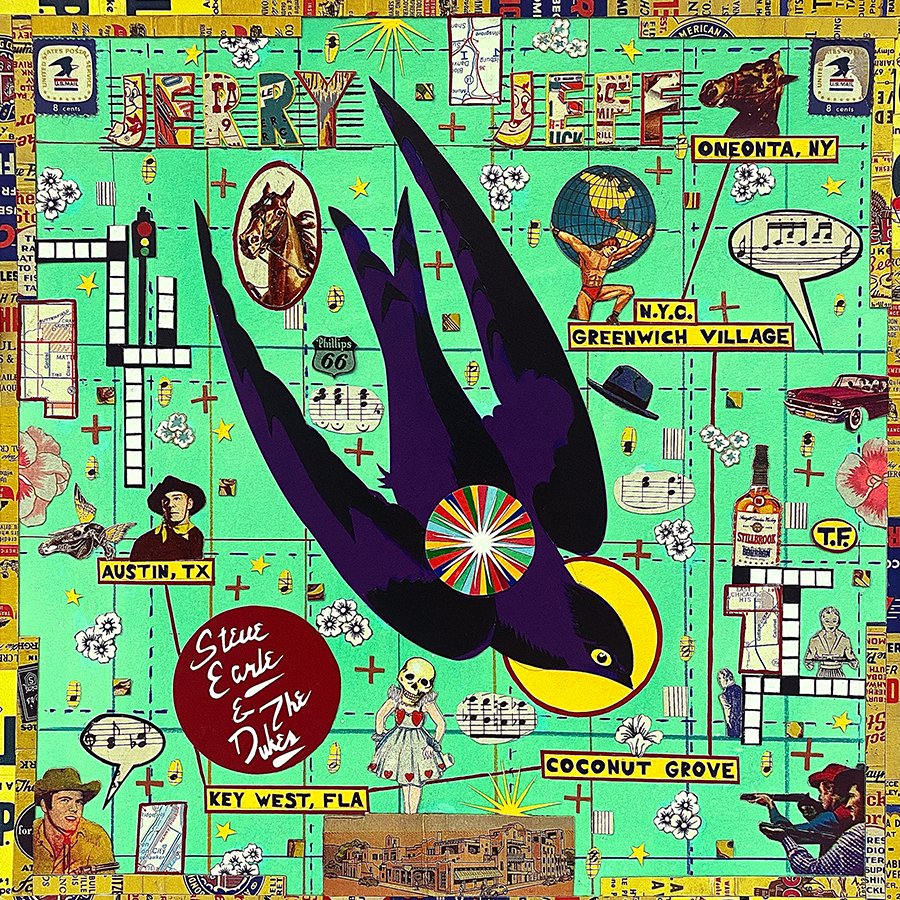
Steve Earle’s recent release, Jerry Jeff
Earle’s life has had its ups and downs, and it’s self-evident that he’s had to dig himself up after digging himself down. Still, starting from ground zero and rebuilding one’s self, one’s career, one’s life takes some of that true grit many only hear about. As Steve suggests, his stories have been told elsewhere and we’re here, in the here and now to talk about this working man where he’s now planted.
With twenty-two albums notched on his belt, Steve Earle has gifted us with song after song, like his cool growly, “Copperhead Road,” a song loved in juke joints and large venues around the world, the crowd favorite, “Guitar Town,” as well as those on his latest release, Jerry Jeff, an album of choice songs by the great Jerry Jeff Walker. including “Getting By,” and, of course, “Mr. Bojangles.”
Steve’s more recent projects include his Sirius XM’s The Steve Earle Show: Hardcore Troubadour Radio, a couple of books and his second play. As the pandemic rolled through our country, he hosted Steve Earle’s Guitar Town, a YouTube series about his 200-plus guitar collection.
In our Zoomed conversation while he was on the road, I pulled out a couple of old guitars of mine to set up some time to talk about his love of guitars, and when I showed him my black ’31 Gibson L-00, it didn’t surprise me that he knew the model and owns one, one more rare than mine made in the ’30s with an elevated or ‘Torres” fretboard. Good thing we weren’t huddled in his shed of guitars going over his collection noting key details, otherwise we would have ended up as skeleton remains, surrounded by his vintage axes.
******
Rick Landers: Great concert last night at The Birchmere, and The Whitmore Sisters were terrific, and you guys were terrific. Your band, The Dukes, was spot on.
Steve Earle: Yeah.
Rick: What I liked was, you’ve got this growl to your voice, and I see that you’ve got a lot of shows, and you’re doing sometimes consecutive shows one night, one the next. I’m wondering, how do you manage to do that without ripping out your vocal chords? Do they get raw?
Steve Earle: When I have trouble with my voice, I have some COPD, which is in pretty good shape these days. So I quit smoking, I guess 17, 16 years ago, something like that. But, the way I sing, I don’t know. It just doesn’t, my voice is like that. I don’t have much voice trouble. We do four, sometimes five shows in a row.
Rick: Do you? Wow.
Steve Earle: The way I sing. I guess it’s just not that demanding.
(Ed: Steve’s connection is glitchy, so he moves from his tour bus to his hotel room.)

Steve Earle at The Birchmere – Photo credit: (c) Rick Landers 2022
Rick: Oh, while you’re walking, I should show you some guitars.
Steve Earle: Yeah, well, yeah. I don’t have much out here. I don’t carry vintage stuff on the road. I’ve got a lot of guitars.
Rick: Yeah. I’ve heard you’ve got more than a few. I’ve probably got 15.
Steve Earle: Yeah, I’ve got more like 215. I’m a pretty serious collector. It’s just where I put money, whenever I manage to make it, and I had to start all over again at one point, but it’s something I understand and I love them, so yeah, that’s what I do. I put money into that, instead of something that I don’t even quite understand.
Rick: Let’s go back to the idea of your voice and how do you keep it in shape night after night of playing? And I heard part of that, but I didn’t hear a lot of it.
Steve Earle: I don’t do anything. I don’t have a lot of trouble with my voice the way that I sing. Usually when I have trouble it’s because of, I don’t have allergies per se, but I have COPD, and when the pollen’s really heavy. I don’t make records in May anymore, for instance. I learned not to do that, because the pollen’s so heavy that it’s going to affect, my chest closes.
My voice is more chest voice than it sounds like. So, if I have any trouble, it’s because my chest is closed up due to what they call environmental allergies. I’m not allergic to anything. It’s not really hay fever. I just am sensitive to some kinds of pollen and dust and stuff in the air. So that can affect my voice some, but I started practicing yoga about, I don’t know, seven years ago now, something like that. And it’s a daily Ashtanga practice, and it’s helped my breathing a lot. So I’m singing better, I think, than I ever have.
Rick: Yeah, you sounded great last night. Just terrific, as did everybody. I see you’re headed up to Winnipeg at the end of the U.S. leg of this tour to the Burton Cummings venue.
Steve Earle: Yeah, that’s been the gig. I played that theater before it was called Burton Cummings. Yeah, we’ve been across the border twice already. We’ve already played the Calgary Stampede, and then we went across, came back in the States for a few gigs and then we went back across and played a big casino called Rama. It’s in Orillia, Ontario, the closest town, which is actually where Gordon Lightfoot was born, but this next trip, we’ll go back across, and we’ll go from Winnipeg west, and then exit the country at Vancouver and come down to the west coast of the United States.
Rick: It’s pretty over there. So, do you find the audiences maybe distinctively different or any different than American audiences?
Steve Earle: I’ve always done better in Canada than I did any place else. So, they’re different in that respect. The only place I ever played arenas was Canada.
Rick: Oh, really?
Steve Earle: Yeah. In the ’80’s, but I think they’re very singer-songwriter oriented there. I think they’ve always have been. And I think that’s one of the reasons I did as well as I did there. They like songs. The part of it that’s not French is as much Scots and Irish as it is more than it is English, when it gets right down to it. And I think that oral tradition and that tradition of songs and storytelling is pretty intense in that culture, and it is on the French side too, but just in a different language, so that’s not really my audience there.
Rick: Yeah. As well as Appalachia, which was pretty Gaelic in a lot of places.
Steve Earle: Absolutely. Gaelic and then also Eastern European, which everybody forgets about, because it was all about mining. So, when they discovered coal in those mountains, they imported the coal industry over from England, which meant the skilled workers, the so-called skilled miners were English, the engineers and stuff, but the laborers were Cornish and Welsh and Irish. And that’s the first wave, and then other miners from other parts of Europe started coming.
There used to be a pretty good Kosher deli in Knoxville, Tennessee, and one in Big Stone Gap, Virginia, that were owned by brothers because of that, but yeah, that’s the reason that that Irish and Scottish thing is in the music and that part of the world, which I was exposed to to some extent growing up in Texas. My mom was born in Tennessee, and we used to go visit her grandmother. So I went to the Grand Ole Opry the first time when I was seven.
And I guess that’s what stuck with me the most out of that trip. And it’s always been in what I do. That’s why “Copperhead Road” started with that idea of the bagpipe at the front of “Copperhead Road” was, there’s always a groaning in almost always in what I do anyway, and I was just trying to come up with that.
It was just a way to set that story up that the idea was isolation, and bagpipes are an interesting sound, because the Irish say, the joke in Ireland is that the Irish gave the Scottish bagpipes as a joke and they took it seriously, because they’re the same people and they’re two migrations of Celts into that part of the world, one earlier and one later and the Irish came, the Celts, whoever they were, came to Ireland first and then over the top of that island and settled in Scotland. The Cornish and the Welsh came much later.
It’s a different language group and a different migration of Celts, and they don’t know who the Celts were or where they came from. The bloodlines are largely Scandinavian, because those people conquered everywhere in Ireland, except Galway in the west coast. It has a separate history mainly because of primitive sailing, that the boats took you where they could take you. So Galway’s a Norman town rather than a Viking town. The only city in Ireland that is, so it has a different history and different culture.
Rick: Did you do a lot of research on mining, because you did the song about mining and you learned about the Irish coming over? Is that where you got that?
Steve Earle: No. I’ve known that stuff for a long time, and I’ve written other stuff about mining. I made a record called, The Mountain, which was a bluegrass record years ago and it has two songs, “The Mountain” and “Harlan Man” that are just a little suite that are the same character years apart in his life talking to you in two different songs.
But, I just made a whole record that was largely about coal mining. My last record of original material was called, Ghosts of West Virginia, and that song that you’re probably talking about, that you heard, that happened 12 years ago, and that happened because of a play that some friends of mine wrote, and they asked me to do music for it. That’s how I found out about that situation.
Well, I heard about it when it happened, but that’s how I got connected to it. I do a lot of research on everything that I do, but I know a lot of that explosion in West Virginia. I have developed a relationship with some of those people. All of us involved, in there was a play called Coal Country that was up at the Public Theater. COVID closed it down. We went back up at Cherry Lane with the Public producing, and that closed right before this tour started.
Rick: Yeah. I wrote a song about two coal mining disasters. One in 1913, one in 1923 in Dawson, New Mexico, where about 400 men passed away. Some of the men in 1923 were the sons of the men who passed away in 1913. So, I’m going to perform it near Raton.
Steve Earle: That’s interesting.
Rick: It’s called Dawson. It’s a ghost town now.
Steve Earle: I know where it is. I know exactly where it is.
Rick: I’m going to play to 100 and then 500 people in September and I’m going to play at the grave of the only Scottish guy there. I wrote that song after I took a camp with John McCutcheon. About six months later, I wrote it, not thinking of John, other than I wanted to write a folk song. And then I found out the only Scottish guy who died was named McCutcheon.
Steve Earle: Huh. That’s interesting. Yeah.
Rick: Its kind of strange. So do you know Burton Cummings?
Steve Earle: No. Never met him.
Rick: Neil Young or Joni Mitchell?
Steve Earle: I know Neil Young. I’ve met Joni Mitchell. I rode in a van with her once at a festival. That’s the only time I met Joni Mitchell. I’ve known Neil Young for a long time. I know Lightfoot really well.
Rick: My wife saw him last night. We had to split up. So, she went to see Gordon, and I went to see you.
Steve Earle: Oh, cool. Where was Lightfoot?
Rick: He was up in Frederick, Maryland.
Steve Earle: Oh, cool.
Rick: The Whitmore Sisters, how did you meet them?
Steve Earle: I’ve known them for a while. Eleanor has been the fiddle player in my band for 12 years. Her and her husband, Chris Masterson. They make records as The Mastersons, as well, and I’ve known Bonnie about the same amount of time, a little less time than I’ve known them, but they just happened to make a record.
This past year they decided that’s what they were going to do. Normally, The Mastersons open my shows, but the Whitmores had made a record, and so we gave up our junk bunk and Bonnie’s on the tour, and so the Whitmores are opening.
Rick: They were terrific. Their harmonies reminded me, the closeness, the tightness of their harmonies remind me of the Everly Brothers and some of the Beach Boys harmonies.
Steve Earle: Well, that’s what happens with people that are related sing together.
Rick: Yeah. Or the Bee Gees. Same thing.
Steve Earle: Yep, yep.
Rick: Well, let’s talk a little bit about guitars. So, you’re not an accumulator, because I’m sure you’ve heard that some people accumulate and some people collect, and it sounds like you’re a collector and you dig in, and you research, right?

Steve Earle – Photo credit: (c) Rick Landers 2022
Steve Earle: Yeah. One time I might have been bordering on being the accumulator. I didn’t really mean to be, but I bought some stuff that I probably wouldn’t buy now. I pick and choose it a little bit more. I learned a lot. The first several years I was in New York, first five years, I lived right behind Matt Umanov’s shop.
I’ve known George Gruhn since I was 19. So when I got to Nashville and I just learned a lot about it over the years, and I collect both acoustic and electric guitars, but more acoustics, more Martins than anything else. I’m pretty close to a complete collection of Gibson acoustics. There’s only a few things I don’t have.
And I’ve got an embarrassingly good collection of archtops for somebody that really doesn’t deserve to have them, because I’ve got the last New Yorker special that Jimmy D’Aquisto built.
Rick: Oh, do you?
Steve Earle: I’ve got a D’Angelico that Steve Gilchrist restored and it’s incredible. It’s an Excel, from the Thirties. Non-cutaways are the old man’s best guitars. I think pretty much everybody agrees with that, but I’ve got one of Gilchrist’s 16-inch archtops, and I’ve got an L-5. It’s a transitional L-5. Its got bar markers. Gibson has that order number thing and serial number thing. It’s probably a guitar that was built in ’35 and sold in ’36, because it’s a 16-inch L-5, which isn’t supposed to exist in ’36, but the serial number is a 1936 serial number. So, it’s one of those confusing Gibson things that happens.
Rick: Yeah. That’s not uncommon. I’ll show you a little guitar. You might have one, it’s a 1931 L-00? [Rick grabs his guitar and shows it too Steve.]
Steve Earle: I have an L-00. Mine’s a ’33, because I’ve got one of the ones, the only year they had the elevated fretboard.
Rick: Oh, yeah. This is a 12 frets to the body.
Steve Earle: Yeah. Mine’s a’33 with an elevated fret board. Yeah. Yeah. Elevated fret board only happens one year, and I think Tom Crandall figured out why. Tom Crandall, who has TR Crandall in New York.
He’s an archtop guy. He’s actually building some L-5’s right now, and I’m going to get one just to have another guitar that he built. I own one guitar he built, but he’s the best repair guy in the business, as far as I’m concerned.
I’ve had this L-00 for a while, and it has the raised fretboard, and they only happened that one year. And then he figured out that, we’re both fans of L-10s, which is supposed to be the poor man’s L-5. I have a really good one that used to belong to Tom.
The best one I’ve ever played belonged to George Gruhn. He’s had it for since the ’70’s, and he’s never turned loose of it. And Steve Gilchrist bases his archtops on that L-10. That’s what made him want to build it, and he won’t build anything, but the 16-inch archtop. He won’t build the 17-inch guitar, because he doesn’t like them.
But, jazz guys want 17-inch guitars for the most part now. The elevated fretboard probably came about, and this holds up, I think, because they’re L-10 necks that they were lying around. They had partial L-10s and no orders for L-10s, and so they just re-purposed a bunch of necks or studied L-10s that were being built and built L-00s, and used those necks and adapted them for them. That makes sense, because it’s the way Gibson did things. No doubt about it.
Rick: Yeah. Even the early 1952 Les Pauls, they used really good archtop wood on the tops. I had one, and somebody had taken the finish off, and the top wood was gorgeous, rippled.
Steve Earle: Yeah. And later, the Bursts had that kind of wood later, and they didn’t last very long. That’s the reason they’re so valuable. I’ve got a ’50, as early as a Humbucking Les Paul gets. I’ve got a ’57, no stickers, no Patent Applied For, but no stickers on either pickup. Double white…
Rick: Yeah. My ’52’s P-90s were probably the most monstrous pickups I’d ever had on a guitar. But, it had that weird bridge and I was like, “Eh, can’t play this.” But here’s here’s one more. [Rick shows Steve an old Gibson] It was built in 1949. It’s a 1950 CF-100, but it was made in 1949.
Steve Earle: I’ve got a ’51 that’s probably, it’s the best one I’ve ever played. It’s really good.
Rick: This belonged to a family until I bought it about six or seven months ago. And it’s from a Emmett Lundy. If you ever heard of Emmett Lundy, who won of the first gold coin at Galax for fiddling. His family won some gold medals. On the back of the neck it’s etched From: Dad to Joy Lundy (1949).
Steve Earle: Right. Cool.
Steve Earle: Yeah, they can be good. They usually fall apart. They sound great, when you find one that’s intact, but they quit making them because when they put the cutaway in, it weakened the design and the adaptation they made. So you get them a lot, and they’re pretty much basket cases, but I’ve got a good one.
Rick: So let’s move on a little bit to your albums with about Townes Van Zandt, and your new one, Jerry Jeff. What was it like for when you first met Townes? Was he playing somewhere, because I understand that you went to meet him when you were 14, but you didn’t meet him till later. So how did that…
Steve Earle: I met him at the Old Quarter in Houston. It’s a pretty famous story. He was heckling me, and you can find that on-line…I was stalking him around. I was following him around, and we finally met, and for some reason, didn’t run me off. Because I knew him when I got to Nashville, they gave me an automatic introduction to Guy Clark.
I was in the same room with Jerry Jeff [Walker], but never really met him before I left Texas. But, then once I knew Guy, when Jerry Jeff came through, that gave me an introduction to Jerry Jeff. So, they were my three original guys. So, that was Townes Van Zandt, Guy Clark, Jerry Jeff Walker. And that’s why I made those three records.
Rick: What were your first impressions of them when you met those guys?
Steve Earle: I was following Townes around. The first time I saw Townes, other than on stage was at Jerry Jeff’s birthday party, which I crashed. I wasn’t even supposed to be there. And he walked in and started a dice game and lost a jacket that Jerry Jeff had given him for his birthday, because their birthdays are about a week apart. And he lost every time he had on that jacket, and I thought, “My hero.” and I followed him around for a couple years before I went to Nashville.
Rick: Yeah. So what are your lasting impressions of him? When you think about him, is there something that pops up in your mind, like a nice guy or just a great singer-songwriter?
Steve Earle: There’s been a lot of stuff written about Townes, and I don’t want to even want to get into it. I knew him pretty well, and I named my firstborn son after him. He could be his own worst enemy, but he was a great songwriter. He was one of the best songwriters that ever lived, and that’s the way I want to remember him, and that’s the way I want to talk about him.
Rick: I understand. I guess there’s a lot of people who don’t know these stories and so…
Steve Earle: Well, I know, but somebody else will tell you those stories, whether they were there or not. There’s lots of people that tell those stories, and they weren’t even there. So, you can find one of those people.
Rick: Yeah. I just read a book about him, so I’m familiar, but a lot of readers may not be.
Steve Earle: Exactly.
Rick: Do you have any favorite songs that you like to sing of theirs? I know you did…
Steve Earle: Townes? I did a whole record of Townes’ records. I don’t know. I did “Mr. Mudd and Mr. Gold”. One of the ones that I go back to, there’s a song called,”Lungs”. I’ve done a lot of Townes’. I do “Pancho and Lefty” still. As obvious as that is, they’re not the obvious. I just did it at Willie Nelson’s birthday party. Guy, there’s a lot of his songs that I like. Probably “LA Freeway”, “Old Time Feeling” and “The Last Gunfighter Ballad”. I’m one of the few people that covers that. And Jerry Jeff, there’s lots of stuff. I’m getting to sing “Mr. Bojangles” again, as obvious as that is, I played that song the first time when I was 14 years old in a play in high school. So, now I get to sing it again. That’s the best thing about this project.
Rick: Yeah. That’s cool. I’m recording an album with Les Thompson, if you know Les, he’s a co-founder of the Nitty Gritty Dirt Band. He lives not too far from here. Nice guy. So, I sent him a short video of you doing “Mr. Bojangles”, and so I guess I’ll hear back from him.
Steve Earle: Cool.
Rick: Last night you mentioned that you, it sounded like you’re going to get into music beyond albums and stuff, that you might be doing some stuff for maybe some media outlets. I didn’t know if you were talking TV commercials or TV series or something that…
Steve Earle: No. I’m doing music for, I’m writing a musical of Tender Mercies, which is a movie that was out in the ’80’s that, Robert Duvall was in. Horton Foote wrote the screenplay, and his daughter Daisy and I are writing a musical of Tender Mercies.
Rick: Yeah. I think Craig Bickhardt did some songs for that original movie. So there’s another one coming up?
Steve Earle: No, all the songs that were in the movie, Robert Duvall wrote.
Rick: Did he really? Huh? I didn’t know that.
Steve Earle: Yeah, Yeah. Yeah. Okay.
[Ed Note: Steve’s correct, two of Craig Bickhardt’s songs are on the soundtrack album, although not in the movie.]
Rick: If it’s okay to talk about Justin, an excellent songwriter, what did you learn from him, and what have you learned from your other kids that you wouldn’t have learned from if you hadn’t been a father?
Steve Earle: Oh, I think he was a better finger picker than I am, and I’m not bad, but he was really, really good at it. And he sorted me out on a couple of Mance Lipscomb songs that I’d been trying to play, and I’d been approaching them wrong. And he, for some reason, caught the wave on them, and so I learned how to play them correctly from him.
Rick: What about your other kids? What have you learned from them? I’m just thinking of you as a father, what have you learned not only in the music arena, but about life in general?
Steve Earle: Well, we were parents, like one of those things. When people have kids and they think it’s going to complete them, I’m like, “No, no, no, that’s not what it does. What it does is, it tears out a piece of your heart, and it releases it into the universe and it goes out there and it breaks it every chance it gets.” And that’s the best case scenario. That’s something, like what happened to Justin doesn’t happen. So, you learn everything. It’s pretty universal what you learn from being a parent, and I have learned that I can’t parent adults, and, that’s probably the most valuable thing I’ve learned from having kids and having them over a period of decades, because I’ve still got a 12-year-old, and he has autism. So, I’m a full-time single dad nine months of the year.
Rick: Okay. Let’s move into lyrics. As a songwriter, when you’re writing lyrics, you find that there’s the epiphany when you come up with a lyric that you would go, “That’s a great lyric,” and you know it’s a great lyric? How do you compare that to being on stage and actually singing those lyrics? There’s got to be some different emotional feelings while you’re doing either one.
Steve Earle: Oh, you just try not to check out and think about baseball or something like singing them when you sing songs. And if I catch myself not being present, I try to correct that, and I’ve gotten to be more into that since I started doing a little bit of acting, which didn’t happen until relatively recently, the last 15 years, 16 years. But no, it’s a little longer, it’s about 20 years, but I think I’m a way more present performer in my day job than I was since I did a little bit of acting. I just learned that from actors. I paint, and I’m really bad at it, but I do it. And I write. I’ve written a couple of books and I occasionally write nonfiction pieces.
I know what I was put here to do, which is write songs, and that all just informs that’s my home base thing that I do. So just writing, I write every day, pretty much. I try to write, when I wake up in the morning, I try to work on something, and I’ll have two or three things going.
I’ve got a book going right now. I’ve got songs for Tender Mercies going. I’ve got a lyric that I’ve been struggling to get finished, just because it’s a little harder. I’m beat, because I’m out here, I’m on the road, I’m playing six shows a week, but I do write as much as I can.

Steve Earle – Photo credit: (c) Rick Landers 2022.
Rick: Yeah. Couple of songs that you did last night, I wasn’t really expecting. They were almost grunge, and I can’t remember the name of the songs, but it’s near the end of your performance. they were really heavy hitting songs that weren’t like country songs. What were those songs?
Steve Earle: You haven’t heard a lot of my records, obviously.
Rick: No, I have not. I have not.
Steve Earle: Yeah. So I was played on country radio for about 30 seconds in the ’80’s, and I had the number one country album, but my first two albums were marketed as country albums, but my third album, it was Copperhead Road, that was marketed as a rock record.
But, a lot of people thought it was too country, so it didn’t get universally played. Then I had to start all over again, because of my own stuff in the mid-’90’s. And from that point on, I essentially made what I thought were rock records for the most part, but they still turned out pretty country too.
I’ve never worried about those things, country and rock and folk. I see myself as a songwriter, and I made a bluegrass record and I made it with the Del McCoury Band. I made a blues record, because that’s always been in what I do because I’m from Texas, and I saw Mance Lipscomb and Lightnin’ Hopkins in the same room at the same time on more than one occasion.
I’ve known Billy Gibbons since I was a teenager. So, I just try to find a different way to write new songs, and sometimes that means getting outside of what I normally do, but I had a ridiculously loud four-piece adult rock band for a lot of the ’90’s, and I just drifted back towards having a steel player and having a fiddle player in the last 14 or 15…the steel player, I hadn’t had a steel player in the band since the ’80’s until a record called, “So You Want to be an Outlaw” that I made. I guess it’s six years ago, something like that now, and that’s when Ricky came along. Eleanor’s been in the band for 12 years, so fiddle’s been there that long, and it’s great because I can do this stuff. I can do the bluegrass stuff. This band [The Dukes] can do anything I’ve ever recorded.
Rick: Yeah. They’re like your own Wrecking Crew.
Steve Earle: Yeah. They can do anything. Literally.
Rick: They were pretty amazing. That’s pretty much what I got for our time here. I want thank you and Paige (publicist) and must say you’ve got a really good support group, as well as a great band, you’re a blessed man.
Steve Earle: Okay, cool. Thank you. Appreciate it. Thanks a lot.
“The strongest opinion in the room is often the right opinion”: How Mark Morton handles writing disagreements with his Lamb of God co-guitarist Willie Adler
![[L-R] Willie Adler and Mark Morton of Lamb of God](https://guitar.com/wp-content/uploads/2026/03/Mark-Morton-Willie-Adler-new-hero@2000x1500.jpg)
Disagreeing with bandmates when working on new material can be uncomfortable to say the least, but Lamb Of God’s Mark Morton has shared how he handles creative friction with those around him.
The band released their 10th album Into Oblivion on 13 March, which follows on from their 2022 release, Omens. Reflecting on their writing process in a new interview, Morton shares how he works with fellow guitarist Willie Adler, and how he knows when to step back and let others take the reins on a track.
“We sometimes disagree. But I’ve learned over the years that if you’ve got five guys and a producer in the room, and you’re trying to make everybody happy, you’re going to wind up diluting a piece of music to the point where it’s not going to have an identity. Somebody’s got to be willing to say, ‘I’m not directing this one,’” Morton tells Guitar World in its new print magazine.
“When that’s me, I fall back and let the people who are the most motivated and the most excited about that particular song steer it. When I stopped trying to be in control of everything, I realised the strongest opinion in the room is often the right opinion. If I disagree with Willie about something, but he’s so dead set on doing it his way because he thinks it’s way better, then I will defer to him, and vice versa.
“Conversely, if somebody’s clinging to something but everyone else thinks it’s the wrong thing, sometimes you’ve got to have that conversation and go, ‘You know what, man? The whole rest of the room disagrees with you so maybe you should just step away.’”
Adler goes on to add, “Mark and I have such a long history together that we’ve learned how to read each other and work together. We feed off each other to such an extent that I’d feel very lost going into a writing session or writing songs without Mark… I can fuck up around Mark. I can woodshed something and sound terrible, but it’s alright because I know I’m going to get there. And Mark knows I’m going to get there.”
Lamb Of God’s new album Into Oblivion is out now. The band are currently on tour, and you can view the full list of scheduled shows via the official Lamb Of God website.
The post “The strongest opinion in the room is often the right opinion”: How Mark Morton handles writing disagreements with his Lamb of God co-guitarist Willie Adler appeared first on Guitar.com | All Things Guitar.
Gary Holt: “All I listen to is Adele”
![Gary Holt [main], Adele [inset]](https://guitar.com/wp-content/uploads/2026/03/Gary-Holt-Adele-hero@2000x1500.jpg)
Being a music lover means listening widely and leaving any snobbery at the door, and that’s certainly the case for Gary Holt, who says he’s always liked pop music.
It’s highly unlikely that all metal artists only listen to metal, and listening widely has influenced his work without it even being conscious. The Exodus guitarist and former Slayer member says there is one artist he particularly loves, and that’s Adele and her soothing piano work.
In an interview for the new print edition of Guitar World, Holt says, “All I listen to is Adele. If you ask me what my five favourite musicians are right now, they’re all Adele. She’s one of the greatest voices ever, and if you listen to her records, outside of the hits, there’s world-class piano playing. Most of it is just her and the piano, and I love listening to piano.”
Fellow guitarist Lee Altus adds: “Good music is good music. I’m not sitting around listening to metal all the time either. One of my all-time favorite bands is ABBA. I grew up on Deep Purple, Black Sabbath, Thin Lizzy, Judas Priest, Scorpions, Iron Maiden. That stuff is still what I go back to, but I love lots of other things.”
Asked if they think the experimental nature in the band’s sound comes from their appreciation of genres outside metal, Holt says, “Maybe. I don’t sit there listening to Adele thinking, ‘I’m going to put pop music into thrash metal,’ but I’ve always liked pop. I was listening to Madonna on the Exodus tour in the eighties with Venom.
“Prince is my hero. There’s probably more Prince influence in Exodus than anyone would ever notice. Listen to Violence Works. Until the riff comes in, it sounds like we’ve lost our minds and have done a disco song. To me, Promise You [This] sounds like Blackfoot meets Discharge. There’s never a rhyme or reason to why it all happens. We just follow the riff.”
Exodus are touring across the UK and Europe right now. You can find out more via their official website.
The post Gary Holt: “All I listen to is Adele” appeared first on Guitar.com | All Things Guitar.
Metallica gifted Wolfgang Van Halen a “perfect attendance during a world tour” certificate for not missing a support slot on his M72 tour run: “If that doesn’t show you how much they care…”

Wolfgang Van Halen and his band Mammoth have been involved in some pretty huge gigs across their time together so far, but supporting Metallica on their whopping M72 world tour was monumental.
Often making headlines for their wholesomeness, be it embracing new and younger fans through the Stranger Things fanbase or their charity work with All Within My Hands, it seems Metallica also look after those around them pretty well too. According to Wolfgang, the thrash legends gifted him with a certificate for perfect attendance and even a signed photograph of Mammoth with the band backstage at their final show together in Mexico.
In a Trunk Nation interview, Wolfgang shares his Mammoth highlights, and begins, “The couple gigs we did opening for Foo Fighters was a really big thing for me. Overall, just being a part of the 72 Seasons world tour with Metallica was probably one of the craziest things we’ve been a part of. That will forever go down as just… Wow.
“Being a part of that and being able to see how it operates, they’re basically a traveling city [with] the amount of people that it takes to build that stage and just to operate in a stadium to begin with. It was such a crazy level of stuff I’d never really been around. To be in that area and see how it works and figuring out how to play on such a crazy stage was a really fun challenge, and really shaped the live band that we are now because of that.”
He goes on to show a certificate to the camera, decorated with guitar picks in the striking yellow colour of Metallica’s 72 Seasons album: “We were the only band out of all the openers to play every single building with them,” he says. “If that doesn’t show you how much they care and how cool they are… They also sent it with [this],” he then shows the photo of them all together.
See it in the video below:
After a lot of speculation, Metallica have confirmed that a residency at the Las Vegas Sphere will take place later this year, with shows kicking off in October. The shows will continue their ‘no-repeat’ weekend tradition, which sees them perform two shows in each city with entirely unique setlists on each night.
The post Metallica gifted Wolfgang Van Halen a “perfect attendance during a world tour” certificate for not missing a support slot on his M72 tour run: “If that doesn’t show you how much they care…” appeared first on Guitar.com | All Things Guitar.
Pages
