
Music is the universal language
“Glory to God in the highest heaven, and on earth peace to those on whom his favor rests.” - Luke 2:14
Norse Guitar Feeds
Angine de Poitrine’s Khn on why guitarists shouldn’t be afraid of music theory: “Value terminology. Worship terminology. Or be a monkey”

Everything about Angine de Poitrine seems to flip the script on what a band ‘should’ look or sound like, but it turns out guitarist Khn de Poitrine thinks that you need to have a bedrock of knowledge of the rules of music before you can really get weird.
Known for his microtonal magic on guitar, Khn feels that some musicians have the wrong idea about implementing scales and theoretical knowledge into their playing. While some may argue it stifles your creativity, he likens such technicality to using a map and a compass, while still having a wandering spirit.
Speaking to Guitar World he says, “I think in terms of scales all the time. Or rather, intervals in a context. But it’s just a harmless piece of information that sits there in the consciousness. A lot of people get this idea of someone playing robotically with a straight face, thinking, ‘Now I should play this note, for this reason.’
“Even among musicians, there is this myth of how knowledge might somehow end up hurting your creativity. If I say, ‘I think in terms of scales all the time,’ it does not mean, ‘the things that should be done according to a given set of rules will dictate all of my choices.’ It’s not like I will only act creatively in a sterile and conscious effort to create only using these tools.”
He goes on to add, “When I wander in that space, I have a compass and a map in my pocket. Some areas remain blurry to me since my knowledge is limited, but I can recognise and name some of the sounds and phenomenons that I love. I can use them by choice if I’m looking for a specific taste, but I can also let things happen and analyse as I go or even after.
“Terminology matters to me,” he states. “When someone uses the inappropriate term in a conversation, I become insanely irritated. I make a conscious effort not to bother people too much with that stuff, though. But when you play chords, intervals, melodies in a harmonic and rhythmic context, every aspect of what is happening has a name.
“Why on earth would someone make a point out of not knowing the names of things? Terminology is our only hope at humanity. Without it, chaos awaits. Value terminology. Worship terminology. Or be a monkey.”
Want to catch Angine de Poitrine live? Head over to the band’s official website to view their full list of scheduled tour dates.
The post Angine de Poitrine’s Khn on why guitarists shouldn’t be afraid of music theory: “Value terminology. Worship terminology. Or be a monkey” appeared first on Guitar.com | All Things Guitar.
Roland CUBE Street MINI review: a busker’s bestie at an equally friendly price point

$199/£169, roland.com
It’s no exaggeration to say without the Roland Micro CUBE I wouldn’t be the guitarist I am today. My teenage years were defined by coming home from school, plugging in my Ibanez SA Series, and cranking that 2-watt beauty until it was time to go to bed.
All over the world there are countless guitarists with a similar story about the CUBE series, which has been a staple of the Roland product lineup for decades. According to Roland, over three million of these combo amps have been sold worldwide since the first CUBE’s launch in 1978.
- READ MORE: Orange Outlowd ES3 review: is Ed Sheeran’s signature amp the best compact acoustic combo out there?
And there’s a good reason for this – they might never be the coolest amps on the market, but as a young Sam found out, they do what they do very well indeed, and their ease of use and reliability means that they remain the default choice for many buskers and solo players.
The CUBE has enjoyed various major and not-so-major updates over its long life, with a variety of variants now in the line, but this latest one is tiny, mighty and a little bit different. Let’s get up close with the confusingly capitalised CUBE Street MINI.
 Image: Press
Roland CUBE Street MINI – what is it?
The CUBE Street MINI is designed, says Roland, to be the most sophisticated busker-friendly CUBE amp yet, and it does that by packing in such mod cons as a USB-C-rechargeable battery offering up to seven hours of continuous unplugged use, Bluetooth connectivity for backing track playback, a suite of onboard effects and more, all wrapped up in a package weighing no more than 2.2kg and being small enough to fit in a backpack.
The CUBE Street MINI boasts a dual-channel design, with the first channel supporting guitar, microphone or a stereo instrument, and the second – the mic channel – featuring an XLR/TRS combo input for a dynamic microphone. As such, it’s aimed squarely at solo buskers and content creators looking to talk or sing while playing guitar or another solo instrument.
An all-in-one PA solution for buskers and guitarists on the move, the CUBE Street MINI is designed to keep things as streamlined as possible, with a suite of onboard effects – including reverb, delay, chorus and echo – as well as an onboard tuner with panel indicators, and Bluetooth audio for streaming songs or backing tracks from a smartphone.
Of course, if you’re busking there’s a good chance you’ll be placing the CUBE Street MINI right on the floor, so it’s handy that there’s an integrated tilt stand for increased projection – and even an integrated mic stand mount. If you don’t want to shove it in a rucksack, it also has an optional soft case that will keep it scratch-free on public transport or in the back of your car.
 Image: Press
Roland CUBE Street MINI – build quality and usability
Like all Roland Cube amplifiers I’ve tried over the years, the CUBE Street MINI feels rock-solid, despite its uber-light weight. With any amp or pedal, or any other music gear, for that matter – there’s a certain resistance to the travel that you’re looking for in the knobs that reassures you about the quality; too loose and the device feels a little cheap, too stiff, likewise. Roland seems to get this right every time, and it’s no exception with the CUBE Street MINI. In fact, the robustness of the design in general makes you confident it could withstand the elements – perfect for a high street performance on a rainy autumn day..
The control panel is beautifully intuitive. After all, this is an amp aimed at buskers looking to plug and play, so there’s no need for it to be endlessly complex. Per-channel volume and tone controls, plus easy-to-understand effects knobs: everything you need and nothing you don’t.
With the exception of the charging port and headphone in, all the inputs are located on the side of the unit – a convenient design choice to get cables out of the way of the top control panel, and perfect for on-the-fly tone adjustments while performing. You get a single combi jack for vocal mics, and a pair of stereo line-level inputs for guitar and keys.
Where the CUBE Street MINI really sets itself apart as a busker’s amp, though, is the addition of a tilt-back stand. With an amp of this size, it’s crucial for the sweet spot of the amplified sound to hit the ears of passers-by rather than their feet, and the tilt-back stand makes this possible while keeping the profile small.
It’s a reassuringly sturdy little stand, too – though not one that is immune from being knocked over, at least compared to the angled bomb-proof stability of the regular CUBE Street. If you want to keep it out of harm’s way, it also has a socket on the bottom for mounting on a mic stand.
 Image: Press
Roland CUBE Street MINI – sounds
Part of the reason why the CUBE series has remained so popular is its unflappable ability to deliver rock-solid digital tones at an affordable price point, and the CUBE Street Mini is no different. Projection is brilliant thanks to 10W of power and a 2.1 speaker system (one 5” woofer and two tweeters), so it makes enough noise to have a chance to be heard in busy environments like town centres, for example.
The first channel allows you to select between clean and overdriven lead guitar, Flat and Bright options for acoustic guitar, a flat, full-range instrument setting for keyboards and other instruments, and a mic channel optimised for vocal clarity.
The lead guitar setting feels pretty powerful, but while you can crank up the overdrive via the tone knob, I can’t help feeling that it doesn’t have quite the same oomph as some of Roland’s previous CUBE models. Of course, you could run an external overdrive pedal, but as an amp marketed as something of an all-in-one performing solution, it feels like a little bit is missing here. Meanwhile, the clean channel sounds beautiful – particularly when paired with the onboard effects like chorus, reverb and delay.
On the acoustic front, it’s nice to have two unique settings to play with. I find myself going back time and again to the Bright setting, as it offers superb clarity while maintaining the sonic character of my acoustic guitar.
 Image: Press
Roland CUBE Street MINI – should I buy one?
If the regular CUBE Street is a reliable if somewhat unspectacular van, the MINI is effectively its sleek, EV equivalent. It might not be quite as outwardly robust as its sibling, but it packs in enough useful technology to make it a valid option.
With up to seven hours of battery life, Bluetooth backing track playback, a reliable onboard tuner and a healthy palette of sounds catering to electric and acoustic guitarists alike, Roland has pretty much hit on all bases a street performer would look for. My only recommendation would be to ensure you have an overdrive pedal if you’re primarily into higher-gain playing.
And at just $199/£169, you can’t really go wrong with the CUBE Street MINI if you’re in the market for a portable performance amp that can handle both vocals and guitar on a budget.
 Image: Press
Roland CUBE Street MINI – alternatives
At $199/£149, the new 3W Orange Outlowd ES3 – developed with busking veteran-turned-worldwide superstar Ed Sheeran – is an obvious alternative here. However, it’s geared squarely towards acoustic guitarists with the absence of a high-gain channel and simple volume, tone and spring reverb controls, so if electric guitar is your weapon of choice, you’ll be better off sticking with the CUBE Street Mini. Either that or go for the Positive Grid Spark Mini ($199/£171), a solid all-rounder offering both electric and acoustic sounds.
If you’ve got more budget to play with, the Katana Air ($499/£329) – from Roland’s subsidiary BOSS – could be a contender. It might be a bit overkill for street performance, but it’s completely wireless with a transmitter that plugs into your guitar, so no annoying cables while performing. That, and the impressive Katana amp models it offers, makes it worthy of consideration.
The post Roland CUBE Street MINI review: a busker’s bestie at an equally friendly price point appeared first on Guitar.com | All Things Guitar.
Win a Double-Cut Powerhouse: Enter to Win the Hagstrom Megin!

Ready to unleash pure tone and road-tested reliability? Enter today for your chance to bring home the Hagstrom Megin!
Hagstrom Megin Giveaway
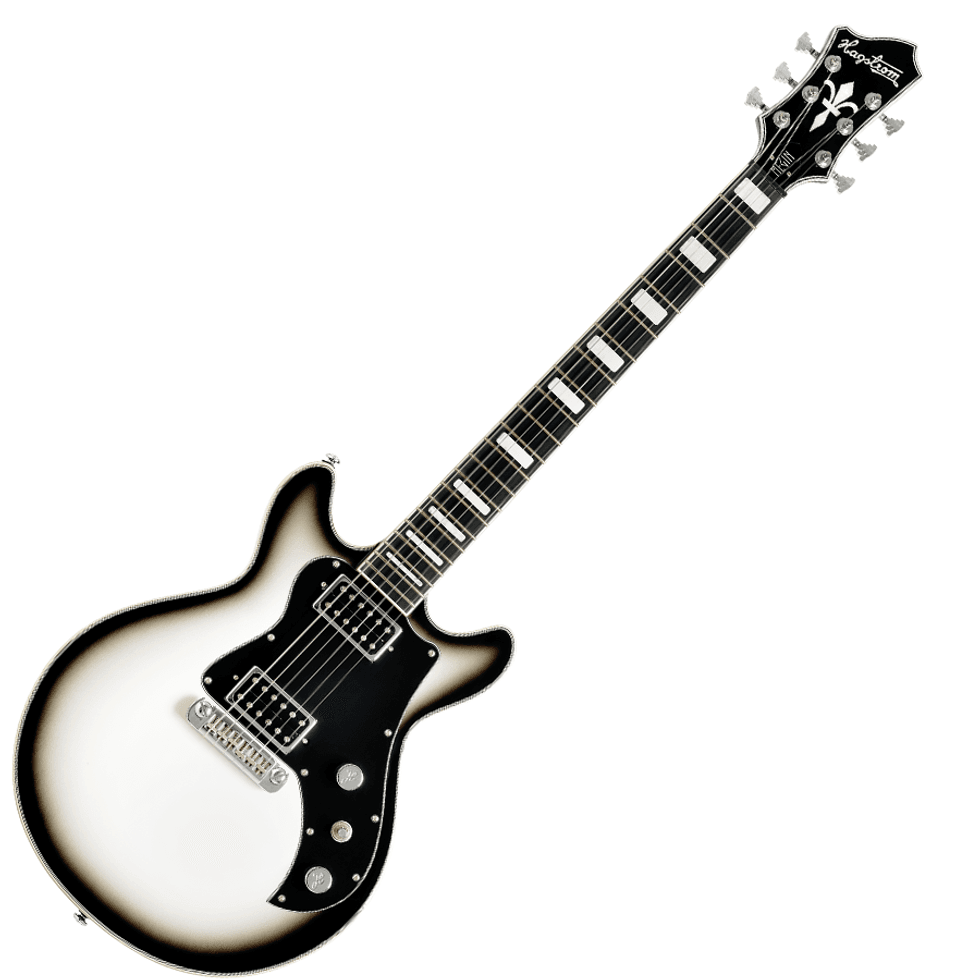
Hagstrom Megin
It’s a double-cut of magic.
Discover a new realm of musical enchantment with the all-new Hagstrom Megin – a guitar that transcends the ordinary and invites you into a world where tone and playability unite perfectly.
In the language of old Norse, “Megin” translates to “Magic,” and this guitar lives up to its name, promising a spellbinding playing experience that captures the essence of enchantment on every stage.
Crafted especially for the modern-day road warrior, the Hagstrom Megin stands as the essence of “bang for the buck,” presenting musicians with the ultimate gigging companion that never compromises quality.
Take it on the road, let it seamlessly become an extension of your musical mastery, and witness the magic unfold in every note.
This extraordinary instrument features a meticulously crafted mahogany long mortise and tenon set neck and a mahogany body, dually delivering a resonance that speaks directly to the soul of your music. Fitted with two powerful Hagstrom Custom 62 humbuckers, the Megin offers a versatile tone that effortlessly adapts to your musical journey, whether it’s weaving sweet melodies or unleashing powerful riffs.
Designed with the touring musician in mind, the Megin is a straightforward powerhouse. Its wrap-around bridge not only enhances sustain and resonance but also channels all that string energy directly back into the instrument, unlocking the magic of its tonal qualities. All that energy contained within the body works as a perfect partner together with our Hagstrom H-Expander truss rod, where that transfer of string energy resonates from the tip of the headstock to the butt of the body to masterfully capture complete resonation throughout the entire instrument. With master volume and tone and 3-way toggle controls, simplicity reigns without sacrificing control on stage or in the studio. This is pure tone, power, and playability – the perfect ally for those who demand reliability on stage.
To heighten the string energy and resonance to the next level, we selected a 25.5” scale length. This intentional decision not only enhances the sustain but also crafts a commanding voice that expresses unmatched clarity and precise pronunciation. Feel free to drop tune effortlessly, unleashing a growl and grunt that will undoubtedly leave your audience in awe.
Step into a world where music transforms into magic. Embrace the enchantment with the Hagstrom Megin – your passport to a sonic realm unlike any other. As always, Hagstrom delivers another masterpiece, ensuring that every chord struck with the Megin resonates with the enticement of true craftsmanship, design, and a pure dedication to the working musician. Welcome to a new era of musical magic.
This Small Amp Sounds HUGE
This dapper 20-watter delivers a full-spectrum sound that starts at jangly chime before its EL84s natrually overdrive into a musical, singing saturation zinging with overtones and sustain.
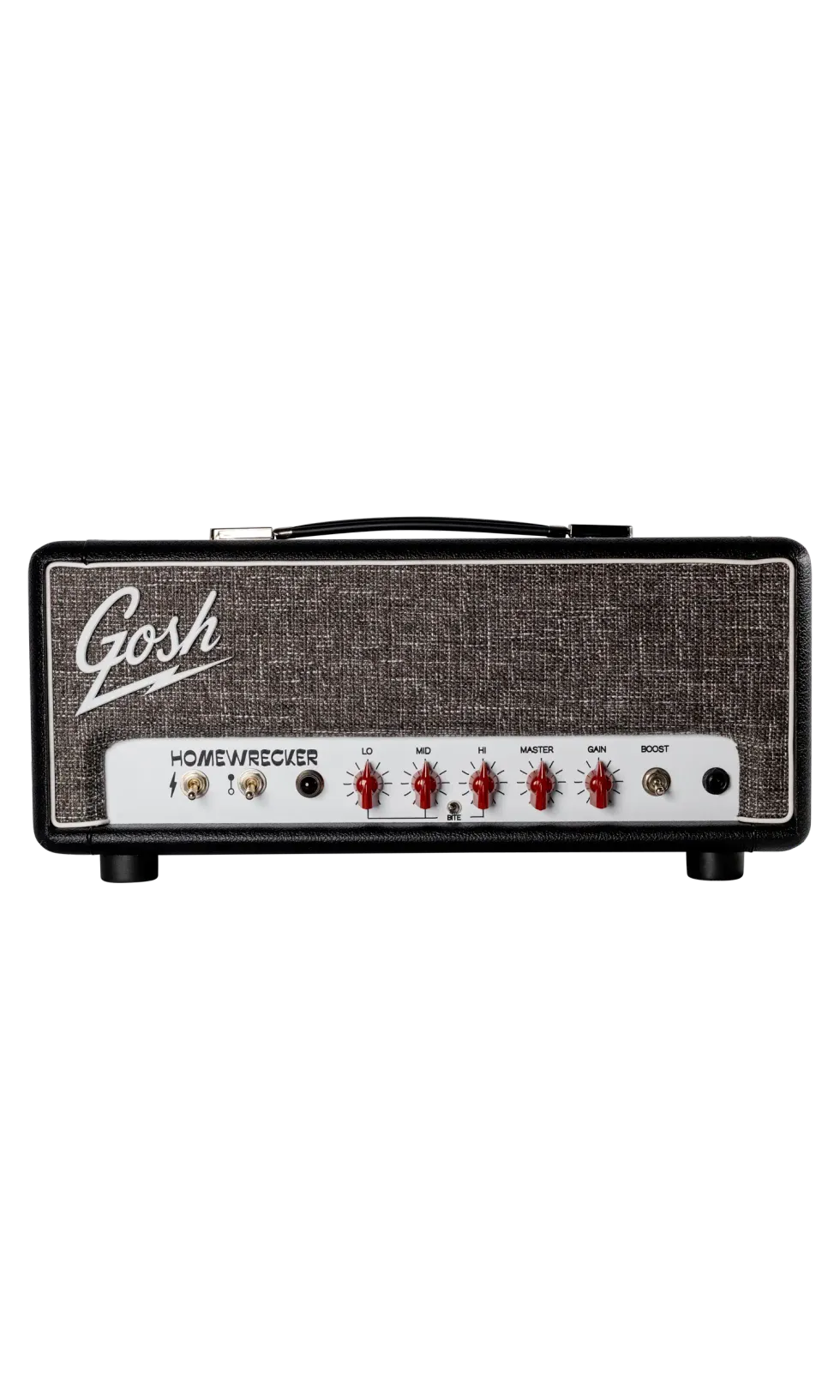
Homewrecker
I originally started experimenting with this circuit over a decade ago while chasing the aggression and harmonic complexity of a cranked vintage British amplifier, but at a volume that actually made sense in the real world. Most high-powered amps sound incredible wide open, but become almost unusable outside of large stages. I wanted something that captured that same energy, compression, and sustain without needing arena-level volume.
The goal became creating an amp that lived right on the edge of saturated and aggressive, while still articulate enough to hear every string inside a chord. I spent years refining the gain and power section so the amp would respond dynamically to pick attack and guitar volume changes instead of simply producing more distortion.
A huge part of the design was the transformers. I worked closely with Brian at Sour Sound to develop custom transformers specifically for this amplifier. Nothing about the power section was off-the-shelf. The transformers were designed around the exact feel, response, and harmonic character I was chasing, and they became a major part of the amp’s larger-than-life voice.
Even though it’s a 20W design, it doesn’t behave like most small amps. It feels bigger than its size, moving from subtle vintage textures to fully saturated overdrive while still retaining clarity and touch sensitivity.
The final design reflects years of refinement, listening, and testing. The 20W became the amp I had been trying to build for years — raw, responsive, and inspiring to play the second you hit the first chord.
A key part of the amp’s character is the custom-tuned smoothing filter in the power section. This helps control harshness while keeping the amp open, punchy, and harmonically rich. The result is an amp that stays aggressive and dynamic without becoming stiff or fatiguing.
The amp also features a Boost switch that adds additional gain, saturation, and low-mid body. It thickens the response and pushes the amp further into rich overdrive while still maintaining clarity and note separation.
The Bite switch is designed to increase perceived gain. It tightens the response, adds edge to the attack, and helps the amp cut through a mix with more aggression and presence without drastically increasing overall volume.
Combined with the custom Sour Sound transformers, the entire amp was voiced to feel bigger, more responsive, and more alive than a typical 20W amplifier. Every feature was designed around touch sensitivity, harmonic detail, and making the amp inspiring to play at any volume."
Features:
• 20 watt all-tube head
• Hand-wired in the USA
• Sour Sound Custom Transformers
• Full-wave rectifier
• Cathode Bias
• 2 x EL84 power tubes
• 2 x 12AX7 preamp tubes
• Bite switch
• Boost Switch
• 4, 8, and 16 ohm impedance
Learn more: https://www.goshsound.com/homewrecker
Acoustic Soundboard: A New Technique From a Romanian Violinist
As anyone who has toiled long enough in any art form can tell you, hitting walls is inevitable, even necessary. They exist to remind us that there’s something on the other side, someplace to go that we haven’t discovered yet. We may not see the way over today, but when we start looking, that’s when new ideas reveal themselves (and not always in a way we can anticipate).
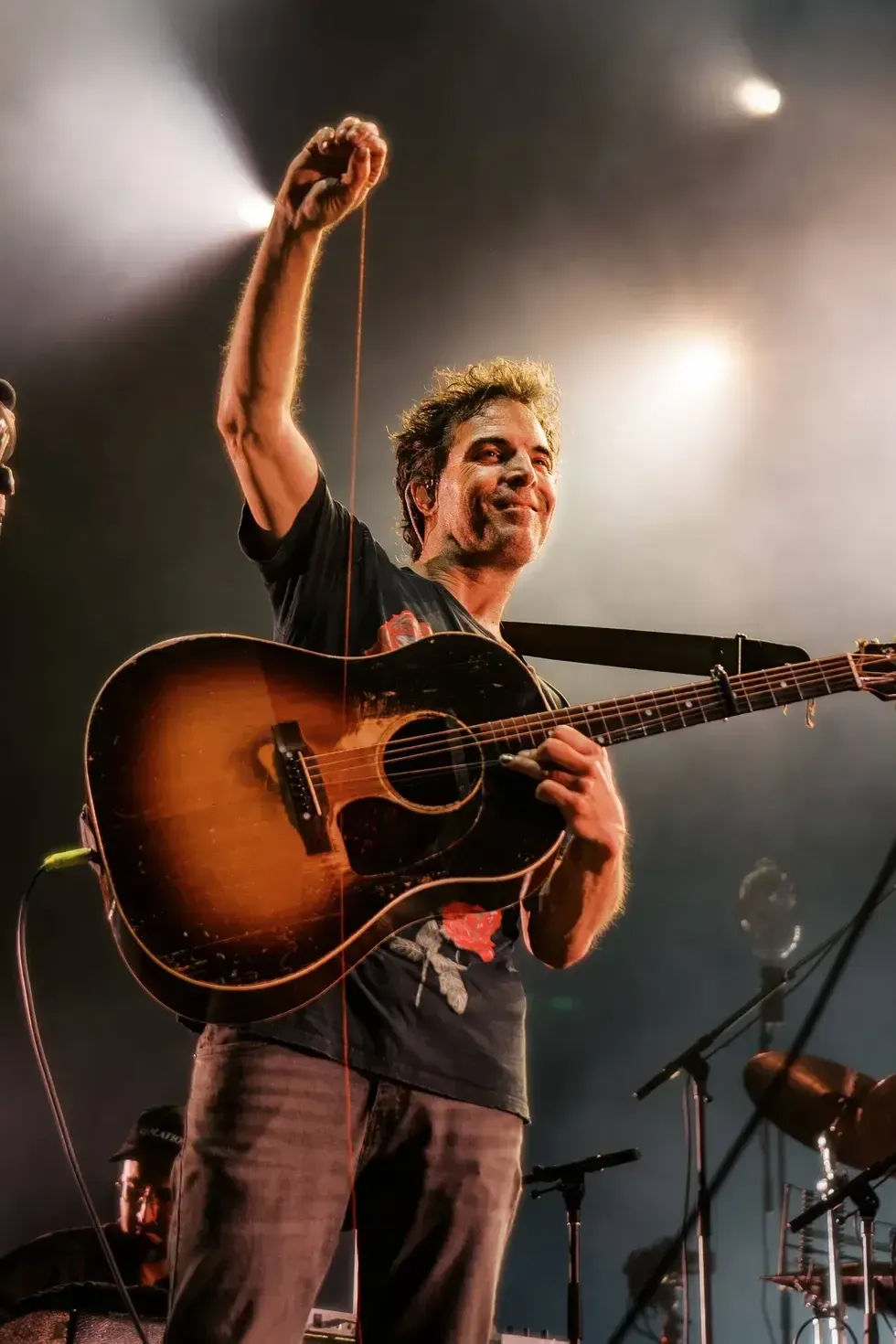
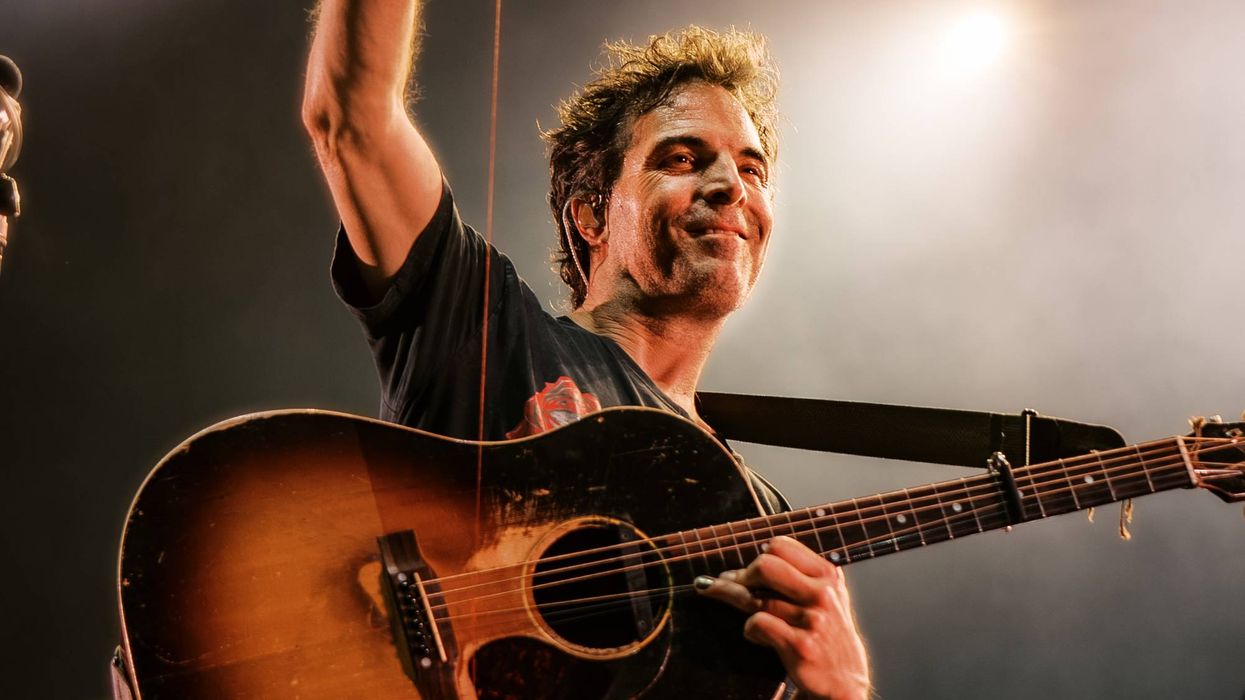
Sometime around 2002, up against such a wall, I was gifted a portal into a new way of approaching the guitar. A friend of mine brought me to see the 1993 Tony Gatliff film Latcho Drom. It follows the path of Roma music as it moves from India and Iran through eastern Europe, eventually landing in Spain, evolving and changing along the way, picking up influences yet retaining its unmistakable signifiers. No talking, no written narrative, just people and music. One scene focuses on an older man standing under a tree with a young boy watching on. The man is Nicolae Neacşu (1924-2002), the great Romanian violinist known for his work with the group Taraf de Haïdouks. As he plays and sings mournfully about the dictator Ceaușescu, he begins to tug on a small piece of string, a horsehair from his violin bow that’s tied on to one of his violin strings. The sound is haunting, complex, simple, earthy, and mystifying. I wanted to run out of the theatre right then, grab a guitar, and try it.
Without a horsehair on hand, and after several attempts with dental floss, cotton thread, and fishing line, I landed on a certain quality of polyester sewing thread that was able to produce a similar effect: cheap, thin, textured, stretchy thread. When I finally got the grip and the right tension, and the first vibrations bounced the sound through my fingers, I felt like I’d been handed a secret technique, like a Japanese hiden—a singular masterstroke.
I’ve spent the last thirty years in pursuit of these connections between the guitar and the natural world. Whether it’s through the raw physics of the instrument, drawing from the sounds of animals, looking to other cultures and their instruments, or finding ways to prepare and effect the guitar to break it open, there is no shortage of discoveries to be made. And this one technique, distilled from Roma ingenuity, has been one of the most curious and most useful. I always have a spool of polyester in my gig case. It takes about 30 seconds to tie it on before a show. I most often tie a strand onto the G string and another onto the D (double knots each), so that two arms-length threads are constantly dangling gently and unobtrusively from about an inch in front of the bridge. (You can pull two strings or more at the same time to create harmony.) I can take them up at any time. By scraping my finger nails down the textured polyester thread, the friction creates a vibration that transfers onto the guitar string. It’s similar to the physics of a cuíca, or the feeling you get when you run scissors down a ribbon to make it curl.
It’s really effective. I most often tie thread onto my 1951 Gibson J-45. There’s a clarity, response, and growl that I get from this instrument that blends well with this technique. I also use it on my ’69 Martin N-10, but because the tension is a bit lower on classical guitars, intonation is less reliable when the thread pulls outward on the nylon strings. At low volume, though, the effect can be sublime. Tied onto an electric guitar and multitracked, a lone producer can emulate an orchestra, creating a more unique sound than using VST. Hit it with distortion, delay, and reverb, and you have the four horses of the apocalypse.
Why not just use a bow? Since guitar bridges, unlike violin bridges, are flat, it’s difficult to bow single-note melodies without hitting multiple strings. This technique produces a similar (if creepier) sound as a bow, but allows the player to focus on a single string.
It’s more complicated to talk about and describe this than it is to just try it. So, give it a shot. Make sure the thread can produce a “zipping” sound when you run your nails down it. That’s the most important thing. The wound strings of the guitar work best as anchors; they lock the thread in place. And you can tie it anywhere along the string horizontally, but the closer you are to the bridge, the clearer and more fundamental tone you get (the further away from the bridge you tie it, the more strange harmonics you get). It’s been a really rewarding way for me to experience another side of the guitar. I hope you get to try it.
MXR Flanger/Doubler Brings Legendary Rack Unit to Your Pedalboard
The MXR Flanger/Doubler recreates the original MXR rack unit in pedal form, capturing those classic all-analog flanger and doubler effects featured on hallmark recordings from the ’70s and ’80s. It’s designed for experimenters, offering the tools to blend and bend your signal into your own rich, multi-layered textures. Built around authentic bucket-brigade devices and the original control set, this pedal delivers the full range of sounds that made the rack unit a studio staple.
 Whether you're chasing the sweeping jet-engine swoosh of the flanger or the thick, doubled-up layering of the doubler, the MXR Flanger/Doubler is equipped with the controls, the CV connectivity, and the visual feedback to take you wherever you want to go.
MXR Flanger/Doubler highlights:
- The renowned rack unit has returned in pedal form
- Authentic all-analog bucket-brigade devices
- Full, original control set shapes tone, range of motion, and sweep rate
- Doubler button switches between classic flanger swoosh and thick doubler chorusing
- Mix knob blends wet and dry signals to taste, from fully dry to fully wet
- Invert switch reverses wet signal polarity for airy, hollow vocality or bold low-mid punch
- Two LEDs track instantaneous delay time for quick adjustments when it’s too loud to rely on just your ear
- CV In and Out jacks connect with synths, sequencers, and CV-capable expression pedals
- Line Level switch ensures optimal performance when working with hot signals
Availability
The MXR Flanger/Doubler is available now at $333.00 street/$475.71 MSRP from select retailers.
“We do not support AI-generated music, and our process will reflect that going forward”: D’Addario admits it used AI-generated music in promotional campaign

Last month, a promotional clip for D’Addario’s new NYXL HD electric guitar strings got a lot more attention than the brand had anticipated. The reason? Keen-eared listeners suspected that AI-generated music was included in the promo – an allegation that D’Addario adamantly denied.
However, the company has now edited its previous denial and admitted that it did use AI. Specifically, D’Addario has confirmed that it used Suno Studio to “regenerate the original track” that had been recorded for the promotional video.
“We got this wrong,” the new statement says. “We’ve completed a full review and confirmed that Suno Studio was used to regenerate the original track. We shared inaccurate information, and we’re truly sorry.”
“Music is made by people-their ears, hands, taste, and emotions,” it continues. “D’Addario exists to give artists the tools to shape their own sound, not to blur the line between human creativity and AI-generated content.”
While nobody is thrown under the bus, the statement implies that, somewhere along the line, someone used AI without D’Addario’s approval. “We do not support AI-generated music, and our process will reflect that going forward,” the company writes. “We’ll require our employees and creative partners to disclose any use of generative AI, and we’ll more closely review everything we put into the world.”
The unfortunate reveal comes after pushback from countless commenters and YouTubers, all suspicious of D’Addario using AI-generated music. At first, the company defended itself in a statement to Guitar World by saying that the demo music was just “over-produced” and that including the demo in a “fully produced mix” was a decision that had “backfired”.
D’Addario also shared behind-the-scenes clips of recording sessions for the track, as well as explaining in a since-deleted post: “[This track] was not created by AI. All guitars were tracked in real-life, drums and synths were MIDI programmed, plus a whole lot of plug-ins and production.”
The company even insisted that it was “a music company, built by musicians for musicians,” and therefore “naturally, [shared] the growing alarm that generative AI can remove the musician from the creative process.”
“Remember, we are a company whose products can only be used by people. If AI replaces musicians making music, then we’re out of business. Of course, that’s nothing compared to the chilling thought of musical expression being co-opted by machines. As a company made of hundreds of people, we desperately want to preserve human expression through music.”
Given the truth, these words seem very ironic… especially considering the company used Suno. When it comes to preserving human creativity, Suno in particular has faced a lot of backlash for allegedly using copyrighted music for its AI training. Just last month, German courts officially ruled that Suno had violated copyright laws.
Moving forward, D’Addario is keen to prove that it does genuinely believe in human-made music. “We know we can’t fix this with another statement,” the company concludes in its latest statement. “D’Addario exists because musicians trust our products with their sound, and we’re committed to earning that same trust in how we show up for this community.”
The post “We do not support AI-generated music, and our process will reflect that going forward”: D’Addario admits it used AI-generated music in promotional campaign appeared first on Guitar.com | All Things Guitar.
Foo Fighters fan? Right now you can get Dave Grohl’s signature Epiphone DG-335 at $500 off
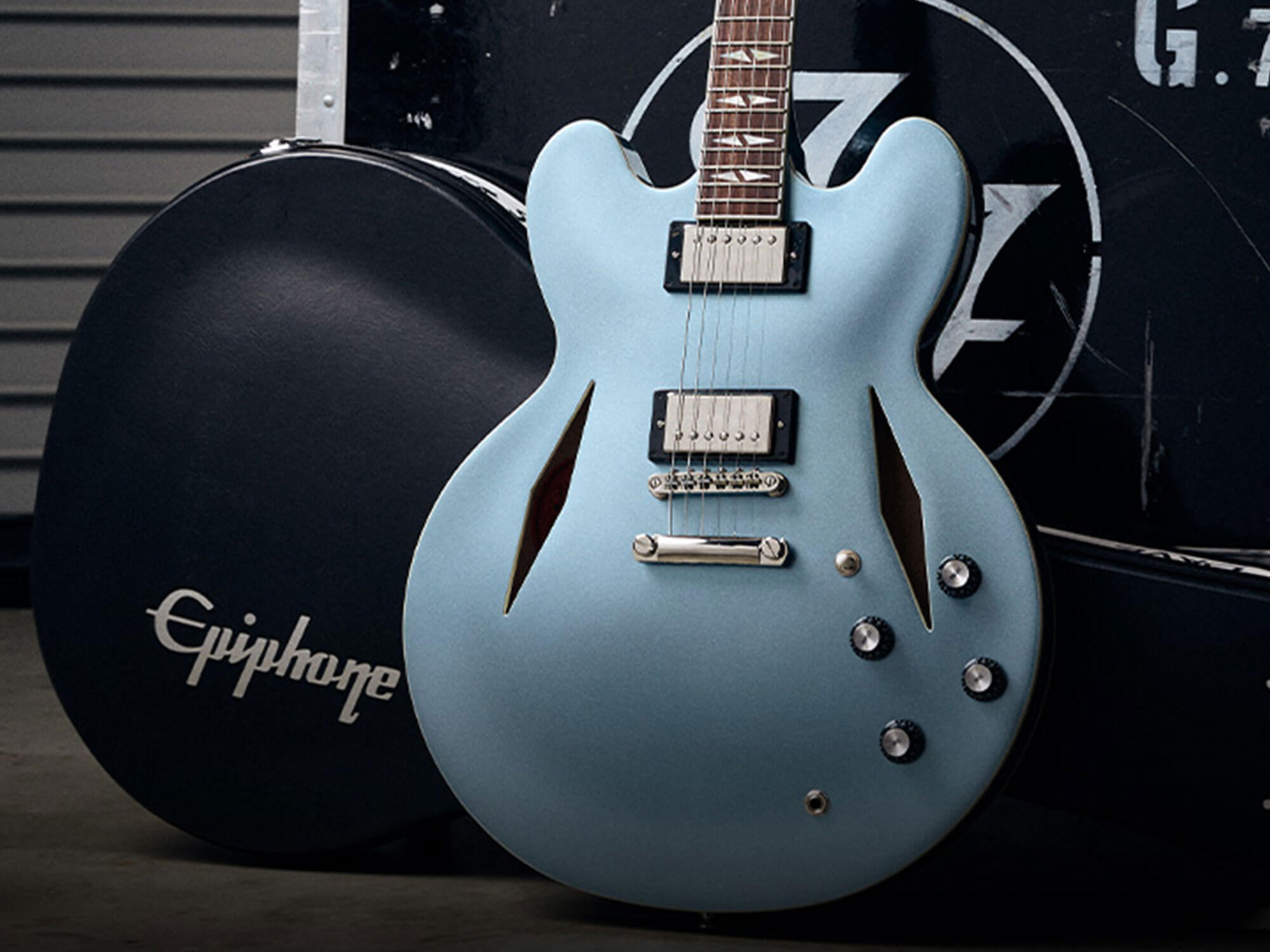
It’s not often a deal comes along where you can save half a grand on a guitar, but at Sweetwater and zZounds right now you can grab the Epiphone Dave Grohl DG-335 signature model with $500 off.
Now reduced to to $799, this Epiphone version of Grohl’s Gibson signature model launched in March 2024 after continued requests from Foo Fighters fans for more than a decade. An initial teaser post from Epiphone on social media showed a graphic resembling the diamond-shaped soundholes in Grohl’s Gibson signature model.
This Epiphone version is still premium-grade despite being a more affordable option. It comes in Pelham Blue (of course), and offers a resonant laminated maple body, Trini Lopez–inspired bound diamond-shaped soundholes, and a one-piece mahogany neck with a laurel fingerboard that hosts split-diamond mother-of-pearl inlays.
Up top there’s a Firebird-style headstock equipped with Grover Mini Rotomatic tuners, complementing the LockTone ABR bridge, and tone is powered by a pair of Gibson USA Burstbucker pickups. Sweetwater says these pickups offer “a rich, expressive, and remarkably dynamic humbucking roar”.
At the time of its launch, Epiphone said: “Dave Grohl is an alternative rock legend who needs no introduction. A longtime Gibson user, his previous Gibson signature guitars have remained extraordinarily popular and command premium prices on the used market – when you can find one.”
Grohl recently spoke of the Foo Fighters’ creative dynamic, stating they still make music like a band in a garage. Speaking to Radio X’s John Kennedy about their latest album Your Favorite Toy, the frontman explained that despite decades of success, the group’s creative process hasn’t strayed far from their roots.
“The way we function as a band… I know that all of this is much different than it was when we were young and playing in bands in a garage, but we still function like a band that plays in a fucking garage,” he said. “It’s the same thing! It’s like, ‘Hey, I’ve got a riff,’ and we show it to everybody.
“Maybe people would imagine that we’re a lot more professional than we actually are, but really the way that we function… it’s really similar to [Dave’s previous punk band] Scream.”
The post Foo Fighters fan? Right now you can get Dave Grohl’s signature Epiphone DG-335 at $500 off appeared first on Guitar.com | All Things Guitar.
What self-taught emo-folk guitarist Truman Sinclair learned from years as studio engineer to Grammy-winning producer

“I find it really hard to write on anything other than a guitar,” begins Truman Sinclair. “I am so inspired by it,” the self-taught emo-folk songwriter continues. “I think about it all the time.”
In fact, ever since he was a child growing up in Chicago, playing guitar was what he enjoyed most. “I’ve always been a fidgety kid and my fidget obsession was the guitar,” he reflects. “I would fiddle with it all the time learning tricks.”
Watching his brother play and having lessons from a friend helped him fall in love with the instrument from the age of eight. “He was really young when he was hammering around the G chord on a nylon string guitar,” Truman recalls. Picking the same one up soon after, his brother taught him the riff to Roy Orbison’s Oh, Pretty Woman.
“I was sold,” enthuses Truman, who grew up on his dad’s love of Bruce Springsteen, Nirvana and AC/DC’s “crazy and epic” Hells Bells before discovering metal bands like Slipknot, Metallica, Beartooth and Attack Attack! during middle school.
Truman’s taste changed, quite dramatically, when he moved to Laurel Canyon at 14-years-old and started going to high school in Los Angeles. “It was a total culture shock because I was used to playing Mario in basements in the Midwest,” he laughs, adding that being in a “massive city where everybody felt so much older than me” made making friends tricky.
He wasn’t too bothered, however, as much of his time after school was spent playing guitar (instead of doing homework) and walking around listening to music that had been made in the area, particularly folk songwriters James Taylor, Neil Young and Joni Mitchell. “Anytime you’re where something historical has happened, it can be really inspiring and I’ve always found that to be very powerful,” Truman says.
 Image: Press
New Noise
Being in a new place altered his approach to the guitar too. “It made me want to play some simple chords, because until then I was really focused on being the gnarliest shredder in town,” he recalls, adding that he tried to write “honest” songs when he turned 16. His limited life experience at that time made this difficult, so Truman started to make instrumental math-rock on his computer.
As his teenage years progressed, he played with the alternative act Fat, Evil Children, and later founded the beloved emo outfit Frat Mouse. Truman even produced four of the latter band’s albums from his bedroom. “It was as simple as it gets,” he reflects, adding that he already knew how to record sample drums. Using a laptop, a Focusrite Scarlett 2i2, mic, stand and Vox AC15 amp (which he still uses daily) he “tried to make the songs awesome”.
Learning how to record guitar educated Truman from a technical standpoint, he considers. “I would try the verse riff 100 times, and that would make me a lot better, because then I could play and listen to it and decide if it was good enough.” His attitude towards the instrument also evolved: “it’s deeper than just the guitar, it’s the spirit you put into it, what you’re trying to do, why you’re trying to do it, and how it makes you feel”.
With his passion abundantly clear, Truman decided to study music production at the University of Southern California. To increase his experience, he set out to work at a studio. Thankfully, Truman met Grammy-winning producer Dave Sardy who, having worked with Oasis and Johnny Cash, gave him a great opportunity. “He said ‘you can be the runner, but it’s on you’,” Truman recalls, describing Sardy as a “really tough, old school” boss. “He’d say ‘if I tell you to do something, don’t ask me, just go figure out how to do it and come back with it done’.”
 Image: Frank Lookinland
The Real Deal
As Sardy’s assistant audio engineer and producer, the first band Truman worked with was Modest Mouse. “I was really scared because I love them but they were very kind to me.” Social Distortion visited the studio soon after: “Mike Ness brought upwards of 45 ‘70s gold top Les Pauls in a vault”, Truman beams, adding that it was “so crazy” to unload them.
Having previously spent his spare time scrolling Reverb.com, Truman was living his “guitar dream”. Instead of looking online at all the different ones that exist, he was playing “priceless” guitars on a daily basis. “It’s like a museum,” he says. “He’s got everything, and he’s one of those dudes who genuinely has a real appreciation for gear, vintage and new.”
Witnessing Sardy at work was hugely inspiring, especially because “everything he makes is handmade; that dude can make a G chord sound better than anybody else on the planet”. This, perhaps unsurprisingly, is exactly what Truman now aspires to: “I’ve always been into making a bass drum guitar mix sound insane, and he’s the master.”
Despite their contrasting profiles, Truman found the similarities between his and Sardy’s processes particularly interesting, especially because of their different set ups. “I realised that what we do is largely the same, but being in a studio requires so much work to keep that sacred bubble working,” he ponders, drawing a comparison of when he’s in his own room working on songs. “No-one wants to bother me, I sit and record on my Nash-S57, sing into my microphone and use a little drum machine,” Truman shares of his creative process.
“I just do my thing, but when you’re a massive artist and you go into a studio, everybody wants to bother you. There are a million things you could do, and you’re all stressed out,” he suggests. Truman is keen to make clear that this wasn’t a problem for artists and bands who passed through Sardy’s studio while he was there: “he’s been able to create a space where they feel like they’re in a room and can just play.”
 Image: Ryan Gomez
Shifting Perspectives
Immersing himself in such an environment altered Truman’s perspective on the guitar even more: “I used to think that gear didn’t matter and that it was more about how you play.” While Truman still thinks this is true, he learned that every guitar sounds different, especially in terms of tone and tuning. “I found that, largely, what people want is what I had in my room — freedom. It all comes back to the simple stuff and the music, how something sounds; half the time, these big artists aren’t using the most expensive thing, they’re using the thing that is in tune, solid and sounds great.”
Subconsciously undergoing “exposure therapy”, as Truman describes it, impacted his own approach to songwriting. “It made me relax and use the gear that’s around because, at the end of the day, they’re all like tools.” Watching some of his favourite songs being made in Sardy’s studio on “the simplest thing” inspired him to pick up his acoustic guitar and “know that I wasn’t really missing anything and that I could do it all here in this very confined world,” he suggests.
“Because the music that I love is pretty simple but sounds awesome, the majority of my songs are no more than four chords,” Truman says, adding that his main focus is the melody and rhythm. To this end, he feels that his music “comes from a very free and fun place”. Maintaining this ethos requires him “having control over it”, so much so that he wrote, produced and recorded all the songs on his 2025 EP American Recordings. “I think I’m a bit of a control freak, which I’ve never admitted,” he laughs, “but it’s a valiant reason of mine. I think there’s something about doing it yourself that keeps it real and natural.”
In a similar vein, Truman is particularly passionate about being able to make the music that he wants to make. “I’m always worried about having it not be mine, so it’s for me,” he attests. “I am very aware that no one wants me to make anything that I think they want to hear,” he considers. “I can’t guess what somebody likes. I just have to make what I think is fucking sick and if I’m making something in my room that I think is cool then that’s good enough for me.”
Despite now being a solo artist, Truman plays with a band. “I don’t think I would feel like myself if I wasn’t doing that,” he says, having recently supported Courtney Barnett on a two-month tour. “Playing music loud in a group is one of the many fruits of life, so I’ll always do that,” he continues.
While it’s a different experience, Truman loves performing solo, on his acoustic guitar, too. “It feels like you can really drive everything. You’re making split-second decisions,” he adds. “Any choice you think of, you can just do it and then see what happens. There’s a freedom that’s super fun and addicting, but at the same time playing with the band is so powerful,” he considers. “There’s something really special about figuring out an arrangement with your band that you all know and love and are tweaking slightly every night. That’s its own thing, so I feel really happy to be doing both.”
Truman’s new single 4th of July is out now
The post What self-taught emo-folk guitarist Truman Sinclair learned from years as studio engineer to Grammy-winning producer appeared first on Guitar.com | All Things Guitar.
Podcast 559: Maisy Owen
Nashville-based singer-songwriter Maisy Owen joins us this week to talk about her gorgeous debut album, Dark on a Sunny Day (Tompkins Square).
Maisy talks about her music-filled upbringing (her dad is songwriter Gwil Owen; radio programming legend Rob Bleetstein is a family friend); her decision to take up the guitar; unlikely jobs (and songwriting sessions); her newfound love for British folk and so much more. Maisy also performed some songs while visiting us, available on our YouTube channel.
We are brought to you by Peghead Nation: https://www.pegheadnation.com
(Get your first month free or $20 off any annual subscription with the promo code FRETBOARD at checkout).
Mike & Mike’s Guitar Bar: https://mmguitarbar.com


The post Podcast 559: Maisy Owen first appeared on Fretboard Journal.
Floyd Rose Unveils Limited Edition Etched Paisley USA Series Tremolo
Floyd Rose has introduced a Limited Edition Laser-Etched Paisley USA Series Original Tremolo, an exclusive release that adorns the iconic double-locking tremolo with an eye-catching, timeless design.
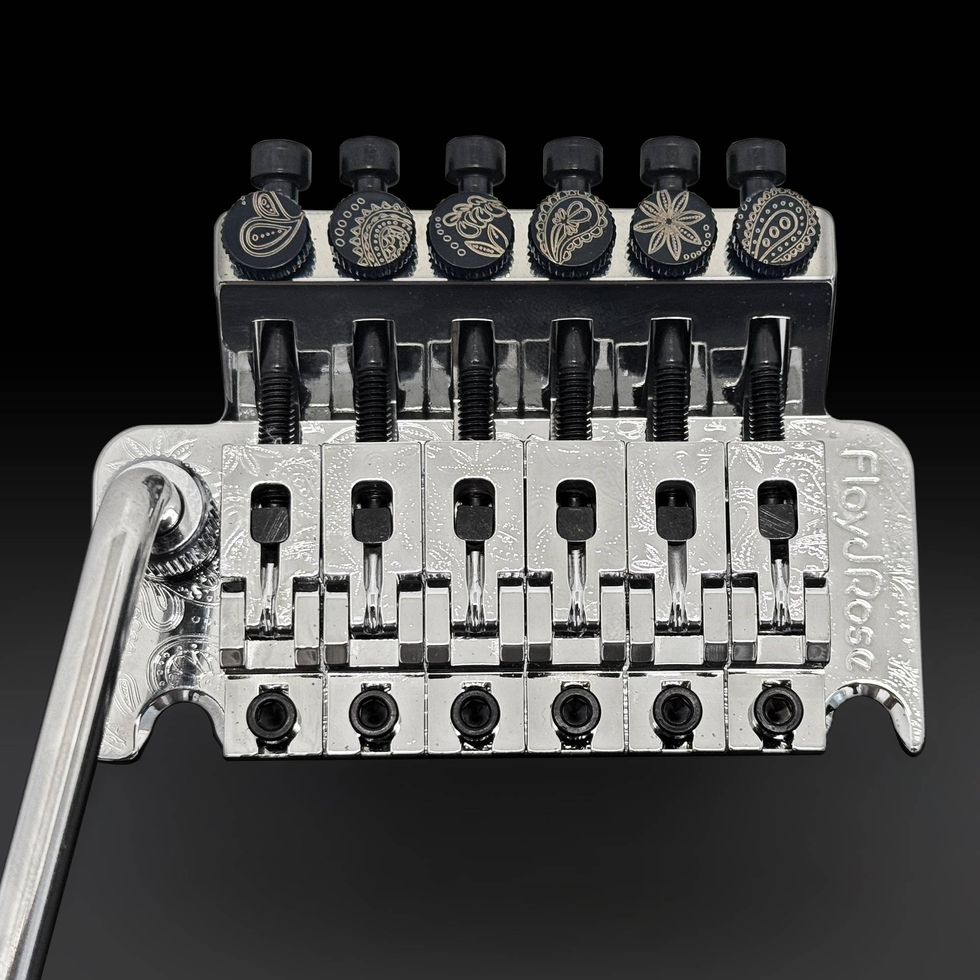
Each limited edition Paisley Tremolo begins as a genuine chrome USA Series Original before receiving a precision laser-etched paisley pattern across the hardened steel base plate, saddles, and fine tuners. The result is a strikingly unique interpretation of the classic Floyd Rose look, combining vintage-inspired style with modern manufacturing precision.
More than just a finish, the etching creates a subtle, understated look that catches the light from every angle while revealing incredible detail. Inspired by the classic paisley motifs that have graced iconic guitars for decades, it brings a fresh take to the legendary Floyd Rose Original.
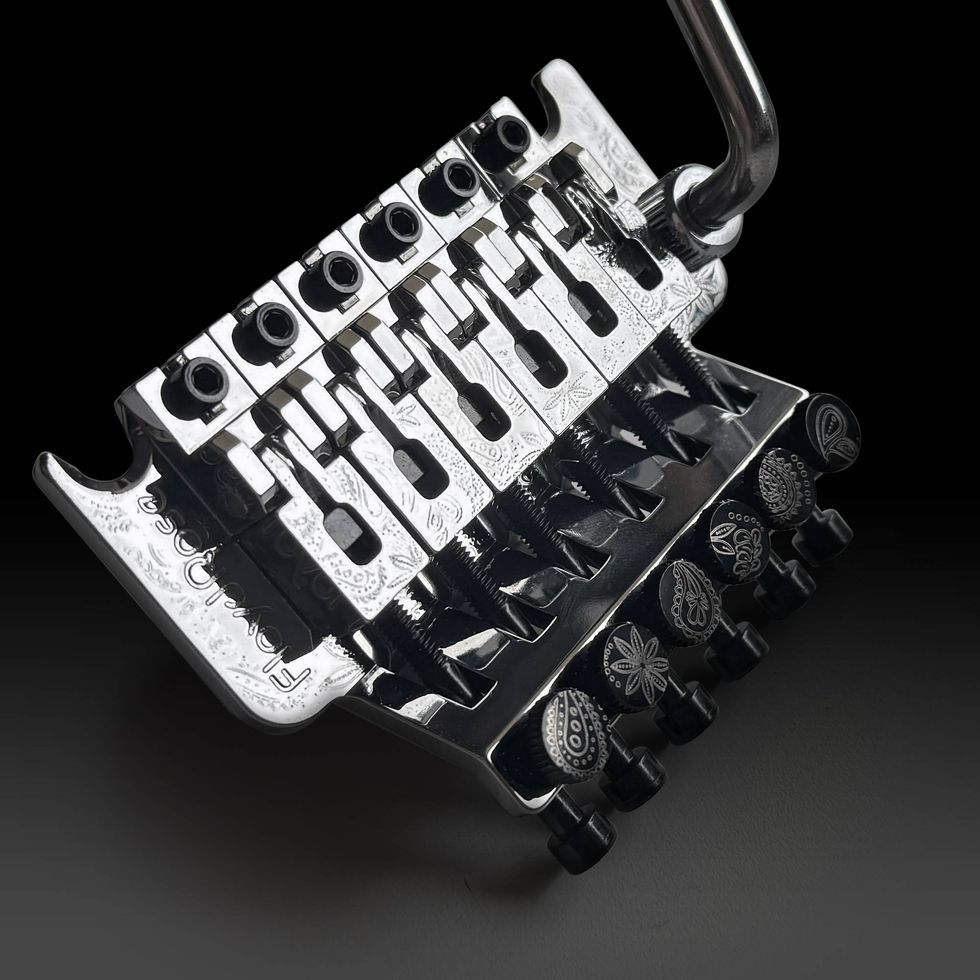
Each unit is built with precision machining and premium materials, so the Etched Paisley Original Tremolo delivers the tuning stability and professional performance musicians expect from a genuine Floyd Rose.
With only 50 pieces available worldwide, the Limited Edition Paisley USA Series Original Tremolo carries a $355 street price. For more information visit FloydRose.com.
“We were just us and and we really stuck out”: Lost Slash interview shows how Guns N’ Roses were always outsiders in the LA scene
![[L-R] Izzy Stradlin and Slash of Guns N' Roses](https://guitar.com/wp-content/uploads/2026/08/Slash-Izzy-Stradlin-hero@2000x1500.jpg)
In a newly unearthed interview given in 1987, Slash comments on how Guns N’ Roses were outsiders to the LA scene during the early days.
Slash and Izzy Stradlin were being interviewed about the band’s at-the-time upcoming tour with Mötley Crüe. The interviewer asked the pair: “Do you feel that you actually fit in to the Los Angeles scene and are you happy out there?”
Slash replies: “Not anymore. We didn’t fit in when the band first started. We didn’t fit in ever. It was always like, there was LA and then there were the five of us crawling around in the dark. In Los Angeles, Los Angeles is like one of those places that like any other big city but even more so. It’s real trendy and it goes through fads and it goes through other stuff.”
The legendary guitarist also adds that they managed to stand out because they did not give into expectations of fad and trend. “And so it was always real hard to say ‘We’re an LA band’ because LA bands always meant this one little band for one particular time that everyone was into because it was a particular fad,” he says.
“We were never like that. We were just us and we really stuck out compared to everything else. I’m really surprised we went to become as big as we did but it’s just because we were really real and people pick up on that no matter how goofy they are.”
He adds that the Axl Rose-fronted group had set a precedent for other bands to “give it a shot and to really go for it. Because maybe at a particular time it wasn’t happening.”
Stradlin adds that music had gotten “into more of a groove” and at one time it was “just a lot of noise going on. It’s 12 million people and 6 million are musicians, it’s every type of music you can imagine.”
The post “We were just us and and we really stuck out”: Lost Slash interview shows how Guns N’ Roses were always outsiders in the LA scene appeared first on Guitar.com | All Things Guitar.
“It scared the s**t out of you”: Pepper Keenan explains what happened when he played through AC/DC’s “insane” guitar rig
![[L-R] Pepper Keenan and Malcolm Young](https://guitar.com/wp-content/uploads/2026/08/Pepper-Malcolm-hero@2000x1500.jpg)
Pepper Keenan had the chance to play out of one of the most legendary guitar rigs in the game thanks to a former guitar tech.
The Corrosion of Conformity member says he played through AC/DC legend Malcolm Young’s guitar rig, courtesy of his former guitar tech.
Keenan tells Chris Garza on the Garza Podcast: “My old guitar tech, Takumi, he worked for White Zombie and then he jumped to COC [Corrosion of Conformity] when COC had the Metallica tour and for all those years needed a real guitar tech.
“Takumi was great, we were on tour with Metallica doing the big, giant shows. Me and Takumi were so tight we roomed together on tour… We were just super buddies and stuff.
“One day he came to me on the Metallica/COC tour and said, ‘Pepper, I’ve been offered another gig.’ I was like, we’re on tour with Metallica. Who could it possibly be? He said ‘Prince.’”
While Keenan understood the offer and Takumi later worked with Prince “for years”, his former touring bunk buddy did later get him the chance to use the Malcolm Young’s AC/DC rig.
Keenan explains: “He did that and then he ended up working for AC/DC. He called me up and I went to a show. Down actually played with AC/DC in Transylvania, but yes, I got to play Malcolm’s rig.
“It’s Marshall’s improper bias that is microphonic, like hot, insane, and they’re all on. It scared the shit out of me. It’s just volume. No overdrive. Just volume. He has no pedals.
“He’s got this big rack for guitars and there’s two of them in there. There’s a glitter one, and then there’s The Beast.”
The post “It scared the s**t out of you”: Pepper Keenan explains what happened when he played through AC/DC’s “insane” guitar rig appeared first on Guitar.com | All Things Guitar.
We said this guitar might be the best PRS SE model yet – now it’s discounted at Sweetwater

If you’ve ever pondered trying out PRS’ take on a T-style guitar, then look no further than Sweetwater – right now, you can save $70 the PRS SE NF 53.
Now priced at $979, this quirky model is quite the investment. It has a unique White Doghair finish (visible wood grain), and comes fitted with PRS’ Narrowfield DD pickups, capturing the peak characteristics of a humbucker, a P-90, a traditional single-coil, and a mini humbucker, merging them into a distinctive voice of its own.
The launch of this SE version followed on from the release of the standard NF 53 and its Kennedy signature sibling back in 2023. PRS later revealed that the guitars were the brand’s top two best-selling USA guitars in that same year. We reviewed this SE version of the guitar last year, and noted that despite it being seen as a “T-type” guitar, it is entirely its own thing.
Guitar.com writer Eric Dahl said, “These Deep Dish pickups have a sound that’s very much their own, but that’s no bad thing at all – if pushed I’d say they sit somewhere between P-90s and mini-humbuckers. In practice, it gives you a very full tonality played cleanly, but adding some gain is where this guitar really comes into its own.”
Aside from its unusual looks and peculiar pickups, other key features of the guitar include a swamp ash body, a maple neck and fingerboard, and an NF 53-profile neck for speed and control. Its sculpted contouring allows for access to all 22 frets across its 10” radius fingerboard.
In other PRS news, the company appointed a CEO for the first time in its history just last month: Jack Higginbotham, formerly the guitar giant’s Chief Operating Officer. Higginbotham will oversee day-to-day business operations while its founder and Managing General Partner, Paul Reed Smith, continues to lead guitar development.
To check out this deal and more, head over to Sweetwater.
The post We said this guitar might be the best PRS SE model yet – now it’s discounted at Sweetwater appeared first on Guitar.com | All Things Guitar.
Joe Bonamassa calls out the guitar community’s “armchair quarterbacks”

Joe Bonamassa has criticised “armchair quarterbacks” for damaging guitar culture.
The blues hero believes those most critical of guitar players ought to pick up an instrument and play rather than put down those who are hard at work.
In a recent interview with Guitar Interactive Magazine [via Guitar World], he explains: “In the US, we have this term called ‘armchair quarterback’, right? I could sit in my chair and say to Tom Brady, ‘I could have thrown that ball better than you.’ No, you can’t.”
Bonamassa, a blues veteran who has opened on numerous occasions for BB King, says there needs to be more empathy – not judgement – when it comes to live performers. He points to a viral incident from the ACM Country Awards in 2016, in which Nick Jonas messed up a guitar solo, only for it to be immortalised on camera. The incident was so traumatic for Jonas that it sent him to therapy.
“That one that caused this guy to go into therapy,” says 49-year-old guitarist Joe Bonamassa. “We’ve all done that. Everybody’s done that.
“You know, like, ‘I didn’t even know what I was thinking!’ But the vitriol. What do you want him to do? Burn his guitar in effigy? Like, jump off a cliff? The guy had to go to therapy! What’s wrong with people?”
“Kenny Wayne Shepherd and I have been on stage a lot together, the last five, six years. It’s not a competition. We don’t look at it like that,” he continues. “Warren Haynes and I, we’re on stage a lot. We’re having fun.
“But what do they expect? A trophy at the end? A cash prize? A judge that goes, ‘I declare the winner!’ like a fucking boxing match.”
Bonamassa is set to tour across North America and Europe this year, with dates scheduled for Radio City Music Hall in New York City on October 1, and at the Uber Arena in Berlin, Germany, on October 30. He will return to Germany next year for the Tollwood Summer Festival in July.
See his official website for a full list of upcoming dates.
The post Joe Bonamassa calls out the guitar community’s “armchair quarterbacks” appeared first on Guitar.com | All Things Guitar.
On the Bench: A 1965 Fender Twin Reverb
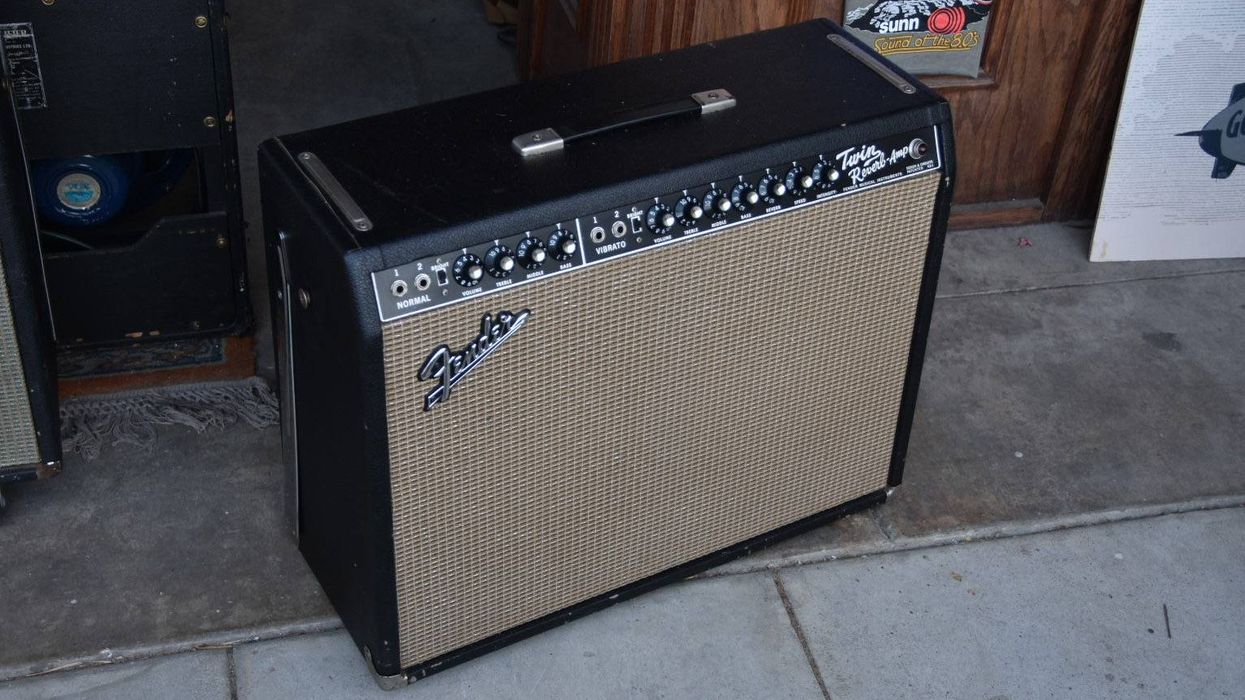
When Fender launched the Twin Reverb in 1963, the music world was blessed with a high-powered, reverb and vibrato-equipped tube amplifier that would become a staple for performing bands. The tweed Twin amps of the decade prior featured totally different circuitry, with lower output power and more grit than we hear from the crystal-clear Twin Reverbs of the ’60s and ’70s. After 1963, spotting a Fender Twin Reverb in a band’s backline became commonplace.
On the bench today we have a 1965 Fender Twin Reverb. The amp was brought to me by a client who described this one as his “daily driver.” This is the case for many musicians who don’t mind lugging around the 65-pound combo. The Twin Reverb’s power and clarity makes it a perfect pedal platform, and its durability makes it the perfect workhorse amplifier.
The main complaint was noise issues, including very scratchy controls. Once I removed the chassis, I was thrilled to see that the amp was almost totally original! The fact that this amp has been heavily used with its 60-year-old parts is a testament to the quality of the components and the circuit design. The filter capacitors were beginning to bulge and leak, so the owner and I decided it was time to give the amp a solid refurbishing to promote stability for future decades of use.
Each technician has their own method of refurbishing a Fender amplifier. Determining how far to go with a restoration is a delicate dance between reliability and originality. I want to repair the issues at hand, while also addressing the parts of the circuit that are prone to issues. In many cases, the bulk of the restoration focuses on the power supply and power amplifier. These sections of the circuit are handling a lot of power and high voltages, and over time they just wear out. Oftentimes, the tone-shaping components in the preamp are able to stay original.
Once I replaced the filter capacitors with high quality F&Ts, I moved on to the cathode bypass capacitors. These caps were also beginning to show signs of weakness, and I typically find myself replacing these in most of my Fender restorations. The last capacitor that I like to replace is the bias capacitor, which is in charge of filtering the negative bias voltage for the output tubes.
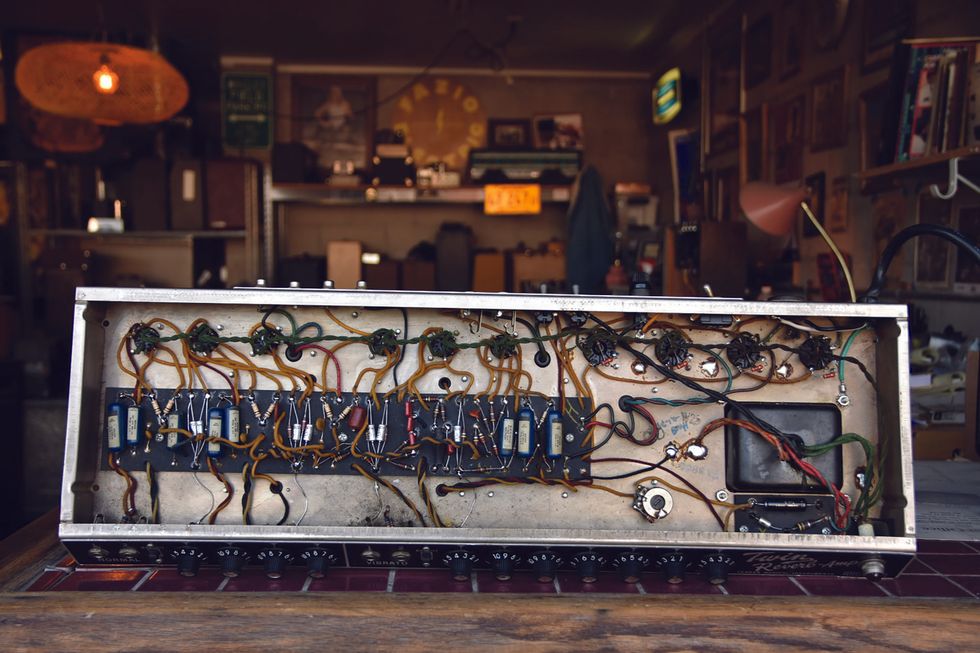
In most amps and many other consumer electronics made before the ’70s, the resistors used are called carbon composition resistors. These are small brown resistors that are made out of finely ground carbon, and mixed with a non-conductive binder. When serving as a preamp plate resistor, these small components have an important job. The plate resistors are connected to the power supply, and feed high voltage to the preamp tube plates. Once the signal is amplified through the preamp tube, that signal exits the tube through the tube’s plate and onto the rest of the circuit. In short, these preamp plate resistors see both high voltage DC and the AC guitar signal. Over time, it is common for the internals of the resistor to break down, which can impart some very noticeable popping and crackling into the signal path.
The last step is to address the vibrato effect. The funny thing is, Fender used the term vibrato but the effect is actually tremolo. In my initial testing of the amp, I noticed that while the effect was functioning, it was a bit weak overall. This is typically due to the oscillator capacitors drifting from spec over time, which can weaken the depth of the volume fluctuation. In this case, replacing the three oscillator capacitors helped get that “vibrato” stronger.
After a deep cleaning of all the pots, jacks, and tube sockets, I ran the amp to listen for any other miscellaneous issues. Many of the tubes in this amp are a variety of vintage tubes, and they passed testing with no noise, excessive microphonics, or overheating issues. Modern tubes are great, and we’re so lucky to have access to them. But I’m always excited to be able to leave in the old tubes, as the quality of manufacturing from decades prior and the mystical “mojo” of the old glass bottles tends to be desired.
The last step in a large refurbish job like this is to play through the amp for a while. I will wiggle the reverb RCA cables to make sure there is no cut-out, test the footswitch, and poke around to make sure I didn’t miss any poor connections or weakened solder points. The Twin Reverb truly lives up to its reputation. It is loud and proud, full-bodied and crystal clear.
Buzzing Bugs Bolster review – is this the ultimate dual fuzz pedal?

£179, buzzingbugsfx.com
If you name a fuzz pedal after an evil scary giant, it’d better be pretty frickin’ fearsome. To that end, the Buzzing Bugs Bolster has been designed with a scorching high-gain circuit on one side… and an even more scorching one on the other.
- READ MORE: Teaching Machines FuzzBillion review: is this the most ambitious and unique dirt pedal ever made?
The giant in question is a figure of Cornish legend – and that’s no coincidence, because the UK’s southernmost county is where this smart-looking pedal is made. But while the original Bolster apparently terrorised villages, ate children and was very inconsiderate to his wife, this one only wants to spook your eardrums.
 Image: Richard Purvis
What is it?
I spent a good half-hour noodling away with the Bolster before I realised something quite important: the ‘more’ side isn’t just an extra dose of gain to add to the main business on the right, but a whole separate fuzz circuit in itself. So this is a classic double stomper, offering instant access to two individual sounds plus an apocalyptic ‘both’ option.
The right-hand fuzz is a silicon transistor type, with controls for gain, tone, output level, volts (for bias-tampering effects) and shift (for thinning out the bass at the input stage). The left channel skips all of that and keeps things simple with a single level knob for its extra-feisty op-amp fuzz. This could get brutal.
 Image: Richard Purvis
Sounds
“Could get brutal”? It starts brutal! The right-hand channel is up first, and it’s a blast. Keep the volts knob set at noon for normal biasing, and what comes out is the very nicest kind of thick, smooth, aggressive fuzz, with a good balance between body and clarity.
If you want to change that balance, you have two options. Turning down the shift knob brings a leaner, more focused sound – a great match for humbuckers that are at risk of succumbing to flub – while the standard tone control turns out to be… well, not exactly standard. Crank it up and, rather than opening up the very highest frequencies, it gives a boost in the bitey upper-mids zone. Neither of these knobs will dramatically transform the tone of the Bolster, but between the two of them you’ve got an awful lot of tweaking power.
The one-knob fuzz isn’t entirely different in character but feels more open, with a distinctly mids-scooped voicing. On its own it sounds properly gigantic… and when you use both sides together, it somehow gets even bigger in a way that can make it difficult to persuade yourself to stop playing.
What’s really cool about ‘both on’ mode, though, is what it does to the volts knob. Without the left circuit engaged, pushing this in either direction brings familiar results: things become increasingly jerky and spluttery as the signal-killing gate effect gets more and more strict. But with both LEDs ablaze you get a softer, more forgiving kind of gating on the clockwise half of the dial – and, at maximum, a pinched buzzing effect that’s somewhere between a Zvex Fuzz Factory in velcro mode and an analogue synth. It’s fiendishly cool, and Bolster the Cornish giant would surely approve.
 Image: Richard Purvis
Should I buy one?
There’s no such thing as a single fuzz pedal that can do it all, but if I had to pick one for an open-ended residency on a desert island then the Buzzing Bugs Bolster might well be it.
As a single pedal, the right half is superb – a classic high-gain dirt machine with elements of Big Muff, Tone Bender and Fuzz Face. When you then add in the smart tone controls and the biasing tricks, and pair all of that with a second circuit that’s even more potent, it becomes something really quite special.
 Image: Richard Purvis
Alternatives
Not many people would be daft enough to put two separate high-gain fuzzes in one box, but there are plenty of one-channel options with a second footswitch that unlocks an extra level of rage. These include the Great Eastern FX Co. Focus Fuzz Deluxe (£299/$349), the Silktone Fuzz+ ($269/£279) and the ThorpyFX Field Marshal (£219/$269).
The post Buzzing Bugs Bolster review – is this the ultimate dual fuzz pedal? appeared first on Guitar.com | All Things Guitar.
Steadfast Designs Introduces the Steadfast Stopbar
Steadfast Designs has launched the Steadfast Stopbar™, a patented aluminum tailpiece that aims to eliminate string-change stress and keep guitars in tune longer. Designed for any guitar with a traditional Tune-O-Matic/stopbar setup, it reimagines the conventional stringing process by anchoring the ball-ends at the tuner and locking the free ends at the tailpiece with precision set screws.
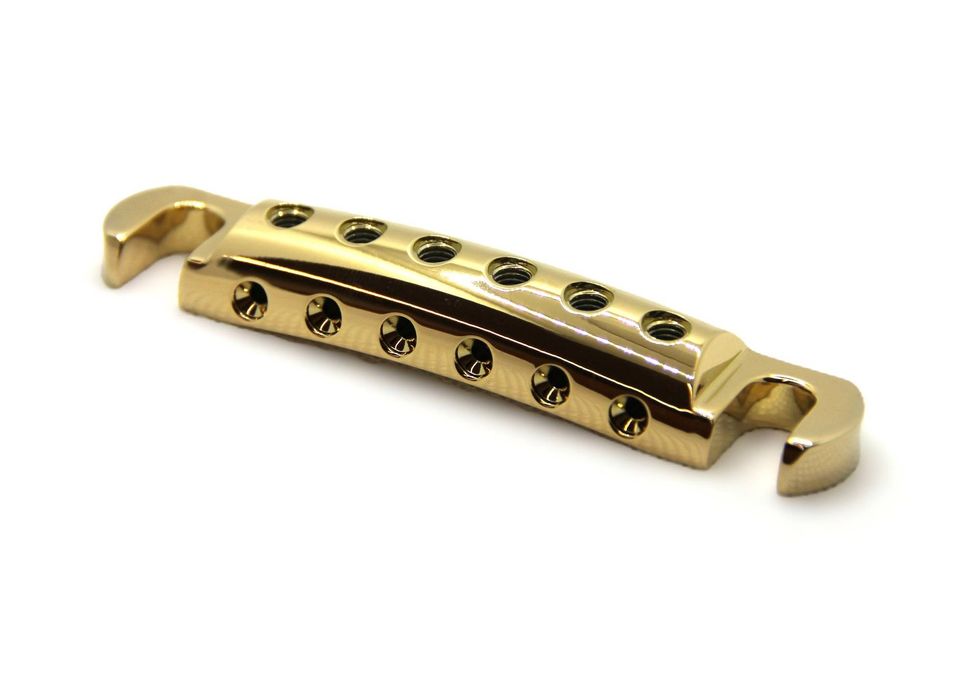
The goal: faster string changes, improved tuning stability, and better tone from a stronger, lighter material than most factory-equipped stopbars. It's intended for gigging musicians, studio guitarists, guitar techs, and anyone who would like fast and easy string changes with better tuning stability and tone so they can get back to playing sooner and sound better too.
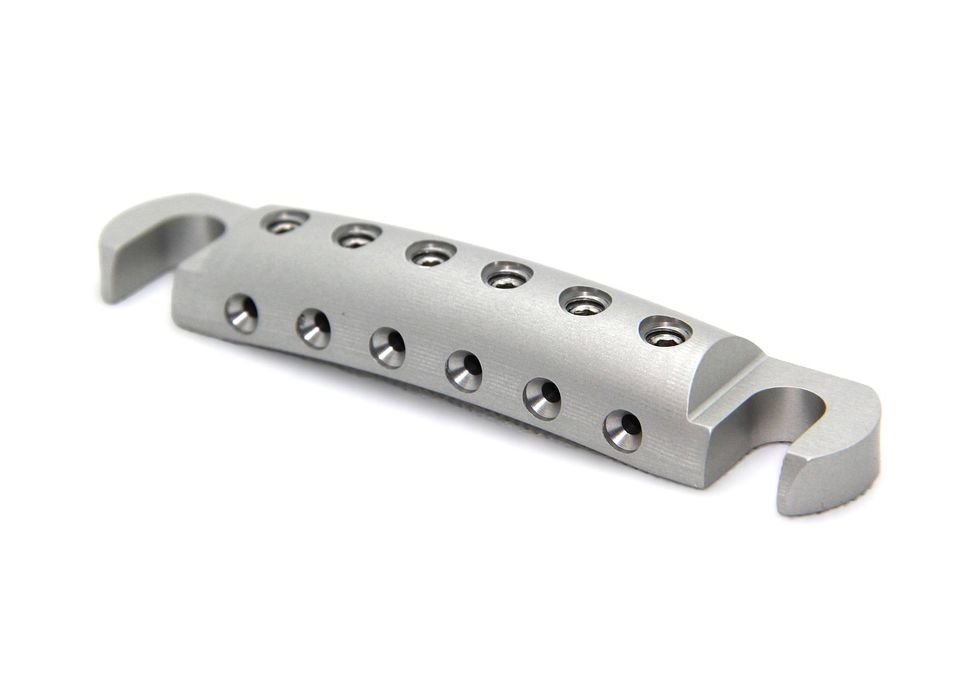
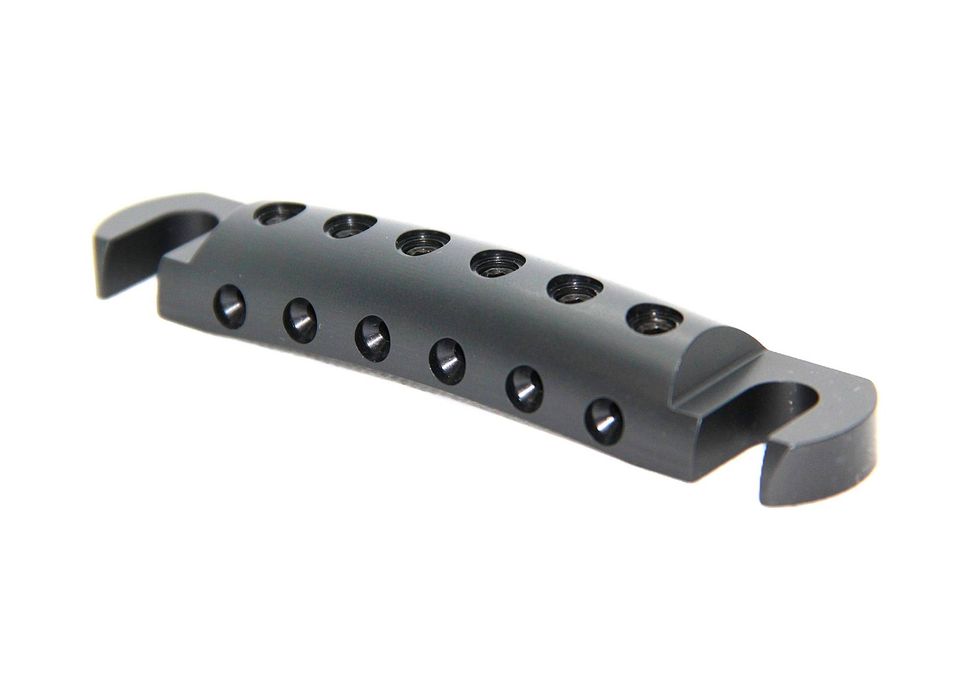
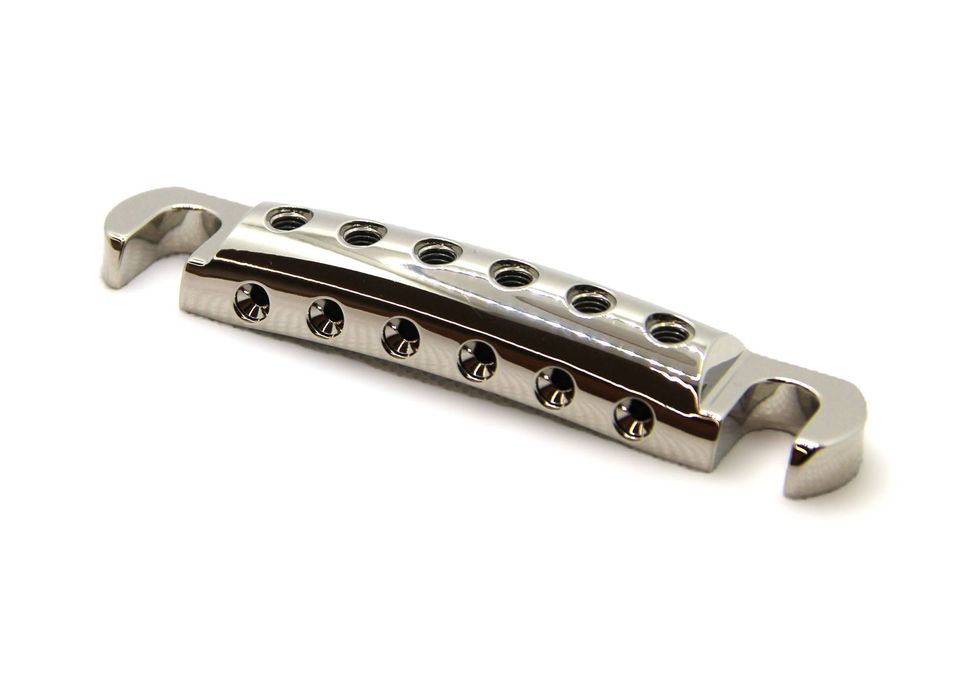
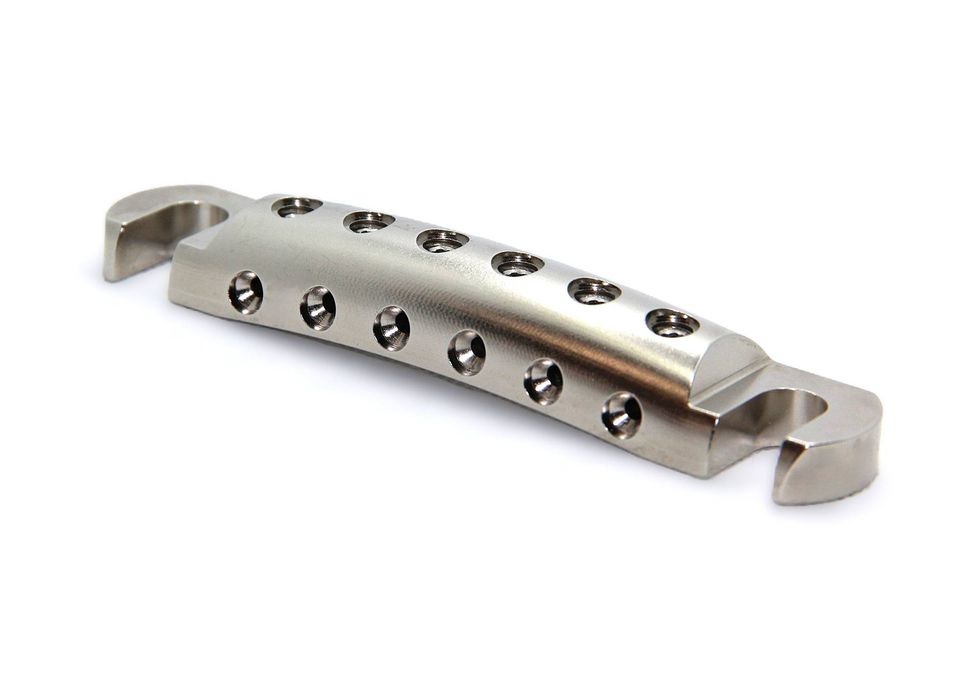
Key features of the Steadfast Stopbar™ include:
- Patented string-locking design aims to remove stress and cut restringing time by up to 75%.
- Innovative double-locking arrangement: created by precision set screws (at the tailpiece) and the string’s ball-ends (at the tuning post). Your guitar’s tuning stays put better than ever.
- CNC-machined in the USA from billet 6061 aluminum: stronger, lighter, and more resonant than the material used in most stock stopbars, with better sustain and clarity.
- Drop-in replacement is fully compatible with US and metric spacing. No drilling, no permanent modifications, zero impact to resale value – and easy upgrade to install.
- Available finishes: Nickel Plated, real 24K Gold Plated, black anodized, and silver anodized.
See the Steadfast Stopbar™ in action: https://www.youtube.com/@SteadfastDesigns
The Foundation Series is available now in five configurations: Faded ($99), Studio ($104), Pro ($109), Standard ($129), and Custom 24K Gold-Plated ($169). For more information on Steadfast Stopbars™ visit www.steadfaststopbar.com.
Goose: Modern Men

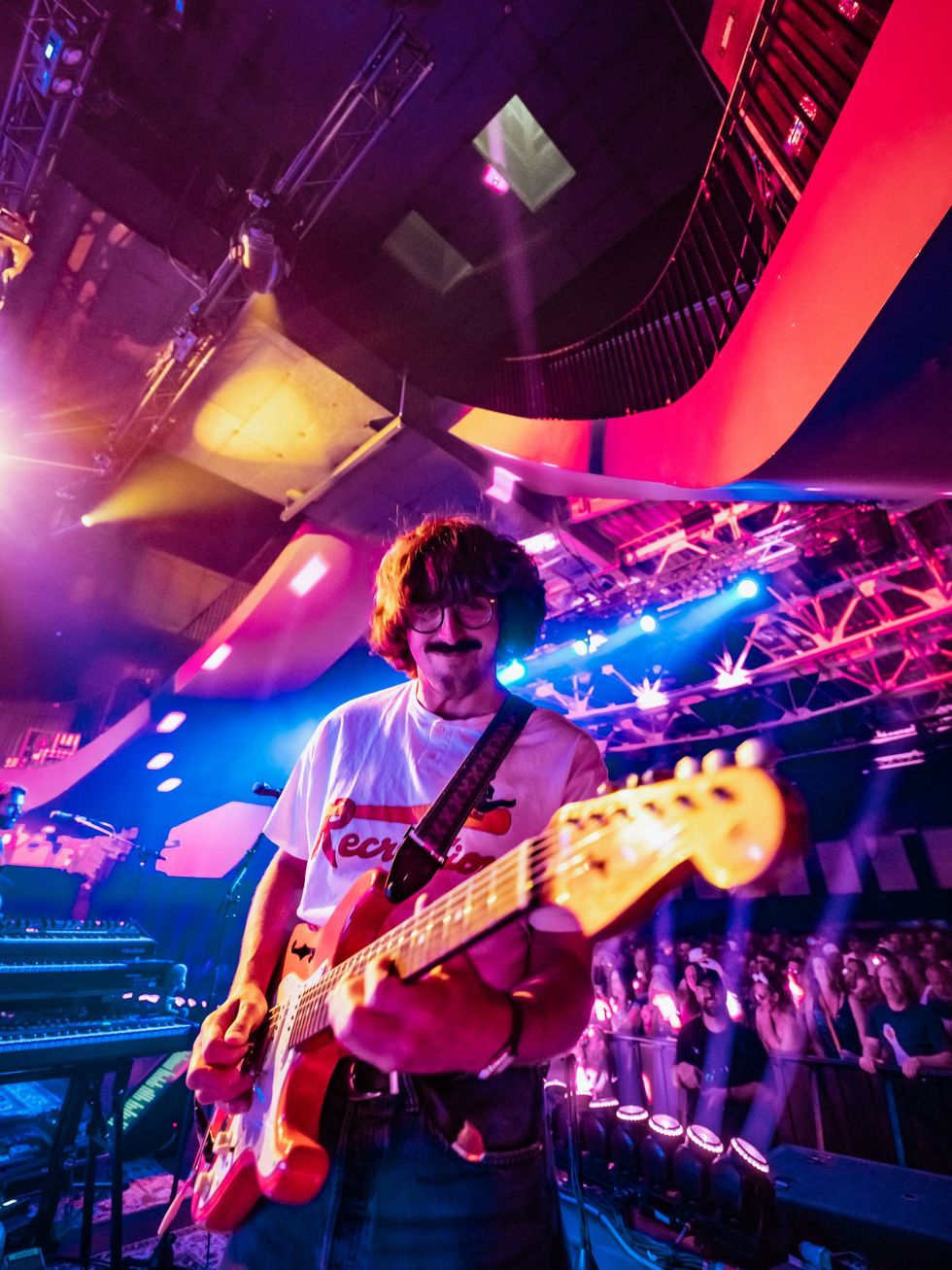
The chameleonic Connecticut-based band Goose have covered a lot of musical ground during their career, offering a little bit of something for just about everyone. Starting out as a self-described “indie-groove” outfit, they were quickly adopted by the jam-band community thanks to the group’s enthusiastic embrace of improvisation, and utter disregard for musical boundaries. Goose’s collision of genres—both onstage and over the course of five studio albums—has smashed together folk, jazz, funk, R&B, pop, progressive, and psychedelic rock. Thus far, they have yet to fold Swedish death metal into the mix, but give them time and they surely will.
Fans can personalize and interpret a band in a multitude of ways, but what does founding guitarist, singer, and primary songwriter Rick Mitarotonda want listeners to appreciate about Goose?
“I don’t think I have any ideas of what I want people to understand about the band,” he says. “For us, I think the goal is to just follow our instincts and creativity and be authentic to ourselves. And continue to uncover and unravel what that is and what that could be.”
He lets that sink in, then continues, “Everyone’s got their own prism through which they see the world and how they relate to things, and there’s no way to know or understand or try to intellectualize what people seem to be thinking about us or what they think of what we do or anything like that. It’s unknowable. It’s not up to us what people make of what we do. It’s just up to us to try to do the best we can with what we have.”
For the group’s growing and fiercely loyal legion of devotees—an audience now large enough to fill amphitheaters, pavilions, and arenas—Goose are doing just fine with what they’ve got. The band’s three-hour-plus shows are fast becoming the stuff of legend for their “anything goes” ethos in the grand tradition of premier jam bands both past and present.

Rick Mitarotonda’s Gear
Guitar
- Greg DeLuis Empress custom model
Amps
- 1960s Fender Deluxe
- Vintage Marshall combo
Effects
- Ibanez Tube Screamer
- MXR Carbon Copy
- Strymon El Capistan Tape Delay
- Strymon Deco Tape Saturation & Doubletracker
Strings, Picks, & Cables
- D’Addario NYXL strings (.010 –.046)
- Dawg David Grisman mandolin pick
- Mogami cables
These aren’t just concerts; they’re more like communal experiences. And the group’s marathon improvs, led by Mitarotonda’s breakneck virtuosity, aren’t self-indulgent, murky ragmops. Each extended interlude is packed with fun, discovery, and a bit of high-wire danger, and carries a sharp emotional breakthrough. There isn’t anything calculated or predictable about Goose (the lineup also features guitarist-keyboardist Peter Anspach, bassist Trevor Weekz, and drummer Cotter Ellis); everything they do feels spontaneous and alive. Nowhere is this more evident than in their playful and promiscuous choice of covers, which can sashay from Laura Branigan to Bob Seger one night, Steppenwolf to A-ha the next.
How a band navigates success can be a tricky bit of business, particularly as it transitions from cult darlings to mainstream stars. Mitarotonda admits that Goose’s rocket-like ascent has presented some challenges. “Certain aspects of this are totally overwhelming,” he says. “There’s little junctures where things you do or things you intend get misinterpreted, and you have no control over it. That can be difficult to contend with. Plus, there’s a struggle to find a balance and wanting to have time to breathe and reflect and process and write and do other things in life that feed creativity amidst the constant ability to tour.”
“There’s no way to know or understand what people seem to be thinking about us or what they think of what we do.”—Rick Mitarotonda
Anspach, who joined Goose in 2017 following the departures of several guitarists and keyboardists, isn’t feeling the pressure. “There have been a lot of times where it’s felt like just tour, tour, tour,” he says. “The pace isn’t really locked down, though. Last year, we put out two albums [Everything Must Go and Chain Yer Dragon], but before that we were touring for two years without a new record. I think in general, we definitely want to keep making records. I don’t really see that slowing down just yet.”
Mitarotonda, for his part, isn’t letting fame affect his creative decisions. “We’re not that big where we’re at risk of jumping the shark,” he says with a smile.
For a band that consistently throws left curves to its audience, Goose’s new album, Big Modern!, is one hell of a wild ride. While it’s not a dedicated concept record—there’s no narrative story or stated theme—it does feel, in sometimes jarring ways, like an homage to the glory days of MTV-era 1980s. The sleek, pulsating groove of “Torero” recalls Jan Hammer’s lush, synthetic noir soundscapes in Miami Vice, while “Savenger” is a synth-pop pastiche that evokes the Human League, Howard Jones, and Mr. Mister. “Media” is a dense and chaotic cardio workout that combines Remain in Light-period Talking Heads with the Tubes at their commercial peak. And if you’re too lazy to search for Nena’s “99 Luftballoons” or Kim Wilde’s “Kids in America,” you can simply cue up “Pop,” a delicious power-pop knockout. It’s all over-caffeinated and overblown, wildly entertaining, and hooky as hell.
Peter Anspach’s Gear
Guitars
- John Suhr Classic S
- Gibson Firebird (belonging to producer D. James Goodwin)
Amps
- 1960s Fender Princeton
- Vintage 100-watt Hiwatt
Effects
- Boss DD-20 Giga Delay
- Analog Man King of Tone
Strings, Picks, & Cables
- D’Addario NYXL strings (.010 –.046)
- D’Addario picks
- Mogami cables
Mitarotonda reasons that if Goose made an ’80s record, they did so unwittingly. “There’s no denying that’s a pretty consistent thread throughout,” he says. “It’s a very synth-heavy record. The drums and the guitar tones are big. A lot of things just pushed the material in that direction, but not in a contrived way. It’s funny, because obviously I wasn’t alive during the 1980s—I was born in 1990—but when I think about that period in time, it was like there was this big, superficial sense of forward momentum. Everybody was saying, ‘The future is now,’ and there were these extremes in sound and fashion. There was new technology coming very fast, and I think people were just inundated with stimulation. The aesthetic was loud, and I think that loudness is a perfect metaphor for the overstimulation that’s going on with technology right now.”
As has been the case since the early days of Goose, tunes are rarely born from jams. Much of the material on Big Modern! was written by Mitarotonda and his longtime collaborator, Matt Campbell. The two recorded “fairly fleshed out” demos that the guitarist says “really informed the trajectory of where we were going.”
“Usually, we kind of sketch out bare-bones demos and then fly by the seat of our pants hashing it out in a practice room,” he says. “This time, we went deeper with the demos, and it became a really valuable process because there were layers and textures that came out of it. We’d be working on a piece, and I’d say, ‘I want to add some bass on this.’ I would just track some bass, then play something and listen back to it, and I’d feel like it became a part of something. There were lots of weird little segments that stood out to me that just kind of added to the whole thing.”
Anspach listened to the demos and was faced with deciding between vintage ’80s-style keyboard textures or some level of dual-guitar attack. “There was a lot of keyboard stuff to learn and figure out for this record,” he says. “But there were also songs like ‘Torero,’ where I’m playing these keyboard layers, but then I switch to guitar. But we’ve developed the technology so that the synths can continue to play while I’m on guitar.”
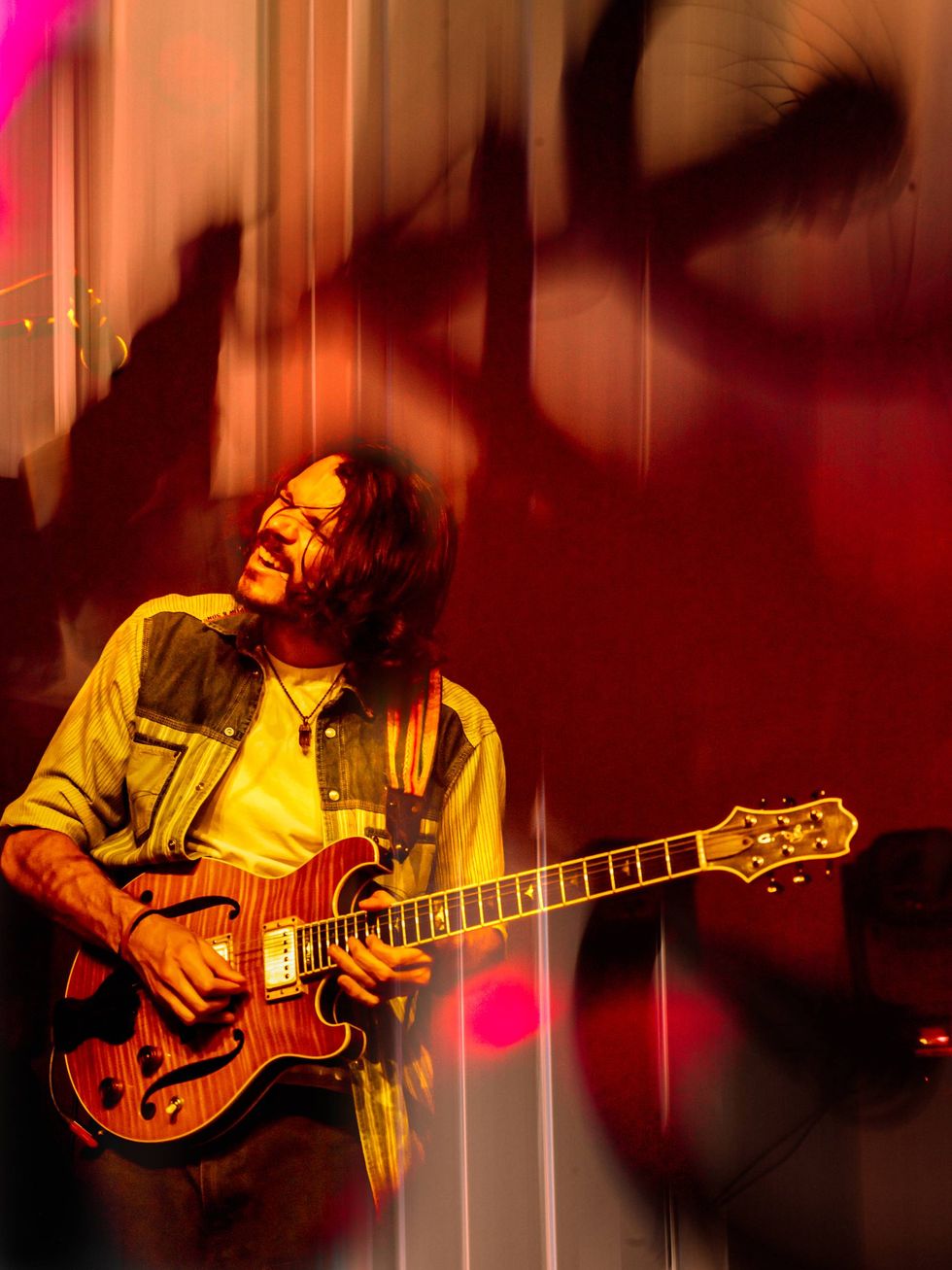
Mitarotonda marvels at his bandmate’s multi-purpose capabilities. “Peter’s pretty clutch at all that,” he says. “On this record, we really built the shit out of these tracks to get them to sound really big. Then we had to try to figure out how to recreate it with just the four of us. There was a point when it was like, ‘Shit, do we need another guy to do some of this stuff?’ But Peter was like, ‘I can be three guys, actually.’ He figured out the game plan and the tech, and he’s playing guitar and four keyboards at the same time.”
“Torero” is one of the focus tracks on Big Modern!, but it almost didn’t see the light of day. The band road-tested it live to great effect before hitting the studio, but the song refused to behave once recording was underway. “We spent a whole day on it, and it just wasn’t there,” Mitarotonda recalls. “After dinner, we went back to it and figured out the arrangement and were just ripping takes. The energy that didn’t exist before became explosive. It was so cathartic, and the way Cotter dug into it, it was epic.”
So, too, is the guitarist’s splashy and exuberant solo, which hits like a ton of bricks. “Good 2B” features another turbulent lead break, but one that takes on a surreal quality as the song churns on. “That one presented some challenges because we knew we could really open the song up live,” Mitarotonda says. “Coming out of the drum break, there’s a ton of steam and it just wants to go on forever.”
His solo on the huge rocker “Salt” generates heat in a different way—it’s slow and full of legato lines, calling to mind George Benson’s unhurried manner of phrasing. “That was the biggest improv on the record,” he says. “We did a bunch of takes as a band, just trying out things, and they all went to different places. In the end, there was a long jam and it just seemed right to leave all those spaces between notes.”
“It’s a very synth-heavy record. The drums and the guitar tones are big.”—Rick Mitarotonda
For the most part, Mitarotonda improvised his solos while tracking with the full band. It’s taken him a while to adopt this approach, and he admits that when Anspach joined Goose, he still maintained a perfectionist’s attitude of crafting and nailing solos during the demo phase. “Peter finally said, ‘Dude, let’s just track it already.’ And he was right. Nothing can touch a holistic take when you’ve got everybody together. You just can’t fake that energy.”
Neither guitarist changed much about his guitar and gear setups for Big Modern! Mitarotonda relied on the same Greg DeLuis custom-made Empress model he’s been playing since 2023. “There’s only a couple of times I might pick up something else,” he says, “but I tracked the whole record with the DeLuis.” Likewise, he estimates that he recorded “perhaps 99 percent” of the album with his favorite amp, a 1960s Fender Deluxe, and “one tiny segment” with a vintage Marshall combo. “I’m not sure what kind,” he says with a smile. “I’ve always been a bit of a simpleton when it comes to gear.”
Anspach kept things basic, as well, using a John Suhr Classic S, as well as a Gibson Firebird that belongs to the band’s producer, D. James Goodwin. “That Firebird rips. It’s pretty sick,” Anspach says. Ampwise, he alternated between a 1960s Fender Princeton and a vintage 100-watt Hiwatt.
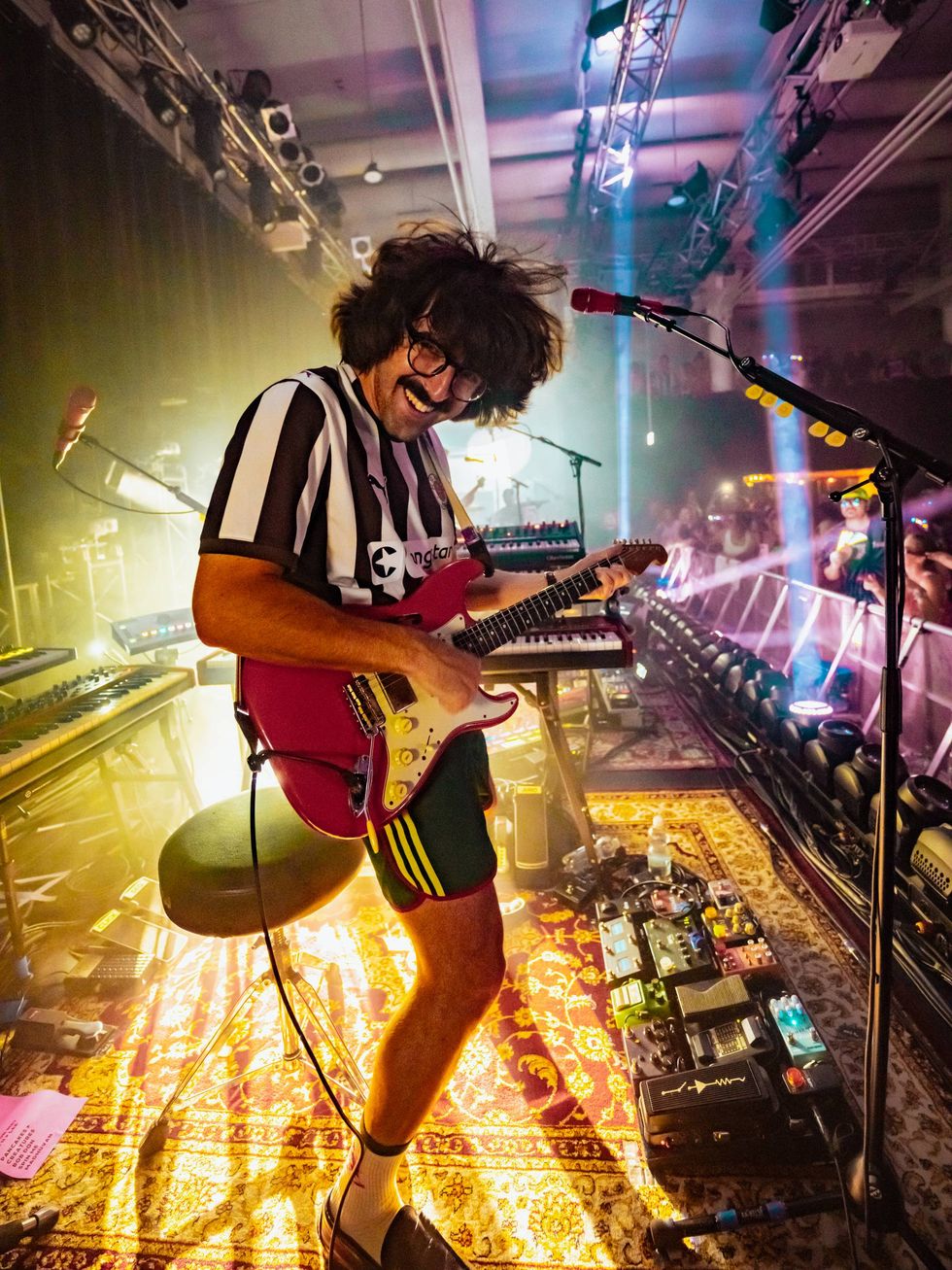
Controlling guitar sound in the studio is a far easier affair than achieving consistent onstage tone and balance—each venue offers its own variables, particularly for outdoor gigs, where sound waves are at the constant mercy of temperature and humidity.
“We try to deal with that as best we can,” Anspach says. “The fact is, it changes night to night, so you just have to embrace it and be like, ‘This is what we have to work with.’ We do as much as we can to keep things at a certain level, and we have a great guitar tech and audio team. There have been a few times where we’re feeling like something is really off, so you make little adjustments. Ultimately, you have no choice but to just ride the wave. The show goes on.”
Sometimes that show goes on without a soundcheck, as was the case last year at the Newport Folk Festival, when a series of thunderstorms and a shelter-in-place order threatened to nix Goose’s appearance entirely. When the weather cleared, the band took to the stage for a shortened set, which turned into a “you-had-to-be-there” moment when they were joined by Kenny Loggins for a high-octane performance of the singer’s cinematic mega-hit, “Danger Zone.”
“It was totally wild and hilarious,” Mitarotonda says. “We had no soundcheck, so it was pretty rough. Kenny couldn’t hear us, we couldn’t hear him, he couldn’t hear himself—it was crazy. We were literally in the danger zone with Kenny Loggins. It was quite the experience. Kenny’s the man.”
Totally Guitars Weekly Update August 7, 2026
August 7, 2026 Do You Know The Way To San Jose has just about run its course with me now that the lesson on my solo arrangement got finished this week. I hope some of you who like instrumentals will have a go at it. There are a couple of challenges, even for experienced fingerpickers, […]
The post Totally Guitars Weekly Update August 7, 2026 appeared first on On The Beat with Totally Guitars.
Pages
