
Music is the universal language
“Glory to God in the highest heaven, and on earth peace to those on whom his favor rests.” - Luke 2:14
Norse Guitar Feeds
PRS has appointed its first-ever CEO – here’s how it will affect the brand

PRS has appointed a CEO for the first time in its history: Jack Higginbotham, formerly the guitar giant’s Chief Operating Officer.
As for the way the company operates, it seems business will continue to function as normal, with Higginbotham overseeing day-to-day business operations, and Managing General Partner Paul Reed Smith – whom the company is named after – continuing to lead guitar development.
PRS says Jack Higginbotham will regularly travel around the globe to strengthen manufacturing processes, dealer relationships, vendor connections, and “every aspect” of PRS Guitars.
Jack Higginbotham was an obvious candidate for the company’s first-ever CEO. A 41-year veteran of the guitar brand since its founding in 1985, he’s worked across many different departments, from his first job in the woodshop, to operations management, purchasing, sales, customer service, marketing, artist relations, and as president for 15 years.
“Jack Higginbotham has been a leader with PRS since the beginning,” says Paul Reed Smith. “He is deeply deserving of this role. I look forward to continuing our close relationship building and selling guitars and amps for the world.”
“PRS is an exciting place to be, now more than ever, and I’m thankful to be surrounded by talented, focused teams in the US, UK, Europe and Japan,” adds Jack Higginbotham.
“As Paul is heard to say, ‘This is our time.’ As I navigate my fourth decade as a PRS employee, I’m looking forward to using my experiences as well as our collective experiences to position us well for the next 40 years. I am grateful for the opportunity and look forward to what is to come!”
Learn more at PRS Guitars.
The post PRS has appointed its first-ever CEO – here’s how it will affect the brand appeared first on Guitar.com | All Things Guitar.
Fender CEO compares cover bands to AI in music: “Cover music has been sort of analogue AI for a long time”

As the Fender Telecaster continues to celebrate its 75th anniversary, Fender CEO Bud Cole has shared his views on AI – and he believes that it has the potential to “help create a whole new world of guitar players”.
Cole’s views crop up at the end of a new interview with T3. In contrast with much of the rest of the music industry rallying against AI, the Fender CEO believes that AI isn’t a bad thing. In fact, he likens its ability to rework existing music to budding musicians covering existing songs to learn the ropes and find inspiration. “I actually believe cover music has been sort of ‘analogue AI’ for a long time,” he insists.
And covering artists was something he himself did before dipping his toes into writing his own music. “I listened a lot to REM, U2, The Smiths and The Cure, and at some point I got sick of just listening to them – I wanted to play it, so I learned to play guitar,” he explains.
Thereon out, he would copy tracks, learn how they worked, and then and twists these skills into new songs. This, if we consider Cole’s view, would be an example of an artist carrying out their own act of ‘analogue AI’. Though, if we’re nit-picking, ‘analogue AI’ would technically just be non-artificial intelligence… meaning that Cole is just describing the typical learning process and adaptive nature of normal, human intelligence.
Though, Cole is convinced AI is a helpful new addition to a musician’s tool belt. “I think we have to be careful, but we should look at how this technology can help us,” he says. “I believe that AI is actually going to help create a whole new world of guitar players that use it. To help connect with other musicians, to be more productive.”
In his words, it could be the ultimate way of elevating new guitarists “students of songwriting to masters of songwriting”.
A similar argument has been parroted by Zakk Wylde in the past. Back in March, he told Qobuz: “If AI listens to all of Ozzy Osbourne’s melodies and gets a feel for what Ozzy’s style is, and then hears Tony Iommi’s riffs and then it could hear the tendencies Bill Ward plays, certain fills he does, and the way Geezer Butler plays bass, and it listens to the lyrics… and it comes up with something, it’d be no different than a songwriter trying to come up with something that Black Sabbath would write.”
However, Wylde wasn’t framing this as a defence for AI. While he admitted the process is similar to a musician copying another artist, he knuckled down and stated that it could never fully replace a strong artist. “It doesn’t bother me [if AI rips off The Eagles], because I’m still gonna buy the record from The Eagles!” he said.
The post Fender CEO compares cover bands to AI in music: “Cover music has been sort of analogue AI for a long time” appeared first on Guitar.com | All Things Guitar.
Is Black Sabbath legend Tony Iommi about to announce a solo album?

Remember the solo record that Tony Iommi teased last year? Well, it looks like it’s finally finished. 21 years after the release of Iommi’s 2005 collaborative effort with Glenn Hughes, Fused, the Black Sabbath legend is set to share details of a new solo record tomorrow (29 July).
Iommi has teased the announcement on Instagram. In a new post, the guitarist can be seen riffing away on his Tony Iommi Signature Epiphone SG Custom, with a caption that simply teases a date: 29 July.
Considering Iommi has been teasing a new record since last year, fans are certain the mysterious date will reveal more information about the long-awaited album. Some are even guessing that the clip might be taken straight from a new music video.
The announcement has also been teased on the streets of Birmingham, with billboards being put up bearing Iommi’s signature crucifix. The billboards have a scannable QR code, which directs you to a site called secret.iommi.com. Once there, you will find an unknown word/phrase slowly taking form (as it stands, there is only an R and an N), as well as a button reading ‘revolution giving birth’.
The link takes you to a scheduled YouTube livestream, set to happen on July 29 at 3:30pm (BST). This is where we assume the announcement will finally take place.
Last year, Iommi teased the new record on Eddie Trunk’s Trunk Nation. The guitarist revealed he had been working on a new solo record before Back To The Beginning temporarily took his eye off the ball. “I was doing my own album until [Back To The Beginning] came up, and then, of course, I had to stop and concentrate on [preparing for] the Sabbath [performance],” he told Trunk [via Blabbermouth].
He continued: “But I’m continuing next week on trying to finish off what I started with this album. And then who knows what I’m gonna do then? It’s great, really, ’cause if something pops up, I’ll do it, if I want to do it. So it’s a good thing.”
The guitarist also revealed that he had “one singer on [the record]” at the time. “It started off as… an instrumental album… but then I thought, ‘Oh, I wanna try it with a singer,’” he explained.
To tune into Iommi’s official announcement on 29 July, head here.
The post Is Black Sabbath legend Tony Iommi about to announce a solo album? appeared first on Guitar.com | All Things Guitar.
Heavy-relic’d guitars for under £250? Meet Harley Benton’s new Aged Series

“Brand-new guitars, fresh out of the factory, yet already carrying an air of wisdom and a story untold…” Meet Harley Benton’s new Aged Series, a line of affordable electric guitars and basses that come pre-aged straight out of the factory.
Relic’d guitars are nothing new, there remains a strong appetite for instruments that look like they’ve been to hell and back. A real vintage instrument with authentic bruises and some rich history doesn’t come cheap, and often, neither do the new guitars that mimic a life on the road via relicing.
But Harley Benton’s new Aged Series looks to put aged, battered-looking instruments in the hands of those on a tighter budget.
The series consists of five models in total: the T-style TE-62, S-type ST-62, the offset JA-62 and two bass models. There’s American alder bodies, vintage caramelised Canadian maple becks and laurel fingerboards across the board, with Light and Heavy aging options available on each.
 Credit: Harley Benton
The aging process is done by hand, Harley Benton says, so the finish and hardware wear will vary slightly between instruments.
A range of classic colours are available across the board, too, including Lake Placid Blue, Seafoam Green, 3-Tone Sunburst, Olympic White and Candy Apple.
“After two years of refining, scaling and finessing, we can no longer keep this to ourselves,” says Harley Benton. “We’re finally proud to let these raconteurs loose.
“We’ve always had ambition here at Harley Benton. The Aged Series is a dream that’s been years in the making. We’ve been working hard to develop a durable finish to nail the character and patina that make these guitars so breathtaking. The result? Authentic, hand-aged instruments, each one unique in aesthetic, all for incredible value, and we’re ever so deeply enamoured.
 Credit: Harley Benton
“These are instruments that already look like they’ve lived a lifetime of adventure. Like they’ve got stories to tell. Whether gigging, shooting content, rehearsing, or just letting one hang on your wall longer than any responsible adult should, these are the kind of guitars that make people stop, star-struck, and say: ‘Wow! How long have you been touring for?’”
These are Harley Bentons we’re talking about, so you’re probably wondering about the price? Each model in the Aged Series clocks in at just €249.
Learn more at Harley Benton.
 Credit: Harley Benton
The post Heavy-relic’d guitars for under £250? Meet Harley Benton’s new Aged Series appeared first on Guitar.com | All Things Guitar.
Jack White cans up some fuzz for the Old Zoo-Lion Meat tin-can pedal

You’ve heard of the tuna fish… but what about the tuna fuzz? Jack White’s Third Man Hardware has just released a pedal as quirky as the White Stripes’ frontman himself, canning up a heavy burst of fuzz into a small ‘tuna tin’ stompbox .
Created in collaboration with Beetronics, the Old Zoo-Lion Meat pedal comes as a limited release, with only 333 units created. With its one-knob design, the fuzz pedal allows you to produce strong vintage tones without the frills; once you’ve twisted the single Phlegmatic Roar knob to control your output volume, all fuzz control is then determined by your guitar’s volume knob.
- READ MORE: Jack White apparently wanted to use The White Stripes’ Seven Nation Army as a James Bond film theme
While the design is inspired by Beetronics’ own Tuna Fuzz, the Third Man Hardware collaboration serves up a unique design. The can’s artwork has been designed by Rob Jones (AKA Animal Rummy), who often works with White, from producing tour posters to having his artwork, Cardiff Giant Baby, displayed in White’s current London art exhibition.
The design in question truly plays into the ‘tuna can’ of it all – though, as the pedal’s name suggests, it acts as if it contains Old Zoo-Lion Meat. On the pedal, there’s even a drawing of the Old Zoo-Lion in question, and he’s depicted as an old, wise man reading a book. “Stewing in listless anxiety amid my kingdom of plastic rocks…” his speech bubble reads, as he ponders over his experience living as a caged being.
Inspired by the biblical tale of Samson and the lion (a biblical tale of a man killing a lion, only to discover a swarm of bees inside of the lion’s corpse), the design also mentions Timnath, the place where the biblical tale takes place. And then, thanks to its transparent bottom, you can admire Beetronics’ inner circuit board which bears the image of a bee.
In a video showcasing the pedal in full force, you can see a bee-headed player really putting it to work. “Eat up, then plug in to give your guitar a belly full of BEES, like the carcass of Samson’s legendary leonine corpse,” the pedal reads.
The Old Zoo-Lion Meat fuzz pedal is currently sold out, but it was on sale for $150.
Alongside the Old Zoo-Lion Meat fuzz pedal, White has been feeding his fans plenty of goods as of late. Not only is his current London art exhibition, These Thoughts May Disappear, running until 13 September, but he also recently released a new album, Frozen Charlotte.
White is set to embark on an European tour this August, before dipping back to the US to perform a slew of shows through to November.
For more information on the Old Zoo-Lion Meat fuzz, head to Reverb.
The post Jack White cans up some fuzz for the Old Zoo-Lion Meat tin-can pedal appeared first on Guitar.com | All Things Guitar.
Meet Untitled, the teenage LA grunge revivalists whose guitar riff went viral on TikTok

Having only started playing school events and backyard shows in 2025, Untitled never imagined they would become one of the most talked about new bands in the alternative rock and grunge scenes.
Rather than setting out with a goal in mind, having fun was always most important for the four teenagers that make up the Los Angeles-based group. “We just wanted to get together and play,” begins vocalist/guitarist Danny, whose first guitar was a cheap Fender Stratocaster that he’s since modified.
Such a DIY ethos relates to the type of music that he, guitarist James, bassist Juan, and drummer Lorenzo started creating in their garage. “We just make whatever we want and don’t follow any trend,” Danny continues. James, who is self-taught and started out trying to make his own riffs on a bass before buying a $80 black Strat, adds that they prefer to not stick to a specific genre. “We bounce around and whatever we’re feeling in the moment is what we do.”
This freedom to create without restrictions stems from the band’s vast range of influences. Having respectively learned by ear and from tabs, for Danny it’s Alex G and early punk bands like The Germs, while guitarist James is a big fan of Foo Fighters and Nirvana as well as Green Day, Blink-182 and Weezer. Untitled’s bassist, Juan, has more of a mellow taste and is into Radiohead, while the drummer, Lorenzo, prefers Led Zeppelin.
 Image: Press
Natural Instincts
Following their own instinct has worked well: in November 2025, a video of the band jamming went viral on Instagram and TikTok. “We posted a little guitar intro and it blew up,” Danny recalls. James ponders that, because people “liked the vibe”, they made edits using the song on their photos and videos.
And, with the band having used specific hashtags on their own posts – namely #Nirvana and #Radiohead – such correlations undoubtedly helped introduce a new generation to the music of their heroes. “We wanted fans of those bands to maybe gravitate towards it,” Danny considers, adding that reviving the grunge scene was also in the back of their mind.
 Image: Press
Amid the hype, however, the band had one problem: the aforementioned riff wasn’t actually part of a song — yet. Though a somewhat unorthodox approach, the band began writing a song based around what people were commenting about how the guitar riff made them feel. “Normally when you write a song, you build and write a story in the form of a song, whereas we wrote a part, and people wrote the story,” Danny considers.
While crafting it was a challenge, they had no choice because Untitled had a show coming up. “I wrote random lyrics, but also lyrics that people can relate to,” Danny recalls, before James nods his head in approval. “I think he did a good job at capturing the vibe of the song.”
Feeling that they “had to release it before people lost interest”, Untitled decided to share Restless with the world. “We had nothing to lose,” James says, adding that he and the band were a little nervous to put their first offering out. They had no reason to be: Restless became the fastest-streaming rock song in the world in the weeks after its release.
Go It Alone
What made this achievement even more impressive was the fact that the band self-released that debut single with no team or promo at the time. Unsurprisingly, an old-fashioned A&R scrap ensued, with majors and independents hoping to strike while the iron was hot. “It almost took on a life of its own,” Danny says of Restless. “We didn’t understand the gravity of what was happening,” James reflects.
“At first, it was mind-blowing,” he recalls of the band being hit up by five labels a day. The group ended up choosing Good Talk Records / Create Music Group, who usually release hip-hop records. “The CEO, Jonny Shipes, was the only one from all the record labels who actually seemed like he enjoyed us,” Danny considers.
“After taking meetings with different labels constantly for several days, you can work out who actually cares and who is just going down a list of bands,” James ponders. He adds that the band were keen to pick a smaller label, and someone that “genuinely cared, because we want what we put out to be the best it can be”.
Being flown out to meet Shipes in New York was proof of their whirlwind success, and further surreal moments followed. Alongside receiving backing from Jakob Nowell (frontman of Californian ska-punk band Sublime) – “he wanted to work with us which is really crazy,” Danny says – they got an Instagram follow from the band Cage The Elephant. Ben Goldstein, who manages Julian Casablancas of iconic rock band The Strokes, also helped Untitled out until they found official management. “He was another cool person who reached out to us,” Danny says.
 Image: Press
Stick To Your Guns
Considering their rapid ascendence, Untitled would be forgiven for compromising on their sound, but that hasn’t happened at all. Crucially, the band are still making music for pure enjoyment, just like they always have. Following up a viral hit that has since clocked up 46 million Spotify streams and counting wasn’t an easy task, however. “It was a lot of pressure,” Danny admits. “Having such a big song, all eyes are on you. We felt that, for whatever was next, there was going to be a lot of judgment, so we wanted the next song to be at least kind of good,” he laughs.
Again, they delivered: their second single, Say It Again, is equally as impactful, as is its follow-up, Nothing Good. Now, the band is working on a debut album. “We want to showcase ourselves as much as possible,” James teases, adding that alongside tracks that share a “similar vibe”, there will be some softer ones too. “People will be able to tell where we have experimented with stuff, but it will all still feel cohesive,” Danny hints.
Long before that record gets released, though, they’re gearing up to play their first shows outside of America, including a debut UK tour that will culminate with a show at London’s iconic 100 Club in Camden. “It’s crazy to think about, but we’re really excited,” Danny says of their increasingly busy schedule.
Considering that getting to this point was not something they envisioned, their advice for anyone starting a band is simple. “Don’t care what people think,” Danny affirms; “just make whatever you want, have fun with friends and express yourself”. James has the final word, suggesting that aspiring musicians shouldn’t doubt themselves so much. “A lot of people question whether they should put the music out or not, but you just have to because you never know what’s going to happen.”
 Image: Press
Untitled’s Six Guitar Heroes
James
“Billie Joe Armstrong because Green Day’s songs were the first ones I learned on guitar. They’re nostalgic to me and they teach you a lot of different skills that you’ll need as you progress.
“Mark Knopfler, the guitarist from Dire Straits, too: whenever I listen to those songs, he just makes the guitar sing in a different way. It’s mesmerizing.”
Juan
“I love Jonny Greenwood from Radiohead, especially the fast bits of In Rainbows.”
Lorenzo
“Paul McCartney, because of how versatile his bass lines are.”
Danny
“Alex G because of the beautiful chords, and Kurt Cobain because of how simple it is.”
The post Meet Untitled, the teenage LA grunge revivalists whose guitar riff went viral on TikTok appeared first on Guitar.com | All Things Guitar.
Green Day serve up Basket Case and a few ice cream cones from the top of a Mister Freezie van

From performing in front of their high school to crashing into London pubs for sweaty sing-alongs, Green Day have always loved a chaotic, impromptu gig. Almost four decades into their career, nothing has changed – only this time, in perhaps a punk rock first, the Californian opted to perform on the top of an ice cream truck.
That’s right – on Friday (24 July) Green Day clambered aboard a Mister Freezie ice cream truck at Gallagher Square outside Petco Parkto during this year’s San Diego Comic-Con. Rather than 99s, fans were served up ’94 classic, Basket Case… though, there were a few free Nimrods-branded ice creams too, courtesy of frontman-turned- ice-cream-vendor Billie Joe Armstrong.
Of course, the ice cream truck was quickly crowded with people. Fans gathered to witness the spectacle, and a few were lucky enough to walk away with free t-shirts and cassette tapes – a true cherry on top of this peculiar punk rock sundae.
I don’t care if Green Day playing Basket Case on an ice cream truck at San Diego Comic Con happened to you it should’ve happened to me instead pic.twitter.com/BVNjDljqGH
— lady stardust (@cinethanhunt) July 25, 2026
The appearance was the band’s own way of hyping their upcoming film, Nimrods, inspired by Green Day’s 1997 record of the same name. Writer and director Lee Kirk crafted the coming-of-age flick with the guidance of the band, and it is set to follow a young band’s tour-van-road-trip in a bid to secure a support slot opening for Green Day.
The film is set to drop in the UK on 11 August, before receiving a US release on 14 August. It will also feature a soundtrack of classic Green Day tracks, as well as their new track I’m Never Gonna R.I.P. and four previously unreleased live recordings from a performance at the Palladium in Los Angeles.
The soundtrack will also feature music from Mckenna Grace, The Paradox, Ultra Q, and a few cuts from the film’s central fictional band, Analog Dogs.
This isn’t the first time Green Day’s music has been transformed into another medium; 2004’s American Idiot was famously adapted into a broadway show. Back in 2010, Deadline alleged that actor Tom Hanks (yes, that Tom Hanks) was even trying to get the play adapted into a fully fledged feature film.
IGN addressed the concept of an American Idiot film in a recent interview, with Armstrong explaining: “We’ve talked about it a lot… there’s always talks about it but we’ve just got to figure out when. But, right now, it’s all about Nimrods.”
The post Green Day serve up Basket Case and a few ice cream cones from the top of a Mister Freezie van appeared first on Guitar.com | All Things Guitar.
“They dragged it out like a dead body”: Musician fumes at American Airlines after guitar destroyed beyond recognition

We’re all aware of Schrödinger’s Cat – the notion that, within the confines of a closed box, a cat is simultaneously both alive and dead in the limbo before you actually check. However, if you were to apply the same thought experiment to, say, an airline handling your guitar, Schrödinger’s theory doesn’t apply. Because artists often know whether their guitar has been bashed around by airport handlers even before cracking open their case.
In fact, sometimes even the case is a casualty. That was unfortunately the case for digital creator Titus Tucker, one of the most recent guitarists to face a devastating loss at high altitude. After flying with American Airlines, Tucker shared a video accusing the airline of damaging his guitar – and we use the term ‘damaging’ very lightly.
For those easily disturbed, look away now… but the condition of Tucker’s guitar is ghastly. As Tucker explains that it’s a new guitar in a brand new case, the pile of wood and strings on the floor is almost unrecognisable as an instrument. Honestly, it’s cartoonishly destroyed – as if handlers dropped the case down a flight of stairs, reversed over it with a lorry, and finally placed grenade placed inside before loading it onto the plane.
This isn’t just exclusive to American Airlines, either. Just yesterday, Nashville artist Ella Hennessee shared her experience with United Airlines, accusing the airline of mishandling her childhood guitar. “I didn’t don’t y’all dropped luggage 25,000 ft apparently,” she jokes in a clip as she inspects cracks down the side of her guitar.
Of course, United Airlines have faced quite a bit of bad press in the past surrounding the way it treats instruments. In 2009, Canadian musician Dave Carroll dropped the ultimate United Airlines diss track, United Breaks Guitars, after the airline refused to front the cost of his $3,000 guitar broken in transit. In the end, the airline ended up paying far more than $3,000 – because the protest track had such an impact that the airline’s stocks dropped by $180 million in a single day.
Elsewhere, Southwest Airlines also received bad press last year for mishandling Emily Wolfe’s guitar. The blues rocker accused the airling of breaking her signature Epiphone White Wolfe, resulting in a snapped headstock.
Wolfe’s experience saw her filing a report, only for the airline to wipe its hands clean due to instruments being classed as “fragile items” – essentially meaning that the company considers it the owner’s responsibility if a guitar breaks in transit.
“If airlines can damage professional-grade instruments, charge us extra to check them, and then refuse to take responsibility, it puts every traveling musician at risk,” Wolfe wrote on her Instagram post. “This is not just about one guitar. It is about protecting the tools of our craft.”
The entire debacle raises a very worrying concern – if your guitar gets damaged mid-tour, it’s just an extra cost on top of the ever-hiking cost of touring. Artist Devin Townsend has even admitted he cuts costs by travelling with just an acoustic guitar as it’s cheaper than lugging around more gear… if his sole acoustic broke, what then?
With airlines attempting to pass the blame on to the individual and refusing to pay out, travelling puts artists in an incredible vulnerable position. It sadly seems we’ve made little progress since 2009’s United Breaks Guitars, but hopefully more artists sharing their experiences online will pressure airlines to take more accountability for any damage that happens on flights.
The post “They dragged it out like a dead body”: Musician fumes at American Airlines after guitar destroyed beyond recognition appeared first on Guitar.com | All Things Guitar.
“I do remember seeing Corey naked a lot”: Producer recalls carnage making Slipknot’s legendary sophomore album, Iowa

In many cases, a closing track is usually a sign that a record is nearing its end… unless you’re Slipknot, that is. On their 2001 release, Iowa, the masked metal unit saved their longest, most evil cut for last, serving up a title-track that sunk listeners into a twisted 15-minute-long finale straight from hell.
Sonically and lyrically sinister, the track explores the mania one might feel after being locked alone with a corpse for far too long. And, keen to authentically embody that madness, frontman Corey Taylor infamously did all he could to get into a dark headspace. We’re talking drugs, nudity and rolling around with shards of glass.
As producer Ross Robinson explains in the latest issue of Metal Hammer, the foundation of the Iowa record was set after a drug-addled jam session. “[The band] pounded a bottle [of NyQuil] and we went into this room… that’s supposed to be haunted, all mouldy and shitty…,” he recalls. “They started jamming and there was this vibe and presence that was the foundation for the whole album.”
“I remember he did that on vocal overdubs… he had to strip his soul all the way,” he notes.
Of course, Taylor did take the notion of “stripping his soul” away a little bit literally. “I do remember seeing him naked a lot,” Robinson admits. But, as he puts it, the nudity felt like it was just a by-product of all the carnal, twisted themes the record was exploring. “We’d get all woo-woo around the lyrics, go deep into the meaning and the tone of everything, so I’d have chills by the time I hit record,” he says.
Over the years, Taylor has explained the meaning of Slipknot’s most macabre nu-metal magnum opus. In 2012, the frontman explained his “thought process” behind Iowa during a fan Q&A: “Oh boy… as I’ve said before, I am a little unbalanced, to put it lightly. I can [mentally] put myself in several very strange situations… But Iowa was really the chance to take it even further. Basically, Iowa is about spending time with a corpse… Don’t judge me! And I’m just doing… beautiful, fucked up things to it…”
“I was a little fucked up when I recorded it, stripped naked… I wish you could have seen Clown’s face,” he continued. “He was in the fucking control room, and there’s this little window… I just start taking [my clothes] off… It was almost like method [acting] at that point. I wanted to go so fucking deep into it… [After I’d finished], Clown looks me right in the fucking face and he just goes, ‘Taylor, what the fuck is wrong with you?’”
The post “I do remember seeing Corey naked a lot”: Producer recalls carnage making Slipknot’s legendary sophomore album, Iowa appeared first on Guitar.com | All Things Guitar.
“I needed another finger”: Eddie Van Halen explains why he developed his two-handed tapping technique

Eddie Van Halen’s famous tapping technique was created because he felt like he needed “an extra finger” for guitar solos.
In an unearthed interview with Eddie, he shows how he decided to incorporate two hands into his soloing as he felt he could only go so far by using just one. The technique is the most recognised associated aspect of his approach to guitar, although many artists over the years have disputed that he was the original inventor.
In the short archival clip, recently shared to YouTube by Hair Metal Revolution, Eddie explains, “I got the idea [because] I wanted another finger, you can only go so far [with one hand]. So I figured if I use this hand, you get more fingers.”
Watch below:
In other Van Halen news, Eddie’s former bandmate Sammy Hagar argued that Eddie “saved guitar players”, and was, in his view, a “music god” whose talents extended far beyond his instrument.
He told Guitar Player, “I can’t imagine where guitar players would be without Eddie. He just took a fuckin’ hard left, man, and we’re going to outer space. There were great guitar players before him: Jimmy Page, Jeff Beck, David Gilmour, Eric Clapton, Jimi Hendrix.
“I mean, Hendrix kind of did the same thing – he got that whammy bar in there and changed everything. But Eddie took the whammy bar and the hammer and the frickin’ tapping.”
Van Halen fans are also patiently awaiting more news on a forthcoming album from Alex Van Halen, who is reworking some old Van Halen demos in order to release them. Details are still scarce, but Steve Lukather is assisting with project.
Despite initial rumours, Lukather has strongly denied any guitar playing on the project, and has stated that he is acting as a co-producer instead. Every riff on the record was recorded by Eddie, and Lukather has called them “jaw-dropping”.
The post “I needed another finger”: Eddie Van Halen explains why he developed his two-handed tapping technique appeared first on Guitar.com | All Things Guitar.
Billy Duffy reveals his favourite era of the Cult: “The guitar sounds are probably the best I ever got”

Billy Duffy believes some of his best guitar work within The Cult’s discography ended up being under-appreciated due to tensions among the band and creative differences.
Looking back on the early 1990s, when The Cult released their fifth studio album Ceremony, Duffy recalls achieving some of his favourite guitar sounds, but felt they were unable to find the right producer to deliver the album as intended. Different sonic desires with bandmate Ian Astbury also created an unsettled creative environment, leading to a “necessary” hiatus in 1995.
Speaking to Guitarist, Duffy reflects on the era of Ceremony: “Ian wanted to go in a different direction. I was a bit more conservative and was like, ‘We’ve just had a multi- platinum record. Why would we depart from that?’ But he wanted to change it up and do something looser and more shambolic, like Keith Richards’ band the X-Pensive Winos,” he says.
“I remember being resistant, so we kind of compromised. Bob Rock was gonna do Ceremony, but he said, ‘Well, I’ve got Metallica. That’s only gonna take a couple of months…’ 13 months later he finished the Metallica record and in the meantime we had to find another producer.
“13 months later he finished the Metallica record and in the meantime we had to find another producer. It was just never right. It was okay, but it didn’t really capture what we wanted to do. It’s sad because the guitar sounds [of that era] are probably the best I ever got,” he adds.
Later asked how he hopes to be remembered as a guitarist, Duffy goes on to name three other albums from The Cult that also show some of his best work.
“I think what I did on Electric, Love and Sonic Temple was interesting. Me taking a Gretsch and putting two overdrives and a wah there, it took Gretsches into another area. I just thought it was kind of cool to try to make this acidy, psychedelic kind of post-punk music – but with a big, solid, chunky rock sound in its foundation.”
He later concludes, “I just think I’d like to be remembered as a guy who kept the values of the 70s – you know, the good stuff – alive. I helped keep the spirit of Free, Bad Company, Mott The Hoople, Zeppelin, Iggy Pop, Sex Pistols, Sabbath and all that stuff alive. I just wanted to keep the essence of proper rock alive.”
The post Billy Duffy reveals his favourite era of the Cult: “The guitar sounds are probably the best I ever got” appeared first on Guitar.com | All Things Guitar.
Orange Outlowd ES3 review: is Ed Sheeran’s signature amp the best compact acoustic combo out there?

$199/£149, orangeamps.com
Whatever you might think of Ed Sheeran’s music – and the comments on our Instagram posts would imply that certain sections of the Guitar.com community are not exactly overwhelming in their affection for the ginger prince – you can’t deny that he’s a bona fide guitar guy.
- READ MORE: Martin 000-10E Retro review: “it authentically distils everything that’s great about 000 guitars”
This is an artist who has taken the ‘singer with an acoustic and a loop pedal’ concept and turned that into sitting just behind Beyoncé in the all-time album sales chart, while also being the third biggest-grossing touring act of the 21st century.
He’s also a guy who loves guitars so much he started his own guitar brand, Sheeran by Lowden, in 2019. The sense that Sheeran really cares about this stuff has only been enhanced by him adding his own looper brand to the stable a few years later, not to mention a PRS signature baritone.
 Ed Sheeran with the Orange Outlowd ES3 amplifiers. Image: Mitch Lowe
The missing piece of the puzzle then was an amp. For someone who cut his teeth busking, the ability to amplify what he was doing with that loop pedal must have been so important, and so it’s a surprise it’s taken this long to arrive… but the real surprise is that he’s done it with Orange.
Because while literally nobody with ears can deny that Orange make superlative guitar amps for almost any style and budget, one thing the British brand hasn’t got any pedigree for – unlike the likes of Marshall, Fender, Laney etc – is making amps for acoustic guitars.
All of which makes the Outlowd – a series of three amps with the same fundamental DNA but different use cases – one of the most interesting and important new amp launches of the year. The less said about the name, the better, though.
Orange Outlowd ES3 – what is it?
The ES3 is the smallest Outlowd in the range, and it has a narrower remit than the bigger brothers in the family. Whereas the 100 and 60-watt versions are two-channel guitar and vocal amplifiers with a variety of inputs and outputs to make it at home as both stage monitor and performing tool, the ES3 keeps things simple. This is a three-watt hybrid acoustic amplifier and Bluetooth speaker, and that’s it.
Simplicity is the order of the day when it comes to this amp, and let’s face it, Orange in general – if you’ve ever found yourself struggling to get to grips with the functionality of one of the brand’s creations, that’s probably a you issue.
In keeping with that, then, the ES3 keeps things incredibly straightforward on the control side of things with knobs for just volume, tone and spring reverb, plus a button to activate Bluetooth pairing. That’s it!
 Image: Mitch Lowe
Orange Outlowd ES3 – build quality and usability
If there’s one thing that Orange amps tend to have in common, beyond the colourful tolex of course, it’s that they are built in a manner that leads you to believe that should armageddon make its long overdue appearance, you could shelter from a nuclear firestorm behind one and come away with nothing more worrisome than a light sun tan.
The ES3 absolutely fits into that lineage, with its angled wooden cabinet not just expertly covered, but feeling incredibly rugged and well-built. It’s the sort of unfussily excellent build quality that leads you to wonder just how tall a building you could launch this thing off and still get a sound out of it.
You probably shouldn’t do that, however, because as with so many Orange amps, that reassuringly robust build comes at a cost. Despite being smaller than a six-pack, this thing tips the scales at a hefty 1.4kg (3.1lbs) – thank goodness for that soft and generous leather carry handle, eh?
As mentioned, the amp is intentionally stripped back and simple; you have just one input for your guitar, mini-rotary controls for volume, tone and the level of onboard reverb, and then a shiny silver button that you use to pair it to your phone for audio purposes.
Now, remember a few paragraphs ago when I said that anyone who struggled to get to grips with an Orange amp’s functionality was probably the one with the problem? Well, I’m going to tell on myself here and say that for a good 30 seconds after sliding the ES3 out of its lovely plush box, I pawed at the silver Bluetooth pairing button wondering why the amp wasn’t turning on and wondering if it was out of battery.
 Image: Press
If you look closely, you’ll see that the power is actually activated by a notched switch on the volume pot – this is probably crushingly obvious to you, but for the sake of fellow morons like myself, I thought this was worth mentioning.
Orange’s ‘pics only’ approach to control labelling is in full effect here, and while anyone with eyes can see that it looks way cooler than boring old text, maybe it does have a drawback. There is perhaps an argument that given the ES3’s target audience of relative newcomers to the guitar amp world, it’s not exactly intuitive to have things like ‘reverb’ and ‘tone’ represented with what are effectively cool squiggles. Obviously, it’s very easy to work out what these things do in short order, but it does add a bit of friction for new users.
Otherwise, it really does feel every bit a very professional bit of kit, despite its size and price. The chunky rubber feet on the bottom make it stable and secure, the metal and fabric grille cloth means you can chuck it in a bag or case without worrying about the speaker being damaged – it’s rock solid.
 Image: Press
Orange Outlowd ES3 – sounds
The elephant in the room with a tiny acoustic amp like this is well… does this really need to exist? An acoustic guitar, by its very nature, is pretty good at amplifying itself, after all… most acoustic players I know have amps primarily for live use where they also double as vocal amplification.
The ES3’s size and functionality obviously make it not best suited to all but the smallest performance settings, so what does it actually offer? Well, for starters we have to consider the cast of characters involved here.
Ed Sheeran is, of course, a musician for whom a dry acoustic guitar signal is very rarely the vehicle for his artistry, and you don’t have to go to many open-mics, cafe shows and other scenarios to see that effects are becoming increasingly common aspects of acoustic guitar musicianship.
With that in mind, having a small and portable amp that you can use to either practice at home with your full rig, or to add some effected sound for busking or smaller gigs has real utility.
Then there’s the fact that Orange amp design guru Adrian Emsley is a bona fide mutton-chopped amp design genius – one of the very few left in a world that seems to be moving away from the magic of real amps.
While most modern digital practice amps will have an acoustic mode that effectively offers a flat response akin to a portable PA, plugging a Martin 000 into the ES3 is a reminder of how different the experience is when you have someone who knows what they’re doing tuning every aspect of the amp to enhance and accentuate the sound of an acoustic guitar.
 Image: Press
The four-inch speaker sounds full, rich and dynamic, accentuating the overall sound of the acoustic in the room rather than outright replacing it. With the tone control in the middle of its travel, you get a tone that has surprisingly punchy and enjoyable mids, while fingerstyle excursions demonstrate that even the high notes sound less thin and ‘string-y’ than you often get putting an acoustic through a practice amp.
There’s not a huge amount of bass response to be had here – after all, this lacks the passive reactors we see on other FRFR cabs – but it does a fine job and doesn’t sound too muddy.
The tone control itself is quite powerful, and sweeping it too far either way quickly makes the sound unappealing, but that’s not necessarily a bad thing. I found the power of this control useful for taming some of the boominess of a Guild dreadnought I also tried, or adding some enhanced midrange to a Gretsch parlor I converted to a rubber bridge guitar.
The real star of the show is the hall-like reverb, which adds a wonderfully produced sheen to basic strumming that really makes you appreciate the value of something like this even if you aren’t using loads of effects. If you are, however, it handles the likes of delay, chorus and even some granular stuff with aplomb – things never get too mushy.
As a Bluetooth speaker it sounds good, though the lack of independent guitar volume control is a little annoying here. You can control the music volume from your device, but turning up the master volume will also make the music louder, so if you’re playing to a backing track, you’ll want to make sure you’ve got your guitar volume sorted before you start getting your levels right, as any tweak to one will mean a tweak to the other.
In terms of music volume, it has plenty of projection and the ability to fill a decent-sized living room – it’s a little boxy and not the most bass-heavy sound ever, and it starts to get a little fuzzy at the upper reaches of the volume control, however, so be warned.
 Image: Press
Orange Outlowd ES3 – should I buy one?
If you’re an exclusively home-based acoustic player, it might be hard to justify dropping nearly $200 on this – though I was pretty startled by how much more I enjoyed the sound of my acoustic at home plugged in with a bit of reverb. It really elevated the whole thing.
If you’re an acoustic player who does use loopers and effects in their sound, or play smaller gigs and busking shows where you just need something to give your guitar a bit of push and polish, this is an impressively designed and great-sounding option.
Orange Outlowd ES3 – alternatives
Blackstar’s Fly 3 Acoustic ($99.99/£89.99) is another small acoustic amp that prioritises ease of use and sounds great – especially when you pair it with its stereo cab. The Positive Grid Spark Mini ($199/£171) is a solid all-rounder that offers both electric and acoustic sounds, while Fender’s Acoustasonic 15 ($169/£129) is a solid small option, but it’s AC-power only.
The post Orange Outlowd ES3 review: is Ed Sheeran’s signature amp the best compact acoustic combo out there? appeared first on Guitar.com | All Things Guitar.
The Truth About Vintage Amps, Ep. 168
It’s the 167th episode of the Truth About Vintage Amps, the call-in show where amp tech Skip Simmons fields all of your tube amp and life questions.
Our sponsors: Grez Guitars; Emerald City Guitars; and Amplified Parts / Mod Electronics.
Some of the topics discussed this week:
:00 Special Guest: Sebastian Gruenberg of Vintage Inspired Pickups (link); molecular biology; winding pickups, making potentiometers; cryo-tuning magnets; Emerald City Guitars; Gibsonette input jack ground issues; and more!
30:57 What’s on Skip’s bench: Magnatones; a Sears 40XL Danelectro; Traynors
34:07 Jonathan Richman, charming singer-songwriter and stone mason
36:17 An early National Dobro amp for sale; where’s Larry Chung?
38:51 The Fretboard Summit, August 20-22 in Chicago (register here); this year @vintagetubeamplifiers is bringing out a bunch of old & rare amps along with various other contributors/listeners!
39:50 A kitchen cleaning tip, Dutch ovens, Skip’s typewriter repair
44:07 Optocoupler repair in a classic Fender
45:57 The BBC’s Shipping Forecast (link)
48:54 Rattlesnake Milk’s ‘Midnight Train’, quick Asian rice, and TAVA buzzwords
50:54 Output tubes for Skip’s Mega Champ amp build (Champ with Soursound transformers)
54:38 A demonic Ampeg B-18N
59:04 A new caster for my 1966 Fender Pro Reverb, ‘The Magnificent Charlie Parker’ compilation; homemade gumbo; Mike Watt
1:06:12 What should I do with this Masco A-10 project? Using a Hammond 166M12 as a Variac; do old black metal pre-amp tubes like the 6SJ7 have glass inside?
1:12:02 A tie story; how can I slow down the tremolo on my modded Silvertone 1484?
1:17:46 Gourmet dog treats
Want amp tech Skip Simmons’ advice on your DIY guitar amp projects? Want to share your top secret family recipe? Need relationship advice? Join us by sending your voice memo or written questions to podcast@fretboardjournal.com! Include a photo, too.
Want to support the show? Join our Patreon page to get to the front of the advice line, see exclusive pics, the occasional video and more.
Hosted by amp tech Skip Simmons and co-hosted/produced by Jason Verlinde of the Fretboard Journal.
Above: @patconnorbass‘ possibly haunted Ampeg bass rig, as discussed on this week’s episode.


The post The Truth About Vintage Amps, Ep. 168 first appeared on Fretboard Journal.
Nashville’s Stacy Hogan Launches His Newest Creative Chapter With Gallows West
Press Release
Source: Gallows West PR
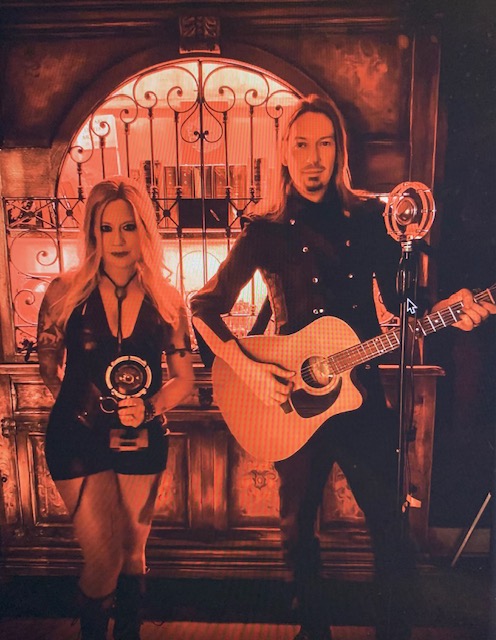
Gallows West – Lauren & Stacy Hogan
Stacy Hogan 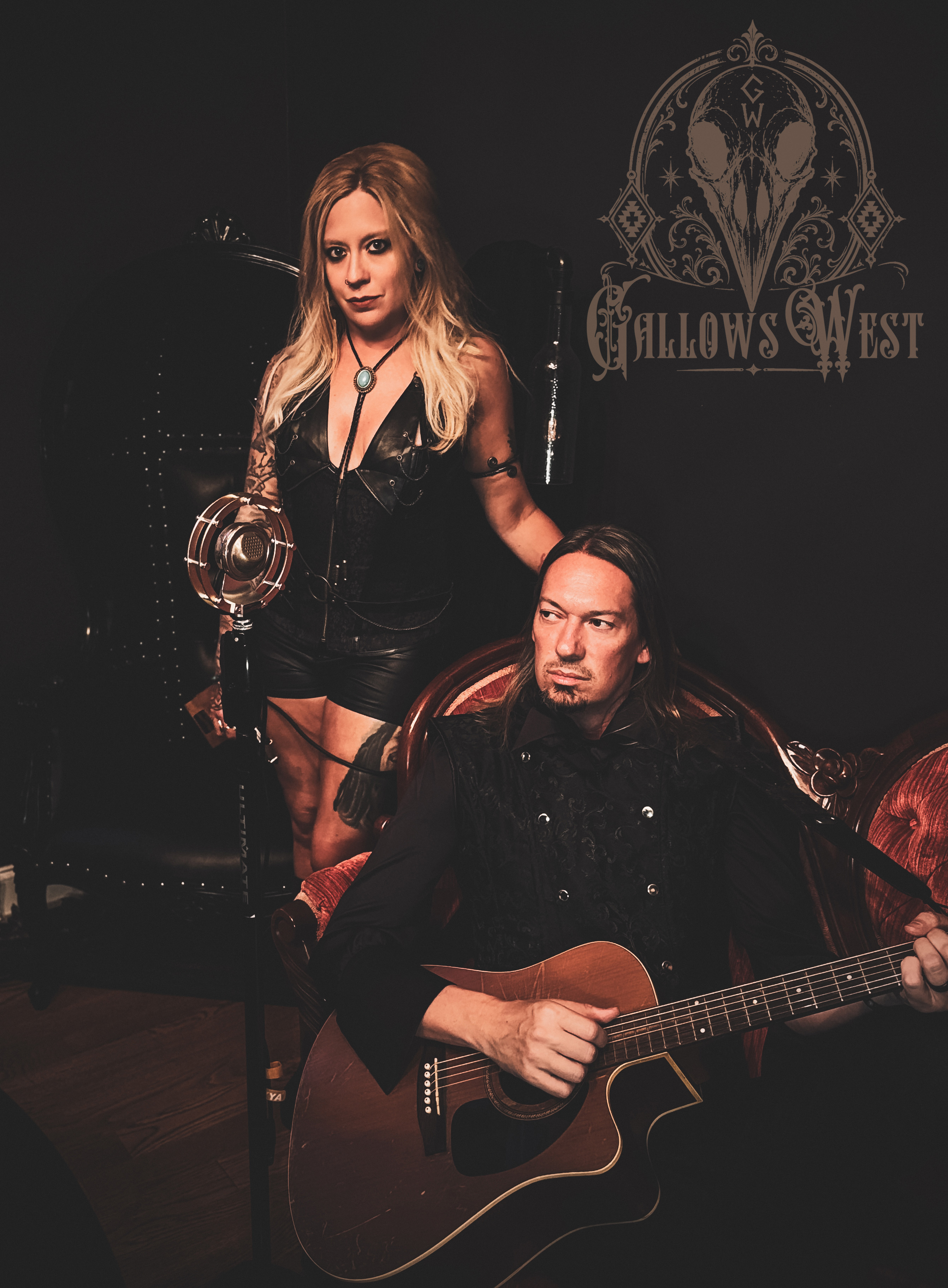 is a Nashville-based producer, mixer, songwriter, and artist with more than 20 years of experience in the music industry. As the founder and owner of A Writer’s Paradise, Hogan has built a career helping artists develop songs from the ground up — from writing and production to mixing, mastering, release strategy, promotion, and sync placement.
As an artist, Hogan is best known for Sin Shake Sin, a politically charged alternative rock project that has earned more than 300 million streams, a #1 Amazon single with “Misinformation,” and placements across more than 100 film, television, sports, and video game projects.
Stacy’s music and production work have been connected to major platforms and shows including Cobra Kai, The Voice, American Idol, Call of Duty, The Vampire Diaries, The Daily Show, NFL programming, WWE, Locke & Key, and more. Hogan’s work has also received coverage or recognition from outlets and organizations including: SPIN, Loudwire, Guitar World, BMI, and MUSO.AI, where he has ranked among the top percentage of producers and songwriters.
In addition to his artist career, Hogan has spent years producing and developing independent artists through A Writer’s Paradise, helping clients shape songs, records, branding, and release campaigns with a full-service Nashville-based approach. His work has crossed rock, country, pop, Christian, Americana, cinematic, and alternative genres, with an emphasis on songs that feel emotionally direct, commercially usable, and sonically finished.
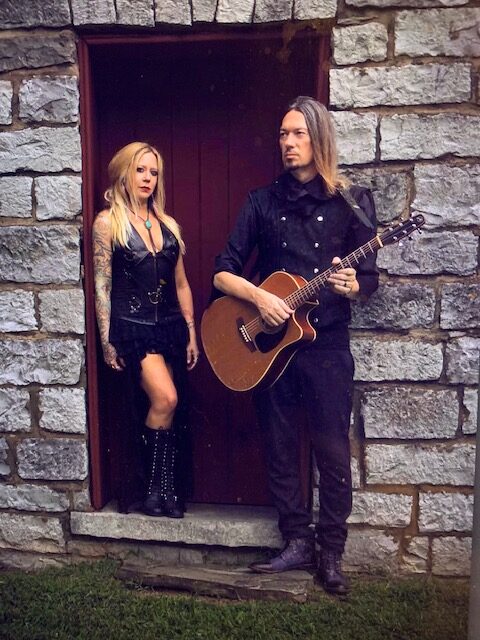
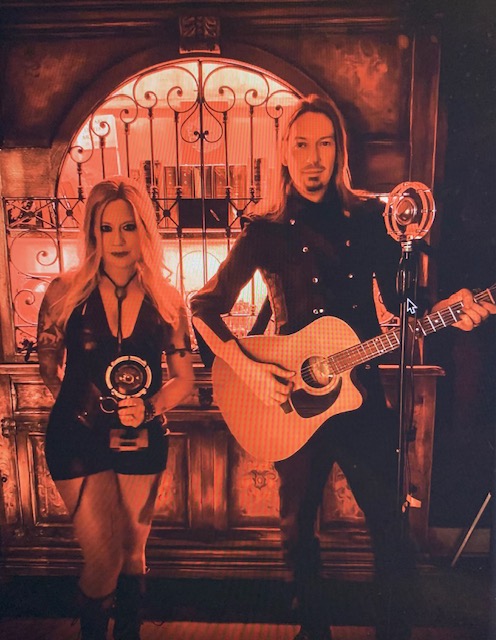
His newest creative chapter is Gallows West, a vocal duo featuring Hogan and his wife, Lauren Hogan. The project grew out of a unique intersection between music, fiction, and cinematic storytelling.
Gallows West is shaped by a their creative partnership. Stacy produces and builds the musical world, while Lauren brings that world to life visually as the director and editor of the project’s videos. She also contributes background vocals and plays a central on-screen role, helping define the project’s visual identity and giving its cinematic world a recognizable presence.
Gallows West began during the creation of music connected to the novel, Cadillac Wheels, by Scott Saxberg. The project was originally developed as the musical identity behind the book’s fictional world and characters, especially the character Tanner Banks. Hogan created a collection of songs that could feel like they existed inside that story — songs with an old-soul, western, haunted Americana quality, but still shaped with the weight and production instincts of modern alternative rock.
That creative experiment eventually became something larger than a book companion. Gallows West developed into its own full artistic world: part dusty outlaw folk, part gothic western, part cinematic alt-rock, and part ghost story. The sound leans into imagery of desert highways, blood-red rivers, old sins, forgotten towns, worn leather, and voices from another century — but with the polish, impact, and atmosphere of a modern record.
The first official Gallows West single is “Where the River Turns Red.” While Gallows West was born from the Cadillac Wheels universe and the project is tied to that larger creative world, “Where the River Turns Red” stands as the first proper public statement from the band.
Where the River Turns Red Video!
Click here to view the embedded video.
The song captures the tone Hogan is building around Gallows West: dark, visual, and cinematic, with a sense of American folklore and old-west mythology filtered through modern production. It feels like a story you can hear — murder ballad energy, frontier imagery, and a haunted atmosphere, but with enough rock weight and melodic focus to sit naturally beside Hogan’s broader catalog.
For Hogan, Gallows West also represents a creative shift. After years of writing politically charged music with Sin Shake Sin, Gallows West offers a different kind of expression — less about the daily fight of modern culture and more about timeless stories, atmosphere, character, place, and myth. It allows him to build a world instead of simply react to one.
The project also gives Hogan a way to connect several parts of his career: songwriting, production, sync-minded storytelling, artist development, visual branding, and literary collaboration. Gallows West is not just a band name; it is a world with a sound, a setting, and a mythology.
At its core, Gallows West is Stacy and Lauren Hogan stepping into a darker, more cinematic version of Americana — one that carries the grit of the Old West, the shadow of southern gothic storytelling, and the scale of modern alternative rock.
A Writer’s Paradise Studios – Nashville, TN
www.AWritersParadise.com
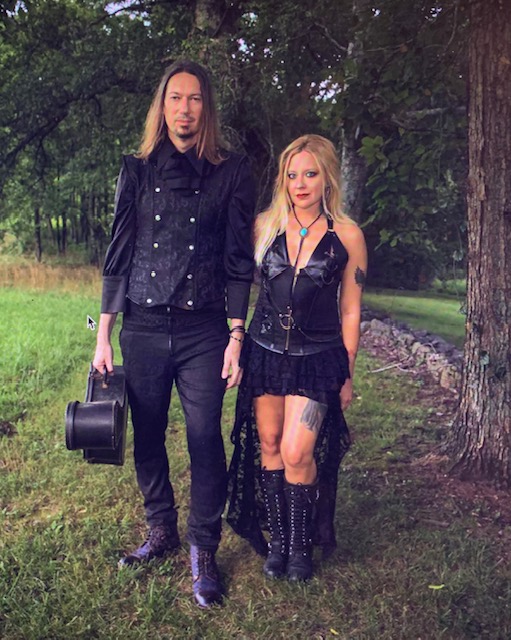
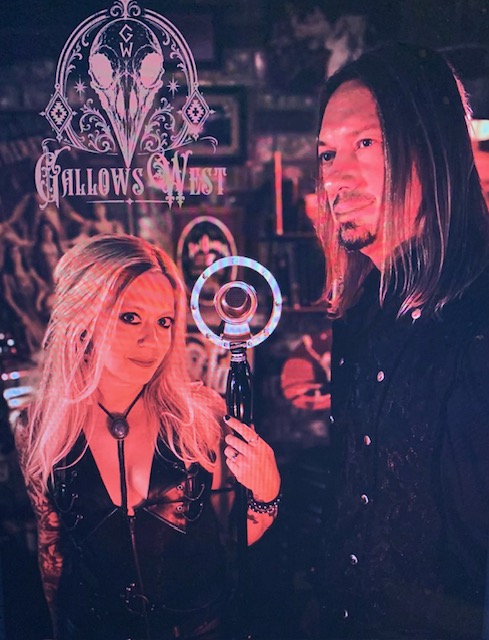
GALLOWS WEST PHOTO GALLERY
Totally Guitars Weekly Update July 24, 2026
July 24, 2026 A student recently wanted to learn Do You Know The Way To San Jose, which brought the song back into my orbit and…what a great piece of music by Burt Bacharach and Hal David. We now have a lesson on it that looks at three different ways of accompanying a vocalist, ranging […]
The post Totally Guitars Weekly Update July 24, 2026 appeared first on On The Beat with Totally Guitars.
Lizzie No’s Songs of Solidarity | Acoustic Guitar Sessions

Richie Faulkner’s dad made him listen to music in the car at full blast to prepare for how loud a gig would be

We all remember our first rock concert. Realistically, nothing was ever going to prepare us for how loud it was going to be. For many of us, that unadulterated, visceral noise was the reason we fell in love with the genre in the first place.
If you went to your first gig as a child, there’s a good chance you went with your parents. And while some parents might choose to furnish their children with earplugs to keep their hearing safe, in the case of Richie Faulkner, his father chose a different tack to get him ready for his first show…
Specifically, Faulkner’s first-ever rock show was a date on Bryan Adams’ Into the fire tour in the late ‘80s.
“It was my first live gig in an arena, and my dad used to take me out in the car preparing me for how loud it was going to be. We’d crank Reckless really loud and drive around listening to songs like Run to You at full volume.”
He continues: “Everyone at school was getting into guitar music, but instead of buying a Guns N’ Roses record like everyone else was, I bought Live After Death by Iron Maiden.
“I remember trying to learn Hallowed Be Thy Name with the light and shade and the different parts. The guitars panned left and right, so you had Adrian Smith on one side and Dave Murray on the other. I’d learn Murray’s bits and then turn him off and play the gig, essentially. After school my friends would go out, and I’d just play guitar night after night with Iron Maiden.”
The post Richie Faulkner’s dad made him listen to music in the car at full blast to prepare for how loud a gig would be appeared first on Guitar.com | All Things Guitar.
AFI frontman claims label wanted them to collaborate with 50 Cent – and other terrible advice: “This motherf**ker says to me, ‘What if you were the first band to write a ringtone album?’”
![AFI [main], 50 Cent [inset]](https://guitar.com/wp-content/uploads/2026/07/AFI-50@2000x1500.jpg)
Once upon a time it was the dream of bands everywhere to get signed to a label. It was often the first sign that you had ‘made it’. Now, the internet has enabled self-promotion, leading many to question whether they need a record label in 2026 like they would have done years ago.
In 2024, M. Shadows, frontman of one of the biggest metal bands in the world, Avenged Sevenfold, questioned the legitimacy of record labels and what they’re able to offer artists.
“You’re going to take 24 cents on our dollar and that’s all you can do, come up with a f**king fake viral TikTok moment?” he asked.
Now, AFI frontman Davey Havok has shared some of the strange advice given to the band after they’d signed to Dreamworks in the mid-2000s.
“The writing of Decemberunderground was a miserable period,” he tells Metal Hammer in a new interview.
“We had signed to Dreamworks, but they sold it to Interscope… Out A&R guy was hellbent on trying to get [Interscope boss] Jimmy Iovine – who had expressly claimed in the press that rock is dead – to pay attention to AFI, and so it was suggested that we collab with Jimmy’s great love at the time, which was 50 Cent.”
He continues: “I have nothing against 50 Cent, but what does that even mean?!”
But Havok says the worst advice came around the time ringtones started becoming popular.
“Even worse than this was the era when ringtones were the new technology craze. I love this man and I still see him once a month at the least, but this motherfucker says to me, ‘What if you were to be the first band to write a ringtone album?’”
While certain tracks from 2006’s Decemberunderground were made available as ringtones, the band never made a full-on ringtone album – nor have they ever collaborated with 50 Cent, so it’s safe to say they stuck to their creative guns…
The post AFI frontman claims label wanted them to collaborate with 50 Cent – and other terrible advice: “This motherf**ker says to me, ‘What if you were the first band to write a ringtone album?’” appeared first on Guitar.com | All Things Guitar.
Boss GX-1 review: A gateway to bigger sounds without the bigger price tag?

$229 / £219, boss.info
In the 49 years since the brand first blessed the world with a compact effects pedal, Boss has been the musical equivalent of a bandmate that always turns up on time, has learned the material perfectly, and offers to be the designated driver home.
- READ MORE: Fender Studio Pro 8 and Quantum LT 16 interface review: a guitar-recording match made in heaven?
The best Boss products tend to hit the sweet spot that has made the compact format such an enduring and popular icon of guitar – they’re not too expensive, they’re very well built and they sound great.
Into that equation comes the latest affordable multi-effects processor, with a simple but compelling mission statement: a unit that’s fully loaded with effects, has a user-friendly interface, and contains enough sonic flexibility to keep you knob-turning until you feel the need to upgrade – if ever.
With an SRP of just $229, it’s also eyebrow-raisingly affordable in a world of four-figure multi-effects units. Obviously, this is not meant to go toe-to-toe with Helix or Neural, but so many other players in this space are trying to be that on a budget, leading to a glut of menu-heavy and often clunky equipment that can fry the brain of a newbie to the world of multi-effects.
This, on the surface at least, looks like a much more gentle introduction…
Boss GX-1: what is it?
The GX‑1 is an all‑in‑one guitar effects processor aimed squarely at entry‑level and intermediate players on a budget. It bundles together all the usual suspects of classic effects – overdrive, distortion, modulation, delay and reverb – alongside an intriguing collection of built‑in amp models, all housed within a solid, yet lightweight and portable unit.
Think of it as a guitarist starter kit that’s been lovingly curated rather than hastily assembled. The GX‑1 offers a full buffet of tones, enough to help you discover what you like with ease.
Accessibility is clearly at the forefront of the design process here. You’re not expected to understand the complexities of audio, nor do you need a PhD in engineering to set up your own presets.
Instead, it’s about plugging in, scrolling through sounds, and stumbling upon something that makes you want to keep playing, which, ultimately, is the whole point, right?
 Image: Adam Gasson
Boss GX-1: build quality and usability
If there are two things Boss consistently gets right, it’s usability and solid construction. The GX‑1 continues that proud tradition with reassuring confidence.
The interface is clean, logical and refreshingly inviting. Navigating through presets feels straightforward, and making adjustments is as intuitive as it gets. Hold down the effects button of your choice, and the screen presents your options. Easy. It’s the kind of unit where you can spend more time actually playing and enjoying than puzzling over button combinations and complicated menus.
 Image: Adam Gasson
Physically, it’s lightweight but far from flimsy. The chassis has that trademark Boss ruggedness, giving me the confidence to toss it into a gig bag without hesitation. The footswitches are responsive with a satisfying “click”, and the expression/wah/volume pedal invites some Hendrix-esque stomping. I don’t expect it to be as bomb-proof as my precious 1980s OD-1, but then again, that’s not the brief here. It’s less future heirloom and more faithful companion – the sort of unit you might outgrow eventually, but not before it teaches you a few valuable lessons.
For bedroom practice, guitar lessons, rehearsals and even the odd gig, the GX-1 is more than up to the task. It can also be battery powered, though it breaks with the conventions of some contemporary multi-effects to eschew a built-in rechargeable battery in place of four AA batteries. This is perhaps not the most environmentally friendly way to go about things, and the cost of those batteries will add up over time, but you can also see the wisdom of using something that is easily and quickly replaced – it will also likely enhance the GX-1’s longevity. As well as keeping the initial asking price down.
 Image: Adam Gasson
Boss GX-1: sounds
Plugging in, you can really get the sense that the sonics will be where the GX‑1 begins to justify its place at the upper echelon of this hotly contested corner of the market.
The range of effects and modulation on offer is impressively broad, especially at this price point. From fuzz, crunch, and high-gain drive to spacious delays and reverbs, there’s a lot here to explore and edit to taste. The effects themselves really are top quality, something I wouldn’t have doubted from Boss-made equipment.
Boss has long been known as the undisputed king of looper pedals, so I was pleased to see an excellent little looper has been included here. It’s a little fiddly to activate, as you have to spread your foot across two pedals to get it started. But from there, it’s more straightforward. It’s an inspiring setup on the effects side, particularly for newer players who are still figuring out what “their sound” might mean, and the possibilities really are endless.However, the 23 included amp models, along with many of the harsher drive tones, are something of a mixed bag. The bright, clean presets are spot on out of the box, with very little adjustment needed. They were more than suitable for live use and even some light recording. Some of the crunch sounds hold their own too, particularly when layered into a full mix.
But push things further, and the cracks begin to show. Higher‑gain tones can feel a touch flat, like a photocopy of a photocopy rather than the original document.
That said, context is key. Through many low-stakes settings, these tones work absolutely fine. They might not fool a seasoned tone purist with a Mayer-like ear, but they’re more than capable of inspiring a player who’s still finding their sound.
 Image: Adam Gasson
Boss GX-1: should I buy one?
If you’re just starting out, or looking for a wallet-friendly way to explore a rich tapestry of guitar effects for rehearsals or demo recording, the Boss GX-1 is a strong contender. Its satisfying combination of user accessibility, a wide range of tonal possibilities, and build quality that exceeds its price makes it an excellent choice.
The amp modelling won’t compete with some higher-end units, but the strengths here outweigh the limitations tenfold.
Boss GX-1: alternatives
There’s so much varied and decent competition at this end of the market, the best thing here is probably to look at what you really want if this ain’t it. If you want ultimate screen-free multi-effects simplicity, then the Line 6 POD Express ($179.99/£149.99) is a great option, as is Blackstar’s ID:X Floor One ($269.99/£169). If you want something that’s perhaps a little more in-depth in terms of sounds and editing, Boss’s own GX-10 ($439.99/£349) is very valid, while the HeadRush Flex Prime ($499/£459) goes even further with profiling and all sorts. If you want something that’s directly going against the GX-1 in vibe and price point, NUX’s MG-300 ($169/£129) and Mooer’s GE150 (£149) don’t have Boss’s prestige, but they’re very good for the money.
The post Boss GX-1 review: A gateway to bigger sounds without the bigger price tag? appeared first on Guitar.com | All Things Guitar.
“I couldn’t play to the potential they needed”: How insecurity made Jim Root turn down joining Slipknot at first

A list of the best modern-day metal guitarists is scarcely complete without Jim Root. His dizzying legato runs in Slipknot are now legendary – try Sulfur or Psychosocial for a quick primer – but, while it may be hard to believe, the guitarist reveals he hasn’t always been sure in his technical ability.
In fact, before joining Iowa’s would-be metal titans in 1999, Root had pretty much checked out of guitar playing altogether. “I was bitter, because I had passed 18 years old and didn’t ‘make it,’” he tells Ben Giese in a new episode of the RIDE BYND podcast.
Root – also a passionate motorcycle enthusiast – says there was a time before joining Slipknot that he didn’t even own a guitar.
“I think I had an amplifier still, but I didn’t even have a guitar at the time,” he says. “I’d given up. I was working at a screen printing place. It was seasonal, and I’d collect unemployment in the winter.”
“My parents had just gotten divorced so I moved in with my mom so she wouldn’t be so low,” he continues. “Then I was just kinda like, ‘Well, this is gonna be it. Maybe something will happen. Maybe there’s a light at the end of the tunnel.’ But I’d resigned myself to the fact that music was just gonna be done.”
But some time later, the call came from then-Slipknot frontman Anders Colsefni asking Root if he was interested in joining the band.
“When that happened, I think Donnie Steele was the guitar player at the time,” Root recalls. “Joey [Jordison, late first drummer of Slipknot] was the drummer… They were players, man… And I hadn’t been playing for so long. I just didn’t feel like my ability was good enough to join their band.
“I didn’t say no to them for any other reason than I just didn’t feel like I was ready for it. I didn’t feel like I could play up to the potential that they needed as a guitar player. Self-defeating, maybe, a little bit.”
Root later answered the call, which proved to be the best career move he could ever make. In the nearly 30 years since he joined the band, Slipknot have become one of the quintessential forces in modern metal, putting out seven top-selling studio albums, frequently headlining festival slots and regularly playing sold-out arena shows.
He’s also made his mark as one of the more unconventional Tele players around right now. The Fender Telecaster is traditionally an instrument claimed by country, blues and softer rock artists, but Root loaded EMG pickups into one and streamlined its features to make it his own signature metal-ready monster.
In a recent video with Fender, Root explained his love of the Telecaster, saying it’s so cool as a guitar design it’s like a timeless pair of sunglasses.
“Everybody thought I should be coming out with some pointy metal guitar that’s got 12 points or whatever. No, how about we just do a classic slab iconic guitar?” he said of his signature model. “Guitars, in my opinion, are like sunglasses. The classics never go out of style. They’ll always be there. People will make their version of it, but there’s only one Fender Telecaster.”
The post “I couldn’t play to the potential they needed”: How insecurity made Jim Root turn down joining Slipknot at first appeared first on Guitar.com | All Things Guitar.
Pages
