
Music is the universal language
“Glory to God in the highest heaven, and on earth peace to those on whom his favor rests.” - Luke 2:14
Norse Guitar Feeds
Excerpt: Bad Religion’s Brian Baker in the Fretboard Journal 60
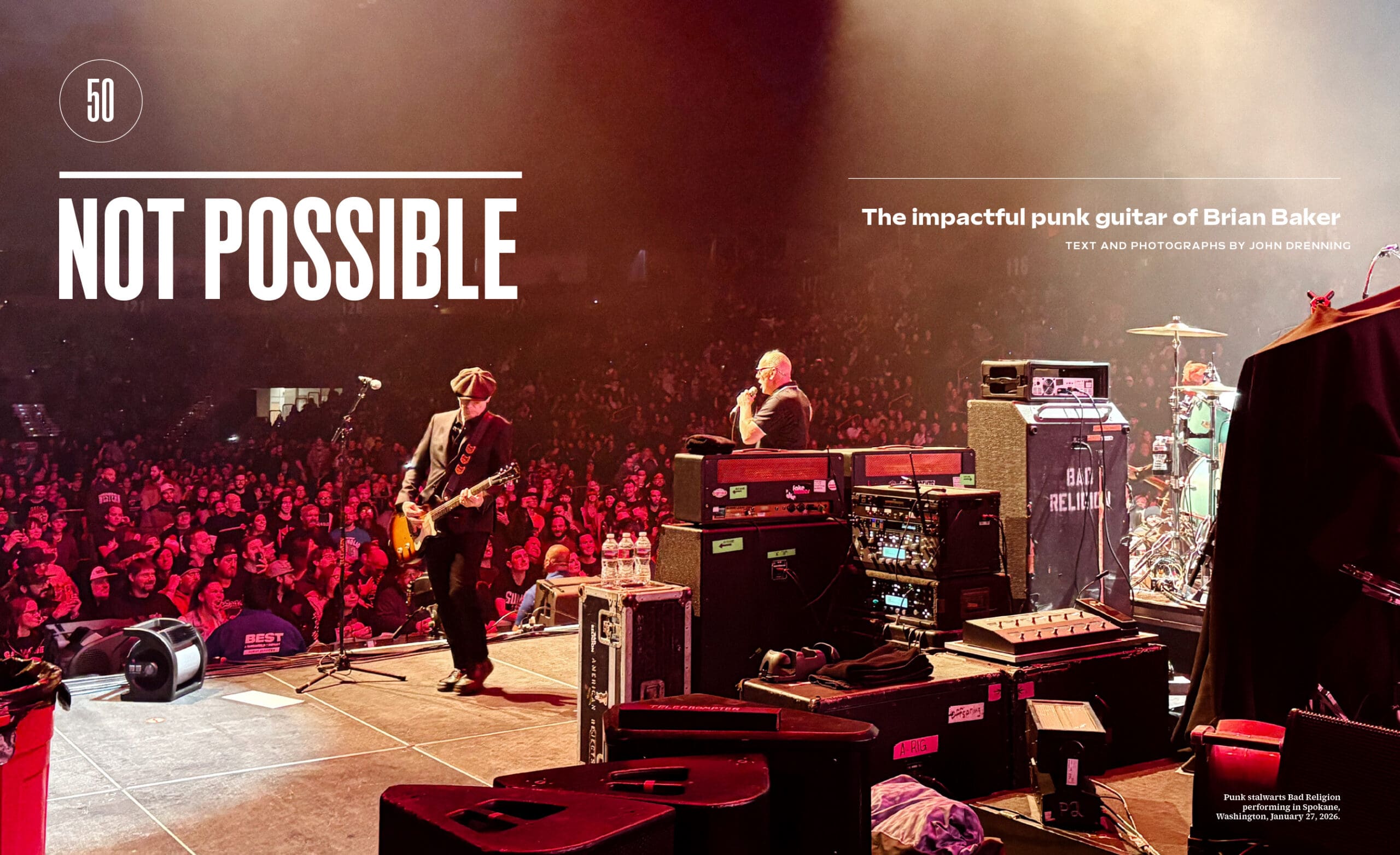
In our 60th issue of the Fretboard Journal (out now), John Drenning sits down with Brian Baker of Bad Religion/Minor Threat fame. The result is an 8,000-word interview that spans some 14 pages of our magazine. As a reader-supported publication, we seldom post stories online, but we thought we’d share a few choice excerpts for all to see. The complete article can be purchased here. -Editor
What’s the point of asking a guitar player their influences? It’s like asking someone their top five albums; it very quickly becomes an exercise in taste and curation. What does it say about me if I name Tom Verlaine instead of Ace Frehley? It’s more honest to think in terms of musical DNA: the guitarists who, when you come up with a riff, you realize they already wrote it; the ones who were the godparents of your own style because you couldn’t do what they did. This imitation isn’t self-conscious. These are the players who made you want to play, and taught you how. Tastes change; DNA doesn’t.
Have you ever met one of these players? What would you say if you did? I met Brian Baker by chance in 1993, backstage at the Whisky. Brian wasn’t just in one of the bands that was most important to me when I was a teenager just a few years prior, learning to play, write, and gig. He was in two of them. There is no question I’d play guitar differently, and maybe even be a different person, if I’d never heard those bands.
I introduced myself and asked what he was doing musically. The man couldn’t have been nicer. After some chitchat and feigned nonchalance, I told Brian his guitar playing and the songs he wrote were more important to me than I could begin to explain, and I just wanted to thank him for that.
He thanked me, very graciously, and then said: You should hear the other guitar player in my band.
Over 30 years later, Brian describes his own talent the way Fonzie apologizes: hesitantly, and under duress. “It was one of those weird things: I could play guitar in a weirdly good way for a very small baby boy…good enough to where it was like a carnival act.” Early influences—DNA, if you will—were “Angus and Malcolm [Young], Billy Gibbons, Eddie Van Halen…My debt to Angus is immeasurable, but if you truly understand Malcolm — talking about him gets me emotional; he’s that good.”
Brian took lessons as a kid, but wasn’t a serious student — “I was a child, and I wanted to skateboard.” In 1978, when he was 13, Brian went full Frehley and added a third pickup and two toggle switches to his Norlin-era Les Paul Deluxe, because it was 1978, and he was 13. Instead of cranking his first amp, a Princeton, or using a pedal for distortion, Brian plugged the speaker into the extension speaker jack. (Amp guru Andy Marshall told me that when you plug a speaker into the external jack only, the main speaker out becomes a “dead short,” and 95% of the amp’s power goes to ground. Per Andy, don’t try this at home unless you like the smell of smoke.)
Brian told me that by ninth grade, “guitar was already my personality, and my entree into polite society.” Guitar was also his entree to the stage at Detroit’s Cobo Hall, where he jammed onstage with Carlos Santana in March of ’79, the month after he turned 14. Did he think at this age he would play guitar for a living? “No, because that’s not possible…I was going to go to college, because that’s what one does.” But then, “almost accidentally,” Brian became a founding member of the most influential high school band of all time.
Minor Threat was one of the first D.C. hardcore bands, which means it was one of the first hardcore bands. As Michael Azzerad put it in Our Band Could Be Your Life: “Black Flag may have been its godfathers and the Bad Brains may have revved up its tempo to light speed, but hardcore has no more definitive band than Minor Threat.” In 1980, Lyle Preslar asked his classmate Brian to play bass. Then 15, Brian had “gone punk” shortly after moving back to DC from Michigan. “I was just one of the few people around who wasn’t already in a band, and knew how to play an instrument. That’s how I got in. I cut my own hair, and I knew how to play guitar.”
Minor Threat didn’t last long—very few of these bands did—but they developed fast, and by the time I discovered hardcore in 1984, a year after they broke up, they were one of the genre’s defining bands. Their eponymous first 7″, with eight songs, runs a little over nine minutes. As Bad Religion co-founder Brett Gurewitz said, 1981’s Minor Threat “set the rule book. It showed how fast, and how tight, hardcore can be, and what it should be.” It was ground zero for straight edge, which altered the trajectory of a lot of kids’ lives, mine included. Later that year they released their second 7″, In My Eyes, having grown rapidly in the intervening six months. Describing songs like “In My Eyes” and “Look Back And Laugh,” author Ben Merlis jokingly called it “prog-ified hardcore—let’s make a three-minute song with lots of parts, but still have it be really hardcore and still have it be really catchy. Good luck doing that. Look how many lesser bands tried copying that later, and it didn’t work.” As a teenage member of one of those lesser bands, I can testify that while the exact recipe was impossible to recreate, the general approach scaled well.
Minor Threat recorded Out Of Step in January 1983. The nine-song EP, 15 seconds shorter in its entirety than the Yes song “The Gates Of Delirium,” has cast the longest shadow, but by this point the internal pressures in the band had become unsustainable. Their last show was September 1983. How do you know your hardcore band is breaking up? Your guitar player sells his Marshall, and buys a Roland Jazz Chorus.
Brian has always been forthright about his belief that, as he told me, “If I hadn’t been in Minor Threat, I do not believe we’d be having this conversation.” If Preslar had asked a different classmate to play bass in his high school band, it’s not hard to imagine Brian as, say, an American history professor. And Brian is quick to credit singer Ian MacKaye’s focus and foresight as key to Minor Threat’s lasting influence. “I was lucky enough to be close to someone with that vision and skillset… those of us who were lucky enough to make records with him when we were very young go on to have conversations with John who’s in Seattle right now for Fretboard Journal.” I don’t believe this is false modesty. The music industry is bleak.
And yet. Seneca: “Luck is what happens when preparation meets opportunity;” Picasso: “Inspiration exists, but it has to find you working.” Etc. Brian may be the most influential musician in the genre, and his playing easily passes the Les Paul test: asked about the hyper-technical shredders of the 80s, Paul responded, “but when they’re on the radio, can their mother tell it’s them?” And multiple collaborators described how Brian’s intuitive contributions could improve their material: he occupies that rare shared territory between technical excellence, which usually arises from ego, and an egoless ability to make the song better. If punk has a Mike Campbell (who has played on two Bad Religion tracks), it’s Brian Baker.
I asked Brian if he thought in his teens and twenties that he could be a professional musician. He responded, “I didn’t know I could do it for a living until I was already doing it for a living.” By then he was in his 30s and had been in Bad Religion for a couple years, and would get home from tour and not have to get a day job. He’d been touring half his life by then: longtime friend and current Fake Names bandmate Johnny Temple (Soulside, Girls Against Boys) told me he and Brian were in high school chemistry class together, and he remembered “Brian leaving class to go on tour with fucking Minor Threat.” Brian said, “There are times when I should have just stopped, but I didn’t know, I just kept going.”
Formed in 1985, Dag Nasty was the second legendary band Brian was in, but was the only band where he was the primary writer, sole guitarist, and, for a time, lyricist. (Brian would be equally comfortable having the descriptor “felon” in the same sentence as his name as “legendary.”) Their first album, Can I Say, was recorded and mixed with minimal overdubs (Brian: “Did we all make it through? OK, let’s keep that take”) in about 20 hours the following year. Brian used his regular gigging rig, as anyone would have on a punk record at the time: an early-70s Les Paul Deluxe Goldtop into a 100-watt ’78 Marshall JMP100, along with an MXR M-134 chorus pedal that was lying around the studio.
Can I Say has the visceral punch of Out Of Step. But the songwriting is revelatory, the well-rehearsed band having shaped Brian’s riffs into songs that didn’t conform to the hardcore mold. The rhythm section of Colin Sears and Roger Marbury was seamless, packing more low-end punch than their hardcore contemporaries. Dave Smalley’s vocals were delivered with uncommon conviction, perfectly blending melody and power. And the lyrics are, well, emotional, not what subsequent Dag vocalist Peter Cortner called “made-to-order anthemic lyrics.” Ben Merlis told me, “The songwriting is incredible; just the right balance of melody and aggression. The recording sounds impeccable—it sounds fresh, and it sounds like you’re in the room with them.” Pete Chramiec, guitarist for Verbal Assault, described hearing Dag Nasty and “immediately turning the ship in that direction. It was a necessary course correction, that you could be way more interesting, and way more musical. We were already getting sick of the macho shit.” End on End podcast cohost Jeff Kaplan told me: “There were already traces of melody in hardcore, including Minor Threat. But Can I Say is the point where you could say, this isn’t just hardcore that’s experimenting with some melodic elements; this is the record that invents melodic hardcore. And I feel like hardcore, even with Minor Threat, had to have this toughness to it, even though Minor Threat weren’t your prototypical tough hardcore guys. It wasn’t macho, but there was still this tough edge to it. Whereas with Can I Say, it was okay to be vulnerable. For the first time in hardcore, we don’t need to be so fucking tough.”
Can I Say is where Brian’s distinctive playing style fully emerged. Like another much-“borrowed from” player, Stevie Ray Vaughan, it’s not that his style was unique; instead, like SRV, Brian was able to meld a variety of pre-existing techniques into one cohesive package, and then execute it with feel, technical precision, and originality. And as with SRV, countless pale imitations ensued. (I was a pale imitator of both.) Brian drew from the deep well of Captain Sensible (i.e., the single-note lines), George Harrison (i.e., the riff-based melodicism), and Malcolm Young (well, Malcolm fucking Young), rather than cookie-cutter punk players, but took those influences in an entirely different direction.
No single part of Brian’s style is revolutionary. What made it unique was doing it all, in tune and in time, in service of the song. Brian Gathy, founder of End On End, told me, “It was all about his choices. He didn’t sound superhuman, but he was so laser-focused in his choices…Every guitar part on Can I Say supports the bones of the song.” Jeff Kaplan remarked that “if we had to pick one record in his entire catalog where we said, this is the defining artistic statement made by Brian Baker, I think it has to be Can I Say. Brian was playing at a different level than his peers. He brought a level of tightness, a level of discipline, that was so rare in hardcore in the early-mid 80s. And he was about the song first—you can be this really great guitar player without making it about you, and instead, just make it about the song.”
Dag Nasty, like Minor Threat, had about a three-year run. After two more albums and numerous lineup changes, Dag played their last show in July 1988. The wind had gone out of the sails. And Brian had run into Chris Gates—formerly the bassist of the Big Boys, who Minor Threat played their last show with in DC, not quite five years ago—in the parking lot of an L.A. 7-Eleven. Gates was playing guitar in Junkyard, recently signed to Geffen, and short a guitar player. The switch from melodic hardcore to Skynyrd-meets-Motorhead rock was not a premeditated career move by Brian; he just wanted to keep playing guitar. In their book on the exploding 1980s L.A. hard rock scene, describing the intense competitiveness of the genre, Tom Beaujour and Richard Bienstock observed that “no one stumbled into this (okay, maybe Brian Baker of Junkyard did).”
As Brian pivoted “mainstream” with Junkyard, and hardcore obstinately stayed put, “alternative,” or “college rock” as we called it back then, was pivoting mainstream, too. This was well underway before the release of Nirvana’s Nevermind in September 1991. This arc is best captured by the ur-college rock band, REM. Document, in 1987, sold a million copies, almost doubling the previous year’s Life’s Rich Pageant. 1988’s Green more than doubled the sales of Document, at 2.6 million. Out Of Time, released six months before Nevermind, sold 12 million copies; next year’s Automatic For The People sold 18 million.
When I met Brian backstage at the Whisky in February 1993, a year after Junkyard’s demise, Peter Buck was also backstage. Neither Brian nor I remembered this, though REM bestrode the earth like a colossus at the time. A year later, Brian was REM’s second guitarist.
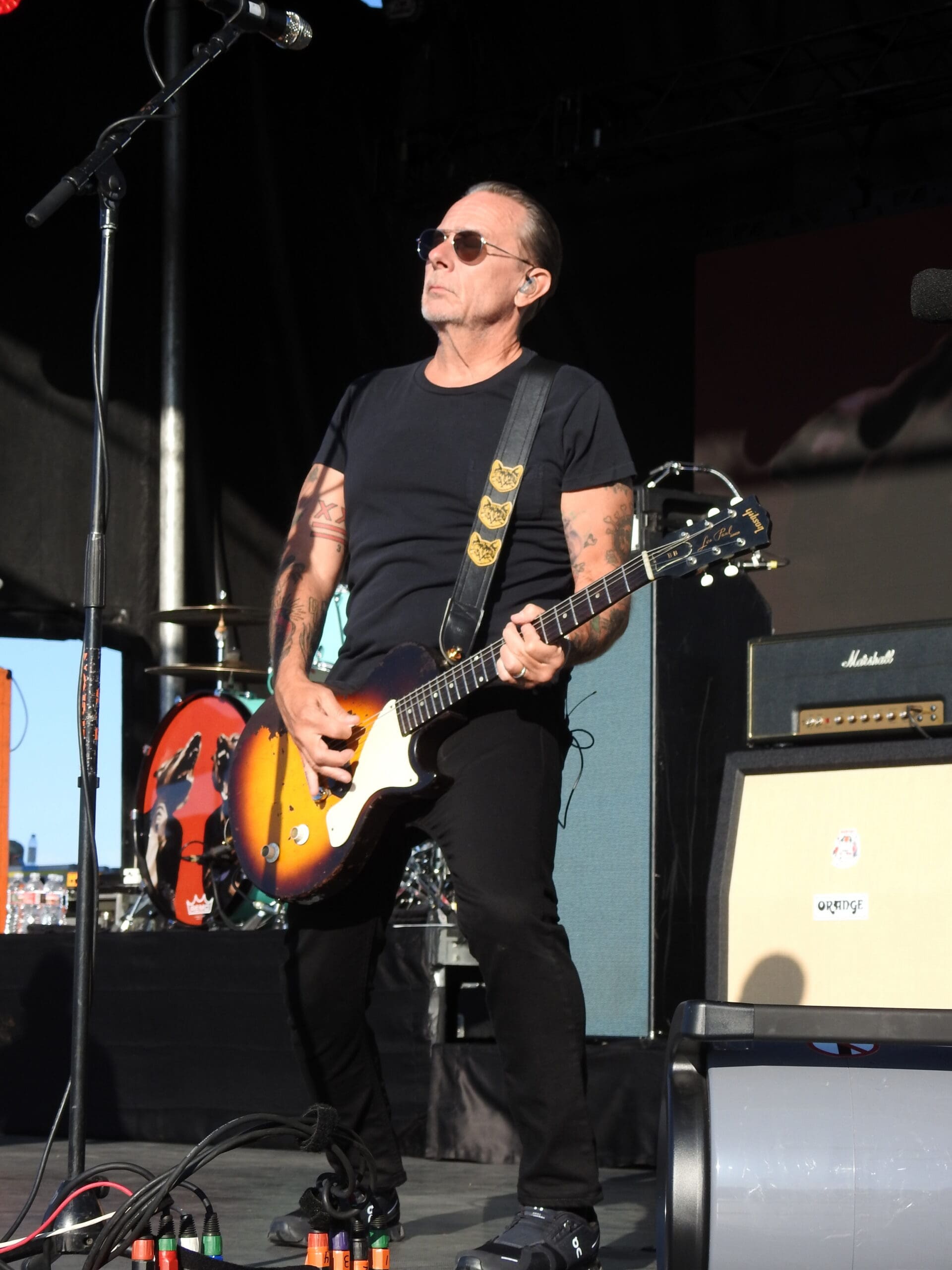
Except, he wasn’t. Shortly after accepting the gig as REM’s touring guitarist, Brian was offered a job as a card-carrying member of Bad Religion. Brian’s chair in Bad Religion had previously been occupied by Brett Gurewitz, founding member and one of the chief songwriters. This is kind of like being offered John Lennon’s spot in The Beatles. In Jim Ruland’s book on Bad Religion, bassist Jay Bentley explained: “When someone leaves the band and people want to know what happened, my answer is, ‘You’ll have to ask him.’ But when someone like Brett leaves and you’ve lost one of your songwriters, you can’t just go, ‘You’ll have to talk to him’ because that’s not going to fly. So having someone like Brian Baker from Minor Threat helped get us out of that awkward conversation. ‘What happened? Here’s Brian!’ It buffered the situation without completely ignoring that we’d lost a major player in our band by replacing him with another major player.”
Hardcore is as obsessed with lineage as the Old Testament. Greg Graffin, Bad Religion’s singer, wrote in his memoir Punk Paradox that a minority of the band’s fans expected the band to fall apart in Gurewitz’s absence. Brian’s pedigree got him in the door, but doesn’t explain why he’s still there: “Once those naysayers realized ‘That’s Brian Baker up there,’ the credibility portion of their criticism would be canceled immediately. But his sound, which is one of the most signature sounds in all of punk, and his virtuosity would do the rest of the talking. It complemented our songs, and blended perfectly with our style, and the audience would soon be treated to hearing a greatly enhanced live set from Bad Religion.”
Brian joined Bad Religion over 30 years ago; only founding members Graffin and Bentley have been in the band longer. As Graffin said, this longevity comes more from Brian’s lineage; Brian’s later collaborator Alec Bourgeois (Severin, Capital City Dusters) described it as “a stroke of luck for all of them.” When I asked Brian about what he brought to a band, he told me that “whatever personality trait” is required for longevity in a band, “I seem to have it.”
Ian MacKaye described Brian’s musical discernment from the beginning; his musical contributions were a big part of why Minor Threat were, as Michael Hampton (S.O.A., Embrace, Fake Names) explained, “heads, and tails, and shoulders above everybody else.” Bourgeois told me, “You talk about musicianship—he was the ringer in Minor Threat, and the reason they were so fucking tight: Brian was the glue there.” And Chris Gates called Brian “literally the perfect definition of a sideman. Without Brian, Minor Threat’s not Minor Threat. Brian’s playing in Junkyard was integral to the sound and how great the band was.”
MacKaye described Brian’s nascent professionalism simply: “Brian is definitely an ambitious guy. He wanted to play guitar for a living.” In the DC scene in the 1980s, this was abnormal, and, arguably, not punk. Brian Gathy said of Brian, “it was clear he had ambition, which, even talking about it now, seems strange to say it as a negative thing [laughing], but it was obvious he wanted a bigger stage, both literally and figuratively…it was clear that he had his eyes on bigger things than being in a good band in DC and maybe touring a little bit; he wanted a career. To some, and we’re talking people in their teens and early 20s, who were high on their own supply of idealism, this professionalism was suspect.
Regarding Brian’s exacting nature, Bourgeois told me: “That precision—it’s not just his playing. And it really does bring people along.” Seattle amp builder and luthier Jesse Quitslund told me that when he’d been working on guitars for almost a decade, Brian asked him to set up his Les Pauls for his first album with Bad Religion. He “did as good a job as I thought was possible,” and returned them to Brian, who “literally played every note on the guitar neck in, like, five seconds, and found the one dead spot.” Brian told him, “This is a really important rock and roll note; can you do anything about this?” This was the first time anyone had asked Quitslund to improve his work; he’d “never set up a guitar for a guitar player who was that technically proficient before.” At the onset of recording, producer Ric Ocasek played all the guitars, declaring Brian’s the only guitars ready to record. Quitslund described it as “a career high point, to have Ric Ocasek praise my work. And Brian, of course, proceeded to nail everything in one take, as he does, and impress everyone, including Ric Ocasek, who then had Brian play in his solo band.”
Everyone I spoke to characterized Brian as very funny, but acerbic, and not one to suffer fools gladly. At some point in every interview, I thought of John McPhee’s description of physicist Edward Teller as having “a sense of humor that could penetrate bone.” Bourgeois said, “Cynical, funny: he is all those things, right? But I think at the center of it, he’s got a giant fucking heart. He’s got a wit that he’s just too tempted by. Brian’s too fucking smart, and too funny.” The corollary to this is that most of the people I spoke to attained prominence as a musician as a teenager. Bourgeois said, “You can’t overemphasize how young everyone was. People were putting out albums and touring before they were out of high school…All the DIY, all the shit that we built is just based on kids not waiting for life to happen to them.” A former bandmate of mine put it succinctly: “we were all kind of assholes back then.”
It’s worth quoting Bill Barbot (Jawbone, Burning Airlines) at length here. When Bill told Ian MacKaye he was joining Foxhall Stacks with Brian: “Ian told me: ‘That motherfucker’s a changed man.’ I think that was Ian’s way of acknowledging that the Brian that he knew, as a young teenager, and the Brian I was in a band with now were completely different people, as far as he was concerned…. Brian went through a lot of transformations, as a person, and as a musician, between when he was ‘launched into fame’ as bass player and guitarist for Minor Threat—that’s a lot of attention to have, at that age, as a kid, that was ‘celebrity’ in our circles—and so the rumor, and the reason I was so nervous about being in a band with Brian Baker, was not just because I knew him to be an exceptional musician, but also because, like, What’s the ego going to be like in the room? Is he going to be critical of my singing or my guitar playing, or look down on me? And he could not have been more the opposite…You could tell he just loved making music so much. And his suggestions came from an intuitive sense of how a song should go. His way of putting things was really positive, and constructive, and helpful. And it’s rare to find someone in life who has that level of expertise in their genre, who also has a sense of how to deliver feedback and be a constructive critic in a way that doesn’t come off as: I’m better than you, because I’m a godfather of hardcore. It felt genuine, and it felt constructive, and it felt like it was offered in the interest of the songs being better.”
One of those transformations was addiction, and then sobriety. Brian said to me, simply, “I lived a lifestyle that allowed me to get away with a lot of shit for a very long time, and it finally got to the point where I was just not able to function, and something had to give.” MacKaye, not one given to sentimentality, seemed to allude to this when he told me, “I think Brian was able to center himself and his life in the last few years in a way that made him really finally reveal what a glorious human being he is. He’s a really lovely dude.”
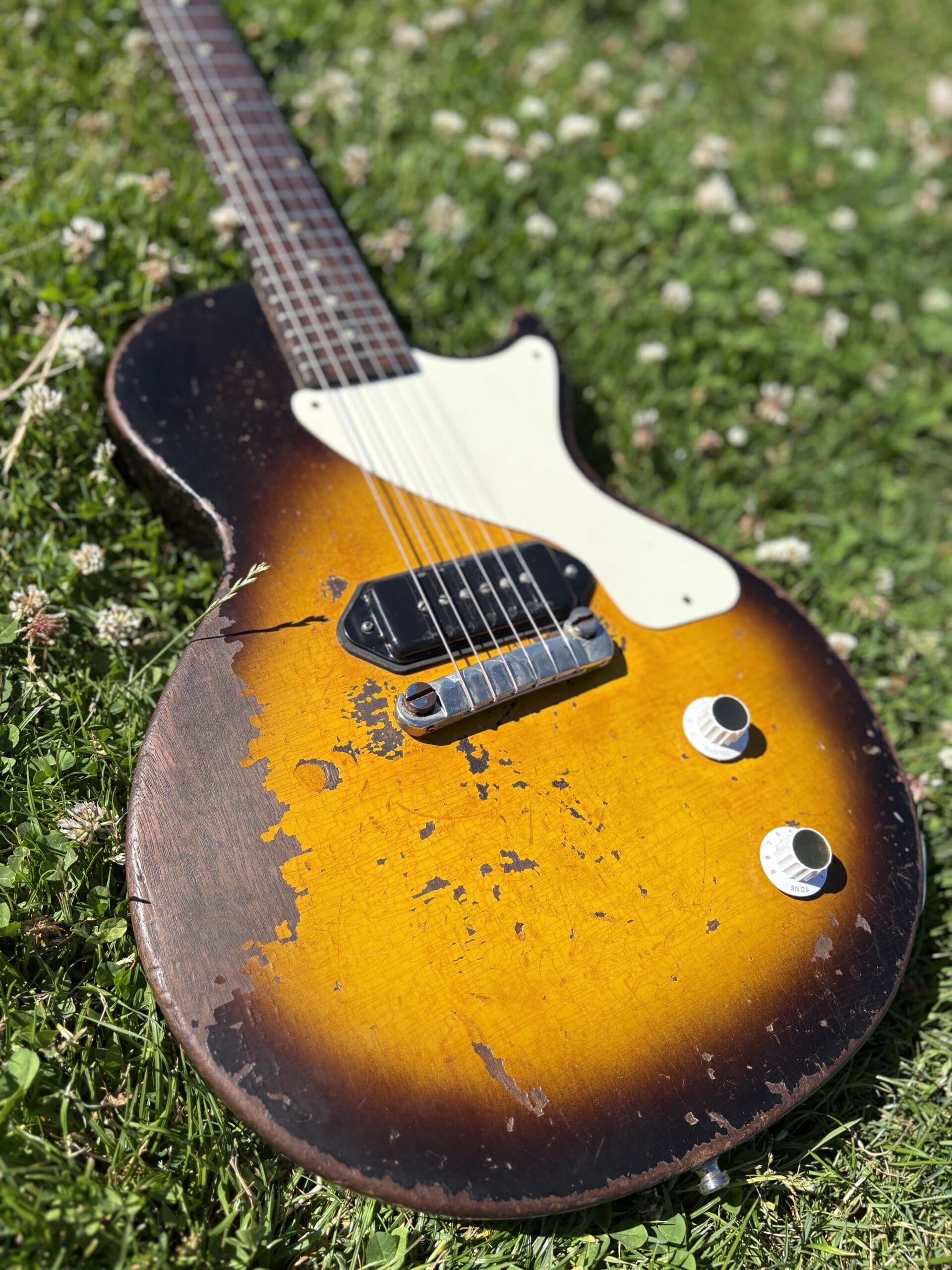
Brian’s primary touring guitars with Bad Religion are a pair of ’55 Les Paul Juniors. Brian is incredibly particular about his gear, but he’s not precious about it. But, in keeping with what Temple called, with approbation, his “fastidiousness,” Brian doesn’t like refins. Every friend of Brian’s I spoke to had a different way of describing him as a perfectionist. He is, however, completely unsentimental about gear. (Brian is the only guitarist I’ve ever spoken to for more than fifteen minutes who didn’t rue a guitar they should never have sold.) Given his minimalist/punk approach to gear, I asked why he didn’t just tour with a reissue. He explained that the older ones have more life, more bloom. And they smell better!
It’s rare to just spontaneously get into vintage Juniors. But when someone puts a Junior in your hands, it’s a revelation. Some years ago Tacoma Luthier Joe Riggio handed me his ’55, with divots in the body from when its original owner used it to drive stakes into the ground. It was the loudest unplugged solid body guitar I’d ever played. As Brian said, “there’s the least amount of things in the way of the vibration” on a Junior.
Brian’s LP Junior sherpa was Bad Religion’s other guitarist, Mike Dimkich. Dismissing complaints about tuning and noise, Dimkich described tuning more as a function of the player than the guitar. (It is very punk rock to view tuning as a matter of personal agency.) He acknowledged the noise, but noise management, like tuning, comes down to personal agency; both Bad Religion guitarists ride their volume knobs relentlessly.
Brian explained that previously, “I didn’t like P-90 guitars because they buzzed and I didn’t like wraptail guitars because you couldn’t intonate them.” But Brian thought Mike “sounded so great…and I was attracted to the economy of the guitar.” Regarding noise, Brian credited a combination of volume knob control and “getting over it.” At first, his “inner nerd” was still obsessing over intonation, but he realized—and I can’t tell you how liberating this epiphany is—“it was the idea of the lack of precision that was bothering me; it wasn’t the lack of precision itself.”
Purchase the issue to read the entire feature.
The post Excerpt: Bad Religion’s Brian Baker in the Fretboard Journal 60 first appeared on Fretboard Journal.
Tonewood Teardown: Upgrading Our Harley Benton Guitar’s Tuners
Hello, and welcome back to Mod Garage! After working on the neck of our Harley Benton guitar last month, let’s spend some money to spruce it up a bit more, starting with the tuners.
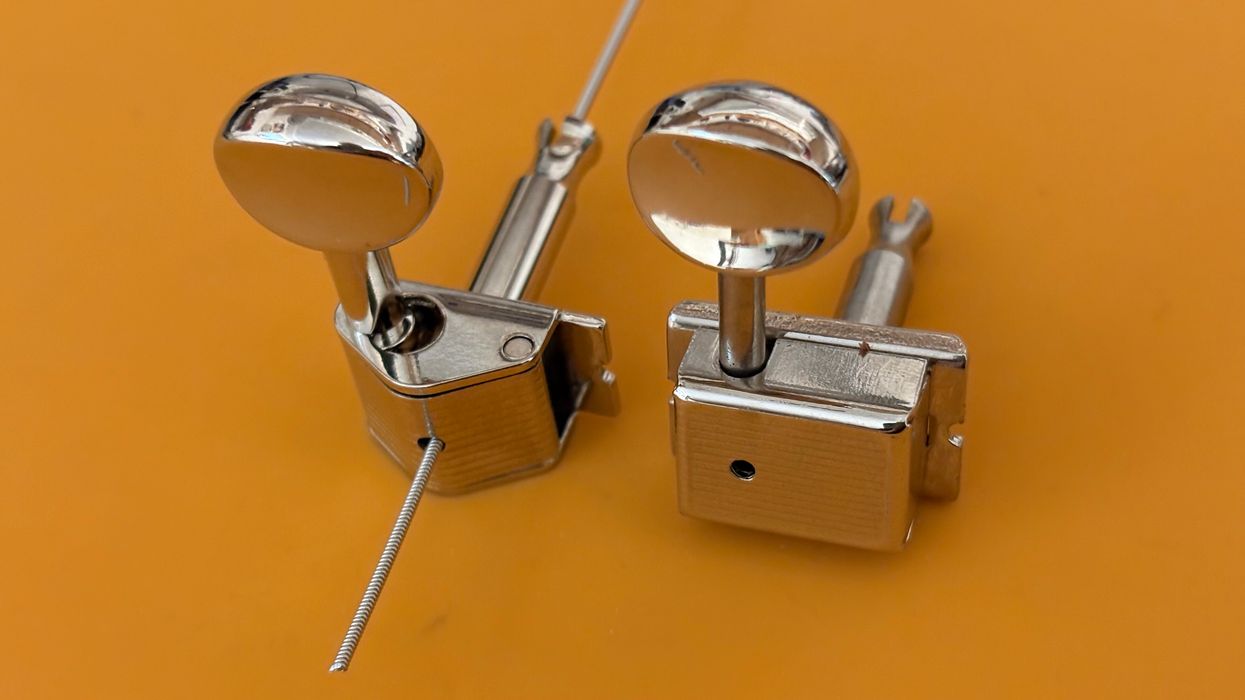
Last month we learned that the stock tuners were pretty heavy, which can lead to neck dive and discomfort. Their stability didn’t impress me, either, so let’s replace them. I wanted to keep our vintage look, so some Kluson originals came to mind. These are also available as locking tuners, which are usually a good choice, but they’re heavier than standard tuners and unnecessary on an Esquire-style electric without a vibrato system. After some research, I decided to use a set of “ClipHAUS” tuners from GÖLDO. This is German vintage at its best: The design goes back to a mechanism made by the ROKO (Robert Kolb) company in the ’60s. What looks like a roof at the top is a clip made of spring steel, pressing the worm shaft against the gear wheel, resulting in backlash-free movement.
However, the old ROKO machine heads, which were used by many guitar manufacturers such as Gretsch, Guild, Höfner, and Framus, were much clunkier and lacked the cool Kluson lining on the clip. Also, these new tuners use a patented “push-through” design: The strings are run through the shaft from the top and can then be clipped off as they sprout out the back—a handy way to avoid scratches and cuts from rogue string ends on your headstock. The housing, including the steel clip, is stamped from sheet steel with extreme precision. As an additional bonus, a set of ClipHAUS tuners is less than half the weight of cast-housing tuners. This particular model is available with different tuner buttons; I went with a set sporting the original oval Kluson shape for a vintage look, which set me back $75 for a full set.
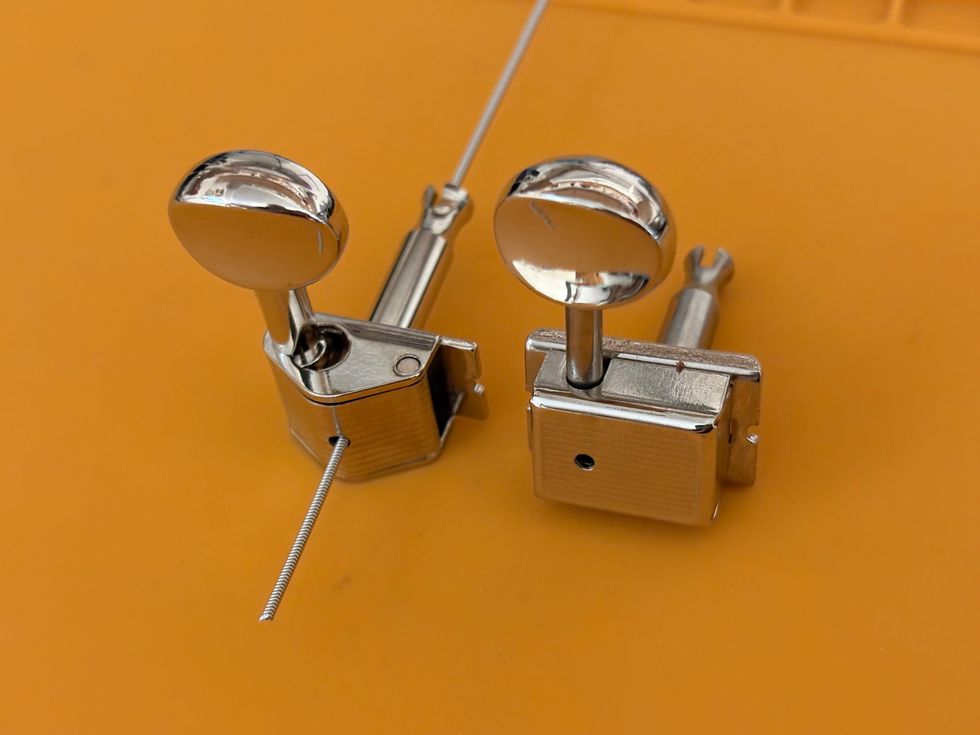
Next, I wanted to give the tuners an “aged” look. First, I broke the shine by giving the tuners, bushings, and buttons a once-over with fine sandpaper or steel wool. If you want to mimic corrosion on the shafts, you’ll want to remove the nickel plating on them completely, a job you can accomplish with steel wool. I placed the tuners and the bushings on some old newspapers, got out my gloves and goggles, and applied some iron oxide (ferric oxide) liquid on them with a Q-tip. Careful not to get any in the tuners—we don’t want any oxidation inside.
Time to decide if you want to mimic the typical oxidation of original non-plated shafts. If you want to do so, apply the liquid only to the case and buttons, leaving out the shaft. Watch the process carefully, and if you like what you see, stop the process by wiping the liquid off the tuner with a wet cloth or paper towel. Afterwards, apply the liquid to the shaft only and watch and stop the process when you’re content. This will take longer on the shaft than on the cover, so I recommend doing it in two individual steps. Personally, I didn’t want oxidation on the tuner shafts, so I simply put on the liquid in only one step. Reminder: This is just one way for aging your hardware, which I chose because its cheap, easy, effective, and safe. There are plenty of others you can try!
Don’t forget to put a drop of oil into the tuners and turn the shaft several times to lubricate them. One drop is plenty, and will last a very long time.
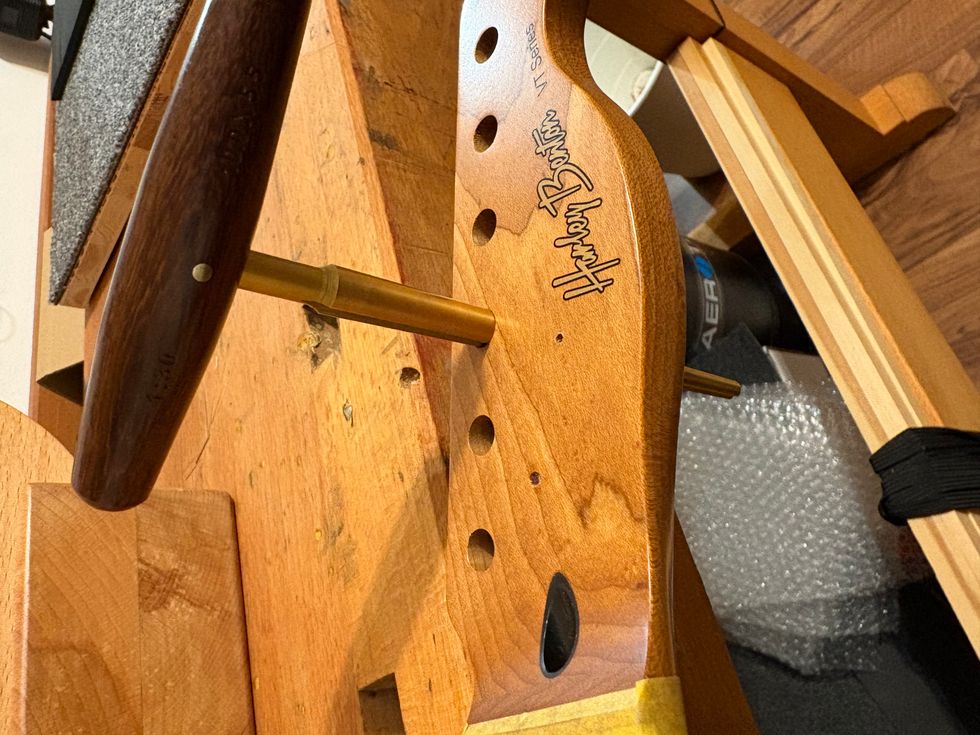
After a quick check, I realized that the new bushings wouldn’t fit the holes in the headstock, and the old screw holes wouldn’t fit for the new tuners. That led to two easy tasks, if you have the right tools.
The headstock’s holes need to be enlarged, which at first might sound like an easy task. Unfortunately, it’s not, and a word of warning: Never try to enlarge a hole in a guitar’s headstock with your hand-held drill and standard drill bit! It will almost certainly end in disaster. Instead, here are three options I recommend:
-The quick and dirty solution: Use a sharp, fine, coarse, rounded file for wood, and enlarge the hole carefully until it’s big enough. If it’s not perfectly round, don’t worry. The bushings on top will mask your dirty little secret.
-The semi-pro solution: Use a very sharp countersunk drill bit in your stationary drill press, and choose a moderate speed. Don’t forget to wear gloves and goggles for this, and drill from the top towards the back of the headstock.
-The professional solution: Use a very sharp handheld tapered reamer. You’ll only need 20 seconds to do each hole.
I decided to use a reamer, so the new bushings will fit tight and snuggly.
For closing the screw holes on the back of the tuner, as well as closing one of the screw holes for the string trees, I decided to use toothpicks and some wood glue. Standard toothpicks are typically made out of any soft wood like birch, which makes them a poor choice for closing holes on a guitar, especially if you need to drill into them later on. Such soft toothpicks can be stabilized by using some super glue, but the better option is to use hard bamboo toothpicks, like you might find in a local Asian restaurant. They’re a bit thicker in diameter and much harder compared to standard toothpicks, so they’re a great match for this task.
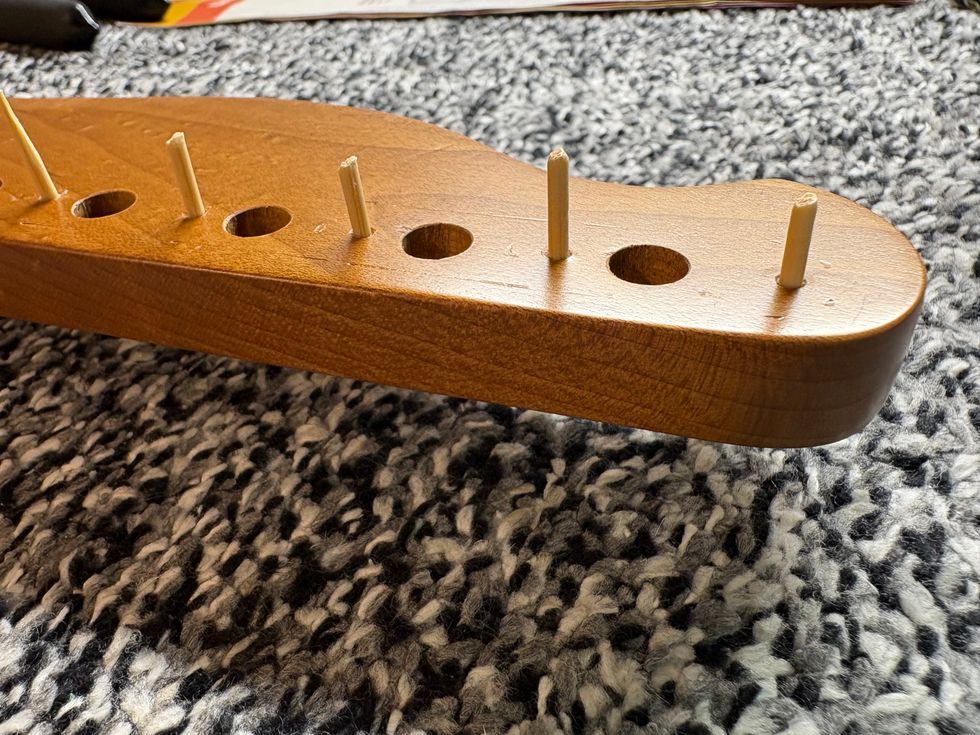
After the wood glue has completely dried, you can chop off the toothpicks carefully flush with a sharp chisel, exacto knife, or razor blade. Because the area will be covered with the new tuners, you don’t need to be super careful, but putting a bit of tape to protect the surface won’t hurt.
We spent $75 on our tuners this month, so our budget for future investments is down to $121. We’re not out of the woods yet: Next month, we’ll press in the new bushings the right way and continue working on the neck, so stay tuned.
Until then, keep on modding!
These are the best deals at Guitar Center this week

We all know Gear Acquisition Syndrome is real, but it hurts a whole lot less when you’re saving a few hundred bucks. If you’ve been waiting for the right excuse to upgrade your rig, Guitar Center’s latest sale might just be it. From American-made Fenders and affordable Epiphones to gig-ready Yamahas, we’ve rounded up the deals actually worth your attention.
Starting with the electrics…
Fender American Professional II Telecaster (was $1,839.99, now $1,639.99)
[deals ids=”3rgK7lWFlZxBZaar8NlAm4″]
If you’ve been waiting for the right moment to invest in an iconic US-made Fender, Guitar Center has knocked $200 off the American Professional II Telecaster in classic Sunburst, bringing it down to $1,639.99. Packed with V-Mod II single-coils, a smooth Deep C neck profile and a sculpted heel for easy upper-fret access, this is an absolute workhorse for gigging players looking for high-end Fender playability.
Epiphone J-45 EC Studio ($399, $359.99)
[deals ids=”5aYcIvqbJzQjY7TWz0ZVt8″]
If you’re after an affordable acoustic-electric, the Epiphone J-45 EC Studio is now $359.99 (down from $399). With a solid Sitka spruce top, sloped-shoulder cutaway body and onboard Fishman electronics, it’s a solid choice for players looking to move between the sofa, the studio and the stage.
Yamaha APX600 Thinline Acoustic-Electric ($369.99, $329.99)
[deals ids=”1J7CyHpm4tdf0A05w0q0CS”]
Electric players after an acoustic that feels immediately familiar should take a look at the Yamaha APX600 Thinline, now going for just $329.99 (down from $369.99). The guitar’s thin-line cutaway body is designed for comfortable live performance, while the built-in pickup system and onboard tuner make it ready for gigs straight out of the box.
Martin D-12E Road Series ($1,079.99)
[deals ids=”bDX3lOtxMKCCbM94qogT3″]
Want classic Martin tone without stepping into the brand’s higher-end price bracket? Guitar Center has knocked nearly $270 off the D-12E Road Series. Built with a solid spruce top and koa fine veneer back and sides, this dreadnought delivers plenty of projection and warmth, while onboard Fishman MX-T electronics make it ready for the stage.
The post These are the best deals at Guitar Center this week appeared first on Guitar.com | All Things Guitar.
Alex Lifeson spent years “fighting for guitar rights” after this Rush song: “It’s a strong song, it’s just the mix that I didn’t like”

Rush’s embrace of synthesisers in the ‘80s may have helped redefine the band’s sound, but it also left Alex Lifeson fighting to keep his guitar heard.
Looking back on the recording of Subdivision, the iconic opening track from 1982’s Signals, Lifeson says the song’s mix marked the start of what he jokingly describes as years spent “fighting for my guitar rights”.
In a recent interview with Classic Rock, the guitarist recalls sitting in on the mixing process for Subdivisions and growing increasingly frustrated as his guitar seemed to vanish beneath the synths.
“I was sitting there thinking: ‘I can’t hear guitar,’” he says. “I’m a very easy-going guy, but I thought: ‘This is not right.’ So I pushed that fader up.”
Producer Terry Brown, however, had other ideas.
“I do remember Terry turning to me and smiling, and reaching over and pulling it back down. I could barely hear my guitar on that mix, and that just screams ‘wrong’ to me.”
The mix went on to become a staple of Rush’s catalogue, and while Lifeson never quite made peace with the balance, he never doubted the material itself.
“It’s a strong song, it’s just the mix that I didn’t like,” he says. “I guess I just fought for my guitar rights for years after that.”
The story echoes comments Lifeson made earlier this year during an appearance on Rick Beato’s YouTube channel, where he admitted to feeling resentful as Geddy Lee’s keyboards began taking on a bigger role in Rush’s sound.
“When we got to the mid-’80s, when we were doing those dense keyboard records, it was really a challenge for me. ’Cause, when we recorded those records, the keyboards went before the guitar,” he said.
“I would sit around, waiting, waiting, and waiting to do guitar stuff. And the more keyboard stuff I heard, the more layers, it was almost impossible for me to figure out how am I gonna fit in here. And by the way, I’m the guitar player in this band. What happened?”
For all his frustrations, Lifeson says Rush’s willingness to evolve was fundamental to the band’s identity.
“I guess you could stay where you are and do the same thing over and over and over again, but that’s not the kind of band we are. Progress is important to us. We always need to go somewhere else. We always wanted to evolve.”
The post Alex Lifeson spent years “fighting for guitar rights” after this Rush song: “It’s a strong song, it’s just the mix that I didn’t like” appeared first on Guitar.com | All Things Guitar.
Joe Bonamassa on the greatest lesson he ever learned from one of his blues heroes: “It was him going, ‘Welcome to the big leagues, kid’”

Joe Bonamassa has looked back on one of the most intimidating moments of his early career, recalling how sharing the stage with blues legend and Telecaster master Albert Collins as a teen taught him some of the “greatest lessons” he’s ever learned as a performer.
Speaking on the No Cover Charge podcast, Bonamassa explains that Collins had a unique way of wielding the guitar not just as an instrument, but as a “weapon” capable of commanding a stage and keeping fellow players on their toes.
“Guitars are great, ‘cos you can use them to coddle people, but you can also use them as a weapon – and I love using guitars as a weapon,” says the guitarist. “You know who’s the best at that? Albert Collins. That was a weapon. They didn’t call him the Iceman for nothing. I mean, I was on the receiving end when I was a kid.”
That unforgettable lesson came at the Silver Lake New York Blues Festival in Hog Rose, where a 12-year-old Bonamassa was invited to sit in with Collins. A year earlier, the young blues prodigy had shared the festival stage with telecaster virtuoso Danny Gatton, where his performance had earned him another slot twelve months later with the Iceman himself.
“They convinced Albert Collins to let me sit in,” Bonamassa recalls. “And he taught me the greatest lessons I’ve ever learned on stage.”
Needless to say, sharing the stage with Collins in his prime was a daunting prospect.
“At the time, I worshiped all those records – the Showdown! record, Ice Pickin’, Frosty.. All that,” says Bonamassa. “So I got up on stage, and I had my little USA Strat with Lace Sensors, and my Sunn Beta Lead solid state 4×12 amp.”
“Debbie Davies was in the band and it was prime time Albert Collins. He had a Tele, a [Fender] Quad Reverb, and about a 150-foot cable because he would go out into the crowd.”
Bonamassa remembers Collins putting him to the test almost immediately.
“He stung a note… He did all that Albert Collins shit, but he kept stinging the note,” says Bonamassa. “I mean, he pointed the Tele like [he was pointing a gun] at me. I’m like this little kid in the cowboy hat. It was his way of saying, ‘Welcome to the big leagues, kid. I don’t care how old you are, being up here requires a certain amount of intestinal fortitude, and I’m testing you to see if you had it.’ So I did my best [plays note] Albert impression.”
Decades on, Bonamassa remains fascinated by the bluesman’s unconventional setup and technique.
“His thing was awesome, because he tuned to open F, and had a really primitive capo. It was kind of gnarly, and I don’t know how he was able to keep the strings from moving. He would bend and not have the strings just move into another position. I don’t know how he did it.”
Watch the full interview below.
The post Joe Bonamassa on the greatest lesson he ever learned from one of his blues heroes: “It was him going, ‘Welcome to the big leagues, kid’” appeared first on Guitar.com | All Things Guitar.
Fender Vintera III Mid ’60s Jazzmaster review: Mexican-made vintage-style offset bliss

$1,349/£1,149, fender.com
It’s strange to think that a few years back, what classed as a bad PR situation for Fender was them shipping the American Vintage II Jazzmaster with a not wholly vintage-correct headstock shape. Simpler times.
Here in 2026, you’d probably forgive Fender taking its eye off the ball a little given everything else that’s going on, but it’s worth remembering that the people actually making and designing these instruments are primarily focused on what they always have been: building the best-sounding, feeling and playing instruments they can at price points that suit pretty much every budget.
The aforementioned AVII headstock snafu was just the latest in a series of incidents where Fender was accused of not quite getting the offset thing by its invariably exacting devotees.
The first Player Jazzmasters, for instance, could have been the best-made guitars on the planet – they were never fully embraced by fans because they had slightly naff-looking open-coil humbuckers in them, and no rhythm circuit. And look, the guy in the demo video didn’t even touch the vibrato, nor did he put the thing through two reverse-reverbs and six fuzzes – do you think he’s even heard Loveless?
A lot has changed since then however, and Fender has done much to make up to the Jazzmaster faithful in the years since – things are undoubtedly better now across the board, but especially in Fender’s Mexico-made Vintera range.
In fact, so good has Ensenada got at making Jazzmasters now, that my colleague Josh felt emboldened to declare that the Road Worn Vintera II guitar he reviewed back in January was “the best all-round Jazzmaster proposition in the Fender range.”
What is it?
The Vintera III range is Fender’s latest attempt to do something that a huge cohort of players want and need the brand to do more than anything else – creating guitars with vintage specs, looks and sounds that don’t require you to take out a small business loan to afford.
It’s been just three short years since the Vintera II launched, however, and there was very little wrong with the old guard, so what’s changed? Well, Vintera III promises to give us an even more accurate take on the vintage JM thing – eschewing the loose decade-spanning scope of the old guitars and focusing on a specific inflection point in a guitar’s development, in this case the mid-1960s – aka the moment that Jazzmasters really started to get fun with custom colours, painted headstocks and the like.
The core sell of the Vintera range remains unchanged – this is a guitar with most of the ‘right’ vintage appointments that’s not so cheap you might as well just get a Squier, and not so expensive that it’s totally beyond the scope of many musicians.
That doesn’t mean it’s cheap, however – sticker shock has come for guitars in a big way over the last few years, and ‘mid-priced’ in Fender terms now stands for $1,349. That is no small number for anyone really, but it’s broadly in line with the guitar it replaced at least – there’s no wince-inducing global inflationary crisis gut-punch that saw hundreds of dollars added to the base price between Vinteras I and II.
While the improvement is clearly iterative with Vintera III, the offsets have changed more than most. Crucially, while the Vintera II Jazzmaster recreated a late-1950s instrument, for III we return to the mid-1960s style of guitar – similar to the first 2019 Vintera run.
As mentioned, that means we have more fun finish options than previous editions – Sonic Blue and Candy Apple Red for those who want matching headstocks, and an Olympic White option – our guitar for today – that comes with a plain headstock.
 Image: Adam Gasson
The latter is a bit of a shame in my opinion as most real Olympic White Jazzmasters from the mid-60s also sported a painted peghead… at least it’s the right shape? Mid 60s also means that we don’t get the bound board with block inlays that came later in the decade – maybe Fender will save that for Vintera IV?
The company’s product page notes a few differences as to how it’s going about the whole “vintage” thing this time around – no real revolutionary changes, but just an overall upping of the focus and detail – the headstock decals are now being applied over the finish, and we’ve got a period-accurate round-laminated rosewood fretboard rather than a slab board, clay-coloured fretboard dots rather than modern white ones, and a real bone nut instead of a synthetic one.
Hardware, electronics and the neck profile are all now “era-based” rather than “decade-based”, which makes sense, given that a “mid-’60s Jazzmaster” can mean a hell of a lot of different things. Fender doesn’t go as far as to put a year on it, but the specs and finish options add up to something approximating, at the latest, a ‘64 Jazzmaster, as bound necks would be introduced in 1965, and the big block inlays/big headstock combo would follow in 1966.
There’s still one major concession to price, in that the finish is poly rather than nitro – no authentic ageing experience for you here. Maybe, like with Vintera II, Fender will wait a year or so and then roll out a road-worn variant with a lightly-aged nitro finish for a little more cash, but until then, we’re strictly in polyurethane town.
Not that the poly finish looks bad, by any means – the Olympic White example I’ve got here is a lovely deep off-white – the white Squier Classic Vibe Jazzmaster next to it in my guitar rack looks as rich and inviting as a sheet of printer paper in comparison.
As a whole the guitar presents very well, and small as they are, those vintage-correct details do have a cumulative effect. The clay dots, for example, really bring the look of the neck together, especially given the rosewood ‘board. On our review example, this rosewood is a chocolate colour so rich and deep I am more than a little tempted to take a bite out of it. Even the three-dimensional nature of the headstock decal being placed over the finish – a detail that seems comically minor on paper – adds a bit of vintage panache to proceedings.
 Image: Adam Gasson
Build quality and playability
I spend a lot of my time playing fairly modern-feeling necks – not quite multi-scale Strandbergs, but at the very least 9.5” boards and jumbo frets. And so getting my mitts around this mid-60s C-profile neck, with its 7.25” radius and vintage-tall frets, is a surprisingly refreshing affair. It is, of course, no slim shredder, but no less comfortable because of this. There’s enough heft to reassure me that I’m actually holding something, but it still allows for some relatively fast movement.
And while it may not be the perfect playground for sweep arpeggios, leads of a less flashy breed are still a hell of a lot of fun – the vintage tall frets are, well, tall, and are therefore great for digging into the side of a string when bending. Down by the headstock, the more curved surface is a lovely affair when fretting big whole-neck chords.
The setup and fretwork in general are great, with no dead spots to speak of and a nice low action. Fender has also continued its trend of gently rolling its fretboard edges, which makes for a supremely comfortable feel, especially when you launch into a big bend that requires hanging onto the neck for dear life, or land on a big open G with less than perfect positioning – the fretboard edges just melt out of your way.
That’s the left hand – at the right hand, the vibrato is the star of the show, as you’d hope from a classic-spec’d Jazzmaster. I find its factory setup pretty dead-on, with a smooth action for some nice woozy pitch-wobbling and just the right amount of tension on things to make it feel responsive and tactile rather than stiff and unwieldy. The rocking bridge also does its job of keeping things in pretty good tune, even after veering into some over-egged wanging on the bar. The push-in arm also stays where I want it, and if I want to move it out of the way, I can do so silently – it does not, as some bars do, creak like the gates of a gothic castle as you move it about.
 Image: Adam Gasson
The one big caveat is this: even sticklers for vintage accuracy would be happy to ignore the anachronism if Fender just admitted defeat, and put a Jaguar bridge on this thing. The threaded saddle bridge has its adherents, but let’s be honest, quite a substantial chunk of offset players will replace theirs by default. There’s a reason the aftermarket Jazzmaster bridge world is absolutely chock-full of options. Fender even makes its own relatively decent mid-priced barrel-saddled option.
We’ve already made one concession to modern player comfort over vintage accuracy, in that these guitars come with 0.010s rather than the heavier strings that work best with the Jazzmaster’s rocking bridge/vibrato combo – so why not just take that extra step, save everyone a few quid, and avoid dooming the stock bridge to rot in a drawer somewhere?
Luckily it’s not a total write-off – the threaded sample example found here does at least function with the factory setup… mostly, as I still occasionally push the low E out of its slot. I’ll put it like this – if I was aiming to make this my main gigging guitar, I’d still seek to replace the bridge as soon as I could, but I wouldn’t shy away from playing the guitar live while said replacement was in the post.
One final gripe – the knobs are still set wrong. When I look down, and the guitar’s on full, I see 4, 5, and 6 – seemingly to let the “volume” and “tone” labels be parallel to the neck. I’ve no idea why they ship like this, because unless you’re playing it like a lap steel you’re not going to see those labels. Everyone else seems to agree that when you look down at a guitar, you should see the number 10 to indicate that you’re on 10. Is this splitting hairs? Yes, but it’s hair-splitting that does actually affect your out-of-box playing experience – if we’re caring about headstock decals being under or over the finish, we’re caring about this, too, Fender!
 Image: Adam Gasson
Sounds
The pickups and electronics are fairly straightforward – no noiseless pickups or fancy switching here, unless you count the near-70-year-old rhythm circuit as a fancy addition. The lead circuit provides all of the spank and the punch you’d want from a Jazzmaster, with a bridge pickup that’s nice and bright but by no means an aural ice-pick, and a rounded, warmer neck pickup that’s got quite a present upper midrange.
The output here is relatively low – perhaps not as low as you might expect from some true vintage examples, but far from any sort of modern, hot pickup output. This does mean that there’s a good amount of dynamic range to be had on clean to lightly-overdriven sounds, even if you’ll want to up the preamp gain somewhere along the chain to compensate – and, on the other end of the spectrum, there’s a surprising amount of breadth and clarity when throwing stacked fuzzes, reverbs and delays at both lead positions.
And speaking of such an activity, the rhythm circuit does its thing, which you will find either unusably muddy or an excellent combination with the aforementioned wall of fuzz and delay, depending on your Jazzmaster preferences. Divisive it may be, it’s still a Jazzmaster, and for many it wouldn’t be complete without it – even for those who dislike it, masking off the switch can be part of the ritual. At this point, a couple of inches of electrical tape should come in the case alongside the vibrato arm…
Personally I find the rounded character of the neck pickup makes the rhythm circuit a pretty usable proposition for both smooth leads and messy Kevin Shields impressions, but for pretty much everything else the brighter, clearer sounds of the lead circuit are more likely to do the trick.
 Image: Adam Gasson
Should I buy one?
If you own a Vintera II Jazzmaster and you like it – I wouldn’t be in a rush to add an extra ‘I’ to the proceedings, unless you’re desperate for a switch to the 60s spec. However, it’d be wrong to expect Vintera III to totally reinvent the Jazzmaster wheel – that’s not really the point of a new range of Vintera guitars. There are only so many ways to skin the particular cat of an 1964-ish Jazzmaster for this price, and with this in mind it’s very nice to see the focus being placed on sharpening the vintage details. These details are packaged up in an extraordinarily well-constructed instrument, one that successfully builds on the successful points of the Vintera II JM.
Even with that upwards shift of the definition of a “mid-priced guitar”, the Vintera range remains a very good bang-for-buck proposition within Fender’s lineup. If you can get over the poly finish, this is as accurate and as playable as you’re going to get if you want a vintage-spec’d Jazzmaster for anywhere this side of £2,000. Or quite a bit more for the real deal. Of course, that accuracy is both better and for worse, perhaps, in the case of the bridge, but hey, what would a Jazzmaster be without a little obtrusiveness?
Vintera III Jazzmaster Alternatives
If you want a similar experience but fancy that nitro finish, some Road Worn Vintera II 50s Jazzmaster models ($1,699/£1,399) are still available in a few places. If you are an offset fan of a slightly different stripe, Vintera III has also arrived with a Jaguar offering ($1,34.99/£1,129). If you want to save a bit of cash, the Player II Jazzmaster offers a relatively authentic but no less enjoyable Jazzmaster experience for very decent price ($879.99/£759), and if you want to go the whole hog and nearabouts double the price tag, you can look at the American Vintage II 1966 Jazzmaster ($2,799/£2,379) now with the right headstock.
The post Fender Vintera III Mid ’60s Jazzmaster review: Mexican-made vintage-style offset bliss appeared first on Guitar.com | All Things Guitar.
TONEX Ecosystem Evolves
MoMojo Records Set To Release Precious Company Sept. 18th
Press Release
Source: Nick Loss-Eaton PR
Jad Tariq
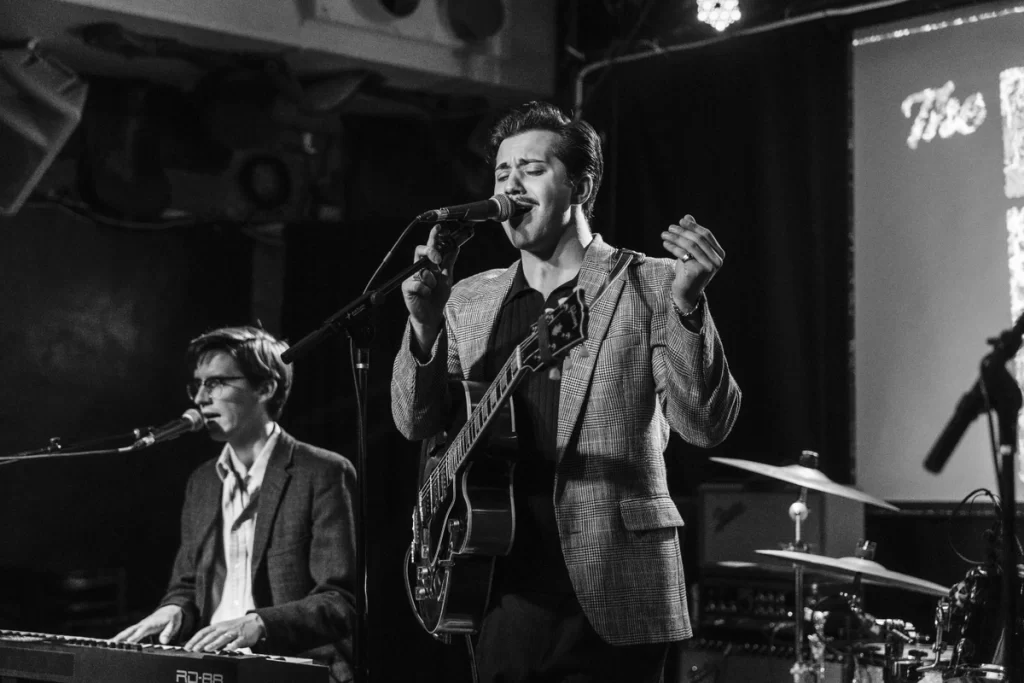
Precious Company slated for September release Memphis-based guitarist, vocalist, and songwriter Jad Tariq made an unforgettable first impression in early 2025 with his debut release, Jad Tariq Sings.
Effortlessly blending feel-good swing with the raw emotional power of the blues, the album quickly captured the attention of audiences and critics alike.
As one reviewer observed, “Jad Tariq leaves no doubt that he has arrived, and that we will be enjoying his artistry for years to come.”
That prediction has proven remarkably accurate. For his highly anticipated sophomore release, Precious Company, Tariq has crafted ten compelling original songs that showcase both his growth as a songwriter and his musical maturity.
Throughout the album, Tariq delivers his well-crafted lyrics and melodies with a rich tone, and his electric guitar dazzles as his playing moves between intimacy and intensity. Backed by some of Memphis’ finest players, Precious Company captures an artist fully stepping into his own, delivering a sound that is both timeless and unmistakably original.
Originally from Trumbull, Connecticut, Tariq began performing professionally at just twelve years old, honing his craft in bars and clubs throughout the tri-state area. At eighteen, he relocated to Memphis, immersing himself in the city’s rich blues tradition.
Since then, he has become a fixture on the Memphis musicscene, performing regularly with his own band while also serving as a sought-after sideman for many of the city’s most respected artists.
Jad has garnered national attention through collaborations with multiple Blues Music Award-winner, John Németh, renowned musician Tony Holiday, and legendary harmonica master Charlie Musselwhite.
Click here to view the embedded video.
Most recently, he earned the prestigious honor of being invited to join Bob Dylan’s touring band for a series of dates. One writer noted: “His instant chemistry with his new bandmates rendered a familiar setlist into something novel and exhilarating. It was easily one of the best Dylan shows I’ve seen over the last 20 years” – fitting praise for one of the most exciting young artists to emerge from today’s blues scene.
“It’s a blessing to see such a talented young artist establish himself and flourish in such a short time,” says MoMojo label manager Debra Clark. “Jad is the complete package. His musicianship speaks for itself, but what impresses me just as much is his professional-ism, humility, and work ethic. Those qualities have earned him the respect of everyone around him and are the basis for what I believe will be a long and remarkable career.”
Jad adds, “I’m so excited to share these 10 new tunes with you all! We recorded these tunes live in my living room studio right here in Memphis. The songs are raw and honest, and I hope you enjoy listening to this record as much as I enjoyed making it!”
Pre-orders will begin August 21; two singles will be released (August 21, September 4) prior to the release date of September 18, 2026.
Win a Taylor Guitars Gold Label 517e Acoustic!

Experience aged-in warmth and deep dreadnought projection. PG has partnered with Taylor Guitars to give one lucky winner a Gold Label 517e! Enter now. (US residents, 18+ Only)
Taylor Guitars Gold Label 517e Giveaway
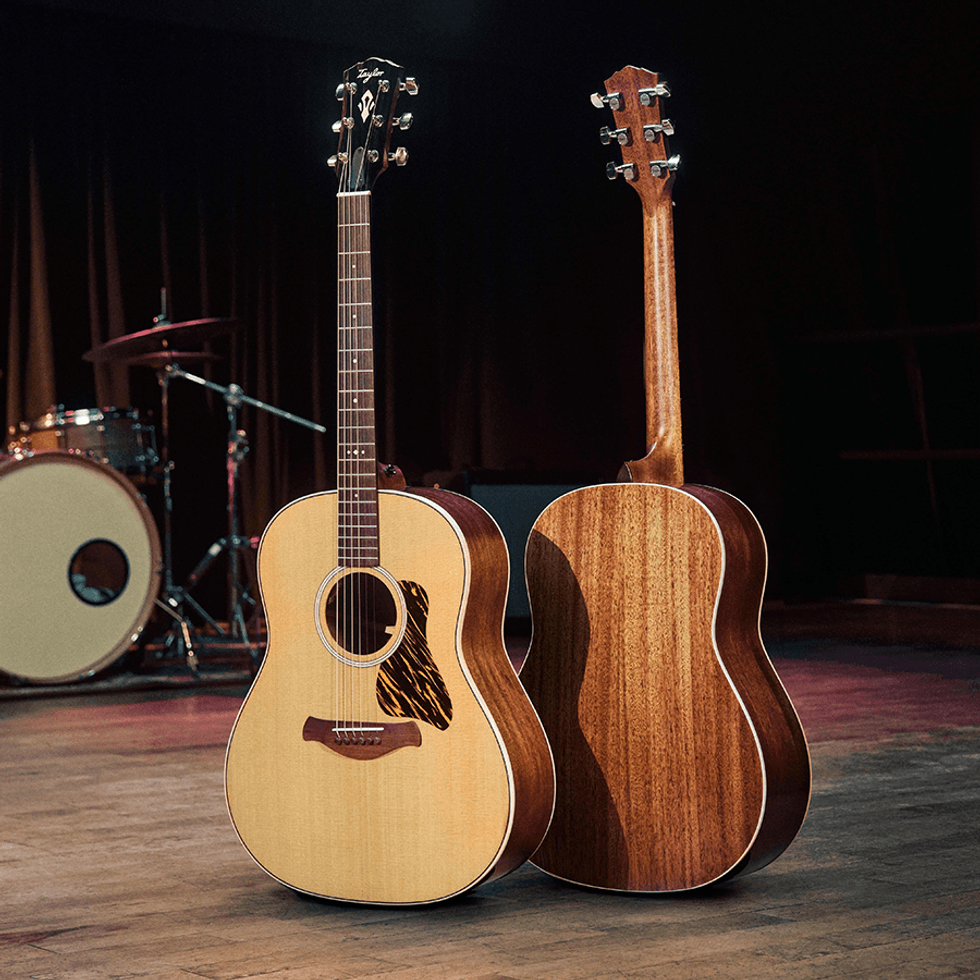
Gold Label 517e
The Gold Label 517e delivers deep, powerful tone with old-school character. Torrefied Sitka spruce, solid mahogany, fanned V-Class bracing, and Action Control Neck™ provide exceptional projection, sustain, and playability.
Adrian Belew, Steve Vai, Tony Levin and Terry Bozzio Announce Tour of the U.S.
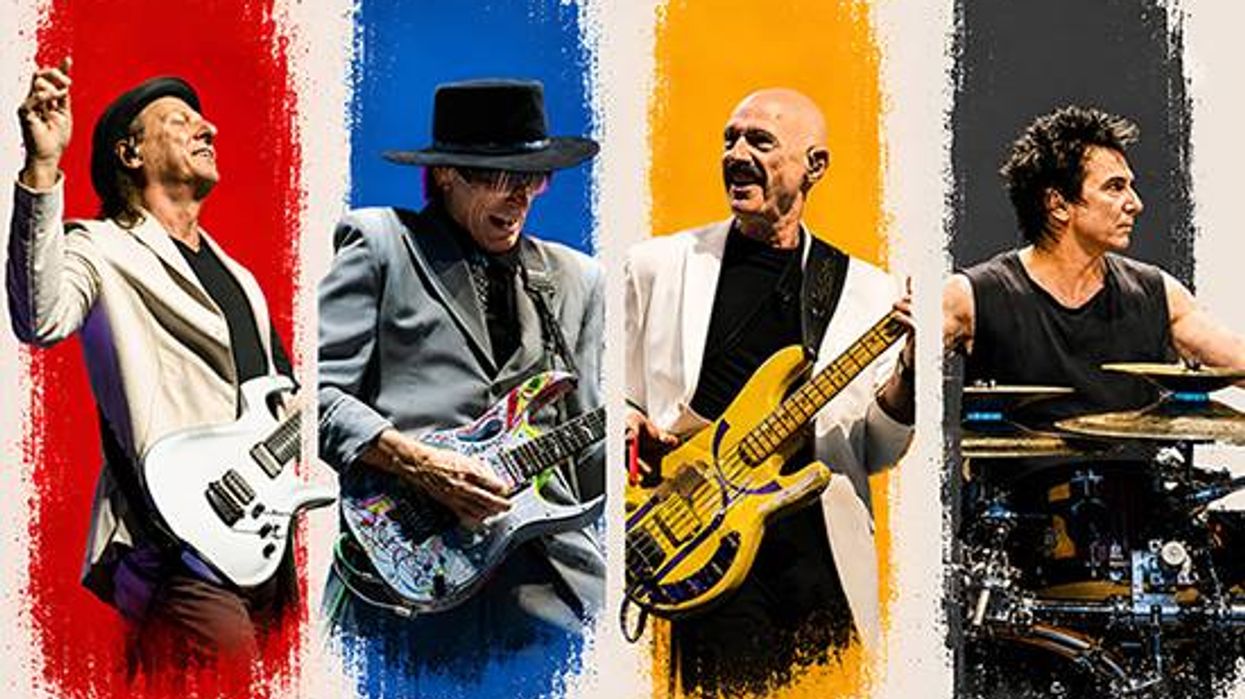
King Crimson members ADRIAN BELEW and TONY LEVIN, alongside STEVE VAI and TERRY BOZZIO approach the next chapter of BEAT. The quartet has announced a tour of the U.S. that will stage 40 appearances. The general on-sale is set for Friday, August 7 at 10AM local time. Tickets and VIP experiences will be available here: https://beat-official.com/tour. The artist pre-sale goes live on Tuesday, August 4 at Noon Eastern time with the password BEATTOUR. Fans can access the ticketing page and simply enter the code at checkout. All pre-sales will end at 10am local time Thursday, August 6.
Adrian Belew shares, “For those of you who’ve seen BEAT live, it’s important to note we’ll be adding some material from ‘90s Crim to our U.S. tour. Along with the addition of superman drummer Terry Bozzio, we feel this will result in a new experience for our audience. We’re very excited to play for you again. Don’t miss it!”
The global audience has celebrated the existence of BEAT, responding to the music, chemistry, spirit and respect this collective of esteemed musicians has brought to one of the most remarkable catalogs in progressive rock. BEAT continues to evolve whole remaining true to the music and the spirit that inspired it.
As Adrian, Tony and Steve approach the band’s upcoming activity, Terry Bozzio enters the fold behind the kit. Danny Carey remains an important part of the BEAT family, and simply his Tool commitments prevent him from being available for this upcoming run in the Fall. Steve Vai offers, “Terry is one of the truly legendary drummers of our time, whose remarkable career and unique musical voice make him the perfect artist to join us for this tour. He brings his own extraordinary artistry to BEAT, and that's something worth celebrating.” Adrian Belew shares, “Our deepest appreciation goes to our brother Danny Carey—a true BEAT-Poet. His extraordinary musicianship, generosity, humor, and explosive creativity helped establish BEAT as something far beyond a tribute. He helped create its identity. While Tool commitments keep him from joining us this fall, he remains an essential part of our family.
When the ensemble’s existence was first made public on April 2, 2024, the vision was simply to present a creative reinterpretation of the three iconic 80s KING CRIMSON albums - Discipline, Beat, and Three Of A Perfect Pair. Just over forty appearances were announced across the U.S., triggering a majority of those planned appearances reaching sold-out status in days. Additional performances were added, creating an inaugural run which staged 65 concerts across the U.S. Appearances in Mexico, South America and Tokyo’s legendary Budokan followed, most recently staging an extensive run of the U.K. and Europe performing in 31 cities this year.
When the band heads back out in the Fall, fans should anticipate some exciting additions to the repertoire being performed, with several songs rotating out while other classic King Crimson pieces emerging in to the set. Those details will come to light once the tour begins.
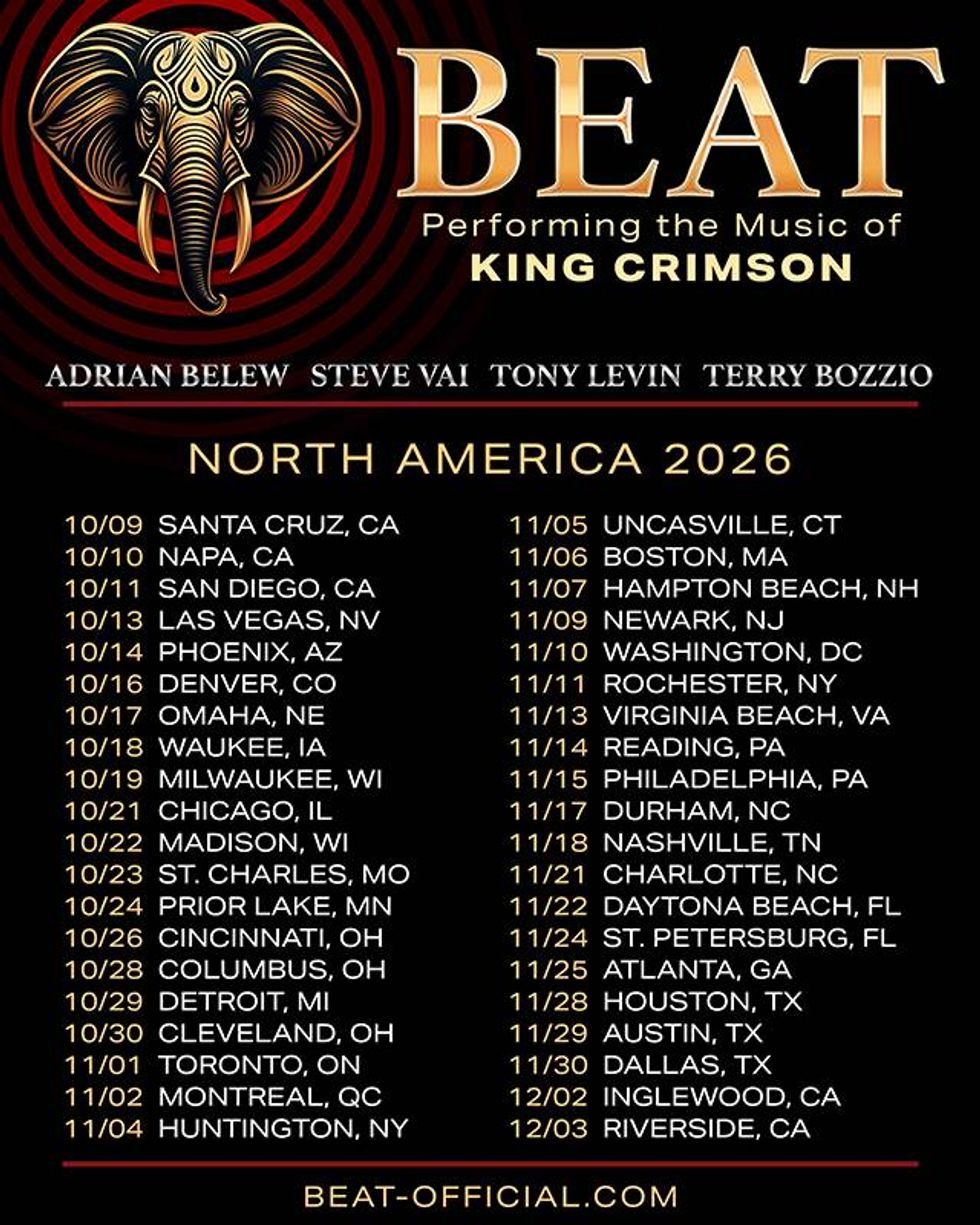
The itinerary kicks off on October 9 at the Quarry Amphitheater in Santa Cruz, CA, with a final appearance planned in at Riverside, CA’s Municipal Auditorium on December 3.
In front of the 2024 tour, guitarist Adrian Belew reflected, “The 1981 through 1984 King Crimson created a music all its own. Timeless. Beautiful. Complex. Fierce. For the fans who lived through it then, and the ones who never got to witness it, our aim is to bring it to life again. A monumental task but we're going for it! There are not enough exclamation points to express my excitement!”
Guitarist Steve Vai stated, “Being a part of this ensemble is an extraordinary privilege and opportunity to perform some of the most beloved, timeless, and monumental music of the 80’s (and beyond) with truly inspired musicians. This music resonates deeply with me. Father Robert Fripp is one of our historical geniuses. His highly specific and exceptionally brilliant guitar technique is studied and revered. His contribution to the quality of my musical life, and so many others is supreme.”
Bassist Tony Levin offered, “Revisiting some of my favorite music is a treat in itself. It’s also great that we’re not just playing a few shows, we’re hitting it hard. So, Road Dogs are coming to your area soon.”
Drummer Terry Bozzio shares, “All of these guys are my friends and excellent musicians who l’ve played with before! When l was asked to join this tour, l was honored & very grateful to do it!”
An exclusive meet & greet with Adrian Belew, Steve Vai, Tony Levin and Terry Bozzio will be staged at each appearance planned. There are three tiers available with limited availability. First, the “BEAT On-stage Experience” features one premium reserved ticket, the rare opportunity to watch the show from an exclusive on-stage VIP viewing area, early entry in to the venue, a pre-show meet & greet and a group photo opportunity with all four members of the band, access to a pre-show soundcheck, a limited edition autographed BEAT tour poster, commemorative BEAT ticket magnet, a specially designed BEAT record bag, an exclusive VIP merchandise item, and an official side-stage laminate and lanyard. This top tier has very limited availability. The second tier is the “BEAT Meet & Greet / Soundcheck Experience.” It features one premium reserved ticket located in the first five rows, early entry in to the venue, a pre-show meet & greet and group photo opportunity with all four members of the band, access to a pre-show soundcheck, a limited-edition autographed BEAT tour poster, commemorative BEAT ticket magnet, a specially designed BEAT record bag, an exclusive VIP merchandise item, and a Meet & Greet laminate and lanyard. The final tier is the “BEAT VIP Tour Package.” It features one premium reserved ticket located in the first 15 rows, a limited-edition autographed BEAT tour poster, commemorative BEAT ticket magnet, a specially designed BEAT record bag, an exclusive VIP merchandise item, and a commemorative laminate and lanyard. There is limited availability for each of these packages, which are available for purchase at https://beat-official.com/tour.
Flattley Pedals Introduces Centurion 10 AE Overdrive
Flattley Pedals has introduced the “Centurion 10 AE”, the company’s special 10th Anniversary Edition of the Centurion transparent overdrive.
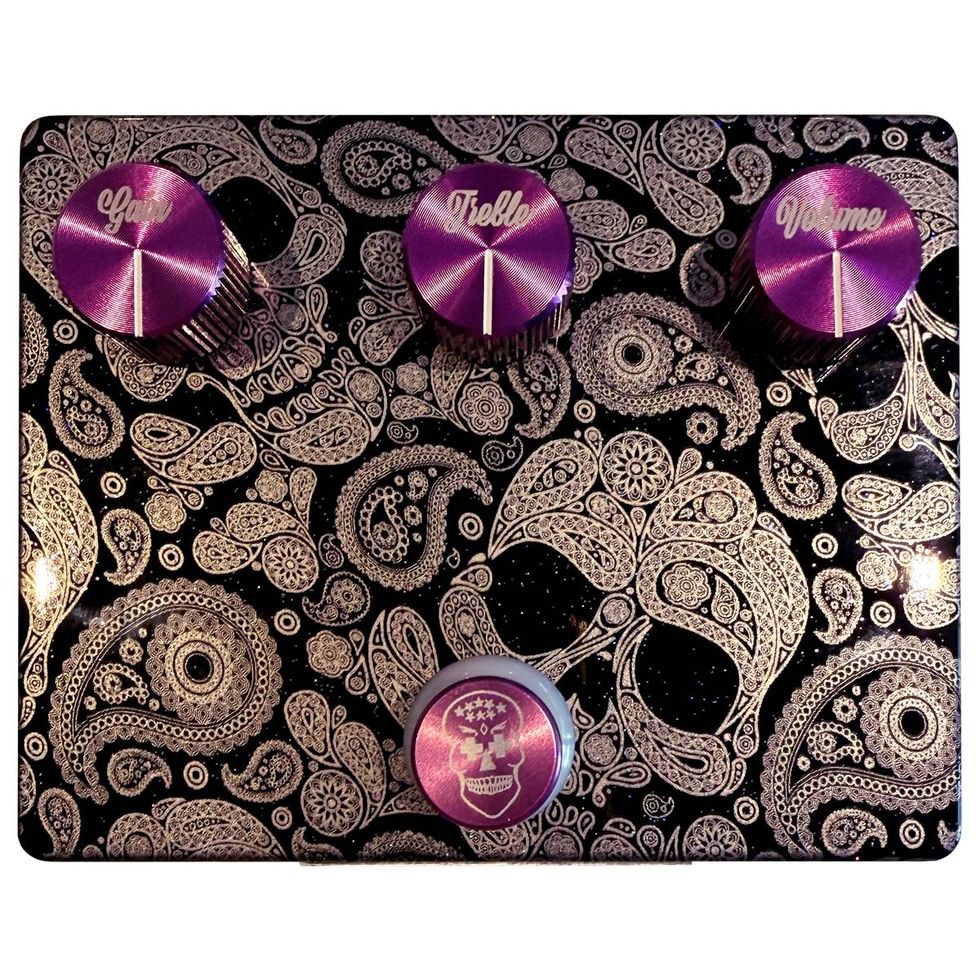
As it’s our 10th anniversary in 2026 at Flattley Guitar Pedals, we wanted to continue with the celebrations and add some special features to our existing Centurion transparent overdrive product by adding some extra mojo.
The Centurion 10 AE comes with purple laser etched control knobs, metallic black paint with the stunning eye-catching silver paisley skulls hydro graphics along with a purple halo LED light ring to light it all up.
The Centurion 10 AE version also got an internal make over and comes with special vintage germanium tube diodes giving the Centurion 10 AE version a whole different feel and sound than the standard version Centurion pedal. These vintage germanium tube diodes just sound so warm and soft which really suits the Centurion circuit.
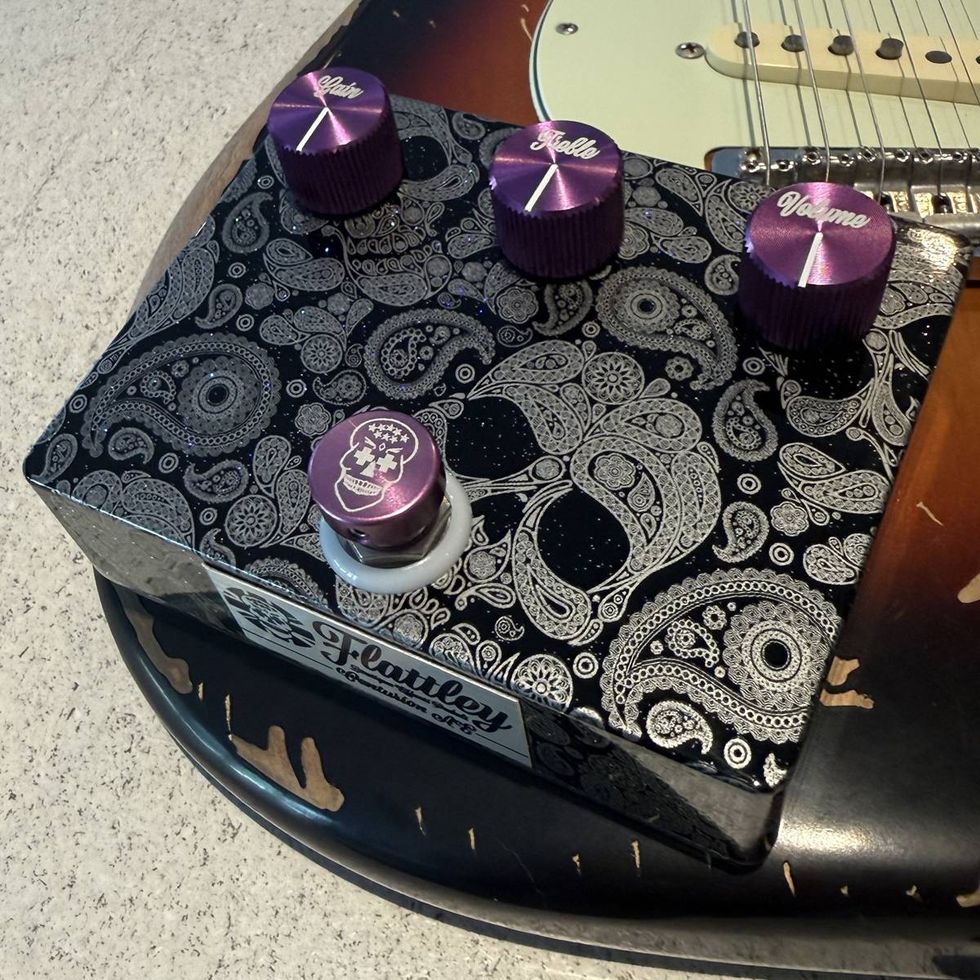
The pedal’s purple halo light ring installed diffuses the light when playing live, so you can avoid being blinded by standard LEDs, and a purple laser etched aluminium foot topper gives you more real estate for contact when switching the pedal on and off during quick changes when playing live.
All Flattley "Platinum Range" pedals are hand processed in our Flattley paint shop, with a strikingly unique finish.
The Centurion 10 AE includes this control set:
Centurion 10 AE Controls
- Volume: Controls the overall output level.
- Gain: Controls the amount of gain/overdrive
- Tone: Controls the amount of treble/bass
Other features include:
- 9-volt external power operation (no internal battery option)
- 20mm purple anodised aluminium custom etched control knobs
- Purple halo light rings installed
- The Centurion 10 AE comes with a purple custom etched aluminium foot topper
All Flattley pedals are handmade and hand wired in the UK using high quality components.
The Flattley Centurion 10 AE carries a street price of $319/£259/€319. For more information visit flattleyguitarpedals.com.
Marcus King partners with Epiphone to revive the El Dorado acoustic: “This guitar means the world to me”

Everyone remembers their first guitar – it’s by your side through thick and thin, no matter how ear-splitting your chord progressions may sound to your peers. For some, that first axe can be a gateway to a beloved hobby… or, in the case of Marcus King, learning the ropes on a 1963 Epiphone El Dorado Acoustic essentially kickstarted a Grammy-winning blues career.
Now, King has partnered with Epiphone to reimagine his legendary first guitar. The result is the limited edition Epiphone Marcus King El Dorado, which serves as yet another way King has honoured the most important, formative guitar in his musical history.
Originally, King’s father gifted him the 1963 Epiphone acoustic when he was just four. King was instantly keen to master the instrument, and he’s always speaking about the importance of the El Dorado throughout his journey. Even his 2020 debut, El Dorado, is named in honour of his all-important guitar.
“This guitar means the world to me,” he says in a press release. “My first El Dorado was a gift from my father, and it carried me through some of the earliest and most important moments of my musical journey. It has always represented family, home, and the songs that shaped me.”
While the guitar has shaped King, this comes as his chance to shape the guitar in return, as well as sharing its vintage charms with the next generation of guitarists. While the guitar’s design captures that feel of ‘60s and ‘70s era El Dorado acoustics, King’s signature sits proudly on the headstock. “Partnering with Epiphone to share that feeling with players around the world is an incredible honour, and I hope this guitar inspires people to write their own stories for years to come,” he adds.
Available in Antique Natural, the Epiphone Marcus King El Dorado sits at 25.5” in scale and is built with all-solid tonewoods. The woods in question consist of a square-shoulder dreadnought body, rosewood back and sides, a spruce top and a C-profile mahogany neck, There’s also a custom pickguard modelled after the one on King’s vintage El Dorado guitars.
 Credit: Epiphone
In terms of the headstock, alongside King’s autograph, the design draws inspiration from 70s MIJ-era and include a bone nut, Epiphone Deluxe tuners, and a mother-of-pearl Epiphone logo. Further down, the fingerboard is rosewood, with 20 frets and rounded-corner mother-of-pearl block inlays. The acoustic is also kitted out with L.R. Baggs Element Bronze under-saddle pickup and preamp.
King recently released Darling Blue / No Room For Blue back in May, and the blues rocker is also set to embark on a tour across North America this August.
The limited edition Marcus King El Dorado is available now for £949. For more information, head to Epiphone.
The post Marcus King partners with Epiphone to revive the El Dorado acoustic: “This guitar means the world to me” appeared first on Guitar.com | All Things Guitar.
Fender Vintera III Early ’60s Bass VI Review
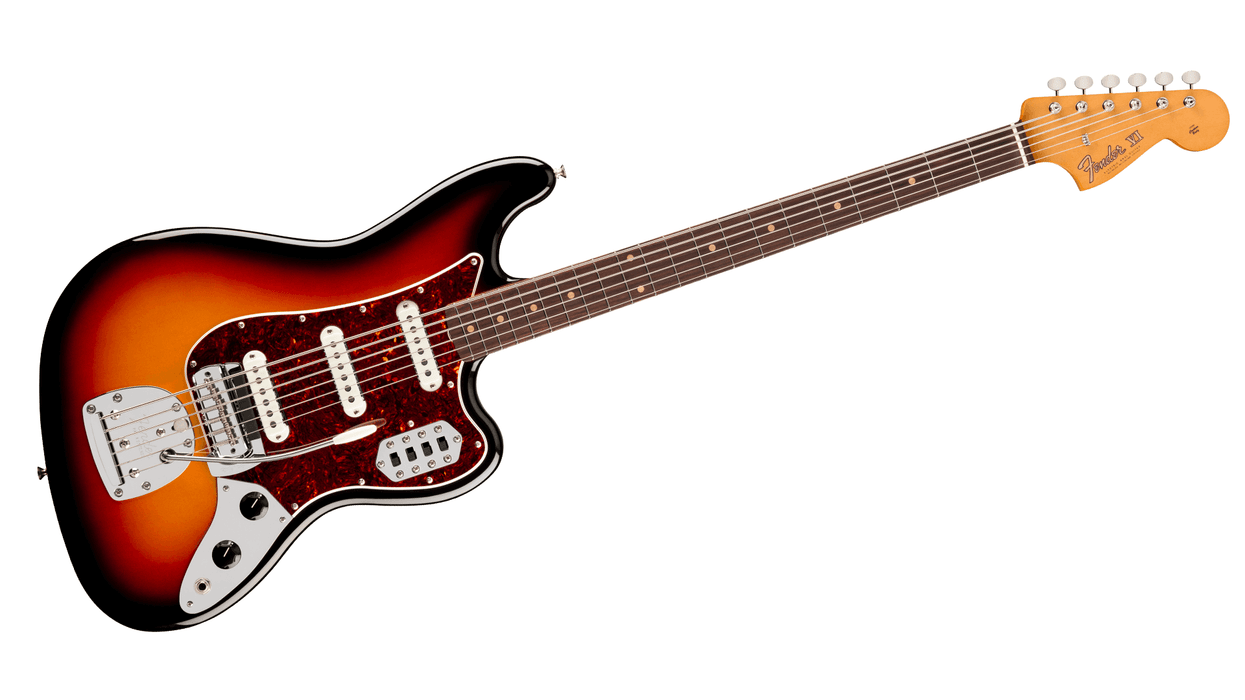
Do you know that feeling when a well-restored vintage car slowly passes you on the street? You stop, you stare, you gasp, and for a fleeting moment, you dream. That is how I felt when I opened the case for the Fender Vintera III Early ’60s Bass VI. It was a peek into a time portal, and I felt an audible, focused exhale leave my lungs. But unlike all those vintage cars I see, I got to take this one for a drive. It was a pleasure that pointed the way to a lot of creative possibilities.
The Middle Way
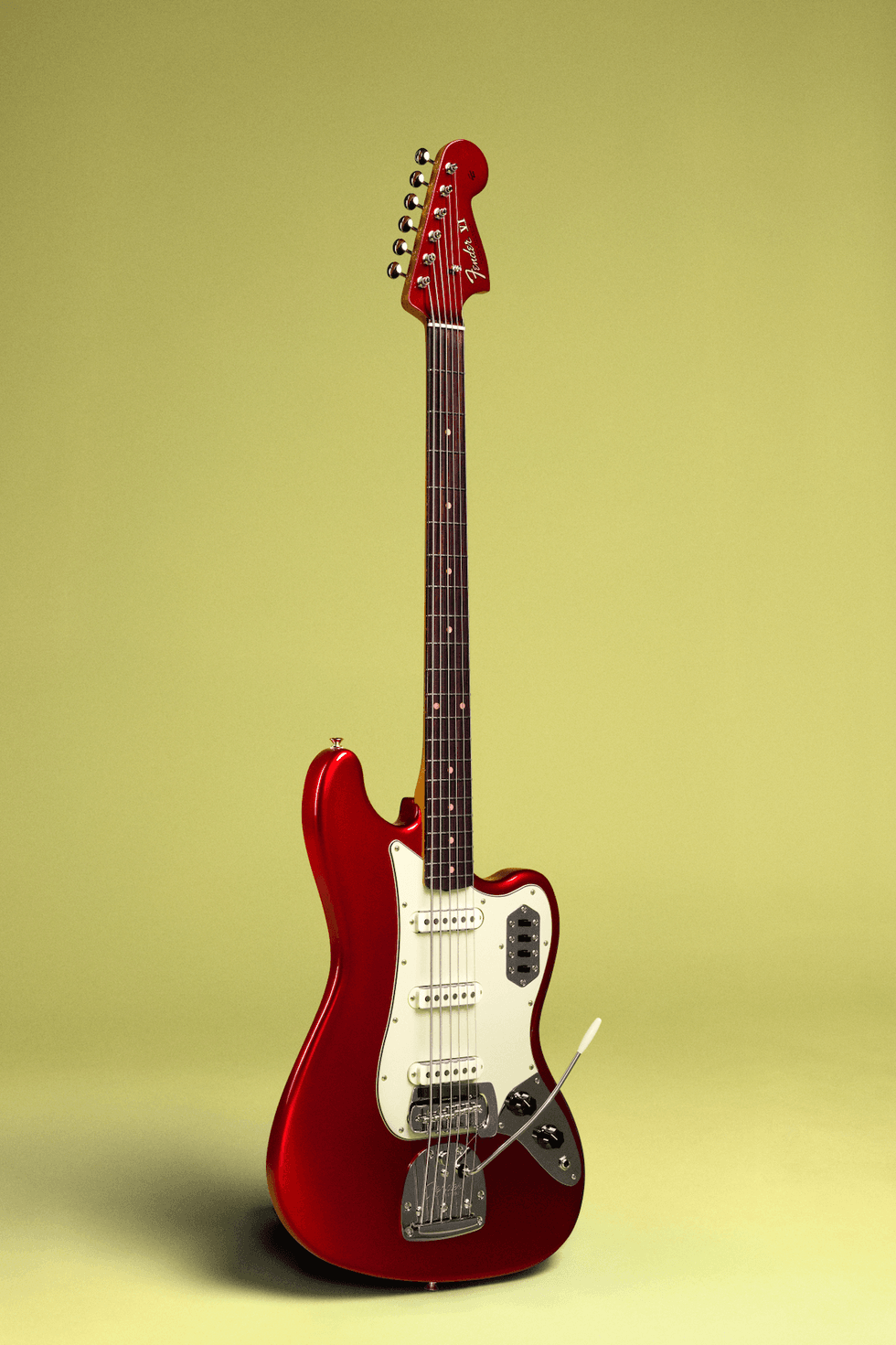
The concept of a 6-string bass was around for several years before Fender introduced the Bass VI in 1961. Bu though it had formidable rivals—the more straightforward Danelectro 6-string bass, for one—the Bass VI had its own vibe. There’s a hint of chime, a hint of bass, and a trace of the dark arts. The Bass VI became a useful tool for players straddling the fence between octaves, and its 30" scale made it a useful compromise for guitar players wanting to play bass and bass players looking for more chances to get fired. But regardless of how it fits into an individual musician’s life, it remains a valuable tool for finding unusual sounds.
Our Focused Era
As part of the Vintera III line, the Bass VI features many enticing 1960s-vintage details, including a real bone nut, clay dots, and a headstock decal applied over the finish. Fender also claims that the pickups and neck profile are more aligned with early ’60s specs. Given how much those elements could vary from guitar to guitar back then, it’s hard to pinpoint a definitive example. Still, this Vintera III version is outwardly inspired by the most desirable version of the Bass VI, which was discontinued in 1975.
“With almost any approach, the Bass VI is great. No, more than great. It’s inspiring. And plugging in and exploring the possibilities is pure joy.”
Let’s say it now: This bass looks like a million bucks. The gloss polyester candy apple red finish (olympic white and 3-tone sunburst are also available), mint green 3-ply pickguard, and matching headstock are a dazzling combination. The offset alder body and round-laminated rosewood fretboard combination (with clay dot markers) are equally complementary. The guitar is also well put together, with a tight neck joint, no fret issues, and a great setup.
Does it Bass? Does it Guitar?
Before I plug into any amp, I like to hear the resonance of an instrument on its own, and with the Bass VI, this process, in a way, involves listening to two instruments at once. You also have to account for how the different scale, strings, and body size change the way you play. For example, I often found myself strumming the top four strings and taking a more conventional bass approach for the traditional four strings of a bass. Your instincts might differ. But with almost any approach, the Bass VI is great. No, more than great. It’s inspiring. And plugging in and exploring the possibilities is pure joy.
The Bass VI has three single-coil pickups that can be switched on individually or in combination, with dedicated on/off switches. The fourth switch is the bass-strangle switch, which filters the low end. Making my way through various pickup configurations, I found rich, useful tones across the board, but very different uses for different ones. The neck pickup solo is probably my favorite for bass-side picking. But the middle and bridge pickup combination is my favorite for more guitar-style playing.
As a dedicated bass, the Fender is interesting, unusual, and effective. It shares a certain sense of feel with a short-scale 4-string bass, and encourages certain short-scale bass techniques. But the subtle differences in the pickups take the Bass VI from a deep 4-string bass voice to something more pointed, and players looking for more focused tones outside of typical bass range will love what they find here.
In terms of feel, the only rub for me is the string spacing, which is much tighter than my Precision Bass-trained hands are accustomed to. Most players new to the Bass VI will have to adapt in some way. It feels truly unique. But it doesn’t take much practice before you sense that you can make it work creatively.
On the guitar(-ish) side of the equation, the Bass VI can sing as well as it can rumble. In more guitar-like applications, the pickups give me tones that range from dark and brooding (neck and middle) to downright twangy (bridge only). The strangle switch helps the pickups shine a little brighter, too. Splash a little chorus on the signal and nudge the floating tremolo, and the Bass VI becomes an instrument well outside conventional guitar or bass categories.
An Old Idea Made New
Though it was sometimes derided—and more often removed— in its time, the 1960s-era string mute that Fender has re-introduced in this Vintera III version is, for me, a secret weapon. Located between the bridge pickup and the bridge, this very simple device can be rocked into place to mute the strings. At least for me, it was an instant game changer. I think a muted bass line speaks volumes, so I love this option.
The Verdict
The Fender Vintera III Early ’60s Bass VI is a beautiful creation. It sits in a sweet spot between tonally interesting and extremely useful, making it an essential studio staple in my book. Guitar players that play bass on their tracks will love it, and bass players will appreciate its 1960s tone vibes. I went for years without any experience with a Bass VI. Now? I am smitten.
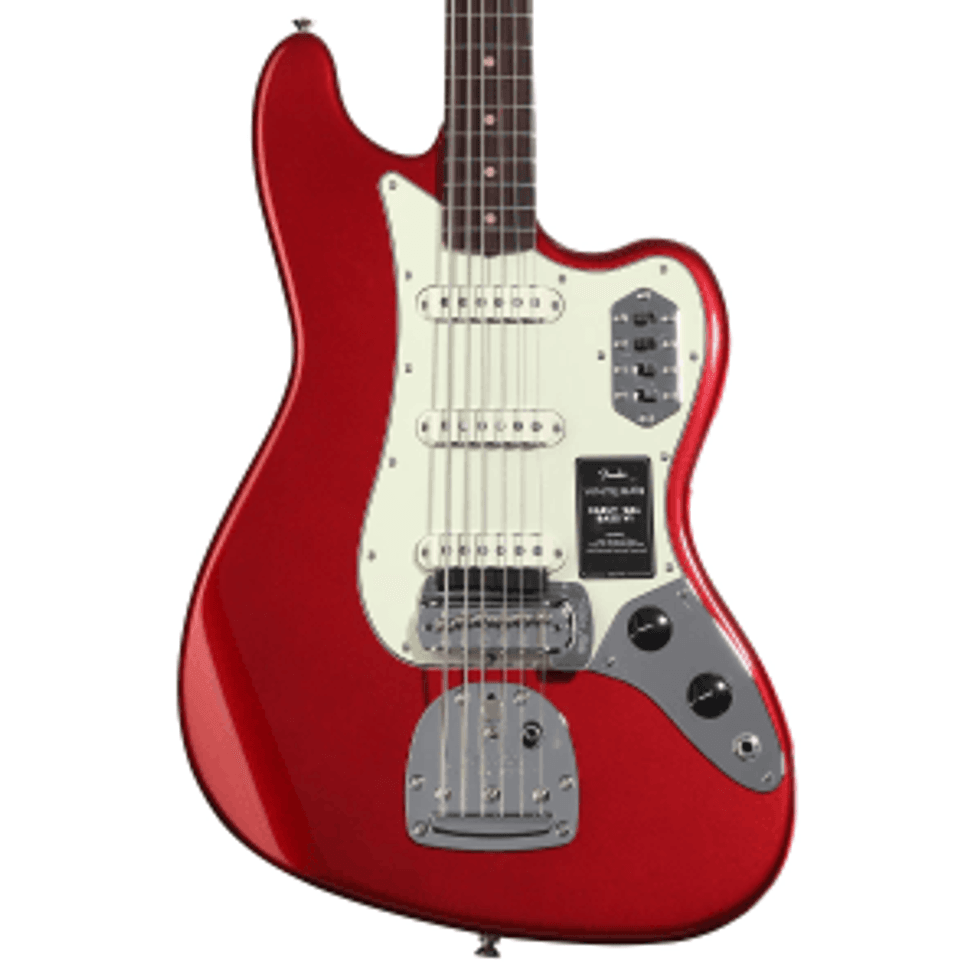
Vintera III Early '60s Bass VI 6-string
6-string Electric Bass with Alder Body, Maple Neck, Rosewood Fingerboard, 3 Single-coil Pickups, and Tremolo - Candy Apple Red
“It’s basically a Gibson Les Paul jammed into a Fender Telecaster”: This is one of Joe Bonamassa’s favourite vintage guitars – and why hybrids can be “the best”

Joe Bonamassa is one of the most prolific collectors of vintage guitars. But he doesn’t possess the purism you might expect from a vintage collector. In fact, one of his favourite guitars is a heavily modified 1968 Fender Telecaster loaded with Gibson PAF humbuckers…
Blues ace and owner of one of the world’s greatest collections of vintage instruments – housed at Nerdville East and West in Nashville and LA, respectively – Joe Bonamassa has hundreds of guitars. But this guitar remains one of his favourites, and it’s precisely because it’s a hybrid, he explains in a new interview with Guitar Center.
“These are PAF humbucking pickups from Gibson,” he says. “I bought this guitar from a guy in Daytona Beach, Florida about 15 years ago. It wasn’t a lot of money. And I plugged it in and it was magic. Sometimes a hybrid can turn out to be the best.”
The Tele, he explains, is fitted with 500k potentiometers – which let less high frequency content bleed resulting in a brighter tone.
“It’s basically a Gibson Les Paul jammed into a Fender Telecaster,” says Bonamassa. ‘But the difference is you have a maple neck and an ash body. And they sound great. And that’s the beauty of a Fender Telecaster: you can pretty much do anything to it.
“Now, do I suggest going out there and buying a very expensive vintage Telecaster, taking a pin router to it and jamming a whole bunch of pickups in there? No. If they’re already modified, then that’s the beauty of it. And you can save yourself some money and have literally just a utility plank that can play anything.”
Of course, one of JoBo’s favourite guitars has obviously seen its share of stage use…
“I’ve used this guitar for jazz fusion gigs, I’ve used it for rock gigs. I’ve used it for everything, because it has so much flexibility.”
He might be a vintage guitar collector, but his love of hybrid guitars isn’t the first opinion that might poke at the gear purists. Increasingly so lately, he’s been touting his love of digital amp modellers.
Recently admitting that he “wanted to hate” amp modellers, he explained: “I was wrong about the fact that no modeller will replace a tube version, I think they’re gonna get there and surpass.”
The post “It’s basically a Gibson Les Paul jammed into a Fender Telecaster”: This is one of Joe Bonamassa’s favourite vintage guitars – and why hybrids can be “the best” appeared first on Guitar.com | All Things Guitar.
This is why your guitar’s scale length actually matters

Scale length is one of those items on the spec sheet that I always saw, for many of my early years before I ever knew what it actually was or what it meant. I would hear terms like “Fender scale” or “Gibson scale” and politely smile and nod.
There were so many differences between a Les Paul and a Telecaster that I never thought much of the scale, but it does have quite an effect on the playability of the models. In this article, we’ll explain what scale is and why it matters – and how you can use that to choose a guitar with the right scale for you.
What the number actually means
Scale length is the working length of the string, measured from the nut to the saddle. The simplest way to find it is to simply measure it. A 25.5-inch scale length has 25.5 inches of string free to vibrate on every course, and that’s all the number tells you on its own. Everything worth knowing comes from what it forces the rest of the instrument to do.
A lot of electric guitars you’ll pick up will sit in one of two camps. Leo Fender built the Telecaster and Stratocaster around 25.5 inches, and that became the standard for Fender and for the mountain of guitars built to copy them. Gibson went with 24.75 inches on the Les Paul, SG and ES-335. If you’re wondering why it is measured in inches instead of metric, its simply because Fender and Gibson were based in the US and the specs fell into that unit of measurement.
Three-quarters of an inch sounds like a rounding error, and as a measurement, it nearly is. A few builders split the difference on purpose. PRS landed on 25 inches, reaching for a bit of Fender’s tightness and a bit of Gibson’s give in the same neck. Other guitars exist outside the 25.5-24.75 thresholds. We’ll get to them later in the article.
Why a longer scale length guitar fights back
Bringing a string up to pitch takes a set amount of tension, and a longer string needs more of it to reach the same note at the same gauge. The relationship isn’t gentle, either. Tension climbs with the square of the scale length, so swapping a 24.75-inch guitar for a 25.5 with identical strings and tuning piles on roughly six per cent more tension across every string.
Six per cent doesn’t read like much, but your fretting hand will feel it. The longer Fender scale pushes back against your bends and snaps to pitch faster. It stays firm when you dig in. It’s a big part of why players coming off a Les Paul onto a Strat so often drop string gauge from 10s to 9s, just to get the old slack back. A shorter scale does the reverse. It’s looser and more forgiving, and bends come without a fight. Plenty of blues and rock players build their whole feel around that softer response.
What scale length does to your tone
Tension shapes the sound as much as the feel. A tighter string speaks with more clarity and top end. There’s more harmonic content sitting under the note, and the low end holds firmer, which is a chunk of that bright, almost piano-like attack baked into the classic Fender voice. A looser string leans harder on its fundamental and comes back warmer and rounder, with the highs pulled off the top. So crediting Gibson warmth entirely to mahogany and humbuckers leaves something out. The short scale is in there doing its share.
Fret spacing is the most visible effect. You cant just move a Fender neck .75 inches further into the body and have it work as a Gibson scale – the fret spacing is different. A longer scale stretches the frets apart, which keeps notes separated but asks more of your hand down near the nut. A shorter scale brings them in tighter, friendlier for small hands and fast chord work, though it can feel cramped once you’re past the body/neck joint.
Non-traditional scale-lengths
Step outside the Fender-versus-Gibson norms and builders start reaching for scale length on purpose. Short-scale guitars like the 24-inch Mustang and Jaguar, or the old Danelectros, play slinky and run a little dark, which is half of why indie and garage players love them. Basses follow the same logic. A 34-inch scale keeps a low E from going to mush, while 30-inch short-scale basses trade some of that tightness for warmth and an easier reach.
Baritones are usually defined as having a scale length of 27 inches or more. The whole point is to tune well below standard without the strings turning to wet noodles, since the extra length holds the tension together down in low drop tunings.
Fanned-fret guitars chase the same fix from another angle. Ralph Novak’s Novax designs run a longer scale under the bass strings and a shorter one under the trebles, with the frets angled so the geometry lines up. The low strings hold their tension and the high strings stay easy to bend. That was the idea behind fanned frets.
So, which scale is right for you? That’s not for me to say. My advice is always to get your hands on as many guitars as possible and see which ones feel and sound best to you. That’s why I love guitar stores where you can pick a guitar up and test it out. It allows you to know what you’re looking for when buying a guitar.
You might prefer the look of Fender guitar but the more compact dimensions of a Gibson – that’s what I realised, and it’s why I build Fender-style necks with 24.75-inch scales for my guitars. Warmoth and other aftermarket companies make these sorts of conversion necks as well if you’re set on the look of one body shape but prefer a different scale length.
Few players can tell the difference by looking at it, but the feel is undeniable. That’s why scale length is such an important part of any guitar equation.
The post This is why your guitar’s scale length actually matters appeared first on Guitar.com | All Things Guitar.
Epiphone Introduces Marcus King El Dorado Acoustic
Epiphone has announced the Marcus King El Dorado, a limited-edition signature acoustic guitar based on a 1970s-era Epiphone model. King, a guitarist, singer, songwriter, and GRAMMY®-nominated artist, has cited a personal connection to the El Dorado, which was his first guitar and a gift from his father. He named his 2020 solo debut album El Dorado after the instrument. The Marcus King El Dorado Limited Edition is available in Antique Natural at authorized Epiphone dealers, Gibson Garage locations in Nashville and London, and at Epiphone.com.
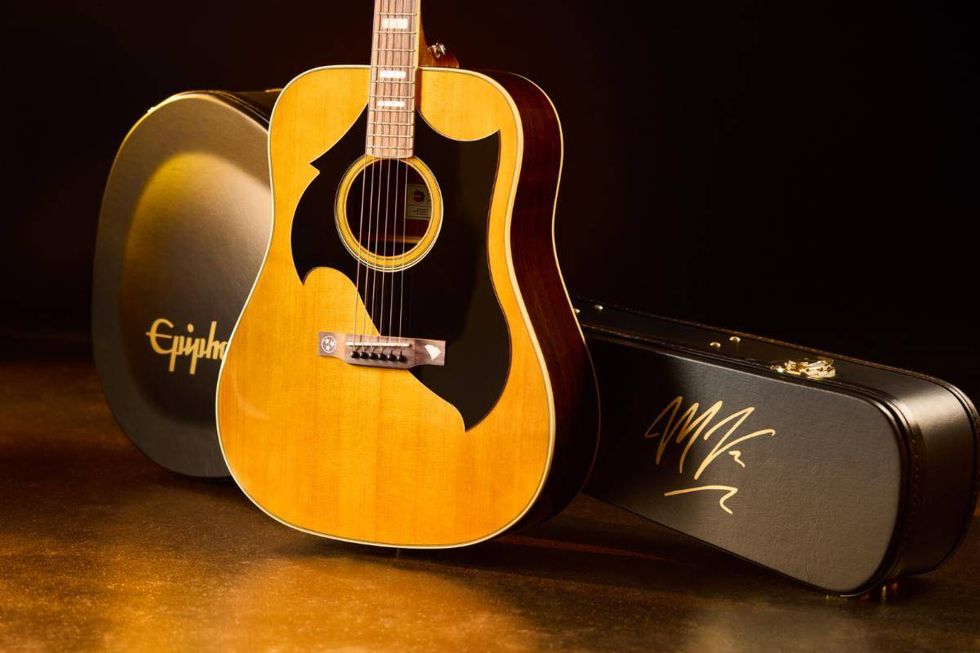
The Marcus King El Dorado is built with a square-shoulder dreadnought body, solid rosewood back and sides, and a solid spruce top.
“This guitar means the world to me. My first El Dorado was a gift from my father, and it carried me through some of the earliest and most important moments of my musical journey,” says Marcus King. “It has always represented family, home, and the songs that shaped me. Partnering with Epiphone to share that feeling with players around the world is an incredible honor, and I hope this guitar inspires people to write their own stories for years to come.”
Highlights include:
- Solid rosewood back and sides, solid spruce top
- Neck: 25.5″ scale mahogany neck with a C profile, headstock volute, and dovetail neck joint
- Body: Four-ply top binding, single-ply back binding
- Headstock: 70s MIJ-style design, bone nut, Epiphone Deluxe tuners with metal buttons, mother-of-pearl Epiphone logo
- Fingerboard: Three-ply bound rosewood, 20 frets, rounded-corner mother-of-pearl block inlays
- Bridge: Belly-down rosewood bridge with compensated bone saddle and black pins; inlays depict South Carolina's outline and Tennessee's Tri-Star emblem
- Pickguard: Custom design based on King's original vintage El Dorado
- Electronics: L.R. Baggs™ Element Bronze under-saddle pickup and preamp, with volume and tone controls mounted at the edge of the soundhole (requires one 9-volt battery, not included)
- Case: Hardshell case with Marcus King signature graphic
Available in Antique Natural finish for a limited time, the Epiphone Marcus King El Dorado carries a street price of $999. For more information visit Epiphone.com.
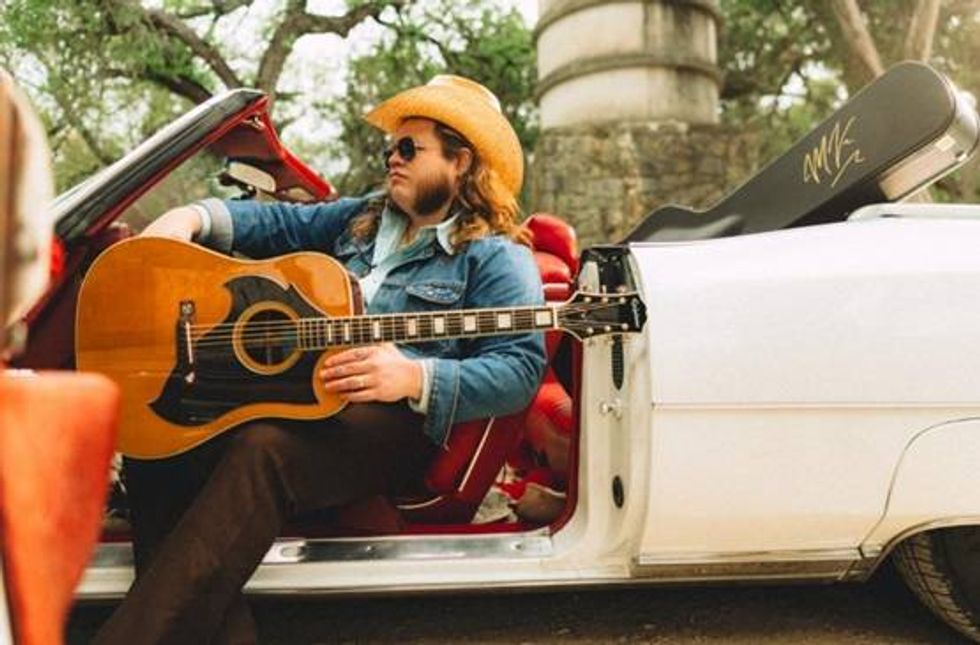
The release coincides with the Marcus King Band's Darling Blue / No Room For Blue, released May 1, the second half of the Darling Blue project first issued as a Record Store Day exclusive. The 12-track collection is available on all streaming platforms and covers themes including clarity, growth, heartbreak, addiction, and renewal, spanning rock, bluegrass, country, blues, and Americana.
King and his band are touring in support of the release on the Waltz Across Texas Tour and Darling Blue Pt. 2 Tour, with dates in July, August, and September 2026, including markets such as New York City, Nashville, Chicago, Boston, and Atlanta, festival dates, and select shows with Mumford & Sons.
For tour updates, see King's Instagram, TikTok, and YouTube accounts, or marcuskingofficial.com.
Tour Dates
- Aug 20: Pittsburgh, PA — PPG Paints Arena (with Zach Top)
- Aug 21: Allentown, PA — PPL Center (with Zach Top)
- Aug 22: Bangor, ME — Maine Savings Amphitheater (with Zach Top)
- Aug 26: East Hampton, NY — The Clubhouse Hamptons
- Aug 28: Gilford, NH — BankNH Pavilion
- Sep 11: Raleigh, NC — Red Hat Amphitheater
- Sep 12: New York, NY — Summerstage in Central Park
- Sep 13: Ithaca, NY — State Theatre of Ithaca
- Sep 15: Burlington, VT — Flynn Center for the Performing Arts
- Sep 18–20: Telluride, CO — Telluride Blues and Brews Festival
- Sep 20: Charlottesville, VA — John Paul Jones Arena (with Mumford & Sons)
- Sep 22: Grand Rapids, MI — Acrisure Amphitheater (with Mumford & Sons)
- Sep 23: Madison, WI — Kohl Center (with Mumford & Sons)
- Sep 29: Birmingham, AL — Coca-Cola Amphitheater (with Mumford & Sons)
- Oct 1: The Woodlands, TX — Cynthia Woods Mitchell Pavilion (with Mumford & Sons)
- Oct 2: Bossier City, LA — Margaritaville Resort Casino
Spector’s Low-End Lineage
In the world of boutique bass building, lineage matters. Knowledge is passed from mentor to apprentice, from workshop to workshop, and from one generation of builders to the next. Few contemporary builders embody that tradition more clearly than Wil DeYoung.
Today, DeYoung serves as general manager and oversees the custom shop for Spector, one of the most recognizable bass companies in modern music. And though his path to becoming a builder was buoyed by family tradition, his rise to his current positions was more circuitous. In fact, DeYoung didn’t even start out wanting to build instruments. Long before he found himself guiding Spector’s future, he was a college jazz student searching for a place in music. And before he worked with some of the most respected builders in the industry, he was tinkering with inexpensive instruments on his own to better understand how they worked. “My dad dropped out of college to open a record store,” DeYoung says with a laugh. “I was probably doomed from the start to be obsessed with music.”
Growing up in Michigan, music was a constant presence in the DeYoung household. Records by Steely Dan, Joni Mitchell, Larry Carlton, and other artists from the golden era of sophisticated studio musicianship formed the soundtrack of his childhood. Like many aspiring musicians, DeYoung’s first instrument arrived in the form of an inexpensive beginner guitar package that quickly found its way to a corner of the basement, which is surprising considering curiosity and generosity would become the hallmarks of his career.
DeYoung’s formal musical journey began in middle school, not on guitar or bass, but on trombone. Around the same time he joined his school’s band, the church his family attended featured a praise band that needed a bass player. Recognizing their son’s passion for music, DeYoung’s parents bought him a Mexican-made Fender Precision bass. He’d already been plucking his way around a double bass on the side in orchestra and jazz band, but this time, rather than gathering dust, the new instrument became a gamechanger. “I learned a lot on that bass,” he recalls. “It started in church, but then it expanded into every musical opportunity I could find.”
Upon graduating high school, DeYoung enrolled as a music education major at Adrian College before shifting his focus to performance and jazz studies. While saxophone remained his primary instrument academically, bass and guitar steadily became larger parts of his musical identity. He started taking guitar lessons with Professor Dick Lange, and before long, he discovered a well-known truth: Bass players tend to stay busy. “My professors used to tell me, ‘We know you want to be a guitar player, but don’t stop playing bass—every guitar player needs a bass player,’” DeYoung recalls. “That turned out to be absolutely true.”
“The more instruments I worked on, the less it became about my playing and the more it became about what’s possible.”
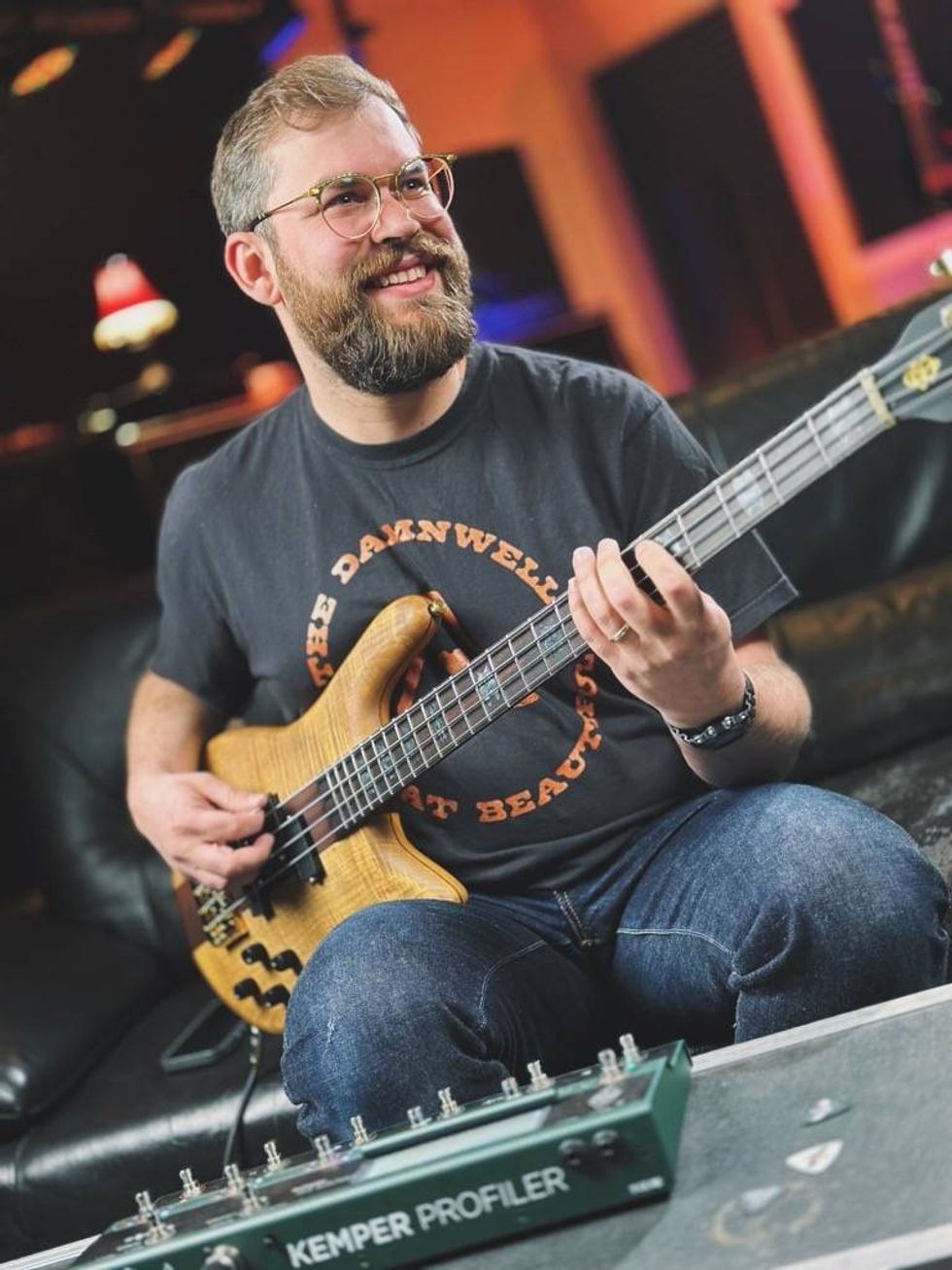
Yet even as his playing developed, another fascination began to emerge. He wanted to know why instruments felt the way they did. What began as simple curiosity evolved into a hands-on education in repair and modification. DeYoung bought inexpensive instruments, disassembled them, experimented with setups, reshaped necks, and gradually taught himself the fundamentals of guitar construction. “The more instruments I worked on, the less it became about my playing and the more it became about what’s possible,” he says. “I wanted to know how far I could push things.” That curiosity eventually led him into repair work at Guitar Center in Toledo, Ohio, where he spent years developing practical skills—setups, re-frets, acoustic neck resets, bridge repairs, and countless other jobs provided daily education in what works, and what doesn’t, when it comes to instrument design.
Perhaps the most important lessons came from the builders who welcomed him into their shops. One of the earliest was Michigan bass builder Matt Kiefer of Better Mousetrap Guitars. At a time when boutique basses were becoming increasingly sophisticated, Kiefer’s instruments represented the modern aesthetic that appealed to DeYoung: multi-laminate necks, exotic woods, extended-range designs, and meticulous craftsmanship.
Equally influential was archtop builder Denny Kopp of Kopp String Instruments in Ohio. Though DeYoung would go on to a career centered around bass-building, his deepest passion remains the archtop jazz guitar. “I’m still obsessed with archtops,” he says. “D’Angelico and D’Aquisto are the pinnacle for me.” Kopp became both mentor and inspiration. During the construction of DeYoung’s own custom archtop, a 17" Betty Swing Archtop, Kopp documented nearly every step of the process, sharing photographs, explanations, and detailed notes. The experience provided a masterclass in craftsmanship and generosity.
“It was incredible,” DeYoung recalls. “He didn’t have to do any of that. He just loved building guitars and loved sharing what he knew.” Watching a single builder transform raw materials into a finished instrument left a profound impression: “I couldn’t help but be hooked at that point.”
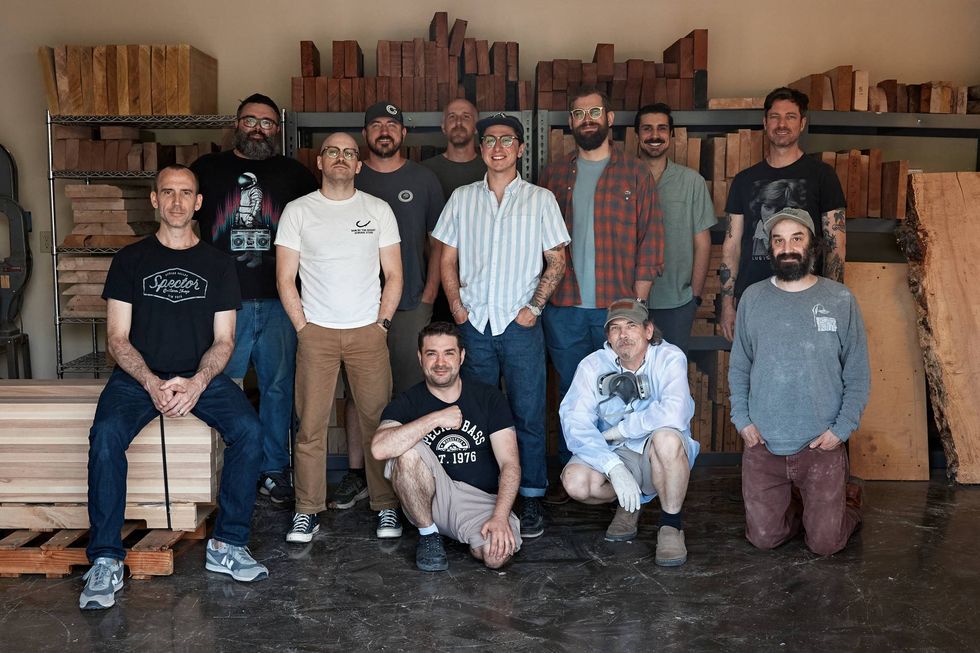
While pursuing graduate studies in jazz guitar, DeYoung knew repair work alone would never satisfy him. He had learned how instruments functioned, how to diagnose problems, and how to improve existing designs. He knew after watching Kopp build him a guitar that what he wanted was to start from scratch. “I’d done enough repair work to understand both the possibilities and the limitations,” he says. “I wanted to see what could happen when you build an instrument from the ground up.” An opportunity to do just that arrived when his future wife, Mia, relocated to New York City. “I figured I’d follow her and see what happened,” DeYoung recalls. “Worst case, I could keep doing repair work, but I knew I wanted to build.”
For a young bassist immersed in jazz, there was one destination that stood above all others: Fodera. Like many players of his generation, DeYoung had spent years listening to artists associated with the company. Victor Wooten, Matt Garrison, Janek Gwizdala, James Genus, Lincoln Goines, Lincoln Schleifer, and Anthony Jackson represented the pinnacle of modern bass playing. Their sounds—and the instruments behind it—had become part of his musical DNA. “That sound was always in my head,” he says. “Why wouldn’t I want to work there?”
The problem was that he had never built a bass professionally. Undeterred, he began calling the company—repeatedly. Over the course of several months, he continued reaching out until persistence finally paid off. “I basically annoyed Laura Fodera into giving me an interview,” he says with a laugh. The interview itself was not what he expected. “I showed up wearing a button-down shirt and khakis, ready for a normal interview.” Instead, he was led directly into the woodshop. “They handed me a bass body and said, ‘You’re going to carve this.’” The practical test functioned more like an audition. Fortunately, it was exactly the kind of challenge DeYoung had spent years preparing for through repair work, experimentation, and self-directed learning.
“I wanted to see what could happen when you build an instrument from the ground up.”
In 2015, he moved to New York City and joined Fodera. Once there, he approached the position with a singular goal: learn everything. “I wanted to understand every part of the build,” he says. “Whether it was my department or not, I wanted to know how it worked.” He stayed late, went in on weekends, and sought opportunities to work in every area of production. Alongside founders Vinny Fodera and Joey Lauricella, builders Aaron Younce and James Michelson became important early mentors. Over time, DeYoung carved necks, routed bodies, installed electronics, fabricated wooden pickup covers and control knobs, performed fretwork, and eventually assumed responsibility for final assembly and setup. For much of his tenure, every bass leaving the shop passed through his hands before reaching its owner.
The role also exposed him to one of the company’s most ambitious technical initiatives: adapting Plek technology to meet the demands of modern electric basses. While Plek systems had originally been developed around acoustic guitars, Fodera’s instruments presented entirely different challenges. Long-scale neck-through basses behaved differently under tension, requiring extensive experimentation and collaboration with the German manufacturer. “We spent a lot of time helping refine what the machine was doing for basses,” DeYoung says. “It taught me a tremendous amount about precision and consistency.”
Years later, when the opportunity emerged to join Spector, DeYoung found himself unexpectedly connected to a much deeper story. The history of Spector and Fodera intersected decades earlier through a woodworking co-op in Brooklyn—Vinny Fodera was Stuart Spector’s first employee. What initially appeared to be a simple career move soon felt more like a continuation of a lineage.
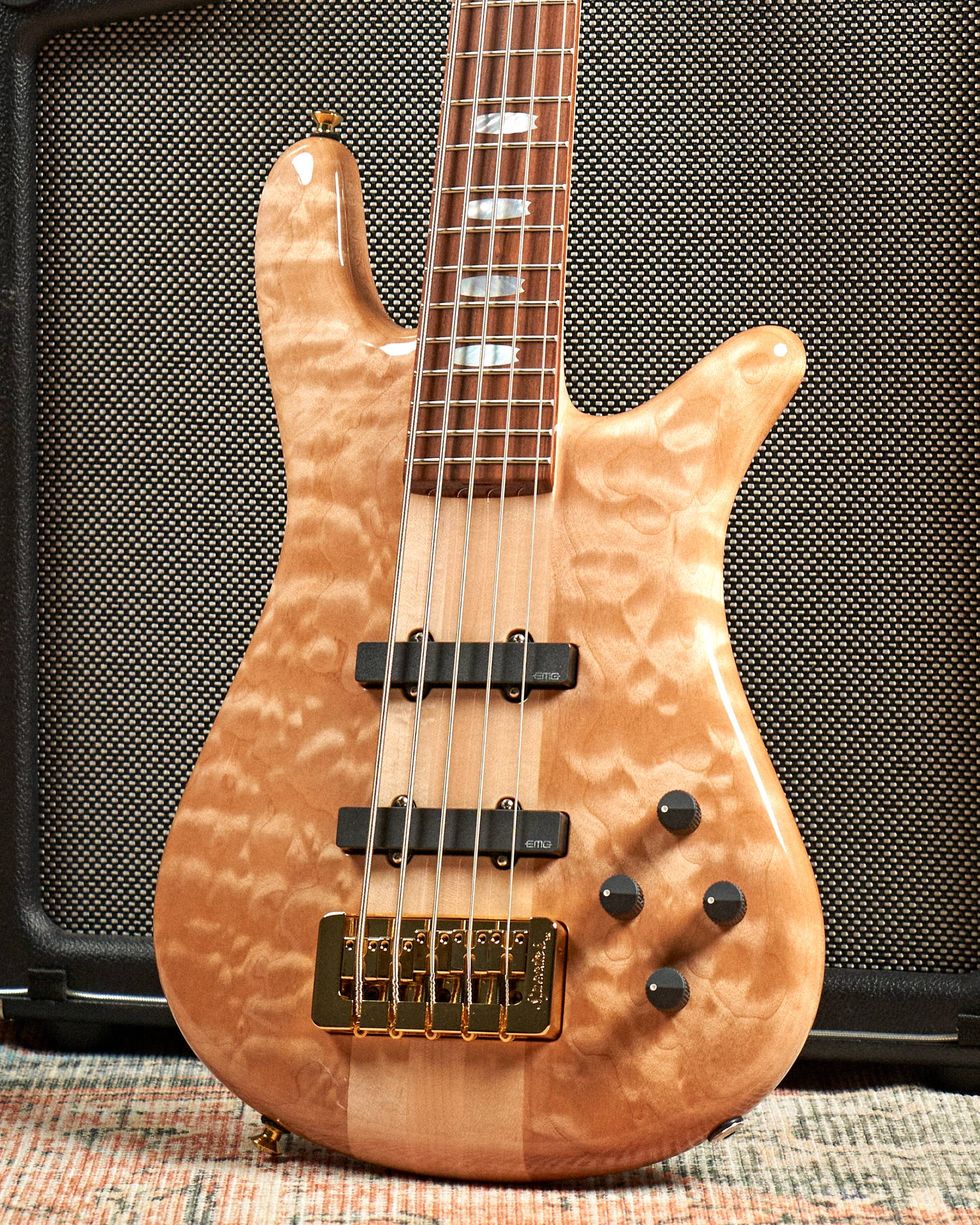
At Spector, DeYoung inherited a legacy unlike any other in the bass world. Stuart Spector and Ned Steinberger created one of the most influential bass designs of the 20th century. The elegant and now-iconic NS body shape transformed the way players thought about ergonomics, comfort, and performance. A generation of bassists, including Sting, Doug Wimbish, Eddie Jackson (Queensrÿche), Rachel Bolan (Skid Row), Guy Pratt (Madonna), and Graham Maby (Joe Jackson), embraced the design. Yet honoring a legacy requires more than preserving the past. For DeYoung, the challenge has been balancing heritage with innovation.
“Anything that’s built for 45 or 50 years is going to be built differently and look differently than it did in the beginning,” he asserts. “It’s going to have all these different benchmarks along the way, indicative of different eras. I spent a lot of time with different instruments evaluating what worked and what didn’t. I wanted to build something that really delivered on the original intention of the design but also included the best of everything that Spector has done over 50 years.”
“Being an enabler of people to grow their own skills and think critically about the jobs that they’re doing, so they can improve the instrument, is such a rewarding thing.”
What he noticed right away about the NS-2 was that some important design elements had changed over the years, whether intentionally or not, including the shape of the body, the neck thickness, and overstand of the fretboard to the top of the body. DeYoung took all of that into consideration when he developed a plan centered on having one definitive, idealized 3D model of the 4-string NS-2. He now refers to that bass as the brand’s “North Star.” Everything else—5-string, short scale, and so on—would be based off one standardized design. “I wasn’t designing from the ground up, but the ethos of every tiny detail mattered,” he attests. “Everything had to be reconsidered.”
The other goal for embarking upon what he now dubs his “revision process” was the import business of Spector, which had historically been separate from instruments coming out of the Custom Shop in upstate New York. “Over the years, there were various Spectors—whether they were made in Korea, China, Indonesia, or Europe—that all had their own identity.” Having elements of the Custom Shop’s craftsmanship flow downstream into the international product line and to a wider audience became part of his grand plan. “If you buy a $179 Squier Strat or buy a $20,000 Masterbuilt Strat, and you put those side by side, you see the same design language. It’s still identifiably a Strat. The pickguard is the same shape; the neck carve is essentially the same—all the stuff that makes it a Strat is still there. And that wasn’t necessarily the case with Spector.”
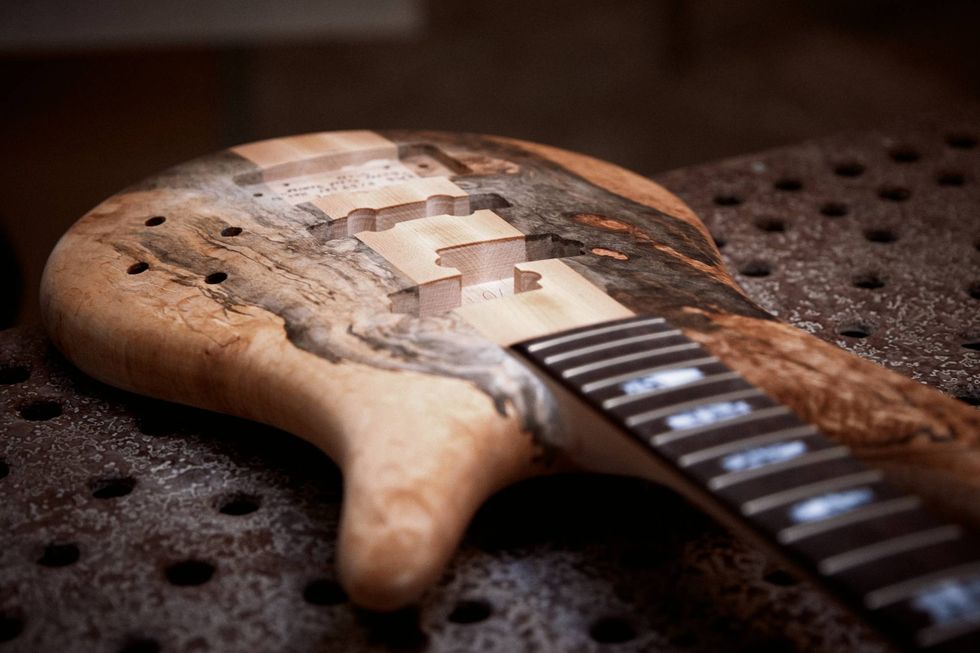
DeYoung’s persistence with Korg USA, Spector’s parent company, about disseminating the design language to their international partners, ultimately led to his appointment as general manager, and recently came to fruition with the introduction of the Icon series, based out of Indonesia. “The Icon was designed in the Custom Shop with the same neck profile, the same body curves, it has crown inlays, and the same headstock shape,” he explains. “I made sure that all the 3D drawings that we’re using were the same, just adapted for a bolt-on neck for the [Indonesian] factory in the format that they needed. When you put it side-by-side with a custom-shop build, we want people to recognize the design language but also know what it’s going to feel and sound like. It’s a known thing. The NS-2 is iconic.”
Another one of DeYoung’s first initiatives at Spector was to import the holistic approach to bass building he learned at Fodera. “It felt like such an opportunity to open doors for people," he says. It’s a perspective that harkens back to his time with Denny Kopp. Yes, DeYoung got hooked on building, but it’s also abundantly clear that he adopted the concept of generosity Kopp embodied so thoughtfully throughout that process. “Being an enabler of people to grow their own skills and think critically about the jobs that they’re doing, so they can improve the instrument, is such a rewarding thing."
Though he’s been handed the keys to the proverbial castle, DeYoung clearly understands his role as caretaker of an iconic brand, and remains focused on the same qualities that first drew him into the craft: curiosity, continuous improvement, and a deep respect for the musicians who bring these instruments to life. “My role is to bring in a new perspective and a different way to think about things,” he says. “When it comes to guitar building, there’s no one right way to build a guitar.”
Yngwie Malmsteen To Release His Mesmerizing New Album Hell Or High Water November 3!
Press Release
Source: SKH Music
 One of the world’s most captivating guitarists, Yngwie Malmsteen has announced his new studio album, Hell or High Water, which will be released on November 13 via Music Theories Recordings / Artone Label Group. To whet your appetite, he has also revealed the first single from the album, ‘Now or Never,’ which you can listen to HERE.
When we think of the greatest guitar players of all-time, specifically the crème de la crème musicians who invented a whole new style and sound on the instrument, Yngwie J. Malmsteen is a name that sits comfortably alongside game-changers like Jimi Hendrix, Jimmy Page and Edward Van Halen.
The nine tracks that make up his latest triumph were crafted meticulously and purposefully, away from the distractions that stall the creative process in the modern age. This is something he first tried with 2021’s Parabellum – mainly because of the state of the world at that time – and the results were so strong, he decided to stick with this as his modus operandi moving forward.
Pre-Order/Stream HERE.
“When I started making records, I would just take the songs I had lying around,” he admits. “Later on, I fell into a schedule – make a record, tour the record and then write the next record. Over the pandemic, I realised it was better to focus completely uninterrupted, so I stayed at home to write this album over the course of eight months. I had around 80 or 90 tracks finished, and then I had to decide which ones were the strongest.”
For a man born with a gift to conjure up overtures “out of nowhere”, the science behind writing a song is something that’s hard to explain. But, in any case, he’s grateful for the abundance of gold-standard ideas that do arrive – the kind that would take other musicians months or even years to realise into actuality. For Yngwie J. Malmsteen, this is simply what he was born to do.
Click here to view the embedded video.
“Even without a guitar in my hands, the music just comes to me,” he reasons. “It’s like that movie Amadeus. Mozart was getting music given to him in complete form. I understand the building blocks and can therefore build you anything you like. If you asked me to write you a death metal song, call me back in five minutes, and I’d have it ready for you. You want country and western or reggae? No problem. I can give you whatever you want. The language of music is simple. There are certain notes that belong together in whatever stylistic direction and sound pleasant to the ear. The ideas don’t come all the time, but when they do, it’s like an avalanche. The pieces I choose for my records are like gifts that I capture because they amaze me. I’m very lucky in that sense.”
Lead single ‘Now Or Never’ is a perfect storm of palm-muted riffing, baroque counterpart melodies, soaring vocals and mind-blowing dexterity. If you’re looking for Yngwie in a nutshell, this is very much it, and similar things could be said of the second track and instrumental pièce de résistance ‘Am Caprice/Hell Or High Water.’
‘(On The) Battlefield’ and ‘Eye For An Eye’ feature some of the singer/guitarist’s strongest vocal performances to date, alongside the stunning instrumentals ‘Antikythera’ and ‘Beyond Zeta Reticuli’ – which were both named after important scientific breakthroughs and discoveries.
Hell Or High Water is an album that’s bursting with emotion from all corners, but the closing track ‘Father’ is undoubtedly the most spirited of them all, written in tribute to the guitar legend’s dad, who passed away last year.
“He was an amazing man,” remembers Yngwie. “I was proud to have him as a father, and I loved him. I wanted to dedicate all of this to him, and that one particular track is for him. I wanted others to feel what I felt when they hear it. Nicola Paganini once said, ‘One must feel strongly in order to make others feel strongly’. It’s one thing to be a typewriter and another thing to be someone who writes stories that can touch people. That was always the point.”
All these years on, Yngwie J. Malmsteen looks and sounds more determined than ever. If the music feels good to him, that’s enough – anyone else liking it is a bonus. And this is precisely the creative fortitude and single-mindedness that turned him into a household name among the guitar community. There is no such thing as half measures or compromise in his world. Here is an artist who will be forever bound to authenticity and creative honesty.
Tour Dates
Tickets available HERE
September 4 – Beijing, China @ East Third Live House
September 6 – Shanghai, China @ Phase Live House
September 11 – Tokyo, Japan @ Toyosu Pit
September 13 – Yokohama, Japan @ Pacifico Yokohama
Yngwie Malmsteen Online
https://www.yngwiemalmsteen.com/
www.facebook.com/officialyngwiemalmsteen
www.instagram.com/yngwiemalmsteen_official
/www.tiktok.com/@yngwiemalmsteen_official
https://www.youtube.com/@officialyngwiemalmsteen622
“My intent was to talk about how technology can help artists and players learn and grow”: Fender CEO responds to his previous comments on AI

Back in May, Edward “Bud” Cole likened AI to “cover music” in an interview with T3, noting that the act of learning and adapting another artist’s songs and techniques is like a form of “analogue AI”. Now, the Fender CEO is keen to clarify his comments.
In a new statement shared with Fast Company, Cole explains that he hadn’t “fully conveyed” his perspective on AI during his T3 interview. “My intent was to talk about how technology can help artists and players learn and grow,” he explains.
He goes on to explain that, while AI can help a player grow, that will never take away the human spirit that keeps the guitar community thriving. “Music is an inherently human experience, and great songs are born out of people’s lives, their creative energy and the countless hours spent learning their instruments – something no machine can ever replicate,” he writes.
“Many of the concerns people have about AI are real,” the CEO continues. “Conversations need to happen about how to advance AI while protecting artists and upholding respect for their work.”
To round off, Cole asserts that he still believes that AI is a supportive tool for guitarists of all levels. In his mind, it serves as a way of opening new doors to “explore, refine and experiment with their own creative ideas”. But “music starts and ends with people, and it always will”.
The post “My intent was to talk about how technology can help artists and players learn and grow”: Fender CEO responds to his previous comments on AI appeared first on Guitar.com | All Things Guitar.
Empire of the Sun’s Luke Steele likens AI music tools to a “really smart guitar pedal”

Recently, backers of the pro-AI movement are taking a new approach when defending its use in the studio. Instead of addressing on the plagiaristic realities of AI training, musicians are focusing on how it improves musical productivity.
The latest artist to proclaim AI as a useful “tool” in the studio is Empire of the Sun’s Luke Steele. In an interview with iHeartRadio Canada, the singer said that AI technology is the same as using a “really smart guitar pedal” that can “empower artists that know how to use it” [via Consequence Of Sound].
Steele is aware of the fact that AI’s steadily increasing influence in the music industry could result in artists falling to the wayside. “I think you’ve got to be careful, you know?” he notes. “‘Cause [AI] is so powerful… it’s going to empower artists that know how to use it, and they’re going to become unstoppable… [if you don’t keep up], it’s going to come and swallow you like a boogie monster at night.”
This isn’t the first time the singer has spoken out in support of AI. In fact, back in April, Steele told Clash Magazine that AI was an “amazing breakthrough in the world”, and explained what AI tools Empire Of The Sun were actively using in the studio.
“I think it’s a breakthrough for artists, too because it’s such a powerful tool…” he said. “We’ve been building out of Base44… [we are using] this thing we called Song Mountain, [which is] like a lyric maker that has all the different tongues of different kinds of words from scriptures to ancient American-Indian Quotes, to different flavours of taxi conversation, it can all be used to kind of help craft different ways lines and verses are written.”
It’s a vastly different approach to the artists standing against AI. Recently, both Sophie Burrell and Sophie Lloyd have spoken out about AI plagiarising their music and likeness, while Rhett Shull has also spoken out about AI ripping off his content.
In terms of artists in the opposing camp, Boy George comes as one of the latest to wave the AI flag. Last week, he proudly asserted that he used AI to write a pro-Israel track, We Will Dance Again. Earlier in the year, George also sunk AI’s praises on Fearne Cotton’s Happy Place podcast, explaining that it AI technology has “really helped [him] as a lyricist”.
In the days following We Will Dance Again’s release, Bandcamp quickly took it down, with a spokesperson telling NME: “The track was removed based on violation of our Acceptable Use & Moderation Policy, which in specific regard to this case, prohibits music and audio that is wholly or in substantial part created, composed, or generated by artificial intelligence”.
The post Empire of the Sun’s Luke Steele likens AI music tools to a “really smart guitar pedal” appeared first on Guitar.com | All Things Guitar.
Pages
