
Music is the universal language
“Glory to God in the highest heaven, and on earth peace to those on whom his favor rests.” - Luke 2:14
Norse Guitar Feeds
The time Jimi Hendrix met Paul McCartney at a fancy event, and couldn’t handle it: “Paul McCartney’s walking towards me… What shall I do?”

Jimi Hendrix could make a guitar scream, set it on fire and generally look like the coolest man in the room. Put him in front of Paul McCartney without a guitar to hide behind, though, and even Hendrix got the nerves.
That’s what happened when the late legend was invited to a star-studded event at London’s Post Office Tower, as his former roadie Eric Barrett recalls in a new interview with Uncut.
With Hendrix arriving without his usual six-string safety blanket, things got particularly tense when he spotted Beatles star Paul McCartney heading his way.
“Jimi was invited to an event at the Post Office Tower, in the revolving restaurant at the top. Gerry [Stickells, tour manager] couldn’t take him, so I said I’d go along with him,” Barrett recalls. “I have no idea what the function was but I went to loads of events like that, just happy to get the free beer and a canapé and spend some time with Jimi.”
There was just one problem: Hendrix didn’t have his guitar.
“Jimi didn’t have a guitar, so he didn’t have a prop, something to hide behind,” Barrett explains. “We walked in and he saw who was there and started speaking out the side of his mouth: ‘Eric, Eric… Paul McCartney’s walking towards me… What shall I do?’ I told him to relax, it would be fine. Paul McCartney came over and was showering him with praise, but Jimi wasn’t good at that at all.”
According to Barrett, Hendrix was similarly uncomfortable around other famous musicians, despite being a hero to many of them himself.
“He was so shy, he didn’t know how to respond. And he was like that with all the stars he met,” says the former roadie. “He didn’t seem to understand why they were looking up to him. If he had met Paul McCartney in the studio, he’d have been much more comfortable.”
Barrett’s years on the road with Hendrix produced no shortage of memorable stories. In an excerpt from his new memoir, Experienced: On the Road with Jimi Hendrix and Beyond, he also looks back on the guitarist’s habit of destroying his instruments onstage – and what Hendrix told him when he finally asked why.
“Eric, I just couldn’t get any more out of it, man,” Hendrix explained. “I squeezed every note and every sound that guitar was ever going to give me. It had nothing left to give.”
The post The time Jimi Hendrix met Paul McCartney at a fancy event, and couldn’t handle it: “Paul McCartney’s walking towards me… What shall I do?” appeared first on Guitar.com | All Things Guitar.
Meet the little-known boutique builder who makes the secret weapons behind some of metal’s most brutal guitar tones

Sometimes, Michael W. Klein is tagged in posts filled with horrifying noises. They’ve been shared online by musicians fighting to contain the fury and chaos of his Oni pedal, a high-gain collaboration with God’s Hate and Twitching Tongues guitarist Taylor Young that’s capable of peeling skin from skulls. “I’m like a proud father watching their kid round the bases,” Klein says with a laugh when he brings up the videos. “God, that thing is nasty.”
If he wanted to, Klein could field a whole baseball team of bench-clearing brawlers, having spent the past decade building a rep as an amp and pedal maker of particular renown among artists whose tastes run to these kinds of extremes. Alongside Young, also an in-demand producer whose Los Angeles-headquartered studio The Pit has become a hub for musicians seeking grimy, mosh-forward textures, his champions include Sammy Duet, of Goatwhore and sludge-metal comeback kids Acid Bath, Matt Harvey, main man of San Jose death metal veterans Exhumed, and thrash titan Gary Holt, who riffs in both Slayer and Exodus.
Sitting in his basement workshop as we talk over Zoom, Klein wears a cream Eyehategod shirt while surrounded by boxes of stuff – miscellaneous tools, screws, cables, stuff – that he’ll put to work in pursuit of noises that would terrify the average person on the street. “I hate to use the word craftsmanship,” he says, trailing off. But, in fairness, what other word is there? Klein’s approach is a fascinating marriage of creativity, technology and old-school trial and error – he will do the scut work of populating a circuit board by hand while contemplating what it means to devote love and care to something so outwardly confrontational.
“I’ve spoken with Taylor, Sammy, Matt about this – it’s almost like those guys and myself are philosophically grounded and driven,” he says. “As a fan of heavy music I tend to gravitate towards music that feels that way as I’m experiencing it. I’m into builders who are that way, too, like Dean Costello. When you hear his amps, and you see how he builds them, it’s so clear that there’s deeper meaning behind it. I’ve been fortunate that other nerds see that in my stuff.”
 Michael W. Klein. Image: Kelly Powell, Elements Brand Haus
Don’t Quit Your Day Job
Klein is fully aware that he is never going to be a unit-shifter of any real note, and equally steadfast in his desire not to be. Based in Kansas City, he has a full-time job that he has no intention of quitting and his equipment is produced in small runs that are pored over in his spare time, reflecting a passion that has been there since he was a teenager studying the chugs on Metallica records. “A friend I used to jam with would tease me about how I spent more time trying to get my guitar rig to sound like [Sepultura’s] Chaos A.D. than playing together,” Klein recalls.
At the same time, the vibrant messageboard scene of the early internet opened doors in terms of starter-pack electronics knowledge and records that pushed his metal fandom towards more esoteric realms. When he emerged from college completely broke and minus all the gear he’d sold to buy food and other unfortunate necessities, Klein stopped short of replacing it. What if, he thought, instead of chasing gear that may or may not sound the way he wants it to, he made it himself? “It just built from there over time,” he says.
“One of the first tube amps I built was a 40-watt simplified Dumble circuit,” he continues. “I had never done anything from scratch quite like that. I remember finishing it, measuring everything, doing startup and it sounded great. That was a turning point for me. In my mind, there were so many legends about tube circuits, specific builders, and all this black magic. I realised there wasn’t anything special – if I could do it, anyone could.”
 Image: Kelly Powell, Elements Brand Haus
Access All Areas
This punk commitment to accessibility is fundamental to Klein’s approach – he keeps his prices as low as possible, especially considering the labour involved, and is really only in it to help other people make the cool stuff he’s always liked. Once he realised he could do it, it was a short hop to thinking he’d like to bring some of the sounds in artists’ heads screaming into reality. A crucial moment arrived in 2015 when, following an Exhumed show, he wandered over to Harvey and offered to buy him a drink.
“I told him how much I appreciated what he does,” Klein remembers. “I was like, ‘I build guitar stuff, and if there’s anything you’d ever like to have, I would be honoured to build it.’ He had a pretty lofty idea – a preamp that had the distortion channel of an Ampeg VH-140C, a clean channel, and then built-in reverb that was assignable to either channel. At that time, I was making my circuit boards by hand, drilling every pad, etching them. That was a logistical nightmare to tackle, and it was also such a blast. That was the impetus for the word of mouth.”
Later, Klein approached Duet with a similar offer through Instagram, while Young was introduced to his work by his former Nails bandmate Leon del Muerte, who was himself introduced to Klein by Harvey, his former Exhumed bandmate. The circle, it spins. Now, having seen Klein in action, they’re all intent on hipping people to what’s going down in Missouri. “I really like working with DIY people,” Young observes. “And it doesn’t get more DIY than Michael’s ‘only-man’ operation.”
 Oni pedal. Image: Kelly Powell, Elements Brand Haus
Oni Option
To make Oni, Klein was tasked with turning a “pedal chain of ridiculousness” into a box that Young estimates still gets used on 50 per cent of sessions at The Pit. “It was a combo of the original Slayer tone, an OD-1, Boss 10-band EQ and a RAT to get more grit and slime out of it,” Young says. “I floated Michael an idea for this chain as a pedal and he sprinted with it. We landed on modded versions of each pedal in one box, but each with their own individual low boost, and a switch to choose which is first in the internal chain.”
With Acid Bath playing stadiums alongside System of a Down thanks to a Crowbar-style TikTok glow up, plenty of eyes will also be resting on Klein and Duet’s Tube Screamer-esque Dybbuk pedal and their SPD100 amplifier, which both featured in Klein’s latest drop. Crucially, though, he’s not just slapping famous names onto things in order to glom some of their buzz. He’s making tools that are there to be used. “I like everything to make sense and have a purpose,” Klein says, and that extends to the process itself.
On one hand, each component finding its right place is about doing the job to the best of his ability, but on the other it’s also about how it makes him feel. “The thing I realised over time is that I was not only building and designing and modding stuff for this love of guitar tone, it was also a way of managing mental health issues,” Klein notes. “I’m dealing with depression and anxiety and suicidal thoughts, all this stuff.”
“It was a way for me to work with my hands and be creative in a way that helped quiet that stuff down, at least temporarily,” he continues. “I’m in a better place than I’ve been in a while. But that is still there. It’s crazy for me that people are interested in this thing I’ve done for myself, because I’m a hopeless nerd and because I have difficulties. If that interest suddenly stopped, I would still be down here in my shop building stuff because I need to. And, because it’s fun.”
The post Meet the little-known boutique builder who makes the secret weapons behind some of metal’s most brutal guitar tones appeared first on Guitar.com | All Things Guitar.
David Lindley Interview
March 20, 2007
David Lindley Interview
By Joerg Kliewe.
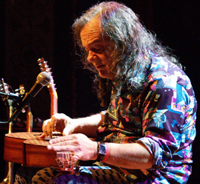 |
| David Lindley playing Weissenborn slide guitar. Photo by Joerg Kliewe. |
Guitarist David Lindley is a pioneer of international music who led one of the first world music rock groups during the ’60s called Kaleidoscope. He would later work with singer-songwriter Jackson Browne starting in 1971 and his staggering solos can be heard ripping through such hits as Jackson’s classic “Running on Empty”.
Whether playing switchbacks on his lap steels, hot rodding through six-string riffs, or grooving on his collection of Middle Eastern stringed axes, David’s extraordinary cauldron of musical talent captivates musicians and fans around the globe.
David Lindley’s show at the Alladin Theater in Portland, Oregon, was the perfect spot to get out of a cold winter rain. Stepping inside the theater, I caught Lindley’s sound check while he tweaked his gear to fit the old vaudeville house’s acoustics. I was caught by surprise and stopped in my tracks when he unleashed an exquisite rendition of the late Warren Zevon’s “The Indifference of Heaven”.
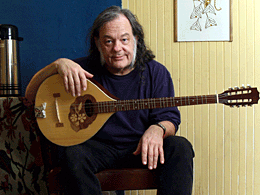 |
| David Lindley backstage with a bouzouki. Photo by Joerg Kliewe. |
A short while later, I found myself sitting across from David as he answered questions between sips of hot coffee and talked about his amazing instrument collection, songwriting, and the world of independent music production.
Although, we now know Lindley as a gifted multi-instrumentalist and for his classic licks on some of the best music produced during the past 40 years, he began his music journey as a banjo player. As a teen he was a five time winner of California’s Topanga Banjo – Fiddle Contest.
A musician’s musician, David can be found ripping it up on tracks with such formidable talents as Ry Cooder, Bob Dylan, Rod Stewart, Terry Reid, Rory Block, James Taylor, David Blue, Linda Ronstadt, Crosby and Nash, Iggy Pop, Little Feat, Linda Thompson, Warren Zevon, and a long impressive list of fellow artists.
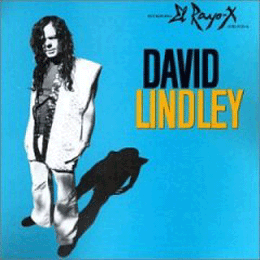 |
| El Rayo-X |
Lindley’s eccentric spirit has led him to classic Danelectros, Tiesco Del Reys, Kays, Nationals, as well as a grouping of exotic instruments with names like oud (Middle Eastern), bouzouki (Greek) and saz (Turkish).
After releasing his solo album El Rayo-X, he formed a band of the same name with Bernie Larsen (guitar), Jorge Calderon (bass), Ian Wallace (drums), and Ras “Baboo” (percussion), who interwove traditional American roots music, world beat, and reggae.
In 1991, Lindley landed in Antanarivo, Madagascar, with avant-garde guitarist and innovator Henry Kaiser that resulted in a durable collaboration based on a series of field recordings. The visit to the island nation yielded six albums of Malagasy music, including an award winning two-volume set A World Out of Time. Later, the two would head to Norway where they pulled together two more CDs, Sweet Sunny North (Vol. 1 and 2).
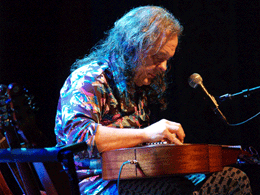 |
| David Lindley on stage at the Alladin with his Weissenborn. Photo by Joerg Kliewe. |
When Lindley stepped out on stage at the Alladin the audience was rewarded with the flash of his very “Mr Dave” outfit that included a flamboyantly hep ‘70s shirt, a pair of funky polyester pants, and “soft like buttah” blue alligator shoes. His set roamed the earth with tunes from all over the planet that began with a short warm up on his bouzouki. He later switched to a Weissenborn guitar to deliver Zevon’s “Seminole Bingo”. The sound he conjured was as wide as a semi-trailer with a thick bass chop that had us thinking that there were two players on stage.
He ventured into performing highlights from his three Twango Bango albums mixed with traditional tunes on the oud and later on some songs he recorded during the ‘90s with Jordanian percussionist Hani Nasser.
Lindley’s Alladin show was a retrospective of over 40 years of playing by one of America’s finest players of stringed instruments. The honesty of his performance and his quirky humor illustrate that he is, indeed, a giant in American music and entertainment.
It’s good to see you back on the West Coast. The last time we met you were performing with Wally (Ingram) in Cologne, Germany, during an extensive European tour.
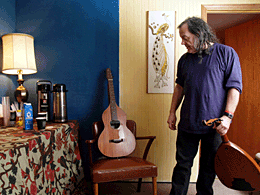 |
| David Lindley backstage. Photo by Joerg Kliewe. |
David Lindley: Yeah, the last German tour has already been a while ago. Anyway, we had serious problems with the promoter during that tour and didn’t go back since. But yes, I have many friends abroad and I would love to play in Europe again.
Are the current dates that you’ve played the start of another world tour?
DL: No, no, no, the U.S. dates will, however, continue until the summer and even into the summer. In between I will finish the new album.
What will be on it? More covers or your own songs?
DL: Ha ha, nice try! I’ll only say this much, everyone will love it! I just finished the basic recordings and I’ll take those to Jackson’s [Browne] studio for the final production.
Is Jackson a part of the project too?
DL: We’re using his studio only, which includes absolutely the best gear you could imagine. I think lending me his studio for free is being involved.
Did you record using microphones or amplify the instruments first?
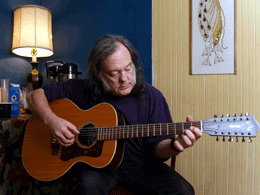 |
| David Lindley backstage with 12-string Guild. Photo by Joerg Kliewe. |
DL: No, by microphone. We were using ProTools and I was catching the signal by four mics on four tracks at the same time to give it more room and depth. The sound will blow you away!
Your concert program is a well balanced set of your own songs and tunes written by other great artists, like Warren Zevon and J. J. Cale, and they blend together just fine. Where and how do you find these songs or do they find you?
DL: Warren’s stuff is great music that I just love and have to play, man. Anyway, I get songs from all over. Often my daughter finds me tunes and if If I don’t find the kind of song I’m looking for I write them myself. It’s actually pretty easy.
You seem to hold close control over the management side of things. Isn’t it still quite difficult to produce and market your music independently in the US?
DL: Yeah, no record company involved other than myself! Actually it isn’t difficult and marketing my music by myself works pretty well for me. I sell my records directly, especially to smaller stores, more the mom and pop kind of stores. And I even sell them in Canada, Europe and Japan .
Not only are you a multi-instrumentalist but you are also known for your huge collection of guitars and stringed instruments. Add any new treasures to your collection recently?
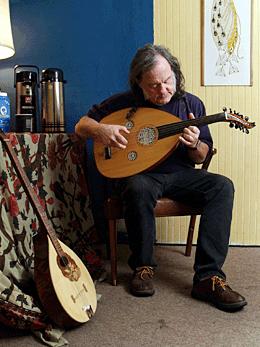 |
| David Lindley backstage with an oud. Photo by Joerg Kliewe. |
DL: I became totally devoted to my ouds and I can’t get enough of them! I already keep thinking of what I’m going to buy to reward myself [for touring] when I get back home. Hmmm, maybe another oud?
During a visit to Turkey I noticed that the oud players were pretty obsessed by their instruments.
DL: I really love these instruments. Maybe because they are so challenging. They are tuned in quarts [fourths] and the traditional music that has been conserved is written for them and includes a special phrase for almost every note. Oud players like Necati Celik Üsta from Turkey started playing when they were kids. These players achieve their title of “Master of The Oud“ from many years of hard practice and play.
You play John Lee Hooker kind of riffs on the oud.
DL: You can play everything on an oud! Isn’t that great? I remember when I received my flat back oud made by Viken Najarian, I plugged it into an amplifier, turned the volume to 10, what is sometimes a good thing to do, and it sounded like [pauses] crap. So, I called Ry Cooder who I knew was working at a studio downtown. I played it to him over the telephone. Ry asked, “Shit. What is this thing? You better get down here with it right away!”
When I got there Ry checked it out and said, “Hmmm, whatever it is, it sounds really good. Can I borrow it for a while?” After a couple of weeks I called him and said: “Ry, I want my oud back.”
You see, this is what these instruments do to you!
What other instruments are you going to play during the concert?
DL: I brought two Weissenborn guitars made by Paddy Burgin in New Zealand, which are mind blowing! The quality is just incredible. I’m also going to play an oud made by Dimitris Rapakousios and, of course, I brought my Guild 12-string. Guild actually had it measured recently because they didn’’t have records on these instruments any more.
Your website shows a respectable part of your collection. And you also own quite a few vintage instruments. How do you feel about the current market situation when it comes to vintage guitars?
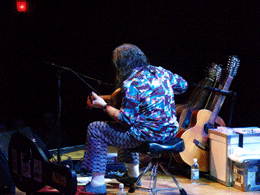 |
| David Lindley in concert. Photo by Joerg Kliewe. |
DL: Look what the ’60s Strats are selling for these days, $30,000 and over! It’s unbelievable! Actually, I have a ’60s Strat and the pickups had even gotten rewound by Doc Kaufmann. I don’t think I’m gonna sell that one!
Do you know exactly how many instruments you currently own?
DL: I will not tell! They are so many by now that I have to keep them safe at different locations.
Related Links
David Lindley
Paddy Burgin Guitars
Dimitris Rapakousios
Walrus Audio Introduces Canvas Expression
A Guitar With a 20-Watt Speaker Built In? | Inspire Pro Demo
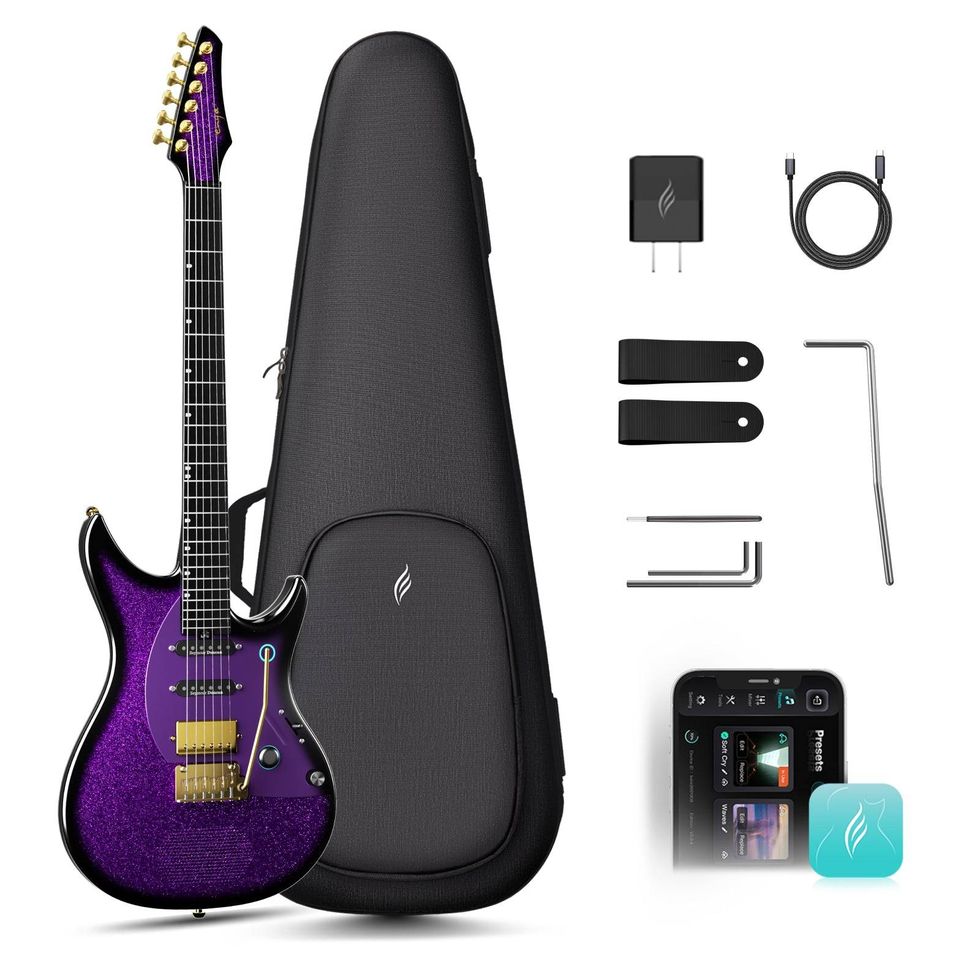
Usually, if you're bringing an electric guitar to a gig, you need to bring an amp, or at least a speaker, too. The Enya Inspire Pro changes that. It's got one built in. Tom Butwin unpacks a smart guitar that folds an entire signal chain into a carbon fiber body, and makes the case that even the most die-hard traditionalist can find a use for it.
Behind the speaker sits the processing: more than 50 amp models, a deep effects library, an onboard looper, tuner, and drum machine. Switch to line-out mode and all that modeling routes out the quarter-inch jack to an amp, interface, or FRFR cab. Add the wireless footswitch and you're jumping between patches and presets from the floor. The Enya app handles the rest, offering the ability to rearrange effect blocks, dial in parameters, and generate tones from a written or spoken prompt.
The Inspire Pro is available at two price points. The SD carries a USA Seymour Duncan set (SSL-2/SSL-3/TB-4), a titanium alloy and brass bridge, and a gloss finish. The AL swaps in Enya's own Apex Lab pickups and a matte Lazer Radiance finish, keeping all the same smart features.
Save $250 on this killer metal-ready Epiphone Flying V prophecy

The Flying V might have been something of a dud when it originally launched back in 1958, but one of Gibson’s most unique designs is proof positive that some guitars are simply ahead of their time.
Indeed, it took a few decades for the circumstances to be quite right, but nowadays the iconic V shape has become a staple of rockstardom – particularly at the heavier end of the spectrum, where pointy guitars are almost mandatory, and shapes like the V and Explorer have become oft-imitated classics.
Thankfully, the success of the Flying V in the hands of Metallica’s Kirk Hammett, Zakk Wylde, Michael Schenker or scores of others means that the guitar world is well-stocked when it comes to options from both Gibson’s range and the more affordable Epiphone end of the spectrum.
Back in 2021, Epiphone launched the Prophecy collection, which was set up metal fans from the off, complete with all-black livery and crucially, sporting a pair of Fishman Fluence active pickups – and now thanks to the good folk at Sweetwater, you can snag one for a very respectable $250 discount.
In addition to the none more black looks and the Fluence pickups, the Prophecy is a classic mahogany design with a 24-fret ebony fingerboard with an asymmetrical Slim-Taper-shaped neck. You’ll also find upgraded hardware that also includes Grover locking Rotomatic tuners, a LockTone Tune-o-matic bridge, and a Graph Tech NuBone nut.
Given that this guitar was originally over a grand, the $250 discount makes this guitar a real steal – the Fluence pickups would cost you about $400 on their own, and that’s without the guitar it’s attached to!
The post Save $250 on this killer metal-ready Epiphone Flying V prophecy appeared first on Guitar.com | All Things Guitar.
Royal Blood Announce New Album "Dead Company"
Royal Blood, one of the most important British rock bands of their generation, return today with an explosive new single “Ten Over Ten” and announce their long-awaited fifth studio album, Dead Company released via Warner Records on November 13th.
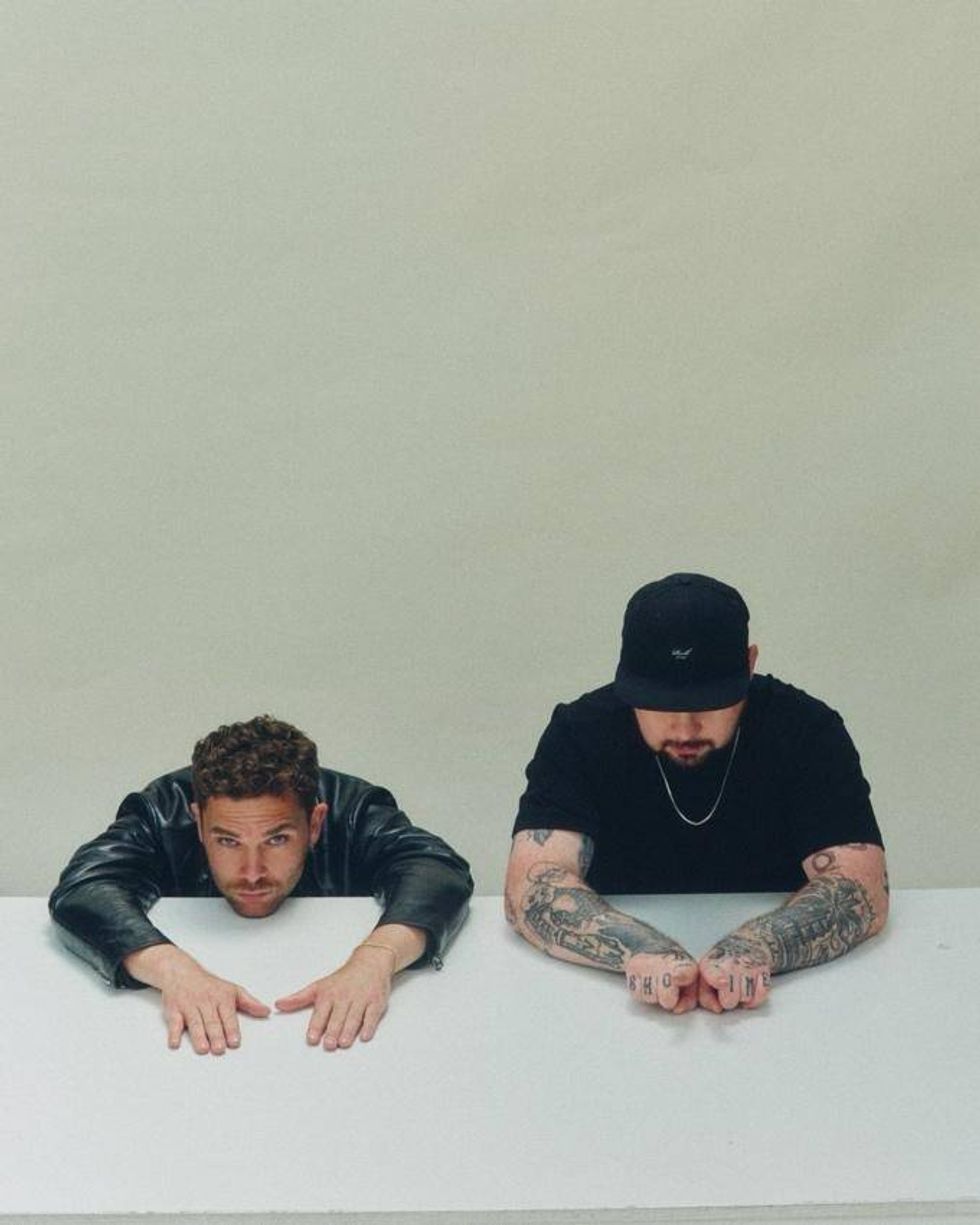
Dead Company marks a powerful new chapter for the duo, who last released an album in 2023. Following a period away from the spotlight, Mike Kerr (bass, vocals) and Ben Thatcher (drums) entered the studio in 2025 with no deadline, no distractions and a simple ambition: to see what was possible with two people, 12 notes and infinite outcomes.
Self-produced by Royal Blood, they set out to make an album as raw, human and visceral as possible. Dead Company strips everything back to its core. Immediate and uncompromising, it captures Royal Blood at their most powerful.
The band adds “After putting the Royal Blood engine in neutral for a couple of years, we've been building up the revs and are playing faster and harder than ever with this album. Written and recorded with the stage in mind, we cannot wait to play it live for years to come.”
The first track to be revealed, “ Ten Over Ten ,” is a menacing desert rock meets Motörhead behemoth of a single. The lyrics and vibe were inspired by the frontman training for a marathon, and it became all about endurance and pushing yourself. Click here to listen.
Since they first emerged 12 years ago when they released one of the fastest-selling rock debuts of the century, Royal Blood have made one hell of an impact: each of their four albums has hit Number One in the UK, shifting over 1 million records, becoming an arena-filling, festival-headlining tour de force, and forerunners of the guitar rock revival we’re seeing today.
The album announcement follows news of three sold-out intimate August underplay shows in the UK. Click here for tickets and tour details. U.S. tour and more to be announced soon. Click here for more info.
Ultimately Dead Company is a bold 10-track album. This is what they were born to do, so they might as well turn it up. And with that Royal Blood return louder, sharper and more vital than ever.
This Taylor Swift-vibed Epiphone acoustic is over $400 off at Sweetwater – and that’s a steal whether you’re a Swiftie or not

While Taylor Swift’s 2023-2024 Eras Tour was a global phenomenon, her arsenal of guitars was equally as staggering. However, one guitar stood head and shoulders above the rest in her grandiose collection: the Gibson J-180. The J-180 was the true star of the show, with the superstar wielding multiple versions of the acoustic-electric, from pastel pink to rhinestone-adorned.
With Swift asserting herself as a modern guitar hero, her favoured guitar is certainly worth considering if you’re in the market. Thankfully, Sweetwater currently has a sweet deal on Gibson’s sister brand, Epiphone – meaning you can get an Epiphone J-180 LS for over $400 off.
While Gibson quickly jumped on the hype of Swift’s Eras tour, releasing a Gibson Custom Everly Brothers version of the J-180, that model will set you back by over $4,000. The Epiphone edition was a much more realistic $1,299 at launch, but that’s now been slashed to an even more appealing $899 – and it packs plenty of charm and quality into that price.
The Epiphone J-180 LS is a great way to capture Swiftie tones. Though there isn’t a silver, rhinestone-studded edition, you can get the same $400-off deal on both the lovely pastel pink and classy ebony black options. Both also feature a C-shaped mahogany neck, with popstar-worthy mother-of-pearl star inlays across a laurel fingerboard.
 Credit: Sweetwater
With a classic Gibson 25.5-inch scale it’s a comfortable player for anyone, and the classic J-style body shape means much of the guitar’s mass is away from the player’s body, with that svelte waist offering easy access even for smaller frames. It also has onboard LR Baggs Element Bronze VTC preamp electronics for to help amplify and maintain a strong, warm acoustic tone.
While the Eras Tour saw Swift run through the full gamut of guitars she’s used and loved throughout her career, the J-180 was clearly her current favourite squeeze. If it’s good enough for Swift, it’s well worth your time.
While last year saw Swift releasing her album The Life of a Showgirl, this year has seen slightly less musical output from the pop superstar. Though, she did have a feature on the new Toy Story 5 soundtrack, releasing the country pop, acoustic-sprinkled I Knew It, I Knew You.
The post This Taylor Swift-vibed Epiphone acoustic is over $400 off at Sweetwater – and that’s a steal whether you’re a Swiftie or not appeared first on Guitar.com | All Things Guitar.
“If you have a bottle of Jack Daniel’s and an eighth of speed – I’ll be there” Lemmy’s amazing response when Billy Morrison asked him to play a show

What exactly do you need to get Motörhead legend Lemmy Kilmister to play your gig? If you’re Billy Morrison, apparently just a bottle of Jack Daniel’s and an eighth of speed.
As Morrison recalls in the new issue of Classic Rock, Ozzy Osbourne had given him Lemmy’s number with the assurance that the singer was “easy to deal with”.
“I do these occasional all-star shows in LA, where we play covers with a bunch of famous people,” says the guitarist. “About twenty-five years ago, Ozzy gave me Lemmy’s cell number and said: ‘Drop him a line, he’s easy to deal with.’ So I cold-texted Lemmy Kilmister. And I’m terrified. Because I don’t know how this legend of debauchery is going to respond.”
Morrison kept the message simple, asking Lemmy if he would come down to the Roxy and play Motörhead classics Ace Of Spades and Bomber.
“Within seconds, he responded: ‘If you have a bottle of Jack Daniel’s and an eighth of Beryl’ – that’s Beryl Reid, which is Cockney rhyming slang for speed ‘I’ll be there.’”
True to his word, Lemmy turned up, bringing all the ingredients Morrison had apparently been promised. His guitar tech also brought along the Motörhead frontman’s famously enormous Marshall rig.
“At that show he was everything you would want Lemmy to be,” Morrison says. “His tech brought down his famous Marshall amp. It was ridiculously loud. The cowboy hat, the voice, the volume – he killed it.”
The experience also left Morrison with a unique perspective on Lemmy’s ability to perform through the excesses that had become synonymous with his image.
“I don’t think [playing under the influence] made any difference,” he says. “This is where everyone goes wrong in the music business, me included. You think you’re great, but you’re shit. There are precious few – Keith Richards being one, Lemmy being another – where, actually, it makes no difference. I’ve seen the man drink a bottle of Jack and snort three grams of speed, then I’d have a conversation with him.”
The post “If you have a bottle of Jack Daniel’s and an eighth of speed – I’ll be there” Lemmy’s amazing response when Billy Morrison asked him to play a show appeared first on Guitar.com | All Things Guitar.
“It could be the last time we see each other”: Ritchie Blackmore on his “very emotional” Deep Purple reunion

For anyone who thought Ritchie Blackmore and Deep Purple would never share a stage again, last Wednesday night at Jones Beach proved that time really does heal all wounds. More than three decades after his last gig with the band in 1993, the guitarist surprised fans when he walked out onstage to perform Smoke on the Water.
Speaking to Guitar Player, 81-year-old Blackmore reveals that the surprise jam was, in fact, entirely his idea.
“I woke up one morning thinking, the day before their show, ‘You know it would be good for the fans if I just got up for one song, probably ‘Smoke’ and just show that we’re not at each other’s throats and don’t hate each other,’” he explains.
Blackmore’s wife and Blackmore’s Night bandmate Candice Night then got in touch with Deep Purple singer Ian Gillan, who gave the idea his approval.
“I said, ‘What do you think about me getting up for ‘Smoke?’ His exact words were, ‘It made me smile.’ He then put it to the band and it was thumbs-up all around.”
That said, stepping back into a Deep Purple rock show came with some understandable nerves for Blackmore – the guitarist hasn’t played a full-on rock gig since performing with Rainbow in 2019, and he wasn’t sure how he would fit into the band’s current setup alongside guitarist Simon McBride.
“I had my misgivings at first, as I didn’t know if I would be heard or too quiet or whatever,” he admits. “I could see the guitarist [Simon McBride], who is very good, had a big amplifier, and I thought I’ll just bring a 50-watt amp, but luckily it all worked.
The performance itself was deliberately stripped back. Blackmore says he didn’t want to overplay, given the short preparation time he had.
“It was very moving because I went on very quickly and had to play immediately,” he says. “I couldn’t warm up, but I wasn’t there to be playing correct notes. I was there to see old friends. I hadn’t seen in 40 years and we’re all getting older. I think we realised it could be the last time we see each other, maybe.”
“It was tricky; I didn’t play anything too technical, as I felt I should stick to the rudiments of being simple. I still lost my place at one point, but it’s not why I was there. I was there to heal any wounds – but there weren’t any wounds. Everyone was like, we were in the army, all along the Western front and we were all getting together again. Very emotional moment.”
Gillan appeared to feel much the same way. After the performance, he turned to address the New York crowd: “I tell you, it was an absolute pleasure to have back on stage the founder member, the great legend, the immortal Ritchie Blackmore… I’ll see you in the bar.”
McBride also shared a backstage photo with Blackmore, describing it as an “absolute pleasure” to share the stage with the guitarist, whom he called “an inspiration to all.”
The post “It could be the last time we see each other”: Ritchie Blackmore on his “very emotional” Deep Purple reunion appeared first on Guitar.com | All Things Guitar.
Jimi Hendrix believed guitars were possessed by spirits, and he smashed them up to “set the spirit free”

We often hear guitarists talk about the ‘soul’ of an instrument, but Jimi Hendrix apparently took the idea quite literally. The guitarist believed that different guitars carried different spirits, and according to his former roadie Eric Barrett, he would sometimes smash an instrument to “set the spirit free” once it had given him everything it could.
In a new interview with Uncut, Barrett – who earlier this month released his memoir Experienced: On the Road with Jimi Hendrix and Beyond – recalls one particularly memorable example. Asked about Hendrix’s belief that the spirit of a guitar could depend on the wood it was made from, Barrett explains that the guitarist had certain instruments he would never destroy.
“Jimi believed that. Certain guitars he’d never smash because of the wood they were made from. One time, he smashed up a beautiful brand-new guitar. After the show I said, ‘Why that one, Jimi?’ He told me he couldn’t squeeze one more note out of it. It had given him everything it could, so he smashed it to set the spirit free.”
As dramatic as Hendrix’s guitar-smashing habit was onstage, it also led to some rather amusing moments when the band took its collection of instruments through customs.
“When we travelled we had to fill out a carnet,” Barrett explains, referring to the document used for transporting equipment across international borders. “You’d write down whatever you were taking out of the country. One time we were coming back into America and the customs official said he could only count 12 guitars but there were 22 on the carnet.”
“I opened a case and it was full of pieces of guitar. I said, ‘There’s your other 10.’ I’ll never forget his face.”
The spirit of Hendrix’s guitars wasn’t the only thing Barrett remembers from life on the road. The roadie also has some less-than-glowing memories of Woodstock, despite the festival’s legendary status.
“I was not crazy about Woodstock. It was not The Jimi Hendrix Experience,” he says. “We had to put up with some attitude from one or two of the new musicians, who looked down on Gerry and I – we were just the help. That left a bitter taste in the mouth.”
“We also went on so late,” Barrett continues. “After the show we were due to play The Dick Cavett Show. The band got some sleep in the house in Woodstock while I set up at the TV studio. I got a call saying that Jimi’s not coming. Mitch told me that the network sent a helicopter. Jimi had looked at the chopper and said, ‘I can’t get on that, it doesn’t have enough blades,’ and went back to bed.”
Released on 4 August, Experienced: On the Road with Jimi Hendrix and Beyond offers a firsthand account of Barrett’s years alongside Hendrix during the guitarist’s rise in the late ‘60s.
The post Jimi Hendrix believed guitars were possessed by spirits, and he smashed them up to “set the spirit free” appeared first on Guitar.com | All Things Guitar.
What guitar does Taylor Swift use? The varied and unique instruments of The Eras Tour

The most famous person in the world is a guitar player. Yep it’s easy to forget that long before Taylor Swift became perhaps the defining cultural icon of the 2020s, Time’s Person Of The Year and an artist so universally popular that she can single-handedly boost NFL TV ratings and jersey sales, she was an aspiring songwriter with a guitar and a dream. But what guitars did Taylor Swift use?
And like any other guitar lover, the more famous and successful Tay-Tay has become, the more interesting and unique guitars she’s added to to her collection – mainly some acoustics but also a fair few interesting electrics along the way.
The epoch-defining Eras Tour has revealed the full gamut of Taylor’s unique and interesting guitar collection, and also showcased it to a wider audience than ever before – it is of course the highest grossing tour of all time, a $200-million cinema box office smash, and the sort of cultural event that defines an entire generation of music fandom.
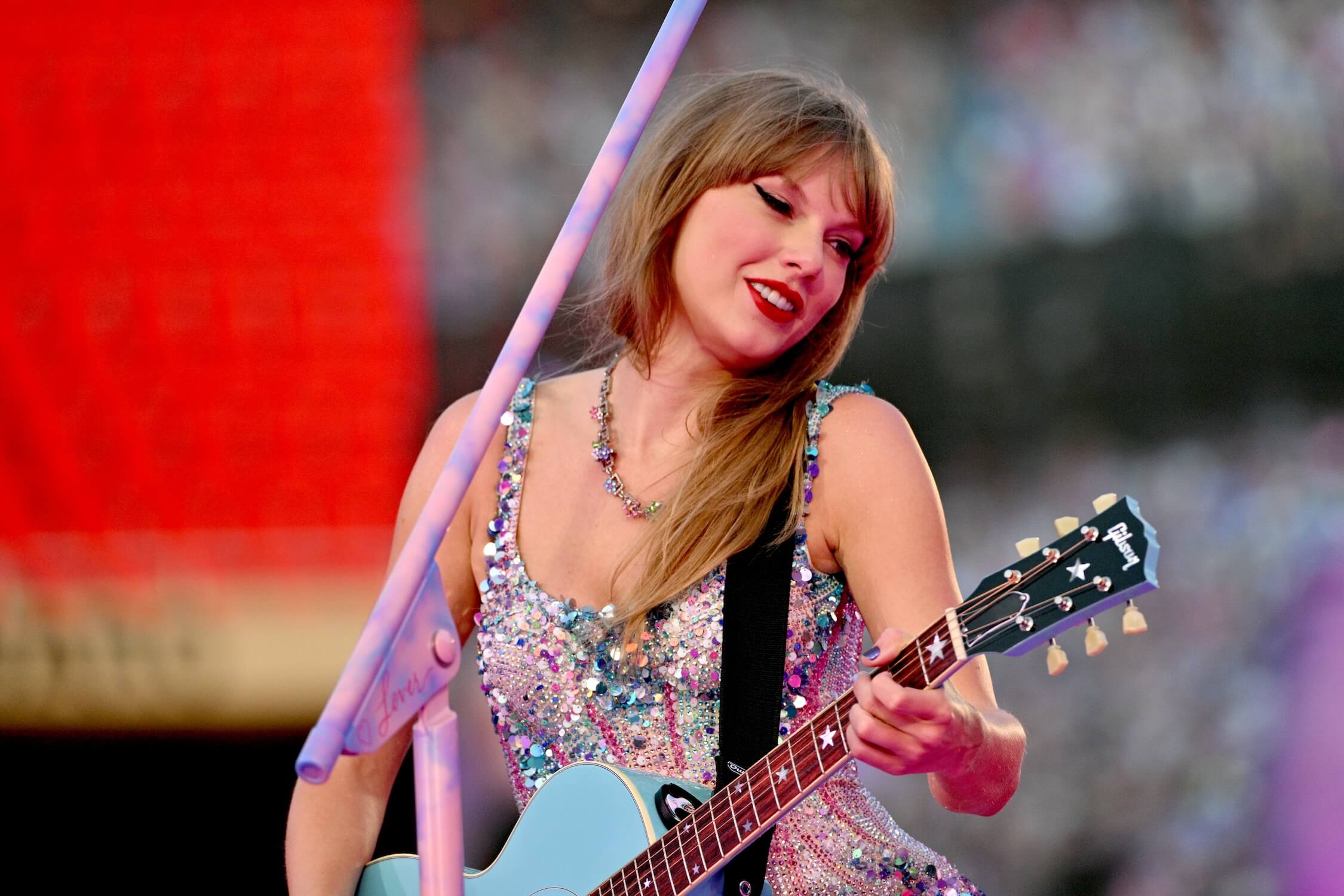 Taylor with her baby blue Gibson J-180 (Photo by Fernando Leon/TAS23/Getty Images for TAS Rights Management)
The Eras Tour is a three and a half hour trip through Taylor’s entire career to date – from her self-titled 2006 debut all the through to Midnights – and most interestingly of all from a Guitar.com perspective, the tour has seen her showcase many of the guitars she used to write and perform those songs at the time.
As such, The Eras Tour gives us a definitive picture of what guitars Taylor Swift uses – many of which are custom-versions of standard models, or rare limited-run designs – read on to find out more about Taylor’s guitar history, and your best options to capture Taylor Swift guitar tones in the real world.
Taylor’s Taylors
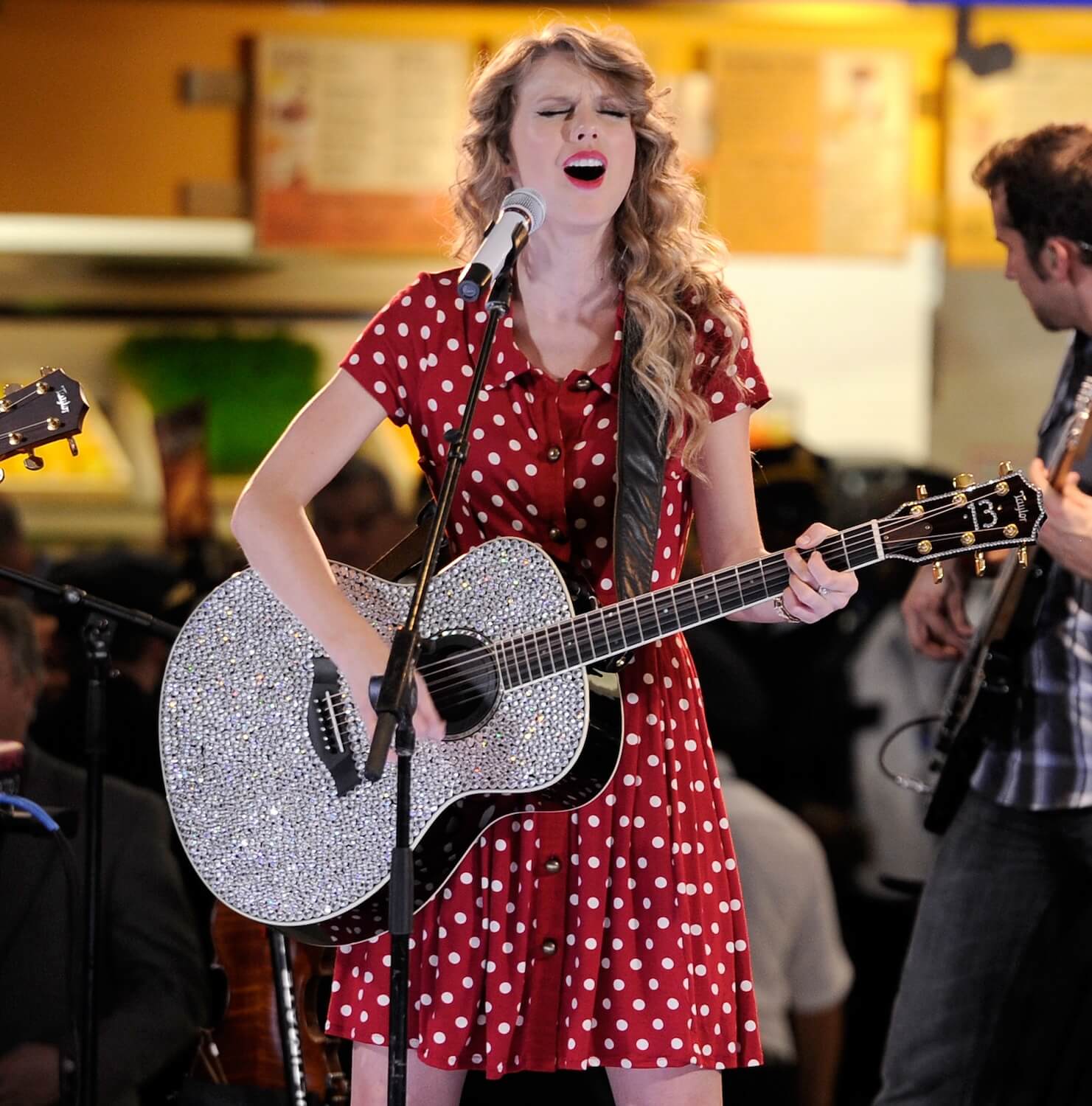 Taylor with her diamante-clad Taylor GS6, which was retired in about 2007 (Photo by Jemal Countess/Getty Images)
It’s perhaps not shocking that going all the way back to her earliest records, Taylor Swift has been a fan of Californian acoustic guitar company Taylor Guitars – after all, who needs a signature model when your name is already right there on the headstock!
Taylor’s Taylor guitars are clearly very sentimental to her, as she’s used them constantly throughout her career, and brought out some of her most cherished examples on the Eras Tour – they’re also some of her most iconic instruments, including her custom red Taylor 614ce that was the main acoustic on the Red Tour, and a diamante-encrusted GS6 that was used on the Fearless Tour in 2008.
Taylor Presentation Series PS-24ce Grand Auditorium
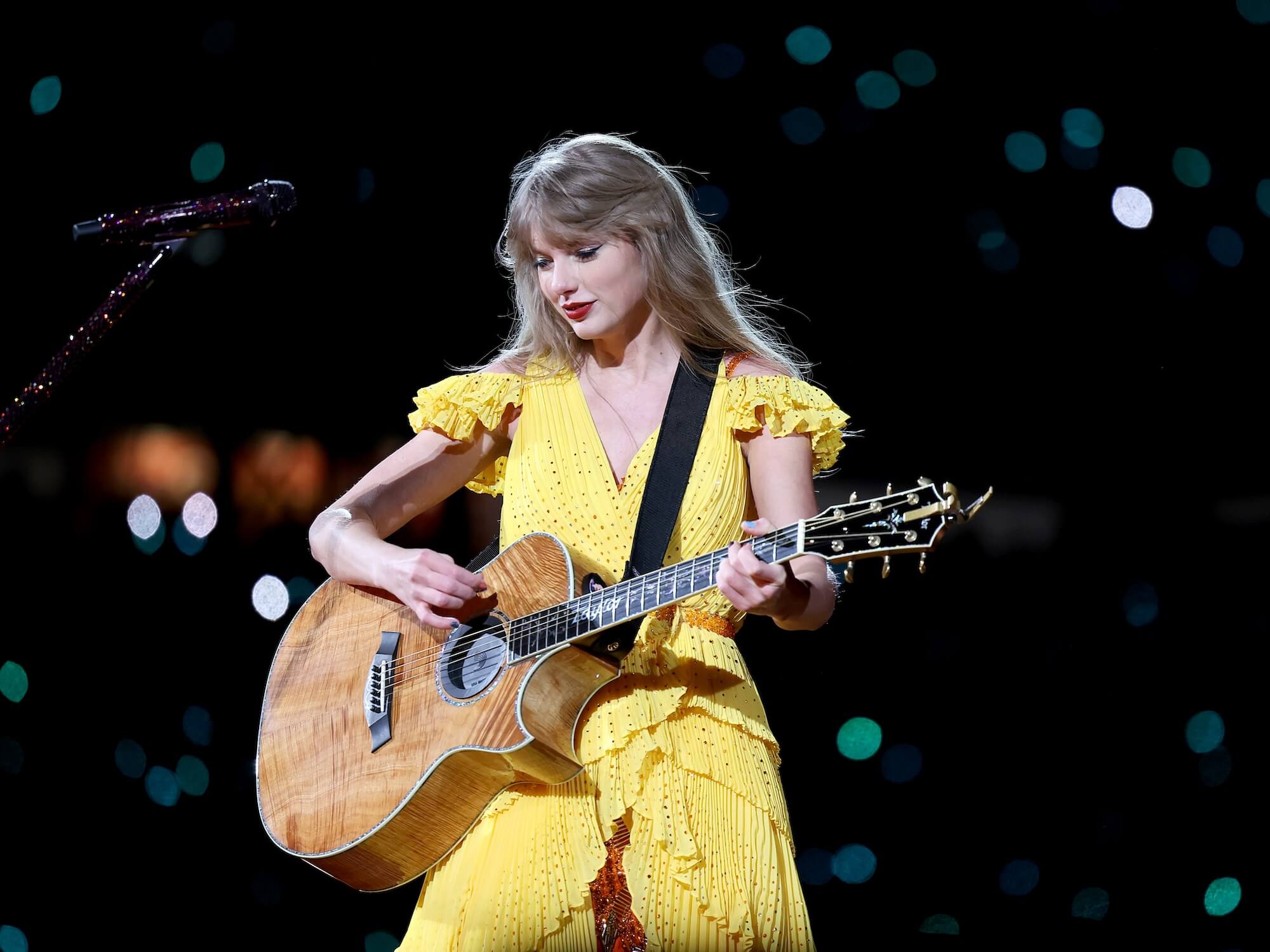 Taylor’s Taylor PS24 (Photo by Scott Eisen/TAS23/Getty Images for TAS Rights Management)
If there’s one guitar that we think might be Taylor’s most sentimental instrument, it’s this one – this stunning guitar has a flamed koa body with a distinctive matching soundhole cover and a ‘Taylor Swift’ in what Taylor calls a ‘Byzantine inlay’ on the fingerboard.
A custom-build, this is based on Taylor’s super-high end Presentation Series PS-24ce Grand Auditorium model, but with a very unconventional ‘Florentine’ cutaway, which has a sharp point, unlike a regular GA model. The guitar also has an ebony peghead and bridge, Gotoh tuners and ivoroid binding.
Taylor started using the guitar around 2007, but it’s clearly a meaningful one as she’s been using it for several songs on The Eras Tour, and displaying it proudly on a stand in front of the audience when she’s not using it.
Get the sound: Taylor’s 214ce is an affordable route to a similar kind of look and sound, with Grand Auditorium body style and koa top
Taylor Grand Symphony “Living Jewels” Series
 Taylor’s ‘Living Jewels’ Taylor Guitar (Photo by Ashok Kumar/TAS24/Getty Images for TAS Rights Management)
This guitar is often referred to as the “Living Jewels” Guitar or the “Koi Guitar”, and is one of the most distinctive and unique instruments seen on The Eras Tour. She first began using the Living Jewels guitar around 2011-2012 during the Speak Now Tour, famously performing songs like Last Kiss. She also used it in 2022 for the music video Anti-Hero, and even put the guitar on display at the Country Music Hall of Fame until it was removed in 2023 for use on the Eras Tour.
This particular guitar came from a very limited series of acoustics designed by Pete Davies Jr. around the year 2000. Only around 100 of these guitars were made, in different designs – one featuring a grey whale, one with a sea turtle, and one with koi fish that Taylor owns. Each of the guitars features beautifully ornate inlay work of the aforementioned sea creatures on the body and fretboard.
Get the sound: Original Living Jewels guitars are almost impossible to find as they were made in very limited numbers and Taylor’s association with them has made them even more collectable, however if you’re not too worried about price, Taylor released a tribute to the guitar back in 2025 that, while not much cheaper, is a little more widely available on the used market.
If seventeen thousand dollars seems a bit rich for a guitar but you’re still in the market for a Taylor Swift-approved Taylor, well you’re in luck – the company has for some time made a Taylor Swift signature version of its entry-level Baby Taylor model. It’s a great starter guitar even without the various Swiftian embellishments.
The Gibson Eras
 Taylor with her pink Gibson J-180 (Photo by TAS2023 via Getty Images)
As befits any country star worth her salt, Taylor has had a long love affair with Gibson guitars – particularly the brand’s acoustic instruments. However, the Eras Tour has seen Gibsons replace Taylors as her primary instruments, with a whole host of new and bespoke instruments of various types that often have colours and customisations that reflect the various albums that she’s referencing in that portion of the show.
While none of these guitars have become actual signature models for Taylor (yet!) they have quickly become as iconic as the popularity of the Eras Tour has exploded, with each of the unique instruments telling its own story about a period in Taylor’s glittering music career.
Gibson J-180
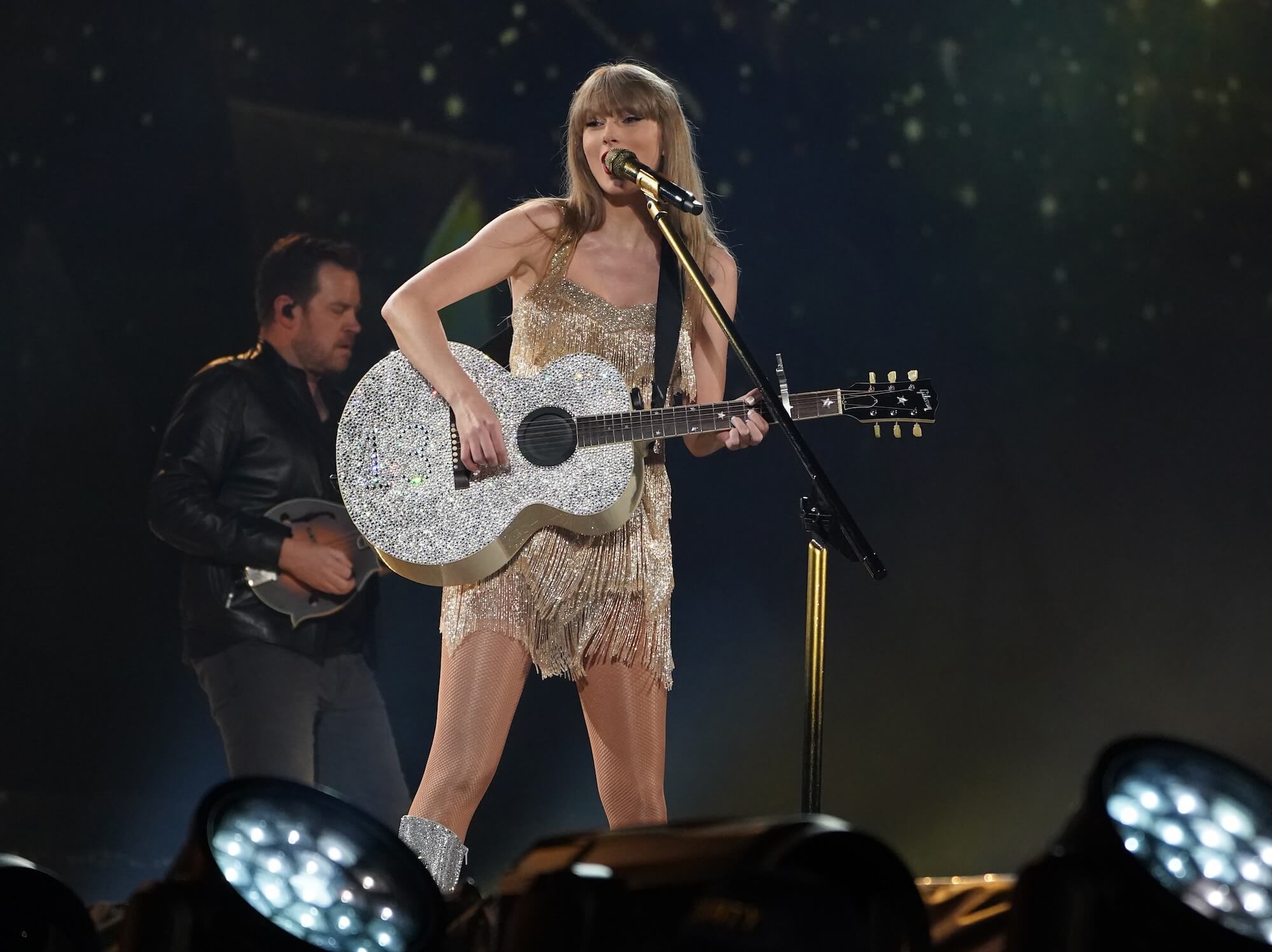 Taylor’s diamante-clad Gibson J-180 (Photo by Christopher Jue/TAS24/Getty Images for TAS Rights Management )
While several of the guitars used on The Eras Tour are instruments she’s pulled out of the rack from the period in question, she’s also brought out several new instruments that are themselves designed to nod to those eras, but with her 2024 sonic preferences.
Key amongst these are a series of Gibson guitars derived from the company’s iconic SJ-200 model – first introduced back in 1937 and used by everyone from The Everly Brothers and Jimmy Page to Billie Joe Armstrong and Justin Timberlake.
Swift recreated her crystal rhinestone-encrusted Taylor Guitars GS6 that was used on the Fearless Tour for The Eras Tour, only this time she used a Gibson J-180 (a thinner-depthed version of the J-200). The GS6 was retired sometime around 2013, but the new guitar featured around 5,400 Swarovski Lead Crystals attached with silicone epoxy by Taylor and her family just days before the tour – the original GS6 was apparently also blinged out by Taylor and her mom.
One notable difference between the new guitar and the original – the addition of a “13” (Swift’s favourite number) rhinestone pattern just behind the bridge.
Taylor clearly really loves the J-180 body shape, as she’s also got several other customised versions of the guitar, including pink and powder blue examples, plus a black one that she auctioned off for charity in 2020 – the guitars are notable for having star inlays on the fretboard as opposed to the usual dots or blocks.
Get the sound: While Taylor still makes the only actual Taylor Swift signature model guitar, Gibson sensibly jumped on the hype train and quickly not only released a Gibson Custom version of the J-180, but also added a trio of more affordable Epiphone models into the line. Conspicuously, these guitars came in hues that were very similar to the custom colour J-180s Taylor used on the Eras tour including pink and blue. It’s a signature model in everything but name.
Gibson J-45
 Taylor’s black sparkle Gibson J-45 (Photo by Christopher Jue/TAS24/Getty Images for TAS Rights Management )
While the J-180 might be her preferred instrument, The Eras Tour also sees Swift playing two different versions of Gibson’s J-45 model – one in a deep red colour and one in a black sparkle finish. Unlike the J-180s these guitars just have standard dot inlays and feel a bit more restrained.
As with pretty much all of Taylor’s guitars though, these J-45s are certainly custom builds, given that they use non-standard finishes, and do not feature pickguards.
Get the sound: Thankfully, Gibson’s J-45 is still in production, though it’s certainly not cheap you can get it in both Cherry Red and Black. If your budget doesn’t stretch to that however, the Epiphone J-45 might be more up your street.
Gibson Hummingbird
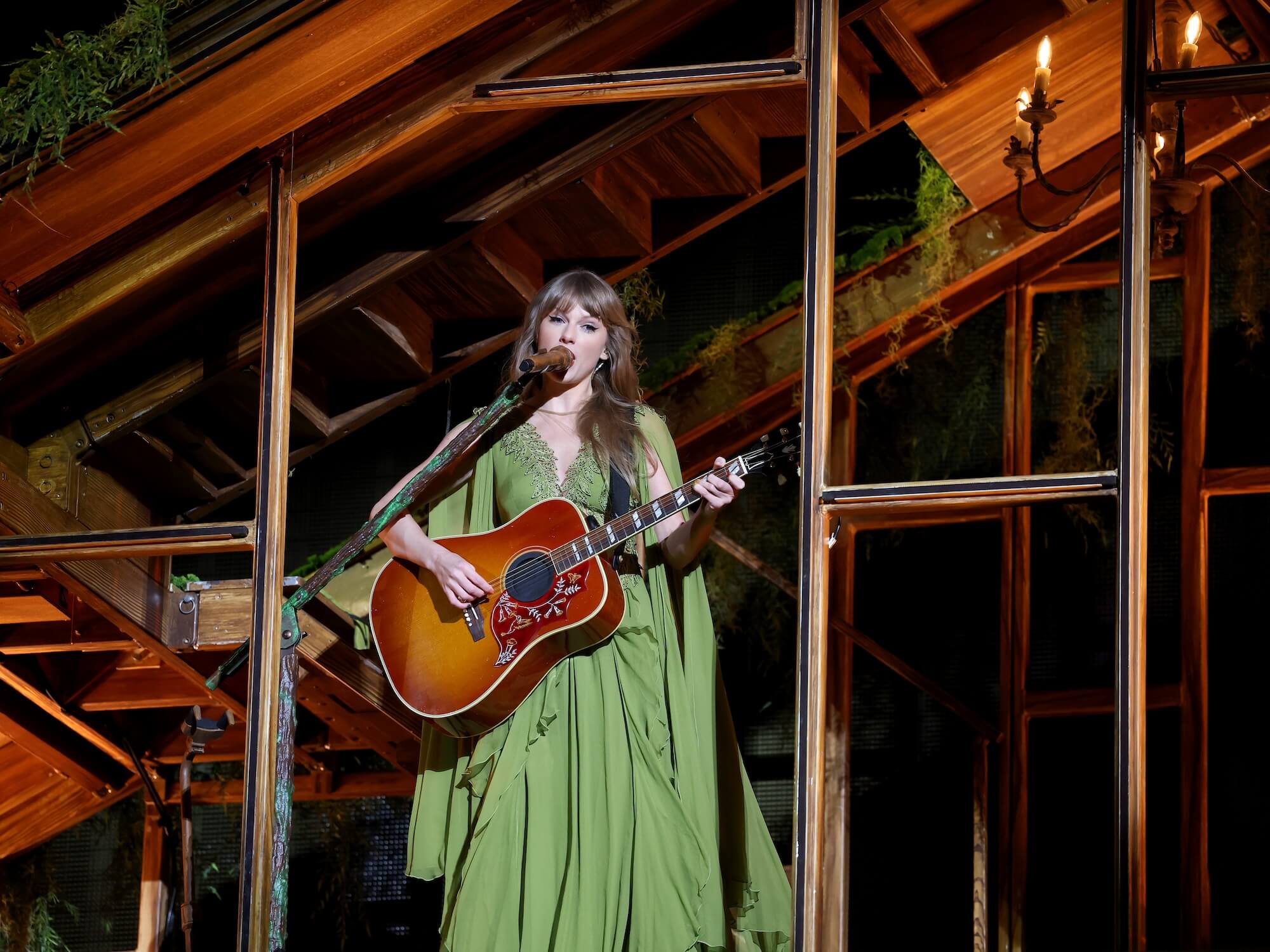 Taylor’s Gibson Hummingbird (Photo by Scott Eisen/TAS23/Getty Images for TAS Rights Management)
Most of the guitars we’ve seen Taylor use on The Eras Tour have been heavily customised and personalised, but there’s one guitar that has the distinction of being stock – a Cherry Sunburst Gibson Hummingbird. Asides from the soundhole plug to prevent feedback (which is common with all her guitars) this instrument is pretty much identical to the guitar you could walk into a store and buy today – including that iconic hummingbird motif on the pickguard.
Get the sound: As mentioned, Taylor’s Hummingbird seems pretty much stock, which means you can buy one from Gibson’s Original Collection today. If you’re not up for spending thousands however, there’s an Epiphone Inspired By version that even comes in the right colour.
Taylor’s Electrics
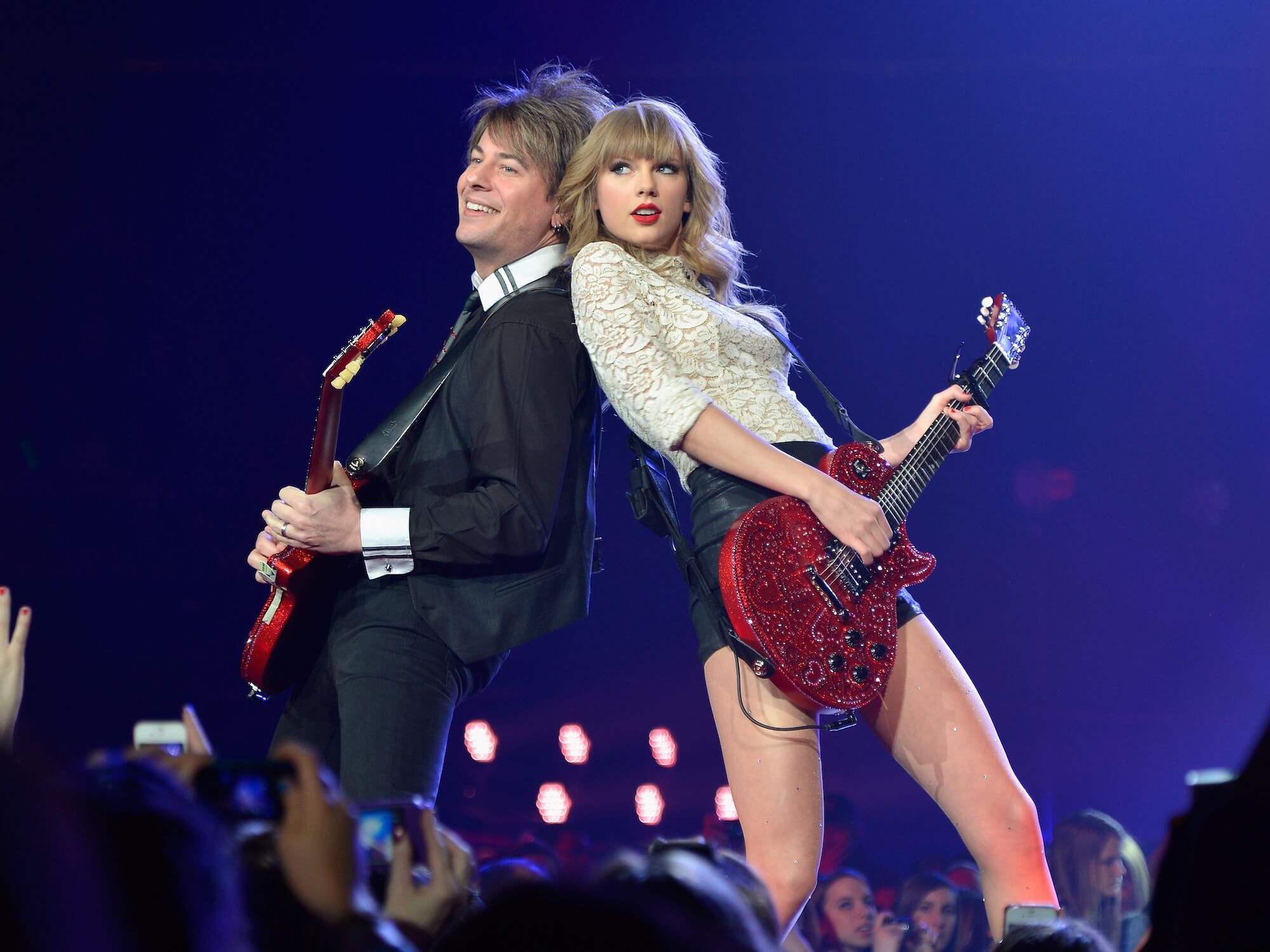 Taylor with her diamanté-clad Les Paul (Photo by Larry Busacca/TAS/Getty Images for TAS)
The Eras Tour sees Swift relying mostly on her acoustic guitar collection, and leaving the electric guitar work to her backing band – that said, she has been known to use a variety of electric guitars over the years, including a red-sparkle Les Paul Standard, a similar guitar with mini-humbuckers, a Les Paul Studio with red diamante finish, and even Taylor T5 and a Johnny Marr Jaguar back in the day.
The Red Sparkle Les Paul Studio even got a run-out on the opening night of The Eras Tour, though the other guitars have yet to make an appearance – they’re all pretty stock spec-wise however.
Get the sound: Taylor has generally been drawn to Gibson-style single-cut guitars over the years, particularly the Les Paul – while her guitars are custom, the recently revived Gibson Les Paul Studio might be your closest bet here.
 Taylor’s Gibson Les Paul with mini-humbuckers (Photo by Mike Marsland/WireImage)
The post What guitar does Taylor Swift use? The varied and unique instruments of The Eras Tour appeared first on Guitar.com | All Things Guitar.
Red Panda RD-1 Pitch Delay review – a clever compact delay with multiple note-manipulating tricks

$229/£224, redpandalab.com
The job of a delay pedal is simple: to listen to what you play then repeat it back to you a few times. Some of them do this job very well – but the really good ones do it extremely badly.
The Red Panda RD-1 Pitch Delay is here to wreck stuff, and that word ‘pitch’ is your big clue as to how: from detuned weirdness to cascading octave screeches, this is all about digital manipulation of notes. Not everything it does is strange and discombobulating – there’s a nice reverse function, and plenty of scope for more standard delay sounds too – but that just means you can lower yourself into the madness gently.
 Image: Richard Purvis
What is it?
The RD-1 has been designed as an alternative to the Red Panda Raster 2 for more compact pedalboards (and more compact bank accounts). If you’re familiar with that pedal, you’ll have a decent idea of what to expect here; if you’re not, let me just begin by telling you it’s a gem.
The Raster 2 is a stereo pedal with lots of multi-function knobs, a second footswitch for layered effects, and the ability to store and recall presets. You’re not getting any of that with its diddy sibling, but you are getting three different pitch-altering modes and an input for an expression pedal, plus a hidden tap-tempo option.
Those modes are called ‘frequency shift’, ‘detune’ and ‘chromatic transpose’, and they have a radical effect on what happens when you tweak the shift knob on the left. Like, radically radical…
 Image: Richard Purvis
Sounds
The shift dial pitches downwards to the left and upwards to the right, naturally, so when it’s pointing straight up the RD-1 becomes a simple, non-mangling digital delay with standard controls for time, feedback and dry/wet blend. While this sound is nothing special it is pleasant, and you only have to tap the reverse button to turn it into something much more fluid and ambient.
But we’re all here for the pitch effects, so let’s get a shift on. The first one is the most out-there of the three, with strangely metallic repeats that can sound something like church bells run through a ring modulator. It’s extreme, but again the reverse function is a great sweetener; and while the pitch-shifting is cumulative, so that each repeat jumps off from the shoulders of the one before, hitting the ‘once’ button means it will only shift the first time – a very different, much more manageable effect.
The second mode measures its shifting in cents and only goes a couple of notes in either direction; the best use I found for this was setting the knob just a tiny twist beyond noon, with the ‘once’ button engaged, for subtle thickening with a hint of modulation.
But the third mode is the one that I suspect most people will end up sticking with. This offers fixed semitone intervals, so perfect harmonies – delivered with a pleasing hint of lo-fi jitteriness – are now in play. With a single shift of a fifth or an octave up, this can sound creepily pretty; now start dabbling with those two buttons and the feedback knob (plus an expression pedal if you have one), and you might just find yourself in glitchy pitchy noise-scape nirvana.
 Image: Richard Purvis
Should I buy one?
Ideally, no, you shouldn’t buy the RD-1 – you should get the Raster 2. But what’s impressive here is how much of that pedal’s unique magic has survived the transition into a properly compact stompbox.
Of course it’s not as good, but it’s closer than I was expecting; and for some players – those who only ever play in mono and don’t need instant access to more than one or two unorthodox delay sounds – the smaller footprint and cleaner interface might even make it more appealing.
 Image: Richard Purvis
Alternatives
It’s infinitely more fiddly than the RD-1, but the Gamechanger Audio Auto Delay (€272/£299/$329) can do extreme pitch swoops among its many digital tricks. A more simple option is the Dreadbox Raindrops (€214/£229/$299) – or you could keep it old-school with the Beetronics BeeBeeDee ($299/£289), an analogue delay with digital control.
The post Red Panda RD-1 Pitch Delay review – a clever compact delay with multiple note-manipulating tricks appeared first on Guitar.com | All Things Guitar.
Behind the Lens: Photographer Michael G. Stewart
Here’s a vintage Guitar International (6/24/2009) with DC/VA/MD photographer, Michael. G. Stewart – the
formatting was a bit disrupted when migrating to a new host and publishing software. There are dozens upon dozens
more to repair. Stand by for more!
by: Rick Landers
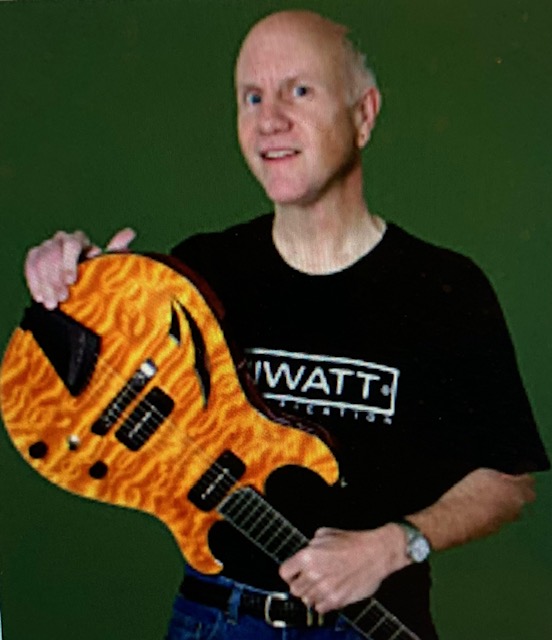
Michael G. Stewart – 2007
Maryland-based photographer and illustrator, Michael G. Stewart, always gets the shot. Whether he’s backstage in dim light with a laconic subject or in the middle of a frenzied crowd of fans at a rock show with blinding stage lights, he nails it.
Artists he’s covered include Les Paul, Neal Schon, Steve Howe, Martin Taylor, Bonnie Raitt, Eric Johnson, Sonny Landreth, Dick Dale, Nokie Edwards, Marshall Crenshaw, Bucky and John Pizzarelli, Doc Watson, Frank Vignola, Cathy Fink and Marcy Marxer, Jimmy Bruno, Deke Dickerson, among a large group of rock, jazz and traditional roots musicians.
Although Stewart didn’t begin his artistic career in photography, it must have been a natural inclination to follow in the footsteps of his father and grandfather who all established themselves as professional image makers in the Washington, D.C. area.
Michael serves as the principal photographer for the National Council for Traditional Arts and has worked with the National Endowment for the Arts. Earlier in his career he was the Chief Photographer for DC’s off-beat magazine Quirks. His work has been featured in the Washington Post, Modern Guitars (Guitar International Magazine), Guitar Player, Vintage Guitar, the Discovery Channel online, Just Jazz Guitar, Chamber Music, Scoot Quarterly, The Classic Motorcyle, and the Strad.
Most of the time, Stewart can be found traipsing along the beaten paths of America in his quest to capture vintage diners, motorcycles, classic cars, guitars and musicians at work and play. He’s covered rock shows, jazz clubs, guitar and music conventions and can occasionally be seen leaning out of hovering helicopters shooting the world below.
His imaginative work as an illustrator can be found in three successful childrens’ books written by author and entertainer Barry Louis Polisar. Michael also illustrated a guide to the Scottish steel string harp and has published a coffee table book on the restoration of St. Mathew’s Cathedral in Washington, D.C. Stewart and his teenage son, Spencer, have gathered enough shots of classic diners and roadside America that they will soon publish an account of their travels and those beloved and vanishing features of the American landscape.
I first met Michael back in 1985 at a party where he was courting his future wife who is a classically trained professional violinist. At the time he and a friend were enthusiastically immersed in a plan to start their own rock band and they had already arrived at an appropriate name, Mid-Life Crisis. Twenty years later, we crossed paths again when Modern Guitars magazine was on the prowl for a photographer in the D.C. area. Bob Shade, president of Hallmark Guitars, and I were discussing the magazine and his guitars when he offhandedly mentioned that he knew a great photographer named Michael Stewart.
I’ve since discovered that Michael’s talents have been embraced by the top jazz musicians on the East Coast, as well as have earned him the respect and admiration of musicians rooted in the traditions of old time Appalachian music. I was able to catch up with Michael between a whirlwind of photo gigs to talk about his career, the art of photography and his love of music and all things guitar.
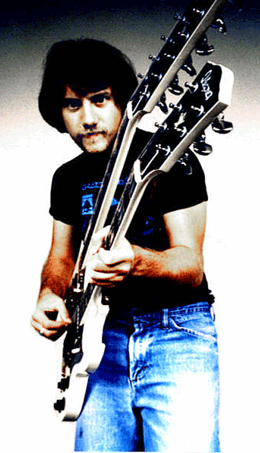 |
| Michael G. Stewart in 1980 |
Michael G. Stewart: Actually I started out for a career in art and illustration. My father was a photographer, but died at a very young age, so the direct connection to photography was out of grasp. I came to photography in my early teens and twenties.
Rick: You’re schooled in photography?
Michael G. Stewart: No, I started out pursuing a career in art at the Maryland Institute of Art College Art in Baltimore [Maryland] and I had training as a film maker. Somewhere along the line I took up photography. Most of that was self-taught.
Rick:What type of rig do you use?
Michael G. Stewart: I’ve always been a Canon person. Since the early ‘70s I’ve used Canon equipment and have always found that as a film camera and digital camera they’ve been of outstanding quality. They’re very easy to use, very durable and just very good equipment overall.
It was a big change after using film for 25 years, both 35mm and larger format. It was rather scary diving into the deep water of the digital field. A very different type of technology, but having switched to fully digital over the past three years in terms of shooting in the music and entertainment fields I’ve actually found it a much more versatile medium. It’s much faster to work with covering a much wider range of applications, especially in the print field as well as with applications like CD and cover designs for the web.
Rick: Most artists seem to favor Macs.
Michael G. Stewart: That seems to be true. I work in a pc environment, however, most of the designers I work with use a Mac. I expect to switch pretty soon. The imaging industry is pretty much Mac-based in the professional world. It’s just easier to go to for technology for any image work.
Rick: Do you focus on the entertainment business or do you handle a broader spectrum of assignments?
Michael G. Stewart: During the past 28 years, I’ve made my living as an architectural and aerial photographer. That’s been the focus of the family business that I recently left. Music and roadside America are the things that I truly love. Apart from the aerial portion from my former career, I don’t miss that so much. It would be nice to make entertainment my full-time work. I’m not sure that’s possible. Having come from a lifetime of listening, creating and interacting with the music entertainment business, I really love and enjoy and believe I have a fine feel for it as a photographer making images.
I’ve also been a performer and I’m married to a full-time classical musician. Both have given me contacts and close working relationships in the music world, so I understand and appreciate that world.
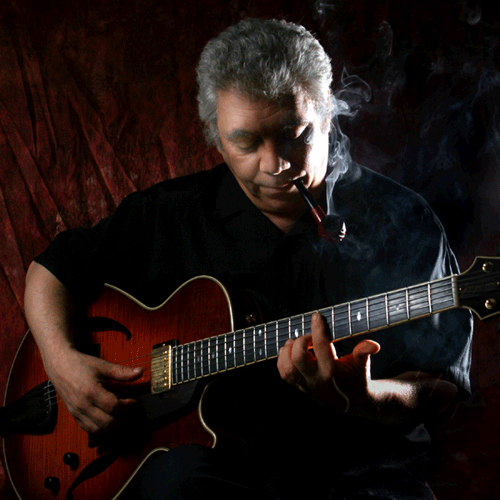 |
| Jimmy Bruno. Photo by Michael G. Stewart. |
Rick: Your website reflects an interest in music, motorcycles and roadside America, specifically diners.
Michael G. Stewart: Yes. My son Spencer actually has a website on roadsideonline.com and he’s probably the youngest acknowledged diner expert in the country. I’ve gone to diners for years and years and have felt that it’s a wonderful piece of vanishing America and a vanishing community. Pretty much independently my son Spencer developed that love and has taken that much further. He’s in contact with every major diner expert and artist in America. So we’ve been on many road trips in search of forgotten diners.
Rick: You met Stevie Ray Vaughan before he exploded on to the music scene.
Michael G. Stewart: Yeah, I met him at a party after he came back from the New Orleans Jazz and Heritage Festival. The first time I’d seen him was before he’d become a known name. But, it was immediately apparent that this was somebody who was going to be well known in a very short time. He was a tremendous talent and a very nice guy. And even though he worked in a very traditional genre of blues and blues rock, he had that personal touch that set him apart. And although there have been many people coming since, in that same vein, he was just someone special that I don’t think anyone since his passing would be where they are musically had it not been for his taking up the torch and carrying it on.
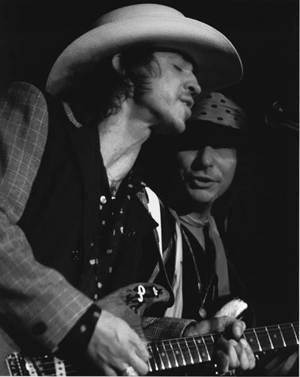 |
| Stevie Ray Vaughan. Photo by Michael G. Stewart. |
Rick: When we’ve been covering a performance you always disappear.
Michael G. Stewart:Yeah, well it’s always good to have a sense of where the performers are going to be when they’re on stage so you’re able to access those areas to get those shots and not be obtrusive to the audience. As a photographer you should be unseen! You don’t want to be a distraction to the performer or the audience. It’s important to get the angles and the views you want to make the performer look his best, but at the same time, you want to be as unobtrusive as humanely possible. Photographers aren’t the focus and they aren’t the event. I’m there to capture the moment and not be part of that moment. You say I disappear and that’s exactly right. I should be someone that no one knows is there.
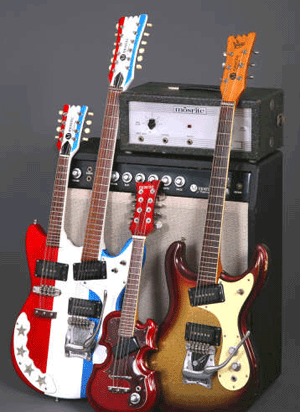 |
| Vintage Mosrite guitars. Photo by Michael G. Stewart. |
Rick: You’re particularly well known for your jazz and folk photography.
Michael G. Stewart: For years and years I was strictly a rock guy doing photos for bands and concerts throughout the ‘70s and ‘80s, but I grew up listening to jazz. Over the years I’ve made some great contacts within the jazz world. I think that love for that music has helped make me the “go to” guy for that type of photography, at least on the East Coast. I’ve made a lot of personal contacts with wonderful players who are also wonderful people.
For the past ten years, I’ve also been affiliated with the National Council for the Traditonal Arts and the National Endowment of the Arts, who put on the National Folk Festival and the Irish Folk Festival and primarily with the folk and traditional arts that run the spectrum classical blues to folk traditions. By folk traditions we’re not talking about Peter, Paul and Mary. We’re talking about old traditional mountain or roots Appalachian, Zydeco and Celtic music. I’ve been able to establish a strong rapport with musicians in those worlds.
And I’ve met some phenomenal guitar players who are lost to the main stream and don’t get the credit they deserve. I get the opportunity to work with those folks and with traditional jazz players, as well as rock and the avant garde world as well.
Rick: Who have been some of the most memorable guitarists you’ve shot?
Michael G. Stewart: Well, certainly Les Paul was a “must remember” moment. He is just the greatest guy in the world, very funny, personable, with loads of stories and even at his advanced age is still a great player and an inspiration to any of us who pick a guitar.
 |
| Les Paul. Photo by Michael G. Stewart. |
I’d have to go back to my younger years and talk about some of my definite favorites from the heyday of the San Francisco sound and psychedelic players. There was Jerry Garcia who everyone knows, but others like Jorma Kaukonen of Hot Tuna who’s always been a favorite guitar player of mine. Lesser known people like Randy Holden of Blue Cheer who has gone on to an interesting career. I also liked John Cippolina from Quicksilver Messenger Service who has been pretty much forgotten. He’s definitely a favorite. I’ve always liked Tony McPhee of The Groundhogs, a British blues band.
Recently, I’ve been hanging out with a lot of superb jazz guitarists including Steve Abshire and Paul Wingo who were both in military bands. Steve was with the Navy’s jazz ensemble, the Commodores, and Paul was with the Army Blues Band. These guys are phenomenal players, just killer guitarists.
I’ve had the opportunity to meet some fabulous folks. One of my favorites was Pop Staples who had phenomenal sound and touch. He was also one of the nicest guys you’d ever want to meet.
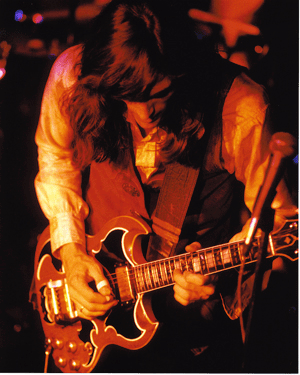 |
| John Cippolina. Photo by Michael G. Stewart. |
Rick: What about fellow Marylander Danny Gatton?
Michael G. Stewart: Danny Gatton was a tragic loss to all of us. I started seeing him in the early ‘70s when he played every week at the Italian Gardens restaurant in Maryland. He kept that up for years. I’m still in touch with members from some of his bands. Danny was the most unassuming guy and he could play anything. Literally play anything. His records don’t do him justice. I’d see him in little bars just wailing away. He could play jazz, hillbilly music, straight away blues and no one could touch him.
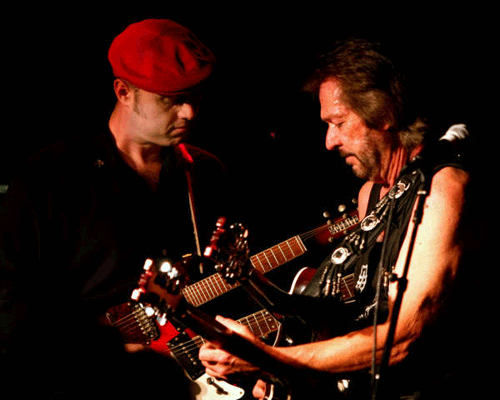 |
| Deke Dickerson (left) and Larry Collins. Photo by Michael G. Stewart. |
The tragedy was that he wasn’t playing one commercial genre, so he really wasn’t given the attention that he deserved. I suppose the hardest thing was that he got so close to recognition, but it was never truly granted to him except from a very narrow group of guitarists. Danny Gatton was a colossal talent who’s sorely missed.
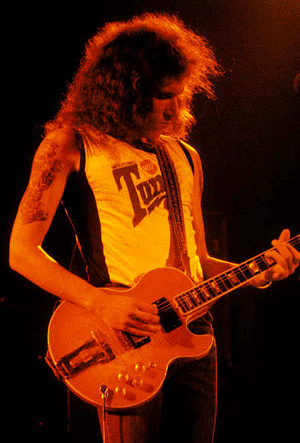 |
| Jorma Kaukonen. Photo by Michael G. Stewart. |
Rick: Did you know him?
Michael G. Stewart: No, I didn’t know him personally. I wish I had and think we would have had a lot to talk about beyond guitars, especially hot rods. No, I was just another guy in the crowd.
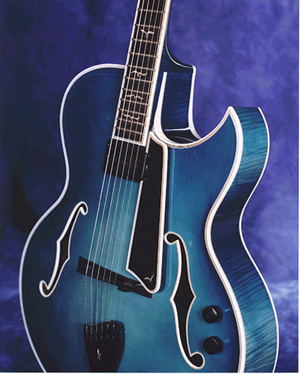 |
| Kenny Burrell model Bendetto guitar. Photo by Michael G. Stewart. |
Rick: Jazz and folk music seem to have lost their audiences during the past fifty years.
Michael G. Stewart: For what I do, the core definition of folk may be different. My focus has been on traditional roots music. For both jazz and traditional folk artists you’re talking about people who are outside the commercial mainstream. Jazz, at one time, was a huge influence on commercial culture during the ‘30s and ‘40s, but certainly since the dawn of the ‘70s has been a musical form that has not been fully appreciated.
Jazz and traditional artists share the burden of not being able to make a living at it. These are individuals who spend their lives studying and playing who are largely left unappreciated and unrewarded when it comes to sales.
For better or worse the new commercial music outlets available to them are limited to downloads to iPod or MP3 players. Most of these guys are self-produced, not making any money and any recognition they do get tends to be from a very small community. I know a number of hugely talented jazz performers who are big names in the jazz field, but when it comes to supporting that talent, they’re pretty much left out in the cold.
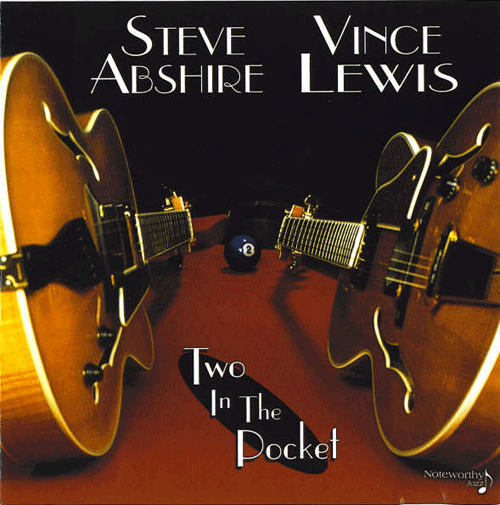 |
| CD cover by Michael G. Stewart. |
Rick: You’ve been designing music cover art for some time now.
Michael G. Stewart: Yeah, I’ve been doing this for over twenty years as far as album cover design. Most of the work I get is from word of mouth. I’m either asked to do something from artists that I know or from artists who know artists that I know. A lot of this comes from shooting live performances. I get a great deal of satisfaction from live gigs and especially being allied with fabulous musicians.
The creative process depends largely on the individual artist. Some have very specific ideas and some come in with absolutely no idea. In the rock and pop world it is a little easier because there’s usually a manager or promoter involved where we work in concert, no pun intended, to make sure the artist is easily recognized in the marketplace.
Many of the jazz and traditional folk artists, those on small labels, don’t realize that packaging is crucial. Sometimes they’ll arrive and just say “Here take this picture and put it on the cover.” I try to steer away from that and try to complement the music by trying to make the cover say what they’re trying to say with their music.
Some do need to be educated and I try to make that part of working with any artist. I like to make the packaging as wonderful as the music inside. It shouldn’t be skimped upon and I try to work with some really good graphic designers and art directors to ensure that the published package looks professional and reflects the music. It should all be married together. You don’t want a CD or album cover that’s not in keeping with the quality and standards of the music.
Rick: CDs give a much smaller point of sales space to grab buyers.
Michael G. Stewart: In the past you had a large canvas for the art work. You’re right the packaging isn’t what it used to be. You now work with a five inch square rather than a twelve inch square. I use to buy records based solely on covers! Really! I could look at a King Crimson or a BeBop Deluxe album or a Stanley Mouse studios cover and I’d buy the album strictly based on the cover. You don’t see that much in the era of CDs, but that’s one of things that was exciting for me starting out. You had a large canvas that everyone could see and it could be associated with the music.
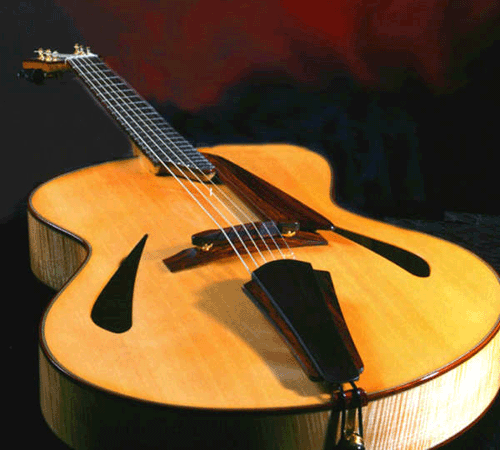 |
| Archtop guitar by Bill Commins. Photo by Michael G. Stewart. |
Rick: With people now downloading their music, do you think CD packaging will go the way of the dinosaur?
Michael G. Stewart: I hope not! I think that you will see some of that happening. But, I think there will always be a place for art to complement the music. For any kind of music marketing you see it tied to some type of visual whether it’s a CD cover or a video or a video cover. It will migrate and turn into different things. Of course, I think with the huge number of opportunities for music distribution on-line that it will change from an in-hand CD, perhaps to images on a website that can be downloaded and disseminated. I think and I hope that there will always be opportunities for imaging even though that’s liable to change in the next five years.
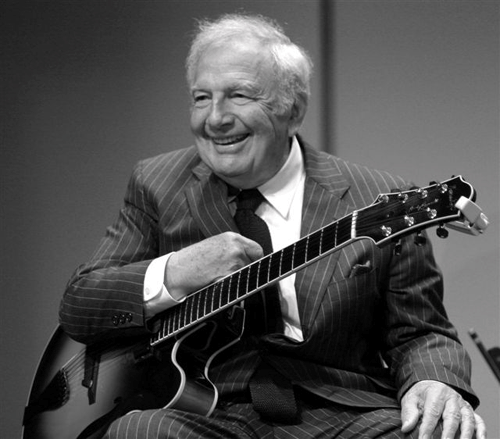 |
| Bucky Pizzarelli. Photo by Michael G. Stewart. |
Rick:How does a professional photographer nail a cover on a music magazine?
Michael G. Stewart: It’s very difficult. I’ve got several and it’s largely by connections at this point. There are a lot of amateurs out there, but knowing when and how to get that great shot is very important. The thinking on intellectual property rights has also changed over the past thirty years.
When I started out anyone could carry a camera into a concert and take pictures. Today, many artists try to keep control of their images. Still people sneak in with point and shooters or camera phones. Still, I don’t think anything can compete with a pro image. Most magazines need a certain level of resolution.
The tough thing for a professional photographer today is the technology leaps ahead making it easier for amateurs to get decent shots. In the long run I think that will hurt the industry. When an amateur turns pro, they find that what they’ve been offering for free will come back to hurt them because their images, in practical terms, no longer belong to them.
 |
| Hallmark Sweptwing guitar. Photo by Michael G. Stewart. |
Rick: What’s been the most challenging part of your career?
Michael G. Stewart: Well, working with this one guy from Modern Guitars has been pretty challenging! [Laughs]
A big challenge is shooting live jazz performances in small clubs because of bad light. It’s hard to get a good image in a club with very low lighting and tungsten lighting. Pros rarely use flash and we like to rely on natural light. It just makes getting good shots a lot harder. Most commercial rock and pop venues have fabulous lighting and it’s hard to get a bad shot! But when working in a crowd of 10,000 or more people getting access to the front of the stage is tough. If you’re on the job and have access then it’s a lot more fun.
I remember back in ’72, a relative of mine was an on again, off again roadie with the Allman Brothers. This was the emergent era of Southern Rock when Wet Willie was the opening act for a guitarist named Jeff Beck! I was trying to get up close to the stage and tried to find someone to give me good access when some guy hauls off and punches me square in the face and knocks me on the ground. That was probably the nastiest occasion I experienced.
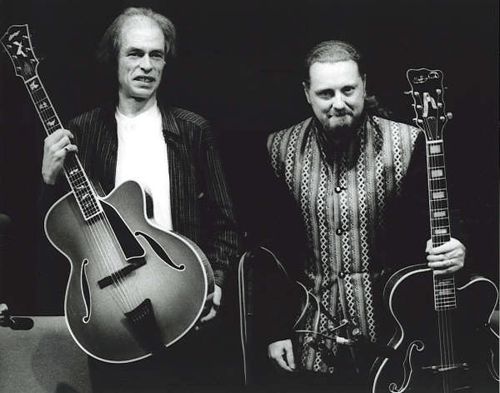 |
| Steve Howe (left) and Martin Taylor. Photo by Michael G. Stewart. |
It’s changed a lot from being a shooter in a crowd to now having to get confirmed access and sometimes a press or photo pass. Smaller jazz and traditional folks gigs aren’t so problematic. But certainly the big name rock acts always require formal access before getting those great shots, as well as typically calling for no flash and limiting the time that you can get shots.
Rick: Ever dealt with a performer who didn’t want to be photographed?
Michael G. Stewart: I’ve covered lots of people like that. It really depends on the individual on how to best address those situations. That’s when it is particularly important to be unobtrusive and to get the shots as quick as possible. They obviously want you there because it’s advantagous for their careers. But they have private lives and want to keep at least a part of them under the radar. It can be difficult. Luckily, most artists are very nice and enjoyable to work with. The important thing is to maintain a professional demeanor and remember that the people on stage are professional, you’re a professional and you’re not there to be a pal and hang out, but to create your art in an environment that allows them to create theirs.
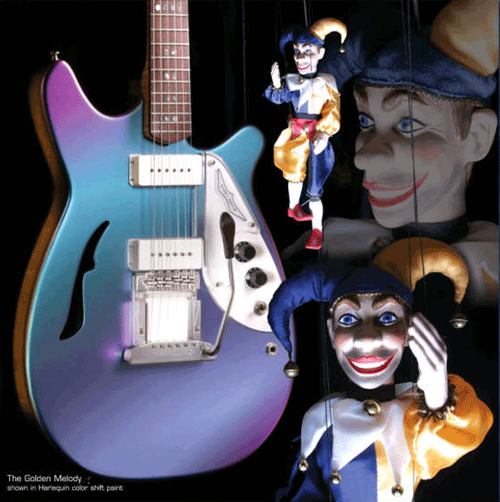 |
| Microfrets Harlequin guitar. Photo by Michael G. Stewart. |
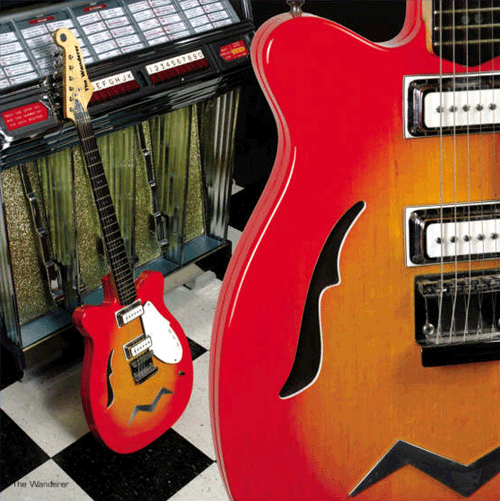 |
| Microfrets Wanderer guitar. Photo by Michael G. Stewart. |
Rick: Do you approach a live performance much differently than a CD cover?
Michael G. Stewart: The final product drives different demands. If you’re shooting in a journalistic capacity to document a particular situation or performance, then you keep it as straight as possible. In a live setting I think the most important thing is to accurately report or document the performance. When it comes to CD packaging I think the more creative that you can be, the better it is for everyone. If the project dictates straight documentation then that’s appropriate, however, if it allows you latitude to be creative then your creativity as a photographer comes into play. Why not be as creative as you can be? There are two very different situations there between journalism and packaging.
Rick: Do you know how a shot’s going to turn out once you take it?
Michael G. Stewart: As a professional you try to be prepared to create that perfect shot every time. I think that’s truly the definition of a professional photographer. But any photographer who’s been around will tell you that some of your best shots are completely unscripted, completely a surprise. You don’t know what’s going to happen, there are surprises and there are contraditictions, a crap shoot. Some are complete serendipity. But on the onehand you should be ready to make that perfect shot. That sets you apart from the guys who are shooting for the fun of it. Whether you shoot ten or one hundered you shoot for the perfect shot.
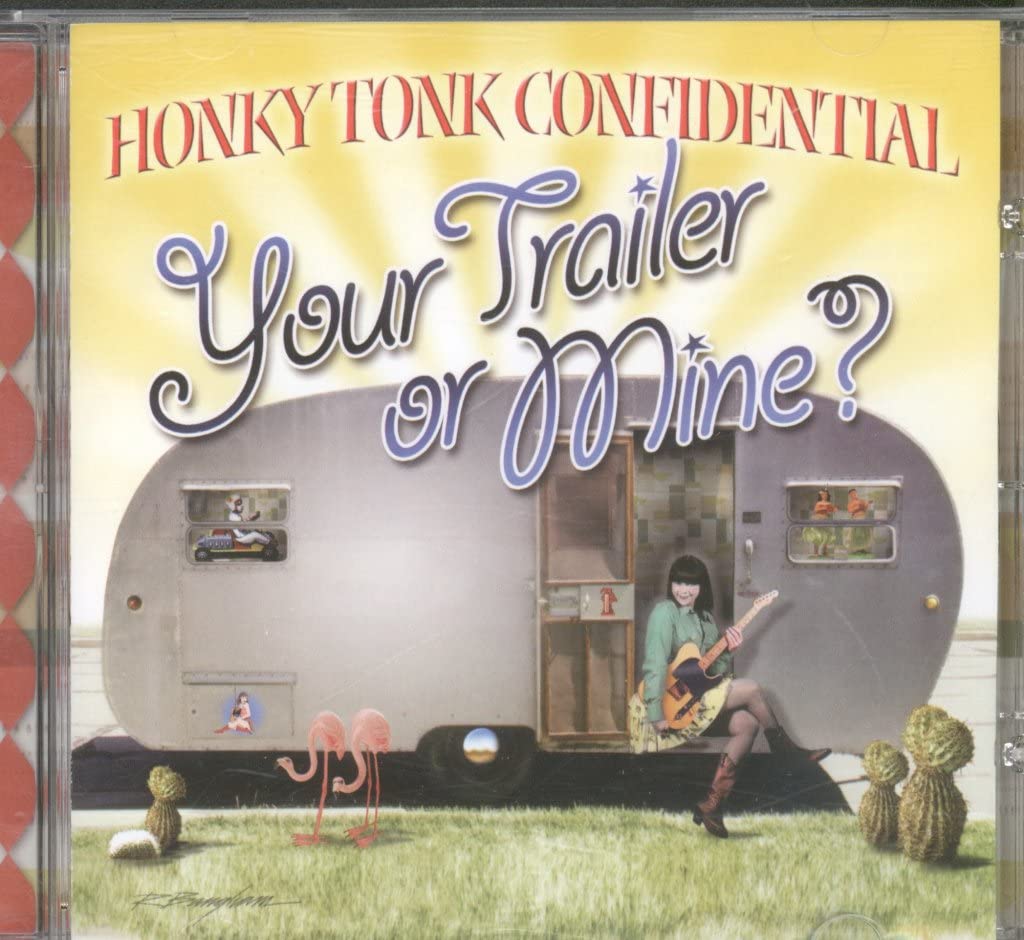
CD cover by Michael G. Stewart
Rick: An area we haven’t covered is guitar photography?
Michael G. Stewart: Yeah, I’ve done a lot of that. There are some superb guitar builders out there that are building some incredible guitars of all types.
Rick: Any new CD cover projects in the works?
Michael G. Stewart: Yes, I have a number of guitar CDs coming out soon. Most of them are jazz releases. I have one with the fabulous Philadelphia-based bebop guitarist Jimmy Bruno, as well as one for Gene Bertoncini up in New York who’s coming out with an album with a stringed quartet that should be quite interesting. I’m talking with Frank Vignola about the possibility of some cover work for an album he’s doing with the Gypsy Grass ensemble that, I suspect, will feature some great gypsy, jazz, and possibly bluegrass fusion.
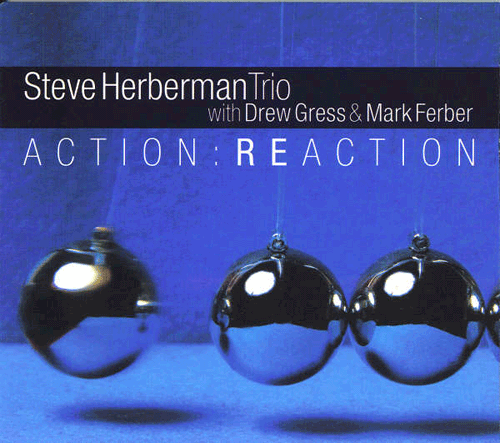 |
| CD cover art by Michael G. Stewart. |
A couple folk things with some blues people Rick Franklin and Michael Baytop who’ll be covering some work of an old blues guy named Frank Stokes. That should have some nice National steel resonator work on it. I’m working on a concept for the Seldom Scene one of the best bluegrass groups around that will feature their fabulous guitarist Dudley Connell. That’ll be a CD to definitely check out! And I’ve been collaborating with a great rockabilly player Deke Dickerson on some things. I am looking forward to getting some more rock guys in there.
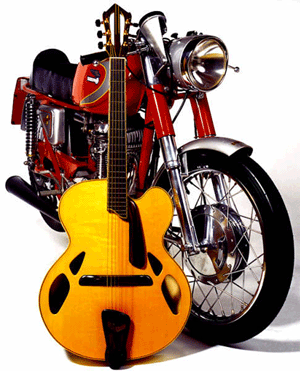 |
| D’Aquisto guitar. Photo by Michael G. Stewart. |
Rick: We’ve talked a bit about guitarists, but what about the tools of the trade that we all covet so much?
Michael G. Stewart: Yeah, we should touch on the guitars themselves! I do a lot of work with luthiers. We don’t want to forget about the people who build fine guitars. We all can’t wait to get our hands on another guitar. One guitar is never enough is it?
There are so many fabulous builders today and some young guys who are just incredible. The quality of many of these guitars is staggering and prices are really low if you compare them with the cost of high quality violins and the time that goes into building a great guitar. I’ve worked with some of the best including Bob Benedetto, John Buscerino, Roger Sadowsky and Bill Comins. All of them build beautiful archtops. There’s a little known guy from Baltimore named Gary Flowers who’s making a name for himself.
I’ve worked some graphics design and images for Bob Shade over at Hallmark Guitars, a company that resurrected the old designs from the ‘60s that still look cool. A few years back I did some stuff with Paul Reed Smith Guitars and recently I’ve been talking to MicroFrets that has come a gone a couple of times and is getting ready to get back into the business very soon with some of their quirky, bizarre and innovative designs.
I got some photos of guitars built by a young guy named Matt Artinger and ended up buying one of his guitars. His quality is nothing short of phenomenal and he’s a heck of a nice guy. He’s another guy to watch. He was working out of his parents’ basement in this tiny space, but was coming out with some exquisite guitars. Now, he’s building rock guitars, archtops and basses.
Rick: How did you end up working with guitar aficionado and collector Scott Chinery?
Michael G. Stewart: A few years ago, I did some work with Scott. The Smithsonian was running his Blue Guitar exhibit that initially featured some of his vast and awesome collection that dovetailed with the museum’s exhibition on the evolution of the guitar in America. Afterwards he commissioned a group of about twelve of the best luthiers in the world to build some blue archtops.
During that time I shot the first of concerts featuring some of his blue guitars. He saw them and invited me up to New Jersey to see his collection and to cover the Blue Guitar concerts. That was certainly a terrific experience for me, not only to see some of the rarest and finest guitars on the planet, but to meet first hand some of the top luthiers in the world. What a thrill!
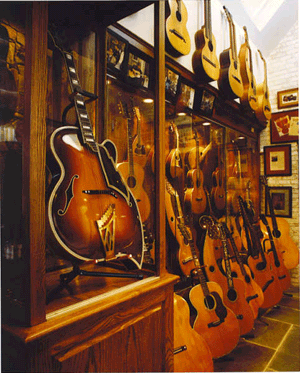 |
| Part of the Scott Chinery guitar collection. Photo by Michael G. Stewart. |
Rick: What advice would you like to offer to young photographers who are just beginning their careers?
Michael G. Stewart: Always be as professional as possible as your conduct reflects on all of us. That’s the reason there are so many restrictions. You have to remember that this is a performance and it’s the audience that counts and the artist’s comfort level. The worst thing in the world is to have a flash going off all the time. It’s a real pain for the audience and it’s a real pain for the musicians. Nobody wants to be blinded every 30 seconds. It’s a very competitive field, so just be as professional as you can.
Sully Guitars Adds 24-Fret Version of Singlecut ‘71 Trella

Sully Guitars is now offering a 24-fret version of its set-neck ‘71 Trella singlecut model. Builder Jon "Sully" Sullivan said, "The '71 addresses the issues I had with the classic singlecut while adding my own flair. The design celebrates its 15th birthday this year, and it's been rewarding to see it grow."
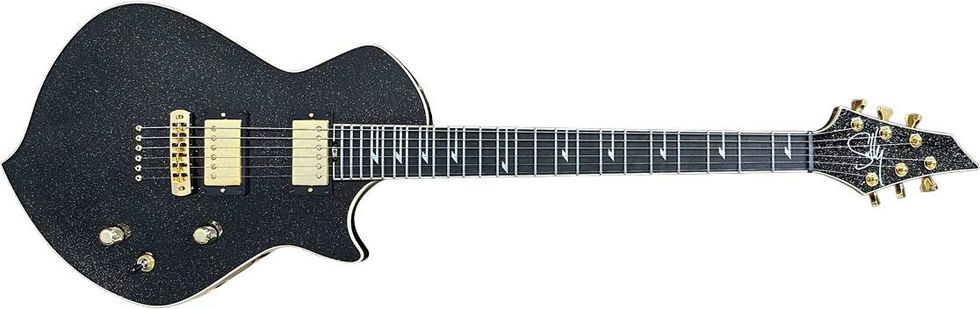
The new version adds two frets to the original 22-fret design. According to Sully Guitars, the upper-fret access and neck-to-body balance of the original have been maintained in the update. A '71 Trella 24 prototype has been used on tour by Smashing Pumpkins guitarist Kiki Wong, including on songs such as "1979."
Wong said: "The Trella is by far a work of art embodying all the beauty, versatility, and charisma I need from an instrument. It truly became one of my favorite guitars of all time."
Sully Guitars '71 Trella 24 specs:
- Body/top: Set-neck singlecut with carved top, now available with 24 frets (previously 22).
- Neck: Slim C profile, 24 stainless steel frets, contoured neck heel for upper-fret access.
- Hardware: Hipshot locking tuners; choice of Hipshot, TonePros, or Floyd Rose bridge; Sully's USA-wound pickups.
- Custom options: Sparkle finishes, heavy relic aging, custom inlays, and baritone scale lengths available.
- Build: USA Custom Series instruments are built by a small team in Texas, PLEK'd, and shipped with a handwritten certificate of authenticity from Sullivan.
Sully Guitars’ '71 Trella 24 has a straight price starting at $3,839. For more information visit sullyguitars.com.
On Bass: Are You Playing With Your Ears or Your Eyes?
I was plugging away in my home studio recently and realized I needed to tune my bass. Within arm’s reach I have a rack tuner, a pedal tuner, and even a few clip-on tuners, but since my hand was on the mouse, I pulled up a tuner plugin within my DAW. The aesthetics on the tuner were great, from the pseudo brushed steel “housing” to the wide, beautifully visible strobe that danced nicely until I found my pitch. It was clear that out of the several DAW tuners I have, this one felt like someone wanted to give it a little more design attention than the others.
It’s a tuner. I get it.
What I also understand is marketing. My degree happens to be in marketing (world-traveling bass player was not one of the options at my college - I had to conquer that on my own), and as I spent many hours filling the plastic seats of my classrooms, I gained an understanding of how we are “nudged” toward certain products and when it comes to buying things, our eyes tend to drown out our other senses.
The MI (musical instrument) business is no different. Bass, amp, and pedal companies are all vying for your cash. They know what you are into. Or at least they think they know. They spend a lot of time designing products, sometimes for themselves, sometimes for the consumer. Either way, they are looking for an edge. There is a lot of trial and error, of course, and sometimes our eyes choose a product over all our other senses. Every company wants their product to stand out. Some follow trends and design for the current market (remember the relic’d guitar war of ‘14?), while others stick to their look forever (much like my dad’s haircut), come hell or high water.
“How many times have you turned your nose up at a particular amp based on the name plate or a guitar for its headstock shape?”
How many times have you turned your nose up at a particular amp based on the name plate or a guitar for its headstock shape? How often are we brand-biased and not sonically driven? Often, I think.
When I moved to Nashville two decades ago, I auditioned for a touring indie artist, and thankfully landed the gig. Before the tour, the MD took me aside and said he wanted to see a P-bass in my hands, not the active 5-string I used in the audition. I had other passive 4-strings that were great, but no, he wanted a P. After settling in town, I also learned that producers were looking to see a certain name on the headstock, no matter the tone or pedigree of the bass being played.
There is certainly an argument for a “tried and true” tone formula; however, I know some bass players that can track master recordings with a broom handle and twine, headstock shape be damned. We shouldn’t let a logo run our lives. I like certain features, I like certain tones, and I also like to root for the underdog. We certainly should give all instruments a fair trial before finding them guilty of not being ‘good’.
I have a $10 no-name garage sale bass that I have used on recording sessions. I’ve seen your favorite bands filling arenas running original red Line 6 “bean” PODs and dummy cabinets onstage. If you are using your ears instead of your eyes, you may free yourself a bit.
Variety is the spice of life. No doubt. We aren’t in a Henry Ford era where all the guitars are simply one design, one pickup, and painted black (and thankfully so). We have different musical needs and tonal requirements, so we inevitably search for “the sound,” or the workhorse, or the feature-packed entity that will quench our thirst. We have limitless wood/electronic configurations at our mail-order beck and call, and in the same breath, it is very easy to become a trail horse and only see what we want to see.
Do yourself a favor: go to a local store and pick up an instrument or try a brand you have ignored in the past. Close your eyes and listen. You may be surprised.
The Truth About Vintage Amps, Ep. 169
It’s the 169th episode of the Truth About Vintage Amps, the call-in show where amp tech Skip Simmons fields all of your tube amp and life questions. This week, returning guest Steve Soest joins us for a chat about the vintage days of vintage guitar buying; playing alongside Chuck Berry and Dick Dale; Leo Fender’s dining habits; and more.
Thank you to our sponsors: Grez Guitars; Emerald City Guitars; and Amplified Parts / Mod Electronics.
Some of the topics discussed this week:
:55 What’s on Skip’s Bench: A messed-up Masco MA-17
4:06 Special guest: Guitar and amp legend Steve Soest (Soest Guitars)! A meeting of the amp minds, Danelectro tales, Standel heads, David Lindley, G&L, consulting for Fender, Dick Dale tales, and so much more!
1:16:25 A possessed Ampeg, redux
1:18:26 Skip’s Disney picks
1:20:57 The Tone Quest Report
1:22:58 Woodinville in the WSJ
1:24:43 Gain knob/master volume 101, cleaning Tolex
1:34:02 Hollywood Bob’s Bandmaster
Want amp tech Skip Simmons’ advice on your DIY guitar amp projects? Want to share your top secret family recipe? Need relationship advice? Join us by sending your voice memo or written questions to podcast@fretboardjournal.com! Include a photo, too.
Want to support the show? Join our Patreon page to get to the front of the advice line, see exclusive pics, the occasional video and more.
Hosted by amp tech Skip Simmons and co-hosted/produced by Jason Verlinde of the Fretboard Journal.
Above: What Skip removed from his client’s Masco PA.


The post The Truth About Vintage Amps, Ep. 169 first appeared on Fretboard Journal.
Eric Gales Goes Months Without Playing Guitar
The blues-rock guitar star sits down with PG's Nikos Arvanitis discussing his growth as a player (including prioritizing time away from the instrument), finding inspiration in figures outside of music, engaging with the social-media phenoms for a motivational challenge, and explaining why his partnership with Kiesel is a perfect fit. Sponsored by: https://stewmac.sjv.io/APO2ED
Tokai Hard Puncher Review
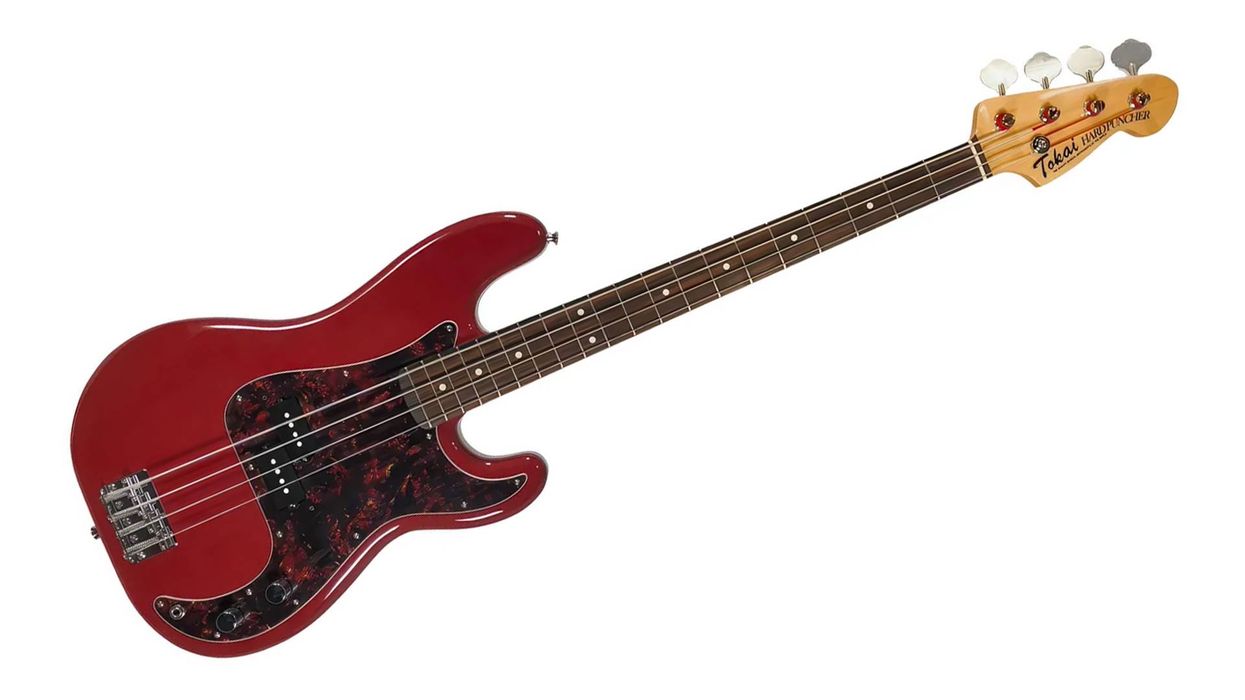
When my editor approached me about reviewing this bass, I had a very visceral sensation of being 12 years old again. That’s when I started playing bass—and perusing basses in a Swedish mail order catalog that had everything from home improvement tools to musical instruments. I distinctly remember scanning that catalog, once upon a time, and spotting a Precision Bass lookalike called the “Hard Puncher,” which, I suppose, sounded much more heroic to a non-native, beginning-English speaker than “P-Bass.”
The Hard Puncher, as it turns out, was made by Tokai, a Japanese manufacturer of what are now known colloquially among collectors as “lawsuit guitars.” Tokai’s instruments were more than just catalog eye candy for European and American players that couldn’t afford a real Fender or Gibson. Most Tokais of the ’70s and ’80s were also exceptionally well-made instruments. So, when the company ceased exporting instruments in the ’90s, it left behind a dedicated cult of fans. That cult is bigger these days, and Tokais are no longer cheap, secret sleepers among the collector set. Good ones fetch pretty hefty prices. So, it’s little mystery that Tokai is having a go at exporting these Japan-made gems again—this time with a push from Audio Collective Group, a distribution company founded by Warm Audio.
Picking Up Where They Left Off
The quality that makes original Tokais minor treasures is recognizable here by feel alone. Fretwork, the neck joint, and the bone nut seat are all tight and solid. The gloss polyester finish is rich and very well executed in a deep dakota red with hints of brown and oxblood that looks fantastic against the red tortoiseshell pickguard. Options abound, though—the new Hard Puncher is available in seven different finishes, and Tokai even offers a choice between alder and ash for bodies, and maple and rosewood for fretboards. (You can select these options on the Tokai website, which, in turn, directs you to a dealer with an instrument that matches your order.)
The 1-piece maple neck is U-shaped and employs a fairly thin slice of rosewood for the fretboard, if you opt for one. The neck has a very nice profile for those of us without large hands, and the compound 7.25" – 10.25" radius lends a natural feel under the fingers. But the neck is also reminiscent of real 1960s-vintage Fender Precisions I have known. As nice as that vintage familiarity is, I wouldn’t complain if Tokai opted to eschew authenticity and use a satin finish on the neck instead of the glossy one on our test instrument. But thanks to the general profile, the feel is fast.
More Extra Effort
Though the basic fit and finish on our Hard Puncher was easy to observe, I was impressed by deeper details—like how carefully the pickups were set up. The E-string side of the P-bass pickup was screwed deeper into the body than you tend to see from most manufacturers. This is the very first adjustment I perform on any bass I buy to compensate for naturally louder low E-strings. The move suggests to me that the folks at Tokai are hip to real-world performance challenges as well as pure aesthetics. It’s a nice thing to see.
The action was great, too—neither too low nor too buzzy. And like the pickups, the careful adjustment meant one less change to make before I took the Hard Puncher on the road or to a session. It’s easy to imagine living with the instrument onstage in most other practical respects, too. It’s comfortable, the medium weight feels good, and it’s very well balanced. Perhaps the only disappointment with the design is that the truss-rod access is a little too much like a vintage P-Bass. You can’t make an adjustment without removing the pickguard first. That’s not a big deal for many players, but as a touring professional who travels between drastically different climates, frequent and easy truss rod adjustment is pretty important.
Force and Flexibility
Rumbling through an amp with tone and volume wide open, the Hard Puncher rewards with a rich, punchy, classically P-bass sound. It’s free of the upper-midrange honk that plagues some P-styles, but retains the immediacy and low-mid emphasis in transient notes that a great P-style should have. Just as importantly, the upper notes on the neck have real body and strong sustain, while the lower notes never feel muddy or too big. The output is just very balanced.
It’s very easy to shape the output from that foundation, too. The tone control has a very usable sweep that allowed me to carefully shape the top end I wanted to tame, rather than just going fully bright or completely dark, which happens in some affordable basses. Dark tones still exhibited great sustain, by the way, which perfectly suited my reggae experiments with the Hard Puncher.
As a player who performs a lot of rock shows, I want to know that a P-style instrument will sound big, warm, and almost piano-like in that setting—particularly with a pick. To find out if this was the case with the Hard Puncher, I swapped the nickel-coated strings that came with the bass for steels. The new set really made the Tokai come alive, without sounding too bright—even on the thinner strings. As you might have suspected, it’s a great rock machine
The Verdict
The Hard Puncher’s $1,499 street price puts it in a very competitive bracket. But I think there’s room there for a high-quality, Japan-made instrument like this. The tones are super solid. The feel inspires confidence from a playability and quality standpoint. Plus, there’s just something hip about a Tokai. It’s a cool way to break from the pack, but it’s also just a great performer with a familiar, even vintage-like feel. Even in a crowded product space, the Hard Puncher screams “contender!”
“It’s what we’ve been looking forward to for 21 hours of the day”: Slash on why Guns N’ Roses still love touring and have no plans to stop

For a band that has spent decades on the road, Guns N’ Roses still sound pretty enthusiastic about the prospect of getting onstage. And according to Slash, that enthusiasm comes down to keeping things fresh and, above all, making sure the band still enjoys what it does.
Speaking to New York rock station Q104.3, the guitarist was asked how Guns N’ Roses keep fans engaged after all these years. His answer was refreshingly simple: “We just sort of do what we do.”
“We throw different things in,” Slash continues. “[But] I think we’re more about keeping ourselves, you know, sort of inspired and having a good time and keeping it fresh for us and then we just come out there and do our thing.”
That enthusiasm becomes particularly apparent once the band reaches the venue. Slash explains that while the travelling and waiting that comes with touring isn’t exactly exciting, once they’re there and ready to play, it’s a different story.
“We’re one of those bands that has been around for a long time, but really loves what we do,” he says. “We spend most of our time humming and hawing about traveling until we get to the venue and then we finally get to get unleashed, and, you know, it’s what we’ve been looking forward to for 21 hours out of the day.”
The band also leaves plenty of room for spontaneity in its setlists. Instead of locking themselves into the exact same sequence every night, Guns N’ Roses keep a large pool of songs ready to go and decide what to play as they go.
“We don’t really have what you call a setlist either,” Slash says. “We have an opening song, we have an ending song, and we have a lot of tentpole songs that we’re going to play. And then we mix a lot of stuff up.”
He adds that the band has around 50 songs to choose from, pulling from across their catalogue each night.
In other news, Slash recently revealed that Guns N’ Roses are have been working towards the long-awaited follow-up to 2008’s Chinese Democracy.
“There’s a lot of writing going on with Guns,” the guitarist told Rolling Stone Australia. “So after I get back from [touring with The Conspirators], we’ll see if [Guns N’ Roses] can start putting some stuff together and getting in the studio.”
The post “It’s what we’ve been looking forward to for 21 hours of the day”: Slash on why Guns N’ Roses still love touring and have no plans to stop appeared first on Guitar.com | All Things Guitar.
Pages
