
Music is the universal language
“Glory to God in the highest heaven, and on earth peace to those on whom his favor rests.” - Luke 2:14
Norse Guitar Feeds
Two Taylor Voices. One Ultimate Showdown.

Friedman Introduces JOSE 20 Head and Combo
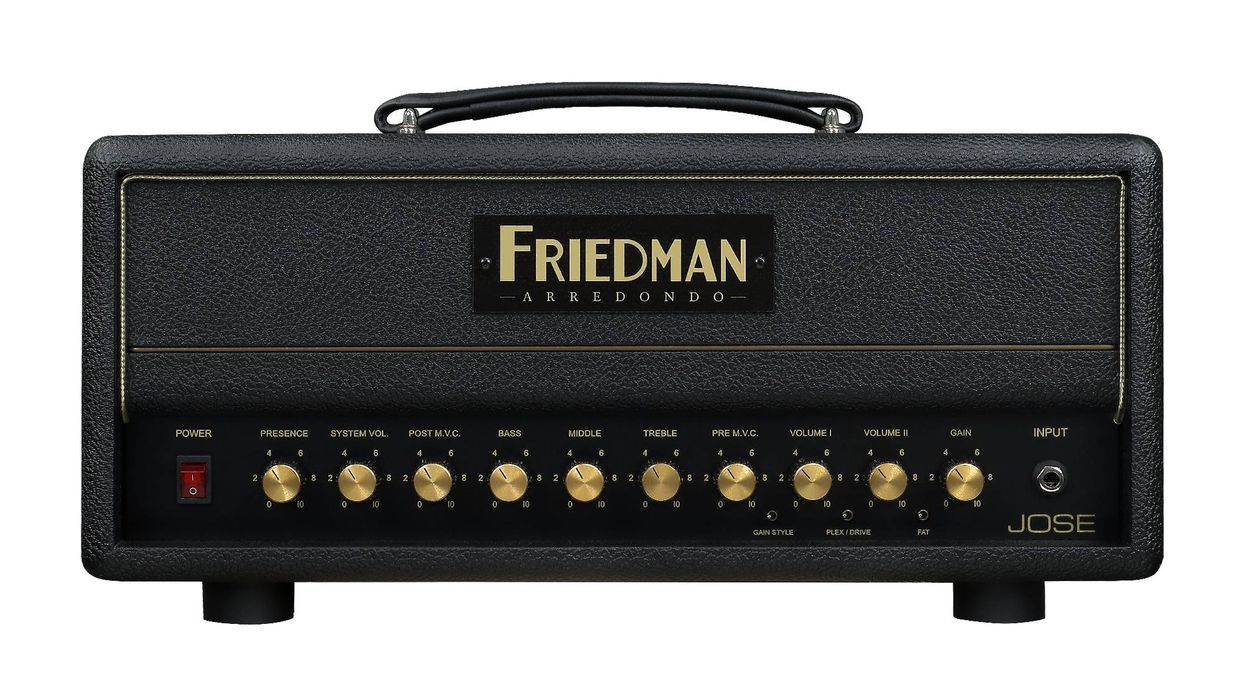
Following the success of the original Friedman JOSE 100, Dave Friedman has introduced the JOSE 20 Series. Available as both a compact head and a 1x12 combo, the JOSE 20 Series delivers the unmistakable voice, feel, and touch response of its 100-watt counterpart - now in a smaller watt format ideal for play at home, in the studio or on stage.
Developed by Dave Friedman in close collaboration with Jose Arredondo’s daughter, Marisol Arredondo, the JOSE 20 Series faithfully translates one of the most influential amplifier voices in rock history into a modern production amplifier. Rather than simply recreating Jose Arredondo’s amplifier modifications, Dave set out to capture the essence of Jose’s work - its feel, dynamics, harmonic complexity, and voice and faithfully translate it into the JOSE 20 Series.
Handcrafted in Los Angeles using premium components and custom-made transformers, every JOSE 20 is built to Dave Friedman’s uncompromising standards.
Jose Arredondo’s groundbreaking amplifier modifications helped define the sound of high-gain rock. His hot-rodded British amplifiers delivered greater sustain, richer harmonics, tighter low end, and a more responsive feel than players had ever experienced. They weren’t production amplifiers - they were individually modified instruments that became the secret weapon of countless professional guitarists and inspired generations of players, builders, and tone chasers.
The JOSE 20 Series distills that voice into a compact 20-watt platform. Internally bridged Volume I and Volume II recreate the classic channel-jumping technique players once achieved with patch cables, blending bright attack with warm body to create the rich harmonic foundation at the heart of the Jose sound.
The Plexi/Gain switch introduces a true additional gain stage, seamlessly moving from classic Plexi response into the aggressive saturation that defined Jose’s most celebrated modifications. The Fat switch adds body, low-end authority, and increased punch while preserving the articulation and clarity that make the amp exceptionally responsive.
The unique three-position Gain Style switch further expands the JOSE 20’s tonal palette by repositioning the master volume within the circuit while introducing diode clipping for additional bite and sustain. Rather than simply adding more gain, each position reshapes the amplifier’s response, delivering everything from articulate hot-rodded Plexi crunch to crushing rhythm tones and fluid, harmonically rich lead sounds.
A transparent series effects loop and System Master Volume allow players to experience authentic Jose dynamics at virtually any playing level.
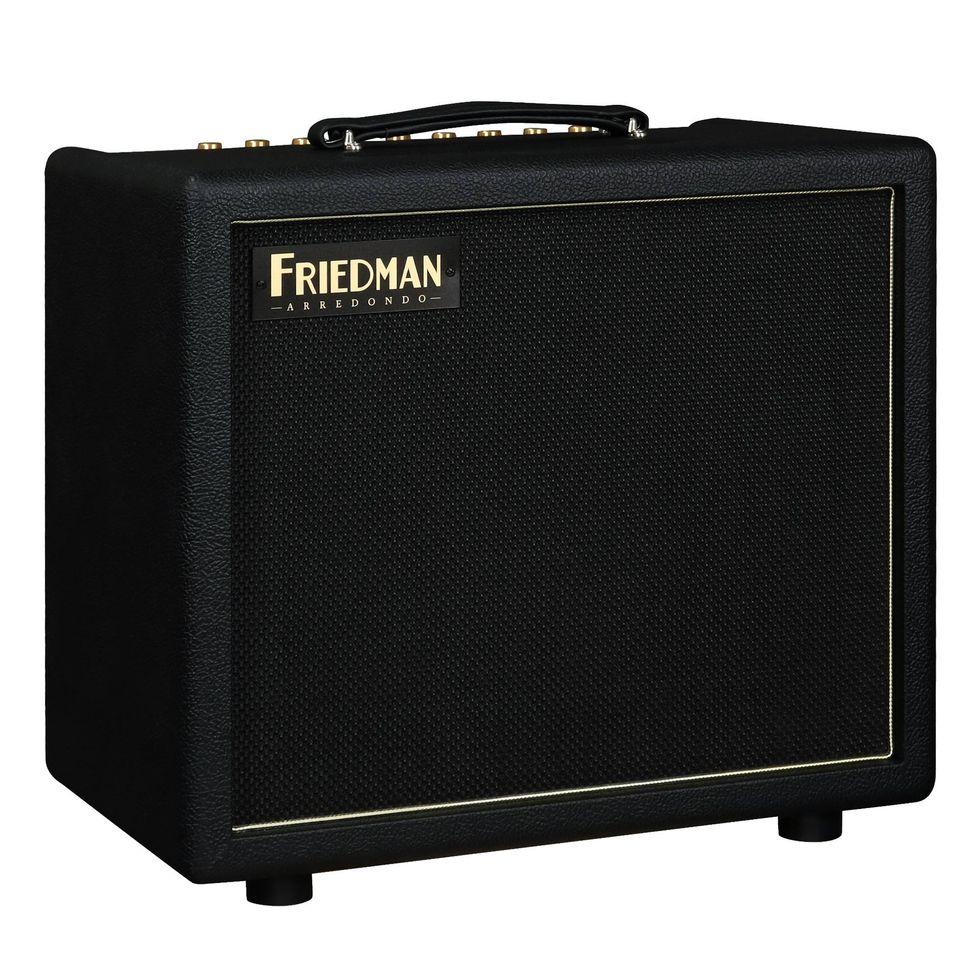
Available as either a 20-watt head or a 1x12 combo loaded with a Celestion G12M-65 Creamback, selected by Dave Friedman for its warm midrange, smooth top end, and dynamic response.
Key features include:
- Available as a 20-watt all-tube head or 1x12 combo
- 2 x EL84 Power Tubes4 x 12AX7 Preamp Tubes
- Combo loaded with a Celestion G12M-65 Creamback speaker
- Developed by Dave Friedman in collaboration with Marisol Arredondo
- Inspired by the legendary amplifier modifications of Jose Arredondo
- Internally bridged Volume I & II recreate classic channel jumping
- Plexi/Gain switch introduces a true additional gain stage
- Fat switch adds body, punch, and low-end authority
- Three-position Gain Style switch revoices the circuit for three distinct Jose-inspired gain structures
- System Master VolumeTransparent series effects loop
- Custom made transformers
- Handcrafted in Los Angeles, California, with Limited 5-Year Warranty
- Head Dimensions: 8.5" (D) x 18" (W) x 8.25" (H)
- Head Weight: 22.5 lbs.
- Combo Dimensions: 11.5" (D) x 18.75" (W) x 16.75" (H)
Friedman’s JOSE 20 amp head carries a $1799.99 street price and the 1x12 combo is street priced at $2099.99. For more information visit friedmanamplification.com.
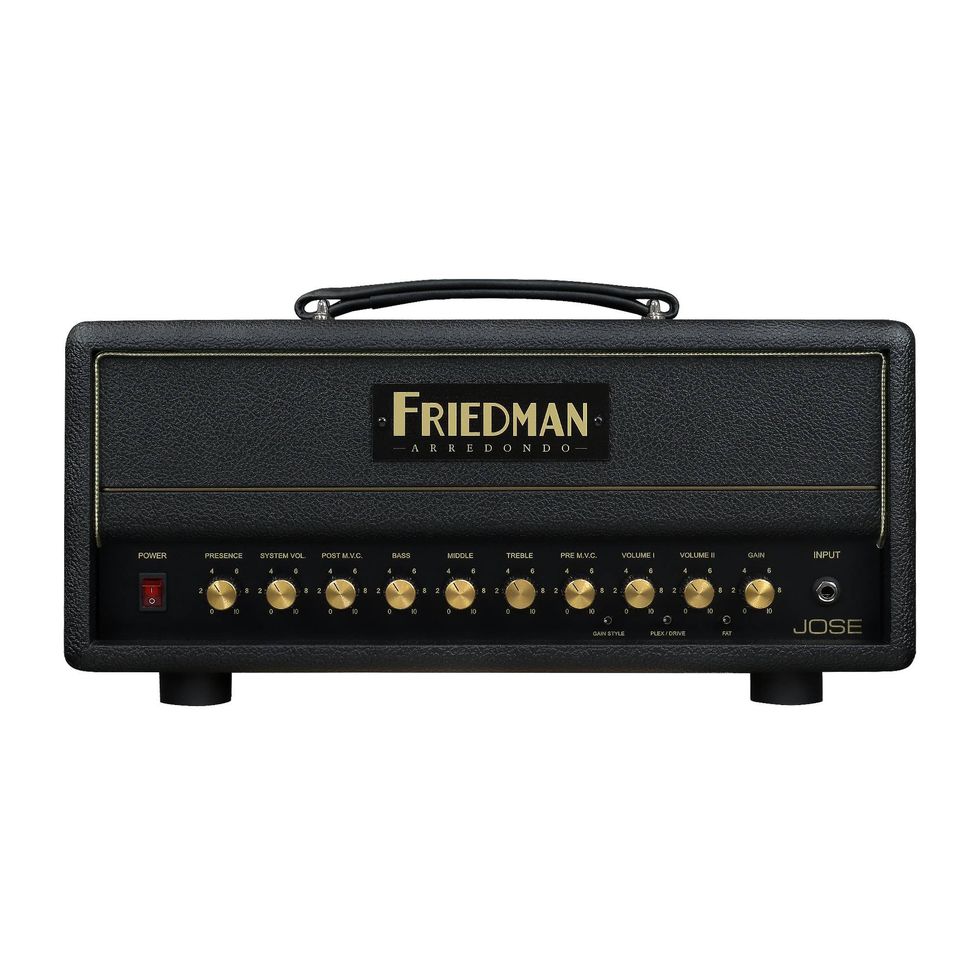
JOSE 20 Head and Combo
August 27, 2026 - Following the success of the original Friedman JOSE 100, Dave Friedman has introduced the JOSE 20 Series. Available as both a compact head and a 1x12 combo, the JOSE 20 Series delivers the unmistakable voice, feel, and touch response of its 100-watt counterpart - now in a smaller watt format ideal for play at home, in the studio or on stage.
Guitar Center unveils the 2026 Exclusive Crossroads Guitar Collection
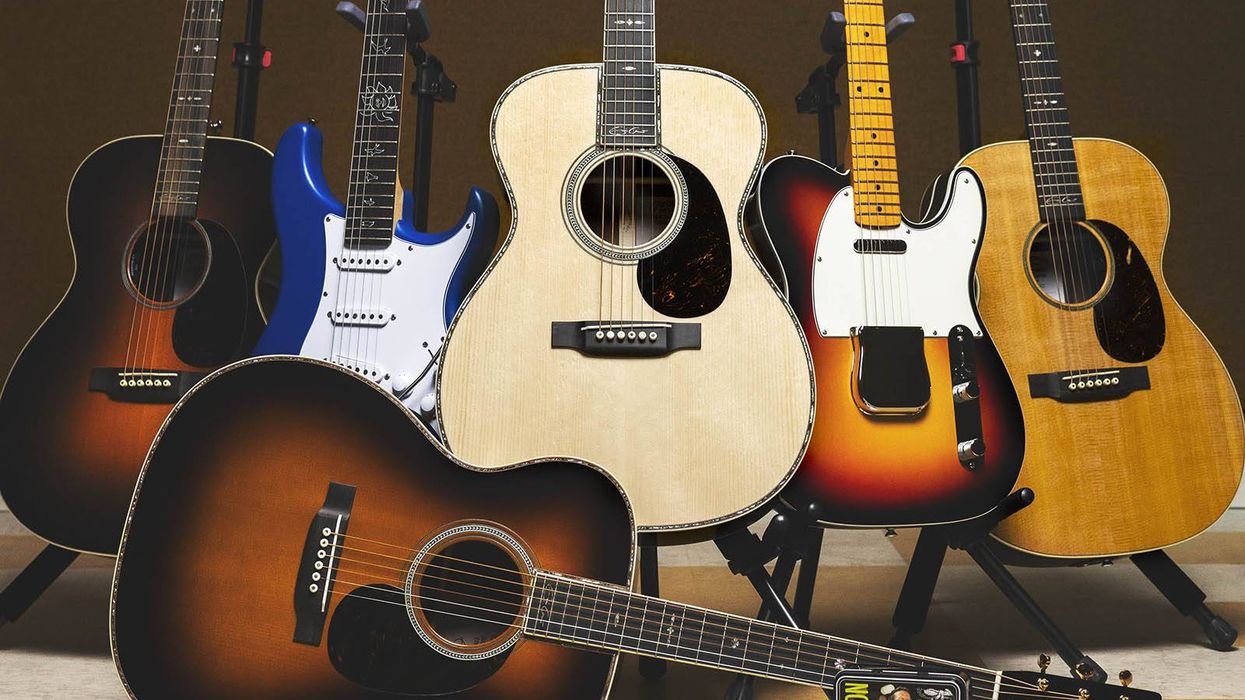
Guitar Center today unveiled the 2026 Exclusive Crossroads Guitar Collection (https://t.e2ma.net/click/l4543m/hda7hd/92s4tv), a lineup of signature guitars and accessories created in collaboration with Eric Clapton and industry-leading brands Martin, Fender and Ernie Ball. Launching ahead of the 2026 Crossroads Guitar Festival, the limited-edition collection builds on more than two decades of collaboration between Guitar Center, Clapton and the Crossroads organization. Proceeds from the collection support Crossroads Centre Antigua, the addiction treatment center Clapton founded in 1998.
Guitar Center’s relationship with Eric Clapton began in 2004, when the company purchased several of his most legendary guitars at the 2004 Crossroads Guitar Auction, including his iconic Blackie Fender Stratocaster, the Cream-era Gibson ES-335 and George Harrison’s Martin 00-21. Those historic instruments are now part of Guitar Center’s renowned Legends Collection, a one-of-a-kind archive of historically significant instruments on display at its flagship Hollywood store. Their acquisition laid the foundation for an enduring collaboration with Clapton and many of the world’s most respected guitar manufacturers, resulting in some of Guitar Center’s most coveted artist recreations and exclusive Crossroads Guitar Collections.
“For more than two decades, we’ve partnered with Eric Clapton and the Crossroads organization to create iconic instruments, with powerful stories behind them, and put them in musicians’ hands,” said Gabe Dalporto, CEO of Guitar Center. “The 2026 Crossroads Guitar Collection continues that tradition, with every one sold supporting a cause Eric has championed for decades.”
Guitar Center’s exclusive Eric Clapton collaborations have long been among the company’s most sought-after releases. The recreation of Eric Clapton’s legendary Blackie Stratocaster sold out in just four hours in 2006, becoming the company’s fastest-selling guitar launch at the time. More recently, Guitar Center’s exclusive Gibson Custom Eric Clapton 1958 Les Paul sold out in less than 12 hours following its 2025 debut. Since then, Guitar Center has continued its decades-long partnership with Eric Clapton through a series of exclusive Crossroads Guitar Collections, offering musicians first access to many of the collaboration’s most coveted releases.
Spanning handcrafted acoustic guitars, faithful recreations of Clapton’s most iconic electric instruments, and premium accessories, the 2026 Crossroads Guitar Collection offers something for every type of player – from exquisitely crafted collector pieces to signature models designed for everyday musicians. Developed in collaboration with Martin, Fender and Ernie Ball, each product celebrates a defining chapter of Clapton’s career while supporting the mission of Crossroads Centre Antigua.
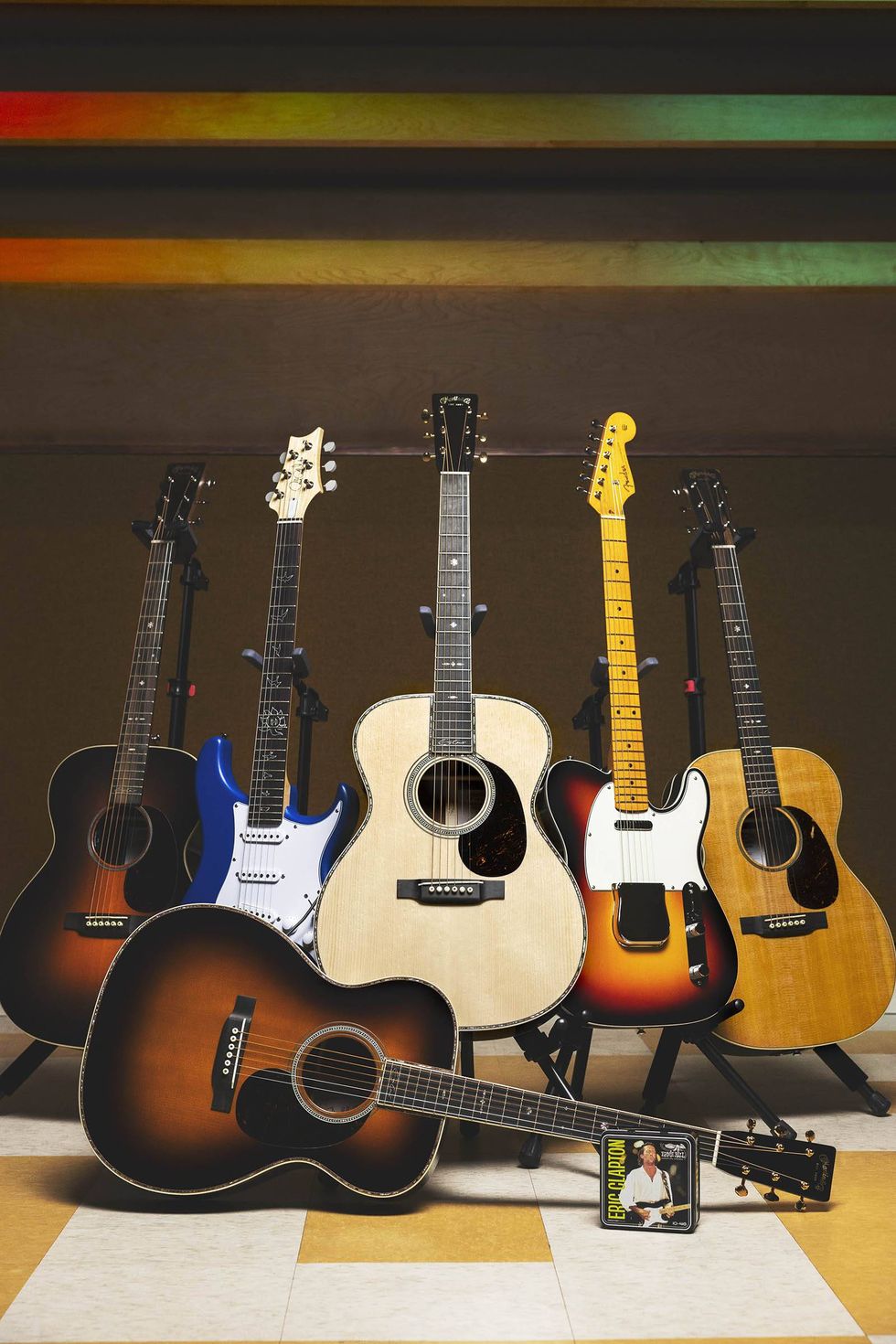
“Music has always been my most reliable source of inspiration, or salvation,” said Eric Clapton. “These guitars are sacred things to me.”
As the exclusive retail partner of the 2026 Crossroads Guitar Festival, Guitar Center returns to support the event and its mission to benefit Crossroads Centre Antigua. This year, Guitar Center will bring its presence to life through The Guitar Center Experience, an immersive destination at Austin’s Moody Center where fans can explore the new 2026 Crossroads Guitar Collection, connect with leading guitar brands including Fender, Gibson, Martin, PRS and Ernie Ball, and engage in hands-on interactive experiences throughout the weekend. Guitar Center will also offer on-site retail, giving attendees access to the exclusive 2026 Crossroads Guitar Collection and other festival merchandise.
In addition, PRS Guitars will support the 2026 Crossroads Guitar Collection in partnership with John Mayer, whose limited-edition PRS Silver Sky “Crossroads” model will be available exclusively through Guitar Center and make its first public appearance onstage with Mayer at the 2026 Crossroads Guitar Festival.
Complementing the new Crossroads Guitar Collection, The Guitar Center Experience will also feature a rare showcase of iconic guitars from Guitar Center’s renowned Legends Collection, including Eric Clapton’s legendary original Blackie Stratocaster and his Cream-era Gibson ES-335.
Fans will have a rare opportunity to view two of the most iconic guitars in rock history up close, while Guitar Center continues its legacy of honoring music’s most influential figures by inducting Paul Reed Smith, founder of PRS Guitars, into the famed Guitar Center Rockwalk during the festival.
Crossroads Guitar Collection Highlights
Martin Custom Shop 000-42 Eric Clapton Brazilian ($24,999.99)
The centerpiece of the 2026 Crossroads Guitar Collection, the Martin Custom Shop 000-42 Eric Clapton Brazilian represents the pinnacle of Eric Clapton’s more than 30-year relationship with Martin Guitar. Limited to just five instruments worldwide, the guitar is handcrafted with rare Brazilian rosewood back and sides, a solid Adirondack spruce top and Clapton’s preferred 000 body shape – the same style made famous during his legendary MTV Unplugged performance. Each guitar is personally hand-signed by Clapton and includes a Certificate of Authenticity, making it one of the most exclusive Eric Clapton signature guitars ever offered by Guitar Center.
Martin Custom Shop 000-42 Eric Clapton Ziricote (Natural & Sunburst) (starting at $9,699.99)
Joining the collection’s flagship Brazilian rosewood model, the Martin Custom Shop 000-42 Eric Clapton Ziricote pairs Clapton’s preferred 000 body shape with ziricote tonewood, prized for its rich sound and striking natural grain. Limited to just 50 guitars in each of two finishes, 1935 Sunburst and Clear Natural, the handcrafted Custom Shop model features a solid Adirondack spruce top, Golden Era 42-style appointments and an ebony fingerboard with an “Eric Clapton” signature inlay. Each guitar includes a printed Certificate of Authenticity and is available exclusively through Guitar Center.
Fender Blind Faith Telecaster ($4,999.99)
Inspired by the iconic guitar Eric Clapton assembled on his kitchen table in 1969 and debuted at Blind Faith’s legendary Hyde Park concert, the Fender Eric Clapton Blind Faith Telecaster faithfully recreates one of the most recognizable instruments of his career. Limited to just 130 guitars worldwide, the production model combines a Telecaster Custom body with a replica 1956 “Brownie” Stratocaster neck and period-correct details, while including both modern electronics and a vintage “Woof Tone” wiring kit for players seeking an authentic recreation. Available exclusively through Guitar Center, each guitar features a unique “EPC” serial number honoring Eric Patrick Clapton.
PRS John Mayer Silver Sky ($3,750.00)
Developed in partnership with John Mayer, the limited-edition PRS Silver Sky “Crossroads” features a unique Incline Blue finish, rosewood fretboard with a custom “Crossroads Sun” inlay at the 12th fret and a “Crossroads Guitar Festival 2026” neck plate. Limited to just 70 guitars, the model will make its first public appearance onstage with John Mayer at the 2026 Crossroads Guitar Festival.
Martin 000-13E Eric Clapton (Natural & Sunburst) (starting at $1,899.99)
Designed to bring an authentic Eric Clapton signature Martin to more players, the Martin 000-13E delivers Clapton’s signature acoustic style at the most accessible price point in the collaboration’s history. Inspired by the smaller-bodied 000 guitars Clapton has favored on stage and in the studio for decades, it features a spruce top with ziricote fine veneer back and sides, along with a built-in soundhole tuner and Martin E1 pickup—the first time those features have been offered together on an Eric Clapton signature Martin. Available in Antique Toner Natural and 1935 Sunburst finishes, the guitar is available exclusively through Guitar Center in the U.S. through Jan. 27, 2027.
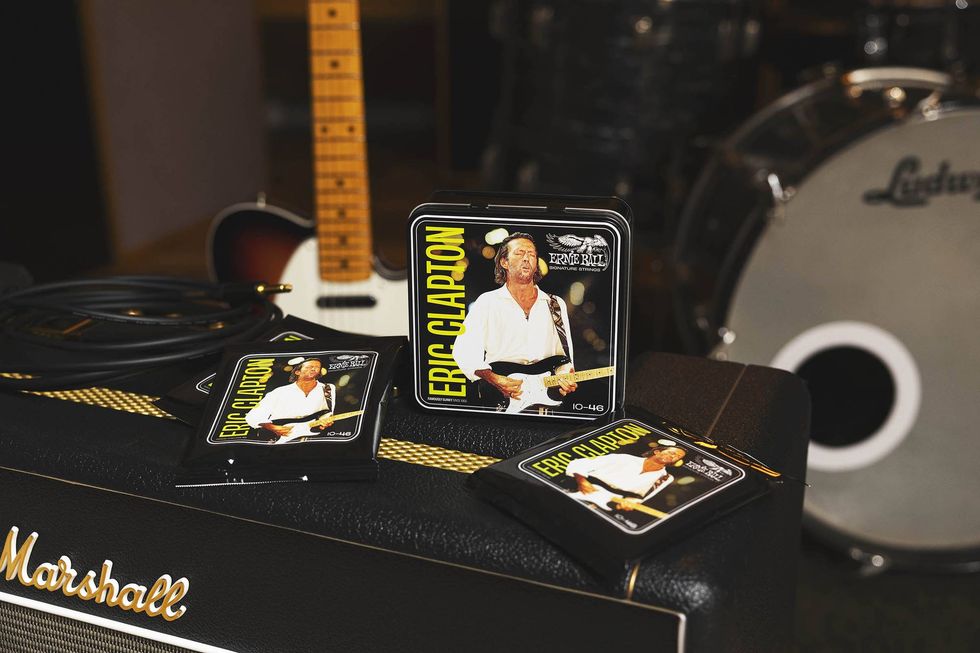
Ernie Ball Eric Clapton Strings ($29.99)
Celebrating nearly 50 years of Eric Clapton’s relationship with Ernie Ball, the Ernie Ball Eric Clapton Signature Strings mark the first-ever signature string set created in collaboration with the legendary guitarist. Packaged in a collectible commemorative tin containing three sets of Ernie Ball Slinky 10–46 strings—the gauge Clapton has relied on throughout much of his career—the limited-edition release gives players the opportunity to experience the feel and tone trusted by one of music’s most celebrated guitarists. Limited to 5,000 collectible tin sets and available exclusively through Guitar Center, the strings complete the 2026 Crossroads Guitar Collection.
The 2026 Crossroads Guitar Collection will be available beginning August 26 at Guitar Center stores nationwide and online at guitarcenter.com and will also be available for purchase at The Guitar Center Experience during the 2026 Crossroads Guitar Festival.
Vintage Vault: The Good, the Bad, and the Ugly of Vintage Guitars at the Movies
“It’s a Gibson SG, mint condish.”
Jack Black, as Dewey Finn, in the film School of Rock is the ultimate guitar salesman. Watch the scene where he puts the class band together, and you’ll pick up on his awesome energy. Dewey is so into what he’s teaching; he’s like some sort of a sanctified backwoods preacher on a sunny Sunday morning delivering the gospel. It’s his enthusiasm that sparks the kids into learning how to rock. What is Dewey’s Excalibur, his all-conquering and mighty weapon? It’s that Gibson SG guitar.
The way I see it, the guitar in cinema can be considered a ticket. In most cases, it’s a ticket to a better life for the person playing it. Be it creative expression, a way to escape poverty, or a way to escape the humdrum existence of the suburbs à la Marty McFly, the guitar, and music, can take you there.
Today, we’re going to look at the good, the bad, and the unexpected as far as vintage guitars are concerned in movies. Length constraints for this article dictate that I might miss your favorite guitar movie, and I apologize for that. I’ll talk about a couple of mine and maybe one you’re not familiar with.
First, the not-so-good. The Buddy Holly Story was released in 1978. It’s an excellent story about Buddy’s life, and Gary Busey is absolutely incredible portraying the young singer, songwriter, and guitar slinger from Lubbock, Texas. But man, for a guitar geek, it’s a little hard to watch. It’s like the people in the props department for that film didn’t do their homework at all.
In the beginning of this film, we see our hero playing at a roller rink in Lubbock, just before he finds fame as a recording artist. It’s a sock-hop and the kids are there to have some fun. It’s an infectious scene with great energy. What’s Buddy playing? A Fender Bronco.
Cue the record scratch: a Bronco? Wow, that’s an inspired choice! It’s also a guitar that didn’t make the Fender lineup for a full eight years after Buddy, Ritchie Valens, the Big Bopper, and their pilot died in a plane crash early in the morning of February 3, 1959 in Clear Lake, Iowa. It’s a cringe moment for guitar aficionados and historians alike.
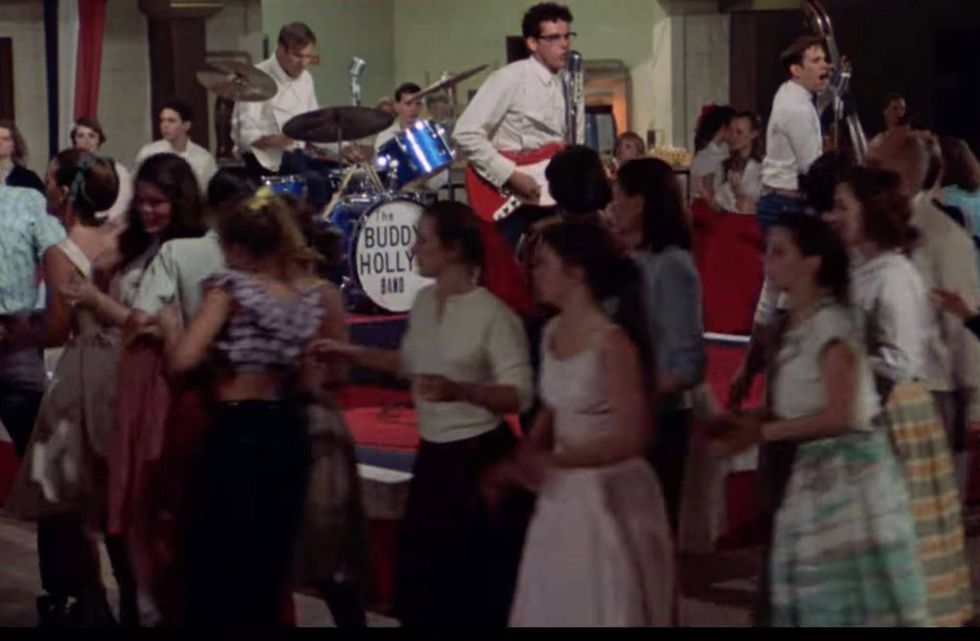
Not only is Holly playing a guitar that didn’t exist in the ’50s, he’s playing it through an amp made by a company that didn’t exist yet either. In the roller-rink scene, Buddy’s plugged into a Music Man amp. Music Man started production in 1974, a full 15 years after Buddy died. At the end of the movie, they show Holly playing his final show with a ’70s Strat with a large headstock. At least they got the Strat part right. It’s like they didn’t even try with the details!
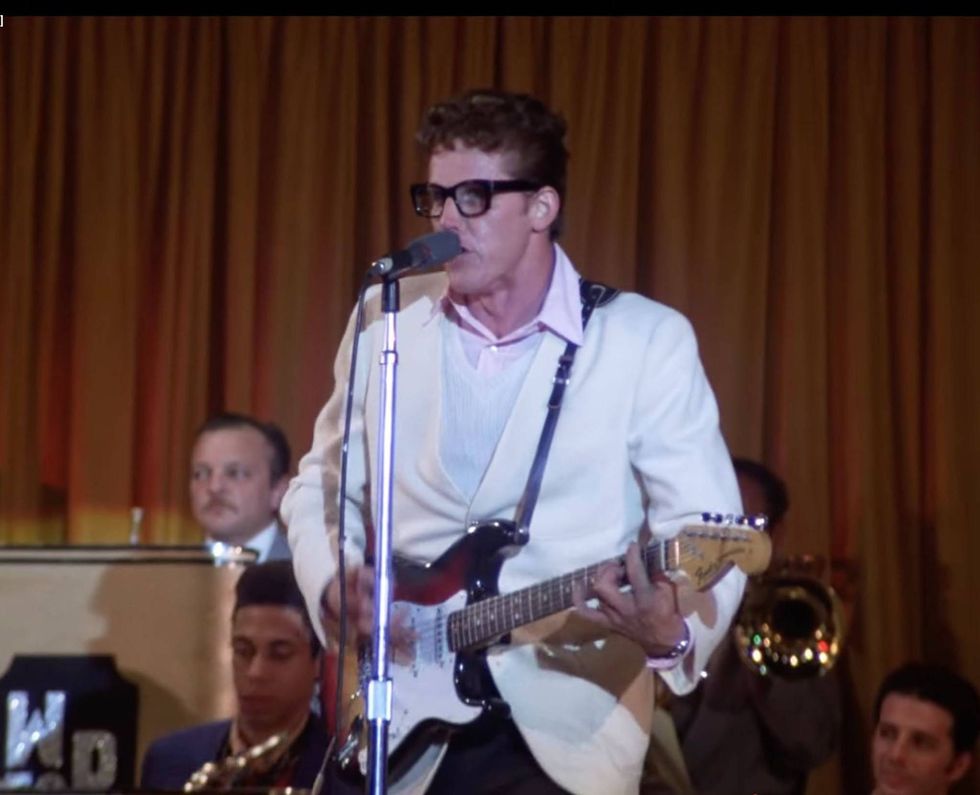
Don’t get me wrong—I love this film. The story is told in a compelling way, and it gets me every time. I just wish they would’ve paid even a small amount of attention to the musical instruments in the film.
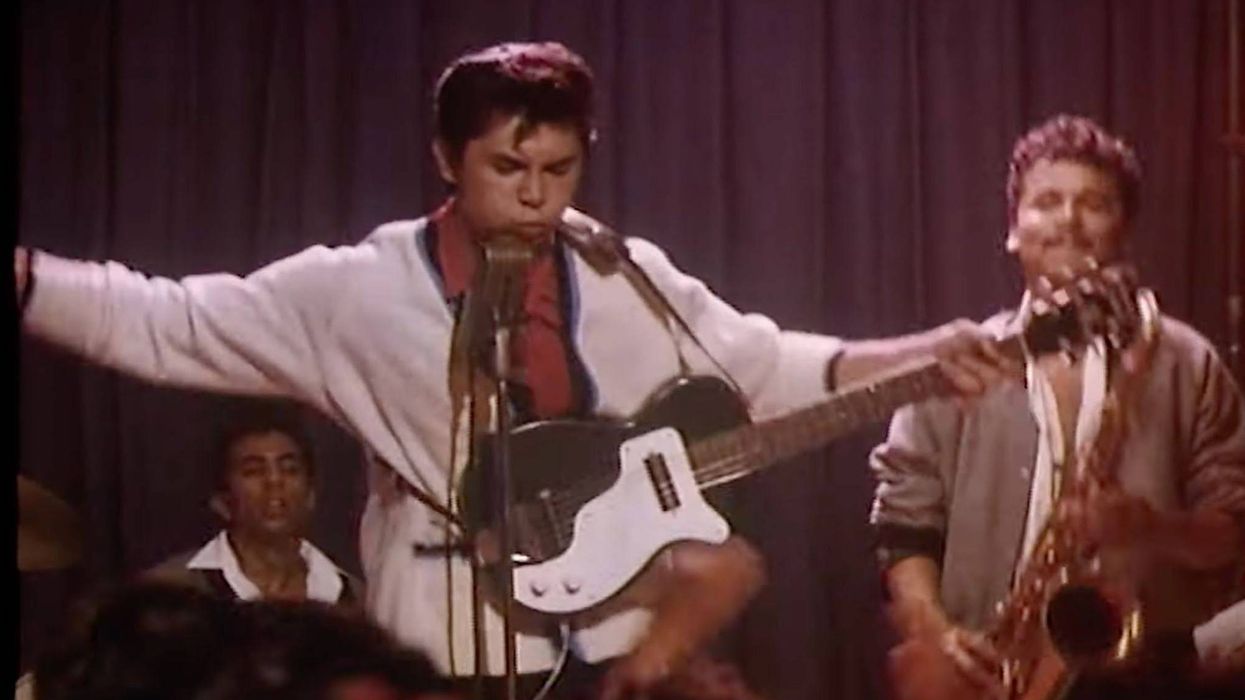
That was the bad; now for the good. La Bamba is my go-to Hollywood film for accuracy in the guitar department—ironically, a story concerning another man killed in the same plane crash, Ritchie Valens. Lou Diamond Phillips plays Ritchie, and does so with aplomb. Every character, every scene, in La Bamba is done with a level of care and attention to detail that seldom come together in a music biopic.
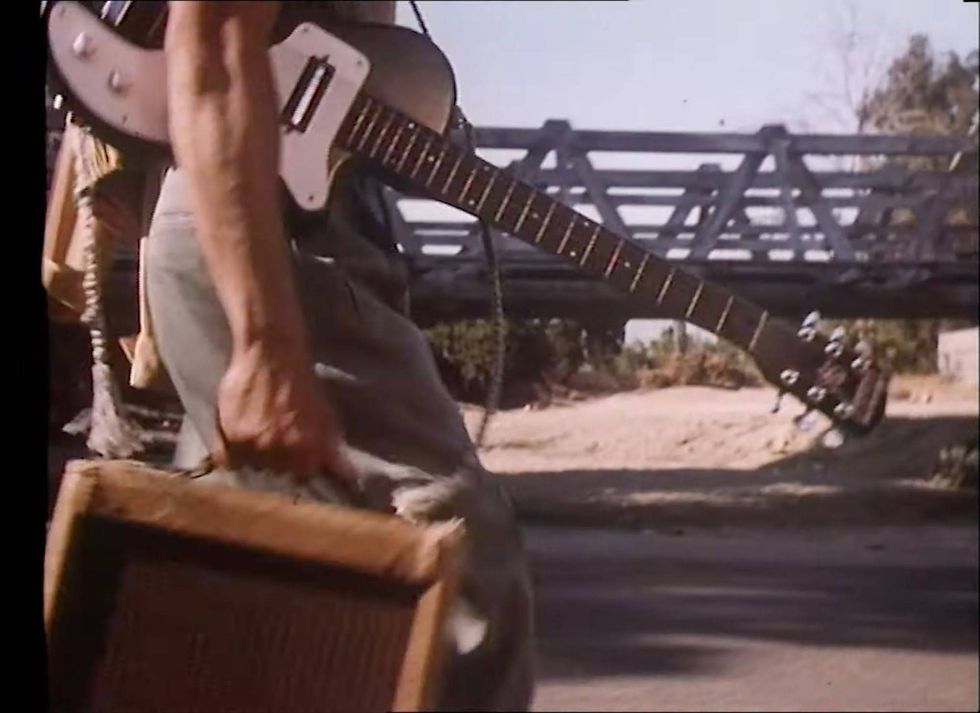
All the musical details in the movie are just about perfect. When pre-fame Ritchie shows up to audition for the Silhouettes, what does he have in tow? A seriously beat-up, single-pickup Harmony Stratotone, and a well-trashed Fender tweed Champ. This was probably the default setup for just about every fledgling rock ’n’ roll hero of the era. Nailed it! Later on in the film, after Ritchie has scored some chart success, we see him out driving around with his girlfriend, Donna. What’s in the back seat of Ritchie’s T’bird? It’s a tweed hardcase, with his Stratocaster inside. It’s a tiny detail, but those details make for a great film.
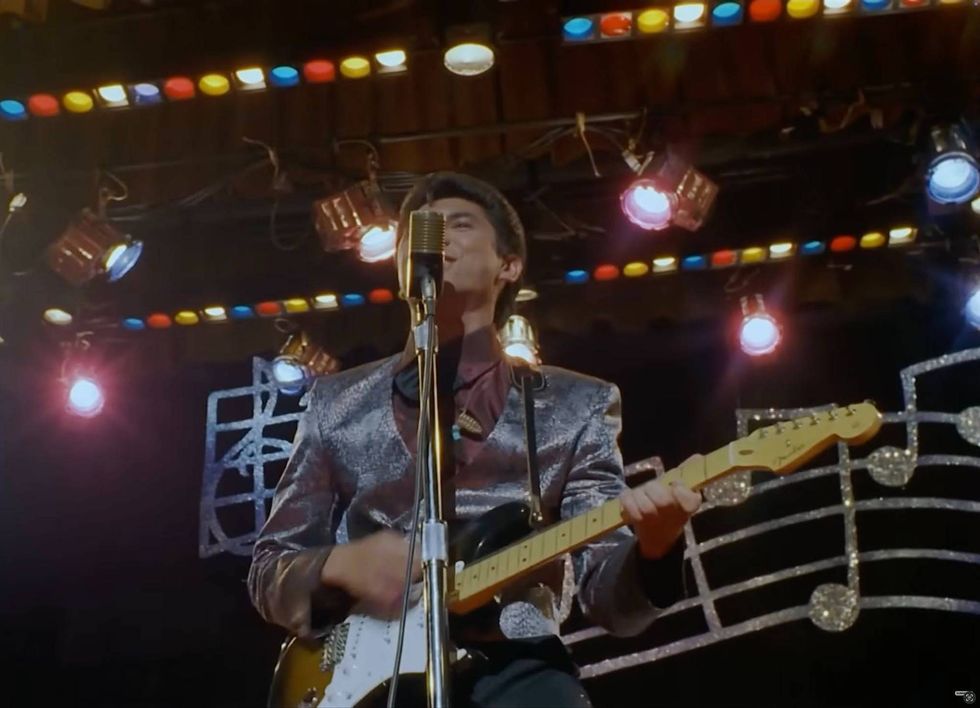
Later, when they show Ritchie playing on American Bandstand, he’s playing what looks like a lightly used ash-bodied Strat, which he probably picked up for $100 or less at a local pawn shop. Ash Strats were made from ’54 to ’56, so it would’ve been a little early for Ritchie to buy one new. At the end of the film, during his last show, he’s portrayed with yet another Strat. It’s a brand new, shiny, alder-bodied Strat. Ritchie likely received this one at the factory in Fullerton, right before he left for his first big tour in 1959. There’s some serious attention to detail in this film. If you haven’t watched it, do yourself a favor and look it up.
And now for the unexpected: Bell, Book and Candle. Made in 1958, it’s a wonderful rom-com about a witch who wants to experience love. (The film’s also the basis for the iconic TV series, Bewitched.) There’s some serious star power here, with Kim Novak as the witch, James Stewart as the love interest, and Jack Lemon as the troublesome little brother. Bell, Book and Candle has a couple of guitar sightings that will totally blow your mind. I don’t want to spoil them here—you just gotta watch it.
Until next time, happy viewing, and as they say in Tinseltown: Cut! That’s a wrap.
“By far the most meaningful record we’ve ever made”: Polyphia announce new album Be Not Afraid – listen to the first single now

Polyphia has announced their new album, Be Not Afraid, which will be released later this year. The band has not put out a studio album since 2022’s Remember That You Will Die and spent the last two years heading down “pretty dark rabbit holes” to come up with material for their fifth release.
The album announcement also saw the release of lead single, Power in the Blood. Polyphia worked on the album throughout 2024 and 2025 in Miami, Los Angeles, and Dallas.
Guitarist Tim Henson confirmed the composition of the album changed massively, initially singing lines out loud and then translating them to guitar. He said: “Instead of going wide on Be Not Afraid, we went as deep as we could. There are so many layers to pull back. Every time you listen to it, you’ll notice something new. Thematically, it’s by far the most meaningful record we’ve ever made.”
Guitarist Scott LePage added: “We physically can’t make the same album twice. We have a yearning to evolve. It was so much fun to write this one together too – the writing sessions for past Polyphia records typically looked like us gathering our ideas separately first and bringing them to each other second, so we took a different approach with Be Not Afraid by treating the sessions like an opportunity to create with everybody in the room first before getting into the separate writing.
“It was a much more communal approach that led to us having so much fun making it that the fun itself was the magic being captured.”
Henson added: “The album takes you through the extremes of two different worlds / moods: one being very uplifting and triumphant, the other being spine-chilling and terrifying. There are moments on the record that legitimately scare me when I listen to them.”
Tim Henson, who has been in the band since its founding in 2010, added that the band headed into darker territory and is their response to feeling “disgusted, demoralised, and completely powerless”.
He said: “During the making of this record, we went down some pretty dark rabbit holes. We kept coming across things that were so depraved they sounded insane when you said them out loud. Then some of the very things we had been talking about started appearing in documents released to the public. You can read that stuff and feel disgusted, demoralised, and completely powerless.
“Be Not Afraid is our response to that. Rather than allowing the ugliness of the world to paralyse us, we put everything we had into making something beautiful. We weren’t afraid of whether something was too different or whether people were going to understand it. We just followed what excited us and made what I believe is our best record to date.”
Dates for the band’s European tour, which starts on November 17 at the Halle 622 in Zurich, can be found below:
- Nov 18 – Zurich, CH – Halle 622
- Nov 19 – Lyon, FR – Le Radiant
- Nov 20 – Toulouse, FR – Interference
- Nov 22 – Barcelona, ES – Razzmatazz
- Nov 23 – Madrid, ES – Sala La Riviera
- Nov 25 – Milan, IT – Alcatraz
- Nov 27 – Munich, DE – Zenith
- Nov 28 – Prague, CZ – SaSaZu
- Nov 29 – Warsaw, PL – Progresja
- Nov 30 – Leipzig, DE – Haus Auensee
- Dec 2 – Hamburg, DE – Docks
- Dec 4 – Copenhagen, DK – Amager Bio
- Dec 5 – Berlin, DE – Tempodrom
- Dec 6 – Oberhausen, DE – Turbinenhalle
- Dec 7 – Brussels, BE – Ancienne Belgique
- Dec 8 – Amsterdam, NL – AFAS Live
- Dec 9 – Paris, FR – Zenith Paris
- Dec 11 – Birmingham, UK – O2 Academy Birmingham
- Dec 12 – Manchester, UK – Manchester Academy
- Dec 15 – Leeds, UK – O2 Academy Leeds
- Dec 16 – London, UK – O2 Academy Brixton
Learn more at Polyphia’s official website.
The post “By far the most meaningful record we’ve ever made”: Polyphia announce new album Be Not Afraid – listen to the first single now appeared first on Guitar.com | All Things Guitar.
DOD Pushes Analog Delay to the Edge with New DRAG Pedal
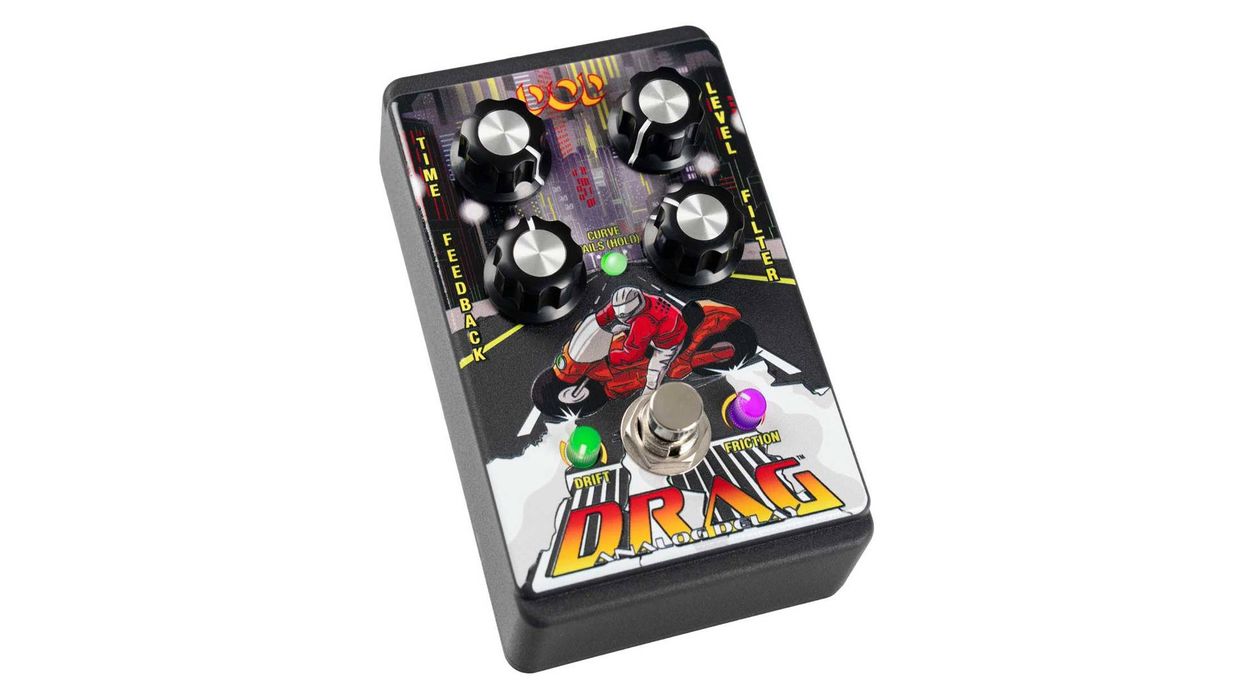
DOD announces the release of the DRAG™ Analog Delay, a new effects pedal that reimagines what analog delay can do through aggressive time-warping control, expanded modulation, and performance-driven features. Available now worldwide through local retailers and online, the DRAG combines classic analog BBD delay with new patent-pending functionality designed to push delay effects well beyond traditional boundaries.
Built around an all-analog bucket brigade design, the DRAG delivers up to 750 milliseconds of delay time, extendable to 1.5 seconds via its Rubbernecking™ function. From tight slapback echoes to drifting, modulated repeats and controllable runaway oscillation, the pedal is designed to move fluidly between familiar delay sounds and more unpredictable, expressive territory. Four standard delay controls: Time, Feedback, Level, and Filter, with two performance controls unique to the DRAG: Drift™, and Friction™, provide detailed command over delay response, tone shaping, and modulation behavior.
At the center of the DRAG experience are its time-warping features, including Rubberneck, SlideStop™, and Evade™ Friction categories. Engaged via the footswitch and Friction control, these functions allow players to manipulate delay time and pitch in real time. SlideStop™ can bring the delay signal to a complete stop before ramping it back up, while Evade introduces alternate motion behaviors such as HopStop™ and Slide-n-Go™. Rubbernecking adds octave-up and octave-down pitch shifting tied directly to delay time changes, opening further performance possibilities.
Modulation capabilities are equally deep, with four selectable waveforms: sine, reverse saw, square, and random. Plus, three intensity ranges: light, medium, and heavy. The Drift control adjusts modulation depth and speed, while the Curve™ control shapes how that modulation behaves, allowing users to dial in anything from subtle movement to more extreme, shifting textures.
The multi-function footswitch expands control beyond simple on/off operation, A short press engages or bypasses the pedal according to the selected bypass mode. Holding the footswitch activates the Friction feature, allowing expressive real-time control over SlideStop, RubberNeck, and Evade features. The two controls next to the footswitch are Drift and Friction change The DRIFT settings. The button in the middle of the pedal allows you to select between multiple bypass modes including True Bypass, and buffered options with delay tails. For extended control, a 3.5mm input supports connection to an optional FS3X footswitch, enabling tap tempo, oscillation hold, and modulation toggling.
Housed in an aluminum chassis with a top-jack design, the DRAG also introduces a patent-pending reversible StagePlate™. This two-sided plate allows players to switch between a Tire Tread Skid Pad for added stability and a hook surface for secure pedalboard mounting.
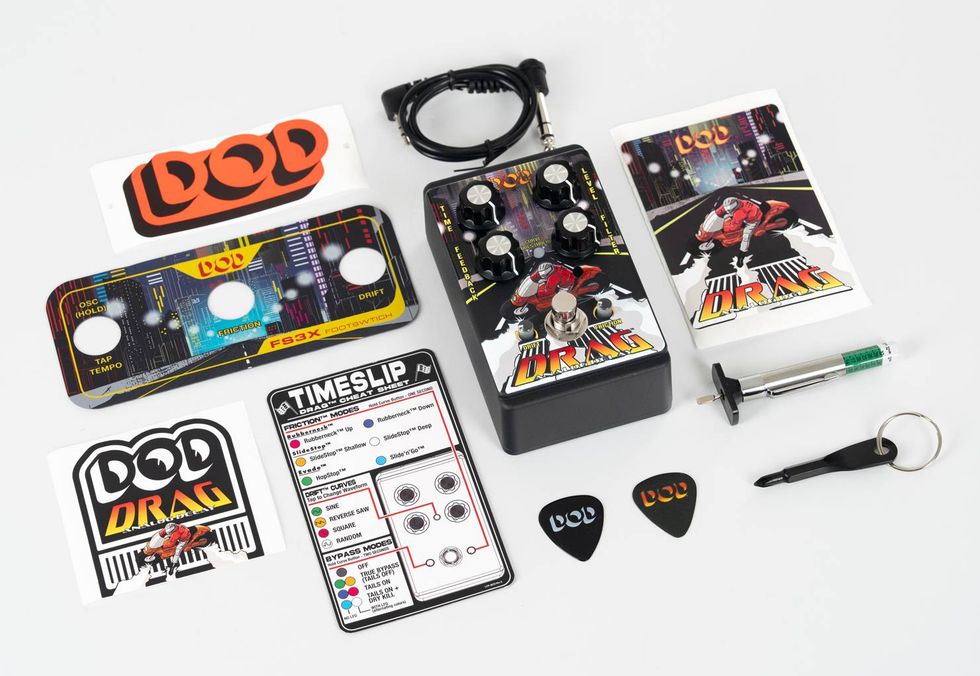
The DRAG runs on a standard 9V DC power supply, measures 4.8” x 2.8” x 1.5”, and weighs 0.67 lbs., making it a compact yet feature-rich addition to any setup.
For more information on the DRAG Analog Delay, visit www.digitech.com.
Street Price: $219.99 USD
Polyphia Announces New Record "Be Not Afraid"
Today, the genre-defying instrumental rock innovators Polyphia announce their fifth full-length studio album BE NOT AFRAID out October 23rd with Rise Records.
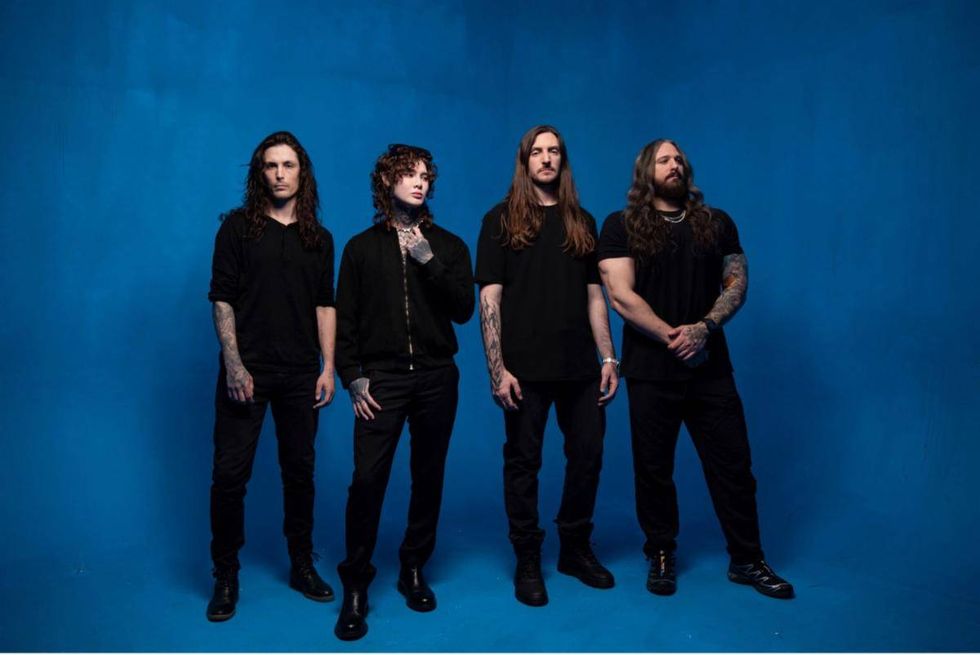
With the news, the band also released their new single off the record “POWER IN THE BLOOD” with an accompanying music video you can watch HERE . Filmed in Rio de Janeiro, Brazil, this video finds the band playing against the ornate, gold-leaf Baroque backdrops from the São Francisco da Penitência Church. The powerful visual lays the foundation for what’s to come off the new record, directed by Caleb Young.
Throughout 2024 and 2025, Polyphia worked together in various locations in Miami, Los Angeles and Dallas alongside co-producer RJ Pasin and guitar phenom Spiro Dussias. Guitarist Tim Henson took a different approach to composition, initially singing lines aloud and then translating them onto guitar, creating a process that encouraged the entire band to build on each other’s ideas in real time. More than anything, the sessions were defined by how much fun they were having creating music together. By the time the album was finished, they had reached a point where they could let go of any expectations about what would happen next and simply enjoy what they had created together.
“Instead of going wide on BE NOT AFRAID, we went as deep as we could,” Henson shares. “There are so many layers to pull back. Every time you listen to it, you’ll notice something new. Thematically, it’s by far the most meaningful record we’ve ever made.”
"We physically can't make the same album twice," adds guitarist Scott LePage. "We have a yearning to evolve. It was so much fun to write this one together too – the writing sessions for past Polyphia records typically looked like us gathering our ideas separately first and bringing them to each other second, so we took a different approach with BE NOT AFRAID by treating the sessions like an opportunity to create with everybody in the room first before getting into the separate writing. It was a much more communal approach that led to us having so much fun making it that the fun itself was the magic being captured."
The collective thread together a three-dimensional offering of otherworldly metal, future-facing prog, and pulsating house sealed tightly with carefully curated samples, inventive beat-craft, and the guitar eloquence that Tim and Scott remain renowned for. This time around, the instrumental push-and-pull invokes the polarity of the ultimate extremes: good and evil.
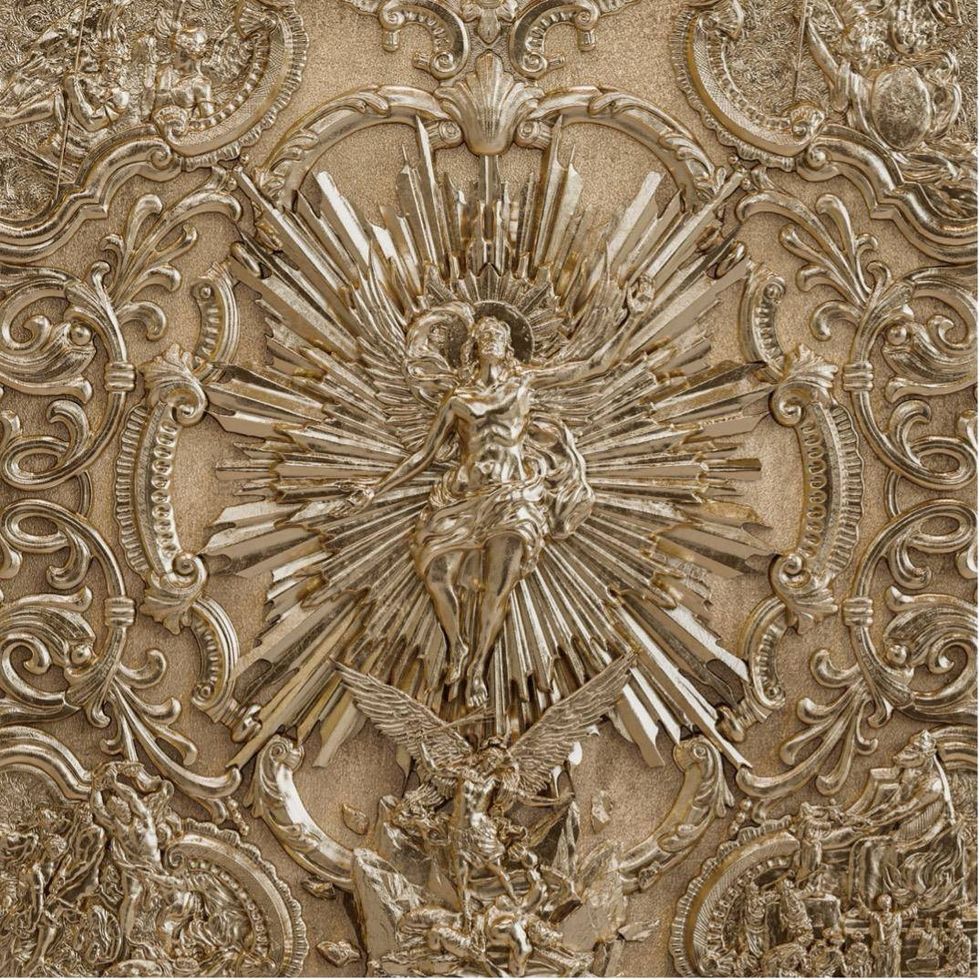
When speaking on the album Henson adds, “The album takes you through the extremes of two different worlds / moods: one being very uplifting and triumphant, the other being spine-chilling and terrifying. There are moments on the record that legitimately scare me when I listen to them.”
Earlier this year, Polyphia teased their new chapter with the release of their first single in over four years, “CAN YOU FEEL IT .” Pushing boundaries in ways the band never has before with a hybrid of metal and dance music, their music video showcased an electrifying performance by the band amidst a crowd of fans.
"During the making of this record, we went down some pretty dark rabbit holes. We kept coming across things that were so depraved they sounded insane when you said them out loud. Then some of the very things we had been talking about started appearing in documents released to the public. You can read that stuff and feel disgusted, demoralized, and completely powerless. BE NOT AFRAID is our response to that. Rather than allowing the ugliness of the world to paralyze us, we put everything we had into making something beautiful. We weren’t afraid of whether something was too different or whether people were going to understand it. We just followed what excited us and made what I believe is our best record to date,” Henson explains.
Polyphia refused to compromise on BE NOT AFRAID. Getting the album exactly where they wanted it meant giving it more time and ultimately pushing the North American leg of the 2026 World Tour to early 2027. RJ Pasin will still support every date worldwide. North American shows will feature Ladrones, with select dates including Intervals. Perturbator will join all UK and European dates, which remain unchanged for Nov/Dec 2026.
Tickets purchased for previous tour dates are valid for the newly announced show dates. A full list of show dates can be found below. For more information and to purchase tickets visit Polyphia.com .
North America Tour Dates 2027 w/ Ladrones & RJ Pasin:
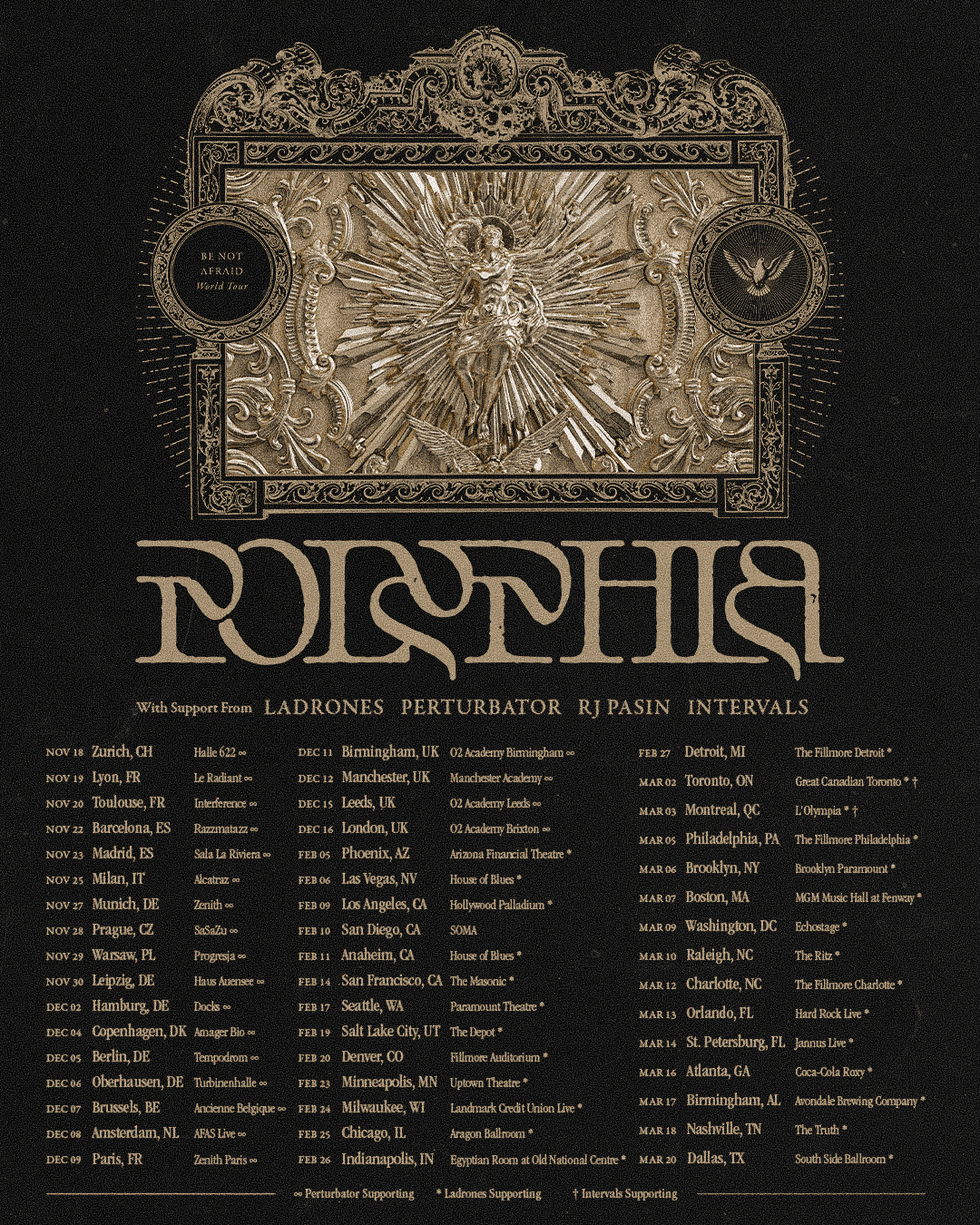
* w/ Intervals
# No Ladrones
February 5 - Phoenix, AZ - Arizona Financial Theatre
February 6 - Las Vegas, NV - House of Blues
February 9 - Los Angeles, CA - Hollywood Palladium
February 10 - San Diego, CA – SOMA #
February 11 - Anaheim, CA - House of Blues
February 14 - San Francisco, CA - The Masonic
February 17 - Seattle, WA - Paramount Theatre
February 19 - Salt Lake City, UT - The Depot
February 20 - Denver, CO - The Fillmore Auditorium
February 23 - Minneapolis, MN - Uptown Theater
February 24 - Milwaukee, WI - Landmark Credit Union Live
February 25 - Chicago, IL - Aragon Ballroom
February 26 - Indianapolis, IN - Egyptian Room at Old National Centre
February 27 - Detroit, MI - The Fillmore Detroit
March 2 - Toronto, ON - Great Canadian Toronto *
March 3 - Montreal, QC – L’Olympia *
March 5 - Philadelphia, PA - The Fillmore Philadelphia
March 6 - Brooklyn, NY - Brooklyn Paramount
March 7 - Boston, MA - MGM Music Hall at Fenway
March 9 - Washington, DC - Echostage
March 10- Raleigh, NC - The Ritz
March 12 - Charlotte, NC - The Fillmore Charlotte
March 13- Orlando, FL - Hard Rock Live
March 14 - St. Petersburg, FL - Jannus Live
March 16 - Atlanta, GA - Coca-Cola Roxy
March 17- Birmingham, AL - Avondale Brewing Company
March 18 - Nashville, TN - The Truth
March 20 - Dallas, TX - South Side Ballroom
Europe/UK Tour Dates w/ Perturbator & RJ Pasin:
Nov 18 – Zurich, CH – Halle 622
Nov 19 – Lyon, FR – Le Radiant
Nov 20 – Toulouse, FR – Interference
Nov 22 – Barcelona, ES – Razzmatazz
Nov 23 – Madrid, ES – Sala La Riviera
Nov 25 – Milan, IT – Alcatraz
Nov 27 – Munich, DE – Zenith
Nov 28 – Prague, CZ – SaSaZu
Nov 29 – Warsaw, PL – Progresja
Nov 30 – Leipzig, DE – Haus Auensee
Dec 2 – Hamburg, DE – Docks
Dec 4 – Copenhagen, DK – Amager Bio
Dec 5 – Berlin, DE – Tempodrom
Dec 6 – Oberhausen, DE – Turbinenhalle
Dec 7 – Brussels, BE – Ancienne Belgique
Dec 8 – Amsterdam, NL – AFAS Live
Dec 9 – Paris, FR – Zenith Paris
Dec 11 – Birmingham, UK – 02 Academy Birmingham
Dec 12 – Manchester, UK – Manchester Academy
Dec 15 – Leeds, UK – O2 Academy Leeds
Dec 16 – London, UK – O2 Academy Brixton
Polyphia have always said what they need to say with their instruments. Since their emergence in 2010, the Texas-bred outfit—Tim Henson [guitar], Scott LePage [guitar], Clay Gober [bass], and Clay Aeschliman [drums]—have organically progressed across a series of acclaimed albums, including Muse [2014], Renaissance [2016], New Levels New Devils [2018], and Remember That You Will Die [2022]. The latter bowed at #1 on the Billboard Top Hard Rock Albums Chart and cracked the Top 40 of the Billboard 200. Tallying hundreds of millions of streams, it established the band as rare outliers equally suited to collaborations with either pop singer Sophia Black, multiplatinum rapper SNOT, guitar hero Steve Vai, or iconic Deftones frontman Chino Moreno (on the same body of work). It’s no wonder Guitar World readers unanimously voted it “The Best Guitar Album of 2022.” Beyond headlining sold-out tours, the group incited the applause of Wired, Revolver, and Rolling Stone who described Tim as “reinventing the instrument for more than a decade.” However, the quartet make a particularly provocative and powerful sonic statement on their fifth full-length offering, BE NOT AFRAID [Rise Records]. The collective thread together a three-dimensional tableau of otherworldly metal, future-facing prog, and pulsating house sealed tightly with carefully curated samples, inventive beat-craft, and the guitar eloquence that Tim and Scott remain renowned for. This time around, the instrumental push-and-pull invokes the polarity of the ultimate extremes: good and evil.
Neural DSP makes “the biggest CorOS update in the company’s history”

Finland-based audio developer Neural DSP has expanded its flagship operating system, CorOS. Quad Cortex and Quad Cortex Mini users will now enjoy compatibility with five of Neural’s classic artist signature Archetype X plugins.
These include: Archetype: John Mayer X, Archetype: Petrucci X, Archetype: Misha Mansoor X, Archetype: Rabea X, and Archetype: Tim Henson X. In total, this includes over 70 amps, cabs and effects catering to everything from metal shredding to smooth, easy-listening strums. Moreover, with these additions, CorOS and Cortex Control can now work with every single X-updated plugin throughout Neural DSP’s arsenal.
Those who have Quad Cortex, Neural DSP’s flagship floorboard amp modeller, also now have access to the brand-new feature, Device Presets. As simple as it sounds, the Quad Cortex can save the precise settings on an individual device it is modelling. Amps, cabinets, drives, effects, and utility blocks can be instantly pulled up with all the knobs exactly where they were before. Plus, the new CorOS adds 2,000 device presets to try out.
“CorOS 4.1.0 represents a major milestone for the Quad Cortex ecosystem,” says Francisco Cresp, Neural DSP CPO and Co-Founder.
“With Plugin Compatibility now spanning every X-updated plugin in our lineup, alongside powerful new workflows like Device Presets, we’re giving musicians even more freedom to create, experiment, and move between software and hardware without compromise.”
As if that wasn’t enough, Quad Cortex and Quad Cortex mini users also get eight new virtual devices: Multivoicer harmonizer, Glitch granular delay, Ring Modulator, Arpeggio Delay, Crystal Delay, Vintage Digital Reverb, Douglas Shining Comp, and Plugin Parametric-4 EQ.
Last but certainly not least, the new Cortex Control has Multiple Device Management to adjust settings on multiple Quad Cortex and Quad Cortex mini units simultaneously. Now the monitor mixer can have a laptop side stage at gigs and change everyone’s settings with a click of a button when the next song arrives.
You can learn more at Neural DSP.
The post Neural DSP makes “the biggest CorOS update in the company’s history” appeared first on Guitar.com | All Things Guitar.
The Warning’s Dany Villarreal on her guitar collection: “I have them stored in a very special place in my basement… and in my heart”

The Warning were just kids when their cover of Metallica’s Enter Sandman went viral. In the decade-plus since, they’ve released four albums, been nominated for a Latin Grammy and toured with Evanescence, Foo Fighters, Halsey and Yungblud.
But before all that, they were just three sisters playing the Rock Band video game at home in Monterrey, Mexico. “I actually started with a plastic guitar,” Daniela “Dany” Villarreal, vocalist and guitarist for the band, says.
From there, she moved to the acoustic guitar, starting with a Taylor GS Mini. Her first electric guitar was a semi-hollow Ibanez, but Villarreal was still quite young, and the guitar was too unwieldy for her small size, so she ended up switching to a Stratocaster.
“My relationship with guitars throughout time was a process of me finding the right sound, the right guitar,” she explains. “Since I started at a very young age, I didn’t quite necessarily get into the specifics from the get-go. I was just focused on learning guitar, but not finding my guitar, what I wanted to sound like, what I was comfortable with.”
That changed when The Warning went into the studio to work on their 2022 album Error, with producer David Bendeth, and he recommended Villarreal try a PRS guitar. “We just clicked,” she says. “It was so comfortable. It just felt completely right. And the more I played it, the more I found quirks in the sound, what I wanted to be, what I wanted to evolve into, and it became my teammate for sure.”
 Dany Villarreal performing with a PRS guitar. Image: Press
Double Duty
The Warning are gearing up to release their fifth album, Everything’s Falling, on August 28, which sees them incorporating pop elements (Bloodsport), metal-style screams (Ego) and reggaeton beats (Bruises), into their signature hard rock sound, defined by blaring guitars. The band is rounded out by Villarreal’s younger sisters Paulina “Pau” Villarreal on drums and Alejandra “Ale” Villarreal on bass, and while all three sisters contribute vocals, Dany is the lead vocalist as well as the sole guitar player.
With dual duties comes additional challenges, one being differentiating the guitar melodies from Villarreal’s vocals, since they often occupy the same range. This has pushed her guitar playing into the lower end. “I’ve fallen in love with low-key trying to play the bass on a guitar,” she laughs.
There was another function Villarreal had to juggle on this record. “We’ve applied a new pedal to this album, sound-wise, that made the album what it is, I think,” she says. “It’s a very unique pedal. It’s called The Noise pedal [by Tallon Electric – Ed]. It’s a very indie pedal, but it just makes noise.” But it does mean that on top of singing and playing guitar, Villarreal also now has to operate a pedal with her foot, like on the groove-filled track Bruises.
It took several different guitars to achieve the dynamic, electrifying sounds of Everything’s Falling. Below Villarreal talks Guitar.com through the most treasured and meaningful guitars in her collection, , including her brand spanking new PRS signature model:
 Dany Villarreal with her signature PRS Astryx. Image: PRS
PRS Astryx
Announced just this week is Villarreal’s very first signature guitar, created in partnership with PRS. The Astryx is based on the iconic Custom 24 model, but with a variety of visual and spec flourishes. For example, the fretboard is ebony instead of the usual rosewood, while an inlaid sun adorns the twelfth fret. The sun theme continues with the guitar’s striking purple, red and orange top finish, which is intended to evoke a sunset. “I had never had the experience of trying to put myself, my personality into a guitar, and having that be me,” she says. “I’m completely in love, and it’s my favorite guitar.”
It took about a year of production, with Villarreal even going to the PRS factory in Maryland to watch how the guitar was made. “I feel like it’s a very big step as a guitar player, and it’s gonna be one of the highlights in my timeline as a guitar player,” she says. Just 200 of these unique instruments will be made for sale, with each one featuring an autographed backplate.
 Dany Villarreal with her signature PRS Astryx. Image: PRS
Gibson Les Paul
Early in her career, Villarreal got her hands on a Les Paul. “[It] is one of my very first guitars ever that I had a hard time letting go of,” she says. “Once I found a Les Paul, it was just like, ‘I love this guitar.’ It eventually became a problem for my back as a growing child because it was very heavy.”
The Les Paul didn’t make it into her touring set, but she held onto it. “I always invite my Les Paul over to the studio because I do feel a strong connection with it,” she adds. “It’s more of a nostalgia thing to have it with me there. We didn’t use it that much but there’s something about maybe playing a basic rhythm, strum-out chords with a Les Paul that just hits right.”
 Dany Villarreal performing with a Fender Stratocaster Baritone. Image: Press
Fender Stratocaster Baritone
This custom twin-humbuckered beast, and other Fender baris, have helped Villarreal reach those lower tones, which have shaped The Warning’s sound. “I have been loving the baritone feel and mid-range that it gives me between the bass and a guitar,” she explains. “It just makes the songs feel so powerful. So I’m really having so much fun exploring that baritone world.”
When it was time to work on Everything’s Falling, the baritone guitars played a key role. “I think I was even surprised how much we used baritone guitar in this album because I started using baritone guitars more as a layer than as a main guitar, and that was not the case for this album,” she says. “We went fully with the main guitars being the baritone guitars.”
They weren’t the only Fenders she used in the studio. “With little arrangements and things where I wanted to be a little bit more delicate, I went with a Telecaster, which is not something I usually use on tour – it’s mainly studio vibes,” she laughs. “And we would figure out at that point what the song was asking for guitar-wise.”
But for writing, she prefers the Fender Acoustasonic. “I usually go full acoustic, which is weird because [we play] rock and roll, but it’s my comfort guitar, and I keep that in my room…. But whenever I have an itch, I just [go for the] Acoustasonic, and it’s my favorite guitar to… explore with,” she says.
Manson Oryx VI
The Warning are big fans of Muse and in 2023, they got the opportunity to support them on tour. While playing a show in Mexico, Muse frontman Matt Bellamy asked Villarreal her favourite colour. “I didn’t know what he was talking about,” she recalls, but she answered with mustard yellow. The Warning ended up joining Muse for a few dates on the United Kingdom leg later that year. On the last show they played together, Bellamy surprised Villarreal by knocking on her dressing room door with a guitar in hand.
“I actually had a time where I played Manson guitars a lot because of him, and I couldn’t believe I was being gifted one by him,” she says. “I played it that very same day. I was just like, ‘I’m gonna test this out on stage, see how it goes,’ and I love it so much.”
But Villarreal’s reluctant to bring it on the road. “We had a jump scare,” she explains. “I took it out on tour, and it did not arrive [at] the final destination. It got lost in some of the airports, and I was like, ‘You know what? This is the only guitar I have gifted [to] me from Matt Bellamy. I’m gonna stop touring with it. I’m gonna keep it safe.’” She keeps it in her home studio. “I take very good care of it now because it really is very very special to me,” she says.
 Dany Villarreal with a Gibson Explorer. Image: Press
Gibson Explorer
In The Warning’s music video for the brash, swaggering single Ego, Villarreal’s holding a white Gibson Explorer with a similar story behind it. The Warning were playing in Texas in 2022 – on a bill that included Halestorm, The Pretty Reckless and Lilith Czar – when Halestorm frontwoman Lzzy Hale walked onstage with a white Gibson Explorer. “And she kneels down [as] if she is asking for my hand in marriage,” Villarreal remembers.
Villarreal assumed Hale was letting her borrow one of her guitars for that set, but when she went to return the guitar after playing, Hale told her to keep it. Hale had herself previously been gifted a guitar by Shinedown’s Jason Todd. “She felt super inspired, and she wanted to keep that tradition going,” Villarreal adds. “And seeing me so young and being a woman on stage, rocking out, and specifically in rock and roll, she felt it was the right moment to give one to me.”
Villarreal’s looking forward to following Hale’s example. “I love each and every one of [my gifted guitars], and I hope I can be that person too,” she says. “I would love to be a gifter of guitars that I like to guitar players that inspire me and want to inspire.”
But, like the Manson, Villarreal doesn’t road-test her gifted guitars. “I have them stored in a very special place in my basement and in my heart,” she says.
PRS Orianthi
Villarreal once mentioned in an interview that she admired Orianthi’s signature PRS guitar. It just so happened that Villarreal and Orianthi, both PRS artists, ended up sharing the stage as part of PRS’s 40th anniversary event last year. “After the performance was done, she just handed it to me,” Villarreal remembers. “I was like, ‘No way, this is insane!’ And it’s even [the] cherry on top that it was the guitar that she played that night with me on stage.”
While she’s been hesitant to take her gifted guitars for a spin live, she did make an exception. “It had to have a moment on stage, so I did play with it for one of the biggest shows in our career, which was Auditorio Nacional in Mexico City,” she explains. The three sold-out shows last year were recorded and the concert film was even screened in movie theatres. “It’s forever now there as the day I played with the Orianthi guitar,” she says.
The post The Warning’s Dany Villarreal on her guitar collection: “I have them stored in a very special place in my basement… and in my heart” appeared first on Guitar.com | All Things Guitar.
Devi Ever Fuzz Available As Plug-Ins
Rig Rundown: Kittie's Morgan Lander & Tara McLeod
Kittie’s 30th-anniversary tour rolled into Nashville’s Brooklyn Bowl, and PG’s Chris Kies caught up with Morgan Lander and Tara McLeod to see what’s left of a rig that once meant hauling an SVT up a flight of stairs. Have a look at some quick highlights below, and tune into the new Rig Rundown for all the details.
Brought to you by D’Addario.
Solar Power
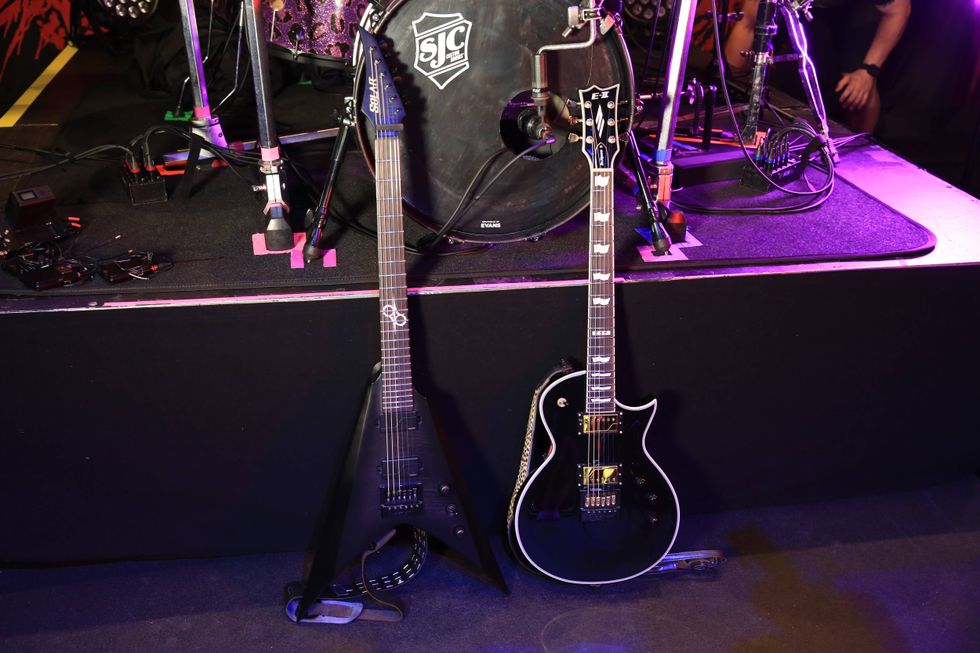
Lander’s main guitar is a Solar Type-V. She’s played the V shape so long that any other body design feels wrong in her hands. Before Solar she was using an old Hamer loaded with EMGs, and further back, a Yamaha Pacifica.
Total Eclipse
McLeod’s ESP E-II Eclipse has Fishman pickups and an EverTune bridge, though the EverTune stays “disengaged” live—Kittie’s sets run song to song with no room for guitar changes, so she needs to tune fast. She moved to active pickups during the “Kittie 2.0” era, wanting more bite than her passive Les Paul gave her.
Drop and Give Me C
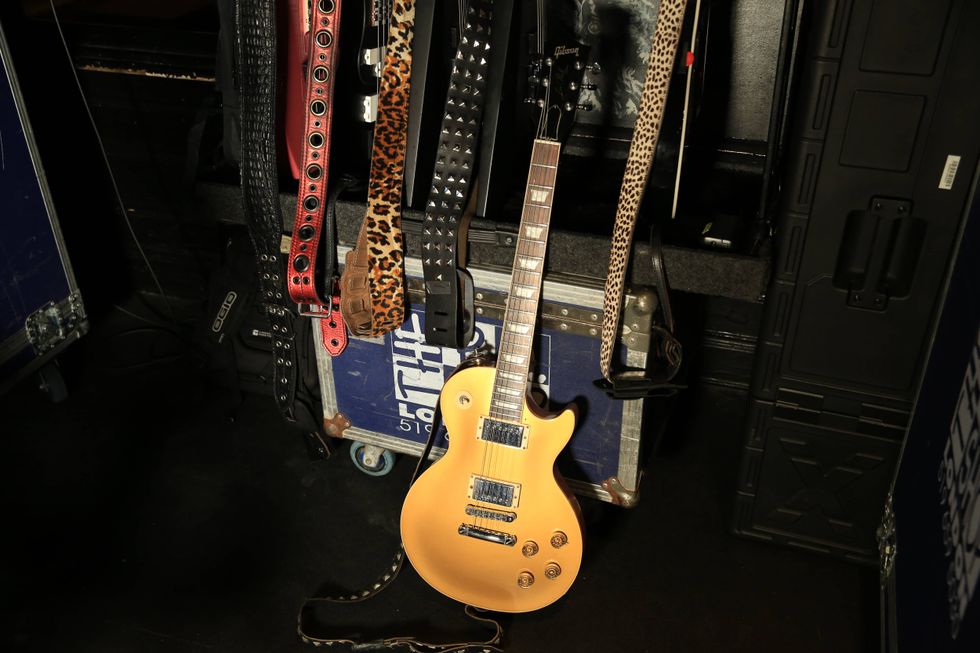
Kittie has used one tuning since 1996: drop C, low to high C–G–C–F–A–D. Both players stick to D’Addario strings: Lander runs .011–.056, while McLeod uses .011–.052 on the Eclipse, with a .056 on the bottom for the Gibson Les Paul goldtop shown here.
Morgan Lander’s Pedalboard
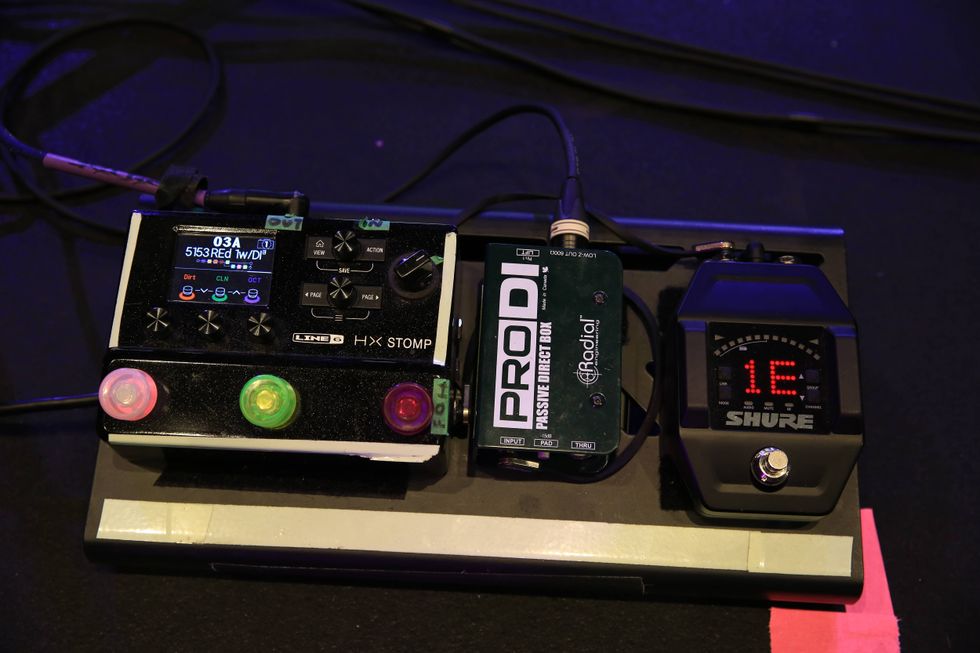
Years of fly dates pushed the band to shrink everything down to what fits in an overhead bin. Lander’s Line 6 HX Stomp does the work of the old rig: a 5150 model for the main rhythm and lead tone, a Tube Screamer in front for a boost, and a channel with a low octave she calls “the scaries,” saved for accents and the extended parts where she steps away from the mic. A Shure GLXD16+ digital wireless system handles her signal and her tuning, and a Radial ProDI passive direct box rounds out the board.
Tara McLeod’s Pedalboard
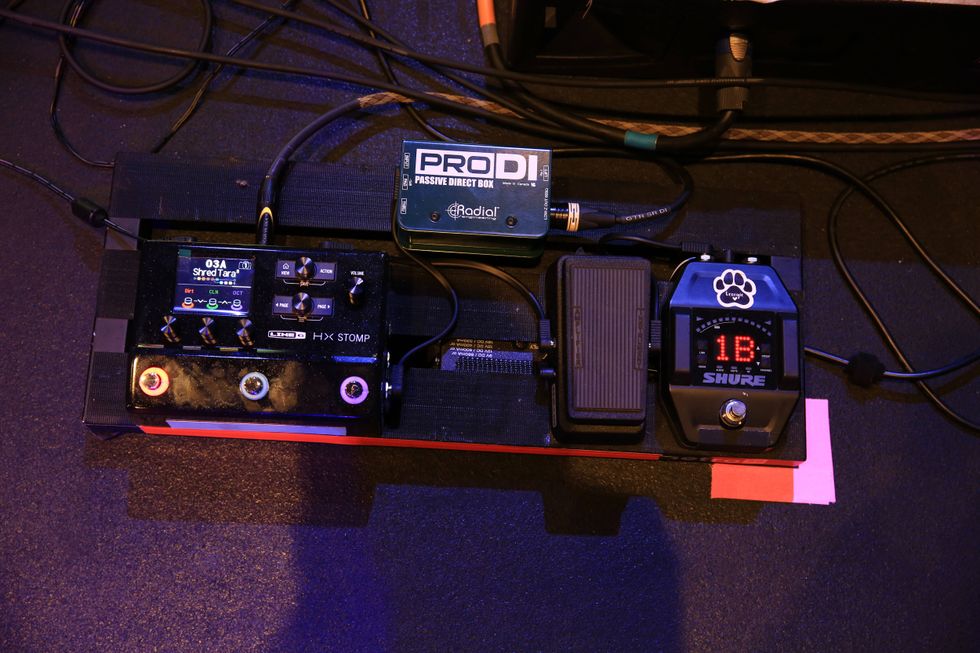
McLeod ran a Neural DSP Quad Cortex for years, but a hiccup mid-tour had her switch over to the same HX Stomp Lander uses, which made it easy to copy her settings and tweak from there. She employs the same 5150 and Tube Screamer models, plus a third channel built around an OCD model with a delay after it for a smoother lead tone. She runs the same Shure GLXD16+ and Radial ProDI as Lander.
Mysterious masked metallers Sleep Token get their first signature guitars courtesy of Jackson and Charvel

In just ten years, Sleep Token have marked themselves as A-listers in the metal world, releasing several studio albums, most recently 2025’s Even in Arcadia, and even securing a headline slot at last year’s Download Festival, all while keeping their identities officially secret.
Yep, the mysterious masked musicians have become one of the most talked-about acts in metal music, so a line of signature models was perhaps overdue.
To that end, the band have partnered with both Charvel and Jackson on two metal-ready signature models…
The first, the Jackson Pro Plus Series Signature Sleep Token IV Monarkh SC, ships tuned down a whole octave, and is designed to let players tap into the distinctive signature crushing riffs of guitarist and backing vocalist IV.
 Credit: Jackson/Charvel
To support that fiendishly low tuning, the guitar features a 30” scale length and precision-engineered EverTune 6 bridge for unshakable tuning stability, alongside a bound mahogany body with a quilt maple veneer, three-piece caramelised maple set neck and compound-radius ebony fingerboard with 22 stainless steel frets.
It’s powered by a pair of Fishman Fluence Open Core Classic humbuckers, and also features pearloid teardrop inlays, Luminlay side dots for visibility in dimly lit environments, and a matching headstock.
Meanwhile, the Charvel Sleep Token III Signature Pro-Mod San Dimas Bass V is a five-string bass for bass player III. It features a resonant poplar body, caramelised maple neck and fingerboard with a 12”-16” compound radius, Luminlay side dots, 34.4” to 35.5” multi-scale fanned fret design, Fishman Fluence soap bar pickups with three distinct voicings, an onboard Fishman 2-band EQ, Ultra Lite open-gear tuners, locking strap pins, and a reverse licensed Stratocaster headstock. In a sweet visual touch, it also dons a question mark inlay spanning the 11th to 13th frets.
“Sleep Token’s sonic and visual identity is so distinctive, and the Jackson and Charvel signature models are a huge part of shaping that sound,” says Justin Norvell, Chief Product Officer at Fender, which owns both Jackson and Charvel.
“These instruments let players tap directly into that tone: the Jackson features a whole-octave-down tuning paired with an EverTune 6 bridge for rock-solid stability in that lower register, while the Charvel is a five-string bass built with custom Fishman pickups for added clarity and punch in the mix.
“We’re always looking for artists who redefine what a signature instrument can be, and Sleep Token does exactly that.”
 Credit: Jackson/Charvel
Price-wise, IV’s new Jackson signature Monarkh clocks in at $2,199.99 / £1,949, while III’s signature Charvel Bass V is $1,599.99 / £1,399.
Learn more at Jackson and Charvel, respectively.
 Credit: Jackson/Charvel
The post Mysterious masked metallers Sleep Token get their first signature guitars courtesy of Jackson and Charvel appeared first on Guitar.com | All Things Guitar.
Jackson And Charvel Debut Sleep Token Signature Guitar And Bass
Fender Musical Instruments Corporation (FMIC) has introduced the Jackson Pro Plus Series Signature Sleep Token IV Monarkh SC and Charvel Sleep Token III Signature Pro-Mod San Dimas® Bass V, marking the first-ever signature collaboration with globally acclaimed phenomenon Sleep Token. These models are built to the exact specifications of Sleep Token’s guitarist and bassist, capturing their genre-defying and mystifying sound.
With an unmistakable identity, a rapidly growing global following and platinum hits like “The Summoning,” Sleep Token fuses djent-weighted riffs, cinematic pop atmospheres and haunting R&B textures into a sound that feels both intimate and colossal. Drawn to that same boundary-pushing spirit, Jackson and Charvel capture it in two new signature models developed in close partnership with the band.
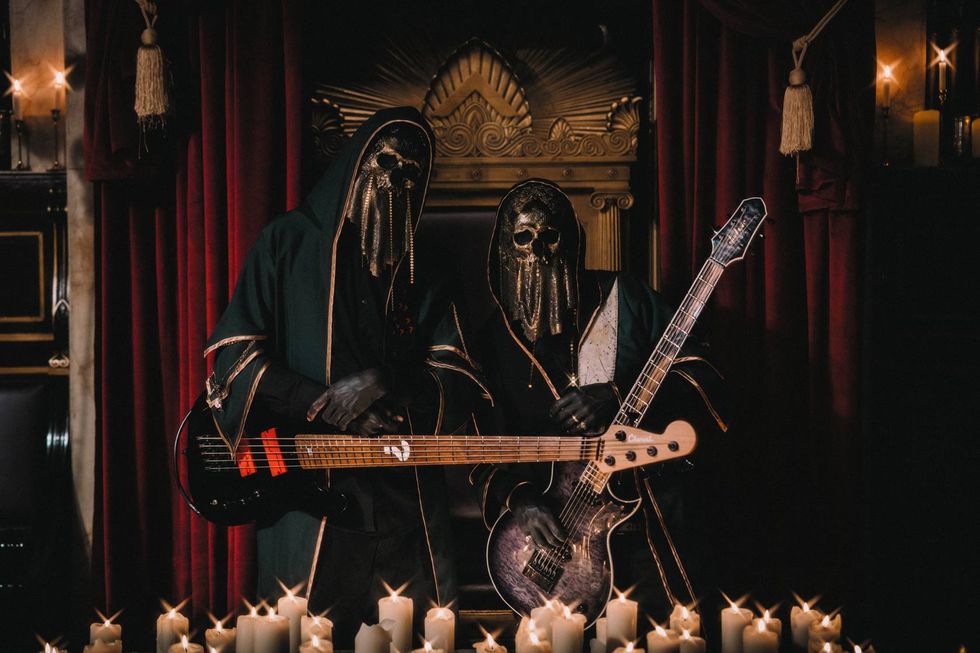
“Sleep Token’s sonic and visual identity is so distinctive, and the Jackson and Charvel signature models are a huge part of shaping that sound,” said Justin Norvell, Chief Product Officer, Fender Guitars. “These instruments let players tap directly into that tone: the Jackson features a whole-octave-down tuning paired with an EverTune 6 bridge for rock-solid stability in that low register, while the Charvel is a five-string bass built with custom Fishman pickups for added clarity and punch in the mix. We’re always looking for artists who redefine what a signature instrument can be, and Sleep Token does exactly that.”
Watch IV and III bring “Vore” to life in instrumental form, armed with their signature Jackson and Charvel.
IV is Sleep Token’s lead guitarist and backing vocalist, and his riffs form the backbone of the band’s sound. Every detail of this instrument’s design reflects his playing style, with IV personally selecting each feature to create a guitar built for reliability night after night on stage: the Pro Plus Series Signature Sleep Token IV Monarkh SC.
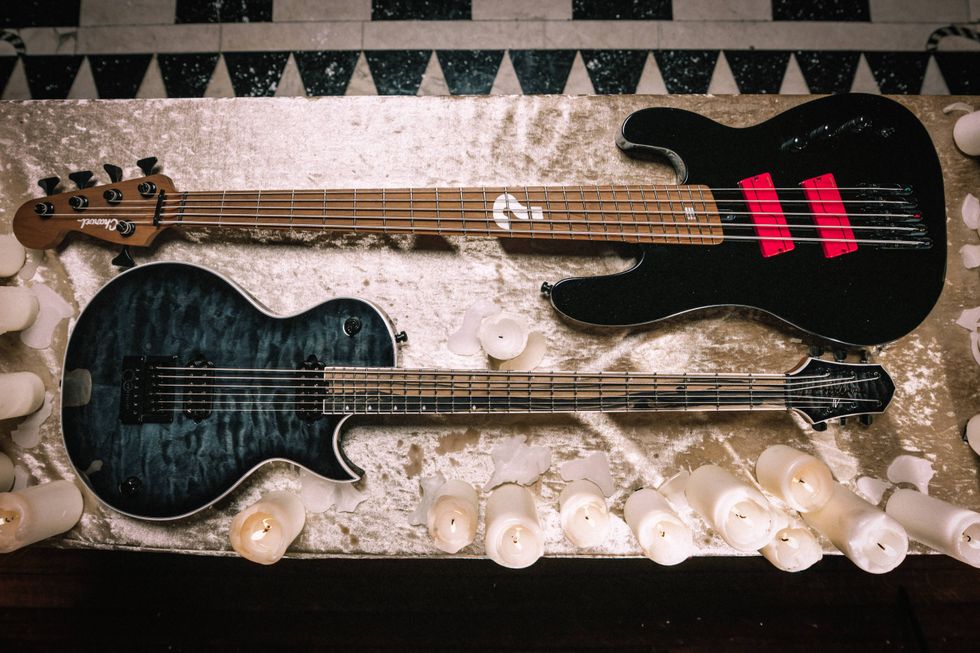
Jackson Pro Plus Series Signature Sleep Token IV Monarkh SC (MSRP: $2,199.99 USD, £1,949 GBP, €2,299 EUR, $4,499 AUD, ¥396,000 JPY) Built for IV’s signature whole-octave-down tuning, the Monarkh features a commanding 30” scale length and precision-engineered EverTune® 6 bridge with custom saddles that deliver clarity and tuning stability in the lowest registers. The bound mahogany body with striking quilt maple veneer and three-piece caramelized maple set-neck construction creates the perfect foundation for IV’s expansive tonal palette, while the compound radius pale moon ebony fingerboard with 22 stainless steel frets provides effortless playability from crushing low-end riffs to devastating chord progressions. Direct-mount Fishman® Fluence® Open Core Classic humbuckers capture every nuance—from crystalline clean tones that pierce the darkness to saturated leads that cut through the heaviest mix, translating pure emotion into sonic impact with exceptional clarity in the extended low range. Complete with pearloid teardrop inlays, Luminlay® side dots, matching headstock and foam core case, the Monarkh makes an unmistakable impact.
III is the heartbeat of Sleep Token’s sound. Visually, his masked mystique and kinetic stage presence amplify the band’s ritualistic aesthetic. Sonically, his bass is the glue between thunderous heaviness and atmospheric lift.
Charvel Sleep Token III Signature Pro-Mod San Dimas® Bass V (MSRP: $1,599.99 USD, £1,399 GBP, €1,649 EUR, $2,699 AUD, ¥258,500 JPY) His weapon of choice is a five-string Charvel® San Dimas bass featuring a resonant poplar body. The caramelized maple neck and fingerboard feature a progressive 12”-16” compound radius with jumbo frets for effortless playability, while Luminlay® side- dots ensure perfect navigation in Sleep Token’s signature darkened stage environments. The 34.4” to 35.5” multi-scale fanned fret design optimizes string tension across all five strings, delivering enhanced intonation and that percussive attack that defines III’s playing style and custom red Fishman® Fluence soap bar pickups with three distinct voicings accessible via a three-way mini toggle—from crystalline clarity to growling aggression. The onboard Fishman® 2-band EQ provides surgical control over bass and treble frequencies, while the blend knob allows seamless pickup mixing for infinite tonal possibilities. Hipshot® Ultra Lite open gear tuners guarantee rock-solid tuning stability, locking strap pins secure the instrument during III’s kinetic performances and the reverse licensed Stratocaster® headstock complements the band’s mysterious aesthetic.
For technical specs, additional information on new Charvel products and to find a retail partner near you, visit www.charvel.com. Join the conversation on social media by following @CharvelGuitars on X and @CharvelUSA on Instagram and Facebook.
Interview: Jeff Tweedy Talks About Tone, Songwriting, and the Importance of Imperfection

Paul Reed Smith To Be Inducted Into The Guitar Center Rockwell
Press Release
Source: PRS Guitars
Paul Reed Smith – image courtesy of PRS Guitars
PRS Guitars and Guitar Center today announced that the national retailer is inducting Paul Reed Smith into the Hollywood Rockwalk, the handprint-and-signature tribute outside Guitar Center’s flagship Hollywood store on Sunset Boulevard. This pedestrian path and industry-recognized music landmark is dedicated to honoring the musicians and industry pioneers who have made significant and lasting contributions to the growth and evolution of music, through an exceptional level of talent, outstanding innovation and creative ingenuity.
John Mayer will give the induction speech to honor Smith. The handprint ceremony will take place September 26th at the Dell West Plaza Rockwalk Stage at the Moody Center during the Crossroads Guitar Festival in Austin, Texas. The completed handprint will later be installed at Rockwalk outside Guitar Center’s flagship Hollywood store.
“The first time I saw a Rockwalk induction, Ted McCarty was getting inducted and Eddie Van Halen was one of the people in attendance to witness it. I was very pleased for Ted. That I’ll be in the middle of another induction is an honor and leaves me without words. I look forward to seeing everyone,” said Paul Reed Smith, Managing General Partner of PRS Guitars.
“There are very few people in the history of the electric guitar who have pushed the design and perfection of the instrument forward more than Paul,” said Gabe Dalporto, CEO of Guitar Center. “He has inspired generations of musicians and instrument makers and is a living legend in our industry.”
Since its founding in 1985, Rockwalk has celebrated some of the most recognized names in rock, blues, soul and popular music through signature and handprint ceremonies outside the Guitar Center Hollywood. More than 150 artists and innovators have been inducted, including gear pioneers Jim Marshall, Robert Moog and Les Paul, as well as music icons including Eric Clapton, John Lennon, Stevie Wonder, Aerosmith, Janis Joplin, Jimi Hendrix, Alanis Morissette, Black Sabbath, The Ramones, Elvis Presley and Johnny Cash. Located at the entrance of Guitar Center’s flagship Hollywood store on Sunset Boulevard, Rockwalk is a permanent public destination where fans and musicians connect with music history year-round.
For all of the latest news, visit www.prsguitars.com and follow @prsguitars on Instagram, TikTok, Facebook, X, and YouTube.
About PRS Guitars:
PRS Guitars is a leading manufacturer of high-quality instruments in Stevensville, Maryland and has provided some of the world’s most renowned musicians with instruments since 1985. The PRS team of highly skilled craftspeople design and build a wide variety of musical instruments and gear for worldwide distribution, including electric and acoustic guitars as well as boutique-style guitar amplifiers and effects pedals. The PRS SE Series complements the Maryland-made PRS line by offering highly approachable and more affordable electric and acoustic guitars. David Grissom, Jimmy Herring, Mark Holcomb, Myles Kennedy, Mark Lettieri, John Mayer, Orianthi, Carlos Santana, Ed Sheeran, Rhonda Smith, Mark Tremonti and Keith Urban are among the artists currently playing PRS instruments and/or amplifiers.
About Guitar Center:
Guitar Center is the leading retailer of musical instruments, lessons, repairs and rentals in the U.S. With more than 300 stores nationwide and one of the top direct sales websites in the industry, Guitar Center has helped people make music for more than 60 years. Guitar Center provides a range of musician-based services, including Guitar Center Lessons for players of all ages and skill levels, GC Repairs, an on-site maintenance and repair service, and GC Rentals, offering easy access to instruments and gear. Guitar Center’s family of brands includes Music & Arts, which operates more than 250 stores specializing in band and orchestral instruments for sale and rental, serving teachers, band directors, college professors, parents and students, and Musician’s Friend, a leading direct marketer of musical instruments in the United States. Guitar Center Business Solutions is the company’s commercial division, delivering professional audio, video, lighting and integrated technology solutions for businesses, institutions and creators nationwide through a portfolio of brands including AVDG (Audio Visual Design Group), GC Pro and Custom House at Guitar Center. The Guitar Center Music Foundation is a national nonprofit that expands access to music through instrument donations and support for communities in need.
Johnny Marr reacts to Andy Burnham playing the Smiths with Ukrainian soldiers: “It’s a victory for the guitar”
![[L-R] Johnny Marr and Andy Burnham](https://guitar.com/wp-content/uploads/2026/08/Johnny-Marr-Andy-Burnham-hero@2000x1500.jpg)
Johnny Marr has reacted to a clip of UK Prime Minister Andy Burnham playing a Smiths song on guitar with Ukrainian soldiers during a recent trip to Kyiv.
The British PM recently made the trip to the Ukrainian capital to reaffirm the UK’s support for the country amid its ongoing war with Russia, and found himself among the Ukrainian military’s Cultural Forces division playing the Smiths’ Rusholme Ruffians with soldiers, in a video that has since gone viral.
Reacting to the video in a new appearance on Absolute Radio, Smiths guitar legend Johnny Marr praises Burnham, calling it a “victory for the guitar”.
“I think it’s an amazing thing. In all honesty, for me it’s like a victory for the guitar,” he says. “Just the way I’m wired, I always think like that. I can’t quite get my head around it. I don’t know whether pride is the word, but it probably is.
“It’s kind of beyond me to process it really, because it could be massive, that. But I just sort of go, ‘How great is the guitar?’ I think, what an amazing tool the guitar is.
“My overwhelming feeling was that it was a victory for the guitar. I know that this being political and obviously with the plight of Ukraine. The more I think about it the more I think about how insignificant I am in it, really. Marr concludes: “Good on him.”
Rusholme Ruffians appeared on 1985’s Meat is Murder. Andy Burnham has made no secret of his love of guitar music during his time as a politician, and has touted his love of classic guitar bands including the Beatles, the Stone Roses, Radiohead and more.
During his jam with Ukrainian soldiers, the prime minister donned a T-style guitar from local Kyiv guitar company WM Guitars, but Burnham has previously displayed his love of Gretsch and Gibson guitars.
The post Johnny Marr reacts to Andy Burnham playing the Smiths with Ukrainian soldiers: “It’s a victory for the guitar” appeared first on Guitar.com | All Things Guitar.
“Instant sainthood”: Tributes pour in from the music world and beyond as country icon Dolly Parton dies at 80

Legendary country singer and music icon Dolly Parton has died at 80, following a short battle with cancer.
The news was confirmed by Parton’s nephew Bryan Seaver in an Instagram video posted yesterday (25 August).
“Hey everyone, my name is Bryan Seaver, son of Cassie Parton, and I am representing the Parton and Owens family today, announcing the passing of my Aunt Dolly Rebecca Parton Dean. Sister, sis, Aunt Granny to one generation and Gigi to the next. This video announcement is something that Dolly asked of me years ago, before I fully absorbed it as a future reality.
“As her head of security for more than two decades, a role my father Larry held before me, I have imagined the heaviness of this moment, but haven’t truly felt it until now. It is an honour, an honour that is mixed with absolute pride and great sadness. But sadness lies with us, not with Dolly. Dolly has lived in the light, and is in the arms of Jesus, surely met by Carl, her parents, and countless others who have watched her and longed for her to meet them in the heavens.”
Seaver goes on: “Dolly opened doors not just for me, but for her entire family to reach the potential we didn’t even know was possible. Dolly also opened doors for generations of singers, songwriters, musicians, and dreamers from every walk of life.”
Indeed, few musicians get to count themselves as influential as Dolly Parton. Born in Tennessee in 1946, the fourth of 12 children, Parton – often dubbed the “Queen of Country” was surrounded by music from a young age, and it very quickly manifested, as she reportedly wrote her first song at just six years old, and was performing regularly on TV at just 10.
A prolific songwriter, Parton is said to have written more than 3,000 songs over the course of her lifetime, but a few stand out as her most enduring. They include I Will Always Love You – the 1973 hit later sent into the stratosphere by Whitney Houston – 9 to 5, a proud anthem of women’s equality in the workplace, and perhaps her biggest hit of all, Jolene. Parton is said to have sold more than 100 million records throughout her career.
She was known for her seismic impact on the music world as much as she was her one-of-a-kind fashion sense; she apparently had a collection of more than 350 wigs, and became somewhat synonymous with long, colourful fingernails. In an interview with The Guardian last year, she remembered composing the now-legendary Jolene lick before she truly adopted her iconic long fingernails.
“I was playing guitar pretty serious back then, before I had all the long nails,” she said. “I remember all the guys learning to play it and everybody thinking how cool a rhythm it was. It was a little out of the norm for the things we’d been doing up to that time. I remember everybody in the studio just loving that song.”
Since the news of her passing was announced yesterday, tributes have been pouring in from the music world and beyond, remembering the enduring impact Dolly Parton had on everything.
UK Prime Minister Andy Burnham – who recently visited Kyiv and played a Smiths song on guitar with Ukrainian soldiers – called himself a “huge” Parton fan, noting her “great music that people will treasure forever”.
Meanwhile, superstar Taylor Swift said in a statement shared with The Hollywood Reporter and Rolling Stone: “A world without Dolly doesn’t feel possible, real, or right. But because of the eternally generous way she spent her time on this earth and the countless lives she changed for the better, her legacy will be an everlasting one. She was truly the gift that kept on giving.”
Elsewhere, Beatles legend Paul McCartney called Parton a “magnificent star”, writing on Instagram: “Thanks Dolly for the beautiful music you gave me and the whole world. We will always love you, god bless and rest in peace. You were the best.”
Gary Holt remembered Parton as “one of my father’s favourite singers”, while Jack White called for the country legend to receive an “instant sainthood”.
The post “Instant sainthood”: Tributes pour in from the music world and beyond as country icon Dolly Parton dies at 80 appeared first on Guitar.com | All Things Guitar.
Newly unearthed Beatles recording showcases Day Tripper without its iconic guitar riff

It’s one of the most iconic guitar riffs of all time, but a new previously unheard recording has revealed exactly what The Beatles’ Day Tripper sounded like before John Lennon and Paul McCartney game up with the iconic intro guitar part.
As part of the build-up to the release of the new Special Edition of Rubber Soul, which is coming out in October, a new ‘work tape’ of Lennon and McCartney working on Day Tripper in a more embryonic form has been released – and it’s a real treasure trove for Beatles fans and guitar fans in general.
The tape, which was recorded during a writing session undertaken at Lennon’s home Kenwood, in the lead up to what would become Rubber Soul, paints a fascinating picture of how such a timeless song can come together.
In amongst the bonhomie and joking you can hear between Lennon and McCartney, you can see that Day Tripper is mostly there – it has the melody, the harmonised vocal lines between the pair, and the basic song structure.
It’s clear, even in this more acoustic-driven, folky form, that it’s an incredible song. What it doesn’t have, however, is a killer riff to make it truly legendary.
That riff, those 11 notes, would come together in the studio later, with Lennon taking credit for coming up with it – though he later reflected that the song was crafted in the studio “under pressure” and felt that, “It was very hard going, that, and it sounds it.”
It seems likely that George Harrison played the iconic riff in the studio – most likely on his Gibson ES-345 or a 1963 Gretsch Tennessean – though Lennon in typically blunt style, claimed responsibility for writing it, even if he was somewhat blase about its brilliance. “That’s mine. Including the lick, the guitar break and the whole bit. It’s just a rock ‘n’ roll song,” he told interviewer David Sheff shortly before his death.
But it was a lot more than “just a rock ‘n’ roll song” for millions of guitarists and musicians. Day Tripper’s riff is important not just because it is a profoundly great guitar part – it’s significant for what it represented for the band and for music in general.
Because the concept of a ‘guitar riff’ in the manner we now regard it was something relatively new in the world of rock ‘n’ roll. The Kinks’ You Really Got Me had only arrived in 1964 and by 1965 the riff was taking over pop music – from (I Can’t Get No) Satisfaction to For Your Love by The Yardbirds.
Over in the States, a place where the Beatles were always more interested in drawing musical inspiration from, Motown was putting riffs at the centre of things in a different but no less impactful way with the likes of My Girl and The Tracks of My Tears.
While the Beatles had many memorable guitar parts before, and had dabbled in the relatively new concept of a ‘guitar riff’ previously – notably on Ticket To Ride earlier in 1965 – Day Tripper was arguably the first time that the band had made a truly riff-driven song, and in typical Beatles style, it was one that raised the bar.
By the end of the decade, guitar riffs would be everywhere in popular music – Purple Haze, Smoke On The Water, Sunshine Of Your Love – and across the Beatles later work as well.
Without Day Tripper, it’s hard to imagine we’d have had some of The Beatles’ most iconic guitar moments – from Taxman to Yer Blues, from Revolver to And Your Bird Can Sing. By the end, The Beatles were crafting some of the most iconic and enduring guitar riffs the world would ever know – and it all started with Day Tripper.
This impact means that it remains a constant inspiration for guitar players so many decades later, and it’s something McCartney acknowledges himself. “You still often hear it played when you walk into guitar shops,” he wrote in his book, The Lyrics. “It’s one of those songs that revolves around the riff. Some songs are hung onto a chord progression. Others, like this, are driven by the riff, and it does that.”
All of the above makes it all the more fascinating to hear Day Tripper in its nascent form – still a great song of course, but one that showcases the enduring and vital power of a brilliant guitar riff to elevate a song into something truly special.
The Beatle’s Rubber Soul Special Edition is out on 2 October, and is available to preorder now.
The post Newly unearthed Beatles recording showcases Day Tripper without its iconic guitar riff appeared first on Guitar.com | All Things Guitar.
Under the Hood with Mr. Black’s Jack DeVille
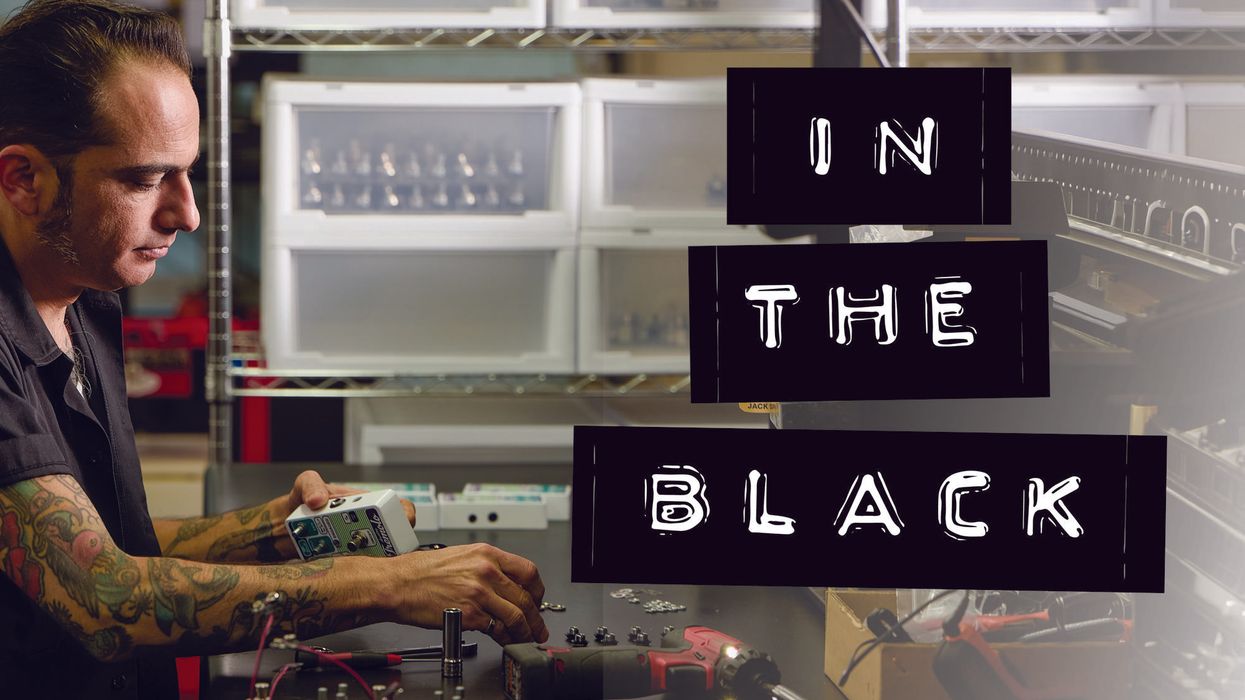
A big-budget Hollywood biopic of pedal-maker Jack DeVille would open in the eye of a furious winter storm—or, more specifically, The Great "Snowpocalypse" that rocked Portland with a record-breaking blizzard back in 2008. Our protagonist, a sharp and scrappy auto mechanic, has been racking up extra hours in the evenings and weekends: working a side gig as a builder with a burgeoning pedal company, taking on freelance gear repairs here and there, experimenting with electronics to learn the core theories that eventually powered his own brand, Mr. Black.
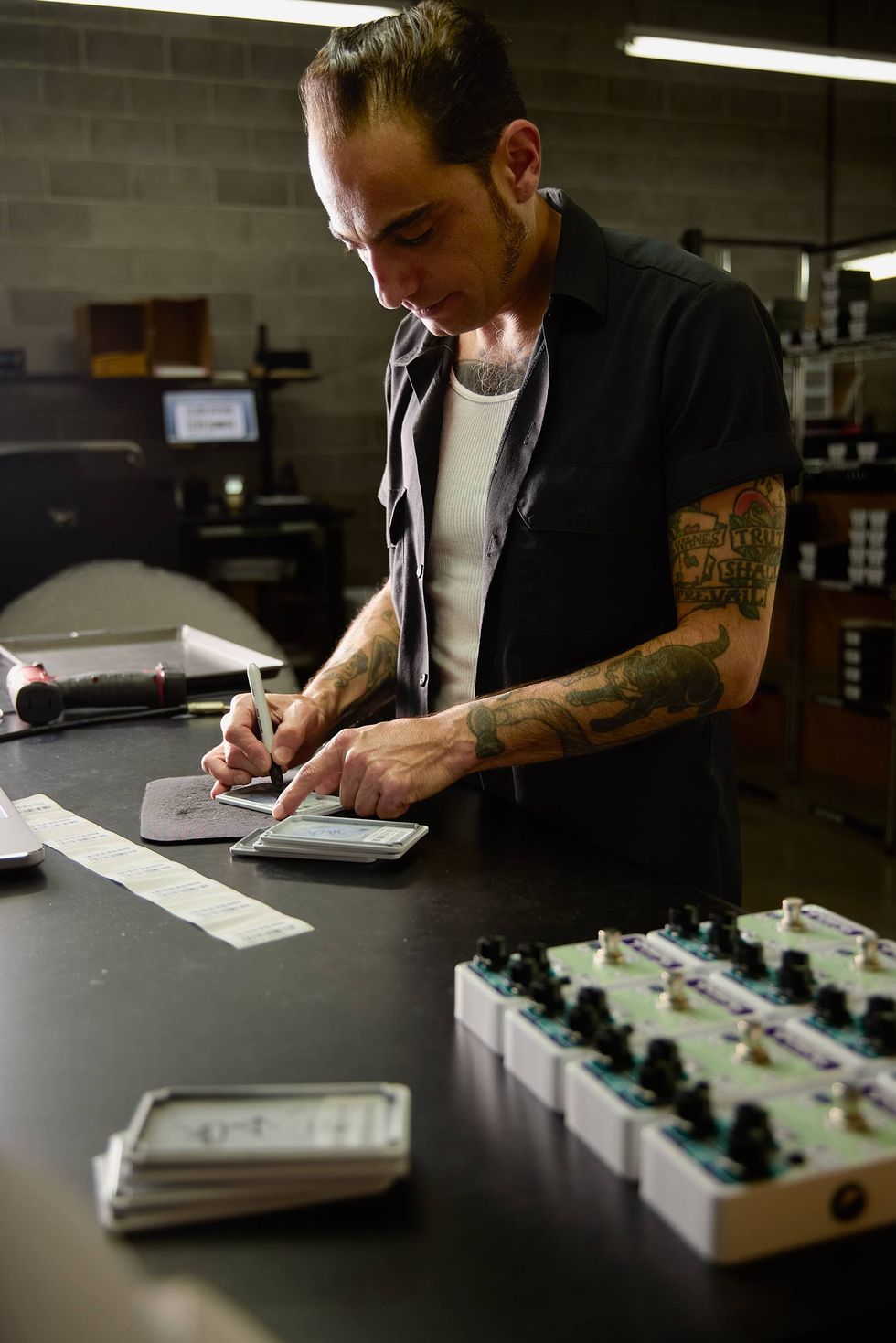
As the snow pours, he takes a crucial step: unveiling his first creation, the Jack DeVille Dark Echo, with all the homespun hustle you can imagine. “I put an ad on Craigslist: ‘Want a delay pedal?’” DeVille tells Premier Guitar. “There wasn’t much [out there] for delay in terms of small-manufacturer ‘boutique’ guitar effects. It’s hard, and that’s probably why. But I thought, If I can make something good, I bet I can sell them. So I did! And a couple people bought ’em.
“It’s gonna sound cheesy and poetic, but this is actually true,” he continues. “On December 23, 2008, I had my ad up, and some guy way down in Southwest Portland was like, ‘I wanna buy this, but I can’t leave my house. You’ll have to deliver it.’ For what it’s worth, there was, like, three feet of snow. But the pedal was $200. I was like, ‘Fuck, dude.’ On Christmas Eve, I actually did ride the bus, spend my $2.25 or whatever, and take a five-hour ride to sell this pedal. But that paid rent.”
Later that night, someone else hit him up: “Hey, I want to buy my husband this guitar pedal.” So DeVille journeyed around a half-mile to a local bar named Dots, where he sold his second Dark Echo.
“That’s when it clicked,” he recalls. “I was like, ‘These cost me $40 to manufacture, but I made $400 this afternoon. If I can do this 10 times per month, I’ll be able to pay my bills.’ Little did I know I was starting a manufacturing company.”
After years of continued grind and word-of-mouth buzz, DeVille is now one of the most respected boutique pedal makers in the business. But there have been no shortcuts—a theme that carries all the way back to his childhood in California.
There were many small but pivotal steps that led DeVille to create Mr. Black. The first was probably falling in love with metal. “I was really into Metallica," he says, highlighting the thrash kings’ 1988 classic, …And Justice for All. “I thought that was the pinnacle of music—until I heard Slayer.”
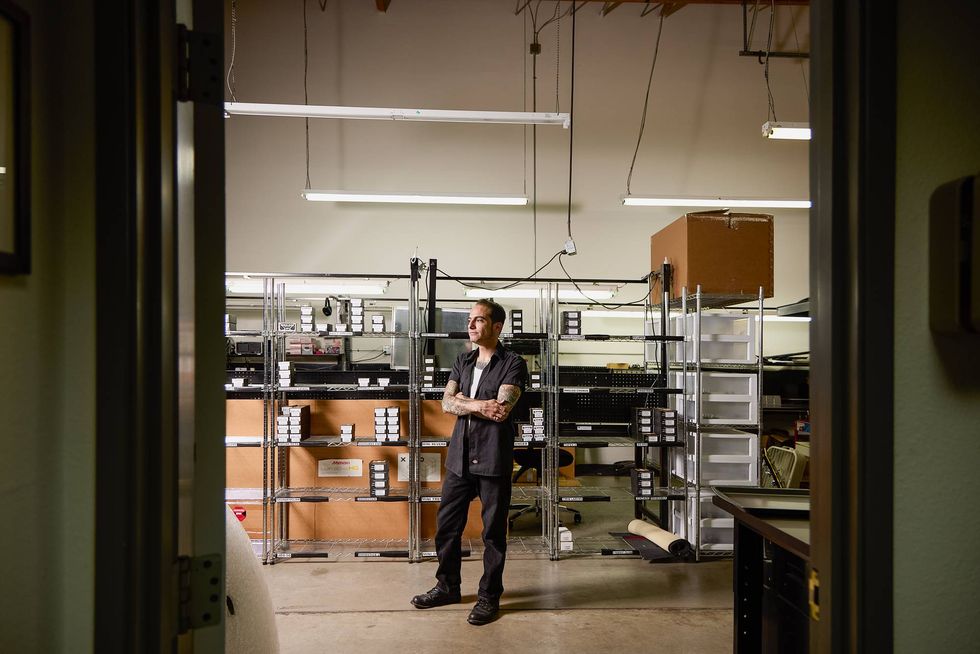
At age 10, back in his original home town of Berkeley (following his family’s brief stint in Oakland), DeVille started taking guitar lessons—and he says that, by around seventh or eighth grade, he was studying under Doug Doppler, a technically gifted player who expanded his knowledge of theory and the instrument’s “technical side.” By ninth grade, he started his first band—but his attention soon drifted elsewhere. “I didn’t like school or any of that,” he says. “So I quit in the ninth grade. I liked girls and getting high, so that’s what I was doing with my time. But that led to some pretty tumultuous years—got my ass locked up for a while, then got out of that.”
By 17, he was renting a “dumpy little apartment” with some friends, working at a junk shop and playing in a punk band. A few years later, he grabbed a copy of the Berkeley Daily Planet newspaper and spotted an eye-catching job posting for a nearby paint shop: “Mechanic, No Experience Necessary.” As it turned out, he was really good at the job, and next enrolled at a local community college for aviation, aspiring to be a helicopter mechanic.
“If I have a new thing I’m working on, it has to change the way you play and pull something out of you.”
DeVille eventually switched gears again, and found work at an Oakland car shop—that is, until a pivotal 2007 trip to Portland, where his sister was living. His then-girlfriend Nancy was there, too, and she fell for the city. “Two days into the trip, she said, ‘I’m moving here. You can come if you want to.’” The idea seemed to make financial sense—on levels both large and small. During his first trip to Dots, staring down at his massive but affordable plate of fries, he knew the truth: “That was the clincher,” he said. “It was an easy thing to figure out.”
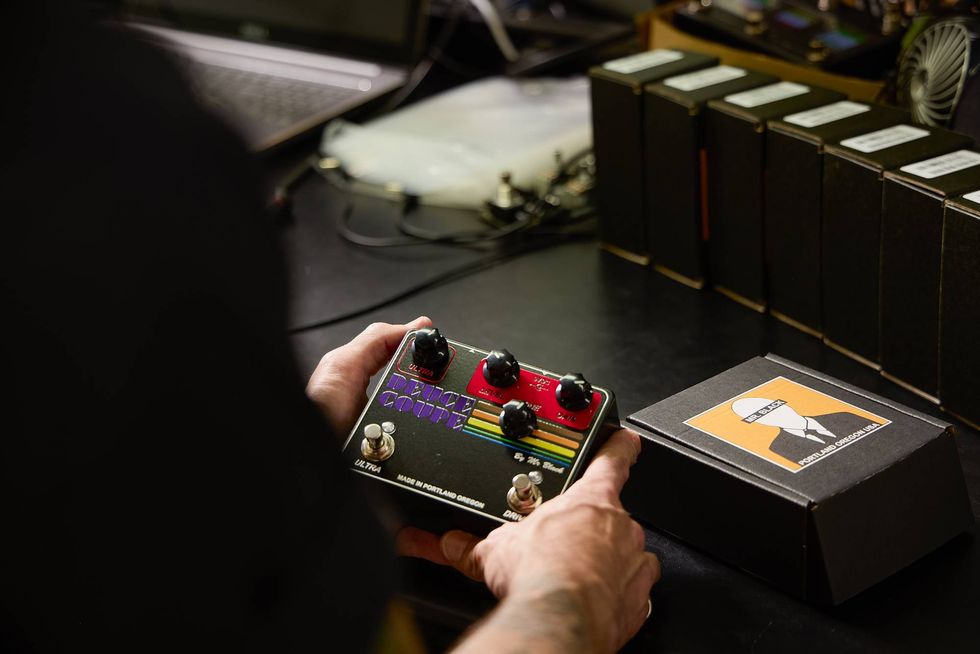
Another easy thing to figure out: focusing on making pedals. In 2008, after those first sales of the Dark Echo, DeVille was working as an amp tech at Eastside Guitar Repair in southeast Portland. “I would also make pedals and sell them out of that place,” he recalls. “People in town knew, ‘If you need a pedal fixed, they’ve got a guy who can do it.’” And he realized he wanted to take his technical knowledge even further. “It only made sense to be like, ‘I know how to repair stuff. I’ll stop working on cars and transition to just doing repair work on amplifiers and guitar pedals and all that,’” he says. “That’s all well and good, but repairs, service work, is kinda shitty. What gets me about that trade and career is that you’re surrounded by broken stuff all the time. Nobody wants to take their car to the shop. Nobody wants to take their amp to the shop.”
That year, he formed Jack DeVille Ltd.—but that venture wound up hitting a dead end. Things changed in early 2012, when he created Mr. Black Pedals as an offshoot product line—and within a few months he had the inspiration for the SuperMoon, which is accurately described on the company’s website as “cavernous, vast, and orbital.” DeVille initially only planned to make 100 pedals, but those sold in five days and demand continued to snowball.
His girlfriend at that time, Victoria, knew he was at a crossroads: “She was like, ‘You’re out of debt. I can’t believe it!’” DeVille says. “She’d met me just before the Mr. Black brand had launched. At that time, I was deep in debt, and there was no one I could turn to. She still liked me. She said, ‘Are you gonna quit? Are you gonna go back to automotive? You hated automotive.’ She only knew me as an amp-repair/pedal person. She said, ‘Don’t do that. Worst-case scenario, if it doesn’t work out, you can always go back to automotive later. Why stop at 100?’ I made another batch of 100, and those sold real fast.”
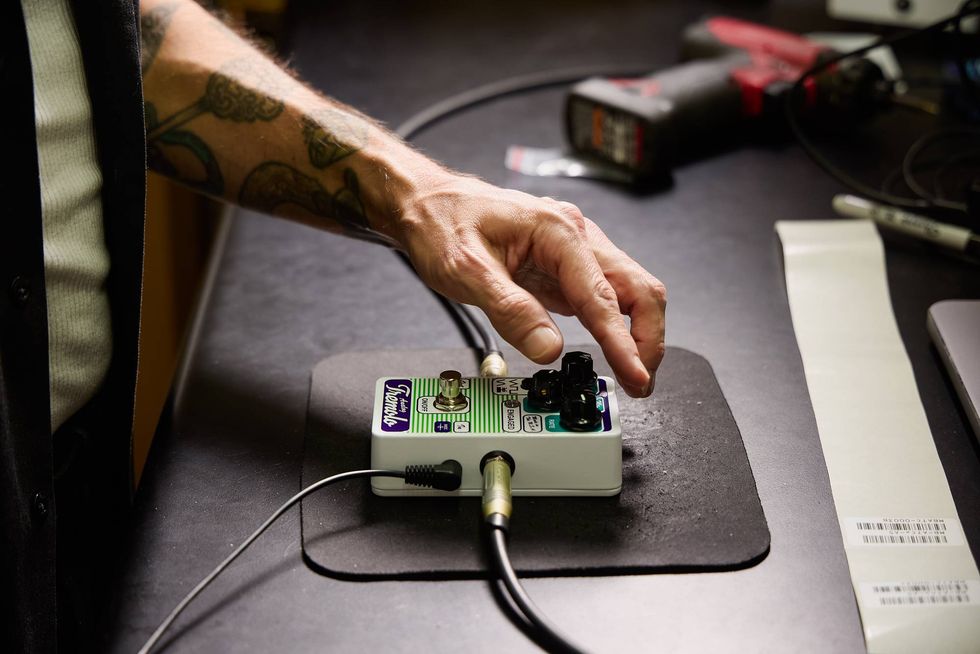
With its massive, 30-second reverb tails and “dynamic, proprietary Sway modulation,” the SuperMoon became a sleeper favorite, with word spreading organically through forums like Harmony Central and The Gear Page. Even 14 years later, as DeVille’s product line has expanded to 30-plus pedals—from the transparent Deuce Coupe overdrive to the ADT/chorus-like DoubleTracker Stereo—he’s maintained that same workmanlike approach, choosing to let the quality of his builds do the talking for him.
“Little did I know I was starting a manufacturing company.”
“I’m not good at social stuff,” he admits. “I have friends who are like, ‘You should come meet so-and-so.’ That’s not my thing, man. Some people promote their products and brands through others, and I understand that’s a common and effective way people do things. It’s just not how I do it.”
DeVille thinks back to the wisdom of his former car-shop teacher, a Vietnam veteran and helicopter pilot named Paul: "When I knew him, he was in his mid-60s. He was my electrical and drivability instructor when I was in the apprenticeship program, and we became friends. One day around 2005, I stopped by Paul’s shop, and he said, ‘You gotta understand, man. I’m working on the grandchildren’s cars of my first customers.’ Paul’s shop had been there 30 years, in the same fucking building. He said, ‘Listen, Jack, all you’ve gotta do is offer a fair price for a good product, and you’ll never see the end of your business. You’ll never get rich like that, but you’ll always have work.’
“That’s always been my ethos,” DeVille continues. “I could have charged way more for the SuperMoon and all that. But who’s buying these? I don’t want to sell them to, like, blues dads. That’s fine. But I don’t want to limit a guy like myself. It’s nice to get a steak every once in a while, but it’s not steak every day. If I’ve got enough food on my plate, why do I need seconds?”
DeVille clearly isn’t chasing pedal-maker hype—he’s just happy to be creating some cool gear that galvanizes ordinary people to simply pick up the guitar and play. “As far as growth goes, I don’t know,” he says. “Money’s fine. I don’t want a big-ass corporation where I have to go to board meetings. I don’t like having employees. I don’t like having to kiss ass. I’m not good at it, and I have no interest in being good at it. I don’t want to have to go to some show for a band I don’t really like and say, ‘Oh, thanks for playing this product. Here’s a new product!’”
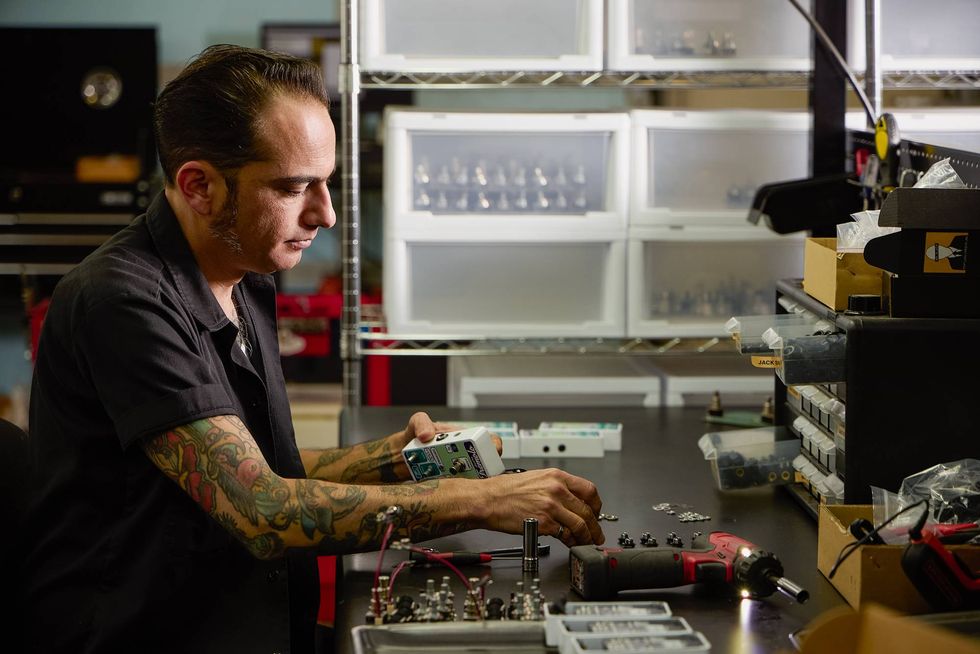
When asked about any famous artists who use Mr. Black pedals, DeVille is charmingly out of the loop. “There’s a country guy—maybe it’s Keith Urban—he has dark hair and stubble. A few years back, someone was like, 'Hey, they’re playing your pedal and gave you a shout-out in their magazine.' I said, ‘This is the first I’ve heard of this.’ I don’t know—I guess he bought it. I didn’t sell it to him, but he must have found it somewhere.” (Urban told Guitarist in 2026, “I use a [Mr. Black] SuperMoon for a couple of songs because it’s such a unique, cool-sounding ’verb.”)
Regardless of who’s playing his pedals, DeVille has some exciting things in the pipeline, including a “really fucking high-performance” product that he’s still tinkering with. “If I have a new thing I’m working on, it has to change the way you play and pull something out of you,” he says. “There are literal boxes full of perfectly good pedals that didn’t make the cut—they’re good, but they didn’t inspire."
The idea is simple: “Whoever inspires you, whatever it may be—maybe it’s Boss, maybe it’s MXR, maybe it’s Strymon, maybe it’s Joe Blow’s Fuzz Shack—buy the one that you like,” DeVille says. “And if at all possible, get the one that’s built by just a guy in his basement. That’s where the big dogs come from. They all start there, and you’re encouraging the next crop.”
He continues. “The expression I know is: ‘The grass is greener where you water it.’ If you want more of whatever it is—say there’s some fuzz pedal you really like, or there’s some boutique guy doing some weird, granular DSP bleep-bloop shit that I don’t understand—buy that one. Go for the one you’re uncertain about, that’s a little risky. Go for the underdog.”
Marshall Expands Hendrix Tribute with Three New 60th Anniversary Editions
Marking 60 years since Jimi Hendrix first plugged into a Marshall amplifier, Marshall continues its tribute to Jimi Hendrix through an expanded, cosmic-inspired anniversary collection.
This latest unveiling features the Studio Vintage amplifier, along with the Major V headphones and Emberton III Bluetooth speaker, all reimagined in a distinctive new aesthetic.
Leading the pack, the portable JMH Studio Bundle reimagines the design of the iconic Studio Vintage amplifier. Combining premium craftsmanship with a distinctive Hendrix-inspired aesthetic, the amp delivers everything from expressive cleans and deep blues textures to rich, harmonically complex driven tones.
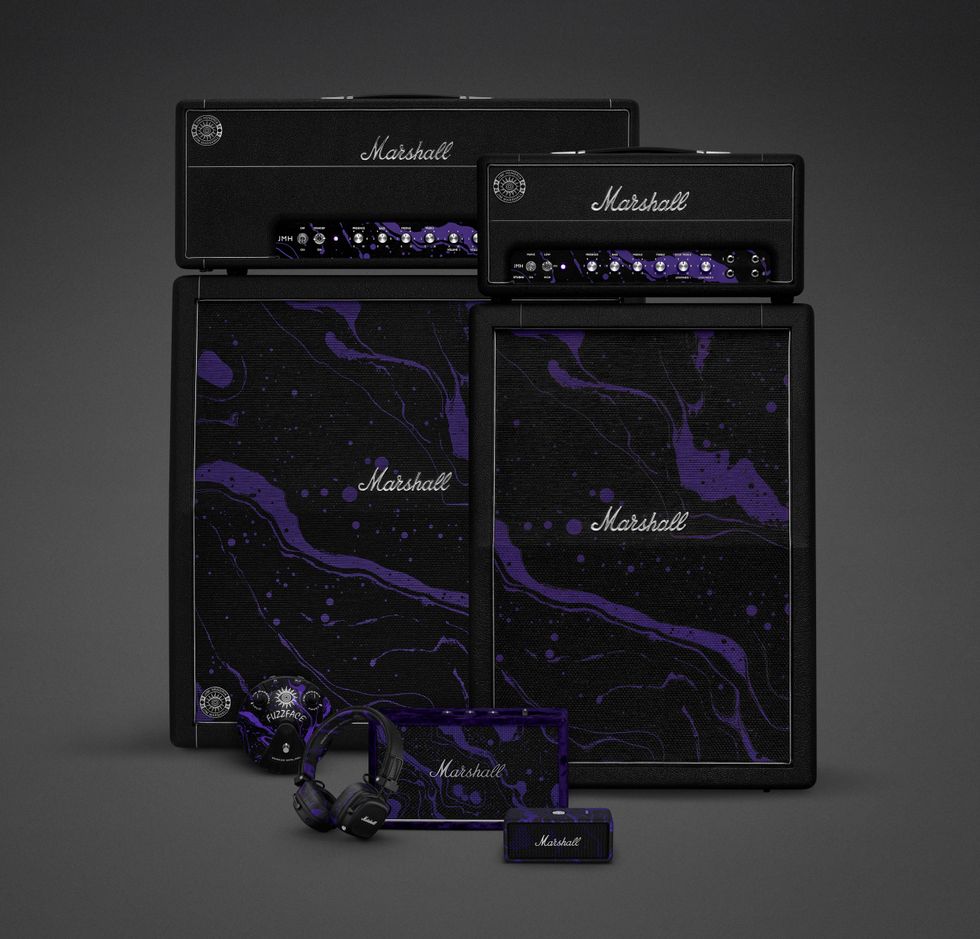
Key specifications:
- 20W tube head with power reduction to 5W
- Two bridgeable channels
- 2 x ECC83 preamp tubes
- 1 x ECC83 phase splitter
- 2 x EL34 power tubes
- Switchable series effects loop
- Speaker outputs for 16Ω, 8Ω and 4Ω loads
- Dimensions: 500mm (W) x 240mm (H) x 230mm (D)
Built by hand at Marshall's factory in Bletchley, UK using quality plywood and wrapped in black Tolex, this stack’s one-of-a-kind anniversary design features black and purple in a psychedelic pattern across the fret and control panel, complemented by a purple LED indicator. Drawing on Hendrix’s distinct personal style and the silver jewelry that became part of his visual identity, intricate silver beading is woven throughout, detailing the knobs, handle, logo, grille, and back panel. The all-seeing eye badge, derived from Hendrix’s fascination with the third eye and expanded vision, sits on the top and bottom of the stack, completing the design.
The anniversary edition Major V on-ear headphones come in a sleek black finish, elevated with psychedelic graphics and subtle Hendrix-inspired details. A striking purple oil-on-water design flows throughout the inner headband and ear cups, finished with the all-seeing eye motif.
Continuing the purple oil-on-water design across the sleeve, and through the grille, the Hendrix 60th Anniversary Edition Emberton III Bluetooth speaker pays homage to Hendrix with the all-seeing eye that appears in silver on the media jog and is accompanied by purple LEDs. The silicone sleeve is hand-dipped using a water transfer print, making each piece entirely unique. With more than a full day of listening on a single charge, there’s plenty of time to play through Hendrix’s extraordinary body of recorded music.
This latest unveiling marks the final release in the Marshall x Hendrix 60th Anniversary Collection. The Major V and Emberton III editions carry street prices of $159.99 and $179.99 respectively. The JMH Studio Edition Bundle carries a street price of $2,499.99. For more information visit marshall.com.
Pages
