
Music is the universal language
“Glory to God in the highest heaven, and on earth peace to those on whom his favor rests.” - Luke 2:14
Norse Guitar Feeds
Totally Guitars Weekly Update July 31, 2026
July 31, 2026 Jerry Garcia was on my mind when the camera got to rolling, so a few of his melodies started today’s Update. We got another Ella Langley lesson from Nesh–Be Her, to go along with Choosin’ Texas from a few weeks back. We are wrapping up the Learn To Read Challenge with TG […]
The post Totally Guitars Weekly Update July 31, 2026 appeared first on On The Beat with Totally Guitars.
Luthier on Luthier: Paco Chorobo
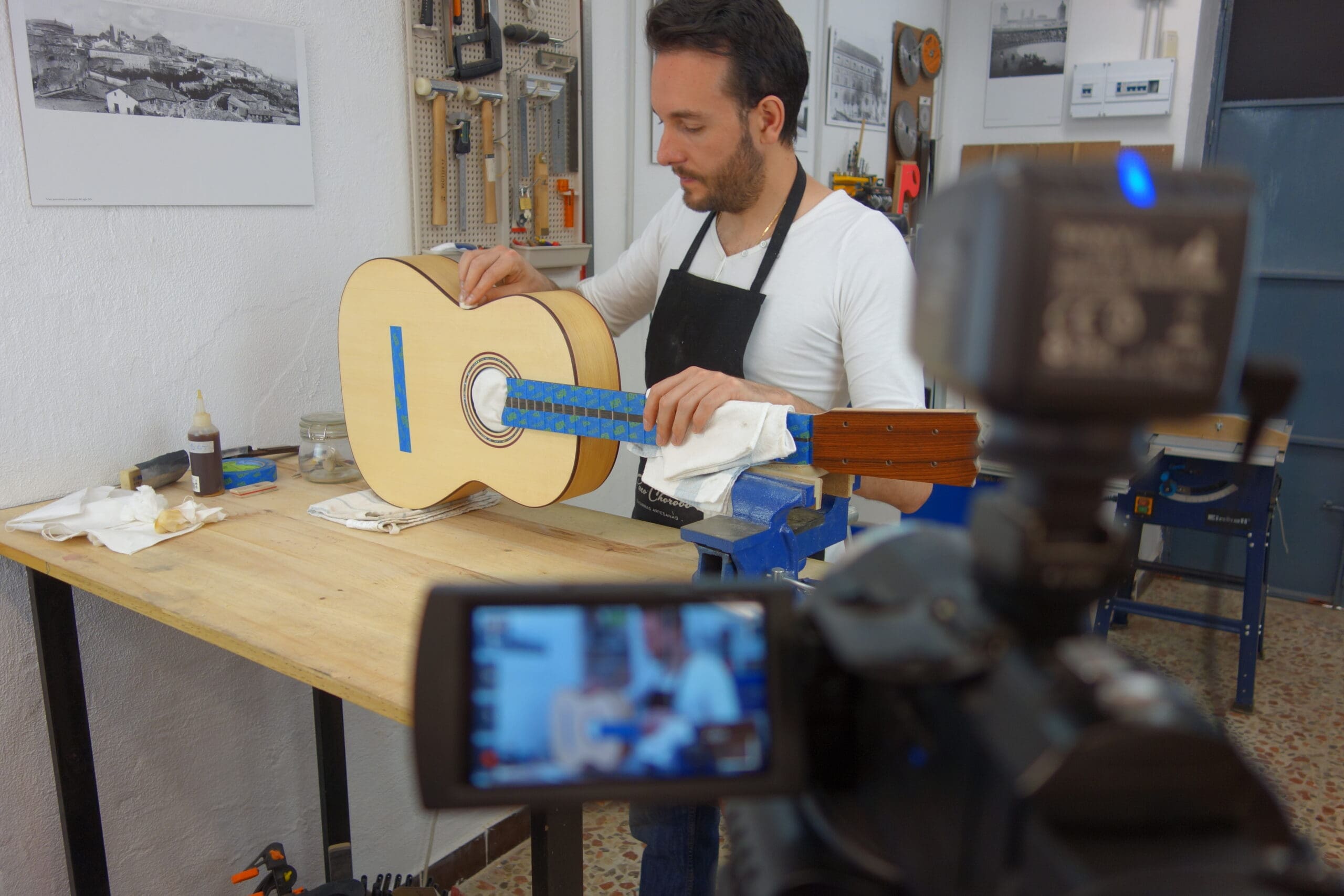
For episode 116, we’re joined by Spanish guitarmaker Paco Chorobo from Úbeda, Spain.
Paco shares his journey from telecommunications engineer to full-time luthier and discusses his approach to building both classical and flamenco guitars while blending traditional hand craftsmanship with modern technology. We also explore the cultural roots of flamenco guitars, the construction differences between flamenco and classical instruments, and his philosophy of building guitars around the individual player.
Link to Paco’s work: https://chorobo.com/home/
Luthier on Luthier is hosted by Michael Bashkin of Bashkin Guitars and brought to you by the Fretboard Journal. This episode is sponsored by the Looth Group, Dream Guitars and StewMac.
Want to support Luthier on Luthier? Join our Patreon to get access to exclusive photos and content from Michael and his builds.

The post Luthier on Luthier: Paco Chorobo first appeared on Fretboard Journal.
The Doom soundtrack is one of the greatest heavy metal compositions of all time. Next year, Mick Gordon will perform it live for the first time

It’s hard to dispute Mick Gordon’s Doom soundtrack as one of the greatest heavy metal compositions of all time. The Australian composer’s genius, crushing eight- and nine-string riffs offer the perfect sonic accompaniment to slaying hundreds upon hundreds of hellish demons and other grotesque creatures.
The soundtrack gave rise to such classics as Rip & Tear and Bfg Division, and gained such a cult status that Gordon was invited to compose the score for the game’s followup, Doom: Eternal, in 2020.
But surprisingly given its adoration by those at the intersection of heavy metal music and gaming, the Doom soundtrack has never been performed live in its entirety in the 10 years since the game’s release in 2016.
But that’s all set to change next year, when Mick Gordon will perform the Doom soundtrack for the first time ever in a headline set at the UK’s RADAR Festival alongside a full band and orchestra.
At RADAR 2027 Mick will bring the Doom soundtrack to the stage for the first time, featuring the DOOM Machine (his custom Doom instrument), with a full live band and an orchestra for good measure,” festival organisers say.
“This isn’t a DJ set, and it isn’t a tribute act. It’s the actual composer, the actual score – the riffs played properly loud in a room that can withstand all the ripping and tearing. “Mick has never performed this music live, like this. Until RADAR came calling.”
Next year’s RADAR Festival will take place at Manchester’s O2 Victoria Warehouse from 30 July to 1 August 2027, but there’s still this year’s edition to get through first. From today (31 July) through the weekend, the festival will see performances from Thy Art Is Murder, Skindred, Northlane, Animals as Leaders and so many more.
Learn more at RADAR Festival.
The post The Doom soundtrack is one of the greatest heavy metal compositions of all time. Next year, Mick Gordon will perform it live for the first time appeared first on Guitar.com | All Things Guitar.
“In their school they weren’t allowed to own a guitar”: Phil Collins explains the early differences between him and his Genesis bandmates

Phil Collins has been looking back on how he managed to join Genesis as their new drummer, and the early differences he noticed between himself and the rest of the band.
Collins had attended a drama school from the age of 14 where, as he says, he could get away with murder, while the other existing band members – Peter Gabriel, Tony Banks, and Mike Rutherford – that he joined in 1970 had all attended the private Charterhouse School in Surrey, UK.
Speaking to Prog about his journey into the lineup, he recalls, “It was just Tony, Peter and Mike. Mike’s always said that when Anthony Phillips, the unsung hero, left because he couldn’t take the stress, they thought that was the end of the band. But they carried on, and thought they could get a better drummer, I believe, than John Mayhew, who was on [second Genesis album] Trespass.
“I didn’t know all this background dynamic; I had just seen their name a lot in the back of Melody Maker. I knew Tony Stratton-Smith, their manager, since I was about 16 and he was managing The Creation.”
He continues, “I went down to the Marquee bar one night to see if he could put in a word for me. He said, ‘Oh, I’d love to, but I’m afraid they’re very fussy, these guys – you will have to audition.’ So I went along and here we are today! Yes, they were public school [an old term for an independent school] boys, and I was from the drama school where you could get away with murder.”
Collins shares, “In their school they weren’t allowed to own a guitar. At mine, I’d bring my records in and we’d play Sgt. Pepper... or Motown or The Byrds’ Younger Than Yesterday. The teacher would say, ‘Are you sure you can hear me talk at the same time as this music is on?’ We’d say, ‘Oh sure…’”
Genesis are releasing their 1974 album The Lamb Lies Down On Broadway in standalone 1-BR Blu-ray Audio for the first time on 28 August. You can pre-order it now via the Genesis website.
The post “In their school they weren’t allowed to own a guitar”: Phil Collins explains the early differences between him and his Genesis bandmates appeared first on Guitar.com | All Things Guitar.
“Seeing Brent in his casket was so difficult to wrap our heads around, and it makes you want to feel f**king alive”: Mastodon’s Brann Dailor on how the band dealt with the death of Brent Hinds

Mastodon’s Brann Dailor and Troy Sanders have been reflecting on the death of Brent Hinds, and how his sudden loss has changed their perspective on living and making things work as a band.
Hinds passed away due to a motorcycle accident at the age of 51 last year, shortly after his departure from the band. Earlier in the same year, Dailor also lost his mother. After a very difficult period of grief, the band are touring again (with more shows scheduled from September), and have a new album titled Marrow Deep landing on 28 August.
In a new interview with The Guardian, the pair look back on their somewhat hectic bond with Hinds, and how they found their desire to make more music after such a tumultuous time.
Dailor says, “If any of us did half the stuff that Brent pulled off, we’d all have been dead years ago. We’ve always been a hard-partying band, but for the last 10, 15 years, the three of us really settled down and were focusing more on our live show and being productive in the studio.
“He was still rocking, which was, for a lot of people from the outside looking in, the most admirable thing about him. But from the inside it’s not always that much fun.”
Dailor and Sanders decline to expand any further on why the band parted with Hinds. Their original statement claimed the decision was mutual, but some pretty scathing social media posts from Hinds regarding the other members suggested there were some inner tensions.
The one thing they can confirm? Hinds never punched Dailor in the face; a rumour which broke out after a public appearance he made with a black eye, just before the announcement. In fact, Dailor says Hinds sent him a text amid the media flurry saying he couldn’t believe the rumours.
Further into the interview, the pair reflect more deeply on the loss – not just the pain it caused them, but how it altered their perspective on living life to its fullest.
“I was devastated,” Dailor shares. “All the shit-talking that had happened – you reference the Instagram comment section shit – I didn’t think about any of that. We got 25 years of a deep relationship with this guy. I could tell who he was by the smell of his farts.
“When one of the integral members, one of your brothers, dies, it’s obviously a very painful thing to go through, but it also makes you question where you’re at. Seeing Brent in his casket was so difficult to wrap our heads around, and it makes you want to feel fucking alive. We’re still here, so we better get to it.”
Marrow Deep, the new album from Mastodon, is released on 28 August. You can pre-order it now.
The post “Seeing Brent in his casket was so difficult to wrap our heads around, and it makes you want to feel f**king alive”: Mastodon’s Brann Dailor on how the band dealt with the death of Brent Hinds appeared first on Guitar.com | All Things Guitar.
“I hate playing acoustic”: Why Tony Iommi is pushing himself outside his comfort zone on new solo album

Tony Iommi has a confession to make: he hates playing acoustic guitar, and in fact, he feels he’s not very good at it.
Iommi announced his first solo album in over 20 years this week. Titled From The Dark, it is due to land on 23 October 2026 via BMG, and features Norwegian vocalist Jørn Lande, Mercyful Fate bassist Becky Baldwin, and former Robbie Williams drummer Karl Brazil. Iommi served as co-producer on the album alongside Mike Exeter.
Despite his admittance that acoustic really isn’t his thing, it gets a prominent spotlight on forthcoming track Legacy with a solo right in the middle. In a new interview with Rolling Stone, Iommi explains why he chose to explore outside of his comfort zone in this way.
“I did have a couple of acoustic things, but I’ve not used them. I thought I’d keep the album like it is. And not only that, it’s already quite long. We wouldn’t be able to fit them on,” he says.
“I like to do something you don’t really expect. And to be honest, I hate playing acoustic. I’m not very good at playing acoustic,” he confesses, before speaking directly on track Legacy, “On that bit, I just thought it would be nice and different.”
Iommi also discusses the album’s first single, World Alone. Asked if he has to push himself to write up-tempo songs like this single, he responds, “Not really. But I do remind myself [to write them]. When I heard [the rest of] what we’ve got I thought, ‘Well, we need to have some up-tempo tracks and a mid-tempo track just to balance off the album, really.”
Listen to World Alone below:
From The Dark is available to pre-order now.
The post “I hate playing acoustic”: Why Tony Iommi is pushing himself outside his comfort zone on new solo album appeared first on Guitar.com | All Things Guitar.
Gretsch Electromatic CVT Baritone review – long-scale downtuned heaviness from Gretsch hits the mark

A while ago I spoke to Gretsch EVP Jason Barnes about the revival of the Corvette, and, being the consummate professional that I am, I only let my personal musical tastes inform the direction of the interview towards the end of the chat. I mentioned that the double-cut, darkly-finished, and dual-humbucker’d Electromatic CVT seemed in part tailor-made for those who listen to a lot more Loathe and/or Electric Wizard than they do Bleachers and Taylor Swift, and Barnes was more than receptive. Despite Gretsch’s heritage skewing towards jazz and rockabilly, and modern usage skewing towards rock, indie and pop, Gretsch has been keeping a keen eye on those who have adopted its guitars – particularly its longer-scale offerings – for metal.
And there’s a lot to keep an eye on, in that regard – a few years back the Meshuggah fans of the world took notice of the downtuning potential of Gretsch’s dual (mini) humbucker Jet Baritone, and it got swept up in a new wave of metal – that G5260 was seen in the hands of both Loathe’s Erik Bickerstaffe and Sleep Token’s IV, both very different players with different musical aesthetics, but both driving a trend for innovative and ultra low-tuned modern metal.
So today we’re looking at the logical conclusion of those observations: a baritone version of the Corvette, launched with a pummelling demo from Loathe’s Erik Bickerstaffe. It’s the same rather mean shape as the newly-designed CVT, with the same full-range Twin Six humbuckers – but gone is the wraparound, replaced with a standard tune-o-matic-style two-piece bridge, placed a little further back in the body to compensate for the increased scale of 27 inches.
Gretsch obviously has a long history with long-scale guitars, but the CVT isn’t really drawing much of this heritage. The Electromatic Jet Baritone, launched on the same day as this guitar, is a lot closer to a pure modern-metallification of an old-school Gretsch formula – the Baritone Jet is a single-cut 29.75” guitar, like it’s more vintage-styled forebears. That’s just 0.25” off the same bridge-to-nut distance as a Fender Bass VI, and so opens up tunings below E1 (or suspension-bridge tension when in the more standard baritone register B-B).
The new CVT Baritone, on the other hand, is 27”, which will be far less alien to those used to playing on 25.5” necks, or even 24.75”. Given that the Corvette shape has had a more sporadic, chameleonic history since its launch decades ago, there aren’t really many expectations to smash here about what it’s meant to sound like – other than those brought by the name on the headstock. So the question remains:
 Image: Adam Gasson
Gretsch Electromatic CVT Baritone – what is it?
The baritone guitar has a long history outside of the heavy universe, and not every new long-scale launch is explicitly aimed at those who walk a more Iommic path. But the Baritone CVT absolutely is. Intentions and the noises made in demo videos may only matter so much, but, overall, the message sent by the guitar upon viewing it and/or its specsheet is that it’s built for metal. Downtuning is obviously a big thing across countless subgenres, but the aesthetics and specs do straddle the border between the classiness of Loathe’s whole gig and the more vintage-forward guitars of sludge and doom.
The finish is the first clue. The Baritone CVT exclusively comes in Bristol Fog – I presume that Gretsch does not mean the Bristol Fog that, on the afternoon of April 20th, rolls in all directions from Castle Park like an encroaching wall of aerosolised cannabinoids. Stoner associations aside, it’s still a dark, woodgrain-forward burst – no sparkle finishes or gold-trimmed vintage white for this launch.
The humbuckers are the next – the Twin Sixes are full-sized humbuckers, explicitly marketed as punchier and more full range than the mini-humbuckers, Broad’Trons and Filter’Trons you’ll find in many other Gretsches – these are far less likely to sound thin and underpowered through heavier gear.
The rest of the setup is essentially a minimalist dual-humbucker arrangement, with a master volume and tone. The wraparound of the standard-scale CVT is now a two-piece tune-o-matic style bridge, which is an unequivocally good change here – longer scale lengths require a lot more travel in the saddles for proper intonation, and I’ve also seen a couple of import wraparounds start to lean forward under higher tensions.
It’s been said that the CVT has more than a little Dunable Cyclops in its looks, with its two horns, long swooping pickguard and general ‘melted SG’ kind of look. The Cyclops and Dunables in general rely on a healthy amount of vintage cool being mixed in with their meaner, heavier looks – a combo that’s found particular footing in the post-, doom- and sludge-metal crowds. (A fun game at festivals like ArcTanGent is Dunable-spotting – drink every time you see one and you’ll be on the floor in no time). The Corvette shape is pretty perfect for achieving a similar visual feel, and so it’s good to see Gretsch work constructively with that aspect of the shape – metal doesn’t have to mean all pointy and satin black and glowing inverted crosses everywhere.
 Image: Adam Gasson
Gretsch Electromatic CVT Baritone – usability and sounds
Can Gretsch translate its baritone heritage to something that’s deserving of the above implications? Are the noisy Loathe demo video and the Dunable comparisons earned? The answer, pleasingly, is a resounding yes – in my view, players seeking sharper, more metalcore-indebted tones and the low-and-slow doom crowd will find a lot to like here.
Let’s start on playability. The neck is not really for shred – but it is a fairly medium C, a profile Gretsch calls “performance C”. On top we’ve got a real rosewood fretboard – now pretty common again on affordable guitars, but no less good to see – with a 12” radius. The profile is a pretty middleweight one, perhaps a little evocative of the slimmer side of a bound Les Paul neck. It’s made somewhat slower by the rather sticky poly finish (nothing a scotchbrite pad and some elbow grease won’t fix), but it’s by no means an unwieldy thing. The neck joint is also pretty sculpted – no big square neck plate here – meaning that up at the dusty end (likely for dissonant stabs mid-breakdown more so than melodic showing-off) it remains very playable.
Frets here are medium jumbo. In use they are, a bit like the neck profile, fairly anonymous – neither massive nor tiny. But they play cleanly and comfortably – zero buzz or grind to be found. It’s also good that they’re not actual jumbo wire – we’ll come to further down-tuning experiments in a bit, but for now it’s worth noting that at lower tension, really tall frets can mean it’s too easy to push strings out of tune as you press down.
Despite the extra length of the neck, the balance is fantastic. Neck dive is always a worry on baritones, but not here, as Gretsch has adjusted where the bridge sits, rather than just shunting all of the mass north of the neck joint. Playing sat or stood is very comfy – this bridge placement means the fretboard presents to your left hand fairly well when sat down, and the strap button being on the horn keeps everything at a good angle when stood up. The bridge is also in a nice and natural position for your right hand – its extra distance down the body makes staying in a palm-muting position easy.
A 27” scale is pretty comfy for a baritone, requiring only a little bit of adjustment if you’re used to standard scale stuff. I also find the stock strings – 14-68s – to be ideal. They’ve got a wound third (as they should have!), and their gauge is more than heavy enough to make tension quite substantial at standard baritone B-B. Bluesy three-semitone bends are out of the question in this register unless you’ve borrowed fingers from an olympic weightlifter – but fast death metal riffs are tight, responsive joy.
 Image: Adam Gasson
I also tune the guitar to where I normally hang out – drop F. This is, for a baritone less than 30” and with any strings other than Bass VI strings, quite a loose tuning – I’d say it’s similar in tension to tuning a Fender-scale instrument down to C with 11-52s. This transforms the playing experience quite a lot, from sleek, sharp and tight to loose and sludgy, but the CVT is up for the challenge: things stay relatively stable and articulate.
Importantly, at no point do I feel like strings are going to flop out of their saddles. A decent amount of neck pitch-back means there’s a lot of downward tension on the tune-o-matic-style bridge. It’s worth noting, however, that drop F is about as low as I’d take it with these strings – double drop C# would be a bit of a stretch without a much heavier gauge.
Helping with the articulation here are the Twin Six humbuckers, which work great in a heavy baritone context. Personally I find they’re voiced just right – full and deep through stacked meaty fuzzes, but still up for a bit of chugging when run into a tighter, more modern sound courtesy of the UAFX Anti.
For a cleaner tone, they’re perhaps a little boomy in full humbucker mode – but they can be split individually with push-pull pots. Their louder nature means that these tones are also quite hefty, but far better for cleans – as single-coils they more resemble P90s than they do spanky strat pickups, thanks to their strong output and midrange presence, but that’s no bad thing in my book.
The cleaner stuff may never really be the highlight or focus of a guitar like this, but the tones are by no means an afterthought – I had just as much fun making ambient and textural sounds on the CVT as I did trying to remember how to play At The Gates riffs. But for more traditional tic-tac/country baritone sounds, you might find yourself wanting a different set of pickups – the mid-forward nature of the Twin Sixes means it’s a little harder to get that spanky/scooped sound that, say, a set of Bass VI pickups do so well.
 Image: Adam Gasson
Gretsch Electromatic CVT Baritone – should I buy one?
For many fans of down-tuning this will be the sort of guitar they were hoping Gretsch would release – accessibly priced, the right look, the right pickups, and a scale length that strikes a balance between playability and still being, well, a baritone. And the guitar, in my time with it, made good on all of its promises. I think the only thing I wish Gretsch did here that it didn’t would be offer a few more finishes. No shade on Bristol Fog, really, but I’m curious how the CVT would look in a version of the Jet’s Imperial Stain.
And on the topic of that guitar, it’s hard to say that Gretsch compromised on scale length here when a 29.75” alternative has also been made available for almost the same price. If you are looking to really explore the depths of registers below E1, I would check out that guitar, and indeed my forthcoming review of it.
As it stands, though, this is the more balanced of the two options. There’s a long history of mid-priced baritone guitars being adopted into moddable djent/doom darlings of the aftermarket (after all, Bickerstaffe himself didn’t wait until Gretsch’s lineup included a more obviously metal instrument, he just tuned a vintage-voiced baritone down to drop Z and blasted away), but the Baritone CVT has clearly been made with a more “out of the box” approach – and it’s worked.
Gretsch Electromatic CVT Baritone – alternatives
Aside from the really obvious one – the Jet counterpart – 2026 has been awash with interesting baritone guitars. There’s the new Squier Paranormal Baritone Jaguar, and the new Fender Player Fusion Baritone Jaguar, both made with a similar audience to the new Gretsches in mind. The Squier Classic Vibe Custom Telecaster is another interesting and mid-priced option – although for metal you might want to also order some blade pickups…
Beyond these there’s a new Orangewood Baritone, Ed Sheeran has a signature Baritone (although to play that in a metal context you’ll probably want to get it re-finished from the off!), Dunable’s relatively affordable (compared to its custom shop) DE line has launched a baritone, and, if you want to throw off the last vestiges of a vintage aesthetic, Hils has launched a new mid-priced baritone headless guitar.
The post Gretsch Electromatic CVT Baritone review – long-scale downtuned heaviness from Gretsch hits the mark appeared first on Guitar.com | All Things Guitar.
Glen Hansard (1970-2026) on the Importance of Songwriting with Intention

Tribute: Glen Hansard (1970-2026)
On the morning of July 29, 2026, singer-songwriter Glen Hansard tragically passed away after a motorcycle accident in Dublin.
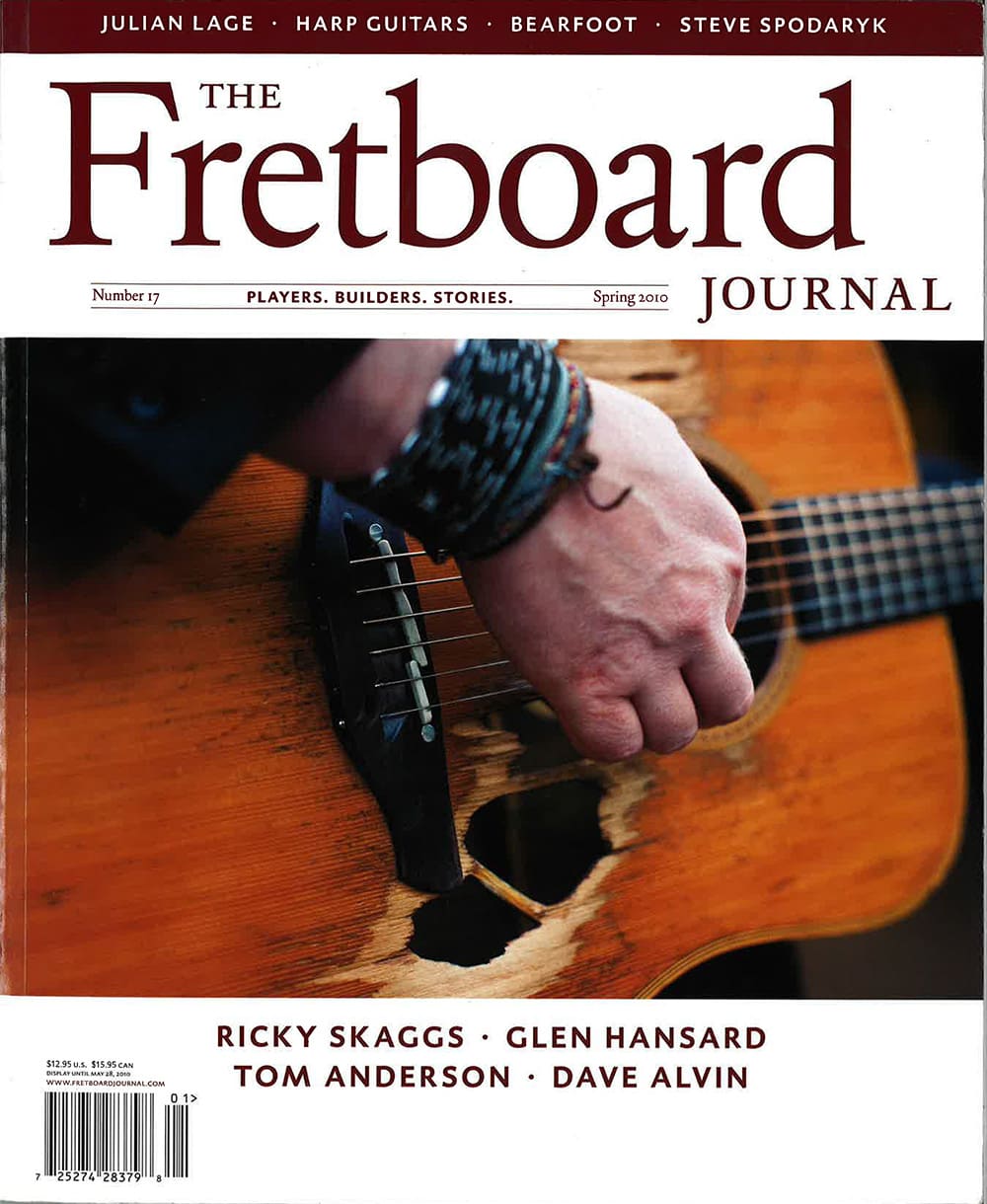
In 2009, I interviewed the Frames and Swell Season frontman for the cover story of our magazine’s seventeenth issue. Back then, he was still touring with the original, worn-through Takamine NP15 as seen in the film Once. Before his Seattle soundcheck, we sat for over an hour at Kells – an Irish pub a short walk away from the famous Pike Place Market clock and fishmongers – with Hansard sharing stories about guitars, life, busking and songwriting. We also talked a lot about his heroes Van Morrison and Bob Dylan, who, in eerie hindsight, had his infamous motorcycle accident sixty years to the day before Hansard’s.
I nursed a beer, while Glen had tea. He was a natural storyteller, which made my job easy. Photographer Maxwell Balmain took pictures for the issue.
After our chat, all three of us walked over to the crowded Market to take some outside photos. Instantly, Hansard started performing with a local busker, who had no clue who he was. The footage launched the Fretboard Journal’s YouTube channel in 2010.
Readers and guitarist friends often ask me about my favorite interview. I’ve been a music journalist for three decades and I’ve been lucky enough to interview a few real rock stars, but I always say, “Glen Hansard.” During our chat, he was utterly present, thoughtful and charming. He spoke with ease, humor and earnestness like no one else. My experience wasn’t unique: Nearly everyone who met him felt like they just stumbled upon their new best friend.
Issue 17 sold out years ago. In light of Glen’s passing, I’m sharing that interview in its entirety below.
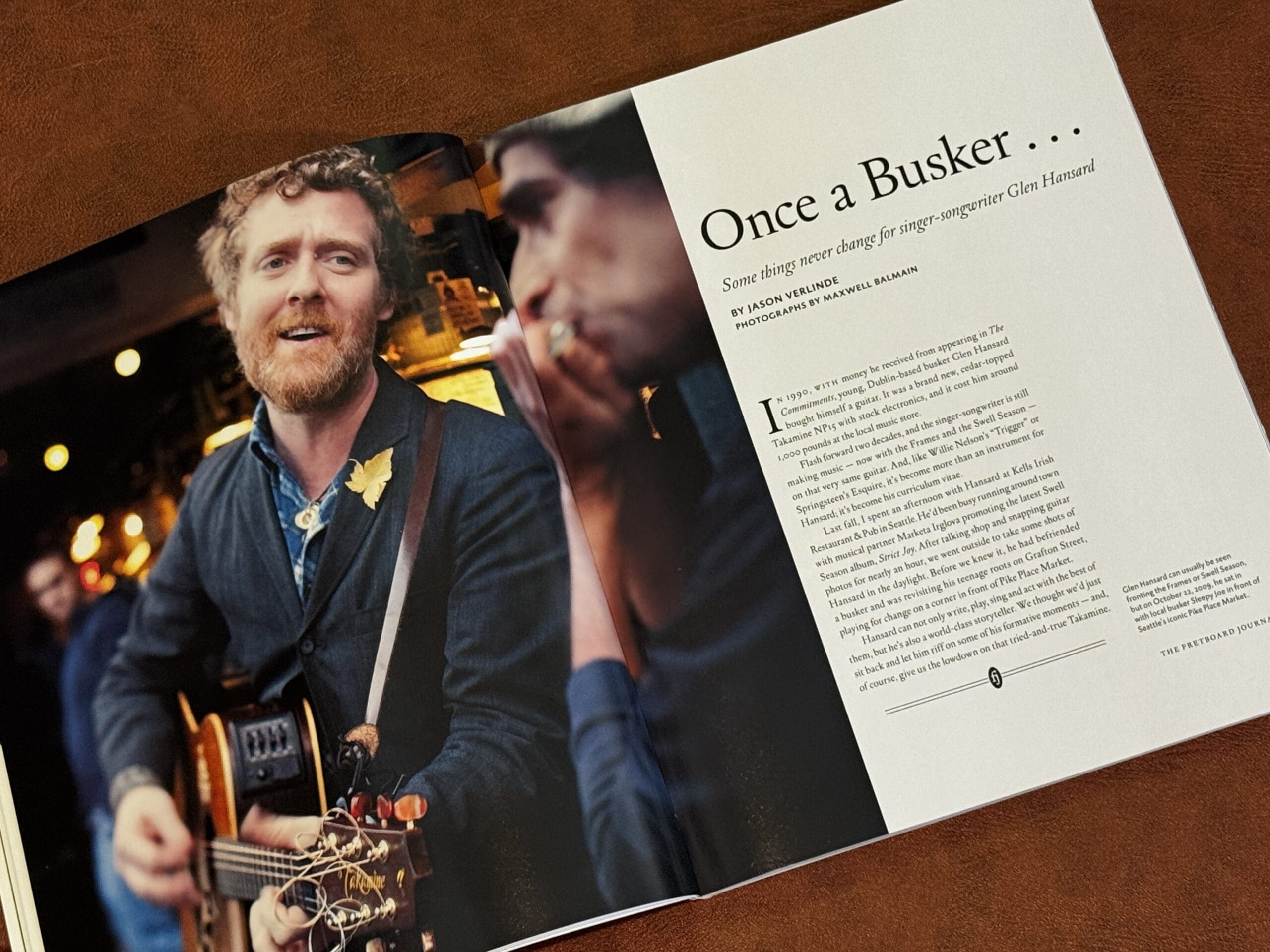
Once a Busker…
Some things never change for singer-songwriter Glen Hansard
By Jason Verlinde
In 1990, with money he received from appearing in The Commitments, young Dublin-based busker Glen Hansard bought himself a guitar. It was a brand new, cedar-topped Takamine NP15 with stock electronics. It cost him around 1000 pounds at the local music store. Flash forward two decades later and the singer-songwriter is still making music—now with the Frames and the Swell Season—on that very same guitar. And, like Willie Nelson’s “Trigger” or Springsteen’s Esquire, it’s become more than an instrument for Hansard, it’s become his curriculum vitae.
On October 22, 2009, I sat down with Hansard at Seattle’s Kell’s Irish Restaurant and Pub while he was busy running around town with musical partner Marketa Irglova promoting the Swell Season album, Strict Joy. After talking shop and snapping guitar photos for nearly an hour, we went outside to take some shots of Hansard in the daylight. Before we knew it, he had befriended a busker and was revisiting his teenage roots on Grafton Street, playing for change on a corner in front of Pike Place Market.
Hansard can not only write, play, sing and act with the best of them, he’s a world-class storyteller. We thought we’d let him riff on some of his formative moments … and give us the lowdown on that tried-and-true Takamine. –Jason Verlinde
First Guitar
When I was a kid, my uncle Paul was super cool. He was the good-looking younger brother of my mother. All the girls loved him. He was working at a theater; he played music in bars. And he was kind of like my father and hero. He taught me A and D chords when I was 8-years-old. He just loved to play, and he brought me to my first concert, the Police, in 1980. U2 opened up for them. They were all we talked about all day long.
He, unfortunately, took a job where he drove a car across Europe with some dodgy guys, and it turned out the car had stuff in it that shouldn’t have been in it. Classic story. He got locked up for a couple years in prison, in Turkey.
All of his stuff basically got left in Ireland, and I discovered his guitar. His instrument was—if I remember correctly, a Hummingbird—but it wasn’t a Gibson. I think it might have been like an Ibanez, some knock-off copy. Beautiful at the time; he adored it.
I discovered it, and learned some Bob Dylan songs on it. The first song I ever picked up was “Bob Dylan’s Dream.” I remember getting a harmonica and learning—picking up the chords … it was A, D and G.
And then I did something very ambitious. I listened to “Famous Blue Raincoat,” by Leonard Cohen, over and over and over until I figured out how to play it. I was going in pretty deep, it is a fingerpicking song. Amazingly, I took on this challenge and figured it out. A year ago, I saw Leonard play in Sydney, Australia, and I watched his hands. I was only wrong by two chords, but the rest I got right! B minor, B, A minor, F sharp minor.
So that was the beginning. Pretty soon after that, I started busking.
When he got out of prison, my uncle freaked out, because I’d knocked his guitar around. I didn’t realize! I was dragging it across the floor, and doing all the things you don’t do to a guitar. It’s only now I can appreciate that, but at the time I was like, “What is getting mad at me for?” I didn’t understand.
Guitar Heroes
As a kid, I was always interested in Angus Young. I grew up Catholic, and they make you take a confirmation, which is kind of like your bar mitzvah. You take on a new name—a saint’s name or whatever. At like 9-years-old, my confirmation name was Angus … he was my God! I guess, if I had guitar heroes, it would be him; Dylan, because his guitar playing is completely underrated; Dave Gilmore, the most amazing player; and maybe Peter Green … JJ Cale. These are all the people that I really adored.
The Takamine
It’s got a few knocks. It’s been played by many different people. I’m a big believer that your instrument is a tool; it’s no more. It shouldn’t be any more. If we identify too strongly with objects, I think we can get into an area where we get very precious.
Now, having said that, I’ve had this thing for so long, and it was always my workhorse. It was never my baby, or my “number one guitar,” or whatever. I’ve got a few guitars, but there are always two I use: a Fender Thinline Telecaster and this guitar. And I just used them both because they’re like an old pair of shoes. They work, they’re the most comfortable, and they sound the best plugged in.
But it became precious when we made Once, because then I noticed people were paying attention to the guitar. People were saying, “Oh, is that guitar you play in the film?” “Is that the guitar you’re playing on the tour?” “Is that the same guitar?” I was like, “Yeah, of course it is. It’s my guitar.” And because it’s gotten so delicate now, because the top of it is really in a pretty awful state, I realize that I’ve got a year or two—maybe three—left in it, in terms of its structure. But luthiers are pretty good at fixing stuff up, so who knows? I might have it for years and years.
I’ve become a little more precious. I bought this [Calton] case for it. I used to just check it in on a flight, in whatever case it was in. Nowadays, I’ll fight to try to get it on the plane with me. Sometimes, I’ll even buy a ticket to put it next to me!
I never thought I was that guy. You meet some people who treat their guitars better than they treat themselves. I don’t believe in this stuff, I believe the guitar is a tool—it’s an object, a piece of wood—it’s a beautiful piece of wood, but when it goes out of your life, it’s gone. And you get another one and you work with that tool.
Very, Very Lucky
I remember one night in Austria, I came out after a gig with my friend, Mic Christopher. Very drunk. I put the guitars down on the street—my electric guitar and my acoustic guitar—and got straight into a taxi, went to another part of town somewhere outside Vienna to this party. When it came time to sing a few songs at the party–two or three hours later–I’m looking for my guitar, and it’s not there! I panicked; I turned white. I ran back to the venue, and amazingly this guitar was still sitting there. There were kids going to school stepping over the guitar! And it was like late at night when we left the place! It was there on the street. My electric guitar was gone; someone picked it up and took it. I had it since I was 15.
But the electric guitar showed up two weeks later, standing against the venue wall. The venue owner came in to work one morning, found it, brought it into the place, and rang me, “Your guitar just showed up, completely untouched, still in tune.” So someone had picked it up, heard that this guy had lost it, and basically felt guilty and brought it back. It’s very, very lucky.
I think for other people this [Takamine] might just be a bit of a plank. But for me, it’s exactly what I need. For them, I don’t know. But it’s like a thousand people have played my guitar, because if we’re on a session and someone wants to sing a song, I just hand it over. I don’t think about. Maybe they’ll break it, and sometimes people do treat it more rough than I’d like them to—but that’s all a part of all my instruments; that’s what they’re for.
Busking for Dummies
I’m not a purest, but there’s something about guys who use a microphone (or amplifier) … not that they’re cheating, but they’re not going to learn as much doing it that way as they will by having to project raw.
That was the biggest lesson I learned: projecting raw. I remember I listened to Before the Flood, where Dylan sings “Just Like a Woman.” I remember making it my goal to be able to sing like that. On Grafton Street, like any street, learning how to project your voice to the point to where it bounces back at you was the goal. And it was all about learning how to play loud, and fast—in that way I noticed I had made more money.
The most lucrative day of the week was always Friday and Saturday night, when everyone was drunk, but that also meant you were going to face a lot of madness as well. It can be very tough, but an education. A baptism of fire.
That guy at the beginning of Once, who steals my money? There was a guy I knew that used to do that. On the street you meet everyone: you know who the pick-pockets are, you know where the whores are, you know who the drug squad are. You figure them all out. If you stand still on any street in the world for long enough, every person in that city will pass you by.
Into the Mystic
When I was busking, one of the people that I became very friendly with was Marina Guinness. She was of the brewing family and she knew I loved Van Morrison, because she heard me singing his tune. She said to me one day, “You know, Van is having this party—his 50th birthday party—at my house. Why don’t you come along?” I said, “What?” “Come along. Take it easy. Don’t make a big deal of it. Bring your girlfriend. Bring a bottle of Port. Treat him with respect, because we’d love for you to come.”
So, I was overjoyed with the opportunity. Her place is way outside the city. I drove out on my scooter with my girlfriend; it was late, and we got there, and we got in. And I thought it was going to be a party, but it wasn’t 20 people. It was Van sitting with just a few friends. And I was introduced to everybody, sat down, we ate some food … just being quiet and sort of being in the background.
It was amazing; I’m sitting here with Van Morrison! And a couple of drinks were had, and then someone came into the room we were in and said, “Everybody, come on into the kitchen… Van is singing some songs.” Van was there with Jerry Lee Lewis. And Jerry Lee and Van are standing at the fireplace, and they’re both singing beautiful old country songs—beautiful.
At one point Van says, “Anyone want to hear a song? Any requests?” I’m a huge fan, but I didn’t know whether I should say it, or whether I shouldn’t. No one else was shouting out, so I said, “Van… ‘I’m Hungry For Your Love’?”
“I’m Hungry For Your Love,” is a great song, but a fairly lesser-known song.
He looks at me, and he says, “You don’t know me!”
I was just like, ‘Jesus Christ!’ I turned away, and I walked outside. I kind of freaked out. The first thing I’d said to him, and I just got BAM!
So I went outside, and I was thinking about taking my head off, thinking I just shouldn’t have come here. And Marina came out, and said, “Glen, come on. Don’t let that get in the way. Come back in, have a good night. Relax!”
So I went back in and stayed at the back of the room, and just enjoyed listening to him. He said, “Anyone else want to sing a song?” And Marina said, “Glen … Glen will sing.” And I was like, “Oh, no!” Freaked out, you know?
I went up and he handed me the guitar, stood up and walked out of the room. I was like, “Oh, fuck!”
So I sang a song and there was nobody else to play, and people asked for another one, so I sang a second one. He comes back in, and sat down with his back to me. And I finished my second song, and he swung his chair around, and he said, “What did you want me to sing?” I said, “Hungry For Your Love.” And he says, “Do you know it?” I say, “Yeah.” He said, “Well, play it,” and he put me on the spot. And thank God I know his songs.
So I played it, and he’s listening to me, and about halfway through the song he starts going, yeah … yeah, and then sings a little harmony with me. I’m blown away. I’m flipping freaking out. I’m singing his song, and he’s singing harmony to me.
And then I finished that song, and he says, “All right. Come on.” I said, “Where?” “Just come on, follow me.” He brings me up the stairs of this beautiful old house, goes into one of the rooms, and sits me down on the couch. He was ready to sing. He sits down opposite me. He’s had a few drinks, and he should be downstairs mingling. And I start playing one of my songs.
He listens to it, he picks the guitar up. He says nothing. I say, “Well, will you play me ‘Hungry For Your Love’?”
He plays it, hands me the guitar. He plays a second song, takes the guitar. “What do you want to hear?” And we pass the guitar, and I’m not kidding you, for hours we passed the guitar. We ran out of songs after an hour-and-a-half.
The sun was coming up, and I remember his girlfriend at the time came into the room at the end, and said, “Come on, we have to go.” And he’s like, “Right.” And he stood up, comes over, pats me on the shoulder, and says, “Nice voice. Nice songs. Blah, blah, blah,” and walks out. And that was it. That was my encounter. That was all he said: “Nice voice. Nice songs. Blah, blah, blah.”
But what was amazing for me, the gift that I’d been given that night, was that I got to watch his hands. I got to watch his neck. I got to watch how he lifted his head into notes. I got to watch how his body leaned into chords.
I got to see Van the way no one probably gets to see him, except maybe his girlfriend, or his kids, or whoever. I got to see a master up close, and to digest every inflection—to use or not use—in my own palette all this experience. Do you know what I’m saying? I went to be being a proper apprentice that night. The education was profound because it was up close and personal with a master.
Meeting Dylan
I was busking and Dylan was in Dublin to do a gig, which, of course, I was going to because I’m a huge fan. He was number one. He was staying at this hotel, the Westbury Hotel. I was down the street and someone comes out and goes, “Bob-Fucking-Dylan just walked out—got out of the van around the corner!”
I just grabbed my guitar and ran … left the money in my case, everything there. I ran around the corner and Dylan was getting out of a truck. He was hanging out, going into the hotel. And I did this stupid thing: I just took a harmonica out of my pocket and I handed it to him. It was a stupid thing to do, give Bob Dylan a harmonica, but he took it, and he was like, “Hey, thanks.”
And that was it; he was gone. But the weird thing was maybe a year or two later … I was rehearsing with my band, and Dylan was rehearsing next door with his band in the rehearsal place we were in, because they were beginning a European tour. We finished our rehearsals, the drum and bass player had gone home, and I was running over one last song, and we didn’t know he was rehearsing next door, because all we were told was, “There’s someone famous next door. Don’t annoy them. Stay out of the way.” We didn’t care. We thought it might have been U2.
But at one point, Colin, our violin player, just looked at me like someone had died, and we turned around, and standing in our doorway was Bob with his foot up, and he’s smoking a cigarette, and he just says, “Sounds good.” And I walked up to him, and I just said, “Bob,” and I shook his hand, and was totally freaked out.
He shook my hand, and I said, “Bob, meeting you [for me] is what it must have been like when you met Woody.” And I think I must have said the right thing, ‘cause Bob was like, “Oh, Woody! Man, Woody was amazing!” He said, “I never got to hear Woody play.” And Bob starts talking … Bob Dylan started talking to me about Woody Guthrie! And I knew just enough about Woody—through Dylan—to hold a conversation with him.
We talked for a minute-and-a-half about Woody Guthrie, and he took off. And I shook his hand, and I ran home. I told my mother I’d shook Bob Dylan’s hand. It was unbelievable.
The next morning, a phone call came in to the rehearsal space. They gave Bob Dylan’s manager my number, and he rang up, and he said, “You must have impressed Bob. Do you want to come to London and open for him?”
It was amazing; he was like, “Can you get a flight? If you can get a flight, you can do the gig.” That was basically how he put it. We went out to the airport and explained our situation, and they canceled five people off the flight for us! We walked on stage, and I said, “Yesterday, I was rehearsing with my band to Dublin, and Bob Dylan appeared in the doorway, and we chatted for a few minutes, and here we are. This is amazing.”
Keeping It Road Worthy
A few months ago, a luthier contacted me via email about fixing my guitar for me. I really wasn’t sure how I felt about it. We were in L.A. and doing press, and he lives an hour’s drive south, and we went down, and we visited him. He asked me to leave the guitar with him for a couple of days, because he just wanted to observe the inside of it. He asked me how I felt about him reinforcing the part where it’s all damaged.
I took a risk, and I left it with him. I came back a couple of days later, and he had done this kind of amazing job, where he had basically put a very thin layer of wood underneath the holes, which basically means that the holes may not grow anymore.
But he didn’t change the aesthetic at all. He wanted to put lacquer—some sort of resin on the holes, which would have made the wood darker, and which would have meant I wouldn’t be able to wear the guitar down anymore.
But I didn’t let him do that, because I think there’s something very natural about the way the thing is. I didn’t want to change anything. But the reinforcement inside me was very happy with. He did an amazing job!
Marketa was amazing. I was kind of weird about [leaving my guitar with a stranger], but I wasn’t saying that. Mar just turned to him and said, “If you fuck up that guitar, I will kill you!” She really had my back.
The post Tribute: Glen Hansard (1970-2026) first appeared on Fretboard Journal.
Tiny form factor, classic Orange sound: meet the Baby Terror

Following the launch of its Outlowd amps in partnership with singer-songwriter superstar Ed Sheeran, Orange has given some more love to its non-signature line, issuing a brand-new amp in a micro-lunchbox format, the Baby Terror.
Delivering 20 watts of power, the new amp joins the company’s Baby series, is designed with portability in mind, and can fit in backpacks, on desktops, in rehearsal rooms and on small stages.
Nowadays, the tradeoff between portability and sound quality is smaller than ever, and the Baby Terror is said to deliver the same classic Orange tone despite its tiny form factor.
Offering a significant amount of sonic control, the amp features a standard three-band EQ to create the kind of brightness, warmth, or power needed for any type of genre playing. The additional presence knob can also fill out the sound quite well on top of the frequency specifications. Then, for the really heavy moments, flick Orange’s classic “Tubby” switch to add that extra low-end.
The Baby Terror also has another volume that’s footswitchable when it’s time to shift from lead to rhythm. Take a step down while your other guitarist gets to solo their heart out then come back strong when the band is full force again. The port for that is right in the back alongside the FX send and return to make easy access for pedal boards.
Considering how simple it is to take the Baby Terror around (it comes with its own soft carrying case), it’s perfect for recording sessions, especially because it has an XLR balanced out for direct connections to interfaces and sound boards.
 Credit: Orange
“The Baby Terror is proof that small does not have to mean less features,” says Sarah Yule, Managing Director of Orange Amps. “It is small enough to carry with one hand, but serious enough to become your main amp – however big your rig is.”
The Orange Baby Terror is currently available for purchase at £199/€229/$249. For more information, head to Orange Amps.
The post Tiny form factor, classic Orange sound: meet the Baby Terror appeared first on Guitar.com | All Things Guitar.
Japanese man arrested, 40 guitars seized after numerous complaints by neighbours

Rock and roll might be a way to stick it to the man, but in Japan, if you rock too hard, the man will take your guitars.
As reported by The Japan Times, a 61-year-old Kyoto resident name Kazunori Yokoi recently had 40 guitars seized and was arrested after his neighbours complained for years about him playing guitar too loudly.
Apparently, Yokoi was playing so loud that the complaining neighbours faced adverse health effects, including sleep deprivation and tinnitus.
After the residents made multiple reports to no result, cops finally got involved. To back up the complaints with evidence, police measured the decibel level in the neighbourhood, which at times registered over 80 dB – about the same as a vacuum cleaner or a crowded train station.
And apparently the guitar playing wasn’t always all that musical, either… “It was awful because all kinds of sounds were jumbled together all day,” says one of the older neighbours.
According to his neighbours, when Yokoi wasn’t shredding his heart out, he was broadcasting his stereo out his window at full blast. No matter how good he was at playing or how fire his playlist was, it’s understandable how that could be rather disruptive.
The Japan Times stated that Yokoi was arrested for assault. In addition to his 40 guitars, which were “mostly electric” the police took amps and a CD and radio cassette player.
Usually when guitars are involved in crime, it’s because people are stealing the instruments and selling them. Not because someone is playing too loud. Back in April, police busted an organized crime ring focused on stealing guitars from a series of Guitar Center retail stores along the West Coast of the United States.
Rebellion is very much in the spirit of rock and roll, and it seems Kazunori Yokoi had a serious case of stick it to the man-eosis. Still, to play so disruptively that police come and confiscate your instruments – and arrest you – has to be worthy of some kind of medal.
The post Japanese man arrested, 40 guitars seized after numerous complaints by neighbours appeared first on Guitar.com | All Things Guitar.
Modern guitarists get criticised for smashing guitars, but Jimi Hendrix was celebrated for doing so – here’s why he did it, in his own words

Jimi Hendrix’s onstage guitar destruction has become one of rock’s defining images. According to his former roadie Eric Barrett, however, there was more to it than a simple act of rock ‘n’ roll excess.
In his upcoming memoir Experienced: On the Road with Jimi Hendrix and Beyond, Barrett recalls witnessing countless smashed guitars during Hendrix’s tours, including one particularly painful moment when a pristine Fender Stratocaster met its end during an encore in Bologna.
Barrett writes that Hendrix often “took all of his frustrations out on the equipment” at the end of a show.
“He beat the hell out of the amplifiers and poked bloody great holes in the speakers with the neck of his guitar,” Barrett recalls [via The Sunday Times]. “No wonder the last roadie took a bucketload of acid and fucked off mid-tour.”
The destruction was rarely planned, either.
“He’d never warn me before a performance,” Barrett writes. “I don’t think he knew himself until it came time for the encore.”
Keen to save at least some of the band’s gear, Barrett says he’d regularly try to persuade Hendrix to sacrifice one of the older guitars instead.
“Before he went on stage, I’d always point out an old guitar, or one I’d rebuilt, and say, ‘Jimi, if you’re gonna smash a guitar tonight, please use that one.’”
“Sometimes he’d listen to me, other nights he didn’t. I remember one really beautiful Fender Stratocaster; I watched in horror as he destroyed it during the encore in Bologna.”
Eventually, Barrett decided to ask the question countless fans have probably wondered over the years: why destroy perfectly good guitars at all?
Hendrix’s answer, he says, had little to do with theatrics.
“Eric, I just couldn’t get any more out of it, man,” the guitarist told him. “I squeezed every note and every sound that guitar was ever going to give me. It had nothing left to give.”
The anecdote is one of many stories featured in Barrett’s forthcoming memoir, which chronicles his time working alongside Hendrix during the guitarist’s late-1960s rise. Experienced: On the Road with Jimi Hendrix and Beyond will be released on 4 August.
While guitar smashing is part of the fabric of rock and roll – with icons like Jimi Hendrix and Pete Townshend routinely laying waste to their instruments, those who’ve destroyed theirs in recent years haven’t exactly been met with the same level of adoration.
In 2021, singer-songwriter Phoebe Bridgers kicked up a storm when she smashed a stage monitor using her Danelectro during a performance on Saturday Night Live. The stunt drew the attention of David Crosby, who called it “childish stage drama”, and DragonForce’s Herman Li, whose issue wasn’t with the smash, but that the guitar wasn’t expensive enough. “Come on, you’re on Saturday Night Live, you can’t be smashing a $500 guitar – too cheap!” he said. The guitar later sold for over $100,000.
Fender Chief Product Officer Justin Norvell even chimed in, noting the “long-standing tradition” of guitar smashing in rock music, and saying Fender was “alright with it”, but that “there’s always a balance that we have to strike”.
The post Modern guitarists get criticised for smashing guitars, but Jimi Hendrix was celebrated for doing so – here’s why he did it, in his own words appeared first on Guitar.com | All Things Guitar.
“If AI replaces musicians, we’re out of business”: D’Addario responds again to claims it used AI-generated music in a demo

D’Addario has again addressed accusations that it used AI-generated music in a recent promotional video for its new NYXL HD electric guitar strings, insisting the track was performed by a human musician and arguing that an unusually heavy production chain is what caused the misunderstanding.
Last week, the string and accessories giant came under fire after guitarists online claimed a demo for its new NYXL HD strings sounded suspiciously like it had been generated using AI. The company was also criticised after comments disappeared from the original post and some users claimed they had been blocked.
D’Addario initially denied the allegations, admitting only that the demo was “over-produced” but not AI-generated. In a statement to Guitar World, the company said it had “made a choice to demo these products in a fully produced mix” – a decision it conceded “backfired”.
In a follow-up post, D’Addario added, “Setting the record straight, this string demo was certainly over-produced. However, it was not created by AI. All guitars were tracked in real-life, drums and synths were MIDI programmed, plus a whole lot of plug-ins and production.”
It also shared a behind-the-scenes video showing the recording session and guitar tracks used to create the demo.
That explanation, however, did little to settle the debate. YouTuber Danny Sapko and other users pointed to apparent differences between the original demo and the behind-the-scenes recording session, arguing the two didn’t appear to match.
Now, in a fresh statement posted to social media, D’Addario has offered a more detailed explanation of its stance as well as how the track was produced.
“We are a music company. Built by musicians for musicians,” the company writes. “So naturally, we share the growing alarm that generative AI can remove the musician from the creative process.”
“In a recent post featuring one of our products, many people questioned whether we employed generative AI in our demo track. The track was written and performed by one of our employees who was proud to create an original piece to show off a new string he helped to develop.”
According to D’Addario, it was the excessively complex production process – rather than generative AI – that gave the recording its artificial-sounding qualities.
The company says the guitar performance was processed with “an excess of plug-ins”, while the drums were created by blending Logic’s stock ‘So-Cal’ kit with EZ drummer, with all velocity set to the maximum value of 127 “to get a big sound”. It argues those production choices “subtracted all the dynamics and added a lot of digital noise”, creating many of the hallmarks listeners associated with AI-generated music.
“There were excessive non-AI tools used to make the original composition sound ‘more produced.’ This added a lot of extra noise and inorganic details to the mix, which people misunderstood as signs of AI generation.”
Addressing the discrepancies people spotted between the original promo and the later workflow video, D’Addario says the footage showed an unmastered collection of stems rather than the finished mix. “The video we posted last week… featured a DAW clip which was a pre-mix and pre-master pile of stems that did not sound like the finished product,” it explains.
The company also clarifies that while no generative AI was used to write or perform the music, AI-assisted mastering tools were used during the final production process.
“While generative AI was not used in the creation of the music, by virtue of using Logic’s ‘Mastering Assistant’ feature and LANDR’s Assisted Mastering, AI did assist with the mixing and mastering process post-DAW export.”
It adds that “most of the digital artifacts” highlighted by critics came from “an unusual take on modern production techniques”, including “4 compressors in series on the drums adding high-end fuzz” and auto-tune on the guitar introducing aliasing.
D’Addario says the delay in issuing a fuller explanation came as it tried to understand why so many listeners had interpreted the recording as AI-generated, adding that it will reconsider “what degree of production is appropriate” for future product demos.
The statement concludes with D’Addario reiterating its broader position on AI in music: “Remember, we are a company whose products can only be used by people. If AI replaces musicians making music, then we’re out of business. Of course, that’s nothing compared to the chilling thought of musical expression being co-opted by machines. As a company made of hundreds of people, we desperately want to preserve human expression through music.”
The post “If AI replaces musicians, we’re out of business”: D’Addario responds again to claims it used AI-generated music in a demo appeared first on Guitar.com | All Things Guitar.
“His songs made me want to write songs – and they also made me cry” Music world pays tribute to Glen Hansard following fatal motorcycle accident

The music world is mourning the loss of Glen Hansard, the Irish songwriter, Frames frontman and Oscar-winning musician, who has died aged 56 following a motorcycle accident in Dublin.
Hansard’s management confirmed the news in a statement, saying: “With broken hearts we announce the passing of Glen Hansard in the early hours of this morning [29 July].”
“We are still dealing with the shock of it all, so we kindly ask that the privacy of Glen’s family, colleagues and friends is respected at this difficult time.”
Hansard first made his name after forming Irish rock band The Frames in 1990, before reaching an international audience with his acting debut in Alan Parker’s musical-comedy The Commitments. His biggest breakthrough came with the 2007 film Once, in which he starred opposite Marketa Irglova. The pair – who also recorded together as The Swell Season – won the Academy Award for Best Original Song with Falling Slowly, bringing Hansard’s songwriting to a much wider audience.
Beyond The Frames and The Swell Season, Hansard enjoyed a successful solo career, with 2015’s Didn’t He Ramble earning a Grammy nomination for Best Folk Album. Just last month, he released the second instalment of his latest project, Don’t Settle (Vol. 2 – Transmissions West).
Hansard is survived by his wife, Finnish poet Maire Saaritsa, and their three-year-old son Christy.
As news of his passing broke, tributes have poured in from across the music world.
Singer-songwriter Finneas reflected on the profound impact Hansard had on him from a young age: “Glen Hansard. North Star songwriter, most wonderful person. The first song I ever got on a stage to perform was Falling Slowly when I was 11,” he wrote.
“His songs made me want to write songs and they also made me cry. When our family met him in Dublin in 2019, he greeted us like old friends even though we were just his fans. Today I am a heartbroken fan. Hope he knew how much he meant to so many, this is how much he meant to me.”
Bruce Springsteen also remembered meeting Hansard in Ireland “many years ago”.
“He was always nothing but a great musician, a good friend and a generous and gracious man,” Springtsteen wrote. “Always positive, smiling and ready to sing.”
In a lengthy tribute, U2’s Bono described Hansard as an “angelic presence” and “a most musical and mischievous archangel of Ballymun”.
“Of all the grand and gigantic venues he and The Frames played, you sensed the street was his most favoured place to perform. And street people, his favourite audience,” he wrote. “I’m telling myself this morning that if he never existed, then he can never cease to exist. For me, he will always be everywhere I see a coin spinning into an open guitar case.”
Producer Andrew Watt, who played alongside Hansard in Andrew Vedder’s ‘Earthling’ solo band, also paid tribute, expressing gratitude for the time they spent together: “You will never be forgotten. How lucky was I to spend as much time both on and off the stage with you?…studios, dressing rooms, bathroom floors, long car rides, guitar stores…your ability to move people with that bellowing Irish tenor of yours is unparalleled.”
Read more tributes below.
The post “His songs made me want to write songs – and they also made me cry” Music world pays tribute to Glen Hansard following fatal motorcycle accident appeared first on Guitar.com | All Things Guitar.
What actually happens when you adjust your guitar’s pickup heights?

Of all the free upgrades available to a guitarist, pickup height is the one most people leave on the table. There are no parts to buy and no soldering involved – all you’ll need is a screwdriver and ten minutes. And yet the same players who’ll agonize over capacitor values will happily leave their pickups sitting wherever the factory left them.
This is, to put it mildly, a shame. Because moving a pickup a millimeter or two can change how a guitar sounds and feels more than a pickup swap does. So before you go reaching for that screwdriver, it’s worth understanding what’s going on under the strings.
Can We Talk About Magnets For A Second?
A magnetic pickup works because your strings are made of steel. The magnets in the pickup throw out a field, and when a string vibrates inside that field it disturbs the flux, which induces a tiny voltage in the coil wrapped around the magnets. That voltage is your signal.
The thing to grasp is that a magnetic field gets weaker very quickly as you move away from the magnet – not in a straight line, but steeply. So the closer the string sits to the pole pieces, the more of that dense field it’s swimming in, and the bigger the signal it generates. Raise the pickup and the output goes up. Drop it, and the output falls away. That’s the part everyone knows, and if output were the only thing in play you’d simply crank every pickup as high as it’ll go and enjoy the extra volume. But it isn’t, and you shouldn’t.
For Every Pro, A Con
Here’s the bit that trips people up. Those same magnets that let the pickup hear your strings are also, gently, trying to grab them. Steel strings are ferromagnetic, so a strong magnet sitting close underneath exerts a real, physical pull on them.
Get the pickup too close and that pull starts to fight the string’s natural vibration. You lose sustain, because the string is being pulled into being centered over each pole piece. Worse, the magnetic tug acts as a second force on the string alongside its own tension, and the two don’t always agree.
The result is a warbling, slightly out-of-tune quality – players often describe notes that “flutter” or beat against themselves, and intonation that wanders even though the saddles are set correctly. Some of the old hands call it “Stratitis,” because vintage-style Strats with their strong Alnico rod magnets are classic offenders.
It’s nearly always worse on the neck pickup. A vibrating string moves furthest from rest near the middle of its length – roughly where the neck pickup lives – so the string is physically closer to those magnets through the swing of its vibration. The bridge pickup sits where the string barely moves, which is part of why it stays clearer even if it is set quite high.
It’s also worse on the wound strings, especially the low E and A, simply because there’s more steel there for the magnet to grab. And when you fret a note at the 12th, the string sits closer to the pickup than it does open, so the higher you play, the more the magnet interferes. If you’ve ever raised a neck pickup for more output and found your guitar suddenly sounds sour on the top frets, that’s exactly what happened.
Here’s A Good Starting Point For Your Setup
Beyond raw output and the pull, height also nudges the character of the sound. Closer pickups tend to sound a touch more compressed and aggressive, with the dynamics squashed slightly. Back them off and you’ll often hear a bit more openness, bloom and dynamic range, at the cost of some level. Neither is “correct” – a player chasing a snarly, in-your-face bridge tone might want it close, while someone after a glassy, bell-like neck sound will usually find it lower down.
The convention is to hold the string down at the highest fret and measure the gap from the top of the pole piece to the bottom of the string. The reason we fret the string is that that’s the worst-case distance and the point where magnetic pull bites hardest.
Manufacturers publish starting points, and they’re a sensible place to begin rather than gospel. For Fender’s single coils, you’re broadly looking at somewhere around 2mm on the treble side and a little more on the bass side, with the hotter, higher-output sets sitting a touch lower than vintage ones to keep the magnetic pull in check. Humbuckers behave more politely – the bar magnet sits below the coils rather than directly under the strings, so the pull at the string is gentler and you can run them closer. Gibson essentially tells you to set them by ear, but somewhere around 1.6mm on the treble side at the last fret is a fair opening bid.
Most techs will set the bass side slightly lower than the treble side; the wound strings have more energy and more steel, so they want a bit more room. Be sure not to set things so high that a hard-strummed string can actually clack against the pole pieces – it’s easy to do on the neck pickup if you’re heavy-handed.
If you’re running active pickups like EMGs, most of this is moot. They use weak magnets and a built-in preamp to do the heavy lifting, so there’s very little pull and height makes far less difference to output. Set them close and forget about it.
The last job is getting your pickups to play nicely together so the volume doesn’t lurch when you flick the selector. Because the neck position is naturally louder, you generally end up with the neck pickup lower and the bridge pickup higher to even them out.
Plug in, switch back and forth between positions while you play, and adjust until the jump in level disappears. It’s fiddly and it’s iterative – raise one and the balance shifts, so you go round again.
Which is really the whole approach in miniature. There’s no single right number on a feeler gauge, only a setting that suits your strings, your magnets, your playing and your ears. Start from the maker’s spec, move in small turns of a quarter-turn or so, and keep playing as you go. The tape measure gets you in the ballpark; the warble, the sustain and the balance between positions tell you when you’ve actually arrived.
The post What actually happens when you adjust your guitar’s pickup heights? appeared first on Guitar.com | All Things Guitar.
The wait is over: Tony Iommi has announced his first solo album in 21 years

After speculation reached fever pitch earlier this week, Black Sabbath legend Tony Iommi has officially announced his first solo album in 21 years, From the Dark. Arriving 23 October via BMG, the album will be the Godfather of Heavy Metal’s first solo album since 2005’s Fused.
Tony Iommi’s riffs are legendary and have literally given birth to and shaped an entire genre, but he couldn’t do it alone, and so he’s pieced together a backing band consisting of Norwegian vocalist Jørn Lande, Mercyful Fate bassist Becky Baldwin, and former Robbie Williams drummer Karl Brazil.
Tony Iommi serves as co-producer of the record alongside Mike Exeter, who is credited on Black Sabbath’s final album, 13, released in 2013.
The announcement arrives alongside the launch of new single World Alone, which you can check out below:
As you’d expect from one of the founders of heavy metal, the track is rooted firmly in high-gain guitar riffs and a thunderous rhythm section. Iommi gets creative on the accompanying music video, which features a protagonist named The Believer thrust into a “twisted video game to save his life and ultimately find salvation”.
The rest of the album is said to be similarly heavy, with Black Times a “sucker-punch strike that takes no prisoners”, and Beyond the Dead featuring a “stately and sinister riff interwoven with epic orchestration”.
The track was premiered today at a special global streaming event hosted in Iommi and Black Sabbath’s hometown of Birmingham, England, a “stone’s throw” from the famous Black Sabbath Bridge.
Scent of Dark and Deified – two other tracks released by the Sabbath guitarist in recent years – will later be released as part of a deluxe-edition CD.
“It’s an album we’ve really enjoyed making. We’re not trying to prove anything – it’s a great album, it rocks!” says Tony Iommi.
Check out the full tracklist of From the Dark below:
- Over The Violent Sun
- Black Times
- World Alone
- Beyond The Dead
- Stormwatcher
- Death Wake
- Return Of The Arbalist
- Legacy
The album’s announcement lands just a few days after the first anniversary of Ozzy Osbourne’s death. Last week, Iommi paid tribute to his fallen Black Sabbath bandmate.
“It’s now a year since Ozzy’s passing and I still can’t believe that he’s not with us,” the guitarist wrote. “I watch him on YouTube and it feels like he’s still here with us. We always stayed in touch, almost every week or so and we’d usually talk about our ailments and then about what we’d been doing that particular week.
“The fans have been absolutely brilliant and the love and respect that they have shown for him has just been amazing. I’m so glad that we were able to play one final show with the original line up of Sabbath at the Back To The Beginning show in our home town of Birmingham! There will never be another Ozzy. I miss you my dear friend.”
From the Dark is available to preorder now.
The post The wait is over: Tony Iommi has announced his first solo album in 21 years appeared first on Guitar.com | All Things Guitar.
Review: The Collings DS1 A Hill Country Is a Different Kind of Dreadnought

Someone made a guitar out of rare Pokémon cards – and we’re here for it

We’ve seen our share of wacky guitar builds. YouTuber Burls Art has treated us to most of them, and is the man behind potentially the heaviest guitar in existence – a 40 lb six-string made from melted copper wire – and another made entirely from plastic dumped in the ocean.
But there’s another creator vying for the title of king of viral electric guitar builds. Luis Orozco, guitarist, creator and founder of custom guitar company Gepettos Guild has also made a name for himself making one-of-a-kind six-strings, and his latest build is a sight to behold.
Essentially, he’s built a T-style guitar from scratch, and wrapped it in vintage Water-Type Pokémon cards…
Gyarados, Poliwrath, Feraligatr, Suicune – and, of course, the “GOAT”, Blastoise – all make the cut, and are placed on top of the guitar’s body, sealed in a quarter-inch of resin, and sprayed all over with a light metallic blue burst. The result? An instrument that’s a Pokémon collector’s dream guitar…
The guitar itself is a stunning example of custom DIY guitar building mastery, although no bonus points for the left-handed model in the video below holding it upside down…
The Water-Type Pokémon guitar is currently not listed for sale on the Gepettos Guild website. This isn’t the first time Orozco has put Pokémon cards in a guitar though; there’s another guitar available featuring Fire-Type Pokémon cards, priced at $3,400.
To make a living out of custom guitar builds, you have to get creative, and Luis Orozco’s builds have to be some of the weirdest out there. Check out this one with an actual dead fish…
Take a look at more of Luis Orozco’s otherworldly guitar builds at Gepettos Guild.
The post Someone made a guitar out of rare Pokémon cards – and we’re here for it appeared first on Guitar.com | All Things Guitar.
The best audio interfaces for guitarists: mobile, desktop and rack units compared
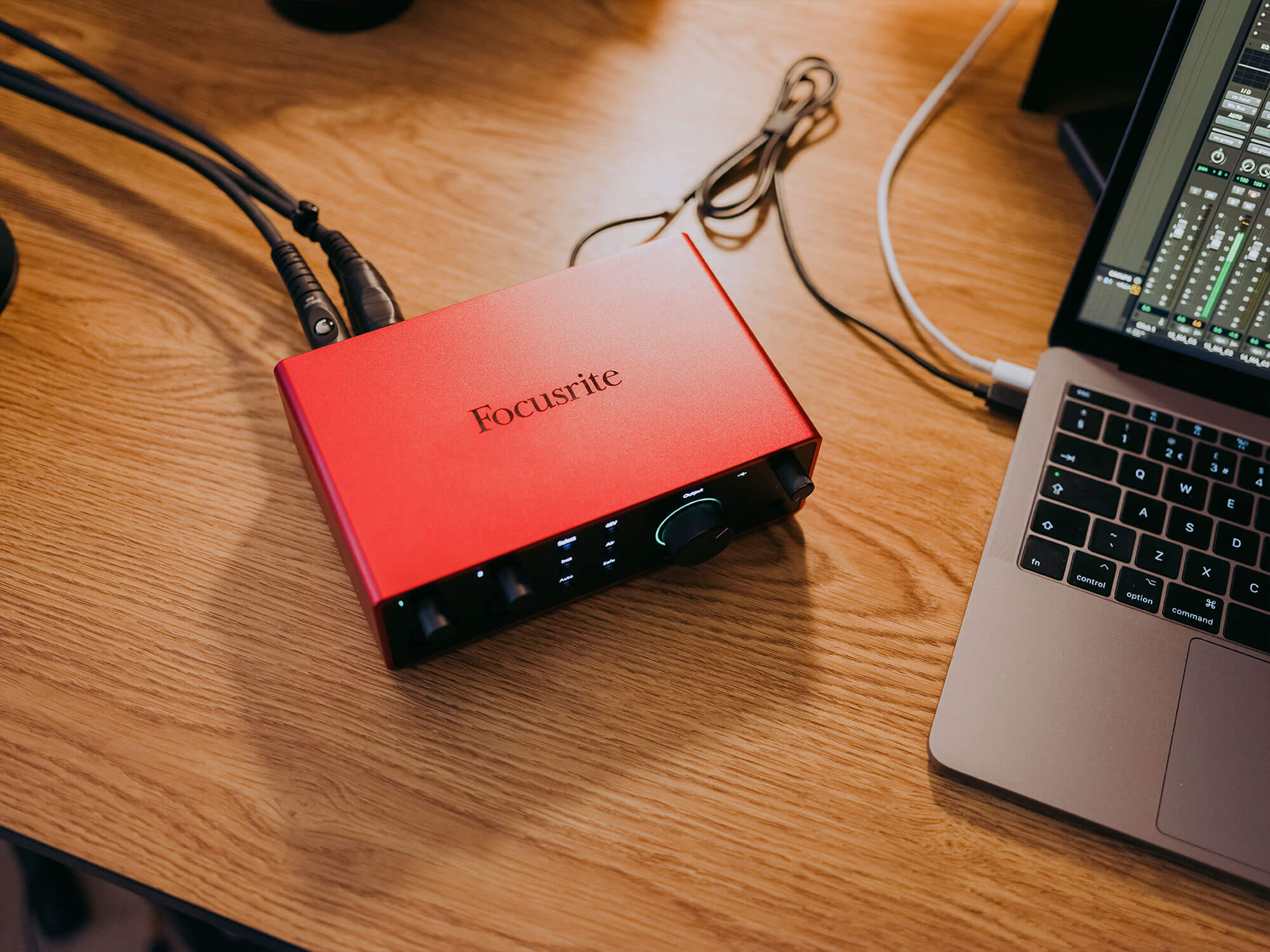
There are all sorts of reasons to plug a guitar into a computer or smartphone, from recording onto a digital audio workstation (DAW) to livestreaming a performance, or using apps for practice, creativity or tuning. Unfortunately, no PC or phone that you’re likely to buy is actually optimised for these uses.
To bridge the gap between an analogue guitar input and a digital device, we need to add a gadget called an audio interface to the signal chain. Not many guitarists would claim that their interface is glamorous or exciting, but these desktop boxes do useful work. Above all, an audio interface ensures that your guitar or microphone signal arrives into your computer’s recording software (DAW), or onto another device such as a smartphone, in a computable form without losing its character.
The most basic benefit of an audio interface is that it (usually) has inputs for ¼″ instrument cables and microphones, which are not present on computers, plus an output such as USB-C that connects to your digital device. Good ones also help the computer to pick up audio signals smoothly and with minimal latency, thanks to features such as on-board ASIO (Audio Stream Input/Output) drivers and analogue-to-digital signal conversion.
One of the most important aspects of recording is listening, and an audio interface helps with this too, as you can plug your headphones or studio monitors into it for low-latency playback. Most interfaces also have controls to tweak the input signal from your guitar, so it won’t be too loud (causing ‘clipping’ – an unwanted distortion) or too quiet.
Any guitarist who is getting into home or studio recording should consider picking up the best audio interface to suit their budget. While most of these gadgets do similar things, there are differences in functionality and performance that will shape the sound of your recordings or livestreams.
At a glance:
- Focusrite Scarlett Gen 4 2i2
- Fender Quantum LT2
- Universal Audio Volt 1
- Audient ID4 MkII
- Fender Link IO
- TC Electronic Helicon GO
- Fender Quantum LT16
- Audient EVO 4
- Universal Audio Apollo Twin X
- Behringer UMC1820
- Why you can trust Guitar.com
Focusrite Scarlett Gen 4 2i2
The fourth-gen Focusrite Scarlett 2i2 is pretty much perfect for the average bedroom recording setup or small studio. It’s straightforward, dependable and equipped with a crowd-pleasing set of inputs and features.
There are two inputs on the front where you can plug your guitar or bass straight in; or you can point a mic at your amp’s speaker cone and feed it into the mic inputs on the back of the interface.
Perhaps best of all, the controls are very clear and accessible, and the LEDs around the input and output dials make it easy to set volume levels without clipping (or tell whether a signal is actually being picked up!)
Fender Quantum LT2
Of all the audio interface brands you could choose, you just know that Fender is going to treat a guitar’s signal well. This is our favourite model from the titan of Telecasters and Twins, with a superb direct input that will keep your guitar or bass sounding very much like itself, even after it’s been converted into 0s and 1s.
The mic input (on the rear of the interface) is also a standout, with an impressive 75 dB of gain to help you capture fine details or quiet audio sources (such as a shy vocalist). There’s also a ‘Mixer Mode’ that allows you to use the Quantum LT2 as a simple mixer (no computer required), which could come in handy for brand practices or live sound emergencies.
Universal Audio Volt 1
An audio interface-lover’s audio interface, the Universal Audio Volt 1 is a great entry point into the UA ecosystem. This brand has carved out its own niche in the premium recording equipment market, with a focus on analogue components, ultra-low latency and vintage design.
Essentially, the Volt 1 gives you that whole, alluring proposition in a compact, budget-friendly(ish) package. It does the basics brilliantly, with a single input and controls for the input gain, monitoring volume and headphone volume. Plus, there are some interesting extras including a ‘vintage’ button that runs your signal through a tube pre-amp emulation circuit.
Audient ID4 MkII
Despite its reasonable pricing, this interface from Audient has a swanky look and feel. Its compact, square-ish footprint fits nicely onto even a crowded desktop.
If you were to make the brave (and possibly foolish) decision to open the metal enclosure, you’d find essentially the same mic preamp circuit which Audient has been using in various products since 1997 – known for its capability to put out a clean signal with minimal unwanted distortion.
There are some handy features here that you won’t find in the average interface. Alongside the ¼″ headphone output is an ⅛″ option that can be used at the same time, which is a great option for engineers listening back to recorded audio with a musician (and telling them how great they are – but let’s try one more take…)
Fender Link IO
A handy, pocket-sized interface that’s ideal for recording onto a smartphone, the Fender Link I/O is one of our favourite options from the more basic end of the guitar interface functionality spectrum.
It doesn’t do much, but it does its job well, with a Fender-designed input, a fool-proof volume control and on-board clipping detection.
The main downside to the Link I/O is that its functionality is relatively limited. You could pay a little extra and get your hands on a much more fully featured audio interface – so the question is whether you’ll actually use those added capabilities.
TC Electronic Helicon GO
Another simple guitar interface designed for on-the-go use, the TC Helicon Go connects your instrument to a smartphone and also works as a standalone headphone amp. (It can be used as a minimalist PC interface, too).
Considering its bargain price, this feels like a worthwhile acquisition for anyone who travels with their electric guitar or bass, or for guitarists interested in playing around with creative music apps on their phone. Speaking of which, the Helicon Go is tailor-made for use with the TC Helicon range of smartphone apps, which includes Go Record and various effects options.
Fender Quantum LT16
 Image: Press
If you’re looking for the best available Fender package for recording guitar, bass and more, this interface would be our pick. It comes with Fender Studio Pro 8, which is a good DAW (recording software) that features a bunch of official Fender amp and effect models, so you can take a dry guitar signal and make it sound deliciously Fenderish.
The interface itself is highly capable and designed for studio use, with eight mic/instrument inputs that can be used for live recording or efficient multi-tracking with a roomful of musicians, plus eight line inputs on the back. Its pricing reflects the fact that this interface goes beyond the average bedroom musician’s needs.
Audient EVO 4
Impressive sound is at its most accessible with the Audient EVO 4. This interface combines palm-sized portability and user-friendly simplicity with a price that’s pleasingly affordable relative to the performance. The on-unit buttons and dial link up smoothly with a functionally expanded digital control panel, which makes it easy to identify and adjust the gain on each of the two channels. An even better feature (for the time-pressured, novice or lazy) is the ‘Smartgain’ button, which you can press to make the interface set appropriate levels automatically.
This isn’t a dedicated interface for recording guitars, but it does have some nice guitarist-focused credentials. Its input circuit is based on a classic valve amp input, and you also get access to some handy ARC software including Softube and a Strymon Cloudburst plug-in.
Universal Audio Apollo Twin X
Happy to spend big on an exceptional interface? This Universal Audio model is pricey, but you get the pro-level performance that you pay for. It’s super-powerful, with Thunderbolt 3 connectivity that shifts data radically faster than USB-C and brings latency down to an imperceptible minimum.
As we’ve come to expect of UA interfaces, the Apollo Twin X has glamorous gubbins to complement its beautiful enclosure and UI. Its pair of Unison mic pre-amps are designed for analogue-like character, while its analogue-to-digital converters use crystal oscillators to ensure an accurate translation from input signal to audio data (and back into your cans).
Behringer UMC1820
This formidable 8-input interface from Behringer gives you the capability to work on expansive studio projects at a hobbyist-friendly price – it’s expandable to 18 inputs digitally. Despite its wealth of connections and controls, the UMC1820 is not especially complex to use – especially if you’ve already had experience with studio rack units. In fact, there are some handy shortcuts, including the ‘PAD’ button on each of the eight input channels, which instantly takes a chunk off the gain on the relevant input. The signal and clipping LED indicators make it easy to identify which inputs are working and which need some gain rolling off.
Why You Can Trust Us
Every year, Guitar.com reviews a huge variety of new products – from the biggest launches to cool boutique effects – and our expert guitar reviewers have decades of collective experience, having played everything from Gibson ’59 Les Pauls to the cheapest Squiers.
That means that when you click on a Guitar.com buyer’s guide, you’re getting the benefit of all that experience to help you make the best buying decision for you. What’s more, every guide written on Guitar.com was put together by a guitar obsessive just like you. You can trust that every product recommended in those guides is something that we’d be happy to have in our own rigs.
The post The best audio interfaces for guitarists: mobile, desktop and rack units compared appeared first on Guitar.com | All Things Guitar.
Wintergrass Sessions: Missy Raines & Allegheny
At the 2026 Wintergrass festival in Bellevue, Washington, the Fretboard Journal teamed up with filmers I Know We Should to capture some of our favorite artists (and talk gear).
In this session, we hear from Missy Raines & Allegheny.
First, they perform, “Cold Wind” and “Cold Black Water.”
Then, we talk gear with the full band.
Register now for Wintergrass 2027. The lineup in 2027 will include Sierra Hull, Jerry Douglas Band, East Nash Grass and other bluegrass favorites.
Video by Brad Wagner, audio by Juan M Soria.
We’ll be sharing more highlights from Wintergrass 2026 on a weekly basis here and on our YouTube channel.
The post Wintergrass Sessions: Missy Raines & Allegheny first appeared on Fretboard Journal.
Pages
