
Music is the universal language
“Glory to God in the highest heaven, and on earth peace to those on whom his favor rests.” - Luke 2:14
Norse Guitar Feeds
“You wake up, lay on the floor and roll around laughing for a couple of minutes”: Sammy Hagar on what it was like selling his tequila company for $80M

Last year, Iron Maiden’s Adrian Smith claimed that only a “tiny percentage” of musicians are able to live off of music alone. A 2023 study suggested the same, revealing almost half of UK artists struggle to earn from their music, often only raking in an average of £14,000 a year. Even Sammy Hagar used to stress over money – that is, until he sold his tequila company Cabo Wabo.
In a new interview with Classic Rock, the ex-Van Halen star reflects on how rock ‘n’ roll alone wasn’t enough to ensure his financial stability. In his case, selling off 80% of his tequila brand was how he earned the big bucks. “I sold my tequila company for 80 million dollars…” he recalls. “That money changed my life.”
Despite earning a respectable amount through music, Hagar claims that the explains that the deal allowed him to stop worrying about money. “With music you’re always insecure,” he explains. “You’re always thinking: ‘Well I’m rich now, but it could all end tomorrow.’ I grew up poor. I didn’t ever want to be poor again.”
Hagar first launched the tequila company back in 1996, nurturing it for 11 years before selling a majority of his shares to Gruppo Campari in 2007. He would later go on to sell his remaining 20% of the company in 2010 for a further $11 million.
For most people, $80 million is an inconceivable amount of money. When the first sum of $80 million was deposited into Hagar’s bank account, he explains how it felt surreal. “I’ll tell you what it feels like to wake up with $80 million in the bank… you wake up, you get out of bed, you lay on the floor and you roll around laughing for a couple of minutes,” he says.
“Then you get up and take a piss and have your coffee… and then you roll around on the floor laughing for a couple more minutes,” he continues. “And you think: ‘How the fuck did I do that?’”
Of course, a hefty sum in your bank account can result in acquiring more expensive tastes. “I like Ferraris, I like a nice house and fine wines,” Hagar explains. “I couldn’t live the way I’m still living right now if it hadn’t been for that [deal].’
He expands on his love of Ferraris elsewhere in the interview, notably reminiscing on when he “was driving to Lake Tahoe and doing a hundred and sixty miles per hour in my LaFerrari”.
This indulgent love of fast cars has been a persistent theme in Hagar’s life. Even before making it big, the musician was indulging in the rush of high speeds. “Before I wrote the song I Can’t Drive 55, I had 34 speeding tickets and my license taken away three times and was paying $135,000 a year for insurance – and that was in 1984!” he explained on his 2024 AETV biography special.
Of course, fame has helped cut back on the speeding ticket front. “I’ve been stopped by the cops for driving too fast, but they always let me off because I’m Sammy Hagar,” he tells Classic Rock. “I’ve been stopped 40 times, maybe more, and I’ve had two tickets.”
Despite his expensive lifestyle, Hagar hasn’t forgotten where he came from. He formed the Hagar Family Foundation in 2008, and, to this day, continues to support numerous charities and donate to local foodbanks while touring.
The post “You wake up, lay on the floor and roll around laughing for a couple of minutes”: Sammy Hagar on what it was like selling his tequila company for $80M appeared first on Guitar.com | All Things Guitar.
From playing Botch to Cate Le Bon to finally understanding the Stones, the oddball guitar story of Dry Cleaning’s new album, Secret Love

Often, the only way to help another person understand what you’re getting at is to show them something. And that’s how Dry Cleaning’s Tom Dowse ended up playing Botch’s classic mathcore face-melter We Are The Romans to Wales’ leading psych-pop auteur Cate Le Bon, who was producing the band’s new record Secret Love at the bucolic Black Box studio in the Loire Valley. Her immediate response? “Nah, absolutely not,” Dowse recalls with a laugh.
But the guitarist soon found that Le Bon has earned her rep as someone who isn’t out to put limits on things. Soon, she was reconfiguring the spirit of Dave Knudson’s gear madness into something that would make sense in Dry Cleaning’s world of oddball melody and guitar skronk. “There’s one track on We Are The Romans where he used four DL-4s playing into each other,” Dowse says. “But I tried to do it with a Boss DD-3, using the hold function. I was making separate loops and then we went back into the control room and chopped them up really brutally.”
You can hear the fruits of this particular labour in a guitar breakdown following the second chorus of Rocks, a song that neatly encapsulates Secret Love’s abrasive spirit by being both furiously hooky and ferociously weird. “Each bar is completely isolated from the last one,” Dowse elaborates. “It’s a hard cut. Cate put a lot of effort into making it work, and it did work. She could have shut that down, but she let me have a go.”
Having broken out with the sardonic post-punk of 2021’s New Long Leg, Dry Cleaning have continually reframed their ambitions. On Secret Love we see more of what makes them tick than ever before, with Florence Shaw’s peerlessly droll spoken-word running alongside Todd Rundgren-esque piano stabs, Richard Dawson-adjacent fingerpicking, brittle no wave leads and the dangerously danceable interplay between drummer Nick Buxton and bassist Lewis Maynard.
 Image: Max Miechowski
They have arrived at this point by allowing even more of themselves to bubble to the surface in hours-long writing sessions that sound from the outside like egalitarian jams. “We’re all equal songwriters,” Dowse observes. “You don’t have a dominant person, you explore what you’re interested in.”
As reliant as they are on the chemistry that exists between the band’s four members, though, they’re not insular. Secret Love is as much about finding other voices that might create a new harmony, leading them to ditch their Peckham rehearsal space for a spell demoing ideas at Jeff Tweedy’s Chicago studio the Loft, where they crossed paths with Le Bon during her stint producing Wilco’s Cousin record.
“One of the things we tried to do there was play a bit more casually,” Dowse says. “The way Tom Schick, the engineer, works is that everything is always mic’d up. Jeff goes there every day to write. I was thinking, ‘While we’re working this out, I’ll sketch it.’ Tom had captured all of it, even incidental things, and he pieced it together really quickly. By the time you’d put the guitar down, he’d mixed it, and you’re like, ‘Fuck, that sounds really good.’ Usually, you’d bug out on mistakes – I’m not a very technical guitarist, I’m quite sloppy – but this is the first time I realised those are the good bits. I really thought about that when we were working with Cate.”
Once they’d left Chicago, there were different itches to scratch. “You’re working with the engineer’s taste, and I wanted to go much more extreme,” is how Dowse puts it. That’s how Dry Cleaning ended up in Dublin, throwing things at Sonic Studios’ walls with the help of Gilla Band’s Alan Duggan and Daniel Fox. “We had a song called Blood,” he recalls. “It starts with a jangly guitar – Johnny Marr is a huge influence – but we couldn’t get it to go anywhere.
“Gilla Band pushed to get an industrial edge on the drums. I thought they’d probably shred all the guitars and start again, but they didn’t. They focused on the drums and made a palette that’s really different to what the guitars are doing. Once they did, things started to open up. Cate heard that and really liked it, and it seeped into a lot of other songs.”
 Image: Max Miechowski
Alongside taking that spirit over to France with them, Dowse sought out a guitar that he’d first encountered in Chicago to make the trip. “Between Jeff and the rest of the band there are about 600 electric guitars and hundreds of acoustic guitars, and they’re all accessible,” Dowse says of his time at the Loft.
“Racks and racks of pedals, all these amps. I sat in Nels Cline’s chair playing one of Jeff’s custom SGs or his olive green ES-335s. The one that really caught me, though, was a Danelectro 1449. He had two lipstick pickups in it. I played that so much. It was a bit of a lightning bolt moment – these crap sounds sat really well with everything else.”
In particular, they took up room where Dowse might have immediately turned to his SG in the past. “A lot of the heavier riffs were done through a ‘70s Hi-Watt with an Expandora I bought in Japan,” Dowse says. “This is the third version of it, which is the best one. When you put that through a Hi-Watt with those shitty lipsticks and a guitar that is basically plastic, it sounded so good.
“For a lot of the harsher sounds, Cate was very keen for me not to use my SG. Usually, we went to the Danelectro so it kept a bit of crapness, it wasn’t too macho or something. I think she was really keen for it not to be really hench. It had to be more unhinged.”
Throughout the course of our chat, Dowse reels off influences with the speed and zeal of someone who really, truly loves this stuff. On the unhinged end of the spectrum there’s the dystopian punk of Helios Creed’s work in Chrome, on the noisy front there’s a deep love of Kevin Shields and My Bloody Valentine. But there are a few that stick out when he thinks of Secret Love – read on to discover the five formative guitar sounds that drove the record.
The trashy brilliance of Moses Brown and Peace De Résistance
“A big influence was Berlin-period Bowie, Lou Reed, all those characters. That bit of glam distortion with a chimey guitar over the top, even an acoustic, that’s really bummed out. There’s an album Lullaby for the Debris by a guy called Moses Brown, who has a project called Peace De Résistance. We listened to that a lot, just for how loose and trashy it was. I used my Laney AOR 50 quite a lot for that kind of thing. He seems like a good amalgam, he was in a post-punk band from Texas called Institute that was inspiring, and then he’s gone down this Lou Reed route. That was a big touchstone.”
Jimi Hendrix’s take on The Star-Spangled Banner
“I wanted a really fucked sound. I was thinking a lot about Jimi Hendrix playing The Star-Spangled Banner, and how fucking crazy it was. I put that performance of guitar up there with any 20th century artistic gesture. I immediately think of those Jasper Johns paintings of the American flag, covered in this thick, gloopy paint. It’s not a patriotic thing he was doing. He was criticising Vietnam. He was a vet, you know? He’s criticising America by doing that solo. I just love how expressive that was. That made me up my game on Hit My Head All Day. I wanted something that had more space in it.”
The weirdo listenability of Guided By Voices
“When we wrote Joy, I was thinking a lot about Guided By Voices. There’s a guitar-pop sound that they did, like an approximation of the British Invasion bands. It was so immediate. If you think about their songs, they’re like a minute long — they get straight to the point. I can hear the Kinks in it, and I absolutely love the Kinks. There’s an album called Half Smiles of the Decomposed, it’s got Girls of Wild Strawberries on it. I wanted Joy to be like that. I wanted this refreshing-sounding chord sequence, even those little licks in the chorus. Actually, for once, I wanted to write something that sounded fun, something that’ll work at a festival.”
Tuning into the Rolling Stones
“The one [big] thing for me as a guitarist over the past five years is finally understanding the Stones. Nick said that he thought I sounded the most Keith on My Soul Half Pint and Cruise Ship Designer. I’m trying to think, ‘What would Keith do?’ Other than the drugs, obviously. What I noticed was that he’s like a party started on the guitar but once he gets going it’s very even-sounding. There are no peaks and troughs, and that’s why he works so well with Mick Taylor. Even when Mick does a ripping solo, it doesn’t jump out of the mix. The song starts, they get a vibe going, and you don’t want it to stop. I was listening to Sticky Fingers — I think that’s their best record — and on Can’t You Hear Me Knocking it’s got those toasted valves. I had my Champ with me. It’s not as good as those ones but that’s definitely something I was going for.”
Anarcho-punk’s unusual chords
“The thing I like about anarcho-punk is they use much weirder chords, they’re not doing the straightforward punk of the time. Icons of Filth have a song called Mentally Murdered and it’s drier, you know? I think what’s happened to hardcore and punk as production has gone on is that it’s lost a little bit of that. Early ‘80s hardcore, like Bad Brains and SS Decontrol, it’s like Keith Richards joined those bands, just how dry it sounds. You have to play hard. There’s no studio trickery in it. I like modern hardcore, but it doesn’t have quite the same character.”
Dry Cleaning’s Secret Love is out on January 9 through 4AD.
The post From playing Botch to Cate Le Bon to finally understanding the Stones, the oddball guitar story of Dry Cleaning’s new album, Secret Love appeared first on Guitar.com | All Things Guitar.
PART 2 – Singer-Songwriter, Author, Producer Rod MacDonald Talks About His Career and Rants & Romance
By: Rick Landers
PART 2
Guitar International and the masterful singer-songwriter, producer, author and music historian-presenter, Rod MacDonald, continue our conversation about Rod’s music career, including challenges, lessons learned, and reinventing or re-strategizing his approach to changes in the music business and life.
If you missed the beginning of our conversation, please go to PART 1 HERE!
“Politics, passion, and a sense of humor” The Village Voice
“A poet with a lot on his mind who has never allowed himself to make points at the expense of making music.” Boston Globe
“MacDonald’s songs combine poetic vision and journalistic insight.” Dirty Linen
CHECK OUT ROD’S 2026 CALENDAR!
******

Rod MacDonald: I’m the president of the Greenwich Village Folk Festival, LLC, but I think that the music that I actually compose and record is much more contemporary and diverse than folk music. As folk music is seen by most people, it’s a very finite kind of thing, even the folk music world. So within the folk music world, for example, I see the playlists of folk DJs. There’s a bulletin board where the folk DJs all publish what they play.
I look at it, I subscribe to it, I’m interested. Part of my job with booking the Greenwich Village Folk Festival is to pay attention to who’s getting hurt around the country. And it’s mostly limited to a very finite kind of sound. Sparse, acoustic rural in a way. And very little of what I actually do would fit that playlist. But because I’m not on a corporate record label, most of the other outlets aren’t available on a certain level.
Things like Spotify is actually a godsend to someone like me. Even if you’re not marketed or promoted by any big corporation, people can still stumble on your music and hear it. So I guess that I feel that a part of me is involved with folk music, but it certainly doesn’t describe all of what I do.
But, I do like folk music as a vehicle for song. And I think that some of the best songs that I hear come from people who are somewhat similar to myself, folk singers that love contemporary music as well.
Rick: I was reading about folk music and a term that I had not seen before for that genre is Folk Adjacent. Have you heard of that before?
Rod MacDonald: Folk adjacent?
Rick: Yeah.
Rod MacDonald: No, I haven’t, but it’s not a bad idea.
Starting in about April of 2020, I played every Sunday night for a year and a half. And after I’d been doing it for a little while, I started thinking, well, I really should play some new songs. So, I started trying to write a song each week. And some of them stuck. Some of ’em were pretty good, I thought timely, and that gave me a lot of new material for the cd. And then when we started working by May of 2022, when we started the actual recording process, I had, I don’t know, 10 or 15 songs to work from.
I teach a music history course in a big lifelong learning program here in Florida, for seniors. It’s the biggest lifelong learning program in the United States. It’s kind of the very first big one. And I’ve been the music Americana instructor since 2006, and I do lectures on famous musicians.
And it’s almost a given that almost every artist who’s been hugely successful runs into a situation where they want to expand their palette and the people that are their financial apparatus, the record labels, the managers, all tell them, “Oh, you can’t do it.” Even their audience, I mean, Dylan is a famous example of somebody who actually had to endure a couple of years of boos from his own audience to get where he wanted to go.
But, it’s not really unusual at all. Ray Charles started out doing R&B for Atlantic Records, and then they didn’t want him to do what he wanted to do, which was to do country music his way. He loved country music, but he wanted to play it his way. So, he changed record labels and had the biggest hits of his career. The music history is full of examples of artists who wanted to be more than they were pigeonholed as.
Click here to view the embedded video.
And I’m sure that’s true of many of the singer songwriters in folk music; that folk is kind of an umbrella term. And yet, Mark Moss, the editor of Sing Out magazine, who is a good friend of mine, once said that the one thing he wasn’t interested in for Sing Out was singer songwriters who couldn’t afford a band. He said, “Just because you’re playing solo doesn’t make it folk music. “And I think he was totally right, that that’s true.
But at the same time, it also means, “Where are you going? Where are you going to go if you’re going to play this music?” Because if you’re not on a commercial record label that’s going to support your musical aspirations, you’re going to have to figure it out yourself.
And then you have to find your audience. And so what you often have is people like myself who record with a full band, but when we go out on tour, we pretty much play solo. Or I go out a lot with Mark Dan playing bass, and we’re pretty good. We’re a pretty good act. But you don’t get to hear, we don’t present my albums’ (songs) the way they sound, when you play them.
Rick: And I don’t think people should expect you to sound like your albums when you’re out playing solo.

Rod MacDonald’s Newest Book, Election Night (2025)
Rod MacDonald: Well, it’s a good thing if they don’t, because for the most part, they’re not going to get it.
Rick: And you also have to split the pie with four or five other people, so you end up with hardly anything. So, how do you survive with the band? Pretty different type of thing.
Rod MacDonald: Yeah, and I played with a band in the late 1970s. I played regularly with a band from about 1976 to the late Eighties around New York City. I played with a band, and at one point we would go up and play weekends in Hartford in this big club for hundreds of people about once a month. And those are really fun times. But, as you get a little older traveling around in a van, everybody’s got their lives, people get married, have kids.
The idea of driving around the country, sleeping in the back of a van with the amps and speakers all around me, no, I’m not going to do that at this point in my life. So, I record the way I aspire to record the versions of the songs that I would really love to hear and then take them out and play them, what I jokingly refer to as the Lonesome Rod Show.
Sometimes, I just go out and sing the songs with my guitar. I think for the most part, the audiences that come to see me are okay with that. Every once in a while when I get to play with other musicians, people kind of go like, “Whoa, that’s a whole other side of you!” Sometimes they’ll say, “We didn’t even know that that existed.”
I’ll say, “Geeze, I’ve been playing and listening to rock and roll and band music all my life. It’s not really that big a stretch. You have to have a group of people that are willing to work to get the music together, to rehearse it, to learn it.
I do concerts here in South Florida for the Lifelong Learning Program a couple times a year, and we’ll take an artist’s entire catalog and boil it and teach it, learn it, learn it in three rehearsals, and then play it in front of hundreds of people a couple of times. We’ve done a huge array of music doing that. We’ve done The Beatles, the Rolling Stones, Dylan, Paul Simon, and Art Garfunkel. We did a concert of Eric Clapton and Jimmy Buffett and Van Morrison Tunes.
Last year, this past year. We did Gordon Lightfoot and Jimmy Buffett with a full band, five piece band, and it’s really fun. It’s kind of like… almost a fantasy. You’ve loved this music all your life. We’re going to pay you enough to learn it and play it a couple times. But, I wouldn’t want to go on the road and do it necessarily. even I got offered. We did a Leonard Cohen show and it was really wonderful. I love Leonard Cohen’s songs, and also a lot of the musical arrangements to his songs are really beautiful.
At this point in my life, it’s not what I want to do, but I enjoyed doing that concert
Rick: And you’ve got plenty of songs at this point to go on the road and play for two or three hours without a problem, I would think.
Rod MacDonald: Yeah, but the problem is, can’t you draw enough people to pay a band?
Rick: True. That’s true.
Click here to view the embedded video.
Rod MacDonald: I’m not a young guy hustling into the music business. I’m not signed to a label. I don’t have promotion people and the “Under Assistant West Coast Promotion Man”, follow me around and any of that kind of stuff anymore. I kind of gave that up years ago and have been on my own.
So, the idea that I’d go to Detroit and Chicago and Omaha and Seattle and draw a big enough crowd to be able to pay a band to do all that, it would take a real businessman to organize that and I’m not that guy.
Rick: And to get a label, from what I understand it, you’re a lawyer, so you’d probably be able to understand the lingo in the contracts. I think having a label, I’m not sure is such a great thing. I interviewed a guy who was picked up in a new RV and I knew he hadn’t had a great paying job and he ended up owing his label a ton of money.
Rod MacDonald: I’ve talked to some guys that have ended up in that position of owing their record company a lot of money. I never ended up in that position, fortunately, and I have done okay. I have a fairly modest career, but I think it’s okay.
Somebody asked me recently on a radio interview, how I feel about that and I said, “Well, I’ve never had to go to rehab. I’m not divorced. There’s some benefits to staying within yourself. On the other hand, you always dream of your music reaching more people than are available on a person to person basis. And hopefully some people who read this interview will say, “Hey, I’d like to check this guy out.” That’s a good thing.

Rick: Yeah. Well what about synching? Have you had any songs that have been in movies or commercials? There seems to be some bucks there.
Rod MacDonald: I suppose there are. The fact is that I don’t really spend a lot of time on the business end of this stuff. If there’s a fault in my career, that’s probably it, that I’m not a very aggressive business person. I don’t go out and look for those opportunities. I just don’t, don’t have time. I don’t want to spend my time doing that. So I guess either you can call it laziness or lack of engagement. I mean, I get emails every day, on how to navigate the new digital wilderness, “Sign up for this service and we’ll do this for you, sign up for that, blah, blah, blah.”
But basically, every once in a while I’ve tried one or two of those on a trial basis and they don’t really do any of those things. What they do is tell you a lot of things that you should do, which I just don’t have the time and ability to navigate my way through 550 Spotify playlists on an individual basis, trying to get my music heard.
If I could send it to 550 playlists in one blast, I would, or I have maybe, and that’s probably where I am getting air played, but I just don’t want to sit there and spend my day writing emails to 550 people or anything like that.
Rick: But what you do with your time has to be, since you’re a singer songwriter, you’ve written at least one book that I know of and you put on a presentations, workshops, whatever. So I would say you do have the discipline, but your discipline is really sort of vectored into actually having several revenue streams.
Rod MacDonald: My dad was an older dad and had started to decline health-wise and I wanted to help my mom take care of him. My dad did not want to leave home and go into a facility just because of his health.
Still very cognizant and he didn’t want to leave my mom, but she couldn’t take care of him physically. And I had been living with my wife, Nicole. We weren’t married yet, but we had been together for almost a year and we decided to move to Florida together and take care of my dad. But, then that meant getting off the road.
I’d been on the road for about 10 years by that time, driving around the country in a rental car, playing concerts. I had an agent. I was on Shaky records. I kind of gave all that up. I was on an upward trajectory probably career wise, but I gave all that up and I don’t regret it. I think it was a good thing to do. It’s given me a more normal life and probably less visibility as an artist, but it’s been a good thing to do.

And so I had to figure out how to make a living without being on the road, because you can only play your own songs in the town you live in so many times a year, you really can’t do that. So I learned. So I started doing a bunch of different things and at Lifelong Learning, being an instructor there came to me from playing this one club I was playing. I played with an Irish trio sometimes part-time here in South Florida.
I still do actually. I’ve been working with this same woman for 30 years and we were at that time playing like 40 weekends a year at this one Irish club, which was a pretty good gig and paid well. And they never objected if I sang one of my songs, any of my songs. So it was an okay situation. Then this woman came in and I didn’t even know there was a Lifelong Learning program. She said that there was, and she would like to introduce me to the director of it.
I went and met that person and then the next thing I knew they were asking me to teach a class. And that’s turned into very steady work and really interesting work, a lot of research and a lot of video editing. But I have learned a tremendous amount from it about artists that I’ve admired and music that I’ve always loved.
And one of the things that was really cool about it was the director of the program said, “We don’t want you just to teach what you already know. What we like our instructors to do is to take a general field that they’re well versed in. Then pick specific topics that they’d like, to know more about themselves.
Rick: Good idea.
Rod MacDonald: And go out and do the research and you’ll still be enthusiastic. So, you’ll bring that enthusiasm to your classes. Interesting. And so I do that and I’ve gone out and done lectures on probably a couple hundred different artists, including People that I always kind of loved but never really had the chance to learn that much about. And it’s really great.
And it’s also led to a lot of other situations where private communities will call me up and say, “Can you come do a lecture for us?” And I’ll say, “Okay, what do you want me to do a lecture about?” And they’ll look at the list of the lectures that I’ve already prepared and they’ll pick a couple topics and I’ll go talk to them and show ’em the videos that I’ve prepared. I’ll go talk to ’em for an hour and a half. And that’s led to another kind of income stream. So, I’ve been able to support my family by doing these diverse things. And then I still do, I don’t know, 50 nights a year of my own songs probably, which is fun too.
BONUS VIDEO “HEAL THE WORLD”
Click here to view the embedded video.
If you missed the beginning of our conversation, please go to PART 1 HERE!
Nuclear Audio Introduces Fission Drive
Boutique effects company Nuclear Audio has introduced their debut pedal: the Fission Drive is two drives in one pedal, each acting on different parts of your guitar or bass signal.
With the Fission Drive you can split your signal into highs and lows at a frequency you select, then drive them each separately – from subtle breakup to thick distortion. Apply separate outboard effects to each channel using the independent effects loops. Use the recombined signal from the output jack or just use the send jacks from the effects loops to drive separate rigs – or use all three.
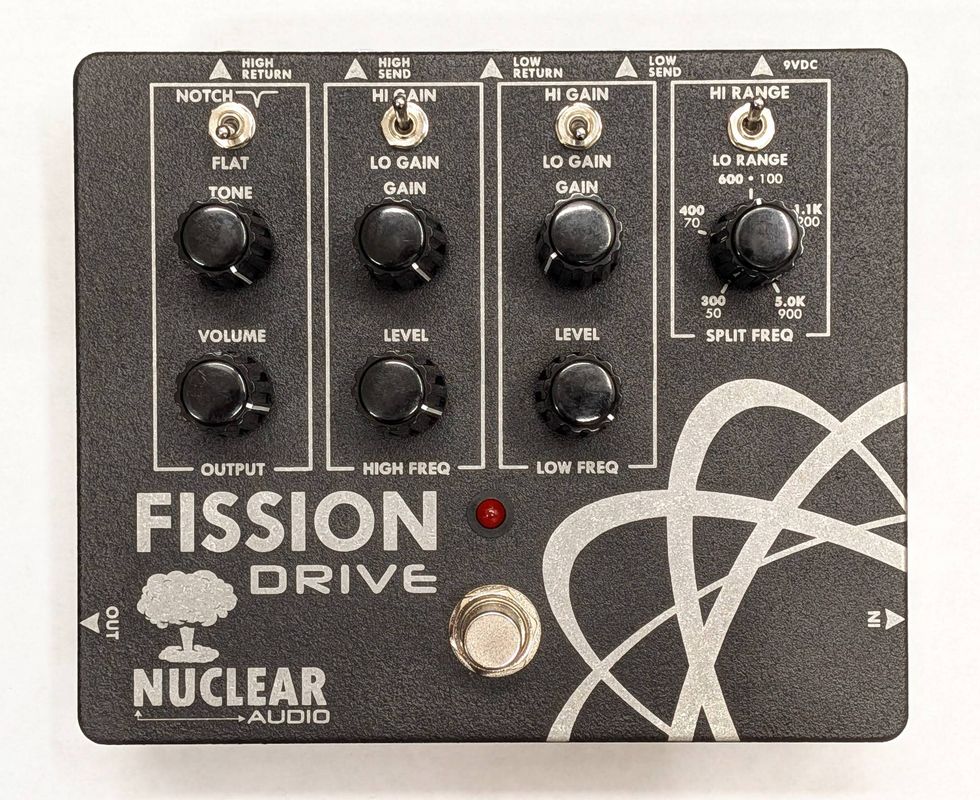
Nuclear Audio’s unique approach to clipping, not based on any previous circuits, smoothly and dynamically transitions between clean, soft clipping, and hard clipping, providing unparalleled responsiveness and dynamics while maintaining exceptional clarity.
Fission Drive highlights include:
- Separate drives for highs and lows, each with their own gain and level controls
- High/Low gain switch on each drive channel
- Control the frequency where the high and low channels are divided
- Post-drive effects loop send/return jacks for each channel
- Notch switch enables an aggressive scoop at the selected split frequency
- True bypass on/off stomp switch
The Nuclear Audio Fission Drive is available now for $300 street price from www.nuclear-audio.com and select retailers.
“Anything but the guitar”: Marcus King claims he never plays guitar at home – and thinks it makes him a better musician

To get to a level of guitar proficiency possessed by blues maestro Marcus King, you’d think you’d have to be practicing around the clock. But as King tells Guitar World in its new print issue, he actually prefers to play just about anything else – while at home, at least.
The 29-year-old ace explains that guitar playing is so deeply rooted within him that playing other instruments is actually beneficial when he comes back to his main instrument.
“When I’m at home, I don’t like to touch the guitar,” he says. “I play a lot of piano, which I write on. Or I’ll sit and I’ll play my pedal steel guitar or my fiddle, banjo, ukulele – anything but the guitar. If I do pick up a guitar, it’s a gut-string, fretless number.
“The guitar is something that I’m so familiar with. It’s like riding a bike or speaking the English language. If I moved abroad and only spoke Spanish for six months, it’s not like I would forget how to speak English. Guitar is so deeply rooted in me.”
It’s certainly true that taking time out of any creative endeavour often means you come back to it with a refreshed creative spark. Marcus King explains that the idea of being a musician first – not just a guitarist – was instilled in him by a book by bass virtuoso Victor Wooten.
“I like to play different instruments, and it helps my playing when I go back to the guitar. I read Victor Wooten’s book [The Music Lesson] and he harped on about the importance of being a musician, not a bass player, and I’ve always been influenced by that idea.
“It’s a holy experience to be able to sit at a guitar and say exactly what I have on my mind.”
Marcus King’s latest album Darling Blue arrived last year. Check out its lead single Honky Tonk Hell below.
The post “Anything but the guitar”: Marcus King claims he never plays guitar at home – and thinks it makes him a better musician appeared first on Guitar.com | All Things Guitar.
Set the World Afire: Dave Mustaine on Megadeth's Final Album and a Lifetime of Riffs
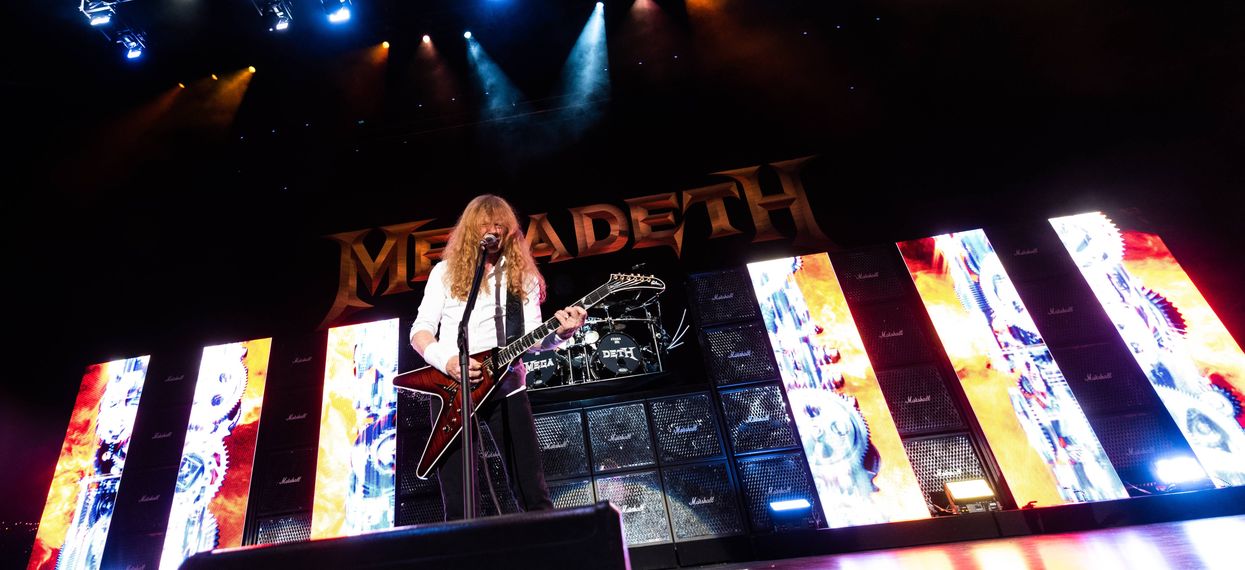
Dave Mustaine didn’t think he’d make it this far. Not the 40 years, not the 17 albums, certainly not the moment he’d be sitting down to talk about Megadeth’s final studio record. But here we are, more than four decades removed from that first gig at Ruthie’s Inn in Berkeley, California (February 17, 1984, to be exact), where the ceiling was so low “you could touch it from the stage,” and Mustaine was still figuring out if he even wanted to be a singer.
Could he have imagined that, in 2025, Megadeth would still be his band? “I didn’t think I was gonna live this long, honestly,” Mustaine admits during a video call, his voice still recovering from a bout of bronchitis that plagued him throughout a recent tour of Europe and the U.K. with Disturbed. Now 64, he’s dealing with health challenges that would have sidelined most musicians years ago—throat cancer, a “fused” neck, radial nerve damage in his arm. But he’s still here, still playing, still shredding. And that first Megadeth show is etched in his memory with remarkable clarity. “The history of that band was, we liked to party,” he recalls. “Ruthie’s was also a jazz club, so we had that temptation running through the band.” They played with drummer Lee Rausch—“I don’t know what happened to Lee, he was a good kid”—that night, and the lineup was still in flux. On guitar alongside Mustaine was Kerry King, on loan from Slayer, and Mustaine hadn’t even fully committed to singing yet. That decision didn’t come until bassist Dave Ellefson asked him why he wasn’t handling vocals. “I said, ‘Because I don’t want to—and that should be good enough for you,’” Mustaine recalls with a laugh. “But I also didn’t wanna hurt the guy’s feelings, ’cause Dave was younger and looked up to me. So I said, ‘Okay, I’ll try it.’ In a weird way, I have David Ellefson to thank for my singing career.”
Fast forward through the decades—through 1986’s Peace Sells... But Who’s Buying?, through 1990’s Rust In Peace, through 12 Grammy nominations and one win, through lineup changes and personal demons conquered—and Mustaine finds himself at an unexpected crossroads. The band’s latest album, simply titled Megadeth, will mark their 17th and final studio effort.
The decision wasn’t made lightly, and it wasn’t made in a single moment. “I would still keep going if I was not battling these things,” Mustaine explains, referring to his ongoing health struggles. “But I just don’t want to go out onstage when I’m not my best. There were many nights on the Disturbed tour where I was in full-blown bronchitis, hopped up on antibiotics and steroids to get rid of the inflammation. That doesn’t feel good. I’m not a guy that likes being sick.”
“I didn’t think I was gonna live this long, honestly.”
The recording process itself proved physically grueling. Working with producer Chris Rakestraw at various points throughout 2024, Mustaine and his current lineup—virtuosic Finnish guitarist Teemu Mäntysaari, Belgian drummer Dirk Verbeuren, and bassist James LoMenzo—did sessions in marathon stretches. “We did about four weeks straight, 12-hour days,” Mustaine recalls. “And I told my management, ‘I don’t know how much longer I can do this.’ My hands were throbbing and my back was hurting from sitting up for that long. What I remember during some of those sessions was torture, when they make people sit for long periods of time.”
Yet despite the physical toll—and the weightiness of knowing this would be Megadeth’s final statement—there was an openness and fluidity to the sessions. The songs were numbered rather than titled during recording—“Tipping Point,” the album’s explosive opener, was “song number nine”—because Mustaine changed titles so many times. “Going into the studio, I don’t really ever have a plan,” he says. “I have songs and we go in to record them, but I think open-mindedness going into the studio has been really good for us. A lot of times you’ll be working on a song and you’ll get an idea, and then you’ll have a completely different song come out of it.”
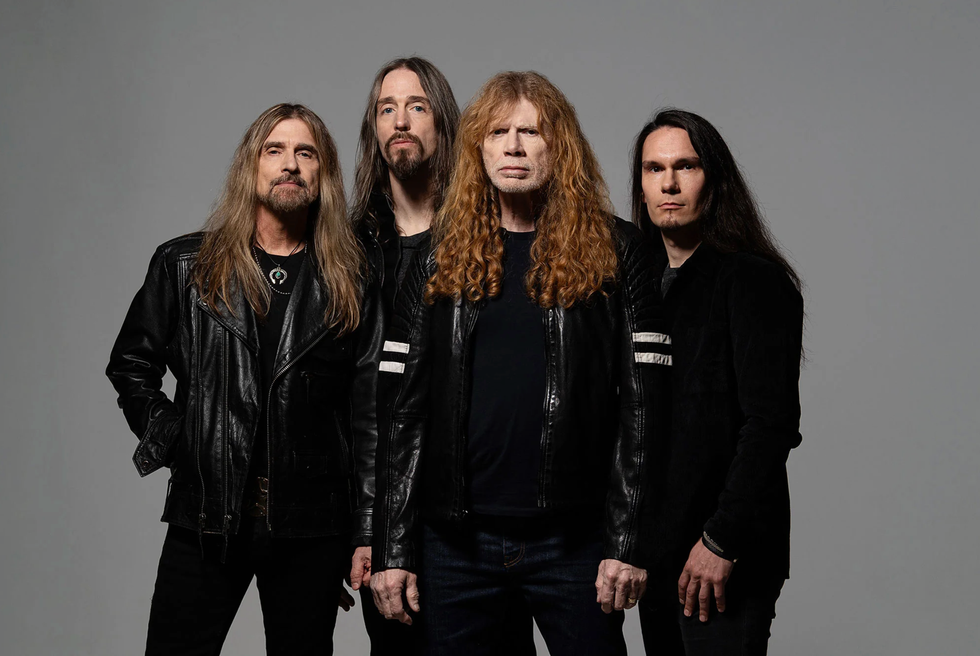
STUDIO GEAR
Guitars
- Gibson Dave Mustaine Flying V EXP
- Gibson Flying V with Evertune bridge
Amps
- Marshall JVM410HJS Joe Satriani Edition
- Marshall 1960DM Dave Mustaine 4x12 cabinet
- Mesa Boogie 4x12 cabinet
- Neve Brent Averill 1272 preamp (no EQ, no FX)
Effects
- TWA Chemical Z overdrive
- MXR Phase 90
- MXR Flanger
- Fortin ZUUL+ noise gate
- Source Audio EQ2
- Peterson StroboStomp HD tuner
- Peterson StroboRack tuner
- Korg DTR-1 rackmount tuner
Picks & Strings
- Dunlop medium picks
- Gibson Dave Mustaine strings, signature gauge (.010-.052)
That openness extended to his bandmates. “Dirk wrote music. James wrote music. Teemu wrote music,” Mustaine notes. “Even our producer chimed in a couple times. Good producers are supposed to do that.” The democratic approach reflects both his confidence in his current lineup and his recognition that fresh perspectives keep the music vital. “I believe with James and Dirk and Teemu’s ideas, this record had a lot of really fresh ideas. Obviously I have my fingerprints on it, but we’re a band.”
The album’s 11 tracks find Megadeth operating with deadly precision—economical, direct, savage. “Tipping Point” kicks off with a blistering guitar solo that gives way to Mustaine’s unmistakable snarl. “I Don’t Care” channels punk fury into defiant aggression. “Let There Be Shred” celebrates guitar virtuosity with mythic, apocalyptic imagery about thrash metal’s birth—a “Mount Olympus kind of thing,” as Mustaine puts it—while cuts like “I Am War” and “Made to Kill” deliver the technical thrash assault the band has honed across four decades.
For Mustaine, the division of labor between himself and Mäntysaari came down to serving the song. “If the rhythm’s really difficult, I’ll usually play the rhythm and let my guitarist do the solo,” he explains. “And if the rhythm’s really easy, I’ll let them do the rhythm and me solo. A lot of that is because these guys are all virtuosos and I’m self-taught, so there’s a limit to what I know how to do. A lot of what my soloing is, is just statements. We could be listening to a really beautiful solo, and then I’m gonna come and stomp through your gardens with combat boots.”
He points to the solo in “Let There Be Shred” as an example. “It’s kind of a hippie solo,” he says. “Teemu’s shredding, and then you go into this kind of slow-motion riff in the middle of the song. And I felt that having a burning solo over that part would be wrong because the rhythm was a really cool rhythm. A lot of times when people play solos, they think the solo’s more important than the song.”
It’s a philosophy Mustaine has carried throughout his career, one rooted in his identity as what he calls “a guitarist that sings” rather than a rhythm player or lead guitarist. “The term ‘rhythm guitar player’ seems a little diminishing for me,” he says. “I love the riff.”
And how committed is he to that principle? When asked what he sees as Megadeth’s main contribution to metal over the decades, he doesn’t hesitate: “Riffs.” It’s the riff—more than the solos, more than the hooks, more than even his distinctive snarl of a voice—that defines the band’s legacy in his mind.
“Sometimes you just want to hear something that makes you wanna kick trash cans over.”
That riff-centric approach announced itself the very first time Mustaine plugged in with his pre-Megadeth band, Metallica. “When I went to Norwalk [California] the day that I met James Hetfield and [original Metallica bassist] Ron McGovney, I didn’t know what was gonna happen,” he reflects. “Nobody did. But I had my style, and it was based around the riff.”
That style made an immediate impression. “I went in there and I didn’t have any Marshalls yet because I was just starting to get serious. I had these Risson amps—they were tan, so from the moment I set up my stack, I was different. I plugged in my guitar and I started warming up, and I kept warming up and warming up. And I finally said, ‘Where the fuck are these guys?’ I set my guitar down and switched my amp to standby. And then I went out there and I said, ‘Man, where’s my audition?’ They said, ‘You got the gig.’ So I got my job just by warming up.”
That period of time proved to be the crucible when thrash metal’s DNA was forged. When Hetfield picked up a guitar at a subsequent rehearsal—they’d been working with a second guitarist who showed up to a gig at the Whisky a Go Go, “in Def-Leppard-circa-’86 clothes, with a giant feather in his ear”—Mustaine was floored. “It blew my mind because he was so good. I kind of thought, where were you when we were auditioning a second guitar player? He was as good as he is today. James is a masterful guitarist.”
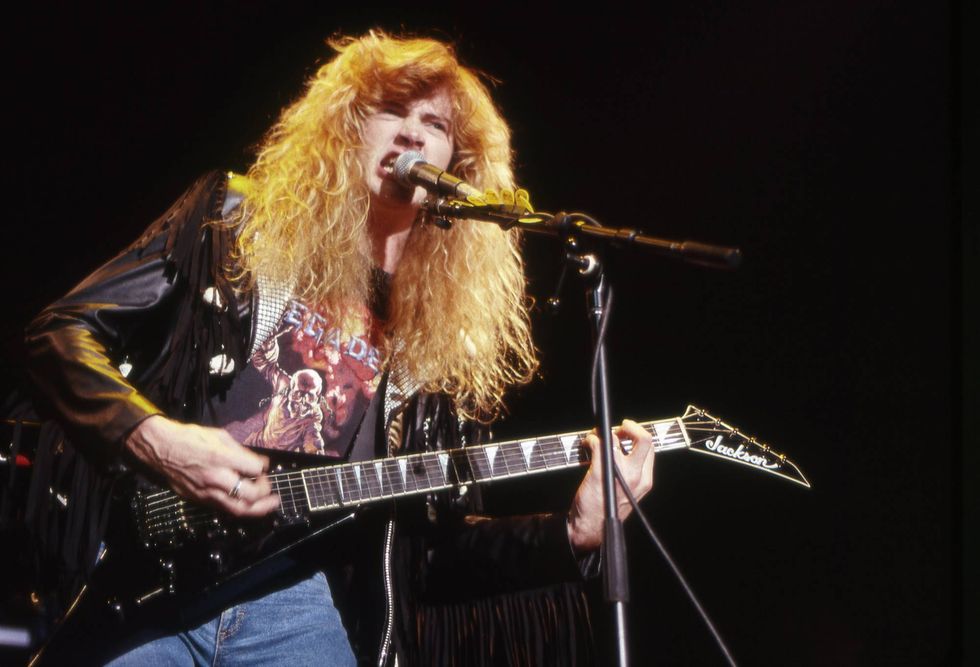
The fact that two musicians who would essentially define thrash guitar—the palm-muted down-picking fury, the intricate riffing, the speed and precision—were sitting in the same room together as teenagers remains remarkable. “I hear influences on everything,” Mustaine says. “I’ll be listening to a TV show and somebody will be playing the soundtrack, and it’s either copying a lick from me or from Metallica. I just take it all in stride. I feel very honored to have been able to make a name for myself.”
That history—and Mustaine’s complex, decades-long relationship with Metallica following his dismissal in April 1983—informs one of Megadeth’s most surprising inclusions: a version of Metallica’s “Ride the Lightning,” which Mustaine co-wrote with Hetfield, Metallica drummer Lars Ulrich, and late Metallica bassist Cliff Burton.
“As I come full circle on the career of a lifetime, the decision to include ‘Ride the Lightning,’ a song I co-wrote with James, Lars, and Cliff, was to pay my respects to where my career first started,” Mustaine explains. “It showcases the spider riffing and the grunting fretting—you fret a G flat power chord and you slide up into the G—technique that I brought [to the band]. I thought it was just a great way to pay my respects to James and Lars and to close the circle.”
Does he consider his take on “Lightning” a cover version? “No, because I wrote the song too. I think other people will say that, but if you’re asking me, I don’t think it’s a cover song. When we played it for people who are fans of that band and that song, the consensus has been that we did a fitting homage. I think we did it at least as good.” He pauses. “It’s a little faster.”
The album closes with “The Last Note,” perhaps Mustaine’s most introspective song—a reflection on career’s end that acknowledges both the cost and the glory. “They gave me gold, they gave me a name / But every deal was signed in blood and flames,” he sings, before delivering a final testament: “I came, I ruled, now I disappear.” Yet Mustaine insists he’s not dwelling on endings. “I’m at a place in my life right now where I’ve been reflective, but not too much,” he says. “I do have days full of satisfaction, a lot of contentment with everything that’s going on.”
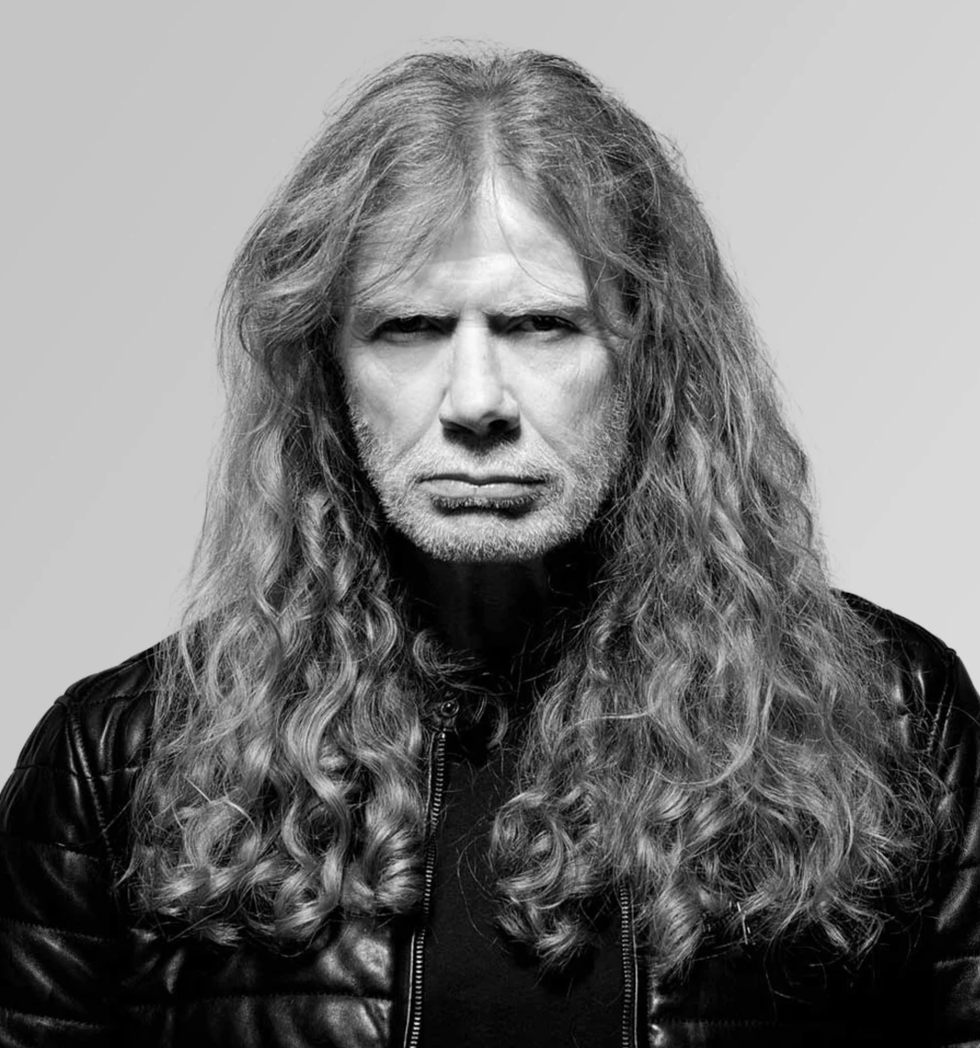
As for the tools that helped forge this final statement, Mustaine has come full circle. After years playing various Flying Vs, he’s now a Gibson ambassador, wielding a signature model that he describes with genuine reverence. The collaboration, he says, enabled him to dial in exactly what he desired—the right pickup configuration, the electrical schematic for his knob placement, a neck that’s very different from the standard Gibson Flying V. “Flying Vs are the most popular guitar in music,” he notes. “When people think of rock bands, they always draw one guy with a Flying V. I grew up loving the V, and to be [Gibson’s] number-one guy right now with it—the guitar is a monster.”
That monster will get plenty of use in the years ahead. Megadeth’s farewell tour will extend well into the future—Mustaine estimates three to five years of dates to properly close out Megadeth’s legacy, including runs supporting Iron Maiden and headlining with Anthrax and Exodus in support. “[Exodus guitarist] Gary Holt and I are like this,” Mustaine says, holding up crossed fingers. “Blood. He’s actually my oldest friend in the music business besides the guys in Metallica.”
“The term ‘rhythm guitar player’ seems a little diminishing for me. I love the riff.”
But he’s already gaming out how to handle that final show. “I was joking around and I said to my management, you should book the tour and then have a couple fake shows listed at the end. So I’ll do the last show thinking there’s still a few more to go, and then you’ll tell me that was it. And I’ll punch you in the face instead of breaking down and sobbing on stage.”
End it in anger instead of sadness? “Yeah,” he says with a laugh. “It’s more ‘Dave.’”
It’s quintessential Mustaine, wrapping emotion in, to use his words, a combat boot. From that first show at Ruthie’s Inn (where Mustaine wielded a pretty killer natural-finish BC Rich Bich that was later stolen) through countless tours and lineup changes, through personal and professional battles, he’s persevered. Does he wonder if younger musicians understand his place in metal history, the role he played in shaping thrash? “I don’t really know how much modern musicians know,” he admits. “If they’re influenced by a band that was influenced by a band that was influenced by me or Metallica, do they know the story? But I’m okay with myself, so I don’t feel the necessity to have people sing my praises. I’m really comfortable with who I am.” He laughs. “A freckle-faced redhead. You don’t think I was picked on growing up?”
For now, though, Mustaine is very much still here, and still vital. The hands may throb and the voice may rasp, but the fire that drove a red-haired kid to pick up a guitar and create a sound no one had heard before still burns. Megadeth delivers on that fire. “Sometimes you just want to hear something that makes you wanna fuck or fight, you know?” he says with a laugh. “Something that just makes you wanna kick trash cans over.”
As for that final show, whenever it arrives, Mustaine will walk offstage knowing he gave everything he had. And whether or not his management actually pulls off those fake extra gigs he joked about, there likely won’t be anger or tears—just gratitude for what was. “I’m really blessed,” he says. “And I’ve loved every moment of this.”
“It’s not puppet show Megadeth”: Megadeth’s final tour won’t feature appearances by the band’s many former members

Megadeth made waves in the metal world last year when Dave Mustaine announced that their self-titled 17th studio album – set to arrive later this month – will be their swansong.
The album will be the band’s only outing with guitarist Teemu Mäntysaari – who replaced Kiko Loureiro in 2023 – and will also, notably, feature a cover of Metallica’s Ride the Lightning, a song Mustaine helped write during his Metallica tenure in the early ‘80s.
Mustaine, Mäntysaari, bassist James LoMenzo and drummer Dirk Verbeuren will hit the road this year – starting in Canada next month – for a mammoth world tour celebrating the new record and the band’s multi-decade career. But as Mustaine confirms, don’t expect appearances from any of the group’s long list of previous members.
In an interview in the latest issue of Guitar World, the 64-year-old frontman is asked whether he plans to give any former Megadeth members a moment in the spotlight on the band’s upcoming trek.
“We’ve already done that with Marty,” he says, referring to the times Marty Friedman joined the band onstage twice in 2023. “And I mean, let’s look at the other people we’ve played with… there’s a lot of people. [laughs]
“That would be a huge undertaking. I don’t think I want to do that. I’d rather keep doing what we’re doing and let the fans [experience] Megadeth music and be happy about it. It’s not ‘puppet show Megadeth.’”
Elsewhere in the interview, Mustaine reflects on still being a highly active thrash metal musician at the age of 64.
“I wish I would have kept in touch with [late Megadeth drummer] Gar [Samuelson],” he says. “You see that Ace Frehley passed away and how sad that is. Whenever stuff like that happens, I feel fortunate because I’m still kicking. But on the opposite side of the coin, I think, ‘Fuck… that could have been me,’ but by the grace of God, it’s not.”
Dave Mustaine famously revealed in 2019 that he had been diagnosed with throat cancer. He confirmed he was “100% cancer-free” the following year, but in 2022 revealed he had nearly lost control of his left hand while undergoing chemo.
Megadeth’s final tour kicks off 15 February in Victoria, British Columbia – part of a string of Canada shows before the band head to South America, Mexico, Europe and the US later in the year.
“There’s so many musicians that have come to the end of their career, whether accidental or intentional,” says Dave Mustaine. “Most of them don’t get to go out on their own terms on top, and that’s where I’m at in my life right now. I have traveled the world and have made millions upon millions of fans and the hardest part of all of this is saying goodbye to them…
“We have done something together that’s truly wonderful and will probably never happen again. We started a musical style, we started a revolution, we changed the guitar world and how it’s played, and we changed the world. The bands I played in have influenced the world. I love you all for it. Thank you for everything.”
For tickets and a full list of upcoming Megadeth dates, head to the band’s official website. You can also check out the album’s lead single Tipping Point below.
The post “It’s not puppet show Megadeth”: Megadeth’s final tour won’t feature appearances by the band’s many former members appeared first on Guitar.com | All Things Guitar.
The ’58 Goldtop Slash couldn’t walk away from: “He said, ‘I don’t need any more of these.’ And then he plugged it in and said, ‘Alright, I’ll take this one!’”

Gibson’s Certified Vintage Program was created to bring clarity, transparency, and confidence to the often opaque world of vintage guitars. And few stories capture that better than a 1958 Goldtop Les Paul that ended up in Slash’s hands – despite his initial insistence that he didn’t need another one.
Speaking to Premier Guitar, Gibson Certified Vintage Manager Mitch Conrad explains that the program was created to bring clarity and confidence to the vintage guitar market.
“The vintage world can be a murky place to navigate,” Conrad says. “It can be hard for people to feel confident about what it is they’re adding to their collection.”
At its core, the goal is simple: “We really wanted to provide the best possible experience when buying a vintage Gibson or a Gibson-made instrument.”
To that end, every Certified Vintage guitar is accompanied by extensive documentation, including a certificate of authenticity, a detailed appraisal letter, and a deep dive into every component on the guitar – down to sourcing vintage-correct replacement screws when needed.
“And, as far as I’m aware, we’re the only ones [offering] a new, limited lifetime warranty,” Conrad adds. “We want to send them back out with that same level of confidence that these instruments will make it another lifetime in the hands of their next caretaker.”
While the goal is always to find the best examples possible, Conrad notes that “best” doesn’t always mean flawless.
“We try to stay away from things that have been broken. Still, we’ll make an exception,” he explains. “We sold a killer 1958 Goldtop that had a headstock repair. But this guitar was incredible. It was not in museum-grade condition, but it was one of the best ’50s Goldtop, darkback, PAF-equipped Les Pauls that we’ve had around.”
That guitar, as we now know, ended up in Slash’s hands.
“When I took it down for him to try out, he told me, ‘I really don’t need any more of these,’ Conrad recalls. “And then he plugged it in. He was like, ‘All right, I think I’ll take this one.’ [laughs]”
Tracking down guitars of that calibre, however, isn’t always a storybook affair.
“A lot of folks reach out directly,” says Conrad. “But there’s a lot of digging around as well. It’s stopping into shops on a long drive and asking, ‘Do you have anything else?’ And then somebody pulls out an old black rectangle case, and it’s a 1969 Les Paul Custom. There’s also Facebook Marketplace, Craigslist, all those spaces. So, not every story has the romantic ‘found it at a garage sale’ start to it.”
The post The ’58 Goldtop Slash couldn’t walk away from: “He said, ‘I don’t need any more of these.’ And then he plugged it in and said, ‘Alright, I’ll take this one!’” appeared first on Guitar.com | All Things Guitar.
Fender unveils its first consumer headphones and speakers – including wireless cans with up to 100 hours of battery life

Fender is officially stepping beyond guitars and amps, unveiling its new Fender Audio line with two landmark releases: the ELIE portable speakers and MIX wireless headphones.
Leading the launch is the ELIE (Extremely Loud Infinitely Expressive) portable Bluetooth speaker series, available in two models: the E6 and E12. Designed to balance portability with serious output, both speakers feature built-in subwoofers and a world-first Waves system-on-a-chip (SOC) implementation to deliver distortion-free sound across a wide dynamic range. The result, says Fender, is “greater volume and acoustic clarity” than rival speakers of the same size.
 Credit: Fender Audio
In terms of raw output, the ELIE 6 delivers 60 watts of power, while the larger ELIE E12 doubles that to 120 watts. Battery life is rated at up to 18 hours for the E6 and 15 hours for the E12, depending on usage.
Beyond simple playback, ELIE speakers are designed to double as flexible, multi-source audio hubs. Each unit can handle up to four audio channels simultaneously with low latency, allowing users to mix different sources with ease. Aside from Bluetooth, both models also feature a combined XLR and ¼” input, meaning you can plug in a guitar, microphone, or other line-level source directly and start playing.
Additional wireless channels can be added using compatible Fender Audio accessories, while multiple ELIE units can be linked together in stereo mode for true left/right separation or connected in multi-speaker mode to fill larger spaces.
 Credit: Fender Audio
Alongside ELIE, Fender Audio has also introduced the MIX headphones – a fully modular, over-ear wireless design aimed at listeners who want longevity as well as performance. At the heart of MIX is the FWD Tx USB-C transmitter, which enables lossless (LHDC-V), low-latency (LC3) and Auracast transmission across a wide range of devices.
The headphones feature 40mm graphene drivers, hybrid active noise cancellation, dual microphones with Environmental Noise Cancellation, and support both wired and wireless playback.
Fender Audio claims up to 100 hours of battery life with ANC switched off, dropping to around 52 hours with ANC enabled. And thanks to their modular design, key components can be replaced over time as opposed to replacing the entire unit.
Pricing-wise, the Fender ELIE E6 will retail for $300, the E12 for $400, and the MIX headphones for $300. All three products will be showcased at CES 2026, offering a hands-on look at Fender Audio’s take on modern, musician-friendly personal audio.
Learn more at Fender Audio.
The post Fender unveils its first consumer headphones and speakers – including wireless cans with up to 100 hours of battery life appeared first on Guitar.com | All Things Guitar.
Big Wreck guitarist says no one can replicate Eddie Van Halen’s feel, even if they can play his music note-for-note: “It’s just an innate feel. It sounds like he’s smiling”

You can learn Eddie Van Halen’s licks, memorise his solos and even play his music note-for-note. But according to Big Wreck guitarist Ian Thornley, there’s one aspect of Eddie’s playing that cannot be replicated no matter how good your technique is – and that is the feel the late legend brought to his playing.
Reflecting on Van Halen’s influence while discussing Big Wreck’s latest album The Rest of the Story, Thornley explains why Eddie’s playing continues to defy imitation, even among the most technically accomplished guitarists.
Despite the lasting impact of Van Halen’s style, Thornley admits Eddie wasn’t an early obsession in the way he was for many players of his generation. Asked whether he grew up as an ‘80s metal fan, he’s quick to set the record straight.
“If I’m being honest, not even a little bit,” he tells Guitar World in its new print issue. “That was more Brian [Doherty, Big Wreck’s late co-founding guitarist]’s thing. The heaviest thing I heard growing up was the Beatles’ Helter Skelter.”
Instead, Thornley’s path into heavier music came via Led Zeppelin III, which he counts as his “first personal exposure to heavy, riff-driven stuff.”
“I fell in love with the second side, with That’s the Way and Tangerine, but then I remember flipping it over and it’s Immigrant Song,” says the musician. “Like, ‘OK, what’s this?’ So I didn’t really know that era of metal. The Van Halen song I really liked was Dance the Night Away, you know what I mean?”
When the interviewer points out the chunky, start-stop swing in Big Wreck’s Believer – a feel often associated with early Van Halen, Thornley replies: “Yeah, I could see that. I mean, a lot of that stuff has seeped in over the past 15 to 20 years.”
“I’ve gone back and listened to all the greats,” he continues. “With Eddie Van Halen, you can learn the licks, and you can learn the songs as he was doing it, but it’s still going to be missing a certain bounce or swing. It’s just an innate feel; it sounds like he’s smiling. [Laughs] It sounds like he’s having the best time.”
The post Big Wreck guitarist says no one can replicate Eddie Van Halen’s feel, even if they can play his music note-for-note: “It’s just an innate feel. It sounds like he’s smiling” appeared first on Guitar.com | All Things Guitar.
“It ain’t the same, man”: Lenny Kravitz thinks modern guitar gear and digital emulations still don’t sound as good as vintage gear

Few topics divide guitarists quite like the modern-vs-vintage gear debate. While digital modellers and boutique recreations promise classic tones at the push of a button – with a large and growing cohort of converts – there’s still a devoted camp that insists the real things can’t be replaced. Count Lenny Kravitz firmly among them.
For Kravitz, whose records are steeped in the warmth of analogue gear and vintage instruments, modern technology still falls short – even after years of rapid advancement. Speaking in the new issue of Guitar World, the rock icon explains why he remains unconvinced by digital emulations and newer equipment.
Asked whether he could recreate the sound of his classic albums using modern gear, Kravitz replies: “It ain’t the same, man. It really isn’t the same. I A/B test everything, and while technology has come a long way and some things are very close, they’re just not close enough.”
“Plus, there is the effect of the accumulation of one thing on top of the other, one old piece combined with something else vintage,” he explains. “It begins to build up a sound that modern equipment can’t reproduce. Just look at old guitars – the age of the wood, you know? That’s something almost indefinable.”
His longtime collaborator and guitarist Craig Ross echoes the sentiment, pointing to the physical changes instruments undergo over decades.
“Wood ages and dries; it’s almost like there’s something in the air that imparts a unique sonic effect,” says Ross. “I think you can’t deny that the pickups in old guitars age in a way that is very hard to reproduce.”
The pair were speaking while revisiting Circus, which has recently been reissued as a 30th-anniversary expanded deluxe edition packed with bonus material.
Kravitz, who remains an avid collector of old instruments, also reveals that the Les Paul Goldtop he’s currently using on tour is one of his most recent acquisitions.
“The Goldtop I’m using now on tour. I have several, but this one is a conversion,” he says. “Someone in its history put PAFS on it and took off the tailpiece. It is the most amazing sounding guitar. I think it’s from around ‘54.”
Not every guitarist, however, sees vintage gear through the same lens. While Kravitz swears by the character and tone of older instruments, others argue that age alone doesn’t determine quality. Blues-rock guitarist Chris Buck, for example, has been vocal about his scepticism toward the idea that older guitars are inherently better.
“I don’t subscribe to the idea that all vintage instruments are great,” Buck told Guitar World, “because I’ve definitely played some dogs. Some of my favourite guitars were made after 2020, and some were made in the ‘60s.
“There’s a synergy between you and a great instrument. That could be a $300 Squier or a $5,000 Gibson. It doesn’t matter. If it speaks to you, it’s the one.”
The post “It ain’t the same, man”: Lenny Kravitz thinks modern guitar gear and digital emulations still don’t sound as good as vintage gear appeared first on Guitar.com | All Things Guitar.
Horrothia Effects Triage Deluxe review – the ultimate all-in-one gain machine for fussy tonehounds?

£240, horrothia.com
The word ‘preamp’ was invented by Satan in order to sow discord and confusion. Does it mean the front half of an amplifier, a DI device with speaker simulation, or just a glorified overdrive pedal? Take your pick, it’s all of them! So let me make it clear that the Horrothia Effects Triage Deluxe falls into the third category… except that it’s not so much glorified as glorious.
This British boutique stompbox has enough gain on tap to replace your Timmy or ODR-1, but it also has the tone-sculpting power to transform your sound in a number of ways, some of them less orthodox than others.
 Image: Press
Horrothia Effects Triage Deluxe – what is it?
There was a non-Deluxe version of the Triage, with just three knobs and a mids switch; this unit has replaced it in the Horrothia line-up, but it’s apparently a whole new design rather than just a more complicated take on the old one. So let’s have a look at what’s going on inside.
The first stage of this preamp is a FET preamp – yes, that’s right, a preamp can also be part of a preamp, when will this madness end!? – which runs into a variable high-pass filter, followed by a discrete op-amp (with adjustable headroom) to bring the grit, and a treble-cutting tone section on the way out.
More importantly than all that, though, did you clock the footswitch? It looks like one of the buttons off an old arcade game, and it’s adorable. This kind of thing should be compulsory on all stompboxes from now on.
 Image: Press
Horrothia Effects Triage Deluxe – is it easy to use?
There are no surprises with the lower three knobs: ‘breath’ is for treble, and gain and output are self-explanatory. For the other two, however, you might have to put your brain into reverse.
The HPF’s cut-off frequency ranges from 20Hz all the way up to 1kHz, so as you turn it up you’re effectively turning the bass down; and the headroom sets the voltage in the second gain stage between 6v and 16v, so as you turn this one up you’re actually reducing the drive and compression.
But hang on, how can you run a pedal at 16v with a 9v power supply? Well, in this case you can’t: the Triage Deluxe will work fine with a standard adapter but it really wants 18v, otherwise you’re basically fixing the headroom at minimum. So, out comes the voltage doubler cable (what would we do without you, Voodoo Lab?) and it’s on with the testing…
 Image: Press
Horrothia Effects Triage Deluxe – what does it sound like?
It’s always nice when a pedal gives you a starting point of absolutely nothing. With clipping off, the filter at minimum and the headroom at maximum, the Triage Deluxe can produce something very close to total transparency… which might not be terribly useful on its own, but does bode well for when the gain and output levels start heading north.
That brings us quickly to two easy wins: as a clean boost, and as a transparent low-gain overdrive, this thing is just impeccable. If you simply want to hear your clean tone but louder and/or grittier, it’s right here. The drive feels quite fluffy and uncompressed but tonally it remains tight; in this sense it’s unlikely you’ll find the HPF necessary to sharpen things up – not with single-coils anyway – but it does allow you to shift the emphasis to the midrange, Tube Screamer style, with total control over just how lean the bottom end gets.
The effect of reducing the headroom can be a lot more subtle, depending on other settings, but it’s step one on the journey from preamp to proper drive pedal – and step two is the clipping switch. This makes things pretty hairy, but still without any suggestion of raggedness or unwanted bloom. The Triage Deluxe is a wonderfully entertaining pedal for sure, but it’s also a master of self-discipline.
 Image: Press
Horrothia Effects Triage Deluxe – should I buy it?
This is not a cheap pedal, but it’s actually something of a bargain by Horrothia standards (the excellent Berkeley vibe is currently going for £370)… and what you’re getting for your money is undoubtedly of the highest quality. Running it off 9v feels a bit like fitting a 50mph limiter to an Aston Martin; but if you have a power supply with 18v outputs, or don’t mind the hassle of using a voltage doubler, it will let you zone in on the exact sound you’re after with a rare level of precision.
Horrothia Effects Triage Deluxe alternatives
Other pedals that trample all over the line between high-class overdrive and tone-shaping preamp include the Hudson Electronics Broadcast (£179) and Origin Effects RevivalDrive Compact (£329). Or for a very different kind of flexibility, you could go for a dual stomper like the Crazy Tube Circuits Crossfire (€218/£178).
The post Horrothia Effects Triage Deluxe review – the ultimate all-in-one gain machine for fussy tonehounds? appeared first on Guitar.com | All Things Guitar.
State of the Stomp: In Defense of the Mono Pedal
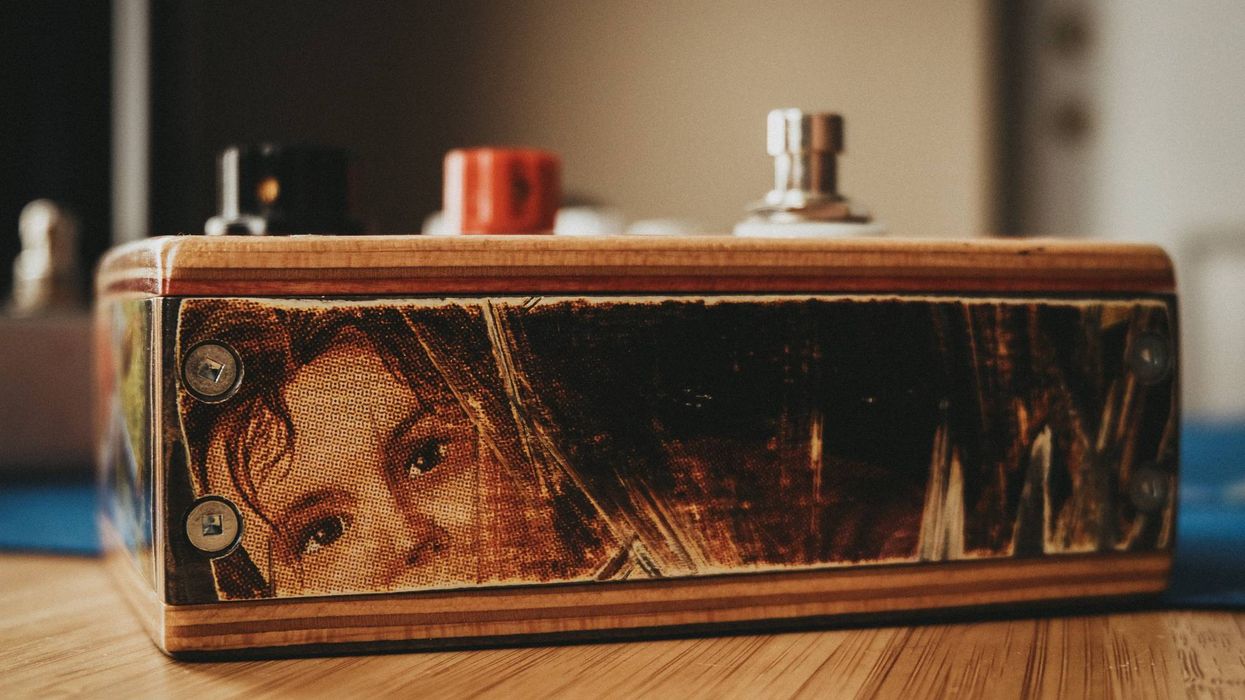
If you scroll through the comments section of most pedal demo videos, you’ll see a familiar refrain: “Why not stereo?” And while stereo has its merits, I’m here to defend the mono signal chain. Before treating stereo as an automatic upgrade, it’s worth taking a closer look at when it helps, when it hinders, and why mono might actually be the more powerful choice for most players.
Stereo is often seen as a bonus for a pedal, a feature that a player may use in the rare case they have a stereo signal. But I’d argue that it can sometimes hurt the pedal’s design. Even with digital pedals, stereo requires extra circuitry to account for both signal paths. This means the pedal will certainly be more expensive. It also means the pedal will likely be bigger, to house both the added circuitry and the additional jacks to support the stereo in and out. So if you’re playing in mono most of the time, don’t worry about that stereo option.
For those who actually use a stereo pedalboard, there’s still plenty to consider. I’ve noticed that the majority of stereo players tend to use it in recording scenarios, but this is also where I find stereo to be the most harmful. Say you’re cutting a track with single takes of each part recorded through stereo effects—while each individual track is wider than a mono recording, together they add up to create a flattened mix because each track is occupying the same area in the stereo field. While it may sound backwards, a mix with multitracked guitars recorded in mono allows for a wider sound. Each track being slightly different creates a perceived physical space, much like a choir sounds fuller and richer than an individual voice.
Furthermore, let’s be honest: Most people don’t listen to music in stereo, either. Have you ever been to a friend’s house where their “stereo” setup consisted of two speakers placed across the room at different heights? And certainly even those who care about stereo have listened to music through a mono Bluetooth speaker or a single headphone.
“While it may sound backwards, a mix with multitracked guitars recorded in mono allows for a wider sound.”
Mono is a great option for guitar signal chains because the guitar is ultimately a mono instrument, a sound created from a single source. By not changing the nature of the guitar, you end up getting more out of it. Embracing mono ultimately empowers every part of your signal chain—guitar, pickups, pedalboard, amp—to be used to its full potential, because you’re not trying to fit it into the needs of stereo. There’s a reason why a two-guitar band sounds so good, or why multitracking works so well. Each part can sit in its own space, live or in a mix, complementing the other to create a greater whole.
There is one use for stereo that I will admit I am very fond of. Wet/dry rigs are a great way to break out of the standard signal chain without losing some of the power of mono. This type of setup has two separate signal chains, one containing the dry signal, including simple effects like compression and distortion, and one containing the more prominent effects like delay and reverb; each runs into a separate amp to be played side by side. In fact, while wet/dry is often thought of as a type of stereo rig, I would argue that it is a version of leveled-up mono—dual mono. Here you can have all of the benefits of two signal chains without the worries of keeping that perfect stereo even-ness, and the two work together to create something larger that is defined by the differences between each signal.
To sum up, stereo isn’t inherently bad—it’s just not the universal upgrade it’s often assumed to be. For many players, chasing stereo introduces more compromises than benefits. By embracing the guitar’s mono nature, you can make more intentional choices about your rig and the playing experience itself. And by understanding these distinctions, you’ll be better equipped to choose the right tools and get the most out of the instrument you already love.
Boss XS-1 Poly Shifter Review
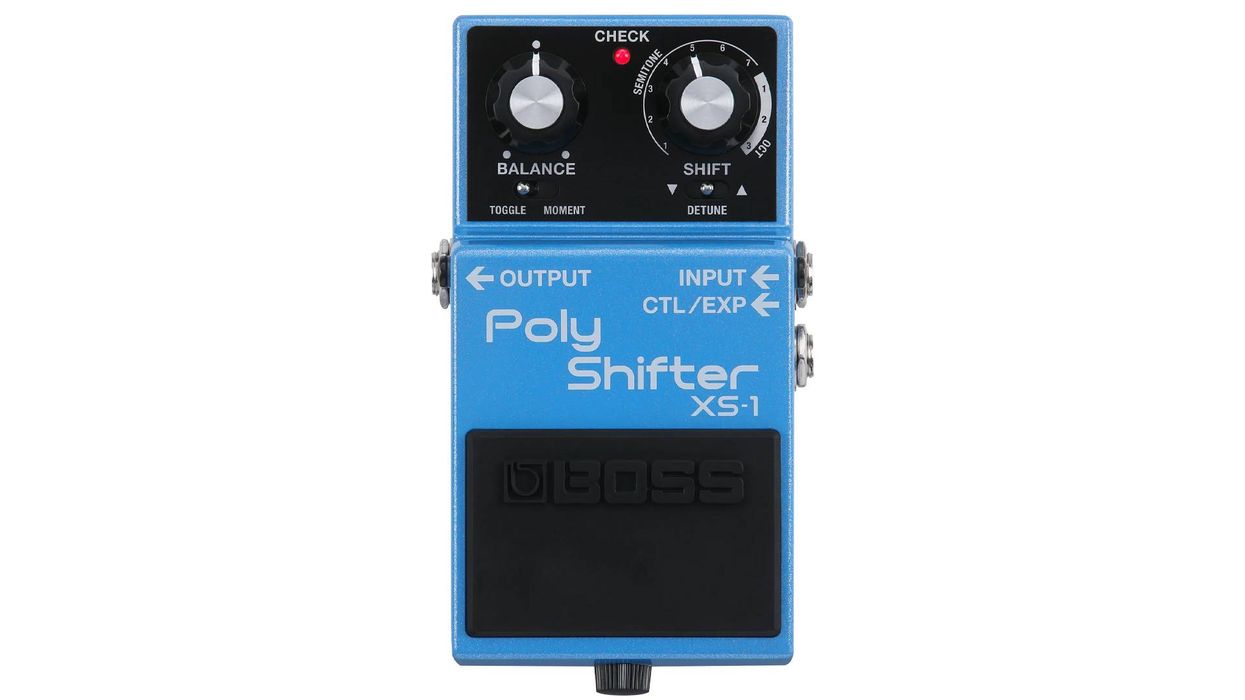
Any effect can color a guitar’s personality and language. But Boss’ new XS-1 Poly Shifter literally stretches the instrument’s vocal range. With the ability to shift input by +/-3 octaves or semitones, it can turn your guitar into a bass, a synth, or a baritone, or function as a capo. It also seamlessly generates harmonies for single note leads and keeps up with quick picking without any apparent latency. Furthermore, the pedal is capable of stranger fare that stokes many out-of-the-box ideas. But if you’re a guitarist that plays more than one role in your band—or musical life in general—the XS-1 can be a utilitarian multitool, too. It’s a pedal that can live many lives.
- YouTube
The XS-1, which was released alongside its bigger, more intricate sibling, the XS-100, is an accessible route to exploring pitch shifting’s potential. Housed in a standard Boss enclosure, it doesn’t consume a lot of floor space like the XS-100 or DigiTech’s Whammy. And while it achieves this spatial economy in part by forgoing a built-in expression pedal (which could be a deal breaker for some potential customers) it’s still capable of +/- seven semitones and a +/- three-octave range that can be utilized in momentary or latching applications.
Slipping, Sliding, and Twitching
Though digital pitch shifters have always been capable of amazing things, early ones sounded very inorganic at times. High-octave sounds in particular could come across as artificial, like the yip of a robot chihuahua plagued by metal fleas. Some very creative players use these colors—as well as the most sonorous pitch shift tones—to great effect (Nels Cline and Johnny Greenwood’s alien tonalities come to mind). In other settings, though, these older pitch devices can be downright cringey.
“The pedal clearly represents several leaps forward from first-generation pitch shifters.”
The XS-1 belies digitalness in some octave-up situations. But the pedal clearly represents several leaps forward from first-generation pitch shifters. Tracking is excellent and shines in string bending situations. Semitone shifts can provide focused harmony or provocative dissonance depending on the wet/dry mix and which semitones clash or sing against the dry signal. At many settings the XS-1 feels alive and organic, too, with legato lines taking on many of the touch characteristics of a violin-family instrument. You get far less of a note-to-note “hiccup,” and glissandos take on a beautifully fluid feel—with or without a slide—letting the XS-1 deliver convincing pedal- and lap-steel-style textures when you add a single octave up. (Such applications sound especially convincing when you kick back on guitar tone and restrict your fretwork to the 3rd through 5th strings, which keeps digital artifacts at bay.)
Mixmaster Required
The most crucial XS-1 control is the mix. For the most convincing bass, baritone, and 12-string tones, you’ll want a fully wet signal. But composite sounds can be awesome, too. You can use the control’s excellent sensitivity and range to highlight or fine tune the prominence of a consonant harmony. But it’s sensitive enough to make blends with dissonant harmonies sound a lot more intentional and integrated. And many of these eerie, wonky, off-balance textures are extra effective when introduced in quick bursts via the momentary switch. (That switch can also deliver great flashes of drama with more consonant harmonies—like dropping in a 3rd or 5th above a resolving chord in a verse.)
You can get creative in other ways using dissonant blends. Droney open tunings can yield fields of overtones that sound extra fascinating with delay, reverb, or 12-string guitar… or all of them! Dialing in blends that really work takes some trial and error, and you’ll definitely hit a few awkward moments if you’re navigating by instinct alone. But those same experiments often uncover real gems—especially in the pitch-down modes, which tend to produce more mysteriously atmospheric textures than their pitch-up counterparts.
The Verdict
Boss’ most straightforward pitch shifter covers a lot of ground. If you play in a duo, trio, or small band, it can expand that collective’s stylistic and harmonic range. It’s small, at least relative to treadle-equipped pitch shifters, so if you’re not a pitch shift power user, you don’t sacrifice a lot of room for an effect you might only employ occasionally, and you can still use the expression pedal jack to hook up a pedal for dynamic pitch control. The $199 price puts it in line with competitors of similar size and feature sets, but the XS-1 is a great value compared to more elaborate, treadle-equipped pitch shifters. If you’re taking your first forays into pitch shifting, or know that you need only the most straightforward functions here, it will ably return the investment. And along the way, it might even unlock a whole cache of unexpected tonal discoveries.
Recording Dojo: How Samplers and Loopers Create Beautiful Chaos
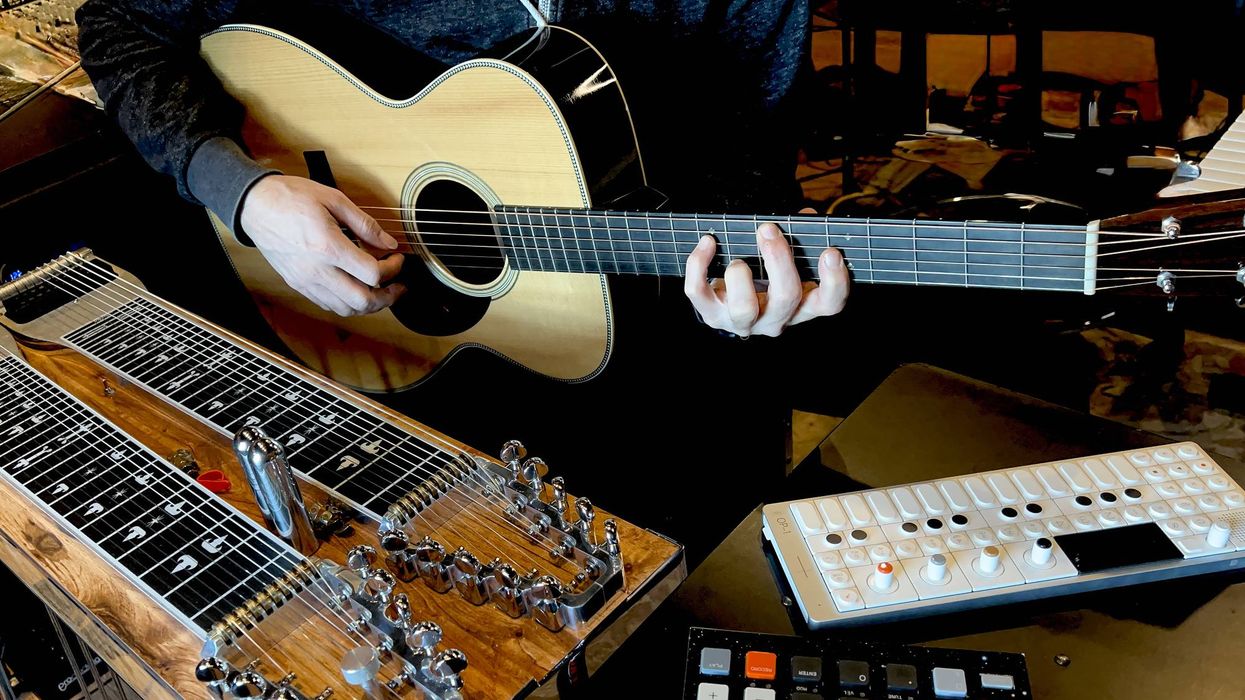
Most people think of samplers as drum machines with delusions of grandeur—four-bar loops, predictable patterns, and neatly sliced bits living forever in the prison of the grid. But for me, samplers and loopers are something completely different. They’re instruments of disruption. They’re creative accelerants. They’re circuit breakers designed to shock me out of my comfort zone and force my compositions, productions, and performances into strange, exhilarating new shapes.
One of my favorite studio practices—and something I encourage my Recording Dojo readers to experiment with—is to sample your performances. Not a preset library, not a pack from somebody else, but use your own melodic lines, motifs, rhythms, textures, and half-formed ideas. There’s something magical about hearing your own musical DNA come back to you in an unfamiliar, mutated form. It’s like collaborating with a version of yourself from an alternate timeline.
The real thrill isn’t about capturing pristine performances. In fact, it’s often the opposite: I’ll grab a phrase that’s imperfect, or mid-gesture, or harmonically unresolved, and drop it into a sampler purely to see what it becomes. When you do this, your musical habits—your well-worn licks, default rhythms, and predictable choices—don’t stand a chance. The sampler shreds them, recontextualizes them, and hands them back as raw material for re-writing, re-arranging, or composing something that never would have emerged in a linear workflow.
Sometimes the transformation is subtle—a lick becomes a rhythmic ostinato, a sustain becomes a pad, a passing tone becomes a focal point. Other times the sampler just mangles it, spits it out sideways, and you think, ‘Oh… now that’s interesting.’ Either way, it becomes a tool for breaking patterns, both musically and psychologically.
My Process: Mutations, Not Replications
My approach to sampling isn’t any more complicated than anyone else’s. I’m not using some secret, elite technique. I’m simply collecting fragments—little melodic cells, rhythmic quirks, harmonic gestures—and giving them permission to misbehave.
I’ll chop up key licks into uneven slices, or isolate just the back half of a phrase, or extract a rhythmic hiccup that wouldn’t survive in a normal editing session. Then I reassemble these bits with the expectation that they won’t behave. I want mutations. I want the musical equivalent of genetic drift. I’m not trying to color within the lines; I’m trying to see what happens when I throw the coloring book across the room.
Once the sampler gives me something intriguing, I run these new creatures through chains of further processing: glitch delays that stutter and fold the sound into origami-like shapes, micro-loopers feeding into overdrives or fuzz pedals, shimmering reverbs that stretch a 200-millisecond blip into a widescreen texture. The result can be anything from a ghostly sustained pad to a snarling, percussive accent, to a completely alien harmonic bed.
You can use these elements as alternate melodic lines, counterpoint, ambient beds, transitions, ear candy, or even structural material for entire songs. And because the source is you, the end result stays connected to your musical identity—just bent, twisted, and refracted into something fresh.
Outcome Independence: The Spirit Behind the Process
If there’s one thing that makes this approach powerful, it’s letting go of the expectation that what you sample must “work.” This is pure experimentation, not product-driven crafting.
I’m outcome-independent when I do this. I’m not looking for a result so much as engaging in the joy of the unknown. Some days nothing meaningful emerges. Other days I strike gold. But either way, the process sharpens my creative instincts. It keeps me curious.
“There's something magical about hearing your own musical DNA come back to you in an unfamiliar, mutated form.”
I use this same strategy when producing artists or working on film and soundtrack material. Recently, I applied it to pedal steel—an instrument known for its lyrical beauty—and the resulting textures were … well, not beautiful in the traditional sense. They were fractured, shadowy, almost Jekyll-and-Hyde. Perfect for a track built around the duality of personality. The clients absolutely loved the unpredictable, emotive soundscape those mutated pedal steel lines created.
Some Favorite Tools for Sonic Mutation
You don’t need a million pieces of gear to do this. A single sampler and a single effects chain can take you far. But here are a few of my favorite “chaos engines,” all of which I own and use regularly:
• Teenage Engineering OP-1 Field – A sampler, synth, tape machine, and chaos generator disguised as a minimalist art object. Its sampling engine and tape modes are perfect for tonal mutations.
• Teenage Engineering EP-133 K.O. II – A quick, dirty, wonderfully immediate sampler for slicing, punching, and recombining your ideas without overthinking.
• Omnisphere 3 – The granular engine alone is a goldmine for turning simple samples into cinematic, evolving textures.
• NI Maschine – Still one of the fastest environments for grabbing a sound, flipping it, and building an idea around the unexpected.
• …and whatever else you have lying around. The point is exploration, not allegiance to any one workflow.
Final Thoughts
Sampling your own voice as an instrumentalist—and then breaking it—reminds you that creativity doesn’t live in the safe, predictable spaces. It lives in the moments where you lose control just enough to discover something new. Give your sampler permission to surprise you, confuse you, and sometimes even challenge your sense of what you sound like. That’s where the good stuff begins.
Slipknot co-founder says AI is like “a professor in my pocket” – and it’s cheaper than a $150k producer who “might not even work with me”

The role of Artificial Intelligence in music-making has been one of the most debated topics of late – and Slipknot’s Shawn ‘Clown’ Crahan is among the few heavy metal musicians speaking openly in its favour.
In a recent interview with The Escapist, the Slipknot co-founder and percussionist praises AI as “a professor in my pocket who only wants to do what I ask it.”
“I’m employing AI 190 percent,” Clown says, explaining that he’s been using it “my whole life” as a tool to refine his work. Over the years, he claims to have transformed “thousands and thousands” of poems he’s written since he was young into new creative forms.
Demonstrating how he uses the tech, Clown tells the publication: “Here are my words. Don’t change them. Don’t alter them. But show me some different ways to sing it.”
The musician also points out the financial benefits of AI, comparing it to hiring a big-name producer – which could cost a small fortune:
“What’s the difference between me pulling out my pocket producer… or me trying to get a famous producer that might not even work with me and could potentially cost me $150,000… who will only give me one or two ways – I’m not mentioning any names!”
Still, Clown stresses the human element remains essential: “But it’s still going to take me to sing it. And it will never be like it was,” he adds. “None of it can work without you, the human. It’s a giant oracle… but it needs you.”
Crahan’s embrace of AI comes amid widespread controversy over the technology’s role in music creation. Critics have raised concerns over copyright and the value of human musical expression – a debate that’s seen contributions from rock’s wider community. Guitar legend Brian May, for one, recently warned that AI training on copyrighted material could make music creation ‘unaffordable’ for artists, while blues‑rock guitarist Kenny Wayne Shepherd said that AI-created music might become the norm even if it lacks the depth of a “fallible human”.
By contrast, not everyone in Slipknot’s orbit shares Clown’s optimism. Frontman Corey Taylor has been openly critical of AI‑generated music, telling Kerrang! in 2023 that he “can’t stand it” and “don’t care for any of that crap”.
The post Slipknot co-founder says AI is like “a professor in my pocket” – and it’s cheaper than a $150k producer who “might not even work with me” appeared first on Guitar.com | All Things Guitar.
Listening and Looking with Steve Tibbetts

There is a specific thread of experimental musician whose real motive is to deal in mystery and wonder. Think conceptualists like Brian Eno and David Bowie, sonic conjurers Sunn O))), transcendent improvisers as varied as Alice Coltrane and Loren Connors, song mystic Annette Peacock—each artist’s work is tied to something that happens beyond the notes, something bigger than just the sounds we hear. And for the listener, there are no easy answers. You can research and dissect compositional and production methods, know all of the gear that was used inside and out, break down all of the influences. But you’re always left with something to chase, to try and understand more deeply. For some, that’s the thrill.
Steve Tibbetts works with these ineffable parts of music, and he has ever since his 1977 self-titled debut. His albums create experiences that, at times, approach definability, but remain elusive: He’s a guitarist, but his music isn’t necessarily “guitar music”; his work is rooted in traditions, but it’s not traditional. So, what is it?
Since the beginning of the 1980s, Tibbetts’ records have been released primarily on the ECM label—the longstanding preeminent home of meditative and ambient jazz and jazz-adjacent sounds. On his earlier releases, you may hear grooves assembled around percussion from various global cultures mixed with suspended 12-string acoustic strumming, soaring evocative melodies, and, at times, blazing electric guitar solos. The cover images on his albums are striking, and often created by the composer himself, capturing some moment in a similarly un-pinnable land—check out the rock formations on either 1980’s Yr or 1986’s Exploded View, for example. The whole blissed-out package is conceptually inspired by place and tradition, yet totally untethered and fresh.
“If I just sat around and played guitar all day long, I don’t know how that would go.”
On more recent releases, and especially on his latest, Close, Tibbetts’ sound has evolved toward something else—more big-picture, but also more personal. Raw and organic sounds mix with a futuristic sonic landscape (and yet, he uses antiquated technology to create those sounds). Close feels like a universal meditation, a grand vision that pulls sounds from across the globe and reaches beyond, toward some distant sonic horizon, overcoming instrument and process. Basically, it sounds like nothing else.
Enigmatic as that is, over the course of an hour or so on our video call, Tibbetts himself proved to be anything but. Speaking from his wood-paneled Minnesota studio, where he’s made much of his music since 1985, he revealed his process and the philosophy behind it—a methodology deeply tied to his own experience of the world.
For Tibbetts, creation starts simply. “You have to sit down and put your hands on the instrument,” he explains. And it’s all about vibe. “Sometimes, it's a matter of getting the guitar warmed up. Hoping for the right humidity in the room.”
In order to keep things moving, his studio is always ready to go—his mics in position and DAW loaded up. “The process is to come to the studio, make a cup of coffee, begin to play, and see if we get to that point,” he says. He starts solo, bringing in other players further down the line. “Nobody cares how loud I get here. I’ve got a couple of Marshall JCM 800s, a younger Marshall, and as long as I wear adequate ear protection, I’m fine. I can get the sound that I need.”
Steve Tibbetts’ Gear
Guitars
Martin D-35 12-string
Martin DM-12
(Fishman TriplePlay pickup for acoustics)
1971 Fender Stratocaster
Amps
Marshall JCM 800 combo
Matchless Lightning 15 watt
Strings
John Pearse custom 12-string sets with double courses instead of octaves
GHS Boomers (Medium)
The days slowly add up. “Do you know what it’s like when you wake up in the night and your fingers are throbbing?” he asks. For him, “that usually means it’s been a good, productive day at the studio. Then you come back the next day. Is there anything worthwhile? Probably not. But after five or six years, you’ve got something—30 minutes, 40 minutes worth of pieces.”
As the music takes form, at some point, he brings in collaborators. On Close, Tibbetts is accompanied by percussionist Marc Anderson, his longest-running musical partner, and drummer JT Bates.
“It begins to sort of assemble itself,” he continues. “It is a little bit of a cliché, but at a certain point, you are in service to the music that you've created and you just need to do a good job with it.”
He quickly balances that thought with a dose of reality: “Mostly, the process is one of tedium, boredom, failure, and actually figuring out what I need to do when I've started the car and am on the way home.”
“What a good thing to do, to listen and look at stuff.”
Tibbetts’ music isn’t purely an in-the-studio creation, though. The world outside his walls plays a major role. “If I just sat around and played guitar all day long, I don’t know how that would go. Maybe there are some guitar players who can do it,” he muses. “Sometimes, the process is to give up entirely and go someplace a long ways away and listen to some loops or little lines that you have as you’re walking around.”
That’s the specific method Tibbetts followed on 2018’s Life Of. He explains: “There’s an area in northern Nepal, close to Tibet, called Lhasa. Difficult to get to, but a friend of mine, a professional clown, named Marian, said, ‘We’re going to Lhasa, do you want to come?’ And I thought, I’ll go there, and I’ll make little mp3s, 60 minutes or so, to listen to while we're walking. That’s what I did. When I came back, I had a good idea of what I wanted to do to put things together.”
For those who can’t travel quite so far, he recommends just getting out of your surroundings. “What a good thing to do,” he enthuses, “to listen and look at stuff. Even mixing. I’m looking at the same paneling here all the time. It doesn’t work. You can take your little laptop now and go to a coffee shop and say, ‘This song is gonna be about this couple over here, or that guy drinking coffee by himself.’ Just mess with your mind a little bit.”
“If it’s not fun, I’m not interested.”
Travel has inspired Tibbetts work throughout his career, thanks especially to his early experience working for study-abroad programs in Bali and Nepal. “That was hard work,” he explains, “but I got to live in cultures where there was different music. Balinese gamelan, if I hear it in Minnesota, it’s just annoying. But over there, it sounds like it fits. The double drumming technique, I had to be in it and study it to bring it back.”
Across the globe, Tibbetts has collected the recordings to incorporate in his music. The idea goes back to his 1997 album, Chö, a collaboration with Tibetan singer Choying Drolma. “We made that record in Kathmandu, Nepal,” he says. “Her singing was incredible. I didn’t want to just strum along on guitar, I wanted to use some of the sounds of Tibetan longhorns, some of my own sounds like bowed hammered dulcimer, my wife’s wine glasses….”
Tibbetts continues, “I did that. And then we got an offer to go out on the road. Desperation takes hold. How am I gonna do this? There’s gotta be a way.”
He devised a setup to trigger samples with his guitar using a Roland MIDI pickup that “had a cable that was about as thick as a stalk of corn that went to another box that would jack into a sampler, probably with a SCSI port.” Inconvenient, but, Tibbetts says, “it did work and we did take that on the road, and then I thought, this will be a good composing tool, this will be fun.” He pauses, and adds, “If it’s not fun, I’m not interested.”
More recently, Tibbetts switched to a Fishman wireless system to trigger the samples. But the samples themselves come from an old version of MOTU’s Digital Performer, which requires him to keep his computer “probably 15 operating systems behind what’s current now.” (He jokingly explains: “I’m working with antiquated technology. I’ve got buggy whips and wooden wheels here.”)
The result is otherworldly. Global sounds enmesh with Tibbetts’ strings, opening up the possibilities of his guitar—a sum-is-greater-than-the-parts experience where you might not realize what exactly is being played or where it’s coming from.
Knowing the sources, however, enriches the experience. Because though some of Tibbetts’ samples are created at home in his studio, many have a story. “I can still hear the chicken in the gong,” he says, launching into a story that goes back to his time working for a study-abroad program in Candi Dasa, Bali. He took the class to visit “a guy that did two things: made sacred knives that they use for ritual activities and had a gong shop.” He explains that gongs for gamelans are all made at the same time to coordinate the orchestra’s tuning, and they visited on a day where new bronze would be poured. “This was a once-in-a-lifetime thing. We went down there and spent a day watching these guys beat the shit out of these things to get them in their own tune, which is still a good 30 or 40 cents off what we would call in tune, but together it sounds good.
He continues: “I spent an extra day there sampling these gongs. I would hit the gong softly. I’d mute it. I would hit it hard.” The gong-maker was curious. “He said, ‘Let me listen to it.’ He listened to it on the headphones and said, ‘I’m sorry my chicken is squawking.’ I said, ‘It’s okay.’ And then the next thing I heard was no chicken squawking. He invited me for dinner. I declined.”
On Close, focused listening reveals another sonic element—the sound from Tibbetts’ acoustic guitar. Often more polished, it’s more raw this time around than on his other records—sometimes you’ll hear buzzing, fretting, and breath sounds. It gives his playing an intimacy, a warmth that stands out. It feels close.
Early in the creation process, Tibbetts wasn’t confident this was a direction he wanted to pursue. So he had Anderson listen to some takes. “People who work alone a lot tend to become a little inbred with themselves, start not understanding what direction they’re going in, or if they’re going in the right direction, or if anything is any good at all,” he muses. “Marc and I have been working together since 1979. His ears are very good. He made me understand that I already knew that this was okay. I just needed confirmation from him.”
He continues, “I am going for the feeling. I guess we’re always going for the feeling, but I just didn’t want to ditch a take because I happened to make a sound, a bad fret sound, a new string sound….”
With Closenow out in the world, don’t hold your breath to catch Tibbetts live—his performances are rare. When asked about this, it’s clear his days of getting in the van are long gone, adding that one-off gigs are also “not that great. It usually takes a few gigs on the road before you get your chops together, lighting, sound, loading in, loading out, your pedals, whatever you have….” But he says there are those occasional gigs that afford the travel, rehearsal time to get it together, and make a compelling enough offer. “If the gig is weird enough and far away enough,” he says, “we'll do it.”Courtney Cox Breaks Down Burning Witches Guitars, Tone, and Touring Gear
Burning Witches guitarist Courtney Cox joins the Axe Lords to talk technique, tone, and the realities of life as a modern touring guitarist. She breaks down how the band writes and records across borders, works under brutally short studio timelines, and balances locked-in rhythm playing with expressive lead work. Cox also explains why learning by ear—not regimented practice—has always driven her playing, and how ADHD shapes both her focus and creativity.

The conversation traces her path from early touring as a teenage prodigy through her years with Iron Maidens, to designing multiple signature guitars built for extended range, lower tunings, and long tours. Along the way, she gets specific about gear and discusses the realities of being a working guitarist, from social media burnout and Patreon economics to perfectionism onstage—and knowing when to stop forcing it and just play.
Follow Courtney @ccshred
Axe Lords is presented in partnership with Premier Guitar. Hosted by Dave Hill, Cindy Hulej and Tom Beaujour. Produced by Studio Kairos. Executive Producer is Kirsten Cluthe. Edited by Justin Thomas (Revoice Media). Engineered by Patrick Samaha. Recorded at Kensaltown East. Artwork by Mark Dowd. Theme music by Valley Lodge.
Follow @axelordspod for updates, news, and cool stuff.
Sounds of 2025: In Memoriam

Pages
