
Music is the universal language
“Glory to God in the highest heaven, and on earth peace to those on whom his favor rests.” - Luke 2:14
Norse Guitar Feeds
Luthier on Luthier: Juha Rukangas
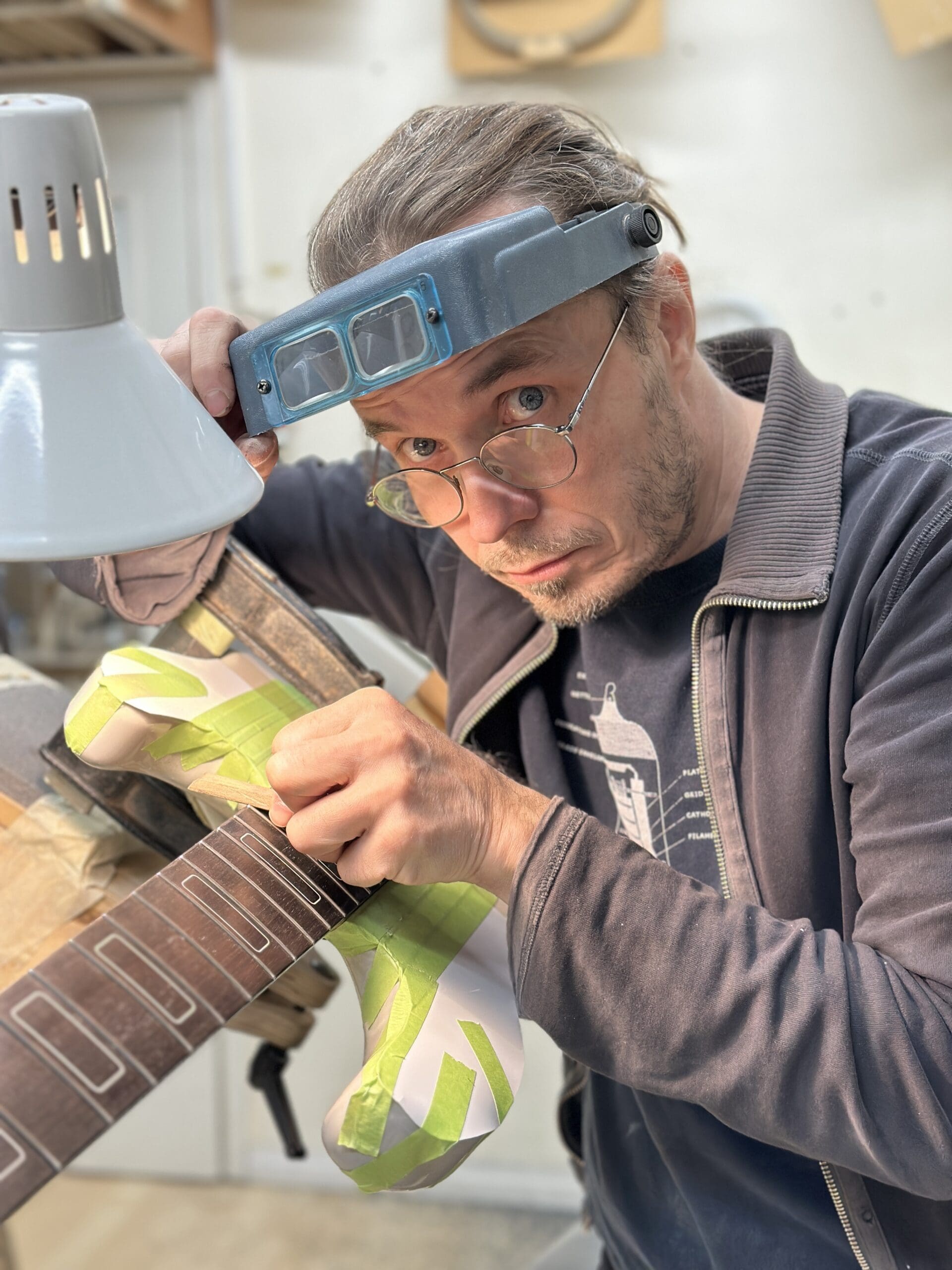
For episode 109 of Luthier on Luthier, we’re joined by Juha Rukangas, a Finnish guitar maker pushing the boundaries of instrument design.
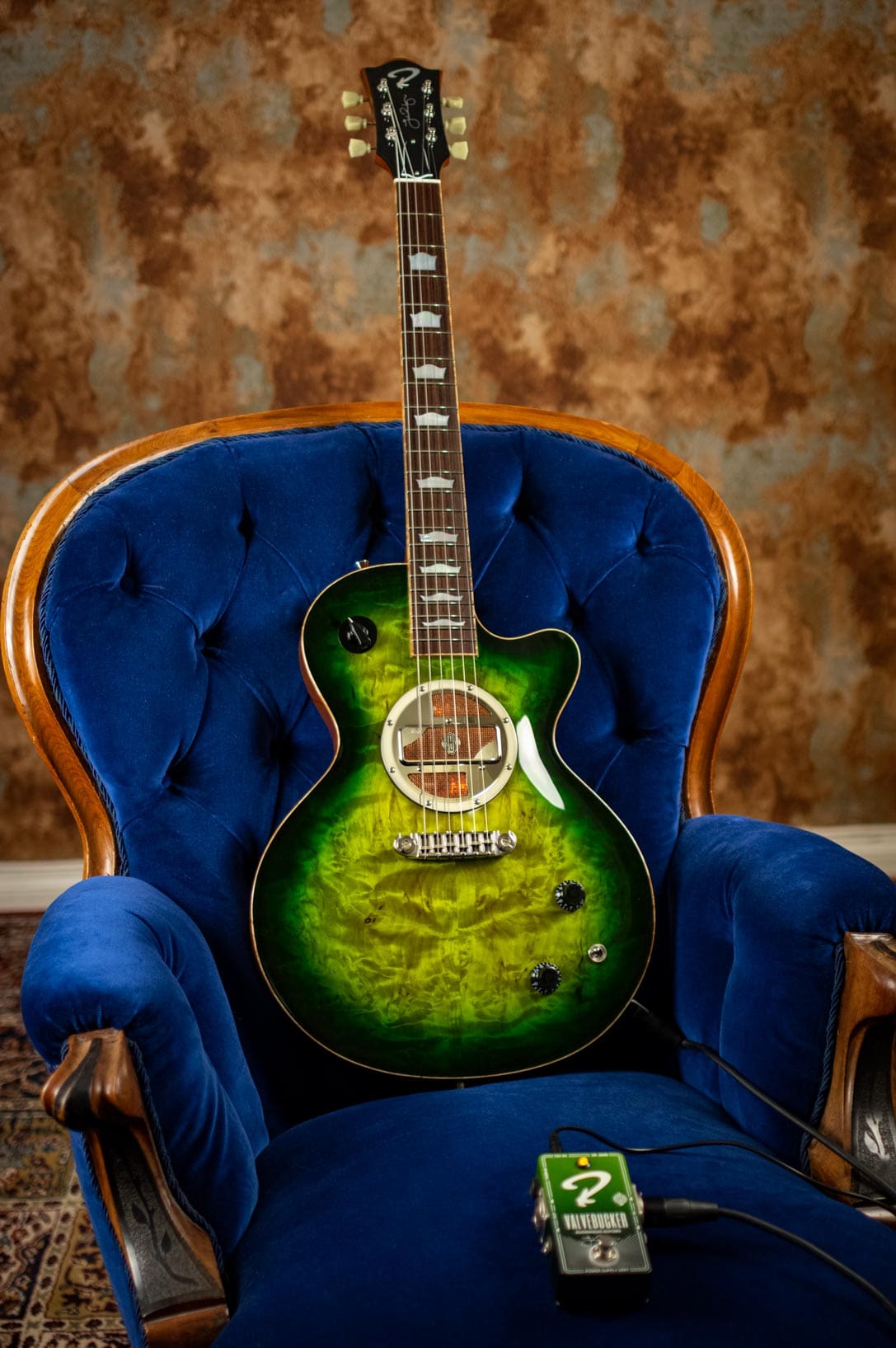
We dive into his innovative Valve Bucker pickup, the Captain Nemo guitar prototype, and his use of local Arctic Birch and wood torrification to create unique guitars. Juha shares his journey from student to professional luthier and his vision for the future of guitar making, blending tradition, technology, and artistry.
Link: https://ruokangas.com/
Luthier on Luthier is hosted by Michael Bashkin of Bashkin Guitars and brought to you by the Fretboard Journal. This episode is sponsored by the Looth Group, Dream Guitars and StewMac.
Want to support Luthier on Luthier? Join our Patreon to get access to exclusive photos and content from Michael and his builds.

The post Luthier on Luthier: Juha Rukangas first appeared on Fretboard Journal.
Question of the Month: Is the Vintage Juice Worth the Squeeze?

Question: Is expensive vintage gear really worth the price?
Guest Picker
Iyad Moussa Ben Abderahmane, a.k.a. Sadam (Imarhan)
A: In terms of music gear, I’m not a big collector. But I’ll always pick vintage over newer stuff. I’m a fan of old Gibson guitars—I actually own an SG from the late ’70s, either ’78 or ’79. It sounds amazing and is really easy to play.
Obsession: My current obsession is figuring out how I can help keep the Tamasheq language alive. I’m thinking about writing a book so my kids can learn it, and maybe even finding a way to connect the language to tourism in southern Algeria. I believe we need to develop tourism around Tamanrasset—it could play an important role in safeguarding our culture.

Reader of the Month
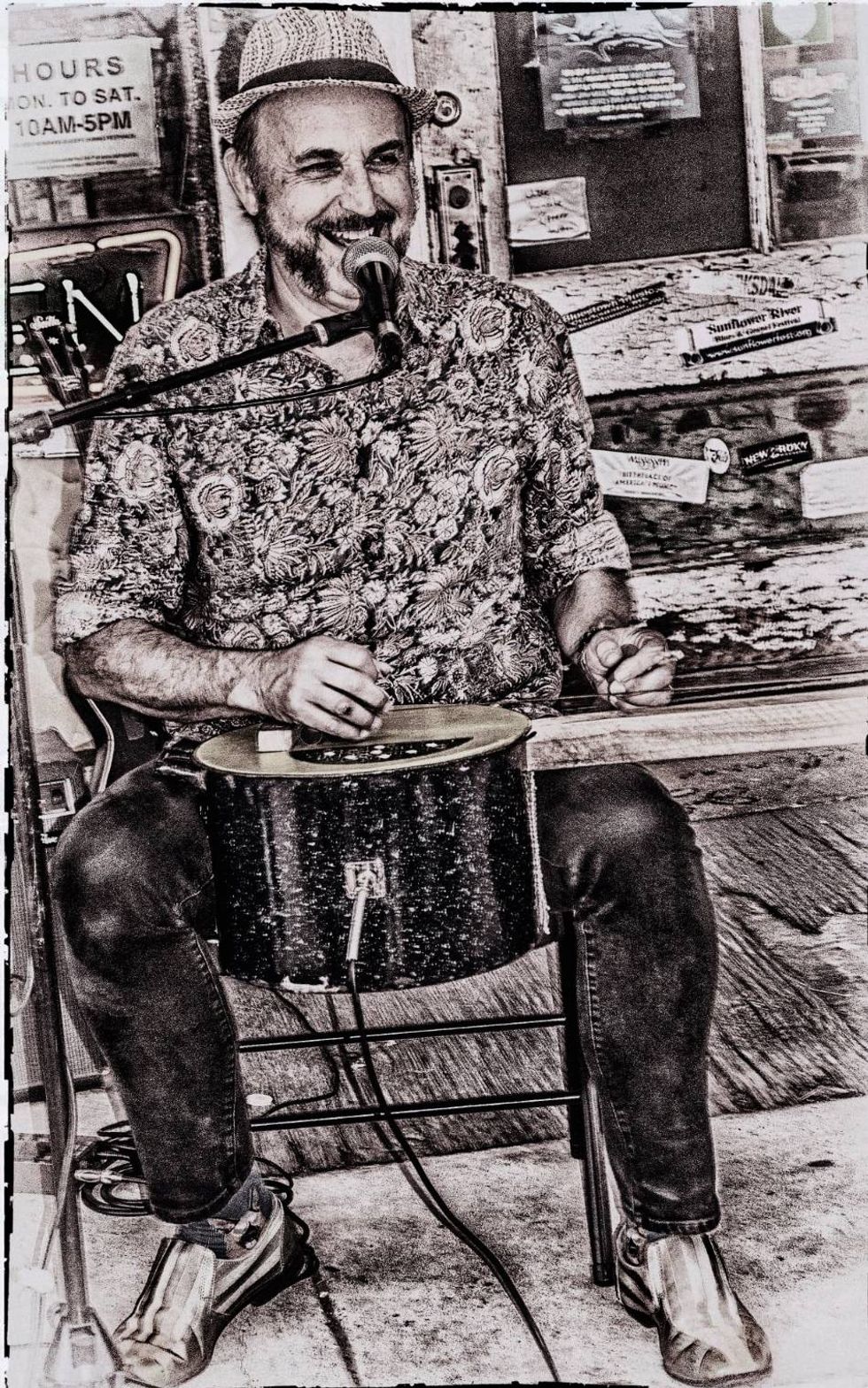
Derek Rader
A: My answer … maybe. What motivates you to play and perform is worth the money within a person’s means. If a vintage guitar price isn’t unobtanium, and it has the feel, sound, and mojo, then it’s an emphatic yes! However, a myriad of luthiers and custom shops can provide a similar experience with modern production methods, materials, and electronics, at a lower cost, and the comfort of a warranty. There isn’t a wrong choice if the purchase is motivated by what drives you to play and write music that created the spark to pick up your first guitar.
Obsession: Music theory! A definite area for improvement, and I’m working with the talented Mr. Cris Eaves to improve as a player. Amazing journey!
Contributing Editor
Ted Drozdowski
A: I used to be dismissive about vintage gear until Ronnie Earl let me play his ’64 Strat years ago. I instantly sounded and played better. Now, I treasure my vintage instruments: a ’68 Les Paul, a ’58 Special, a ’72 Super Lead, a ’64 Supro Tremo-Verb, and an original Maestro Fuzz-Tone. Nothing sounds quite like these originals. That said, I can’t imagine spending six digits on a guitar—even if I had that much cake—unless I was also giving a lot to charity.
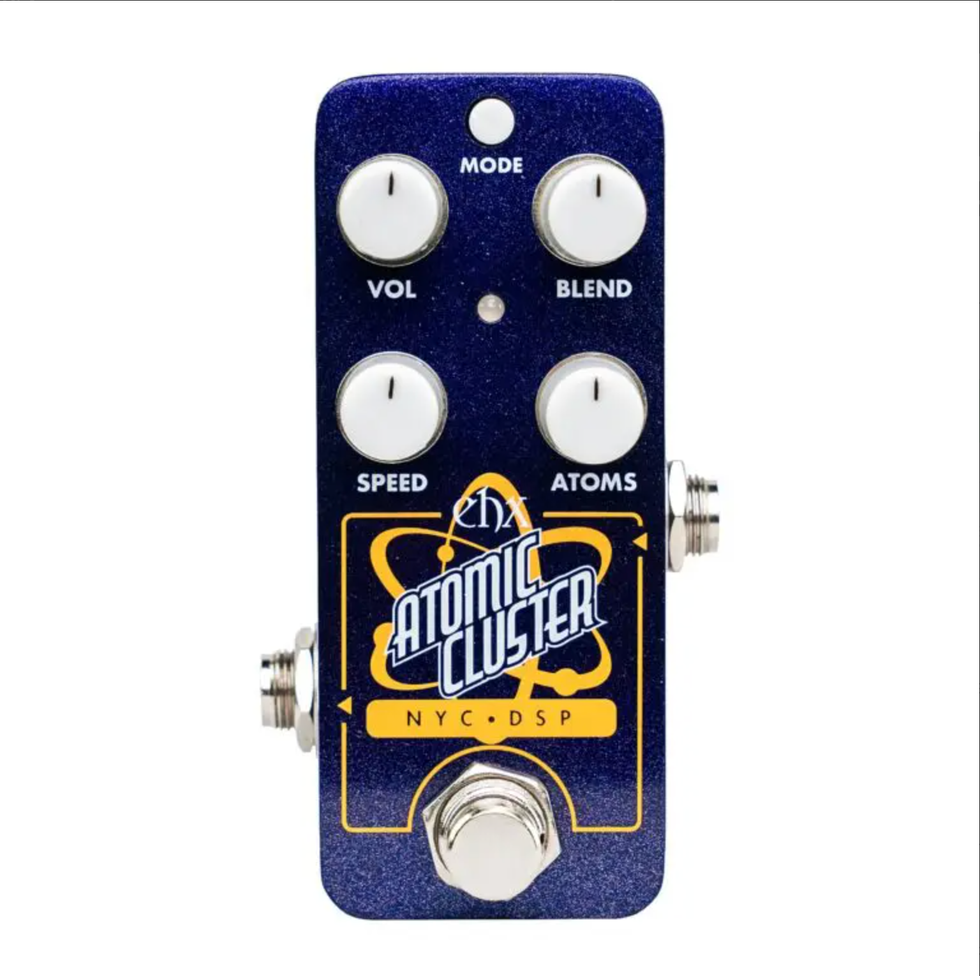
Obsession: EHX’s new Pico Atomic Cluster Spectral Decomposer. It’s full of sounds I’ve been looking for!

Gear Editor
Charlie Saufley
A: Vintage-or-not is a completely case-by-case thing, and there is no one criteria by which to judge the worth of an old instrument. Depending on your musical needs and manner of expression, some old things that have since been digitized don’t cut it in compact form. For instance, I’m tired of paying to fix my Echoplex EP-3, but I haven’t found a digital alternative that I can physically manipulate in the same way. Three little clustered dials just aren’t going to work or feel like the EP-3’s record-head slider/lever and the perfectly spaced sustain and volume knobs—not to mention the tape irregularities.
Vibes are a real thing too, though. I’m no less psyched when I play something I like on a brand-new Squier. But I also know that engaging with my old guitars and amps is a different kind of fun. It’s just like driving a car from the 1950s or 1960s. The right ones—in addition to feeling as comfortable as old, worn baseball gloves—exude a sense of history and travel and secret stories that appeal to a sentimentalist like myself, and those sensations spark my imagination in ways I can’t put a price on.
Obsession:
Inventing a melody, slowing it down—way down—and fitting a new melody in the spaces in between.
Home Front’s Post-Punk Call to Arms

When he was 10 years old, Graeme McKinnon walked into a pawn shop near his home in Edmonton, Alberta, and bought his first guitar for $50. It was a sharp-angled, all-black axe made by the Japanese company Profile as a low-cost imitation of a Jackson, with a knife-like headstock that jutted curiously upward.
“It looked like a reaper’s scythe,” McKinnon says, recalling the way he’d carry it around town in an awkwardly shaped gig bag. “Everyone thought I had a hunting rifle.”
It was the early ’90s, in the thick of the Seattle grunge movement, and McKinnon’s older cousin would often come over and play him Pearl Jam songs, which he didn’t really like. But when his guitar teacher showed him the Ramones, something unlocked in the youngster. As he improved his chops, McKinnon and his older brother, a bassist, would jam Dead Kennedys and Beastie Boys songs together. McKinnon was hooked on punk rock. “That’s how I cut my teeth,” he says. “The downstrokes from the Ramones stuck with me forever. I always practiced my right hand.”
Fast forward 30 years, and today McKinnon is one half of the post-punk duo Home Front, one of the most hyped-up bands to emerge from Canada in recent years. And the outfit’s new album Watch It Die should earn them a spot on the Mount Rushmore of the current post-punk revival, alongside other breakouts like Fontaines D.C., Idles, and Viagra Boys.
In 2021, McKinnon’s hardcore punk band No Problem was on hiatus and he was looking for a new outlet. That’s when his childhood friend Clint Frazier, previously a member of the electro dance-punk outfit Shout Out Out Out Out, asked him to start a synth-driven band.
“The downstrokes from the Ramones stuck with me forever. I always practiced my right hand.”—Graeme McKinnon
The style that they created combines the jangly sheen of synth-pop, the sneering attitude of old-school punk rock, and the hard-stomping force of oi! and hardcore. The band nicknamed it “bootwave,” a reference to the distinct sound of winter boots marching on ice-crusted snow or the cold concrete of the streets of Edmonton. “Our sound has this duality,” McKinnon says. “There’s the punk side, there’s the synth side, and it’s always these two forces.”
“We’re just trying to find enough space in the songs to do both of them well,” adds Frazier. “I’ve been trying to do that for over 20 years.”
Graeme McKinnon’s Gear
Guitars
Fender Classic Series ’72 Telecaster Deluxe (with new humbucker and graphite saddles)
1979 Gibson Marauder (with P-90 pickup and kill switch)
Hagstrom Viking
Basses
Fender Steve Harris Precision Bass
Fender Bass VI
Guitar Amps
1979 Marshall JMP
Hiwatt Custom 50
Marshall 4x12 cabinet
Bass Amps
Peavey Super Festival Series F-800B
Peavey Roadmaster Vintage Tube Series
Ampeg 6x10 cabinet
Effects
Roland SDE-3000
MXR Carbon Copy
EHX Holy Grail
Van Hall fuzz
MXR Analog Chorus
Various Pro Co RAT models
MXR Blue Box
Strings & Picks
Ernie Ball Regular Slinky (.010–.046) (Telecaster)
Ernie Ball Power Slinky (.011–.048) (Marauder)
Ernie Ball Regular Slinky (.045–.130), unchanged since 2019 (bass)
Dunlop .73mm picks

Watch It Die follows Home Front’s full-length debut, 2023’s Games of Power. That album earned them positive press from some of the indie-rock scene’s key tastemakers, and it was longlisted for the Polaris Music Prize. The band hit the road hard to support it, embarking on multiple tours of the U.S., the U.K., and mainland Europe, including dates with punk veterans like Dillinger Four and Cock Sparrer, as well as fellow newcomers the Chisel and High Vis.
Like its predecessor, Watch It Die is a record that posits that life is hard, the world is cruel, and it’s easy to feel powerless to make any difference. It’s a headspace that stops just a few yards short of nihilism. But this time around, McKinnon and Frazier are channeling something else, too: hope.
“Our sound has this duality. There’s the punk side, there’s the synth side, and it’s always these two forces.”—McKinnon
“I was using a metaphor of a flower being picked and becoming an ornament in someone’s place, and it’s slowly dying,” McKinnon says. “The secret, the bit that brings a little bit of hope, is that the seed is still in the ground. They can’t see it and they can’t steal it. You watched this part die, but underneath, there’s something else.”
With his previous bands, McKinnon had approached his instrument in much the same way he had since he was a kid: Ramones-style power chords and fast-and-furious downstrokes on his trusty Fender ’72 Telecaster Deluxe. With Home Front, McKinnon had to rethink his playing so that it could coexist with Frazier’s ordnance of analog synths and drum machines.

He looked for inspiration from bands he had always loved but hadn’t previously channeled: England’s ’80s post-punk and new wave exports like New Order, Joy Division, Depeche Mode, the Cure, A Flock of Seagulls, and Blitz. But he wasn’t just looking to do what they did; instead, he wanted to bring his hard-nosed punk style to the mix. “If the electronics are covered, then maybe the play is to bring that punk attack to the guitar to accent the synths,” he says.
On Watch It Die, McKinnon played almost everything through a 1979 Marshall JMP, giving him bright, saturated power chords that tracked well whether he was palm muting or fully strumming. The main exception was a cigar box amp made by a friend who works at an auto shop. It was miked close and cranked, giving them the trashy ’70s punk sound on “Young Offender.”
McKinnon used his Telecaster for most of the record, but he also brought out a 1979 Gibson Marauder with a swapped-in P-90 pickup, which he coupled with a German-made Van Hall fuzz pedal to find the nasty, scooped-out tone that appears on some of the record’s more straight-ahead punk songs like “Young Offender” and “For the Children (F*ck All).” On the new wave jams “Kiss the Sky” and “Between the Waves,” he pulled out a Hagstrom Viking that engineer Nik Kozub recorded by miking the semi-hollow body itself, giving the songs a thin, percussive jangle without having the low end of a proper acoustic muddying the mix.
For McKinnon, it was important to get his palm mutes sounding clean and punchy, and to have them perfectly aligned with the synth arpeggiators—even when he’d add swirls of reverb and delay in his chain. Enter his secret weapon: an old Roland SDE-3000 digital delay that he got from the TV studio where he works. McKinnon and Frazier used its BPM-sync function to dial it in to precisely match the tempo of the drum machines.
McKinnon also records all of the bass lines for Home Front. That, of course, comes with its own military-grade arsenal. On “Empire,” he pulled out all the stops. For the grand finale, he chained the Van Hall into a fully cranked Pro Co RAT, into the MXR Blue Box octave fuzz, and finally into a dimed-out Peavey Super Festival F-800B. It was “the nastiest fuzz bass I’ve ever played,” he says, creating a wall of sound inspired by My Bloody Valentine. Frazier accentuated that enormous gain-fest with eighth-note Roland 808s that he painstakingly tuned, note by note, so that each kick would follow the bass line, creating a pulsating effect that makes rhythmic sense of McKinnon’s fuzzed-out chaos.
That is, fittingly enough, the thematic throughline of Watch It Die: making sense of the madness. “Our lives are chaos all the time,” says McKinnon. “We have jobs that are going to end at any moment. The rent is too high, the groceries are too expensive, all these stresses, and then every time you open up your phone, there’s atrocities in the world. There’s shit your government’s doing, police breaking families apart, this is stuff you’re constantly thinking about, and it’s always hitting you.”
But Home Front aren’t just going to wallow in their sorrows. “On this record, I didn’t want to sound like, ‘Shit’s bad. I’m just gonna be kicking rocks,’” McKinnon continues. “It’s more like, ‘Shit’s bad, but this is how we’re gonna work through this, by having outlets that allow us to form like Voltron to terrorize the oppressors.’” PG
Megadeth’s Dave Mustaine reveals hand condition making it “really painful to play”

Dave Mustaine has revealed that a hand ailment that makes playing “really painful” is the main reason behind Megadeth’s decision to call it quits after their final album and farewell tour.
Earlier this August, the thrash metal legends announced plans to release a final self-titled record in early 2026, followed by a global farewell tour that will take the band across North America, Europe, and back.
Speaking with MariskalRockTV about his condition, Mustaine says that he noticed growing discomfort in his hands while working on the band’s new record.
“I just said one day to my management, ‘You know, I don’t know how much longer I’m gonna be able to do this,’” the Megadeth leader recalls. “I didn’t say, ‘Hey, I wanna retire right now.’”
The 62-year-old explains that Dupuytren’s contracture – a condition that causes a thick cord of tissue to form in the palm, bending one or more fingers toward the center of the hand – is affecting his hands to the point where playing the guitar has become extremely difficult.
Holding up his hand for the interviewer, Mustaine showed how the disorder is already affecting him. “It’s gonna make my finger come down like this,” he says. “It’s already started, where it’s kind of bunching up a little bit. And then if you look at the tips of my fingers, they’re severely arthritic. So all those bumps make it really painful to play.”
While he plans to undergo surgery to address the condition, Mustaine is waiting until after the farewell tour to avoid any setbacks.
“If I wait until my hands are causing a problem and I try it and it doesn’t work, well then I’ve toured everywhere, I’ve said farewell everybody and am not leaving stuff unsaid or unfinished,” he says.
Check out the full list of tour dates at the Megadeth website.
The post Megadeth’s Dave Mustaine reveals hand condition making it “really painful to play” appeared first on Guitar.com | All Things Guitar.
Wolfgang Van Halen on stepping out of his father’s shadow: “I’m happy that people are beginning to take me seriously as my own artist and separate me from my family history”

Carving out your own identity in rock is tough – even more so with the Van Halen name hanging over your head.
Wolfgang Van Halen has spent years stepping out of one of rock’s biggest shadows, and in a recent interview with Chile’s Radio Futuro, the Mammoth leader slash Van Halen alum opens up about the challenges and freedoms of forging his own path, and the satisfaction of finally being taken “seriously” as an artist in his own right.
Asked what it feels like to be recognised for his own musical accomplishments, Wolfgang says [via Blabbermouth], “It’s pretty great. I’m very lucky and happy that people are beginning to take me seriously as my own artist and separate me from my family history. ‘Cause at the end of the day, that’s all I would really like to do, is be taken at face value for what I represent and not for what my family represents. And I think that’s why I’m trying to do something different.”
“I don’t play Van Halen music at my shows,” he adds. “I would rather fail on my own than succeed by playing Van Halen music. So I think it just shows the work that I’ve been putting in and people beginning to see the person I am on my own. So I’m very grateful.”
Still, the musical connection to his father runs deep. As Wolfgang explains, both he and Eddie “started on the drums”, which gave them a “great sort of rhythmic background to the foundation of being a musician”.
“And so I think we both attack guitar playing from a rhythmic perspective,” says Wolfgang. “And so I think that’s a really great thing that my dad and I have in common. And I’m very happy to have that in common with him.”
Elsewhere in the interview, Wolfgang also praises the growing presence of women in rock, saying “It’s awesome… I think it’s an archaic mindset to think that women can’t be in rock and roll.”
“I mean, I think one of my favorites out there right now is a very close friend of mine, Lzzy Hale of Halestorm. I think what she’s doing is incredible, and she’s one of the best singers out there. And also, yeah, the drummer that they’ve got for Rush [Anika Nilles] is incredible. I can’t wait to see what the shows are gonna be like. I remember I watched some of her videos on Drumeo, on the YouTube channel, and she’s just absolutely insane. No wonder they picked her… [Linkin Park’s Emily Armstrong], she’s badass as well,” says Wolfgang.
Mammoth is currently riding the wave of their third album, The End, which they celebrated with a headline tour that wrapped up earlier this month.
The post Wolfgang Van Halen on stepping out of his father’s shadow: “I’m happy that people are beginning to take me seriously as my own artist and separate me from my family history” appeared first on Guitar.com | All Things Guitar.
“It was rough being bullied by our favourite bands”: Matt Heafy opens up on their rough early touring experiences

Breaking into metal can be brutal, as 39-year-old Matt Heafy will tell you from experience. Long before Trivium settled into their role as one of the genre’s most reliable headliners, the band’s early success made them a target, drawing hostility not just from fans, but from some of the very bands they grew up idolising.
- READ MORE: Trivium’s Matt Heafy names the five up-and-coming metal bands everyone needs to watch in 2026
Speaking to Guitar.com in a new interview, Heafy looks back on the period surrounding 2005’s Ascendancy, the breakout album that positioned Trivium as metal’s next big thing. Despite the magazine covers and blockbuster tours, the band quickly learned that success came with its own harsh lessons.
“It was rough being bullied by our favourite bands, and by their fans,” Heafy recalls. “We got bottles thrown at us [while onstage]. People tried to accost us by our van.”
He adds, “We were on tour with Lamb of God, Machine Head and Gojira in 2006, and we had our sound guy walk out on us. I was going to our bus and some guy said [sarcastically], ‘Good show,’ and flipped me off and walked off.”
Those early battles left Heafy determined to do things differently. Rather than perpetuating the same hazing culture, the frontman is now a vocal supporter of new metal acts, regularly inviting younger bands out on tour with Trivium and using his radio show to spotlight emerging talent.
It’s a mindset that shapes how he views the scene today – and why he believes it’s in a healthier place for newcomers.
Reflecting on the current state of metal, he told Metal Hammer: “It’s a good time to be playing heavy music, man. It’s a good time to be a younger band, too. You’re not having to deal with as much of the bullshit that we had to deal with: there’s not this intense ostracisation, this intense cliquiness.”
The post “It was rough being bullied by our favourite bands”: Matt Heafy opens up on their rough early touring experiences appeared first on Guitar.com | All Things Guitar.
The pop-punk band Good Charlotte’s Benji Madden claims will be “the next Rolling Stones”

Good Charlotte’s Benji Madden believes pop-punk’s biggest chapter is still being written, and according to the guitarist, there’s one band with the power to follow in the enduring, stadium-filling footsteps of the Rolling Stones.
After seven years away, Good Charlotte returned this year with Motel Du Cap, their first new album since 2018’s Generation Rx. It marks the end of a long quiet stretch for the Maryland pop-punk veterans, who had largely stepped back from releasing music after that record and its accompanying tour.
Speaking to Guitar.com in a new interview, Madden shares his thoughts on what it takes for a guitar player to leave a lasting mark and why he doesn’t believe the era of pop-punk stadium bands is over just yet. When asked to name the most important guitarists in the genre, his number one choice came without hesitation.
“If I have to go number one, it’s Billie Joe from Green Day,” says Madden. “They’ve taken pop-punk all the way from clubs to stadiums and now a bunch of pop-punk bands have done – or will do – stadiums. You haven’t seen the last pop-punk stadium band. Green Day will be the [next] Rolling Stones, as they continue on and play stadiums all over the world.”
For Madden, Joe’s influence goes far beyond guitar tones or technical showboating. Instead, it’s about songs – and the ability to write music that embeds itself into culture.
“Again, it goes back to, ‘How can I become a guitar hero? How can I become a guitar player that’s remembered in time?’ It’s all about the songs,” Madden continues. “Billie Joe has his own feel, and his own journey, too. That would be the poster child to me, because they are a fixture in the culture of what people love and remember and associate with. That makes him a really important pop-punk guitar player.”
Good Charlotte’s latest album, Motel Du Cap, is out now. The band is also set to appear at the Slam Dunk Festival next May.
The post The pop-punk band Good Charlotte’s Benji Madden claims will be “the next Rolling Stones” appeared first on Guitar.com | All Things Guitar.
Squier Classic Vibe Custom Esquire review – “I was having so much fun I forgot all about the neck pickup”

$599/£449, fender.com
Whilst players from Beck, Gibbons, Cropper to Springsteen have chosen the single-pickup Fender Esquire as their six-string of choice over the years, many players still prefer a Telecaster’s broader tonal palette courtesy of its dual pickup format.
But can that still work when that magic is distilled into something a lot more humble than the guitars that those icons were using? Well, Squier’s latest addition to the impressive Classic Vibe range aims to make you a believer…
 Image: Adam Gasson
Squier Classic Vibe Custom Esquire – what is it?
In addition to having considerably more naming designations than it does pickups, the Squier Classic Vibe Custom Esquire eschews the blue-collar simplicity of what most of us would associate with the Esquire look for a classier double-bound early 60s custom colour look.
You get a poplar body and a maple neck with an Indian laurel fretboard – as is the norm for the Classic Vibe range – plus a single alnico single-coil pickup with a three-way selector switch (more on that later).
The Esquire is available in Candy Apple Red or the classy Sherwood Green you see here. It’s not often that a guitar unboxing gets all heads in the room turning – especially at this price point – but there can be no doubt that this Squier Esquire is a looker.
However, like a nightclub bouncer in a dinner jacket, looks can be deceptive; underneath the West Coast hot rod look, is there a bruiser waiting to be unleashed?
 Image: Adam Gasson
Squier Classic Vibe Custom Esquire – build quality and playability
With its double-bound body, the retro-feeling slim C-ish neck profile and 21 vintage-sized frets, it all adds up to a 60s Fender playing experience in the hand – there’s even a subtle hint of flame to the back of the neck, adding to the ‘how much?’ vibe.
The single Fender-designed alnico single-coil bridge pickup has controls for volume and tone, but also a 3-way selector. Why? Well, thanks to some clever wiring, position one has a capacitor to give a dark pseudo-‘neck’ tone, the middle position has the tone and volume controls connected and having the selector all the way back bypasses the tone control for a subtle lift in output and top end.
 Image: Adam Gasson
Squier Classic Vibe Custom Esquire – sounds
Plugging in, and instantly the drawback of that single pickup is felt. Unfortunately, to my ears, the pseudo neck position is just too dark and woolly to be usable in most musical contexts. It’s not the end of the world, however – there are plenty of simple wiring mods you could make to the capacitor value to change this should you be handy with a soldering iron, though I can’t really understand why Fender would persist with this as the default.
Getting to the good stuff, however, the Fender-designed single-coil pickup at the bridge is a sweet and punchy-sounding pickup, bright without being abrasive, offering plenty of snap and clarity to notes with cleaner sounds and a powerful punky snarl with more gain. Select the ‘middle position’ dial the tone control back and a mellower tone that contrasts well to the straight-ahead bridge sound emerges, and select the pickup alone in position three ups the brightness and output a touch, pure BFG, pure rock ‘n’ roll and loads of fun, offering more versatility than the single pickup initially suggests.
 Image: Adam Gasson
Squier Classic Vibe Custom Esquire – should I buy it?
I thought I’d miss those genuine neck pickup and middle position Jimmy Page Tele tones; however, the straight-ahead bridge sound, especially the snarling aggressive vibe of the bypassed tone control setting, meant I was having so much fun I forgot all about them!
This is a seriously cool guitar, head-turning elegant looks, retro feel, and tons of 60s Americana vibes. And it has some seriously good tones, too. For this price, you’d be crazy not to take a look.
 Image: Adam Gasson
Squier Classic Vibe Custom Esquire – alternatives
For more classic single-pickup action, a good P-90-loaded guitar is a must, and the Epiphone Coronet ($449/£379) is a lot of guitar for the cash. Alternatively, for a wallet-conscious take on a Gibson classic, there’s the Sire Larry Carlton L3 P90 ($459/£279). For heavier music with the stripped-down simplicity and a cool range of colours, the humbucker-loaded Squier Sonic Esquire H ($230.99/£159) is a tempting proposition.
The post Squier Classic Vibe Custom Esquire review – “I was having so much fun I forgot all about the neck pickup” appeared first on Guitar.com | All Things Guitar.
Source Audio Encounter Review
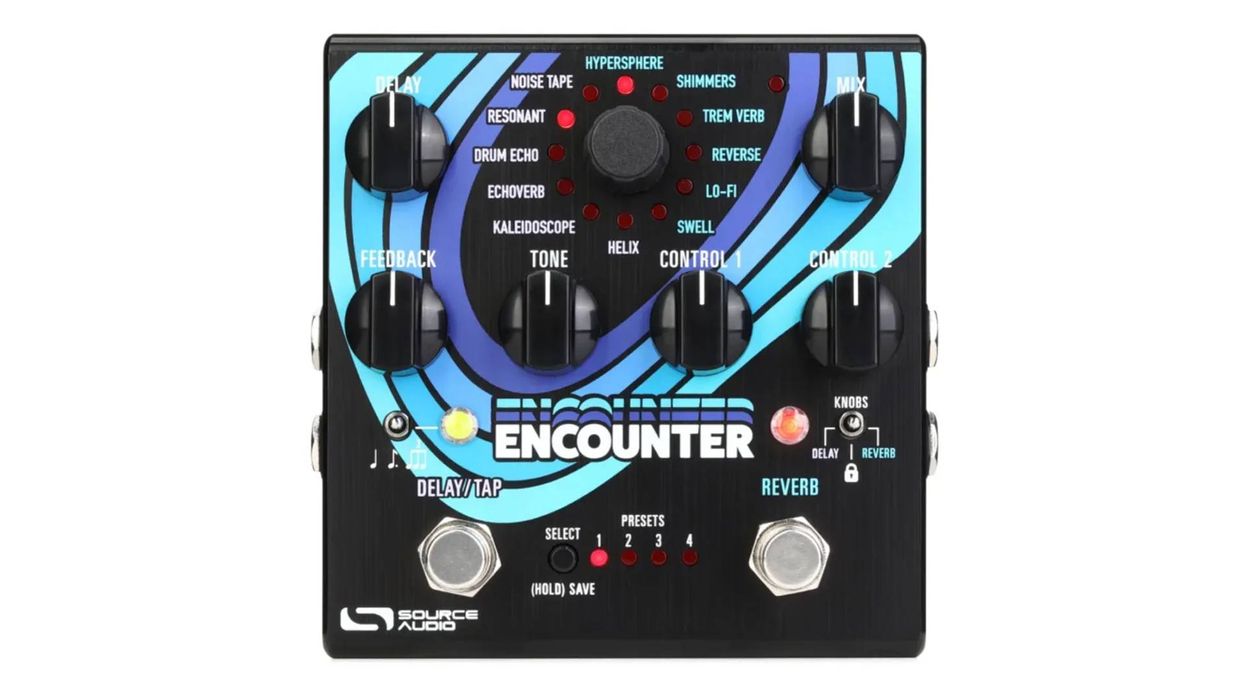
Reverb and delay. What two effects are better suited to live side-by-side in one pedal? Source Audio’s new Encounter reverb and delay is a mirror image of the company’s Collider, which explores the reverb/delay combo via a vintage lens. The mirror by which Encounter reflects the Collider, however, is more like the funhouse variety. There are many psychedelic, cosmic, and wildly refracted echoes to utilize in the Encounter. There are lots of practical ones that can be tuned to subtle ends, too. But Encounter’s realm-of-the-extra-real extras make it a companion for players that ply dreamy musical seas. It’s incredibly fun, a great spark for creativity, and, most certainly, a place to lose oneself.
Exponentially Unfolding
Of Encounter’s six reverb modes and six delay modes, four of them—the hypersphere, shimmers, and trem verb reverbs, and the kaleidoscope delay—are entirely new. Hypersphere, fundamentally, makes reverberations more particulate. Source Audio says it’s a reverb without direct reflections. In their most naked state, these reverberations can still sound a touch angular and perhaps not quite as ghostly and fluid as “no direct reflections” suggests. But they are still complex, appealing, immersive sounds. Odd reverberation clusters can conjure a confused sense of space and highlight different overtones and frequency peaks in random ways. At settings where you can hear this level of detail, hypersphere shines, particularly in spacious solo phrases. Hypersphere also features phase rate and pitch modulation depth functions via the control 1 and control 2 knobs, and they can further accent and enhance those frequency peaks, creating intoxicating, deep fractal reflection systems.
“Blends of the delay and reverb are the kind of places where you can lose track of a rainy day.”
The new trem verb mode can be practical or insane. The two effects together are a pillar of vintage electric guitar atmospherics. But the Encounter’s trem verb explodes those templates. As with the hypersphere mode, trem verb can zest simple chord melodies by using extreme effect settings at low mixes, where chaotic, half-hidden patterns dip in and out of the shadows, sometimes creating eerie counterpoint. But I loved trem verb most at extremes—mostly high mix, feedback, and decay settings with really slow modulation. Sounds here can be intense and vague—like strobe flashes piercing drifting fog. It might not be an ideal place to indulge fast, technical fretwork, but it’s a wonderland for exploring overtones, drone, and melodic possibilities.
Incidentally, the trem verb is a great match for the six delays, and the new kaleidoscope delay in particular, which fractures and scatters repeats in a million possible directions and spaces. Blends of the delay and reverb are the kind of places where you can lose track of a rainy day. The sound permutations often seem endless, and finding magic can take some attention and patience. But you can strike gold fast, too. You have to take care to save settings you really love (you can store as many as eight presets on board, and 128 total via midi) because it’s hard to resist the urge to meander through— and meditate on—hours of sound without stopping. Not all of the Encounter’s sounds are perfectly pleasing. Some combinations reveal peaky little chirps that betray digital origins—the merits of which are subjective and contextual. For the most part, though, the combined sounds are liquid and vividly complex, and can be especially enveloping at high mix and feedback.
Extended Reach
If the onboard controls don’t get you in enough trouble, downloading the Neuro 3 app, which unlocks deep control and functionality, is a minor wormhole. Take the case of trem verb—you can use Neuro 3 to change the wave shape or set up the reverb to affect the wet signal only, just the dry signal, or both of them. All of these changes open up a new system of tone caves as the sound evolves. If you’re deep in the nuance of a mix or arrangement, this functionality can be invaluable. And it’s a boon if you have nothing but time on your hands. In a state of engaged, intuitive workflow, I like to avoid these kinds of app dives. But having that much extended power on your phone or computer is impressive.
Neuro 3 extends the capability of the Encounter in other ways, too. The SoundCheck tool within Encounter is home to prerecorded loops of various instruments that you can then route through a virtual Encounter pedal. That means you can explore Encounter’s potential while stuck in a train station. It’s a real asset if you want to understand the pedal as completely as possible, and certainly a way to extract the most value from the unit’s considerable $399 price.The Verdict
About that price. It looks steep. For most of us, it’s a significant investment. But when I consider how many sounds I found in the Encounter, how compact it is, and the possibilities that it opens up in performance and portable production (especially when you factor in the stereo ins and outs), that investment seems pretty sound. I must qualify all this by saying I was happiest with the Encounter when exploring its spaciest places—the kind of atmospheric layer where Spacemen 3, ambient producers, 1969 Pink Floyd, and slow-soul balladeers all hang. But there is room to roam for precision pickers that background radical effects, too.
Still looking to justify the cash outlay? Consider the Encounter as a portable outboard post-production and mixing asset. If you’re creating music built on big, shape-shifting ambience, it’s a cool thing to have in your bag of tricks. Different artists will mine more from the Encounter than others, so you should consider our ratings scores on a sliding scale. But as you contemplate the Encounter, be sure to factor in mystery paths that will beckon when you dive in. There’s lots of fuel for creation along most of them.
On the Bench: 1959 Fender 5F1 Champ
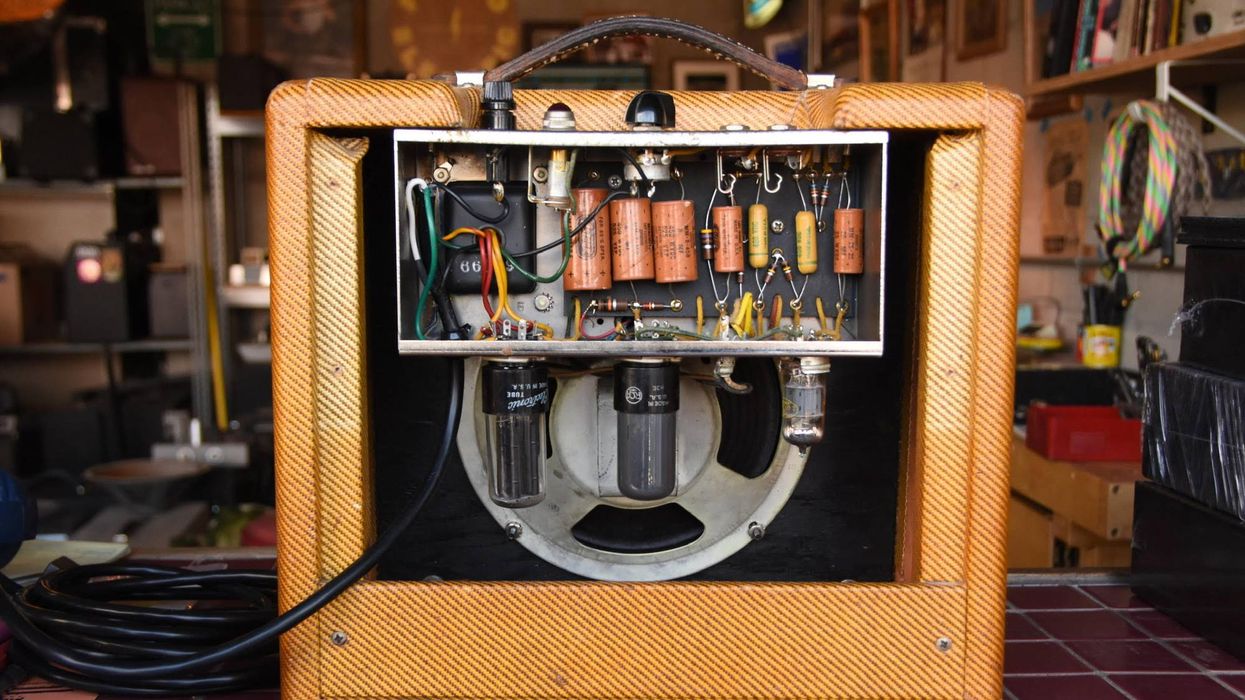
There is an element of time travel in opening up an amp to find original circuitry from decades prior. As an amp repair technician, there are few things better than finding that circuit untouched. And that feeling is enhanced when the amp has sentimental value.
In this case, I received a 1959 Fender 5F1 Champ that belonged to my client’s grandfather, who used it along with his Fender Champion lap steel guitar. He was a Polish immigrant who worked in the coal mines of Pennsylvania and enjoyed teaching himself a range of subjects from mathematics to music.
The 5F1 “narrow-panel” Champ was produced from 1956-1964. All of the tweed-era amps were special, but the 5F1 is a quintessential amp of that period. It’s a simple circuit, with only one volume control. This is as pure as it gets, allowing the unfiltered guitar signal to really breathe through the speaker and into our ears.
When you think about early rock ’n’ roll, and that warm and crunchy guitar tone, you’re hearing a tweed Champ. Eric Clapton, Joe Walsh, and Keith Richards were all known to use a 5F1 in the studio. At low volumes, a guitar sounds smooth and rich. As the amp’s volume gets cranked, it starts to growl, filling the room with pure grit.
“It was customary for the amp’s builder to sign their name on this piece of tape, and in many cases during this time, the builder was a woman.”
At first glance, I was impressed with the overall condition of the amp. The tweed and grill cloth are in beautiful shape, with barely any flaws. Opening up the amp only entails the removal of 4 screws. I held my breath as I placed the asbestos-lined panel—which was meant to act as a heat shield—outside. I then sealed it with a clear lacquer, to avoid disturbing the material.
Immediately, my eye was drawn to the tiny piece of masking tape that had been placed inside the chassis. It was customary for the amp’s builder to sign their name on this piece of tape, and in many cases during this time, the builder was a woman. Sometimes that piece of tape is missing or illegible, but I was happy to see the name “Lily” clearly visible in this amp.
This Champ still has its original speaker, an 8" Oxford, which is dated the 3rd week of 1959. Sadly, but not surprisingly, the speaker did need a re-cone. Over time, it’s common for the paper cone to crack or tear, which was visually obvious in this case. If we were to put a signal through the speaker as it was, it would sound horribly blown.
The circuit itself is pristine, sporting all of the original components that had kept the amp alive for the last 66 years. The orange Astron filter and cathode bypass capacitors caught my attention as soon as I saw them.The filter capacitors are an important part of the amp, as they smooth or “filter” noise out of the power supply. Eventually, these capacitors dry out and can cause loud humming or other issues. The cathode resistor sets the bias for each cathode-biased tube, which, in the 5F1, includes the output tube. The cathode bypass capacitor works in parallel with this resistor to resurrect the gain and tonal color that tends to flatten out through this process. When these capacitors start to drift from factory specification, they can cause strange tone or signal issues.
It’s disappointing to have to replace parts on such an original specimen, but in order to make the amp usable and reliable, the leaky and drifted capacitors need to go. Thankfully, there is a way to preserve the aesthetic beauty of the orange Astrons and keep the amp appearing as original as possible. I carefully opened up each capacitor, removed the outer orange cardboard, and pulled out the capacitor itself, which is typically silver in color. I then installed the new, quality F&T filter capacitors inside of the original cardboard covering. I did the same with the bypass capacitors, using Sprague as a replacement.
This process takes a bit of finesse, but the results are worth it. There is nothing like seeing that orange color inside of a tweed Fender amp.
Safety standards have changed significantly since the 1950s. Instead of the original 2-prong power cord, I will always install a grounded 3-prong power cord. I will also remove the “death cap,” which is a capacitor connected from the AC power line to ground. These were originally used to reduce noise, but are completely obsolete with a grounded power cord. If this capacitor shorts, the chassis could become electrified, resulting in an unpleasant shock hazard. With the installation of a modern power cord and the removal of the “death cap,” the amp is safe to use.
After a basic service and tube install, I was finally able to hear the amp in its full glory. The owner and I agreed that NOS tubes would suit this beauty well. I happily tested the amp for a while, buttoned it up, and sent it on its way to thrive for another 65 years.
A Famous Drum Company’s First Electric Guitar
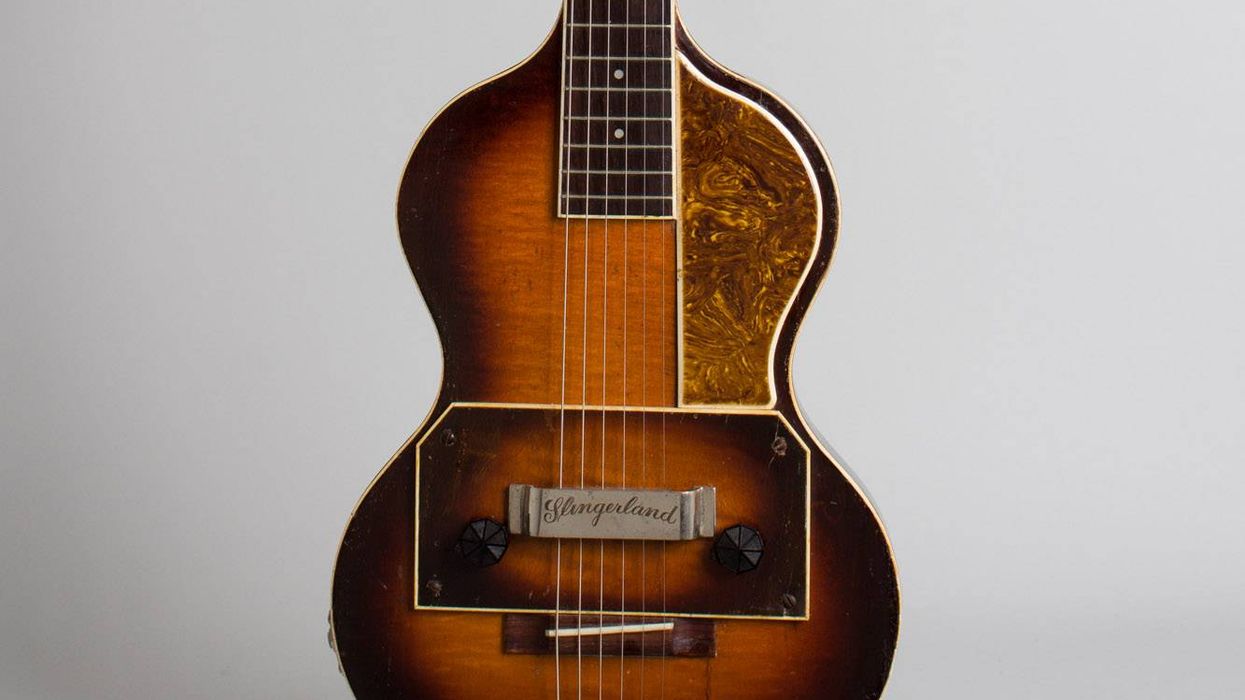
When you get into the history of the development of the electric guitar, you encounter a lot of famous names: Les Paul creating his “Log” from a 4x4 block and a Gibson neck, Paul Bigsby fashioning his ultra-modern solidbody for country legend Merle Travis.
Go deeper and you’ll read about pioneering brands like Rickenbacker, Epiphone, Vega, Volu-Tone, and Vivi-Tone, all of which helped bring the dream of the electric guitar to life. But one name you seldom see? Slingerland.
Yes, Slingerland.
Although best known these days as a drum brand (thanks to the success of its 1930s Radio King set), back in the 1920s Slingerland was actually the king of cheap banjos. It was only after the success of the banjos that it moved into drums, then acoustic guitars, and soon thereafter, a giant leap forward for electric guitars.
The Slingerland Songster Model 401, created in 1936, was in many ways the first solidbody electric guitar that most of us would recognize as a modern instrument. Serial #132, up for sale now on Reverb via Retrofret Vintage Guitars, is our featured pick for this edition of Vintage Vault.
That’s not to say this model was the first. By ’36, there were many companies affixing pickups to otherwise acoustic archtops and flattops. Rickenbacker had made its frying pan lap steel way back in ’31, and had issued a solid, plastic-bodied Bakelite Electro Spanish guitar in 1935.
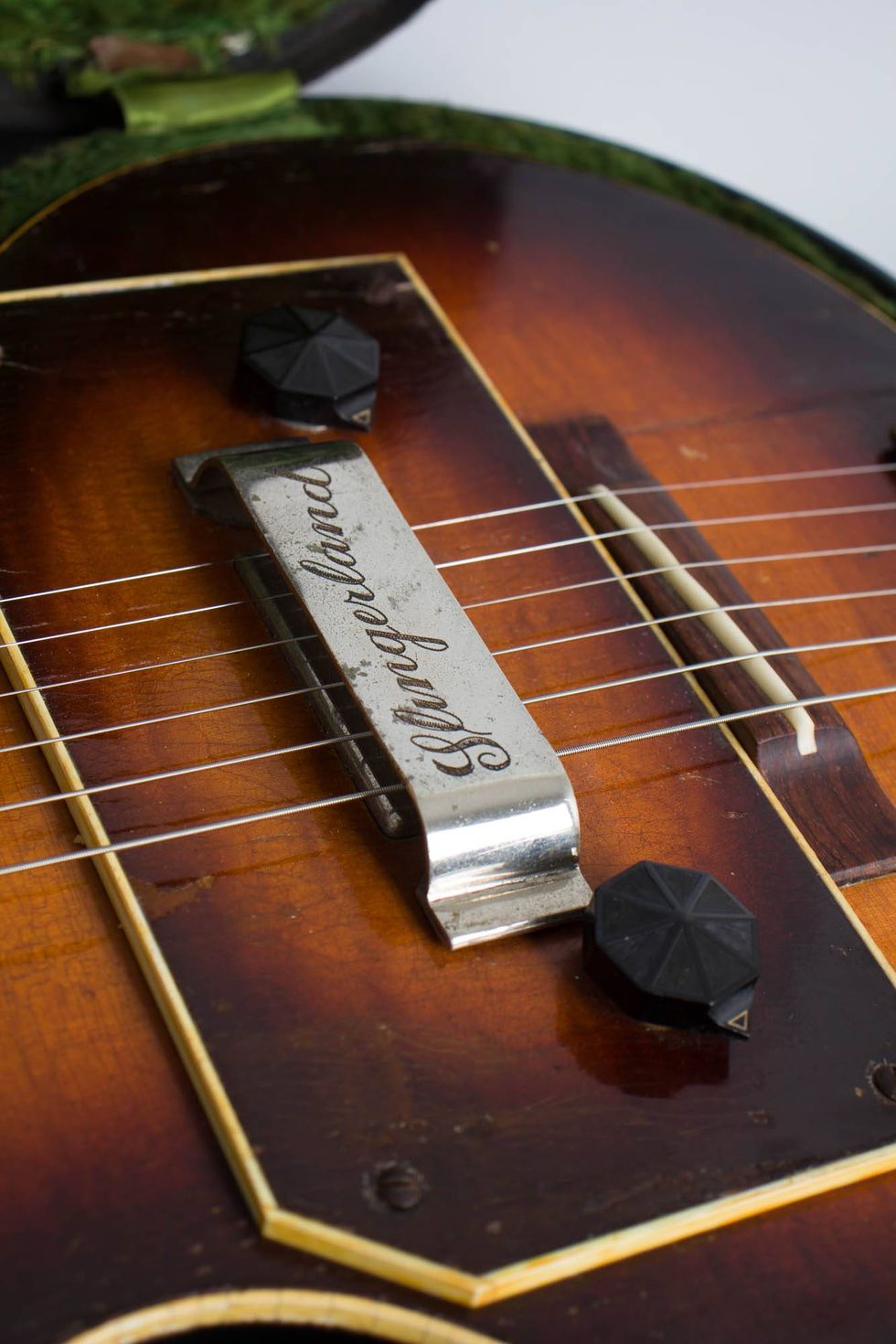
But the Songster Model 401 was the first solidbody electric guitar to be made out of solid wood, which is a fairly important distinction. In an era of electrified archtops, aluminum Hawaiian steels, or Rickenbacker’s plastic Electro Spanish, the Model 401 was a beautiful, slightly hefty instrument, one that would look right at home on a wall hook next to a Les Paul.
Built via neck-through construction, the round, D-shaped neck and the body itself were both made out of poplar, with a gorgeous flamed maple veneer on top with a sunburst finish. The rosewood fretboard has a comfortably fast 12" radius, and a 25" scale length.
Its body—15.25" long, and 11.5" wide at the lower bout—was revolutionarily small compared to the large archtops that dominated the guitar market, and is even svelte compared to a Les Paul. But at over 7 pounds and 6 ounces of solid wood in weight, it would’ve felt closer to a light Tele than any of its mid-’30s peers … if the Tele had been invented in time to compare.
“…the Model 401 was a beautiful, slightly hefty instrument, one that would look right at home on a wall hook next to a Les Paul.”
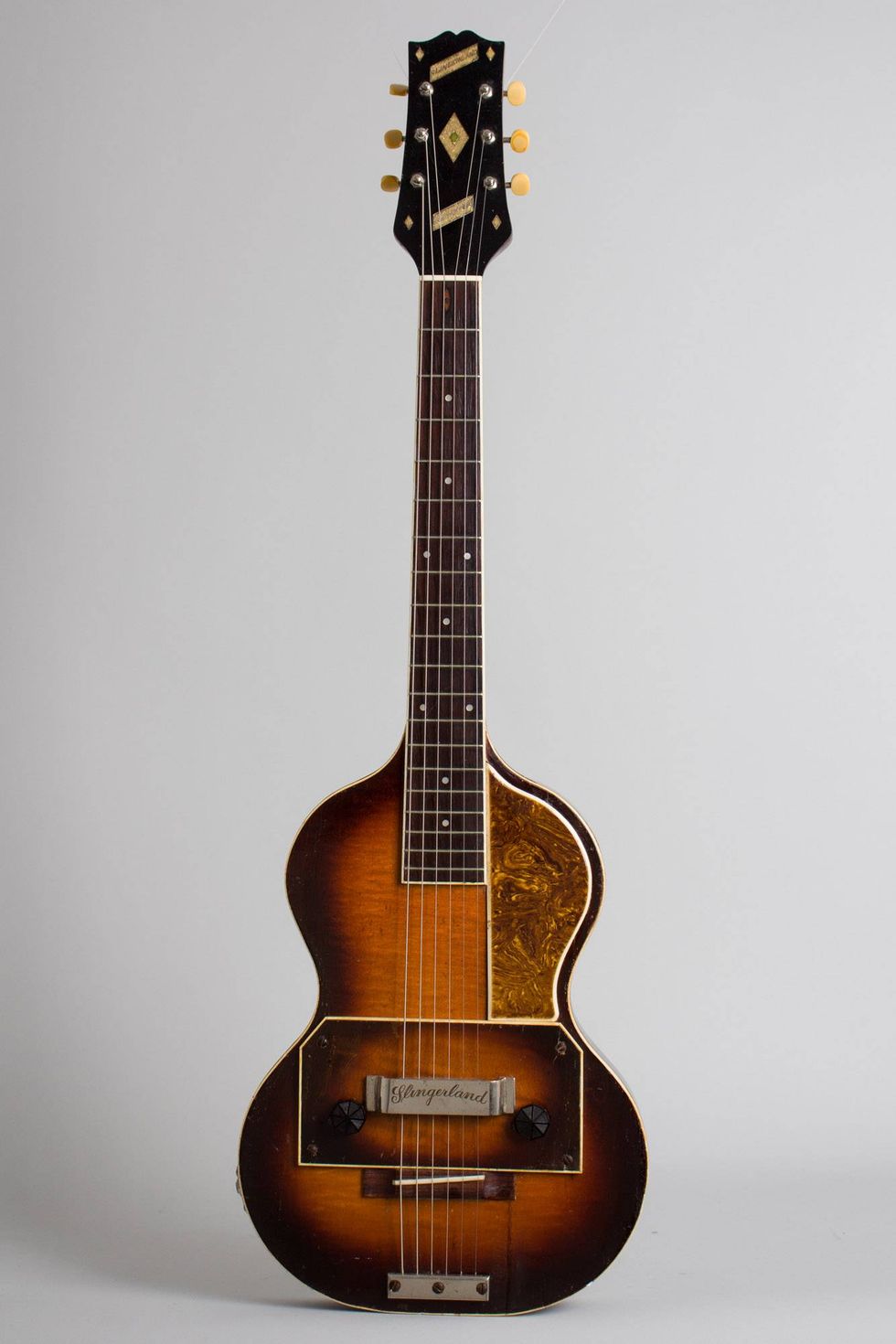
The Model 401’s pickup situation looks quite unique, but what you’re looking at is something akin to the Stratocaster’s pickguard: the Songster’s pickup, volume, and tone control all mounted onto one plate that is then secured to the body.
In The Pinecaster Collection, Lynn Wheelwright explains what’s happening under the hood: “The original Songster pickup had a unique design; it used six individual pole pieces—one for each string. Each elongated coil was divided into two sections of three coils with the coils connected in series.” These were energized by a horseshoe magnet. While not constructed the same, the effect was similar to a modern humbucker.
The 401, with its matching amplifier, was $135 at the time of its release, in line with other electrics of the era and a little more than $3,000 today if adjusting for inflation. Its solid wood construction, flamed maple top, and small body made it thoroughly modern, and it was, perhaps, too advanced for its time. By 1940, it had ceased production in its original form, only ever numbering in the dozens of units.
Today, you might expect them to be priceless. But you can actually find them for anywhere between its original inflation-adjusted price of about $3,000 to $9,000. Our Vintage Vault pick, listed at $5,950 at the time of writing, is not even the only one currently for sale on Reverb.
So if you want a piece of true guitar history, why not start with an early electric solidbody that won’t even feel that early in your hands?
Sources: The Pinecaster Volume 1: The Pioneers by Lynn Wheelwright, jayrosen.com, Reverb listings
Treasure Hunt: Inside Gibson's Certified Vintage Program
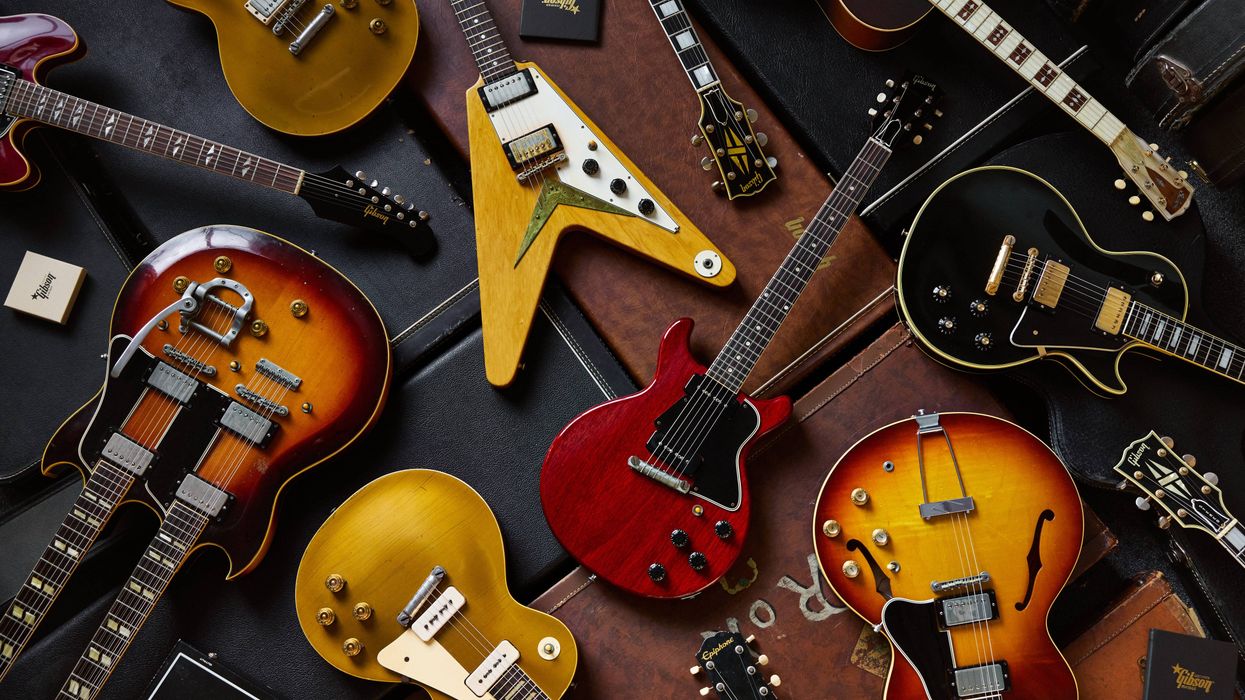
Gibson Certified Vintage isn’t just a place for the lucky few to buy a vintage guitar; it's a portal into the DNA of some of the most important instruments in history. Every level of the program is composed of people obsessed with acoustics, electrics, and basses. For a guitar to earn its Certified Vintage certificate, it has to be truly extraordinary.
Thankfully, the whole program is curated by someone who grew up with Gibson woven into the landscape and relationships around him.
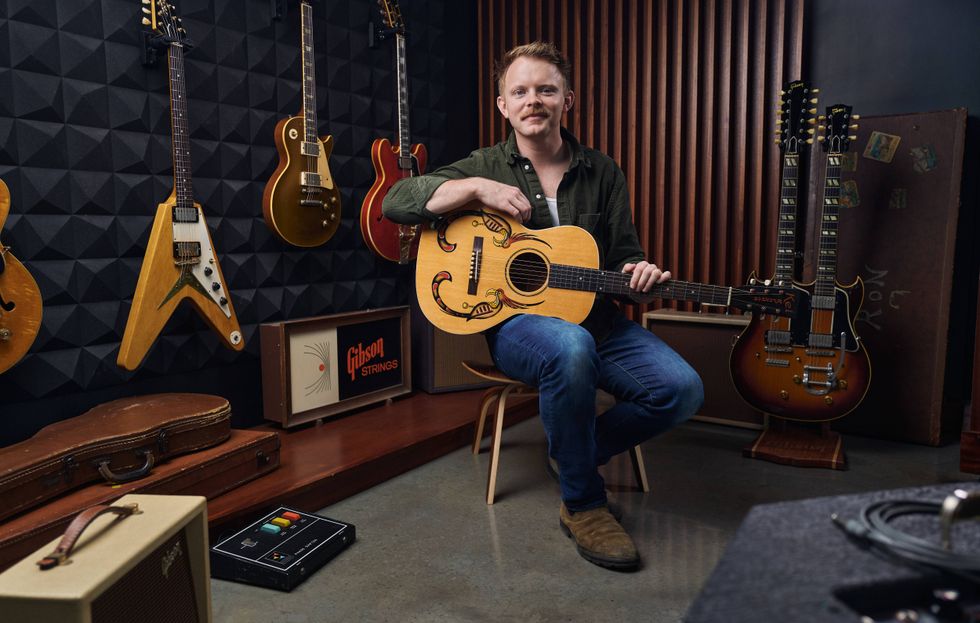
“I grew up in St Joe [Joseph], Michigan, about an hour southwest of Kalamazoo,” explains Mitch Conrad, Gibson’s Certified Vintage Manager. “And when my grandfather was in the military, a guy swapped his late ’40s blonde Gibson L-7 with him. That Gibson was permanently entrenched in my brain, and I was very fortunate for my grandfather to gift that guitar to me for my 18th birthday.”
This history set Conrad on a path that mixed curiosity, hustle, and deep respect for the past. After meeting Gibson VP of Product Mat Koehler while running a photography studio, the pair bonded over their shared passion for all things vintage. That connection led Conrad to Nashville and, eventually, to his current role.
"These guitars are built to last lifetimes, and being part of that journey really matters to us."
Today, he is responsible for finding, authenticating, restoring, and documenting the guitars that have shaped the company’s legacy. For Conrad and the Certified Vintage team, it’s all about honoring both the guitars and the people who play them. And from his process for unearthing hidden gems to his candid transparency around pricing, he didn’t hold anything back.
Recognizing that there are various outlets for vintage gear these days, what drove Gibson to create the Certified Vintage program?
Mitch Conrad: The vintage world can be a murky place to navigate. It can be hard for people to feel confident about what it is they’re adding to their collection. We really wanted to provide the best possible experience when buying a vintage Gibson or a Gibson-made instrument.
When we sell one of our Certified Vintage instruments, it comes with a certificate of authenticity. It comes with the letter of appraisal documenting anything and everything that we know about the instrument, in terms of its history and its provenance. It also includes a deep dive into all the bits and pieces. Even if the mounting screws that were originally on it corroded and rusted out, we’ll source a vintage-correct set and put them on. We’ll call that out.
And, as far as I’m aware, we’re the only ones [offering] a new, limited lifetime warranty. We want to send them back out with that same level of confidence that these instruments will make it another lifetime in the hands of their next caretaker.
Are you specific about the guitars you’re looking for?
Conrad: We want to find the best examples of these instruments. If you’re out on the hunt for a nice mid-’60s ES-335, there’s confidence in knowing that the model Certified Vintage has is a really great one.
But "best" is a little bit of a flexible term. For instance, we try to stay away from things that have been broken. Still, we’ll make an exception. We sold a killer 1958 Goldtop that had a headstock repair. But this guitar was incredible. It was not in museum-grade condition, but it was one of the best ’50s Goldtop, darkback, PAF-equipped Les Pauls that we’ve had around.
That one actually went to Slash. When I took it down for him to try out, he told me, “I really don’t need any more of these.” And then he plugged it in. He was like, “All right, I think I’ll take this one.” [laughs]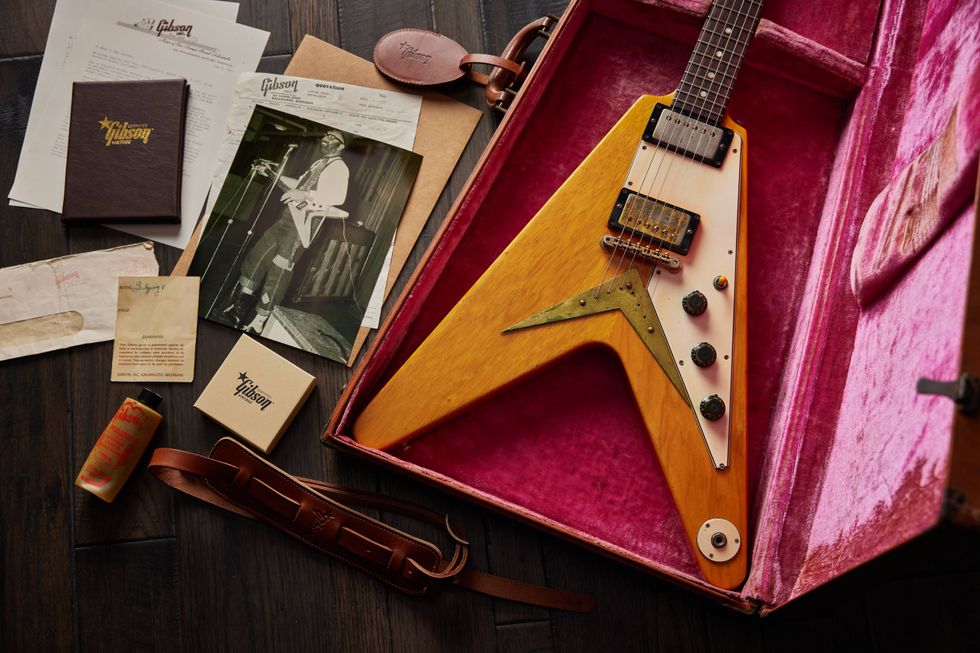
How do you find the guitars to bring into the program?
Mitch Conrad: A lot of folks reach out directly. We’re really fortunate that the name on the headstock of the guitars we’re looking for is also the name on the website.
But there’s a lot of digging around as well. It’s stopping into shops on a long drive and asking, “Do you have anything else?” And then somebody pulls out an old black rectangle case, and it’s a 1969 Les Paul Custom. There’s also Facebook Marketplace, Craigslist, all those spaces. So, not every story has the romantic “found it at a garage sale” start to it.
It sounds like there’s a real personal touch to this.
Conrad: We work really hard to make this feel like a boutique offering inside a global company, and we’re intentional about keeping that human connection at the center.
There was one really sweet woman whose mother had a beautiful ’57 Southern Jumbo. She said, “I can’t play—I don’t have a musical bone in my body—but I remember my mom playing that guitar every week.” As much as she loved having it around, she knew she couldn’t make music with it, and that’s what the guitar had spent its whole life doing. She wanted it to continue doing that.
When instruments like that come in, we’re just a temporary stop as they move from one caretaker to the next. These guitars are built to last lifetimes, and being part of that journey really matters to us.
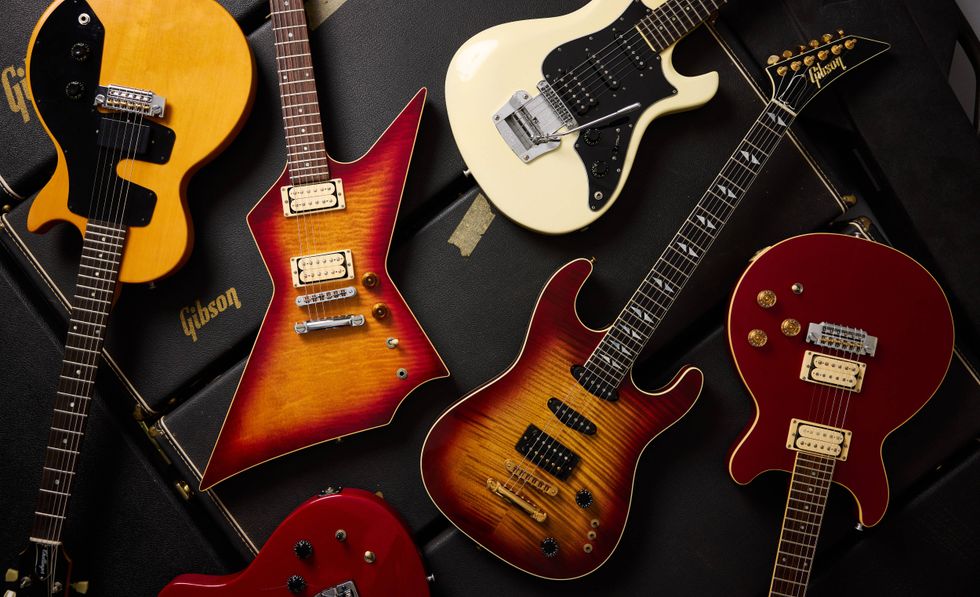
For people just expecting to see a lot of ’50s- and ’60s-era Les Pauls, the collection has real surprises. For instance, tell us about the 1980s prototypes and other “vault” pieces you’re offering.
Conrad: When you’re developing a new product that ultimately doesn’t move forward, there isn’t really a pathway for those instruments to make it out into the world. So you end up with these great prototype pieces that, for one reason or another, just stayed behind.
It’s really fun to dig these things out. A lot of the ’80s stuff, it really scratches an itch for a group of people. These guitars don’t always get the limelight: the Q Series or Corvus, or Explorer XPLs. To be able to buy—directly from Gibson—an original prototype that’s never been offered to the public before is a unique thing.
Whether it’s a one-off prototype or a vintage Gibson classic, what does a guitar need to qualify for Certified Vintage authentication?
Conrad: Step one is identifying exactly what the instrument is. Step two is playing it—we check that it feels right and sounds right, or shows the potential to do so. The biggest part comes down to originality. “Let’s make sure that everything that’s here is what’s supposed to be here.”
"Every day brings a strange mix of vintage guitar joy and chaos."
Again, there may be times when that’s not a deal breaker for a specific instrument, but we want them to be as representative of what they were originally intended to be as possible. We’re looking at clean solder joints. We’re saying, “Have these covers been off and back on? Are the caps what they should be?” We’re digging into the finish extensively. We’re looking at every screw and every saddle and asking, “Are all these things the things that should be on this guitar?”
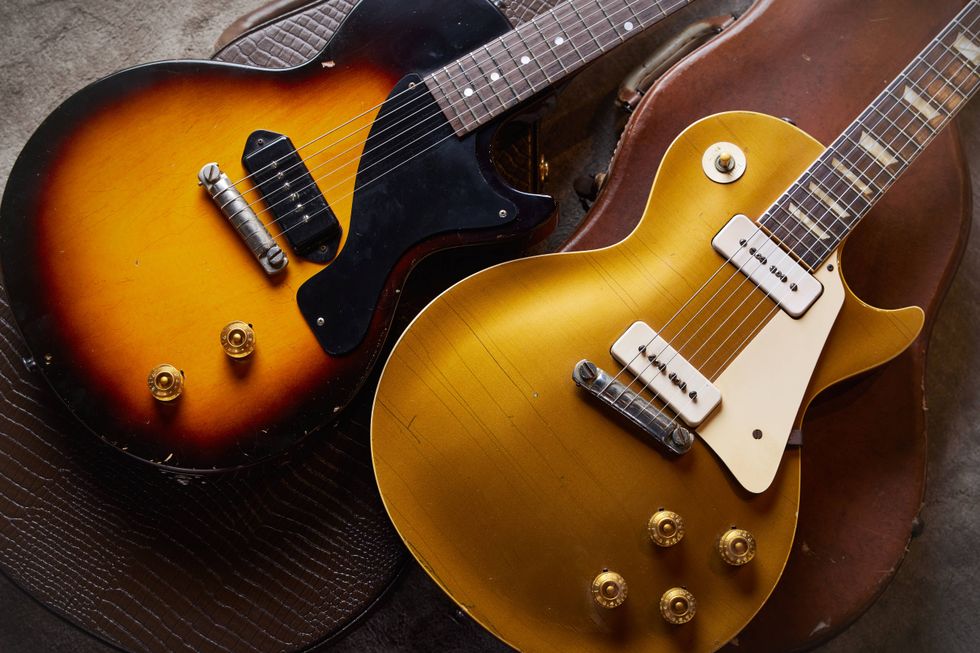
Sometimes, ensuring authenticity and playability—or tone—can be at odds. How do you strike that balance?
Conrad: We approach each guitar individually. If there’s an artist instrument that has caps from the ’80s, but it’s a ’50s Les Paul, those are now part of its legacy. That’s worth hanging on to. If we get a guitar that’s in excellent condition, where someone replaced a few parts but everything else is original, we want to restore that back to how it ought to be. And we’ll call that out. We’re not going to try and hide that work.
Do you still have access to a lot of the original records and notes for these older instruments?
Conrad: Yes. A lot of our records are still very intact. I have this super beautiful 1965 ES-335 that we’ll be making available in the next few weeks. I was able to find [it] in the shipping ledger, and I can say that it left the factory in Kalamazoo on November 18, 1965. That doesn’t change what the guitar is, but for someone, it gives the instrument a birthday. They get to know exactly when it left the factory and connect with a bit more of its story.
We’re still on the hunt for our ’59 shipping ledger, and I feel confident we’re going to find it! I feel it in my bones. I have to believe it’s out there and it will make its way home someday.
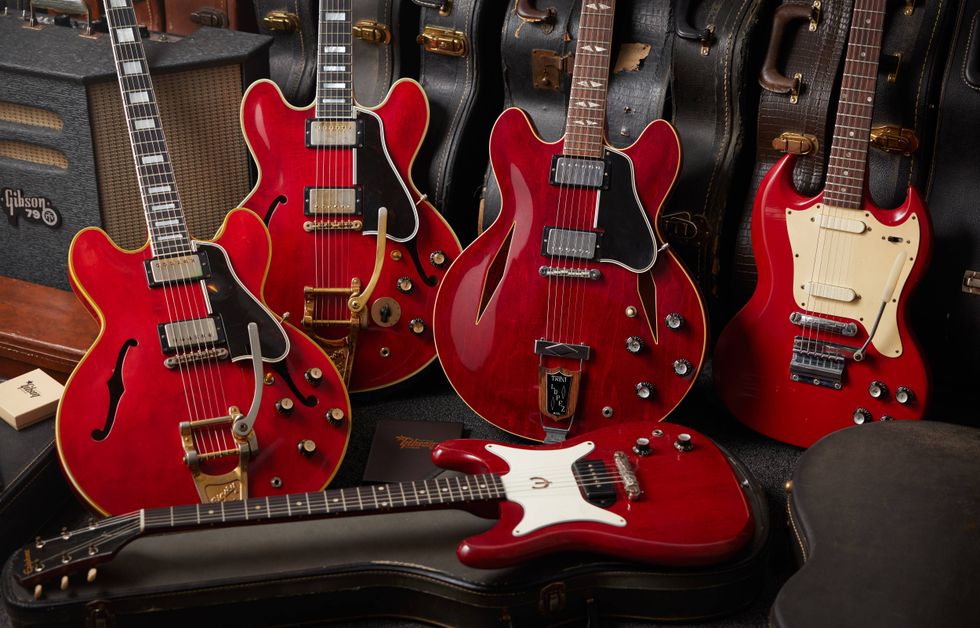
Your pricing sometimes differs from what’s seen on sites like Reverb.com. How do you explain that, and what feedback have you received from buyers?
Conrad: I’m really grateful for all the positive testimonials from folks who have purchased instruments from us—they’ve been good ambassadors for the program. It’s a reminder that we’re guitar people here. We’re excited about bringing these instruments back home to Gibson, and the program gives us a chance to celebrate these beautiful guitars we’ve made in the past.
"We work really hard to make this feel like a boutique offering inside a global company."
I also work hard to make sure that what we’re bringing to market is staying in the ballpark of what else is out there. I don’t want to find ourselves trying to tack on a higher percentage because of who we are. That said, when we bring a guitar in, we pay a little more because we want it to be an excellent example. And there might be times when a guitar [we’re offering] has more that’s gone into it. Vintage acoustics, for instance, are one of those things where they need work.
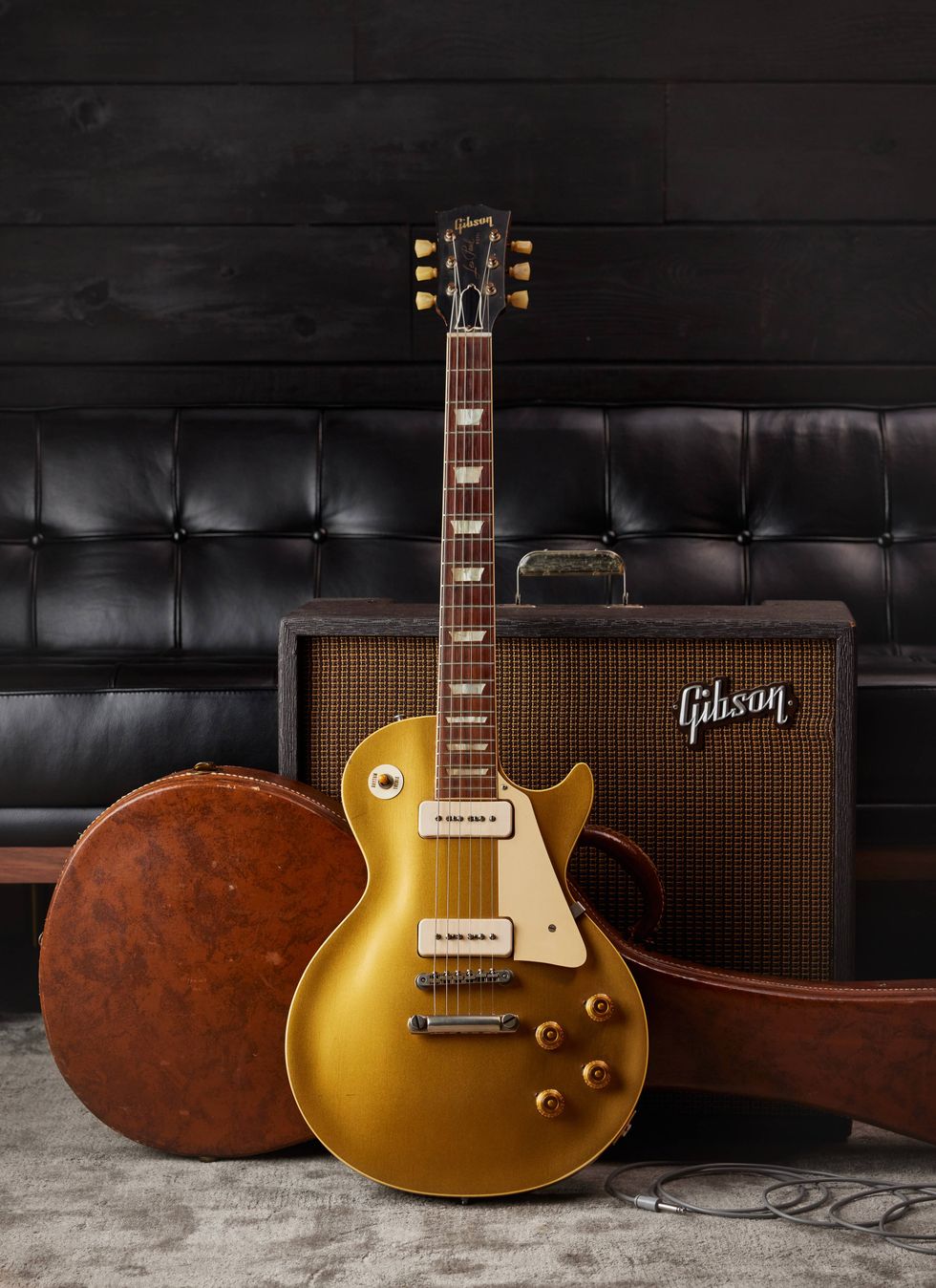
From road trips and online marketplaces to restorations and authentications, your job definitely keeps you busy.
Conrad: Every day is a new adventure. I’m out on the road a fair amount, going out and finding these guitars and purchasing them from all sorts of folks. And we’re working with high-value items, so you’re making sure they make it safely to their new homes and new caretakers.
But my day-to-day also may involve re-adhering the green felt lining of a late ’40s Lifton case. I have to get some new buttons installed on a set of No-Line Kluson 3-On-a-Plate tuners. Every day brings a strange mix of vintage guitar joy and chaos.
Clearly, working in the Certified Vintage program requires more than just guitar skills—it takes deep knowledge and a keen instinct for spotting truly special instruments.
Conrad: [That’s why] it’s important to me that we preserve this aspect of our history, and give the team a chance to see these original instruments. The [1959] Korina V that we brought to market earlier this year was a huge one. Sharing that guitar internally with our teams is really exciting.
Folks across all levels of things, from customer service and the crafters to product development and the aging team in Murphy Lab, are so passionate about our history and legacy. I feel a very personal connection to that.
To see the latest releases from Gibson Certified Vintage, follow the program on Instagram at @gibsoncertifiedvintage and on Facebook at Gibson Certified Vintage. If you have a vintage Gibson you’re looking to sell, you can contact the team directly at gibsoncertifiedvintage@gibson.com.
The Cure guitarist Perry Bamonte has died aged 65

Perry Bamonte, guitarist for The Cure, has died after a short illness over Christmas, aged 65.
Bamonte’s death was confirmed by the band earlier today (27 December). “It is with enormous sadness that we confirm the death of our great friend and bandmate Perry Bamonte, who passed away after a short illness at home over Christmas,” the band’s statement reads.
Bamonte began as a personal assistant and guitar technician for frontman Robert Smith, before joining the band on guitars and keyboards in 1990. He remained until 2005, and rejoined in 2022.
The band continues: “‘Teddy’ was a warm hearted and vital part of The Cure story. Looking after the band’ from 1984 through 1989, he became a full time member of The Cure in 1990, playing guitar, six string bass and keyboard on The Wish, Wild Mood Swings, Bloodflowers, acoustic hits and The Cure albums, as well as performing more than 400 shows over 14 years.”
“He rejoined The Cure in 2022, playing another 90 shows, some of the best in the band’s history, culminating with The Show of a Lost World concert in London November 1 2024. Our thoughts and condolences are with all his family. He will be very greatly missed.”
The post The Cure guitarist Perry Bamonte has died aged 65 appeared first on Guitar.com | All Things Guitar.
StewMac Valve Factory 18 Review
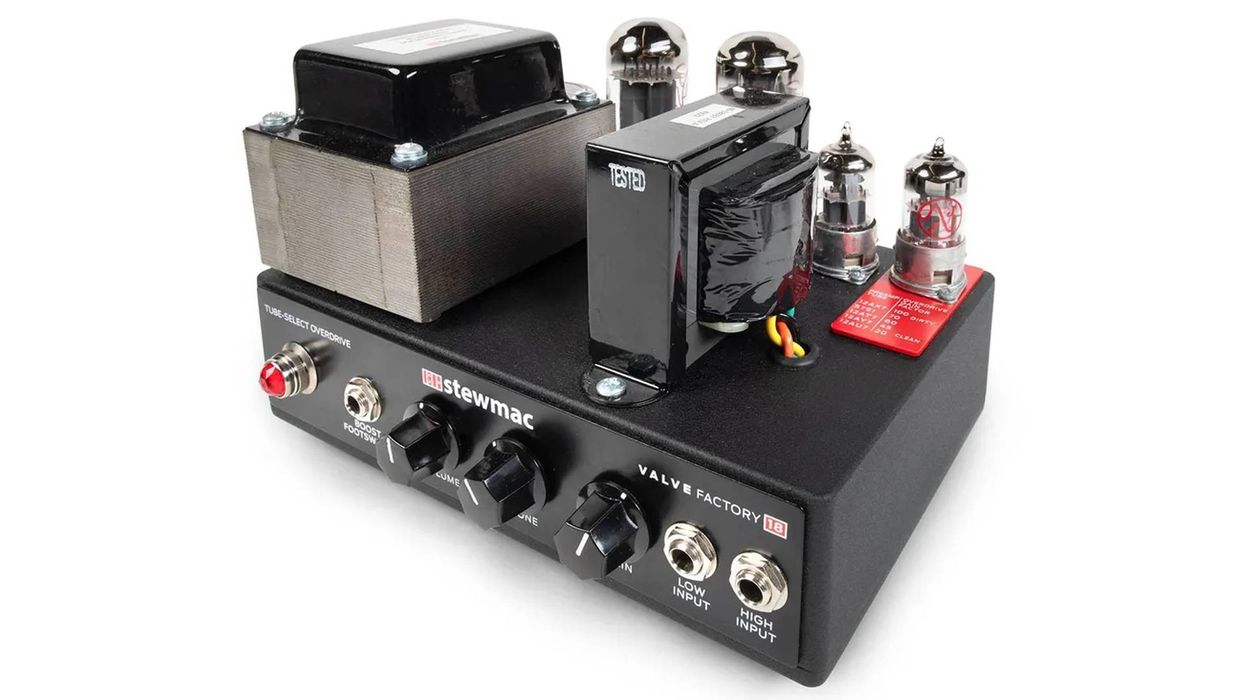
Most amp kits are Fender flavored, typically recreating historic 5F1 Champ, 5F2-A Princeton, or 5E3 Deluxe tweed-style circuits. And since an actual late-’50s Princeton, for example, costs about $3,000, at well less than a third of that price a DIY kit is an affordable alternative for any guitarist with soldering skills and the patience to follow instructions. But what if Fender isn’t exclusively the taste you’re looking for? What if Valco, Ampeg, Marshall, or modern takes on classic tones also float your rubber raft?
Enter StewMac’s mighty little Valve Factory 18 head kit, a 12-pound beast that punches above its weight class, offers a variety of classic-inspired sounds, and hints at modern boutique amp voices.
Flexible Fryer
Part of the Valve Factory 18’s versatility is due to the two preamp tube options provided in the kit: a 12AX7 or a 12AY7. But it’s mostly the result of a concise-but-flexible set of controls. On the front panel, there are volume, gain, and tone dials, but the way they shape sound depends on whether your guitar is plugged into the low- or high-input jack. The low input is the clearer of the two and hews close to Fender tweed world. But the high input offers gentle breakup that, to my ears, gets into gnarlier old amp voices. Both channels offer plenty of headroom and work well with pedals, but if your primary sources of tone color are stompboxes, the low input may be best for you. Both also benefit from a clean boost footswitch that pumps up the volume without altering the tones in play too much.
On the back, there’s an impedance switch with 4-, 8-, and 16-ohm settings, so the Valve Factory 18 can be used with most cabinets. There’s a single speaker-out jack, and on/off and standby toggles. And as its name implies, the amp delivers 18 watts, and it’s a loud 18 watts at that—fitting for today’s small-amp sweepstakes.
Brick By Brick
Confession: StewMac sent me an immaculate, pre-assembled review model rather than a kit. But I still settled into a meticulous reading of the highly detailed and lavishly illustrated instruction book. It begins with a menu of the included parts, which are metal film and metal oxide resistors, plus a single wire-wound resistor, two 1N5408 diodes, nine various capacitors, a pair of custom-built Pacific Trans transformers (power and output, naturally), wire, heat-shrink tubing, sockets and tubes (more on the tubes later), the fuse and fuse holder, the pilot lamp, screws and locknuts, input jacks, control pots, front and rear faceplates, the fully assembled footswitch for the boost, and a very solid anodized metal chassis.
Point-to-point assembly begins with the filter cap and works through the sockets on up to populating the circuit board, and so on. It’s advisable to have a digital multimeter handy to check each resistor before installation. Our test Valve Factory 18 arrived ready to go save for installing the tubes, which was easy, since this amp does not have a cabinet, so, it's merely a matter of plugging the tubes into the slots on the top of the chassis. Two JJ 6V6s live atop the amp’s crown next to the filter cap, which is also adjacent to the 18-watt power amp. I inserted the provided 12AT7 phase inverter tube and then decided whether to plug the 12AX7 or 12AY7 into the preamp slot.
Totally Tubular
Those aren't the only tubes that can be swapped in the preamp slot. The amp will function happily with 7025, 5751, 12AT7, and 12AU7 valves. But I stuck to the provided 12AX7 and 12AY7. Both performed true to their tendencies. I used the Valve Factory 18 to power a Sam Hill Custom 1x12 cab with a 50-watt Eminence Private Jack and plugged in a two-humbucker Les Paul, a PRS SE Silver Sky, a Dean electric resonator with a lipstick pickup and a piezo, and a Steinberger Spirit. In all these combinations the 12AY7 yielded a little more headroom than the 12AX7, little breakup when pushed, and a cleaner sound profile overall. That is not to say the 12AX7, my favorite of the two, lacks headroom—especially when I plugged into the low-input jack. But playing through the high-input side, the 12AX7 gave me exactly what I want from an amp: enough clean tone to stay articulate along with a gritty patina that speaks the language of rock and blues.
For me, that sound sings best with the tone between 10 and 2 o’clock and the gain between 10 and 12 o’clock which generates genuine old-school breakup. The tone control has great range. Turned hard to the left, it creates a booming, bass dominated voice; hard right, it’s bright and cutting, but never piercing. I did not find an unsatisfying sound within its scope. Dialing the gain to the top and the tone to about 8 o’clock, visions of doom rock danced in my head. With the tone at noon and higher, and the gain all the way up, I could hear the hard rock and metal applications, though the Valve Factory 18 isn’t a 5150 by any means. The volume dial simply makes things louder without significantly impacting the tone, which is ideal.
The Verdict
Short story: I dig this amp in all its sonic variations. Although the Valve Factory 18 is simple to use—and seems relatively easy to build—it is cleverly designed too. Playing it is a joy. So much so that I am disappointed that it’s not gig-ready. Without a cabinet or some cover to protect the tubes, transformers, and filter cap, it’s easily damaged. That said, the power, versatility, tonal range, and sense of accomplishment in building a point-to-point packed with character seems well worth $599.
Orangewood Del Sol Baritone Review
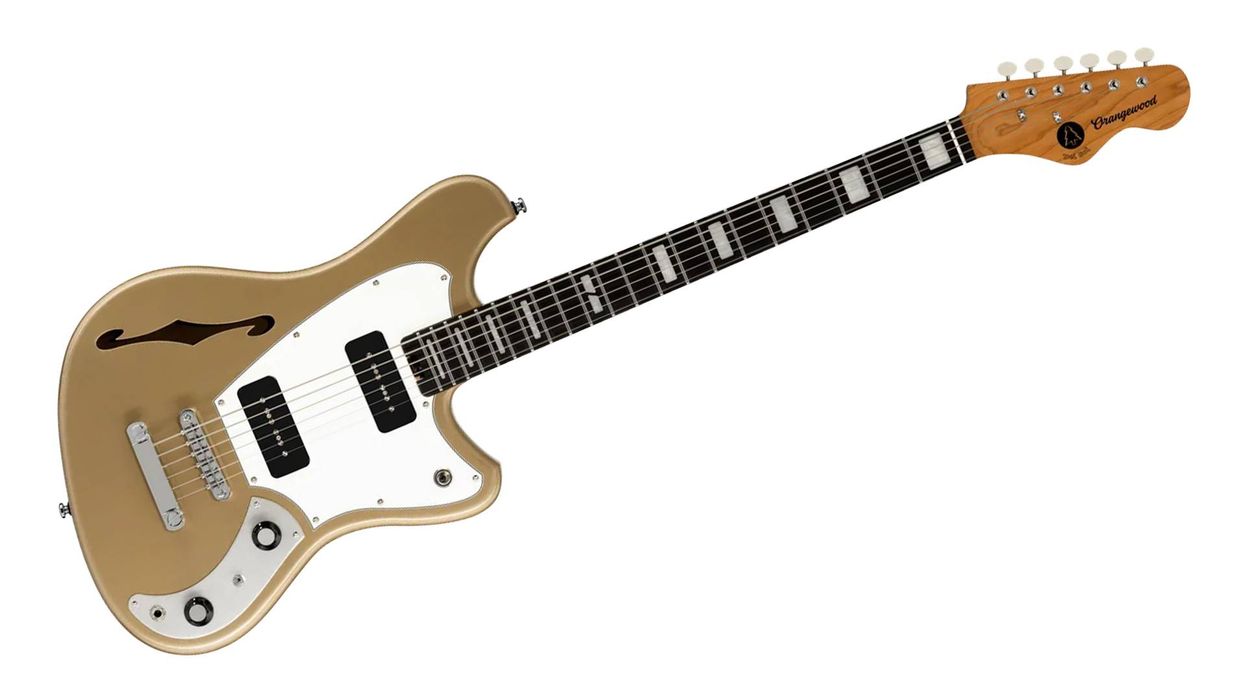
Connecticut builder Josh Forest’s TreeTone Guitars specializes in retro-inspired designs with hip offset bodies, classic inspired color combos, and an array of electronic options. He’s teamed up with Orangewood to offer an imported version of his Del Sol model—which he produces in a standard-tuning version under his own name—as a baritone. Although the Orangewood Del Sol Baritone hits a price point well below a domestic build, it’s a solidly crafted, handsome guitar that punches well above its $795 tag.
Comfy Feels
The Del Sol Baritone’s slick, unique offset mahogany body evokes retro Fender vibes, but on its own terms. It’s a sleek look, and thanks to its chambered design—with a bass-side f-hole—it’s lightweight.
Playing while seated, the bari has a nice weight distribution and offers a comfortable playing experience. Its 27 1/2" scale length is close enough to a standard scale to feel familiar, giving it a more guitar-like feel than, say, a Danelectro’s 29 3/4" scale or a Bass VI’s 30", which makes it easy to get acquainted with.
Without checking price data first, I guessed it was priced a few hundred bucks above its $795 cost direct from Orangewood.”
A pair of P-90s sit nicely in the 3-ply parchment pickguard. Controls include a master volume and tone with pickup selector, plus a phase switch. Characteristically, the P-90s tend toward warmth more than clarity, but together they have a wide range, from bridge-position twang to thick neck tones. They certainly lean dark, and digging in will push their output enough to drive the amp if you’re already heading in that direction. That’s particularly the case with the neck pickup, though tamping down the bass control on my Deluxe Reverb helped keep it cleaner longer. But the P-90s performed great once overdriven, whether from the amp or with the help of a dirt box, with plenty of sonic space for well-articulated arpeggios and dynamic strumming. I preferred the middle position most, and the phase switch—located on a brushed aluminum control plate between the volume and tone knobs—opens up the possibilities. It’s a helpful control, especially for navigating bass response and finding the line between heaviness and twang.
Jack of All Trades
The Del Sol’s roasted maple neck has a smooth satin finish and a soft C profile. Combined with the 12" radius on its rosewood fretboard, the neck feels great. A rounded heel offers easy access to the upper frets, and has a spoke wheel for truss rod adjustment, which I always find to be a thoughtful and welcome feature. The 43 mm nut width feels naturally spaced for the .013–.072 strings that come stock.
As far as build quality goes, my demo model arrived set up and ready to go. The frets are even and nicely dressed across the neck, and seem to have received a fine level of attention. In fact, from top to bottom, the Del Sol’s build is flawless. Without checking price data first, I guessed it was priced a few hundred bucks above its $795 cost direct from Orangewood.
Though its offset aesthetic gives a bit of a surfy vibe, the Del Sol Baritone is more of a rocker—though I suspect replacing the Tune-o-matic-style bridge with a JM-style vibrato could push it in the former direction. It’s definitely capable of heavier sounds and plays well with distortion. The resonance of the chambered body lends some sustain across its range, and that helps this bari sing. The easy playability of the neck and fretboard open it up to all styles, and knotty, technical passages are easy to execute. That makes the Del Sol a specifically versatile instrument. The other side of versatility, though, is that if you’re looking for specialized sounds—let’s say a Dano-with-lipstick-pickup kind of thing, or a tic tac bass sound—you might not find it. But as a do-it-all baritone under $1,000, the Del Sol is one to consider.
The Verdict
The Orangewood brand model delivers attention to detail in cool aesthetic packages at easy-to-reach prices. Yes, there are less expensive baritones than the Del Sol on the market. But many of those cater toward more specific, if not a bit quirky, tastes. Instead, the Del Sol Baritone can cover a breadth of stylistic ground both sonically and, thanks to its easy playability, from a technical perspective. With a build quality that’s more consistent with a higher price point, it delivers both musical and financial value. If you want a well-rounded bari, this may be all you’ll ever need.
Boss OC-5 review: what makes a great octave pedal?

What makes a great octave pedal? That question is a bit of a pandora’s box, but we can at least prop the lid open for a bit with one of the most popular modern octave pedals out there: the Boss OC-5, which folds in nearly 40 years of Boss octave history, while remaining a lot more accessible than octave workstations like the Pog 3.
The OC-5 was released in 2020, superseding the very vintage (and analogue) OC-2 Octaver from 1982, and 2003’s OC-3 Super Octave. The OC-3 was notable as it was the first polyphonic octave pedal – meaning it could accept chords without completely destroying its ability to track. The OC-5 contains a more modern polyphonic mode, as well as a recreation of the OC-2’s glitchy, dual-sub-octave tracking.
OC-5 control overview
The OC-5’s controls are pretty straightforward, with the exception of the multi-function range/-2 oct knob on the right. This varies its function depending on if you’re in vintage or poly mode – in vintage mode, it blends in an ultra-low sub-sub octave, while in poly mode, it controls how the -1 octave signal tracks. On its lowest range, this sub-octave will only follow the lowest note of a given chord – turn it up, and more of your signal will join the low-octave mix. Other than this control, there’s dry blend, which ranges from completely killing the signal to a fairly hefty boost, the blend for the upper octave and the blend for the sub octave.
Vintage mode
True to the goal of recreating the OC-2’s rudimentary tracking, the Vintage Mode is purely monophonic. But even with single note inputs, it can struggle to find what you’re actually playing, resulting in glitchy artefacts as the octave sound jumps about. This mode is still a lot of fun, although unless you’re in a two-piece, the -2 octave sound is absolutely bound to get lost in a full band mix.
Poly Mode
This is the main event, really, and realistically the far more usable of the two modes. The improved tracking makes it obviously much more tight and responsive to play – and thanks to that cleaner tracking, the mix controls are a lot more useful in dialling in what output you want.
The upper octave here is a lot of fun, especially on leads – one of the main uses of an octave pedal is to make your guitar sound like a synth or an organ, and while the OC-5 isn’t quite as built for that approach as, say, the new Pog 3, there are still plenty of big synthy sounds on tap, especially with some gain and power chords.
Some aggressive use of the upper octave is perhaps the most fun you can have with the OC-5, though – especially on leads, adding a screaming, Jack White-style edge to things.
Digital vs analogue octave pedals
While the original OC-2 was analogue, the power of the OC-5 comes from its digital nature. But if you’re in the market for a compact octave pedal, you may well have come across a modern analogue option like the EQD Tentacle, an updated version of the Dan Armstrong Green Ringer, or something like MXR Blue Box.
These pedals rely on the fact that you can do some very simple maths with analogue equipment – either folding the signal over to double its frequency, or using flip-flop circuits to recreate every other wave peak to half the frequency. This leads to a much more chaotic and fuzzy sound, hence vintage octaves are so closely associated with octave fuzzes rather than cleaner “pitch-shifting” units.
A/Bing the OC-5 (with only its upper octave engaged) and an EQD Tentacle is particularly illuminating in this regard – even with an amp set clean, the Tentacle introduces audible distortion – and while it “handles” chords, anything more complex than a power chord gets messy – even basic thirds get crunched apart.
On the other hand the OC-5 in its modern Poly mode introduces no distortion at all, with a sparkly-clean recreation of the exact same sound, only one octave higher, blended in. So keep this in mind if you’re looking to make a decision between an analogue and a digital octave pedal in 2025.
Can you stack the OC-5?
The OC-5 is an excellent pairing with some heavy full-spectrum distortion – especially something super-saturated like a Big Muff. If you’re a fan of, say, Jack White, you may already know that a digital octave run into a Big Muff Pi is one of the best sounds out there – and thanks to the OC-5’s clean tracking, big riffs will gain a synthy, powerful character rather. We’ve seen this sound get a lot of love recently with Keeley’s Octa Psi and Eventide’s Knife Drop, the latter a collaboration with White himself.
But combined with impedance-sensitive fuzzes, however, things are less ideal – the Boss buffer will present problems even in bypass, and the digital nature of the tracking is not a fond pairing with the more uncontrolled nature of a raspy, vintage-voiced fuzz.
Another trendy pairing in recent years has become an octave pedal and a RAT, a combo made famous by Sunn O)))’s albums Life Metal and Pyroclasts, immortalised in the band’s signature Life Pedal. This sound is definitely doable with the OC-5 – run into a RAT, you get a thick but harmonically complex wall of sound. However, the cleanliness of the OC-5 means that, in comparison to using an analogue octave up, things don’t quite develop and shift over the course of a (very long) note – arguably the appeal of that sound.
Who is the OC-5 for?
The world of pitch-shifting is a massive and expansive one – and the OC-5 only represents a small part of it. The clean, full sound of an octave harmony is a very distinct thing to the more evocative sound of a scale-based harmoniser, or the free-form pitch ramps of something like a Whammy. And the OC-5 offers a good amount of control, but nowhere near as much as some of the bigger workstation pedals out there – but for guitarists looking to explore the benefits of cleanly mixing in octave-shifted sounds into the mix, whether that’s for otherworldly synth parts or for massive Jack White impressions, the OC-5 is a great, affordable compact option.
OC-5 alternatives
We’ve already mentioned a lot of the different styles of octave pedal already, but for posterity let’s establish some directions to go – using the OC-5 as a starting point. Given its affordable and compact nature, a starting point is a good way of looking at it – for many, it’ll be all they need – for others, a gateway drug into the world of octaves.
If the OC-5 is too clean for you, and you want raspy unpredictability, you can go for the Earthquaker Devices Tentacle for an analogue upper-octave sound. In the other pitch direction the MXR Blue Box is a sub-octave fuzz, and is completely gnarly.
If you want more control over your octaves, most iterations of EHX’s POG line will give you that – not least the incredibly extensive new POG 3. Until boss makes an OC-200, it’s probably the most fully-featured octave pedal you’ll be able to find – but keep in mind its price and its size make it a pretty big commitment.
The post Boss OC-5 review: what makes a great octave pedal? appeared first on Guitar.com | All Things Guitar.
Merry Christmas, Everyone!
Merry christmas!
Though there is no snow
for northern new mexico
this christmas,
i hope you have a wonderful time
with friends and family!

Rig Rundown: Marc Ford and Doug Pettibone (The Lucinda Williams Band)
The country legend’s bandmates bring a range of low- to high-end gear to Nashville’s Basement East.
Ahead of Lucinda Williams’ fundraiser show on December 15 at Nashville’s Basement East, PG’s John Bohlinger spent some time with guitarists Marc Ford and Doug Pettibone, and bassist David Sutton, at the venue for this special holiday Rig Rundown. Tune in for all the goods, and check out the highlights below!
Brought to you by D’Addario.
Gretschy Guild
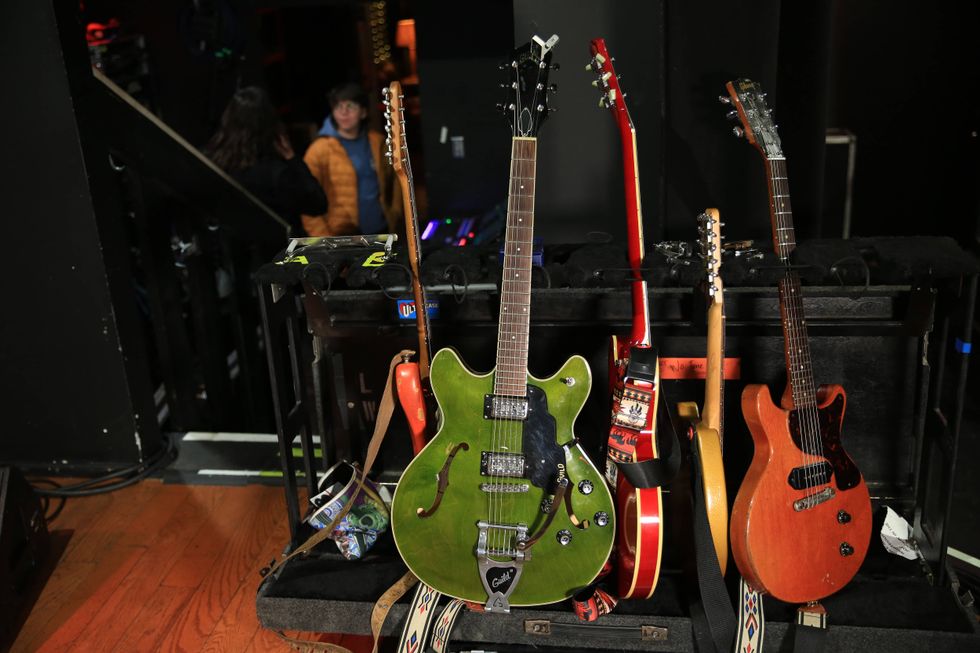
Pettibone plucked this off the wall of a guitar shop in Philly to demo an amp and ended up walking out with it. Its Seymour Duncan pickups are coil-split, and Pettibone gets some good, old-timey Gretsch tones out of it. Plus, after having a load of gear stolen on tour a while back, Pettibone prefers to bring out less precious instruments.
Tok-ibson
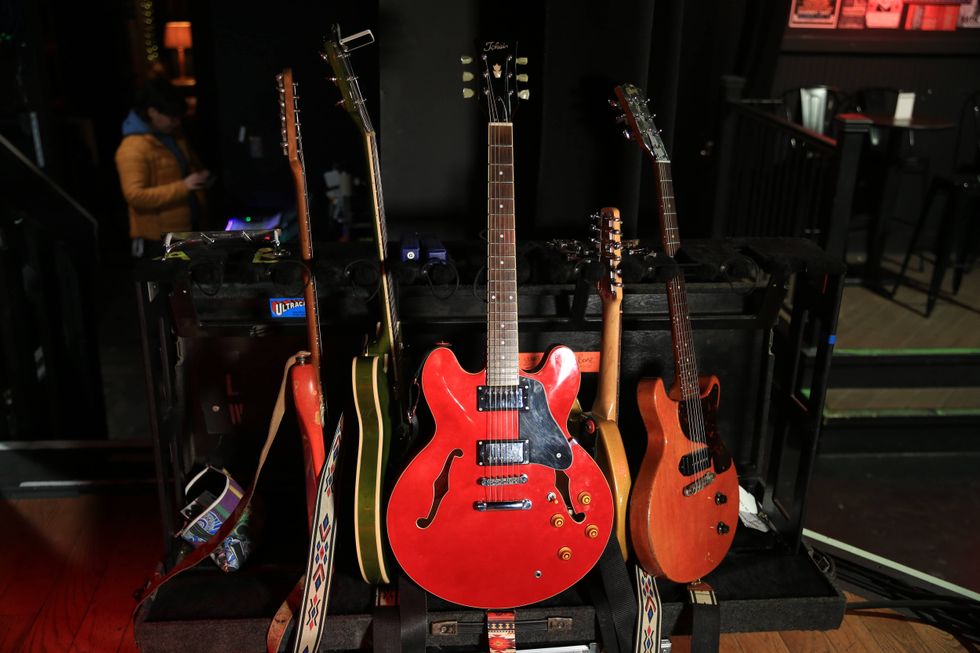
Pettibone snagged this Japan-made ES-335 knockoff, built by Tokai, while touring Australia earlier this year.
A Jewel of a Pedal Steel
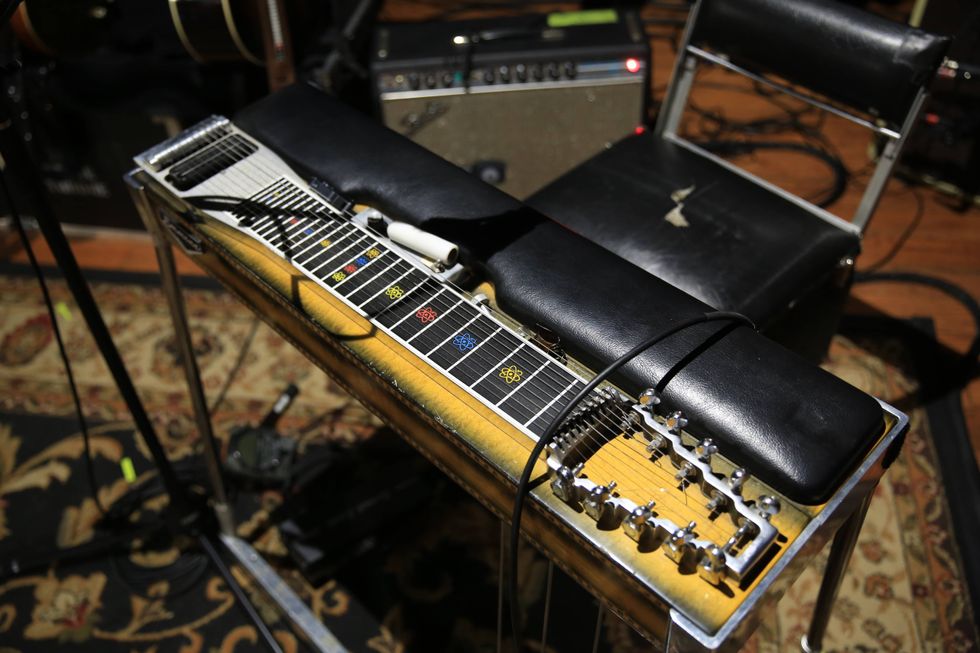
Pettibone’s main pedal steel is this 1999 Emmons, which he ordered brand-new when he was playing with Jewel.
Fender Friends

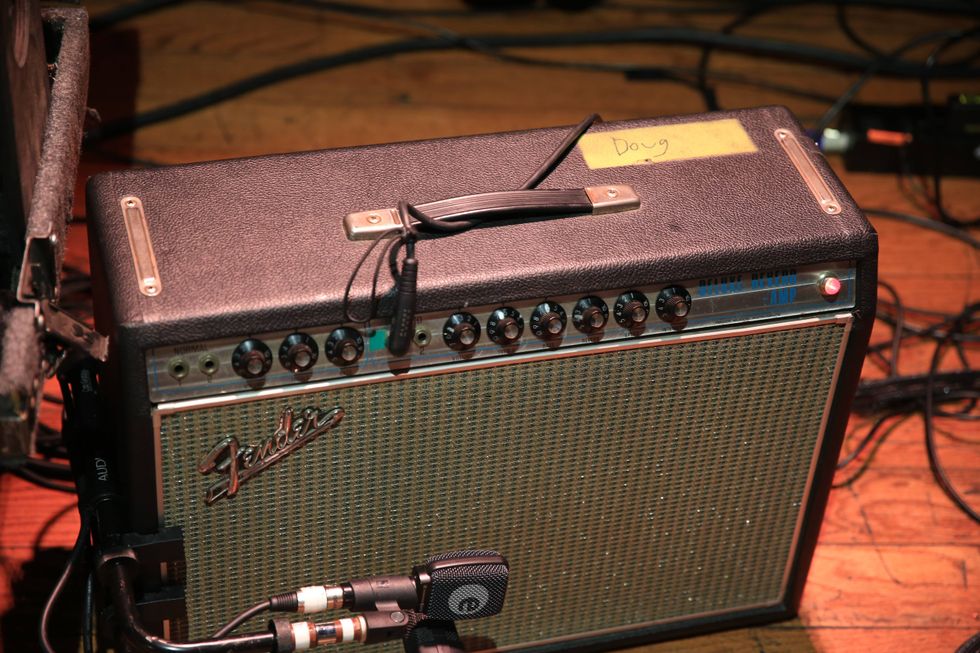
Pettibone runs the Emmons pedal steel through a ’64 Fender Twin Reverb, with a ’70s JBL 15" speaker. A Strymon El Capistan adds delay, if desired. His 6-strings run into a ’68 Fender Deluxe Reverb, loaded with a Celestion Greenback speaker.
Doug Pettibone’s Pedalboard

Pettibone runs a Sarno Earth Drive, Durham Electronics Crazy Horse, Keeley-modded Boss BD-2, Boss TR-2, Mad Professor Silver Spring Reverb, and a Catalinbread Belle Epoch. A Strymon Zuma powers them.
Thou Shalt Not Covet
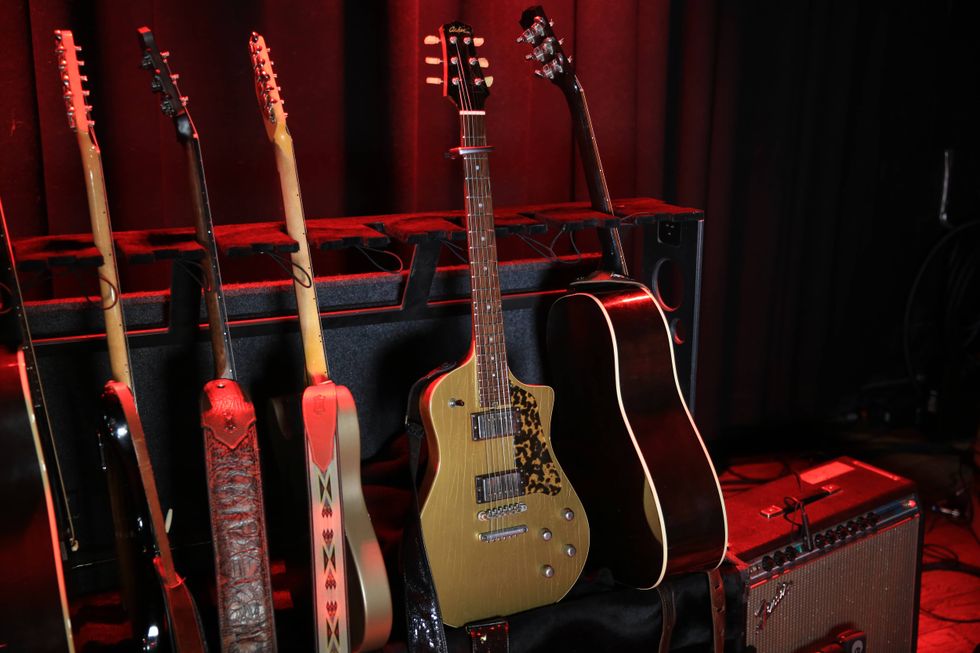
After “coveting” it for a long while, Ford borrowed this humbucker-equipped 6-string from Bill Asher, and after a bit of time with it, decided that he couldn’t give it back—even though he has an Asher signature model.
Nashing of Teeth
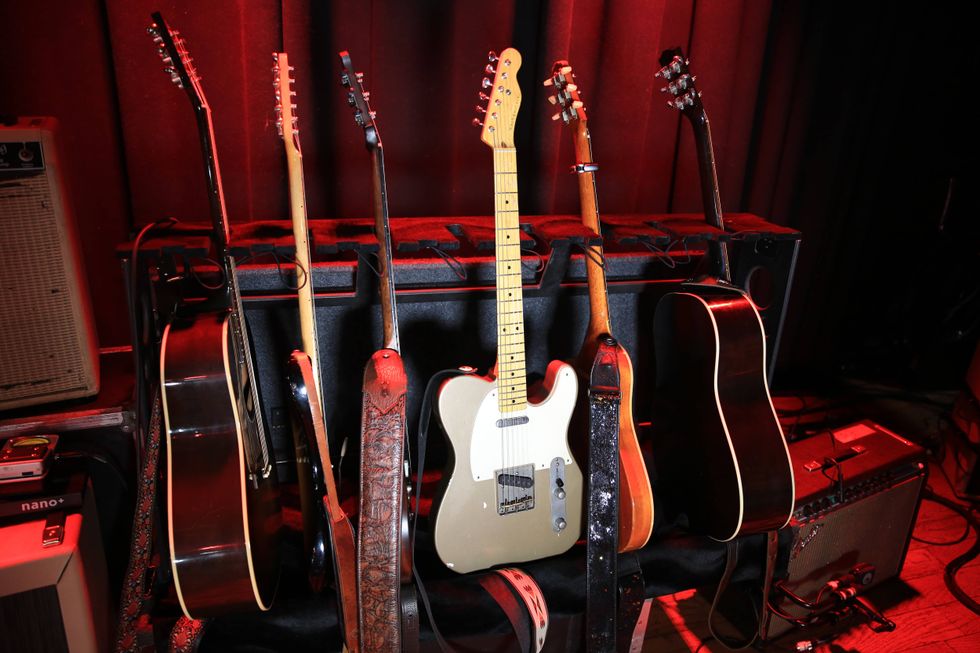
Ford was on the hunt for a Telecaster with a maple neck, and snagged this Nash T-style just a few weeks before this Rundown.
Hurtling Through Space

This custom Satellite amp has two 10" speakers and pumps out roughly 20 to 25 watts.
Marc Ford’s Pedalboard
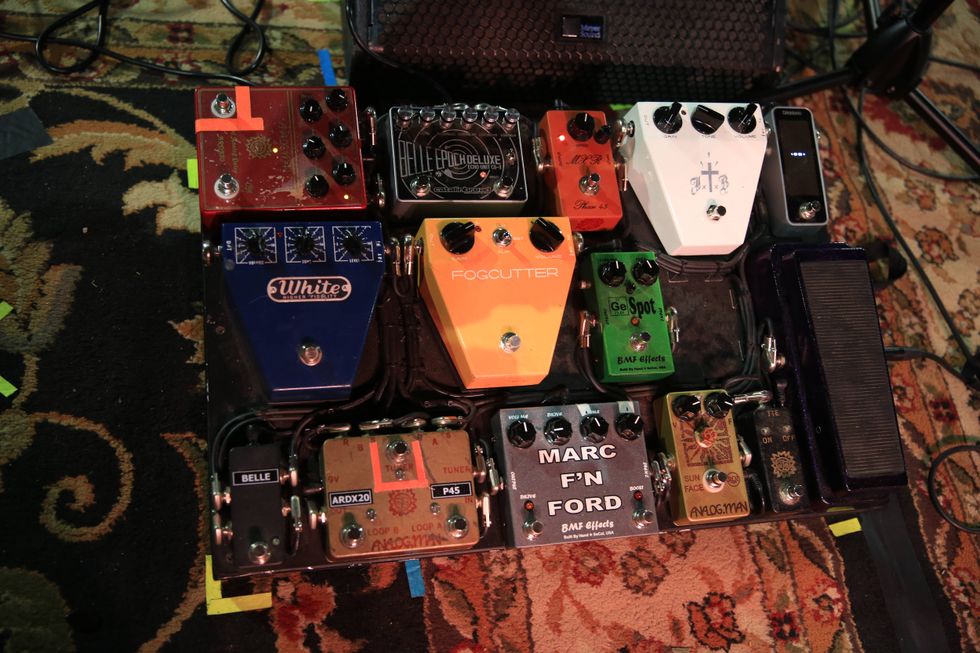
On his board, Ford runs a D’Addario tuner, BMF Effects Marc F’n Ford and Ge Spot, Analog Man Sun Face, Satellite Fogcutter, White Amp Emulator, and Jonny Two Bags, a Catalinbread Belle Epoch Deluxe, MXR Phase 45, and Analog Man ARDX20.
Ghost of Christmas Past
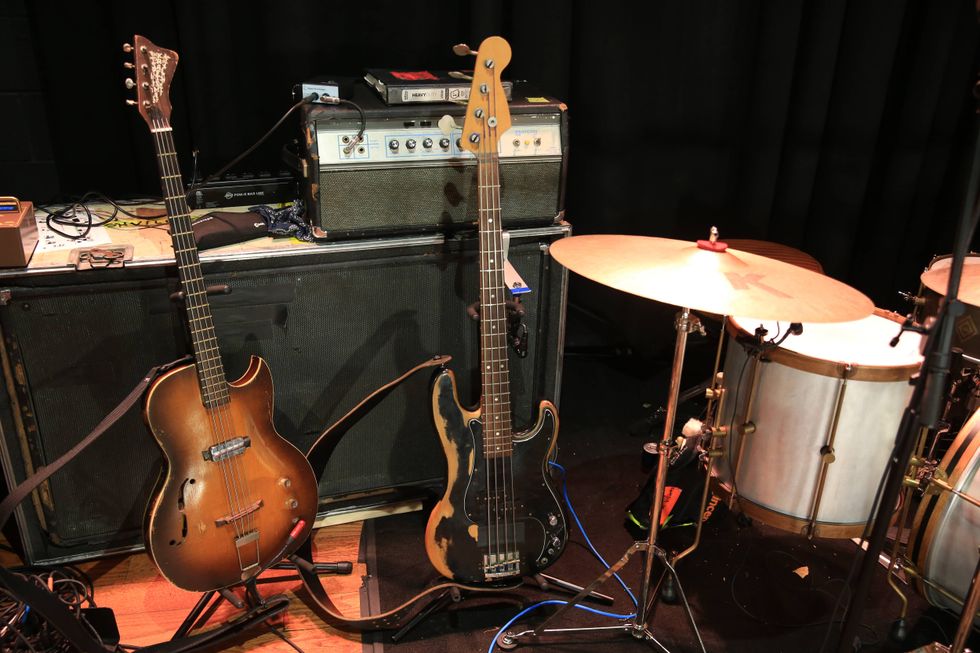
There’s a lot of history in this picture. The P-bass on the right was a gift that Sutton received on Christmas morning when he was 16. The body is the only original part left, and he strings it with La Bella flatwounds. On the left is an old Kay/Kraftsman bass, which he plays with old roundwounds strings. Sutton has owned the Ampeg SVT and cab, at rear, since he was 18.
David Sutton’s Pedalboard

At his feet, Sutton runs a TC Electronic PolyTune, Radial Loopbone Master Loop Controller, Boss TR-2, SansAmp Bass Driver DI, and ACT Entertainment Panic Button, all powered by a Voodoo Lab Pedal Power 2 Plus.

Tech 21 SansAmp Bass Driver DI
The Truth About Vintage Amps, Ep. 158
Episode 158: Chris Benson of Benson amps and Bryan Sours of Soursound transformers make their long-awaited returns to the Truth About Vintage Amps. Why? They want to tell us all about the logging truck of an amp they are currently building, a 700-watt(!) all-tube beast dubbed Babylon!
The Babylon will feature 14 KT88 tubes, 16 total speakers, three knobs, and two power cords. It’s literally the most powerful tube amp they could make without requiring a dryer outlet.
Check our Instagram for a sneak peek at the creation.
and honorable mention to…
https://bottosbbq.com/
Hear the Babylon in person at the 2026 Wood, Wire & Volts festival (or anywhere within a mile or two radius of the show).
https://www.woodwirevolts.com/
Deep cuts: Bryan’s first appearance on our show can be found here (it’s pretty epic) and Chris originally appeared on our 30th episode.
Thank our sponsors: Grez Guitars; Emerald City Guitars and Amplified Parts. And happy holidays to all of our listeners and Patreon members for their support! We’ll be back in 2026.
Want amp tech Skip Simmons’ advice on your DIY guitar amp projects? Want to share your top secret family recipe? Need relationship advice? Join us by sending your voice memo or written questions to podcast@fretboardjournal.com! Include a photo, too.
Hosted by amp tech Skip Simmons and co-hosted/produced by Jason Verlinde of the Fretboard Journal.
Don’t forget, we have a Patreon page. Support the show, get behind-the-scenes updates and get to the front of the line with your questions.


The post The Truth About Vintage Amps, Ep. 158 first appeared on Fretboard Journal.
Mod Garage Tonewood Teardown: Chasing the “Closet-Classic” Look
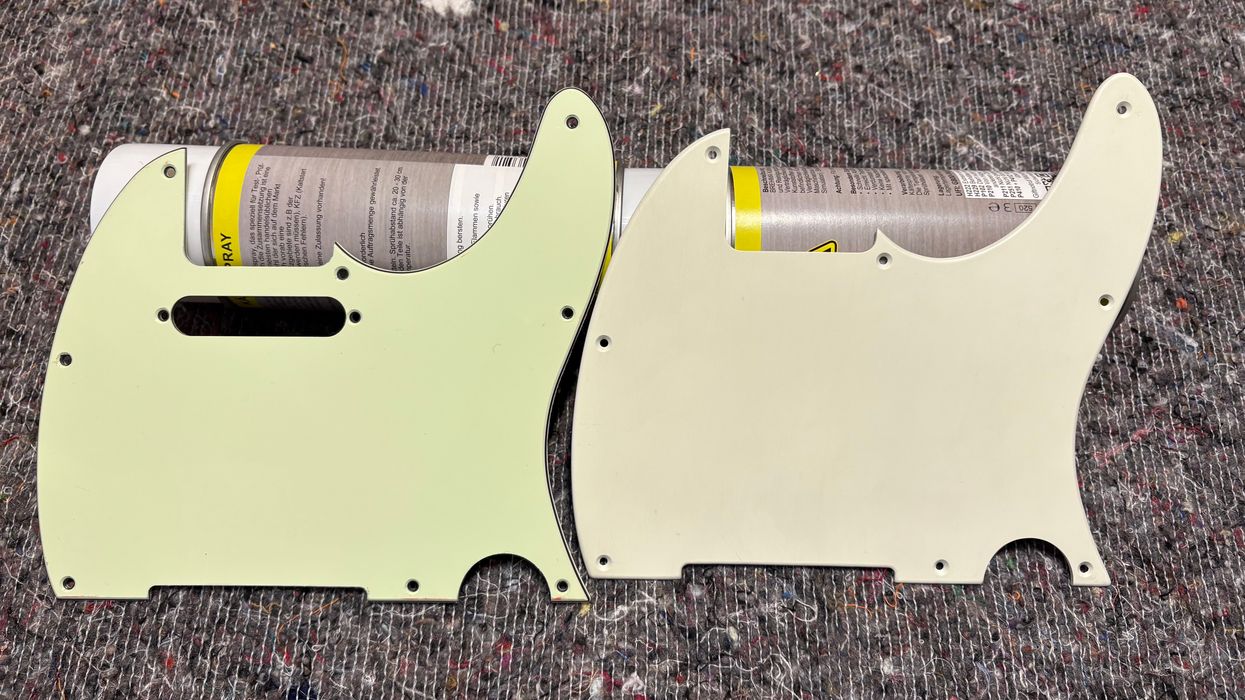
Hello! Welcome back to Mod Garage, and our “Tonewood Teardown” series. After finishing our work on the body of our Telecaster, let’s move on to the hardware and electronics, starting with the pickguard.
The factory-stock pickguard on this guitar is a 3-ply mint green one, and as they say, there’s no accounting for taste! In my book, a greenish pickguard on a green body isn’t an appealing look, so it had to go. Because I want to transform the guitar to Esquire specs, I had to replace it anyway, and this is a perfect field to let creativity flow and create a custom look: There are countless choices when it comes to materials, from plastic to metal to wood to acrylic glass to leather and beyond. Find the color and pattern you like best, or simply leave the original pickguard with the neck pickup removed for a serious DIY aesthetic. You can cover the hole for the neck pickup with some tape (maybe in a third green color, like neon green!) or simply remove the pickguard for the ultimate outlaw look, exposing the neck pickup routing.
I decided for a classic vintage look, with a twist. After comparing several different pickguard colors, I decided to use a 1-ply nicotine-white guard, which perfectly matches the now-matte look of the surf-green body. The color is also often referred to as parchment, offset white, eggshell white, or vintage white—not white, not cream, but somewhere in between. (Wow, an accidental rhyme!)
You can buy replacement pickguards from plenty of companies, but if you want to keep it strictly DIY, you can purchase an uncut sheet of the material. I already had some nicotine-white blanks in my storage room, so I used the old pickguard as my pattern and a simple jigsaw with different saw blades to carve out the new one. For the curvatures, I like to use a superfine round saw blade, and a standard straight one for even lines. Put some self-adhesive foil on the surface to keep you safe from any accidents.
An Esquire pickguard without the neck pickup opening is easy to fashion, and a perfect beginners’ project for pickguard-making—so be brave! It took me about 20 minutes, plus a few more minutes to drill and countersink the holes for the pickguard screws. After another 10 minutes with some sandpaper and files, the new pickguard was ready, and it looked so much better on the surf green body compared to the stock mint green.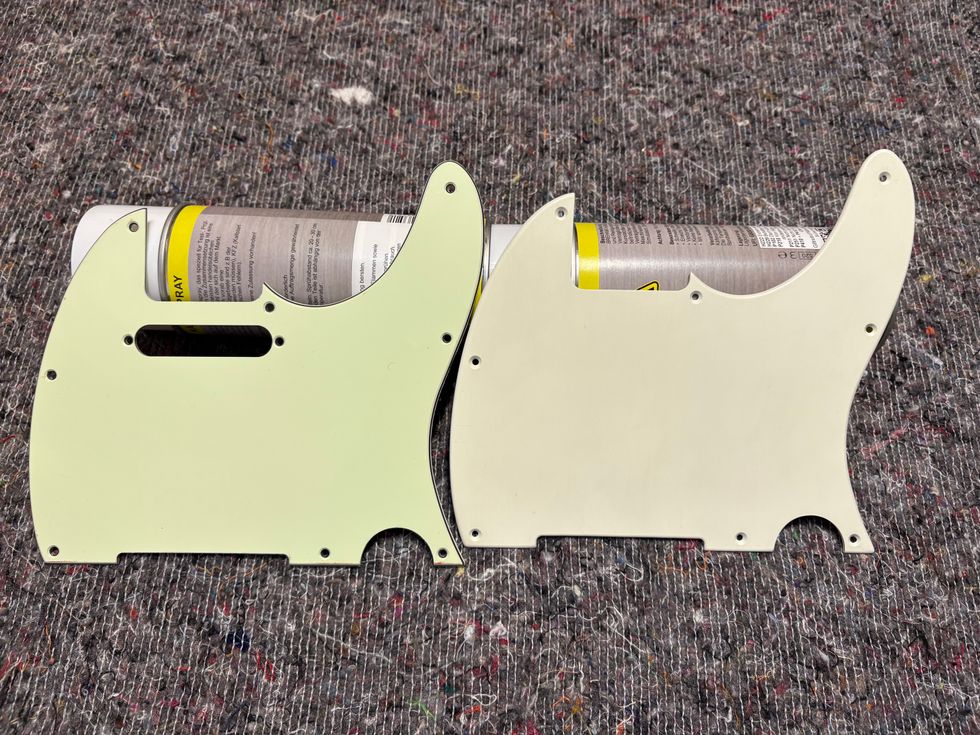
To give the new pickguard a custom-shop twist, I decided to break the shine and make it matte like the body, which was done in just a few minutes by using some fine 0000-grit steel wool and abrasive cloth. This easy step makes it look slightly used, and by applying different grades of steel wool and pressure, you can decide on your own exactly how “used” it will look. I decided for a moderate used look that Fender would call “closet classic.”
“Do yourself a favor and replace the tiny screws with heavier ones—better safe than sorry!”
To take it the extra mile, I decided to round all the edges to give it a rolled-edge feeling—very smooth and a pleasure to touch. I thought this would be done in no time, but I was mistaken; it took me almost an hour to look and feel great! That said, rounding the edges isn’t a complicated task, since all you need is some sandpaper wrapped around a wooden rod. The hard part is getting all of the edges totally even, so if you decide to give it a try, prepare some strong coffee and take your time. It was absolutely worth the time, effort … and swearing. I found that the trick was to always get the same angle with the sandpaper, and to stay away from rotating tools like a Dremel.
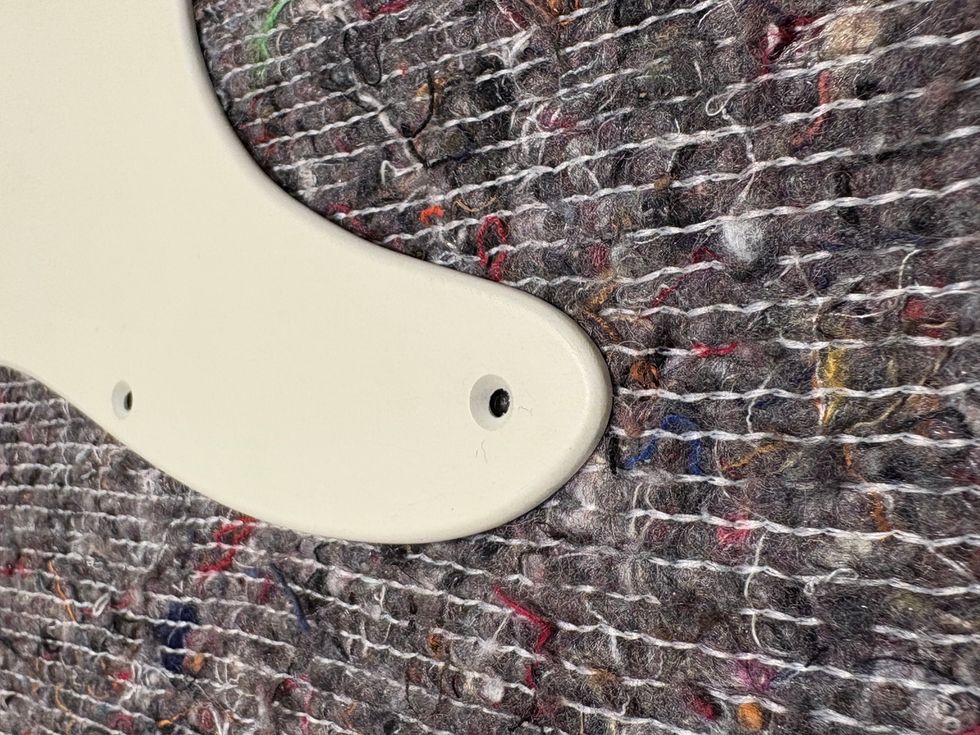
Now, for the rest of the body. In general, I have a problem with all the screws used on this guitar. The diameter is always smaller compared to the standard, and the material is very soft, which is flirting with stripped-screw-head disaster. Besides this, the chromed surface is super shiny, so I decided to replace all screws with stainless-steel screws in standard sizes. I really like the typical matte look of most stainless-steel screws; they appear a little bit worn right out of the box and are easy to work with. All you need to do to give them the “closet-classic” look is rub the head of the screws with some sandpaper to produce artificial scratches. You can buy matching stainless-steel screws in any guitar or hardware store.
Next, let’s take a look at the factory-stock strap buttons. They’re chromed and standard Fender-sized, so no need to replace them if you want to keep the classic ’50s look. The stock screws are tiny, so I’ll replace them with thicker stainless steel ones. Here, too, you have plenty of options to customize your guitar by using the strap buttons you like best, or, alternatively, removing them. You can use smaller Gibson-style ones made of aluminium, locking buttons, custom buttons made out of wood, graphite, etc ... it’s your guitar, and you decide what to use. But do yourself a favor and replace the tiny screws with heavier ones at this spot—better safe than sorry! The stock strap buttons came with a small ring of black felt to protect the body from any imprints, so it’s your call whether you reinstall or remove them. For a more classic look, I decided to remove them.
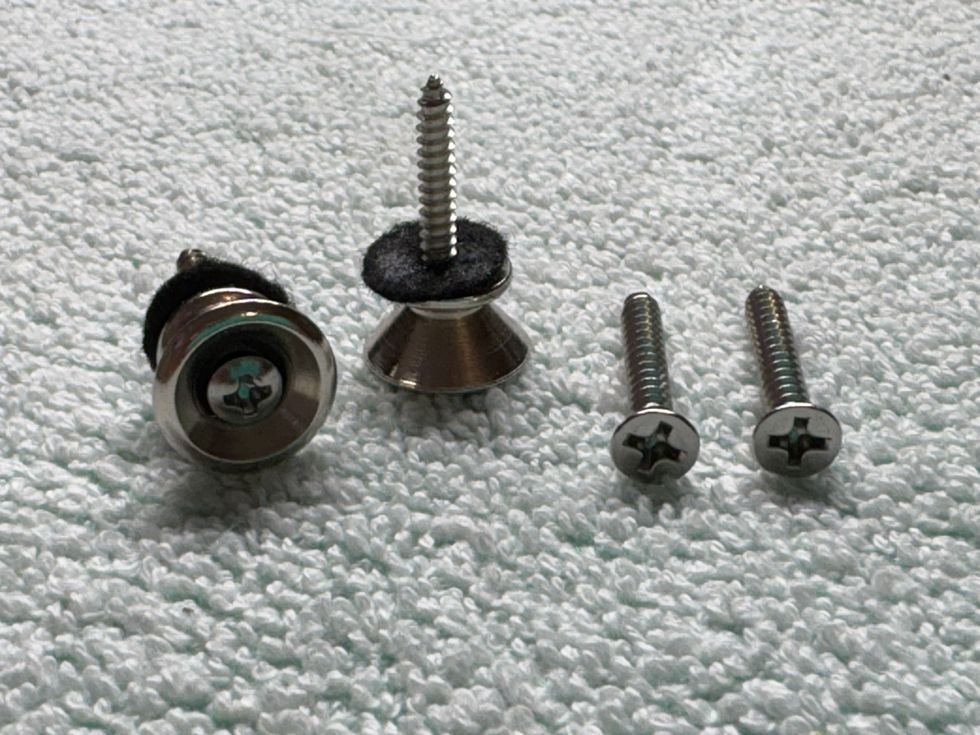
To break the shiny chromed surface of the stock strap buttons, you can again use some steel wool, abrasive cloth, or go the chemical route. Here are two other easy techniques you can use on chrome or nickel guitar hardware.
1. Alternative mechanical methods
Collect a nice mixture of nails, metal parts, broken glass, gravel, sand, little stones, etc., and put this mixture into a small box or a bucket with a lid. Put the hardware inside, close the lid, and shake the hell out of it for a couple minutes to create some nice random scratches, dings, and bumps on the metal parts. The longer you shake, the more weathered it will look. Check the result after a few minutes, and if you want more scratches, keep on shaking.
If you don’t want to shake by hand or plan to do this regularly, I recommend a small stone tumbler like we have in the shop. Usually, they’re used for polishing, which is exactly the opposite of what we want to do, but loading it with our mixture from above will work perfectly for relic’ing metal hardware. When you’re pleased with the result, take the hardware out of the box or tumbler tube, and use a soft brush to clean off any dust.
2. Alternative chemical method
Place the hardware on some old newspapers, put on some gloves and goggles, and put iron (III) oxide (ferric oxide) liquid on the hardware with a Q-tip. Watch carefully, and if you like what you see, stop the process by wiping the liquid off the object with a wet cloth or paper towel, or run it under cold water.
Next month, we’ll work on the rest of our Telecaster’s hardware. I calculated $25 for a new pickguard and another $10 for the stainless-steel screws, so our budget is down to $305 for future investments. Stay tuned, and until then ... keep on modding!
Pages
