
Music is the universal language
“Glory to God in the highest heaven, and on earth peace to those on whom his favor rests.” - Luke 2:14
Norse Guitar Feeds
The legendary guitarist that Wolfgang Van Halen calls “the Malcolm Young of metal”

Wolfgang Van Halen is inspired by a number of modern metal players, but his love for Tool runs deep, and his admiration of Adam Jones’ guitar work perhaps even deeper.
WVH’s band Mammoth released their third studio album, The End, back in October. Though it departs from the sound established by the band on their first two albums, the influences of his favourite players still jump out.
Alongside the likes of Foo Fighters and Intervals, Wolfgang has shared his love of Tool a number of times across his music career, and feels that Jones’ approach to guitar echoes that of AC/DC’s Malcolm Young.
He tells Guitar.com, “I think, in terms of every instrument I play – bass, guitar, drums and singing – each member of Tool is on the respective Mount Rushmore for their instrument.
“The first song I heard from them was Third Eye [from 1996’s Ænima], which is funny, because it wasn’t a single or anything. It kind of opened my mind – opened my third eye, so to speak – regarding what music can be. I was like, ‘This is a 13-minute song! Not just a four-minute thing!’ It blew my mind when I was in seventh grade. There’s power in its simplicity: when Adam just holds down the rhythms and almost lets Justin [Chancellor, bass] take the lead, they have such a great connection.”
He adds, “When it comes to rhythm playing, Adam is almost like the Malcolm Young of metal. He is such a fucking awesome rhythm guy, and he’s a great lead guy, too. Things like the talkbox solo on Jambi are just the best.
“In Mammoth, the influence of bands like Tool and Meshuggah will come out in places you don’t expect. If you listen to [the song] The End, the very end of it, there’s this double-kick, half-time, metal-ey thing. They just pop up… It’s never intentional.”
Mammoth’s third album The End is out now. They head out on tour in March – find out more via the official Mammoth website.
The post The legendary guitarist that Wolfgang Van Halen calls “the Malcolm Young of metal” appeared first on Guitar.com | All Things Guitar.
Guitar Talk: Why Trey Hensley Leans on Old Martins and New Taylors—and Why He’s Stepping Out as a Solo Artist

Jason Isbell thinks his Martin guitars are sort of “like a laptop” – and his justification actually makes sense

Jason Isbell has made a rather strange comparison, but it kind of makes sense – his beloved Martin guitars are somewhat “like a laptop”.
Isbell teamed up with Martin for the launch of two signature models back in October, both of which take after his beloved pre-war 0-17 model used across his latest record, Foxes In The Snow.
Speaking to Guitar.com about the guitars, as well as the Grammy nominations for his new album, Isbell likened his use of Martin models to the use of a laptop – not necessarily due to any jazzy technical specifications, but because of how versatile he finds them to be. With a Martin in hand, he gets stuff done.
“I’ve never felt like I could do something that a Martin couldn’t do,” Isbell explains. “You know, it’s kind of like my laptop. Especially with the really good old ones or the nice Custom Shop new ones. It’s like I’m doing emails on here, and this thing could operate a city or an automobile, y’know?”
He adds, “You don’t want your tools to create the ceiling. You want your creativity to create the ceiling and the tools should be able to follow you there. And that’s always been the case for me with Martins.”
The launch consisted of the super limited Martin 0-17 Jason Isbell, with just 50 made available, and the slightly “more accessible” 0-10E Retro Jason Isbell. Speaking of the two variations, he says, “This time around, I felt like a version that was more accessible would be a good idea because I didn’t want to split the difference.
“I feel like there wouldn’t be as much of a purpose in making one that was sort of in the middle of the road. I wanted one version that was as close to the old guitars we could get and then, one version that sort of had the spirit of that guitar, but was a lot more affordable.”
Find out more about Jason Isbell’s signature models via Martin Guitar.
The post Jason Isbell thinks his Martin guitars are sort of “like a laptop” – and his justification actually makes sense appeared first on Guitar.com | All Things Guitar.
“I buried myself in my own coffin”: Matt Heafy opens up on mental health struggles

Matt Heafy has opened up on his struggles with burnout and mental illness, sharing how in 2024 he juggled around 30 projects at the same time.
His band Trivium released a new EP, Struck Dead, in October, which explores his confrontation with his own mind. Though still super busy balancing the writing of the band’s 11th album with fatherhood, Twitch streaming, and more, Heafy has a new perspective on his mental health, and is trying to scale things back.
In an interview with Guitar.com, he shares: “[Last year] I was doing 15 to 20 to 30 projects at the same time. I was producing bands, I was managing bands; I was making all these different products and trying all these different things, like scoring video games and scoring a movie and starting a pop-up restaurant.”
The pressure became too immense, and his bandmates and loved ones staged an intervention. Heafy went on to attend counselling and cognitive behavioural therapy: “What we determined through therapy is that I’m naturally very low on serotonin,” he explains.
“I have to be on SSRIs to help my very low serotonin. Once I corrected that, we realised that I’ve got intense ADHD, anxiety and OCD. I wanted to figure out what makes me tick. Why do I think this way? How can I stop going to such an extreme point every single time?”
Track Six Walls on the new EP is potent with brutal honesty about the darkness that overcame him. He tells us, “I buried myself in my own coffin, and the six walls of this wooden coffin are what I pictured. I’m finally trying to break free. It took, like, a year. It was in January [2025] when I started coming to. On the first tour after treatment – after 38, 39 years of living the same way – I was like, ‘Holy shit! I’m having so much fun!’”
Hear the track below:
Trivium’s new EP, Struck Dead is available now to buy or stream. Find out where you can get support if you’re struggling with your mental health.
The post “I buried myself in my own coffin”: Matt Heafy opens up on mental health struggles appeared first on Guitar.com | All Things Guitar.
The secret difference that Tom Morello uses to tell his original Arm The Homeless guitar apart from his new signature model

Tom Morello’s Arm The Homeless guitar is featured on 22 albums and has accompanied him on every tour from 1998 to the present day. Now, thanks to Fender, you can now get one of your own.
The guitar’s origin story begins sometime around 1986 and 1987. Morello had just moved to LA having graduated from Harvard, and splashed out on a custom guitar from LA’s Performance Guitar USA. Luthier Kenny Sugai had made guitars for Frank Zappa, Joe Walsh and Steve Vai, but there was a problem with Morello’s finished model – he thought it was “crappy”.
Sugai was not to blame for his disappointment, though. As Morello has admitted, he had ordered a custom made instrument with “no idea” what he was doing. He began to completely modify the guitar, changing everything apart from the body wood, leading to the creation of one of the most recognisable and unique guitars of our time.
The model has now been fully replicated by Fender, and proceeds from each sale of the instrument go towards supporting the work of Midnight Mission in Los Angeles, and Covenant House, a charity that helps homeless teenagers across the US.
In a new interview with Guitar.com, Morello assures us that the real Arm The Homeless guitar will still come out for special occasions and remains in the studio “always ready”, but says this new replica is now the one he takes out on the road.
It faithfully emulates the original so closely, that even Morello’s son has struggled to tell them apart. But there is one identity marker on the original guitar that was not included in Fender’s rendition.
“If you look closely you can tell, because a dog chewed the headstock of the Arm The Homeless guitar at some point in the past. And we did not recreate because I did not think that was important to the sound! But you will always be able to tell the real one because it’s been chewed!” Morello explains.
Of the charitable aspect of this guitar collaboration, Morello adds: “It was important that in making a guitar that has spent so many decades on the front lines, fighting for the oppressed and fighting for justice, that there be a justice component to this as well.
“While this guitar is made up of scraps and shards, to get it just right is not necessarily an inexpensive process. And so I want to make sure that there’s a Robin Hood component, where when you purchase this guitar it does filter back into people who really need it.”
You find out more or shop the guitar now over at Fender.
The post The secret difference that Tom Morello uses to tell his original Arm The Homeless guitar apart from his new signature model appeared first on Guitar.com | All Things Guitar.
Universal Audio Paradise Guitar Studio review – all the classic tones you need for home recording?

$199, uaudio.com
Glossing over a period towards the end of the 20th century when it slightly didn’t exist, Universal Audio has been making studio equipment since 1958. It’s also been doing effect plugins since 2002 and amp emulator pedals since 2022, so there aren’t many companies with better pedigree when it comes to creating an entire guitar recording chain in the software realm.
- READ MORE: Neural DSP Archetype: John Mayer X review – is this the Mayer tone plugin we’ve been waiting for?
A plugin for your DAW of choice, Paradise Guitar Studio includes virtual stompboxes, amps, cabs, mics and studio effects – everything you need, in theory, to record high-quality tracks without any hardware except a guitar, a cable and an audio interface. OK, and maybe a pick.
 Amps. Image: Press
UA Paradise Guitar Studio – what is it?
I’ve reviewed most of the aforementioned UA amp pedals, and there’s been something of a common theme: the user experience isn’t always perfect but the tones are fabulous. And the good news is, the amps in this plugin are built on the same software. At least, on some of it…
The thing is, Paradise Guitar Studio is not the sort of ultra-comprehensive offering that will keep you scrolling through dozens of models before you even record a take. UA describes the gear it’s included as a “golden unit” collection, which I think is another way of saying “not very big”.
Three of those pedals were made available as individual plugins over a year ago: the Dream ’65 (based on a black-panel Fender Deluxe Reverb), Ruby ’63 (Vox AC30) and Lion ’68 (Marshall Super Lead). They’re joined here by the Woodrow ’55 (tweed Fender Deluxe) and Enigmatic ’82 (Dumble Overdrive Special), plus another black-panel Fender modelled on the more headroomy Showman. That’s a total of six, which is enough to cover most bases but does mean neither of UA’s recent high-gain amp emulators – the Knuckles and ANTI – is on board. Perhaps these are being held back for a rock and metal add-on?
In terms of effects, there are six drive/distortion options, seven modulation types, four delays and four reverbs, plus two compressors and two EQs. The speaker cabinet selection is a lot more generous – I counted 34 – but each has its own mic (or pair of mics) and you can’t change these or move them around.
Hardcore recording nerds will already be sneering at these limitations, but if you’re new to this sort of thing – or just crave simplicity – it’s still an impressively well-appointed tonal toolbox. And there are loads of user presets to get you started.
 Preset. Image: Press
UA Paradise Guitar Studio – is it easy to use?
Guitar plugins like this have been around long enough now that there’s no excuse for making one that’s difficult to use. Luckily, Paradise Guitar Studio doesn’t need any excuses because it’s as clear and intuitive to navigate as it could possibly be.
The carefully curated selection of models certainly helps with this: there’s no need to go scrolling in search of an amp, because they all fit on one page. But UA also deserves credit for some fine UX design, with everything just where you’d expect it to be and no unpleasant surprises.
There is one more limitation that might bother some shoegazers, soundscapers and ambient drug casualties: you can only use a maximum of five stompboxes in front of the amp. It’s also a bit of a faff to remove a pedal from your virtual pedalboard, except by replacing it with another one. Not a real issue, just an annoyance for neat freaks like me.
 Cabs. Image: Press
UA Paradise Guitar Studio – what does it sound like?
Those fabulous amp tones I mentioned earlier? They’ve made it safely across from the real world to the virtual one. All are beautifully realistic and three-dimensional, with special mention going to the rich chiming midrange of the Vox model and the sweetly thick scuzz of the tweed Deluxe. Side-scrolling through the cabs brings instant access to all the options you could want for that all-important final stage of tone shaping, and you’re then free to play around with EQ, compression and reverb.
Both black-panel Fender amps work well as clean platforms for the pedals – and this, lest we forget, is another field where UA has plenty of experience. Its range of standard effects boxes is now 14-strong, so it’s no surprise that the delays and reverbs in particular are well up to scratch.
This is one area where you might find yourself longing for more choice, though. The six dirt options are a Muff, a Rat, a Klon, a Tube Screamer, a Fuzz Face and a Nobels ODR-1 – solid picks. But when it comes to modulation, three of the seven models are choruses – what is this, 1985? – along with a tremolo, a vibrato, a flanger and a phaser. This latter has just a single knob for speed, MXR-style, and a switch for vintage or modern voicing.
Still, you do have the option of going hybrid – combining your own real pedals with Paradise Guitar Studio’s virtual amps. So maybe it isn’t time to toss all your trusty old hardware onto a giant bonfire just yet.
 Dirt. Image: Press
UA Paradise Guitar Studio – should I buy it?
There are two very clear reasons not to buy this plugin. If you’re a metal fan looking for your next fix of high-gain chuggage, you’re not going to find it here; there are plenty of other plugins for that, though. Or if you’re a dedicated tone-sniffer who demands hundreds of options and complete control over every imaginable parameter, you’re not going to find that either. For everyone else, UA’s impeccable tones should prove more than enough.
 Mod. Image: Press
UA Paradise Guitar Studio alternatives
If varied options is your bag, the one to beat in this race is IK Multimedia AmpliTube 5 Max V2 (€99.99), which includes a huge array of pedals, amps, cabs, mics and virtual recording spaces. Its many challengers include Positive Grid Bias X ($149); but if you fancy something even simpler than UA’s offering, try the MixWave JHS Loud Is More Good Collection ($179) with its five pedals and one amp.
The post Universal Audio Paradise Guitar Studio review – all the classic tones you need for home recording? appeared first on Guitar.com | All Things Guitar.
Why Is Rhythm Guitar So Hard?
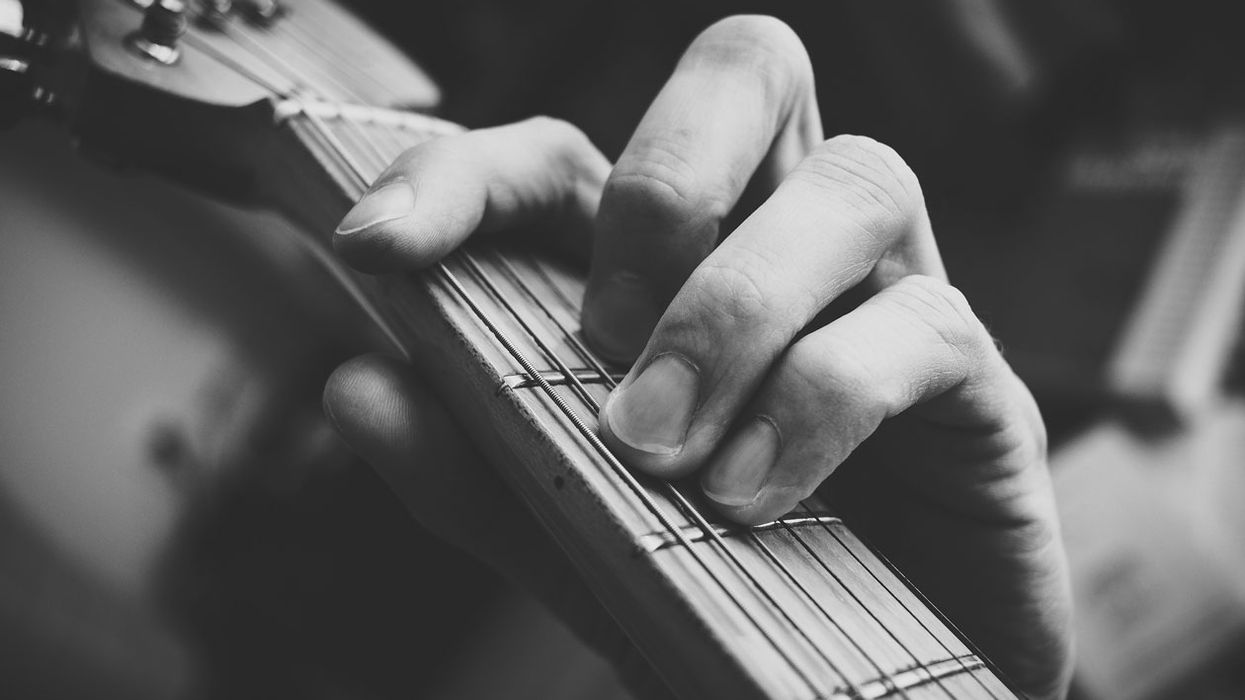
Rhythm guitar is arguably the most important aspect of guitar playing, and it’s also one of the most challenging skills to develop. The discouragement many players feel when working on rhythms forces too many of them to oversimplify the nuances, and this can reduce a performance from exceptional to fine. In this lesson, we’ll investigate why rhythm guitar can be so puzzling and look at a few ways to keep yourself motivated enough to persevere and improve.
Why So Hard?
In my many years of teaching I have found that students can learn the basic open-position chord shapes relatively quickly. The same goes for the pentatonic and major scale patterns. Even riffs and hooks like “Smoke on the Water,” “Crazy Train,” and “Oh, Pretty Woman” come relatively quickly to beginners. The biggest challenge for most guitar players is mastering rhythm guitar.
I’m not referring to the basics, such as four down strums in a measure of 4/4, a down and up eighth-note strum, or even the slightly syncopated strum of Ex. 1.
Ex. 1
Rather, I’m talking about the rhythms in countless classic rock, folk, and pop songs, which are the mainstays—for better or worse—of every oldies station, cover band’s setlist, and many aspiring beginners’ guitar dreams. Why are these rhythms so challenging for most players?
Dictionary.com defines idiosyncratic as “something peculiar to an individual.” Well, there’s your answer. Many of our favorite songs and guitarists, such as Neil Young, Malcolm and Angus Young, Joni Mitchell, David Gilmour, Jimi Hendrix, and Prince, possess idiosyncratic strums. How can something peculiar to an individual be easily reproduced? It can’t. Imitation takes hard work, hours of practice and refinement, and highly developed listening skills. That is not to say that idiosyncratic strums can’t be reproduced, only that they can’t be imitated easily.
What Can Guitar Players do to Improve Their Rhythm?
The first priority is to confirm that you genuinely know how the rhythm was originally performed. In this day and age, with reliable, professionally created guitar transcriptions and instructional videos (as well as an abundance of isolated rhythm guitar tracks on YouTube), there is ample opportunity to both hear and see accurate rhythms. This doesn’t make the rhythm immediately easier to play. It will help you avoid practicing it incorrectly and allow you to generate modifications based on the original, rather than through guesswork.
Play the Part Correctly and Slowly
The second step I recommend is to endeavor to play the part correctly and slowly. This requires playing the rhythms with slower tempos and one measure at a time rather than the more common four-measure patterns. This second aspect is important as many idiosyncratic strums vary from measure to measure. Such a lack of uniformity adds to the artistry of the music, but it can be frustrating to imitate.
For instance, look at Ex. 2, which is similar to Pink Floyd’s “Wish You Were Here.” While the chords themselves, G–C–D–Am, are easy enough to fret, the strum pattern is a nightmare of mixed rhythms, with each measure not only containing a different pattern, but different string choices as well. (To make it even more tricky, David Gilmour continues to vary his rhythms throughout the song.) Let’s consider just the first measure. There’s only one chord, but three different rhythmic figures. It gets even worse than that. Sometimes the strum includes all six strings, other times one note, two notes, or three notes. Maddening! This is one of the most challenging aspects of idiosyncratic rhythm. And these types of variations show up over and over again in accurate portfolio transcriptions. Yes, it is correct, but it’s an ordeal to decipher.
Ex. 2
Here’s a tip. First work on the strum, not the individually plucked notes and strings. Strum the entire G chord (Ex. 3). Next, isolate the lowest note in the chord (Ex. 4). If you can play this correctly then you can begin mixing it up with a combination of full chords, single bass notes, and partial chords. Trust me, Gilmour wasn’t thinking, “Gotta play just the top three strings on the 16th-note upbeat of beat two and the two bottom strings on the ‘and’ of beat four.” It’s idiosyncratic! Once you have measure one correct, move on to measure two, which is slightly different. Measures three and four are also marginally altered.
Ex. 3
Ex. 4
Hopefully you’ll find that one new rhythmic pattern on its own is relatively manageable. Having to generate four different patterns in the space of four measures? In that situation, strums become exponentially more complex. As this lesson moves forward, all the examples will be variations on this theme, in different contexts, and citing different specific artists. The idea here is to demonstrate the vast complexity idiosyncratic playing can generate.
Neil Young's Strumming Patterns
In my experience, Neil Young has some of the most seemingly random strums one can find. He’ll play a song with only four chords but there will be 16 different strum patterns. It’s both inspiring and infuriating. Ex. 5 is an example of such an exasperating figure, based on “Heart of Gold.” There are four chords in two measures, each with a different strum, followed by variations on the same four chords! Brilliant and unbearable.
Ex. 5
Ex. 5
To make mastering this a bit more tolerable, as with the previous Gilmour-esque pattern, break it down into smaller parts. You’ll also want to add full chord strums on the Em and C. Ex. 6. and Ex. 7 demonstrate measures three and four of Ex. 5, isolated and repeated. Do this for the first two measures as well.
Ex. 6
Ex. 6
Ex. 7
Joni Mitchell's "Big Yellow Taxi"
Another icon of individuality is Joni Mitchell, who deserves a lesson all to herself. For now, Ex. 8 will suffice. In this example, based on “Big Yellow Taxi” (although the original is performed in open-E tuning), there is the added complication of muted strums.
Ex. 8
If these muted strums are new to you, I recommend you focus on the mutes, as shown in Ex. 9. Once that is comfortable, return to Ex. 8 and incorporate the barre chords into the pattern. As with all our examples thus far, break them down, making sure each measure is solid before moving on to the next. At the risk of belaboring the point, these strums are demanding—there is no instant gratification here. “Practice and refine” should be your mantra.
Ex. 9
Let's Talk About Jimi Hendrix
It would be impossible to write about either guitar icons or 6-string idiosyncrasy without mentioning Jimi Hendrix. Jimi’s use of his thumb to fret chords is alone worthy of attention. For now, let’s stick with his eccentric strumming patterns. A good place to start is probably Hendrix’s version of “Hey Joe.” It consists of a three-and-a-half-minute loop of the circle of fourths chord progression C–G–D–A–E, yet Jimi finds a new way to play the pattern every time. Ex. 10 offers one of countless variations you can attempt. Ex. 11 demonstrates how to break it down.
Ex. 10
Ex. 11
While it’s true that most AC/DC songs feature the same riff or chord pattern played repetitively, you’ll also find that many of those patterns are four measures long, with multiple, highly syncopated rhythms found within each measure. “You Shook Me All Night Long,” “Bad Boy Boogie,” and “Highway to Hell” are all excellent examples of this. Ex. 12 demonstrates Malcolm and Angus Young’s penchants for such patterns by imitating the rhythms of “For Those About to Rock (We Salute You).” As you can hear, there are four measures with an immense amount of space in them and four different rhythmic figures. The key to perfecting this sort of rhythm is to not rush. Either tap your foot or use a metronome to keep your tempo steady.
Ex. 12
Our final example isn’t exactly idiosyncratic, though the referenced artist is. While Prince’s music and personal style is incredibly diverse, he often wears his influences on his sleeves, whether those be James Brown, Jimi Hendrix, or Joni Mitchell. Nevertheless, he habitually put his own spin on the source inspiration.
Ex. 13 provides you with a funky rhythm that will improve your playing, no matter what genre you specialize in, as it features muted strings (similar to those in our Joni Mitchell example), a fast syncopated 16th-note strum, and a four-measure pattern that requires you to focus on the subtle variations found in the pattern. Once again, I’ll remind you to practice such patterns one measure at a time. Goodness, any one of these measures is funky enough on its own and would satisfy most funk musicians: It’s the idiosyncratic nature of Prince to go beyond.
Ex. 13
Ex. 14 is measure three of Ex. 13 isolated and repeated. I’ve chosen this measure because for me it’s the easiest to play (always start with what’s easiest for you). Note that in Ex. 14, I removed the muted strums. We know they’re in the original and we can add them in soon enough, as demonstrated in Ex. 15.
Ex. 14
Ex. 15
Finally, let’s play all four measures without the mutes, as demonstrated in Ex. 16. It is this sort of compartmentalized, methodical, attention-to-detail practice that will improve your playing.
Ex. 16
Words of Encouragement
Ironically, one of the best things I can tell you about practicing the guitar is, “Learning to play guitar is hard!” I don’t say this to discourage, but to give perspective. If it’s taking you a week to learn a certain rhythmic pattern, guess what? It might take you a month to really get it down. Still, the rewards are worth the effort. Good luck with your rhythms!
Get Slash Tones Without Breaking The Bank
Slash’s tone is often regarded in gear circles like buried treasure—elusive, highly coveted, and shrouded in the mystique of modified vintage Marshalls and “Holy Grail” '59 Les Pauls. For most aspiring players, achieving that sound feels unattainable due to the specificity of the gear and the level of precision required to capture his Appetite for Destruction-era tone. In the first installment of a new video series, Blueprints, PG contributor Tom Butwin demonstrates that the "blueprint" isn't a locked vault; it’s a set of principles you can follow using modern, accessible tools.
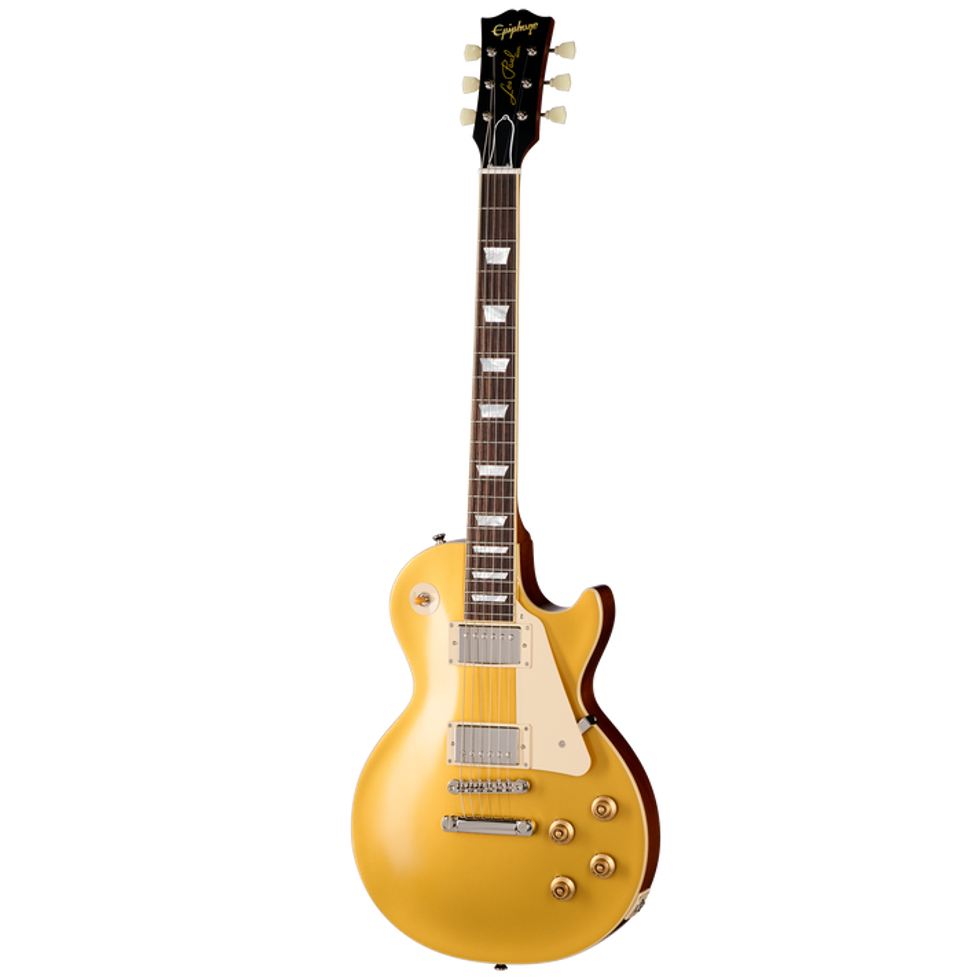
IGC 1957 Les Paul Goldtop Reissue, Double Gold
An Inspired by Gibson Custom reissue of the classic humbucker-equipped ’57 Goldtop –
1957 was the year that the Les Paul™, as most players think of it today, truly came into its own. It was the first full year that it had Patent Applied For humbucker™ pickups installed. The humbuckers, along with the ABR-1 Tune-O-Matic™ bridge and Stop Bar tailpiece that first appeared on a Les Paul with the introduction of the Les Paul Custom in late 1953 and on the Goldtop in late 1955, were defining features that many players still prefer over the earlier models that had a wraparound bridge/tailpiece and P-90 pickups and made the Les Paul into a true fire-breathing rock icon. Now, Epiphone, in collaboration with Gibson Custom, is very proud to introduce the 1957 Les Paul Goldtop Reissue, a stunningly authentic Inspired by Gibson Custom reissue of those early humbucker-equipped Les Paul Goldtops that delivers vintage Les Paul looks and performance at an accessible price. The 1957 Les Paul Goldtop Reissue isn’t just a guitar; it’s a bridge to a symphony of possibilities, willing and ready to help you make your own mark on music history.
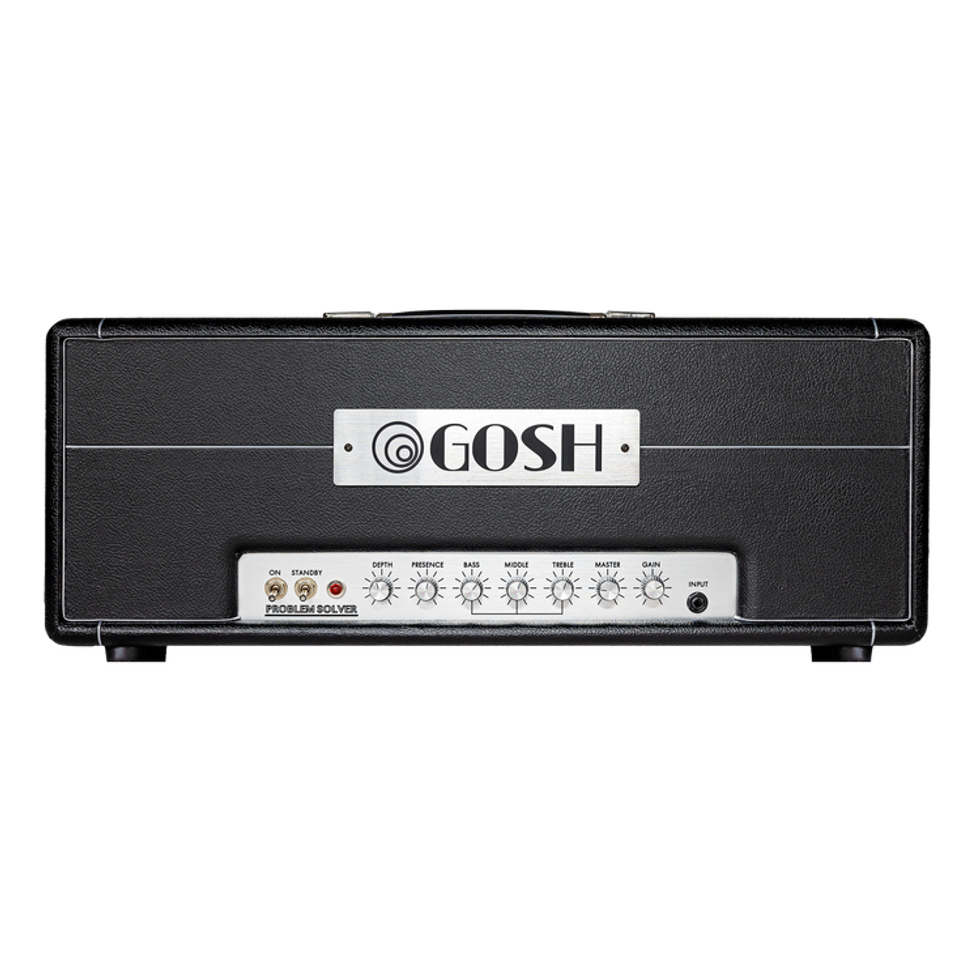
Problem Solver 50
What sets the Problem Solver apart is its thoughtful array of features, carefully curated to empower your creativity. The AGE switch lets you tailor your tone stack to different eras – whether you crave the cutting-edge brilliance of 1963, the aggressive bite of 1966, the mid-heavy roar of 1981, or the warmth of 2023, it's all at your fingertips.
The Mid Boost switch elevates your highs and mids, ensuring your solos cut through the mix with unparalleled clarity. The Depth control allows you sculpt the low-end frequencies. And the revamped EQ controls provide a logical, intuitive layout, ensuring that you can sculpt your sound effortlessly, straight out of the box.
In the end, the Problem Solver Amplifier isn't just an homage to the past—it's a celebration of timeless tone, reimagined for the demands of today's musicians. Join us on this journey and discover a new era of sonic possibilities. Plug in, play, and let the music do the talking – the Problem Solver has arrived.
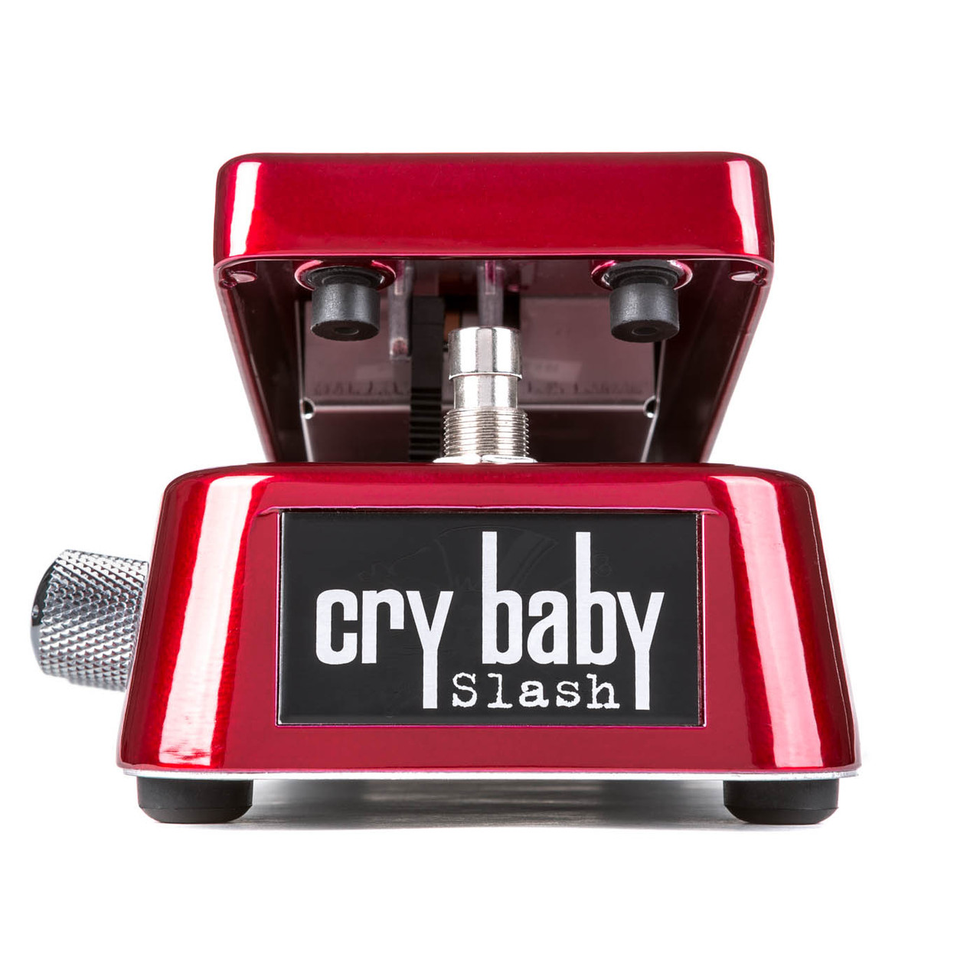
SLASH CRY BABY® WAH
This Cry Baby Wah combines high gain distortion with the Classic circuit for Slash's cutting lead tone, with LEDs to indicate effect status.
This pedal can be powered by two 9-volt batteries, a 18-volt adapter or the DC Brick™, Iso-Brick™ and Mini Iso-Brick™ power supplies.
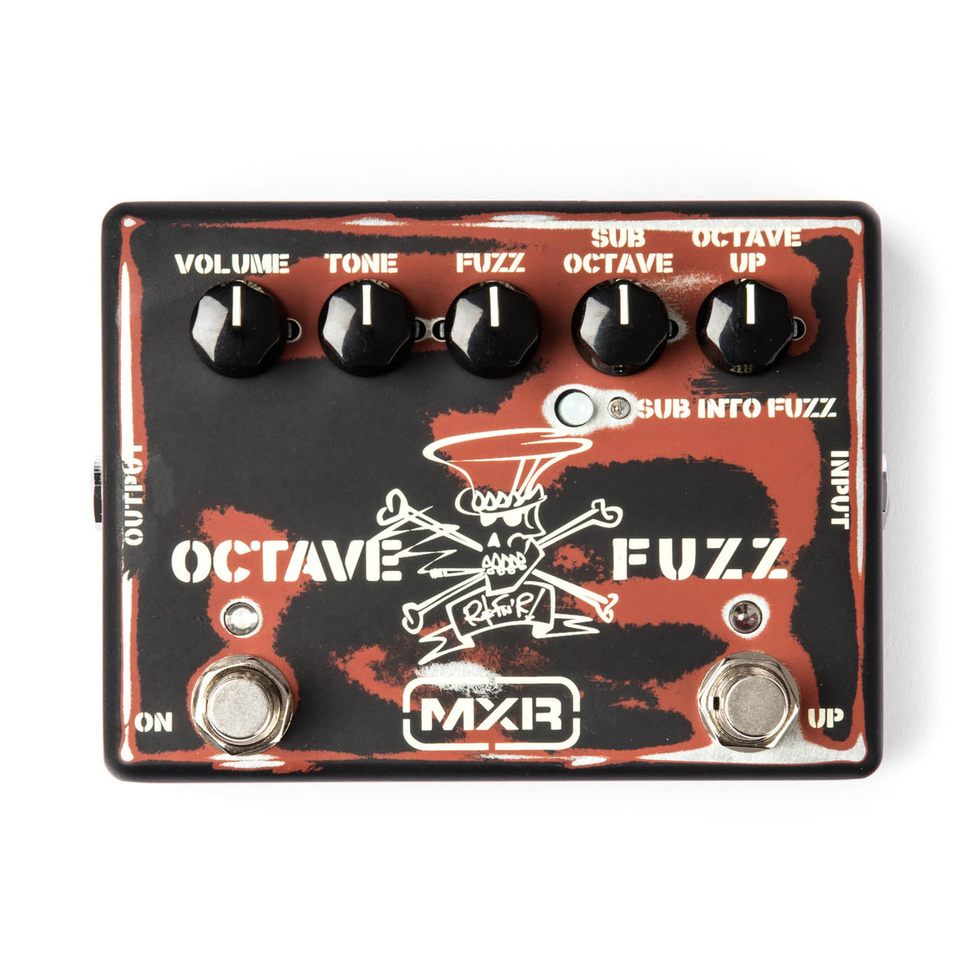
SLASH OCTAVE FUZZ
The Slash Octave Fuzz combines searing fuzz with a sub octave grow and an array of controls for fine-tuning your sinister sound.
This pedal can be powered by a 9-volt battery, a Dunlop ECB003 9-volt adapter, or the DC Brick™, Iso-Brick™, and Mini Iso-Brick™ power supplies (not included).
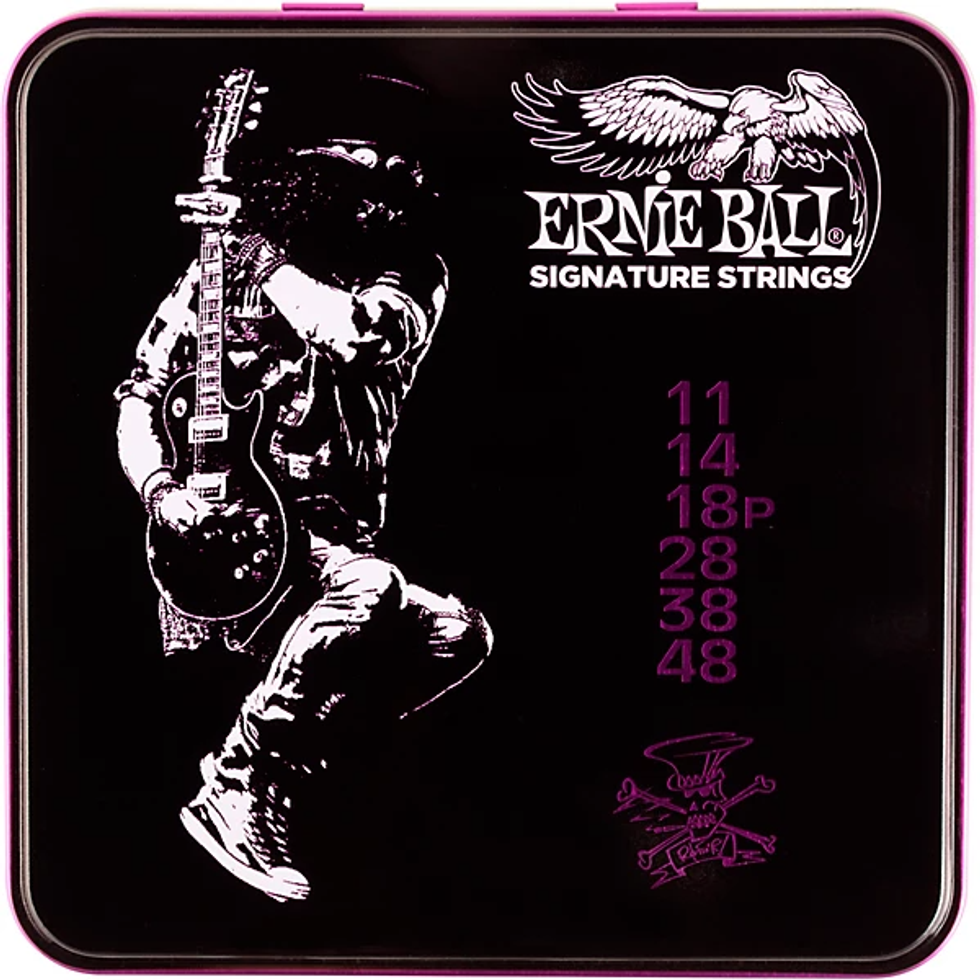
Limited-Edition Slash Signature Strings Set .011-.048
Ernie Ball introduces a limited-edition set of custom-wound Slash signature Slinky strings. Slash’s signature string sets are the culmination of over three decades of Slash and Ernie Ball’s ongoing pursuit to create strings that provide more durability and tuning stability without sacrificing tone or feel. These sets consist of Slash's preferred 11-48 gauge Slinkys wound with Paradigm core wire and plasma-enhanced nickel-plated steel wrap wire, while the Paradigm plain strings are constructed with a heavier brass wire reinforcement at each of the ball ends for better tuning stability and strength. These limited-edition string sets are highly collectible and conveniently packaged in a three-pack embossed tin for easy storage.
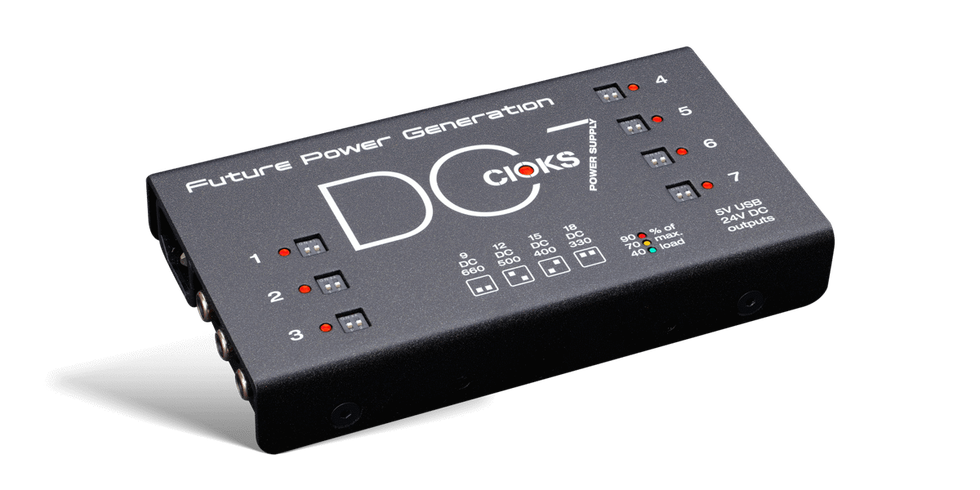
DC7
The groundbreaking DC7 has a one-inch (25,4mm) profile and weighs 1.1 pound (500 grams) thanks to the pure 2-stage switch-mode technology inside. The profile may be low but the power ratings are certainly not – the DC7 puts out a maximum of 48W and allows the user to connect multiple high-current effects such as devices from Effectrode, Line 6 and Eventide without noise of any kind.
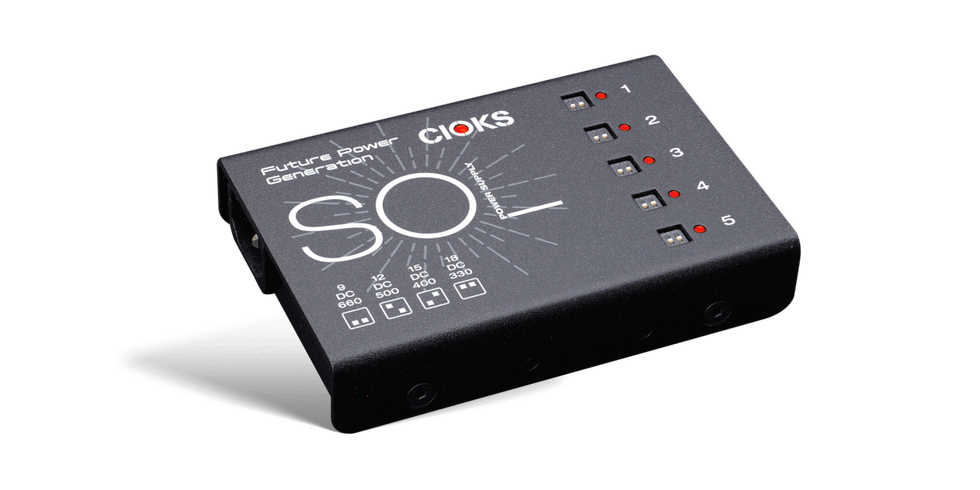
SOL
SOL is the ultimate solution for bringing life to a small to medium-sized pedalboard setup, especially if you are using power-hungry pedals. SOL is the smallest mains-powered switch-mode power supply we make at CIOKS (no wall-warts here) and the no-frills design plus massive power will leave you free to focus on your creative spark.
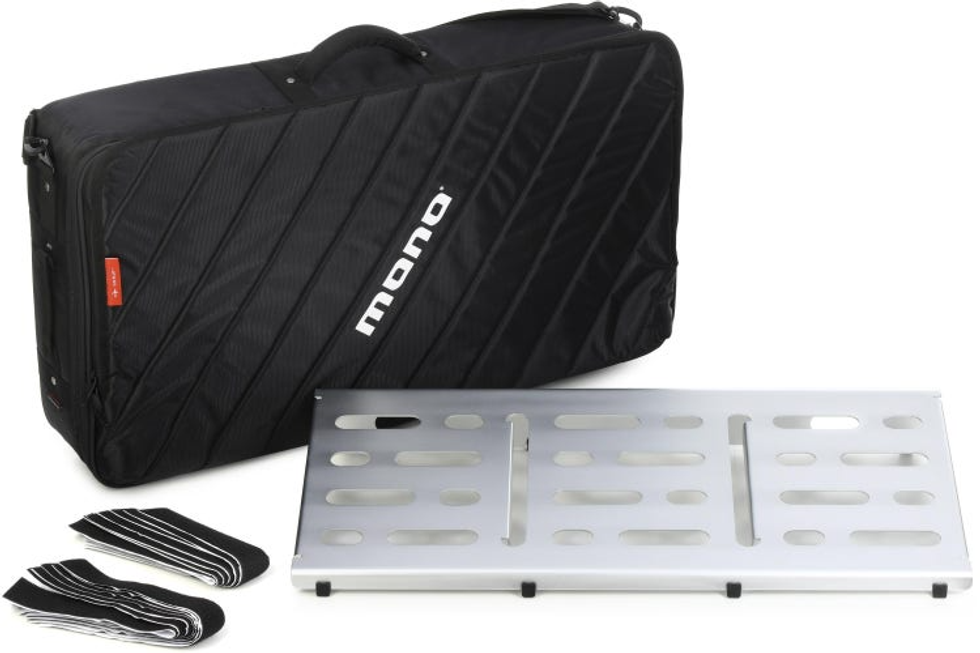
Pedalboard Large with Pro Accessory Case 2.0
This is it — the granddaddy of Pedalboard series. The MONO Pedalboard Large is a pro-sized and -featured pedal solution that won't weigh you down in size or cost. The Pedalboard Large is cut from a single piece of anodized aluminum for superior strength, light weight, and an elegant textured surface. Cutouts along the surface hide pedal jumpers and power cables for a streamlined, professional look. Rubber feet on the bottom absorb shock and prevent the Pedalboard Large from sliding across hard surfaces as you stomp.
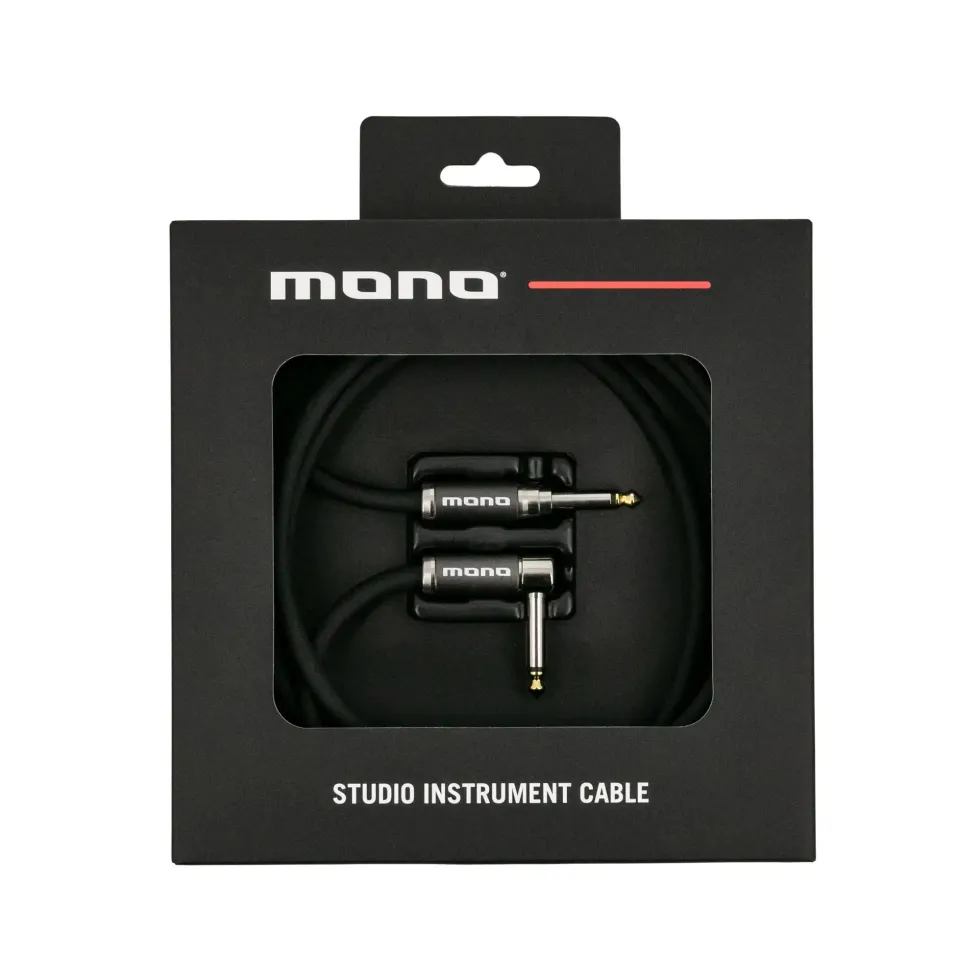
Studio Instrument Cable
Built for musicians chasing studio-grade clarity, the MONO Studio Instrument Cable delivers pure tone and zero compromise. Inside, 150 strands of 0.08 mm oxygen-free copper give you detailed highs, tight lows, and everything in between. Precision insulation keeps your signal clean from the first take to the final mix.
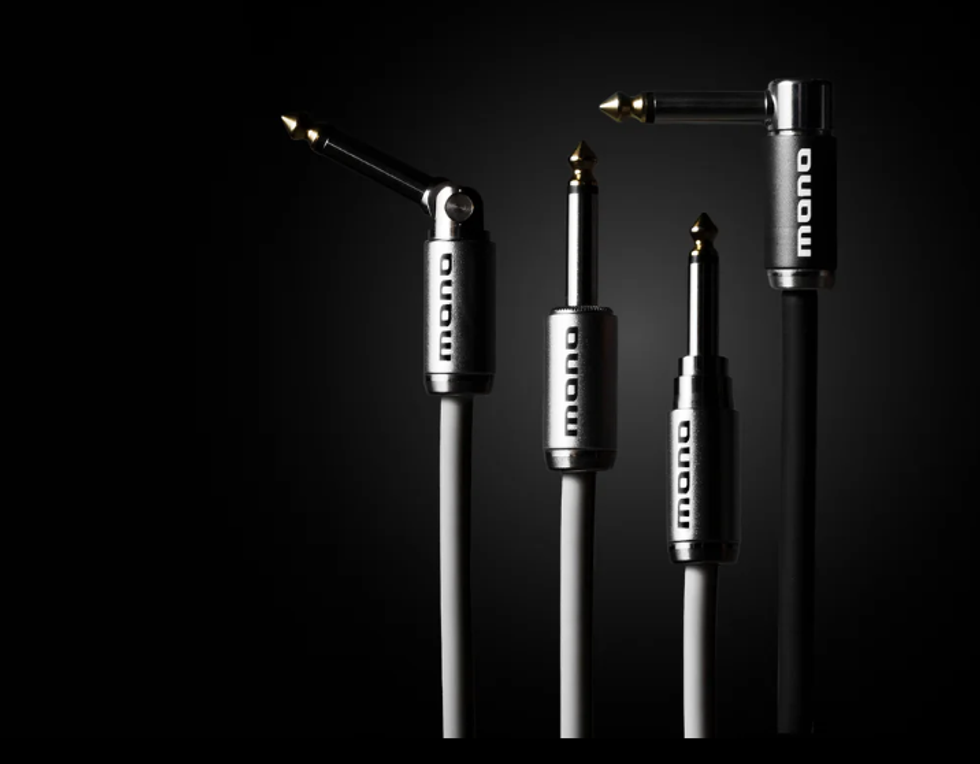
Instrument Cables
Engineered for clarity with oxygen-free cores with precision insulation and shielding to reduce interference and keep signal clear.
Slash Blueprints Giveaway!

Want to sound like Slash? Grab your chance with the Slash Blueprints Giveaway!
Slash Blue Prints Giveaway
See it in action!
Welcome to our new video series, Blueprints. In the first episode, PG contributor Tom Butwin features Slash and explores the architectural DNA of the top-hatted rocker's legendary sound.
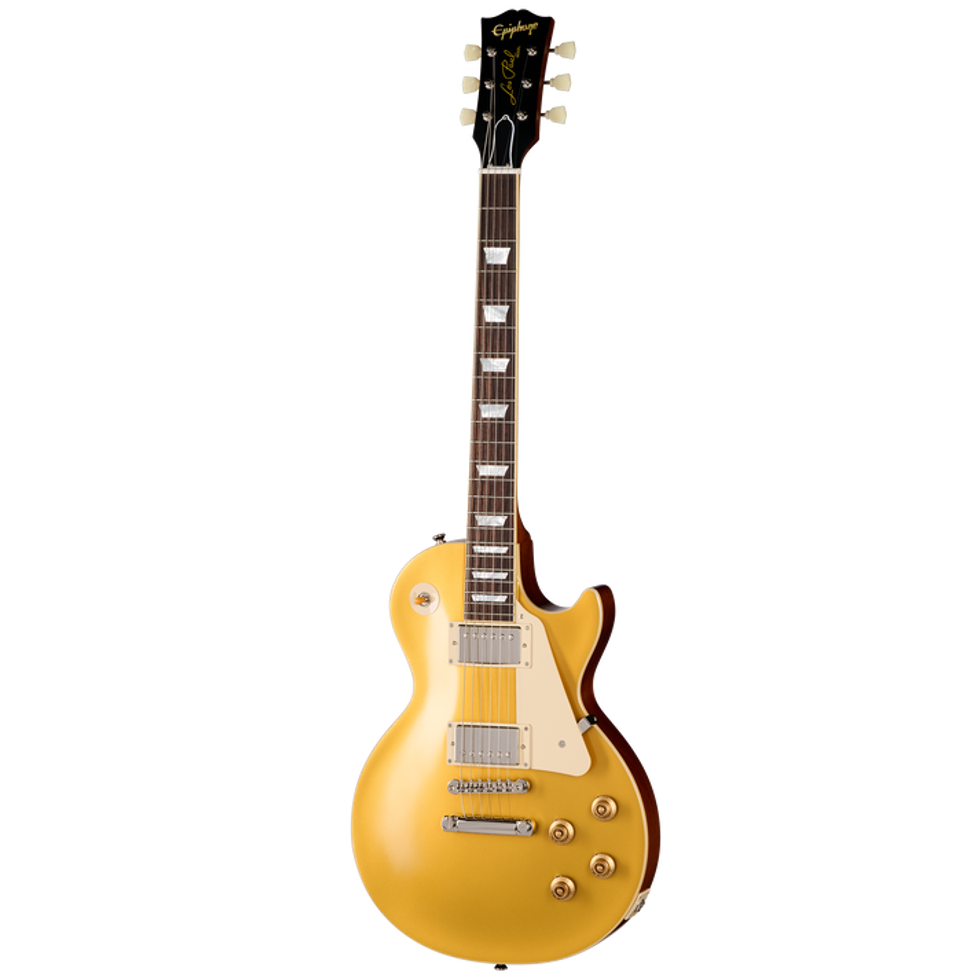
IGC 1957 Les Paul Goldtop Reissue, Double Gold
An Inspired by Gibson Custom reissue of the classic humbucker-equipped ’57 Goldtop –
1957 was the year that the Les Paul™, as most players think of it today, truly came into its own. It was the first full year that it had Patent Applied For humbucker™ pickups installed. The humbuckers, along with the ABR-1 Tune-O-Matic™ bridge and Stop Bar tailpiece that first appeared on a Les Paul with the introduction of the Les Paul Custom in late 1953 and on the Goldtop in late 1955, were defining features that many players still prefer over the earlier models that had a wraparound bridge/tailpiece and P-90 pickups and made the Les Paul into a true fire-breathing rock icon. Now, Epiphone, in collaboration with Gibson Custom, is very proud to introduce the 1957 Les Paul Goldtop Reissue, a stunningly authentic Inspired by Gibson Custom reissue of those early humbucker-equipped Les Paul Goldtops that delivers vintage Les Paul looks and performance at an accessible price. The 1957 Les Paul Goldtop Reissue isn’t just a guitar; it’s a bridge to a symphony of possibilities, willing and ready to help you make your own mark on music history.
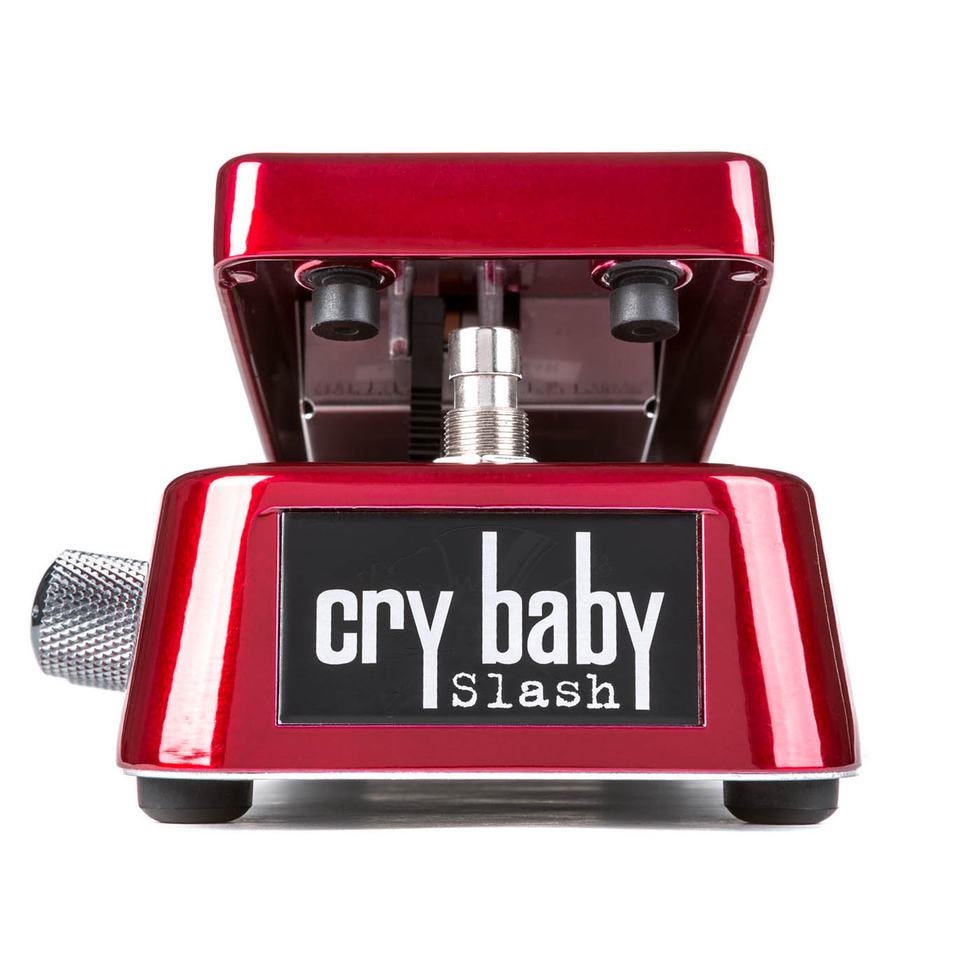
SLASH CRY BABY® WAH
This Cry Baby Wah combines high gain distortion with the Classic circuit for Slash's cutting lead tone, with LEDs to indicate effect status.
This pedal can be powered by two 9-volt batteries, a 18-volt adapter or the DC Brick™, Iso-Brick™ and Mini Iso-Brick™ power supplies.
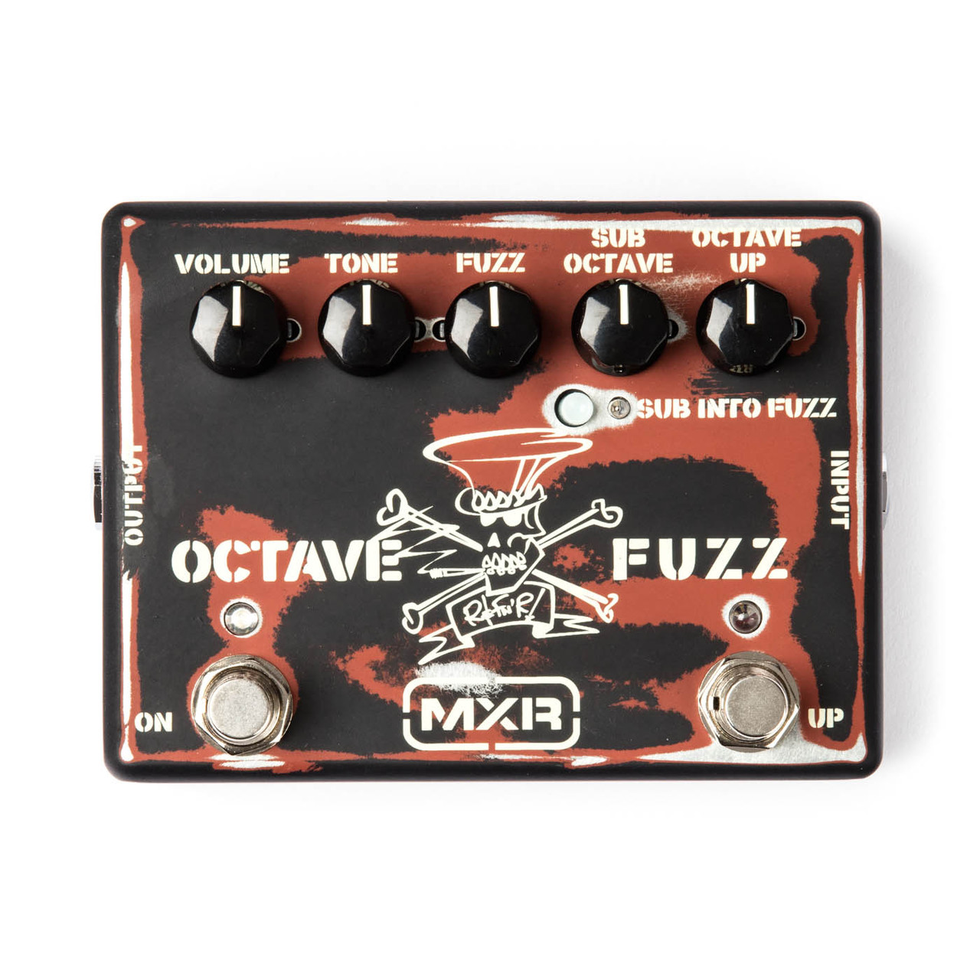
SLASH OCTAVE FUZZ
The Slash Octave Fuzz combines searing fuzz with a sub octave grow and an array of controls for fine-tuning your sinister sound.
This pedal can be powered by a 9-volt battery, a Dunlop ECB003 9-volt adapter, or the DC Brick™, Iso-Brick™, and Mini Iso-Brick™ power supplies (not included).
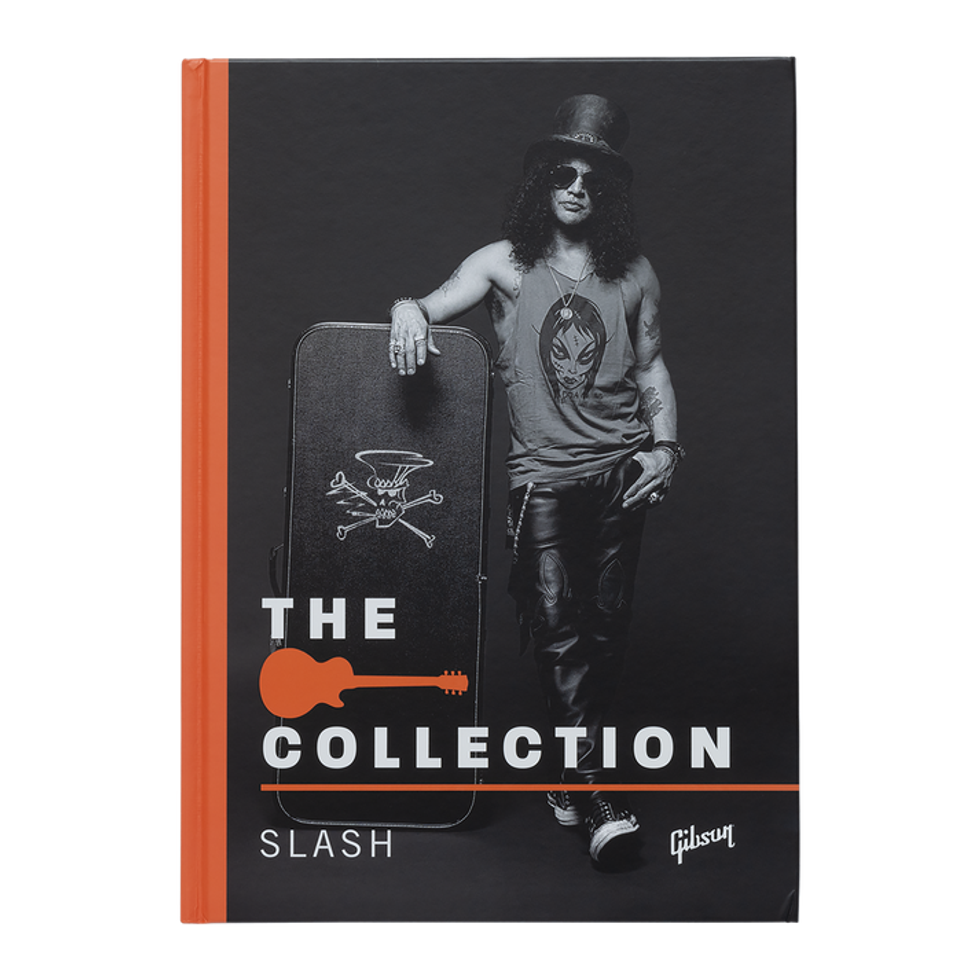
The Collection: Slash, Standard Edition
This premium coffee table book explores in unprecedented detail the instruments Gibson Global Brand Ambassador and rock legend Slash has used on countless hit records and on stages worldwide, in front of millions of adoring fans.
Gibson Publishing, headquartered in Nashville, Tennessee, is the next major step from Gibson Brands, contributing to the evolution of collaborative artist partnerships and promoting music and music-related topics to fans worldwide. As with the recently launched Gibson Records, the first project for Gibson Publishing is a collaboration with Gibson Global Brand Ambassador and rock legend, Slash.
EarthQuaker Barrows Review
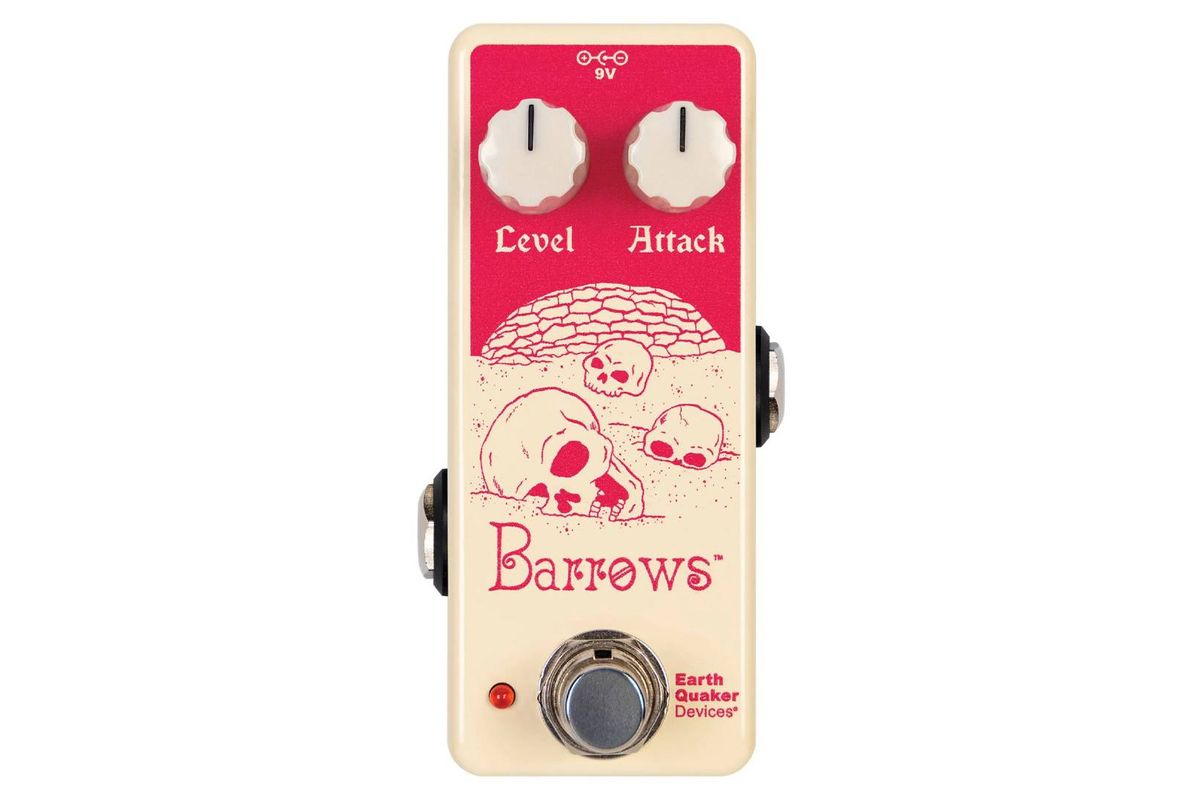
Among the many fuzz pedals to carry the Tone Bender name, the MkII might be the one that rips the most. And though not as common as the Vox Tone Benders that American psych-punk fans wrestled with for decades—which were generally Mk1.5 or MkIII versions—it might have been the Tone Bender version that people experienced the most thanks to Jimmy Page. As Page superfans and fuzzspotters outed the MkII as the sound of Led Zeppelin, it came to embody what a Tone Bender should be. Consequently, a lot of builders jumped on the bandwagon.
There is a practical, musical upside to the MkII that transcends the Jimmy Page associations. Some desert, doom, and stoner rockers, for instance, love its ability to sound huge and evil while occupying less mix space than a Big Muff. And while not as sweetly sensitive to input dynamics as the Fuzz Face (or the very Fuzz Face-like Tone Bender Mk1.5 and first-generation Vox Tone Bender), its germanium transistor topology makes it responsive to guitar-volume attenuation. EarthQuaker’s new take on the MkII, the Barrows, shares all these attributes. And between its very convenient size and refinements that make it less noisy, Barrows represents a ceratin sonic, functional, and practical ideal of what a vintage-style germanium fuzz can and should be in 2025.
Savage, Sassy, and Sweet
Doctrinaire thinking around germanium fuzz usually states that it sounds good only at maximum volume and gain levels and that any variation must come from the fingers and guitar controls. The Barrows reveals the cracks in this view. While the Barrows is positively searing at wide-open settings, and most receptive to input dynamics at these levels, it shines at many different gain and level settings. There are heaps of cool, smoky, more subdued fuzz sounds lurking in the middle third of the gain range that can be useful for simultaneously creating mystery and generating menace and mass in a recording situation without blowing the room apart with volume. The Barrows is not as touch-sensitive here, but guitar-volume adjustments can create dark, compelling fuzz voices that are equally interesting with a 50-watt amp and a 2x12 cabinet or a practice amp.
MkII Tone Bender-style circuits have always been regarded as second-best to the germanium Fuzz Face when it comes to gnarly-to-clean range. That dictum remains mostly true in the Barrows, at least as far as clean tones go. But if the Barrows can’t quite equal a Fuzz Face’s capacity for airy clean sounds at reduced guitar volume, its near-clean sounds still have abundant clear, bell-like resonance and detail that will suffice for most. The Barrows’ dynamic range is most evident in its touch sensitivity. You can generate many beautiful, spooky, and smoldering gain shades just by varying picking intensity. It’s especially impressive if you ditch your pick and use your fingers to generate these tone variations. And if you want to go super old-school and string up your guitar with flatwounds, the Barrows reveals many beautiful, round, and vocal fuzz colors. More than once, I was moved to think that if Sinatra was a psych-punk he would have adored the atmospheric, verge-of-exploding moods Barrows can produce in these environs.
“If Sinatra was a psych-punk he might have adored the atmospheric, verge-of-exploding moods Barrows can produce.”
The Verdict
For a fuzz nut, the Barrows—for its small size and big sound—might as well be candy. Players that use fuzz more infrequently, though, will dig its simplicity, small dimensions, and the fuzzy classicism exuded by its punchy, straight-ahead voice. The pedal is intrinsically limited by the same factors that limit any germanium fuzz with 1960s lineage. And by the standards of modern gain devices that can be tuned in small increments to match very specific distortion needs, the Barrows can, at times, seem unruly and one dimensional. But if you’re willing to use guitar volume and tone and touch dynamics to re-shape the fuzz, you’ll uncover many less aggro tones ranging to light drive and near-clean sounds—applications made even more rewarding thanks to a low noise floor. Best of all, the petite Barrows comes with an equally petite price tag of $129. For germanium-fuzz newbies, that makes a plunge into the unknown a lot more palatable. But even seasoned fuzz and Tone Bender users are bound to be impressed by the quality and flexible vintage voice Barrows delivers for the money. PG
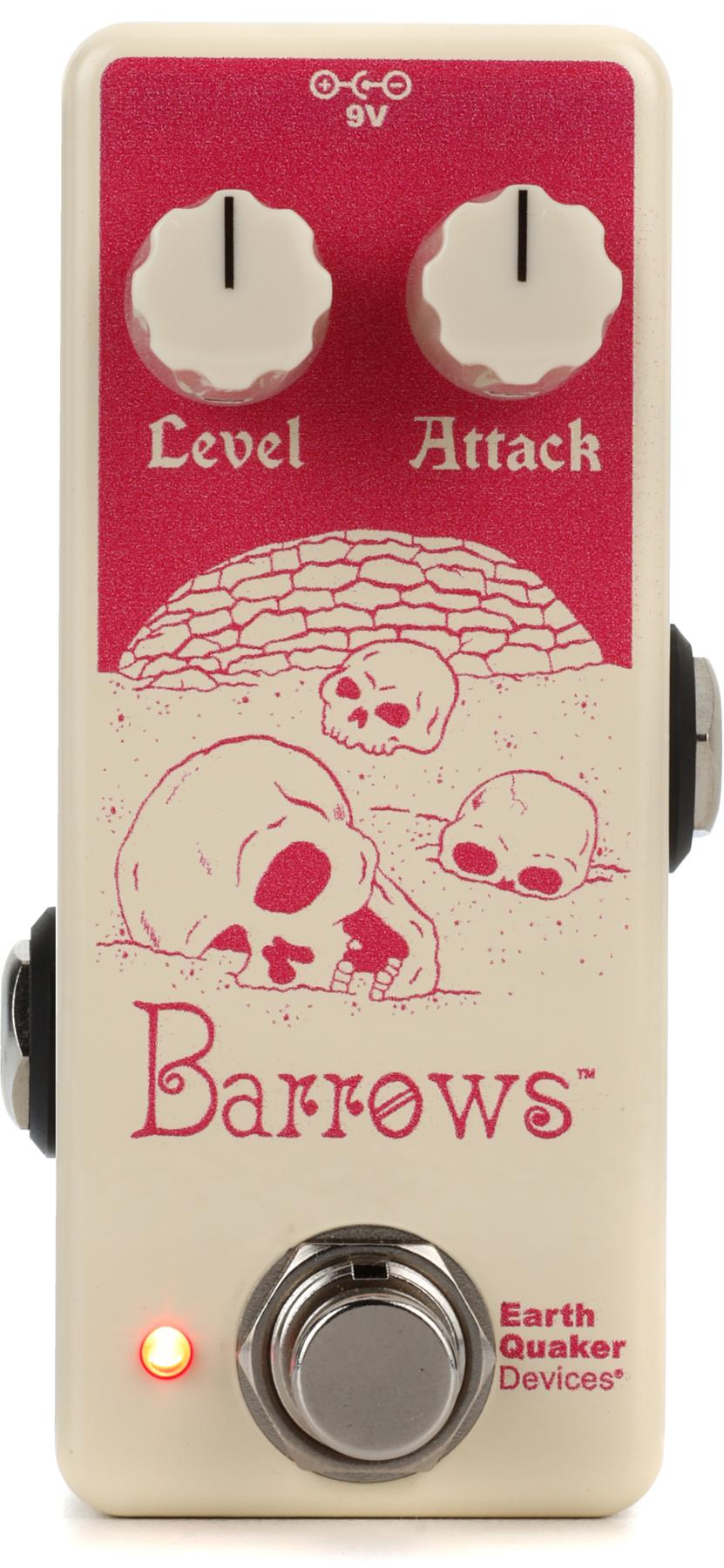
EarthQuaker Devices Barrows Fuzz Pedal - White
Mod Garage Tonewood Teardown: Upgrading Hardware
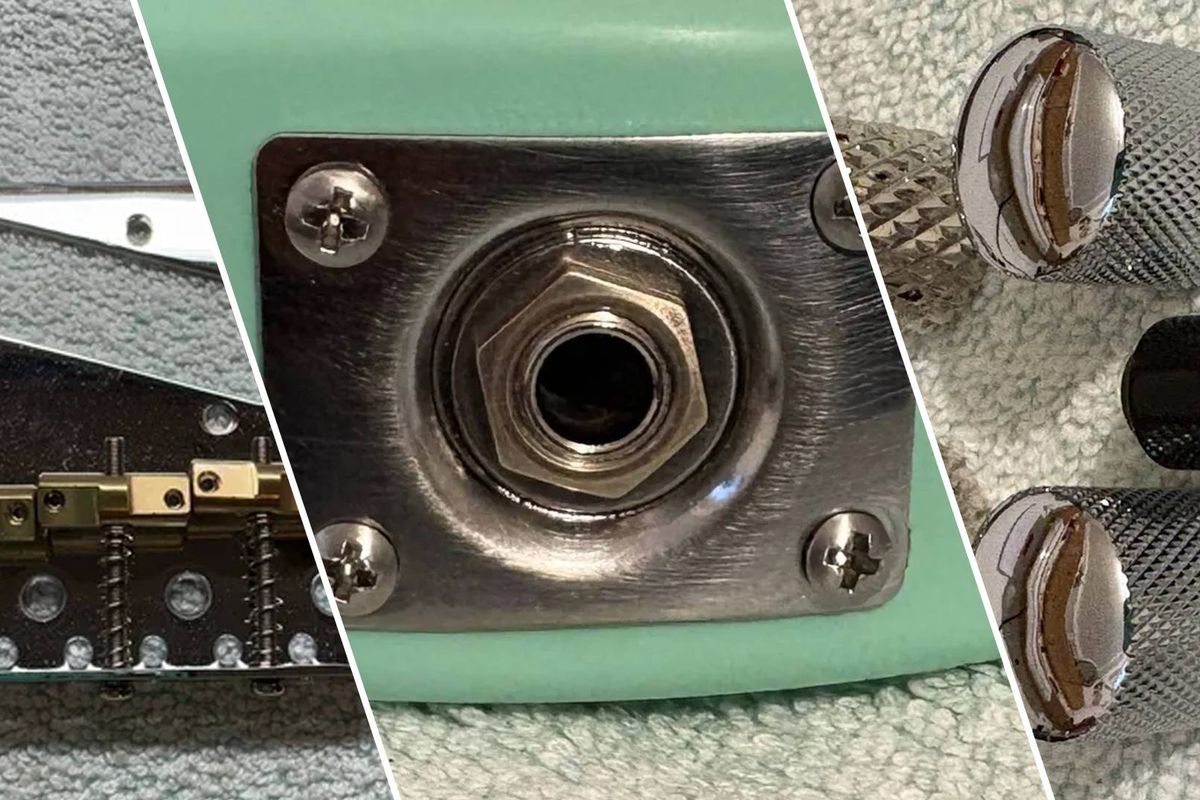
Hello, and welcome back to Mod Garage. In this month’s edition of our ongoing tonewood teardown, we’ll continue working on our guitar’s body and hardware. That means we’ll be spending a chunk of the $305 remaining in our $500 budget to make some worthwhile improvements.
After inspecting the stock hardware, I decided to keep the neck mounting plate, control plate, and jack plate. Below is a quick rundown of the individual parts.
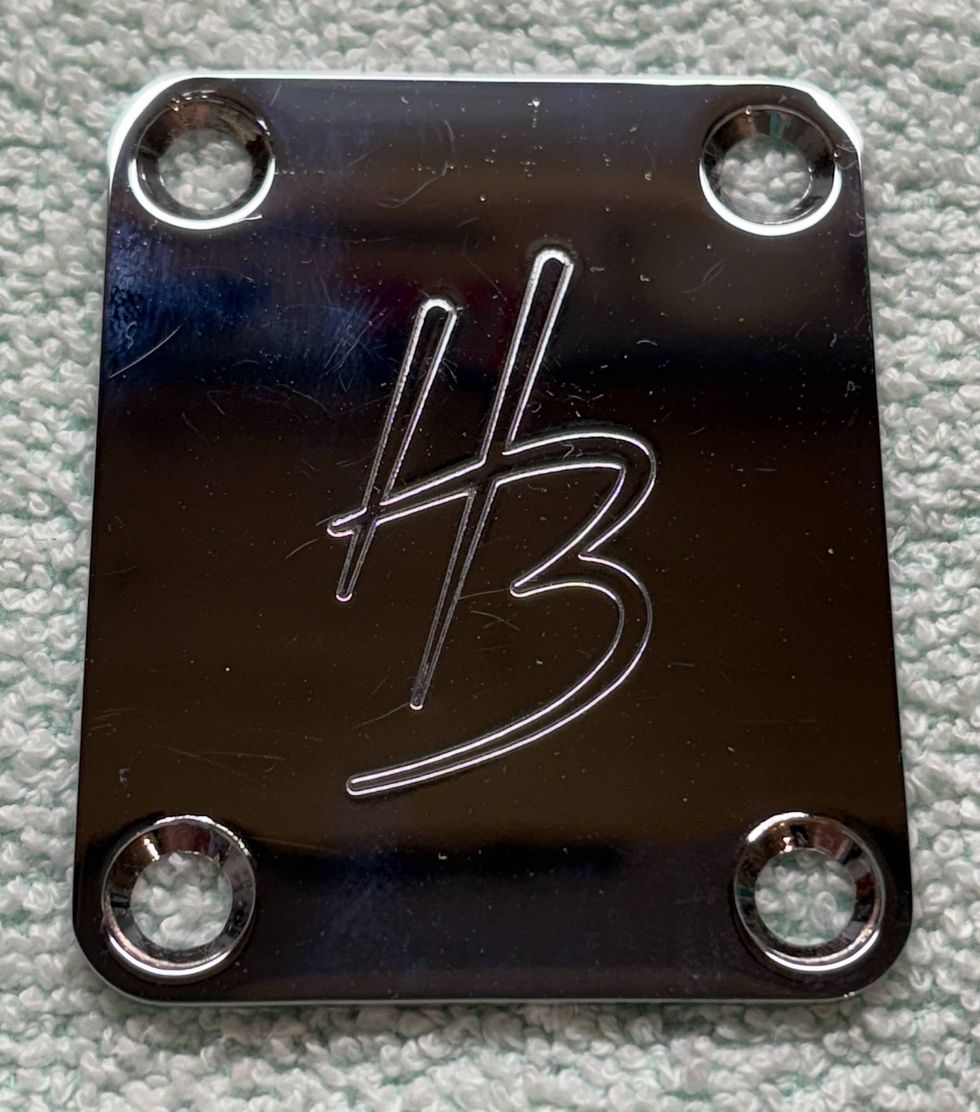
The neck mounting plate is perfect as it is, and I really dig its snazzy Harley Benton engraving. It has the typical Fender dimensions, so I see no need to change it. I will, however, replace the four soft, tiny neck attachment screws with regular-sized, stainless-steel screws, but we’ll get to more details on that later. If you want to customize this part of your guitar, by the way, you have plenty of choices regarding color, thickness, materials, and, of course, custom engravings of all kinds. If you want to save some weight, look for one made out of aluminum or titanium. You can put a custom paint job on the plate, put a plastic neck-plate guard underneath, or whatever you have in mind. Stick to metals, though; other materials are too weak.
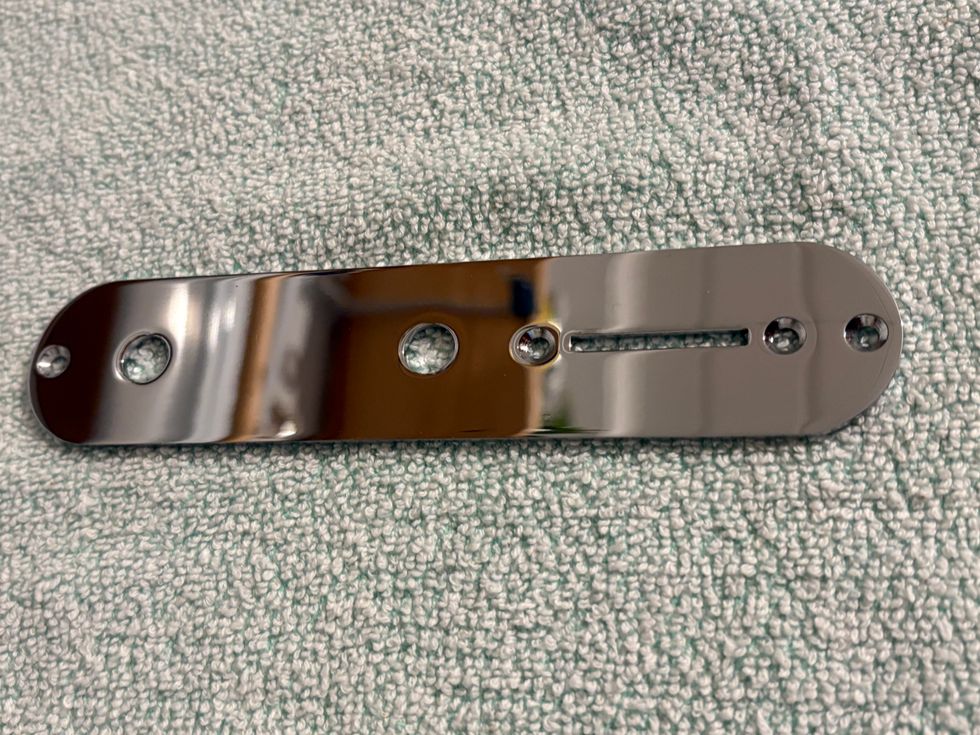
The stock control plate is a typical Telecaster control plate with openings for two pots and a pickup selector switch. It has the typical modern 2 mm thickness to match 3-ply pickguards—the thinner 1.5 mm control plate (aka the vintage version) is the right choice for single-ply pickguards. Keep this in mind if you want to change your pickguard. I fashioned my own new pickguard out of material that is 2 mm thick, so the stock control plate works perfectly for me. Later, when we talk about the wiring of this guitar, you will see that tiny metric parts were installed. I checked the diameter of the two holes for the pots, and to my surprise, they’re drilled for U.S.-standard, 3/8"-inch hardware. Same goes for the slit for the pickup selector switch: An average-quality import switch was installed, but a regular U.S. inch switch fits perfectly. These screws, too, will be replaced with stainless steel ones.
If you want to change the control plate on your guitar, you can choose between wood, metal, and plastic options with all kinds of configurations. You have countless choices here to customize your guitar.
The jack plate is not the typical Telecaster jack cup construction, but a Les Paul-style rectangular plate that is held by four screws. For me, this is one of the best improvements one can do to any Telecaster style guitar. No matter what you are doing, it’s only a matter of time until the classic jack cup comes loose. You might even pull out the whole thing including the output jack when trying to unplug your cable. To reinstall and fasten it, you need a specialized tool. I have done this modification to all of my own Telecaster-style guitars, and encourage you to do the same.
The jack cup is held by four screws, resulting in a very strong connection. I’ll swap in four stainless steel screws, but otherwise, it’s perfect as is. A tiny metric import output jack was installed, but again, the hole is 3/8" inch, so we can use a quality output jack. If you want to downgrade to a classic Telecaster jack cup, you can do so, but you’ll have four visible holes in the body around it. If you like this update but not the stock plate, there are alternatives available—for example, oval ones made from wood, plastic, and metal held by only two screws (aka a cat-eye plate), square (classic Les Paul-style), or rectangular like the stock version in different types and finishes.
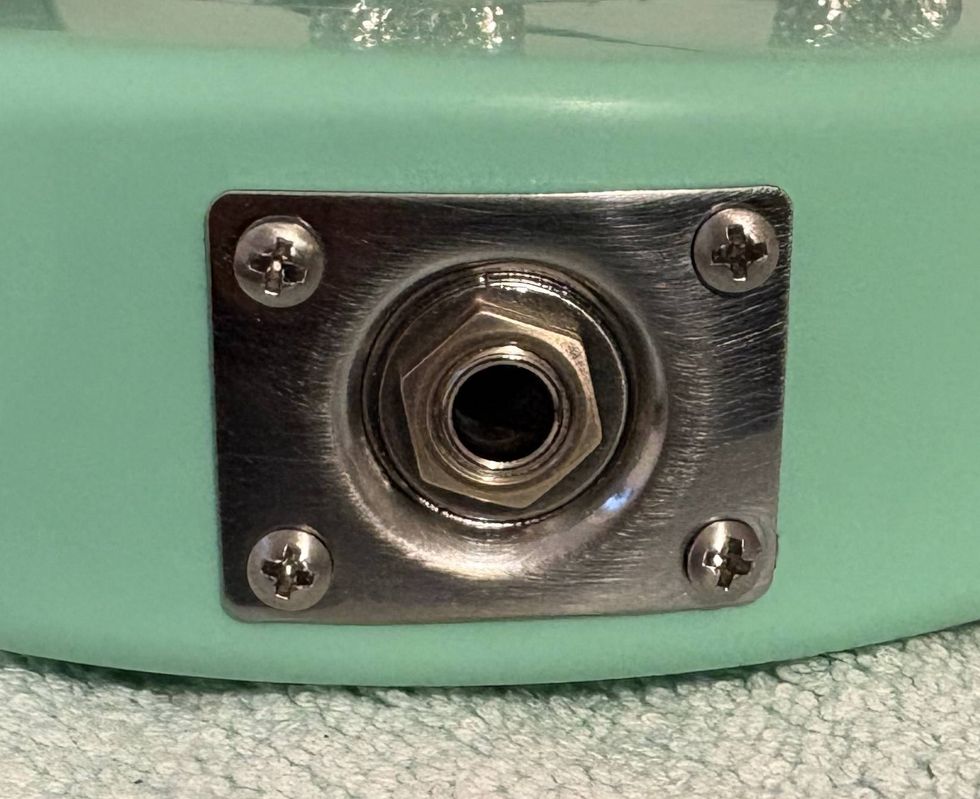
Let’s break the aggressive shine of these three parts by putting them into the stone tumbler for a few minutes, creating some wear and random scratches. Now, we’ll continue with the knobs for the two pots and the pickup selector switch.
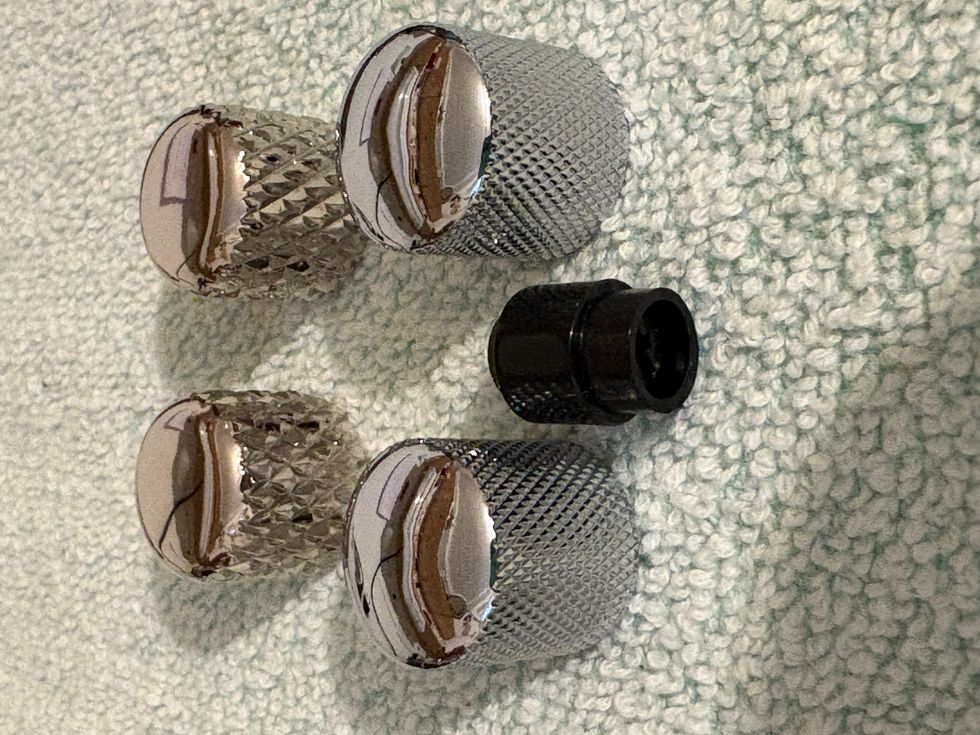
The stock knobs are ’50s vintage-correct, with two typical Telecaster dome knobs for the pots and a round, plastic barrel switch tip. Because I wanted to keep a slightly worn vintage look, only the switch tip made it back to the guitar. The two dome knobs are slightly oversized and fairly heavy—I can’t remember having such bulky knobs on a guitar before! Plus, they’re not made with the set screw for the typical Tele solid-shaft pots.
To add some early Tele flair, I ended up with two heavy knurled dome knobs that Fender used in the very early days. I really like their somewhat raw look, and I bought two knobs that are made out of nickel-plated aluminium—they have virtually no weight at all, and they’re the correct size. They are made for U.S.-inch solid shaft pots with the typical set screw to lock them, and I paid $18 for a pair of two. Before I sent them to the stone tumbler for a few minutes, I used a mid-grade abrasive cloth to smooth out the heavy knurled surface a bit so it feels more comfortable. They turned out great, and I really like the look.
Another great way to create a unique look for your guitar is to use custom knobs made from metal, wood, plastic, bone, or any other material. But take care to choose the right ones. Knobs for metric hardware will not fit U.S. components and vice versa, and knobs for push-on split-shaft pots will not fit their solid-shaft counterparts. I always choose the pots first, because performance is much more important than appearance.
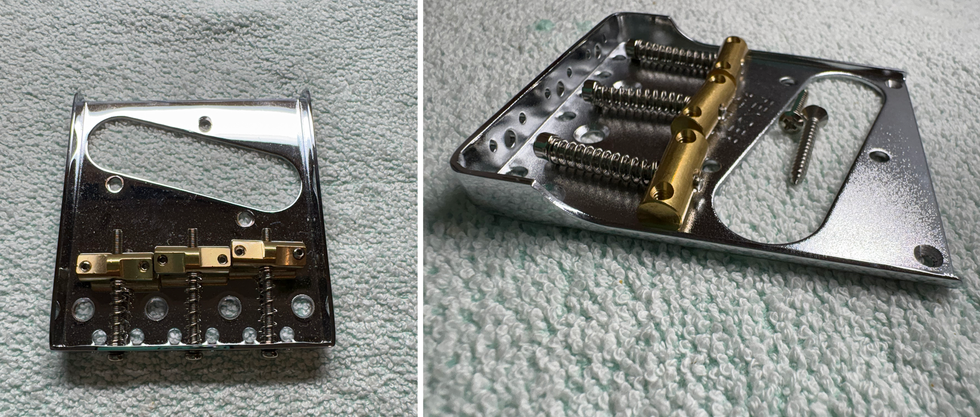
The stock bridge has the typical Telecaster string-through-body construction and shape, with three compensated brass saddles—a great update for any Telecaster. Because of the overall construction, I’m pretty sure it’s either an unbranded Wilkinson-made bridge, or a knock-off of one. For some reason, very tiny screws have been used to fasten the heavy, brass-construction bridge. The Wilkinson compensation system uses saddles that are not slanted but have relocated edges on top, resulting in a somewhat irritating appearance and a not-very-comfortable surface with some sharp edges and spots. I don’t like either of these quirks, so it was clear that the bridge had to go.
There is a massive range of Telecaster bridges from various companies, with different construction, materials, shapes, and, of course, functionality. I wanted a bridge with a classic look, very light weight, and compensated saddles that feel smooth and comfortable. To stay within our budget, I decided to look for a used bridge on eBay, Reverb, and similar platforms. I ended up with an excellent used bridge for $28. It’s very lightweight and has a thin baseplate and double-cut “tapered walls,” compensated round brass saddles, two additional countersunk holes towards the neck, and double functionality regarding the strings. Besides the classic string-though-body option, it can also act as a top-loading bridge so you can choose which you like best, or even mix and match to your taste.
That’s it for now! Next month, we will continue with the bridge and saddles before working on the wiring. Our budget is down to $259 for future investments, but I’m still hopeful that we will not break our $500 barrier, so stay tuned.
Until then ... keep on modding!
The biggest news stories from the world of guitar in 2025

One thing’s for sure: the world of guitar and rock music is still very much popping, with millions of you visiting Guitar.com over the past year to stay up to date with the latest news – from gear launches to the hottest takes from your favourite artists. And as Guitar.com’s News Editor, it’s been my distinct pleasure keeping you informed…
Now, as we wrap up 2025 and get ready to celebrate the festive season, I thought we’d take a quick look back at some of the biggest news stories from the past year that had you all clicking the most. No further beating around the bush – you probably have plenty more gifts to wrap (or, like me, buy…). Enjoy!
Metallica guitar tech on how ditching real amps helped the band improve the spectacle of their live shows
 Credit: Steve Jennings/Getty Images
When many of us think of a rock show, part of the image in our heads is a wall of Marshalls at the back of the stage. For many years it was. But now, many of the world’s biggest bands are turning to amp modellers for their tones, thus freeing up space on stage to play around with set design. And Metallica guitar tech Chad Zaemisch says the switch has led to “a lot more opportunities” when it comes to providing a spectacle for the fans.
“The people in set design realised that if we don’t have this wall of speakers anymore, we have all of these other things available to us,” he said.
“Everybody’s all about content these days, and not a lot of people want to watch a band stand in front of their amp line with nothing else going on. Now we can use large video screens. It opens up a lot more opportunities to do different things.”
What do you think – should it be mandatory for a rock band to be seen in front of their amp line, or does it not really matter anymore?
We said goodbye to some rock legends
![[L-R] Brian Wilson, Ozzy Osbourne and Ace Frehley](https://guitar.com/wp-content/uploads/2025/12/Brian-Wilson-Ozzy-Ace@2000x1500.jpg) Credit: Getty ImagesThere’s no getting around it – some of our biggest rock heroes are getting older, and this year we’ve had to say goodbye to some of the genre’s most legendary figures.
Credit: Getty ImagesThere’s no getting around it – some of our biggest rock heroes are getting older, and this year we’ve had to say goodbye to some of the genre’s most legendary figures.
In June, we lost Beach Boys legend Brian Wilson at the age of 82, prompting a flood of tributes from far and wide, including from the likes of Paul McCartney, Sean Ono Lennon, Bob Dylan and Ronnie Wood. Wilson’s influence on the world of pop music cannot be understated, his creative vision and keen ear for melody shaping the sound of the genre in the decades following the formation of the Beach Boys in 1961.
It was hard to believe the news when it came – particularly as Black Sabbath had played their monumental farewell show in Birmingham just two weeks prior – but the metal world mourned in July when Prince of Darkness Ozzy Osbourne passed away aged 76. His death prompted thousands of tributes from across the music world, with bandmate Tony Iommi calling it “such heartbreaking news that I can’t really find the words”.
The guitar world was also stunned when it was confirmed that founding Kiss guitarist Ace Frehley had passed away at the age of 74. His former Kiss bandmates called him an “essential and irreplaceable rock soldier”.
Tobias Forge comments on Ghost’s phone ban for their 2025 tour
 Credit: Mariano Regidor/Redferns
We’re all more glued to our phones than ever, and some artists have been looking for solutions to make their shows feel more organic and connected. Swedish metal powerhouse Ghost – a troupe of Nameless Ghouls led by frontman Tobias Forge – were one of the most high-profile acts this year to instate a ban on mobile phones at their 2025 shows.
This year, fans have been forced to seal their devices in Yondr pouches, designed only to unlock when outside the venue so fans are more present while watching the show. “If you have 10,000 people at a concert and 8,000 of them are holding a phone, there’s something deeply disconnected,” Forge said while justifying the ban.
It ignited considerable debate this year, with many commending the ban for making shows feel more “connected”, while others took issue with certain logistical challenges, like not being able to contact others while inside a venue, or not being able to take videos.
Machine Gun Kelly revealed how he once accidentally stole a Martin guitar from a hotel room
 Credit: Norman’s Rare Guitars/YouTube
Rockstars and hotel rooms have never really been a match made in heaven, and Machine Gun Kelly revealed how he once got on the wrong side of hotel staff when he accidentally swiped a Martin guitar from his room. Believing it to be a gift for playing his show in LA, he told Norman’s Rare Guitars that he took the instrument on the way out, and later received a call from his label saying the hotel had alerted them of the theft.
“I took the guitar out of the room, we exited the building, and Interscope called me 20 minutes later. They said, ‘The Ace Hotel just called us and said that they have you on camera leaving with the guitar,’ and I was like, ‘Oh yeah, well, I thought it was a gift for doing the show!’ They were like, ‘Yeah, well, it wasn’t a gift, that’s just what they put in their hotel rooms,’” he said.
MGK decided he didn’t want to give the instrument back, as he had already developed an attachment. “I love the guitar, just tell them I have to have it,” he told the Interscope rep. “The hotel billed me for $5,000.”
Cory Wong kicked up some dust with this opinion…
 Credit: Kieran Frost/Redferns
Is it necessary as a guitarist to know every single note on the fretboard? Cory Wong definitely thinks so, and wasn’t shy in sharing his opinion back in March. In an Instagram Reel, the jazz-funk maestro said: “Gentle call out to the folks that consider themselves advanced guitarists. You should know where all the notes are on a guitar!”
As it does best, the guitar world erupted in debate, with many refuting Wong’s claim and saying it’s not essential to know your fretboard inside out after all.
Wong was undeterred by the furore spurred on by his comments, though, later saying: “Didn’t know this would trigger so many folks,” he writes. “I’m here for it.”
The post The biggest news stories from the world of guitar in 2025 appeared first on Guitar.com | All Things Guitar.
The Guitar.com staff picks: this is the best new gear of 2025

2025 is nearly over – across the last 12 months we’ve seen some seriously impressive guitar products arrive, ranging from overarching software suites to gorgeous metal guitars, from innovative utility pedals to gorgeous ambient delays. Over the last few days myself and the rest of the Guitar.com team have been collating our favourites from the whole year – let’s dive into our picks!
Best premium acoustic: Taylor 314ce

[products ids=”2pp28xiqcMHnhGFMJwrwsR”]
News Editor Sam: “Forget the scene when Jack lets go of the door and Rose watches him fade into the icy abyss of the Atlantic Ocean. A real tragic end to a beautiful love story came earlier this year when the UPS courier came to collect the Taylor 314ce Studio I had spent months developing an intimate bond with. I’ve never quite felt heartbreak like seeing that van – carrying what I can only describe as the love of my life – fade into the distance. I won’t be judged for being dramatic.
“The Taylor 314ce is among a small crop of the finest instruments I’ve ever played. Everything, to me, is exactly how I want it to be. The action is set up pristinely, which, paired with Taylor’s “easy-playing” neck profile – and satin-finished neo-tropical mahogany neck and West African Crelicam Ebony fingerboard – makes for one of the most luxurious acoustic guitar playing experiences imaginable. The guitar also delivers a stunningly balanced and earthy tone, with satisfying low end projection plus gorgeous sparkly highs, making everything from simple chord strumming to intricate fingerstyle playing an utter delight. I must also note that I had this guitar for months and played it regularly, and somehow the strings still sounded brand-new.”
Best affordable acoustic: Martin 000 Jr Sapele

[products ids=”6TjYw4atqgk5G677nW7vyV”]
Commissioning editor Josh: “I am not a small person. I am big and broad enough that I will begrudgingly accept that I do look rather silly playing any kind of student or parlor guitar. And yet… I bloody love a small-bodied acoustic. Especially as the entirety of my acoustic playing life is now at home, I don’t really care about the power and projection of a big-bodied guitar at this point. I just want something that’s comfortable, plays well and sounds good.
That said, I was not expecting to get on with the Martin 000 Jr quite as much as I did – but something about the whole recipe really did just click with me in a way that made it a very, very hard guitar to say goodbye too.
“That scaled-down 000 body shape doesn’t feel as dainty as a parlor-sized instrument, and the full-size scale length certainly combines with that to make it feel every inch a ‘proper’ guitar, but just a big more ergonomic and compact. It also sounds and looks great too, and with its stained sapele finish, it just looks at home in any space you put it in – a killer instrument and a killer price too.”
Best gigging amplifier: Orange Tour Baby 100
 Image: Orange
[products ids=”1Wm3RZH94Qmcv7woe2mJ3D”]
Senior Staff Writer Cillian: “It’s no secret I love Orange amps, and I’ve recently been having a very good time with the brand’s solid-state offerings. Late last year I bagged myself a used Super Crush 100, which is essentially a JFET version of the Rockerverb preamp running into a Pedal Baby power amp. It’s a great amp and I love how it sounds and looks, but I was really impressed with one of Orange’s more compact solid-state offerings this year – the Tour Baby.
“The Tour Baby is the same size as the Pedal Baby, but adds two preamp channels and a built-in compressor for the cleans. Given its miniscule size but beefy 100-watt power stage, it’s a really compelling option for small gigs where you don’t want to load the boot of your car to bursting but still want to kick out some serious dBs on stage. Its overdrive sounds were great too, and it took dirt pedals amazingly – in all, a very Orange take on the solid-state thing, with some added versatility and portability, all for under £400. What’s not to like?”
Best practice amplifier: Orange O Tone

[products ids=”7IswkZ25Qr6bBFgWpEN5ig”]
Commissioning editor Josh: “I didn’t actually review this one in the end, Richard did, but the O Tone 40 spent a few weeks in my house while it was waiting to be photographed and man, did I have a good – and extremely loud – time with it sitting in for my trusty Princeton over that time. Because, as the O Tone 40 proves, nobody really designs amps like Orange’s design guru Ade Emsley. Here’s a solid-state, non-modelling amp that sounds absolutely fantastic, responds like a tube amp in all the best ways and is unapologetically and unreasonable loud with it.
“I am a paid up member of the ‘most people play at home we need amps that sound great at bedroom levels’ club, but I love that there are people out there like Orange building these uncompromising machines in 2025 – it’s a dying art and we should appreciate it.”
Best utility pedal of 2025: Boss PX-1

[products ids=”4oqjJvcO30hZzQWjyXF2dk”]
Commissioning editor Josh: “A confession, before we start: I think we might have reached something of a saturation point in terms of pedal innovation in 2025. That’s not a particularly original thought I know – my esteemed colleague Cillian said much the same last year – but it’s something I’ve been coming back to a lot this year. It’s not that there aren’t still good and interesting pedals being made all the time of course. But I think we’ve reached the point in the curve where the ‘surprise and delight’ aspect has started to wear off. Pedals are a bit like iPhones now – what would have blown your mind a decade ago is kinda normal now, and it takes a lot to really inspire much strong emotion.
“Which is why I found the reaction – and dare I say the backlash – to the Boss PX-1 so interesting. There’s no doubt that what Boss is trying here is quite different – creating a pay-as-you-go archive of classic and rare stompboxes from the brand’s illustrious past is not what anyone had on their bingo cards I don’t think. And while I think that the discussion and debate it provoked was actually quite useful and important – I’ll be very surprised if anyone tries a subscription-based pedal thing any time soon on the back of it, for example – it did rather obscure what the pedal itself was about.
“And taken on its own merits, the PX-1 is a very fun thing to have around – a living library of Boss rarities to pull out as and when the mood strikes. And judging by how quickly they flew off the shelves, a lot of you agreed with that sentiment.”
Best guitar software of 2025: Positive Grid Bias X

[products ids=”2vXLD0BRrjfb1BKeBMm9Jy”]
News editor Sam Roche: “My colleagues Cillian and Josh started their year-end gear picks lists with their favourite guitars, and I’ll get to mine, but first I have to highlight BIAS X, the groundbreaking new AI-powered amp and effects suite from Positive Grid. Essentially an evolution of the brand’s long-adored BIAS FX 2, BIAS X blew the in-the-box tone market wide open when it landed in September, bringing with it an AI assistant, on hand to turn the tone in your head into a reality, in some cases in seconds.
Creativity should be the ultimate goal, and the tone-making process taking too long can be a hindrance to that end. With BIAS X, you can enter any prompt (“give me a high-gain tone for modern metal”), and the AI assistant conjures a signal chain from the platform’s vast amp and effects library to best match the vibe you’re going for. Like any AI, it’s not always perfect, but almost always offers a solid starting point which you can then tweak to your heart’s content. For the record I’m not a fan of any AI which takes creativity out of the hands of humans. But this is an application which expedites the tone-chasing process, and ultimately keeps you in your creative flow, so it’s a big A+ in my book.”
Best vintage-style electric of 2025: Fender Road Worn 50’s Jazzmaster
[products ids=”UXwapbo8d1FF5n4EL48Tc”]
Commissioning editor Josh: “Okay, I’m going to cheat slightly here because, frankly, this is my article and you can’t tell me what to do. Yes, you will probably have noticed that Guitar.com hasn’t quite got round to publishing our review of Fender’s latest Road Worn return… but I’ll let you in on a little secret: I’ve had one in my house for the last month and it is K-I-L-L-E-R killer.
“That might be somewhat spoiling the review when it comes out early next year, but time is a construct and I will not be constrained by such trivialities. I love a Jazzmaster at the best of times, but the Road Worn Vintera II is such a wonderfully bang on version for the money.
“I remember the first RW Jazzmaster Fender made over a decade ago, and while it was cool, it did very much look like a factory-aged guitar. The subtle ageing and lacquer checking on the 2025 variant is so much more believable. The only thing that’s lacking is the colour options – Fiesta Red and Sunburst? Come on guys, give us some custom colour options – Sonic Blue, Seafoam Green, Shoreline Gold… who cares if it’s vintage-correct, live a little!”
The best rock/metal electric of 2025: Jackson Lee Malia LM-87
 Jackson Lee Malia LM-87 guitar. Image: Press
[products ids=”5iJIvQ0gmrg79ARQ4QBSdw”]
Senior Staff Writer Cillian: “Is it a metal guitar for offset nerds? Or an offset guitar for metal nerds? Who knows, but either way, Jackson’s new Lee Malia signature is absolutely my top pick of 2025’s new guitar releases. Firstly: it looks cool as hell, and in a super classy way. This is not the kind of heavy guitar that, aesthetically, screams “mettuuull”, shotguns a beer and stage-dives into the moshpit – instead the dark, open-pore finish, the offset shape and the weird tune-o-matic nabbed from Malia’s love of weird vintage Gibsons make it appealingly minimalist but still mean looking. Sonically, the combo of a subtle P90 in the neck and an absolute jackhammer of a bridge humbucker makes it great for doing things that aren’t just drop-A chugs – but it does still excel at those.”
Best modern electric of 2025: Sterling By Music Man Kaizen

[products ids=”1PABXW1k2Kq2cAXKBsLNrI”]
News editor Sam: “I’m fortunate enough with this job to have many guitars across my desk, and every now and then there’s one which has me tempted to get my wallet out to persuade the powers that be to let me keep it. When I was delivered the Sterling by Music Man Kaizen 6 last month, it was one of those moments.
“I love to experiment with jazz, blues and all manner of other genres, but really I’m a metal player through and through. And the SBMM Kaizen – an affordable take on its Ernie Ball Music Man counterpart, developed in partnership with Animals As Leaders visionary Tosin Abasi – is genuinely up there as one of the best guitars I’ve ever played. Much is often made of a guitar’s ergonomics, and for good reason. The way it sits in your lap and contours against your body will often be the defining factor in whether you play it casually for 10 minutes or get lost in it for two hours. And when I say I couldn’t put the Kaizen down, I mean I actually couldn’t put it down. I had plans on the evening of the day I received it which I was late for because I was so consumed.
“It’s so lightweight and thin that it quickly starts to feel like an extension of yourself – which in my mind is the perfect recipe for creativity. Oh, and I’m not even mentioning the high-gain and clean tones offered up by its duo of ceramic humbuckers. And add to that a floating trem? Take my money.”
The best ambient pedal of 2025: Old Blood Noise Endeavours Bathing
 Image: Press
[products ids=”2ziixnJ6HWsWKgGJSPIDi9″]
Senior Staff Writer Cillian: “A lot of guitar gear is rooted in what was – but it’s hard to level that accusation at Old Blood Noise Endeavour’s Bathing. It’s a delay with a totally unique signal chain that shunts the feedback through a variable-stage and variable-LFO phaser – which is a whole lot of jargon to say it sounds utterly unique, totally gorgeous and, true to OBNE’s stated goal, very ‘liminal’. While it’s by no means for everyone, it’s hard to think of a pedal release I was so intrigued by this year, and I have a lot of respect for the approach of aiming for a totally new, uncharted feeling with a pedal – the art of the thing is in the driving seat, and it’s the sort of thing I’d love to see more pedal companies do.”
The post The Guitar.com staff picks: this is the best new gear of 2025 appeared first on Guitar.com | All Things Guitar.
Why Noel Gallagher will never play a Strat live with Oasis, according to Gem Archer: “He doesn’t need all the bells and whistles”
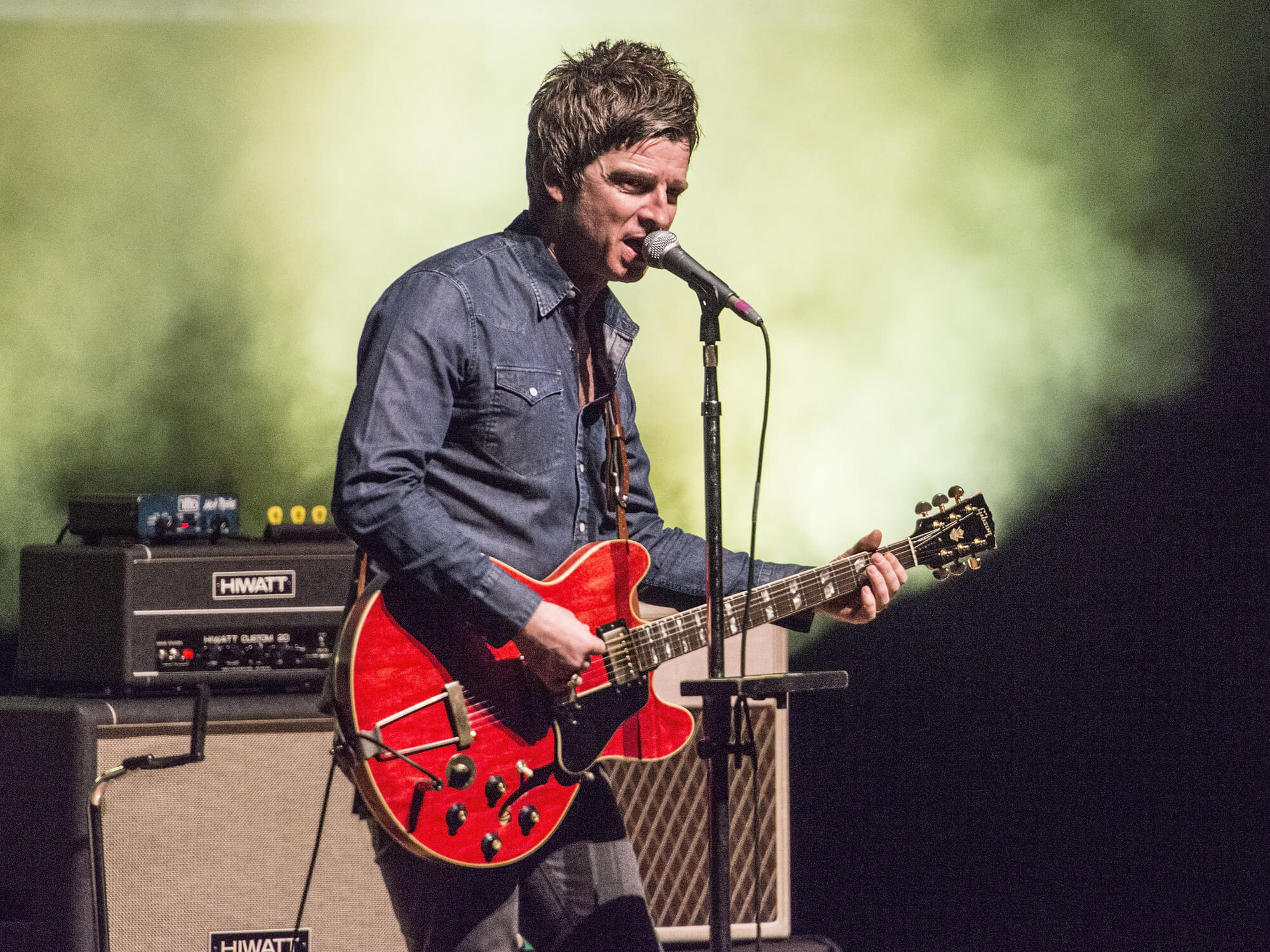
Noel Gallagher may happily reach for a Stratocaster in the studio or on stage with High Flying Birds, but don’t expect to see one slung over his shoulder at an Oasis gig. According to fellow Oasis guitarist Gem Archer, it’s simply not how Noel approaches the band live, as the musician “doesn’t need all the bells and whistles”.
Speaking to Guitar World in a wide-ranging new interview, Archer sheds light on Gallagher’s live guitar philosophy, and shares why certain instruments – however iconic – just don’t fit the Oasis blueprint on stage.
Archer, who rejoined Oasis for their mammoth Live ’25 reunion tour alongside Noel and Liam Gallagher and original rhythm guitarist Paul ‘Bonehead’ Arthurs, says that while Strats have their place elsewhere in Noel’s world, Oasis is a different beast entirely.
“He plays Strats with High Flying Birds, but in Oasis that’s not his thing,” explains Archer. “He doesn’t need all the bells and whistles live – it’s a direct thing, and he’s not gonna go from his wall-of-sound Les Paul to suddenly playing a Strat. It’s not needed.”
That said, despite Noel’s Gibson-heavy reputation, Archer reveals that at least one defining Oasis track was cut with a Fender, much to his own surprise.
“Don’t Look Back in Anger… was done with a Strat on the record,” he says. “I think it was a sunburst Strat. One of the first times I met Noel, I was round his house and he went, ‘Do you wanna come upstairs and see some guitars?’ And he went, ‘This is what I played on Don’t Look Back in Anger.’ I was like, ‘What?’”
Meanwhile, Gallagher himself has previously addressed his mixed feelings about Stratocasters. Speaking to Guitar.com in the past, the Britpop veteran admitted he was “never a fan of Strats” – even if he’s happy to rotate guitars in the studio, noting that “all guitars have got songs in them”.
The post Why Noel Gallagher will never play a Strat live with Oasis, according to Gem Archer: “He doesn’t need all the bells and whistles” appeared first on Guitar.com | All Things Guitar.
“I canceled. That wasn’t how I wanted to spend my time”: Guitar legend Larry Carlton reveals how he quit working with John Lennon after one drunken session

Session ace Larry Carlton has opened up about a chaotic, late-night studio date with John Lennon that turned out to be such a “drag” he ended up quitting after just one night
The session in question was for Rock ’n’ Roll, Lennon’s fifth and final solo album, released in February 1975. A covers record paying tribute to the rock and roll songs of Lennon’s youth, the album’s creation was famously turbulent, unfolding amid Lennon’s legal battle with Morris Levy over The Beatles track Come Together and his separation from Yoko Ono.
- READ MORE: Ed Sheeran is inspiring more people to play the guitar than The Beatles, according to a new study
Speaking to Jonathan Graham on the Thinking About Guitar YouTube channel, Carlton explains that he was booked for what was meant to be a full week of sessions at A&M Studios.
“I didn’t end up on the album,” he says [via Ultimate Guitar]. “Phil Spector, the producer, had booked a lot of us musicians for seven o’clock every night that week, five nights. And so, I went to the session for John on time, and Leon Russell [keyboards], I forget who else was there that night…”
“But anyway, what I’m getting at, is the seven o’clock session. [It’s] nine-thirty, still no John Lennon and Phil Spector. We’re just sitting around A&M Studios, Leon Russel and I went to another studio, he sat at the piano, and we just kind of jammed a little bit.”
When Lennon and Spector finally arrived, Carlton says the atmosphere only deteriorated further.
“So, John and Phil finally got there at ten o’clock or something. I didn’t tell the story for a lot of years, but it was a bad time for John,” Carlton recalls. “He was drinking. And so, we were gonna do a song, Bony Moronie [cover of the 1957 Larry Williams single]. I played Bony Moronie when I was 12 years old. So, I was in my cubby here, and John’s right there, and he had been drinking. He’s calling the chord changes; it’s only three. He’s going, ‘A!’ ‘Oh, I got it!’ ‘D!’ I said, ‘I got it!’…. It was a drag.”
By the end of the night, Carlton had made up his mind.
“It was not professional,” says the guitarist. “So, we finished that night’s session, I drove Leon Russel back to his hotel, and I said, ‘Man, that was a drag, darn it!’ And with his Oklahoma accent, Leon said, ‘You’re kiddin’, I’m back at Tulsa in the mornin’.’ I got home and called Phil Spector’s office, and just left a message at midnight, and said, ‘Sorry, I can’t make it for the rest of the week.’ I canceled. That wasn’t how I wanted to spend my time. It could have been so cool. But, one of those things. For me, it was the right decision. That wasn’t fun.”
That fateful session turned out to be the last time he crossed paths with the Beatles star as well, with Carlton admitting, “I’m an admirer, but that was a bad time.”
The post “I canceled. That wasn’t how I wanted to spend my time”: Guitar legend Larry Carlton reveals how he quit working with John Lennon after one drunken session appeared first on Guitar.com | All Things Guitar.
Trivium’s Matt Heafy names the five up-and-coming metal bands everyone needs to watch in 2026

Matt Heafy is at a transitional point. With his band, Trivium, he’s recently released the EP Struck Dead and is in the process of bringing aboard new drummer Alex Rüdinger while writing album number 11. Things are also changing behind-the-scenes. Revered for years as the busiest man in metal, Heafy is trying to scale things back.
“[Last year] I was doing 15 to 20 to 30 projects at the same time,” the singer/guitarist says, talking to Guitar.com during a down day on Trivium’s North American tour. “I was producing bands, I was managing bands; I was making all these different products and trying all these different things, like scoring video games and scoring a movie and starting a pop-up restaurant.”
The plates that Heafy was spinning all smashed on the ground when he had a self-described “metal breakdowns/mid-life crisis” in 2024. Burnt out more than he realised, his bandmates and loved ones staged an intervention, and he began to attend counselling and cognitive behavioural therapy.
“What we determined through therapy is that I’m naturally very low on serotonin,” says Heafy, explaining why he had to stay so busy for so long. “I have to be on SSRIs to help my very low serotonin. Once I corrected that, we realised that I’ve got intense ADHD, anxiety and OCD. I wanted to figure out what makes me tick. Why do I think this way? How can I stop going to such an extreme point every single time?”
 Image: Mike Dunn
By any other person’s standards, Heafy is still a wildly busy man, balancing Trivium with fatherhood, a regular Twitch presence and his passion for Jiu-Jitsu. However, he’s zeroed in on being a musician and a dad, and the lyrics on the three songs that make up Struck Dead are him interrogating his own thought process.
Opener Bury Me with My Screams is about the spiral that led up to his breakdown, centrepiece Struck Dead (Pain Is Easier to Remember) quotes something that bassist Paolo Gregoletto told him at his intervention, and widescreen finale Six Walls is about trying to break free from mental health struggles.
“I buried myself in my own coffin,” Heafy says, “and the six walls of this wooden coffin are what I pictured. I’m finally trying to break free. It took, like, a year. It was in January [2025] when I started coming to. On the first tour after treatment – after 38, 39 years of living the same way – I was like, ‘Holy shit! I’m having so much fun!’”
 Image: Mike Dunn
Musically, Trivium looked backwards while making Struck Dead: the writing coincided with their rehearsals for a co-headline tour with Bullet for My Valentine, where they played 2005 breakthrough Ascendancy in full. However, the EP is just as forward-thinking as it is nostalgic. Bury Me… closes with a torrent of breakdowns heavy enough to murder a newborn elephant, and the intro of Six Walls brings the shamisen, a Japanese stringed instrument, into Trivium’s world.
Ascendancy’s lyrics were just as bare as Struck Dead’s, with a 19-year-old Heafy opening up about depression and social anxiety. The album catapulted Trivium into metal’s stratosphere, but it was a mixed blessing. As great as all the magazine covers and blockbuster tours were, the band found themselves being bullied by jealous peers and gatekeeping fans.
“It was rough being bullied by our favourite bands, and by their fans,” Heafy reflects today. “We got bottles thrown at us [while onstage]. People tried to accost us by our van. We were on tour with Lamb of God, Machine Head and Gojira in 2006, and we had our sound guy walk out on us. I was going to our bus and some guy said [sarcastically], ‘Good show,’ and flipped me off and walked off.”
Having been through that and come out the other side, Heafy’s now a staunch advocate for new metal bands, not wanting them to be hazed the way he was. Trivium frequently pick young artists to open for them, and Heafy has a radio show dedicated to spotlighting rising talent. So, for the second half of our interview, we asked him to pick five up-and-coming metal acts who are truly impressing him right now. This is who he thinks will take over in 2026:
Fit for an Autopsy
“It was Corey [Beaulieu, Trivium lead guitarist] who first got me into them. I think he sent me Heads Will Hang first. I was like, ‘Holy shit, this is incredibly heavy!’, because it’s that mixture of stuff that I love. It feels a little bit like they would have been in the Gothenburg sound, a little bit like they’re into hardcore, and a little bit like they’re into modern metal. And then I heard Hydra, and I was like, ‘This is one of the best usages of a breakdown essentially being a song that I’ve heard since a band like Pantera.’
“We brought them out on the Trivium, Arch Enemy, While She Sleeps, Fit for an Autopsy North American tour, and they were just such lovely, wonderful guys. I spent hours or days playing games with Joe Bad [frontman Joseph Badolato] while we both streamed. Love him. I love all the guys: I had them all at my house, basically, when my kids were maybe a year old. We got them all Cuban food.
“They’re so freaking good live. They’re just perfect. The stuff that Joe can do, from his super low screams to his high screams and then his singing range, it’s just marvellous. The songs that Will Putney [guitarist/producer] writes… I think Putney is a wonderful songwriter and a great producer. When you hear a Putney record, you know instantly it’s one of his records. There’s this live energy to it while also being perfect. It sounds so well put together.”
Orbit Culture
“I love them so much. I’d say, if someone hasn’t heard them before, I don’t want to pigeonhole them but they’re for fans of Gojira, Machine Head, Fear Factory – the glory days of each of these bands. It reminds me of melodic death metal in a way, but it’s not. It’s got moments of the 2000s vibe of the Gothenburg sound. The songs are awesome, the production is awesome. But, it’s done very differently. I think it’s really cool that, at times, the drums will really just groove. It’ll give almost a Chaos A.D. kind of simplicity, drum-wise [referring to Sepultura’s influential 1993 groove metal album].
“Vocally, Niklas [Karlsson, vocals/guitars] is a powerhouse. Just like Joe, he’s able to do very low screams to very high screams. He has such a great grit scream. His gritty singing reminds me of [classic Metallica album] Ride the Lightning. It doesn’t sound like James Hetfield, but it makes you think of Hetfield from ’84, ’85, ’86.
“Niklas was one of the people who influenced me to get my grit scream back. The first time we toured with them, I was still doing my safe screaming that I’d done for 10 years [Matt adopted a new screaming technique after blowing out his voice in 2014]. I remember hearing Niklas’ voice and I was like, ‘Goddamn!’ He was definitely one of my inspirations to get that back. The fact that a band that’s relatively new can inspire a band that’s been doing it for 27 years, that’s awesome.”
Burner
“Burner’s album [2023’s It All Returns to Nothing] is that perfect fusing of these different sounds and styles and worlds while being its own thing, which is really cool. It so seamlessly blends things together. I think before, maybe in the 2000s, you could really feel the black and white combination of styles. But, I think the way Burner have done it, it’s their own palette they’ve created. It’s hard to say, ‘Hey, did they get this from Mastodon-era bands? From sludgier bands? From hardcore? From extreme metal?’, but you have all those tonalities within it.
“They have a really amazing recording quality, already. Straight out of the gate, hearing the guitar sound and the vocal sound, you know right away that it is Burner. I think that that’s a really important thing. When you can hear that individualism that quickly, that’s a rare thing, because there are a lot of bands today that are kind of chasing the same sound. There are five bands where I’ll hear five singles and go, ‘This all sounds like the same band.’ When you hear a band like Burner, you know right away that this is their sound.
“If I were to give Burner any advice, it would be the advice I gave to bands when I helped produce their records. I would say, imagine yourself playing at 1pm at Wacken or Summer Breeze or something, to 20,000 or 30,000 people who’ve never heard of you before. What is a guitar riff or a beat or a vocal line or a hook that by 2am, when they’re done watching the headliner, they can still remember you for? What’s your Roots Bloody Roots chorus, your Du Hast chorus? Let’s hear Burner’s version of these.”
Heriot
“Our manager’s just like us: he’ll tell us, ‘Hey, check this band out,’ and we’ll check them out. [When I first heard Heriot] I was like, ‘Holy shit, this is pulverisingly heavy.’ There are these kind of moody vibes in between. When I was dropping my kids off at school, another one of the dads was wearing a Heriot shirt. I was like, ‘Oh, man, we’re touring with them [in North America this autumn]!’ He was more excited about Heriot than us.
“Debbie [Gough, singer/guitarist] is fucking awesome and she looks so badass, too. With that Jackson old-school style guitar that she wears, it reminds me of Andreas [Kisser] from Sepultura. The music hearkens back sometimes to old 90s industrial, which is something that is near and dear to my heart: originally, Trivium was meant to be an industrial band. Sometimes I get vibes of Godflesh when I hear them, or if you stripped back and made heavier Napalm Death.
“I just love the visceral heaviness that goes on. I remember watching them a lot on this tour and people being very just, like, ‘Holy shit! This is so heavy! This is so good!’ They’re wonderful people. Rudy [Alex Rüdinger] actually just gave haircuts to a couple of the band members. I love the vibes of people who are just nice, good people, who can play incredibly heavy music. There’s something extra heavy about that!”
Paledusk
“HUGs is the opening song of Gachiakuta, which is a really wild anime. It’s a show where bad people are sent to this trash pit. I don’t want to give too much else away, but it reminds me of Borderlands and Dune and Fallout all in one. Musically, it starts off with this cool singing pattern that has a really heavy scream underneath. It almost reminds me of the screams that I do. And then it just gets really, really wild, like this kind of a new-school, super heavy, Bring Me the Horizons wildness mixed with Mick Gordon [composer of the recent Doom games]. Imagine the Doom score and Bring Me The Horizon when they’re really going heavy and nutty, using digital chops and stutters inside the song. It makes it seem like the music is glitching.
“The vocalist [Kaito Nagai], sometimes he’ll be singing pretty freaking high, and then he’ll go into this ultra-high, really strange, heavy, kind of Architects-three-or-four-records-ago stuff. Really, really cool, really bizarre. That’s what’s happening in the Japanese scene: it’s really weird. Being half-Japanese, I can say, us Japanese folk are pretty strange. It’s really cool that Paledusk are exemplifying that in a new way, with these no-holds-barred song structures. The hook structures don’t always make sense. They really don’t repeat like you’d expect them to. It’s very cool, very weird.”
The post Trivium’s Matt Heafy names the five up-and-coming metal bands everyone needs to watch in 2026 appeared first on Guitar.com | All Things Guitar.
Overloud Adds AIR To THU
RC Davis Launches New Performer Line With The Beast 2-Channel Head
RC Davis Amplification, known for its award-winning boutique tube amplifiers, has launched their new higher-wattage amp series called the Performer line, debuting with a two-channel amp head dubbed The Beast.
Brandishing 65 watts of output power, The Beast features a clean channel with reverb and an overdrive channel, both with individual EQ controls and a 30dB tone stack. The amp’s clean channel offers a balanced, crisp tone with plenty of headroom, radiant reverb and rewarding note bloom. The amp’s footswitchable overdrive channel is capable of kicking out sizzling grind, harmonics, and presence. Dual EQ controls allow each channel access to the trademark RC Davis 30dB-sweep mid control, providing players with a wide spectrum of vintage-inspired tonality.
The new model showcases RC Davis’ knack for reimagining vintage tube technology to provide modern stage versatility. After creating an acclaimed series of lightweight tube combo models, Rob Davis developed the Performance line when players such as James DePrato, Ronny North, Joe Bergen, Carl Verheyen and Eric McFadden requested a more powerful amp that still featured the RC Davis signature tone.
- 65 watts of cathode-bias tube-driven power including (4) 6L6GC power tubes
- Dual channel operation, selectable via footswitch: a clean channel (with reverb) and an overdrive channel, both with individual EQ controls
- Hand-wired, point-to-point circuitry for improved tonality and reliability
- Effects loop
- 4/8/16 ohm speaker out with load loop (use virtually any extension cab)
- Box-jointed sturdy, lightweight 13-ply Baltic Birch cabinetry
- Time-tested Heyboer and Hammond transformers
- PRP/Dale resistors, Mallory 150 film capacitors, Vishay 716 film capacitors (orange drops) and solid core silver wire (PTFE) for optimum performance and longevity
- Premium coverings and hardware
The Beast carries a $2995 street price and will debut at the January 2026 NAMM Show in Anaheim at the RC Davis booth #4447. For more information visit rcdavisamps.com.
Overloud Adds AIR to THU
ILIO, leading distributor of virtual instruments and audio processing software, and Overloud, renowned for their innovative audio plug-ins, are pleased to announce the release of AIR or "Amp In Room." This new feature is included in the latest version of THU, Overloud’s flagship guitar amp simulation suite. Available now as a free update for all THU users, AIR brings a new dimension to amp simulation by recreating the feeling of standing in front of a real amp in a real room, adding subtle reflections, room resonance, and air movement that go far beyond a close-mic’d speaker.
Explore the AIR Feature - https://www.ilio.com/overloud-thu#air
AIR Is Free for All THU v2 Users
Whether you own a single Rig Library or the full THU Premium suite, AIR is included at no cost. This continues Overloud’s ongoing commitment to support the THU community with high-value feature updates without subscriptions.
Every Overloud purchase includes a perpetual license, free lifetime updates, and authorization on three computers, with no subscription required.
Browse All THU Plugins - https://www.ilio.com/products/overloud/thu-guitar-effects
What is AIR?
THU is already the most powerful amp simulator in its class. Now, with AIR, it includes a key feature for delivering a finished, authentic guitar tone in one plugin. By modeling how a speaker cabinet interacts with its physical environment, AIR introduces a sense of spatial realism, one that’s rarely captured through traditional cabinet IRs or static mic placements. The result is a tone that feels more lifelike, three-dimensional, and truly “in the room."
How to Use AIR
AIR lives in the Cabinet section of THU and includes:
- An AIR knob that controls the amount of room interaction and spatial detail.
- A dropdown menu offering several ambience types in both Normal and Wide stereo modes.
- Normal mode provides tight spatial cues while Wide mode expands the stereo field for an even more immersive tone
- AIR is also integrated into the SuperCabinet, allowing users to apply room interaction while building their own custom IR blends.
- AIR can be enabled globally from the Master Control section to apply across all presets.
- Transformer: Authentic low-end thickening and high-end sparkle through accurate transformer emulation.
Reader Guitar of the Month: A phoenix rises, with inspiration from Jimmy Page
The Phoenix began life as a 2016 Mexico-made Fender Telecaster. But the real inspiration for the guitar came from Jimmy Page’s legendary Dragon Telecaster—the gift from Jeff Beck that Page played in the Yardbirds, on Led Zeppelin’s 1969 debut, and for the solo on “Stairway to Heaven,” among many other moments. I built this guitar a few years before Fender issued their own tribute model, so I knew I’d have to create my own version from the ground up.
I’d always been fascinated by the Dragon and its storied history. And after watching the band’s 1969 television appearances on Supershow and Danmarks Radio (collected on Led Zeppelin DVD) with Page wielding his psychedelic Tele through blazing renditions of “Communication Breakdown” and “Dazed and Confused,” I knew that’s what I wanted my number-one Telecaster to look like. At the time, I owned five different Telecasters, but none had that visual impact. None were truly personal.
“I approached my Russian mother-in-law, who has an art background, with an unconventional request: Could she paint something in the traditional Khokhloma Russian folk-art style?”
Given my performing outlet at the time, there was a certain irony to desiring Page’s Telecaster. Here I was, playing in a busy Bay Area cover band focused primarily on r&b, country, and pop covers, yet dreaming of a guitar that screamed psychedelic rock rebellion.
But rather than copying Page’s design, I wanted a twist on the dragon theme. So, I approached my Russian mother-in-law, who has an art background, with an unconventional request: Could she paint something in the traditional Khokhloma Russian folk-art style? And instead of Page’s psychedelic dragon, she painted a fiery Phoenix in brilliant reds, golds, and blacks—the signature colors of Khokhloma decorative painting. At the time, I didn’t realize how apt a depiction of the “rising from the ashes” fable would be for this guitar. Early Telecasters like Page’s, after all, were crafted from ash lumber. The symbolism was too perfect to be intentional.
To complete the transformation, I fitted the Phoenix with a Fender Classic Series ’60s Telecaster neck and Fender Pure Vintage ’51 Telecaster pickup set, giving it a vintage look and voice. The result is a unique confluence of old-world Russian and mid-century American design. It also honors an important moment in rock history, while celebrating my wife and Russian in-laws’ rich cultural heritage. Every time I pick it up, it reminds me that the best guitars aren't just instruments, they’re stories— connections between past and present, between different worlds and traditions, all speaking the universal language of music.
Pages
